
AMA NEWS
Frequency Alert — April 1991
FCC Rule Making Completed
By Report and Order released April 10, 1991, the FCC has acted on petitions begun almost two years earlier. The new rules require manufacturers and importers to produce transmitters that conform to the narrowband guidelines promulgated by the Academy over five years ago. Although many manufacturers have voluntarily produced transmitters to those specifications for several years, FCC approval now mandates that future transmitter production meet the guidelines.
The Report and Order sets the following implementation schedule:
- Effective March 1, 1992: All transmitters designed to operate in the Radio Control (R/C) Radio Service VHF band and submitted to the Commission for approval under its equipment authorization program, or manufactured in or imported into the United States, must comply with narrowband requirements.
- Effective March 1, 1993: Marketing of R/C transmitters that have not been authorized pursuant to the narrowband standards is prohibited.
- Transmitters purchased before March 1, 1993 that meet only wideband standards may continue in use until March 1, 1998; at that time their use will be terminated (commonly referred to as the grandfather period).
AMA members should note the following when operating radio control models, individually or as part of an AMA‑chartered club:
- Transmitters currently in the field that are operating properly and are legal under FCC regulations may be used through March 1, 1998.
- Transmitters operated at AMA‑sanctioned events must meet the narrowband requirements and have the R/CMA/AMA gold sticker affixed (27 and 53 MHz excepted).
- AMA‑chartered clubs may require the gold sticker for operation at their field; such a rule becomes part of the AMA Safety Code for that field.
- FCC requirements address transmitters (what is put on the air), not receivers. However, narrowband receivers are important to help make systems as interference‑free as possible.
- Exercise extreme care when using older wideband equipment near metropolitan areas. High‑powered commercial transmitters on frequencies only 10 kHz away from modeling frequencies can create safety hazards.
If you have questions or concerns, contact Bob Underwood at AMA Headquarters.
Robinson Engineering — Memorandum Opinion and Order (March 25, 1991)
On March 25, 1991, the FCC issued a Memorandum Opinion and Order granting Robinson Engineering a waiver allowing their equipment to operate on model frequencies until June 30, 1993.
Two years earlier the Academy successfully opposed Robinson’s petition to share model frequencies for radio‑control crane operation. At that time it was discovered Robinson had already placed some equipment on model frequencies. Robinson requested a waiver until 1993 to allow time to change those users to proper frequencies. The Academy filed a Petition for Partial Reconsideration asking for a maximum of 180 days; that petition was denied. As a result, Robinson has until June 30, 1993 to move approximately 130 users off model frequencies.
To assess the impact on modelers, the Academy requested and received a list of users. Letters have been mailed requesting the exact location, frequency, and power level for each transmitter operating on a model frequency. The Academy has also asked Robinson Engineering to assist in obtaining information to minimize safety concerns. As information becomes available it will be published, and chartered clubs in affected areas will be contacted with complete details.
The Academy regrets this situation but notes that attempts to appropriate unused frequencies or seek shared frequencies will likely become more common as commercial radio activity increases. The Academy will carefully monitor the situation. Direct questions or concerns to Bob Underwood, AMA Headquarters.
Life Membership Information
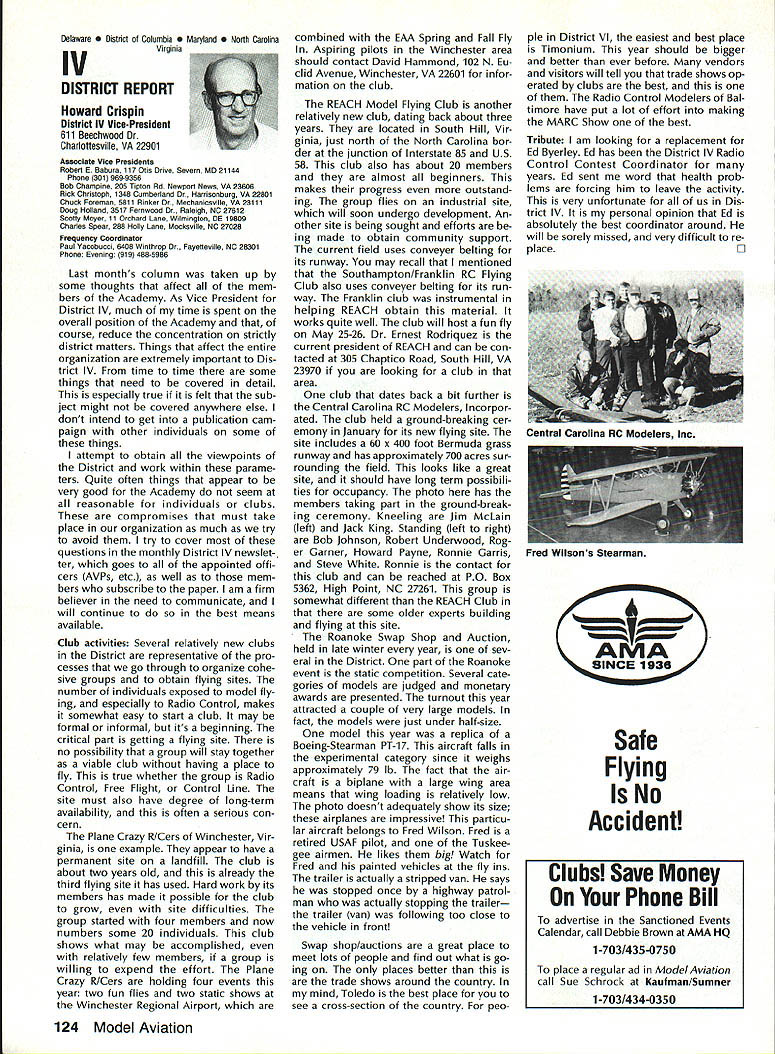
For a contribution of $1,000 (increasing to $1,500 effective January 1992) you become an AMA contributing member with Life Membership privileges. As a contributing member you financially support AMA programs and receive automatic annual renewal of AMA membership.
Life Membership benefits include:
- Model Fliers License.
- Publication service (Model Aviation magazine, including "AMA News" and "Focus on Competition").
- Permanent metal license card.
- Life member cloth patch.
- Appropriate recognition of your contribution in current AMA publications.
- Continuing recognition through issuance of a special "L" AMA number (for example: L30).
Your contribution is tax‑deductible. Note that the IRS may, in an audit, exclude a dollar amount equal to the direct cost of servicing the Life Membership; this is currently estimated at approximately $20 per year.
Alternate payment plans are available: $250 down with $250 per year for the following three years, or other combinations over three years or less with a minimum down payment of $250.
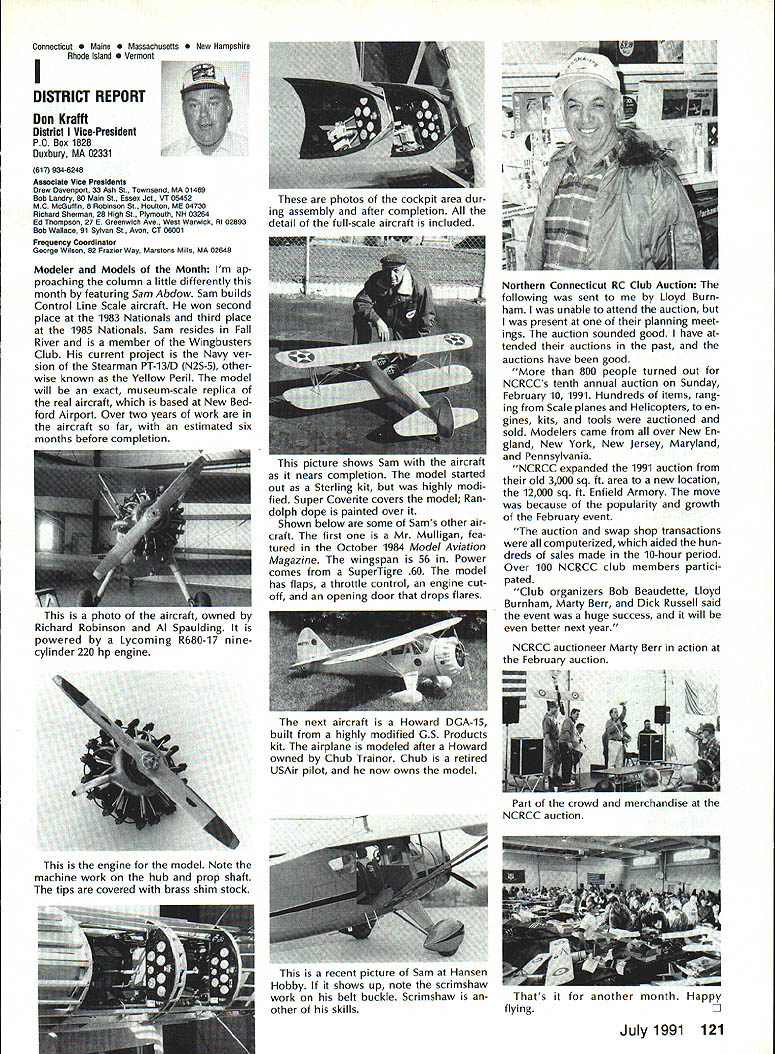
IX DISTRICT REPORT
News from around the District
Neal Martin (Grand Forks, North Dakota) shares photos and a report on winter flying while earning his All‑Season Flyer patch:
"These pictures show Mike Beaton and myself on December 30, 1990. It was nearly unbearable because of the wind and cold (-13°F; minus 60°F with wind chill), but we had to get in our flight for the month because we are both going for the All‑Season Flyer patch.
"I had to warm the SuperTiger G46 with a propane torch to get it to turn over enough for the starter to spin it. Mike had accidentally bumped the needle valve and broken it off, so we stopped the engine a few times and tweaked it with a pair of needle‑nose pliers. We were darned if we'd go home for a replacement needle!
"After Mike briskly hand‑launched the Kadet Senior into the wind, I flew it around the field once and handed the transmitter to him so he could do the same. With my hands still stinging from the cold, I set it up for a landing in the snow, got it down, and we went home ASAP!
"For some reason we had waited until the last day of the cold months, hoping for better weather. December 31 was 40°F instead of -13°F! We think there should be a special All‑Season Flyer patch recognizing the northern tier states. The guys in Phoenix and Miami don't have to earn them like this!"
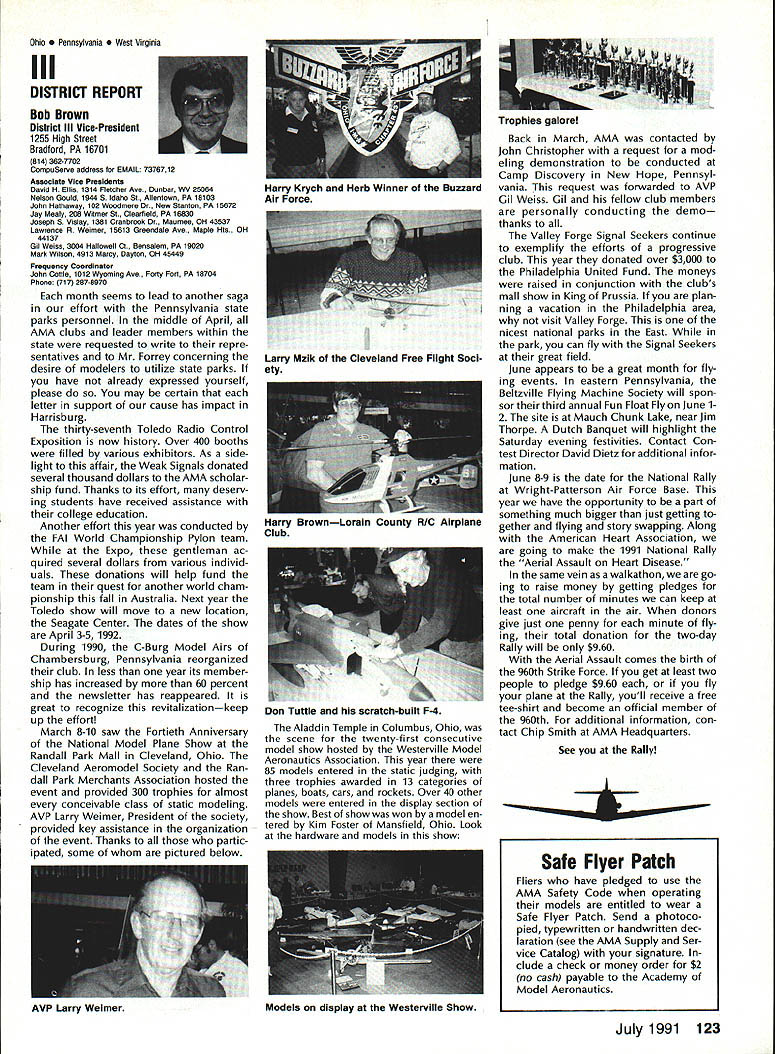
Don Atwood, AVP from Aurora, Colorado, reports on the Arvada Associated Modellers Mall Show (Arvada, Colorado), held in January 1991:
"It was a cold, blustery weekend, which resulted in a large crowd gathering in the mall's main atrium to view the models. The mall's management allocated a large area (approximately 40 x 50 ft.) to display the models. The area was fenced in; however, people were allowed to walk among the tables to see everything up close, after which they cast votes for their favorite model. After over 800 votes were tabulated, Buzz Butler was declared People's Choice winner for his Laser 200.
"A special panel of model judges also judged models in several categories. After judging, Larry Greene was declared Best of Show for his Demoiselle.
"Larry's Demoiselle is a fantastic example of craftsmanship; many hardware items, including the gearbox for the electric motor, were handmade.
"Winners in other categories included:
- Pattern: Laser 200, Buzz Butler
- Sport: Ultra Sport, Gary Peterson
- Silent Flight: SR7, Steve Goodenham
- Trainer: Senior Kadet, Tom Powers
- Scale: Demoiselle, Larry Greene
- Biplane Golden Oldie: George Spero
- Other (boat): Chris Craft, Pat Vachon
"Members of Arvada Associated Modellers were on hand to answer public questions and demonstrated model construction and finishing techniques."
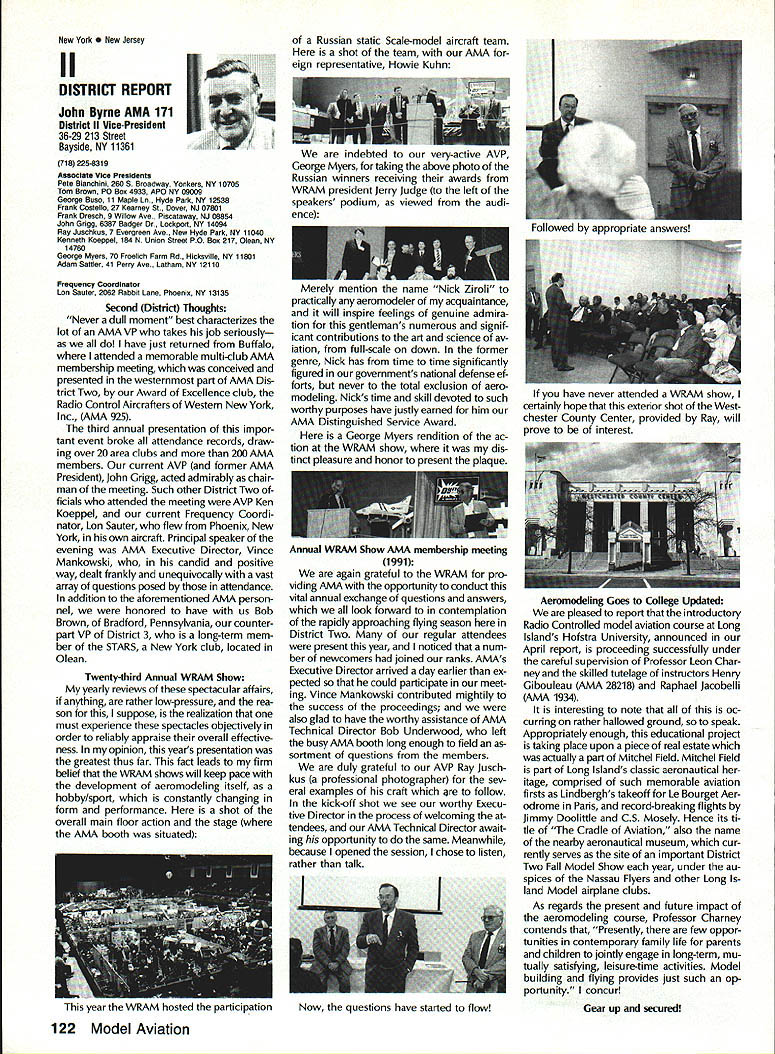
Annual WRAM Show / AMA Membership Meeting (1991)
We are indebted to AVP George Myers for photos of the Russian winners receiving their awards from WRAM president Jerry Judge. At the WRAM show it was the editor's pleasure to present the AMA Distinguished Service Award to Nick Zirolli. Nick has made numerous and significant contributions to aviation, full‑scale and model, including service in national defense efforts while remaining actively involved in aeromodelling. His efforts have justly earned the AMA Distinguished Service Award.
Aeromodelling Goes to College — Updated
The introductory R/C course at Hofstra University (Long Island), announced previously, is proceeding under the supervision of Professor Leon Charney with instructors Henry Gibouleau (AMAA 28218) and Raphael Jacobelli (AMAA 1934). The course takes place on land that was part of the historic Hempstead Plains—ground tied closely to Long Island's early aviation heritage.
Professor Charney commented: "Presently, there are few opportunities in contemporary family life for parents and children to share quality leisure time. Model aviation provides just such an opportunity."
Keep 'em flying!
Transcribed from original scans by AI. Minor OCR errors may remain.

