
SOUND & MODEL AERONAUTICS
Howard Crispin, Jr.
There was a plan to provide information on several items this month. This has been deferred in order to take a look at what is occurring in one competition category: F3A Aerobatics.
There are some differences between F3A and the AMA Rule Book events for Aerobatics. Two primary differences are the turnaround-type flight schedule and mandatory sound levels. Both of these change next year with the introduction of the 1992–1993 AMA Competition Regulations. This change requires that we look at where we have been and where we appear to be going.
Several years ago the four-stroke engine was introduced to the field of aerobatics. The engines were new, and the O.S. and Enya were the engines of choice. The rule‑makers of the FAI decided that the power output of these engines was so low, relative to the existing two‑stroke engines, that the four‑stroke rated a bonus in displacement. What came about was that a 1.20 cu. in. four‑stroke was equal to a .61 cu. in. two‑stroke.
Advocates of the four‑stroke touted the design for the quiet operation that could be obtained without much effort. This was at the time that the sound level for F3A was reduced to 98 dBA at 3 meters.
A strange thing happened. Engines such as the Enya R‑12 and the O.S. Surpass .12 were being operated at higher power output and at higher speeds. The suppression of sound levels became more difficult at a time when the lowering of sound levels for the two‑strokers was being accomplished with relative ease. By the time of the World Championships four years ago some progress was being made and sound levels, overall, were well below the mandated figure. The two‑stroke engine was still the predominant choice. This was true, to a great extent, two years ago at the U.S. Team Selection and at the World Championships.
Something else has happened in two years, at least here in the United States. The YS‑12 was recognized as a powerful engine when it was introduced. Today it is being operated in a manner which makes it even more powerful. This is true to the extent that it is beyond a doubt the most powerful engine allowed for aerobatic competition. The newer, boosted YS‑12 will no doubt prove to be ever more powerful.
The process of obtaining this power is not without cost. First, fliers are using anywhere from 25% to 50% nitro. This is at a time when nitro is becoming scarce and expensive. Fifty‑percent‑nitro fuel is costly under any conditions. Engines will not last nearly as long operated in this manner. Stresses appear within the engine and in the parts of the exhaust/pipe system. More care needs to be taken with the installation to avoid high amplitudes of vibration.
Today, when one considers the propellers being driven by two‑stroke and four‑stroke engines, the engine speeds and other factors, it becomes apparent that the power ratio has completely reversed. The 1.2 cu. in. four‑stroke engine being used today is far more powerful than the .61 cu. in. two‑stroke engine. The time has come for CIAM to reconsider the old displacement ratio if things are to be equal.
Alternatives would be to increase the allowable displacement of the two‑stroke engine, reduce the allowable displacement of the four‑stroke engine, or limit the use of nitro or comparable additives to alcohol‑based fuel. At least one new fuel without nitro should be available soon.
This increase in possible power has done several things to F3A competition design. If the trend follows, this will be seen in the AMA categories. If this happens, the turnaround‑type pattern has not arrived too soon. Some data obtained at the 1991 F3A Team Selection, held at Eglin Air Force Base, Florida, at the end of June sheds a bit of light on the topic. The aircraft are changing into something unheard of a few years ago.
Consider the size of the aircraft flown by one member of the team headed for Australia, David Von Linsowe. This aircraft, powered by the YS‑1.2 running on 40% nitro and turning at 8,500 rpm on a 15 x 12 APC propeller, has a wing area of 1,100 sq. in. Compare typical aircraft flown in current AMA competition — big, slow aircraft. David tells me that he has clocked it at 120 miles per hour in straight, level flight at full power.
Performance in the pattern? David's final flights were among the best in the entire contest; he scored very well in those rounds.
David has been very active in working with lowering sound levels and had one of the very quiet four‑stroke installations. He measured about 91 dBA at 3 meters. While figures were at this level, and lower, for many two‑stroke engines, there were fewer four‑stroke engines down at this level. Many were running at levels that mean that, for next year, much work will need to be done to get them down to acceptable levels.
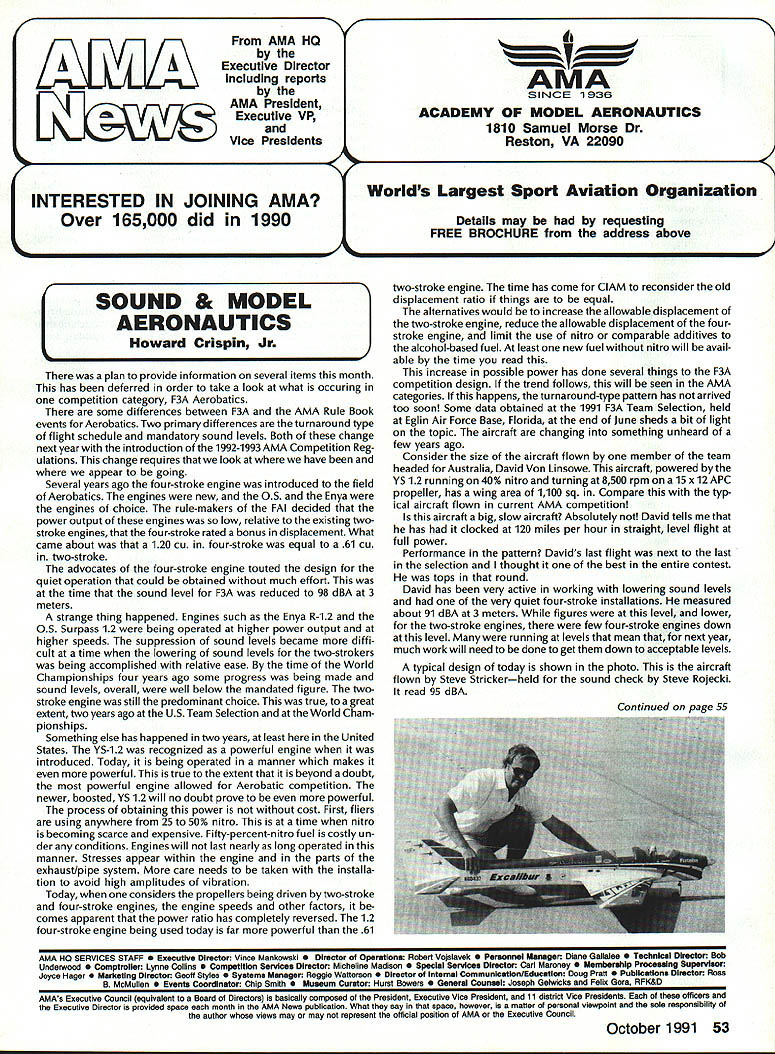
A typical design of today is shown in the photo: the aircraft flown by Steve Stricker (held for the sound check by Steve Rojecki) read 95 dBA.
Sound (Competition observations)
- Generally speaking, the two‑stroke engines were operating at lower average sound levels, with engines turning 12‑in. diameter propellers in the range of 9,000–10,000 rpm.
- Out of the 54 contestants at the Team Selection, 23 individuals used two‑stroke engines. Of those, three of the 11 finalists used two‑stroke engines.
- Dean Koger, using a belt‑drive unit, consistently ran about 90 dBA and attracted attention for the different character of the sound rather than loudness.
- The APC propeller (Landing Products) was the propeller of choice. One unusual sighting was an MK prop on a Rossi .61 — the only Rossi observed at the contest.
- Very few models operated without some type of vibration isolator; popular mounts included Chidgey, Planes and Things (now being made and marketed by Sullivan Products), and Performance Products. Several individuals devised their own mounts.
- Many four‑stroke exhaust systems used the AAP system, with some using an AAP header and a Hatori pipe. The Hatori pipe is also popular for two‑stroke engines. Only a couple of carbon pipes were present.
Do these trends translate into what we can expect to see in the future for the AMA classes? That remains to be seen. If they do, expect a considerable increase in the cost of competition. We have seen a resurgence in aerobatics in the past couple of years; whether higher costs will adversely affect this trend is uncertain. Fuels and other changes may moderate the quest for power. Back to solutions next month.
AMA HQ SERVICES STAFF
- Executive Director: Vince Mankowski
- Director of Operations: Robert Voislavek
- Personnel Manager: Diane Gallalee
- Technical Director: Bob Underwood
PHONE NUMBERS
Note: Calls cannot be transferred between these numbers.
- AMA HQ: (703) 435‑0750
- General AMA business, Model Aviation subscriptions (member and non‑member), back issues and/or copies of articles, changes of address, advertising in Sanctioned Events Calendar.
- MA Editorial: (703) 435‑0760
- Magazine article submission and information, full‑size plans from Model Aviation, hobby shop resale accounts, advertising billing questions.
- MA Advertising: (703) 434‑0350
- Advertising rates, specs, schedule, etc. (except not applicable to Sanctioned Events Calendar).
---
EXECUTIVE VP'S REPORT
Dave Brown AMA Executive VP 4560 Layhigh Road, Hamilton, OH 45013
Here we go again. Another month has gone by, and the mailbox has brought a few letters from people upset over the increase in membership cost for our Senior Citizen members. I realize that this may create some level of hardship on them, but they still get their membership for 25% less than regular Open members, with all of the same benefits.
We needed to increase our income by about $300,000 to balance the budget, and it made more sense to look to areas that we were subsidizing to bear the increase. The Senior Citizen category is growing faster than the general membership, leaving more people being subsidized and fewer people to do the subsidizing. Frankly, $30 is roughly the direct cost of having a member, including insurance, magazine, membership processing, mailings, and labor.
Up until now, each Senior Citizen was being subsidized to the tune of about $10 by the rest of the members. Our younger members continue to be subsidized, and that subsidy is viewed as an investment in the future of modeling by most.
I got a kick out of one Senior Citizen member who threatened an age discrimination suit because we increased the Senior Citizen rates. What we did was simply reduce the amount of subsidy. Senior Citizens are still being subsidized by the rest of the membership; if anyone wishes to claim age discrimination, they should take that up with those members paying the full amount.
The word "investment" is interesting when it applies to AMA. Beyond financial investments (money market accounts, CDs, property, equipment), AMA invests in the future in a nonfinancial sense—PR, flying site efforts, frequencies, rules, instructor programs—activities that are essentially expenses but aimed at future enjoyment of aeromodeling.
Years ago, AMA spent resources obtaining the original 27 MHz RC frequencies. Today, we benefit from that investment. Public relations and membership efforts have been vital to the hobby's survival.
When AMA bought the Reston Headquarters facility, some criticized it as extravagant. We later needed that asset to maintain insurance coverage. Now we have purchased the Muncie site, and similar criticisms arise. There is a recurring "me, me, me" attitude: people wanting immediate convenience and expecting others to do the work or pay the costs. This attitude is harmful to our hobby.
We used to build and restore our creations, enjoying them for a long time; today we seek instant gratification. We expect facilities to be maintained by someone else and complain if things aren't perfect. If a flying site is lost, we expect someone else to find us a new one and to pay for preparation.
AMA? People often join only because insurance requires it; they judge the magazine, the staff, the officers, and membership value by narrow criteria. If you believe the hobby is worth preserving, consider involvement rather than only criticism.
Till next month.
EXECUTIVE DIRECTOR'S VIEW FROM HQ
Vince Mankowski AMA Executive Director 1810 Samuel Morse Dr., Reston, VA 22090
Newsletters are interesting. I recently read a club newsletter that raised questions about AMA farming some of the land recently purchased in Indiana. AMA does not own any farm equipment; all disking, drilling, planting, cultivating, etc., is done under contract on a per‑acre basis. Contractors provide their own machinery, insurance, fuel, and maintenance.
AMA decided to farm because of the economic opportunity. Revenue generated from the property will both develop the site and be a source of income to acquire additional sites around the country. Some profits are already converting property from agricultural use to flying‑site use.
Membership renewal: the second renewal notice went out in late April, and the third notice in early June to 1990 members who had not yet renewed for 1991. These notices, together with the Renew for 2 option, are helping.
A letter complained about having to renew for 1992 and 1993 now. Renew for 2 is optional; it guarantees no dues increase for 1993 and sends an Eye‑Denta card with expiration 12/31/93 embossed on it. The Eye‑Denta card is a $10 value and gives the member a membership card they won't have to watch for in 1992 or 1993.
Many members commented positively on the video AMA Today and asked that Volume 3 include coverage of the AMA museum collection. Volume 3 should be available in October.
The August issue of Model Aviation carried Robert A. Benjamin's cover art "A Salute to the Air Crews of the U.S. Armed Forces." Prints of that cover are available; we may commission a special work‑of‑art issue cover for the March issue each year to provide an additional incentive for timely renewals.
Member benefits: during the last renewal cycle, AMA provided a Vision Care Card offering discounts on eyewear. Many members wrote that the discount more than compensated for their membership fee. We are exploring other discount programs, such as long‑distance telephone service discounts and subscription packages for model publications. These programs are optional and will not place your name on other mailing lists.
Another question: with minor computer changes, AMA numbers could be alphanumeric. Are members interested?
Frequency items: the Kiplinger Washington Letter noted that more radio frequencies may be opened for non‑government use and Congress will reassign some government frequencies. The FCC issued a notice of inquiry concerning bands below 470 MHz, seeking options to promote more efficient use of spectrum. RC modelers will need AMA more than ever as demands on spectrum accelerate.
Your timely AMA renewal is important; your help in recruiting RC fliers to join AMA strengthens our representation.
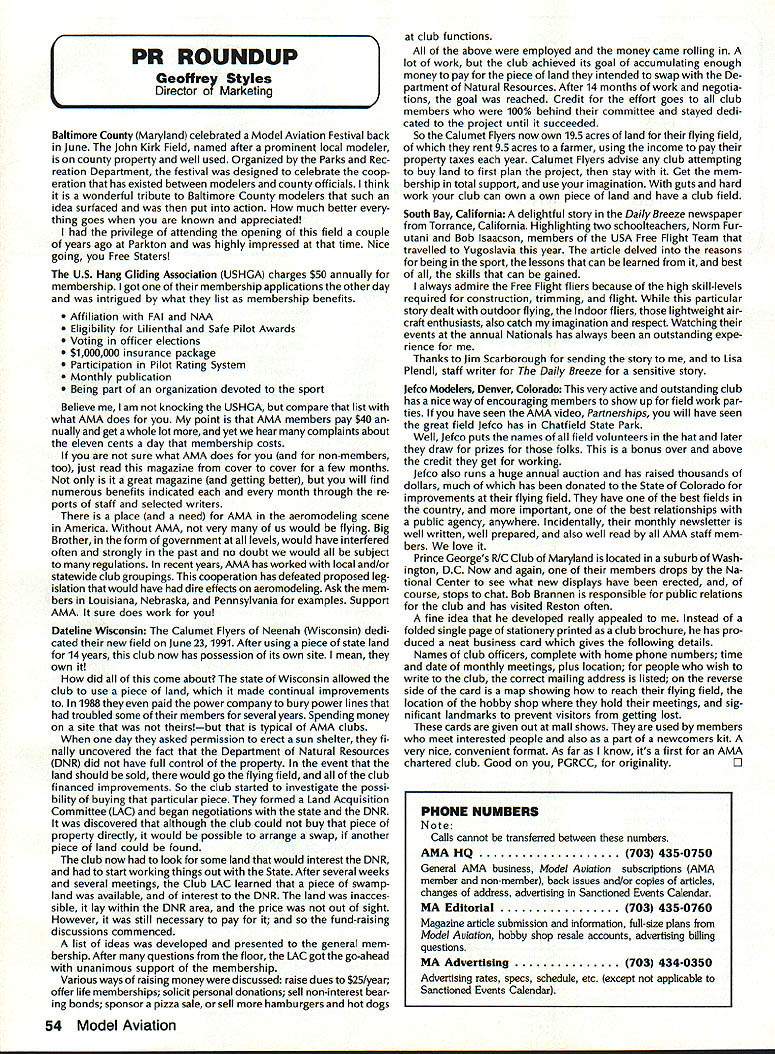
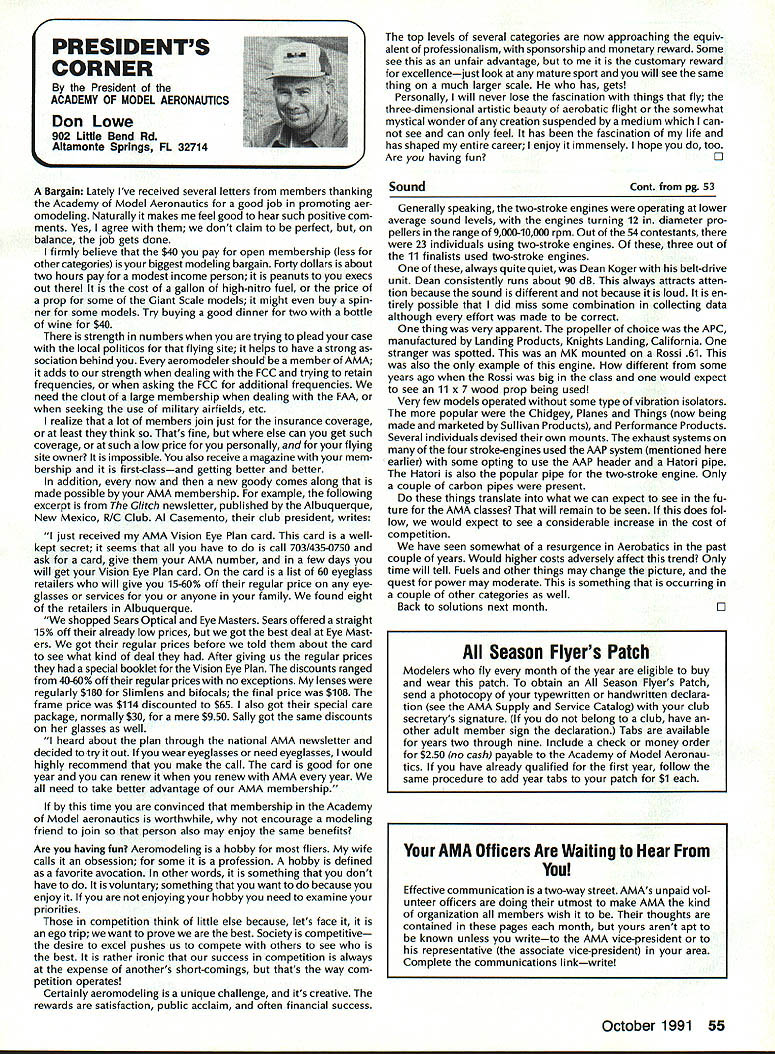
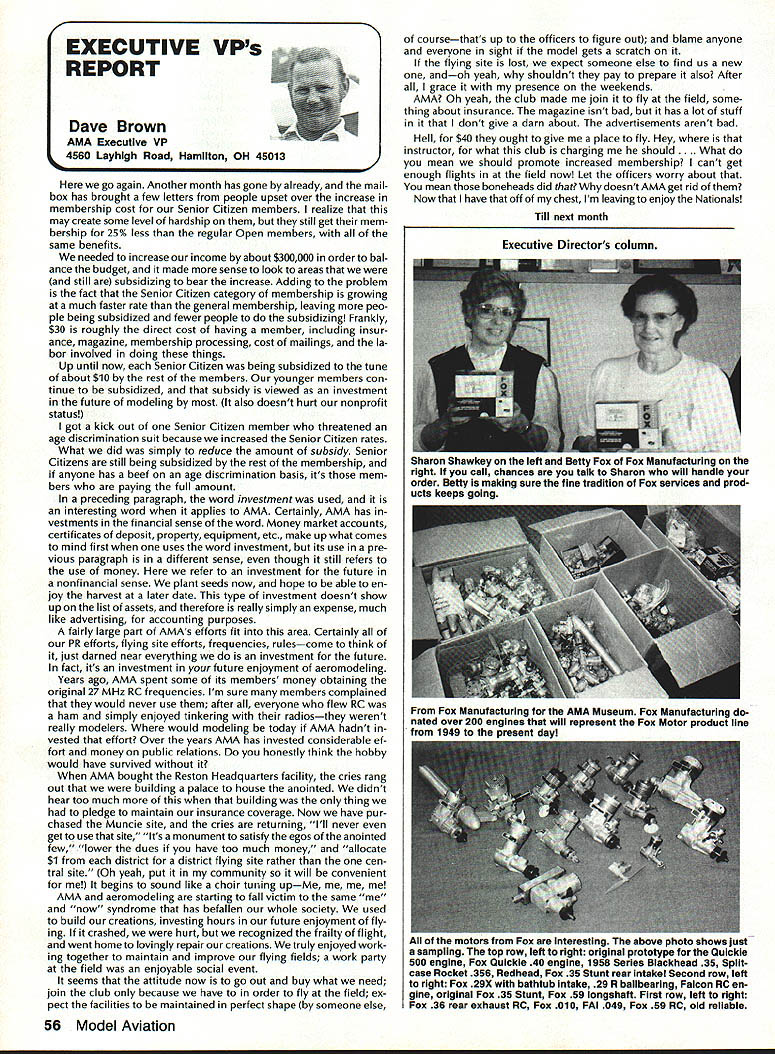
Thanks to Zap Gang, Futaba, Hi‑Tec RC, Ace RC, and Fox Manufacturing for sponsoring joint AMA‑Heart Association efforts at the recent National Rally in Dayton. On May 13 I visited Fox Manufacturing and returned with over 200 Fox engines for the AMA museum collection.
Mid‑summer has been busy at HQ: staff turnover and reassignments, performance reviews for 53 employees, meetings with our PR agency and bank, litigation, construction bid opening in Muncie, indoor and outdoor national events, team trips, and the Executive Council meeting. We also handled farming commodity sales, IMAC planning, Grand Opening planning for Muncie, and locating the National Model Airplane Championships for 1992. A very busy 61 days!
DISTRICT I REPORT
Don Krafft District I Vice‑President PO Box 1828, Duxbury, MA 02331 (617) 934‑8248
Associate Vice Presidents:
- Drew Davenport, 33 Ash St., Townsend, MA 01469
- Bob Landry, 80 Main St., Essex Jct., VT 05452
- M. C. McGuffin, 8 Robinson St., Houlton, ME 04730
- Richard Sherman, 28 High St., Plymouth, NH 03264
- Ed Thompson, 27 E. Greenwich Ave., West Warwick, RI 02893
- Bob Wallace, 91 Sylvan St., Avon, CT 06001
Frequency Coordinator:
- George Wilson, 82 Frazier Way, Marstons Mills, MA 02648
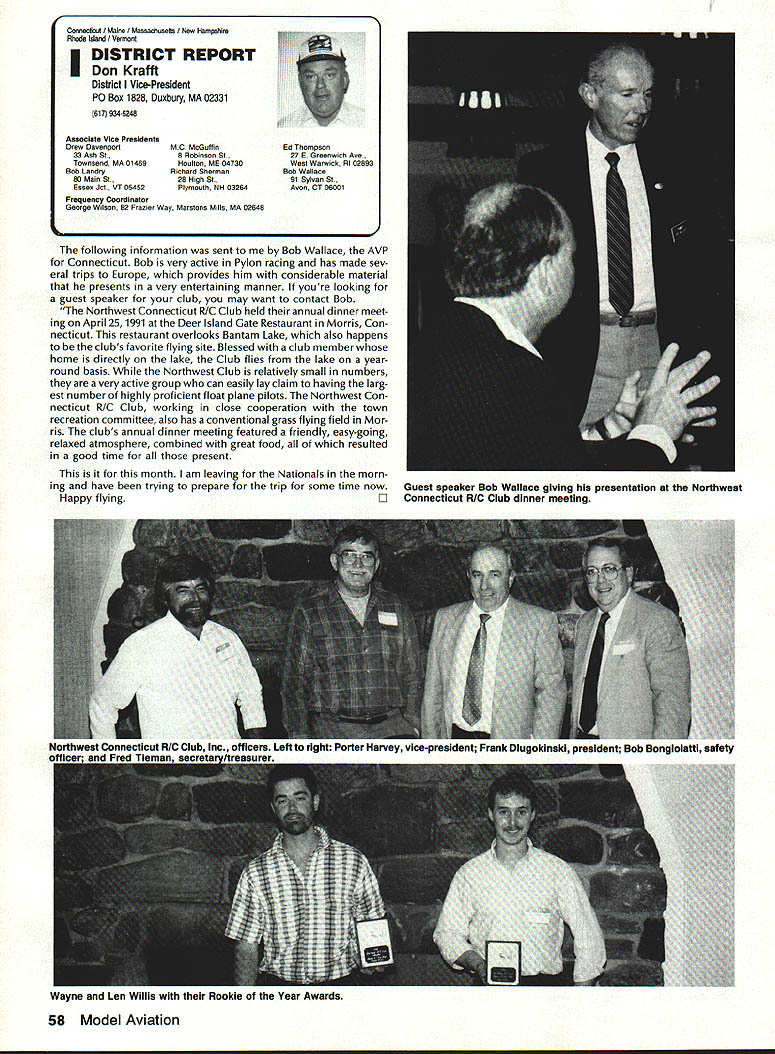
The following information was sent by Bob Wallace, AVP for Connecticut. Bob is very active in pylon racing and has made several trips to Europe. If you're looking for a guest speaker for your club, you may want to contact Bob.
The Northwest Connecticut R/C Club held its annual dinner meeting on April 25, 1991, at the Deer Island Gate Restaurant in Morris, Connecticut. The restaurant overlooks Bantam Lake, the club's favorite flying site. The club flies from the lake on a year‑round basis and also has a conventional grass flying field in Morris working with the town recreation committee. The dinner featured a relaxed atmosphere and great food.
This is it for this month. I am leaving for the Nationals in the morning. Happy flying.
Second (District) Thoughts
I seem to detect early warning signals that we may be entering an era of discord among modelers and clubs. My comments focus on public acreage already utilized with official permission by authorized groups; these groups are understandably alert to disadvantages and dangers implicit in unregulated flight operations. While their concerns are valid, a defensive gut reaction has no place in our deliberations.
There is an ever‑growing need for sharing public land between established AMA clubs. Cooperation and civility are essential.
Johnny Clemens (AMA 18): Having just received word of Johnny's passing, I am in a mood of sorrow. His contributions to AMA and aeromodeling are legendary; his optimism and sense of humor will be missed. God bless you, Johnny!
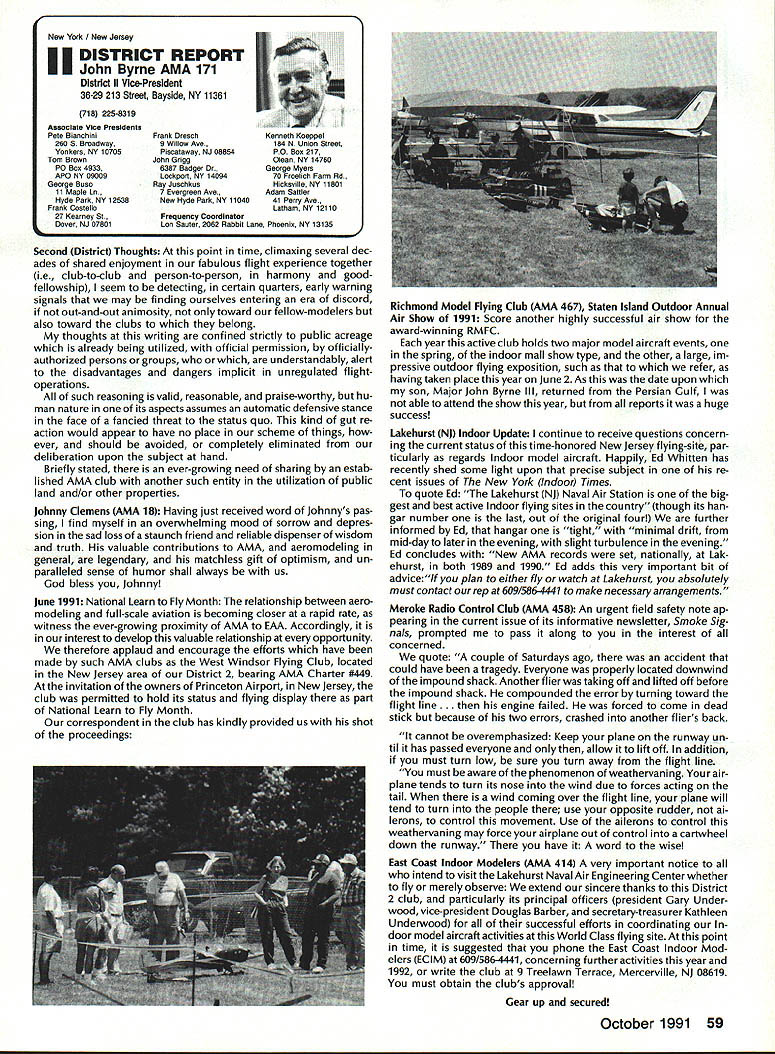
June 1991: National Learn to Fly Month: The relationship between aeromodeling and full‑scale aviation is becoming closer, as seen by AMA's growing proximity to EAA. We applaud efforts by clubs such as the West Windsor Flying Club (a new District 2 club, AMA Charter #449) which held activities at Princeton Airport as part of Learn to Fly Month.
Lakehurst (NJ) Indoor Update: Ed Whitten reports that Lakehurst Naval Air Station is one of the biggest and best active indoor flying sites in the country. If you plan to fly or watch at Lakehurst, contact the ECIM rep at 609/586‑4411 to make arrangements.
Meroke Radio Control Club (AMA 458): A safety incident prompted this reminder: keep your plane on the runway until it has passed everyone, then allow it to lift off. If you must fly low, turn away from the flight line. Be aware of weathervaning and use opposite rudder, not aileron, to correct it.
East Coast Indoor Modelers (AMA 414): Call ECIM at 609/586‑4411 for Lakehurst activity information or write: 3 Treeview Terrace, Mercerville, NJ 08619. You must obtain club approval to fly at the site.
Gear up and secured!
III DISTRICT REPORT
Bob Brown
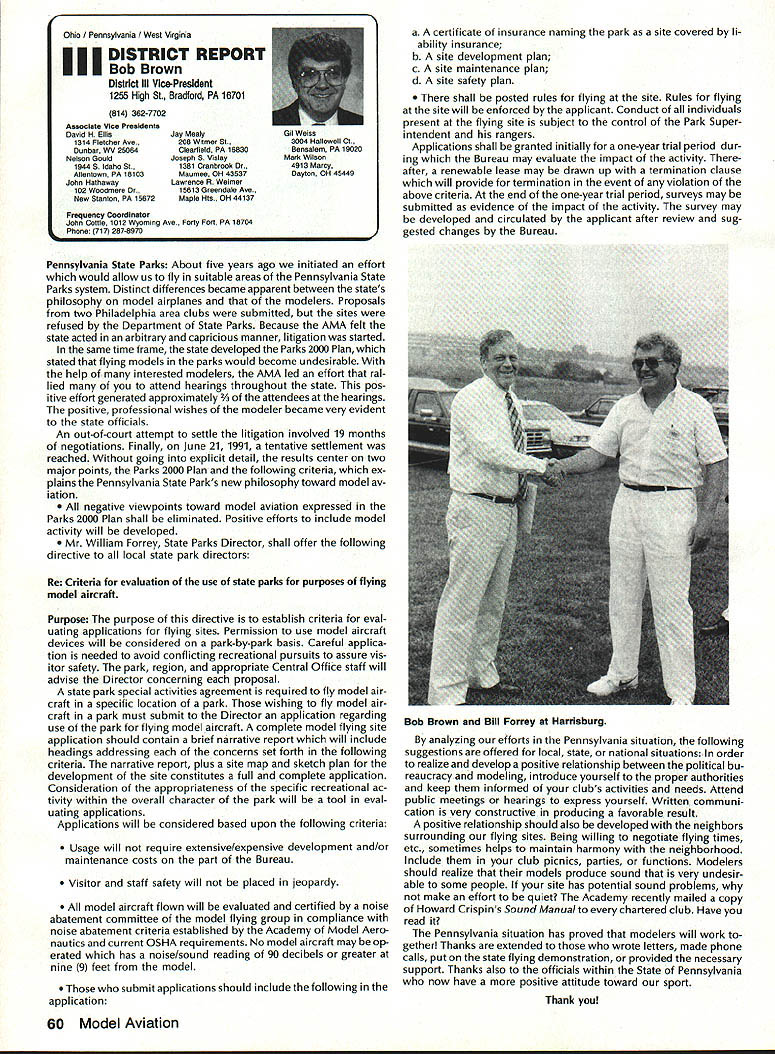
Pennsylvania State Parks: About five years ago we initiated an effort to allow flying in suitable areas of the Pennsylvania State Parks system. Initial club proposals were refused; AMA felt the state had acted arbitrarily and litigation was started. The state developed the Parks 2000 Plan, which labeled model flying undesirable. AMA led efforts to attend hearings throughout the state; modelers made a positive showing.
After 19 months of negotiations, a tentative settlement was reached on June 21, 1991. The results center on two major points: elimination of negative viewpoints in the Parks 2000 Plan and the adoption of criteria for evaluating the use of state parks for flying model aircraft.
Criteria for evaluation (summary):
- Permission to fly will be considered on a park‑by‑park basis. Applications must avoid conflicts with other recreational pursuits and assure visitor safety.
- A state park special activities agreement is required to fly model aircraft in a specific park location.
- A complete model flying site application should include a narrative report addressing the following concerns, a site map, and a sketch plan for site development.
- Applications will be considered based upon:
- Usage will not require extensive/expensive development or maintenance costs for the Bureau.
- Visitor and staff safety will not be jeopardized.
- All model aircraft flown will be evaluated and certified by a noise abatement committee of the model flying group in compliance with AMA noise abatement criteria and current OSHA requirements. No model aircraft may be operated which has a noise reading of 90 decibels or greater at nine (9) feet from the model.
Application items to include: a. Certificate of insurance naming the park as covered by liability insurance. b. Site development plan. c. Site maintenance plan. d. Site safety plan.
Rules for flying at the site shall be posted and enforced by the applicant. Conduct of individuals at the flying site is subject to control by the Park Superintendent and rangers.
Applications will be granted initially for a one‑year trial period during which the Bureau may evaluate the activity's impact. Thereafter, a renewable lease may be drawn up with termination clauses for violations. Surveys may be submitted after the trial period to evidence the activity's impact.
Lessons and suggestions from the Pennsylvania experience:
- Introduce yourself to appropriate authorities and keep them informed about club activities and needs.
- Attend public meetings or hearings; written communication is constructive.
- Develop positive relationships with neighbors around flying sites; negotiate flying times and include them in club functions.
- Be mindful of noise; the Academy recently mailed Howard Crispin's Sound Manual to every chartered club—read it.
The Pennsylvania situation shows that modelers can work together. Thanks to those who wrote letters, made phone calls, put on shows, gave demonstrations, or provided support, and to state officials who now have a more positive attitude toward the sport.
Thank you!
IV DISTRICT REPORT
Howard Crispin
Contest coordinator: The Radio Control Contest Coordinator position for District IV has been filled. After careful consideration, Steve Moulton of Chesapeake, Virginia, was chosen to replace Ed Byerley. Steve has an extensive background and understands the problems and needs of Contest Directors. He will process sanctioning for rule‑book events, fun‑flys, fly‑ins, and IMAA activities. Help the Coordinator by submitting legible, timely applications and planning ahead. Coordinators will check adjacent districts for potential conflicts; allow time for this.
If you have problems with your sanction, call AMA Headquarters; all records are processed there.
Average member: The term "average member" often appears in letters. Most members fly some type of radio‑controlled aircraft, so one might say the average member is an RC flier. However, there are many Free Flight and Control Line fliers, and many members only participate occasionally. In practice, the "average" member may be someone seldom seen at meetings or events. A low percentage attend meetings or participate in club activities. Clubs need ways to encourage non‑participating members to become active.
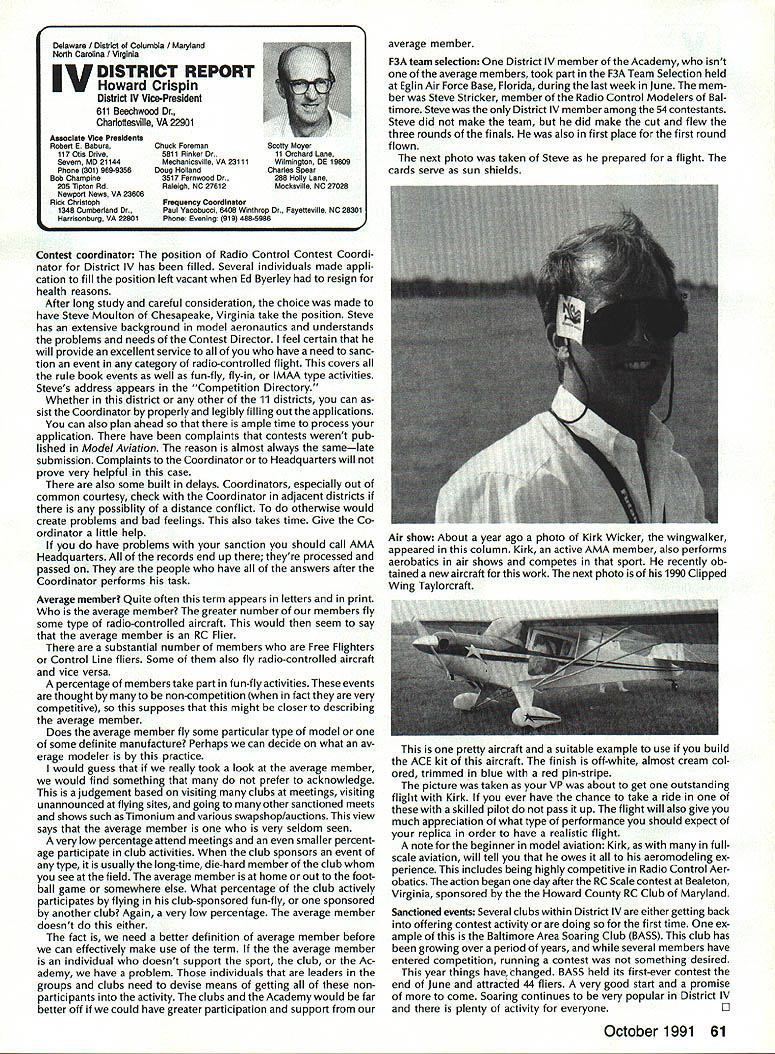
F3A team selection: One District IV member, Steve Stricker of the Radio Control Modelers of Baltimore, took part in the F3A Team Selection at Eglin AFB. Steve did not make the final team but did make the cut and flew in the finals; he held first place after the first round.
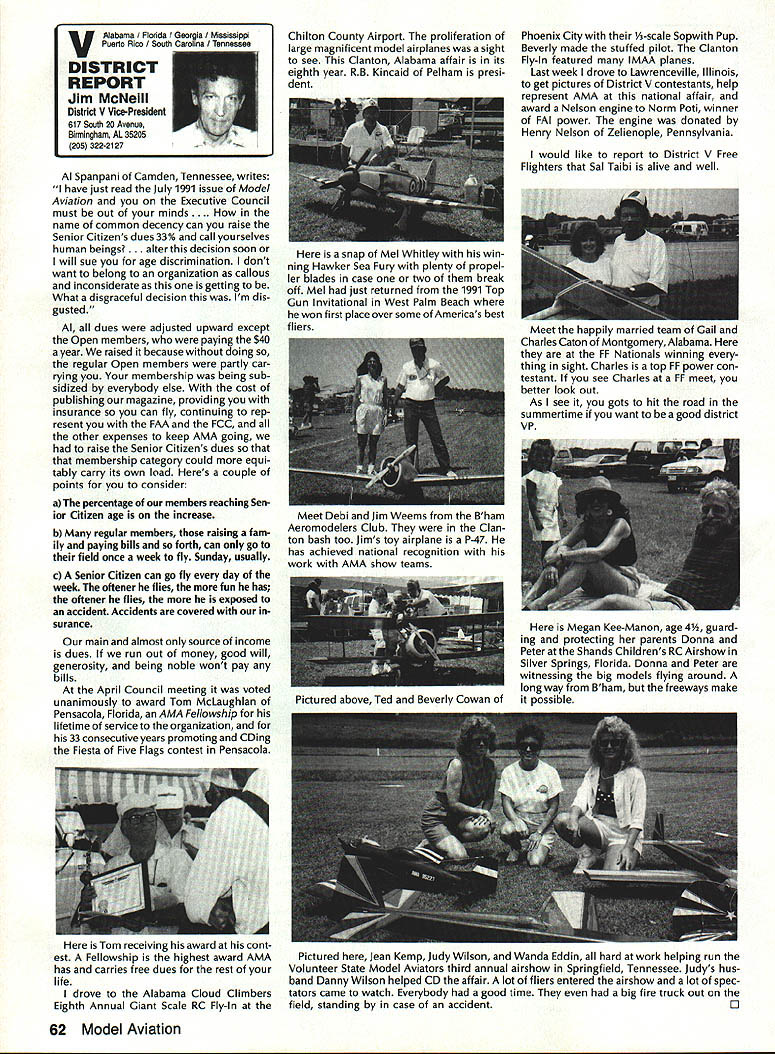
Sanctioned events: Several clubs in District IV are beginning contest activity or are running contests for the first time. The Baltimore Area Soaring Club (BASC) held its first contest at the end of June and attracted 44 flyers—a strong start. Soaring remains popular in District IV.
Contest coordinator contact information appears in the Competition Directory. Ensure timely submissions so events appear in Model Aviation.
Howard Crispin Jr. plans to provide more information on various items next month.
COMMUNITY & REGIONAL NOTES
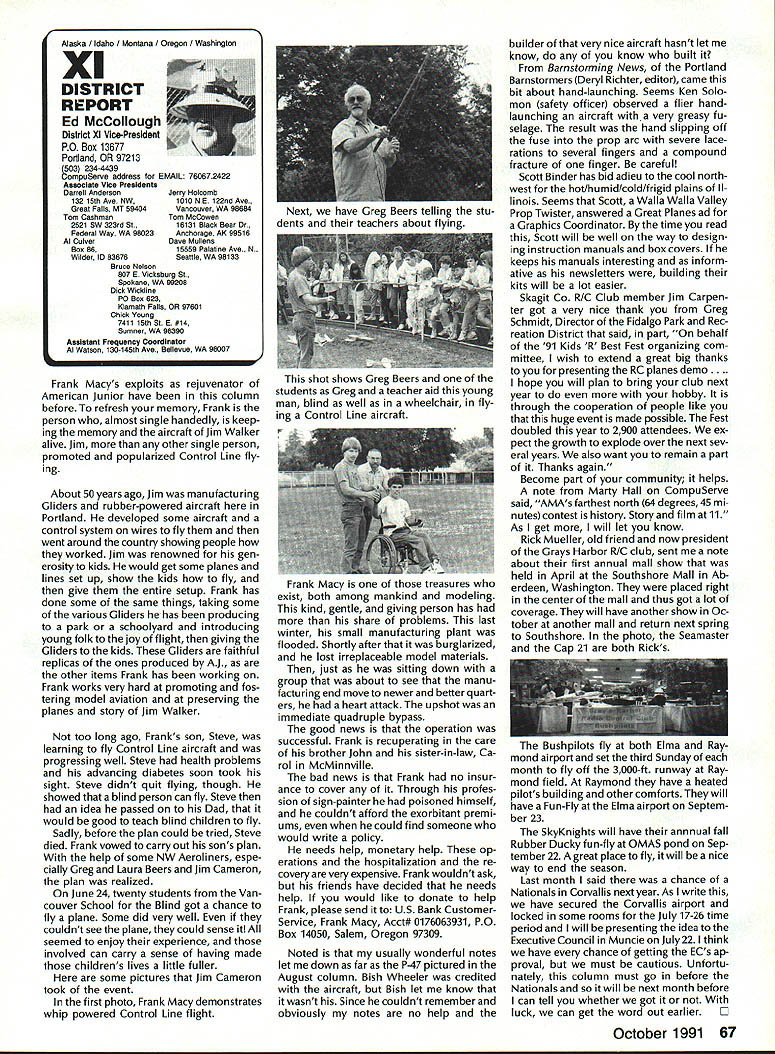
- Frank Macy and the restoration of Jim Walker's legacy: Frank has promoted control line flying and has introduced children to free flight and gliders. His son Steve, who was learning control line, became blind from diabetes and later passed away; Steve had wanted to teach blind children to fly. With local volunteers, Frank helped 20 students from the Vancouver School for the Blind get a chance to fly model aircraft on June 24. Frank recently suffered a flooded plant, a burglary, a heart attack, and a quadruple bypass. He has no insurance to cover the medical costs. If you wish to help: U.S. Bank Customer Service, Frank Macy, Acct. #0170603931, P.O. Box 14050, Salem, OR 97309.
- Safety reminder: a hand‑launching incident with a greasy fuselage resulted in severe lacerations and a compound fracture. Be careful when hand launching; ensure a secure grip and proper procedure.
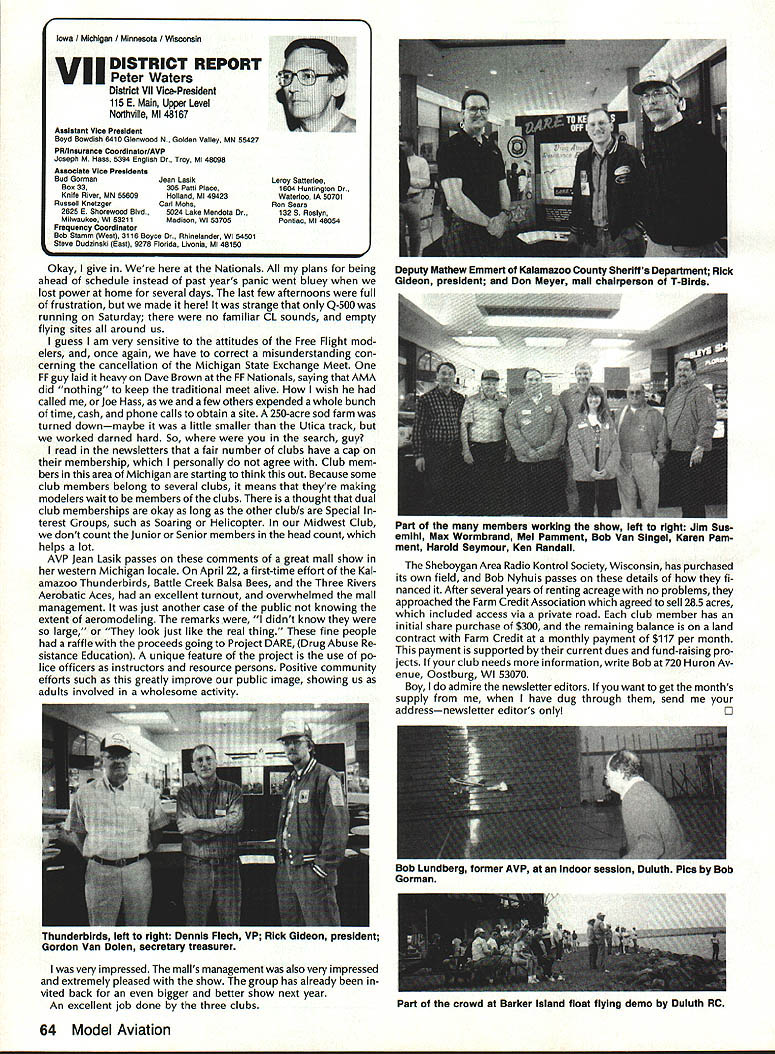
- Club and community outreach: Mall shows and school demonstrations continue to raise public awareness. Example: the Kalamazoo Thunderbirds, Battle Creek Balsa Bees, and Three Rivers Aerobatic Aces had an excellent mall show on April 22 and raised funds for Project DARE.
- Field purchase example: Sheboygan Area Radio Kontrol Society purchased 28.5 acres using a Farm Credit Association land contract. Members made initial share purchases and supported monthly payments with dues and fund‑raising. For more information contact Bob Nyhus, 720 Huron Avenue, Oshkosh, WI 53070.
- Newsletter editors: If you want monthly materials for your club newsletter, send your address to the district office (newsletter editors only).
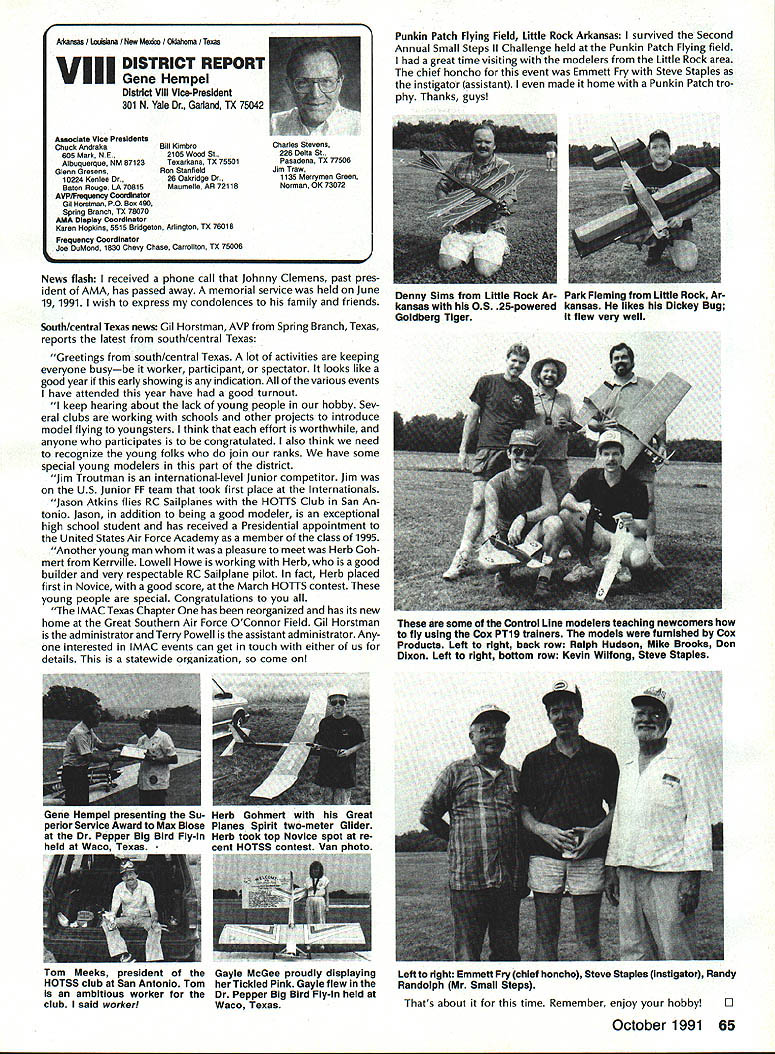
VIII DISTRICT REPORT
Gene Hempel District VIII Vice‑President 301 N. Yale Dr., Garland, TX 75042
- Johnny Clemens, past president of AMA, passed away. A memorial service was held on June 19, 1991. Condolences to his family and friends.
South/central Texas news (from Gil Horstman, AVP, Spring Branch, TX):
- Clubs are working with schools and projects to introduce youngsters to model flying.
- Notable young modelers:
- Jim Troutman: international‑level junior competitor; on the U.S. Junior FF team that took first place internationally.
- Jason Atkins: RC sailplane pilot with HOTTS Club (San Antonio); received a Presidential appointment to the U.S. Air Force Academy (Class of 1995).
- Herb Gohmert (Kerrville): first place in Novice at a HOTTS contest.
- IMAC Texas Chapter One has been reorganized at Great Southern Air Force O'Connor Field. Contacts: Gil Horstman (administrator) and Terry Powell (assistant).
Punkin Patch Flying Field, Little Rock, AR: The Second Annual Small Steps II Challenge was successful; thanks to Emmett Fry and Steve Staples.
Remember to enjoy your hobby!
---
Transcribed from original scans by AI. Minor OCR errors may remain.

