
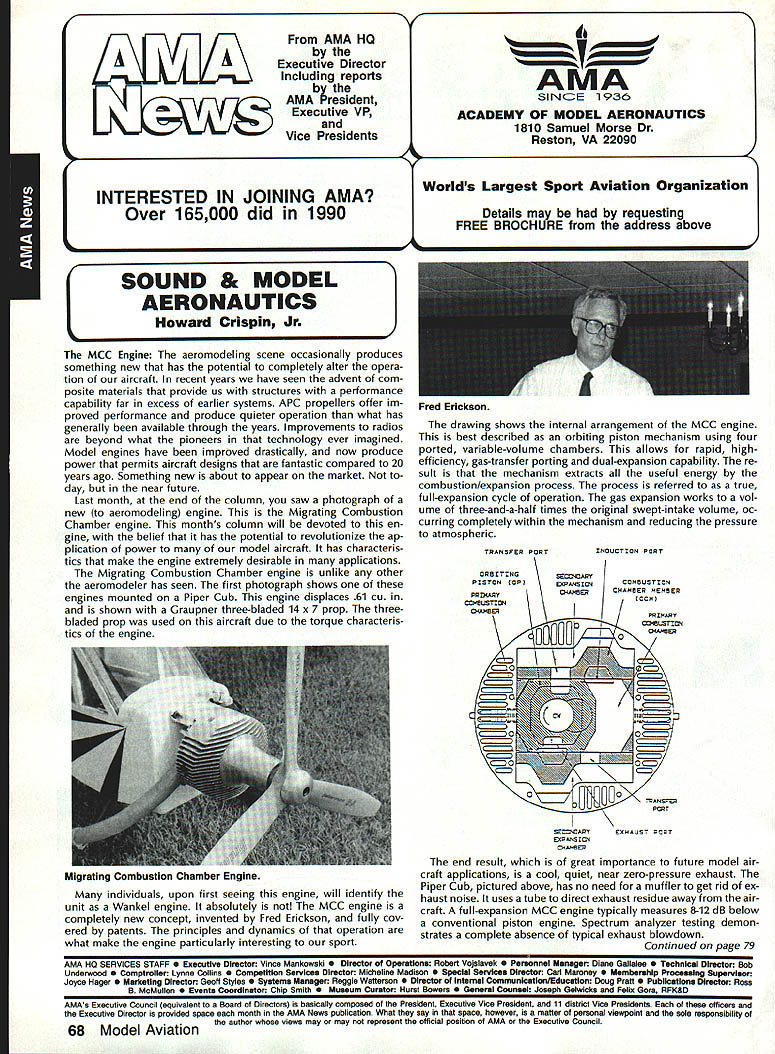
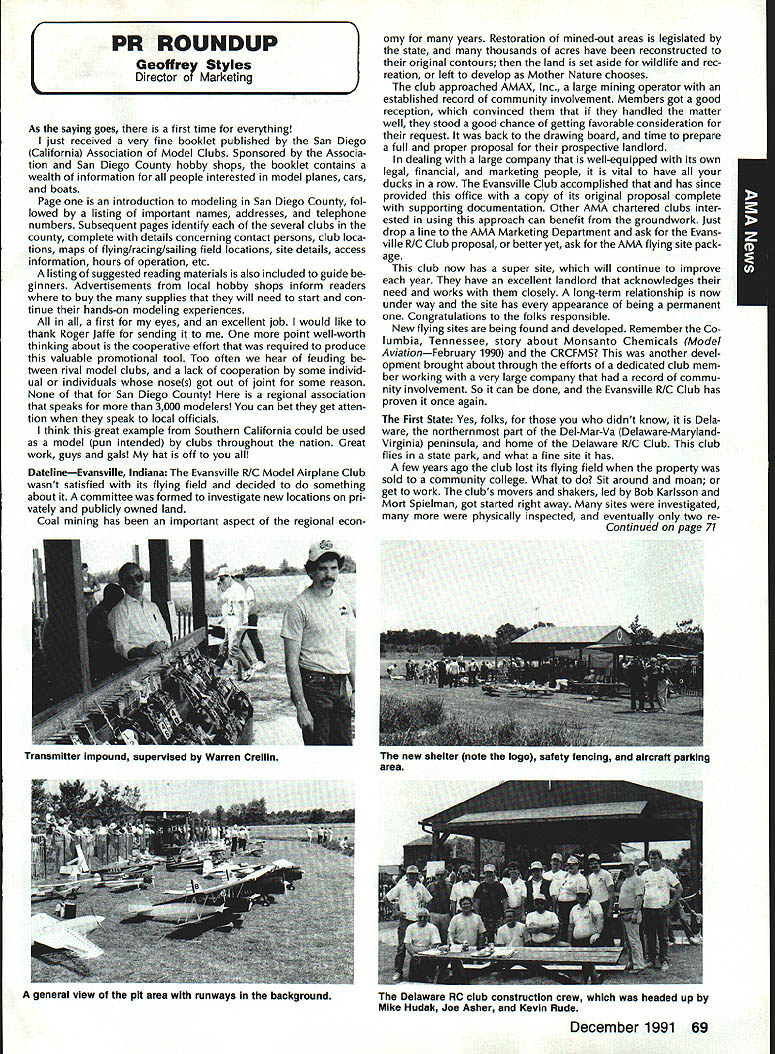
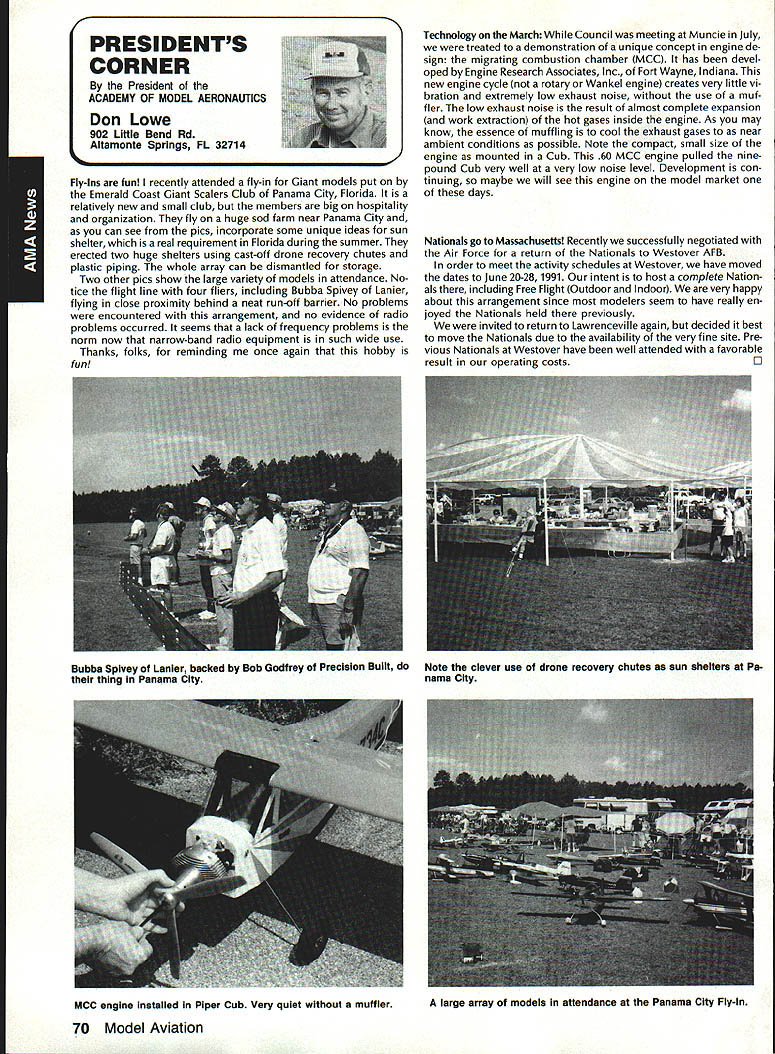
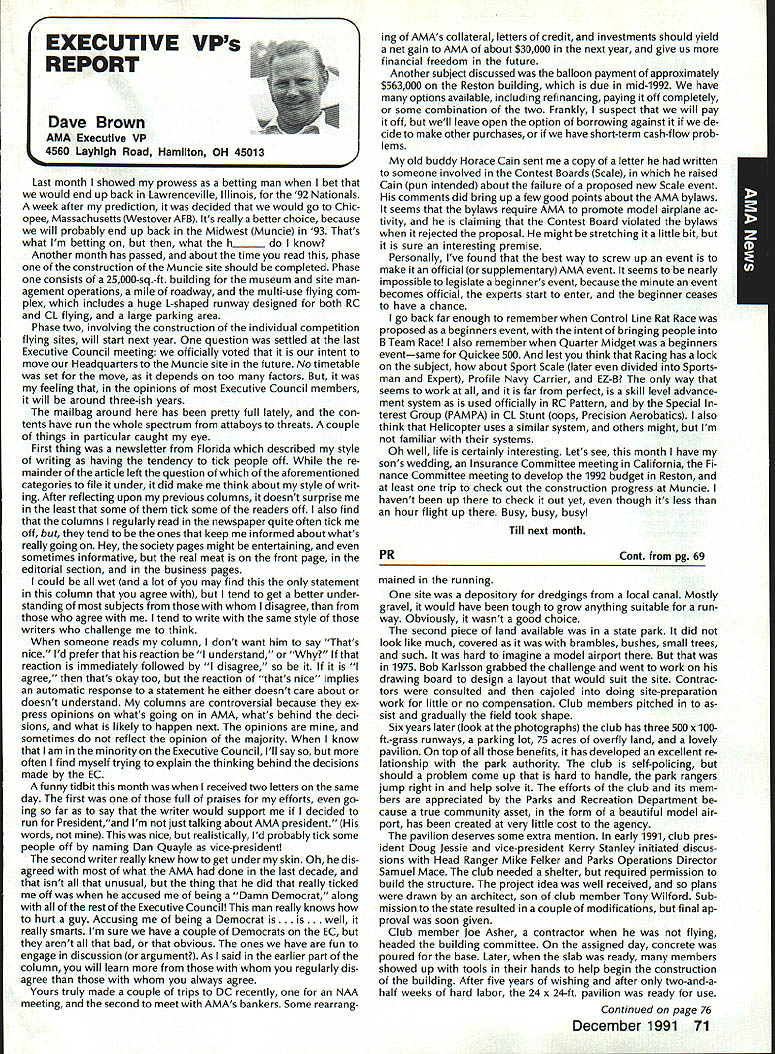
AMA News
SOUND & MODEL AERONAUTICS
Howard Crispin, Jr.
The aeromodeling scene occasionally produces innovations that can completely alter the operation of our aircraft. In recent years we have seen composite materials that enable structures with far greater performance, APC propellers that improve performance and reduce noise, radios that exceed early pioneers' expectations, and model engines that permit aircraft designs unthinkable 20 years ago. Something new is about to appear on the market: the Migrating Combustion Chamber (MCC) engine.
Last month I showed a photograph of a new-to-aeromodeling engine. This month’s column is devoted to that engine, which I believe has the potential to revolutionize how power is applied to many of our model aircraft. It has characteristics that make it extremely desirable in many applications.
The MCC engine is unlike any engine aeromodelers have seen. One early installation shows a .61 cu. in. unit mounted on a Piper Cub using a Graupner three-bladed 14 x 7 propeller—the three-blade was chosen because of the engine’s torque characteristics. Many will initially identify the unit as a Wankel engine. It absolutely is not. The MCC is a completely new concept, invented by Fred Erickson, and covered by patents.
The internal arrangement is best described as an orbiting-piston mechanism using four ported, variable-volume chambers. This allows rapid, high-efficiency gas-transfer porting and dual-expansion capability. The mechanism extracts nearly all useful energy from the combustion/expansion process in what is referred to as a true, full-expansion cycle. Gas expansion reaches about 3.5 times the original swept-intake volume, occurring completely within the mechanism and reducing the pressure at the transfer port on induction.
Key benefits and technical notes:
- Exhaust: Cool, quiet, near-zero-pressure exhaust—typically 8–12 dB below a conventional piston engine. Spectrum-analyzer testing shows a complete absence of typical exhaust blowdown; many installations require no muffler, just a tube to direct residue away from the aircraft.
- Exhaust temperature: Under full load, MCC exhaust temperature is approximately 300°F, compared to about 1,400–1,600°F for typical model piston engines.
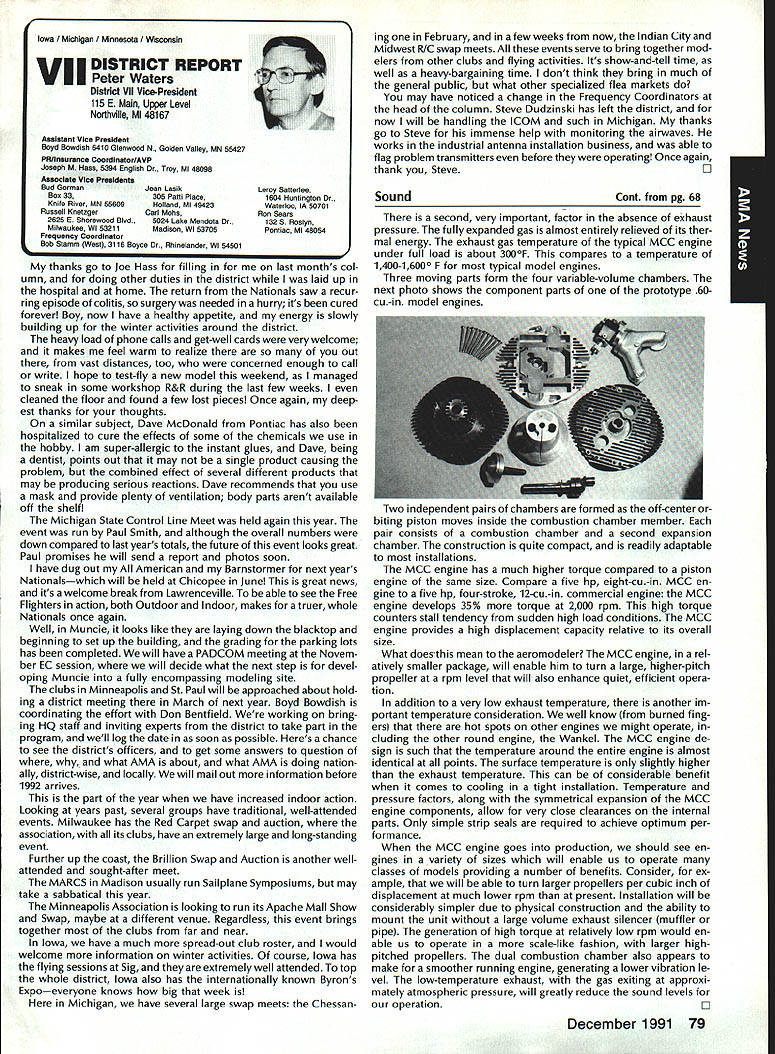
- Construction: Only three moving parts form the four variable-volume chambers. Two independent pairs of chambers are formed as the off-center orbiting piston moves inside the combustion chamber member; each pair consists of a combustion chamber and a second expansion chamber. The construction is compact and readily adaptable to many installations.
- Torque and performance: The MCC produces much higher torque compared to a piston engine of the same size. For example, a five-horsepower, eight-cu.-in. MCC develops about 35% more torque at 2,000 rpm than a five-horsepower, four-stroke commercial engine of much smaller displacement. High torque helps counter stall tendencies from sudden high-load conditions. The high displacement capacity relative to overall size enables turning larger, higher-pitch propellers at lower rpm for quiet, efficient operation.
- Temperatures and tolerances: The MCC design yields nearly uniform surface temperature—only slightly higher than exhaust temperature—making cooling simpler in tight installations. Symmetrical expansion allows for close internal clearances; only simple strip seals are required.
- Installation and operation: Expected production will include a variety of sizes, enabling many classes of models to benefit. Simpler installation is possible because large mufflers or pipes are unnecessary. The dual combustion/expansion arrangement also makes for very smooth-running operation with low vibration.
When the MCC enters production, expect engines sized for a wide range of models and applications, offering quieter operation, lower vibration, simpler installation, and the ability to use larger props at reduced rpm.
---
PR ROUNDUP
Geoffrey Styles Director of Marketing
There is a first time for everything. I recently received an excellent booklet published by the San Diego Association of Model Clubs, sponsored with local hobby shops. It contains an introduction to modeling in San Diego County, listings of clubs with contact people, maps to flying/racing/sailing fields, site details, access, hours, suggested reading for beginners, and hobby shop advertisements. It’s a cooperative promotional tool representing more than 3,000 modelers—an excellent model for other regions. Thanks to Roger Jaffe for sending it.
Dateline — Evansville, Indiana: The Evansville R/C Model Airplane Club wasn’t satisfied with its field and formed a committee to seek new locations. They approached AMAX, Inc., a mining operator active in community involvement, and prepared a full, proper proposal that impressed the company. The club provided AMA Headquarters with a copy of its proposal and supporting documentation; other AMA-chartered clubs may request the Evansville proposal or the AMA flying site packet from the AMA Marketing Department. The club now has a super site and an excellent long-term landlord relationship—congratulations to everyone involved.
New flying sites continue to be developed. Remember the Columbia, Tennessee, story about Monsanto Chemicals (Model Aviation—February 1990)? That was another example of a dedicated club working with a company with community involvement. It can be done.
First State notes: Delaware’s northern Del‑Mar‑Va peninsula is home to the Delaware R/C Club, which flies in a state park. A few years ago, the club lost its field to a community college but immediately went to work, inspected many sites, and found excellent alternatives.
Fly-ins are fun: I attended a Giant model fly-in by the Emerald Coast Giant Scalers Club of Panama City, Florida. They fly on a large sod farm and improvised large sun shelters from drone recovery chutes and plastic piping. The variety of models and organized flight lines were impressive, and no frequency problems occurred—narrow-band radio equipment has made frequency conflicts rare. Thanks to the club for a reminder that this hobby is fun!
Technology on the march: During the July Council meeting in Muncie we saw a demonstration of the MCC engine developed by Engine Research Associates, Inc., of Fort Wayne, Indiana. This engine cycle (not a rotary or Wankel) produces very little vibration and extremely low exhaust noise without a muffler, due to nearly complete internal expansion of the hot gases. The compact .60 MCC pulled a nine-pound Cub very well at a very low noise level. Development is continuing.
Nationals go to Massachusetts: We successfully negotiated with the Air Force for a return of the Nationals to Westover AFB. To fit Westover’s schedule we have moved the dates to June 20–28, 1992, with the intent to host a complete Nationals there, including Free Flight (outdoor and indoor). Previous Nationals at Westover were well attended and cost-effective.
---
EXECUTIVE VP'S REPORT
Dave Brown AMA Executive VP 4560 Layhigh Road, Hamilton, OH 45013
Last month I predicted we might return to Lawrenceville, Illinois, for the 1992 Nationals; a week later the decision was made to go to Westover AFB in Massachusetts. It’s really a better choice; we will likely return to the Midwest (Muncie) in 1993.
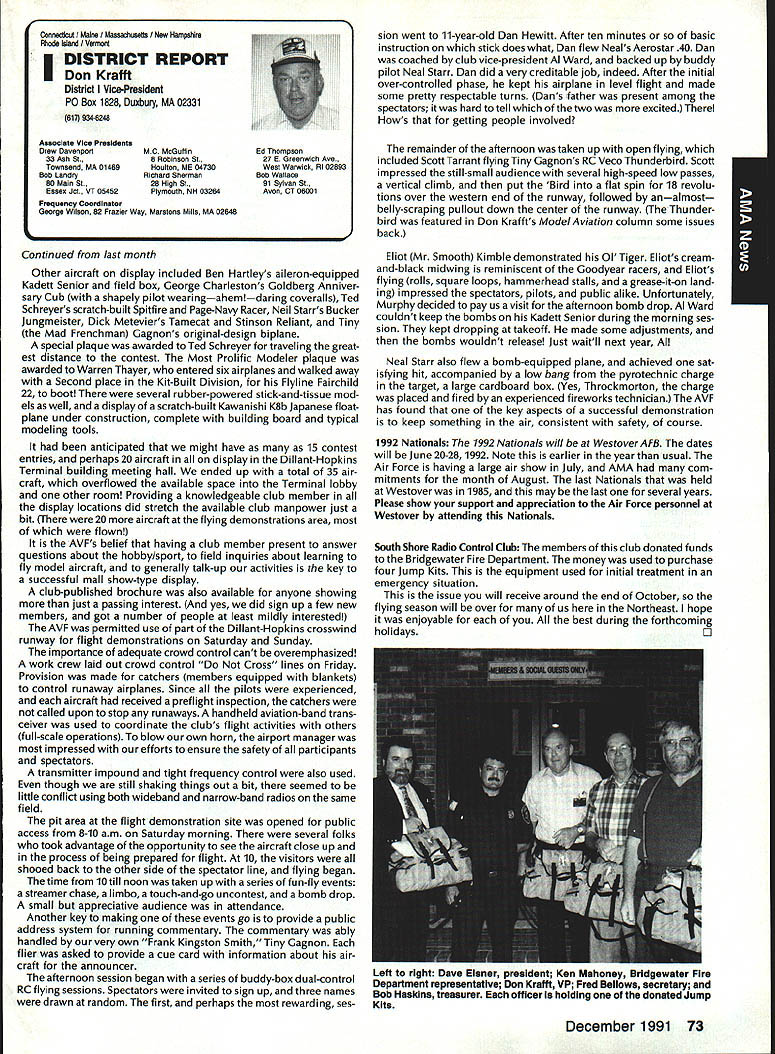
Phase one of Muncie site construction should be completed around the time you read this. Phase one includes:
- a 25,000-sq.-ft. building for the museum and site management,
- a mile of roadway,
- the multi-use flying complex with a large L-shaped runway for RC and CL flying,
- and a large parking area.
Phase two (individual competition flying sites) will start next year. The Executive Council voted that it is our intent to move Headquarters to the Muncie site in the future; timing depends on many factors, but most EC members expect it to be in about three years.
The mailbag has run the spectrum from praise to threats. A Florida newsletter described my writing as having the tendency to tick people off. That’s not surprising—some of my columns challenge readers. I prefer readers react with “Why?” or “I disagree” rather than a passive “That’s nice.” My columns express opinions about AMA decisions and motivations; when I’m in the minority on the Council, I’ll say so, but often I explain the thinking behind EC decisions.
A funny day: I received two letters on one day—one full of praise (even urging support if I ran for president), and another accusing me of being a “Damn Democrat.” Both made me reflect—but I enjoy robust discussion with those who disagree.
Recent trips: to Washington, D.C., for an NAA meeting and to meet AMA’s bankers. Some collateral and investment rearrangements should yield about $30,000 net to AMA in the next year, improving our financial flexibility. We are also addressing the balloon payment (approximately $563,000) on the Reston building due mid-1992; options include refinancing, full payoff, or a combination. I suspect we will pay it off but leave borrowing options open if needed.
Horace Cain wrote a letter raising questions about AMA bylaws versus Contest Board decisions—an interesting premise. On events: making an activity an official AMA event often brings experts that overshadow beginners. Beginner events tend to work better when managed with skill-level advancement systems (as seen in RC Pattern and CL Precision Aerobatics as used by PAMPA).
This month I have my son’s wedding, an Insurance Committee meeting in California, the Finance Committee meeting to develop the 1992 budget in Reston, and at least one trip to inspect Muncie’s construction progress. Busy, busy, busy!
Till next month,
Dave Brown
---
EXECUTIVE DIRECTOR'S VIEW FROM HQ
Vince Mankowski AMA Executive Director 1810 Samuel Morse Dr. Reston, VA 22090
There are many important items this month: the 1992 renewals, a special election in District IX, changes to 1992 contest sanction kits, a new video, a grand opening, a special magazine subscription option for members, and more information on the 1992 National Championships.
Membership renewals: By the time you read this, your 1992 renewal should be in your hands—AMA mailed renewals beginning September 23 to avoid a potential postal rate increase in October. Please remember to sign your application; unsigned applications or those with insufficient payment will be returned. This year we intend to process all renewals at Headquarters (no lockbox). Last year we returned membership cards within ten working days to over 90% of members; we aim to meet or exceed that service—please sign and enclose proper payment.
Renew-for-2 option: You may choose Renew-for-2 on your 1992 renewal—two years’ dues plus $10 for an Eye-Denta card (savings of $10 if you would otherwise buy the card each year). The Eye-Denta card is more durable, will show the two-year expiration date, and can be worn as a badge or used on your club field frequency board.
District IX special election: Travis McGinnis resigned from the Executive Council and a special election was held. AVP Tom Boyd (Lincoln, NE) and AVP Russ Miller (Carrington, ND) were on the ballot; the winner serves as vice-president through December 31, 1992.
Changes to contest sanction kits: A new form, “Waiver of Claims, Release of Liabilities and Indemnity Agreement,” will be completed by the Contest Director and participants at sanctioned events. The form identifies city/county/state, contest date, chartered club (where applicable), site owner, and the Contest Director. Participants must sign the waiver and each signature page must be witnessed and signed by the CD. This step is unfortunate but necessary to remind participants of inherent risks; signing does not diminish the insurance provided to AMA members.
"AMA Today, Volume III": This 20–25 minute video is available for $10; we produce only enough copies to fill orders.
Muncie grand opening: Saturday and Sunday, June 13–14, 1992, are the dates for the grand opening of the Academy’s new flying facility in Muncie, Indiana. All AMA members are invited—no admission, entry, or landing fees for members. Industry participation is likely—mark your calendars for this historical milestone.
Member subscription offers: The 1992 membership card mailing will include a discounted subscription offer to other modeling magazines; more offers are in development at rates below other sources.
1992 Nationals: The 1992 National Model Airplane Championships will be held in Chicopee, Massachusetts, at Westover AFB, likely June 20–28, 1992. Control Line and RC activities should occur there on those dates. Planning meetings will set the full schedule; Indoor and Outdoor Free Flight fliers will await final announcements.
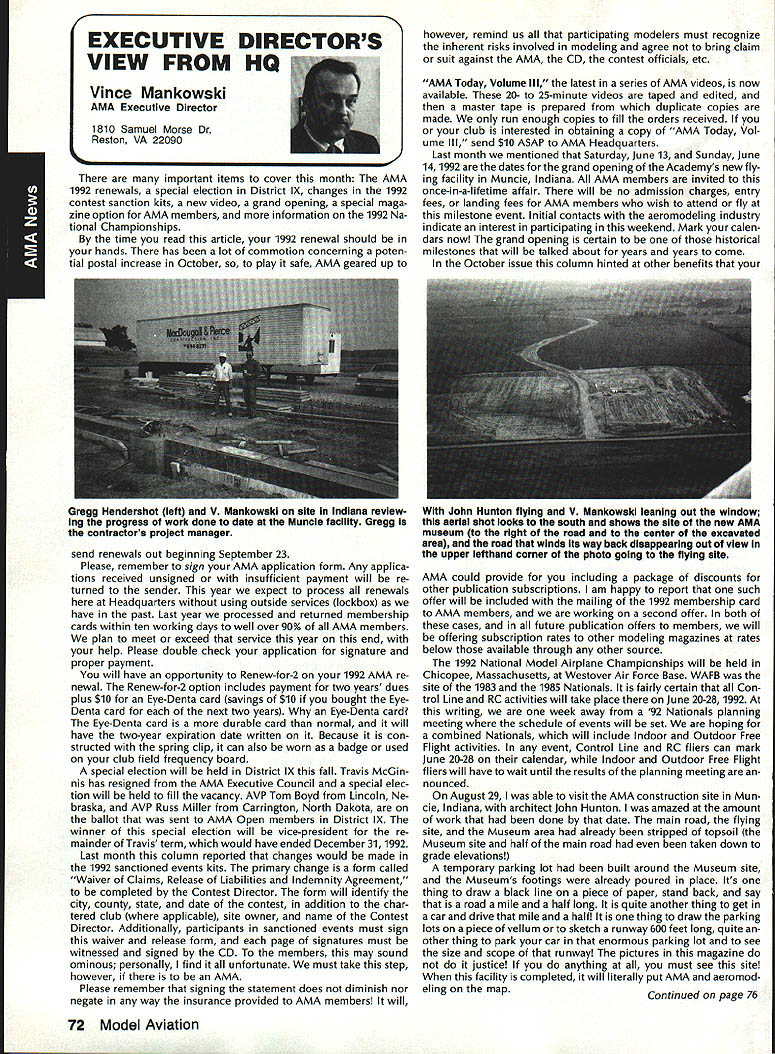
Muncie visit: On August 29 I visited the Muncie construction site with architect John Hunton and was amazed at the progress. The main road, flying area, and museum area had been stripped of topsoil; the Museum footings were poured, temporary parking was in place, and the runway and parking areas are gigantic. When completed, the facility will truly put AMA and aeromodelling on the map.
---
New York / New Jersey District Report
John Byrne AMA 171, District IV Vice‑President
Second (District) Thoughts: This will be my last report. After months of deliberation, I have decided not to seek re-election as district vice-president. I extend my profound gratitude to all who have participated in serving AMA and its membership and will support my successor.
PARCS Third Annual Giant Aircraft Fly-In and Social Happening: On August 25 at Floyd Bennett Field, Brooklyn, the PARCS event was “a day of old-fashioned fun, flying and gabbling.” Event Director Tony Ristuccia and co-directors Joe Sylvester and Angelo Lanci did a great job—an unforgettable birthday for me as well.
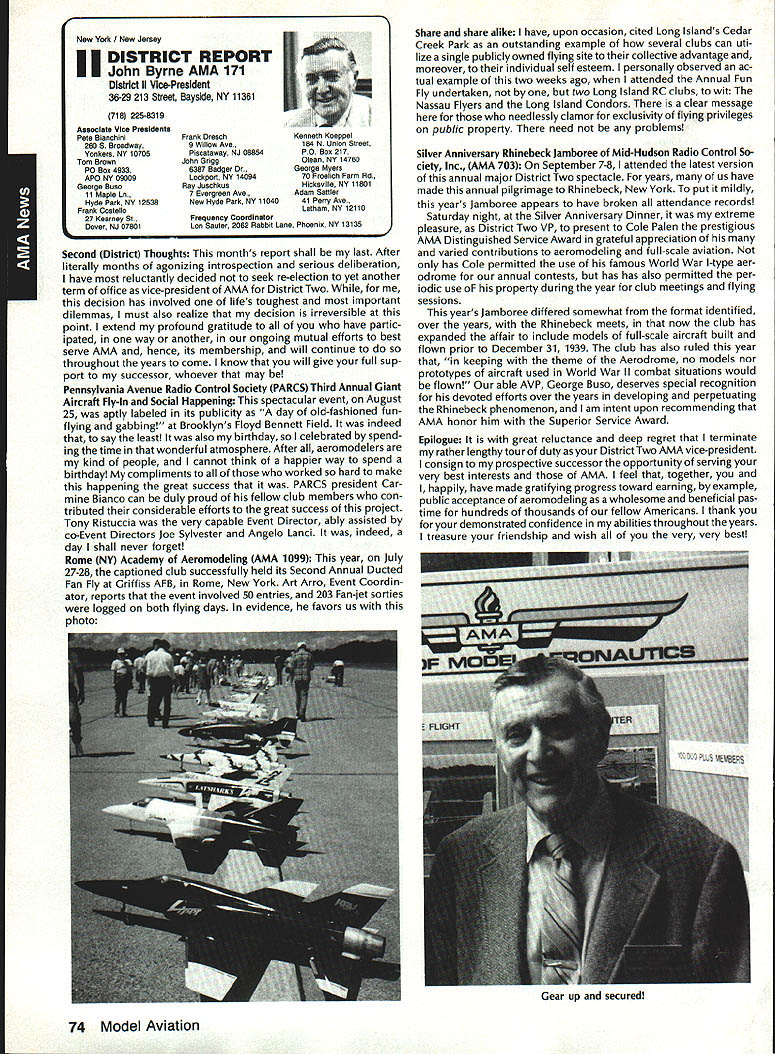
Rome (NY) Academy of Aeromodelling (AMA 1099): On July 27–28, Griffiss AFB hosted the Second Annual Ducted Fan Fly. Event Coordinator Art Arno reports 50 entries and 203 fan-jet sorties over two flying days.
Share and share alike: Long Island’s Cedar Creek Park shows how multiple clubs can share a single public flying site successfully. The Nassau Flyers and the Long Island Condors jointly ran an annual Fun Fly; cooperation is possible and beneficial.
Silver Anniversary Rhinebeck Jamboree (Radio Control Society, Inc., AMA 703): On September 7–8, attendance appeared to break all records. At the Silver Anniversary Dinner I presented Cole Palen with the AMA Distinguished Service Award for his many contributions and for providing his World War I–type aerodrome and hangar for our events. The club has expanded to include models of pre-December 31, 1939 full-scale aircraft; World War II combat models are excluded to honor the Aerodrome theme. AVP George Buso deserves special recognition for his long-term work on Rhinebeck.
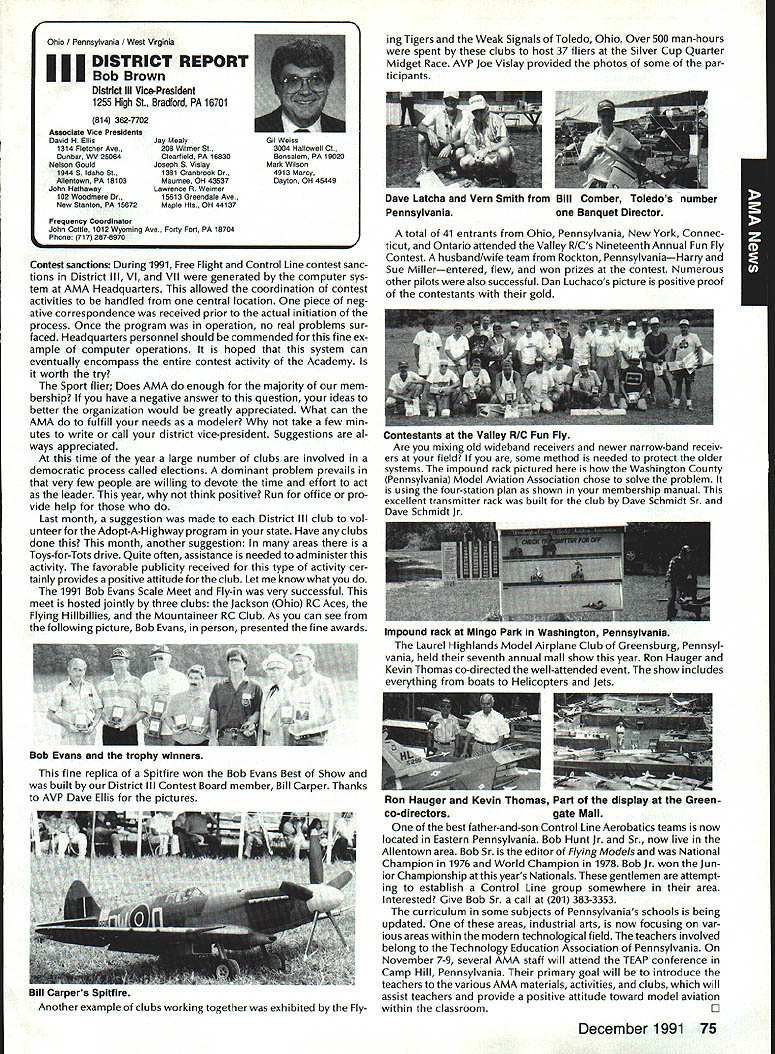
Epilogue: With reluctance I end my tenure as District Two vice-president. Together we have advanced public acceptance of aeromodelling as a wholesome pastime. Thank you for your confidence and friendship.
---
Regional Highlights
- Valley R/C’s Nineteenth Annual Fun Fly Contest drew 41 entrants from Ohio, Pennsylvania, New York, Connecticut, and Ontario. A husband-and-wife team, Harry and Sue Miller from Rockton, PA, won prizes.
- Washington County (PA) Model Aviation Association uses a four-station impound rack (built by Dave Schmidt Sr. and Jr.) to protect older wideband receivers when mixed with newer narrow-band gear.
- Laurel Highlands Model Airplane Club (Greensburg, PA) held its seventh annual mall show, co-directed by Ron Hauger and Kevin Thomas, featuring boats, helicopters, and jets.
- Eastern Pennsylvania has a strong father-and-son CL Aerobatics team: Bob Hunt Sr. (editor of Flying Models, 1976 National Champion, 1978 World Champion) and Bob Hunt Jr. (Junior Champion at this year’s Nationals). They are organizing a CL group—contact Bob Sr. at (201) 333‑3533.
- Pennsylvania schools are updating industrial arts to focus on modern technology. AMA staff will attend the Technology Education Association of Pennsylvania conference (Nov 7–9) to introduce AMA materials and activities to teachers.
---
IV District Report
Howard Crispin Jr. District IV Vice‑President 611 Beechwood Dr., Charlottesville, VA 22901
Congratulations: Great news from the 1991 F3B World Championships in the Netherlands—Joe Wurts placed first, Daryl Perkins second, Larry Jolly twenty-sixth, and the team (managed by Randy Spencer) placed third. Outstanding effort.
Anniversary: The Brainbusters of Hampton, Virginia, will host a 50th anniversary reunion next April. The club has deep ties to NACA/NASA wind-tunnel research and remains an active Free Flight group. Contact Ed Sullivan, 19 Frederick Drive, Newport News, VA 23601, (804) 596‑6104 for information.
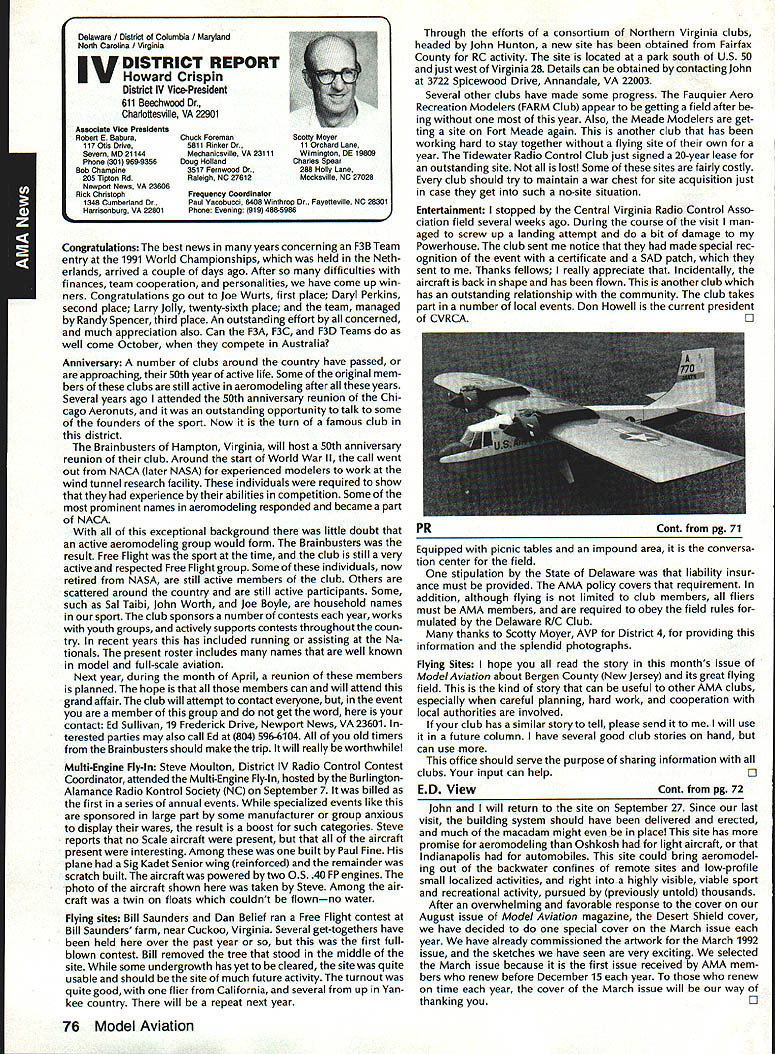
Multi-Engine Fly-In: Steve Moulton attended the Multi‑Engine Fly‑In hosted by the Burlington‑Alamance R/C Society (NC) on September 7. Interesting aircraft included a twin-powered model on floats that couldn’t be flown.
Flying sites: Bill Saunders and Dan Belief ran a Free Flight contest at Saunders’ farm near Cuckoo, Virginia, clearing a tree and making the site usable. A Northern Virginia consortium, led by John Hunton, obtained a new RC site from Fairfax County (park south of U.S. 50 and west of Virginia 28)—contact John at 3722 Spicewood Drive, Annandale, VA 22003. Other clubs finding or regaining sites include the Fauquier Aero Recreation Modelers and the Meade Modelers (Fort Meade). The Tidewater Radio Control Club secured a 20-year lease for an outstanding site.
Entertainment: I visited the Central Virginia Radio Control Association field, damaged my Powerhouse on landing, and received a humorous certificate and “SAD” patch from the club—thanks; the aircraft is repaired and flown again. Don Howell is CVRCA president.
---
Miscellaneous Eastern News
I visited the Fort Payne, Alabama, quarter-scale show recently—bleachers were full of spectators. Barry Strickland was CD and turnout was good.
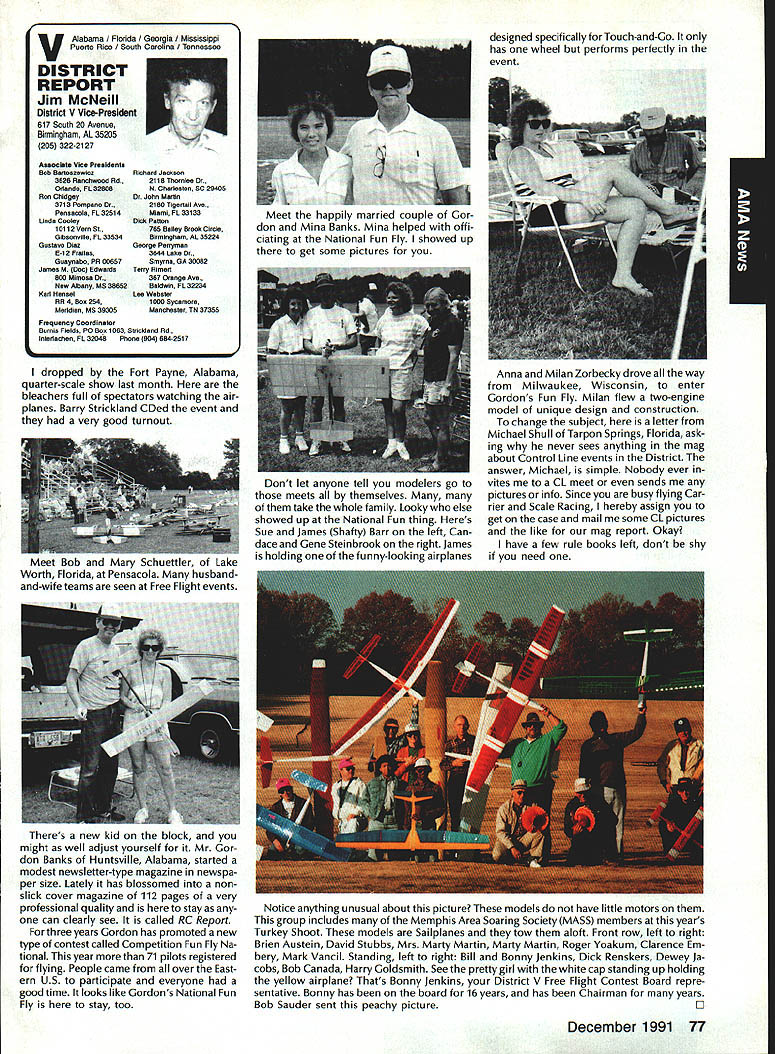
RC Report: Gordon Banks (Huntsville, AL) started a modest newsletter that evolved into a 112-page slick-cover magazine, RC Report. For three years Gordon has promoted the Competition Fun Fly National; this year over 71 pilots registered and people came from across the Eastern U.S.
Family participation: Many meets draw entire families. Photos show participants and models designed for touch-and-go events.
Call for Control Line coverage: If anyone in District Two attends CL meets, please send pictures and information—coverage depends on submissions.
---
VI District Report
Jim Sears District VI Vice‑President PO Box 308, Burgin, KY 40310 (606) 748‑5384
A mixed August: I planned a float-fly in Ottawa, Illinois, but missed airport pickup, so stayed home and prepared a model for my son to fly. The next weekend I attended the RC Thunderbirds’ float-fly and picnic in Marion, KY—great food and flying despite few float planes.
The second and third weekends I spent recovering from a kidney stone and dealing with bad weather that spoiled an Elgin, IL, trip. The fourth weekend brought my first Grumman fly-in and a business trip to Boulder, Colorado; I stopped in Kansas City to visit KCRC (thanks to Ed Baucom and Ray Eaton) and flew in a Skyhawk for a field view. I planned to stop in St. Louis on the return but came home early—thunderstorms the next day would have spoiled it.
Photos and format: The new magazine format limits photo space, so I’m forced to return some photos. I prefer my original style and humor and hope to have more space for photos in future columns.
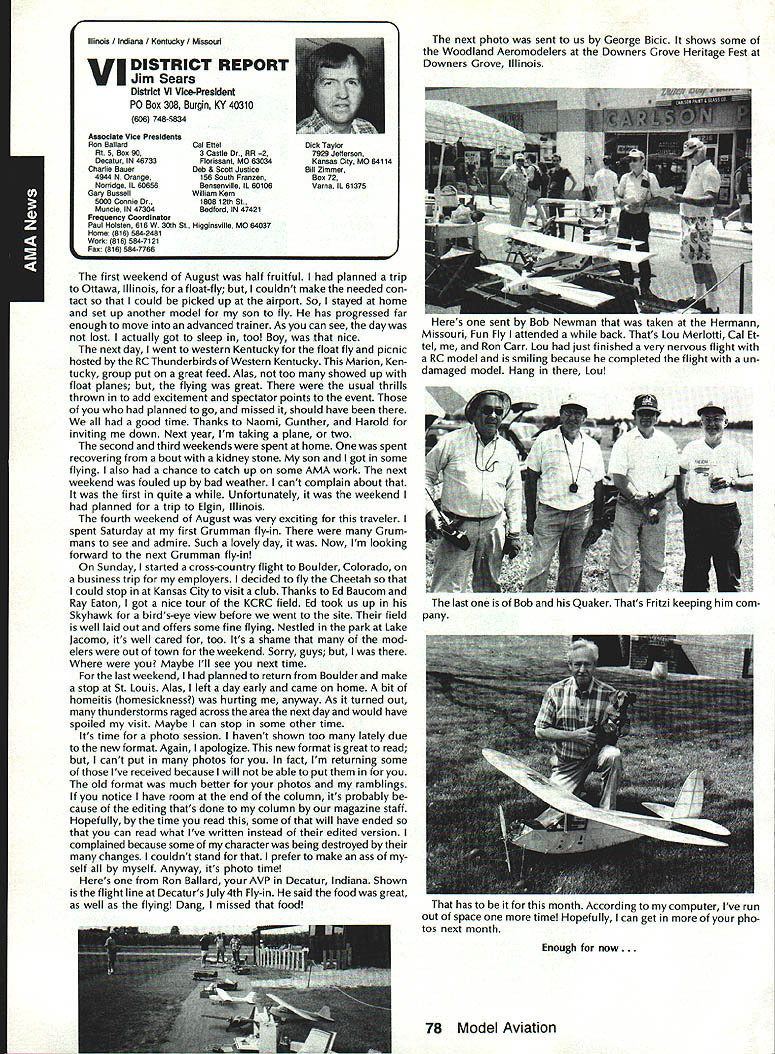
Decatur July 4th Fly-In: Thanks to Ron Ballard (AVP, Decatur, IN) for sharing photos—the food and flying were great.
Enough for now.
---
MCC Technical Addendum (integrated)
- Three moving parts form the four variable-volume chambers.
- The fully expanded gas inside the MCC is nearly relieved of its thermal energy; exhaust temperatures are low (~300°F).
- The MCC’s temperature uniformity and symmetrical expansion permit close clearances and simple sealing.
- The dual combustion/expansion chambers provide smoother running, lower vibration, and low sound levels at atmospheric-pressure exhaust.
When produced, MCC engines will likely be available in various sizes, simplifying installation, enabling larger propellers per cubic inch of displacement at much lower rpm, and providing scale-like operation with high torque and low vibration.
---
VIII District Report
Gene Hempel District VIII Vice‑President 301 N. Yale Dr., Garland, TX 75042
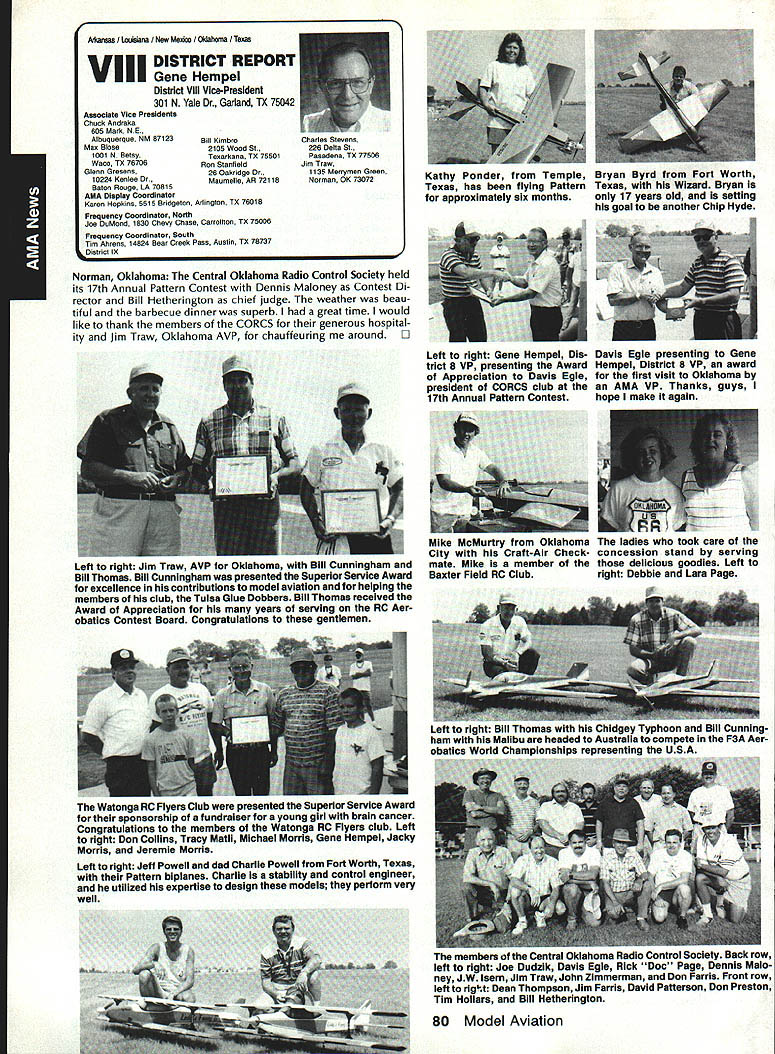
Norman, Oklahoma: The Central Oklahoma Radio Control Society held its 17th Annual Pattern Contest with Dennis Maloney as Contest Director and Bill Hetherington as chief judge. Weather was beautiful and the barbecue superb—many thanks for the hospitality. Jim Traw (Oklahoma AVP) chauffeured me around.
The Watonga RC Flyers Club received the Superior Service Award for organizing a fundraiser for a young girl with brain cancer—congratulations to the club.
---
IX District Report
Travis McGinnis District IX Vice‑President 8027 W. 81st Circle, Arvada, CO 80005 FAX (303) 420‑1670
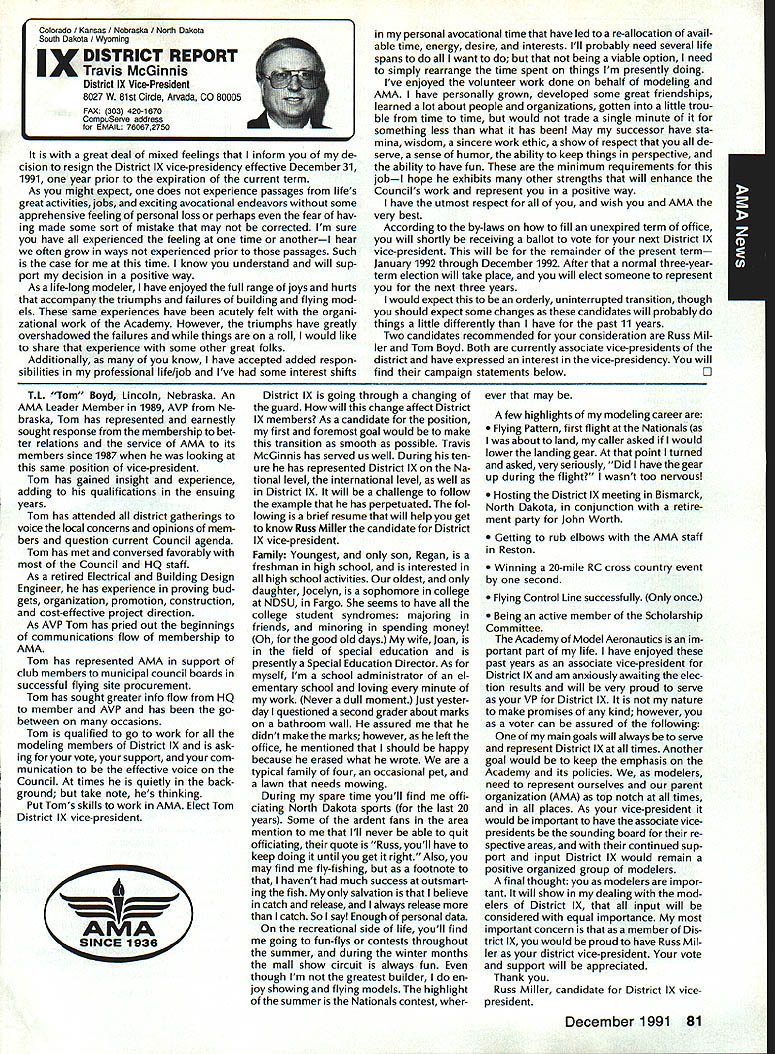
I have decided to resign the District IX vice-presidency effective December 31, 1991, a year before my term expires. This decision follows changes in professional responsibilities and personal interests requiring a reallocation of time. It’s been a rewarding volunteer experience—I've grown, made friendships, learned a lot, and wouldn’t trade it.
Per by-laws, a ballot will be mailed for District IX to elect someone to serve the remainder of the term (Jan–Dec 1992). A normal three-year term election will follow. Expect an orderly transition, though each new officer will bring different approaches.
Two recommended candidates are Russ Miller and T.L. "Tom" Boyd. Their campaign statements follow.
#### T.L. "Tom" Boyd (Lincoln, Nebraska) Tom is an AMA Leader Member (since 1989) and has been AVP for Nebraska since 1987. He has worked to improve communication between members and AMA, represented members in flying-site procurements, and has experience in budgets, organization, promotion, construction, and cost-effective project direction. Tom asks for your vote and support to be an effective voice for District IX on the Council.
#### Russ Miller (Bismarck, North Dakota) Russ is a longtime modeler, current associate vice-president for the district, school administrator, and community volunteer (including 20 years officiating North Dakota sports). He enjoys contests, mall shows, and Nationals and has been active on the Scholarship Committee. Russ pledges to serve District IX, emphasize AMA policies, and use AVPs as sounding boards. He asks for your vote and support.
---
X District Report
Regg Keyawa District X Vice‑President 4500 Onyx Way, Carmichael, CA 95608 Home: (916) 961‑6627 CompuServe: 764247.47
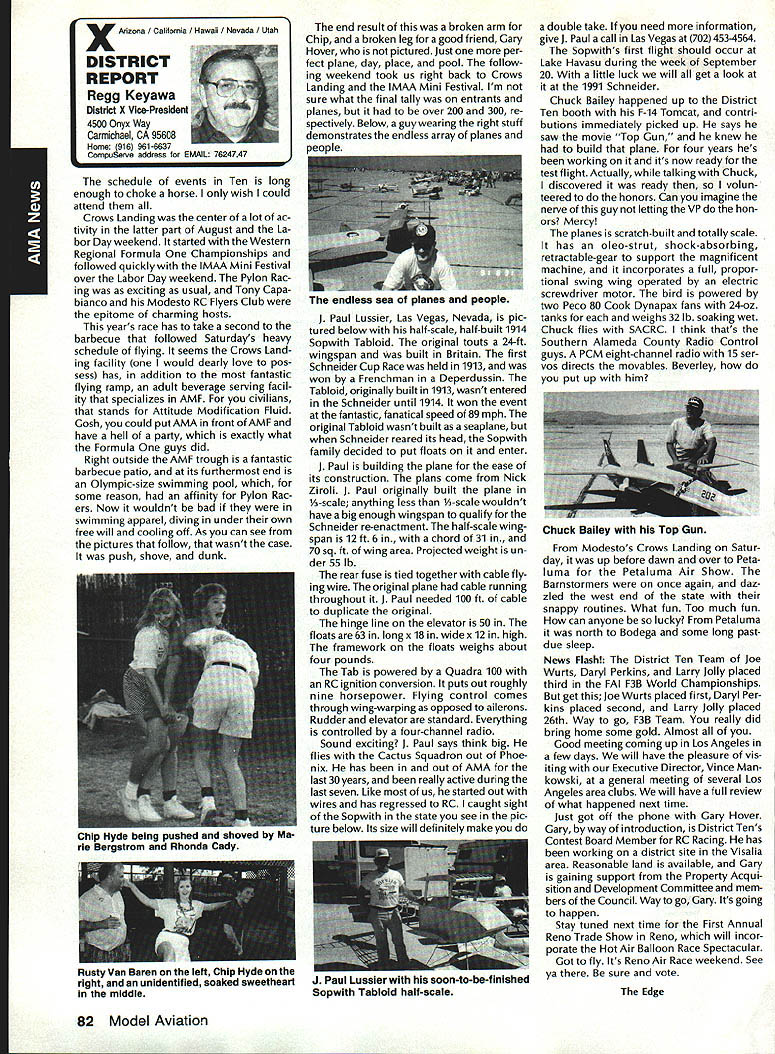
The schedule in District Ten is packed. Crows Landing was busy in late August through Labor Day weekend: the Western Regional Formula One Championships followed by the IMAA Mini Festival. Pylon racing and hospitality (including a notable barbecue) were highlights—even pool antics ended in broken bones for a couple of participants.
IMAA Mini Festival saw well over 200 entrants and perhaps 300 models. J. Paul Lussier (Las Vegas) is building a half-scale 1914 Sopwith Tabloid (12 ft. 6 in. wingspan projected) from Nick Ziroli plans, powered by a Quadra 1000 with an RC ignition conversion (~9 hp). Its first flight is scheduled for Lake Havasu the week of September 30; we hope to see it at the 1991 Schneider reenactment.
Chuck Bailey brought a Top Gun model to the District Ten booth—scratch-built, scale, oleo-strut retractable gear, a proportional swing wing driven by an electric screw driver motor, powered by two Peco 80 engines, PCM eight-channel radio with 15 servos, and weighing about 35 lb.
News flash: District Ten’s F3B Team (Joe Wurts, Daryl Perkins, Larry Jolly) placed at the FAI F3B World Championships—congratulations.
A Los Angeles meeting with Executive Director Vince Mankowski is upcoming. Gary Hover (RC Racing Contest Board Member) is working on a site in the Visalia area with support from the Property Acquisition and Development Committee—stay tuned.
Reno: Look for the First Annual Reno Trade Show combined with the Hot Air Balloon Race Spectacular and Reno Air Race weekend—be there and vote.
---
Northwest District Notes
- Address change: Please note the change in mailing address listed at the top of the relevant column—use the new address for ordinary mail.
- Harts Lake Free Flight events: If traveling to Harts Lake, contact Mark Sexton at (206) 781‑1615 to confirm access; the Army has become unpredictable about site usage.
- No‑Doe Scale Meet at Harvey Field: Went well with nice weather and beautiful models.
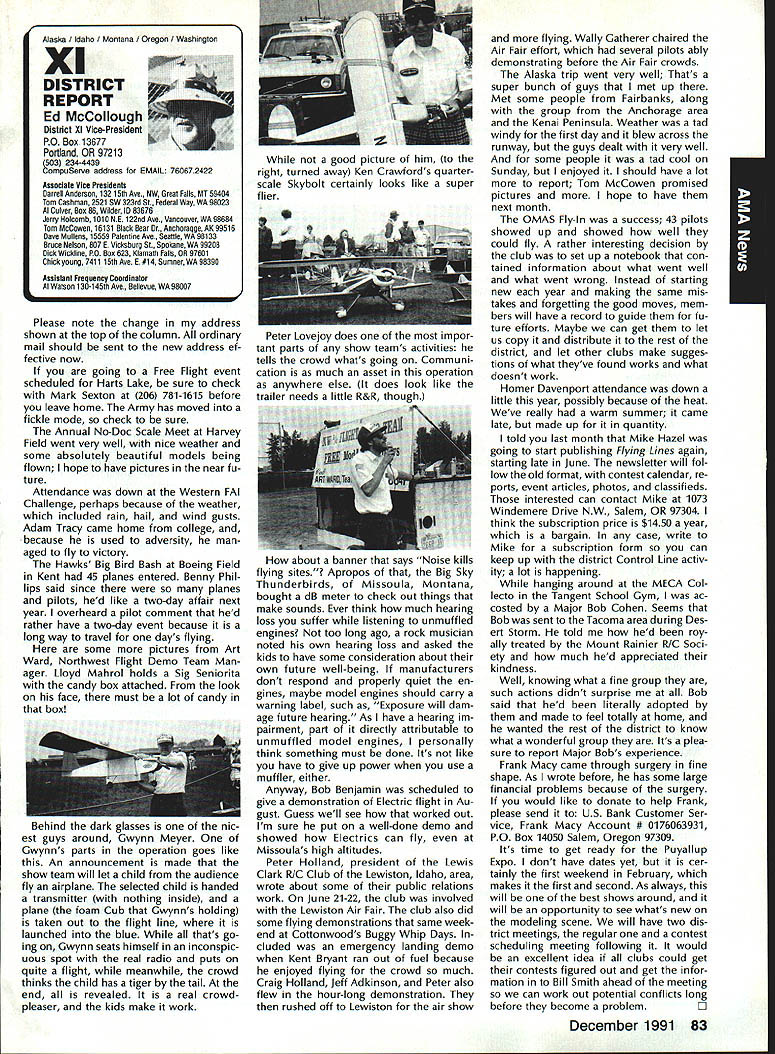
- Western FAI Challenge: Attendance down, possibly due to rain, hail, and wind gusts. Adam Tracy returned from college and managed to win despite adversity.
- Hawks’ Big Bird Bash (Boeing Field, Kent): 45 planes entered; organizers may expand to two days next year due to large turnout.
- Show team tactics: Art Ward’s Northwest Flight Demo Team uses staged child “pilot” giveaways with a hidden expert pilot to delight crowds—great PR.
- Noise awareness: The Big Sky Thunderbirds (Missoula, MT) bought a dB meter to measure sound. Unmuffled engines contribute to hearing loss; manufacturers should be urged to reduce engine noise. Consideration of warnings or design improvements is needed.
- Electric flight demos: Bob Benjamin demonstrated electric flight; electrics perform well even at Missoula’s high altitudes.
- Lewis Clark R/C Club (Lewiston, ID): Participated in the Lewiston Air Fair and Cottonwood’s Buggy Whip Days with flying demonstrations.
- Alaska trip: Warm reception from Anchorage, Fairbanks, and Kenai Peninsula modelers despite some windy conditions.
- OMAS Fly-In: 43 pilots attended; the club compiled a notebook of lessons learned to improve future events—an excellent idea.
- Homer Davenport: Attendance was slightly down, possibly due to heat.
- Flying Lines: Mike Hazel restarted Flying Lines late in June; to subscribe contact Mike at 1073 Windemere Drive N.W., Salem, OR 97304 (approx. $14.50/year).
- MECA Collector: Major Bob Cohen reported being well treated by the Mount Rainier R/C Society while deployed—great community support.
- Frank Macy: Frank recovered well from surgery but incurred financial strain; donations may be sent to U.S. Bank Customer Service, Frank Macy Account #0170663931, P.O. Box 14503, Salem, OR 97309.
- Payne/Hullup Expo: Typically the first weekend in February (first and second). Expect swap meets, clinics, and trade show—plan to participate and get district contest schedules arranged early.
Transcribed from original scans by AI. Minor OCR errors may remain.

