
AMA News
SOUND & MODEL AERONAUTICS
Howard Crispin, Jr.
The start of this month's column finishes last month's discussion of the Migrating Combustion Chamber (MCC) engine.
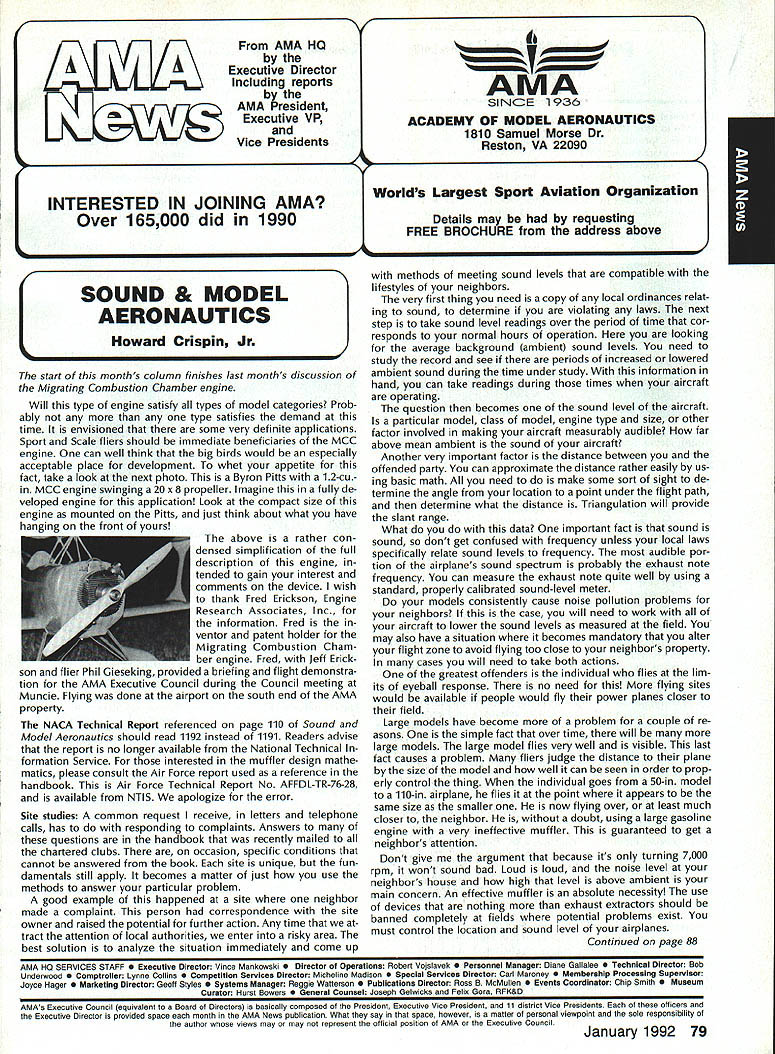
Will this type of engine satisfy all model categories? Probably not any more than any single engine type satisfies all demands. It is envisioned that there are some very definite applications. Sport and scale fliers should be immediate beneficiaries. Big birds would be especially acceptable places for development. To whet your appetite, take a look at the next photo: this is a Byron Pitts with a 1.2-cu-in. MCC engine swinging a 20 x 8 propeller. Imagine this in a fully developed engine for this application — look at the compact size of the engine as mounted on the Pitts.
This is a condensed simplification of the full description intended to gain interest and invite comments. I wish to thank Fred Erickson, Engine Research Associates, Inc., for the information. Fred is the inventor and patent holder for the Migrating Combustion Chamber engine. Fred, Jeff Erickson, and flier Phil Gieseking provided a briefing and flight demonstration for the AMA Executive Council during the Council meeting at Muncie. Flying was done at the airport on the south end of the AMA property.
Correction: The NACA Technical Report referenced on page 110 of Sound & Model Aeronautics should read 1192 instead of 1191. Readers advise the report is no longer available from the National Technical Information Service (NTIS). For those interested in muffler-design mathematics, please consult the Air Force report used as a reference in the handbook: Air Force Technical Report No. AFFDL-TR-76-28, available from NTIS. We apologize for the error.
Site studies: I commonly receive letters and calls asking how to respond to complaints. Many answers are in the handbook recently mailed to all chartered clubs, but specific conditions may require site-specific solutions. Fundamentals still apply; it's a matter of applying methods to your particular problem.
A recent example: a neighbor complaint escalated to correspondence with the site owner and a potential for further action. Any time local authorities become involved, the situation becomes risky. The best solution is to analyze the situation promptly and develop methods to meet sound levels compatible with neighbors' lifestyles.
Steps to take:
- Obtain a copy of any local ordinances relating to sound to determine whether you are violating laws.
- Take sound-level readings over the period corresponding to your normal hours of operation to establish average background (ambient) sound levels. Note periods of increased or decreased ambient sound.
- With that information, take readings during aircraft operation to determine how far above mean ambient the aircraft sound is.
- Determine whether particular models, classes, engine types/sizes, or other factors make your aircraft measurably audible.
Distance to the offended party is crucial. Approximate distance using basic trigonometry: make a sighting to determine the angle from your location to a point under the flight path and use triangulation to estimate the slant range.
Focus on sound level rather than frequency unless local laws specify frequency limits. The most audible portion of an airplane's sound spectrum is likely the exhaust-note frequency, measurable with a properly calibrated sound-level meter.
If models consistently cause noise complaints, work to lower sound levels measured at the property line. You may also need to alter the flight zone to avoid flying too close to neighbors’ property. Often, the individual who flies at the limit will be the problem.
Large models are more problematic for several reasons:
- They fly well and are visible at greater distances, leading fliers to misjudge distance.
- Pilots moving from smaller to larger models may unintentionally fly much closer to neighbors.
- Larger models commonly use large gasoline engines with ineffective mufflers.
Don’t argue that lower RPM means low noise — loud is loud. An effective muffler is an absolute necessity. Devices that are nothing more than standard mufflers and do little to protect neighbors should be avoided. You must control both the location and sound level of your airplanes.
---
AMA News
Retired Delta Airlines Captain Hank Frese working with Amanda Jones at Peachtree Elementary School.
Cliff Adkins assists another Peachtree student with Delta Dart construction.
Mike McGowan, head instructor, smiles as he shows off a completed Delta Dart (AMA Cub).
The photos on this page should have appeared in the November 1991 issue of Model Aviation. They show the Fayette Flyers Adopt‑A‑School program.
---
THE 1991 CHARLES HAMPSON GRANT SCHOLARSHIP FUND
Bill Baker, Assistant Director of Marketing
The Academy of Model Aeronautics (AMA) has awarded the 1991 Charles Hampson Grant Scholarship Fund to five university students for academic excellence, civic responsibility, and modeling activity.
The $20,000 fund was distributed among Mark Cantarella, Joel Grasmeyer, Raymond Jungmann, Andrew Kenedy, and James Stewart to assist in their education. According to Bob Underwood, Scholarship Committee chairman, the five were selected because they exemplify the spirit of Charles Hampson Grant, an aeromodeling and full‑scale aviation pioneer.
Recipients:
- Mark Cantarella — West Chester, Pennsylvania. Received $2,000 for freshman studies in Economics and Political Science at George Washington University. An avid RC sport flier who gives flight demonstrations and lessons to scouts and community groups. Past member of Simi Valley Fliers; current member of Chester County RC Club. Active in Student Government, National Honor Society, Spanish National Honor Society, school newspaper, debate team, Catholic Youth Organization, and Boy Scouts (Senior Patrol Leader).
- Joel Grasmeyer — Freshman at Purdue University studying Aerospace Engineering; Grand Rapids, Michigan native. Received $6,000. World‑class free flight modeler; member of the U.S. Junior Free Flight Team. Member of Grand Valley RC Club and Western Michigan Free Flight Club. Active in demonstrations and mentoring students. Outstanding high‑school record including Who's Who in American High School Students, National Honor Society, track, debate, Civil Air Patrol, and local astronomical and Audubon societies.
- Raymond Jungmann — Buckholts, Texas. Received $3,000. Freshman studying Aerospace Engineering at Texas A&M. Avid RC modeler; built a scratch Roun' Tuit. Member of Milam County Aeromodelers and active in demonstrations and contests. Valedictorian, National Merit Semi‑Finalist, National Honor Society, 4‑H, FFA, and community service singing at nursing homes.
- Andrew Kenedy — Junior at Rensselaer Polytechnic Institute (RPI), Troy, New York. Received $3,000. Double major in Aeronautical Engineering and Biology; top student at the university. Builds and repairs models (Pattern ship, Italian Firmini, T‑34 Mentor), instructs beginners, participates in static displays and contests, and serves as secretary/treasurer of the RPI aeromodeling club. Winner of nearly 60 awards in academics, music, and athletics; classical guitarist and member of state‑title hockey teams. (Photo of Andrew Kenedy will appear next month.)
- James Stewart — Missoula, Montana. Received $6,000. Freshman studying Aerospace Engineering at Iowa State University. Diverse interests: gas and electric models, RC gliders, helicopters, and free flight. Member of Big Sky Aeromodellers, assists beginners and participates in meets and contests. First in his class at Sacred Heart High School; National Honor Society, Academic All‑State, student government, debate, math and science clubs, track, cross‑country, boxing, Eagle Scout, and extensive community service.
Additional awards: Joel Grasmeyer and James Stewart were each awarded $1,000 from the Toledo Weak Signals Scholarship Fund (sponsored by the Toledo Weak Signals, an AMA‑chartered club) to the top candidates of the Charles Hampson Grant Scholarship Fund.
Background and application information:
- The Charles Hampson Grant Scholarship Fund was established in 1987 in memory of Grant's achievements in full‑scale and model aviation.
- Applicants must be high‑school graduates or currently enrolled in a university program and must have been involved in some type of modeling activity within the past three years.
- Recipients are selected by the AMA Scholarship Committee and approved by AMA's Executive Council.
Further information and applications: AMA Headquarters, Scholarship Applications, 1810 Samuel Morse Dr., Reston, VA 22090; tel. (703) 435‑0750.
---
AMA News
- Some membership-rate categories were not covering the costs of processing applications or the benefits received.
- Because most members opt to receive Model Aviation, we stopped publishing separate copies of AMA News that were sent to "no publication" categories.
These actions will give the magazine a higher-quality mix of AMA and other news, reduce restraints of a finite AMA News section, produce a better magazine, and save publication costs.
There was never any attempt to cover up or sugar-coat the dues increase for some categories. The Council conducts business according to the by‑laws, which empower it to set reasonable dues rates. Council members are volunteers who work for the best interests of modelers.
If we polled the membership on every item of business, nothing would get done. Council must balance the will of the people they represent with the common good. Do you really think the membership would vote for a dues increase? Probably not; it's like taxes — necessary for services.
Even with a dues increase for a small percentage of AMA members, membership remains a bargain. Insurance benefits alone (personal liability, accident, death, theft) provide substantial value for a modest sum. For comparison, an EAA $250,000 policy covering accident and death while riding in a certified airplane costs over $200 in addition to membership.
One category that received a rate increase was Senior Citizens. Some letters complained about this; while nobody likes an increase, the insurance coverage and benefits make membership worthwhile. We did not increase the Open category dues, which is the largest segment of membership. We should not subsidize some categories unfairly to the detriment of others.
---
Scholarship (continued)
Continued from previous scholarship coverage: Joel Grasmeyer and James Stewart each received $1,000 from the Toledo Weak Signals Scholarship Fund.
(Continued on page 84 in original.)
---
EXECUTIVE DIRECTOR'S VIEW FROM HQ
Vince Mankowski, AMA Executive Director 1810 Samuel Morse Dr., Reston, VA 22090
Many events have kept HQ busy this month. An operational plan and budget were developed for the AMA‑Hosted Scale World Championships next August. Various details concerning entry cost, housing and transportation, and site information will be presented to the FAI in Paris.
The 1992 AMA operational budget was prepared and delivered to the Finance Committee in September. Assembling an annual budget requires many hours reviewing year‑to‑date expenses, projected costs, service contracts, insurance, utilities, taxes, supplies, and airfare increases. The Finance Committee met on October 12 for a twelve‑hour review. The revised 1992 budget will be presented to the AMA Executive Council on November 9 for final approval.
HQ continues to review operations and oversee the development of AMA's property in Indiana. Work includes monthly construction reviews, grant applications, easements, permits, and schedule maintenance.
A planning meeting was held for the 1992 National Model Airplane Championships at Westover Air Force Base. The 1992 Nationals will be held at Westover AFB, Massachusetts, from June 20‑29, and will return to a combined Nationals format. Westover can accommodate all events; organizers expect a large turnout.
Renewals: The renewal process began late September. By the first full week in October, over 24,000 renewals had been received at HQ. Fifteen percent chose the Renew‑for‑2 option. Between 1,000 and 6,000 applications arrived each day. All renewals are handled at HQ without an outside lockbox, and staff expect to work overtime to avoid delays.
Common renewal issues:
- Confusion between the Eye‑Denta card (thick plastic AMA membership card usable as a frequency clip; costs $10) and the Vision Care card (discount card for eyeglasses; mailed free with license card).
- Youth Membership rate of $14 includes a subscription to Model Aviation. Some members did not want a second copy; the second subscription may be sent to the home, school, or library of choice to resolve this.
- Possibility of offering a Family membership (same name, same address) is under Executive Council review.
- Some renewals arrive with a signature only and no identifying information. If you mailed such a form and have not heard from AMA in more than three weeks, contact the membership department and ensure your name and address are included on the renewal.
Muncie visit: At the end of September I visited Muncie to check construction progress. Ironwork was in place and the building was being closed in; the roadway was at final grade. Standing on the first AMA flying site was an impressive experience. We intend to get as many members to the site as possible so they can appreciate its scope firsthand.
Grand Opening plans: Previously we mentioned a black‑tie Dedication Dinner for Grand Opening weekend, but after seeing the site, I plan to recommend changing the Saturday night format to an open, informal celebration free to all members. This site will do wonders for AMA and demonstrate that our hobby is a viable sport and recreational activity.
---
Championship Unlimited RC Races
This month's column covers the Championship Unlimited RC Races held at the Madera, California, airport, October 3‑6, 1991. Each pilot and aircraft had to be licensed and qualify to race (qualifying on Thursday and Friday; races on Saturday and Sunday). Competing aircraft had to be modeled after aircraft that qualified to race in the unlimited races at Reno. Maximum weight was 55 lb fueled and ready; no engine restrictions. Wingspan had to be at least 100 in., and scale outlines had to be maintained.
Three classes were flown: Gold, Silver, and Bronze. Qualifying times determined class placement. The course went around three pylons and measured 3/4 mile. Speeds varied from about 75 to 135 mph. Attrition was high; much equipment and technology were used for the first time and landing gear gave fliers considerable trouble.
The event was sponsored by Cliff Adams and Tom Easterday and was professionally done. Tom, Cliff, and their assistants deserve credit for creating a successful event. I was unable to stay for Sunday's activities and do not have final results.
---
AMA News
DISTRICT II REPORT
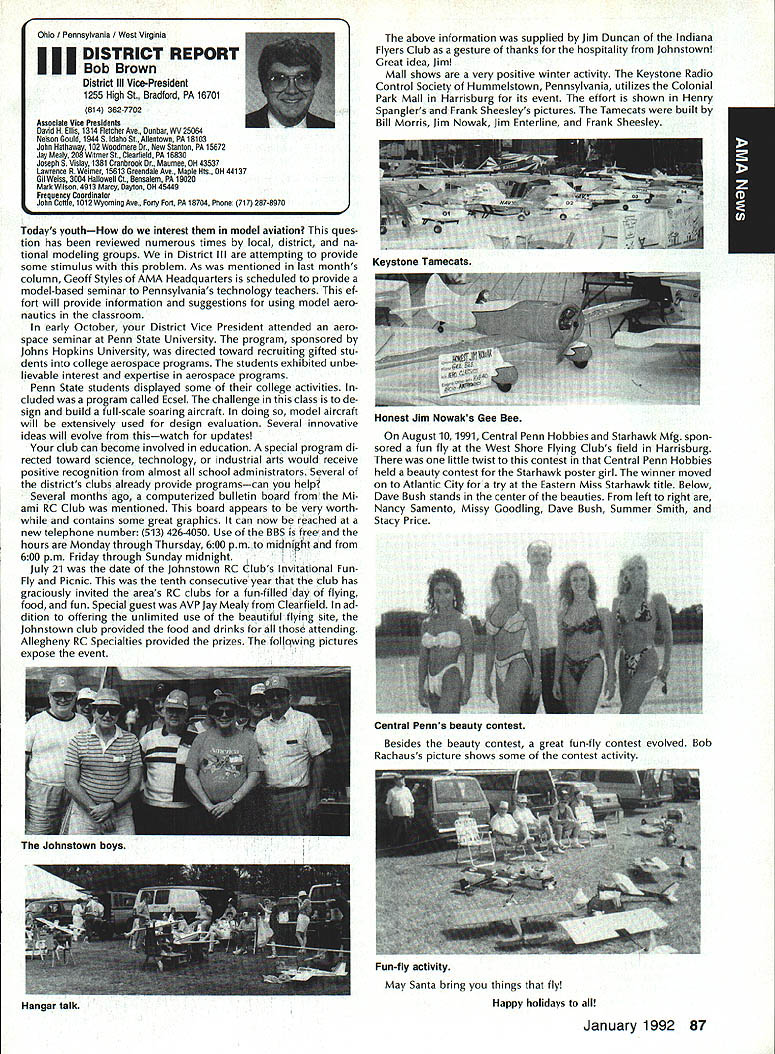
Today's youth—How do we interest them in model aviation? District II is attempting to stimulate interest. Geoff Styles of AMA Headquarters is scheduled to provide a model‑based seminar to Pennsylvania technology teachers to suggest ways to use model aeronautics in the classroom.
In early October, the District Vice President attended an aerospace seminar at Penn State University, sponsored by Johns Hopkins University, aimed at recruiting gifted students into college aerospace programs. Students showed strong interest and expertise.
Penn State students displayed a program called Excel, challenging students to design and build a full‑scale soaring aircraft, using model aircraft extensively for design evaluation. Look for updates as innovative ideas develop.
Clubs can become involved in education. Programs directed toward science, technology, or industrial arts receive positive recognition from school administrators. Several district clubs already provide such programs.
A computerized bulletin board from the Miami RC Club (previously mentioned) can now be reached at (513) 426‑4050. Use is free; hours are Monday through Thursday 6:00 p.m. to midnight and Friday through Sunday 6:00 p.m. to midnight.
Johnstown RC Club Invitational Fun‑Fly and Picnic (July 21): The club hosted its tenth consecutive Invitational Fun‑Fly and Picnic, with AVP Jay Mealy from Cleveland as a special guest. The club provided the beautiful flying site and food/drinks. Allegheny RC Specialties provided prizes.
Mall shows are a positive winter activity. The Keystone Radio Control Society of Hummelstown, Pennsylvania, uses the Colonial Park Mall in Harrisburg for its event. The Tamecats were built by Bill Morris, Jim Nowak, Jim Enterline, and Frank Sheesley.
On August 10, 1991, Central Penn Hobbies and Starhawk Mfg. sponsored a fun fly at the West Shore Flying Club's field in Harrisburg. A beauty contest for the Starhawk poster girl was part of the event; the winner advanced to Atlantic City for the Eastern Miss Starhawk title. A fun‑fly contest accompanied the festivities.
May Santa bring you things that fly! Happy holidays to all.
---
AMA News
IV DISTRICT REPORT
Howard Crispin, District IV Vice‑President 611 Beechwood Dr., Charlottesville, VA 22901
Associate Vice Presidents:
- Robert E. Babura, 117 Otis Drive, Severn, MD 21144, Phone (301) 969‑9356
- Bob Champine, 209 Tipton Rd., Newport News, VA 23606
- Rick Cromer, 1348 Cumberland Dr., Harrisburg, VA 22801
- Chuck Foreman, 5811 Rinker Dr., Mechanicsville, VA 23111
- Doug Holland, 3517 Fernwood Dr., Raleigh, NC 27612
- Scotty Moyer, 11 Orchard Lane, Wilmington, DE 19809
- Charles Spear, 2888 Holly Lane, Mocksville, NC 27028
Frequency Coordinator:
- Paul Yacobucci, 6408 Winthrop Dr., Fayetteville, NC 28301; Phone, Evening: (919) 488‑5986
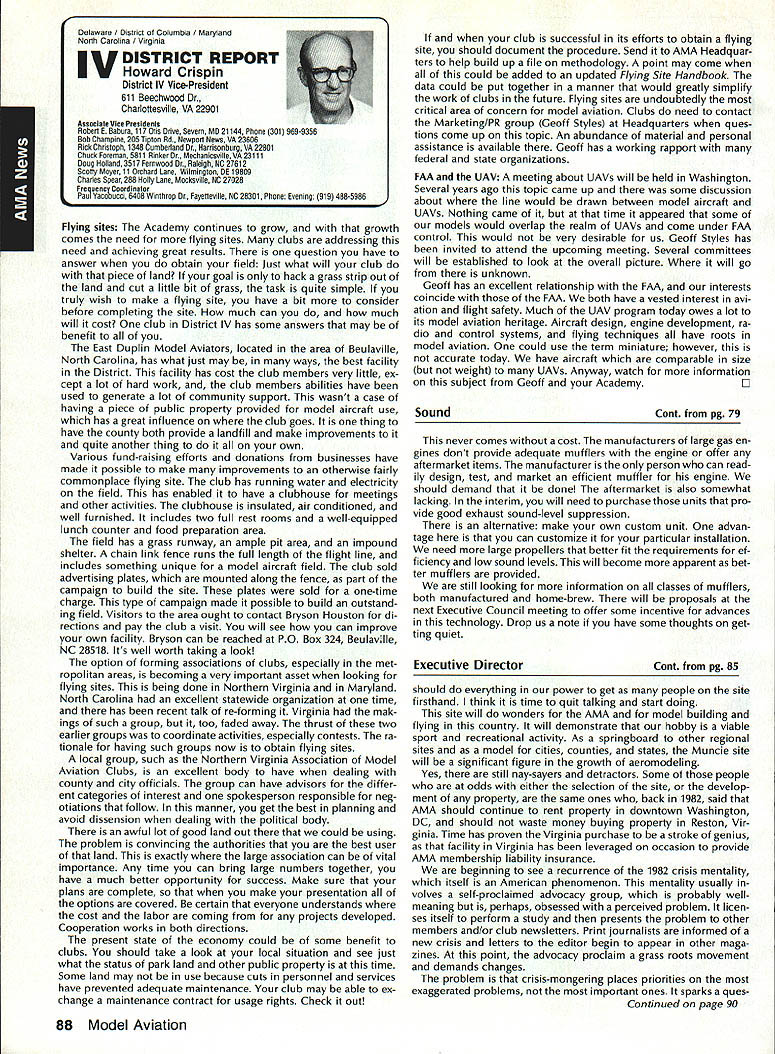
Flying sites: AMA continues to grow, increasing the need for flying sites. When obtaining a field, clubs should determine intended use. If you plan more than a basic grass strip, consider funding, costs, and community support. One successful example:
East Duplin Model Aviators (Beaulaville, NC) have developed an outstanding facility through hard work, fundraising, and business donations. Features include running water, electricity, an insulated and air‑conditioned clubhouse with rest rooms and a lunch counter, a grass runway, a generous pit area, an impound shelter, and a full‑length chain‑link fence with sold advertising plates mounted along it. The plates were sold for a one‑time charge to fund improvements. Visitors may contact Bryson Houston, P.O. Box 324, Beaulaville, NC 28518.
Forming associations of clubs—especially in metropolitan areas—is a valuable approach for obtaining flying sites. Northern Virginia and Maryland have used this method. A unified group can provide advisors and a single spokesperson for negotiations with county and city officials. Complete plans and clear cost/labor responsibilities improve chances of success.
Current economic conditions may provide opportunities: some park land or public property may be underused due to cuts in maintenance. Clubs might exchange maintenance contracts for usage rights—check local opportunities.
Document your successful process and send it to AMA Headquarters to help build a Flying Site Handbook. Flying sites are the most critical area of concern for model aviation. Contact the Marketing/PR group (Geoff Styles) at Headquarters for assistance and materials.
FAA and UAV: A meeting about UAVs will be held in Washington. In past discussions, some models overlapped the UAV realm and could come under FAA control — a scenario we wish to avoid. Geoff Styles attends FAA meetings and maintains an excellent relationship; interests of model aviation and FAA often coincide around aviation and flight safety. Watch for more information from Geoff and AMA.
Sound: Large gasoline‑engine manufacturers do not typically provide adequate mufflers or aftermarket solutions. Manufacturers are best positioned to design, test, and market efficient mufflers; we should demand better options. In the interim, purchase units that provide good exhaust sound‑level suppression or make custom units tailored to your installation. We also need more large, efficient propellers that produce less noise. Proposals to offer incentives for advances in muffler technology will be discussed at the next Executive Council meeting — send suggestions.
---
AMA News
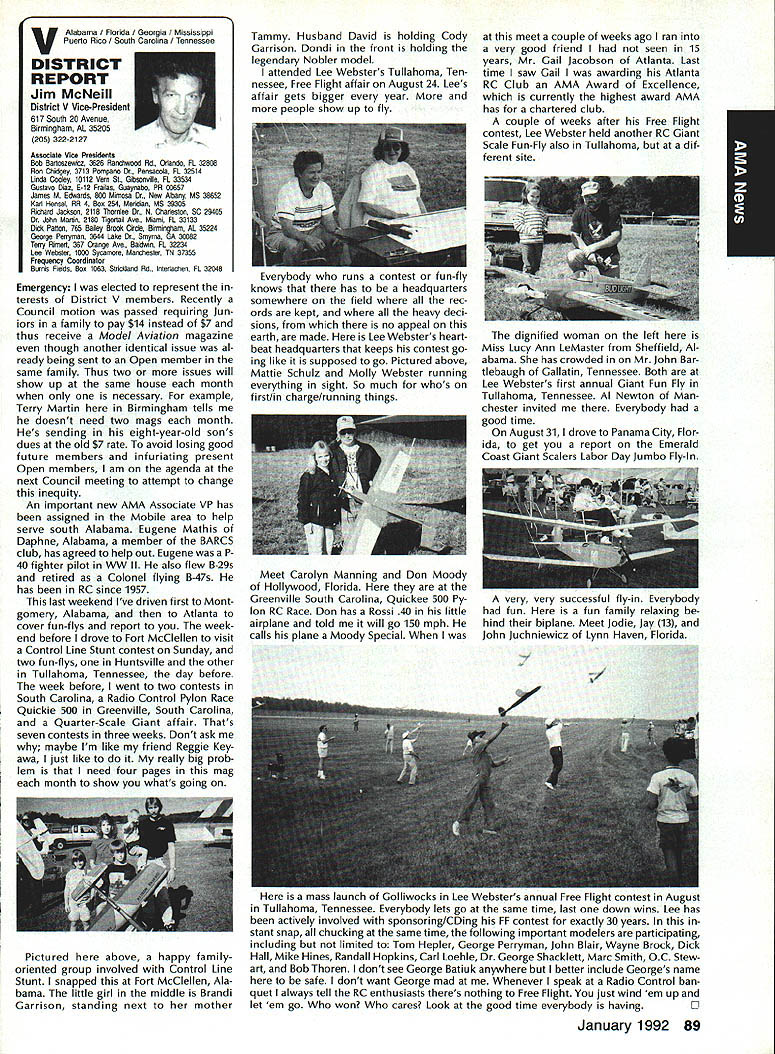
Pictured here are family participants in Control Line Stunt at Fort McClellan, Alabama: Brandi Garrison with her mother Tammy, husband David holding Cody Garrison, and Dondi holding a Nobler model.
I attended Lee Webster's Tullahoma, Tennessee, Free Flight event on August 24, which continues to grow. Headquarters at these contests is essential; Lee Webster's headquarters (Mattie Schulz and Molly Webster) keeps the contest running smoothly.
Meet Carolyn Manning and Don Moody of Hollywood, Florida, at the Greenville, South Carolina, Quickie 500 Pylon RC Race. Don flies a Moody Special with a Rossi .40 engine, which he claims reaches 150 mph.
At Lee Webster’s Giant Fun Fly in Tullahoma, Miss Lucy Ann LeMaster from Sheffield, Alabama, and Mr. John Bartlebaugh of Gallatin, Tennessee, attended. The Emerald Coast Giant Scalers Labor Day Jumbo Fly‑In in Panama City, Florida, was very successful.
At Lee Webster's Free Flight contest, a mass launch of Golliworks had many notable modelers participating, including Tom Hepler, George Perryman, John Blair, Wayne Brock, Dick Hall, Mike Hines, Randall Hopkins, Carl Loehle, Dr. George Shacklett, Marc Smith, O.C. Stewart, and Bob Thoren.
---
VI DISTRICT REPORT
Jim Sears, District VI Vice‑President PO Box 308, Burgin, KY 40310 — (606) 748‑5834
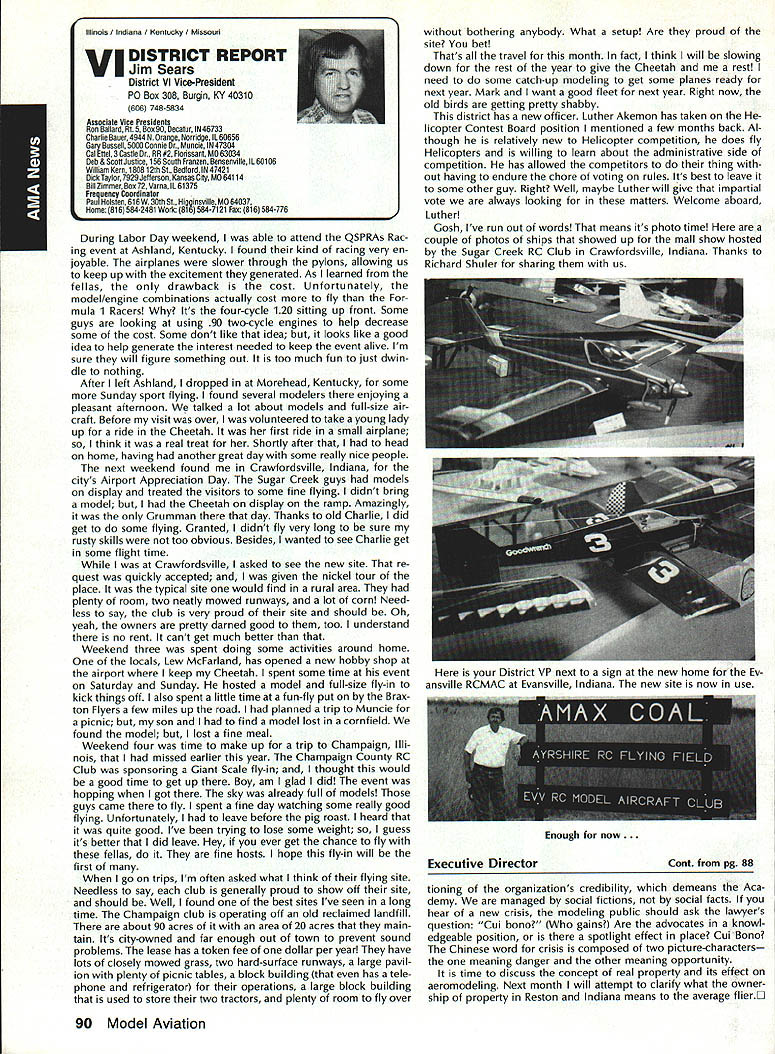
Labor Day weekend: I attended QSPRA's racing event at Ashland, Kentucky. The racing was very enjoyable; airplanes were slower through pylons, making it easier to follow. Cost is a drawback — four‑cycle 1.20 engines increase expense; some consider .90 two‑cycle engines to reduce costs.
After Ashland, I visited Morehead, Kentucky, for Sunday sport flying and took a young lady up for her first ride in a small airplane (Cheetah). At Crawfordsville, Indiana, I displayed the Cheetah and enjoyed flying with the Sugar Creek club.
Crawfordsville club’s site is typical rural: plenty of room, two mowed runways, and good club support with no rent.
The Champaign County RC Club's Giant Scale fly‑in was excellent. The club operates on a reclaimed landfill (about 30 acres, 20 maintained) with a one‑dollar yearly lease, hard‑surfaced runways, pavilion, block buildings with telephone and refrigerator, tractors, and ample flying space — a fine site.
New officer: Luther Akemon has taken on the Helicopter Contest Board position. Although relatively new to helicopter competition, he flies helicopters and is willing to learn the administrative side. Welcome, Luther.
Photo notes: Thanks to Richard Shuler for sharing photos from the Sugar Creek RC Club mall show in Crawfordsville.
---
AMA News
SOUND & MODEL AERONAUTICS (brief recap)
Howard Crispin, Jr.
This month's column concluded last month's MCC engine discussion. Sport and scale fliers should benefit. See the Byron Pitts example with a 1.2‑cu‑in. MCC engine on a 20 x 8 prop. Fred Erickson of Engine Research Associates provided information and demonstration to the AMA Executive Council at Muncie.
Reminder: NACA report reference should be 1192. For muffler math see Air Force Technical Report AFFDL‑TR‑76‑28 available from NTIS.
Site studies and sound measurement procedures were reiterated: review ordinances, measure ambient sound, take readings during operation, use triangulation to estimate distances, focus on sound level (exhaust note), and mitigate noise by altering aircraft, flight zones, and using effective mufflers.
---
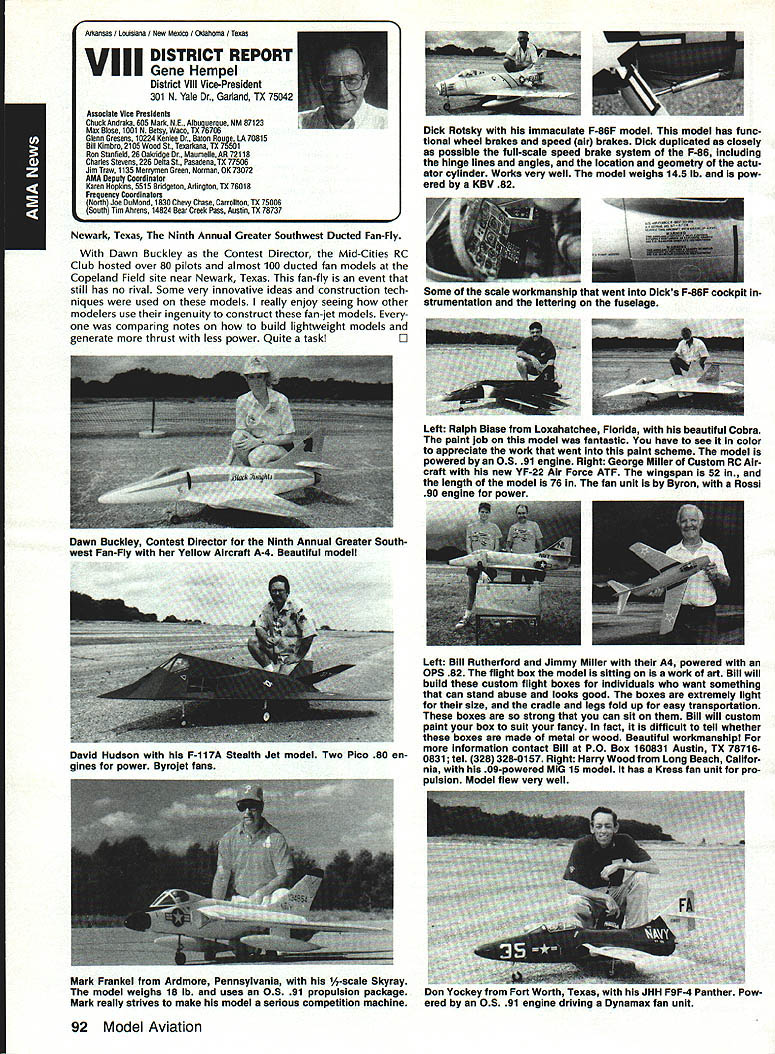
Newark, Texas — Ninth Annual Greater Southwest Ducted Fan‑Fly
Dawn Buckley served as Contest Director for a Mid‑Cities RC Club event at Copeland Field near Newark, Texas. Over 80 pilots and nearly 100 ducted fan models attended. The event showcased innovative construction techniques and lightweight designs to generate more thrust with less power.
---
IX DISTRICT REPORT
Travis McGinnis, Vice‑President
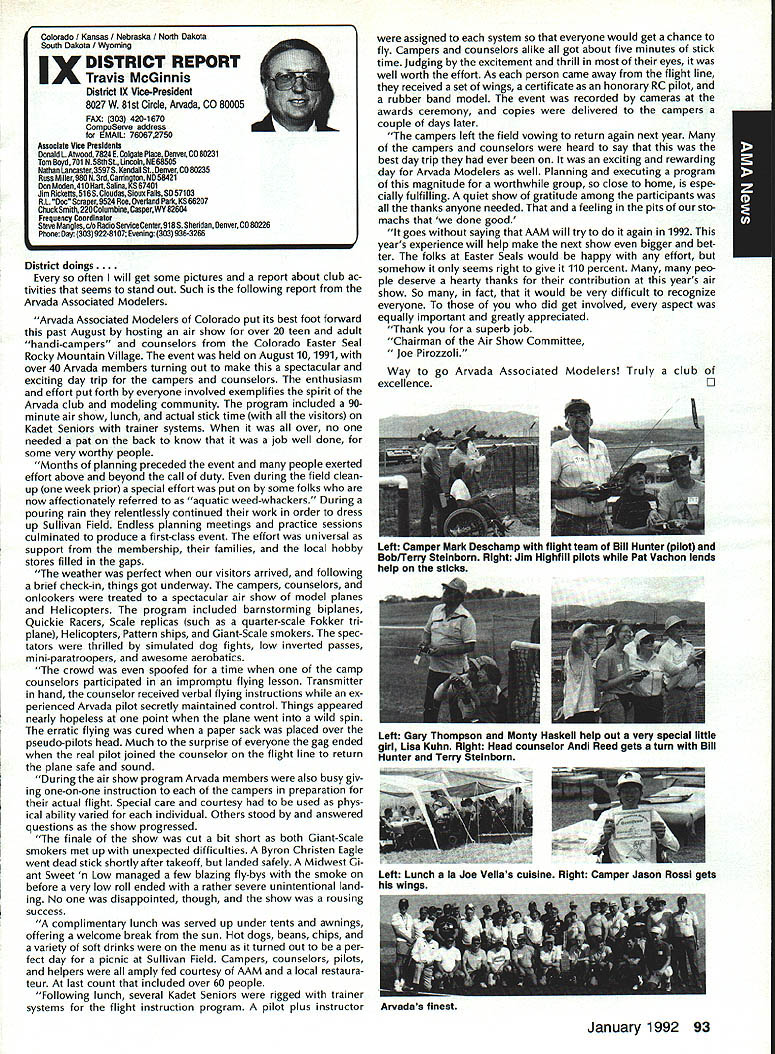
Arvada Associated Modelers (Colorado) — Air Show for Easter Seal campers:
- On August 10, 1991, Arvada hosted an air show for over 20 teen and adult "handi‑campers" and counselors from the Easter Seal Rocky Mountain Village.
- Over 40 Arvada members participated, providing a 90‑minute air show, lunch, and actual stick time on Kadet Seniors with trainer systems.
- The event included barnstorming biplanes, Quickie Racers, scale replicas (including a quarter‑scale Fokker triplane), helicopters, pattern ships, and giant‑scale smokers.
- The finale was shortened by two giant‑scale smokers experiencing difficulties, but no one was hurt and the event was a success.
- Campers received wings, a certificate as an honorary RC pilot, and a rubber‑band model. Photos were recorded and copies later delivered to campers.
- Arvada plans to repeat and expand the event in 1992.
Chairman of the Air Show Committee: Joe Pirozzoli. Way to go, Arvada Associated Modelers!
---
AMA News
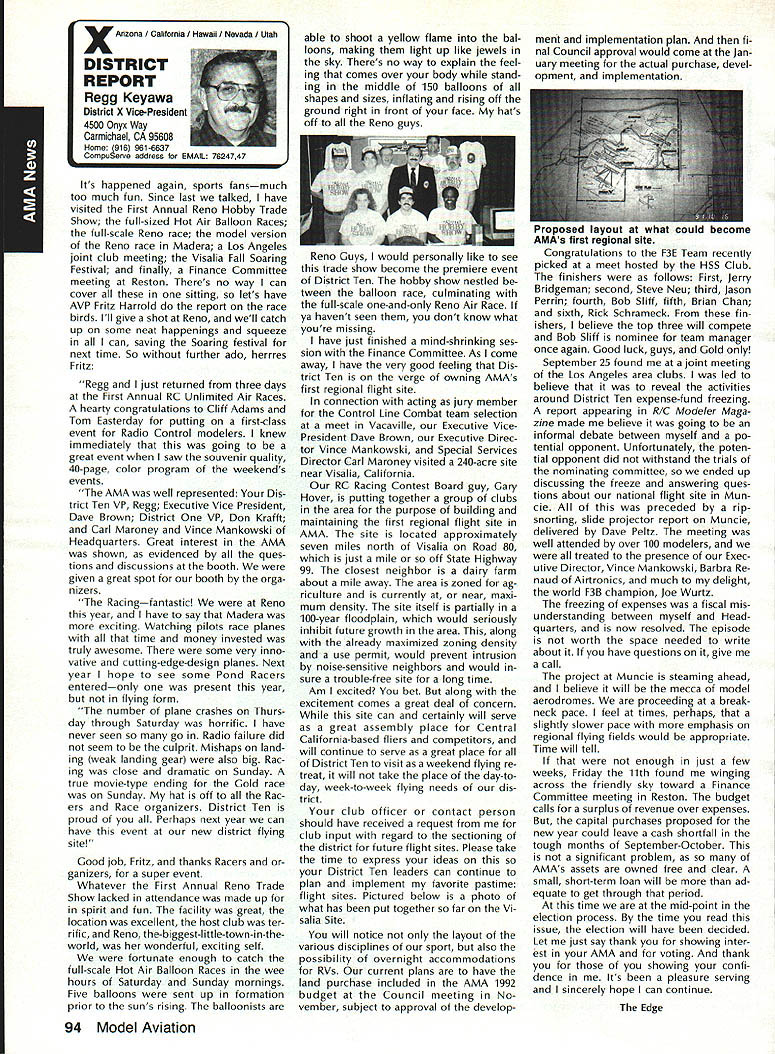
District Ten and regional site news: The Balloon Races and associated hobby show make for district attractions. A Finance Committee session suggested District Ten might be on the verge of owning AMA's first regional flight site.
A 240‑acre site near Visalia, California, was visited; the site is about seven miles north of Visalia, one mile off State Highway 99, with the nearest neighbor a dairy farm about a mile away. The area is zoned for agriculture and near maximum density; part of the site lies in a 100‑year floodplain, which limits future residential development and reduces potential noise‑sensitive intrusions.
Plans include facilities for various disciplines and possible overnight RV accommodations. Land purchase is proposed for inclusion in the AMA 1992 budget, subject to Council approval and a development/implementation plan.
F3E Team trials: Finishers at a recent meet hosted by HSS Club were:
- Jerry Bridgeman
- Steve Neu
- Jason Perrin
- Bob Sliff
- Brian Chan
- Rick Schrammek
The top three are expected to compete; Bob Sliff is nominee for team manager.
A joint meeting in Los Angeles addressed expense‑freeze concerns and Muncie updates; the matter was resolved. AMA projects at Muncie continue at a rapid pace, though an emphasis on regional flying fields is desirable.
The Finance Committee meeting in Reston indicated a budget surplus but potential late‑year cash shortfalls due to capital purchases; a short‑term loan should be adequate if required.
Mid‑point in the election process: thank you to members for participating.
---
Second Edition
Don Ross's first edition (5,000 copies) of Rubber Powered Model Airplanes sold out in just over two years. The second edition is in print and should be ready by November 11, 1991. It will be published by Markowski International. Don will stock 1,000 books for continued promotion and will ship orders directly from his home: Don Ross, 38 Churchill Road, Cresskill, NJ 07626. Price: $3.95 plus $1.05 postage ($5.00 total); each copy autographed.
Don is also starting work on a new book that will go beyond the basic primer to cover competition models (Coupe, Wakefield), CO2, electric, small gas, compressed air, materials such as Mylar, Kevlar, carbon fiber, foam construction, and new plans. He plans to include a chapter on modifying scale kits to make them fly and invites suggestions and sources for special materials.
---
Three Mini‑Sticks
Indoor Model Supply (Lew Gitlow) offers Mini‑Stick kits: three different designs per box, select core‑produced balsa for at least three models, design requirements, a plans sheet (including prop and trim details), and UltraFilm covering. Kits include all materials except cement. Price: $3.95.
Standard Quick Cement is available in a steel‑tip glue gun with wire insert for $2.95. Mini dual bearings (six for $4) are useful. An 18‑page catalog is $1 with the kit or $2 alone; add $3 for shipping. Mail: Indoor Model Supply, Box 531, Salem, OR 97304.
---
Flying Scale Plans
A request from Flying Scale modelers: designers and publishers of flying scale plans should always include an accurate three‑view drawing of the subject airplane. Three‑views are essential for documentation and are sometimes difficult to obtain elsewhere. Designers, please include an accurate three‑view on plans to fulfill their purpose.
---
Keep your tail light — I'll be with you next month.
Transcribed from original scans by AI. Minor OCR errors may remain.

