
Robert E. Vojslavek, 1937–2000
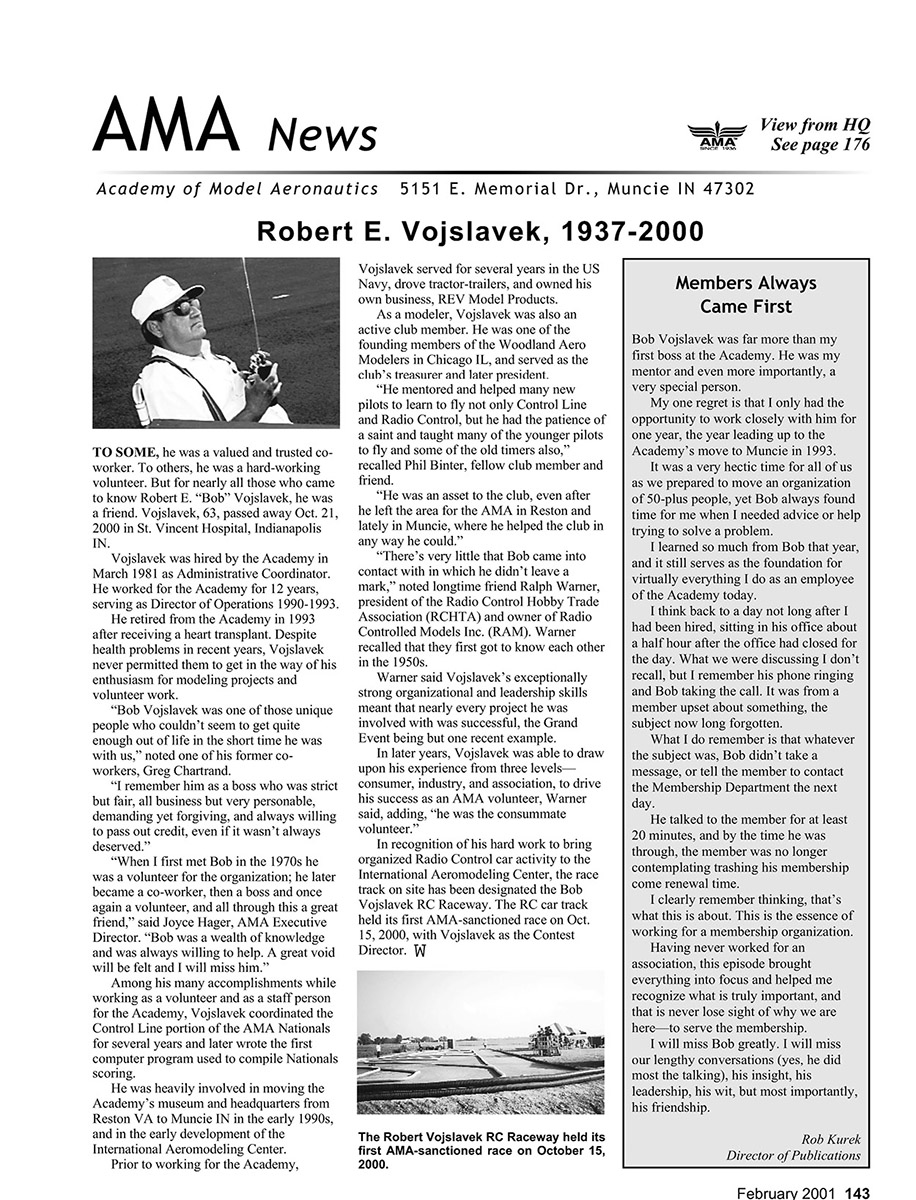
To some, he was a valued and trusted co-worker. To others, he was a hard-working volunteer. But for nearly all who came to know Robert E. "Bob" Vojslavek, he was a friend. Vojslavek, 63, passed away Oct. 21, 2000, at St. Vincent Hospital, Indianapolis, IN.
Vojslavek was hired by the Academy in March 1981 as Administrative Coordinator. He worked for the Academy for 12 years, serving as Director of Operations from 1990–1993. He retired from the Academy in 1993 after receiving a heart transplant. Despite health problems in recent years, Vojslavek never permitted them to get in the way of his enthusiasm for modeling projects and volunteer work.
"Bob Vojslavek was one of those unique people who couldn't seem to get quite enough out of life in the short time he was with us," noted one of his former co-workers, Greg Chartrand.
"I remember him as a boss who was strict but fair, all business but very personable, demanding yet forgiving, and always willing to pass out credit, even if it wasn't always deserved."
"When I first met Bob in the 1970s he was a volunteer for the organization; he later became a co-worker, then a boss and once again a volunteer, and all through this a great friend," said Joyce Hager, AMA Executive Director. "Bob was a wealth of knowledge and was always willing to help. A great void will be felt and I will miss him."
Among his many accomplishments while working as a volunteer and as a staff person for the Academy, Vojslavek coordinated the Control Line portion of the AMA Nationals for several years and later wrote the first computer program used to compile Nationals scoring.
He was heavily involved in moving the Academy's museum and headquarters from Reston, VA, to Muncie, IN in the early 1990s, and in the early development of the International Aeromodeling Center.
Prior to working for the Academy, Vojslavek served for several years in the U.S. Navy, drove tractor-trailers, and owned his own business, REV Model Products.
As a modeler, Vojslavek was also an active club member. He was one of the founding members of the Woodland Aero Modelers in Chicago, IL, and served as the club's treasurer and later president.
"He mentored and helped many new pilots to learn to fly not only Control Line and Radio Control, but he had the patience of a saint and taught many of the younger pilots to fly and some of the old timers also," recalled Phil Binter, fellow club member and friend.
"He was an asset to the club, even after he left the area for the AMA in Reston and later in Muncie, where he helped the club in any way he could."
"There's very little that Bob came into contact with in which he didn't leave a mark," noted longtime friend Ralph Warner, president of the Radio Control Hobby Trade Association (RCHTA) and owner of Radio Controlled Models Inc. (RAM). Warner recalled that they first got to know each other in the 1950s.
Warner said Vojslavek's exceptionally strong organizational and leadership skills meant that nearly every project he was involved with was successful, the Grand Event being but one recent example. In later years, Vojslavek was able to draw upon his experience from three levels — consumer, industry, and association — to drive his success as an AMA volunteer, Warner said, adding, "he was the consummate volunteer."
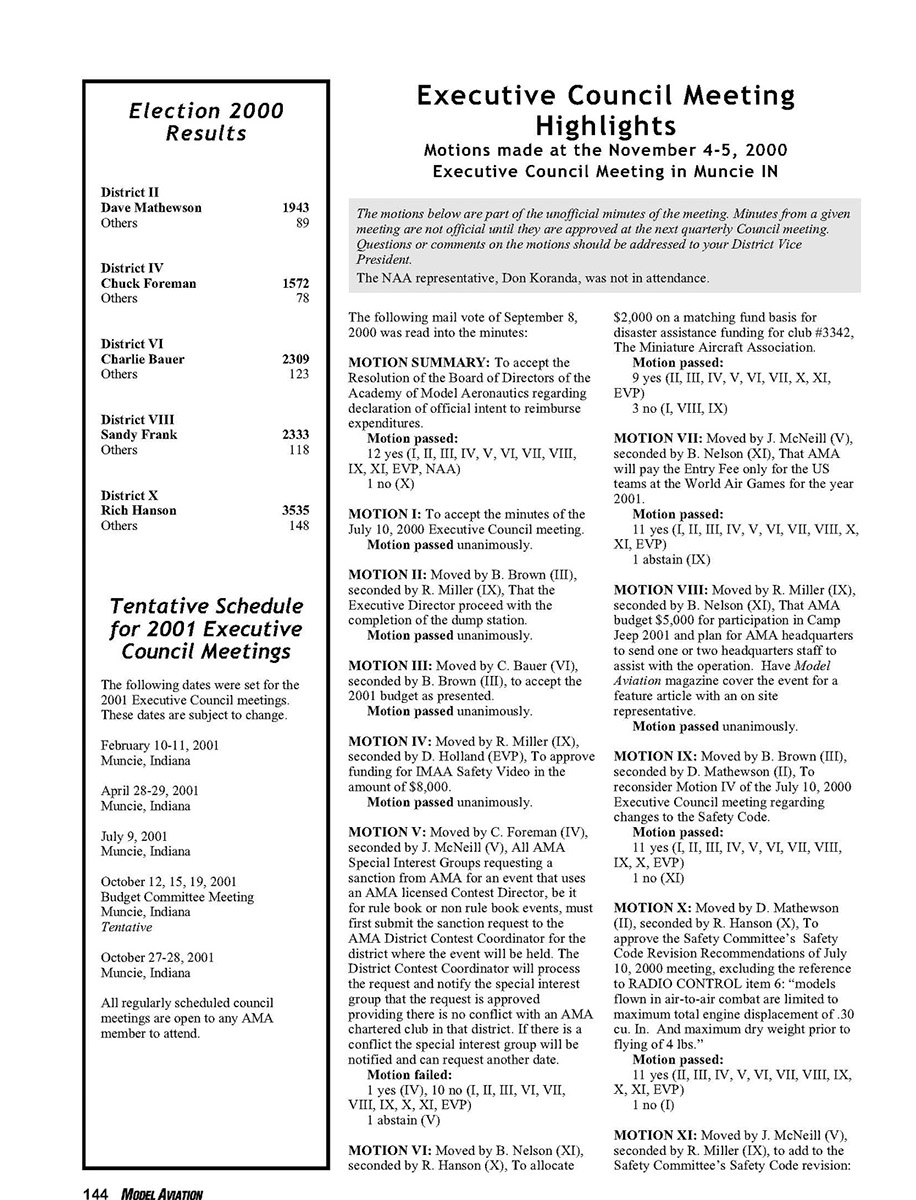
In recognition of his hard work to bring organized Radio Control car activity to the International Aeromodeling Center, the race track on site has been designated the Bob Vojslavek RC Raceway. The RC car track held its first AMA-sanctioned race on Oct. 15, 2000, with Vojslavek as the Contest Director.
---
Executive Council Meeting Highlights
Motions made at the November 4–5, 2000 Executive Council Meeting in Muncie, IN
The motions below are part of the unofficial minutes of the meeting. Minutes from a given meeting are not official until they are approved at the next quarterly Council meeting. Questions or comments on the motions should be addressed to your District Vice President.
The NAA representative, Don Koranda, was not in attendance.
The following mail vote of September 8, 2000 was read into the minutes:
- MOTION SUMMARY: To accept the Resolution of the Board of Directors of the Academy of Model Aeronautics regarding declaration of official intent to reimburse expenditures.
- Motion passed: 12 yes (I, II, III, IV, V, VI, VII, VIII, IX, XI, EVP, NAA); 1 no (X).
- MOTION I: To accept the minutes of the July 10, 2000 Executive Council meeting.
- Motion passed unanimously.
- MOTION II: Moved by B. Brown (III), seconded by R. Miller (IX). That the Executive Director proceed with the completion of the dump station.
- Motion passed unanimously.
- MOTION III: Moved by C. Bauer (VI), seconded by B. Brown (III). To accept the 2001 budget as presented.
- Motion passed unanimously.
- MOTION IV: Moved by R. Miller (IX), seconded by D. Holland (EVP). To approve funding for IMAA Safety Video in the amount of $8,000.
- Motion passed unanimously.
- MOTION V: Moved by C. Foreman (IV), seconded by J. McNeill (V). All AMA Special Interest Groups requesting a sanction from AMA for an event that uses an AMA licensed Contest Director, be it for rule book or non-rule book events, must first submit the sanction request to the AMA District Contest Coordinator for the district where the event will be held. The District Contest Coordinator will process the request and notify the special interest group that the request is approved providing there is no conflict with an AMA chartered club in that district. If there is a conflict the special interest group will be notified and can request another date.
- Motion failed: 1 yes (IV); 10 no (I, II, III, VI, VII, VIII, IX, X, XI, EVP); 1 abstain (V).
- MOTION VI: Moved by B. Nelson (XI), seconded by R. Hanson (X). To allocate $2,000 on a matching fund basis for disaster assistance funding for club #3342, The Miniature Aircraft Association.
- Motion passed: 9 yes (II, III, IV, V, VI, VII, X, XI, EVP); 3 no (I, VIII, IX).
- MOTION VII: Moved by J. McNeill (V), seconded by B. Nelson (XI). That AMA will pay the Entry Fee only for the US teams at the World Air Games for the year 2001.
- Motion passed: 11 yes (I, II, III, IV, V, VI, VII, VIII, X, XI, EVP); 1 abstain (IX).
- MOTION VIII: Moved by R. Miller (IX), seconded by B. Nelson (XI). That AMA budget $5,000 for participation in Camp Jeep 2001 and plan for AMA headquarters to send one or two headquarters staff to assist with the operation. Have Model Aviation magazine cover the event for a feature article with on-site representative.
- Motion passed unanimously.
- MOTION IX: Moved by B. Brown (III), seconded by D. Mathewson (II). To reconsider Motion IV of the July 10, 2000 Executive Council meeting regarding changes to the Safety Code.
- Motion passed: 11 yes (I, II, III, IV, V, VI, VII, VIII, IX, X, EVP); 1 no (XI).
- MOTION X: Moved by D. Mathewson (II), seconded by R. Hanson (X). To approve the Safety Committee's Safety Code Revision Recommendations of the July 10, 2000 meeting, excluding the reference to RADIO CONTROL item 6: "models flown in air-to-air combat are limited to maximum total engine displacement of .30 cu. in. and maximum dry weight prior to flying of 4 lbs."
- Motion passed: 11 yes (II, III, IV, V, VI, VII, VIII, IX, X, XI, EVP); 1 no (I).
- MOTION XI: Moved by J. McNeill (V), seconded by R. Miller (IX). To add to the Safety Committee's Safety Code revision: For Combat: distance between flight line and spectator line will be 500 feet per cubic inch of engine displacement. (Example: .40 engine = 200 feet.)
- Motion passed: 10 yes (II, III, IV, V, VI, VII, VIII, IX, X, XI, EVP); 2 no (I, X).
- MOTION XII: Moved by R. Miller (IX), seconded by B. Brown (III). To allocate an additional $1,000 for the District II VP budget for the remainder of the year 2000.
- Motion passed: 11 yes (I, II, III, IV, V, VI, VII, VIII, IX, X, XI, EVP); 1 abstain (VIII).
- MOTION XIII: Moved by C. Bauer (VI), seconded by R. Miller (IX). A Senior Citizen discount for the year 2002 and beyond license renewal shall be given to those persons born in 1935 or before.
- This motion was tabled.
- MOTION XIV: Moved by R. Miller (IX), seconded by B. Brown (III). To table MOTION XIII until the next council meeting.
- Motion passed: 10 yes (I, II, III, IV, VI, VII, VIII, IX, X, XI, EVP); 2 no (V, unknown).
- MOTION XV: Died for lack of a second.
- MOTION XVI: Moved by S. Frank (VIII), seconded by R. Miller (IX). To accept the new AMA Special Interest Group NIRCAC (National Indoor Remote Control Aircraft Council).
- Motion passed unanimously.
- MOTION XVII: Moved by J. McNeill (V), seconded by C. Bauer (VI). To accept the 2001 Nationals as a 5A contest; dates are Indoor May 30–June 3, 2001 and Outdoor July 6–August 2, 2001.
- Motion passed unanimously.
- MOTION XVIII: Moved by R. Hanson (X), seconded by C. Bauer (VI). The AMA Executive Council establish a standing committee titled the Flying Site Acquisition and Development Committee to oversee the Academy's activities in this area.
- The Chairman of the committee will be appointed by the AMA President. Committee members will be appointed by the chairman and shall consist of AMA Executive Council members, AMA Leader members, and others deemed beneficial to the committee's activities. The AMA Executive Director shall appoint one member from the AMA staff to facilitate the committee. It is recommended this individual be the Flying Site Acquisition and Development program director or a member of his/her staff.
- The committee shall meet as deemed necessary by the committee chairman, but shall meet no less than once each calendar year.
- The duties of the committee shall include but not be limited to: reviewing and approving the Flying Site Acquisition and Development mission statement and annual goals and objectives; reviewing monthly program progress reports submitted to the committee by the program director; at the end of each year, evaluating the program's progress in meeting the stated goals and objectives and reporting the results of the evaluation to the Executive Council.
- This motion was tabled.
- MOTION XIX: Moved by C. Foreman (IV), seconded by R. Miller (IX). To table MOTION XVIII until the first Executive Council meeting of 2002.
- Motion passed: 8 yes (I, III, IV, V, VI, IX, X, EVP); 4 no (VII, VIII, XI, unknown).
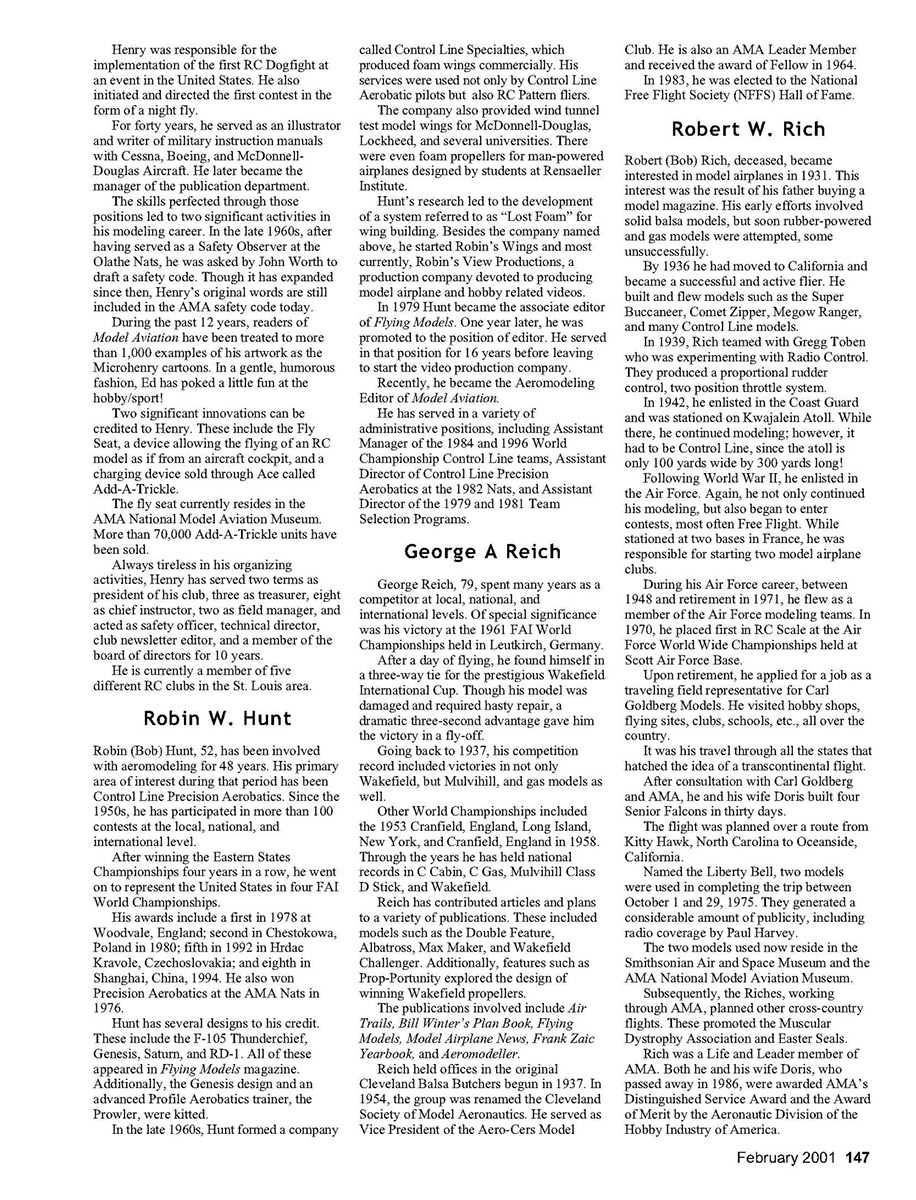
The RC car track at Muncie was dedicated and named the Bob Vojslavek RC Raceway.
---
Edward Daniel Calkin
Edward Calkin built his first successful model aircraft engine when he was only 17 years old. His first Elf engine was sold in July 1935.
He devoted his life to the advancement of model aviation by pioneering the development of small engines. He was famous for the Corncob, Elf Single, Elf Twin, Elf Four, and Elf Six. The smallest of these, the Corncob, was specifically designed for the Texaco-type event. It would run approximately 42 minutes on an ounce of fuel.
Calkin graduated with honors from MIT in 1933 with a master's degree in mechanical engineering.
Other technical achievements included the development and manufacturing of a small lightweight 1.5-volt coil, propellers, 1/4-32-size spark plugs, a model aircraft engine-driven fuel pump, and an RC stick assembly for Jim Walker in 1940.
Calkin did considerable research into RC model airplane flight controls, developing both mechanical and pneumatic systems. He frequently contributed to the model magazines of the day, most notably Model Airplane News. Elf-powered airplanes were common in publications such as the 1938 Model Aeronautic Yearbook by Frank Zaic.
When his shop closed in 1956, he devoted himself to a new career working as a scientist at Douglas Missile Division in Santa Monica, California. He created mathematical models for missiles used to design the guidance systems.
His peers considered him a near-genius and he was highly respected. After his retirement, he was known to say that he got the most satisfaction in life from making the Elf engines! During his Douglas days and until his death, he devoted himself to developing a Radio Control system. Ever the perfectionist, he never got it to work to his satisfaction.
Calkin served as a judge at many contests. He worked tirelessly to obtain positive publicity for the hobby/sport, as well as encourage youth participation. His reputation as a master craftsman and engineer survives, along with the legacy of the Elf engine.
---
Joseph Elgin
Joseph Elgin, 80, hails from Ohio. Growing up in the Cleveland area during the Depression, he discovered aeromodeling and regularly flew with and competed against luminaries such as Dick Korda and Chet Lanzo.
Both before and after World War II, he successfully competed in Free Flight on a world-class level. In 1951, he competed in FAI Wakefield, representing the United States in Finland. The same year, he competed in Gas Free Flight in France. In 1953, he participated in Gas Free Flight in Cranfield, England.
His connection with Cleveland Models resulted in the design and kitting of many famous Free Flight designs, including the Playboy Junior and Senior, Condor, Eaglet, Baby Playboy, Itsy Bitsy, Viking, Thermaliner, and Gull.
In 1972, working in conjunction with Chet Lanzo, he designed a more portable sailplane winch.
Elgin's national competition record included a variety of events throughout the years. In 1950, he finished first in CO2 Free Flight at the Nats. The FAI Free Flight Gas team trophy was earned in 1953, along with a first in Free Flight Gas with a .15 glow engine.
He was a founding member of the Cleveland Society of Model Aeronautics in 1948 and served as president of that group as well as president of the Buckeye Soaring Club.
His many model designs continue to be flown today by thousands of modelers worldwide.
---
Robert Gialdini
Robert Gialdini, 67, has spent more than a half-century in aeromodelling. His primary area of interest originally was Control Line Precision Aerobatics.
Since the late 1950s, he has been a competitor, designer, and official, both nationally and internationally. He served as an FAI World Championships judge in 1966, 1976, and 1992. At these events, Gialdini worked diligently at being an ambassador of good will while working with officials from around the world.
As a competitor, he won the open event and the Walker Cup at the 1963 and 1965 National Aeromodelling Championships (Nats). In other Nats, he finished third, fourth, fifth, 10th and 11th.
As a noted figure in the center of the circle, he was recognized for his natty appearance, dressed in pristine white clothes and shoes. Upon Gialdini's 1996 induction into the Precision Aerobatics Model Pilot's Association (PAMPA) Hall of Fame, he was said to have pioneered the "Professional Look" at the Nats.
In addition to many Nats wins, Gialdini placed third at the FAI F2B World Championships (1964) in Budapest, Hungary, leading the United States to a team victory.
As a designer, he has had a variety of plans published. These include the Olympic MK. VII (1963) and Stingray (1965, Control Line). He also product-reviewed the Atlanta .60 in 1985 (Radio Control).
He pioneered the use of mufflers long before they were required, having won the 1965 F2B event at the Nats with a muffler-equipped model. It was fitted to another model of his design, the Eclipse. Throughout a long period, he worked at promoting sound-reduction programs. Two of Gialdini's models, including the Eclipse, are currently in AMA's National Model Aviation Museum.
He served as president of the Devil Creek Flyers, Inc. from 1991–1998. On several occasions, he served as a Contest Director for local meets, and in 1963 he managed the F2B Team Selection event.
In recent years, Gialdini worked diligently at establishing a stronger bond between the AMA and the Experimental Aircraft Association (EAA). This led to his developing a proposal to host an FAI Control Line World Championships at the Oshkosh home of EAA.
---
Ed Henry
Ed Henry, 80, has spent 62 years involved in aeromodelling. He still flies monthly and has not missed a month for the last 16 years. He started counting flights in 1985 and has made more than 5,000 flights since then.
Henry has trained more than 100 RC pilots in the last 15 years. He states that flying "makes me young and happy."
While he entered many contests from 1956 through 1997, winning trophies and hardware, he is noted for organizing and running many more. The McDonnell-Douglas RC club, for which Henry was founder and first president, has conducted an annual RC contest for the last 40 years. He was the first Contest Director for the event and the assistant for the next 17 years.
Henry was responsible for the implementation of the first RC Dogfight at an event in the United States. He also initiated and directed the first contest in the form of a night fly.
For forty years, he served as an illustrator and writer of military instruction manuals with Cessna, Boeing, and McDonnell-Douglas Aircraft. He later became the manager of the publication department. The skills perfected through those positions led to two significant activities in his modeling career.
In the late 1960s, after having served as a Safety Observer at the Olathe Nats, he was asked by John Worth to draft a safety code. Though it has expanded since then, Henry's original words are still included in the AMA safety code today.
During the past 12 years, readers of Model Aviation have been treated to more than 1,000 examples of his artwork as the Microhenry cartoons. In a gentle, humorous fashion, Ed has poked a little fun at the hobby/sport!
Two significant innovations can be credited to Henry: the Fly Seat, a device allowing the flying of an RC model as if from an aircraft cockpit, and a charging device sold through Ace called Add-A-Trickle. The Fly Seat currently resides in the AMA National Model Aviation Museum. More than 70,000 Add-A-Trickle units have been sold.
Always tireless in his organizing activities, Henry has served two terms as president of his club, three as treasurer, eight as chief instructor, two as field manager, and acted as safety officer, technical director, club newsletter editor, and a member of the board of directors for 10 years. He is currently a member of five different RC clubs in the St. Louis area.
---
Robin W. Hunt
Robin (Bob) Hunt, 52, has been involved with aeromodelling for 48 years. His primary area of interest has been Control Line Precision Aerobatics. Since the 1950s, he has participated in more than 100 contests at local, national, and international levels.
After winning the Eastern States Championships four years in a row, he went on to represent the United States in four FAI World Championships. His awards include first in 1978 at Woodvale, England; second in Chestokova, Poland in 1980; fifth in 1992 in Hradec Kralove, Czechoslovakia; and eighth in Shanghai, China, 1994. He also won Precision Aerobatics at the AMA Nats in 1976.
Hunt has several designs to his credit, including the F-105 Thunderchief, Genesis, Saturn, and RD-1. All of these appeared in Flying Models magazine. Additionally, the Genesis design and an advanced profile aerobatics trainer, the Prowler, were kitted.
In the late 1960s, Hunt formed a company called Control Line Specialties, which produced foam wings commercially. His services were used not only by Control Line Aerobatic pilots but also by RC Pattern fliers. The company also provided wind-tunnel test model wings for McDonnell-Douglas, Lockheed, and several universities. There were even foam propellers for man-powered airplanes designed by students at Rensselaer Institute.
Hunt's research led to the development of a system referred to as "Lost Foam" for wing building. Besides the company named above, he started Robin's Wings and, most recently, Robin's View Productions, a production company devoted to producing model airplane and hobby-related videos.
In 1979 Hunt became the associate editor of Flying Models. One year later, he was promoted to editor and served in that position for 16 years before leaving to start the video production company. Recently, he became the Aeromodelling Editor of Model Aviation.
He has served in a variety of administrative positions, including Assistant Manager of the 1984 and 1996 World Championship Control Line teams, Assistant Director of Control Line Precision Aerobatics at the 1982 Nats, and Assistant Director of the 1979 and 1981 Team Selection Programs.
---
George A. Reich
George Reich, 79, spent many years as a competitor at local, national, and international levels. Of special significance was his victory at the 1961 FAI World Championships held in Leutkirch, Germany.
After a day of flying, he found himself in a three-way tie for the prestigious Wakefield International Cup. Though his model was damaged and required hasty repair, a dramatic three-second advantage gave him the victory in a fly-off.
Going back to 1937, his competition record included victories in Wakefield, Mulvihill, and gas models. Other World Championships included the 1953 Cranfield, England, Long Island, New York, and Cranfield, England in 1958. Through the years he has held national records in C Cabin, C Gas, Mulvihill Class D Stick, and Wakefield.
Reich contributed articles and plans to a variety of publications. These included models such as the Double Feature, Albatross, Max Maker, and Wakefield Challenger. Features such as Prop-Portunity explored the design of winning Wakefield propellers. Publications involved include Air Trails, Bill Winter's Plan Book, Flying Models, Model Airplane News, Frank Zaic Yearbook, and Aeromodeller.
Reich held offices in the original Cleveland Balsa Butchers begun in 1937. In 1954, the group was renamed the Cleveland Society of Model Aeronautics. He served as Vice President of the Aero-Cers Model Club. He is also an AMA Leader Member and received the award of Fellow in 1964. In 1983, he was elected to the National Free Flight Society (NFFS) Hall of Fame.
---
Robert W. Rich
Robert (Bob) Rich became interested in model airplanes in 1931 after his father bought a model magazine. His early efforts involved solid balsa models, then rubber-powered and gas models.
By 1936 he had moved to California and became a successful and active flier. He built and flew models such as the Super Buccaneer, Comet Zipper, Megow Ranger, and many Control Line models.
In 1939, Rich teamed with Gregg Toben, who was experimenting with Radio Control. They produced a proportional rudder control and a two-position throttle system.
In 1942, he enlisted in the Coast Guard and was stationed on Kwajalein Atoll. While there, he continued modeling—though it had to be Control Line because the atoll is only 100 yards wide by 300 yards long!
Following World War II, he enlisted in the Air Force. While stationed at two bases in France, he was responsible for starting two model airplane clubs. During his Air Force career (1948–1971), he flew as a member of the Air Force modeling teams. In 1970, he placed first in RC Scale at the Air Force World Wide Championships held at Scott Air Force Base.
Upon retirement, he worked as a traveling field representative for Carl Goldberg Models, visiting hobby shops, flying sites, clubs, and schools across the country. His travels hatched the idea of a transcontinental flight. After consultation with Carl Goldberg and AMA, he and his wife Doris built four Senior Falcons in thirty days.
The flight, named the Liberty Bell, was planned from Kitty Hawk, North Carolina to Oceanside, California. Two models completed the trip between October 1 and 29, 1975, generating considerable publicity, including radio coverage by Paul Harvey. The two models used now reside in the Smithsonian Air and Space Museum and the AMA National Model Aviation Museum.
Subsequently, the Riches, working through AMA, planned other cross-country flights to promote the Muscular Dystrophy Association and Easter Seals.
Rich was a Life and Leader member of AMA. Both he and his wife Doris (who passed away in 1986) were awarded AMA's Distinguished Service Award and the Award of Merit by the Aeronautic Division of the Hobby Industry of America.
---
AMA News - 2001/02
Richard J. Sherman
Richard (Dick) Sherman, 76, built his first model airplane 70 years ago and is still active today in Old Timer Free Flight and RC sailplanes. He is probably best known for his model airplane museum started in 1957 in Plymouth, New Hampshire, which is open to the public and free of charge.
Sherman was a volunteer worker at most of the AMA Nats from 1958 to 1985. After retiring as an airline pilot in 1970, he assumed responsibility for organizing the archives for AMA. In 1975, the Academy presented him with the AMA Distinguished Service Award for the work accomplished through his museum, recognizing him as "Curator of Model Aviation History." A second Distinguished Service Award was presented following his 11 years of service as the District I Scale Contest board member.
Sherman attended many contests, flying a variety of model types. In 1953, he held the Control Line Class A Speed record—for one week! Indoor Rubber, 1/2A Free Flight, hand-launch, Wakefield, and many different SAM events held his interest.
In 1986, he was awarded the prestigious "Old Goat Award" by SAM. He has flown in the Australian Nats, the 50th anniversary of the Wakefield Trophy, and the 50th anniversary of the first flight of the Blackburn SKUA aircraft in England. He published plans for his Coupe d'Hiver in 1970.
In 1958, he turned the family's 30-acre farm into a flying site for area clubs, including areas for Free Flight, an 80' x 300' runway for RC, and an 80' circle for Control Line. Sherman also organized model groups for Cub Scouts and Boy Scouts in his area and served as aviation merit badge counselor until 1989 for the Lowell District.
Sherman helped organize the original New England Model Aircraft Council and served as club president for the Lawrence Aristocrats three times between 1959–1965. He is currently an Associate Vice President for District I.
---
Joe Wagner
Joe Wagner, 72, has spent 65 years as a "pilot with his feet on the ground." He co-founded the International S.M.A.L.L. movement for small models (Small Model Aircraft Lovers League) and maintains a website at smallnet.com.
In 1958, Wagner organized the Model Engine Collectors' Association (MECA) and served until 1961 editing and publishing the MECA Journal. For 10 years, Wagner wrote and illustrated three separate columns for Model Airplane News: "Small Steps," "About Those Engines," and "Building Model Airplanes." He also published articles in Air Trails, Flying Models, Model Builder, and Model Aviation.
Starting in 1950, Wagner served as the Chief Engineer of Veco, producing a popular line of model products. Several of his designs were kitted, including the Sioux, Commanche, Scout, Chief, Squaw, Papoose, Brave, and Warrior. He was responsible for the Dakota, a Free Flight biplane. In 1954, Wagner was hired by Ken-Hi and acted as consulting engineer for manufacturers including Cox, Revell, Pactra, and Babcock Radio.
Since 1946, Wagner has been an AMA Contest Director and Scientific Leader Member.
---
Le Roy Weber
Le Roy Weber, 81, has been an AMA member since it was established in 1936. Weber's first love in modeling is Scale competition. In the 1960s he served as the Scale Event Director at the AMA Nats in Los Alamitos, Dallas, Willow Grove, and Glenview.
On the international scene, Weber promoted Scale modeling worldwide. He is responsible for introducing Scale competition in the FAI modeling community and served as Chairman of the FAI CIAM Scale Subcommittee beginning in 1960. He served as a judge at four Scale World Championships and on many AMA Nats competitions.
As Chairman of the FAI Scale Advisory Committee, he helped maintain rules and U.S. participation in the international Scale scene. In 1970, he served as the Team Manager for the United States team participating in England.
Weber is noted for a vast collection of Scale documentation; much of this material is now part of the AMA National Model Aviation Museum. In 1966, he authored Profile Publication #106, depicting the famous P-38. In 1974, the Academy awarded Weber the AMA Distinguished Service Award and AMA Fellow. He continues to attend all FAI Scale World Championships, most recently the 2000 event in Interlaken, Switzerland.
---
John Zaic
John Zaic, 85, has been an active model builder and contestant since the 1920s. He and his brother Frank began their model-building career in the pre-balsa days using hardwood, red bamboo secured with thread, and LePage's glue. Following Lindbergh's historic flight in 1927, model building became common and more successful.
As indoor model design improved, hazards such as girders and snags became a problem. Zaic's solution was the use of gas-filled balloons to dislodge aircraft caught high in rafters. He saw the benefits of balsa wood (used as shielding in shipping), acquired a table saw, and began producing sheets, strips, and blocks for modelers' use. He developed a grading system regarding weight and types of cuts to help in model construction. In 1933, the Aeronautical Supply Depot was created; later, with a capital of $75, this became the Junior Aeronautical Supply Co.
Besides balsa supplies, John developed and distributed a successful microfilm solution for indoor models. Late in 1933, John returned to live with his parents in Slovenia. His brother Frank maintained the company until the entire Zaic family returned to the United States in 1939.
John served in World War II, and upon his return the Junior Aeronautical Supply Company became a family project. John was the driving force in developing production methods, sources of supply, designs, and kitting a line of gas models, RC, gliders, etc. The line of products became known ultimately as Jasco.
John, along with his brother Frank, is recognized as a true aeromodeling pioneer. Much interesting information about John and this era can be gleaned from the many Yearbooks written and published by Frank Zaic, beginning in the 1930s.
Congratulations to these 13 deserving individuals as they enter the Model Aviation Hall of Fame. They can be proud that their contributions have helped aeromodeling achieve significant progress through the years.
---
Focus on Education
Michael Smith AMA Education Committee Member
Rocco Ferrario, in the December Focus on Education column, made a point I would like to carry one step farther. I believe there are thousands of children and adults who simply love aviation but do not know how to become involved. In the museum we encounter this frequently as visitors view the exhibits. The question is: how do we find these individuals and introduce them to model aviation? How do we make them aware of the many benefits that model aviation can offer?
It is one thing for visitors to ooh and ahh at beautifully constructed models; it is another matter entirely to get them involved. The key is to reach out, and this does not simply mean showing someone an airplane. It means getting them involved, even if it is only for a few minutes.
Recently the museum set up a booth at Ball State University's Homecoming game to reach this untapped market. With the assistance of many volunteers, we exhibited approximately 14 aircraft, similar to a mall show. These included Scale models, a ducted-fan jet, several sport models, sailplanes, a trainer, and a couple of model cars. Brochures, literature, AMA stickers, and passes to the museum were also handed out.
Before kickoff, hand-launched gliders and an electric glider were flown for the gathering crowd. Wind hampered the flying, but interest generated by the booth more than made up for this as those staffing the booth were busy answering questions the entire time. Attendance for the game was approximately 17,800. Of course, not all of these people will become modelers, but they were introduced to the hobby and were able to speak with enthusiastic supporters. The only thing missing was the hands-on component.
Have you ever witnessed a child's—or an adult's—eyes open wide as they begin to understand an idea or concept? AMA Education Coordinator Jack Frost and I were fortunate enough to see this repeatedly during TechKnowFest. This one-day event, run by Ivy Tech State College in Kokomo, Indiana, is geared toward bringing a new perspective to learning.
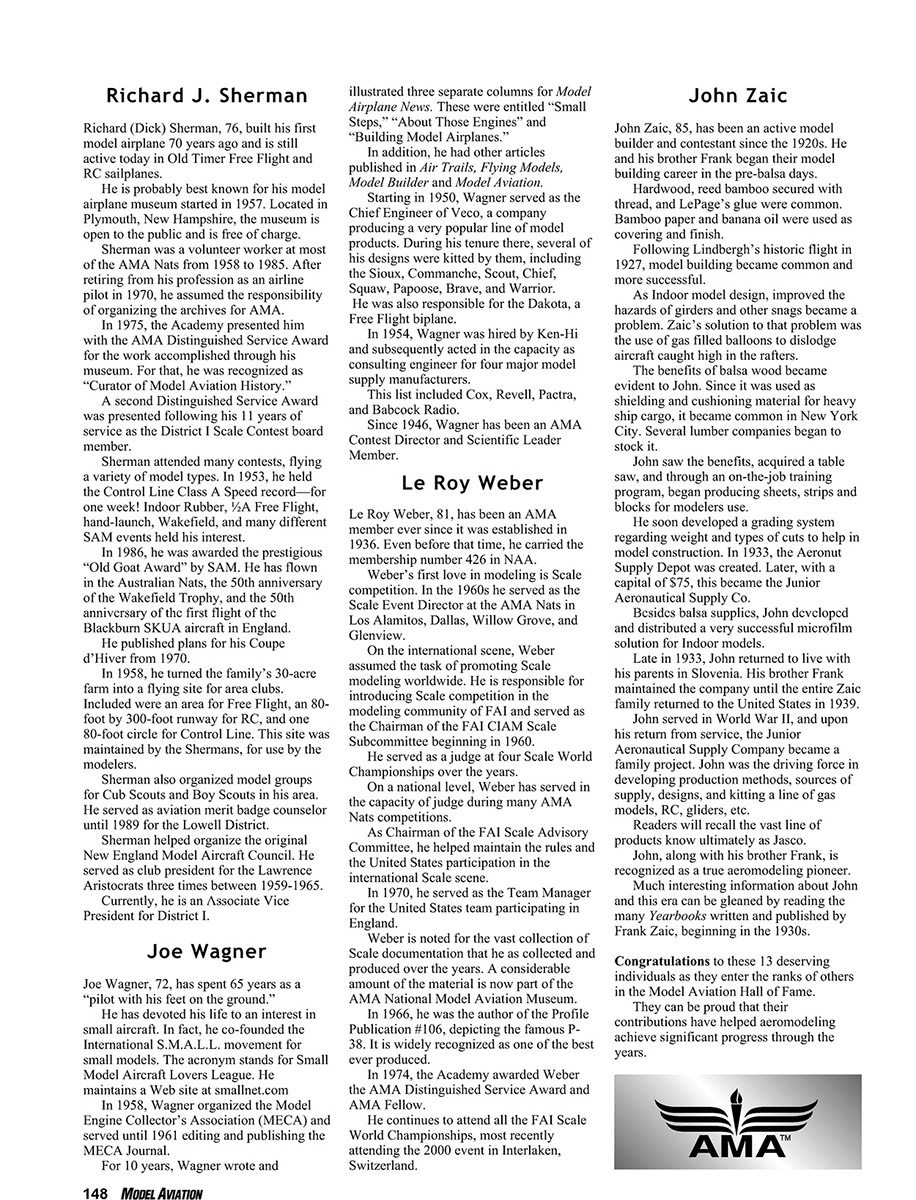
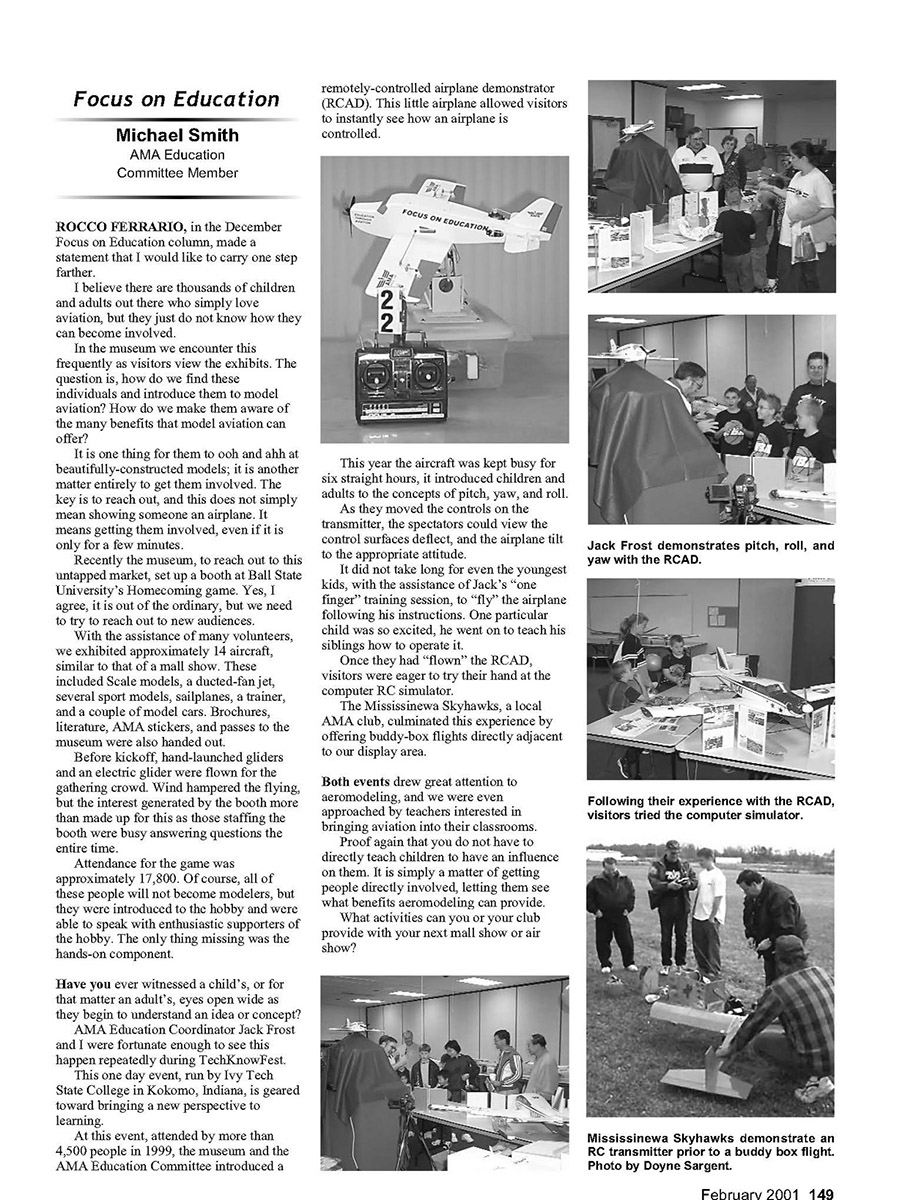
At TechKnowFest the museum and the AMA Education Committee introduced a remotely controlled airplane demonstrator (RCAD). This little airplane allowed visitors to instantly see how an airplane is controlled. The aircraft was busy for six straight hours, introducing children and adults to the concepts of pitch, yaw, and roll. As they moved the controls on the transmitter, spectators could view the control surfaces deflect and the airplane tilt to the appropriate attitude.
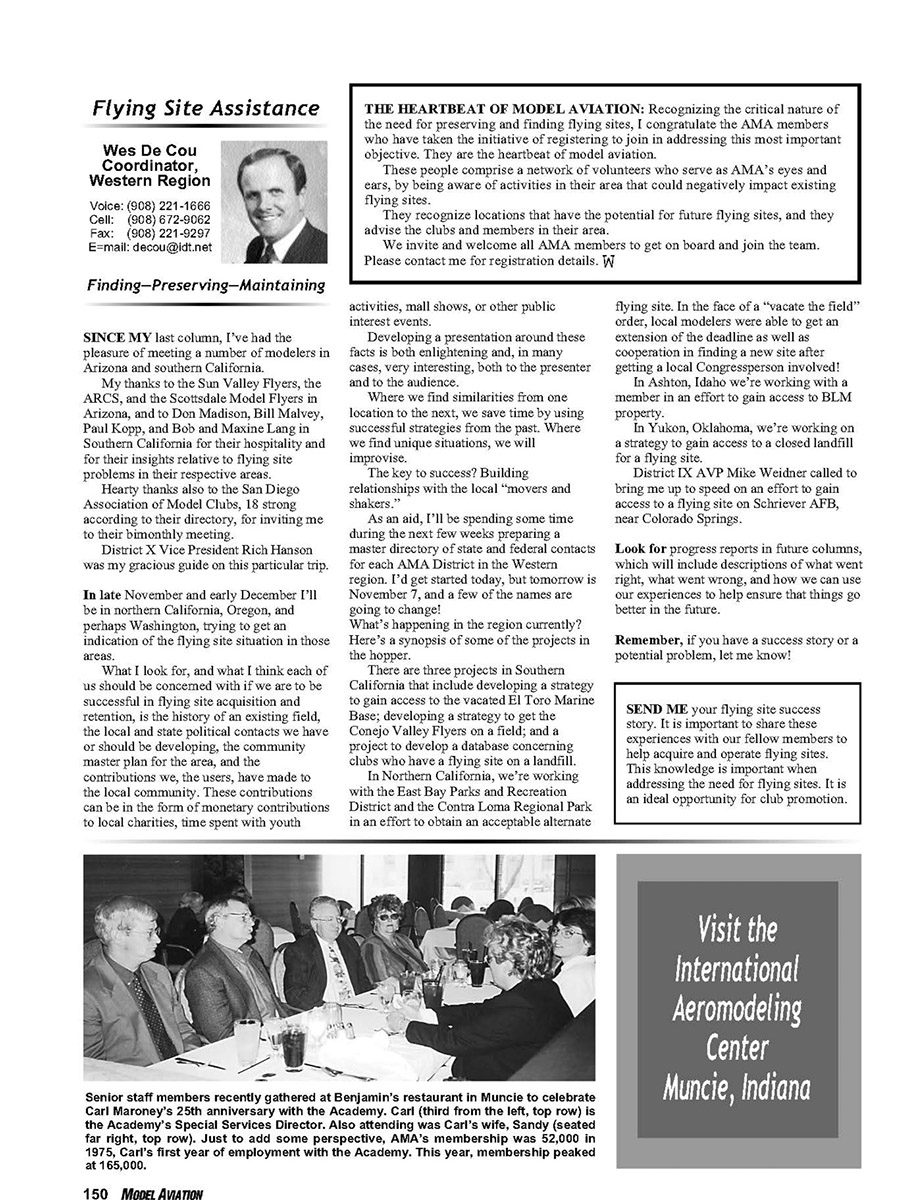
It did not take long for even the youngest kids, with the assistance of Jack's "one finger" training session, to "fly" the airplane following his instructions. One child was so excited he went on to teach his siblings how to operate it. Once they had "flown" the RCAD, visitors were eager to try the computer RC simulator. The Mississinewa Skyhawks, a local AMA club, culminated this experience by offering buddy-box flights adjacent to our display area. Both events drew great attention to aeromodelling, and we were even approached by teachers interested in bringing aviation into their classrooms.
Proof again that you do not have to directly teach children to have an influence on them. It is simply a matter of getting people directly involved, letting them see the benefits aeromodelling can provide. What activities can you or your club provide at your next mall show or air show?
Since my last column, I've met a number of modelers in Arizona and southern California. My thanks to the Sun Valley Flyers, the ARCS, and the Scottsdale Model Flyers in Arizona, and to Don Madison, Bill Malvey, Paul Kopp, and Bob and Maxine Lang in Southern California for their hospitality and insights into flying-site problems in their areas. Hearty thanks also to the San Diego Association of Model Clubs for inviting me to their bimonthly meeting. District IX Vice President Rich Hanson was my gracious guide on this trip.
In late November and early December I'll be in northern California, Oregon, and perhaps Washington, trying to get an indication of the flying-site situation in those areas. What I look for—and what each of us should be concerned with to be successful in flying site acquisition and retention—is the history of an existing field, the local and state political contacts we have or should be developing, the community master plan for the area, and the contributions we, the users, have made to the local community. These contributions can be monetary donations to local charities, time spent with youth activities, mall shows, or other public-interest events.
Developing a presentation around these facts is both enlightening and, in many cases, very interesting to the presenter and the audience. Where we find similarities from one location to the next, we save time by using successful strategies from the past. Where we find unique situations, we will improvise. The key to success? Building relationships with the local "movers and shakers."
As an aid, I'll be spending some time during the next few weeks preparing a master directory of state and federal contacts for each AMA District in the Western region.
What's happening in the region currently? Here's a synopsis of projects in the hopper:
- Southern California: developing strategies to gain access to the vacated El Toro Marine Base; getting the Conejo Valley Flyers on a field; developing a database concerning clubs with flying sites on landfills.
- Northern California: working with the East Bay Parks and Recreation District and Contra Loma Regional Park to obtain an acceptable alternate flying site. Local modelers were able to get an extension of a "vacate the field" order and cooperation in finding a new site after involving a local Congressperson.
- Ashton, Idaho: working with a member to gain access to BLM property.
- Yukon, Oklahoma: working on a strategy to gain access to a closed landfill for a flying site.
- Near Colorado Springs: efforts to gain access to a flying site on Schriever AFB.
Look for progress reports in future columns, which will include descriptions of what went right, what went wrong, and how we can use our experiences to help ensure that things go better in the future.
SEND ME your flying-site success story. Sharing these stories helps fellow members acquire and operate flying sites and is an ideal opportunity for club promotion.
---
Sound Advice
Ian Maclaughlin 11453 Alps Way, Escondido, CA 92026–7026 E-mail: ian@spawar.navy.mil
Does your club flying site have a sound level limit? If your answer isn't "yes," it is probably wrong. Almost every site does have a limit on allowable sound emission. If that limit is exceeded, community reaction could bring enough pressure to result in prohibition of model flying there.
The real question is: do you know what the sound level limit is at your flying site? When the answer is a confident "yes," you will have completed the first and most critical step in protecting your field from loss due to negative community reaction.
I've had many inquiries as to the current AMA rules for governing sound levels. The simple answer is that there aren't any universal rules, except for a limited number of competition categories. AMA is not a controlling authority for noise abatement. The role of the AMA Sound Committee is not to make and enforce rules, but to assist you in meeting the regulations set by those who have authority.
In the U.S., that authority is normally at a local county or city level, and the standards are delineated in codes and ordinances. This places more burden on clubs for noise control than in England, for example, where standards are set at the central government level and the British Model Flying Association (BMFA) implements rules flowing from Department of Environment standards.
The 90 dBA at nine-foot standard that AMA has recommended for many years is essentially the same as the BMFA's 82 dBA at seven meters when compensation is made for different measurement distances. The significant difference is the BMFA rule is mandatory and the AMA rule is voluntary.
The AMA Sound Committee now promotes an alternative to the "90 at nine" guideline: "Do what it takes to comply with local community standards." These are recommendations, and clubs are free to choose between them or select another approach if they find a better way.
Rationale behind two alternatives:
- The "90 at nine" rule is easy to implement: get your club to agree to it, then test each model to qualify it to fly at your field. It is portable: models that qualify at one field can be expected to qualify at another that uses the same rule.
- By numbers, 90 dBA measured at nine feet is reduced by spreading loss to 47 dBA at a neighbor's location 1/4 mile away. If four models fly at once, the received level might rise to about 53 dBA. A maximum level in the range of 50–55 dBA has been shown tolerable to most people most of the time.
The first line of defense against hostile community reaction is to avoid causing neighbors irritation in the first place. The simple 90 dBA at nine-foot rule will serve well for many sites but does not guarantee there will be no complaints. People vary widely in sensitivity to noise.
If a neighbor complains to local authorities, compliance with AMA recommendations will carry little weight. The controlling authority is local government. When defending your club before local officials, it is essential to show that your club rules clearly track to community standards.
As a practical matter, there is little difference between the effort required to determine if the 90 dBA at nine-foot rule conforms to local standards and what is required to derive a club sound limit directly from local standards. In either case you must research codes and ordinances to locate applicable provisions, determine maximum levels allowed at receptor locations, and map spreading-loss contours to determine the difference between source and received levels. From there you can work back to set the maximum allowable source level with a margin of safety.
Tailoring your club rules to local standards makes enforcement easier because the rules have a clear, rational basis. Tailoring may result in allowed levels above or below the 90 dBA rule. If more restrictive, it's better to accept that than to operate under rules that won't keep you out of trouble.
Two examples of setting up club field sound standards were covered in the November 1999 and February 2000 issues of this column. Reprints are available by contacting AMA Headquarters at (765) 287-1256, ext. 506, or I can provide unedited manuscript versions by return e-mail.
If you need help tailoring a standard for your field, please feel free to contact me by phone or preferably via e-mail.
---
I was able to prevail upon the Cub Scout leader to get one adult for every two boys in the activity. We had seven Cub Scouts, two Boy Scouts, four dads, and one mother. The Scouts had built an AMA Racer, a larger aircraft of the same type, in their school activities about three weeks before. They knew how to do it and were helpful in assisting the adults.
Everyone took an airplane home to build another one since they now knew how. I told them they needed to do everything twice—the first time to learn how and the second time to enjoy it. We did not have enough time for flying, but we will do that next week. I am looking forward to seeing the kids as they put something they built into the air.
As long as I have been flying, I never cease to get a thrill when my airplane is in the air. If you have never built a Cub or a Racer, order some from AMA. You will have a great time playing with them. You might even learn something about adjusting a model you may not have known because you have been flying airplanes that did not require as much personal attention as these rubber-band models need.
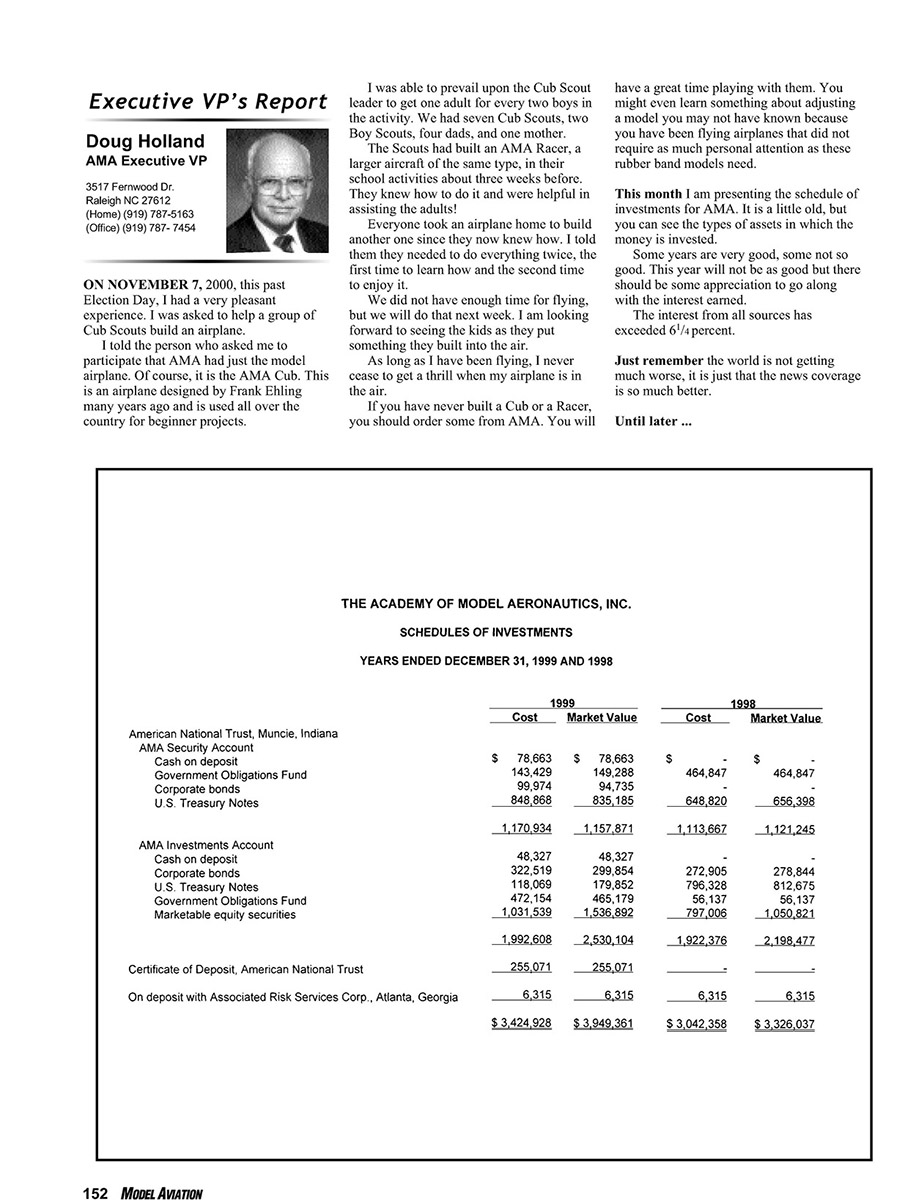
This month I am presenting the schedule of investments for AMA. It is a little old, but you can see the types of assets in which the money is invested. Some years are very good, some not so good. This year will not be as good but there should be some appreciation to go along with the interest earned. The interest from all sources has exceeded 6.25 percent.
Just remember the world is not getting much worse; it's just that the news coverage is so much better.
Until later ...
---
District I Report
Connecticut / Maine / Massachusetts / New Hampshire / Rhode Island / Vermont
Don Krafft, Vice President PO Box 1828, Duxbury, MA 02331–1828 (781) 934-6248
Note: Please see a previous issue of the magazine for listing of all district Associate Vice Presidents and Frequency Coordinator.
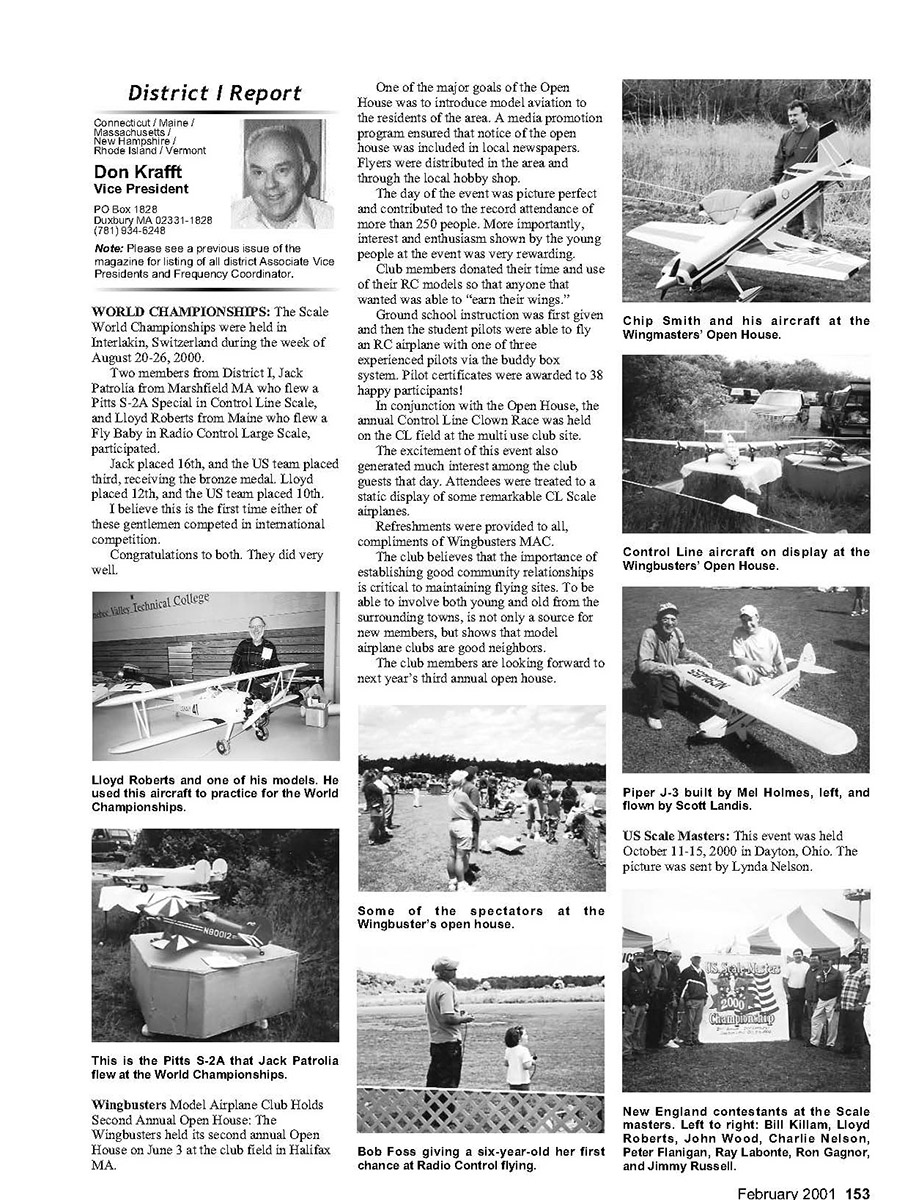
WORLD CHAMPIONSHIPS: The Scale World Championships were held in Interlaken, Switzerland during the week of August 20–26, 2000.
Two members from District I participated: Jack Patrolia (Marshfield, MA) flew a Pitts S-2A Special in Control Line Scale and placed 16th; Lloyd Roberts (Maine) flew a Fly Baby in Radio Control Large Scale and placed 12th. The U.S. teams placed third (Jack's team, bronze) and 10th (Lloyd's team).
Wingbusters Model Airplane Club Holds Second Annual Open House: The Wingbusters held their second annual Open House on June 3 at the club field in Halifax, MA. One major goal was to introduce model aviation to area residents. Media promotion and distributed flyers helped. The day had record attendance of more than 250 people. Club members donated their time and RC models so anyone could "earn their wings." Ground-school instruction was given, then students flew via buddy box with experienced pilots. Pilot certificates were awarded to 38 participants!
In conjunction with the Open House, the annual Control Line Clown Race was held on the CL field. Attendees saw a static display of some remarkable CL Scale airplanes, and refreshments were provided courtesy of Wingbusters MAC. The club believes establishing good community relationships is critical to maintaining flying sites. Members look forward to next year's third annual open house.
---
HELLO AGAIN. I'm writing this on my way home from the November AMA Executive Council meeting in Muncie. This was my first meeting sitting in the District II chair. I'll be filling you in more in the District II Newsletter, including how I voted on each motion, but I do want to tell you a little about the meeting.
This meeting ran for two days, from 8 a.m. until 5:30 p.m. on Saturday, and then from 9 a.m. until about 12:30 p.m. on Sunday. You'd be amazed at the amount and diversity of business conducted: from setting dates for next year's AMA Nationals to approving the AMA operating budget for 2001. Discussions can get intense, but at the end of the day differences are left in the conference room.
I truly believe that each Council member tackles each issue with an open mind and makes decisions based on all the facts presented and what he believes will be in the best interest of the membership. AMA President Dave Brown works to give everyone an opportunity to voice opinions while keeping up the pace to get through the agenda. Council meetings are always open to the membership and I encourage anyone with the opportunity to sit in on one.
AVP Bob McKay sent the following report:
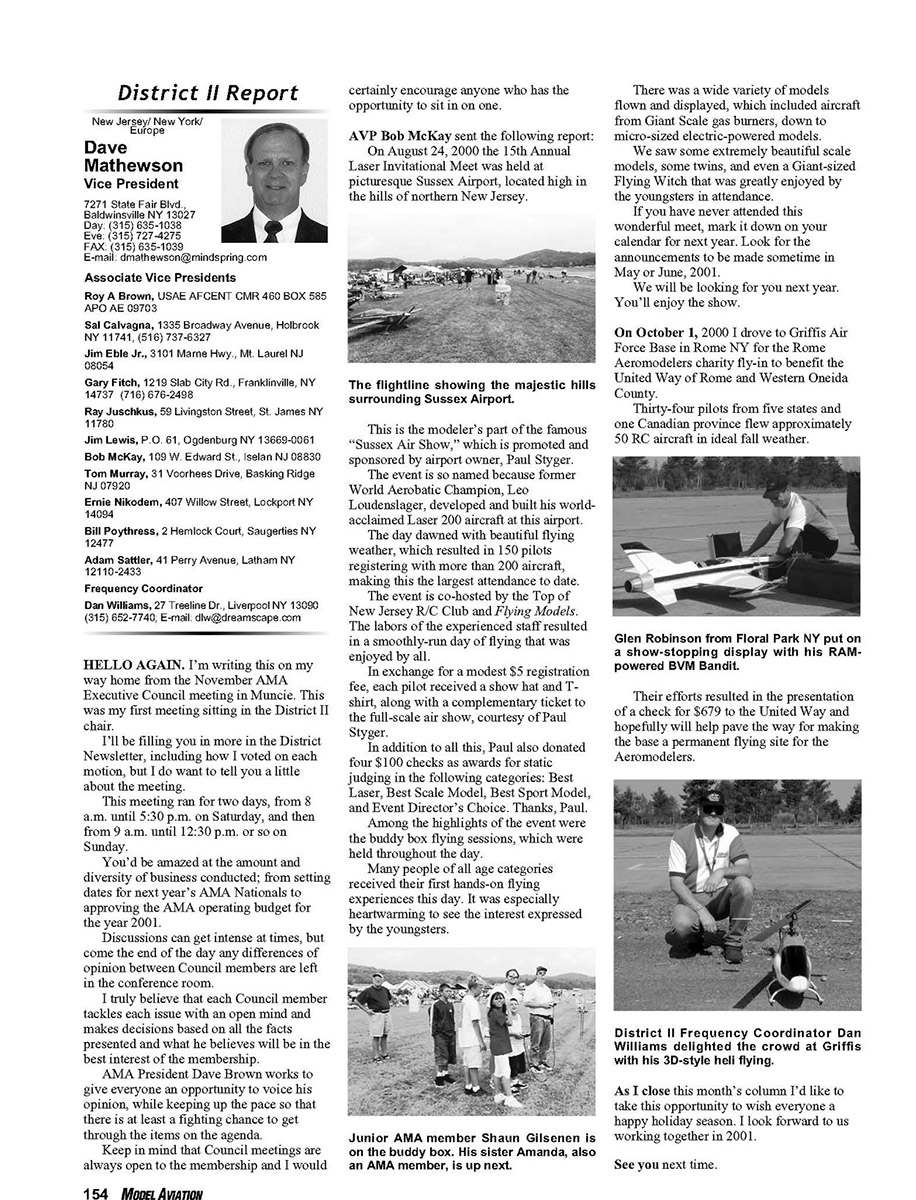
On August 24, 2000 the 15th Annual Laser Invitational Meet was held at Sussex Airport in northern New Jersey. The event, part of the Sussex Air Show promoted by airport owner Paul Styger, had beautiful weather and 150 pilots registering with more than 200 aircraft—the largest attendance to date. The event is co-hosted by the Top of New Jersey R/C Club and Flying Models. Each pilot received a show hat, T-shirt, and a complimentary ticket to the full-scale air show. Paul Styger also donated four $100 checks as awards for static judging. Buddy-box flying sessions gave many people their first hands-on flying experience.
On October 1, 2000 I drove to Griffiss Air Force Base in Rome, NY for the Rome Aeromodelers charity fly-in to benefit the United Way of Rome and Western Oneida County. Thirty-four pilots from five states and one Canadian province flew approximately 50 RC aircraft in ideal fall weather. Their efforts resulted in a $679 presentation to the United Way and may help pave the way for making the base a permanent flying site for the Aeromodelers.
As I close this month's column I'd like to wish everyone a happy holiday season. I look forward to working together in 2001. See you next time.
---
District III Report
Ohio / Pennsylvania / West Virginia
Bob Brown, Vice President 35 Sanford Street, Bradford, PA 16701 (814) 368-7655 E-mail: amadill@penn.com
Associate Vice Presidents:
- Mike Barbee, 6561 Calgary Court, Columbus, OH 43229–2008 (614) 891-1643
- David H. Ellis, 5281 DeWitt Road, Cross Lanes, WV 25313–1209 (304) 776-1409
- Nelson Gould, 1943 Idaho Street, Allentown, PA 18103–1519 (610) 797-6597
- Donald Klopp, 637 Hamilton Court, Trappe, PA 19426–2256 (610) 409-0129
- Tom Morris, 5131 Delford, Pittsburgh, PA 15207 (412) 461-7346
- Frank Noll, 5492 Waterloo Road, Dayton, OH 45459 (937) 435-9232
- Joe Otto, 13065 Heath Road, Chesterland, OH 44026–3225 (440) 729-0185; E-mail: JOTTOAMA@AOL.COM
- Matthew Turowski, 5 Dogwood Road, Drums, PA 18222 (717) 788-0861
- Joseph S. Vislay, 1831 Cranbrook Drive, PO Box 951, Maumee, OH 43537–3062 (419) 893-9537; E-mail: jsvislay@classicity.net
Frequency Coordinator:
- John Cotte, 1012 Wyoming Avenue, Forty Fort, PA 18704 (717) 287-8870
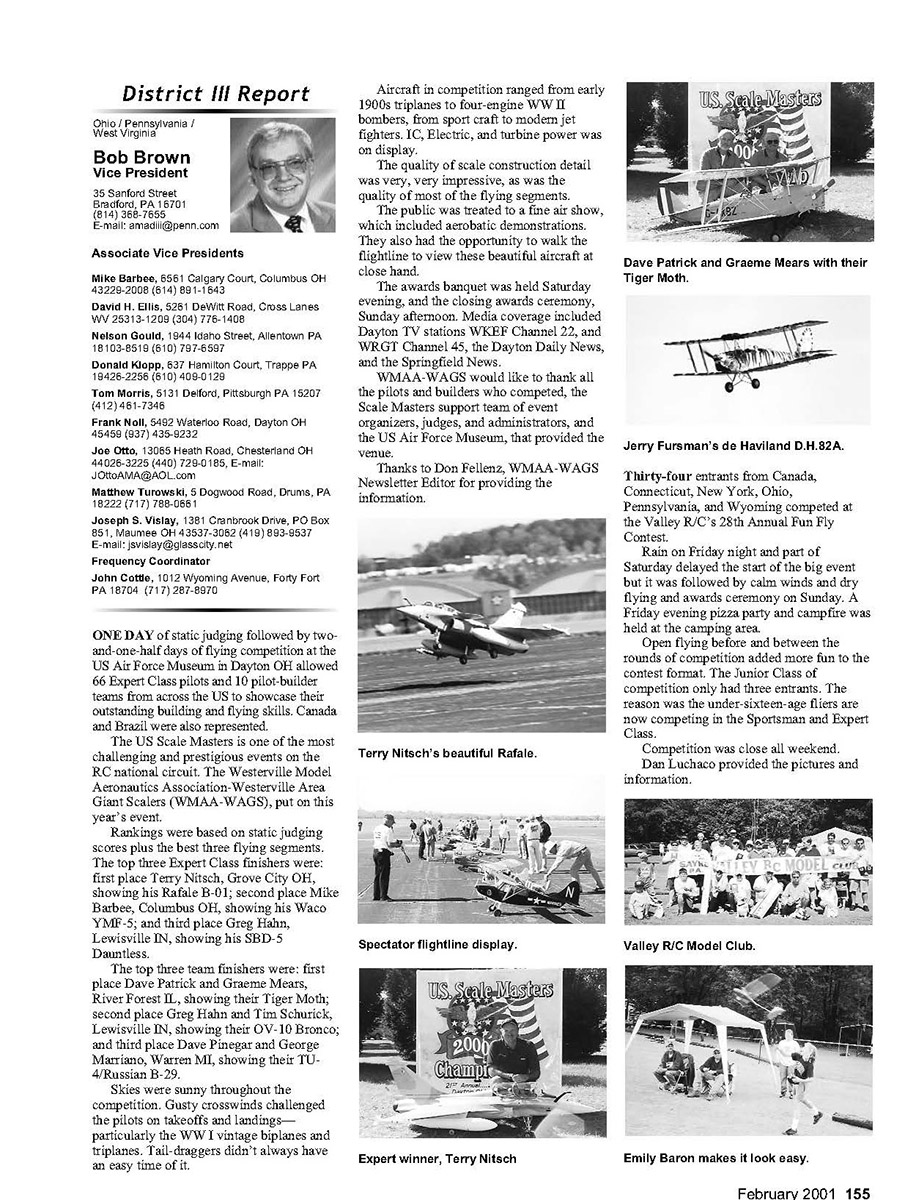
ONE DAY of static judging followed by two-and-a-half days of flying competition at the U.S. Air Force Museum in Dayton, OH allowed 66 Expert Class pilots and 10 pilot-builder teams from across the U.S. to showcase outstanding building and flying skills. Canada and Brazil were also represented.
The U.S. Scale Masters is one of the most challenging and prestigious events on the R/C national circuit. The Westerville Model Aeronautics Association–Westerville Area Giant Scalers (WMAA-WAGS) hosted this year's event. Rankings were based on static judging scores plus the best three flying segments.
Top three Expert Class finishers:
- 1st: Terry Nitsch, Grove City, OH — Rafale B-01
- 2nd: Mike Barbee, Columbus, OH — Waco YMF-5
- 3rd: Greg Hahn, Lewisville, IN — SBD-5 Dauntless
Top three team finishers:
- 1st: Dave Patrick and Graeme Mears, River Forest, IL — Tiger Moth
- 2nd: Greg Hahn and Tim Schurick, Lewisville, IN — OV-10 Bronco
- 3rd: Dave Pinger and George Marraiano, Warren, MI — TU-4/Russian B-29
Skies were sunny throughout the competition. Gusty crosswinds challenged pilots—especially WWI vintage biplanes and triplanes. Aircraft ranged from early 1900s triplanes to four-engine WWII bombers, modern jet fighters, and included IC, electric, and turbine power. The quality of scale construction detail and flying segments was very impressive. The public enjoyed the event and the awards banquet and closing ceremony received media coverage from local TV and newspapers.
Thanks to Don Fellenz, WMAA-WAGS Newsletter Editor, for providing the information.
---
District IV Report
Delaware / District of Columbia / Maryland / North Carolina / Virginia
Chuck Foreman, Vice President 412 Pine Cone Ct., Kill Devil Hill, NC 27948 Phone: (252) 441-5855 • Fax: (252) 441-6554 E-mail: CHUCKAMAVP@aol.com
Associate Vice Presidents:
- George Abbott, 8712 Westlake Court, Raleigh, NC 27613; (919) 848-6719; E-mail: GAbbott462@aol.com
- Robert E. Babura, 117 Otis Dr., Severn, MD 21144–1130; (410) 969-9356; E-mail: bbabura@msn.com
- Randy Elliott, 103 Virginia Court, Pulaski, VA 24301; (540) 980-8461; Office: (540) 994-2316
- Steve Moulton, 2217 Johnstown Rd., Chesapeake, VA 23322; (757) 421-4545; Office: (757) 463-8483 ext. 23; E-mail: moultons@mindspring.com
- Richard (Dick) Smith, 761 Gwynne Ave., Waynesboro, VA 22980–3346; (540) 943-1684; E-mail: flyrss@aol.com
- John Stare, 826 Marl Pit Rd., Middletown, DE 19709; (302) 376-7154; E-mail: vrcs38@aol.com
- Bliss Teague, 225 5th Ave. SW, Hickory, NC 28602; (828) 324-2164; Office: (828) 733-9228; E-mail: blissteague@conninc.com
Frequency Coordinator:
- Paul Yacobucci, 6408 Winthrop Dr., Fayetteville, NC 28311–1007; Evening: (910) 488-5986; E-mail: PYacob1313@aol.com
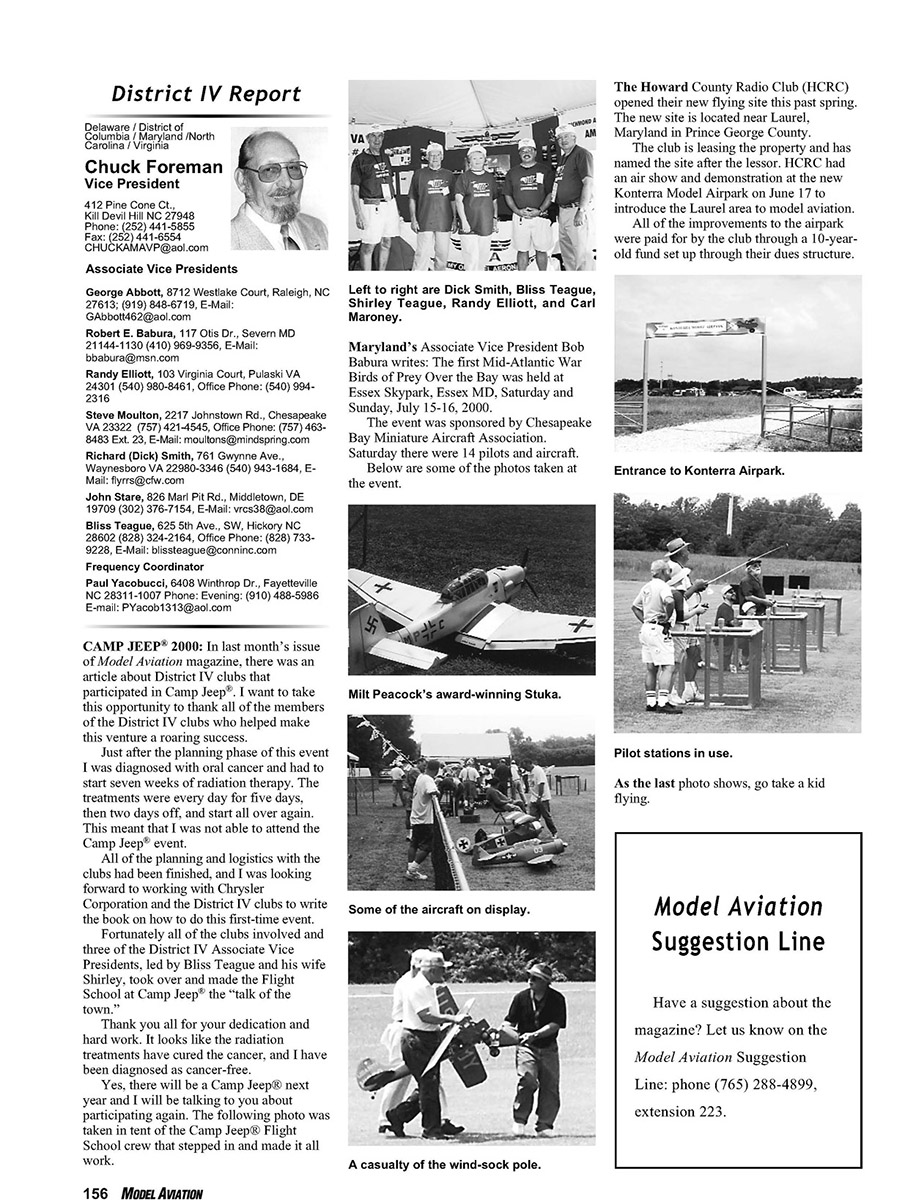
CAMP JEEP® 2000: In last month's issue there was an article about District IV clubs participating in Camp Jeep®. I want to thank all District IV club members who helped make this venture a success. Shortly after planning began I was diagnosed with oral cancer and underwent seven weeks of radiation therapy, meaning I could not attend Camp Jeep®. Fortunately, club members and three District IV AVPs, led by Bliss Teague and his wife Shirley, stepped in and made the Flight School at Camp Jeep® the "talk of the town." Thank you all for your dedication and hard work. The radiation treatments appear to have cured the cancer; I have been diagnosed as cancer-free. Yes, there will be a Camp Jeep® next year.
Maryland's AVP Bob Babura writes: The first Mid-Atlantic War Birds of Prey Over the Bay was held at Essex Skypark, Essex, MD, Saturday and Sunday, July 15–16, 2000. The event was sponsored by Chesapeake Bay Miniature Aircraft Association. Saturday there were 14 pilots and aircraft.
The Howard County Radio Club (HCRC) opened their new flying site this past spring near Laurel, Maryland, in Prince George's County. The club leased the property and named the site after the lessor. HCRC had an air show and demonstration at the new Konterra Model Airpark on June 17 to introduce the Laurel area to model aviation. All improvements were paid for by the club through a 10-year-old fund set up through their dues structure.
As the accompanying photo shows: go take a kid flying.
---
District V Report
Alabama / Florida / Georgia / Mississippi / Puerto Rico / South Carolina / Tennessee
Jim McNeill, Vice President 617 South 20 Avenue, Birmingham, AL 35205 Tel.: (205) 252-1217 • Fax: (205) 252-2854 E-mail: amav@hiwaay.net
WEB PAGE: Lamar Blair — http://home.att.net/~ama_district_v
Associate Vice Presidents:
- Lamar Blair, Decatur, AL (256) 351-8445
- Malcolm Boartfield, Marietta, GA (770) 977-4126
- Ron Chidgey, Pensacola, FL (850) 476-8639
- John G. Cooper, Memphis, TN (901) 363-3420
- James Alvis, Jackson, MS (601) 956-4978
- Michael Gregory, Greenville, SC (864) 244-8860
- Louise Izzo, Wintersprings, FL (407) 699-4929
- Richard Jackson, Charleston, SC (843) 744-4575
- Dr. John Martin, Miami, FL (305) 858-6363
- Russell Mobley, Thomson, GA (706) 597-9783
- Tom Morris, Anniston, AL (256) 820-1983
- Fred Mulholland, Tampa, FL (813) 962-7020
- George Perryman, Smyrna, GA (770) 436-6001
- Melvin Sires, Aiken, SC (803) 649-4073
- Jim Weems, Indian Springs, AL (205) 733-2021
- Ward Van Duzer, Gainesville, GA (770) 718-0122
- Lee Webster, Manchester, TN (615) 728-3283
- Joseph Micalizzi, Fajardo, PR (787) 863-9163
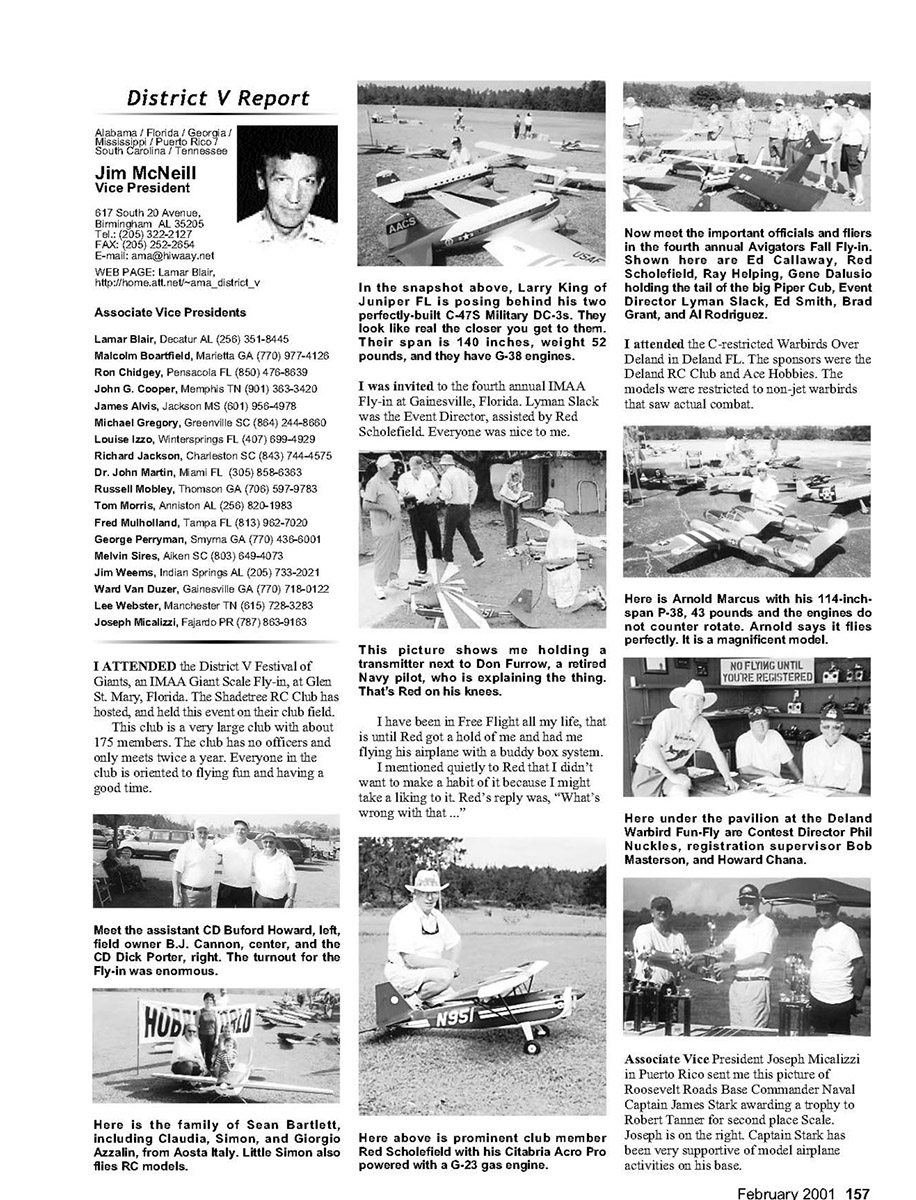
I attended the District V Festival of Giants (an IMAA Giant Scale Fly-in) at Glen St. Mary, Florida. The Shadetree RC Club hosted the event and is a large club with about 175 members. I was invited to the fourth annual IMAA Fly-in at Gainesville, Florida. Lyman Slack was Event Director, assisted by Red Scholefield.
I have been in Free Flight all my life—until Red got me flying his airplane with a buddy box system. I attended the C-restricted Warbirds Over Deland in Deland, FL. Sponsors were the Deland RC Club and Ace Hobbies. Models were restricted to non-jet warbirds that saw actual combat.
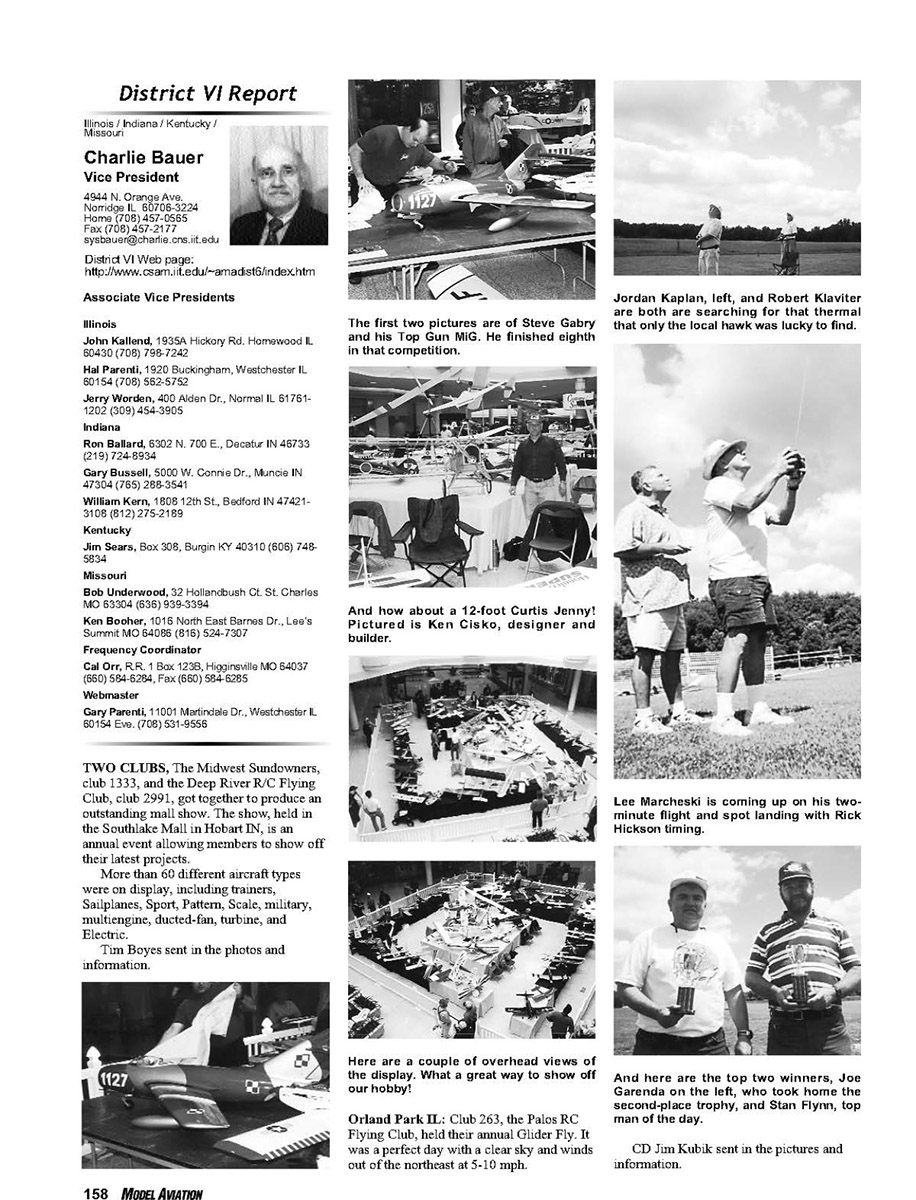
Two clubs, The Midwest Sundowners (club 1333) and the Deep River R/C Flying Club (club 2991), produced an outstanding mall show at Southlake Mall in Hobart, IN. More than 60 different aircraft types were on display, including trainers, sailplanes, sport, pattern, scale, military, multiengine, ducted-fan, turbine, and electric.
Orland Park, IL: Club 263, the Palos RC Flying Club, held their annual Glider Fly on a perfect day with winds at 5–10 mph. CD Jim Kubik sent pictures and information.
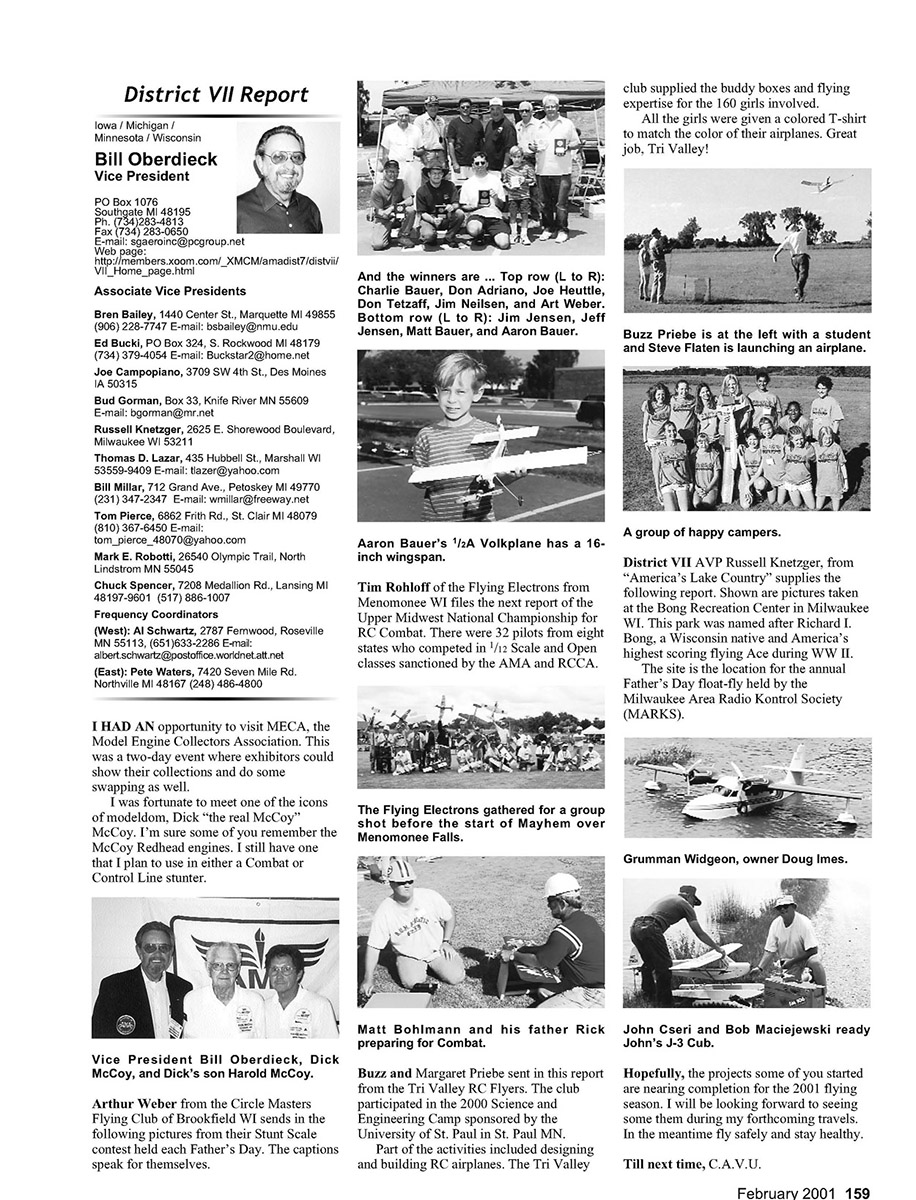
I had an opportunity to visit MECA, the Model Engine Collectors Association. This two-day event featured exhibitors, swapping, and icons of modeldom such as Dick "the real McCoy" McCoy (of McCoy Redhead fame).
Arthur Weber from the Circle Masters Flying Club of Brookfield, WI, sent photos and information from their Stunt Scale contest held each Father's Day. Tim Rohloff of the Flying Electrons reported on the Upper Midwest National Championship for RC Combat with 32 pilots from eight states competing in 1/2 Scale and Open classes (sanctioned by AMA and RCCA).
Buzz and Margaret Priebe reported that the Tri Valley RC Flyers participated in the 2000 Science and Engineering Camp at the University of St. Paul in St. Paul, MN. The club supplied buddy boxes and flying expertise for 160 girls who designed and built RC airplanes. All the girls were given colored T-shirts matching their airplane colors. Great job, Tri Valley!
District VII AVP Russell Knetzger supplied photos from the Bong Recreation Center in Milwaukee, WI—the site of the annual Father's Day float-fly held by the Milwaukee Area Radio Kontrol Society (MARKS).
Projects some of you started are likely nearing completion for the 2001 flying season. Fly safely and stay healthy. Till next time—C.A.V.U.
---
District VIII Report
Arkansas / Louisiana / New Mexico / Oklahoma / Texas
Dr. Sandy Frank, Vice President 105 N. Brazos St., Weatherford, TX 76086–3207 Phone/Fax: (817) 599-7131 • E-mail: sfrank69@airmail.net Web: www.AMA-Dist-8.org
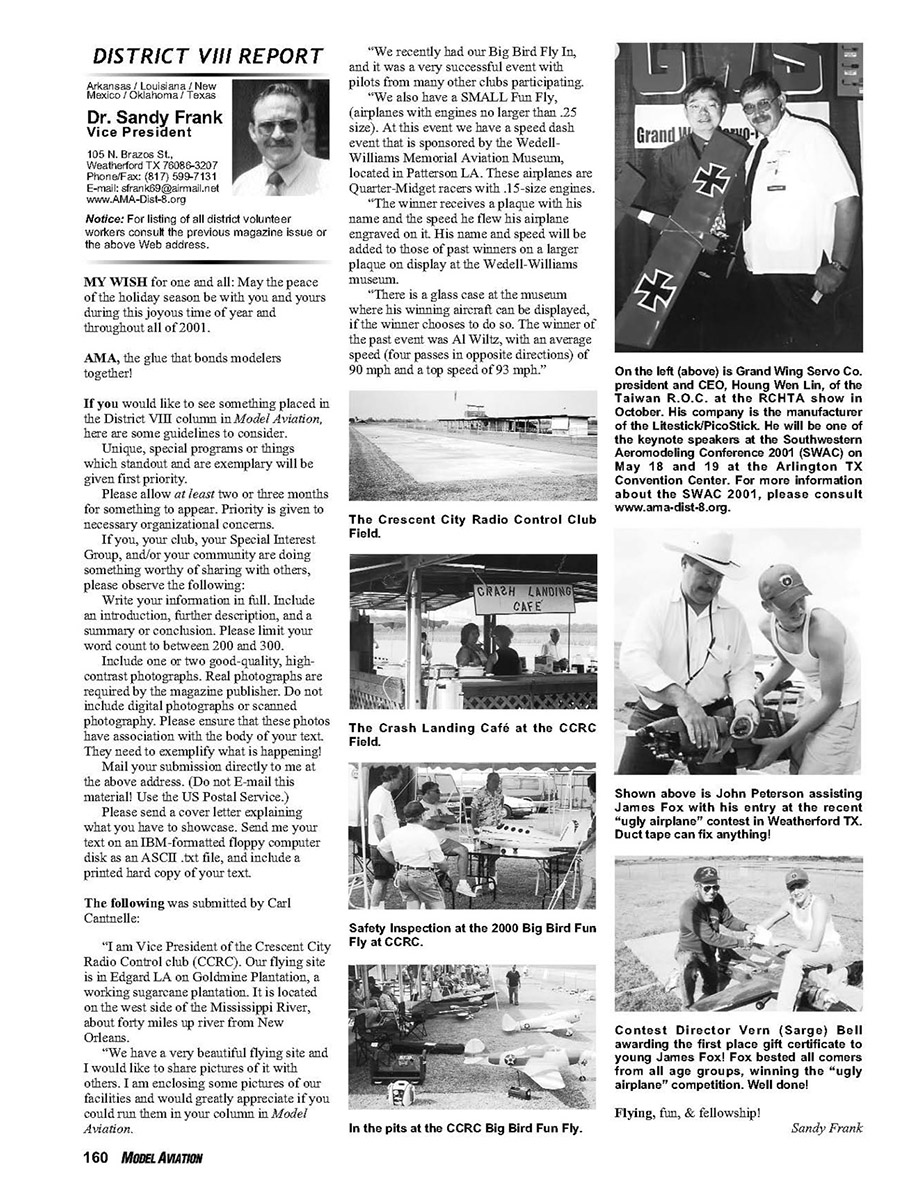
Notice: For a listing of all district volunteer workers consult the previous magazine issue or the above web address.
My wish for one and all: may the peace of the holiday season be with you and yours during this joyous time of year and throughout 2001.
If you would like to see something placed in the District VIII column in Model Aviation, please follow these guidelines:
- Unique, special programs or exemplary activities will be given priority.
- Allow at least two or three months for publication.
- Write your information in full: include an introduction, description, and summary or conclusion. Limit word count to 200–300 words.
- Include one or two good-quality, high-contrast photographs (real photographs required; do not submit digital or scanned images).
- Mail submissions to the address above (do not e-mail). Send a cover letter, text on an IBM-formatted floppy as an ASCII .txt file, and a printed hard copy.
Submission from Carl Cantrelle (Crescent City Radio Control Club, Edgard, LA): The club's flying site is on Goldmine Plantation, a working sugarcane plantation about 40 miles upriver from New Orleans. The site is beautiful and hosted a successful Big Bird Fly-In with pilots from many clubs. They also host a SMALL Fun Fly (airplanes with engines no larger than .25) featuring a Quarter-Midget race with .15-size engines. Winners receive a plaque and the option to display their aircraft at the Wedell-Williams Memorial Aviation Museum.
Al Wiltz won the past event with an average speed of 90 mph and a top speed of 93 mph.
---
News from Colorado: 2000 Rocky Mountain Big Bird Festival
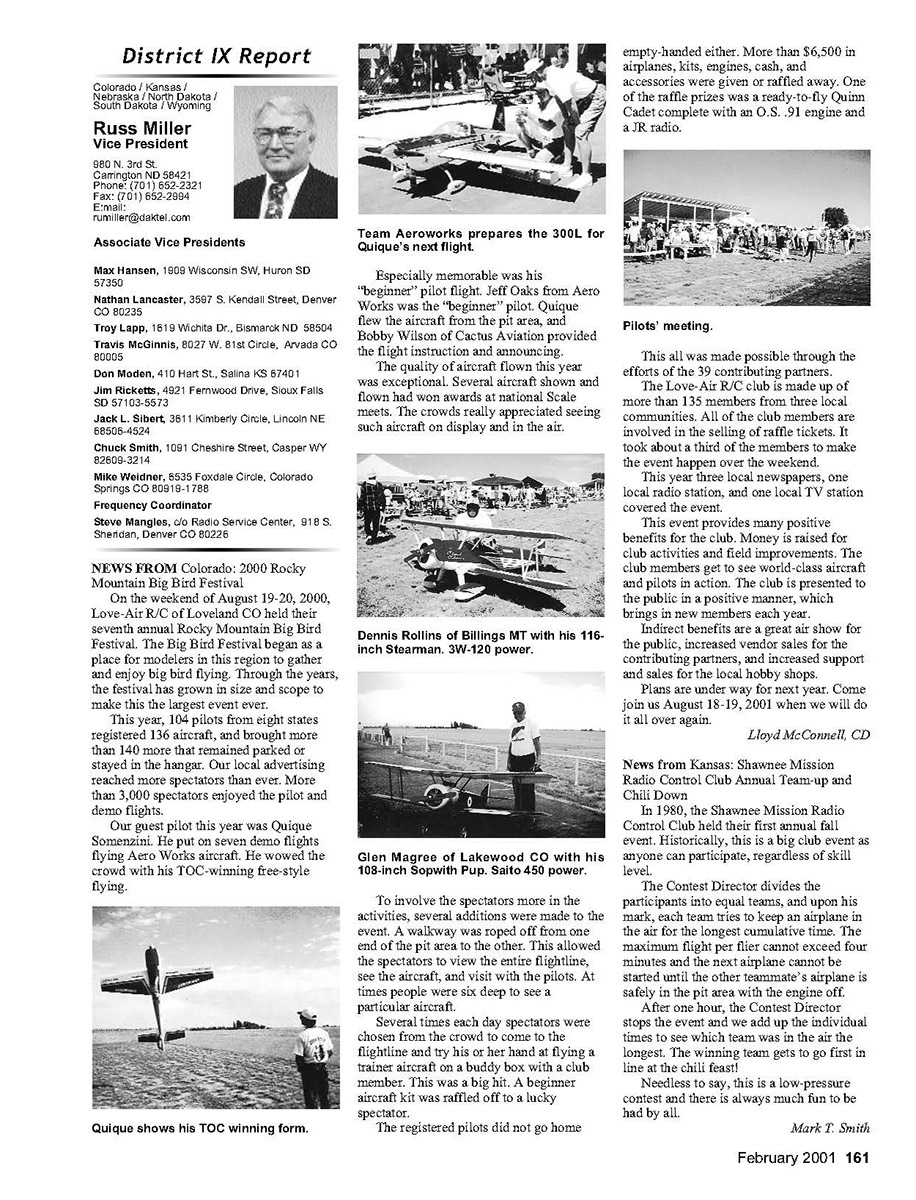
On the weekend of August 19–20, 2000, Love-Air R/C of Loveland, CO, held its seventh annual Rocky Mountain Big Bird Festival. The festival began as a regional gathering for big-bird flying and has grown to the largest such event in the area.
This year, 104 pilots from eight states registered 136 aircraft, with more than 140 additional aircraft parked or kept in the hangar. Local advertising drew more spectators than ever—more than 3,000 enjoyed pilot and demo flights.
Guest pilot Quique Somenzini put on seven demo flights flying AeroWorks aircraft, including a memorable "beginner" pilot flight where Quique flew from the pit area while a novice pilot simulated flying via instructor control. The quality of aircraft was exceptional, with several award-winning Scale models on display.
To involve spectators, a walkway was roped off along the pit area for close viewing and pilot interaction. Spectators were chosen to try buddy-box flying sessions, and a beginner aircraft kit was raffled off. Registered pilots shared in more than $6,500 in prizes (airplanes, kits, engines, cash, and accessories). One raffle prize was a ready-to-fly Quinn Cadet with an O.S. .91 engine and JR radio.
This success was made possible by 39 contributing partners and the efforts of the Love-Air R/C Club's membership of more than 135. Media coverage included three local newspapers, one radio station, and one TV station. The event raised money for club activities and field improvements and presented the club positively to the public, bringing in new members.
Plans are under way for next year; mark your calendar for August 18–19, 2001.
Lloyd McConnell, CD
---
News from Kansas: Shawnee Mission Radio Control Club Annual Team-Up and Chili Down
In 1980 the Shawnee Mission Radio Control Club held their first annual fall event. This big-club event invites any participant. The Contest Director divides participants into equal teams, and each team tries to keep an airplane in the air for the longest cumulative time. Maximum flight per flyer is four minutes; the next airplane cannot start until the previous airplane is safely in the pit area with the engine off. After one hour, times are totaled and the winning team gets first in line at the chili feast. Low-pressure and good fun for all.
Mark T. Smith
---
District X Report
Arizona / California / Hawaii / Guam / Nevada / Utah
Richard Hanson, Vice President PO Box 3312, Scottsdale, AZ 85271 Voice/Fax: (888) 899-3548 • E-mail: richh@pinnet.com Web: http://www.ama-10.com/ama
Associate Vice Presidents:
- Darwin Barrie, Scottsdale, AZ (480) 946-8955
- Don Goeschl, Lancaster, CA (661) 940-6066
- Darlene Frederick, Santa Rosa, CA (707) 525-8815
- Marc Karpowich, Logan, UT (435) 994-4955
- Dave Pinjuv, Las Vegas, NV (702) 656-1772
- Don Guilhur, Santee, CA (619) 449-8397
Frequency Coordinators:
- Eloy Marez, Santa Ana, CA (714) 540-4935
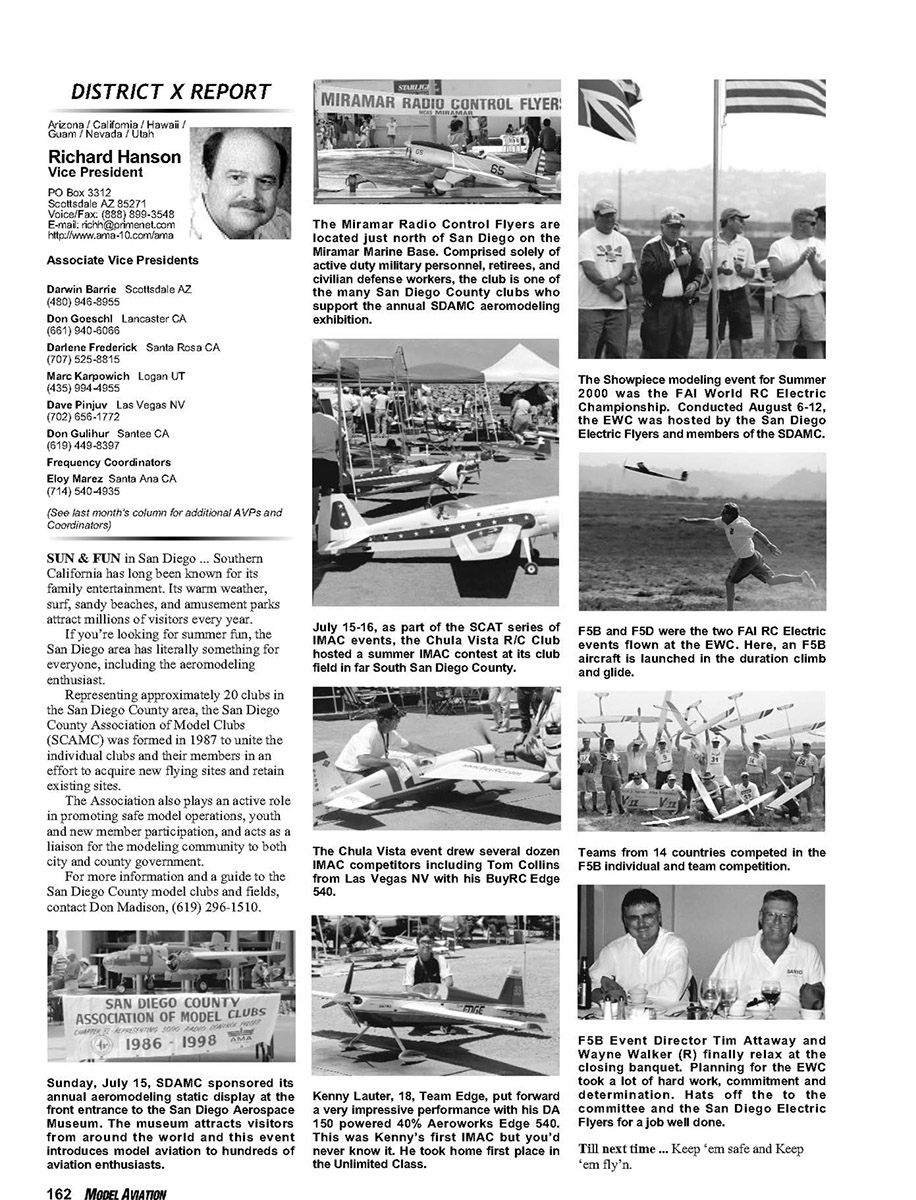
SUN & FUN in San Diego: Southern California is known for family entertainment, warm weather, and attractions. For modelers, the San Diego County Association of Model Clubs (SCAMC), formed in 1987, unites clubs to acquire and retain flying sites, promote safe model operations, support youth and new members, and act as a liaison to city and county governments. For more information and a guide to San Diego County model clubs and fields, contact Don Madison at (619) 296-1510.
---
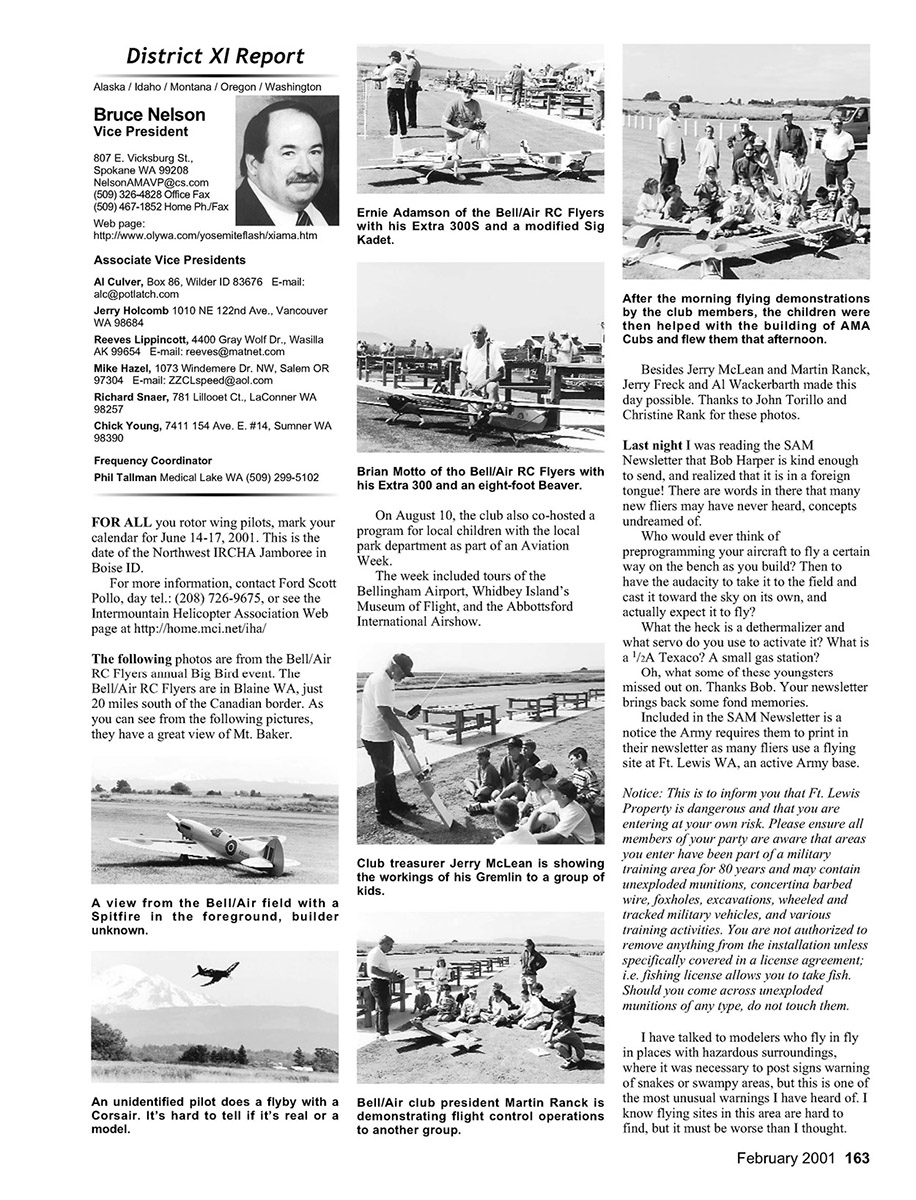
District XI Report
Alaska / Idaho / Montana / Oregon / Washington
Bruce Nelson, Vice President 807 E. Vicksburg St., Spokane, WA 99208 E-mail: NelsonAMAVP@cs.com • Office Fax: (509) 326-4828 • Home Ph./Fax: (509) 467-1852
Web page: http://www.olywa.com/yosemiteflash/xiama.htm
Associate Vice Presidents:
- Al Culver, Box 86, Wilder, ID 83676; E-mail: alc@potlatch.com
- Jerry Holcomb, 1010 NE 122nd Ave., Vancouver, WA 98684
- Reeves Lippincott, 4400 Gray Wolf Dr., Wasilla, AK 99654; E-mail: reeves@matnet.com
- Mike Hazel, 1073 Windemere Dr. NW, Salem, OR 97304; E-mail: ZZLcspeed@aol.com
- Richard Snaer, 781 Lillooet Ct., LaConner, WA 98257
- Chick Young, 7411 154 Ave. E. #14, Sumner, WA 98390
Frequency Coordinator:
- Phil Tallman, Medical Lake, WA (509) 299-5102
FOR ALL rotor-wing pilots: mark your calendar for June 14–17, 2001—the Northwest IRCHA Jamboree in Boise, ID. For more information contact Ford Scott Pollo at (208) 726-9675 or see the Intermountain Helicopter Association web page.
The following photos (not included here) are from the Bell/Air RC Flyers annual Big Bird event in Blaine, WA, with a great view of Mt. Baker. On August 10 the club co-hosted a program for local children with the park department as part of Aviation Week. The week included tours of the Bellingham Airport, Whidbey Island's Museum of Flight, and the Abbotsford International Airshow.
An excerpt from the SAM Newsletter includes a mandatory Army notice for those using Ft. Lewis, WA: Ft. Lewis property is potentially dangerous due to unexploded munitions and other hazards; you enter at your own risk and should not remove anything from the installation unless covered in a license agreement.
I have talked to modelers who fly in places with hazardous surroundings—signs warning of snakes or swampy areas—but this is one of the most unusual warnings I've heard. I know flying sites in this area are hard to find, but it must be worse than I thought.
Transcribed from original scans by AI. Minor OCR errors may remain.

