
Focus on Education
Charles Kelley AMA Education Committee Member
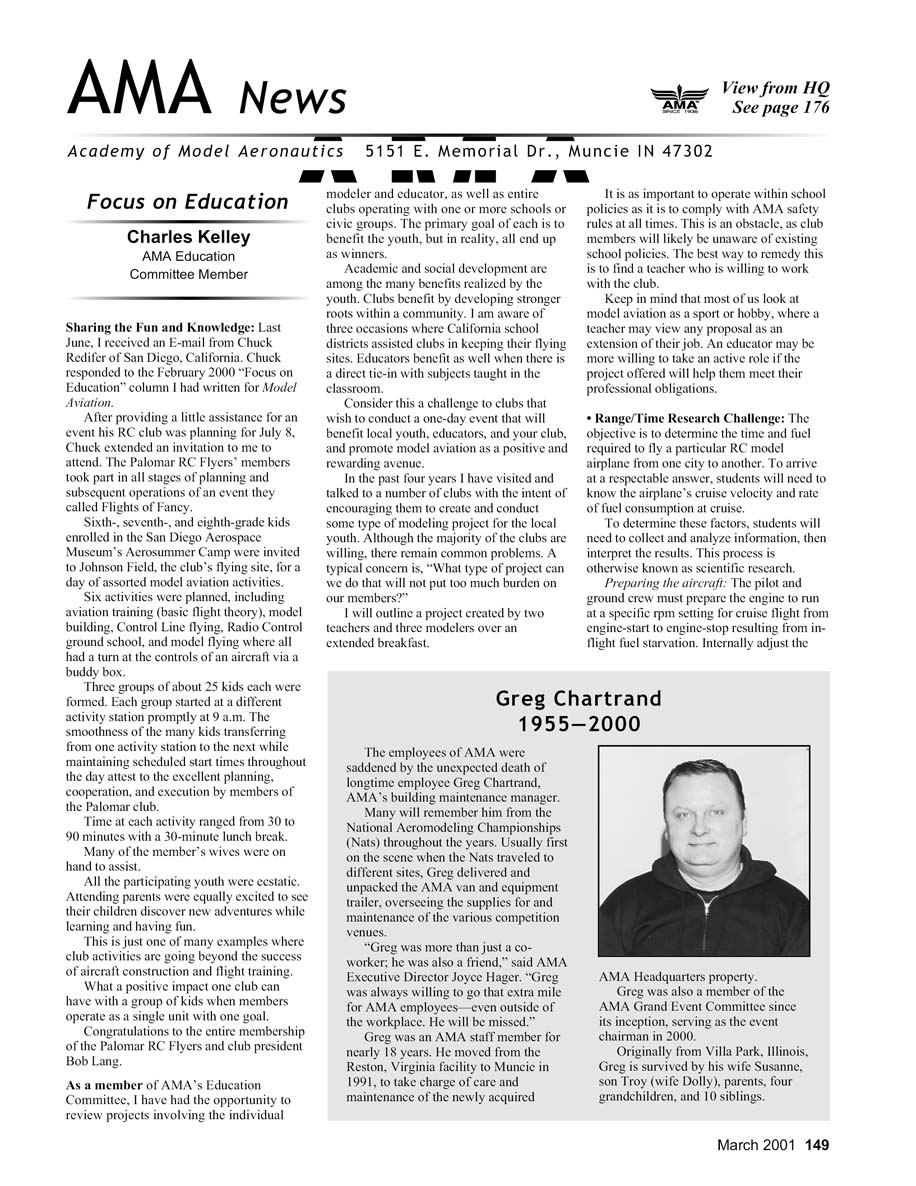
Sharing the Fun and Knowledge: Last June I received an e-mail from Chuck Redifer of San Diego, California. Chuck had responded to the February 2000 "Focus on Education" column I wrote for Model Aviation. After providing a little assistance for an event his RC club was planning for July 8, Chuck extended an invitation to me to attend.
The Palomar RC Flyers' members took part in all stages of planning and subsequent operations of an event they called Flights of Fancy. Sixth-, seventh-, and eighth-grade kids enrolled in the San Diego Aerospace Museum's Aerosummer Camp were invited to Johnson Field, the club's flying site, for a day of assorted model aviation activities.
Six activities were planned, including:
- aviation training (basic flight theory),
- model building,
- Control Line flying,
- Radio Control ground school, and
- model flying where all had a turn at the controls of an aircraft via a buddy box.
Three groups of about 25 kids each were formed. Each group started at a different activity station promptly at 9 a.m. The smooth movement of the many kids from one activity station to the next while maintaining scheduled start times throughout the day attested to the excellent planning, cooperation, and execution by members of the Palomar club.
Time at each activity ranged from 30 to 90 minutes with a 30-minute lunch break. Many of the members' wives were on hand to assist. All the participating youth were ecstatic; attending parents were equally excited to see their children discover new adventures while learning and having fun.
This is just one of many examples where club activities go beyond the success of aircraft construction and flight training. What a positive impact one club can have with a group of kids when members operate as a single unit with one goal. Congratulations to the entire membership of the Palomar RC Flyers and club president Bob Lang.
As a member of AMA's Education Committee, I have had the opportunity to review projects involving individual modelers and educators, as well as entire clubs operating with one or more schools or civic groups. The primary goal of each is to benefit youth, but in reality all end up as winners.
Academic and social development are among the many benefits realized by the youth. Clubs benefit by developing stronger roots within a community. I am aware of three occasions where California school districts assisted clubs in keeping their flying sites. Educators benefit when there is a direct tie-in with subjects taught in the classroom.
Consider this a challenge to clubs that wish to conduct a one-day event that will benefit local youth, educators, and your club, and promote model aviation as a positive and rewarding avenue.
In the past four years I have visited and talked to a number of clubs in an effort to encourage them to create and conduct some type of modeling project for local youth. Although the majority of clubs are willing, common concerns remain. A typical question is, "What type of project can we do that will not put too much burden on our members?"
I will outline a project created by two teachers and three modelers over an extended breakfast. It is as important to operate within school policies as it is to comply with AMA safety rules at all times. This is an obstacle, as club members will likely be unaware of existing school policies. The best way to remedy this is to find a teacher who is willing to work with the club.
Keep in mind that most of us look at model aviation as a sport or hobby, where a teacher may view any proposal as an extension of their job. An educator may be more willing to take an active role if the project will help them meet their professional obligations.
Range/Time Research Challenge
Objective: Determine the time and fuel required to fly a particular RC model airplane from one city to another. To arrive at a respectable answer, students need to know the airplane's cruise velocity and rate of fuel consumption at cruise.
To determine these factors, students will collect and analyze information, then interpret the results. This process is scientific research.
Preparing the aircraft:
- The pilot and ground crew must prepare the engine to run at a specific rpm setting for cruise flight from engine-start to engine-stop resulting from in-flight fuel starvation.
- Internally adjust the carburetion mixture and the throttle to obtain a repeatable cruise setting.
- Use an electric starter to eliminate variation due to hand-cranking.
- Range flights should be made over a long, unobstructed area using an altitude setting of not less than 50 feet.
Fuel flow measurement:
- Use a drum-type or calibrated measuring cup to measure the amount of fuel required to refill the tank after each flight.
- Record the time flown to 1/10 minute at the end of each flight.
- Calculate cruise fuel consumption in ounces per minute. Convert to gallons per hour if desired.
Wind correction:
- Record wind direction and estimated velocity.
- To determine the true airspeed, measure ground speed with a calibrated ground speed meter or time a measured course. Use these data to compute the effect of winds aloft at cruise altitude.
Safety:
- Brief all participants on safety.
- Have an adequate safety line and chase vehicle for the downwind leg.
Presentation:
- Students prepare a written report and an oral presentation with charts and graphs showing their data and conclusions.
This challenge provides students with hands-on experience in flight testing, data analysis, and report preparation. The experience also teaches teamwork, problem solving, and communication skills—attributes valuable in any career. I encourage clubs interested in conducting such projects to contact their local schools, scout troops, or youth organizations. The time and effort invested will pay dividends for both the youth and the hobby.
If your club has conducted interesting educational projects, please write and share them with me at MAYA712@aol.com if I may provide any assistance.
Determining cruise velocity
Measure the time it takes the aircraft to fly a known distance during cruise (for example, from one end of the runway to the other, called the "test area"). Have a student with a stopwatch stand at the point where the aircraft will exit the test area. Have another student hold up a flag at the point of entry. Just as the aircraft enters the test area, signal the timer to start the watch by dropping the flag. Stop the watch when the aircraft passes over the exit end of the test area.
Conduct several runs to arrive at the most accurate answer. With distance and time, students can calculate cruise velocity.
Propeller Research
Provide the students with a low-pitch propeller for the first run. After one or two runs, change to a high-pitch propeller using the same rpm as before. It is not necessary to remeasure the fuel or total flight time—only the speed with the high-pitch propeller. When the entire experiment is conducted with an 80% static rpm value, use both propellers again and have students record the results. Remember, they are collecting data to be used later.
Determining rate of fuel consumption
Start a separate stopwatch the instant the engine begins to run with measured fuel. Stop the watch when the engine quits at flight fuel starvation. It may require a modeler's skill to help detect engine shutoff if the airplane is on the downwind leg away from the students. Record the run time and the fuel used.
Obtain a state or local map where the distance can be measured using a ruler and mileage information provided on the map. Select imaginary takeoff and landing points that are greater than or equal to 50 miles apart and measure the distance accurately. The students now have enough data to calculate the aircraft's range, time to fly the distance, the amount of fuel required, and the number of necessary refueling stops. Range projection calculations should be made with a full fuel supply using the largest possible fuel tank.
Where is the Center of Gravity?
Items needed:
- four models—two properly balanced, one tail-heavy, and one nose-heavy,
- three postal scales (25-pound capacity or less), and
- a yardstick.
Also provide balance diagrams and related mathematical formulas.
Procedure:
- Suspend one of the balanced models with a string at the center of lift so that it remains level. Explain how the aircraft is affected if the center of gravity (CG) is too far out of line with the center of lift. Discuss the dangers and importance of making certain any aircraft is properly balanced prior to flight.
- The teacher can explain the method for calculating the CG. The modeler will carefully place the first aircraft where each wheel is on a separate scale. Allow the students to record the weight at each wheel and take as many measurements as possible within five or 10 minutes.
- Remove the first aircraft and place the second on the scales and allow five or 10 minutes for all measurements. Repeat the process for the third aircraft.
- Using math, have the students determine the exact position of the CG for each aircraft. If done correctly, they will be able to indicate which aircraft is nose-heavy, tail-heavy, and balanced.
It is important not to let any student pick up any of these airplanes, as they will be able to feel the ones out of balance. For the tail-heavy airplane, it may be a good idea to use a retired aircraft where the mains can be readjusted slightly rearward.
These and other activities have been successfully used in Southern California high schools. It is my hope that this information will help some clubs share their members' knowledge and skills with local youth in concert with a school. I extend an invitation to e-mail me at MAYA712@aol.com if I may provide any assistance.
---
Let It Be Known
There is a misconception that has been perpetuated for years that what we do as Control Line, Radio Control and/or Free Flight builders and flyers is a hobby. We need to clarify and present to all that we are involved in a sport—a sport that requires hours of dedication to hone talents in not only flying but building the machines we take into local, national and international competition.
Throughout Europe, aeromodeling is considered a sport. In many countries talented young fliers are trained for international competition. In the United States, however, it is often looked upon as a hobby. There needs to be a change and it must be done soon if we are to survive.
We are losing flying fields in record numbers—fields necessary as practice and competition sites. Part of the reason these fields are being taken over by soccer and other sports teams is the belief among decision-makers that flying model planes is a hobby enjoyed by only a few with little or no spectator presence.
We must challenge these views. The sport is growing yearly as more who were builders and flyers years ago again take to the skies. Many bring their children and grandchildren. And where is it written that a spectator must be charged an admission fee to enjoy watching a sport? It is hard to determine the number of people watching a contest when you don't have a ticket count, but that doesn't mean they aren't there.
What changed many recreational activities from a hobby to a sport? In many cases, it was the attitude of the participants and how they notified the general public of their activities. It is time to end the "playing with toy airplanes" mindset and recognize model aviation as a respected sport.
I urge each of you who love aeromodeling to speak to your local recreational boards, media, interested parent groups, etc., and explain what our sport is all about. Explain the pride of a child experiencing his first flight—the flight of a plane he built of balsa while learning the basics of woodworking and the laws of aerodynamics. Our sport is in your hands and theirs.
by John Brodak Carmichaels, PA
Reprinted with permission from Flying Models.
Some think their field rules are too harsh
This is how Robert S. Bush, Esq., IMAA Safety Officer, addresses the subject.
Several members have asked what to do with people who refuse to follow the field rules. My answer: tell them to pack up and go elsewhere.
"But Bob, these people have paid their dues and have a right to fly!" some say. Occasionally someone will claim, "It's my inalienable right to fly my plane the way I want to and no group is going to tell me otherwise!" Putting on my legal cap, I usually respond, "Your rights end where they infringe on the rights of others. Either fly within the rules, or land the plane."
Am I taking a hard line? Yes, and I make no apologies. There is a strong reason for my stance. Our nation has developed into a nation of litigants. We don't like something someone has said—we sue. We don't like something someone has done—we sue. We don't get our way—we sue. I feel at times we have forgotten how to communicate outside of a courtroom. Don't be afraid to ask someone to leave; if you don't it may cost you more than money.
Each club has a duty to protect their field so that all can fly. With more and more fields disappearing because of land development, it is imperative we take steps to protect our right to fly. The person who refuses to fly within the rules jeopardizes everyone's ability to enjoy our sport. An injury caused by someone practicing their "inalienable right" will result in increased government intervention, increased legal fees and damages, and fewer places for everyone to fly.
Don't feel sorry for people who don't wish to fly according to established rules. They're not worth your time and jeopardize everyone's right to enjoy themselves.
Reprinted with permission from IMAA's High Flight.
Register as an FSA Volunteer!
The Flying Site Assistance Program (FSA) consists of a network of volunteers who serve as the AMA's eyes and ears. These volunteers read newspapers and watch news programs to be aware of any activities that could impact existing or potential flying sites.
Volunteer duties:
- Collect information regarding flying sites,
- Advise local modelers and AMA clubs in the area, and
- Pass information on to the AMA Flying Site Assistance Coordinator.
Join this program as a service to your fellow modelers. Anyone interested should contact the program coordinator.
To assist you in your philosophical growth, I will share The Optimist Creed from my civic club, The Optimist Club of Raleigh, North Carolina. If you need a good civic club, I highly recommend The Optimist Club. Now for the Creed.
The Optimist Creed
Promise Yourself:
- To be so strong that nothing can disturb your peace of mind;
- To talk health, happiness, and prosperity to every person you meet;
- To make all your friends feel that there is something in them;
- To look at the sunny side of everything and make your optimism come true;
- To think only of the best, to work only for the best, and to expect only the best;
- To be just as enthusiastic about the success of others as you are about your own;
- To forget the mistakes of the past and press on to the greater achievements of the future;
- To wear a cheerful countenance at all times and give every living creature you meet a smile;
- To give so much time to the improvement of yourself that you have no time to criticize others;
- To be too large for worry, too noble for anger, too strong for fear, and too happy to permit the presence of trouble.
---
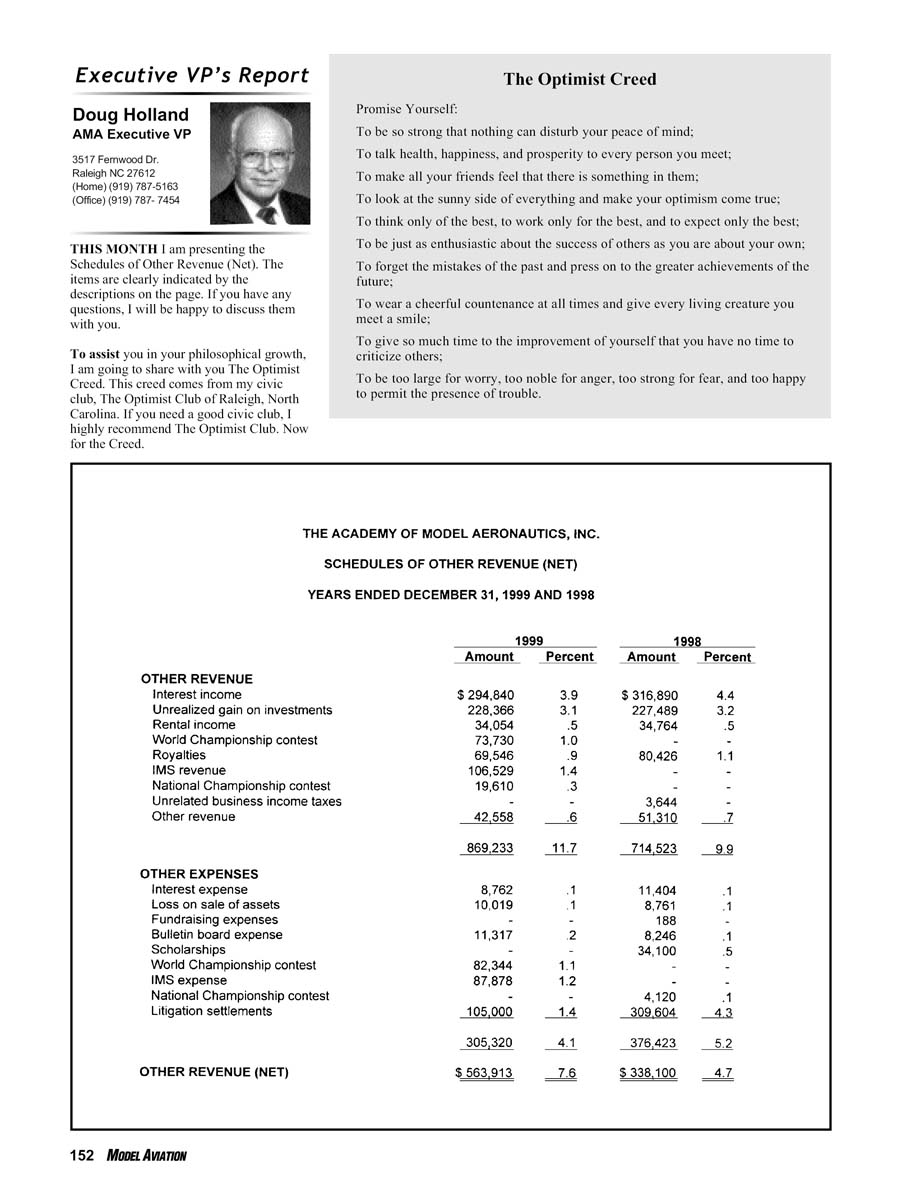
THE ACADEMY OF MODEL AERONAUTICS, INC. SCHEDULES OF OTHER REVENUE (NET) YEARS ENDED DECEMBER 31, 1999 AND 1998
OTHER REVENUE
- Interest income: $294,840 (3.9%) — 1999; $316,890 (4.4%) — 1998
- Unrealized gain on investments: $228,366 (3.1%) — 1999; $227,489 (3.2%) — 1998
- Rental income: $34,054 (0.5%) — 1999; $34,764 (0.5%) — 1998
- World Championship contest: $73,730 (1.0%) — 1999; - — 1998
- Royalties: $69,546 (0.9%) — 1999; $80,426 (1.1%) — 1998
- IMS revenue: $106,529 (1.4%) — 1999; - — 1998
- National Championship contest: $19,610 (0.3%) — 1999; - — 1998
- Unrelated business income taxes: - — 1999; $3,644 — 1998
- Other revenue: $42,558 (0.6%) — 1999; $51,310 (0.7%) — 1998
Total Other Revenue: $869,233 (11.7%) — 1999; $714,523 (9.9%) — 1998
OTHER EXPENSES
- Interest expense: $8,762 (0.1%) — 1999; $11,404 (0.1%) — 1998
- Loss on sale of assets: $10,019 (0.1%) — 1999; $8,761 (0.1%) — 1998
- Fundraising expenses: - — 1999; $188 — 1998
- Bulletin board expense: $11,317 (0.2%) — 1999; $8,246 (0.1%) — 1998
- Scholarships: - — 1999; $34,100 (0.5%) — 1998
- World Championship contest: $82,344 (1.1%) — 1999; - — 1998
- IMS expense: $87,878 (1.2%) — 1999; - — 1998
- National Championship contest: - — 1999; $4,120 (0.1%) — 1998
- Litigation settlements: $105,000 (1.4%) — 1999; $309,604 (4.3%) — 1998
Total Other Expenses: $305,320 (4.1%) — 1999; $376,423 (5.2%) — 1998
OTHER REVENUE (NET): $563,913 (7.6%) — 1999; $338,100 (4.7%) — 1998
---
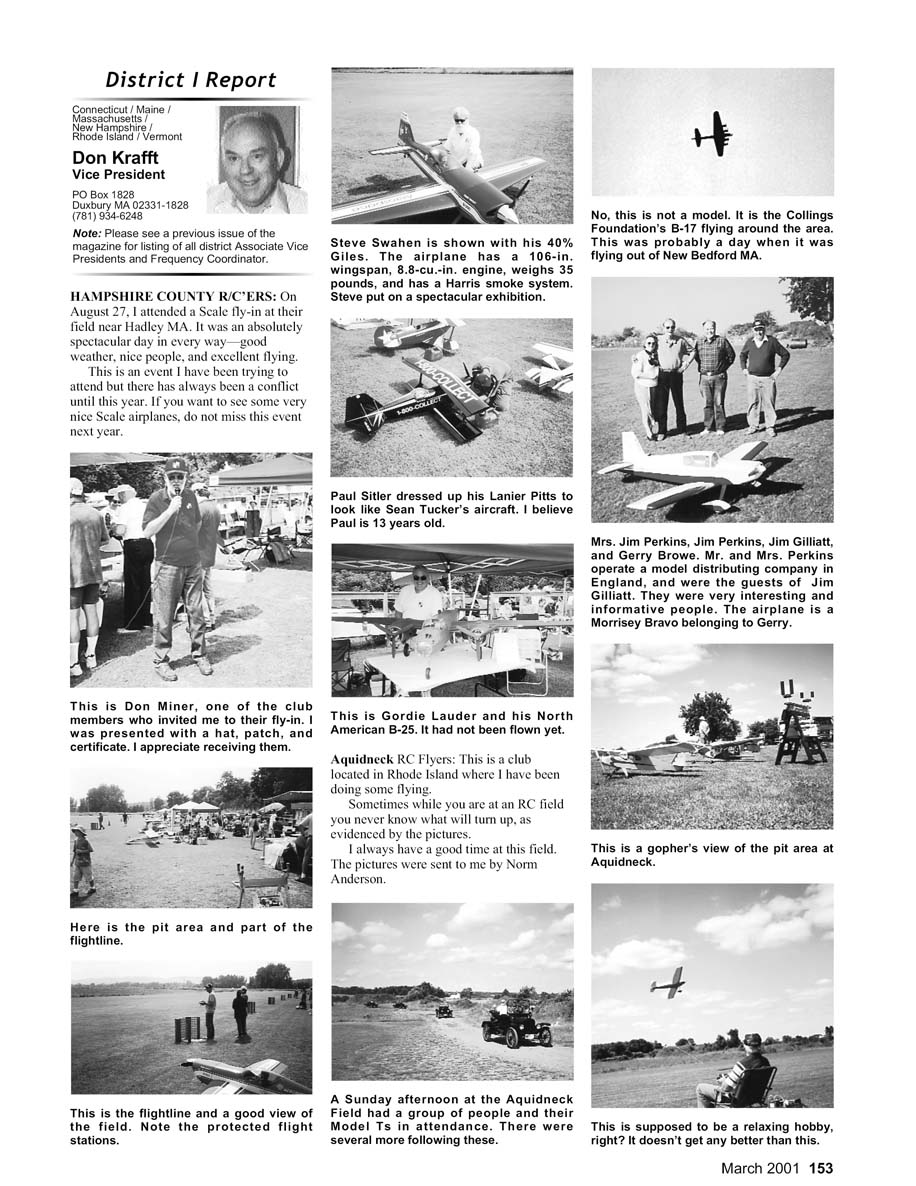
District I Report
Connecticut / Maine / Massachusetts / New Hampshire / Rhode Island / Vermont
Don Krafft Vice President PO Box 1828, Duxbury MA 02331-1828 (781) 934-6248
Note: Please see a previous issue of the magazine for the listing of all district Associate Vice Presidents and Frequency Coordinators.
Hampshire County R/C'ers
On August 27, I attended a Scale fly-in at their field near Hadley, MA. It was an absolutely spectacular day in every way—good weather, nice people, and excellent flying. If you want to see some very nice Scale airplanes, do not miss this event next year.
Aquidneck RC Flyers
This club is located in Rhode Island where I have been doing some flying. Sometimes while you are at an RC field you never know what will turn up, as evidenced by the pictures sent to me by Norm Anderson. I always have a good time at this field.
---
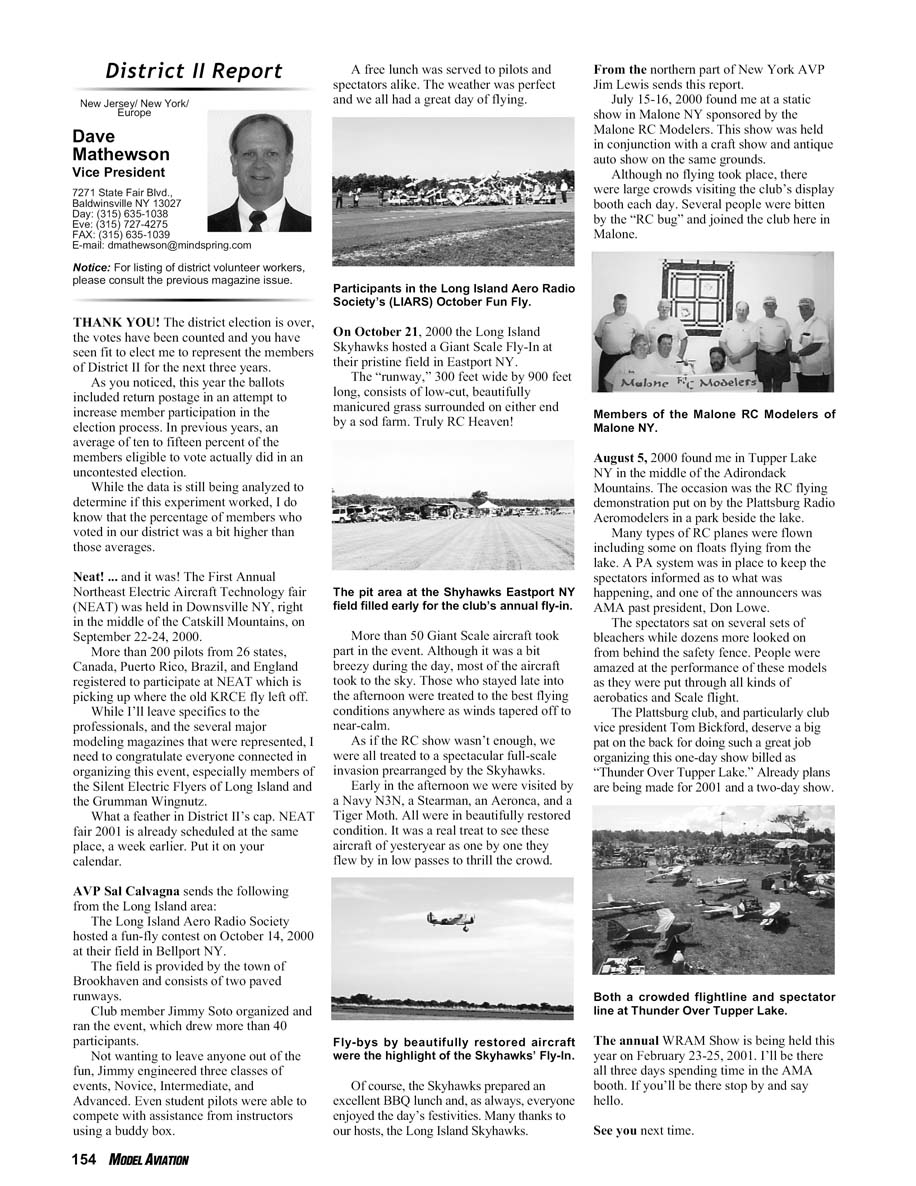
District II Report
New Jersey / New York / Europe
Dave Mathewson Vice President 7271 State Fair Blvd., Baldwinsville NY 13027 Day: (315) 635-1038 | Eve: (315) 727-4275 | FAX: (315) 635-1039 E-mail: dmathewson@mindspring.com
Notice: For a listing of district volunteer workers, please consult the previous magazine issue.
THANK YOU! The district election is over—the votes have been counted—and you have elected me to represent District II for the next three years. This year the ballots included return postage in an attempt to increase member participation in the election process. In previous years, an average of 10–15% of eligible members voted in uncontested elections. While the data is still being analyzed, I know the percentage of members who voted in our district was a bit higher than those averages.
Neat! The First Annual Northeast Electric Aircraft Technology fair (NEAT) was held in Downsville, NY, on September 22–24, 2000. More than 200 pilots from 26 states, Canada, Puerto Rico, Brazil, and England registered. NEAT is picking up where the old KRCE fly-in left off. Congratulations to the organizers, especially members of the Silent Electric Flyers of Long Island and the Grumman Wingnutz. NEAT 2001 is already scheduled at the same place, a week earlier—put it on your calendar.
AVP Sal Calvagna (Long Island area)
The Long Island Aero Radio Society hosted a fun-fly contest on October 14, 2000 at their field in Bellport, NY. The field is provided by the town of Brookhaven and consists of two paved runways. Club member Jimmy Soto organized and ran the event, which drew more than 40 participants. Jimmy engineered three classes—Novice, Intermediate, and Advanced. Even student pilots competed with assistance from instructors using a buddy box. A free lunch was served to pilots and spectators alike. The weather was perfect.
On October 21, 2000, the Long Island Skyhawks hosted a Giant Scale Fly-In at their pristine field in Eastport, NY. The "runway," 300 feet wide by 900 feet long, consists of low-cut, beautifully manicured grass surrounded on either end by a sod farm. More than 50 Giant Scale aircraft took part. Late afternoon conditions were near-calm for great flying. A spectacular full-scale visit included a Navy N3N, a Stearman, an Aeronca, and a Tiger Moth, all beautifully restored, which flew low passes to thrill the crowd. The Skyhawks prepared an excellent BBQ lunch—many thanks to our hosts.
AVP Jim Lewis (Northern New York)
July 15–16, 2000: I attended a static show in Malone, NY, sponsored by the Malone RC Modelers, held with a craft show and antique auto show. Although no flying took place, there were large crowds at the club's display booth; several people joined the club.
August 5, 2000: I was in Tupper Lake, NY, for an RC flying demonstration put on by the Plattsburg Radio Aeromodellers in a park beside the lake. Many types of RC planes were flown, including floatplanes. A PA system kept spectators informed; one announcer was AMA past president Don Lowe. Spectators sat on bleachers and behind the safety fence, amazed at the aerobatics and Scale flight. Kudos to the Plattsburg club and vice president Tom Bickford for organizing "Thunder Over Tupper Lake." Plans are already being made for 2001 and a two-day show.
The annual WRAM Show is scheduled for February 23–25, 2001. I'll be in the AMA booth—stop by and say hello.
See you next time.
---
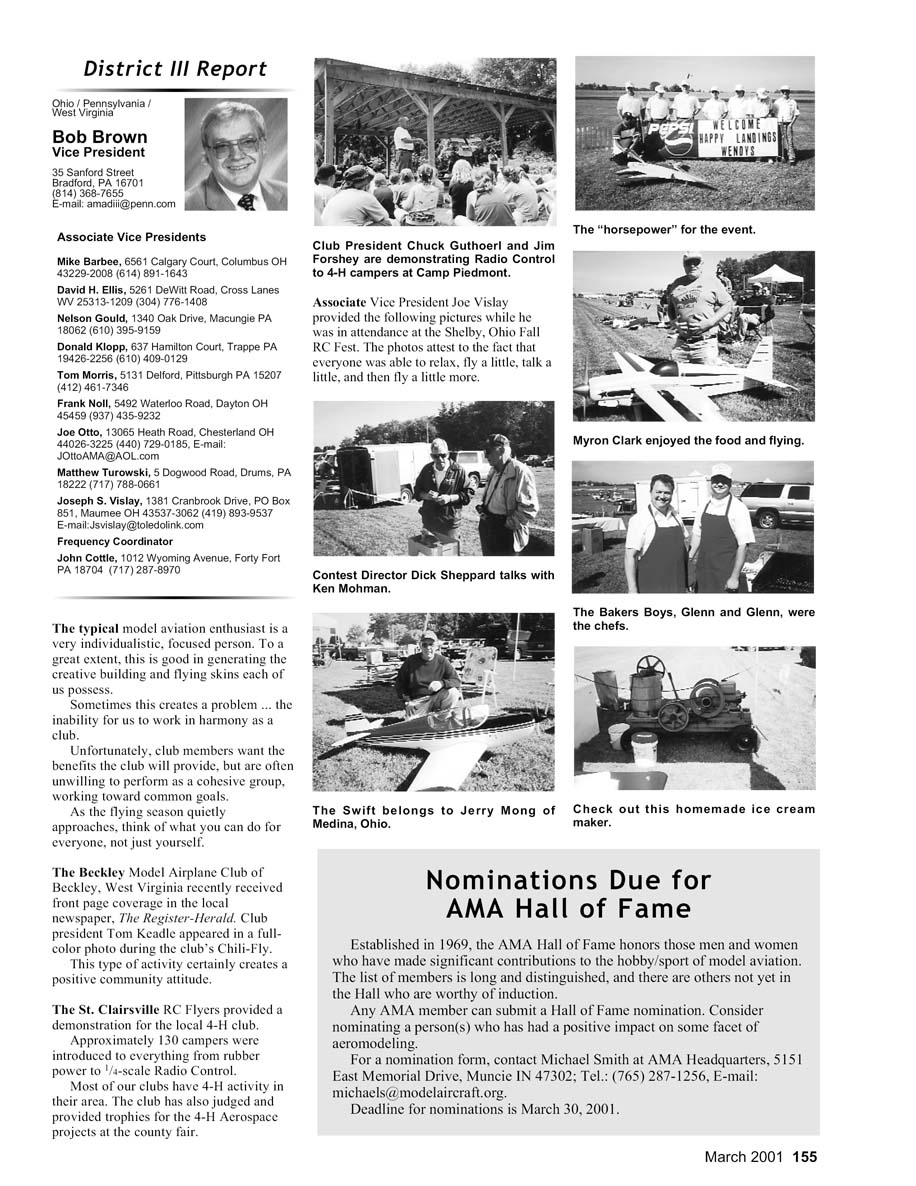
District III Report
Ohio / Pennsylvania / West Virginia
Bob Brown Vice President 35 Sanford Street, Bradford, PA 16701 (814) 368-7655 E-mail: amadiii@penn.com
Associate Vice Presidents
- Mike Barbee, 6561 Calgary Court, Columbus, OH 43229-2008 (614) 891-1643
- David H. Ellis, 5261 Dewett Road, Cross Lanes, WV 25313-1209 (304) 776-1408
- Nelson Gould, 1340 Oak Drive, Macungie, PA 18062 (610) 395-9159
- Donald Klopp, 637 Hamilton Court, Trappe, PA 19426-2256 (610) 409-0129
- Tom Morris, 5131 Delford, Pittsburgh, PA 15207 (412) 461-7346
- Frank Noll, 5492 Waterloo Road, Dayton, OH 45459 (937) 435-9232
- Joe Otto, 13065 Heath Road, Chesterland, OH 44026-3225 (440) 729-0158 | E-mail: JOttoAMA@AOL.COM
- Matthew Turowski, 5 Dogwood Road, Drums, PA 18222 (717) 788-0661
- Joseph S. Vislay, 1381 Cranbrook Drive, PO Box 851, Maumee, OH 43537-3062 (419) 893-9537 | E-mail: jsvislay@toledolink.com
Frequency Coordinator
- John Cottle, 1012 Wyoming Avenue, Forty Fort, PA 18704 (717) 287-8970
The typical model aviation enthusiast is an individualistic, focused person. This is good for generating creative building and flying skills, but sometimes causes difficulty working in harmony as a club. Club members want benefits but may be unwilling to perform as a cohesive group working toward common goals. As the flying season approaches, think of what you can do for everyone, not just yourself.
The Beckley Model Airplane Club of Beckley, West Virginia, recently received front-page coverage in the local newspaper, The Register-Herald. Club president Tom Keadle appeared in a full-color photo during the club's Chili-Fly. This type of activity creates a positive community attitude.
The St. Clairsville RC Flyers provided a demonstration for the local 4-H club. Approximately 130 campers were introduced to everything from rubber power to 1/4-scale Radio Control. Many clubs judge and provide trophies for 4-H Aerospace projects at county fairs.
Associate Vice President Joe Vislay provided photos from the Shelby, Ohio Fall RC Fest showing everyone relaxing, flying, and talking.
---
Nominations Due for AMA Hall of Fame
Established in 1969, the AMA Hall of Fame honors men and women who have made significant contributions to model aviation. Any AMA member can submit a nomination. Consider nominating a person who has had a positive impact on some facet of aeromodeling.
For a nomination form, contact Michael Smith at AMA Headquarters, 5151 East Memorial Drive, Muncie, IN 47302; Tel.: (765) 287-1256; E-mail: michaels@modelaircraft.org.
Deadline for nominations: March 30, 2001.
---
District IV Report
Delaware / District of Columbia / Maryland / North Carolina / Virginia
Chuck Foreman Vice President 412 Pine Cone Ct., Kill Devil Hills, NC 27948 Phone: (252) 441-5855 | Fax: (252) 441-6554 E-mail: CHUCKAMAVP@aol.com
Associate Vice Presidents
- George Abbott, 8712 Westlake Court, Raleigh, NC 27613; (919) 848-6719 | E-mail: GAbbott462@aol.com
- Robert E. Babura, 117 Otis Dr., Severn, MD 21144-1130 (410) 969-9356 | E-mail: babura@mps.com
- Randy Elliott, 103 Virginia Court, Pulaski, VA 24301 (540) 980-8461 | Office: (540) 994-2316
- Steve Moulton, 2217 Johnstown Rd., Chesapeake, VA 23322 (757) 421-4545 | Office: (757) 463-8483 Ext. 223 | E-mail: moultons@mindspring.com
- Richard (Dick) Smith, 761 Gwynne Ave., Waynesboro, VA 22980-3346 (540) 943-1684 | E-mail: flyrds@cokmac.com
- John Starre, 826 Marl Pit Rd., Middletown, DE 19709 (302) 376-7154 | E-mail: xrs28@aol.com
- Bliss Teague, 625 5th Ave., S.W., Hickory, NC 28602 (828) 324-2164 | Office: (828) 733-9228 | E-mail: blissteague@coninc.com
Frequency Coordinator
- Paul Yacobucci, 6048 Winthrop Dr., Fayetteville, NC 28311-1070 | Evening: (910) 488-5986 | E-mail: PYacob313@aol.com
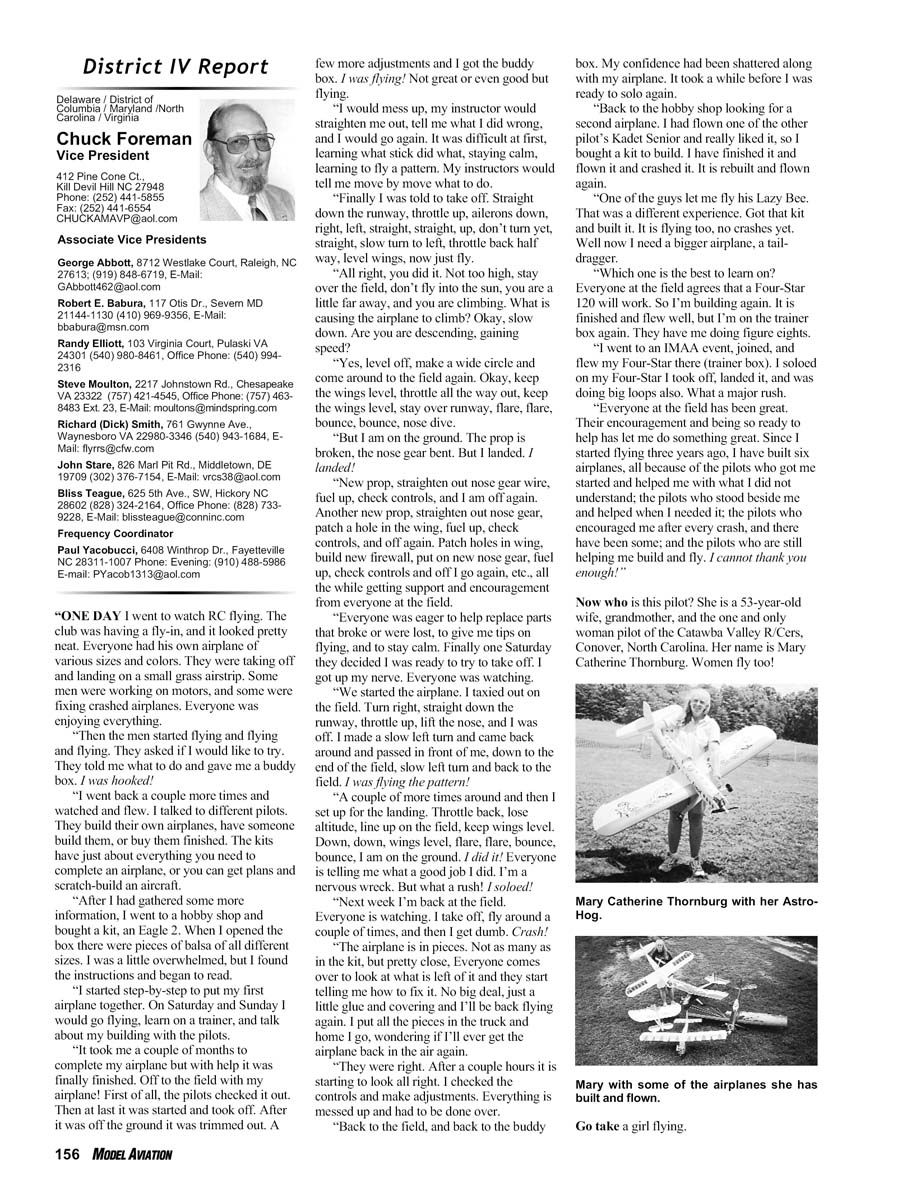
A personal story: One day I went to watch RC flying at a club fly-in. The pilots offered me a buddy box and instruction, and I was hooked. I bought a kit and, with help from pilots at the field, learned to build and fly. After many crashes, repairs, and encouragement from club members, I eventually soloed. The pilots' willingness to help—replacing parts, offering tips, and encouraging me—made all the difference. That pilot turned out to be a 53-year-old wife, grandmother, hobby shop owner, club secretary, and the only woman pilot of the Catawba Valley R/Cers in Conover, North Carolina: Mary Catherine Thornburg. Women fly too!
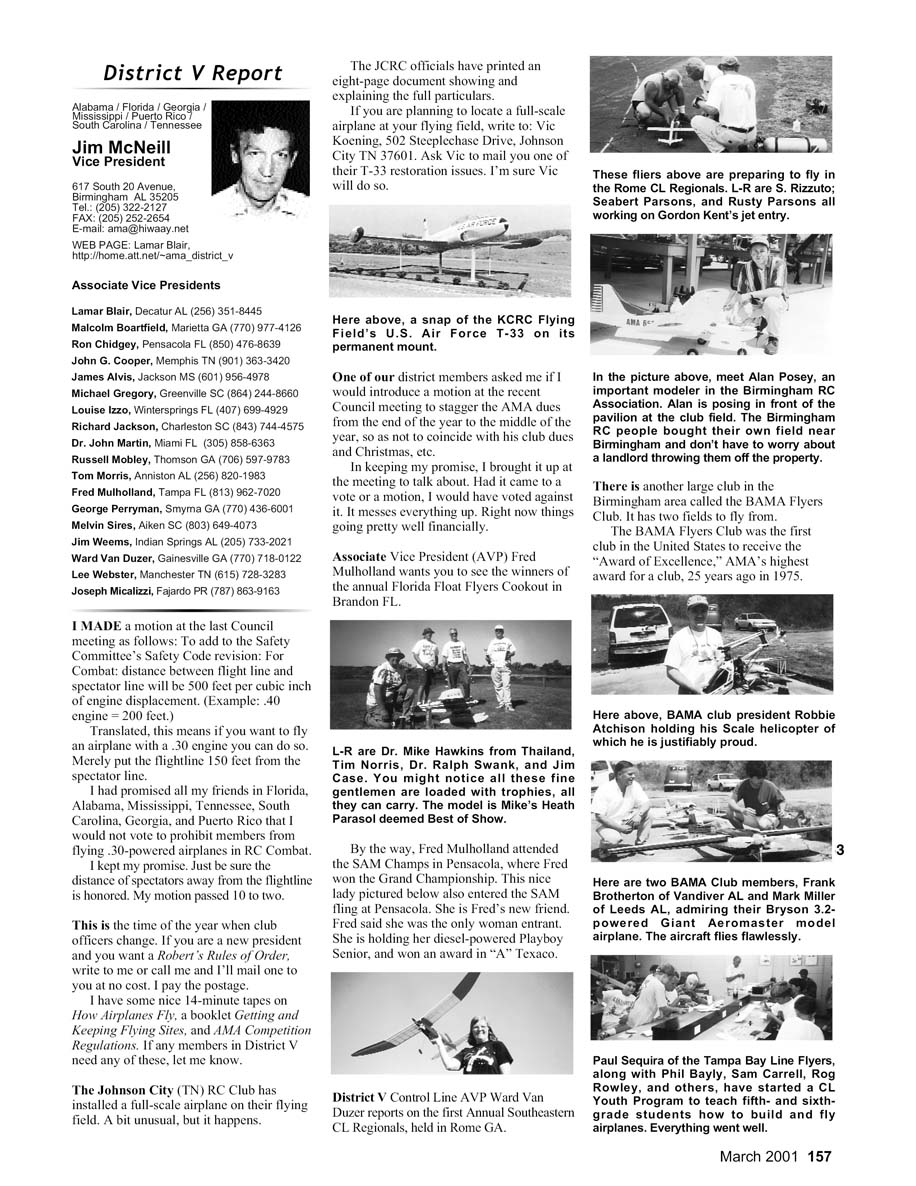
I made a motion at the last Council meeting to add to the Safety Committee's Safety Code revision: for Combat, distance between flight line and spectator line will be 500 feet per cubic inch of engine displacement (example: .40 engine = 200 feet). Translated, if you want to fly an airplane with a .30 engine, set the flightline 150 feet from the spectator line. I promised members in FL, AL, MS, TN, SC, GA, and PR I would not vote to prohibit .30-powered airplanes in RC Combat—and I kept my promise. Just be sure spectator distance from the flightline is honored. My motion passed 10 to 2.
This is the time of the year when club officers change. If you are a new president and want a copy of Robert's Rules of Order, write or call me and I'll mail one at no cost (I pay postage). I also have 14-minute tapes on How Airplanes Fly, a booklet Getting and Keeping Flying Sites, and AMA Competition Regulations—contact me if you need any of these.
The Johnson City (TN) RC Club has installed a full-scale airplane on their flying field. The club printed an eight-page document explaining the restoration; contact Vic Koening, 502 Steeplechase Drive, Johnson City TN 37601 for a copy.
A district member asked me to introduce a motion to stagger AMA dues from year-end to mid-year to avoid coincidence with club dues and Christmas. I discussed it at the meeting; had it come to a vote, I would have voted against it. It complicates things; current finances are in good shape.
Associate Vice President Fred Mulholland shared winners of the annual Florida Float Flyers Cookout in Brandon, FL. Fred attended SAM Champs in Pensacola and won the Grand Championship. He also noted a woman competitor who entered a diesel-powered Playboy Senior and won an award in "A" Texaco.
District V Control Line AVP Ward Van Duzer reported on the first Annual Southeastern CL Regionals held in Rome, GA.
The BAMA Flyers Club in Birmingham has two fields and was the first U.S. club to receive the Award of Excellence (AMA's highest award for a club) in 1975.
Paul Sequiera and others started a CL Youth Program to teach fifth- and sixth-grade students to build and fly airplanes—everything went well.
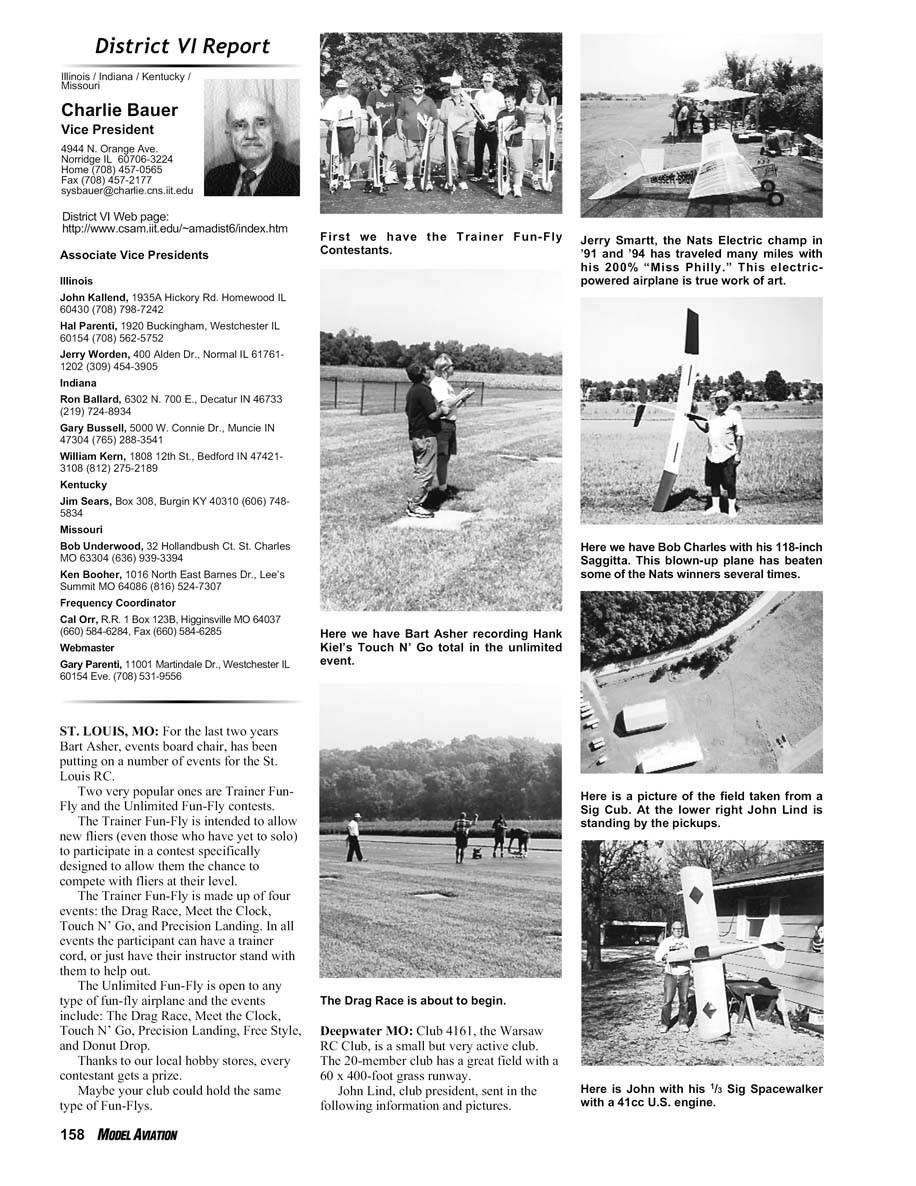
St. Louis, MO: For the last two years Bart Asher, events board chair, has run popular events for the St. Louis RC: Trainer Fun-Fly (for new fliers) and the Unlimited Fun-Fly (open to any fun-fly airplane). Trainer Fun-Fly events include Drag Race, Meet the Clock, Touch N' Go, and Precision Landing—participants may use a trainer cord or have an instructor assist. Unlimited Fun-Fly adds Free Style and Donut Drop. Local hobby stores sponsor prizes for every contestant. Maybe your club could hold similar Fun-Flys.
Deepwater, MO: Club 4161, the Warsaw RC Club, is a small but very active 20-member club with a 60 x 400-foot grass runway. Club president John Lind provided information and pictures.
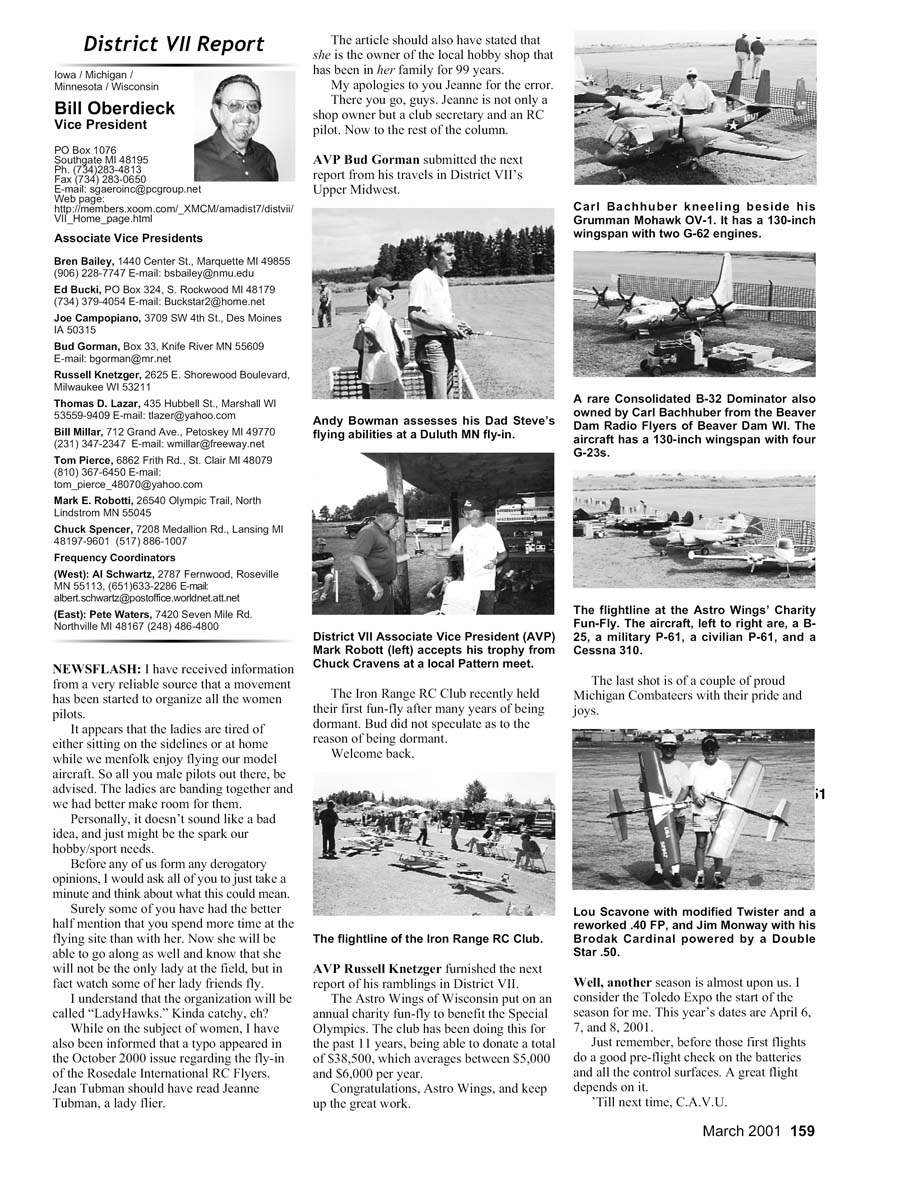
Correction note: Jeanne, a shop owner, club secretary, and RC pilot, was misidentified in a previous column—my apologies.
AVP Bud Gorman reported on the Iron Range RC Club's recent fun-fly after many years of dormancy—welcome back. AVP Russell Knetzger reported the Astro Wings of Wisconsin's annual charity fun-fly benefiting the Special Olympics; over 11 years the club donated $38,500. Congratulations.
Well, another season is almost upon us. I consider the Toledo Expo the start of the season for me. This year's dates are April 6–8, 2001. Before those first flights, do a good pre-flight check on batteries and control surfaces. A great flight depends on it.
'Till next time, C.A.V.U.
---
District VIII Report
Arkansas / Louisiana / New Mexico / Oklahoma / Texas
Dr. Sandy Frank Vice President 105 N. Brazos St., Weatherford, TX 76086-3207 Phone/Fax: (817) 599-7131 E-mail: sfrank69@airmail.net www.AMA-Dist-8.org
Associate Vice Presidents
- George Aldrich, 12822 Tarrytown, San Antonio, TX 78233 (210) 656-2021
- Max Blose, 1001 N. Betsy, Waco, TX 76706 (254) 662-5587
- Ervin "Chick" Frierson, Box 188, Haskell, TX 79525 (817) 864-3086
- Jim D. Marshall, Box 992, Mission, TX 78572 (956) 585-6446
- Marlin McGee, 126 1/2 S.E. 35th St., Oklahoma City, OK 73129 (405) 634-5331
- Randy Randolph, 4873 Fallon Pl., Dallas, TX 75227 (214) 381-7624
- Jim Simpson, 604 San Juan Del Rio, Rio Rancho, NM 87124 (505) 891-1336
- Ron Stanfield, 26 Oak Ridge Dr., Maumelle, AR 72113-8646 (501) 851-1607
- Charles Stephens, 226 Delta St., Pasadena, TX 77506 (713) 473-4995
- Ward Watts, 13415 Joor Rd., Baton Rouge, LA 70818 (504) 261-5974
Frequency Coordinators
- North: Joe DuMond, 6731 Bridge Street, PMB-224, Ft. Worth, TX 76112 (817) 457-6685
- South: Gene Kent, 2811 Cork Cove, San Antonio, TX 78230 (210) 308-8043
AMA Display Coordinator
- Karen Hopkins, 5515 Bridgeton Avenue, Arlington, TX 76018 (817) 467-9211
THANK YOU to those who voted in District VIII's fall election. Though running unopposed, I received more than 1,000 additional votes compared to a similar uncontested ballot three years earlier. I will do my utmost to represent you on the AMA Board of Directors!
You are the ambassador for your hobby of aircraft modeling. The most powerful representative for our endeavor has been the individual participant. Associations, SIGs, instructors, and local clubs support the hobby, but one-to-one contact between prospective participants and active modelers is key to expanding and sharing the hobby.
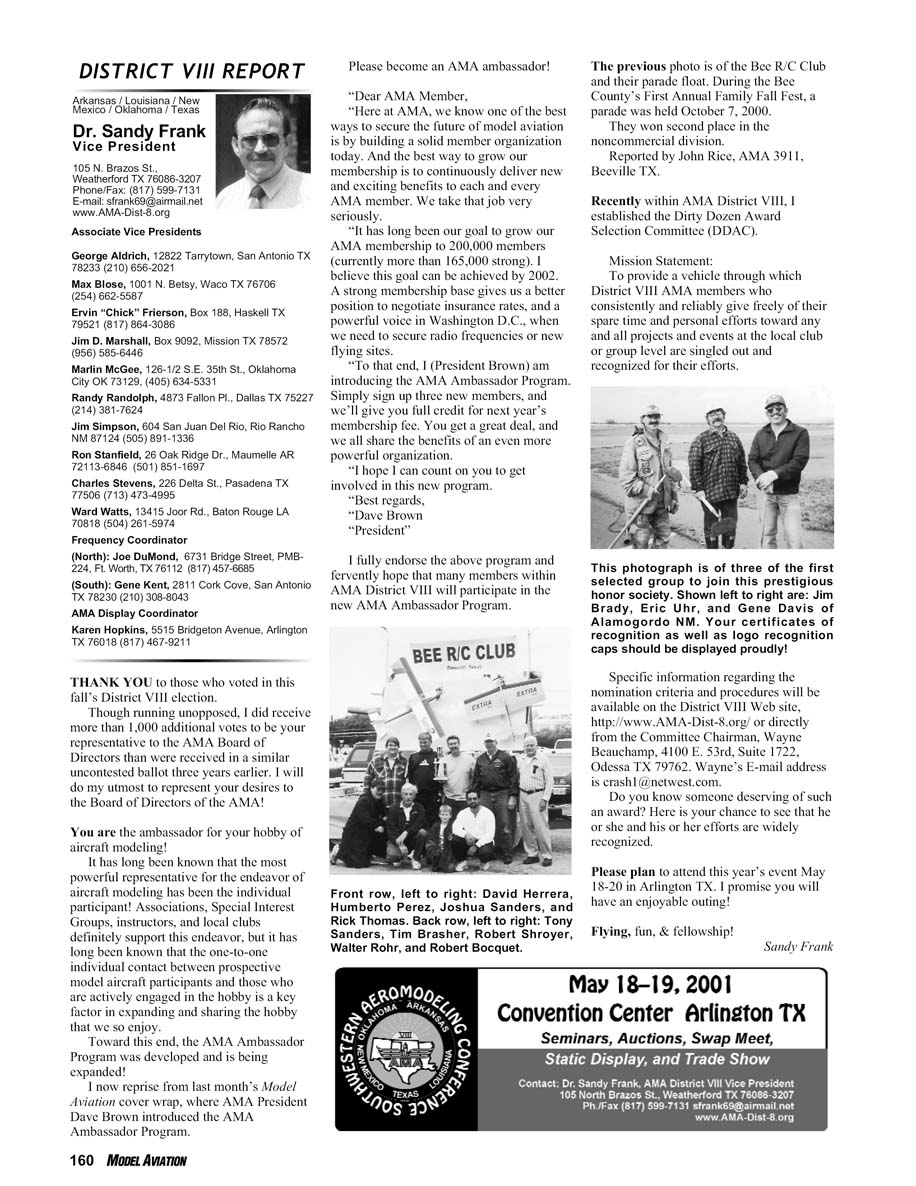
Toward this end, the AMA Ambassador Program was developed and is being expanded. AMA President Dave Brown introduced the program: sign up three new members and you'll receive full credit for next year's membership fee. I fully endorse the program and hope many in District VIII participate.
The Bee R/C Club won second place with a parade float during Bee County's First Annual Family Fall Fest on October 7, 2000. Reported by John Rice, AMA 3911, Beeville, TX.
I established the Dirty Dozen Award Selection Committee (DDAC) in District VIII.
Mission Statement: Recognize District VIII AMA members who consistently and reliably give freely of their spare time and personal efforts toward local club or group projects and events.
The first selected members include Jim Brady, Eric Urr, and Gene Davis of Alamogordo, NM. Certificates and logo caps will be provided. Nomination criteria and procedures will be available on the District VIII Web site (http://www.AMA-Dist-8.org/) or from Committee Chairman Wayne Beauchamp, 410 E. 53rd, Suite 1722, Odessa, TX 79762 | e-mail: crash1@netwest.com.
Do you know someone deserving? Nominate them. Please plan to attend this year's event May 18–20 in Arlington, TX—flying, fun, and fellowship!
Sandy Frank
---
District IX Report
Colorado / Kansas / Nebraska / North Dakota / South Dakota / Wyoming
Russ Miller Vice President 980 N. 3rd St., Carrington, ND 58421 Phone: (701) 652-2321 | Fax: (701) 652-2994 E-mail: rumiller@daknet.com
Associate Vice Presidents
- Max Hansen, 1909 Wisconsin SW, Huron, SD 57350
- Nathan Lancaster, 3597 S. Kendall Street, Denver, CO 80235
- Troy Lapp, 169 Wichita Dr., Bismarck, ND 58504
- Travis McGinnis, 8027 W. 81st Circle, Arvada, CO 80005
- Don Moden, 410 Hart St., Salina, KS 67401
- Jim Ricketts, 4921 Fernwood Drive, Sioux Falls, SD 57103-5574
- Jack L. Sibert, 3611 Kimberly Circle, Lincoln, NE 68506-4524
- Chuck Smith, 1091 Cheshire Street, Casper, WY 82609-3214
- Mark T. Smith, 14632 W. 50th Street, Shawnee, KS 66216
- Mike Wendner, 6535 Foxdale Circle, Colorado Springs, CO 80919-1788
Frequency Coordinator
- Steve Mangels, c/o Radio Service Center, 918 S. Sheridan, Denver, CO 80226
RALLY of the GIANTS 2001: Planning has been underway for many months. The event is scheduled for June 6–10, 2001. A web site is available at www.rallyofthegiants2001.com where registration forms for pilots, manufacturers, and vendors can be downloaded.
Tours for registered visitors include:
- June 7: Mount Rushmore and Deadwood, SD (with buffet lunch), returning late.
- June 8: Tour of a local open-pit coal mine and Devils Tower National Monument (fee for Devils Tower tour).
Planned social events:
- Friday night: Wyoming-style barbeque (barbequed buffalo), with music by Bill and Bob Carpenter.
- Saturday evening: Prime rib dinner hosted by the Flying Cowboys of Sheridan, WY; banquet hall seats approx. 1,000.
Sister clubs from WY, CO, MT, and SD pledged support and some plan to arrive early to help with setup. With paid pilots and manufacturers/vendors, this promises to be a great event. For more information contact Nolan Bartz at (307) 682-5136 | bartz@vcn.com or Jack Adsit at (307) 687-1450 | triplane@vcn.com.
Mark Smith of Shawnee, KS has been appointed District IX's newest Associate Vice President. Mark and his wife Ruth have two children, Shane (25) and Shonda (23). Mark is an Adjunct Professor at Baker University and retired early from Sprint after 28 years, where he focused on local market integration. He is active in several community and modeling activities, including vice president of the Shawnee Mission Radio Control Club (SMRCC), involvement with SIG 705 NCFFA, and volunteer work with Habitat for Humanity and the Boy Scouts.
---
District X Report
Arizona / California / Hawaii / Guam / Nevada / Utah
Richard Hanson Vice President PO Box 3312, Scottsdale, AZ 85271 Voice/Fax: (888) 899-3548 E-mail: rhich@rpmnet.com http://www.ama-10.com/ama
Associate Vice Presidents
- Glenn Carter, Walnut Creek, CA (925) 933-2086
- Jim Giffin, Sacramento, CA (916) 638-4283
- Michael Harrington, Kaneohe, HI (808) 239-6682
- Kai Jensen, Reno, NV (775) 329-6430
- Bill Malvey, Aliso Viejo, CA (949) 362-8371
- Bob Reynolds, Tucson, AZ (520) 296-8183
Frequency Coordinator
- George Steiner, Sacramento, CA (916) 362-1962
Each year the Arizona Radio Control Society hosts their Octoberfest Fly-in and Fun Fly in Phoenix's West Valley. The October 7–8 event saw a record turnout and opened its doors to the community. Hobby Bench and the Glendale Police Department supported the event.
Highlights:
- Masters pilot Dick Belden made final adjustments to an NSRCA Dist VII VP John Fayad Typhoon.
- Hobby Bench had a significant presence.
- Rick Powers flew a Kyosho electric-powered ducted fan Lear Jet with store owner Lee Piester timing the flight.
The 2000 USRA Giant Scale World Championship Air Races were held at Eagle Field (near Los Banos, CA) September 28–October 1. Eagle Field, a WWII training base, is now a living museum.
On August 12–13, the Bayside RC club hosted their fifth annual Helicopter Jamboree. This event has grown into one of the major helicopter fly-ins in the district. Electric-powered RC helicopters (e.g., Century's Hawk III) are a new innovation and were medal winners at the 2000 Electric World Championships in San Diego. Precision autorotation is one of the Jamboree's most popular events.
The Sacramento Area Modelers' Bud Garric Memorial Pattern Contest (August 19–20) saw 31 entries and raised more than $400 for the home club.
Stay safe and keep 'em fly'n.
---
District XI Report
Alaska / Idaho / Montana / Oregon / Washington
Bruce Nelson Vice President 807 E. Vicksburg St., Spokane, WA 99208 NelsonAMAVP@cs.com | (509) 326-4288 (Office Fax) | (509) 467-1852 (Home Ph./Fax) Web: http://www.olywa.com/yosemiteflash/xiama.htm
Associate Vice Presidents
- Al Culver, Box 86, Wilder, ID 83676 | e-mail: alc@potlatch.com
- Jerry Holcomb, 1010 NE 122nd Ave., Vancouver, WA 98684
- Reeves Lippincott, 4400 Gray Wolf Dr., Wasilla, AK 99654 | e-mail: reeves@matnet.com
- Mike Hazel, 1073 Windemere Dr. NW, Salem, OR 97304 | e-mail: ZZCLspeed@aol.com
- Richard Snaer, 781 Lillocet Ct., LaConner, WA 98257
- Chick Young, 7411 154 Ave. E. #14, Sumner, WA 98390
Frequency Coordinator
- Phil Tallman, Medical Lake, WA (509) 299-5102
On October 14–15, the Western Oregon Control Line Flyers of Salem hosted their 14th Annual Really Racing/Fall Follies with 20 entries. Events included Aerobatics and multiple racing classes.
Aerobatics winners:
- Beginner Precision Aerobatics: 1st Loren Anderson (Bend, OR); 2nd Mike Anderson (Bend, OR); 3rd Montana Marlatt (OR).
- Advanced Precision Aerobatics: 1st Nils Norling (Metolius, OR); 2nd Keith Varley (Vancouver, B.C.); 3rd Dave Royer (Portland, OR).
- Expert Precision Aerobatics: 1st Paul Walker (Kent, WA); 2nd Jack Pitcher (Gresham, OR); 3rd Scott Riese (Portland, OR).
Race results:
- Class I Mouse Race: Nitroholics Racing Team, 3:09.00 heat
- Class II Mouse Race: Nitroholics Racing Team, 6:37.77 heat
- Slow Rat Race: Nitroholics Racing Team, 3:59.40 heat
- Northwest Sport Race: 1st Ron Howell (Hoquiam, WA) 10:42.72; 2nd Nitroholics Racing Team, Oregon 10:44.95; 3rd Mike Conner (Pitt Meadows, B.C.) 11:52.88
The host club put on a barbecue lunch and the weather cooperated for both days. The event began as a low-key competition for local fliers to practice for more formal competition and has become popular.
I received photos from Mike Mosbrooker taken at the Whidbey Island RC Society Big Bird event on August 12–13, which had 23 fliers and 34 aircraft.
Thanks, Mike, for the great pictures.
Transcribed from original scans by AI. Minor OCR errors may remain.

