
AMA News - 2004/02
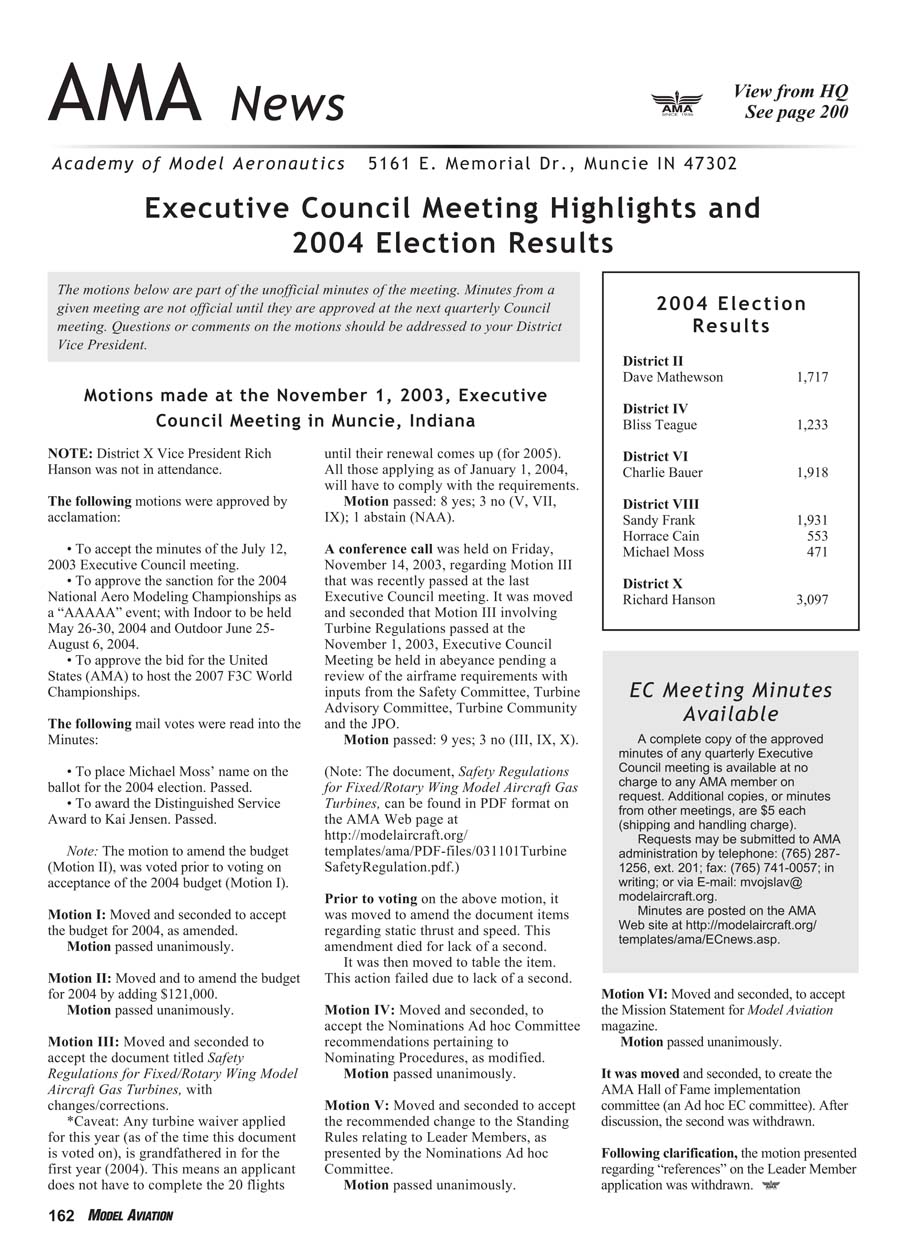
Executive Council Meeting Highlights and 2004 Election Results
The motions below are part of the unofficial minutes of the meeting. Minutes from a given meeting are not official until they are approved at the next quarterly Council meeting. Questions or comments on the motions should be addressed to your District Vice President.
Motions made at the November 1, 2003, Executive Council Meeting in Muncie, Indiana
NOTE: District X Vice President Rich Hanson was not in attendance.
The following motions were approved by acclamation:
- To accept the minutes of the July 12, 2003 Executive Council meeting.
- To approve the sanction for the 2004 National Aero Modeling Championships as a "AAAAA" event; Indoor to be held May 26–30, 2004 and Outdoor June 25–August 6, 2004.
- To approve the bid for the United States (AMA) to host the 2007 F3C World Championships.
The following mail votes were read into the Minutes:
- To place Michael Moss' name on the ballot for the 2004 election. Passed.
- To award the Distinguished Service Award to Kai Jensen. Passed.
Note: The motion to amend the budget (Motion II) was voted prior to voting on acceptance of the 2004 budget (Motion I).
Motion I: Moved and seconded to accept the budget for 2004, as amended.
- Motion passed unanimously.
Motion II: Moved and seconded to amend the budget for 2004 by adding $121,000.
- Motion passed unanimously.
Motion III: Moved and seconded to accept the document titled Safety Regulations for Fixed/Rotary Wing Model Aircraft Gas Turbines, with changes/corrections.
- Caveat: Any turbine waiver applied for this year (as of the time this document is voted on) is grandfathered in for the first year (2004). This means an applicant does not have to complete the 20 flights until their renewal comes up (for 2005). All those applying as of January 1, 2004, will have to comply with the requirements.
- Motion passed: 8 yes; 3 no (V, VII, IX); 1 abstain (NAA).
A conference call was held on Friday, November 14, 2003, regarding Motion III that was recently passed at the last Executive Council meeting. It was moved and seconded that Motion III involving Turbine Regulations passed at the November 1, 2003, Executive Council Meeting be held in abeyance pending a review of the airframe requirements with inputs from the Safety Committee, Turbine Advisory Committee, Turbine Community and the JPO.
- Motion passed: 9 yes; 3 no (III, IX, X).
(Note: The document, Safety Regulations for Fixed/Rotary Wing Model Aircraft Gas Turbines, can be found in PDF format on the AMA Web page at http://modelaircraft.org/templates/ama/PDF-files/031101TurbineSafetyRegu....)
Prior to voting on the above motion, J. McNeill (V) moved to amend the document items regarding static thrust and speed. This amendment died for lack of a second. J. McNeill (V) then moved to table the item; this motion failed for lack of a second.
Motion IV: Moved and seconded to accept the Nominations Ad hoc Committee recommendations pertaining to Nominating Procedures, as modified.
- Motion passed unanimously.
Motion V: Moved and seconded to accept the recommended change to the Standing Rules relating to Leader Members, as presented by the Nominations Ad hoc Committee.
- Motion passed unanimously.
Motion VI: Moved and seconded to accept the Mission Statement for Model Aviation magazine.
- Motion passed unanimously.
It was moved and seconded to create the AMA Hall of Fame implementation committee (an Ad hoc EC committee). After discussion, the second was withdrawn. Following clarification, the motion presented regarding "references" on the Leader Member application was withdrawn.
2004 Election Results
- District II
- Dave Mathewson 1,717
- District IV
- Bliss Teague 1,233
- District VI
- Charlie Bauer 1,918
- District VIII
- Sandy Frank 1,931
- Horace Cain 553
- Michael Moss 471
- District X
- Richard Hanson 3,097
EC Meeting Minutes Available
A complete copy of the approved minutes of any quarterly Executive Council meeting is available at no charge to any AMA member on request. Additional copies, or minutes from other meetings, are $5 each (shipping and handling charge).
Requests may be submitted to AMA administration by telephone: (765) 287-1256, ext. 201; fax: (765) 741-0057; in writing; or via E-mail: mvojslav@modelaircraft.org.
Minutes are posted on the AMA Web site at http://modelaircraft.org/templates/ama/ECnews.asp.
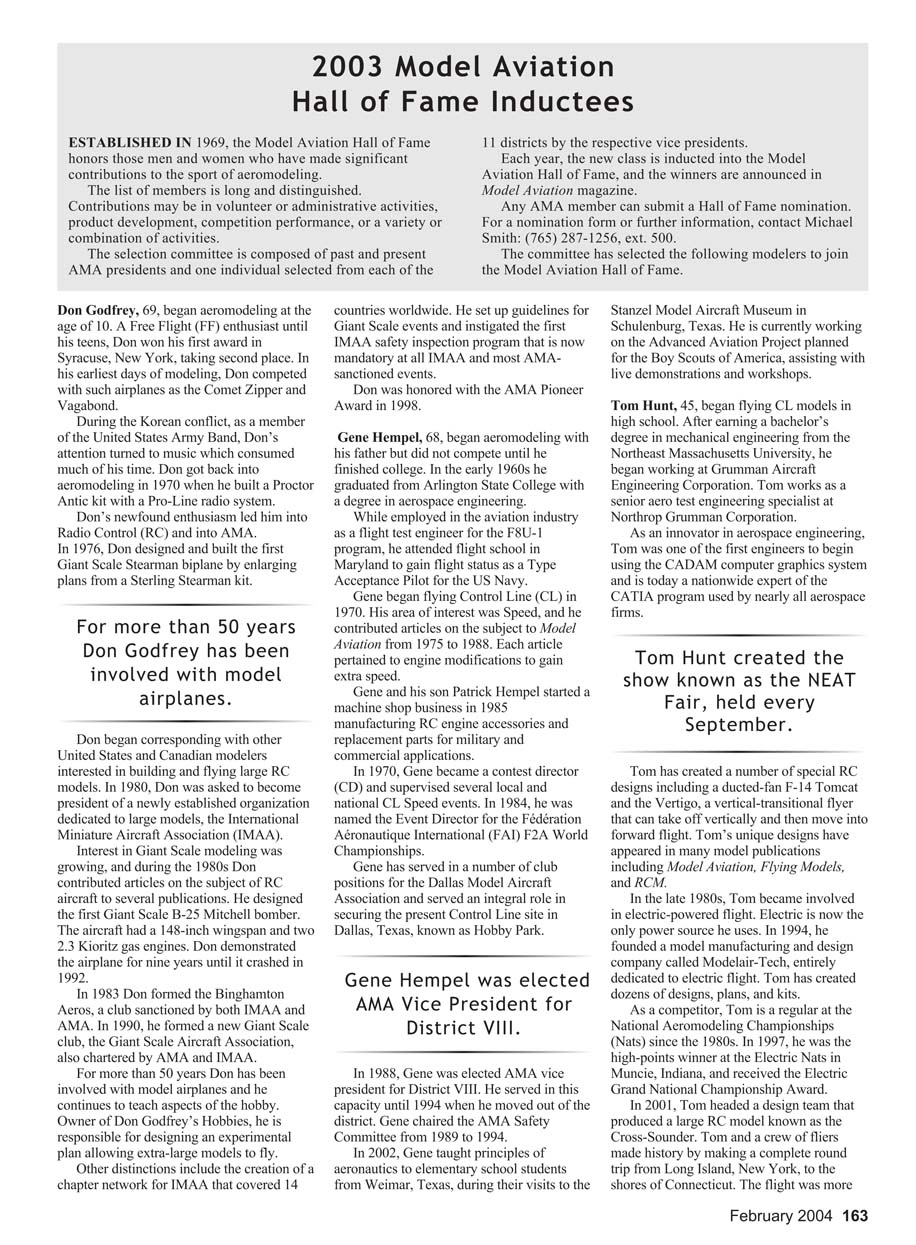
2003 Model Aviation Hall of Fame Inductees
ESTABLISHED IN 1969, the Model Aviation Hall of Fame honors those men and women who have made significant contributions to the sport of aeromodeling.
The list of members is long and distinguished. Contributions may be in volunteer or administrative activities, product development, competition performance, or a variety or combination of activities.
The selection committee is composed of past and present AMA presidents and one individual selected from each of the 11 districts by the respective vice presidents.
Each year, the new class is inducted into the Model Aviation Hall of Fame, and the winners are announced in Model Aviation magazine.
Any AMA member can submit a Hall of Fame nomination. For a nomination form or further information, contact Michael Smith: (765) 287-1256, ext. 500.
The committee has selected the following modelers to join the Model Aviation Hall of Fame.
Don Godfrey
Don Godfrey, 69, began aeromodeling at the age of 10. A Free Flight (FF) enthusiast until his teens, Don won his first award in Syracuse, New York, taking second place. In his earliest days of modeling, Don competed with such airplanes as the Comet Zipper and Vagabond.
During the Korean conflict, as a member of the United States Army Band, Don's attention turned to music, which consumed much of his time. Don got back into aeromodeling in 1970 when he built a Proctor Antic kit with a Pro-Line radio system.
Don's newfound enthusiasm led him into Radio Control (RC) and into AMA. In 1976, Don designed and built the first Giant Scale Stearman biplane by enlarging plans from a Sterling Stearman kit.
For more than 50 years Don Godfrey has been involved with model airplanes. He began corresponding with other United States and Canadian modelers interested in building and flying large RC models. In 1980, Don was asked to become president of a newly established organization dedicated to large models, the International Miniature Aircraft Association (IMAA).
Interest in Giant Scale modeling was growing, and during the 1980s Don contributed articles on the subject of RC aircraft to several publications. He designed the first Giant Scale B-25 Mitchell bomber. The aircraft had a 148-inch wingspan and two 2.3 Kioritz gas engines. Don demonstrated the airplane for nine years until it crashed in 1992.
In 1983 Don formed the Binghamton Aeros, a club sanctioned by both IMAA and AMA. In 1990, he formed a new Giant Scale club, the Giant Scale Aircraft Association, also chartered by AMA and IMAA.
Don continues to teach aspects of the hobby. Owner of Don Godfrey's Hobbies, he is responsible for designing an experimental plan allowing extra-large models to fly.
Other distinctions include the creation of a chapter network for IMAA that covered 14 countries worldwide. He set up guidelines for Giant Scale events and instigated the first IMAA safety inspection program that is now mandatory at all IMAA and most AMA-sanctioned events.
Don was honored with the AMA Pioneer Award in 1998.
Gene Hempel
Gene Hempel, 68, began aeromodeling with his father but did not compete until he finished college. In the early 1960s he graduated from Arlington State College with a degree in aerospace engineering.
While employed in the aviation industry as a flight test engineer for the F8U-1 program, he attended flight school in Maryland to gain flight status as a Type Acceptance Pilot for the US Navy.
Gene began flying Control Line (CL) in 1970. His area of interest was Speed, and he contributed articles on the subject to Model Aviation from 1975 to 1988. Each article pertained to engine modifications to gain extra speed.
Gene and his son Patrick Hempel started a machine shop business in 1985 manufacturing RC engine accessories and replacement parts for military and commercial applications.
In 1970, Gene became a contest director (CD) and supervised several local and national CL Speed events. In 1984, he was named the Event Director for the Fédération Aéronautique Internationale (FAI) F2A World Championships.
Gene has served in a number of club positions for the Dallas Model Aircraft Association and served an integral role in securing the present Control Line site in Dallas, Texas, known as Hobby Park.
In 1988, Gene was elected AMA Vice President for District VIII. He served in this capacity until 1994 when he moved out of the district. Gene chaired the AMA Safety Committee from 1989 to 1994.
In 2002, Gene taught principles of aeronautics to elementary school students from Weimar, Texas, during their visits to the Stanzel Model Aircraft Museum in Schulenburg, Texas. He is currently working on the Advanced Aviation Project planned for the Boy Scouts of America, assisting with live demonstrations and workshops.
Tom Hunt
Tom Hunt, 45, began flying CL models in high school. After earning a bachelor's degree in mechanical engineering from the Northeast Massachusetts University, he began working at Grumman Aircraft Engineering Corporation. Tom works as a senior aero test engineering specialist at Northrop Grumman Corporation.
As an innovator in aerospace engineering, Tom was one of the first engineers to begin using the CADAM computer graphics system and is today a nationwide expert on the CATIA program used by nearly all aerospace firms.
Tom Hunt created the show known as the NEAT Fair, held every September.
Tom has created a number of special RC designs including a ducted-fan F-14 Tomcat and the Vertigo, a vertical-transitional flyer that can take off vertically and then move into forward flight. Tom's unique designs have appeared in many model publications including Model Aviation, Flying Models, and RCM.
In the late 1980s, Tom became involved in electric-powered flight. Electric is now the only power source he uses. In 1994, he founded a model manufacturing and design company called Modelair-Tech, entirely dedicated to electric flight. Tom has created dozens of designs, plans, and kits.
As a competitor, Tom is a regular at the National Aeromodeling Championships (Nats) since the 1980s. In 1997, he was the high-points winner at the Electric Nats in Muncie, Indiana, and received the Electric Grand National Championship Award.
In 2001, Tom headed a design team that produced a large RC model known as the Cross-Section. Tom and a crew of fliers made history by making a complete round trip from Long Island, New York, to the shores of Connecticut. The flight was more than 30 miles and was completed nonstop with a single battery pack.
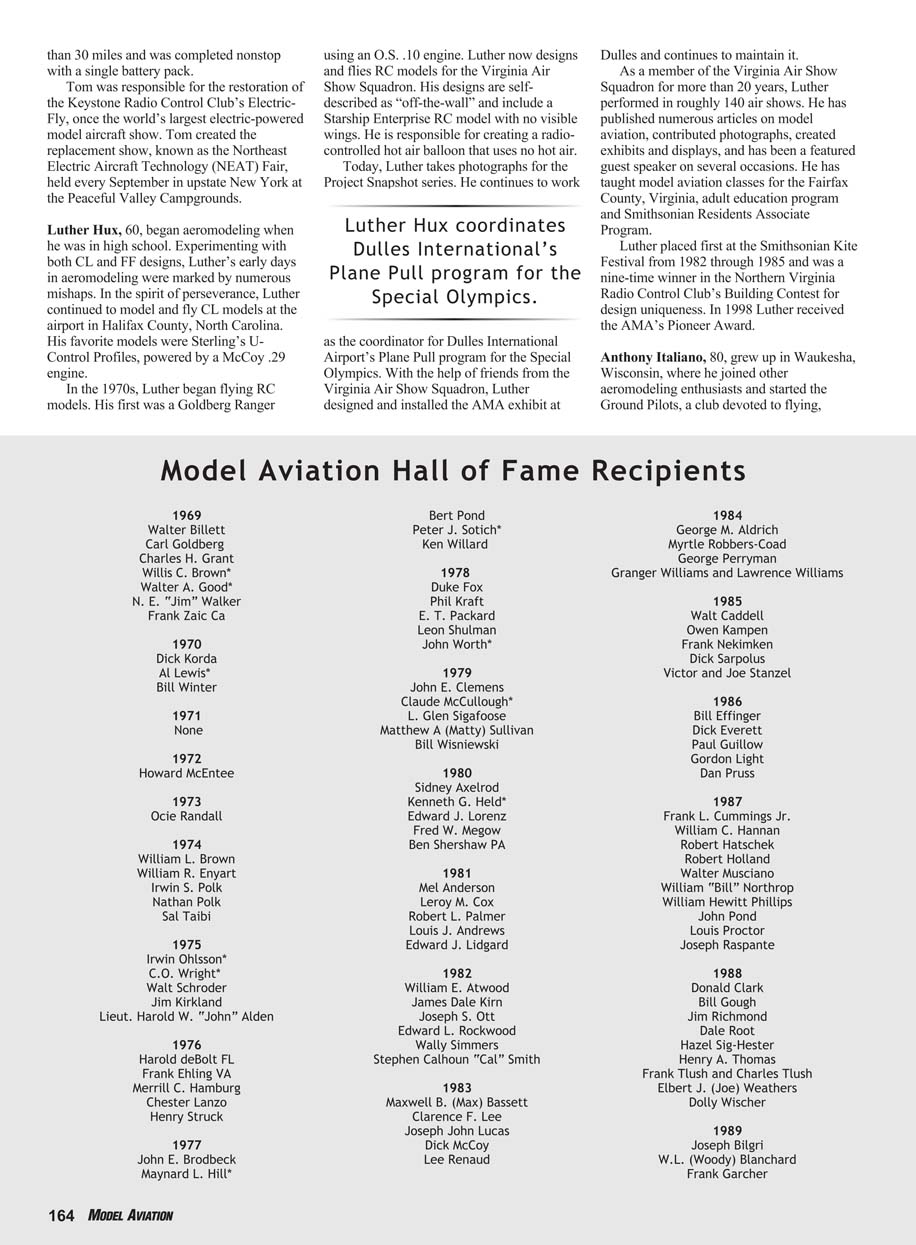
Tom was responsible for the restoration of the Keystone Radio Control Club’s Electric-Fly, once the world’s largest electric-powered model aircraft show. Tom created the replacement show, known as the Northeast Electric Aircraft Technology (NEAT) Fair, held every September in upstate New York at the Peaceful Valley Campgrounds.
Luther Hux
Luther Hux, 60, began aeromodeling when he was in high school. Experimenting with both CL and FF designs, Luther’s early days in aeromodeling were marked by numerous mishaps. In the spirit of perseverance, Luther continued to model and fly CL models at the airport in Halifax County, North Carolina. His favorite models were Sterling’s U-Control Profiles, powered by a McCoy .29 engine.
In the 1970s, Luther began flying RC models. His first was a Goldberg Ranger using an O.S. .10 engine. Luther now designs and flies RC models for the Virginia Air Show Squadron. His designs are self-described as "off-the-wall" and include a Starship Enterprise RC model with no visible wings. He is responsible for creating a radio-controlled hot air balloon that uses no hot air.
Today, Luther takes photographs for the Project Snapshot series. He continues to work as the coordinator for Dulles International Airport’s Plane Pull program for the Special Olympics. With the help of friends from the Virginia Air Show Squadron, Luther designed and installed the AMA exhibit at Dulles and continues to maintain it.
As a member of the Virginia Air Show Squadron for more than 20 years, Luther performed in roughly 140 air shows. He has published numerous articles on model aviation, contributed photographs, created exhibits and displays, and has been a featured guest speaker on several occasions. He has taught model aviation classes for the Fairfax County adult education program and the Smithsonian Residents Associate Program. Luther placed first at the Smithsonian Kite Festival from 1982 through 1985 and was a nine-time winner in the Northern Virginia Radio Control Club’s Building Contest for design uniqueness. In 1998 Luther received the AMA’s Pioneer Award.
Anthony Italiano
Anthony Italiano, 80, grew up in Waukesha, Wisconsin, where he joined other aeromodeling enthusiasts and started the Ground Pilots, a club devoted to flying, exchanging ideas, and competing.
In the late 1930s, Tony started a model supply company with his brother, Victor, and sold modeling items at a reduced cost. The brothers organized the Supreme Model Supply Company which produced rubber-powered model kits.
In 1942, both brothers joined the Army Air Force. Tony joined the 13th Air Force and worked his way up the ranks to become a lieutenant colonel before war's end.
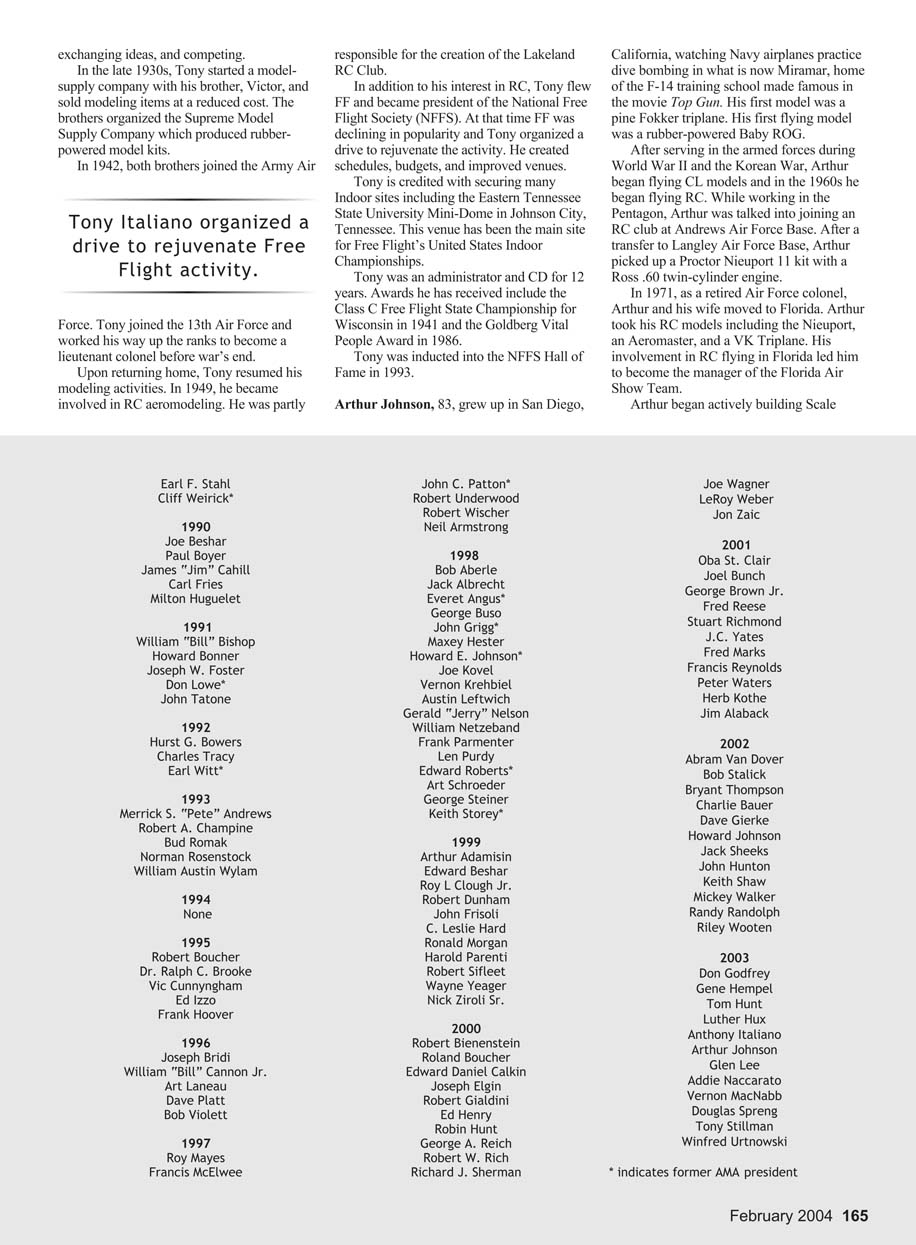
Upon returning home, Tony resumed his modeling activities. In 1949, he became involved in RC aeromodeling. He was partly responsible for the creation of the Lakeland RC Club.
In addition to his interest in RC, Tony flew FF and became president of the National Free Flight Society (NFFS). At that time FF was declining in popularity and Tony organized a drive to rejuvenate the activity. He created schedules, budgets, and improved venues.
Tony is credited with securing many indoor sites including the Eastern Tennessee State University Mini-Dome in Johnson City, Tennessee. This venue has been the main site for Free Flight's United States Indoor Championships.
Tony was an administrator and contest director for 12 years. Awards he has received include the Class C Free Flight State Championship for Wisconsin in 1941 and the Goldberg Vital People Award in 1986.
Tony was inducted into the NFFS Hall of Fame in 1993.
Arthur Johnson
Arthur Johnson, 83, grew up in San Diego, California, watching Navy airplanes practice dive bombing in what is now Miramar. His first model was a pine Fokker triplane. His first flying model was a rubber-powered Baby ROG.
After serving in the armed forces during World War II and the Korean War, Arthur began flying CL models and in the 1960s he began flying RC. While working in the Pentagon, Arthur was talked into joining an RC club at Andrews Air Force Base. After a transfer to Langley Air Force Base, Arthur picked up a Proctor Nieuport 11 kit with a Ross .60 twin-cylinder engine.
In 1971, as a retired Air Force colonel, Arthur and his wife moved to Florida. Arthur took his RC models including the Nieuport, an Aeromaster, and a VK Triplane. His involvement in RC flying in Florida led him to become the manager of the Florida Air Show Team.
Arthur began actively building scale models including a model of the F-82E. He constructed a 94-inch-wingspan P-38 model that flew for several years. The P-38 won awards at the 1977 Nats in California. Model Builder published plans for the P-38 as well as some of Arthur's later models including the P-40 and P-43.
Arthur maintains an interest in Scale models of military aircraft. In 1981, he placed first in Giant Scale at the Nats in Texas. He also entered models including a ducted-fan F-100D and a Martin B-26.
Arthur is a member of a number of RC clubs throughout the country and is a charter member of the National Association of Scale Aeromodelers (NASA). He is one of the oldest RC pilots still in active competition.
Glenn Lee
Glenn Lee, 71, first won a trophy at the Nats in 1962. He founded the Tree Town Modelers, serving as the club's newsletter editor for several years.
Glenn authored the CL Speed column in Model Aviation from 1994 to 2000. He wrote the rules used in the popular .21 Sport Speed event.
Elected District VI vice president from 1972 to 1979, Glenn received a Meritorious Service Award in 1978 for his efforts.
A longtime competitor, Glenn was United States Grand National Champion in 1968. He was Control Line Champion at the 1974 Nats and Speed Champion at the 2001 Nats. In FAI competition, Glenn was a two-time member of the United States International Speed team in the 1960s and 1970s.
During this same time, Glenn competed in Free Flight Helicopter and Indoor Hand-Launched (HL) Glider contests. He has set three CL Class B Speed records, most recently in August 2002.
Vernon MacNabb
Vernon MacNabb, deceased, was a pioneer of license-free radios for model airplanes. Vernon built FF and CL models before establishing the Citizen-Ship Radio Corporation in 1950. Citizen-Ship was created to develop and manufacture license-free radios at 465 megacycles, considered impossible at the time.
Vernon's work with the 465-megacycle band was demonstrated at the Texas Nats in 1950. The new frequency helped revolutionize license-free RC flying, and he made significant contributions in the field of vacuum tube technology.
Addie Naccarato
Addie Naccarato, 76, became involved in model aviation in her early teens. She had brothers who built model airplanes but often left them unfinished, so Addie finished her brothers' work. When her brothers sold the airplanes, Addie was upset and her father purchased a model for her. This was the start of a life in model aviation.
After World War II, Addie and her husband Tony began inventing model airplane products. At the time, Addie was flying CL models. In 1951, she and her husband bought a hobby shop in Burbank, California, and renamed it Tony and Addie's Hobby Lobby. Addie and her family members taught CL and RC flight at the Sepulveda Basin outside of Los Angeles.
With son Tony Jr., Addie built some of the first Electric Free Flight airplanes.
Addie is credited with giving more than 300 demonstrations across the country. Since the days of giving demonstrations, she has been a pioneer in electric flight, building and flying a scale B-36 bomber at the Quarter Scale Association of America (QSAA) in Las Vegas, Nevada. Addie developed rules for Classes A and B of the AMA Electric Free Flight and Control Line events.
Doug Spreng
Doug Spreng, 71, is well-known in the world of RC. Doug started flying RC in 1955. While working for Babcock Engineering Inc., Doug helped to develop a "hard tube" super-regenerative single-channel receiver.
In 1960, Doug created his famous Stormer Pattern model, powered by a Lee .45. This model won at the 1960 Nats. Working for the Jet Propulsion Laboratory in the early 1960s, Doug fashioned the concept of a digital-proportional radio system. He named this system Digicon for digital control.
Doug won a place on the 1966 AMA International Team using his Thunderstreaker model controlled by a Micro-Avionics system. At the international competition, Doug placed third.
Doug met Harry Brooks of Great Britain, who convinced Doug to move to the United Kingdom. Together the two invented the Springbrook RC system, which sold in the United Kingdom.
Doug is responsible for developing the IC servo amplifier, a two-channel RC glider unit, and the Kraft Signature Series RC units in the 1970s. Doug is the 1976 recipient of the Howard McEntee Award and was inducted into the Vintage Radio Control Society Hall of Fame that same year.
Tony Stillman
Tony Stillman, 45, has been a major participant in the RC arena. He has planned and developed several model airplane events and education programs.
As past president of the National Society of Radio Controlled Aerobatics (NSRCA), Tony was granted lifetime membership. He conducted judge training and certification school for several years at the Weak Signals/Toledo Show for NSRCA.
Tony designed and ran three aviation programs and flew both airplane and helicopter demonstration flights for the Pensacola, Florida, school system.
He works in the model aviation industry, spending 27 years at Radio South where he is currently president.
Tony's other accomplishments include working as technical advisor measuring airframes at the Tournament of Champions in Las Vegas, Nevada. He has been published in K Factor, the newsletter of NSRCA, and Radio Rumblings.
Winfred "Windy" Urtnowski
Winfred "Windy" Urtnowski, 57, has been an avid participant in CL Aerobatics for more than 40 years. Primarily interested in F2B, Windy has tinkered in RC and FF, once owned and piloted a full-scale 1947 Ercoupe, and even has a small model railroad. He has flown in the Control Line Precision Aerobatics National Championships since 1960, placing in the top five several times.
Windy has flown in FAI Team Trials competitions, also placing in the top five more than once. He has six Red Reinhardt Cup wins and Massachusetts Cup wins in 1995 and 1997.
Windy was the recipient of the Concours Award at the Nats in 1985, 1987, 1992, 1996, and 1997. He won the Concours 20-Point Award in 1988 and 1997.
Windy designed and flew seven Stunt airplanes, most of which have appeared in magazines. Two of his models have been kitted. One design—the B-25 Mitchell Bomber—won regional awards.
Windy has made more than 700 videos covering Precision and Stunt model construction, as well as flying and repairing airplanes. His articles have appeared in Model Aviation and Flying Models.
Windy is responsible for developing Broadok dope, new engines and pipes, and is an expert in the use of carbon fiber on models.
Transcribed from original scans by AI. Minor OCR errors may remain.

