
STATEMENT OF AMA
The Academy of Model Aeronautics, Inc. acknowledges that Sport Flyers Association, Inc. has commenced litigation in the District Court of Dallas, Texas, against the AMA and certain officers and employees thereof. The claims asserted by SFA involve such matters as libel and slander, tortious interference with business relationships, and violations of various Texas statutes. The AMA vigorously denies the allegations and, with equal vigor, shall contest the lawsuit. However, as a result of this action by SFA, neither the AMA, its officers, nor its employees will comment further on this suit during its pendency.
AMA News
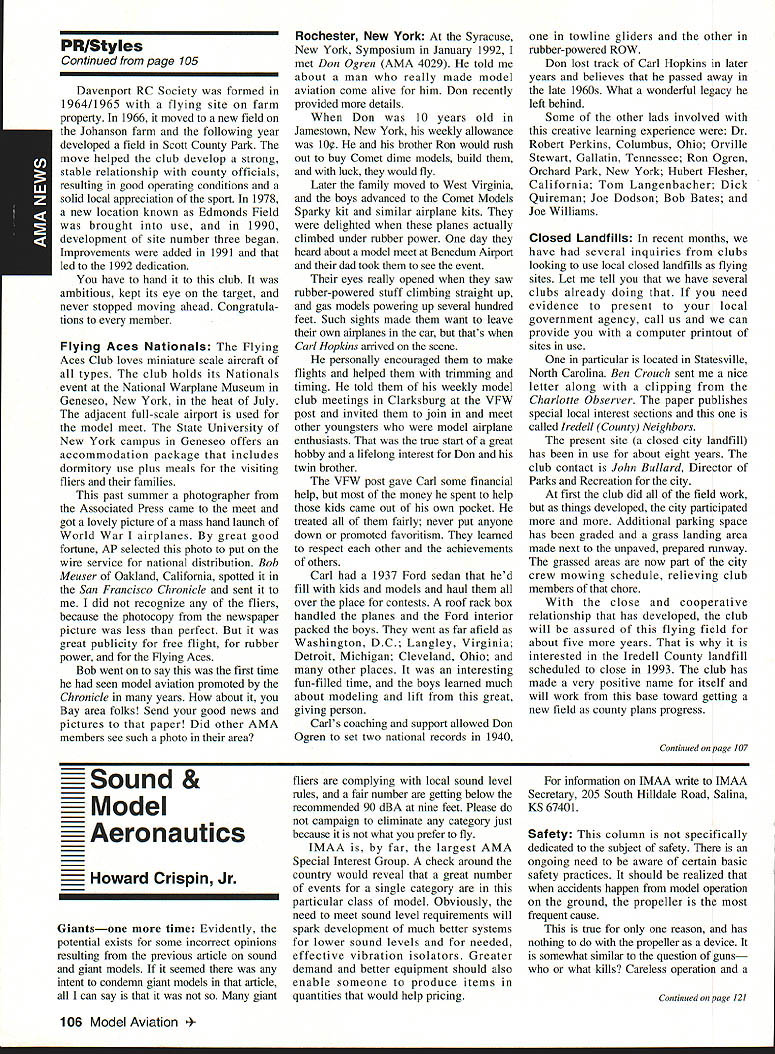
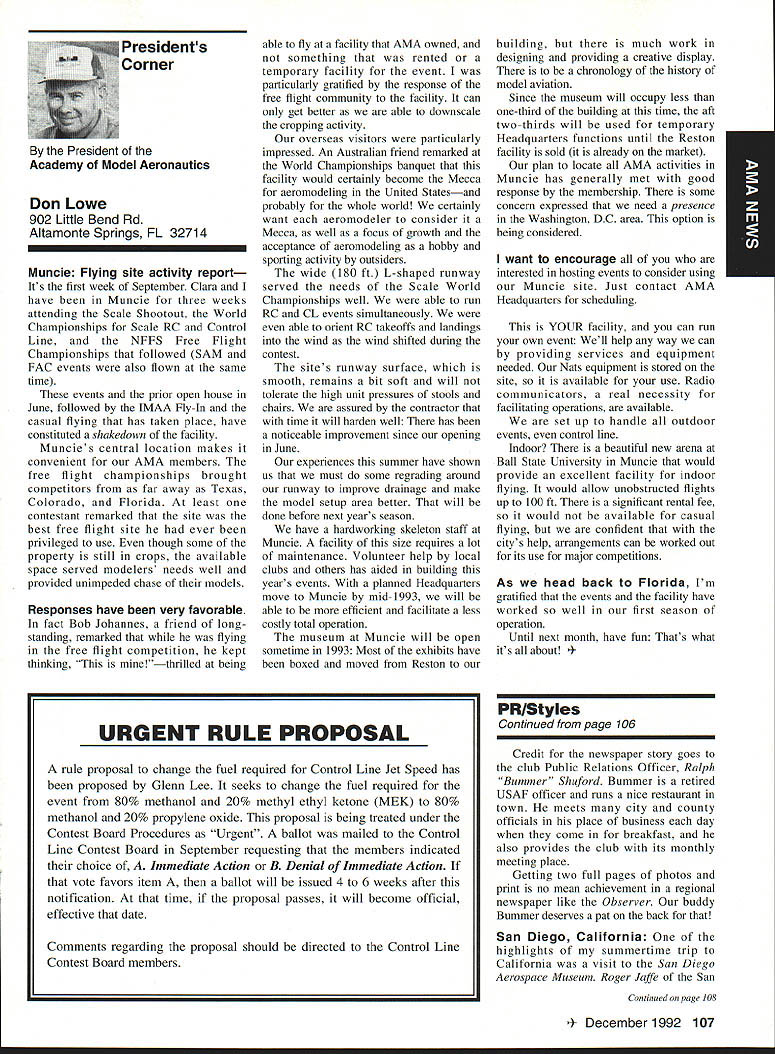
Davenport RC Society was formed in 1964/1965 with a flying site on farm property. In 1966 it moved to a new field on the Johanson farm and the following year developed a field in Scott County Park. The move helped the club develop a strong, stable relationship with county officials, resulting in good operating conditions and a solid local appreciation of the sport. In 1978 a new location known as Edmonds Field was brought into use, and in 1990 development of site number three began. Improvements were added in 1991 and that led to the 1992 dedication.
You have to hand it to this club. It was ambitious, kept its eye on the target, and never stopped moving ahead. Congratulations to every member.
Flying Aces Nationals: The Flying Aces Club loves miniature scale aircraft of all types. The club holds its Nationals event at the National Warplane Museum in Geneseo, New York, in the heat of July. The adjacent full-scale airport is used for the meet. The State University of New York campus in Geneseo offers an accommodation package that includes dormitory use plus meals for the visiting fliers and their families.
This past summer a photographer from the Associated Press came to the meet and got a lovely picture of a mass hand launch of World War II airplanes. By great good fortune, AP selected this photo for national distribution. Bob Meuser of Oakland, California spotted it in the San Francisco Chronicle and sent it to me. I did not recognize any of the fliers, because the photocopy from the newspaper picture was less than perfect. But it was great publicity for free flight, for rubber power, and for the Flying Aces.
Bob went on to say this was the first time he had seen model aviation promoted by the Chronicle in many years. How about it, Bay Area folks? Send your good news and pictures to that paper! Did other AMA members see such a photo in their area?
Rochester, New York: At the Syracuse, New York, Symposium in January 1992, I met Don Ogren (AMA 4029). He told me about a man who really made model aviation come alive for him. Don recently provided more details.
When Don was 10 years old in Jamestown, New York, his weekly allowance was 10¢. He and his brother Ron would rush out to buy Comet dime models, build them, and, with luck, they would fly.
Later the family moved to West Virginia, and the boys advanced to the Comet Models Sparky kit and similar airplane kits. They were delighted when these planes actually climbed under rubber power. One day they heard about a model meet at Benedum Airport and their dad took them to see the event.
Their eyes really opened when they saw rubber-powered stuff climbing straight up, and gas models powering up several hundred feet. Such sights made them want to leave their own airplanes in the car, but that's when Carl Hopkins arrived on the scene.
He personally encouraged them to make flights and helped them with trimming and timing. He took them to his weekly model club meetings in Clarksburg at the VFW post and invited them to join in and meet other youngsters who were model airplane enthusiasts. That was the true start of a great hobby and a lifelong interest for Don and his twin brother.
The VFW post gave Carl some financial help, but most of the money he spent on the boys came out of his own pocket. He treated all of them fairly; never put anyone down or promoted favoritism. They learned to respect each other and the achievements of others.
Carl had a 1937 Ford sedan that he'd fill with kids and models and haul them all over the place for contests. A roof rack handled the planes and the Ford interior packed the boys. They went as far afield as Washington, D.C.; Langley, Virginia; Detroit, Michigan; Cleveland, Ohio; and many other places. It was an interesting, fun-filled time, and the boys learned much about modeling and life from their great, giving person.
Carl's coaching and support allowed Don Ogren to set two national records in 1940, one in towline gliders and the other in rubber-powered R.O.W. Don lost track of Carl Hopkins in later years and believes that he passed away in the late 1960s. What a wonderful legacy he left behind.
Some of the other lads involved with this creative learning experience were: Dr. Robert Perkins, Columbus, Ohio; Orville Stewart, Gallatin, Tennessee; Ron Ogren, Orchard Park, New York; Hubert Flesher, New York; Hubert Flesher, California; Tom Langenbacher; Dick Quireman; Joe Dodson; Bob Bates; and Joe Williams.
Closed Landfills: In recent months we have had several inquiries from clubs looking to use local closed landfills as flying sites. Let me tell you that we have several clubs already doing that. If you need evidence to present to your local government agency, call us and we can provide you with a computer printout of sites in use.
One in particular is located in Statesville, North Carolina. Ben Crouch sent a nice letter along with a clipping from the Charlotte Observer. The paper publishes special local interest pieces and this one is called Iredell (County) Neighbors. The present site (a closed city landfill) has been in use for about eight years. The club contact is John Hurd, Director of Parks and Recreation for the city.
At first the club did all of the field work, but as things developed, they participated more and more. Additional parking space has been graded and a grass landing area made next to the unpaved, prepared runway. The grassed areas are now part of the city crew mowing schedule, relieving club members of that chore.
With the close and cooperative relationship that has developed, the club will be assured of this flying field for about five more years. That is why it is interesting to the Iredell County landfill scheduled to close in 1993. The club has made a very positive name for itself and will work from this base toward getting a new field as county plans progress.
AMA News
President's Corner
By Don Lowe President, Academy of Model Aeronautics
Don Lowe 902 Little Bend Rd. Altamonte Springs, FL 32714
Muncie: Flying site activity report—
It's the first week of September. Clara and I have been in Muncie for three weeks attending the Scale Shootout, the World Championships for Scale RC and Control Line, and the NFFS Free Flight Championships that followed (SAM and FAC events were also flown at the same time).
These events and the prior open house in June, followed by the IMAA Fly-In and the casual flying that has taken place, have constituted a shakedown of the facility.
Muncie's central location makes it convenient for our AMA members. The free flight championships brought competitors from as far away as Texas, Colorado, and Florida. At least one contestant remarked that the site was the best free flight site he had ever been privileged to use. Even though some of the property is still in crops, the available space served modelers' needs well and provided unimpeded chase of their models.
Responses have been very favorable.
In fact Bob Johannes, a friend of long standing, remarked that while he was flying in the free flight competition, he kept thinking, "This is mine!"—thrilled at being able to fly at a facility that AMA owned, and not something that was rented or a temporary facility for the event. I was particularly gratified by the response of the free flight community to the facility. It can only get better as we are able to downscale the cropping activity.
Our overseas visitors were particularly impressed. An Australian friend remarked at the World Championships banquet that this facility would certainly become the Mecca for aeromodelling in the United States—and probably for the whole world! We certainly want each aeromodeler to consider it a Mecca, as well as a focus of growth and the acceptance of aeromodelling as a hobby and sporting activity by outsiders.
The wide (180 ft.) L-shaped runway served the needs of the Scale World Championships well. We were able to run RC and CL events simultaneously. We were even able to orient RC takeoffs and landings into the wind as the wind shifted during the contest.
The site's runway surface, which is smooth, remains a bit soft and will not tolerate the high unit pressures of stools and chairs. We are assured by the contractor that with time it will harden well. There has been a noticeable improvement since our opening in June.
Our experiences this summer have shown us that we must do some regrading around our runway to improve drainage and make the model setup area better. That will be done before next year's season.
We have a hardworking skeleton staff at Muncie. A facility of this size requires a lot of maintenance. Volunteer help by local clubs and others has aided in building this year's events. With a planned Headquarters move to Muncie by mid-1993, we will be able to be more efficient and facilitate a less costly total operation.
The museum at Muncie will be open sometime in 1993. Most of the exhibits have been boxed and moved from Reston to our building, but there is much work in designing and providing a creative display. There is to be a chronology of the history of model aviation.
Since the museum will occupy less than one-third of the building at this time, the aft two-thirds will be used for temporary Headquarters functions until the Reston facility is sold (it is already on the market).
Our plan to locate all AMA activities in Muncie has generally met with good response by the membership. There is some concern expressed that we need a presence in the Washington, D.C. area. This option is being considered.
I want to encourage all of you who are interested in hosting events to consider using our Muncie site. Just contact AMA Headquarters for scheduling.
This is YOUR facility, and you can run your own event: we'll help any way we can by providing services and equipment needed. Our RATS equipment is stored on the site, so it is available for your use. Radio communicators, a real necessity for facilitating operations, are available.
We are set up to handle all outdoor events, even control line.
Indoor? There is a beautiful new arena at Ball State University in Muncie that would provide an excellent facility for indoor flying. It would allow unobstructed flights up to 100 ft. There is a significant rental fee, which may not be available for casual flying, but we are confident that with the city's help, arrangements can be worked out for its use for major competitions.
As we head back to Florida, I'm gratified that the events and the facility have worked so well in our first season of operation.
Until next month, have fun: that's what it's all about!
Executive VP's Report
Dave Brown AMA Executive VP 4560 Layhigh Rd. Hamilton, OH 45013
After 151 consecutive months of facing a column deadline, it seemed strange not to do a column last month. It didn't feel all that bad, mind you—just different.
It's been an interesting couple of months, accentuated by the Scale World Championships for CL and RC in Muncie. Our first major event at the new site was deemed a success by all who attended.
We do need to try to figure out how to make these types of events more interesting for the general public—perhaps a show team to provide a daily air show during a lunch break and a big show at the end of the event. It is of paramount importance that we keep the competition pure, fair, and uncompromised, so tailoring the competition to the spectators is not the proper thing to do. Scheduling an air show in conjunction with the event would be reasonable and would enable us to generate some spectator interest—and hence generate income to underwrite the event.
This brings up that whatever we do takes financing, and we have a couple of choices as to how to handle this.
In the past, we have relied on income from membership dues and participant fees to support virtually all of our activities. This has done well for us, but costs have risen, and the fees for participants in special events and projects are beginning to limit those who can participate. Programs that benefit all AMA members more directly are not leaving any money left over from dues income to support these special events and projects.
Although I have not seen the numbers on this particular event (Scale World Champs), I have a feeling that we may have actually made a small profit on it, primarily because of the income generated through parking fees. If this is an example of offsetting the future expense of running this kind of event, it is encouraging.
I don't foresee, nor would I want to see, this sort of event becoming an income producer for AMA, but if they can become totally self-sufficient financially—and help to cover some of the expenses of operating the facilities they use—we could produce more events, attract more people, and charge the participants less.
At a recent district meeting, the subject of Nats entry fees (which are too high) came up, and perhaps the same situation can help to lower those fees substantially. Frankly, I'd rather see 3,000 entries at $30 each, than 900 entries at $100 each, even though it generates the same total entry income.
During a recent discussion with an old friend over the establishment of policy for AMA, the friend made the statement, "Y'all are micromanaging the AMA." (In case you couldn't tell, the friend wasn't from the Northeast!)
While this friend and I didn't get too far in resolving the discussion over the policy issue, the statement that we were micromanaging the AMA got me to thinking: micromanagement is a term whose usage has gained significant popularity in recent times, and it isn't generally used as a compliment. I tried to find it in the dictionary, but it wasn't listed. I found that micro came from the Greek micro and means "small." So I'd guess that micromanagement would mean to small-manage, or to be too involved in the details of RUNNING the organization, rather than MANAGING it.
Organizationally, the AMA is run, in theory at least, by a staff. The staff works under the direction of an Executive Director, who is hired by a board of directors (our Executive Council), and who manages the business. The board of directors is elected by the membership to establish the policies under which the Executive Director manages the organization.
In theory this works fine, but in practice the lines between what constitutes running the organization, managing it, and establishing policies for its management become pretty clouded. The term micromanagement technically applies more to the relationship between the Executive Director and the staff, but the same problem can exist between the board of directors and the Executive Director—only there isn't a trendier term for it.
What my friend really meant was that we, meaning the officers of the organization (members of the board), are too involved in managing the organization, rather than establishing the policies for that management. In reality, he was right. We do get involved in the management of the association, but the membership, which we represent, expects us to, so what is micromanagement to one person is, to another, simply doing what the membership elected us to do. It's a tightrope that we walk, and that conversation made me give a little more thought to how important it is that we not fall too often on the wrong side of it.
It's food for thought.
Executive Director's View from HQ
Vince Mankowski AMA Executive Director 1810 Samuel Morse Drive Reston, VA 22090
It is now official: AMA has launched an ambitious fund-raising campaign to complete the development of the first National Flying Site and museum complex in Indiana and to provide the necessary funding to acquire regional sites around the country.
By now you have received your renewal notice in the mail and perhaps have even taken part in AMA's initial fund-raising step.
This initial step in fund-raising is a simple and painless one. To recap briefly, all AMA members who renew on time will be listed on a roster of current AMA members in the new Frank V. Ething museum complex when it opens in 1993. Those who make a $10 contribution along with their timely renewals will have their names on this roster in bold print. If 10% of all AMA members take advantage of this opportunity, we will be able to raise $160,000 through this simple, painless step.
Where will the money go? Out of the first $50,000 raised, $25,000 will be used to help set up the new museum. The other $25,000 will be put toward improvements in the already existing flying facilities. Thereafter, half of all monies generated through the fund-raiser will develop additional specific flying venues on the National Flying Site. Of the remaining funds, one-third will be allocated to the museum, library, and film archives, while two-thirds of the remainder will go into a fund to acquire additional regional flying sites.
While I'm in the process of writing this column, HQ is heavily involved in the preparation of the 1993 AMA operating budget. This annual budget itemizes all aspects of our operation costs and then balances them with a realistic projected income. Not included in the 1993 operational budget are items such as the development of Muncie and additional regional flying site acquisitions. These monies will come from voluntarily donated funds through our new fund-raising effort.
The '93 budget has over $1,200,000 dedicated to the promotion of aeromodeling—projects ranging from air show teams, school programs, displays, handouts, films, mall shows, etc. The budget also includes insurance premiums and fees, the cost of NAA and FAI fees, postage, freight, phone, and membership supplies.
In addition, there are the costs of doing business and owning property, such as AMA vehicles, property in Reston, and the property in Indiana. Costs for these properties include taxes, insurance, principal and interest payments, utilities, etc. The budget also addresses data processing, professional services, salaries, and many other items of normal operational costs.
Someone posed the question, "What if the AMA had a $25 instead of a $40 membership fee?" Sure, it would cost the individual member less, but we need to keep in mind some of the programs that would be lost, such as films, videos, all committee support (sound, frequency, safety, etc.), officer support (AVPs, frequency coordinators, contest coordinators, etc.), scholarships, the National Newsletter, Cloud Nine newsletter, the only national aeromodeling museum—the Frank V. Ething complex, events such as World Championships, the National Championships, and all other AMA-hosted events, all FAI programs, the Adopt-A-School program, air show team programs, support for mall shows, all educational promotional budgeted support, the national awards recognition program, support for AMA publications such as the flying sites book and the new sound books, the National Flying Site, as well as all site acquisition plans.
In addition, the fire, theft, and vandalism coverage, plus the accidental death and dismemberment coverage would be lost, as well as the AMA rule book, the AMA membership manual, the technical department of AMA, and there would be some measure of reduction of the size and layout of Model Aviation. Add to this a trimming of the AMA staff from 53 by somewhere between 40–50%, that would directly transfer to a reduction in services from the Academy of Model Aeronautics to its members and aeromodelers nationwide. The majority opinion still prevails—the $15 is worth it.
Speaking of AMA projects, the Academy acquired two Turbomeca T240 jet engines from the manufacturer in France.
With the advent of commercially available turbine jet engines, the Academy will be testing these engines for safety and handling procedures and will be gathering information on the latest technology available to the aeromodeler. We expect testing to begin in November and hope to relay technical data to the membership in a timely fashion.
Nats stuff: The date and location for the 1993 National Model Airplane Championships has been tentatively set for July 17–26 in Lubbock, Texas. I use the word "tentatively" because we are awaiting approval from the FAA (at this writing) to use the necessary air space at the Lubbock airport.
Speaking of the Nationals, all AMA Contest Directors were sent a memo listing FAI and AMA rule book events (provisional and supplemental rules not included), and their input was sought concerning which events should be included in the National Model Airplane Championships.
At this writing, not enough data has been received, but we will report on the results of this survey as soon as sufficient responses have been tallied.
There was another "something new" in that the November issue of Model Aviation magazine was a special Nats issue. It was cover to cover with color photographs and expanded coverage on all events held at the Nats. We hope you enjoyed that special edition and invite your comments. Please address your opinions on an annual special Nats issue to my attention at AMA Headquarters.
Muncie topics: AMA acquired 1,047 acres of Indiana farmland about a year ago. In that short year, park funds, a 167,000-sq.-ft. flying site, a 25,000-sq.-ft. museum facility, and an 8,000-ft. road were constructed.
In addition, many acres of corn and beans were converted to grass fields, and many fence rows and tree lines were removed in order to convert the site from farmland to flying sites. Development is not without some problems. The site experienced 15 inches of rain in July! This kept mowing, trimming, and site work at a standstill for at least 45 days!
In the last few months, the flying site has hosted a control line stunt contest, an IMAA regional fly-in, a grand-opening event, the Scale World Championships, and an AAAA free flight contest. In my discussions with a number of AMA members who have visited the site, I believe we can expect the Muncie flying site to be quite busy in 1993! We are already hearing rumblings about a possible F2B team trial, a major control line aerobatics contest, a big-time combat contest, an IMAA fly-in, a possible scale team selection meet, two free flight events, and the membership is asking AMA to host another grand-opening-style rally next year.
More next month.
AMA News
Nationals: This column will be devoted primarily to the 1992 Nats. I understand there were about 92 events flown, and as far as I know, they were all completed regardless of the delays due to rain. There were some comments about the variable weather, but that's New England for you. I feel the Nats was a success, even though the attendance was somewhat low. Many reasons have been given for the attendance, such as the economy, early dates, other contests, including the pattern contest held in July, etc. Pick your own reason. This is the first time all the events were held on one site; it seemed to work well, but it did restrict the times some events could be run.
Listed below are the people from District 1 who competed in the 1992 Nats. These names were taken from the AMA list of contestants, so it should be complete. If your name is not shown, please accept my apologies in advance. Those who received trophies have the event and placing listed.
Free Flight:
- Gerald Donahue: sixth—1/2A Gas; fifth—B Gas; first—Hand Launched Glider; fourth—Catapult Glider; fifth—F1H; third—Hand Launched Glider; second—Bostonian.
- Stephen Landry: seventh—1/2A Gas; third—Payload.
- Gene Martha: sixth—C Gas; second—Mulvihill; sixth—Coupe d'Hiver.
- William Johnson.
- William Purtell.
- Stan Colson: sixth—Catapult Glider; first—F1H.
- Matthew Colson: second—P-30; second—Catapult Glider.
- Arthur Ellis: first—P-30; second—Hand Launched Glider.
- Raymond Factor: fifth—Mulvihill; third—P-30; fourth—Coupe d'Hiver.
- John Guentes: fourth—P-30.
- Allen Vollmer.
- Richard Nelson.
- Herbert Sholl.
- Ronald Sholl.
- Ronald Mignot: fourth—F1H.
- Dannal Farrell: third—Hand Launched Glider.
- Thomas Fox.
- Paul Brenneman.
- Robert Nichols: first—Cargo; fifth—Catapult Glider; first—Electric A; first—Electric B; first—CO2; third—Limited Pennyplane.
- Harry Keshissian.
- T. H. Lewis.
- John Norton.
- James Grant: third—Manhattan; third—Easy B; fourth—Pennyplane; first—Limited Pennyplane; first—Bostonian; first—Indoor Peanut.
- Chet Bukowski: third—Bostonian.
- James Fiorielo: third—Pennyplane; fourth—Hand Launched Glider.
- Philip Nault: second—Limited Pennyplane; second—Hand Launched Glider.
- Lincoln Ross.
- Christopher Bowler.
- Clark Bowler.
- Thomas Nallen Jr.: first—Outdoor Peanut; first—Outdoor Rubber.
- Tom Nallen: second—Outdoor Peanut; third—Outdoor Rubber.
- Harvey Pastel: second—Indoor Peanut; first—Indoor Flying Rubber.
Control Line:
- Thomas Blankmann: third—A Speed; fourth—Sport Speed 21.
- Santo Rizzotto: fifth—A Speed; sixth—B Speed.
- Gary Widell.
- James G. A. Simpson: fourth—Carrier I; third—Carrier II; second—Profile Carrier.
- Ara Dedekian.
- Rafael Gonzalez.
- Bill Suarez.
- Eric Jensen.
- Bruce Olsen.
- David Midgley: fourth—Advanced CL Aerobatics.
- Richard Campbell: fifth—Advanced CL Aerobatics.
- Richard Woolsey.
- Joseph Fussell.
- Lloyd Seymour: first—Slow Combat.
- Neil Simpson: fourth—Slow Combat.
- Edward Blair.
- Paul Kubek.
- Leonard Mink.
- Conrad Wendlowski.
- James Carpenter: first—F2D.
RC Pattern:
- Michael Mirabilio: second—Sportsman.
- Dave Elsner.
- Mark O'Connell.
- Eisenbaum/Marx team.
- Charles Watt.
- Douglas Nutter.
- Eric Henderson.
- John Backhaus.
- Dan Snow.
- Vito Pascucci.
- Stephen Smith.
- Paul Horvath.
- Joe Sella.
- Ed Bure.
- James Seminare.
- J. S. Melville.
- Stephen Leiter.
RC Pylon:
- William Glode: third—Formula I.
- Jessica Thurrott: second—Q-500.
- McStay/Wallace team.
- Greg Kersen.
- Lloyd Burnham.
- David Doyle.
- Pete Reed.
- Dave Chapdelaine.
- Jerry Krasser.
- Matthew Desimone Jr.
- Raymond Dolf.
- Ilh—Quickie 500.
- Michael Mungavin.
- Michael Bumbaca.
- John Yassendesis.
- George Denault.
- Robert Beaudette.
- Ralph Rinaldi.
- Richard Estabrook.
Helicopter:
- Daniel Zaverton: first—Class I.
- William Comerford: fourth—Class I.
- Ken Gabrys: fifth—Class I.
- Sherman Conlin Jr.: sixth—Class I.
- Christopher Danserau.
- Robert Burgo.
- Thomas Clune.
- Richard Sowers Jr.
- Richard Bell: first—Class II.
- Michael Swift: third—Class II.
- John Bone: sixth—Class II.
- Raymond Powell.
- Richard Bliss.
- Alexander Lob.
- Walter Sabel.
- Lee Woodworth.
- R. L. Murphy: first—Class III.
- Fred Schneider: second—Class III.
- Raymond St. Onge.
Sailplane:
- Richard Roekle: third—Hand Launched Sailplane.
- Terrence Sweeney.
- Thomas Kiesling: third—Two Meter; 11th—Unlimited Sailplane.
- Stephen Schonberg.
- Kay Fisher.
- James Tighe.
- Robert Waldhaus: seventh—Two Meter; 10th—Standard Sailplane.
- Christopher Ordaz.
- Robin Fleming.
- Martin McCartney.
- Luis Mora.
- James Reith.
- Gregory Baggerly.
- Freemon Knowlton.
- Arthur Feria.
- Carl Berger.
- Dan Carr.
- James Friedrichs.
- Leslie Gerhardt.
- Stephen Sykora.
- Grant Fleming.
- Chris Schoon.
- Nicholas Saitaplane.
- Robert Rondeau.
- Louis Ullimert.
- Salipalne.
- Tom Arcaviati.
- Victor Bunze.
- John Marin.
- Fritz Blel.
- Ronald Stinafeld.
- John Nilsson.
- James Bork.
- Anker Berg-Sonne.
- William Wargo.
- Dennis Phelan.
Control Line Scale:
- Sam Abdown: second—Precision; sixth—Sport Scale.
- Jack Patrotla: second—Sport Scale.
RC Scale:
- Don Boyd: second—Sportsman Sport Scale.
- Tom Nelson: third—Sportsman Sport Scale.
- John Nicolai: sixth—Sportsman Sport Scale.
- Phil D'Ostilio: sixth—Sportsman Sport Scale.
- John Klavin: seventh—Sportsman Sport Scale.
- Art Aliano.
- Michael Gent.
- Ed Fastbrook.
- Roger Carrigan.
- Peter Flanigan.
- Toby Guidome.
- Lindsay Smith.
- Earl Everlifis.
- David Sklinks.
- John Laurent.
- Bob Boulas.
- Ronald Gagner.
- Robert Smith.
- Angelo Perugino.
- Douglas Nutter.
- William Schumacher.
- Charles Nelson: first—Expert Sport Scale.
- Tom Kosoweski: third—Expert Sport Scale.
- Fred Menna: fifth—Expert Sport Scale.
- Scott Foster: sixth—Expert Sport Scale.
- Al Pineau.
- Roland Bretta.
- H. D. Margraff.
- Richard Bernier.
- Bill Reeve.
- James Russell.
- Barry Gare.
- William Rousch.
- James Clark.
- Ben Bailey.
- Brian Sharp.
- RC Fun Scale:
- James Brown: sixth—RC Fun Scale.
- Richard Durand.
- N. L. Ventur.
- Harvey Thomasian.
- Robert Joslyn.
- Mike Thomas.
- Thomas Cline.
I would like to thank all who attended the 1992 Nationals. I hope you enjoyed yourselves.
AMA News
Ray Juschkus, AVP/New York
This was the weekend for the Gathering of Eagles; all model clubs from the Nassau area were represented.
Models were displayed—140 of them—alongside many antique airplanes that are permanently exhibited at the Cradle of Aviation Museum at Mitchell Field, Long Island, New York.
Everyone had a great time swapping stories and looking at the exquisitely restored full-scale airplanes, some of which date from the Wright brothers and the Spirit of St. Louis to modern-day jets.
Hank Anholzer, supervisor of restoration, reported that 1,500 people have visited the museum this year.
The show's directors, Bob Geyer, president of the Nassau Flyers Condors, and Nick Capriotti, deserve a huge "thank you" for their efforts in making the event a great pleasure for everyone.
Adam Sattler, AVP/New York
On May 23–24, 1992, nine of the original 46 members of the 1938–1942 Stewart Model Airplane Club, Newburgh, New York, met for a first-time reunion. Most of them had not seen each other for over 50 years. They ate, drank, talked, and flew various vintage models and modern aircraft at the Galeville field, where a Saturday picnic was also enjoyed by club members, wives, and friends.
Notable fliers such as Leon Shulman, Vince Bonnema and his Clippers, Ed Soltis, Joe Beshar with the Fox, Sal Talbit, Scotty Murray of Topper fame, Joe Raspanti, Ben Shereshaw, and the old master, Carl Goldberg, attended the club's meets.
It was recalled that George Terwilliger beat out all the names, including Carl Goldberg, at the 1939 Poughkeepsie meet with an Ohlsson .23-powered Interceptor, going O.O.S. (out of sight) on the third official flight and losing the model forever. He was awarded a Forster .29 for his efforts, but to this day would trade two of them for that Ohlsson .23.
It was a once-in-a-lifetime experience—a wonderful time of reminiscing, of storytelling, of catching up on lives lived, and of fond remembrances.
Terry Terrenoire, AVP/New York
The photo sent by Willy Payne shows the setup used by the Ithaca R/C Club for its small show in May. More than 50 planes were displayed. Club members spent one day building a prefab for the benefit and entertainment of the spectators.
I recently attended the monthly meeting of the Oswego Valley Modelers. Only one member, Bill Orr, has been a member since 1972 and he's still going strong.
After the meeting, I was invited to fly with this very special group of guys who are doing what we all strive to do—have fun with a challenging hobby.
Merrick S. Andrews — An Appreciation
It saddens me to announce the death of "Pete," as we all knew him. He was the first to fly an official indoor flight over 30 minutes, at Lakehurst, New Jersey, on August 14, 1949, where his Class C stick model flew 32 minutes, 19.8 seconds.
Pete Andrews served on the U.S. Indoor Team three times, and in 1972 achieved the World Championship at Cardington, England.
His good friend Don Garofalow sent the following letter after being informed of Pete's passing. Don best relates his memory:
"I just cannot find the right words to describe my feelings when you called to inform me of the passing of my good friend, Pete Andrews.
Pete was recognized by all as a pioneer in the field of indoor modeling, being the first in the world to achieve a 30-minute flight indoors. A Hall of Famer, he held many other AMA records as well.
Pete's craftsmanship and technical execution were unsurpassed. He will be sorely missed not only by me but the whole world of indoor modelers.
Goodbye Pete. Now your constant companion and wife, Georgia, will be forever at your side and together you will always have heights in an unlimited ceiling. You will never be forgotten."
District 3 Report
Bob Brown District 3 Vice President 1255 High Street, Bradford, PA 16701 Phone: (814) 362-7702
Associate Vice Presidents:
- Mike Barbee, 6561 Calgary Court, Columbus, OH 43229-2008
- David H. Ellis, 5261 DeWitt Road, Cross Lanes, WV 25313-1209
- Nelson Gould, 1944 S. Idaho Street, Allentown, PA 18103
- John Hathaway, 102 Woodmere Drive, New Stanton, PA 15672
- Jay Mealy, 208 Witmer Street, Clearfield, PA 16830
- Joseph S. Vislay, 1381 Cranbrook Drive, Maumee, OH 43537
- Lawrence R. Wiemer, 15613 Greendale Avenue, Maple Heights, OH 44137
- Gil Weiss, 3004 Hallowell Court, Bensalem, PA 19020
- Mark Wilson, 4913 Marcy, Dayton, OH 45449
Frequency Coordinator:
- John Cottle, 1012 Wyoming Avenue, Forty Fort, PA 18704
Phone: (717) 287-8970
The first major event, the FAI Scale World Championships, was held recently at our Muncie site. The U.S. control line team placed third and the U.S. radio control team placed second.
District 3 members should be especially proud of two modelers from our area. Ralph Burnstine, Port Clinton, Ohio, led the United States control line team to third place. Our radio control team member, Kim Foster from Mansfield, Ohio, placed 16th. Congratulations to the teams and to these fine gents.
The Muncie site proved to be unique during the World Championship. One feature never before accomplished at a large meet was allowing the spectators to do hands-on flying via the RC buddy-box system. Tom Runge, Steve Kaluf, and the rest of the Ace R/C crew donated their equipment and time to allow interested spectators to fly planes via the trainer cord.
They started their intro with a mini-group school that demonstrated the functions of the radio transmitter and airplane. The next step allowed the actual flight. Finally, each participant was awarded a certificate signifying his participation in the program. Several hundred persons enthusiastically flew the trainer, including Muncie mayor David M. Dominick. Thanks to Ace R/C for the positive effort!
During Labor Day weekend, the Toledo Weak Signals hosted the FAI team selection for the 1993 U.S. pylon team. If you weren't there, you missed 18 of the world's best racers. Would you believe three World Champions and at least six national champs were going at it? Congratulations to Dave Shadel, Richard Verano, and Henry Bartle, the 1993 U.S. FAI Pylon Team. A big thanks is expressed to the Weak Signals for producing the race. The hospitality was second to none. The work they do to help others enjoy the hobby is to be commended!
Club workers at the various functions often remain unmentioned. The next photo recognizes the hardworking crew at the Skyhawks Heart Fund Air Show near Steubenville, Ohio. John Barilla, their longtime president, provided the photo.
Clifford Campo recently forwarded some interesting information pertaining to the Northeast Philadelphia Radio Control Club. Quickie pylon racing appears to have caught on, and several club members are enjoying the competition. Some of the crew is pictured in the column.
The Northeast Philadelphia RC Club also produces a well-attended noncompetitive fun-fly.
Clubs are now in the election period for club officials. I've been told that the major club problem is that of club apathy. Somewhere between 10% and 15% of the membership of a club assists in the activities of the club. Are you one of them? Currently, this is election time for the Academy and most local clubs. Did you vote? Be positive. If you don't like the current philosophies, change them by voting! We should be thankful we live in a democratic society. Please do your fair share! Modelers who work for club activities definitely have more fun!
In early September, a questionnaire was mailed to over 4,000 AMA Contest Directors, requesting input as to the current philosophy and scheduling of the Nats. If you did not receive a copy, please cite your opinions in writing and mail them to Bob Brown at the address above. Several members in District 3 are on a committee established by Don Lowe. It is their desire to fulfill the wishes of the majority by providing a better Nats! Let your ideas be known.
Another club is in the process of becoming a proud landowner. Congratulations to The Flying Tigers of Toledo, Ohio, which is in the final legal stages of owning its own field. Your club would be wise to develop a financial plan that could lead to land acquisition. A few dollars saved this year could lead to field purchase in a short period of time.
Winter club activities provide enjoyment for all. Your local AMA Associate Vice President can be the focus for one of your meetings. Give him a call and schedule your meeting now.
Another program could be the new AMA video that pertains to judging RC Pattern. Not only does it assist the judge but also the pilot by providing the criteria needed for piloting the proper aerobatic maneuver. The video can be purchased through AMA Headquarters. A special thanks to District 3 member Jay Gerber who spearheaded its production.
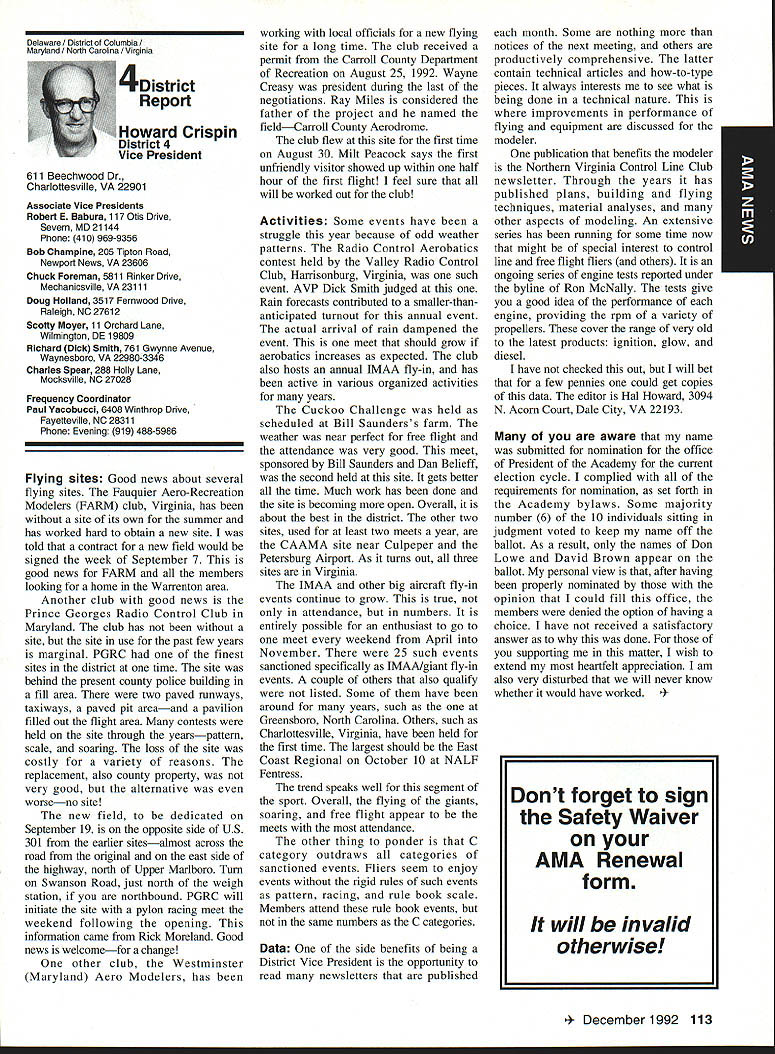
District 4 Report
Howard Crispin District 4 Vice President 611 Beechwood Dr., Charlottesville, VA 22901
Associate Vice Presidents:
- Robert E. Barba, 117 Otis Drive, Severn, MD 21144 — Phone: (410) 969-9356
- Bob Champion, 265 Tipton Road, Newport News, VA 23606
- Chuck Foreman, 5811 Rinker Drive, Mechanicsville, VA 23111
- Doug Holland, 3517 Fernwood Drive, Raleigh, NC 27612
- Scotty Moyer, 11 Orchard Lane, Wilmington, DE 19809
- Richard (Dick) Smith, 761 Gwynne Avenue, Waynesboro, VA 22980-3346
- Charles Spear, 288 Holly Lane, Mocksville, NC 27028
Frequency Coordinator:
- Paul Yacoubcobi, 6408 Winthrop Drive, Fayetteville, NC 28311 — Evening Phone: (919) 488-5986
Flying sites: Good news about several flying sites. The Fauquier Aero-Recreation Modelers (FARM) club, Virginia, has been without a site of its own for the summer and has worked hard to obtain a new site. I was told that a contract for a new field would be signed the week of September 7. This is good news for FARM and all the members looking for a home in the Warrenton area.
Another club with good news is the Prince Georges Radio Control Club in Maryland. The club has not been without a site, but the site in use for the past few years is marginal. PGRC had one of the finest sites in the district at one time. The site was behind the present county police building in a fall area. There were two paved runways, taxiways, a paved pit area—and a pavilion filled out the flight area. Many contests were held on the site through the years—pattern, scale, and soaring. The loss of the site was costly for a variety of reasons. The replacement, also county property, was not very good, but the alternative was even worse—no site!
The new field, to be dedicated on September 19, is on the opposite side of US 301 from the earlier site—almost across the road from the original and on the east side of the highway, north of Upper Marlboro. Turn on Swanson Road, just north of the weigh station, if you are northbound. PGRC will initiate the site with a pylon racing meet the weekend following the opening. This information came from Rick Moreland. Good news is welcome—for a change!
One other club, the Westminster (Maryland) Aero Modelers, has been working with local officials for a new flying site for a long time. The club received a permit from the Carroll County Department of Recreation on August 25, 1992. Wayne Creasy was present during the last of the negotiations. Ray Miles is considered the father of the project and he named the field—Carroll County Aerodrome.
The club flew at this site for the first time on August 30. Milt Peacock says the first unfriendly visitor showed up within one-half hour of the first flight! I feel sure that all will be worked out for the club.
Activities: Some events have been a struggle this year because of odd weather patterns. The Radio Control Aerobatics contest held by the Valley Radio Control Club, Harrisonburg, Virginia, was one such event. AVP Dick Smith judged at this one. Rain forecasts contributed to a smaller-than-anticipated turnout for this annual event. The actual arrival of rain dampened the event. This is one meet that should grow if aerobatics increases as expected. The club also hosts an annual IMAA fly-in, and has been active in various organized activities for many years.
The Cuckoo Challenge was held as scheduled at Bill Saunders' farm. The weather was near perfect for free flight and the attendance was very good. This meet, sponsored by Bill Saunders and Dan Belieff, was the second held at this site. It gets better all the time. Much work has been done and the site is becoming more open. Overall, it is about the best in the district. The other two sites, used for at least two meets a year, are the CAAMA site near Culpeper and the Stafford Airport. As it turns out, all three sites are in Virginia.
The IMAA and other big aircraft fly-ins continue to grow. This is true, not only in attendance, but in numbers. It is entirely possible for an enthusiast to go to one meet every weekend from April into November. There were 25 such events sanctioned specifically as IMAA/giant fly-in events. A couple of others that also qualify were not listed. Some of the meets have been around for many years, such as the one at Greensboro, North Carolina. Others, such as Charlottesville, Virginia, have been held for the first time. The largest should be the East Coast Regional on October 10 at NALF Fentress.
The trend speaks well for this segment of the sport. Overall, the flying of the giants, soaring, and free flight appear to be the events with the most attendance.
The other thing to ponder is that C category outdraws all categories of sanctioned events. Fliers seem to enjoy events without the rigid rules of such events as pattern, racing, and rule book scale. Members attend these rule book events, but not in the same numbers as the C categories.
Data: One of the side benefits of being a District Vice President is the opportunity to read many newsletters that are published each month. Some are nothing more than notices of the next meeting, and others are productively comprehensive. The latter contain technical articles and how-to-type pieces. It always interests me to see what is being done in a technical nature. This is where improvements in performance of flying and equipment are discussed for the modeler.
One publication that benefits the modeler is the Northern Virginia Control Line Club newsletter. Through the years it has published plans, building and flying techniques, material analyses, and many other aspects of modeling. An extensive series has been running for some time now that might be of special interest to control line and free flight fliers (and others). It is an ongoing series of engine tests reported under the byline of Ron McNally. The tests give a good idea of the performance of each engine, providing the rpm of a variety of propellers. These cover the range of very old to the latest products: ignition, glow, and diesel.
I have not checked this out, but I will bet that for a few pennies one could get copies of this data. The editor is Hal Howard, 3094 N. Acorn Court, Dale City, VA 22193.
Many of you are aware that my name was submitted for nomination for the office of President of the Academy for the current election cycle. I complied with all of the requirements for nomination, as set forth in the Academy bylaws. Some of the 10 individuals sitting in judgment voted to keep my name off the ballot. As a result, only the names of Don Lowe and David Brown appear on the ballot. My personal view is that, after having been properly nominated by those with the opinion that I could fill this office, the members were denied the option of having a choice. I have not received a satisfactory answer as to why this was done. For those of you supporting me in this matter, I wish to extend my most heartfelt appreciation. I am also very disturbed that we will never know whether it would have worked.
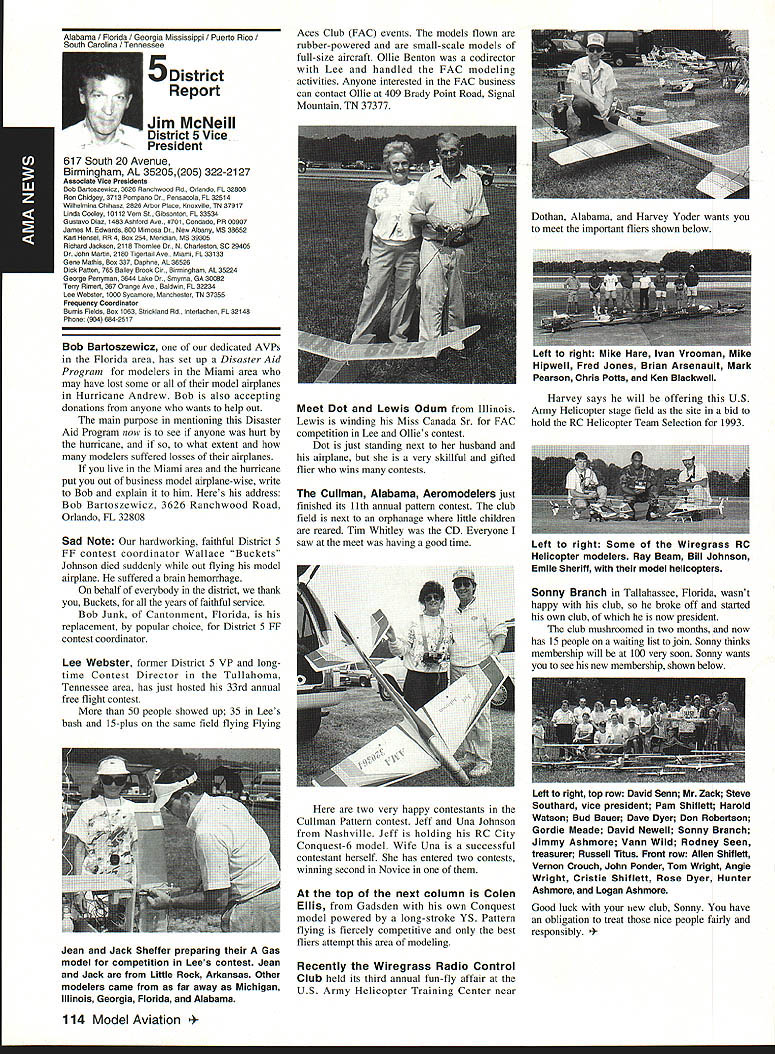
District 5 Report
Bob Bartoszewicz reports that one of our dedicated AVPs in the Florida area has set up a Disaster Aid Program for modelers in the Miami area who may have lost some or all of their model airplanes in Hurricane Andrew. Bob is also accepting donations from anyone who wants to help out.
The main purpose in mentioning this Disaster Aid Program now is to see if anyone was hurt by the hurricane, and if so, to what extent and how many modelers suffered losses of their airplanes.
If you live in the Miami area and the hurricane put you out of business model-airplane-wise, write to:
- Bob Bartoszewicz
3626 Ranchwood Road, Orlando, FL 32808
Sad Note: Our hardworking, faithful District 5 free flight contest coordinator Wallace "Buckets" Johnson died suddenly while out flying his model airplane. He suffered a brain hemorrhage.
On behalf of everybody in the district, we thank you, Buckets, for all the years of faithful service.
Bob Junk, of Cantonment, Florida, is his replacement, by popular choice, for District 5 free flight contest coordinator.
Lee Webster, former District 5 VP and longtime Contest Director in the Tallahomma, Tennessee area, has just hosted his 33rd annual free flight contest.
More than 50 people showed up; 35 in Lee's class and 15-plus on the same field flying Flying Aces Club (FAC) events. The models flown are rubber-powered and are small-scale models of full-size aircraft. Ollie Benton was a co-director with Lee and handled the FAC modeling activities. Anyone interested in the FAC business can contact Ollie at 409 Brody Point Road, Signal Mountain, TN 37377.
Meet Dot and Lewis Odum from Illinois. Lewis is winding his Miss Canada Sr. for FAC competition in Lee and Ollie's contest. Dot is just standing next to her husband and his airplane, but she is a very skillful and gifted flier who wins many contests.
The Cullman, Alabama, Aeromodelers just finished its 11th annual pattern contest. The club field is next to an orphanage where little children are reared. Tim Whitey was the CD. Everyone I saw at the meet was having a good time.
At the top of the next column are two very happy contestants in the Cullman Pattern contest: Jeff and Una Johnson from Nashville. Jeff is holding his RC City Conquest-6 model. Wife Una is a successful contestant herself. She has entered two contests, winning second in Novice in one of them.
At the top of the next column is Colen Ellis, from Gadsden, with his own Conquest model powered by a long-stroke YS. Pattern flying is fiercely competitive and only the best fliers attempt this area of modeling.
Recently the Wiregrass Radio Control Club held its third annual fun-fly at the U.S. Army Helicopter Training Center near Dothan, Alabama. Harvey Yoder wants you to meet the important fliers shown below.
Harvey says he will be offering this U.S. Army Helicopter stage field site again in a bid to hold the RC Helicopter Team Selection for 1993.
Sonny Branch in Tallahassee, Florida, wasn't happy with his club, so he broke off and started his own club, of which he is now president.
The club mushroomed in two months, and now has 15 people on a waiting list to join. Sonny thinks membership will be at 100 very soon. Sonny wants you to see his new membership.
Good luck with your new club, Sonny. You have an obligation to show your club people fairly and responsibly.
AMA News — Statement (Duplicate)
Academy of Model Aeronautics, Inc. acknowledges Sport Flyers Association, Inc. has commenced litigation in District Court, Dallas, Texas against AMA and certain officers and employees thereof. The claims asserted by SFA involve such matters as libel, slander, tortious interference with business relationships and violations of various Texas statutes. AMA vigorously denies the allegations and, with equal vigor, shall contest the lawsuit. However, as a result of this action by SFA, neither AMA nor its officers or employees will comment further on the suit during its pendency.
Instinct, and everything. I can read the frustration in the newsletters, and it adds to a conversation that Joe Haas and I had a few weeks ago about the attitudes of many model airplane clubs.
Joe remarked that he felt many clubs seem bent on a road to self-destruction! Give him a thought. Dig out all those occasions where a club member caused a problem for the whole of the club. Remember when someone went flying too early or too late, flew over a banned area, had a very noisy motor, lost his muffler, but still flew—just this once! Think about the member who brought a nonmember to the field, allowed him to fly with no insurance coverage—repeatedly—or who flew an illegal frequency because there was no one around. You can continue this list—seemingly forever—but it really shows how we tolerate these rule-bending happenings that can create real problems for the clubs.
Consider the other side of the picture—someone belongs to a really expensive country or golf club. Do the members break the rules? Wow! After paying the hefty dues and monthly fees, to get kicked out would be a sizable loss in dollars to the member, and then there are members who are content when they are members of a very staid and controlled recreation area.
I am convinced that there will be a time when the dues needed to join an RC club will be well over several hundred dollars, plus a legal, signed membership agreement that could include a statement that would result in a member paying hefty fines for rule infringements. Look at the average dues we pay now—around $40—and remember, there are modelers who belong to several clubs in their area.
So, what is the effect if they are driven from one club? Not much, they can fly in another one.
I am a firm believer that it is a privilege to join a club, not a right simply because you have the money. To be a member includes the responsibilities of participating in the club's activities. Every member should serve on at least one committee, and fulfill that task before becoming eligible for the following year. Ah, well—enough said for now, but give something to your club in 1993.
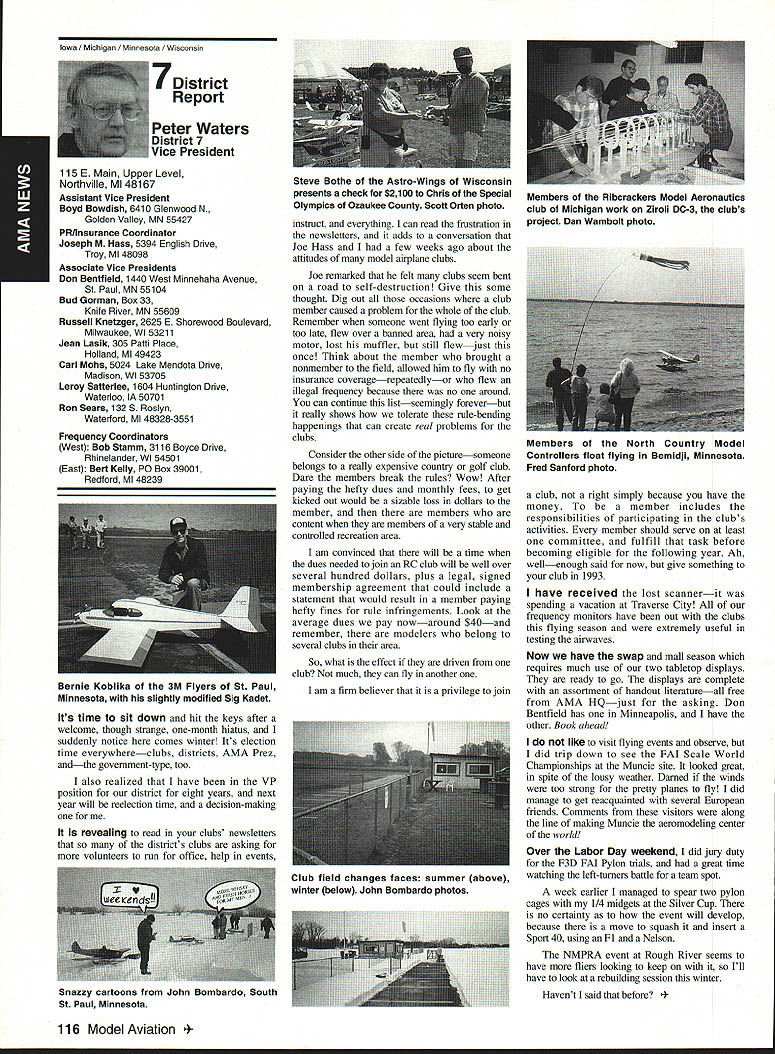
I have received the lost scanner — it was spending a vacation at Traverse City! All of our frequency monitors have been out with the clubs this flying season and were extremely useful in testing the airwaves.
Now we have the swap and mall season which requires much use of our tabletop displays. They are ready to go. The displays are complete with an assortment of handout literature—all free from AMA HQ—just for the asking. Don Benfield has one in Minneapolis, and I have the other. Book ahead!
I do not like to visit flying events and observe, but I did trip down to see the FAI Scale World Championships at the Muncie site. It looked great, in spite of the lousy weather. Darned if the winds were too strong for the pretty planes to fly! I did manage to get reacquainted with several European friends. Comments from these visitors were along the line of making Muncie the aeromodeling center of the world!
Over the Labor Day weekend, I did jury duty for the F3D FAI Pylon trials, and had a great time watching the left-turners battle for a team spot.
A week earlier I managed to spear two pylon cages with my 1/4 midgets at the Silver Cup. There is no certainty as to what the event will develop into, because there is a move to squash it and insert a Sport 40, using an F1 and a Nelson.
The NMPRA event at Rough River seems to have more fliers looking to keep on with it, so I'll have to look at a rebuilding session this winter.
Haven't I said that before?
AMA News
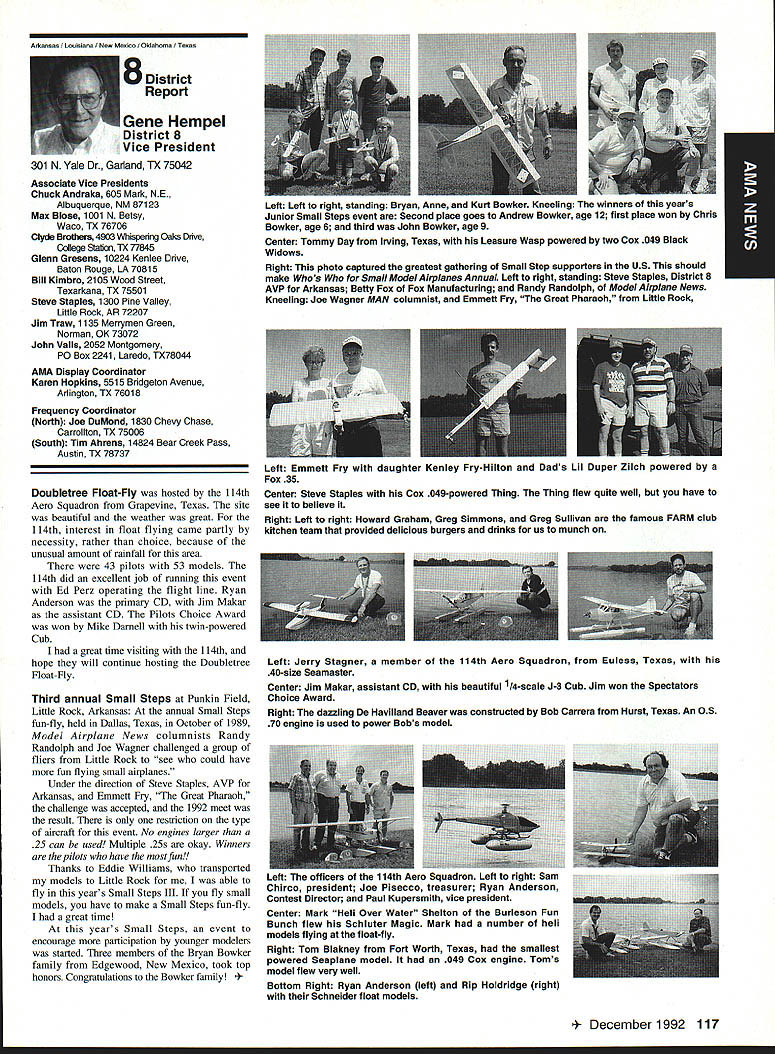
Doubletree Float-Fly was hosted by the 114th Aero Squadron from Grapevine, Texas. The site was beautiful and the weather was great. For the 114th, interest in float flying came partly by necessity, rather than choice, because of the unusual amount of rainfall for this area.
There were 43 pilots with 53 models. The 114th did an excellent job of running this event with Ed Perez operating the flight line. Ryan Anderson was the primary CD, with Jim Makar as the assistant CD. The Pilots Choice Award was won by Mike Darnell with his twin-powered Cub.
I had a great time visiting with the 114th, and hope they will continue hosting the Doubletree Float-Fly.
Third annual Small Steps at Punkin Field, Little Rock, Arkansas: At the annual Small Steps fun-fly, held in Dallas, Texas, in October of 1989, Model Airplane News columnists Randy Randolph and Joe Wagner challenged a group of fliers from Little Rock to "see who could put on more flying small airplanes." Under the direction of Steve Staples, AVP for Arkansas, and Emmett Fry, "The Great Pharaoh," the challenge was accepted, and the 1992 meet was the result. There is only one restriction on the type of aircraft for this event. No engines larger than .25 can be used! Multiple .25s are okay. Winners are the pilots who have the most fun!
Thanks to Eddie Williams, who transported models to Little Rock, I was able to fly in this year's Small Steps III. If you fly small models, you have to make a Small Steps fun-fly. I had a great time!
At this year's Small Steps, an event to encourage more participation by younger modelers was started. Three members of the Bryan Bowker family from Edgewood, New Mexico, took top honors. Congratulations to the Bowker family!!
Symposium January 1992 met Don Ogren, AMA 4029, who told about a man who really made model aviation come alive for him. Don was 10 years old in Jamestown, New York. With his weekly allowance of 10¢ he and his brother Ron would rush out to buy Comet dime models, build them, and, with luck, get them to fly. Later the family moved to West Virginia where the boys advanced to Comet Models Sparky kits and similar airplane kits. They were delighted the planes actually climbed under rubber power. One day Don heard about a model meet at Benedum Airport and his dad took him to see the event. His eyes were really opened when he saw rubber-powered stuff climbing straight up and gas models powering up several hundred feet. Such sights made him want to leave his own airplanes in the car. Carl Hopkins arrived on the scene, personally encouraged him to make flights, helped with trimming and timing, and told him about weekly model club meetings. The Clarksburg VFW post invited him to join meets with other youngsters and model airplane enthusiasts—the true start of a great hobby and lifelong interest. Carl and others provided some financial help from their own pockets to help kids, treated everyone fairly, never put anyone down or promoted favoritism, and taught respect for the achievements of others.
AMA News
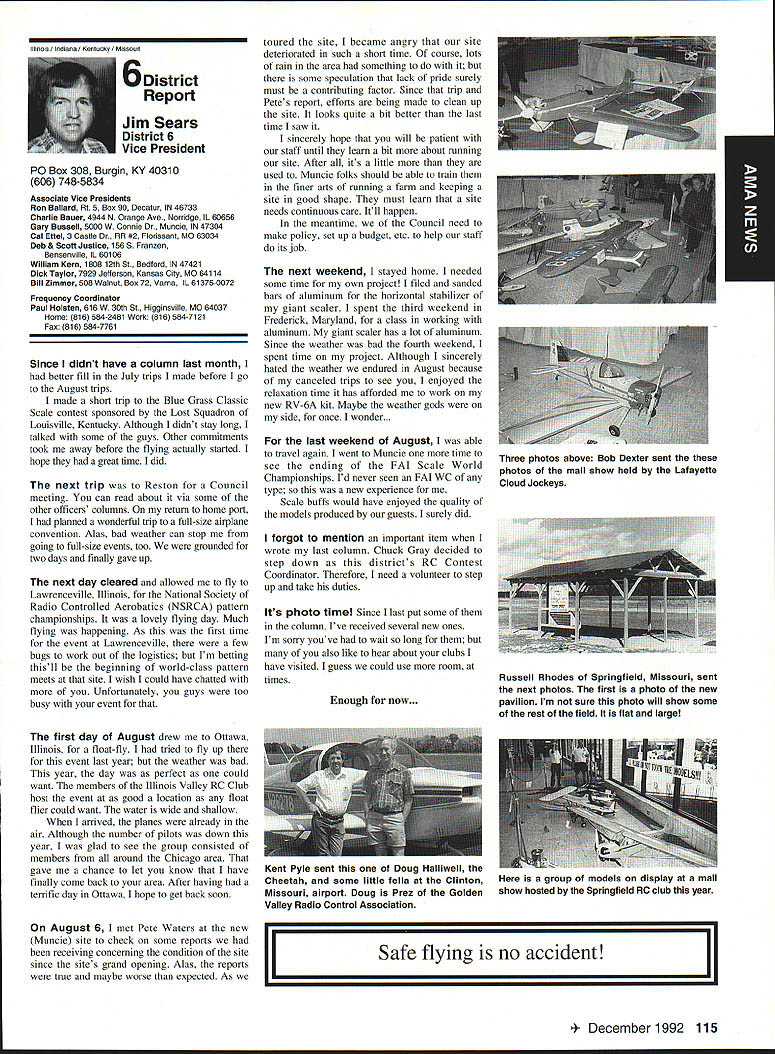
District 9 Report
Russ Miller District 9 Vice President 980 N. 3rd Street, Carrington, ND 58421 Days: (701) 652-2739 — Evenings: (701) 652-2321
Associate Vice Presidents:
- Tom Boyd, 701 N. 58th St., Lincoln, NE 68505
- Nathan Lancaster, 3597 S. Kendall Street, Denver, CO 80235
- Travis McGinnis, 8027 W. 81st Circle, Arvada, CO 80005
- Loren Moen, 607 E. Vera, Bottineau, ND 58318
- Don Moden, 410 Hart, Salina, KS 67401
- Jim Ricketts, 4921 Fernwood Drive, Sioux Falls, SD 57103-5573
- R.L. "Doc" Scraper, 9524 Roe Avenue, Overland Park, KS 66207
- Chuck Smith, 1091 Cheshire Street, Casper, WY 82609-3214
Frequency Coordinator:
- Steve Mangels, c/o Radio Service Center, 918 S. Sheridan, Denver, CO 80226
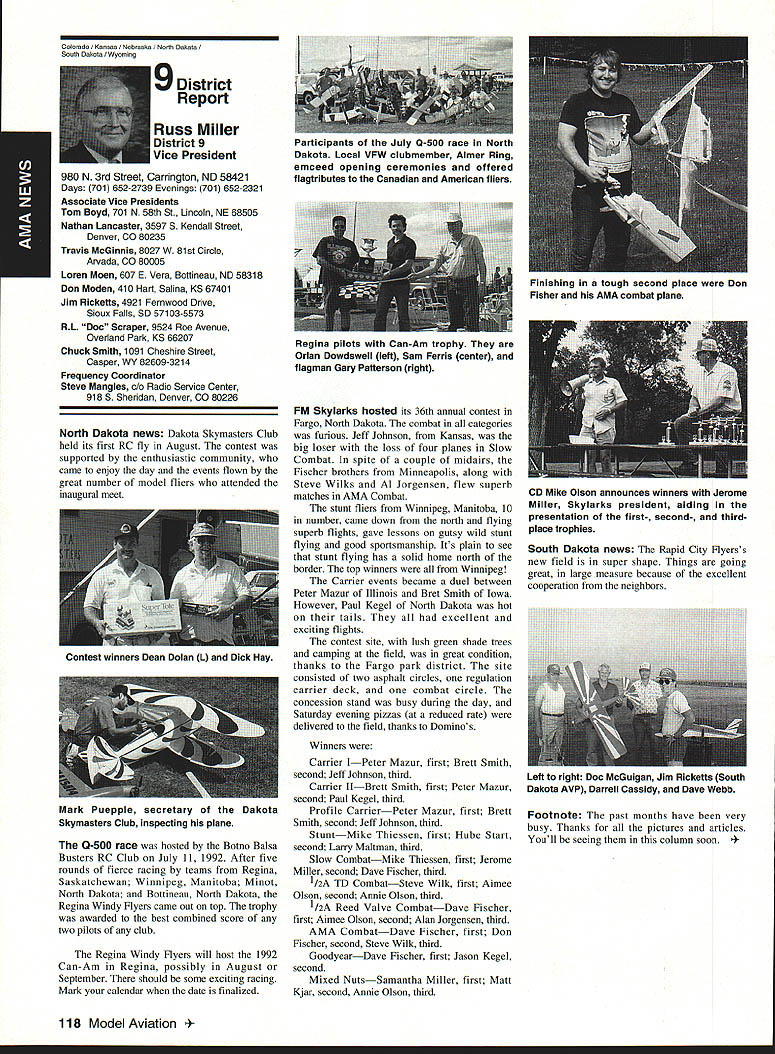
North Dakota news: Dakota Skymasters Club held its first RC fly-in in August. The contest was supported by the enthusiastic community, who came to enjoy the day and the events flown by the great number of model fliers who attended the inaugural meet.
The Q-500 race was hosted by the Bohn Balsa Busters RC Club on July 11, 1992. After five rounds of fierce racing by teams from Regina, Saskatchewan; Winnipeg, Manitoba; Minot, North Dakota; and Bottineau, North Dakota, the Regina Windy Flyers came out on top. The trophy was awarded to the best combined score of any two pilots of any club.
The Regina Windy Flyers will host the 1992 Can-Am in Regina, possibly in August or September. There should be some exciting racing. Mark your calendar when the date is finalized.
FM Skylarks hosted its 36th annual contest in Fargo, North Dakota. The combat in all categories was furious. Jeff Johnson, from Kansas, was the big loser with the loss of four planes in Slow Combat. In spite of a couple of midairs, the Fischer brothers from Minneapolis, along with Steve Wilks and Al Jorgensen, flew superb matches in AMA Combat.
The stunt fliers from Winnipeg, Manitoba, came down from the north and, flying superb flights, gave lessons on gutsy old stunt flying and good sportsmanship. The top winners were all from Winnipeg.
The Carrier events became a duel between Peter Mazur of Illinois and Brett Smith of Iowa. However, Paul Kegel of North Dakota was hot on their tails. They all had excellent and exciting flights.
The contest site, with lush green shade trees and camping at the field, was in great condition, thanks to the Fargo park district. The site consisted of two asphalt circles, one regulation carrier deck, and one combat circle. The concession stand was busy during the day, and Saturday evening pizzas (at a reduced rate) were delivered to the field, thanks to Domino's.
Winners were:
- Carrier I — 1st: Peter Mazur; 2nd: Brett Smith; 3rd: Jeff Johnson.
- Carrier II — 1st: Brett Smith; 2nd: Peter Mazur; 3rd: Paul Kegel.
- Profile Carrier — 1st: Peter Mazur; 2nd: Brett Smith; 3rd: Jeff Johnson.
- Stunt — 1st: Mike Thiessen; 2nd: Hube Start; 3rd: Larry Maltman.
- Slow Combat — 1st: Mike Thiessen; 2nd: Jerome Miller; 3rd: Dave Fischer.
- 1/2A T/D Combat — 1st: Steve Wilk; 2nd: Aimee Olson; 3rd: Annie Olson.
- 1/A Reed Valve Combat — 1st: Dave Fischer; 2nd: Aimee Olson; 3rd: Alan Jorgensen.
- AMA Combat — 1st: Dave Fischer; 2nd: Don Fischer; 3rd: Steve Wilk.
- Goodyear — 1st: Dave Fischer; 2nd: Jason Kegel.
- Mixed Nuts — 1st: Samantha Miller; 2nd: Matt Kjar; 3rd: Annie Olson.
South Dakota news: The Rapid City Flyer's new field is in super shape. Things are going great, in large measure because of the excellent cooperation from the neighbors.
Footnote: The past months have been very busy. Thanks for all the pictures and articles. You'll be seeing them in this column soon.
Thanks for all the cards and letters. I'm doing fine and looking forward to the District 10 meeting in Las Vegas. See you there—I hope.
Thanks to the effort and energy of Roger Jaffe of San Diego, District 10 now sports a bimonthly newsletter, Ten Forward. The first issue went out on September 1, 1992. Issue two will hit the streets around November 1. The newsletter will be mailed to the key person or contact person in each club. Please use any pertinent information—all or in part—in your club's newsletter. If you did not get the first issue or would like to be placed on the mailing list, call Roger Jaffe at (619) 463-4455.
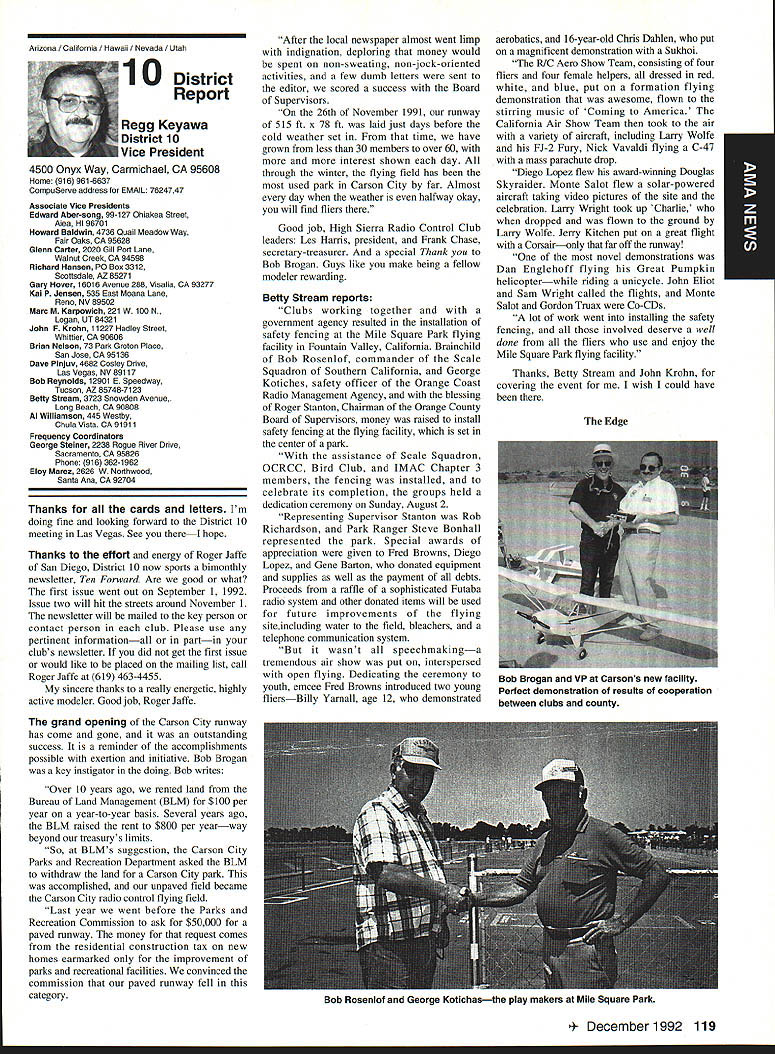
The grand opening of the Carson City runway has come and gone, and it was an outstanding success. It is a reminder of the accomplishments possible with exertion and initiative. Bob Brogan was a key instigator in the doing. Bob writes:
"Over 10 years ago, we rented land from the Bureau of Land Management (BLM) for $100 per year on a year-to-year basis. Several years ago, the BLM raised the rent to $800 per year—way beyond our treasury's limits.
So, at BLM's suggestion, the Carson City Parks and Recreation Department asked the BLM to withdraw the lease for a Carson City park. This was accomplished, and our unpaved field became the Carson City radio control flying field.
Last year we went before the Parks and Recreation Commission to ask for $50,000 for a paved runway. The money for that request comes from the residential construction tax on new homes earmarked only for the improvement of parks and recreational facilities. We convinced the commission that our paved runway fell in this category.
After the local newspaper almost went limp with indignation, deploring that money would be spent on non-sweating, non-jock-oriented activities, and a few dumb letters were sent to the editor, we scored a success with the Board of Supervisors.
On the 26th of November 1991, our runway of 515 ft. x 78 ft. was laid just days before the cold weather set in. From that time, we have grown from less than 30 members to over 60, with more and more interest shown each day. All through the winter, the flying field has been the most used park in Carson City by far. Almost every day when the weather is even halfway okay, you will find fliers there."
Good job, High Sierra Radio Control Club leaders: Les Harris, president, and Frank Chase, secretary-treasurer. And a special thank you to Bob Brogan. Guys like you make being a fellow modeler rewarding.
Betty Stearn reports:
"Clubs working together with the county and a government agency resulted in the installation of safety fencing at the Mile Square Park flying facility in Fountain Valley, California. Bob Rosenlof, commander of the Scale Squadron of Southern California, and George Kotiches, safety officer of the Orange County Radio Management Agency, and with the blessing of Roger Stanton, chairman of the Orange County Board of Supervisors, money was raised to install safety fencing at the flying facility, which is set in the center of a park.
With the assistance of Scale Squadron, OCRRC, Bird Club, and IMAC Chapter 3 members, the fencing was installed, and to celebrate its completion, the groups held a dedication ceremony on Sunday, August 2.
Representing Supervisor Stanton was Bob Richardson, and Park Ranger Steve Bonhall represented the park. Special awards and appreciation were given to Fred Brown, Diego Lopez, and Gene Barton, who donated equipment and supplies as well as the payment of all tents. Proceeds from a raffle of a sophisticated Futaba radio system and other donated items will be used for future improvements of the flying site, including water to the field, bleachers, and a telephone communication system.
But it wasn't all speechmaking—a tremendous air show was put on, interspersed with open flying. Dedication ceremonies were highlighted with an aerial photograph of the Mile Square Park flying facility. Sixteen-year-old Chris Dahlen put on a magnificent demonstration with a Sukhoi aerobatic. The RC Aero Show Team, consisting of four fliers and four female helpers, all dressed in red, white, and blue, put on a formation flying demonstration that was awesome, to the stirring music of 'Coming to America.' The California Air Show Team then took to the air with a variety of aircraft, including Larry Wolfe and his FJ-2 Fury, Nick Nava flying a C-47 with a mass parachute drop.
Diego Lopez flew his award-winning Douglas Skyraider. Monte Balof flew a solar-powered aircraft taking video pictures of the air and the celebration. Larry Wright took up Charlie, who has a Corsair—only that far off the runway!
One of the most novel demonstrations was Dan Englehoff flying his Great Pumpkin helicopter—while riding a unicycle. John Eliot and Sam Wright called the flights, and Monte Balof and Gordon Truax were CDs.
A lot of work went into installing the safety fencing, and all those who were involved deserve a well-done from all the fliers who use and enjoy the Mile Square Park flying facility."
Thanks, Betty Stearn and John Krohn, for covering the event. I wish I could have been there.
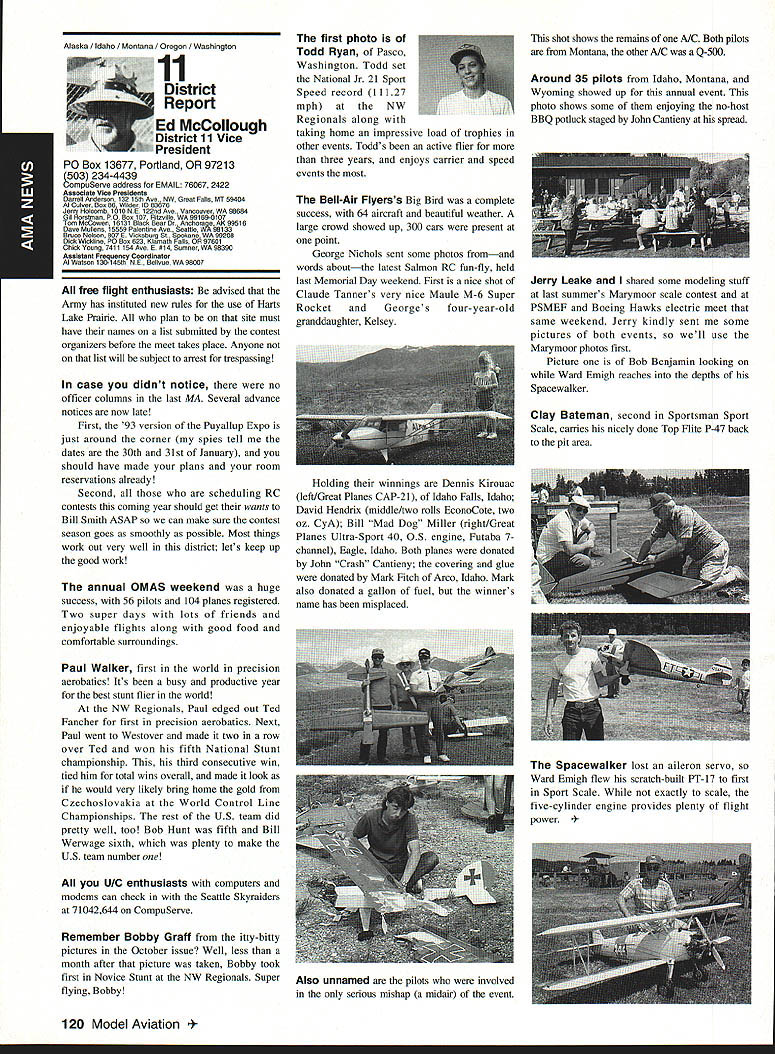
All free flight enthusiasts: Be advised that the Army has instituted new rules for the use of Harts Lake Prairie. All who plan to be on that site must have their names on a list submitted by the contest organizers before the meet takes place. Anyone not on that list will be subject to arrest for trespassing!
In case you didn't notice, there were no officer columns in the last MA. Several advance notices are now late!
First, the '93 version of the Puyallup Expo is just around the corner (my spies tell me the dates are the 30th and 31st of January), and you should have made your plans and your room reservations already!
Second, all those who are scheduling RC contests this coming year should get their wants to Bill Smith ASAP so we can make sure the contest season goes as smoothly as possible. Most things work out very well in this district; let's keep up the good work!
The annual OMAS weekend was a huge success, with 56 pilots and 104 planes registered. Two super days with lots of friends and enjoyable flights along with good food and comfortable surroundings.
Paul Walker, first in the world in precision aerobatics! It's been a busy and productive year for the best stunt flier in the world!
At the NW Regionals, Paul edged out Ted Fancher for first in precision aerobatics. Next, Paul went to Westover and made it two in a row over Ted and won his fifth National Stunt championship. This, his third consecutive win, tied him for total wins overall, and made it look as if he would very likely bring home the gold from Czechoslovakia at the World Control Line Championships. The rest of the U.S. team did pretty well, too! Bob Hunt was fifth and Bill Werwagge sixth, which was plenty to make the U.S. team number one!
All you U/C enthusiasts with computers and modems can check in with the Seattle Skyraiders at 71042,644 on CompuServe.
Remember Bobby Graff from the itty-bitty pictures in the October issue? Well, less than a month after that picture was taken, Bobby took first in Novice Stunt at the NW Regionals. Super flying, Bobby!
Sound / Crispin
Lack of respect for safety causes the problem. This is the area of starting, adjusting, taxiing, and shutting down the engine. All clubs must teach—and practice—safe operation.
- Use a starter or chicken stick to start the engine. Do not reach over or through the propeller arc to adjust the engine.
- Never run the engine to full rpm while squatted down in front of the aircraft, or in line with the plane of the propeller.
- Do not point the aircraft at spectators while revving the engine.
- Do not taxi in the pit areas.
- Use a kill switch on ignition engines, and set the low throttle position to cutoff on glow engines.
- When you get in trouble on a taxi maneuver or during takeoff, shut down the engine to avoid hitting a fellow member.
- Get behind the aircraft immediately upon start-up. Do not trust holding the aircraft—practice safety at all times.
- Keep a first-aid kit handy at the field. DO NOT FLY ALONE!
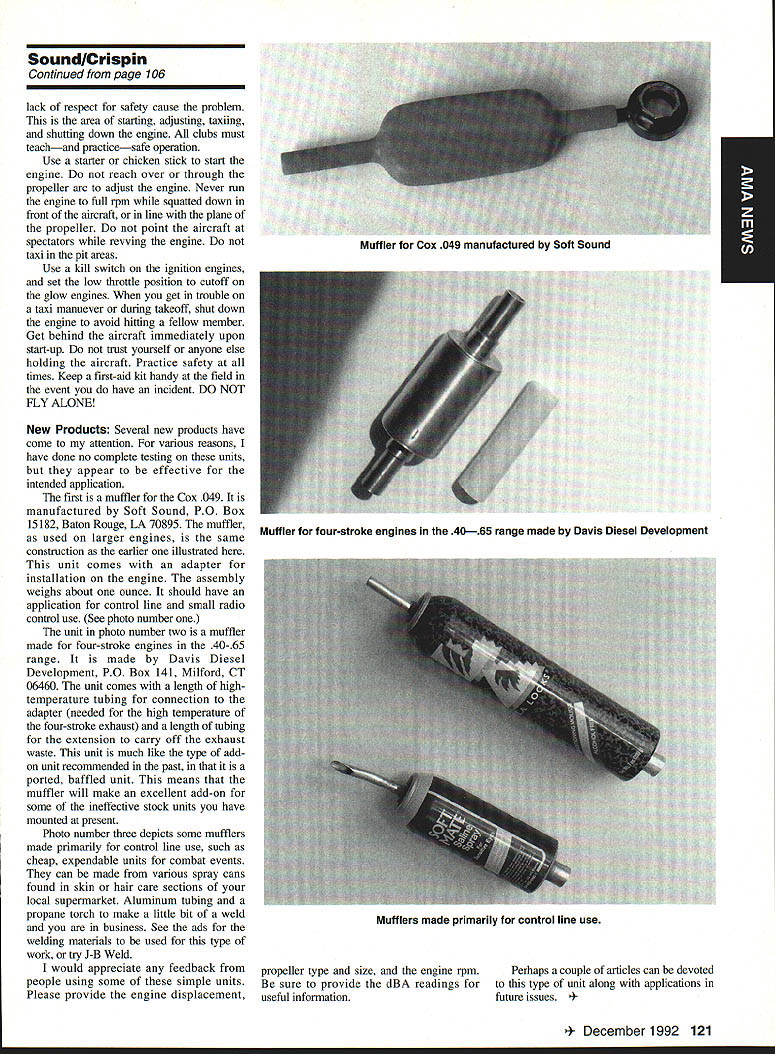
New Products: Several new products have come to my attention. For various reasons, I have done no complete testing on these units, but they appear to be effective for the intended application.
- A muffler for the Cox .049, manufactured by Soft Sound, P.O. Box 15182, Baton Rouge, LA 70855. The muffler is similar to those used on larger engines and comes with an adapter for installation. The assembly weighs about one ounce. It should have applications for control line and small radio control use.
- A muffler made for four-stroke engines in the .40–.65 range, made by Davis Diesel Development, P.O. Box 141, Milford, CT 06460. The unit comes with a length of high-temperature tubing for connection to the adapter and a length of tubing for the extension to carry off the exhaust waste. This is a ported, baffled unit, useful as an add-on for some ineffective stock units.
- Simple mufflers for control line use can be made from various spray cans and aluminum tubing. A propane torch can be used for basic fabrication; J-B Weld or similar products can help complete the unit.
I would appreciate any feedback from people using some of these simple units. Please provide the engine displacement, propeller type and size, the engine rpm, and dBA readings for useful information. Perhaps a couple of articles can be devoted to this type of unit and applications in future issues.
AMA ANNOUNCES NEW INSURANCE LIMITS FOR SITE OWNERS
— $1 or $2 Million Additional Coverage Available —
AMA is recognized as the national association representing the aeromodellers' interests in the United States. It is the voice accepted by various Federal, State, and local government agencies. We strive to meet the needs of our members, chartered clubs, and site owners.
There have been a few occasions in the past where site owners wanted more than the standard $1 million of primary liability insurance coverage. AMA has assisted clubs by working with local agents/brokers in the club's locale to secure policies solely on behalf of the individual clubs. This service has always been provided by the AMA. From time to time there have been requests for $1 million of automobile liability coverage by commercial property owners. AMA has been able to handle this need under its own auto policy. A certificate providing coverage for the club's site owner involving motor vehicles owned or used by club members and/or spectators has been provided at no additional cost to the club since AMA incurred no additional premium.
With almost 3,000 site owners protected under the Charter Club program, less than a dozen site owners have indicated a need for higher liability limits. Although the Academy has heard very little from our clubs, we have had our broker secure a source for higher liability limits and it is now available to AMA clubs. A choice of an additional $1 or $2 million is available over the AMA standard of $1 million. This is being offered to clubs for their principal field for which they have a specific written request by the site owner for increased liability insurance. Clubs are cautioned not to openly solicit higher limits to site owners, but to be able to respond to site owner requests with this new AMA charter club benefit.
An application form for this specific need will be provided to those submitting a property owner's request. The AMA/insurance broker processing fees are:
- $240.00 for $1 million additional coverage
- $290.00 for $2 million additional coverage
AMA's simplified approach avoids the necessity to calculate the cost based on a specific number of club members, spectator attendance, model type restrictions, issuance of special insurance policies relying upon underwriting reviews with emphasis placed on a property owner being a private individual, corporate, or public (local, state, or federal agencies) entity.
Regardless of the application date the certificate will be issued at these AMA fees for the remainder of the current 1992 and new 1993 club charter year with the latter period of coverage ending on March 31, 1994. As usual all certificates issued are mailed to the club contact for distribution directly to the property owner.
This program is intended to assist clubs with unique coverage requirements by site owners. The Academy is pleased to automatically extend the new additional limit of either $1 million or $2 million to the club when higher limits are issued for their site owner. Proof of the additional club protection will be recorded and maintained in the club file at AMA. Eighteen months of this additional coverage at the cost described above can begin as early as October 1 with application and approval. This offer of additional limits and continuous protection through 3/31/94 is available if your club renews its charter on or before March 31, 1993. New certificates of insurance for these additional levels will automatically be reissued for the named additional insured and sent to the club contact for the 1993–94 policy period (3/31/93 through 3/31/94).
This new service is available immediately. Applications are available by calling 703/435-0750 and asking for the Special Services Department, extension 271.
Transcribed from original scans by AI. Minor OCR errors may remain.

