
HALL OF FAME AWARDS — 1992
The Academy is pleased to announce the 1992 AMA Model Aviation Hall of Fame inductees. Twenty-one nominees were proposed and their credentials submitted to the HOF Selection Committee for consideration. All candidates were well qualified, having contributed to the growth of aeromodeling in many facets of the hobby. After many hours of deliberation, the Committee made the selection in accordance with Executive Council guidelines. Congratulations to all of the inductees — an honor well deserved.
With the addition of these new members the AMA Hall of Fame is once again enhanced. We thank all members who provided nominations. Those people who were not installed this time will be up for consideration in 1993.
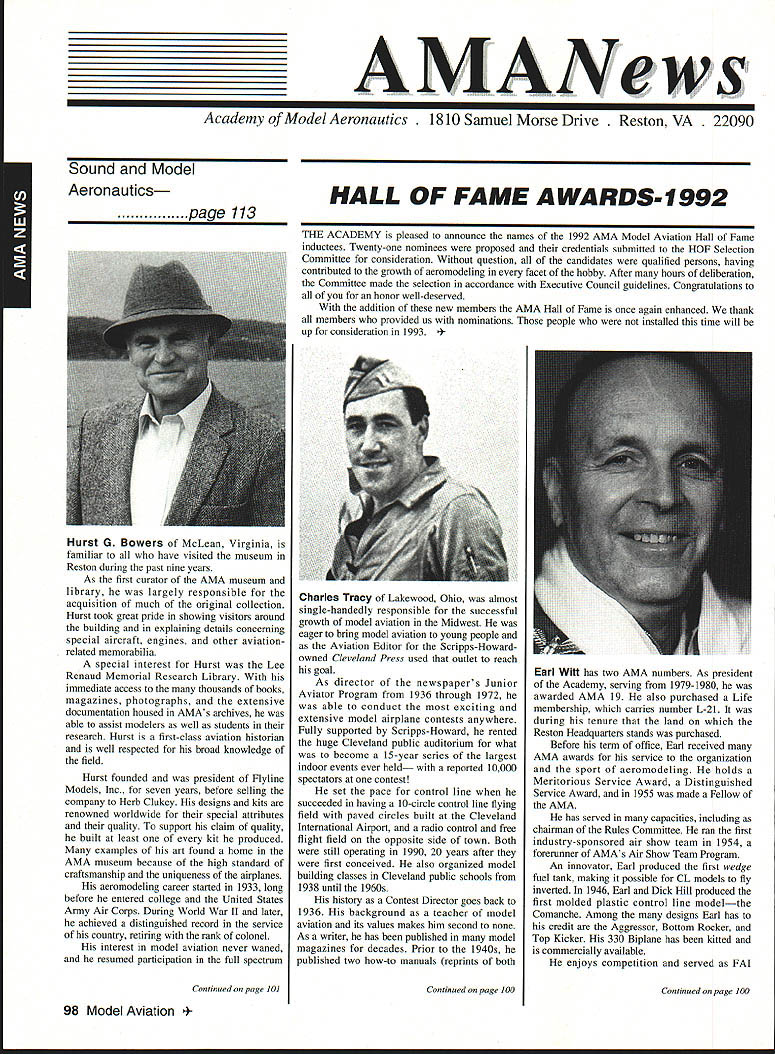
Hurst G. Bowers — McLean, Virginia Hurst is familiar to all who have visited the museum in Reston during the past nine years. As the first curator of the AMA Museum and Library, he was largely responsible for the acquisition of much of the original collection. Hurst took great pride in showing visitors around the building and in explaining details concerning special aircraft, engines, and other aviation-related memorabilia.
A special interest for Hurst was the Lee Renaud Memorial Research Library. With immediate access to the many thousands of books, magazines, photographs, and extensive documentation housed in AMA's archives, he was able to assist modelers as well as students in their research. Hurst is a first-class aviation historian and is well respected for his broad knowledge of the field.
Hurst founded and was president of Flyline Models, Inc., for seven years before selling the company to Herb Clukey. His designs and kits are renowned worldwide for their quality. To support his claim of quality, he built at least one of every kit he produced. Many examples of his work found a home in the AMA Museum because of their high standard of craftsmanship and the uniqueness of the airplanes.
His aeromodeling career started in 1933, long before he entered college and the United States Army Air Corps. During World War II and later, he achieved a distinguished record in the service of his country, retiring with the rank of colonel. His interest in model aviation never waned, and he resumed participation in the full spectrum of the hobby.
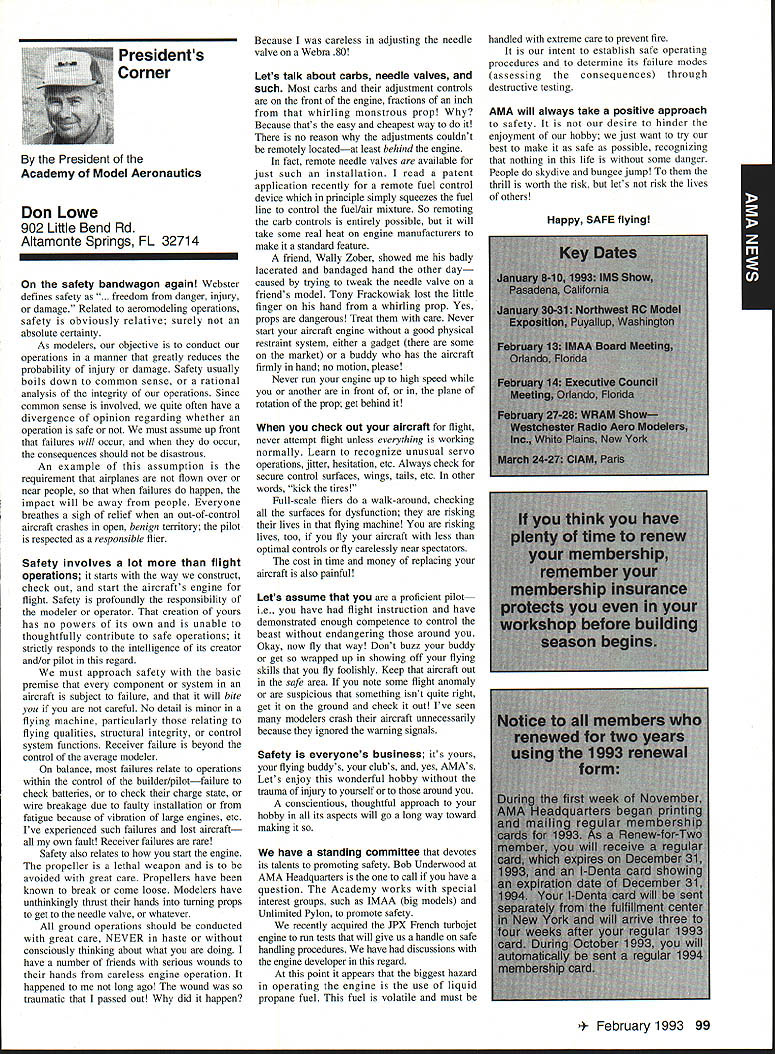
Charles Tracy — Lakewood, Ohio Charles was almost single-handedly responsible for the successful growth of model aviation in the Midwest. He was eager to bring model aviation to young people and, as Aviation Editor for the Scripps-Howard-owned Cleveland Press, used that outlet to reach his goal.
As director of the newspaper's Junior Aviator Program from 1936 through 1972, he conducted large and exciting model airplane contests, fully supported by Scripps-Howard. He rented the huge Cleveland Public Auditorium for a 15-year series of the largest indoor events ever held — with a reported 10,000 spectators at one contest.
He set the pace for control line when he succeeded in having a 10-circle control line flying field with paved circles built at the Cleveland International Airport, and a radio control and free flight field on the opposite side of town. Both were still operating in 1990, twenty years after they were first conceived. He also organized model-building classes in Cleveland public schools from 1938 until the 1960s.
His history as a contest director goes back to 1936. As a teacher of model aviation and its values, he is second to none. As a writer, he has been published in many model magazines for decades. Prior to the 1940s, he published two how-to manuals (reprints of both).
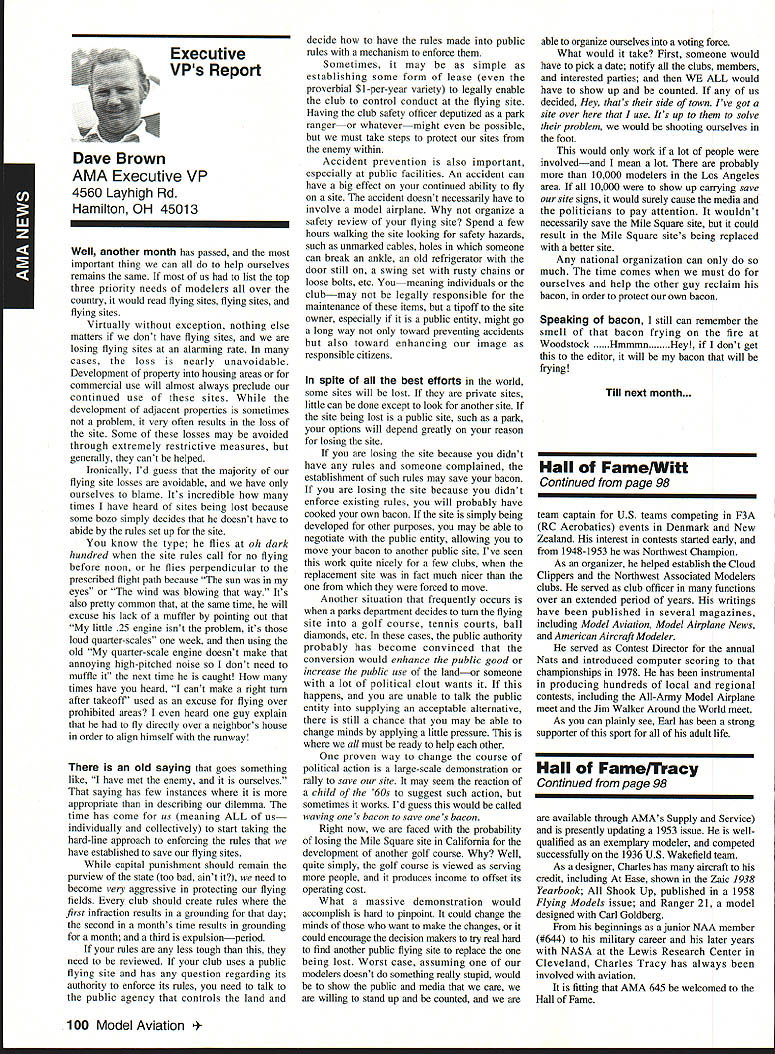
Earl Witt Earl has two AMA numbers. As president of the Academy (1979–1980), he was awarded AMA 19. He also purchased a Life membership, which carries number L-21. It was during his tenure that the land on which the Reston Headquarters stands was purchased.
Before his term of office, Earl received many AMA awards for his service to the organization and the sport of aeromodeling. He holds a Meritorious Service Award, a Distinguished Service Award, and in 1955 was made a Fellow of the AMA.
He has served in many capacities, including chairman of the Rules Committee. He ran the first industry-sponsored air show team in 1954, a forerunner of AMA's Air Show Team Program.
An innovator, Earl produced the first wedge fuel tank, making it possible for CL models to fly inverted. In 1946, Earl and Dick Hill produced the first molded plastic control line model—the Comanche. Among the many designs Earl has to his credit are the Aggressor, Bottom Rocker, and Top Kicker. His 330 Biplane has been kitted and is commercially available.
He enjoys competition and has served in FAI-related activities.
(Additional Hall of Fame inductees and full citations were announced by the Academy.)
President's Corner
By Don Lowe President, Academy of Model Aeronautics 902 Little Bend Rd., Altamonte Springs, FL 32714
On the safety bandwagon again! Webster defines safety as "... freedom from danger, injury, or damage." Related to aeromodeling operations, safety is obviously relative; it is not absolute.
As modelers, our objective is to conduct operations in a manner that greatly reduces the probability of injury or damage. Safety usually boils down to common sense, or a rational analysis of the integrity of our operations. Since common sense is involved, we often have a divergence of opinion regarding whether an operation is safe or not. We must assume up front that failures will occur, and when they do, the consequences should not be disastrous.
An example is the requirement that airplanes are not flown over or near people, so that when failures do happen, the impact will be away from people. If one breathes a sigh of relief when an out-of-control aircraft crashes in open, benign territory, the pilot is respected as a responsible flier.
Safety involves more than flight operations; it starts with the way we construct, check out, and start the aircraft's engine for flight. Safety is profoundly the responsibility of the modeler or operator. Creating your power plant is one of the most dangerous parts of the flight. Safety must be designed into the model and its operation; it cannot be added on later. We must approach safety with the basic premise that every component or system in an aircraft is subject to failure — and that it will fail if you are not careful. No detail is minor in a flying machine, particularly those relating to flying qualities, structural integrity, or control system functions. Receiver failure is beyond the control of the average modeler.
On balance, most failures relate to operations within the control of the builder/pilot — failure to check batteries or their charge state, wire breakage due to faulty installation or fatigue because of vibration or large engines, etc. I've experienced such failures and lost aircraft — all my own fault! Receiver failures are rare.
Safety also relates to how you start the engine. The propeller is a lethal weapon and must be avoided with great care. Propellers can break or come loose. Modelers have unthinkingly thrust their hands into turning props to get to needle valves or other adjustments.
All ground operations should be conducted with great care. NEVER in haste or without consciously thinking about what you are doing. I have friends with serious wounds to their hands from careless engine operation; it happened to me not long ago — the wound was so traumatic I passed out! Why did it happen? Because I was careless in adjusting the needle valve on a Webra .80.
Most carbs and their adjustment controls are on the front of the engine, fractions of an inch from that whirling prop — because that's the easy and cheapest way to do it. There is no reason why the adjustments couldn't be remotely located — at least behind the engine. In fact, remote needle valves are available for such an installation. I recently read a patent application for a remote fuel control device that squeezes the fuel line to control the mixture. Remote controls are possible, but it will take real pressure on engine manufacturers to make them standard.
A friend, Wally Zober, recently showed me his badly lacerated, bandaged hand — caused by trying to tweak the needle valve on a friend's model. Tony Frackowiak lost the little finger on his hand from a whirling prop. Yes, props are dangerous! Treat them with care. I never start my engine without a good physical restraint system: either a marketed gadget or a buddy who holds the aircraft firmly.
Never run your engine up to high speed while you or another are in front of, or in, the plane of rotation of the prop; get behind it!
When you check out your aircraft for flight, never attempt flight unless everything is working normally. Learn to recognize unusual servo operations — jitter, hesitation, etc. Always check for secure control surfaces, wings, tails — in other words, "kick the tires!" Full-scale pilots do a walk-around; you are risking lives too if you fly with less than optimal controls or too close to spectators.
Let's assume you are a proficient pilot. You have had flight instruction and have demonstrated competence. Fly that way! Don't buzz your buddy or show off to the point of flying foolishly. Keep the aircraft in the safe area. If you notice an anomaly, get it on the ground and check it. I've seen many modelers crash unnecessarily because they ignored warning signals.
Safety is everyone's business — yours, your flying buddy's, your club's, and the AMA's. Let's enjoy this wonderful hobby without the trauma of injury. A conscientious, thoughtful approach in all aspects will go a long way.
We have a standing committee devoted to promoting safety. Bob Underwood at AMA Headquarters is the contact if you have questions. The Academy works with special interest groups, such as IMAC (big models) and Unlimited Pylon, to promote safety.
We recently acquired a JPX French turbine engine to run tests that will help establish safe handling procedures. It appears that the biggest hazard in operating the engine is the use of liquid propane fuel — it is volatile and must be handled with extreme care to prevent fire. Our intent is to establish safe operating procedures and determine failure modes through destructive testing.
AMA will always take a positive approach to safety. It is not our desire to hinder enjoyment of our hobby; we just want to make it as safe as possible, recognizing that nothing in life is without some danger. Happy, SAFE flying!
Executive VP's Report
Dave Brown AMA Executive VP 4560 Layhigh Rd., Hamilton, OH 45013
Well, another month has passed, and the most important thing we can all do to help ourselves remains the same: flying sites, flying sites, flying sites.
Virtually nothing else matters if we don't have flying sites, and we are losing them at an alarming rate. Development into housing or commercial use will almost always preclude our continued use of these sites. While some losses may be unavoidable, many are avoidable and result from our own lack of discipline.
I've heard too many stories of sites being lost because someone ignores site rules: flying before permitted hours, flying perpendicular to prescribed flight paths, or failing to muffle noisy engines. The time has come for us — individually and collectively — to enforce the rules we have established to save our flying sites.
Every club should adopt strict penalties: first infraction — grounding for that day; second — a one-month grounding; third — expulsion. If your rules are less strict, review them. If your club uses public land and needs enforcement authority, talk to the public agency that controls the land and work to have rules made public with an enforcement mechanism. A lease (even $1-per-year) can legally enable the club to control conduct at the site. Deputizing the club safety officer may also be possible.
Accident prevention is also important, especially at public facilities. An accident can have a big effect on our continued ability to fly on a site. Organize a safety review: walk the site looking for hazards such as unmarked cables, holes, old refrigerators with doors, swing sets with rusty chains, etc. Even if the club is not legally responsible for maintenance, addressing these hazards can prevent accidents and enhance our image as responsible citizens.
Some sites will still be lost. If a private site is lost, little can be done except look for another. If a public site is lost because you lacked rules or failed to enforce them, you may have only yourselves to blame. If land is being developed for other public uses, negotiate for a replacement site — I've seen this work.
When a parks department chooses to convert a flying site into other recreational uses, pressure may help. Large-scale demonstrations or rallies can show decision-makers and the media that we care and are organized. If a lot of people show up, it can prompt officials to seek alternatives.
Right now, we face the probability of losing Mile Square in California to a golf course, which serves more people and produces income. A robust demonstration could either change minds or encourage officials to find a suitable replacement.
Any national organization can only do so much. We must help each other protect our flying sites. Till next month...
Executive Director's View from HQ
Vince Mankowski AMA Executive Director 1810 Samuel Morse Drive, Reston, VA 22090
Recently the AMA mailed a letter to all Leader Members as a next step in revitalizing the Leader Member program. Several items were brought to their attention for input. Responses have been outstanding — between 30 and 60 replies a day for the past two weeks.
Leader Members were asked for input on the selection process for national AMA offices; whether redistricting is a problem; and whether Leader Member meetings should be held regionally. We requested that each response be made on a separate piece of paper for easy filing and review. Thank you to all Leader Members for your thoughtful input.
One continuing question at AMA HQ concerns whether the new SFA company is affecting AMA. In 1992 AMA had projected 4% growth but finished the year with a 1% membership loss. Given the economic conditions of 1992, AMA did quite well to achieve a 1% retention rate.
After discussions with industry and clubs, another picture is emerging: most segments of the hobby industry achieved growth through the summer of 1992. So why did AMA experience a 1% loss instead of 4% growth? Renewals were mailed by the second full week of September. There was an initial optimistic response, paralleling industry growth, but the initial rush subsided and AMA ran about 4% behind renewal rate at the same point last year. It is too early to determine a trend — the situation will be clearer by December 31.
Regardless of trends, the Academy will study and review whether changes are due to the '92 economy or the new SFA company.
The response to our special NATS issue of Model Aviation has been good. Members generally prefer the perfect-bound magazine format; therefore AMA will begin perfect binding all issues and will upgrade the cover material to UV-coated stock.
Please report service problems promptly. It is far easier to resolve issues when they are fresh. A recent case required employees to review files and microfiche to recreate an incident that occurred eight months prior.
AMA has an Industry Associate Program for manufacturers, wholesalers, and retailers to participate in and support AMA efforts. Many hobby shops have joined; AMA has mailed notices to members near participating shops to inform them their local shop supports AMA programs.
We recently scanned the guestbook at the national flying site in Muncie and were surprised by the number of AMA members who visited from all over the U.S. There is far more sport flying than competition flying at the site. Members frequently ask when the next big event will be; AMA is investigating a fun-fly on June 19–20, 1993, which might be called "Homecoming."
Another 1993 event is the planned opening of the Frank V. Ehling museum complex. The date depends on fundraising; we hope for a fall opening, possibly in September 1993. The museum is presently closed to visitors and consists of models and artifacts awaiting assembly; turning that pile into a museum will take considerable time and effort.
Purdue University has requested permission to use the property for a youth rocketry contest as part of its extension service youth program; AMA has granted permission for this event on July 12, 1993, at the national flying site in Muncie, Indiana. Officially recognized Special Interest Groups will be invited to hold events at the national flying site.
Two final items: the deadline for this magazine is three days before we will know definitively whether the '93 Nats will be in Lubbock, Texas. If not approved, the likely alternative is a return to Lawrenceville. Information concerning aluminum-clad AMA license numbers (e.g., "FLY RC") will be mailed to all AMA members in their 1993 membership kits, which mail toward the end of January.
Presidents Corner (Regional)
President, Academy of Model Aeronautics Don Lowe 902 Little Bend Rd., Altamonte Springs, FL 32714
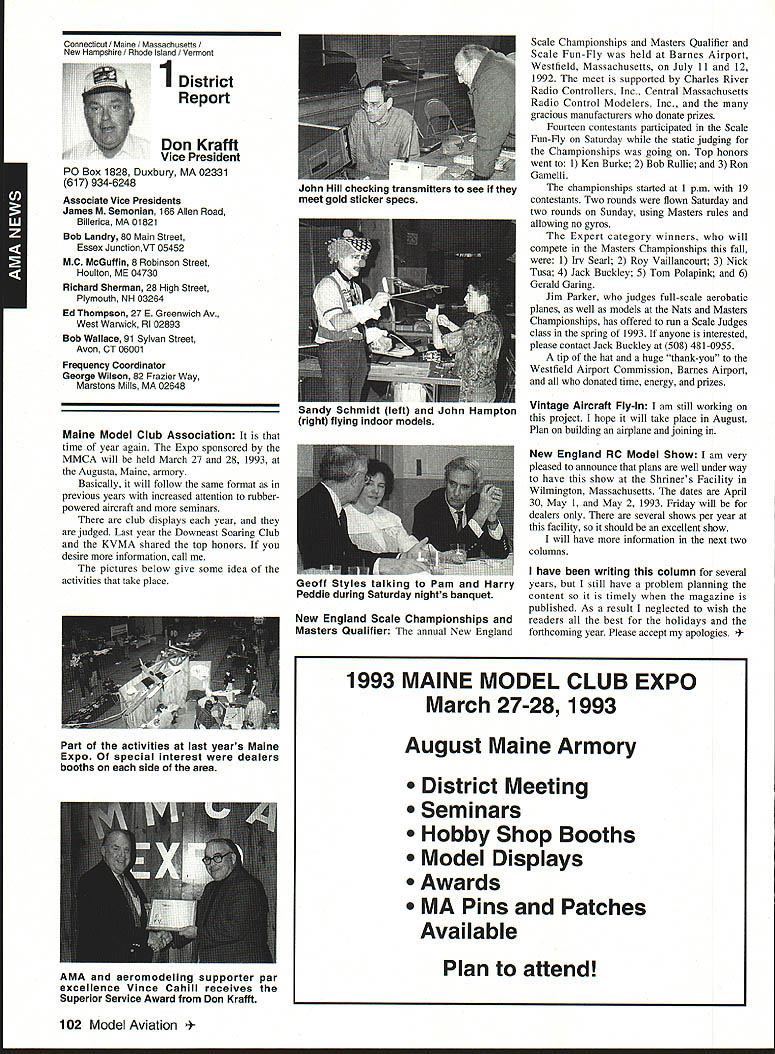
New England Scale Championships and Masters Qualifier
The annual New England Scale Championships and Masters Qualifier and Scale Fun‑Fly was held at Barnes Airport, Westfield, Massachusetts, on July 11–12, 1992. The event was supported by Charles River Radio Controllers, Inc.; Central Massachusetts Radio Control Modelers, Inc.; and many manufacturers who donated prizes.
Fourteen contestants participated in the Scale Fun‑Fly on Saturday during static judging. Top honors were: 1) Ken Burke; 2) Bob Rullie; 3) Ron Gamelli.
The championships started at 1 p.m. with 19 contestants. Two rounds were flown Saturday and two on Sunday, using Masters rules and allowing no gyros. Expert category winners who will compete in the Masters Championships were: 1) Erv Searl; 2) Roy Vaillancourt; 3) Nick Tusa; 4) Jack Buckley; 5) Tom Polapink; 6) Gerald Garig.
Jim Parker, who judges full‑scale aerobatic planes as well as models at the Nats and Masters, offered to run a Scale Judges class in spring 1993. Contact Jack Buckley at (508) 481‑0955 if interested.
Thanks to the Westfield Airport Commission, Barnes Airport, and all who donated time, energy, and prizes.
Vintage Aircraft Fly‑In
Work continues on this project; it is hoped to take place in August. Plan on building an airplane and joining in.
New England RC Model Show
Plans are underway to hold the show at the Shriver's Facility in Wilmington, Massachusetts, on April 30, May 1, and May 2, 1993. Friday will be dealers‑only. More information will appear in future columns.
I have been writing this column for several years but sometimes miss timely content. Please accept my apologies for not wishing readers well for the holidays in a previous issue.
AMA News
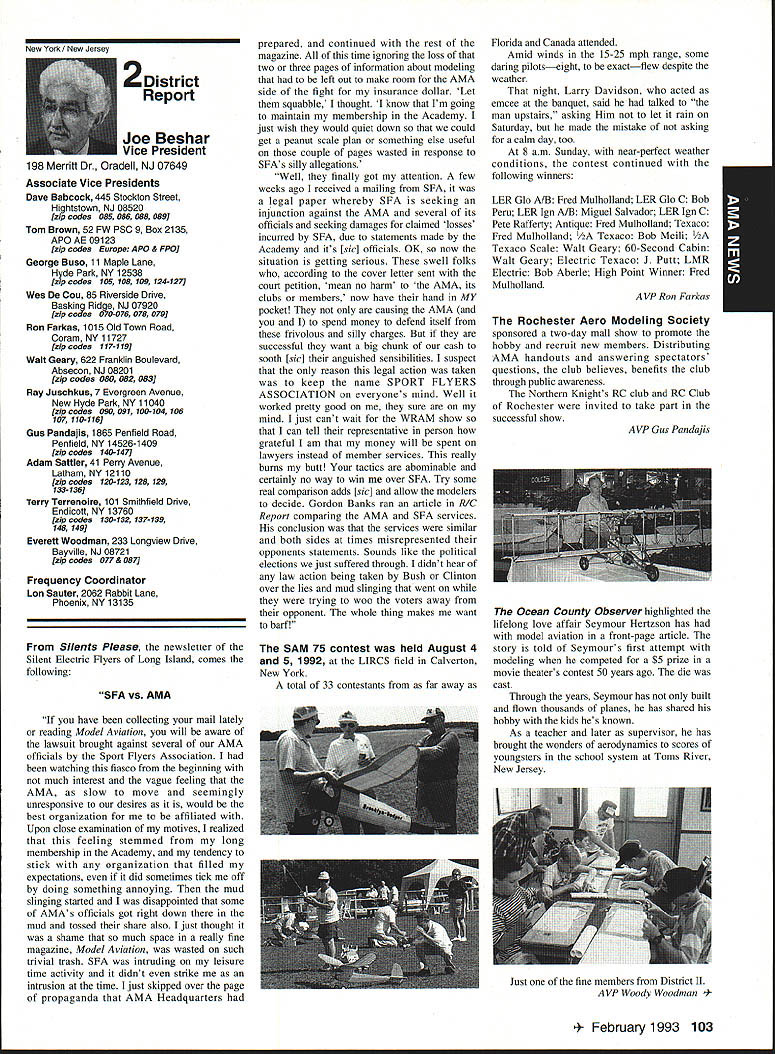
From Silents Please, newsletter of the Silent Electric Flyers of Long Island:
SFA vs. AMA A reader described frustration with the SFA lawsuit against AMA officials and the accompanying publicity. The mailing from SFA seeking an injunction and damages drew the reader's ire for causing AMA to spend money on legal defense and for using aggressive tactics to keep SFA's name in front of modelers. The reader urged more constructive comparison advertising and less legal action.
SAM 75 Contest — LIRCS Field, Calverton, NY (August 4–5, 1992) A total of 33 contestants attended from as far away as Florida and Canada. Despite winds of 15–25 mph, eight pilots flew in adverse conditions. Sunday brought near-perfect weather. Winners included:
- LER Glo A/B: Fred Mulholland
- LER Glo C: Bob Perle
- LER Ign A/B: Miguel Salvador
- LER Ign C: Pete Rafferty
- Antique: Fred Mulholland
- Texaco: Fred Mulholland
- 1/2A Texaco: Bob Knie
- 1/2A Texaco Scale: Walt Geary
- 60-Second Cabin: Walt Geary
- Electric Texaco: J. Putt
- LMR Electric: Bob Abler
- High Point Winner: Fred Mulholland
(Reported by AVP Ron Farkas)
Rochester Mall Show The Rochester Aero Modeling Society sponsored a two-day mall show to promote the hobby and recruit new members. The Northern Knights RC Club and RC Club of Rochester participated. (Reported by AVP Gus Pandajis)
Seymour Hertzson Feature The Ocean County Observer profiled Seymour Hertzson and his lifelong involvement in model aviation, from a childhood contest to teaching generations of students about aerodynamics in Toms River, New Jersey.
AMA News — District Report
District 3 Report
Bob Brown — Vice President 1255 High Street, Bradford, PA 16701 (814) 362-7702
Associate Vice Presidents:
- Mike Barbee — Columbus, OH
- David H. Ellis — Cross Lanes, WV
- Nelson Gould — Allentown, PA
- John Hathaway — New Stanton, PA
- Jay Mealy — Clearfield, PA
- Joseph S. Vislay — Maumee, OH
- Lawrence R. Weimer — Maple Heights, OH
- Gil Weiss — Bensalem, PA
- Mark Wilson — Dayton, OH
Frequency Coordinator: John Cottle — Forty Fort, PA (Phone: (717) 287-8970)
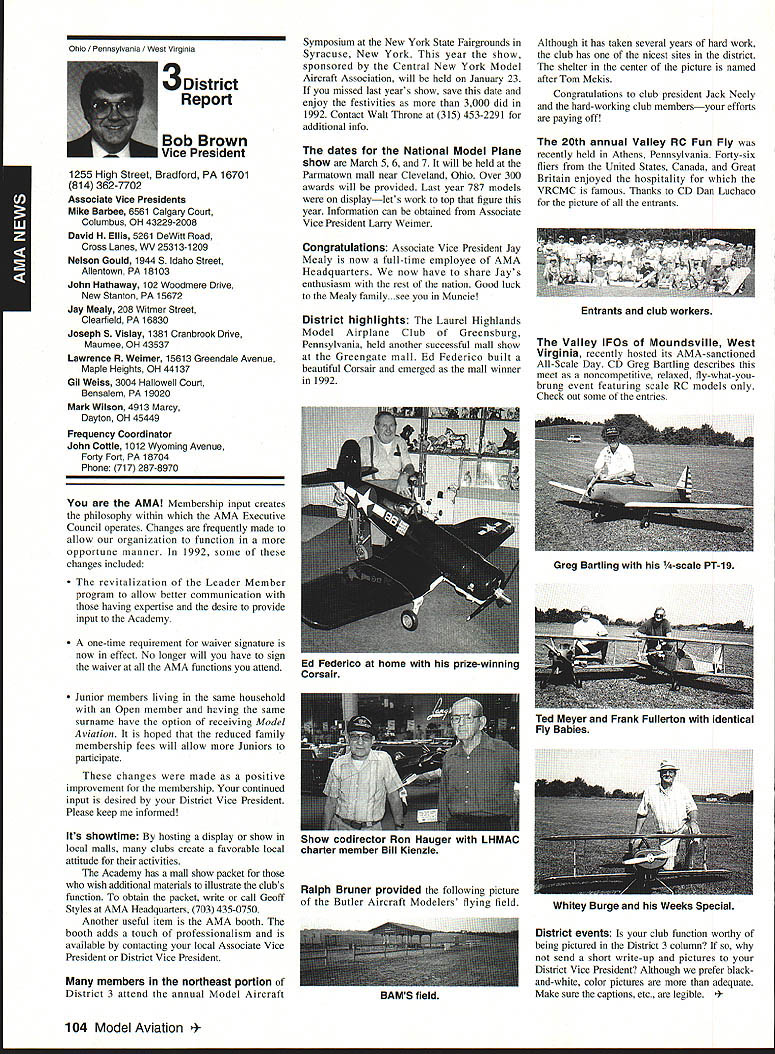
You are the AMA! Membership input creates the philosophy within which the Executive Council operates. Recent changes in 1992 include:
- Revitalization of the Leader Member program for better communication with experienced members.
- A one-time waiver signature requirement; you no longer have to sign the waiver at all AMA functions.
- Junior members living in the same household as an Open member and sharing the same surname may opt to receive Model Aviation, aiming to reduce family membership fees and increase Junior participation.
Host a mall display or show to create a favorable local attitude for the hobby. The Academy has a mall show packet; contact Geoff Styles at AMA Headquarters ((703) 435-0700). The AMA booth is also available through your local AVP or District VP.
Central New York Model Aircraft Association's annual Model Aircraft Symposium will be at the New York State Fairgrounds in Syracuse on January 23. Contact Walt Throne at (315) 453-2291 for details.
The National Model Plane Show will be March 5–7 at Parmatown Mall near Cleveland, Ohio. Over 300 awards will be provided; last year 787 models were on display. Contact AVP Larry Weimer for information.
Congratulations to AVP Jay Mealy on becoming a full-time employee of AMA Headquarters.
District highlights: The Laurel Highlands Model Airplane Club of Greensburg, PA, held a successful mall show at Greengate Mall; Ed Federico won the mall prize with a beautiful Corsair.
Send club event write-ups and photos to your District Vice President for possible inclusion in the District 3 column.
(Region covered: Delaware / District of Columbia / Maryland / North Carolina / Virginia)
District 4 Report
Howard Crispin — Vice President 611 Beechwood Dr., Charlottesville, VA 22901
Associate Vice Presidents:
- Robert E. Babura — Severn, MD (Phone: (410) 969-9356)
- Bob Champine — Newport News, VA
- Chuck Foreman — Mechanicsville, VA
- Doug Holland — Raleigh, NC
- Scotty Moyer — Wilmington, DE
- Richard (Dick) Smith — Waynesboro, VA
- Charles Spear — Mocksville, NC
Frequency Coordinator: Paul Yacobucci — Fayetteville, NC (Evenings: (919) 488-5986)
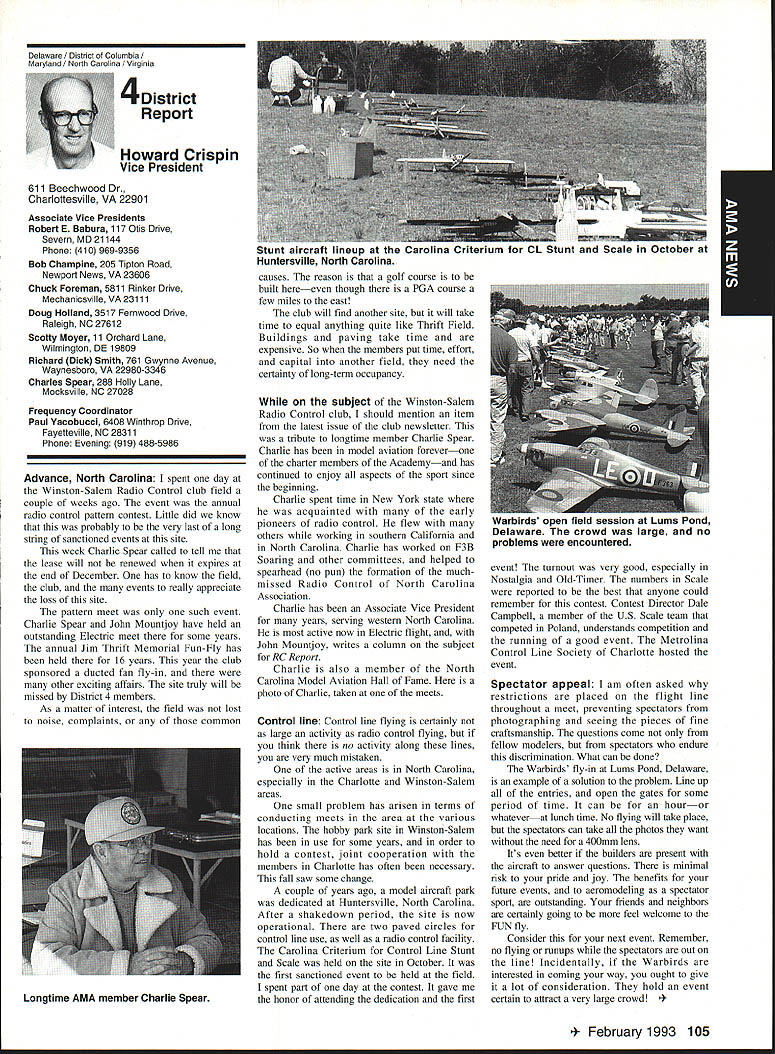
Advance, North Carolina: I visited the Winston‑Salem Radio Control club field for the annual radio control pattern contest — likely the last sanctioned event there, as the lease will not be renewed at the end of December. The site hosted many long-running events: pattern meets, the Jim Thrift Memorial Fun-Fly (16 years), an electric meet, and a ducted fan fly-in. The field is being converted to a golf course despite another PGA course a few miles away.
Tribute to Charlie Spear: Charlie is a longtime modeler, a charter AMA member, an AVP for many years, active in electric flight, and a member of the North Carolina Model Aviation Hall of Fame.
Control line: Control line flying remains active, particularly in Charlotte and Winston-Salem. A new model aircraft park at Huntersville, NC, includes two paved circles for control line use and a radio control facility. The Carolina Criterium for Control Line Stunt and Scale was held there in October, with a very good turnout — especially in Nostalgia and Old-Timer classes. Dale Campbell directed the event, hosted by the Metropolitan Control Line Society of Charlotte.
Spectator appeal: To allow photography and closer viewing at events, consider opening the flight line for limited periods (e.g., lunch hour) with no flying or runups. Having builders present enhances spectator experience and promotes the hobby.
District 5 Report
Jim McNeill — Vice President 617 South 20 Avenue, Birmingham, AL 35205 (205) 322-2127
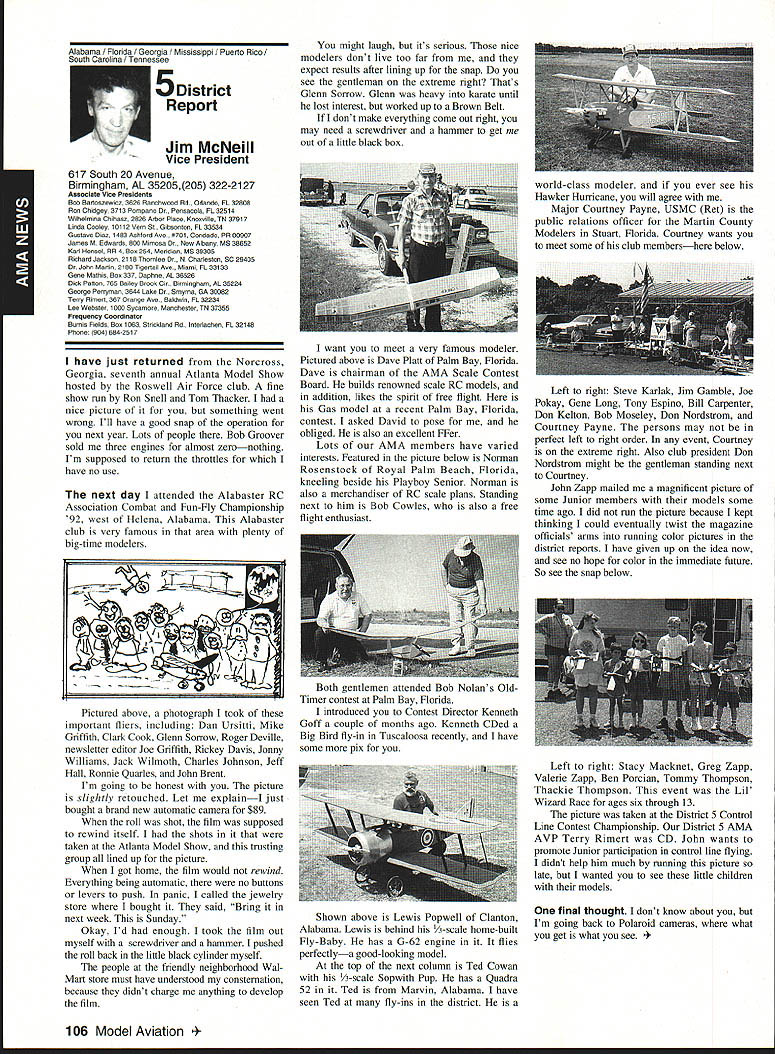
I returned from the Norcross, Georgia, seventh annual Atlanta Model Show hosted by the Roswell Air Force Club. The Alabaster RC Association Combat and Fun-Fly Championship '92 was held west of Helena, Alabama; many prominent fliers attended.
Highlights and photos included many notable modelers and events across the district, junior participation at the Lil' Wizard Race, and various fly-ins and contests. A reminder: newsletter editors, please add me to your mailing list so I can keep up with club events.
Final thought: I'm going back to Polaroid — where what you get is what you see.
(Additional club photos and event notes appeared in this month's column.)
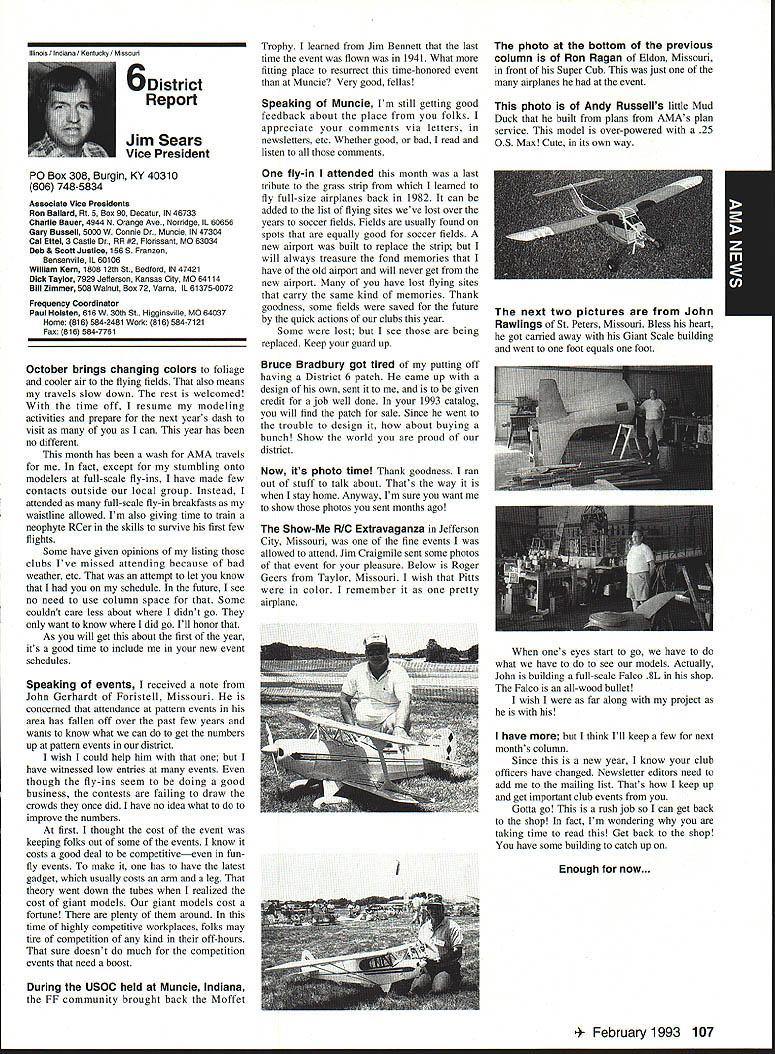
District 6 Notes
District 6 reports and photos included memories of lost grass strips, development of a District 6 patch (available in the 1993 catalog), and coverage of the Show‑Me R/C Extravaganza in Jefferson City, Missouri. Members are encouraged to submit photos and stories for inclusion.
District 7 Report
Peter Waters — Vice President 115 E. Main, Upper Level, Northville, MI 48167
Assistant Vice President: Boyd Bowdish — Golden Valley, MN
PR/Insurance Coordinator: Joseph M. Hass — Troy, MI
Associate Vice Presidents: Don Benfield; Bud Gorman; Russell Knetzger; Jean Lasko; Carl Mohs; Leroy Saetterle; Ron Sears.
Frequency Coordinators: Bob Stamm (West); Bert Kelly (East).
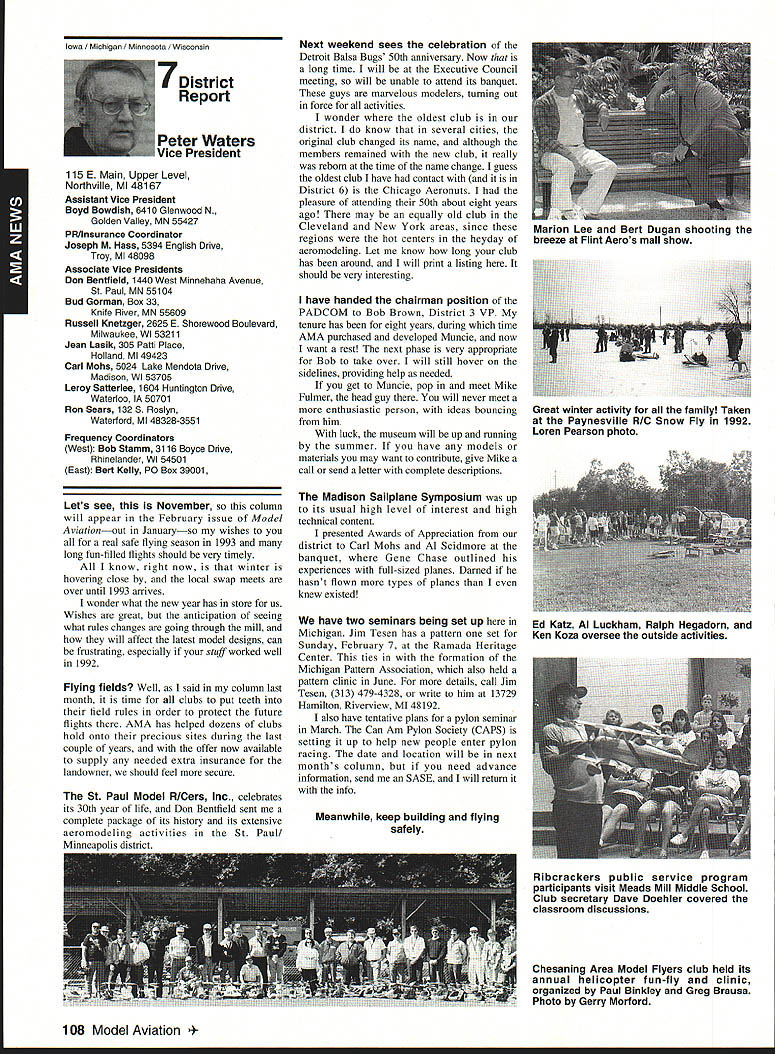
This column appears in the February issue; best wishes for a safe flying season in 1993. Winter swap meets are winding down and building time is at a peak.
Field protection: It is time for clubs to enforce field rules to protect the hobby. AMA can help clubs hold onto sites and can provide extra insurance for landowners.
St. Paul Model R/Cers celebrated their 30th year. The Detroit Balsa Bugs celebrated their 50th anniversary. Please send club histories and anniversaries for publication.
PADCOM chairmanship was handed to Bob Brown, District 3 VP. The museum in Muncie may be up and running by summer. If you have models or materials to contribute, contact Mike Fulmer at Muncie.
Seminars: Jim Tesen is organizing a pattern clinic in Michigan for February 7; a pylon seminar is planned for March. Contact Jim Tesen at (313) 479-4328 for details.
District 8 Report
Gene Hempel — Vice President 301 N. Yale Dr., Garland, TX 75042
Associate Vice Presidents: Chuck Andarka; Max Bloese; Clyde Brothers; Glenn Greens; Bill Kimbro; Steve Staples; Jim Trew; John Valls.
AMA Display Coordinator: Karen Hopkins — Arlington, TX. Frequency Coordinators: Joe DuMond (North); Tim Ahrens (South).
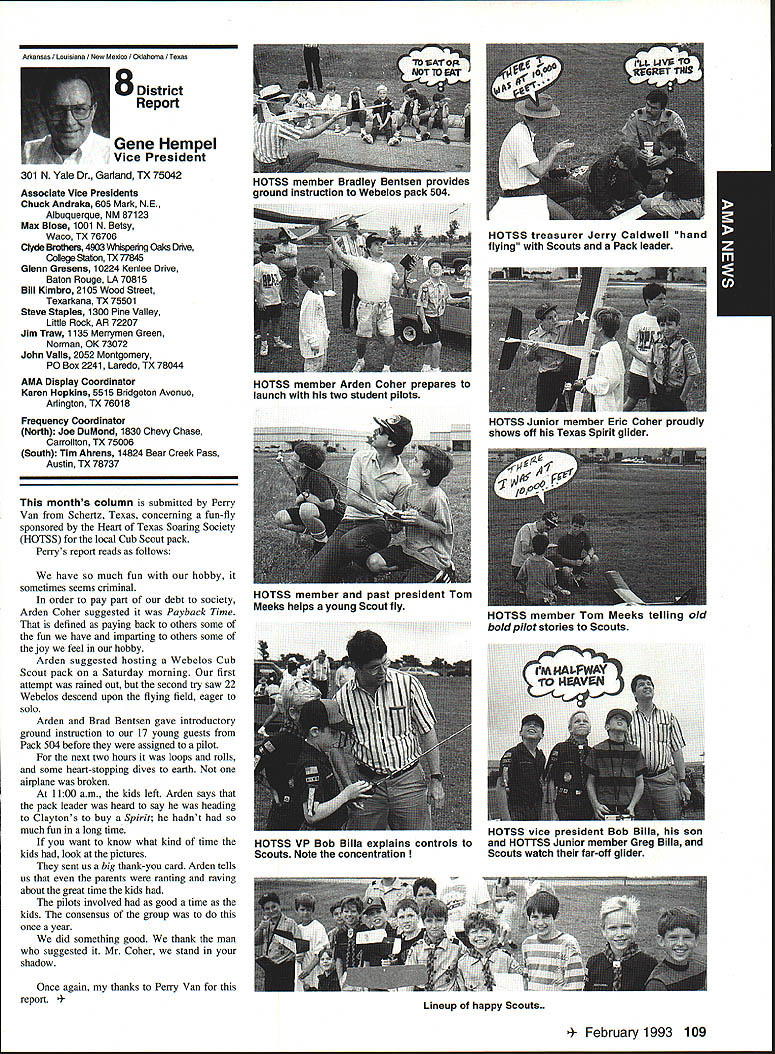
This month's column features a report by Perry Van of Schertz, Texas, on a Heart of Texas Soaring Society (HOTSS) fun-fly for a Cub Scout pack. Twenty-two Webelos attended; 17 were instructed and flew with pilots for two hours of loops and rolls — no airplanes were broken. Parents and kids raved about the event; the pilots enjoyed it and agreed to make it an annual activity.
Thanks to Perry Van and all who participated.
District 9 Report
Russ Miller — Vice President 980 N. 3rd Street, Carrington, ND 58421 Days: (701) 652-2739 Evenings: (701) 652-2321
Associate Vice Presidents: Tom Boyd; Nathan Lancaster; Travis McGinnis; Loren Moen; Don Moden; Jim Ricketts; R.L. "Doc" Scraper; Chuck Smith.
Frequency Coordinator: Steve Mangles — Denver, CO.
News highlights: Kansas attendees at the '92 Nats enjoyed the event despite wet weather. Arvada Associated Modelers hosted a successful Easter Seal model airplane event with more than 20 campers and counselors.
Send pictures and captions of club activities to be included in the District 9 column. February brings mall shows and the peak of building season — plan to attend the Nats.
Quote for the month: "Young people should remember that old folks know more about being young than young people know about being old."
District 10 Report
Regg Keyawa — Vice President
I’m winding down a hectic fall schedule and looking forward to a weekend at home.
The Tournament of Champions in Las Vegas saw unprecedented rain, canceling Saturday flying. Congratulations to District 10's Chip Hyde for winning.
Highlights included the Cloud Dancers show team (outstanding ducted‑fan performance), the French team with a jet turbine engine, and Curtis Youngblood's astonishing helicopter maneuvers.
At the District 10 meeting, President Don Lowe attended and answered questions about AMA policies. On the issue of AMA and SFA members flying together: you must be an AMA member to fly on a site insured by AMA.
Discussion of fair membership representation on the Council raised the idea of splitting District 10; most attendees disagreed. Suggestions included having the number of Vice Presidents consistent with member counts and considering the title "District Director."
Property acquisition: a recent $1,325,000 claim settlement in California affected funding for additional regional sites in 1993. The Executive Council agreed to proceed with acquiring a conditional use permit and extending escrow one year on a property.
Site development philosophy: sites should be acquired before development and at minimal cost to AMA; local membership can develop sites with support from Special Interest Groups. Examples: Ogden, Utah — a group acquired 50 acres for $10,000; Logan, Utah — a fun‑fly and banquet were successfully hosted using an abandoned full‑scale runway. Local initiatives like these are promising models for future site acquisition and development.
Always a pleasure talking to you — but I have to run.
Transcribed from original scans by AI. Minor OCR errors may remain.

