
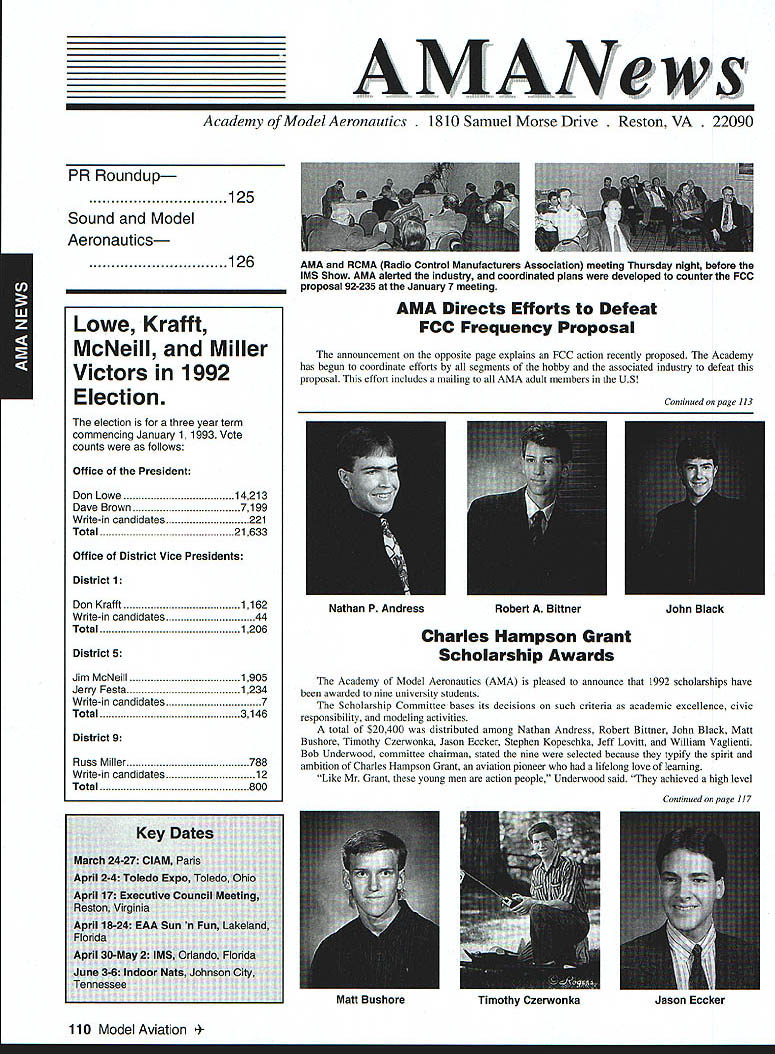
AMA Directs Efforts to Defeat FCC Frequency Proposal
The announcement on the opposite page explains an FCC action recently proposed. The Academy has begun to coordinate efforts by all segments of the hobby and the associated industry to defeat this proposal. This effort includes a mailing to all AMA adult members in the U.S.!
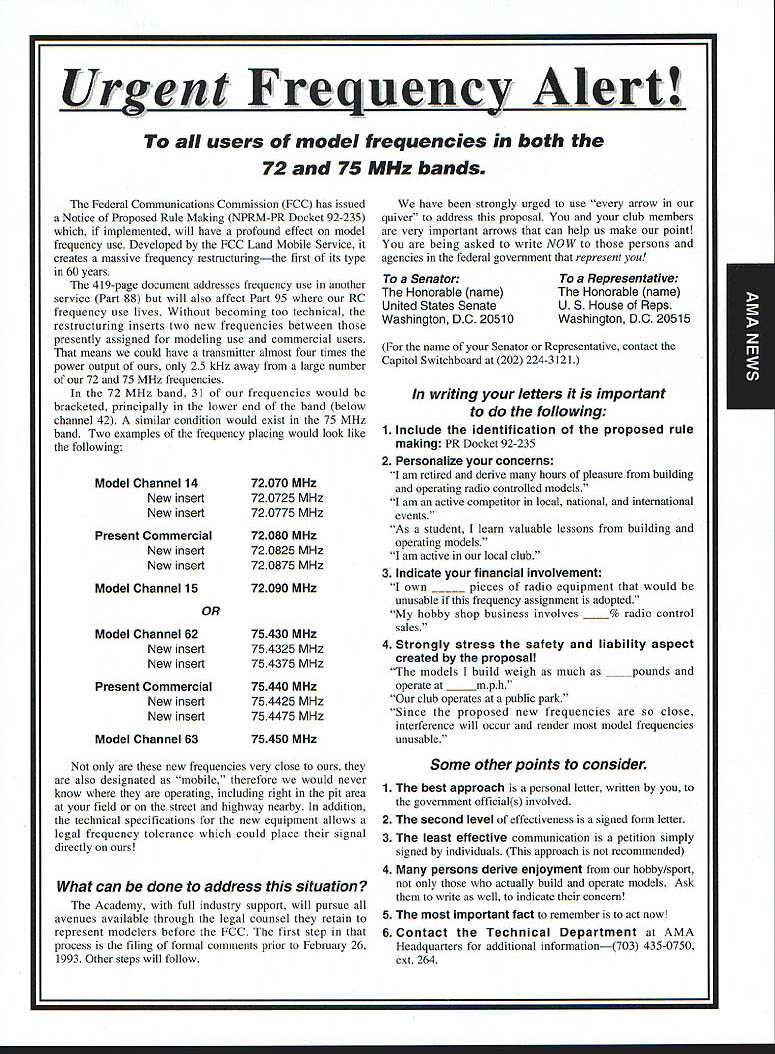
Urgent Frequency Alert!
To all users of model frequencies in both the 72 and 75 MHz bands:
The Federal Communications Commission (FCC) has issued a Notice of Proposed Rule Making (NPRM—PR Docket 92-235) which, if implemented, will have a profound effect on model frequency use. Developed by the FCC Land Mobile Service, it creates a massive frequency restructuring—the first of its type in 60 years.
The 419-page document addresses frequency use in another service (Part 88) but will also affect Part 95 where our RC frequency use lives. Without becoming too technical, the restructuring inserts two new frequencies between those presently assigned for modeling use and commercial users. That means commercial transmitters, with up to almost four times the power output of our transmitters, could be only 2.5 kHz away from a large number of our 72 and 75 MHz frequencies.
In the 72 MHz band, 31 of our frequencies would be bracketed, principally in the lower end of the band (below channel 42). A similar condition would exist in the 75 MHz band. Two examples of the frequency placing would look like the following:
- Model Channel 14
- 72.070 MHz
- New insert 72.0725 MHz
- New insert 72.0775 MHz
- Present commercial 72.080 MHz
- New insert 72.0825 MHz
- New insert 72.0875 MHz
- Model Channel 15 — 72.090 MHz
- Model Channel 62
- 75.430 MHz
- New insert 75.4325 MHz
- New insert 75.4375 MHz
- Present commercial 75.440 MHz
- New insert 75.4425 MHz
- New insert 75.4475 MHz
- Model Channel 63 — 75.450 MHz
Not only are these new frequencies very close to ours, they are also designated as "mobile," therefore we would never know where they are operating — including right in the pit area at your field or on the street and highway nearby. In addition, the technical specifications for the new equipment allow a legal frequency tolerance which could place their signal directly on ours.
What can be done to address this situation?
The Academy, with full industry support, will pursue all avenues available through the legal counsel it retains to represent modelers before the FCC. The first step in that process is the filing of formal comments prior to February 26, 1993. Other steps will follow.
We have been strongly urged to use "every arrow in our quiver" to address this proposal. You and your club members are very important arrows that can help us make our point! You are being asked to write NOW to those persons and agencies in the federal government that represent you:
- To a Senator:
- The Honorable (name)
- United States Senate
- Washington, D.C. 20510
- To a Representative:
- The Honorable (name)
- U.S. House of Representatives
- Washington, D.C. 20515
(For the name of your Senator or Representative, contact the Capitol Switchboard at (202) 224-3121.)
In writing your letters it is important to do the following:
- Include the identification of the proposed rule making: PR Docket 92-235.
- Personalize your concerns:
- "I am retired and derive many hours of pleasure from building and operating radio controlled models."
- "I am an active competitor in local, national, and international events."
- "As a student, I learn valuable lessons from building and operating models."
- "I am active in our local club."
- Indicate your financial involvement:
- "I own ___ pieces of radio equipment that would be unusable if this frequency assignment is adopted."
- "My hobby shop business involves ___% radio control sales."
- Strongly stress the safety and liability aspect created by the proposal:
- "The models I build weigh as much as ___ pounds and operate at ___ m.p.h."
- "Our club operates at a public park."
- "Since the proposed new frequencies are so close, interference will occur and render most model frequencies unusable."
Some other points to consider:
- The best approach is a personal letter, written by you, to the government official(s) involved.
- The second level of effectiveness is a signed form letter.
- The least effective communication is a petition simply signed by individuals. (This approach is not recommended.)
- Many persons derive enjoyment from our hobby/sport, not only those who actually build and operate models. Ask them to write as well, to indicate their concern!
- The most important fact to remember is to act now!
- Contact the Technical Department at AMA Headquarters for additional information — (703) 435-0750, ext. 264.
Executive VP's Report
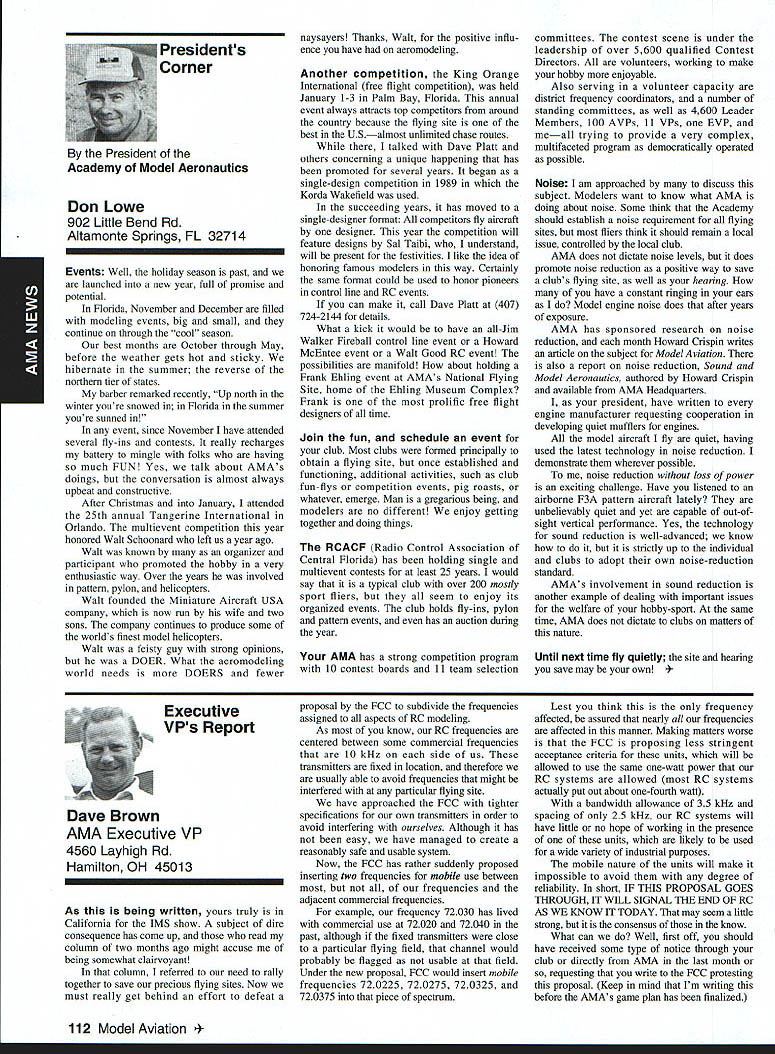
Dave Brown AMA Executive VP 4560 Layhigh Rd. Hamilton, OH 45013
As this is being written, yours truly is in California for the IMS show. A subject of dire consequence has come up, and those who read my column of two months ago might accuse me of being somewhat clairvoyant!
In that column, I referred to our need to rally together to save our precious flying sites. Now we must really get behind an effort to defeat a proposal by the FCC to subdivide the frequencies assigned to all aspects of RC modeling.
As most of you know, our RC frequencies are centered between some commercial frequencies that are 10 kHz on each side of us. These transmitters are fixed in location, and therefore we are usually able to avoid frequencies that might be interfered with at any particular flying site.
We have approached the FCC with tighter specifications for our own transmitters in order to avoid interfering with ourselves. Although it has not been easy, we have managed to create a reasonably safe and usable system.
Now, the FCC has rather suddenly proposed inserting two frequencies for mobile use between most, but not all, of our frequencies and the adjacent commercial frequencies.
For example, our frequency 72.030 has lived with commercial use at 72.020 and 72.040 in the past; although if the fixed transmitters were close to a particular flying field, that channel would probably be flagged as not usable at that field.
Under the new proposal, the FCC would insert mobile frequencies 72.0225, 72.0275, 72.0325 and 72.0375 into that piece of spectrum.
If all of our frequencies were affected similarly, the instantaneous practical effect on most of our channels would be drastic. We would probably have something like one usable frequency in every block of five.
We must act quickly to make our views known. If you value RC flying, write your Senator and Representative and ask them to oppose PR Docket 92-235. Include the docket number and explain briefly how this proposal would affect you personally, stressing safety, financial impact, and loss of flying sites.
Write to:
- The Honorable (name), United States Senate, Washington, DC 20510
- The Honorable (name), U.S. House of Representatives, Washington, DC 20515
Or call the Capitol Switchboard at (202) 224-3121.
Please write TODAY. If this proposal goes through, it will signal the end of RC as we know it. That may seem a little melodramatic, but it's the only way the FCC will know how strongly we feel.
Until next time — fly quietly; the site and hearing you save may be your own!
Executive Director's View from HQ
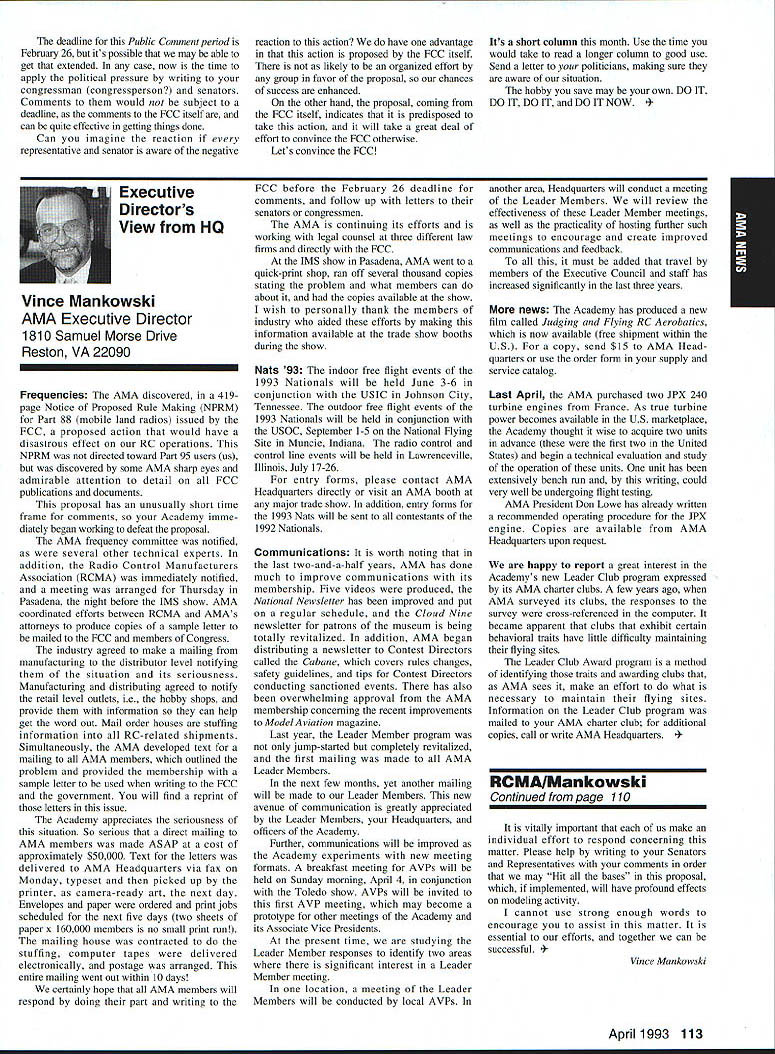
Vince Mankowski AMA Executive Director 1810 Samuel Morse Drive Reston, VA 22090
Frequencies: The AMA discovered, in a 419-page Notice of Proposed Rule Making (NPRM) for Part 88 (mobile land radios) issued by the FCC, a proposed action that would have a disastrous effect on our RC operations. This NPRM was not directed toward Part 95 users (us), but was discovered by some sharp eyes at the AMA and admirable attention to detail in all FCC publications and documents.
This proposal has an unusually short time frame for comments, so your Academy immediately began working to defeat the proposal.
The AMA frequency committee was notified, as were several other technical experts. In addition, the Radio Control Manufacturers Association (RCMA) was immediately notified, and a meeting was arranged for Thursday in Pasadena, the night before the IMS Show. AMA coordinated efforts between RCMA and AMA's attorneys to produce copies of a sample letter to be mailed to the FCC and members of Congress.
The industry agreed to make a mailing from manufacturing to the distributor level notifying them of the situation and its seriousness. Manufacturers were asked to notify the retail level outlets, i.e., the hobby shops, and provide them with information so they can help get the word out. Mail order houses are adding information into all RC-related shipments. Simultaneously, the AMA developed a sample letter to be used when writing to the FCC and the government. You will find a reprint of those letters in this issue.
The Academy appreciates the seriousness of this proposal. So serious that a direct mailing to AMA members was made ASAP at a cost of approximately $50,000. Text for the letters was delivered to AMA Headquarters via fax on Monday, typeset and then picked up by the printer as camera-ready art the next day. Envelopes and paper were ordered and print jobs scheduled for the next five days (two sheets of paper x 160,000 homes is no small print run!). The mailing house was contracted to do the stuffing, computer tapes were delivered electronically, and postage was arranged. This entire mailing went out within 10 days!
We certainly hope that all AMA members will respond by doing their part and writing to the FCC before the February 26 deadline for comments, and follow up with letters to their senators or congressmen.
The AMA is continuing its efforts and is working with legal counsel and three different law firms and directly with the FCC.
At the IMS show in Pasadena, AMA went to a quick-print shop, ran off several thousand copies stating the problem and what members can do about it, and had the copies available at the show. I wish to personally thank the members of industry who aided these efforts by making this information available at the trade show booths during the show.
Nats '93: The indoor free flight events of the 1993 Nationals will be held June 3–6 in conjunction with the USIC in Johnson City, Tennessee. The outdoor free flight events at the 1993 Nationals will be held in conjunction with the USOC, September 1–5 on the National Flying Site in Muncie, Indiana. The radio control and control line events will be held in Lawrenceville, Illinois, July 17–26.
For entry forms, please contact AMA Headquarters directly or visit an AMA booth at any major trade show. In addition, entry forms for the 1993 Nats will be sent to all contestants of the 1992 Nationals.
Communications: It is worth noting that in the last two-and-a-half years, AMA has done much to improve communications with its membership. Five videos were produced, the National Newsletter has been improved and put on a regular schedule, and the Cloud Nine newsletter for patrons of the museum is being totally revitalized. AMA began distributing a newsletter to Contest Directors called the Cubane, which covers rules changes, safety guidelines, and tips for Contest Directors. These improvements have been overwhelmingly approved by the AMA membership concerning the recent improvements to Model Aviation magazine.
Last year, the Leader Member program was not only jump-started but completely revitalized, and the first mailing was made to all AMA Leader Members.
In the next few months, yet another mailing will be made to Leader Members. This new mailing will call for regional forums staffed by the Leader Members, your Headquarters, and other members of the Academy.
Further, communications will be improved as the Academy experiments with new meeting formats. A breakfast meeting for AVPs will be held on Sunday morning, April 4, in conjunction with the Toledo show. AVPs will be invited to this first AVP meeting, which may become a prototype for other meetings of the Academy and its Area Vice Presidents.
At the present time, we are studying the Leader Member responses to identify those areas where there is significant interest in a Leader Member meeting.
In one location, a meeting of the Leader Members will be conducted by local AVPs. In another area, Headquarters will conduct a meeting of the Leader Members. We will review the effectiveness of these Leader Member meetings, as well as the practicality of holding further such meetings to encourage and create improved communications and feedback.
To all of this, it must be added that travel by members of the Executive Council and staff has increased significantly in the last three years.
More news: The Academy has produced a new film called Judging and Flying RC Aerobatics, which is now available (free shipment within the U.S.). For a copy, send $15 to AMA Headquarters or use the order form in your supply and service catalog.
Last April, the AMA purchased two JPX 240 turbine engines from France. As these turbine power units become available in the U.S. marketplace, the Academy bought two units to acquaint its judges and members (these were the first two to arrive in the United States) and have since sold units to the membership for evaluation and study of the operation of these units. One unit has been extensively bench-run and, by this writing, could very well be undergoing flight tests.
AMA President Don Lowe has already written a recommended operating procedure for the JPX engine. Copies are available from AMA Headquarters upon request.
We are happy to report a great interest in the Academy's new Leader Club program expressed by its AMA charter clubs. A few years ago, when AMA surveyed its clubs, the responses to the survey were less favorable in some cases, and the response rate was disappointingly low. The Leader Club Award program is a method of identifying and rewarding those clubs that are exemplary and that meet the criteria required by the program. Information on the Leader Club program was mailed to your AMA charter club. For additional copies, call or write AMA Headquarters.
Vince Mankowski
AMA News
Connecticut / Maine / Massachusetts / New Hampshire / Rhode Island / Vermont
District Report
Don Krafft Vice President PO Box 1828, Duxbury, MA 02331 (617) 934-6248
Associate Vice Presidents:
- James M. Semonian, 166 Allen Road, Billerica, MA 01821
- Bob Landry, 80 Main Street, Essex Junction, VT 05452
- M.C. McGuffin, 8 Robinson Street, Houlton, ME 04730
- Richard Sherman, 28 High Street, Plymouth, NH 03264
- Ed Thompson, 27 E. Greenwich Ave., West Warwick, RI 02893
- Bob Wallace, 91 Sylvan Street, Avon, CT 06001
Frequency Coordinator:
- George Wilson, 82 Frazier Way, Marstons Mills, MA 02648
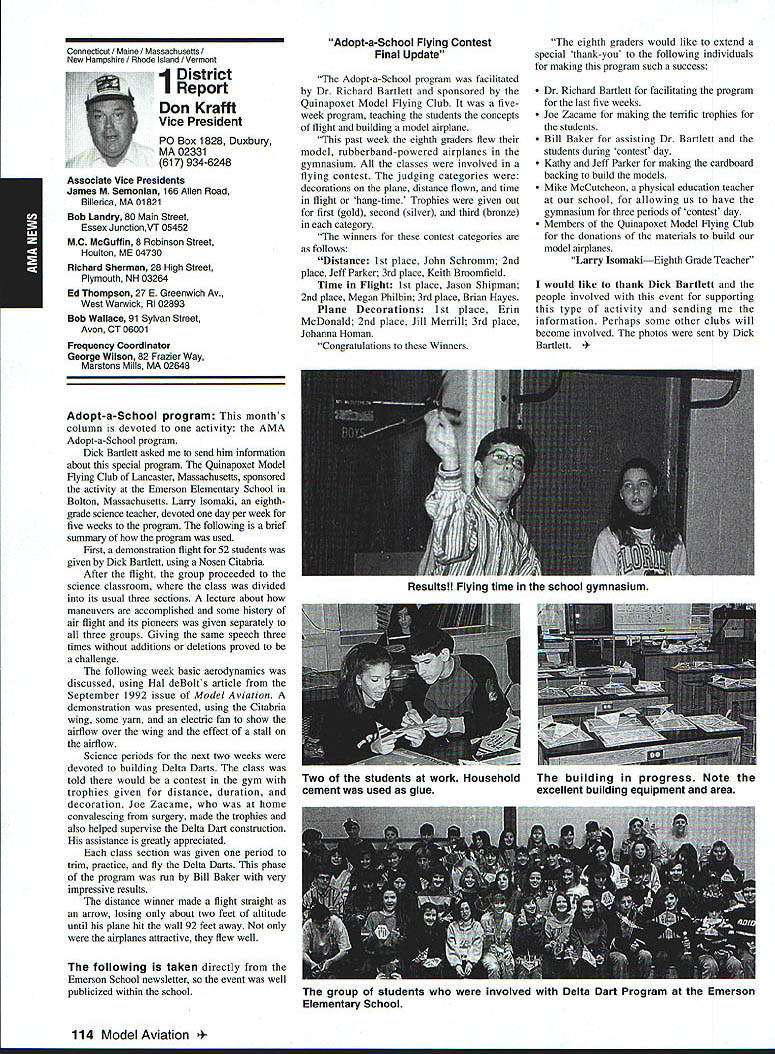
Adopt-a-School Flying Contest Final Update
"The Adopt-a-School program was facilitated by Dr. Richard Bartlett and sponsored by the Quinapoxet Model Flying Club. It was a five-week program, teaching the students the concepts of flight and building a model airplane.
"This past week the eighth graders flew their model, rubberband-powered airplanes in the gymnasium. All the classes were involved in a flying contest. The judging categories were: decorations on the plane, distance flown, and time in flight or 'hang-time.' Trophies were given out for first (gold), second (silver), and third (bronze) in each category.
"The winners for these contest categories are as follows:
- Distance: 1st place, John Schromm; 2nd place, Jeff Parker; 3rd place, Keith Rosenfield.
- Time in Flight: 1st place, Jason Shiman; 2nd place, Megan Philbin; 3rd place, Brian Hayes.
- Plane Decorations: 1st place, Erin McDonald; 2nd place, Jill Merril; 3rd place, Johanna Homan.
"Congratulations to these winners.
"The eighth graders would like to extend a special 'thank-you' to the following individuals for making this program such a success:
- Dr. Richard Bartlett for facilitating the program for the last five weeks.
- Joe Zacame for making the terrific trophies for the students.
- Bill Baker for assisting Dr. Bartlett and the students during 'contest' day.
- Kathy and Jeff Parker for making the cardboard backing to build the models.
- Mike McCutcheon, a physical education teacher at our school, for allowing us to have the gymnasium for three periods of 'contest' day.
- Members of the Quinapoxet Model Flying Club for the donations of materials to build our model airplanes.
"Larry Isomaki — Eighth Grade Teacher"
I would like to thank Dick Bartlett and the people involved with this event for supporting this type of activity and sending me the information. Perhaps some other clubs will become involved. The photos were sent by Dick Bartlett.
Adopt-a-School program: This month's column is devoted to one activity: the AMA Adopt-a-School program.
Dick Bartlett asked me to send him information about this special program. The Quinapoxet Model Flying Club of Lancaster, Massachusetts, sponsored the activity at the Emerson Elementary School in Bolton, Massachusetts. Larry Isomaki, an eighth-grade science teacher, devoted one day per week for five weeks to the program. The following is a brief summary of how the program was used.
First, a demonstration flight for 52 students was given by Dick Bartlett, using a Nossen Citabria. After the flight, the group proceeded to the science classroom, where the class was divided into its usual three sections. A lecture about how models are made and some history of air flight and its pioneers was given separately to all three groups. Giving the same speech three times without additions or deletions proved to be a challenge.
The following week basic aerodynamics was discussed, using Hal DeBolt's article from the September 1992 issue of Model Aviation. A demonstration was presented, using the Citabria wing, some yarn, and an electric fan to show the airflow over the wing and the effect of a stall on the airflow.
Science periods for the next two weeks were devoted to building Delta Darts. The class was told there would be a contest in the gym with trophies given for distance, duration, and decoration. Joe Zacame, who was at home convalescing from surgery, made the trophies and also helped supervise the Delta Dart construction. His assistance is greatly appreciated.
Each class section was given one period to trim, practice, and fly the Delta Darts. This phase of the program was run by Bill Baker with very impressive results.
The distance winner made a flight straight as an arrow, losing only about two feet of altitude until his plane hit the wall 92 feet away. Not only were the airplanes attractive, they flew well.
The following is taken directly from the Emerson School newsletter, so the event was well publicized within the school.
AMA News
New Jersey / New York
2 District Report
Joe Beshar Vice President 198 Merritt Dr., Oradell, NJ 07649
Associate Vice Presidents (zip codes outlined are represented):
- Dave Babcock, 445 Stockton Street, Hightstown, NJ 08520 (zip codes 085, 086, 087)
- Tom Brown, 52 FW PSC Q, Box 2135, APO AE 09123 (zip codes Europe: APO & FPO)
- Wes De Cou, 85 Riverside Drive, Basking Ridge, NJ 07920 (zip codes 070–076, 078, 079)
- Ron Farkas, 1015 Old Town Road, Coram, NY 11727 (zip codes 117–119)
- Walt Geary, 622 Franklin Boulevard, Absecon, NJ 08201 (zip codes 080, 082, 083)
- Ray Juscyk, 7 Evergreen Avenue, New Hyde Park, NY 11040 (zip codes 100–103, 104, 106, 107, 110–119)
- Gus Pandajis, 1865 Penfield Road, Penfield, NY 14526-1409 (zip codes 145, 147)
- Adam Sattler, 41 Perry Avenue, Latham, NY 12110 (zip codes 120, 121, 128, 129, 133–136)
- Terry Terrenore, 101 Smithfield Drive, Endicott, NY 13760 (zip codes 130–132, 137–139, 148, 149)
- Everett Woodman, 233 Longview Drive, Bayville, NJ 08721 (zip codes 077 & 087)
Frequency Coordinator:
- Lon Sauter, 2062 Rabbit Lane, Phoenix, NY 13135
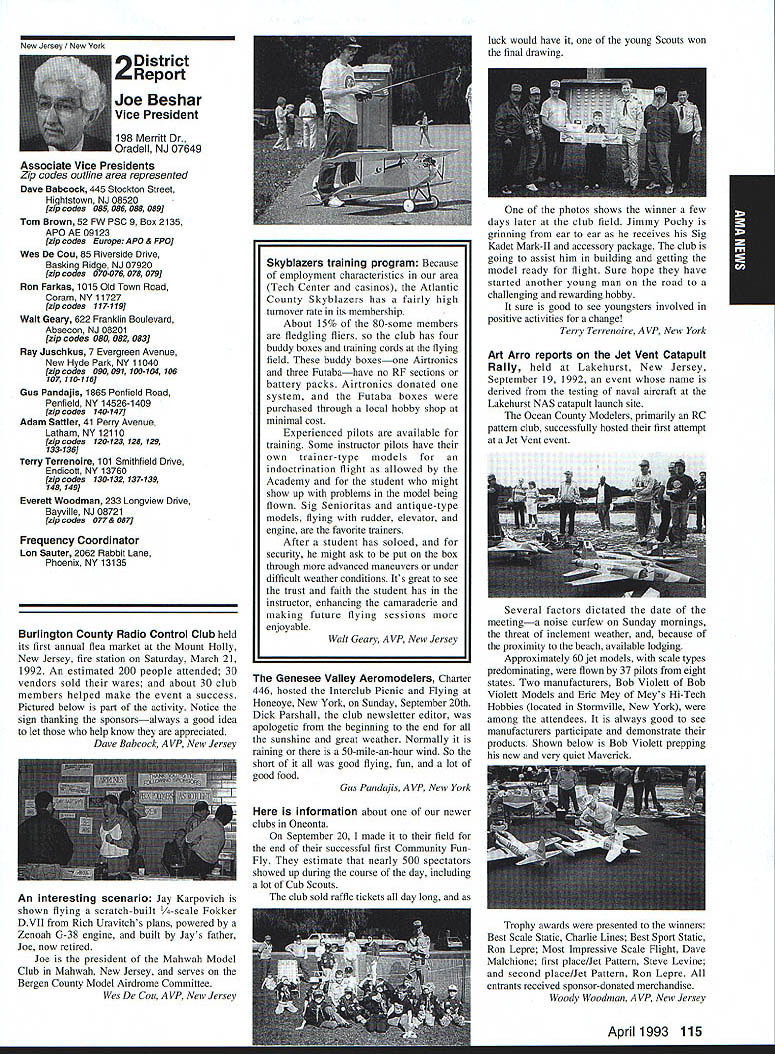
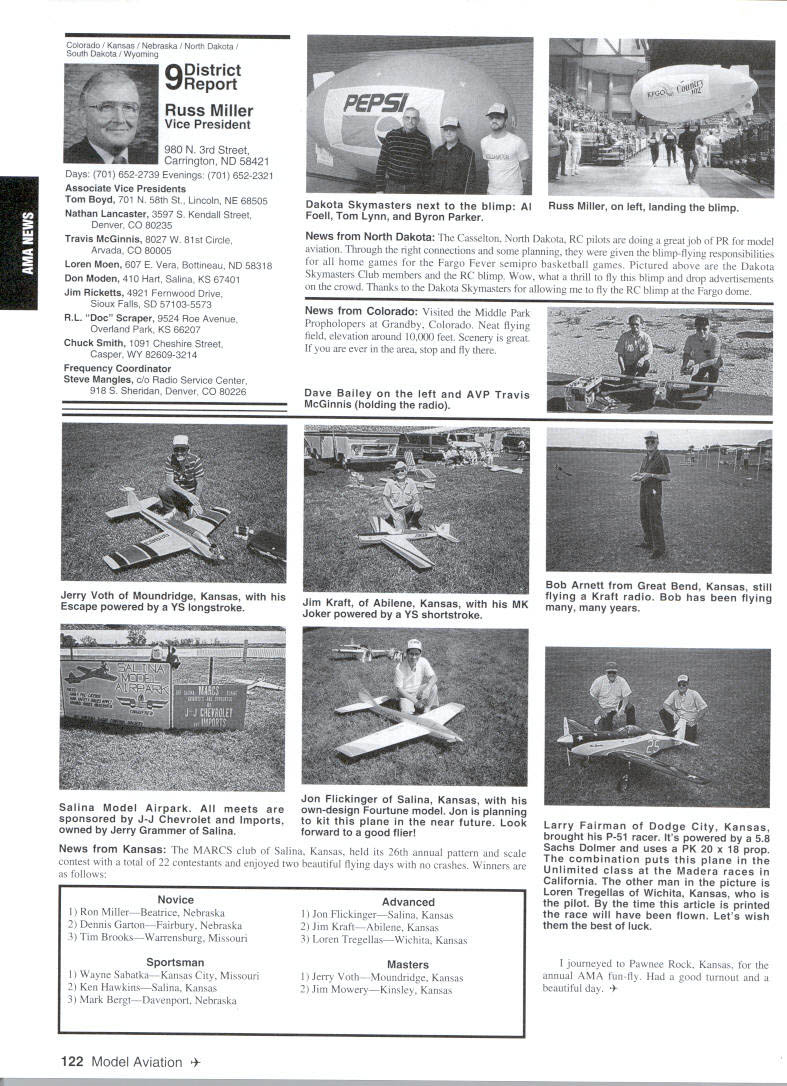
Burlington County Radio Control Club held its first annual flea market at the Mount Holly, New Jersey, fire station on Saturday, March 21, 1992. An estimated 200 people attended; 30 vendors sold their wares; and about 30 club members helped make the event a success. Pictured below is part of the activity. Notice the sign thanking the sponsors—always a good idea to let those who help know they are appreciated.
Dave Babcock, AVP, New Jersey
An interesting scenario: Jay Karpovich is shown flying a scratch-built 1/4-scale Fokker D.VII from Rich Uravitch's plans, powered by a Zenoah G-38 engine, and built by Jay's father, Joe, now retired.
Joe is the president of the Mahwah Model Club in Mahwah, New Jersey, and serves on the Bergen County Model Airdrome Committee.
Wes De Cou, AVP, New Jersey
Skyblazers training program: Because of employment characteristics in our area (Tech Center and casinos), the Atlantic County Skyblazers has a fairly high turnover rate in its membership.
About 15% of the 80-some members are fledgling fliers, so the club has four buddy boxes and training cords at the flying field. These buddy boxes—one Airtronics and three Futaba—have no RF sections or battery packs. Airtronics donated one set; and the Futaba boxes were purchased through a local hobby shop at minimal cost.
Experienced pilots are available for training. Some instructor pilots have their own trainer-type models for an introduction flight as allowed by the Academy and for the student who might show up with problems in the model being flown. Sig Senioritas and antique-type models, flying with rudder, elevator, and engine, are the favorite trainers.
After a student has soloed, and for security, he might ask to be put on the box through more advanced maneuvers or under difficult weather conditions. It's great to see the trust and faith the student has in the model and instructor, enhancing the camaraderie and making future flying sessions more enjoyable.
Walt Geary, AVP, New Jersey
The Genesee Valley Aeromodellers, Charter 446, hosted the Interclub Picnic and Fly-in at Honeoye, New York, on Sunday, September 20th. Dick Parshall, the club newsletter editor, was apologetic from the beginning to the end for all the sunshine and great weather. Normally it is raining or there is a 50-mile-an-hour wind. So the short of it all was good flying, fun, and a lot of good food.
Gus Pandajis, AVP, New York
Here is information about one of our newer clubs in Oneonta.
On September 20, I made it to their field for the end of their successful first Community Fun-Fly. They estimate that nearly 500 spectators showed up during the course of the day, including a lot of Cub Scouts.
The club sold raffle tickets all day long, and as luck would have it, one of the young Scouts won the final drawing.
One of the photos shows the winner a few days later at the club field. Jimmy Pachis is grinning from ear to ear as he receives his Sig Kadet Mark-II and accessory package. The club is trying to assist him in building and getting the plane ready for flight. Sure hope they have started another young man on the road to a challenging and rewarding hobby.
It sure is good to see youngsters involved in positive activities for a change!
Terry Terrenore, AVP, New York
Art Arro reports on the Jet Vent Catapult Rally, held at Lakehurst, New Jersey, September 19, 1992, an event whose name is derived from the testing of naval aircraft at the Lakehurst NAS catapult launch site.
The Ocean County Modelers, primarily an RC pattern club, successfully hosted their first attempt at a Jet Vent event.
Several factors dictated the date of the meeting—a noise curfew on Sunday mornings, the threat of inclement weather, and, because of the proximity to the beach, available lodging.
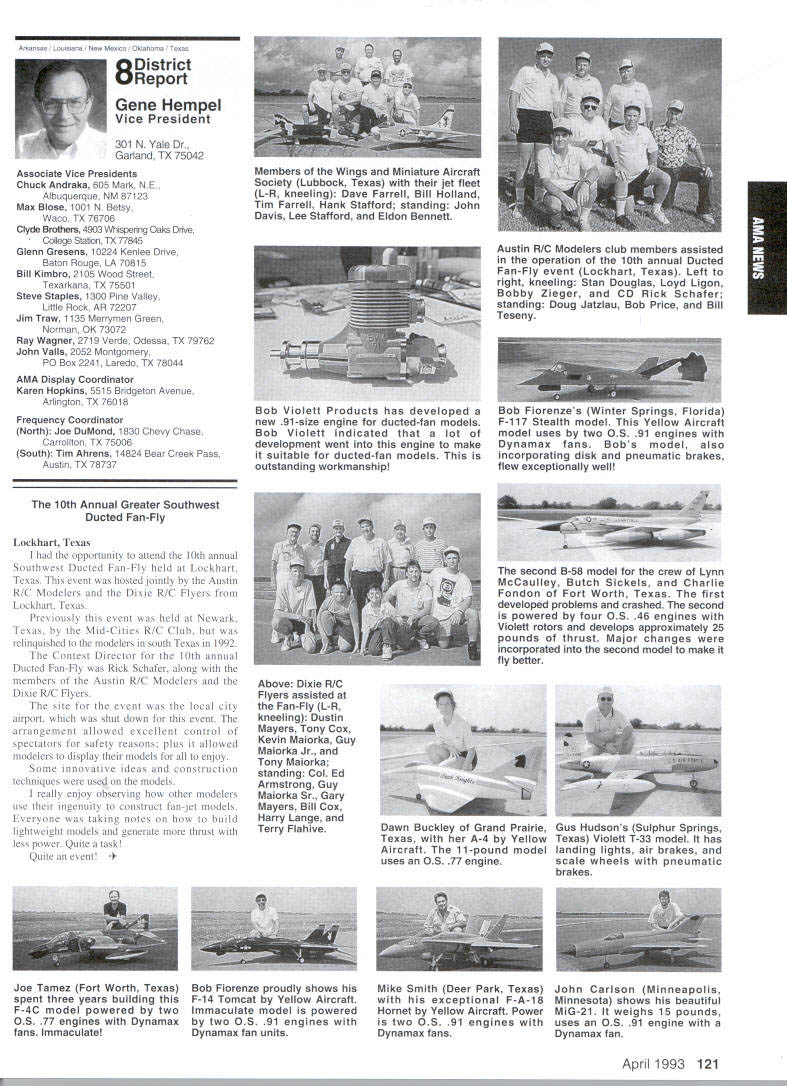
Approximately 60 jet models, with scale types predominant, were flown by 37 pilots from eight states. Two manufacturers, Bob Violett of Violett Models and Eric Mey of Mey's Hobbies (located in Stormville, New York), were among the attendees. It is always good to see manufacturers participate and demonstrate their products.
Trophy awards were presented to the winners: Best Scale Static, Charlie Lines; Best Sport Static, Ron Lepre; Most Impressive Scale Flight, Dave Malchione; first place, Jet Pattern, Steve Levine; and second place, Jet Pattern, Ron Lepre. All entrants received sponsor-donated merchandise.
Woody Woodman, AVP, New Jersey
AMA News
3 District Report
Bob Brown Vice President 1255 High Street, Bradford, PA 16701 (814) 362-7702
Associate Vice Presidents:
- Mike Barbee, 6561 Calgary Court, Columbus, OH 43229-2008
- David H. Ellis, 5261 DeWitt Road, Cross Lanes, WV 25313-1209
- Nelson Gould, 1944 S. Idaho Street, Allentown, PA 18103
- John Hathaway, 102 Woodmore Drive, New Stanton, PA 15672
- Donald Klopp, 370 West Valley Forge Road, King of Prussia, PA 19406
- Joseph S. Vislay, 1381 Cranbrook Drive, Maumee, OH 43537
- Lawrence R. Weimer, 15513 Greendale Avenue, Maple Heights, OH 44137
- Mark Wilson, 4913 Marcy, Dayton, OH 45449
Frequency Coordinator:
- John Cottle, 1012 Wyoming Avenue, Forty Fort, PA 18704
Phone: (717) 287-8970
Winter activity: Although the winter months curtail some flying, it can still be a time of opportunity for the club. Mall shows, auctions, and flea markets are substantial club functions. Not only do they provide a club activity, they are also positive tools for public relations.
Probably the largest mall show in the United States will be coordinated by the Cleveland area modelers on March 5–7 at the Parmatown Mall. Other clubs hosting mall shows include the Flying Hillbillies of Dunbar, West Virginia; the Frequent Flyers of Butler, Pennsylvania; the Goodyear Model Aircraft Club of Akron, Ohio; and the Waco Area Flyers of Troy, Ohio. Congratulations to these clubs for their fine efforts.
The Central Penn Aeromodelers Association of Lebanon, Pennsylvania, takes great pride in producing the most extensive RC flea market in the country. Over 29,000 square feet houses 350 tables of modeling goodies. This is one not to miss! Mark Saturday, March 13, on your calendar—call Jack Arthurs at (717) 243-4575 for additional information.
The Gateway R/C Club of Penn Hills, Pennsylvania, is using the local public library as its avenue to public relations. Static displays, videos, and demos are focused toward the youth of the area. George Minear is the director of this operation.
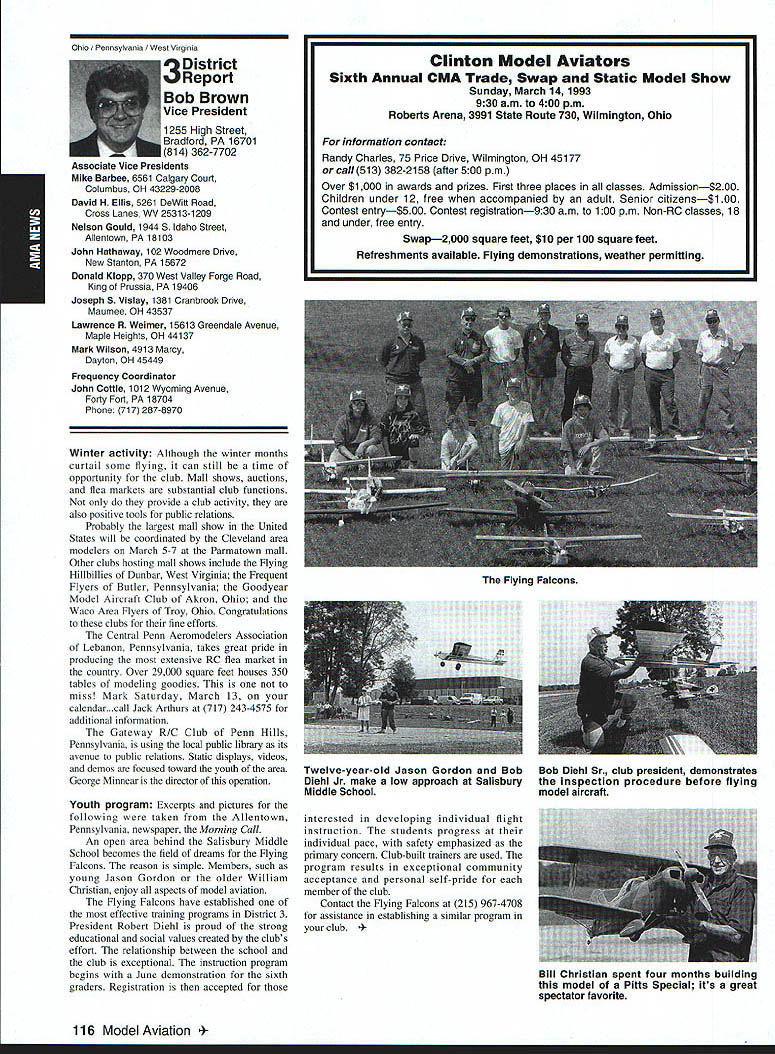
Youth program: Excerpts and pictures for the following were taken from the Allentown, Pennsylvania, newspaper, the Morning Call.
An open area behind the Salisbury Middle School becomes the field of dreams for the Flying Falcons. The reason is simple. Members, such as young Jason Gordon or the older William Christian, enjoy all aspects of model aviation.
The Flying Falcons have established one of the most effective training programs in District 3. President Robert Diehl is proud of the strong educational and social values created by the club's effort. The relationship between the school and the club is exceptional. The instruction program begins with a June demonstration for the sixth graders. Registration is then accepted for those interested in developing individual flight instruction. The students progress at their individual pace, with safety emphasized as the primary concern. Club-built trainers are used. The program results in exceptional community acceptance and personal self-pride for each member of the club.
Contact the Flying Falcons at (215) 967-4708 for assistance in establishing a similar program in your club.
Scholarship Continued from page 110
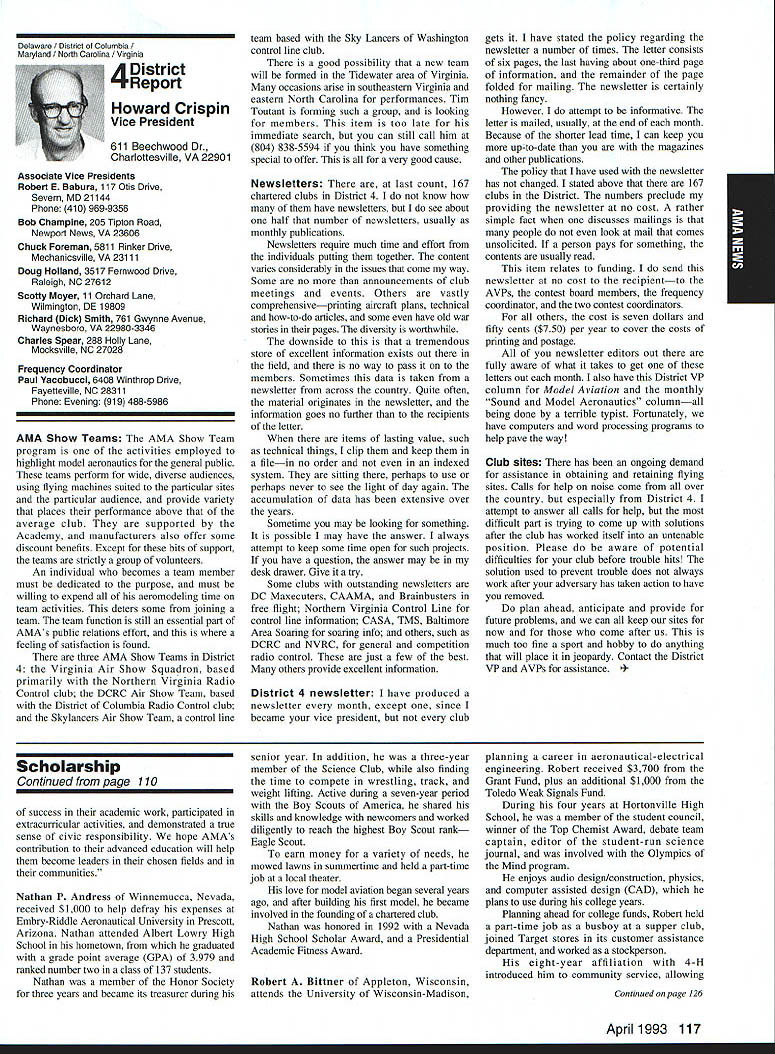
We honor students who demonstrated academic success, participated in extracurricular activities, and showed civic responsibility. We hope AMA's contribution to their advanced education will help them become leaders in their chosen fields and communities.
- Nathan P. Andress, Winnemucca, Nevada — $1,000 to help defray expenses at Embry-Riddle Aeronautical University, Prescott, Arizona. Nathan graduated from Albert Lowry High School with a GPA of 3.979, ranked number two in a class of 137. Member of the Honor Society (treasurer senior year), three-year Science Club member, participated in wrestling, track, and weight lifting. Active in Boy Scouts for seven years, attained Eagle Scout. Worked mowing lawns and part-time at a local theater. His love for model aviation led him to help found a chartered club. Honored in 1992 with a Nevada High School Scholar Award and a Presidential Academic Fitness Award.
- Robert A. Bittner, Appleton, Wisconsin — received $3,700 from the Grant Fund plus $1,000 from the Toledo Weak Signals Fund. Attends the University of Wisconsin–Madison planning a career in aeronautical-electrical engineering. At Hortonville High School he was on student council, won Top Chemist Award, served as debate team captain, edited a student-run science journal, and participated in Olympics of the Mind. Enjoys audio design, physics, and CAD. Worked part-time as a busboy, at Target, and as a stockperson. Eight-year 4-H affiliation introduced him to community service.
- Timothy Czerwonka, Chetek, Wisconsin — granted $3,500 from the Charles Hampson Grant Fund. Valedictorian of his high school with a 3.993 GPA; now at University of Wisconsin–Madison studying mechanical engineering. Academic honors include Academic letters (1989–1991), the 3M Creativity Award, Science Olympiad, Odyssey of the Mind, and National Honor Society. Held FBLA offices including president; first place in regional Computer Applications for Business; listed in Wisconsin’s Who’s Who in FBLA. Earned Extra Class FCC radio license, served as Red Cross volunteer, involved with Amateur Radio Emergency Service and International Amateur Radio Club. AMA member since 1989 and active in Six Lakes Aero Modelers.
- Jason Leecker, Schaumburg, Illinois — awarded $2,000 to attend Washington University in St. Louis, majoring in Finance/French. Graduated from James B. Conant High School with a WGPA of 4.75. Active in sports, class treasurer as a freshman, fund-raising chairman as a junior, vice president as a senior. Member of National Honor Society, sound chairman for music/drama events, volunteer cameraman at Channel 6–TV, and community fundraiser for Cystic Fibrosis. Active RC’er for six-plus years with Tri-Valley Club; implemented computer scoring for club use in 1989.
- Stephen Kopeschka, Fairmont, Minnesota — awarded $1,000 to attend GMI Engineering and Management Institute, Flint, Michigan. Graduated from Fairmont Senior High School with a GPA of 3.928. Four years in marching band (first chair percussion), Superior Award from State High School League, High Honor Roll all four years, state honors in mathematics. Member of Elm Creek Flyers RC Club with gliders, powered aircraft, and RC boats and cars (scratch-built). Club activities include mall shows, fun-flys, and demonstrations. Worked five years as a paper carrier.
- Jeff Lovitt — awarded $2,000 to help at University of California–Davis, majoring in agricultural engineering. Graduated from Willits High School with a GPA of 4.0. Listed in Who’s Who in American High School Students, National Honor Society, awards in math and science, jazz band, musicals, and captain of varsity tennis. Eagle Scout (1990). Worked at a local pharmacy. Introduced to modeling by his father, active in contests and judging, builds scale projects, and volunteers at contests.
- William Vaglienti, Spokane, Washington — awarded $1,000 to attend the University of Washington–Seattle, majoring in Aeronautical Engineering. Graduated from Ferris High School with a 3.83 GPA, National Merit Commended Scholar, honor roll every semester, regional and state science awards. Aeromodeling began at 13; member of Barons Model Club and Barons Flying Circus RC Demo Team. Builds and flies many models including sailplanes and scratch-built pattern aircraft. Volunteer at parent meetings and contests.
We wish each of these talented, hardworking young men success in their endeavors. We are proud to honor them as Grant/AMA Scholarship recipients.
AMA News
5 District Report
Jim McNeill Vice President
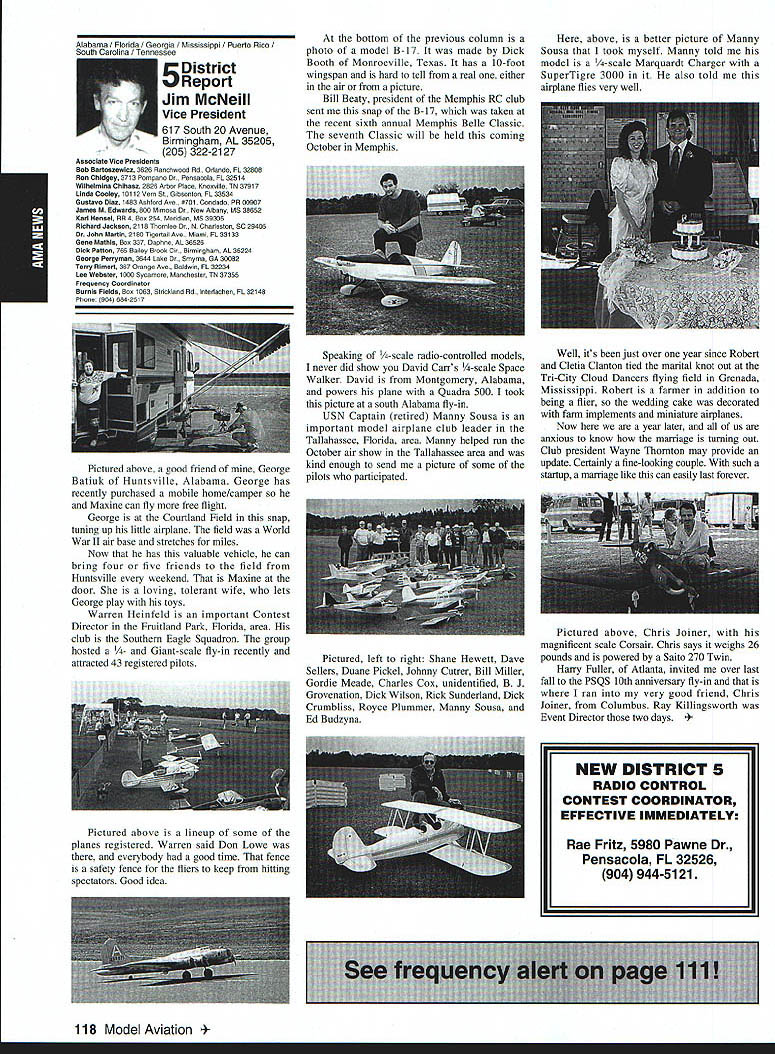
Pictured above is a good friend, George Battick of Huntsville, Alabama. George has recently purchased a mobile home/camper so he and Maxine can fly more free flight. George is at the Courtland Field in this snap, turning up his little airplane. The field was a World War II air base and has airstrips for miles.
Now that he has his valuable vehicle, he can bring four or five friends to the field from Huntsville every weekend. That is Maxine at the door. She is a loving, tolerant wife, who lets George play with his toys.
Warren Heinfield is an important Contest Director in the Fruitland Park, Florida, area. His club is the Southern Eagle Squadron. The group hosted a 1/4- and Giant-scale fly-in recently and attracted 43 registered pilots. Pictured is a lineup of some of the planes registered. Warren said Don Lowe was there, and everybody had a good time. That fence is a safety fence for the fliers to keep from hitting spectators. Good idea.
At the bottom of the previous column is a photo of a model B-17 made by Dick Booth of Monroeville, Texas. It has a 10-foot wingspan and is hard to tell from a real one, either in the air or from a picture. Bill Beatty, president of the Memphis RC club, sent this snap of the B-17 taken at the recent sixth annual Memphis Belle Classic. The seventh Classic will be held this coming October in Memphis.
Speaking of 1/2-scale radio-controlled models, I never did show you David Carr's 1/4-scale Space Walker. David is from Montgomery, Alabama, and powers his plane with a Quadra 500. I took this picture at a south Alabama fly-in.
USN Captain (retired) Manny Sousa is an important model airplane club leader in the Tallahassee, Florida, area. Manny helped run the October air show in the Tallahassee area and was kind enough to send me a picture of some of the pilots who participated.
Pictured, left to right: Shane Hewett, Dave Sellers, Duane Pickel, Johnny Cutter, Bill Miller, Gordie Meade, Charles Cox, unidentified, B. J. Grovenation, Dick Wilson, Rick Sunderland, Dick Crumbliss, Royce Plummer, Manny Sousa, and Ed Buzdyna.
Here is a better picture of Manny Sousa that I took myself. Manny told me his model is a 7/8-scale Marquart Charger with a SuperTiger 3000 in it. He also told me this airplane flies very well.
Well, it's been just over one year since Robert and Cleitie Clanton tied the marital knot out at the Tri-City Cloud Dancers flying field in Grenada, Mississippi. Robert is a farmer in addition to being a flier, so the wedding cake was decorated with farm implements and miniature airplanes. Now here we are a year later, and all of us are anxious to know how the marriage is turning out. Club president Wayne Thornton may provide an update. Certainly a fine-looking couple. With such a start-up, a marriage like this can easily last forever.
Pictured above, Chris Joiner, with his magnificent cased Corsair. Chris says it weighs 26 pounds and is powered by a Saito 270 Twin.
Harry Fuller, of Atlanta, invited me over last fall to the PSQS 10th anniversary fly-in and that is where I ran into my very good friend, Chris Joiner, from Columbus. Ray Killingsworth was Event Director those two days.
NEW DISTRICT 5 RADIO CONTROL CONTEST COORDINATOR, EFFECTIVE IMMEDIATELY!
- Rae Fritz, 5980 Pawnee Dr., Pensacola, FL 32526.
Phone: (904) 944-5121.
AMA News
Right now, all is quiet. My mail and phone calls have fallen off considerably. I hope that means all of you have been preparing for a new year of flying. By the time you read this, it will almost be time to test-fly those new dream ships. As for me, the lack of calls means shop time. My RV-6A's empennage is near completion, a wing kit awaits me, and my airplanes need attention. Whew! I hope things stay quiet for awhile!
Let's cut the bull and get into the photos I have in stock. Some have been around for awhile and a couple need to be shown!
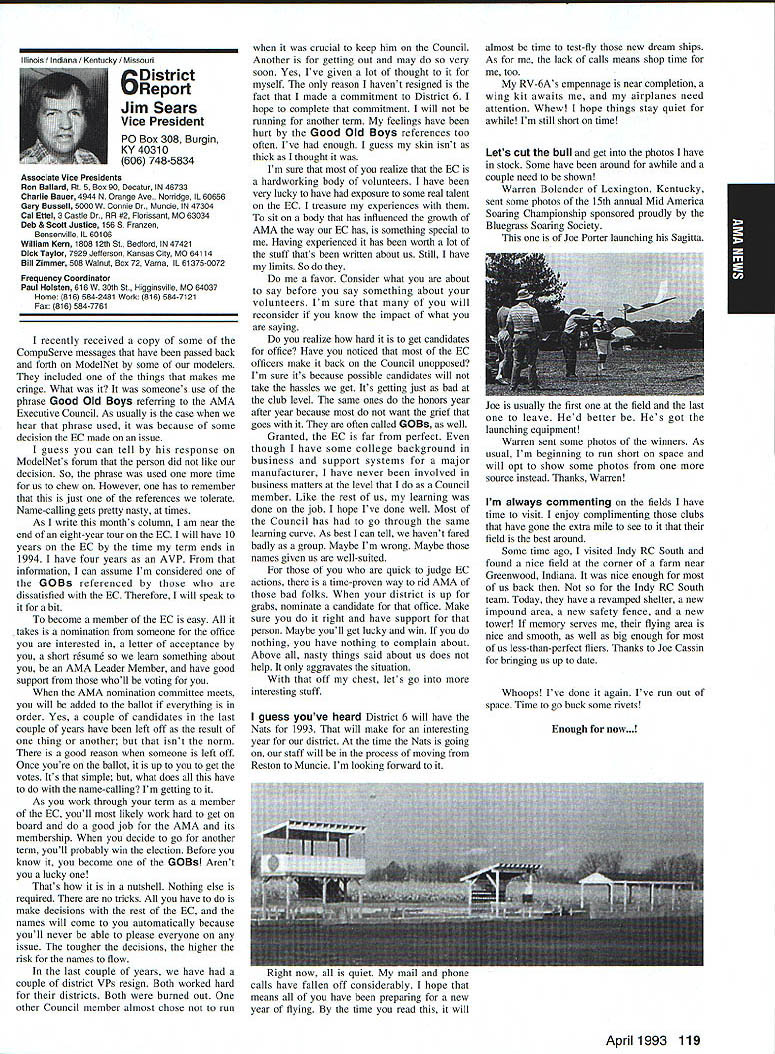
Warren Bolender of Lexington, Kentucky, sent some photos of the 15th annual Mid America Soaring Championship sponsored proudly by the Bluegrass Soaring Society. This one is of Joe Porter launching his Sagitta. Joe is usually the first one at the field and the last one to leave. He's got the launching equipment!
Warren sent photos of the winners. As usual, I'm beginning to run short on space and will look for some more photos from one more source instead. Thanks, Warren!
I'm always commenting on the fields I have time to visit. I enjoy complimenting those clubs that have gone the extra mile to see to it that their field is the best around.
Some time ago I visited Indy RC South and found a nice field at the corner of a farm near Greenwood, Indiana. It was nice enough for most of us back then. Not so for the Indy RC South team. Today, they have a revamped shelter, a new impound area, a new safety fence, and a new tower! If memory serves me, their flying area is nice and smooth, as well as big enough for most of us less-than-perfect fliers. Thanks to Joe Cassin for bringing us up to date.
Whoops! I've done it again. I've run out of space. Time to go back some rivers!
Enough for now...!
AMA News
7 District Report
Peter Waters Vice President 115 East Main, Upper Level, Northville, MI 48167
Assistant Vice President:
- Boyd Bowdish, 6410 Glenwood N., Golden Valley, MN 55427
PR/Insurance Coordinator:
- Joseph M. Hass, 5394 English Drive, Ypsilanti, MI 48198
Associate Vice Presidents:
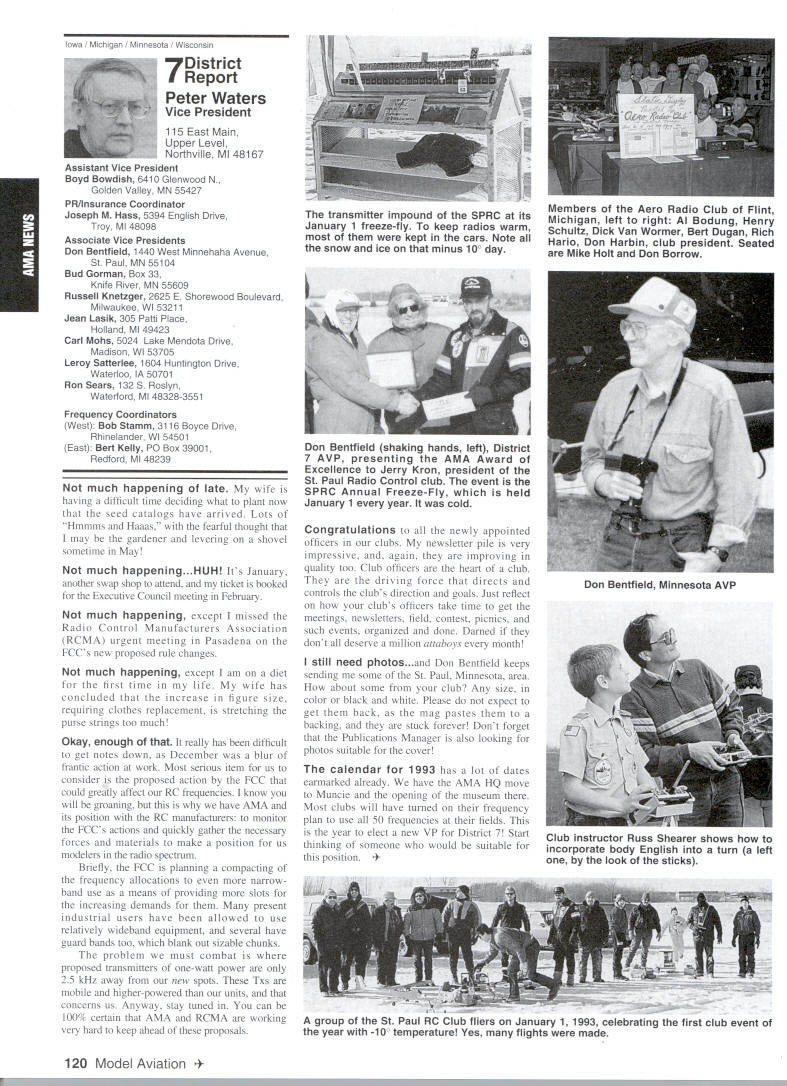
- Don Benfield, 1440 West Minnehaha Avenue, St. Paul, MN 55104
- Bud Gorman, Box 33, Knife River, MN 55609
- Russell Knetzger, 2625 E. Shorewood Boulevard, Milwaukee, WI 53211
- Jean Lasik, 305 Patti Place, Holland, MI 49423
- Carl Mohs, 5024 Lake Mendota Drive, Madison, WI 53705
- Leroy Satterlee, 1604 Huntington Drive, Waterloo, IA 50701
- Ron Sears, 132 S. Roslyn, Waterford, MI 48328-3551
Frequency Coordinators:
- (West): Bob Stamm, 3116 Boyce Drive, Rhinelander, WI 54501
- (East): Bert Kelly, PO Box 39001, Redford, MI 48239
Not much happening of late. My wife is having a difficult time deciding what to plant now that the seed catalogs have arrived. Lots of "Hmmm's" and "Haaas," with the fearful thought that I may be the gardener and levering on a shovel sometime in May!
Not much happening...HUH! It's January, another swap shop to attend, and my ticket is booked for the Executive Council meeting in February.
Not much happening, except I missed the Radio Control Manufacturers Association (RCMA) urgent meeting in Pasadena on the FCC's new proposed rule changes.
Not much happening, except I am on a diet for the first time in my life. My wife has concluded that the increase in figure size, requiring clothes replacement, is stretching the purse strings too much!
Okay, enough of that. It really has been difficult to get notes down. As December was a blur of frantic action at work. Most serious item for us to consider is the proposed action by the FCC that could greatly affect our RC frequencies. I know you will be groaning, but this is why we have AMA and its position with the RC manufacturers: to monitor the FCC's actions and quickly gather the necessary forces and materials to make a position for the hobbyists in the radio spectrum.
Briefly, the FCC is planning a compacting of the frequency allocations to even more narrow-band use as a means of providing more slots for the increasing demands. Many present industrial users have been allowed to use relatively wideband equipment, and several have guard bands used which block out sizable chunks.
The problem with the proposed action is where proposed transmitters of one-watt power are only 2.5 kHz away from our new spots. These TXs are mobile and higher-powered than our units, and that concerns us. Anyway, stay tuned in. You can be 100% certain that AMA and RCMA are working very hard to keep ahead of these proposals.
AMA News
...would allow commercial transmitters to be located immediately adjacent to our channels. We have strongly urged the use of the following letter format to address the proposal. Club members: it is very important that your letters be personal and specific; they can help us make the point. You are being asked to write NOW to the persons and agencies of the federal government who represent you:
- Senator — Honorable (name)
United States Senate Washington, DC 20510
- Representative — Honorable (name)
U.S. House of Representatives Washington, DC 20515
Name your Senator and Representative. Contact the Capitol Switchboard at 202-224-3121.
Writing letters — important: follow these suggestions
- Include identification of the proposed rule making: PR Docket 92-235.
- Personalize concerns: for example, "I am retired and derive many hours of pleasure building and operating radio-controlled models," or "I am an active competitor in local, national and international events." As a student, you might say you learn valuable lessons building and operating models and that you are active in your local club.
- Indicate financial involvement: state how many pieces of radio equipment you own that would be unusable if the frequency assignment is adopted; if your hobby shop or business is involved, indicate what percentage of sales are radio control related.
- Strongly stress the safety/liability aspect created by the proposal: describe models you build (weight, top speed), the fact your club operates in a public park, and the potential risks created if adjacent commercial transmitters cause interference.
Urgent Frequency Alert (continued)
Since proposed new frequencies could place commercial users immediately adjacent to model channels—potentially allowing commercial transmitters with much greater power only 2.5 kHz away—we have strongly urged prompt action. Club members: it is very important that you write NOW. Your letters can help us make the point.
You are being asked to write to the following persons/agencies in the federal government who represent you:
- Senator — Honorable (name)
United States Senate Washington, DC 20510
- Representative — Honorable (name)
- Personalize your concerns. For example: “I am retired and derive many hours of pleasure building and operating radio‑controlled models,” or “I am an active competitor in local, national and international events,” or, as a student, “I learn valuable lessons building and operating models and am active in my local club.”
When writing letters, please follow these suggestions:
Please write immediately — time is short.
District 10 Report
Associate Vice Presidents:
- Edward Aber-song, 99-127 Ohiaeka Street, Aiea, HI 96706
- Howard Baldwin, 4736 Quail Meadow Way, Fair Oaks, CA 95628
- Glenn Carter, 2020 Gull Port Lane, Walnut Creek, CA 94598
- Richard Hanson, P.O. Box 3312, Scottsdale, AZ 85271
- Gary Hover, 16016 Avenue 288, Visalia, CA 93277
- Kai P. Jensen, 535 East Moana Lane, Reno, NV 89502
- John F. Krohn, 11267 Hadley Street, Whittier, CA 90606
- Brian Nelson, 73 Park Groton Place, San Jose, CA 95136
- Dave Pinjuv, 4682 Cosley Drive, Las Vegas, NV 89117
- Bob Reynolds, 1201 E. Speedway, Tucson, AZ 85748-7123
- Betty Strean, 3723 Snowden Avenue, Long Beach, CA 90808
- Al Williamson, 445 Westby, Chula Vista, CA 91911
Frequency Coordinators:
- George Steiner, 2238 Rogue River Drive, Sacramento, CA 95826
Phone: (916) 362-1982
- Eloy Marez, 2626 W. Northwood, Santa Ana, CA 92704
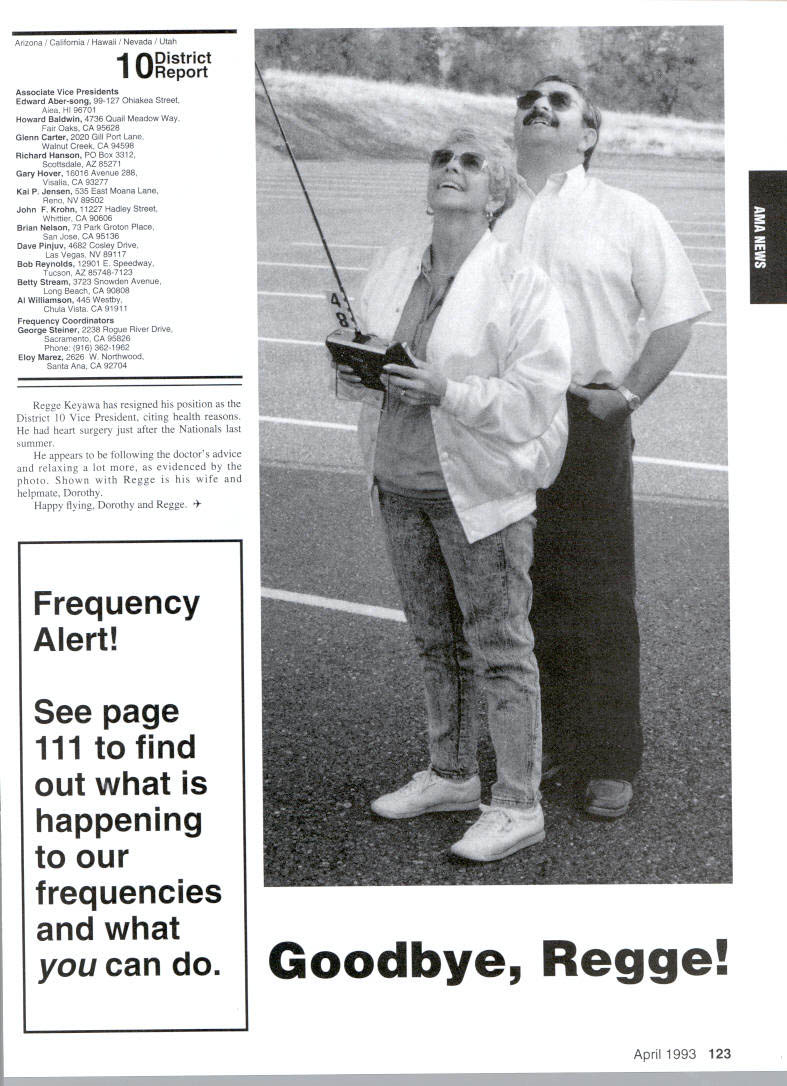
Regge Keyawa has resigned his position as the District 10 Vice President, citing health reasons. He had heart surgery just after the Nationals last summer.
He appears to be following the doctor's advice and relaxing a lot more, as evidenced by the photo. Shown with Regge is his wife and helpmate, Dorothy.
Happy flying, Dorothy and Regge.
District 11 Report
Ed McCollough, Vice President
Check this out—from the CAMS about the symposium. The dates will be April 17–18, not April 4, as previously announced. Also, the symposium is evolving! It will be called the NW Modelers Rendezvous, and will be the combined effort of the CAMS and Kester Marketing Services. Held at the Kootenai County Fairgrounds, the Rendezvous will consist of a trade show, swap meet, and seminars. These events will include all forms of modeling—airplanes, boats, trains, and dollhouses. Demonstrations will be given by certain clubs. Vern Clements has been asked to attend as a special guest.
Anyone interested in more information should contact Wayne Kester at 1-800-436-9146, or (208) 687-2200, or write to KMS, P.O. Box 919, Rathdrum, ID 83858.
For those wondering how to stimulate club members to help out more, MARC keeps tabs on the hours worked by volunteers. An award is given to the person who does the most for the club. As of this date, the most active person is ahead of the second-place person, 287/104 — that's hours of service!
Last month, I wrote about the presentation of the Fellow award to Bob Smuthwaite, and about the number of early kitmakers and movers and shakers in the model aviation industry who were in the Northwest.
Last weekend, we had the second running of the American Junior Swap Meet in Vancouver, and I discovered that Van Camp, whom I've known for many years and who is a fellow Barnstormer, was the man behind Air King Models in the late '30s. More as I find out.
Eric Hawkinson, editor of Horsefeathers!, made an excellent point: "One thing that has not changed is the absolute need for membership involvement in order to maintain and improve the club. I hope you will all reaffirm your commitment to making things happen in your club." Whether this means serving as an officer, working at events, or helping new members, the need is there, and the rewards for the club are significant. Add one more: the rewards to you are also significant, and then extend your involvement to the entire AMA. It is your organization. You have the power to make changes, to improve, and to direct the Academy. It does, however, take involvement, and involvement takes time.
Eric also reminded readers to support local hobby shops. It is very nice to be able to get a new prop or glow plug on a moment's notice; supporting that dealer keeps local dollars in the community and helps municipal leaders recognize the economic value of our hobby.
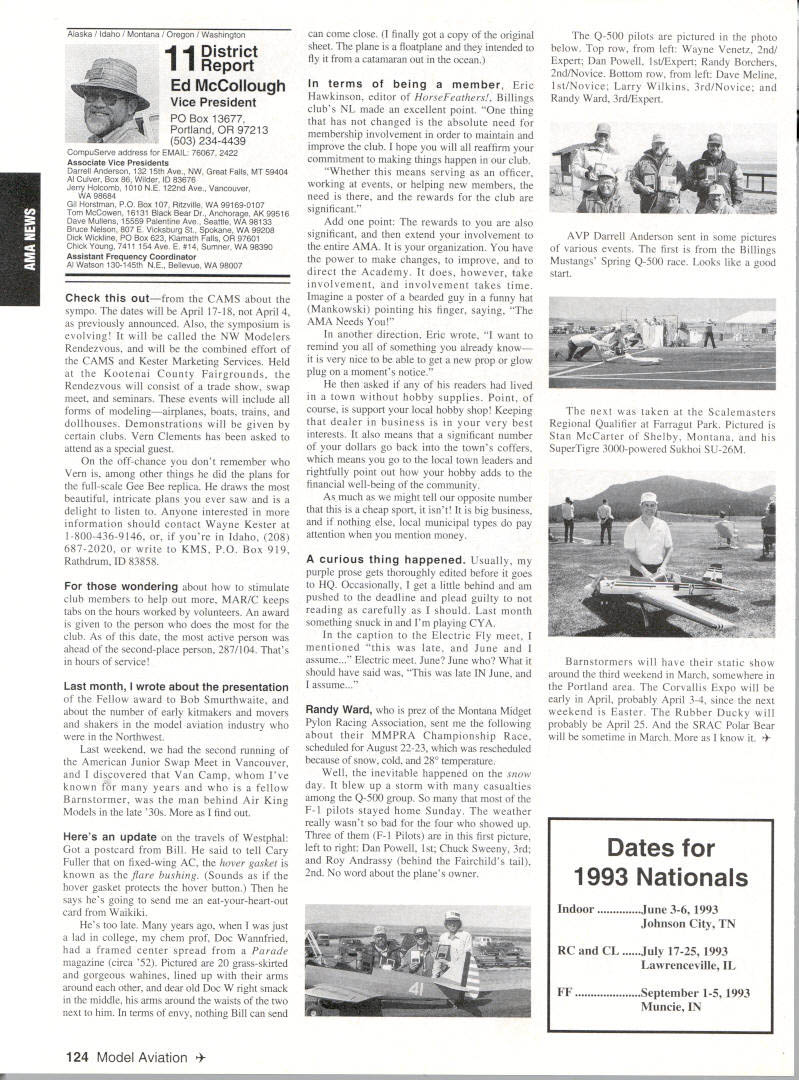
Randy Ward, president of the Montana Midget Pylon Racing Association, reported on their MMPRA Championship Race, scheduled for August 22–23, which was rescheduled because of snow, cold, and 28° temperature. On the snow day it blew up a storm with many casualties among the Q-500 group. On Sunday the weather was not so bad for the four who showed up. Three of them (F-1 Pilots) are pictured: Dan Powell, 1st; Chuck Sweazy, 3rd; and Roy Andrassy, 2nd.
Barnstormers will have their static show around the third weekend in March in the Portland area. The Corvallis Expo will be early in April, probably April 3–4. The Rubber Duck will probably be April 25. The SRAC Polar Bear will be sometime in March. More as I know it.
AMA News
Urgent Frequency Alert
Users of model frequencies in both the 72 and 75 MHz bands: The Federal Communications Commission (FCC) has issued a Notice of Proposed Rule Making (NPRM) — PR Docket 92-235. If implemented, it will have a profound effect on model frequency use.
The FCC has developed a new Land Mobile Service which creates a massive frequency restructuring — the first of its type in 60 years. The 419-page document addresses frequency use for another service (Part 88) and will also affect Part 95 and RC frequency use.
Without becoming too technical, the restructuring inserts two new frequencies between presently assigned model-use channels. Commercial users could have transmitters with almost four times the power output only 2.5 kHz away from a large number of 72 and 75 MHz model frequencies. In the 72 MHz band, 31 model channels would be bracketed, principally at the lower end of the band below channel 42. A similar condition would exist in the 75 MHz band.
Two examples of how frequency placing would look are as follows:
- Model Channel 15:
- 72.070 MHz
- 72.0725 MHz
- 72.0775 MHz
- 72.080 MHz
- 72.0825 MHz
- 72.0875 MHz
- 72.090 MHz
- Model Channel 63:
- 75.430 MHz
- 75.4325 MHz
- 75.4375 MHz
- 75.440 MHz
- 75.4425 MHz
- 75.4475 MHz
- 75.450 MHz
We have strongly urged club members to address the proposal. It is very important that you write NOW to the persons and agencies in the federal government who represent you:
- Senator: Honorable (name), United States Senate, Washington, D.C. 20510
- Representative: Honorable (name), U.S. House of Representatives, Washington, D.C. 20515
To find the names of your Senator and Representative, contact the Capitol Switchboard at 202-224-3121.
When writing, please do the following:
Two examples of frequency placing would look like the following:
- Model Channel 14 (new inserts shown around present channel):
- 72.070 MHz 72.0725 MHz 72.0775 MHz 72.080 MHz 72.0825 MHz 72.0875 MHz 72.090 MHz
- Model Channel 62 (new inserts shown around present channel):
- 75.430 MHz 75.4325 MHz 75.4375 MHz 75.440 MHz 75.4425 MHz 75.4475 MHz 75.450 MHz
AMA News
At home he was a great help to his dad in the family auto repair and towing business, which he credits with teaching him many lessons—how to get along with people under difficult circumstances, how to fix and repair almost anything, two-way radio operation, and stints in the office.
In spite of many honors devoted to home, family business, and community, Matt also enjoyed model building and flying. His four RC aircraft gave him hours of fun, and control-line planes he built and flew included many 1/2A designs. He soloed with his RC plane in April 1989 and has flown almost every month since then. Quite a record for those cold wintry days in Wisconsin.
Timothy Czerwonka from Chetek, Wisconsin, attended high school in that city, from which he graduated as valedictorian with a 3.993 GPA. He was on the honor roll throughout his high school years, ranked first in his class of 76. He is now at the University of Wisconsin–Madison where he is studying mechanical engineering. Tim was granted $3,500 from the Charles Hampson Grant Fund.
Tim achieved many honors, including Academic letters in 1989, 1990, and 1991, the 3M Creativity Award, Science Olympiad, and Odyssey of the Mind. He was a member of the National Honor Society in 1989, 1990, and 1991, and served as junior class treasurer and secretary for 1990–1991.
Tim held many offices in the Future Business Leaders of America (FBLA) Chapter at school, including president, vice president, and secretary. In addition, he achieved first place in regional competitions for Computer Applications for Business and was listed as number two in Wisconsin’s Who’s Who in FBLA competition.
Other school activities included Spanish club, the amateur radio club, student council, homecoming committee, Winter Carnival, prom committee, and fund-raising for school projects, and various speaking engagements.
As an active member of Six Lakes Aero Modelers, he served as secretary/treasurer for three years.
In extracurricular activities, Tim earned his Extra Class FCC radio license, served as a Red Cross volunteer, and was much involved with the Barron County Amateur Radio Emergency Service and the International Amateur Radio Club.
An AMA member since 1989, he feels the lessons he learned from aeromodeling (patience, research, problem solving, leadership) will serve him well in his higher education experience and later life.
Jason Leecker from Schaumburg, Illinois, graduated from James B. Conant High School (Schaumburg) with a WGPA of 4.75 and is now at Washington University in St. Louis, Missouri. He plans a major in Finance/French. A $2,000 scholarship was awarded to Jason.
During his high school years, he was active in sports as class treasurer in his freshman year, fund-raising chairman as a junior, and vice president of his senior class. He was a member of the National Honor Society in grades 11 and 12.
Jason was sound chairman for music and drama events, and belonged to both the International Sound Society and the International Thespian Society. With his skills in lighting and sound, he worked the Miss Hoffman Estates Pageant, variety shows, school dance shows, and the school prom fashion show.
As a reception host for the Foreign Exchange Club and the Sister Cities program, he gained good experience working with people. At Channel 6–TV, he served as a volunteer cameraman, adding to his long list of abilities. Jason’s community work included five years as a fundraiser for the Cystic Fibrosis campaign.
As an active RC’er for six plus years with the Tri-Valley Club, he worked many club functions and handled the monthly raffle. He flew sport and pattern aircraft and placed high in club contests. Jason implemented computer scoring for club use in 1989 and his system continues to be in use today.
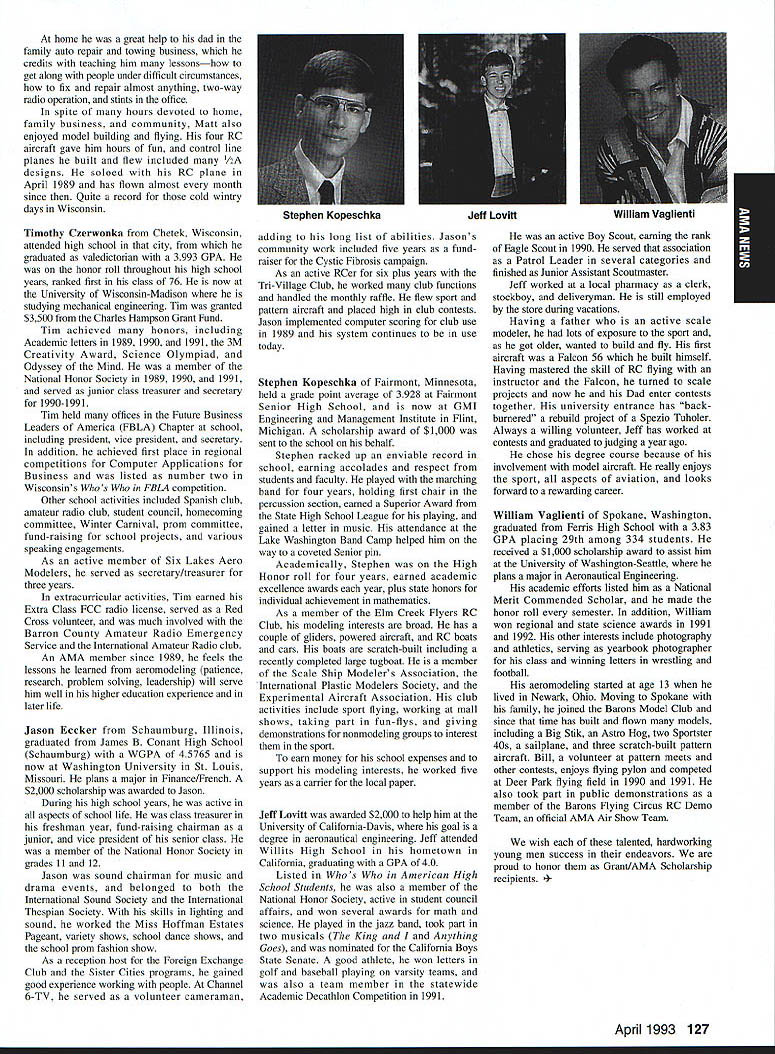
Stephen Kopeschka of Fairmont, Minnesota, held a grade point average of 3.928 at Fairmont Senior High School, and is now at GMI Engineering and Management Institute in Flint, Michigan. A scholarship award of $1,000 was sent to the school on his behalf.
Stephen racked up an enviable record in school, earning accolades and respect from students and faculty. He played with the marching band for four years, holding first chair in the percussion section, earned a Superior Award from the State High School League for his playing, and gained a letter in music. His attendance at the Lake Washington Band Camp helped him on the way to a coveted Senior pin.
Academically, Stephen was on the High Honor Roll for four years, earned academic excellence awards each year, plus state honors for individual achievement in mathematics.
As a member of the Elm Creek Flyers RC Club, his modeling interests are broad. He has a couple of gliders, powered aircraft, and RC boats and cars. His boats are scratch-built including a 30-inch hydroplane large tugboat. He is a member of the Scale Ship Modeler’s Association, the International Plastic Modelers Society, and the Experimental Aircraft Association. His club activities include sport flying, working at mall shows, taking part in fun-flys, and giving demonstrations for nonmodeling groups to interest them in the sport.
To earn money for his school expenses and to support his modeling interests, he worked five years as a carrier for the local paper.
Jeff Lovitt was awarded $2,000 to help him at the University of California–Davis, where his goal is a degree in agricultural engineering. Jeff attended Willits High School in his hometown in California, graduating with a GPA of 4.0.
Listed in Who’s Who in American High School Students, he was also a member of the National Honor Society, active in student council affairs, and won several awards for math and science. He played in the jazz band, took part in two musicals (The King and I and Anything Goes), and was nominated for the California Boys State Senate. A good athlete, he won letters in baseball and soccer and was captain of the varsity tennis team. He was also a team member in the statewide Academic Decathlon Competition in 1991.
He was an active Boy Scout, earning the rank of Eagle Scout in 1990. He served as patrol leader and as a Junior Assistant Scoutmaster.
Jeff worked at a local pharmacy as a clerk, stockboy, and deliveryman. He is still employed by the store during vacations.
Having a father who is now an active scale modeler, he had lots of exposure to the sport and, as he got older, wanted to build and fly. His first aircraft was a Falcon 56 which he built himself. Having mastered the skill of RC flying with an instructor and the Falcon, he turned to scale projects and now he and his Dad enter contests together. His university entrance has "back-burnered" a rebuild project of a Sepeca Tuholer. Always a willing volunteer, Jeff has worked at contests and graduated to judging a year ago.
He chose his degree course because of his involvement with model aircraft. He really enjoys the sport, all aspects of aviation, and looks forward to a rewarding career.
William Vaglienti of Spokane, Washington, graduated from Ferris High School with a 3.83 GPA, placing 29th among 334 students. He received a $1,000 scholarship and plans to attend the University of Washington–Seattle, where he plans a major in Aeronautical Engineering.
His academic efforts listed him as a National Merit Commended Scholar, and he made the honor roll every semester. In addition, William won regional and state science awards in 1991 and 1992. His other interests include photography and athletics, serving as yearbook photographer for his class and winning letters in wrestling and football.
His aeromodeling started at age 13 when he lived in Newark, Ohio. Moving to Spokane with his family, he joined the Barons Model Club and since that time has built and flown many models, including a Big Stik, an Astro Hog, two Sportster 40s, a sailplane, and three scratch-built pattern aircraft. Bill, a volunteer at parent meetings and other contests, enjoys flying pylon and competed at Deer Park flying field in 1990 and 1991. He also took part in public demonstrations as a member of the Barons Flying Circus RC Demo Team, an official AMA Air Show Team.
Transcribed from original scans by AI. Minor OCR errors may remain.

