
Sound & Model Aeronautics
Howard Crispin, Jr.
Mufflers and add-ons: This month we will examine and discuss how some people are producing original sound-level reducing devices.
Some of the devices are easy to make using basic tools and techniques. Some of the devices are complete mufflers. Others are intended to be added to the manufacturer-supplied mufflers.
Some of our members are involved in extensive studies and are producing immensely useful information. The purpose of printing the information is twofold—to provide devices that might help meet field rules and, possibly, to improve on the device enough to warrant production by someone. That is the manner in which progress for quieter operation is made in this effort. This month we will look at two different assemblies.
The Hayworth muffler: This unit, designed and built by Ernie Hayworth (1210 Wolcott Dr., Horseheads, NY 14845), is made from basic materials. The assembly does require the ability to silver-solder components.
Ernie made the unit and used it on an Enya .46 four-stroke engine. He then made comparisons using no muffler, the Enya can, and this assembly. The conventional Enya can dropped the dB level from 99 to 94, but it also dropped the rpm by at least 200. Ernie's assembly dropped the dB level to 92, and the rpm returned to that of the un‑muffled engine.
The central tube in the drawing (number one) is six inches long, and the other parts are drawn to the same scale. Cut paper patterns to size before attempting to solder the units together. Try different tube lengths, hole sizes, and expansion chamber volumes. Other experimentation should make this a unit that can bring the dB level well into the 80s range. If you do make useful changes on the unit, please let Ernie and me know about it. It is always useful to know what others are doing.
San Diego County Association of Model Clubs: The San Diego Association of Model Clubs has been working with sound-level problems for several years. It has been responsible for a number of articles on the subject; much of what has been published is the result of testing and studies.
The field situation has required that the clubs operate within strict noise-limit guidelines. The cutaway drawings shown here are for an add-on unit that has been effective for their purposes. The situation is a bit different from the basic AMA 90 at 9 practice. The group operates with a system that is frequency dependent. Using this formula results in having the dB reading plus (rpm/1,000) equal 96. Thus, at 10,000 rpm, the dB reading for the engine must not be greater than 86.
Frequency consideration is not a requirement at most sites, but it is a useful process if local ordinances are frequency-based or if there are other reasons for stricter requirements at the site.
The procedure used by the SDAC is simple to use. It requires no exotic analyzers—the only need is an accurate tachometer and a sound meter.
President's Corner
By the President of the Academy of Model Aeronautics
Don Lowe 902 Little Bend Rd. Altamonte Springs, FL 32714
I'm sure that by now all AMA members, as well as RC fliers everywhere, are aware of the frequency alert initiated by the Academy. The alert was in response to action taken by the Federal Communications Commission (FCC) to effect major changes in frequency assignments for land mobile communications. Although the proposed plan would not eliminate any frequencies now assigned for RC, it would place additional frequencies too close to ours for our equipment to reject their operation (if the unit is in close proximity).
This PROPOSED rule making will become fact only after considerable exposure to public light and debate. What your AMA asked for in this situation is a reaction of public opinion and thoughtful reflection on what this rule making would do to our operations. (Editor's note: The deadline for letters of comment has been extended to May 28.)
The irrefutable facts are these: model equipment, as designed, will not reject transmissions at 2.5 kHz separation (if the transmission is close by). Because our equipment operates at a roughly 0.25-watt output, it would also have a difficult time competing with a one-watt transmitter. The proposed FCC frequency tolerances for the new equipment would also, in some instances, wipe out any frequency separation at all. A basic problem is that the equipment would be mobile, or hand‑held, and could appear anywhere.
We are particularly concerned about the FCC action since we have spent the last 10 years phasing in a safe operating environment by redesigning equipment and tightening up the transmission specifications for model transmitters to accommodate the new frequency assignments given to us by the FCC. Our program is now in place and is working very well with no known instances of modeling equipment causing problems for other services. We also have seen minimal interference with model operations.
AMA and industry have worked closely to make this happen. We are concerned with the transmission interference because we are dealing with things that fly or are in high‑speed motion. There is a serious question of operating safety. It isn't a matter of garbled communication; it is a matter of public SAFETY.
We want you to know that there will be verbal discussions and presentations to the FCC by AMA/industry in order to pursue the write‑in initiative that we have set in motion.
Some members have asked, "Why the short fuse on this response?" AMA was made aware of the proposed rule making in late December 1992. The information was ferreted out by AMA's attorney who is paid to keep track of goings-on in the FCC. The proposed change appeared in PR Docket 92-235 — a huge 419‑page document. The proposal was to replace Part 90 of the rules that govern private land mobile radio services with a new Part 88. No mention was made of RC frequency assignments that appear in Part 95.
Our immediate reaction was to contact our Frequency Committee. A course of action was finalized at a meeting of AMA and industry at the International Modelers Show (IMS) in early January. Following that meeting, a public release was made at the trade show, and thousands of posters were distributed to those attending. We then sent a mailing to each AMA member. Sport Flyers Association (SFA) was also provided with the alert information. Notification was in hand to all concerned in sufficient time for the requested response.
The Frequency Committee, which includes members of the industry, met at AMA Headquarters in Reston on February 6 to finalize our response to the FCC. SFA was in attendance.
How will all of this work? At this point we do not know, but you can be sure that we will seek to resolve the issue in an aggressive, responsible manner. It probably will take several months plus the expenditure of $100,000 to resolve the issue. None of this would be possible without the cohesive force of a responsible association.
Continual vigilance of this nature is required because we live in an environment of ever-increasing demands on the frequency spectrum for communications and remote operations. We survive by presenting a strong case for a real need. Numbers are important. Legitimacy of the need also counts heavily. We would like to see industry take action to unify its voice, making a strong power base. We trust that industry will also aggressively pursue the technology necessary to assure safe operation in a tough radio frequency (RF) environment.
You can rest assured that your AMA will do its part.
VP Report / Dave Brown
Clutter exists between some flying sites without the participants realizing how close they are—sometimes a 20‑mile drive over the closest bridge separates them. Occasionally they may even be in different AMA districts.
A few (10?) years ago, I did a column devoted to the concept of using longitude/latitude positions of flying sites to isolate frequency conflicts between commercial users and ourselves. More recently, we have added a request to the charter renewal form for the latitude/longitude position of a club site. Unfortunately, only about 15% of the clubs have supplied the information, so we have a long way to go.
I'd like to institute a program that would provide usable separation between AMA‑chartered clubs, using the longitude/latitude data to determine the distance between any club applying for a charter or site‑owner insurance certificate and any existing flying site. I would hope that, if it became necessary, the clubs would be able to work out a frequency‑sharing plan and live happily ever after, but the rub comes when they are not willing or able to get the job done.
My first reaction was that the new club shouldn't be chartered, but after a heated discussion with one of my peers, I have to admit that this may not be the best solution. One of the reasons that AMA fought for and got the fifty 72‑MHz frequencies was to provide for this type of situation.
Realistically, no club needs 50 frequencies at its club site, and some form of mandated sharing by chartered clubs might be necessary if the clubs can't agree to a plan.
I know some people will point out that everyone has the right to use any and all of the FCC‑assigned frequencies; however, that right would also apply to the guy who wants to operate his equipment in the parking lot without regard to your frequency control system.
I'm sure nearly any club in the country would expel him if he refused to change his ways. Most of us recognize that while it may be our right to operate that radio, the safe and enjoyable exercising of that RC system is a privilege afforded to us by our willingness to cooperate with other modelers.
The conveying of a club charter from the AMA, along with the site‑of‑owner insurance that is available as a chartered club, is a privilege—not a right—and carries with it a duty to exercise the privilege in a way that allows other members to enjoy the hobby.
I believe that it is perfectly proper for the AMA to mandate a frequency‑sharing system, if necessary, as a condition of charter issuance or renewal. I would sincerely hope that the clubs could get together and work out their own solution, but if that is not possible in a reasonable time frame, AMA should impose a plan on the groups. If they refuse to agree to it, we have little choice but to revoke or not issue charters.
I have said before that we need to become aggressive in protecting our flying sites, but that also applies to not blowing the chance to see our hobby grow and prosper as a result of needlessly preventing another flying site from existing.
Till next month.
Yesterday's, Today's, and Tomorrow's Modelers Saluted by AMA
AMA / Grant Scholarship
Yes, folks, that's right. The annual AMA / Charles Hampson Grant scholarships will be awarded once again in 1993.
Charles Hampson Grant (1894–1987) was one of the early birds whose interest in and knowledge of aviation influenced or inspired the aeromodeling activities of all modelers, with special emphasis on young people. The program was established as a tribute to Charlie Grant and to further his dream of youthful participation in model aviation.
Funded from donations and general revenue, the scholarship program has been a lifesaver for many young people and their families. Nine grants, totaling $23,400, were awarded in 1992.
The deadline for receipt of applications for the 1993 awards is April 30, 1993. If you are an AMA member and know a young person who has been an AMA member for the last three years and is considering how to pay for a university education, you should advise him or her to get the forms and apply. It is a simple procedure, but supporting documentation from the individual's high school or verifiable facts and figures is needed.
All applications go before the AMA Scholarship Committee, which evaluates the individual's test scores, class rank, grade point average, and community and modeling service records. The schedule is set so that the funds awarded will be available prior to the start of the school year.
Here is an opportunity not to be missed! The funds are there. Don't be left wishing that you "had done that in time."
DO IT NOW. Call AMA Headquarters at (703) 435-0750, ask for the Technical Department, and request that application forms be mailed to you the same day.
AMA Hall of Fame
Has anyone in your club made major contributions to the sport of model aviation? Do you have a friend who has devoted more than his or her share of time and energy to model aircraft development? If you are aware of such a person, perhaps he or she belongs in the Academy of Model Aeronautics Hall of Fame (HOF). It is important to acknowledge these efforts and accomplishments.
The Hall of Fame awards are made every year to the extraordinary people who have contributed in a variety of ways to the progress of the sport of model design, construction, engine development, and piloting.
The HOF Committee receives nominations annually and thoroughly considers each submission. A nomination must be in the hands of the committee by May 31 of each year, so if you have someone in mind, call AMA HQ and ask for the form and instructions that you need.
As many as five names are added each year to the distinguished roster of Hall of Fame members. Your nominee could join such aviation giants as Carl Goldberg, Frank Zaic, Bill Winter, Ken Willard, Glen Sigafossie, Leroy Cox, and many others.
Being a Hall of Fame member is an honor that is not easy to achieve. Play your part in adding to this prestigious group. Look around your circle of creative, hardworking, passionate modelers, and decide that 1993 is the year you will nominate someone who deserves this very satisfying distinction.
For nomination applications, call or write AMA at 1810 Samuel Morse Dr., Reston, VA 22090, or telephone (703) 435-0750.
Remember, the deadline is May 31.
AMA News — President's Notice
I'm sure AMA members — and RC fliers everywhere — are aware of the frequency alert initiated by the Academy. The alert and response action taken by the Academy was prompted by an FCC proposal effecting major changes in frequency assignments for land mobile communications. Although the proposed plan would affect frequencies now assigned to RC use, it would place additional frequencies too close to our equipment and could cause receivers to be desensitized by units in close proximity. The proposed rule making will become fact only after considerable public exposure and debate. What AMA sought was reaction, public opinion, and thoughtful reflection on what the rule making would do to our operations. (Editor's note: Deadline for letters of comment has been extended to May 28.)
The irrefutable facts: model equipment will not reject transmissions at very close frequency separations when the transmitter is nearby, and because our equipment operates at low output power, it would have difficulty competing with high‑power land mobile transmitters operating nearby. The potential effect on safety and operation is serious and requires a unified response from the hobby and industry.
1 District Report
Don Krafft Vice President PO Box 1828, Duxbury, MA 02331 (617) 934-6248
Associate Vice Presidents:
- James M. Semonian, 166 Allen Road, Billerica, MA 01821
- Bob Landry, 80 Main Street, Essex Junction, VT 05452
- M.C. McGuffin, 8 Robinson Street, Houlton, ME 04730
- Richard Sherman, 28 High Street, Plymouth, NH 03264
- Ed Thompson, 27 E. Greenwich Ave., West Warwick, RI 02893
- Bob Wallace, 91 Sylvan Street, Avon, CT 06001
Frequency Coordinator:
- George Wilson, 82 Frazier Way, Marstons Mills, MA 02648
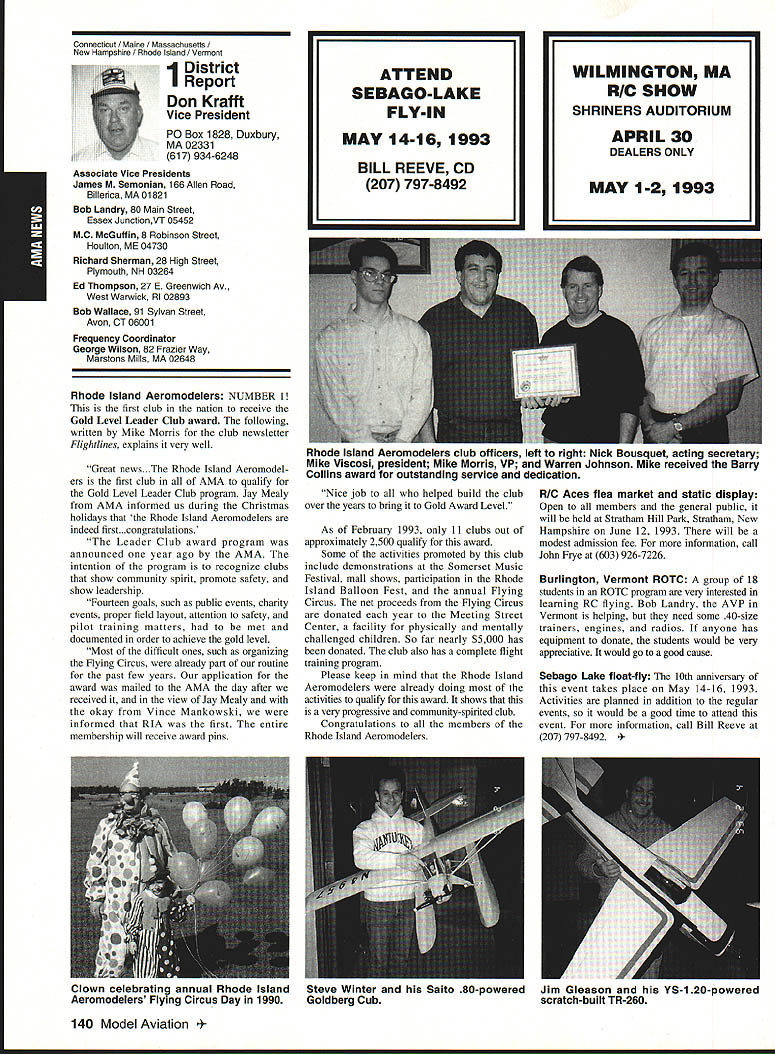
Rhode Island Aeromodelers: NUMBER 1
This is the first club in the nation to receive the Gold Level Leader Club award. The following, written by Mike Morris for the club newsletter Flightlines, explains it well.
"Great news... The Rhode Island Aeromodelers is the first club in all of AMA to qualify for the Gold Level Leader Club program. My lead from AMA informed us during the Christmas holidays that the Rhode Island Aeromodelers are indeed first... congratulations.
"The Leader Club award program was announced one year ago by the AMA. The intention of the program is to recognize clubs that show community spirit, promote safety, and show leadership.
"Fourteen goals, such as public events, charity events, proper field layout, attention to safety, and pilot training matters, had to be met and documented in order to achieve the gold level.
"Most of the difficult ones, such as organizing the Flying Circus, were already part of our routine for the past few years. Our application for the award was mailed to the AMA the day after we received it, and in the view of May and with the okay from Vince Mankowski, we were informed that RIA was the first. The entire membership will receive award pins.
"Nice job to all who helped build the club over the years to bring it to Gold Award Level."
As of February 1993, only 11 clubs out of approximately 2,500 qualify for this award. Some of the activities promoted by this club include demonstrations at the Somerset Music Festival, mall shows, participation in the Rhode Island Balloon Fest, and the annual Flying Circus. The net proceeds from the Flying Circus are donated each year to the Meeting Street Center, a facility for physically and mentally challenged children. So far nearly $5,000 has been donated. The club also has a complete flight training program.
Please keep in mind that the Rhode Island Aeromodelers were already doing most of the activities to qualify for this award. It shows that this is a very progressive and community-spirited club. Congratulations to all the members of the Rhode Island Aeromodelers.
Upcoming Events and Notices
- R/C Aces flea market and static display: Open to all members and the general public; held at Stratham Hill Park, Stratham, New Hampshire on June 12, 1993. Modest admission fee. For more information, call John Frye at (603) 926-7226.
- Burlington, Vermont ROTC: A group of 18 ROTC students are interested in learning RC flying. Bob Landry, the AVP in Vermont, is helping, but they need some .40‑size trainers, engines, and radios. Donations of equipment would be appreciated.
- Sebago Lake float‑fly: The 10th anniversary takes place on May 14–16, 1993. Additional activities will be planned. For more information, call Bill Reeve at (207) 797-8492.
AMA News — District 2 Highlights
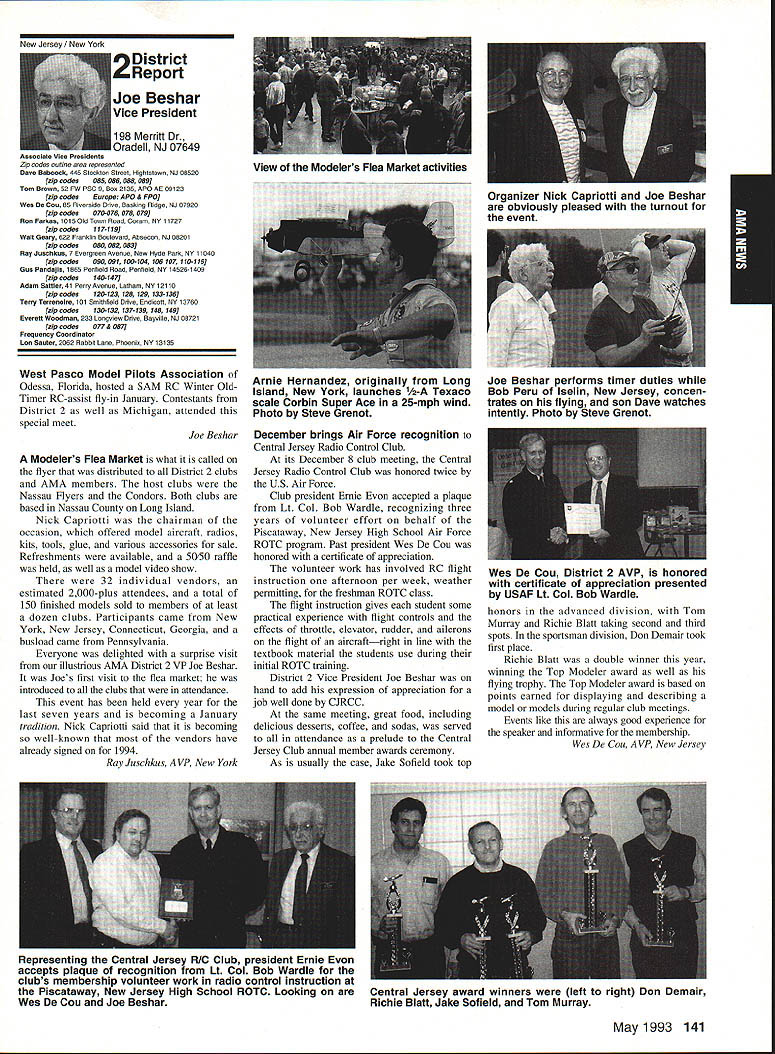
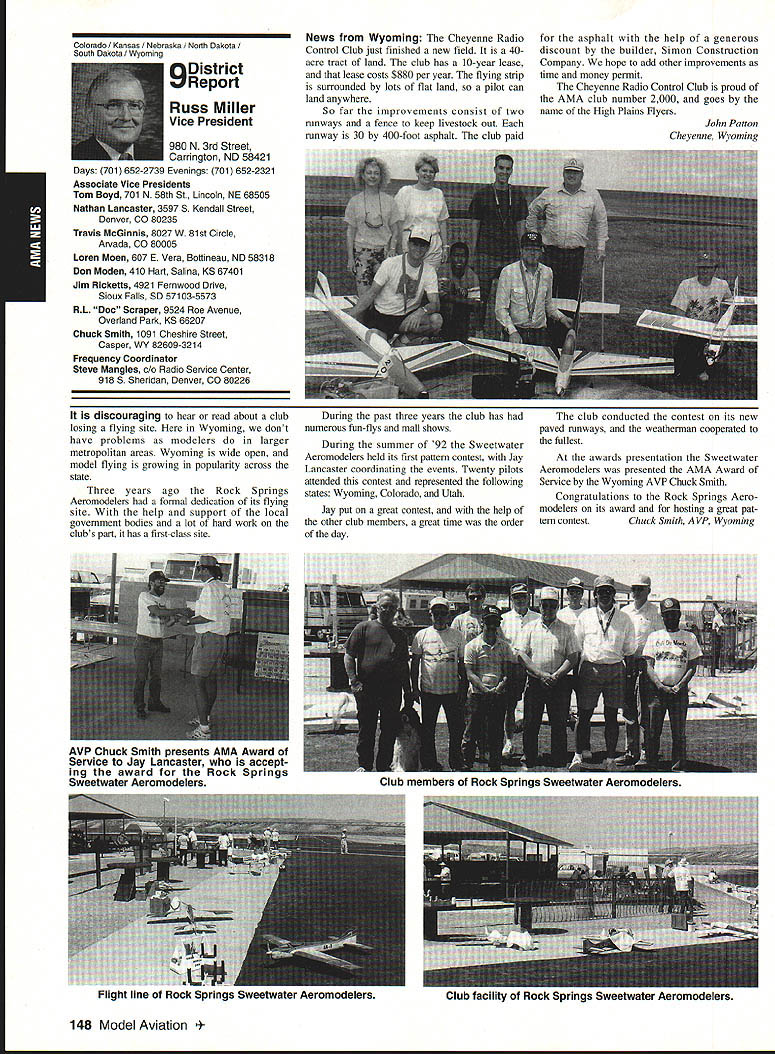
West Pasco Model Pilots Association of Odessa, Florida, hosted a SAM R/C Winter Old‑Timer R/C‑assist fly‑in in January. Contestants from District 2 and as far away as Michigan attended.
Modeler's Flea Market (Long Island): The Nassau Flyers and the Condors hosted a flea market open to District 2 clubs and AMA members. Nick Capriotti chaired the event, which offered aircraft, radios, kits, tools, glue, and accessories. There were 32 individual vendors, an estimated 2,000-plus attendees, and some 150 finished models sold. Participants came from New York, New Jersey, Connecticut, Georgia, Pennsylvania, and elsewhere. District 2 VP Joe Beshar made a surprise visit.
Central Jersey Radio Control Club: At its December 8 meeting the club was honored by the U.S. Air Force for volunteer effort on behalf of the Piscataway High School Air Force ROTC program. Volunteers provide R/C flight instruction to give students practical experience with flight controls. Club awards were also presented, and member achievements recognized.
Contributors:
- Ray Juschkus, AVP, New York
- Wes De Cou, AVP, New Jersey
3 District Report
Bob Brown Vice President 1255 High Street, Bradford, PA 16701 (814) 362-7702
Associate Vice Presidents:
- Mike Barbee, 6561 Calgary Court, Columbus, OH 43229-2008
- David H. Ellis, 5261 DeWitt Road, Cross Lanes, WV 25313-1209
- Nelson Gould, 1944 S. Idaho Street, Allentown, PA 18103
- John Hathaway, 102 Woodmore Drive, New Stanton, PA 15672
- Donald Klopp, 370 West Valley Forge Road, King of Prussia, PA 19406
- Joseph S. Vislay, 1381 Cranbrook Drive, Maumee, OH 43537
- Lawrence R. Weimer, 15613 Greendale Avenue, Maple Heights, OH 44137
- Mark Wilson, 4913 Marcy, Dayton, OH 45449
Frequency Coordinator:
- John Cottle, 1012 Wyoming Avenue, Forty Fort, PA 18704
Phone: (717) 287-8970
Frequency problems: By now you have been asked to assist fellow modelers by writing to your national senators, representatives, and the FCC. If you have not done so, your inactivity may result in a revision of the FCC rules that govern radio control modeling. Political activism is the name of the day—we must learn to play the game. The activity generated by this problem is one more example of the Academy working toward a common goal. Your assistance is appreciated.
Leader Club program: Three clubs in District 3 have the distinction of being named Leader Clubs: Westlake R/C Club (North Olmsted, OH); Sky Hawks (Weirton, WV); and Flying Circuits (Findlay, OH). The Leader Club award recognizes clubs that are good neighbors, support schools and youth programs, organize public events and charity activities, and generally work to retain flying sites.
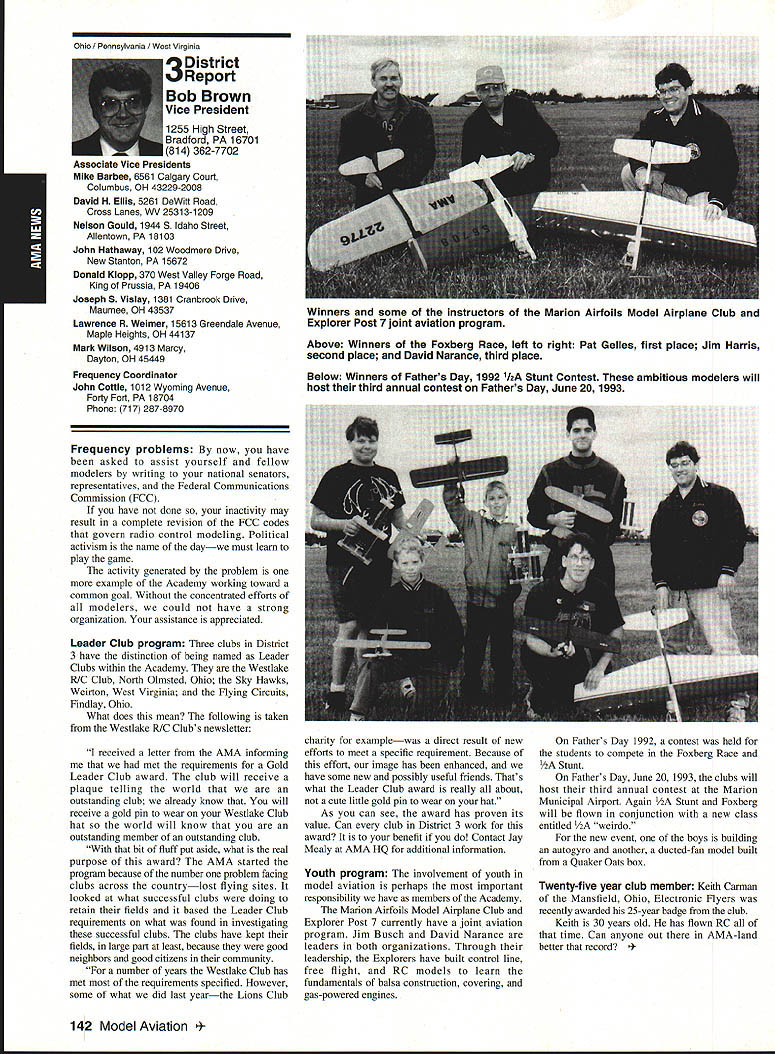
Youth program: The Marion Airfoils Model Airplane Club and Explorer Post 7 have a joint aviation program led by Jim Busch and David Narance. Explorers build free flight, control line, and RC models to learn construction, covering, and gas‑powered engine fundamentals. Events include Foxberg Race and V‑2/A Stunt; on Father's Day 1993 a new V‑2/winder class will be flown.
25-year club member: Keith Carman of the Mansfield Electronic Flyers was awarded his 25‑year badge from the club. He is 30 years old and has flown RC all of that time.
AMA News — Radio Questions and Leader Clubs (District 4)
The FCC proposal has generated a flurry of letters from AMA members. Letter writing remains the major effort at this time. Further action will be taken by the Academy and the Frequency Committee between now and the FCC response date. No action should be taken by members until and unless they are notified by AMA Headquarters.
The crucial thing is that the Academy, its members, and the radio control manufacturers present a unified front. Representatives from RCHTA and RCMA, and manufacturers including Airtronics and Futaba, participated in meetings. The Sport Flyers Association (SFA) agreed to work within this unified approach.
Leader clubs: Interest in the Leader Club program is picking up in District 4. Three clubs in the district have qualified:
- Baltimore Area Soaring Society (Maryland) — active in soaring, electric activity, site search and maintenance, school support, and the MARC Show.
- Fredericksburg Aeromasters (Fredericksburg, VA) — active in flying site acquisition and community relations, supports Technology Day at local schools.
- Statesville Model Fliers Radio Control Club (Statesville, NC) — vigilant in protecting and expanding flying sites; working with local agencies to secure new fields.
Congratulations to these clubs.
(See Frequency Alert on page 129.)
5 District Report
Jim McNeill Vice President 517 South 20 Avenue, Birmingham, AL 35205 (205) 322-2127
Puerto Rico: Puerto Rico is in AMA District 5 and currently has about 268 members. If you live in Puerto Rico and edit a club newsletter, please send a copy periodically. If you are a modeler there, send a picture of yourself and your airplane for possible publication.
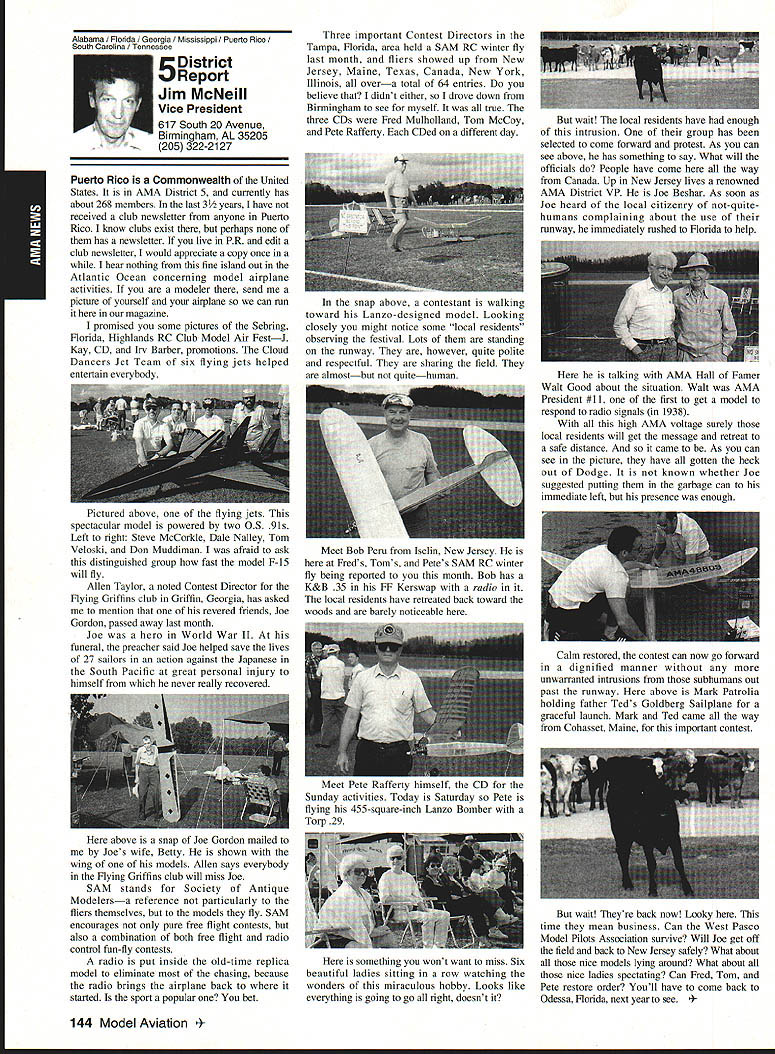
Sebring Model Air Fest: Photos from the Sebring Highlands RC Club Model Air Fest featured the Cloud Dancers Jet Team of six flying jets.
Notices:
- Allen Taylor (Flying Griffins, Griffin, GA) reports that Joe Gordon, a World War II hero, passed away.
- SAM (Society of Antique Modelers) events: SAM encourages free flight and RC fun-fly contests that often include radios inside old-time replica models to eliminate chasing. A SAM RC winter fly in Tampa recently drew 64 entries from across the country and Canada. Contest Directors included Fred Mulholland, Tom McCoy, and Pete Rafferty.
AMA News — President and Membership Notes
Don Lowe, President
I recently received a letter of suggestions from the Orange County Association of Model Clubs. Their input contained many good ideas; I appreciate their efforts. In other news, the FCC Notice of Proposed Rule Making regarding 72‑MHz frequencies prompted quick action by AMA staff, industry, and membership. Many of you responded with letters and support.
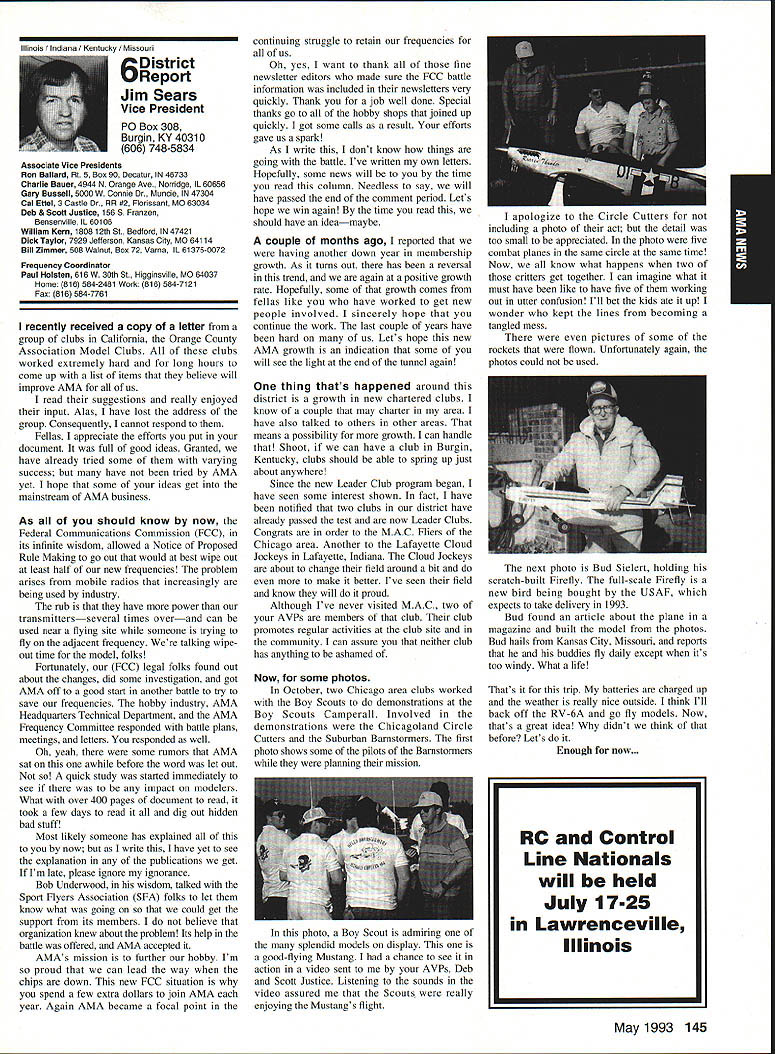
Membership: After a down trend, membership growth has reversed and is back to a positive rate. New chartered clubs are appearing, and the Leader Club program continues to attract interest. Congratulations to recent Leader Clubs: M.A.C. Fliers (Chicago area) and Lafayette Cloud Jockeys (Lafayette, IN). Clubs in the Chicago area worked with Boy Scouts to demonstrate model aviation at a camporee.
AMA News — Frequency Committee Reaction
Because the FCC announced possible changes to 72‑MHz allocations, AMA staff and the Frequency Committee have been very busy. Timely announcements at the IMS and the AMA mailing helped. Ray Kowalski, AMA counsel, monitored the NPRM and guided the response. Remember, the NPRM is a proposal only; nothing is final.
To those who responded with letters and phone calls to lawmakers: thank you. (Editor's note: The deadline for letters of comment has been extended to May 28.)
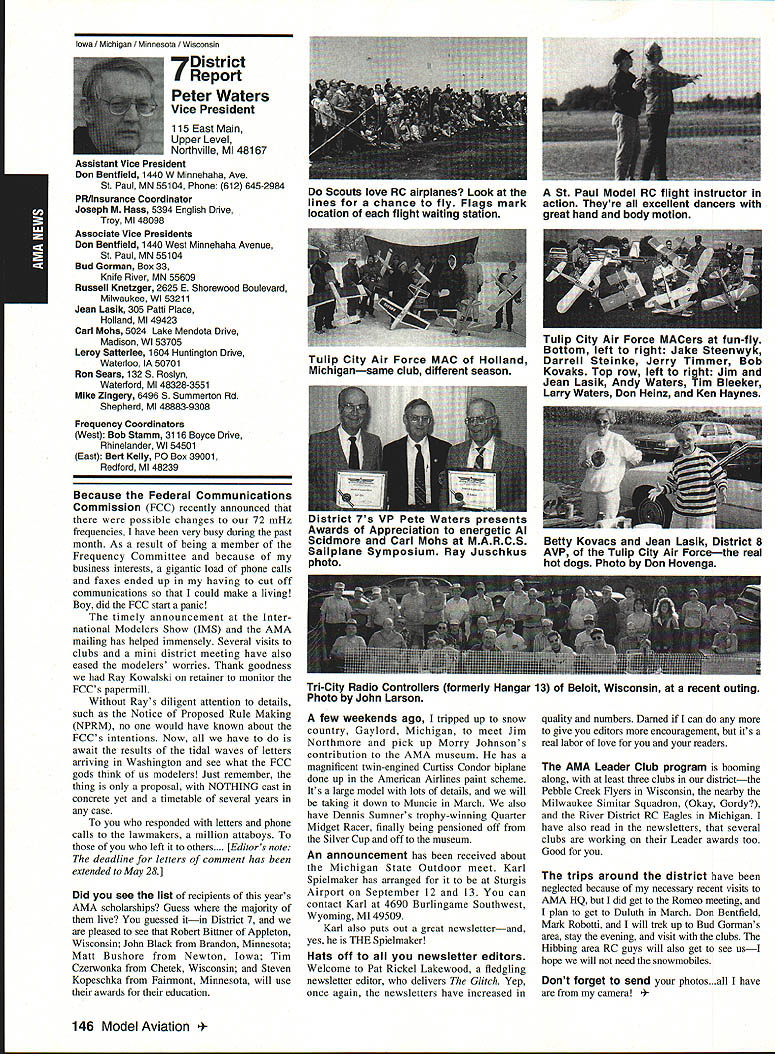
Scholarships: The list of this year's AMA scholarship recipients includes several from District 7. Congratulations to Robert Bittner (Appleton, WI), John Black (Brandon, MN), Matt Bushore (Newton, IA), Tim Czerwonka (Cloquet, WI), and Steve Kopcsuch (Fairmont, MN).
District 10 — Communication and Farewell
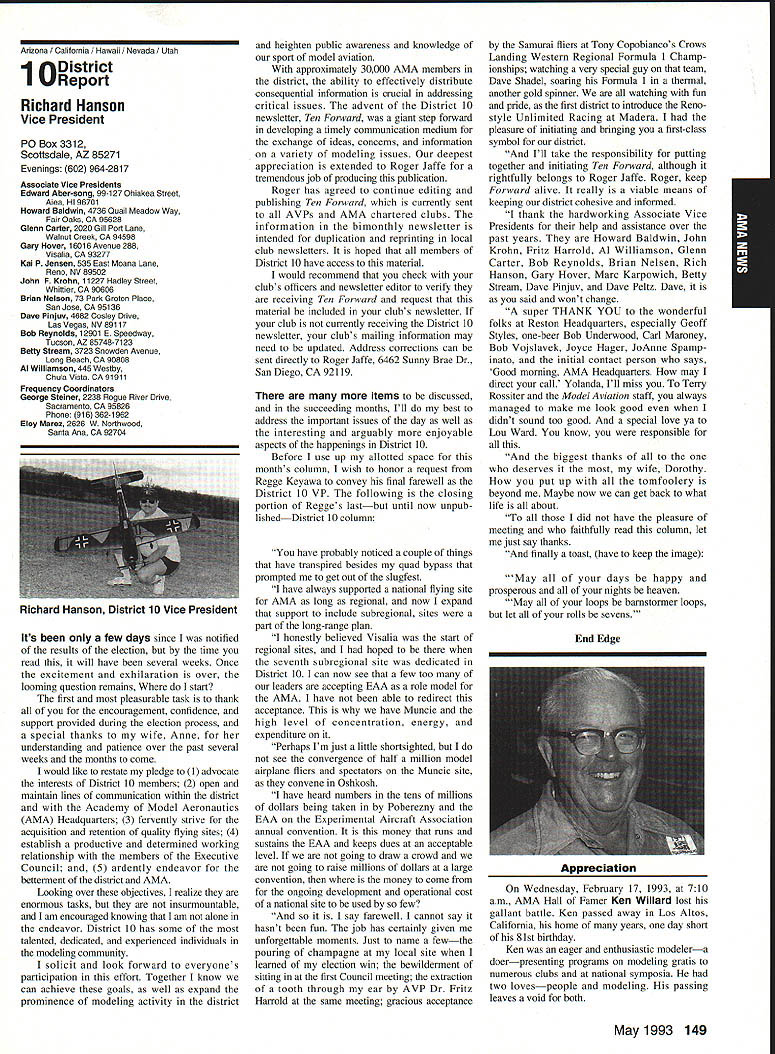
With approximately 30,000 AMA members in the district, effective distribution of consequential information is crucial. The District 10 newsletter, Ten Forward, was a significant step forward in providing timely communication. Our appreciation to Roger Jaffe for producing the publication. Ten Forward is sent to AVPs and AMA‑chartered clubs, and its content is intended for duplication in local club newsletters. If your club is not receiving Ten Forward, address corrections can be sent to Roger Jaffe, 6462 Sunny Brae Dr., San Diego, CA 92119.
A farewell from Rege Kejawa (former District 10 V.P.):
- He has supported the idea of a national flying site for AMA as well as subregional sites.
- He questioned the Muncie model as directly analogous to EAA/Oshkosh, arguing we may not achieve a similar scale or funding.
- Rege thanked many volunteers and AMA Headquarters staff by name and offered a heartfelt toast and farewell message to readers.
- He closed with a personal toast: "May all of your days be happy and prosperous and all of your nights be heaven. May all of your loops be barnstormer loops; but let all of your rolls be sevens.............."
11 District Report (Alaska / Idaho / Montana / Oregon / Washington)
Ed McCollough Vice President PO Box 13677, Portland, OR 97213 (503) 234-4439 CompuServe address for EMAIL: 76007,2422
Associate Vice Presidents:
- Darrell Anderson, 132 15th Ave., N.W., Great Falls, MT 59404
- Al Culver, Box 86, Wilder, ID 83676
- Jerry Bolen, 8010 N.E. 122nd Ave., Vancouver, WA 98684
- Gil Horstmann, P.O. Box 107, Riverton, WY 82501-0107
- Tom McCaw, 16131 Black Bear Dr., Anchorage, AK 99516
- Dave Mullens, 15559 Palatine Ave. N., Seattle, WA 98133
- Bruce Nelson, 807 E. Vischer St., Spokane, WA 99208
- Dick Wickline, PO Box 623, Klamath Falls, OR 97601
- Chick Yong, 7411 15th Ave. E., #14, Sumner, WA 98390
Assistant Frequency Coordinator:
- Al Watson, 130–145th N.E., Bellevue, WA 98007
District news and events:
- John Crossetto has accepted the position of Free Flight Contest Board member. Contact him at 14809 S.E. 54th, Bellevue, WA 98006 for rules input.
- Corvallis Expo will be held May 1–2; a fun‑fly at the BCRC Field at Adair is planned for May 2.
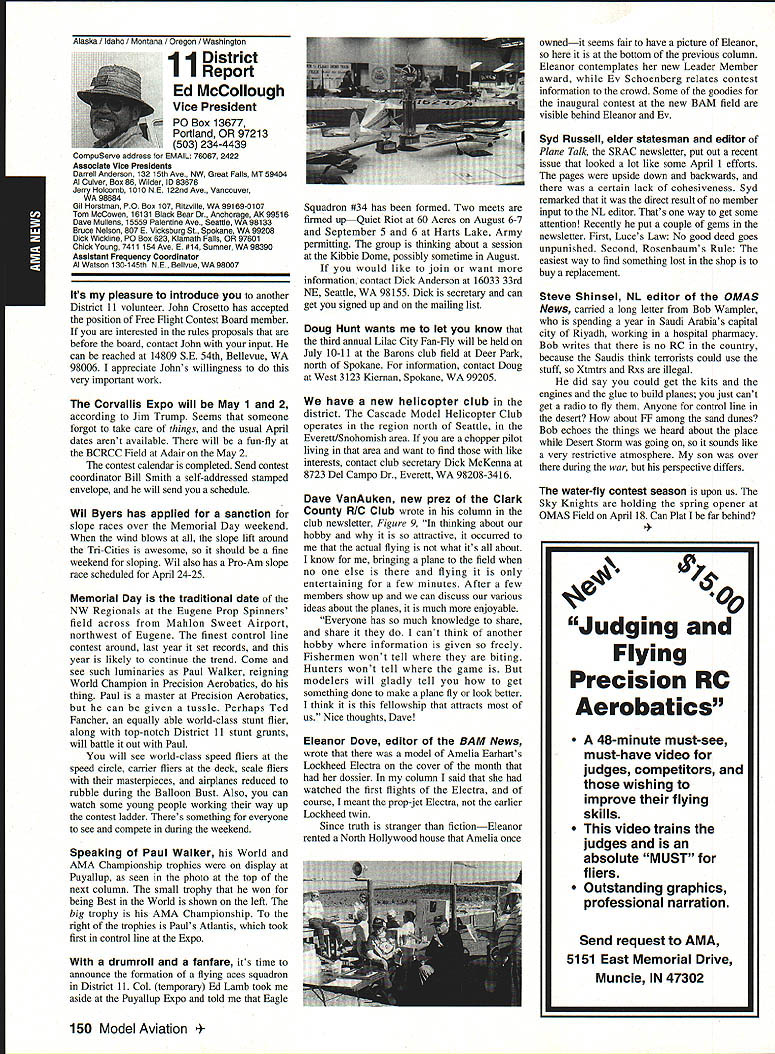
- Memorial Day weekend hosts the NW Regionals at the Eugene Prop Spinners' field; expect top contest flyers including Paul Walker and Ted Fancher.
- Eagle Squadron #34 formed; events include Quiet Riot at 60 Acres (August 6–7) and Harts Lake (September 5–6, Army permitting). Contact Dick Anderson (16033 33rd NE, Seattle, WA 98155) to join.
- Lilac City Fan‑Fly: July 10–11 at the Barons club field at Deer Park, north of Spokane. Contact Doug Hunt at W. 3123 Kiernan, Spokane, WA 99205.
- New helicopter club: Cascade Model Helicopter Club (Everett/Snohomish area). Contact Dick McKenna, 8723 Del Campo Dr., Everett, WA 98208-3416.
- Several clubs and editors contributed column items, photos, and community outreach updates. The district encourages fellowship and information-sharing among members.
The water‑fly contest season is approaching: the Sky Knights' season opener is at OMAS field on April 18.
End.
Transcribed from original scans by AI. Minor OCR errors may remain.

