
Sound & Model Aeronautics
Howard Crispin, Jr.
Safety: This column has been caught up in a bit of a controversy over safety. The question started with the article some months ago that gave instructions for making a pressure system for paint spraying. The article did contain information that appeared to violate laws related to pressure vessels. The questioning in that instance was valid. Pressure vessels and controls are nothing to be complacent about at any time.
When the article submitted for last month's column was received by the editor, the question was brought up concerning the use of an empty mousse can, or something of a similar nature, for the fabrication of an add-on muffler for a model engine. The question also applied to the manufacture of a stand-alone muffler.
The portion of the article that contained drawings and instructions for such a muffler was withdrawn. This does not mean that many of these mufflers are not in use; quite a number of individual designs have been submitted. Some of them are effective in reducing sound levels and are especially useful to those who desire to do this at minimum cost.
There are really two important points to bear in mind. The first is that we are not using these cans as pressure vessels. That means that any comparison to the spray systems is not relevant at all. The second consideration really has to do with whether we consider the modeler incapable of following basic instructions and concepts.
There is no doubt that when you purchase a spray can of any type at your local grocery or drugstore, the contents are under pressure. There are a couple of reasons why we would not puncture such a can without getting rid of the contents. Many of us would consider the contents to be rather obnoxious in concentration. We certainly would not appreciate the contents being sprayed around work in progress in the shop.
Safety is something that all of us should practice. Accidents do not take a holiday. Many types of spray cans do use a flammable substance as a propellant, and quite often the contents will also ignite.
Cans that fall into this category will normally carry such a notation, usually in small print somewhere on the can. This makes it absolutely necessary that the contents are not exposed to anything that would result in ignition. Probably the most likely cause would be a lit cigarette. The solution to this is not to smoke in the shop.
When the contents of one of these cans has been expended, one can safely proceed with the desired application. The cans are so thin that few individuals would be capable of performing any type of welding in the manufacture of an add-on muffler. Holes do need to be bored. This has to be done like boring a hole in a steel plate or a wood block. The odds are that it will be done very carefully by hand. Assembly of the can, tubes and whatever else is required will be done using a compound such as J.B. Weld.
The assumption that this is the procedure does mean that we will not be creating any hazards for ourselves or for any innocent bystanders. Common sense will go a long way when it comes to safety.
People worry about accidents in shop practice, and there are things that demand care. Tools of all sorts—drill bits, knives, saws, pins, and other items—have sharp edges. Improper usage will certainly result in cuts. We learn to use these things with care. Recognize the hazard, and learn to cope with the risk.
The actual operation of our models can be most hazardous for the uninitiated. We encounter everything from the chance of cuts, burns, and bruises from being hit with a rapidly turning propeller, to burns from contact with hot exhaust or cylinder head, back strain from lifting a heavy aircraft, infection by ticks, rashes from poison ivy, tripping over an anchor stake, eating a bad hamburger at the contest, going to sleep and running off the road returning from a long trip to a meet, and any number of other accidents. The point is that we must use common sense and follow safe practices in all aspects of our sport.
Perhaps there will be a response from those who will decide we can print more home project articles. We can hope that we will be able to continue. A number of drawings and methods for using these devices are on hand. Watch for further information.
President's Corner
By the President of the Academy of Model Aeronautics
Don Lowe 902 Little Bend Rd. Altamonte Springs, FL 32714
As you may know by now, your AMA has secured an improved insurance program, beginning March 31, 1993, at no increase in cost to you and at less cost to the AMA. It also reduces the exposure of the AMA to big hits in insurance claims.
AMA shops the insurance market each year for the best coverage possible for a reasonable investment. I can't imagine that anyone would want or need more coverage than we are currently offering members—$2.5 million per incident. This protection applies to individuals, clubs, and site owners. It also provides up to $5 million aggregate coverage to the flying site owner for the insurance year! And it provides EQUAL protection to model airplanes, boats, cars, and rockets; no more restricted limits on cars, boats, and rockets as there were in the past.
This great package is available because AMA is a large, reputable association with a history of modest claims and a good track record in each of the modeling categories. We have every reason to believe that this coverage will be available each successive year, assuming a reasonable claims record.
Headquarters reports that our renewals and new memberships are running several percentage points above 1992 and 1991 records. We are growing! Growth means that we will be able to offer more services and programs. YOU can help the hobby/sport by convincing your friends to become AMA members.
The frequency thing: The most-asked question these days is, What's happening with the frequency issue? As you know, the Federal Communications Commission (FCC) is engaged in a major restructuring of the Land Mobile Communications service. It involves a lot more than models, but could impact model operating safety if implemented as initially proposed.
The huge response by AMA members and others has caused the FCC to extend the comment period to May 1993, and the commission has also held a briefing session that was attended by AMA, the RC industry, and representatives of the other users.
At this point it is apparent that the FCC is calling the document a first cut—subject to change. It is also apparent that proposed implementation schedules will be delayed. That doesn't mean that we are home free, by any means; we must continue to press our case, which we intend to do. The FCC certainly knows we are here, by virtue of the thousands of letters it has received.
We need to look at this whole thing realistically, however. Certainly there will be an ever-increasing demand for frequencies as personal communication and remote control needs grow.
Because of this, we must promote research aimed at reducing band-pass requirements of our equipment. We are going to need an even tighter requirement on our transmitters and receivers in order to SURVIVE in an increasingly HOSTILE RF environment.
Food for thought: It seems to me that the 27 MHz, so-called citizens band, needs to be recaptured. It is a virtual wasteland of illegal operations, linear amplifiers, and operators on illegal frequencies. I've done some monitoring recently and found a jumble of communications—illegal people operating illegally and people using utterly profane language. In short, an absolutely worthless slice of the spectrum. Can it be reclaimed? At this point, I doubt it, with the limited ability of the FCC to police its frequencies. But it really bugs me that while we operate circumspectly on our allotted portion of the 72 and 75 MHz bands (and we certainly should), the operations on 27 MHz are an absolute waste of useless transmission!
I am concerned that if mobile equipment on our 72 and 75 MHz bands becomes easily and cheaply obtainable, our bands will go the way of 27 MHz! I sure hope that doesn't happen, but the FCC simply does not have the manpower to patrol and control the total frequency spectrum.
The frequency assignments that we currently have, coupled with other authorized users, are working very well. This basically provides a 10-kHz frequency separation between us and them.
To my knowledge there have been no reports of our transmission harming "them." Similarly, there have been minimal reports with their transmissions bothering us. As you know, model operations are considered secondary users, so we must tolerate any interference from "them."
The new proposed mobile communications assignment within 2.5 MHz of our frequencies would be intolerable to us with our current equipment. We visualize an unsafe scenario, and that's the reason we are making a real issue of the proposed change with the FCC.
Executive VP's Report
Dave Brown AMA Executive VP 4560 Layhigh Rd. Hamilton, OH 45013
(Editor's note: Please read Executive Director Mankowski's column for updated information on FCC response and liaison with AMA.)
Eleven thousand sounds like a lot of anything, but there are those in the Federal Communications Commission (FCC) who seem to think it doesn't amount to much when it comes to letters logged in protest of its proposed action to put more industrial users into slots very close to our frequencies.
Frankly, I was surprised that the FCC claims that such a low number of letters has been received by the commission. I believe it is understating our response by quite a bit. I have read a few plausible reasons for their low number, not one of which claims that these are all of the responses they got.
One hypothesis is that the commission records only individual letters and considers form letters simply on the basis of volume or weight. Another is that the first 11,000 were logged in, and then the commission simply quit recording.
I have heard that there are piles of letters at the FCC that have not been counted and that probably won't be counted.
A slip of the tongue by the proposal's author, if he is quoted properly in the Sunday, March 7 Cincinnati Enquirer, may shed a little insight into the reality of the situation. Doron Fertig, an economist for the FCC and generally credited (or blamed) as the author of the proposal, is quoted as having said, "There's only one person to read them, and that's me. So I wave at them, and put them in storage."
It is disturbing that an FCC employee would take such a cavalier attitude to public comment on a proposal of this magnitude, but it is even more disturbing to me that, according to his own statement, he is the only one who reads the letters! It's his job to guard the henhouse; I don't know what is.
While the FCC is required by law to solicit public comment, I guess it doesn't have any compulsion to pay much attention to it.
Very early in our campaign, a modeler told me that he had telephoned the FCC and had been laughed at. He was told to write to the FCC during the comment period, but was also told NOT to write to the politicians, as they just muddy the water.
Well, I thought at the time that this was a case of the FCC trying to keep from having to do the right thing, and I am now even more convinced of it. Letters to the politicians are the only ones being read, and inquiries to the FCC from those politicians will not be ignored by the FCC. We already have evidence of this fact.
We must be very careful to be factually correct in our letters to the politicians, as any factual discrepancy will result in the politician being told that the modelers are wrong in their statement or that the proposal will do the opposite of what the modelers claim. The previously mentioned articles (two slightly different ones in different editions of the paper, by the same author) illustrate the problem quite nicely. A modeler was quoted by the author of the article as saying that the proposed change would create a situation where someone picking up a car phone within a mile of you would be able to destroy the air! Even though the article had stated earlier that the expanded frequencies were for industrial users, mentioning car phones gave the impression that it would affect us.
AMA News
I have seen some letters from the politicians that show exactly this effect. Don't give the FCC this out! Don't embellish the story with unnecessary rhetoric. "This proposal puts other users too close to our RC frequencies for safe operation" says all that is necessary, and forces the FCC to deal with the real problem rather than giving them something technically flawed to show that we don't know what we are talking about.
There is an old joke about voting now and voting often. Stand up and be counted now.
Aw, what the heck, if the FCC buys this proposal as the panacea for the future of communications, I'd imagine that some economist will try to convince the Department of Transportation that the cure for traffic congestion is to paint more lanes on the highways to handle more traffic!
Don't widen the roads, just paint more lines on them. Let's see, five-foot-wide lanes should be enough for eight-foot-wide trucks. I'm sure the technology will develop to allow it!
Till next month.
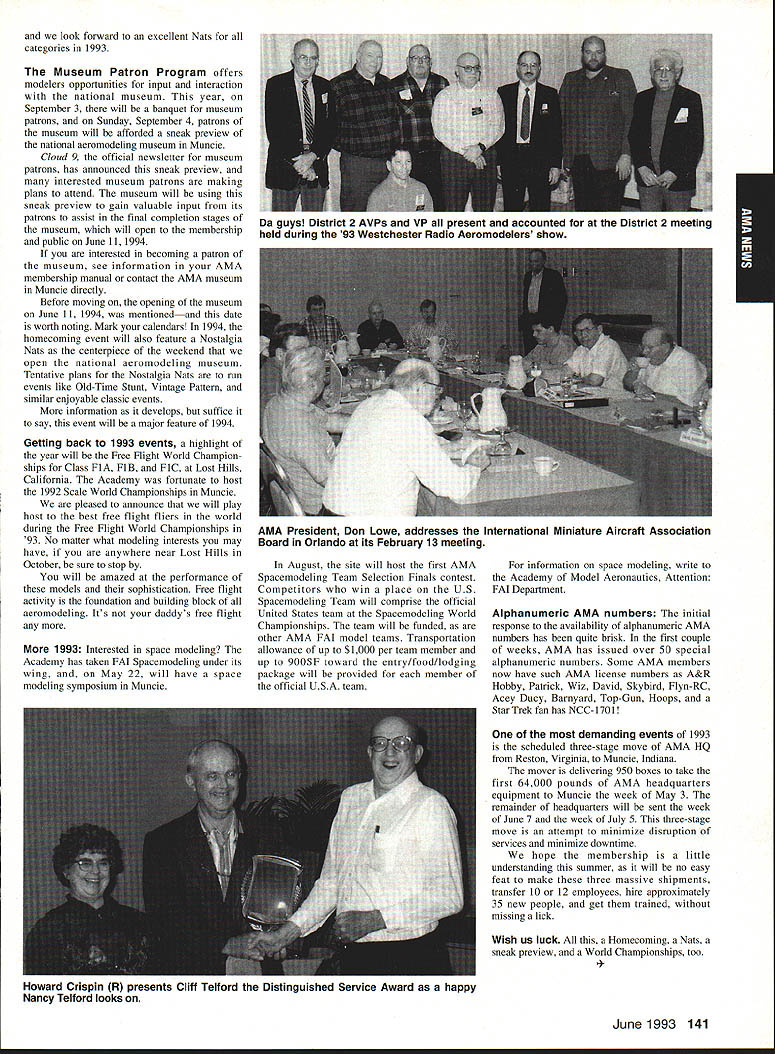
The Museum Patron Program offers modelers opportunities for input and interaction with the national museum. This year, on September 3, there will be a banquet for museum patrons, and on Sunday, September 4, patrons of the museum will be afforded a sneak preview of the national aeromodeling museum in Muncie.
Cloud 9, the official newsletter for museum patrons, has announced this sneak preview, and many interested museum patrons are making plans to attend. The museum will be using this sneak preview to gain valuable input from its patrons to assist in the final completion stages of the museum, which will open to the membership and public on June 11, 1994.
If you are interested in becoming a patron of the museum, see information in your AMA membership manual or contact the AMA museum in Muncie directly.
Before moving on, the opening of the museum on June 11, 1994, was mentioned—and this date is worth noting. Mark your calendars! In 1994, the homecoming event will also feature a Nostalgia Nats as the centerpiece of the weekend that we open the national aeromodeling museum. Tentative plans for the Nostalgia Nats are to run events like Old-Time Stunt, Vintage Pattern, and similar enjoyable classes and events.
More information as it develops, but suffice it to say, this event will be a major feature of 1994.
Getting back to 1993 events, a highlight of the year will be the Free Flight World Championships for Class F1A, F1B, and F1C at Lost Hills, California. The Academy was fortunate to host the 1992 Scale World Championships in Muncie.
We are pleased to announce that we will play host to the best free flight fliers in the world during the Free Flight World Championships '93. No matter what modeling interests you may have, if you are anywhere near Lost Hills in October, be sure to stop by.
You will be amazed at the performance of these models and their sophistication. Free flight activity is the foundation and building block of all aeromodeling. It's not your daddy's free flight any more.
More 1993: Interested in space modeling? The Academy has taken FAI Spacemodeling under its wing, and, on May 22, will have a space modeling symposium in Muncie.
In August, the site will host the first AMA Spacemodeling Team Selection Finals contest. Competitors who win a place on the U.S. Spacemodeling Team will comprise the official United States team at the Spacemodeling World Championships. The team will be funded, as are other AMA FAI model teams. Transportation allowance of up to $1,000 per team member and up to $900 toward the entry/food/lodging package will be provided for each member of the official U.S.A. team.
For information on space modeling, write to the Academy of Model Aeronautics, Attention: FAI Department.
Alphanumeric AMA numbers: The initial response to the availability of alphanumeric AMA numbers has been quite brisk. In the first couple of weeks, AMA has issued over 50 special alphanumeric numbers. Some AMA members now have such AMA license numbers as A&R Hobby, Patrick, Wiz, David, Skybird, Fly-N-RC, Acey Ducey, Barnyard, Top-Gun, Hoops, and a Star Trek fan has NCC-1701!
One of the most demanding events of 1993 is the scheduled three-stage move of AMA HQ from Reston, Virginia, to Muncie, Indiana.
The move is delivering 950 boxes to take the first 64,000 pounds of AMA headquarters equipment to Muncie the week of May 3. The remainder of headquarters will be sent the week of June 7 and the week of July 5. This three-stage move is an attempt to minimize disruption of services and minimize downtime.
We hope the membership is a little understanding this summer, as it will be no easy feat to make these three massive shipments, transfer 10 or 12 employees, hire approximately 35 new people, and get them trained, without missing a lick.
Wish us luck. All this, a Homecoming, a Nats, a sneak preview, and a World Championships, too.
District Report
Connecticut / Maine / Massachusetts / New Hampshire / Rhode Island / Vermont
Don Krafft Vice President PO Box 1828, Duxbury, MA 02331 (617) 934-6248
Associate Vice Presidents:
- James M. Semonian, 166 Allen Road, Billerica, MA 01821
- Bob Landry, 80 Main Street, Essex Junction, VT 05452
- M. C. McGuffin, 8 Robinson Street, Houlton, ME 04730
- Richard Sherman, 28 High Street, Plymouth, NH 03264
- Ed Thompson, 27 E. Greenwich Ave., West Warwick, RI 02893
- Bob Wallace, 91 Sylvan Street, Avon, CT 06001
Frequency Coordinator:
- George Wilson, 82 Frazier Way, Marstons Mills, MA 02648
New Hampshire Flying Tigers R/C Club:
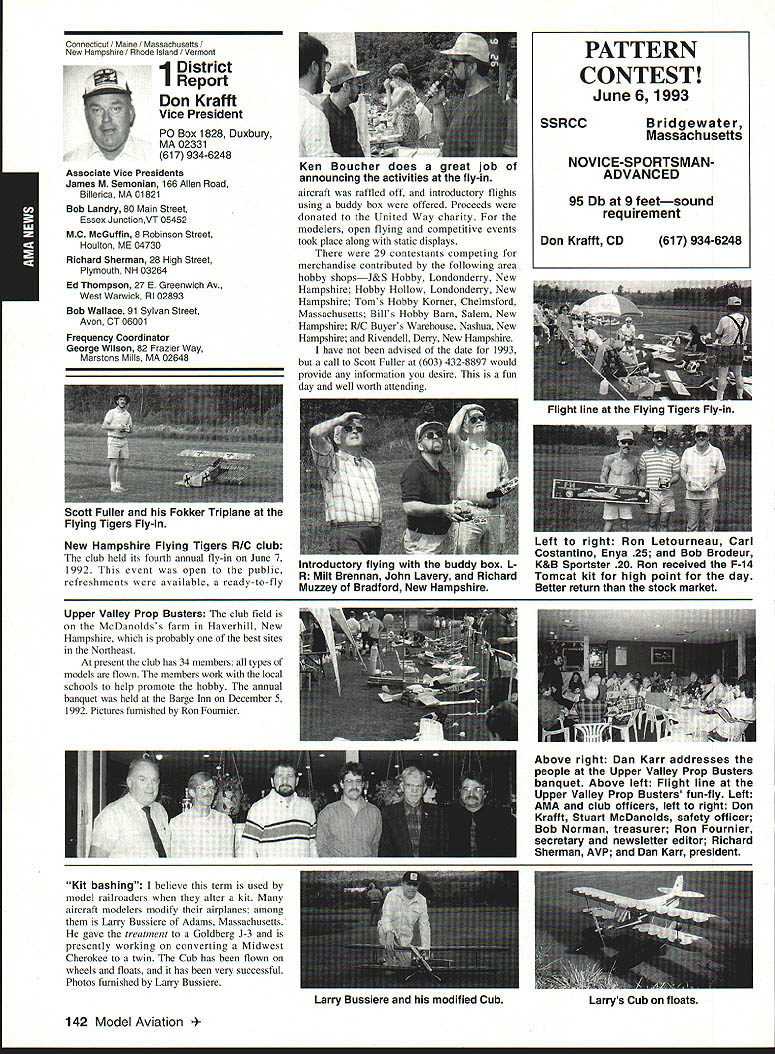
The club held its fourth annual fly-in on June 7, 1992. This event was open to the public, refreshments were available, a ready-to-fly aircraft was raffled off, and introductory flights using a buddy box were offered. Proceeds were donated to the United Way charity. For the modelers, open flying and competitive events took place along with static displays.
There were 29 contestants competing for merchandise contributed by the following area hobby shops:
- J & S Hobby, Londonderry, NH
- Hobby Hollow, Londonderry, NH
- Tom's Hobby Korner, Chelmsford, MA
- Bill's Hobby Barn, Salem, NH
- R/C Buyer's Warehouse, Nashua, NH
- Riverdell, Derry, NH
I have not been advised of the date for 1993, but a call to Scott Fuller at (603) 432-8897 would provide any information you desire. This is a fun day and well worth attending.
Upper Valley Prop Busters:
The club field is on the McDonald's farm in Haverhill, New Hampshire, which is probably one of the best sites in the Northeast.
At present the club has 34 members; all types of models are flown. The members work with the local schools to help promote the hobby. The annual banquet was held at the Barge Inn on December 5, 1992. Pictures furnished by Ron Fournier.
"Kit bashing": I believe this term is used by model railroaders when they alter a kit. Many aircraft modelers modify their airplanes; among them is Larry Bussiere of Adams, Massachusetts. He gave the treatment to a Goldberg J-3 and is presently working on converting a Midwest Cherokee to a twin. The Cub has been flown on wheels and floats, and it has been very successful. Photos furnished by Larry Bussiere.
AMA News
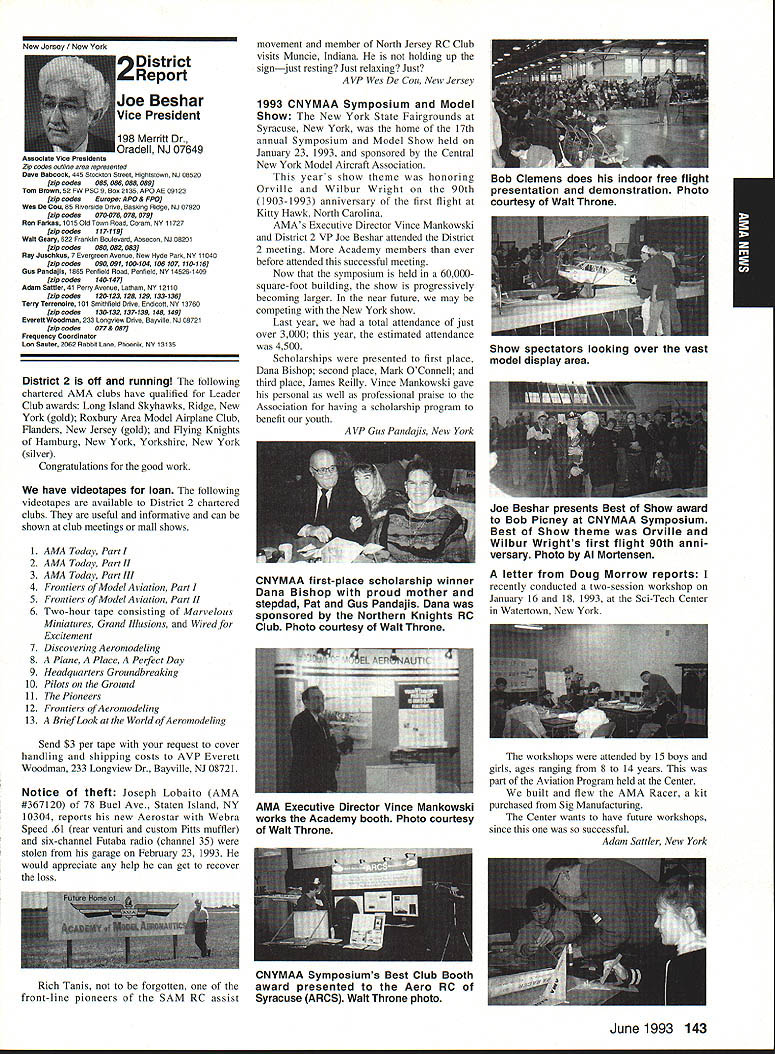
District 2 is off and running! The following chartered AMA clubs have qualified for Leader Club awards:
- Long Island Skyhawks, Ridge, NY (gold)
- Roxbury Area Model Airplane Club, Flanders, NJ (gold)
- Flying Knights of Hamburg, NY, Yorkshire, NY (silver)
Congratulations for the good work.
We have videotapes for loan. The following videotapes are available to District 2 chartered clubs. They are useful and informative and can be shown at club meetings or mall shows:
- AMA Today, Part I
- AMA Today, Part II
- AMA Today, Part III
- Frontiers of Model Aviation, Part I
- Frontiers of Model Aviation, Part II
- Two-hour tape consisting of Marvelous Miniatures, Grand Illusions, and Wired for Excitement
- Discovering Aeromodelling
- A Plane, a Place, A Perfect Day
- Headquarters Grandopening
- Pilots on the Ground
- The Pioneers
- Frontiers of Aeromodelling
- A Brief Look at the World of Aeromodelling
Send $3 per tape with your request to cover handling and shipping costs to: AVP Everett Woodman 233 Longview Dr. Bayville, NJ 08721
Notice of theft: Joseph Lobaito (AMA #367120) of 78 Beull Ave., Staten Island, NY 10304, reports his new Aerostar with Webra Speed .61 (rear venturi and custom Pitts muffler) and six-channel Futaba radio (channel 35) were stolen from his garage on February 23, 1993. He would appreciate any help he can get to recover the loss.
3 District Report — Bob Brown, Vice President
Associate Vice Presidents:
- Mike Barbee, 6561 Calgary Court, Columbus, OH 43229-2008
- David H. Ellis, 5261 DeWitt Road, Cross Lanes, WV 25313-1209
- Nelson Gould, 1944 S. Idaho Street, Allentown, PA 18103
- John Hathaway, 102 Woodmere Drive, New Stanton, PA 15672
- Donald Klopp, 370 West Valley Forge Road, King of Prussia, PA 19406
- Joseph S. Vislay, 1381 Cranbrook Drive, Maumee, OH 43537
- Lawrence R. Weimer, 15613 Greendale Avenue, Maple Heights, OH 44137
- Mark Wilson, 4913 Marcy, Dayton, OH 45449
Frequency Coordinator:
- John Cottle, 1012 Wyoming Avenue, Forty Fort, PA 18704
Phone: (717) 287-8970
AMA insurance: The acquisition and maintenance of flying sites should be easier with the recent revision to the AMA insurance. The increase to $2.5 million provides the liability coverage needed to satisfy the most critical landowner. Let's hope we never need it—it's there if we do.
Frequency problems: Today, the most frequently asked question has to do with the current status of the Federal Communications Commission's (FCC's) rearrangement of frequencies. Since the status seems to change almost on an hourly basis, constant updates are needed. If you want to be current, don't hesitate to call your AMA officials. You should also contact your congressmen and keep them advised of your interest. As has been stated many times—your involvement is necessary!
You can be included: Quite often, members comment on the lack of coverage of their club within the District 3 column. Almost every article sent to your vice president has been utilized. To see yourself in Model Aviation is quite simple. Send a brief write-up of your activity or model along with any color or black-and-white picture to me. No guarantee, but the odds couldn't be better that you'll see yourself soon.
George McLean, a member of the North Canton RC Club, recently inquired as to how to be included. Since George also enclosed some pictures and a short write-up, the question can be answered very quickly.
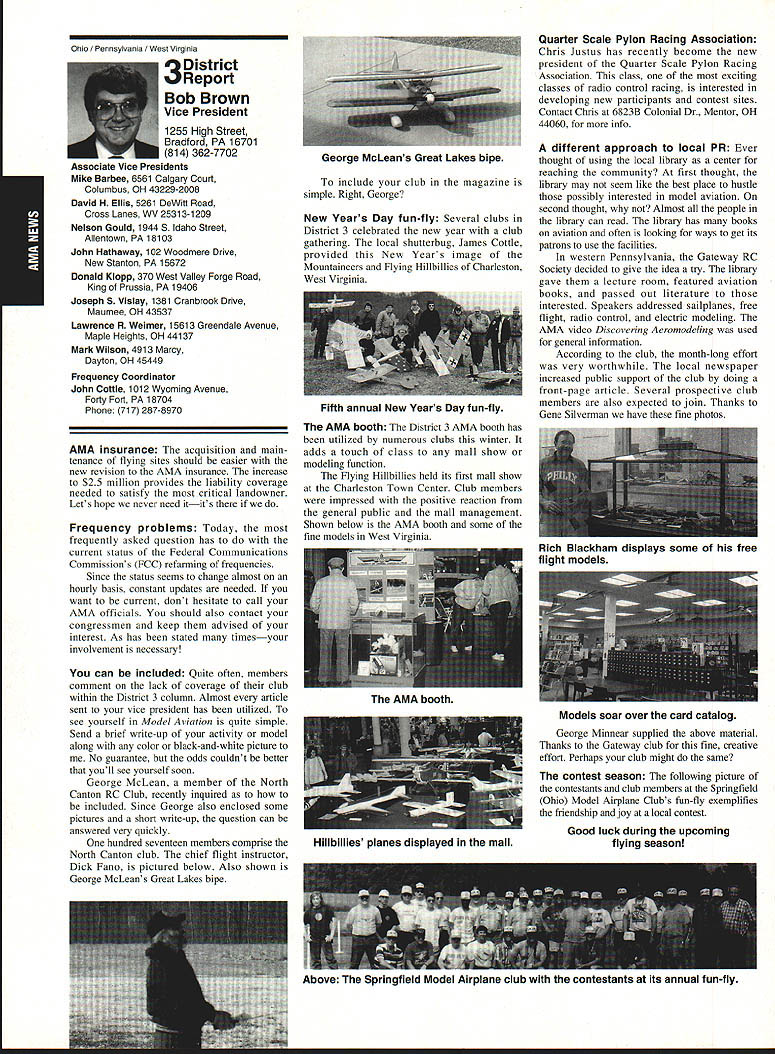
One hundred seventeen members comprise the North Canton club. The chief flight instructor, Dick Fano, is pictured below. Also shown is George McLean's Great Lakes biplane.
To include your club in the magazine is simple. Right, George?
New Year's Day fun-fly: Several clubs in District 3 celebrated the new year with a club gathering. The local shutterbug, James Cottle, provided this New Year's image of the Mountaineers and Flying Hillbillies of Charleston, West Virginia.
The AMA booth: The District 3 AMA booth has been utilized by numerous clubs this winter. It adds a touch of class to any mall show or modeling function.
The Flying Hillbillies held its first mall show at the Charleston Town Center. Club members were impressed with the positive reaction from the general public and the mall management. Shown below is the AMA booth and some of the fine models in West Virginia.
Quarter Scale Pylon Racing Association: Chris Justus has recently become the new president of the Quarter Scale Pylon Racing Association. This class, one of the most exciting classes of radio control racing, is interested in developing new participants and contest sites. Contact Chris at 6823 Colonial Dr., Mentor, OH 44060, for more info.
A different approach to local PR: Ever thought of using the local library as a center for reaching the community? At first thought, the library may not seem like the best place to hustle those possibly interested in model aviation. On second thought, why not? Almost all the people in the library can read. The library has many books on aviation and often is looking for ways to get its patrons to use the facilities.
In western Pennsylvania, the Gateway RC society decided to give the idea a try. The librarian gave them a lecture room, featured aviation books, and passed out literature to those interested. Speakers addressed sailplanes, free flight, radio control, and electric modeling. The AMA video Discovering Aeromodelling was used for general information. According to the club, the month-long effort was very worthwhile. The local newspaper increased public support of the club by doing a front-page article. Several prospective club members are also expected to join. Thanks to Gene Silverman we have these fine photos.
The contest season: The following picture of the contestants and club members at the Springfield (Ohio) Model Airplane Club's fun-fly exemplifies the friendship and joy at a local contest. Good luck during the upcoming flying season!
AMA News
4 District Report
Howard Crispin Vice President 611 Beechwood Dr., Charlottesville, VA 22901
Associate Vice Presidents:
- Robert E. Barba, 117 Otis Drive, Severn, MD 21144. Phone: (410) 969-9356
- Bob Champine, 205 Topton Road, Newport News, VA 23606
- Chuck Foreman, 5811 Rinker Drive, Mechanicsville, VA 23111
- Doug Holland, 3517 Farrowood Drive, Raleigh, NC 27612
- Scotty Meyer, 11 Orchard Lane, Wilmington, DE 19809
- Richard (Dick) Smith, 761 Gwynne Avenue, Waynesboro, VA 22980-3346
- Charles Spear, 288 Holly Lane, Mocksville, NC 27028
Frequency Coordinator:
- Paul Yacoubcci, 6408 Winthrop Drive, Fayetteville, NC 28311. Phone: Evening (919) 488-5986
Safety: A safety article appeared in a recent issue of the AMA National Newsletter, under the byline of Mike Lynch and credited to the Tri-Village Newsletter, whose editor is Fred L. Krogman.
This particular article has been reproduced in several District 4 newsletters and probably does more across the country. The article, while good for the purpose, has one especially improper statement. I talked to people at AMA Headquarters concerning the problem. No retraction or correction has been made. The statement in question says, "ALWAYS stand in front of or behind the airplane." The first half of the statement is absolutely wrong!
Propellers are probably the most likely cause of injuries, especially cuts and bruises, that occur from the operation of model aircraft.
It is important to understand the safe manner for the use of these devices. It is true that a propeller blade may be thrown directly out from the hub, but the spinner, prop nut, and propeller will travel in front of the aircraft. The blade itself lifts in that direction and has little option but to continue if separated from the shaft of the engine. The propeller must move forward to leave the engine.
The statement should read "Never stand in front of the aircraft after starting the engine. ALWAYS stand to the rear of the aircraft after starting the engine." If you or your club are using this article, please make this correction. We do not need more injuries resulting from a rather dumb statement. Please correct it.
AMA Leader Member clubs: Congratulations are extended to the clubs that have met the standards required for Leader Member status. Your club can also apply for this award. Information regarding application for the award was published in the February AMA National Newsletter. You may also obtain the information from headquarters.
The Northern Virginia Radio Control Club (NVRC) operates at a site south of Dulles Airport, just off U.S. 50, west of VA 28.
The club has long been the most active in Northern Virginia. They have held many local events in many categories, including some innovative types of flying contests. NVRC supports an AMA Show Team and an IMAA chapter. Members of the club have worked with local authorities and other clubs in flying site acquisition and have been active in AMA official activities, such as the frequency committee.
The current president is Ralph Ennis; the vice president, George Flood; the treasurer, Frank Hammerich; and the secretary, Tom Perry. The newsletter, Feedback, is edited by Bernie Stucker.
The Fauquier Aero-Recreation Modelers (FARM) is another longtime club in northern Virginia. The club has worked closely with county officials, although there has been less support in the last couple of years. Some struggles have occurred when school property was used for years as a flying site was converted into ball fields. A new site is being sought and is about to be placed in full service, and things are again looking up.
The club has held a number of events in the past and will be doing this again very soon. The president of the club is Bill McMullin; the vice president, Charlie Koutsenius; the secretary, Ralph Grubb; the treasurer, Ed Gerber, Jr.; and the newsletter editor, Kirby Benson. Former editor Tom Chipley is a monthly contributor to the newsletter.
The Baltimore Area Soaring Society (BASS) is one of the first soaring clubs to attain Leader Member club status, having qualified for the Gold. The club created and presented a 27-page booklet in support of its application. The presentation included written documentation, photographs, maps, letters, club history and other information relative to the club history. This is a good example of what each club applicant might consider doing.
The club newsletter, in discussing the award, made special mention of the activities of John Dolf. He is the catalyst for many of the activities cited; too, was his work in the club's school program in association with another Leader Member club, The Westminster Aero Modelers. The president of BASS is Al DeBerniz; the vice president, Bill Cavanaugh (former and longtime editor of BASS News); the treasurer, Jose Alluig; the secretary, John Appling; and the BASS News editor is Steve Pasierb.
Look for AMA members wearing the Leader Club lapel pin! It is the symbol that identifies those clubs and members working for the betterment of model aviation. These people are committed to informing the public about who we are and what we represent to the community.
Trade show: Keep in mind the Mid-Atlantic Radio Control Show, June 5 and 6, at the Maryland State Fair Grounds, Timonium, Maryland.
The show building is now air-conditioned for a more comfortable atmosphere. Handicapped parking is near the entrance. The MARC show is within easy reach of everyone in District 4. Stop by the AMA booth.
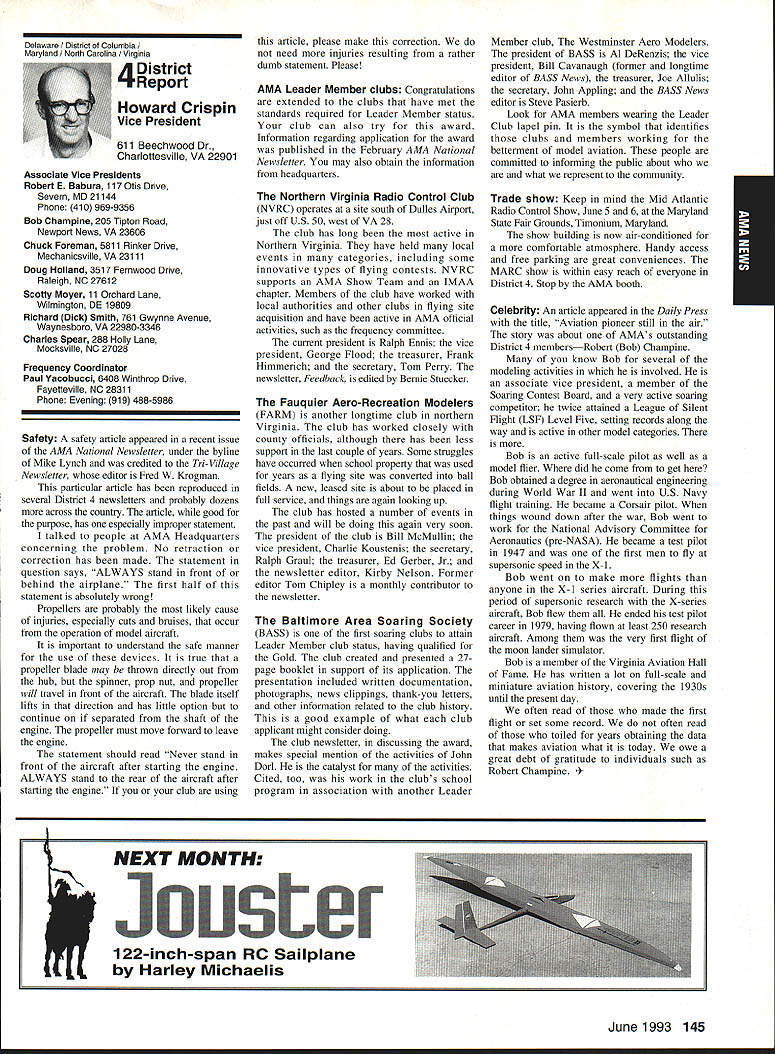
Celebrity: An article appeared in the Daily Press with the title, "Aviation pioneer still in the air." The story was about one of AMA's outstanding District 4 members—Robert (Bob) Champine.
Many of you know Bob for several of the activities in which he is involved. He is an associate vice president, a member of the Soaring Contest Board, and a very active soaring competitor; he also attained a League of Silent Flight (LSF) Level Five, setting records along the way, and is active in other model categories.
Bob is an active full-scale pilot as well as a model flier. Where did the love for the field begin? Bob obtained a degree in aeronautical engineering during World War II and went into U.S. Navy flight training. He became a Corsair pilot. When he returned after the war, Bob went to work for the National Advisory Committee for Aeronautics (pre-NASA). He became a test pilot in 1947 and was one of the first men to fly the X-1 supersonic research airplane.
We often read of those who made the first flight or set some record. We do not often read of those who toiled for years obtaining the data that makes aviation what it is today. We owe a great debt of gratitude to individuals such as Robert Champine.
AMA News
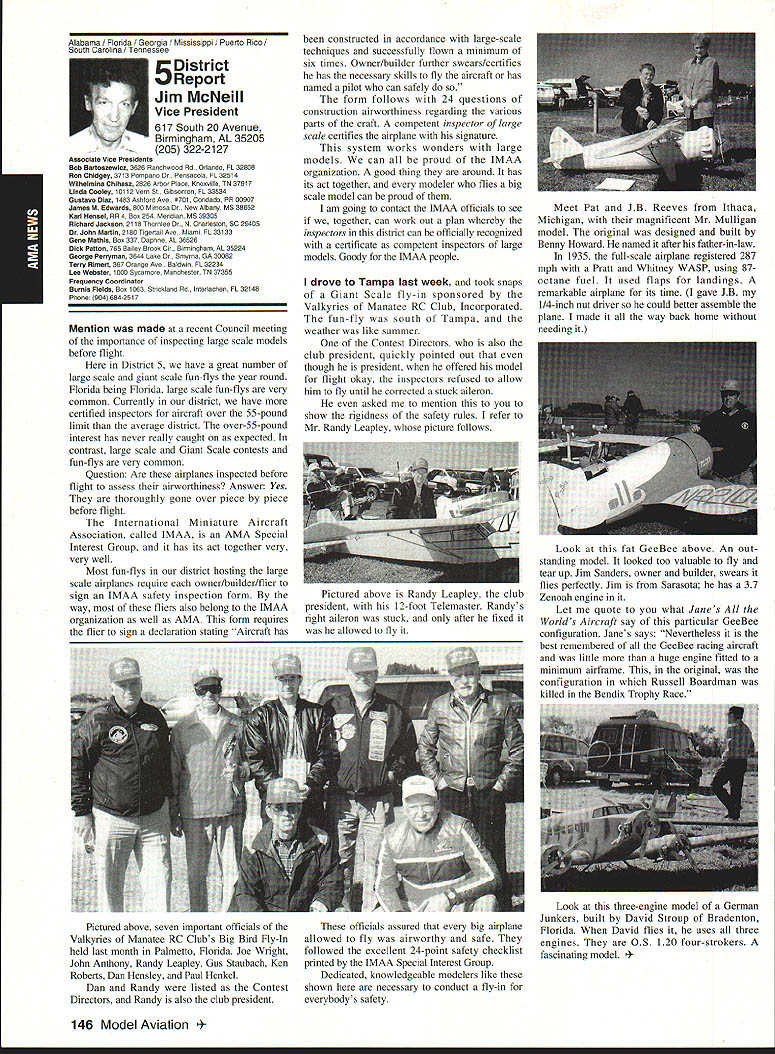
District 5 Report — Jim McNeill, Vice President
617 South 20 Avenue, Birmingham, AL 35205 (205) 322-2127
Mention was made at a recent Council meeting of the importance of inspecting large-scale models before flight.
Here in District 5, we have a great number of large-scale and giant-scale fun-flys year round. Florida being Florida, large-scale fun-flys are very common. Currently in our district, we have more certified inspectors for aircraft over the 55-pound limit than the average district. The over-55-pound interest has never really caught on as expected. In contrast, large-scale and Giant Scale contests and fun-flys are very common.
Question: Are these airplanes inspected before flight to assess their airworthiness? Answer: Yes. They are thoroughly gone over piece by piece before flight.
The International Miniature Aircraft Association, called IMAA, is an AMA Special Interest Group, and it has its act together very, very well.
Most fun-flys in our district hosting large-scale airplanes require each owner/builder/flyer to sign an IMAA safety inspection form. By the way, most of these fliers also belong to the IMAA organization as well as AMA. This form requires the flier to sign a declaration stating, "Aircraft has been constructed in accordance with large-scale techniques and successfully flown a minimum of six times. Owner/builder further swears/certifies he has the necessary skills to fly the aircraft or has named a pilot who can safely do so."
The form follows with 24 questions of construction airworthiness regarding the various parts of the craft. A competent inspector of large scale certifies the airplane with his signature.
This system works wonders with large models. We can all be proud of the IMAA organization. A good thing they are around. It has its act together, and every modeler who flies a big-scale model can be proud of them.
I am going to contact the IMAA officials to see if we, together, can work out a plan whereby the inspectors in this district can be officially recognized with a certificate as competent inspectors of large models. Good for the IMAA people.
I drove to Tampa last week, and took snaps of a Giant Scale fly-in sponsored by the Valkyries of Manatee RC Club, Incorporated. The fun-fly was north of Tampa, and the weather was like summer.
One of the Contest Directors, who is also the club president, quickly pointed out that even though he is president, when he offered his model for flight, the inspectors refused to allow him to fly until he corrected a stuck aileron.
He even asked me to mention this to you to show the rigidness of the safety rules. I refer to Mr. Randy Leapley, whose picture follows.
These officials assured that every big airplane allowed to fly was airworthy and safe. They followed the excellent 24-point safety checklist printed by the IMAA Special Interest Group.
Dedicated, knowledgeable modelers like these shown here are necessary to conduct a fly-in for everybody's safety.
PR Roundup — Geoffrey Styles, Director Marketing
Take Pride America
It's that time of year to look at your flying field. If you have improved and feel proud depending on how good your field looks you may qualify for an award under the Take Pride America program sponsored by the U.S. Department of the Interior. Two years ago Farragut Flyers, Idaho, won an award. This auspicious program recognizes people or groups who have appreciably improved a piece of U.S. real estate. Statewide awards usually are presented at the appropriate state capital. National awards are bestowed in Washington, D.C., at a special ceremony. On the occasion of impressive club wins, making the effort to improve the field to its highest possible level also makes for a memorable event. You may also enter the national contest if your state has a coordinator. Just ask us at AMA HQ — we can get addresses and an application form. If your state wins you'll be glad you asked. Best of luck.
Birds and model aircraft
Telephone calls often come in from people who say they are fanatical bird lovers and claim model flying is disrupting Mother Nature. Let us say, as a bird-watcher and ornithologist, that in honest years of model flying I have never seen a bird scared off by a model being flown responsibly. I have flown in the company of hawks, turkey buzzards and eagles. At Lodi, Wisconsin, one of the nicest slope-soaring sites in the country, hawks frequently have passed right through formation-flying sailplanes. The problem of birds being scared of models should be directed at full-size, noisier aircraft. Yes, one can see bird strikes reported at airports in parts of the country, and costly efforts have been made to get birds off airport property.
So this month we have enclosed a photo. Keep this page handy — you might need it some day. You could have enjoyed ducks much while flying.
AMA News
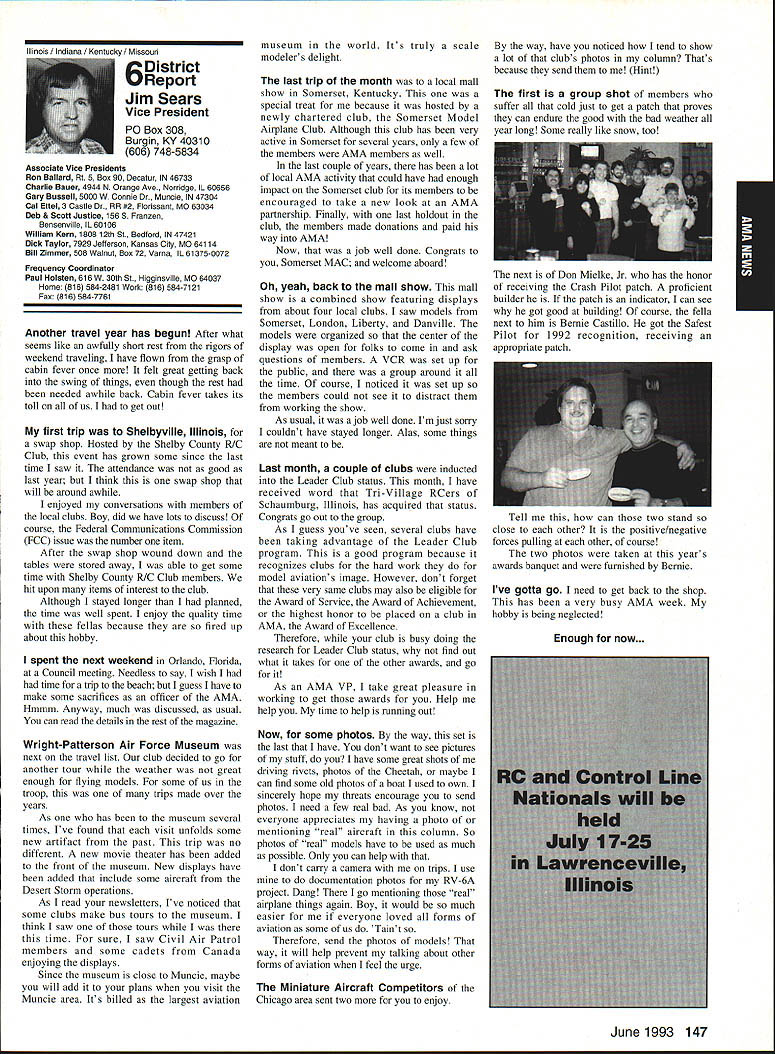
The Miniature Aircraft Competitors of the Chicago area sent two more for you to enjoy.
By the way, have you noticed how I tend to show a lot of that club's photos in my column? That's because they send them to me! (Hint.)
The first is a group shot of members who suffer all that cold just to get a patch that proves they can endure the good with the bad weather all year long! Some really like snow, too!
The next is of Don Mielke, Jr., who has the honor of receiving the Crash Pilot patch. A proficient builder he is. If the patch is an indicator, I can see why he got good at building! Of course, the fellow next to him is Bernie Castillo. He got the Safest Pilot for 1992 recognition, receiving an appropriate patch.
Tell me this, how can those two stand so close to each other? It is the positive/negative forces pulling at each other of course.
The two photos were taken at this year's awards banquet and were furnished by Bernie.
I've gotta go. I need to get back to the shop. This has been a very busy AMA week. My hobby is being neglected!
Enough for now...
AMA News
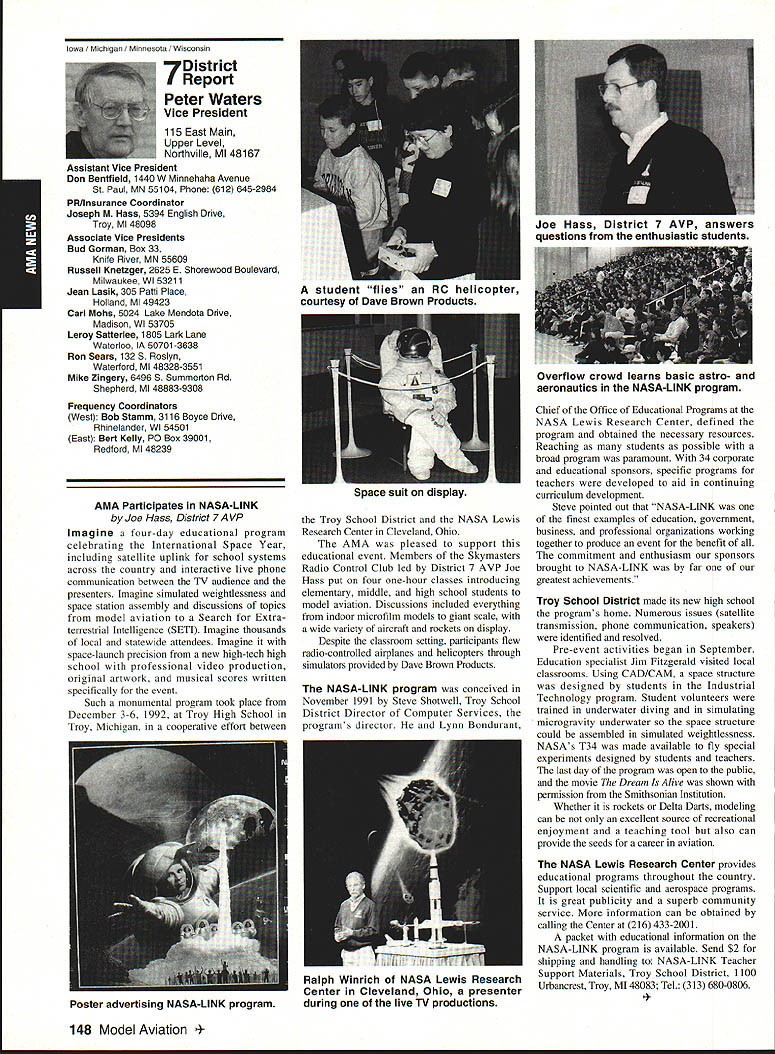
AMA Participates in NASA-LINK by Joe Hass, District 7 AVP
Imagine a four-day educational program celebrating the International Space Year, including satellite uplink for school systems across the country and interactive live phone communication between the TV audience and the presenters. Imagine simulated weightlessness and space station assembly and discussions of topics from model aviation to a Search for Extraterrestrial Intelligence (SETI). Imagine thousands of local and statewide participants. Imagine it with space-launch precision from a new high-tech high school with professional video production, original artwork, and musical scores written specifically for the event.
Such a monumental program took place from December 3-6, 1992, at Troy High School in Troy, Michigan, in a cooperative effort between the Troy School District and the NASA Lewis Research Center in Cleveland, Ohio.
The AMA was pleased to support this educational event. Members of the Skymasters Radio Control Club led by District 7 AVP Joe Hass put on four one-hour classes introducing elementary, middle, and high school students to model aviation. Discussions included everything from indoor micromodels to giant scale, with a wide variety of aircraft and rockets on display.
Despite the classroom setting, participants flew radio-controlled airplanes and helicopters and used simulators provided by Dave Brown Products.
The NASA-LINK program was conceived in November 1991 by Steve Shotwell, Troy School District Director of Computer Services, the program's director. He and Lynn Bondurant, chief of the Office of Educational Programs at the NASA Lewis Research Center, defined the program and obtained the necessary resources. Reaching as many students as possible with a broad program was paramount. With 34 corporate and educational sponsors, specific programs for teachers were developed to aid in continuing curriculum development.
Steve pointed out that "NASA-LINK was one of the finest examples of education, government, business, and professional organizations working together to produce an event for the benefit of all." The commitment and enthusiasm our sponsors brought to NASA-LINK were by far one of our greatest achievements.
Troy School District made its new high school the program's home. Numerous issues (satellite transmissions, phone communications, speakers) were identified and resolved.
Pre-event activities began in September. Education specialist Jim Fitzgerald visited local classrooms. Using CAD/CAM, a space shuttle was designed by students in the Industrial Technology program. Student volunteers were trained in underwater diving and in simulating microgravity underwater so the space structure could be assembled in simulated weightlessness. NASA's TV3 was made available to fly special experiments designed by students and teachers. The entire program was videotaped for later broadcast, and the movie The Dream Is Alive was shown with the permission of the Smithsonian Institution.
Whether it is rockets or Delta Darts, modeling can be not only an excellent source of recreational enjoyment and a teaching tool but also can provide the seeds for a career in aviation.
The NASA Lewis Research Center provides educational programs throughout the country. For information on local scientific and aerospace programs or the NASA-LINK program, contact the Center at (216) 433-2001.
A packet with educational information on the NASA-LINK program is available. Send $2 for shipping and handling to: NASA-LINK Teacher Support Materials Troy School District 1100 Urbancrest Troy, MI 48083 Tel.: (313) 680-0066
8 District Report
Gene Hempel Vice President 301 N. Yale Dr., Garland, TX 75042
Associate Vice Presidents:
- Chuck Andraka, 1701 Martha, N.E., Albuquerque, NM 87112
- Max Blose, 1001 N. Betsy, Waco, TX 76706
- Clyde Brothers, 4093 Whispering Oaks Drive, College Station, TX 77845
- Glenn Gressens, 10224 Kenlee Drive, Baton Rouge, LA 70815
- Bill Kimbro, 2105 Wood Street, Texarkana, TX 75501
- Steve Staples, 1300 Pine Valley, Little Rock, AR 72207
- Jim Traw, 1115 Merrymen Drive, Norman, OK 73072
- Ray Wagner, 2719 Verde, Odessa, TX 79762
- John Valls, 2052 Montgomery, PO Box 2241, Laredo, TX 78044
AMA Display Coordinator:
- Karen Hopkins, 5515 Bridgeton Avenue, Arlington, TX 76018
Frequency Coordinators:
- (North) Joe DuMond, 1830 Chevy Chase, Carrollton, TX 75006
- (South) Tim Ahrens, 14824 Bear Creek Pass, Austin, TX 78737
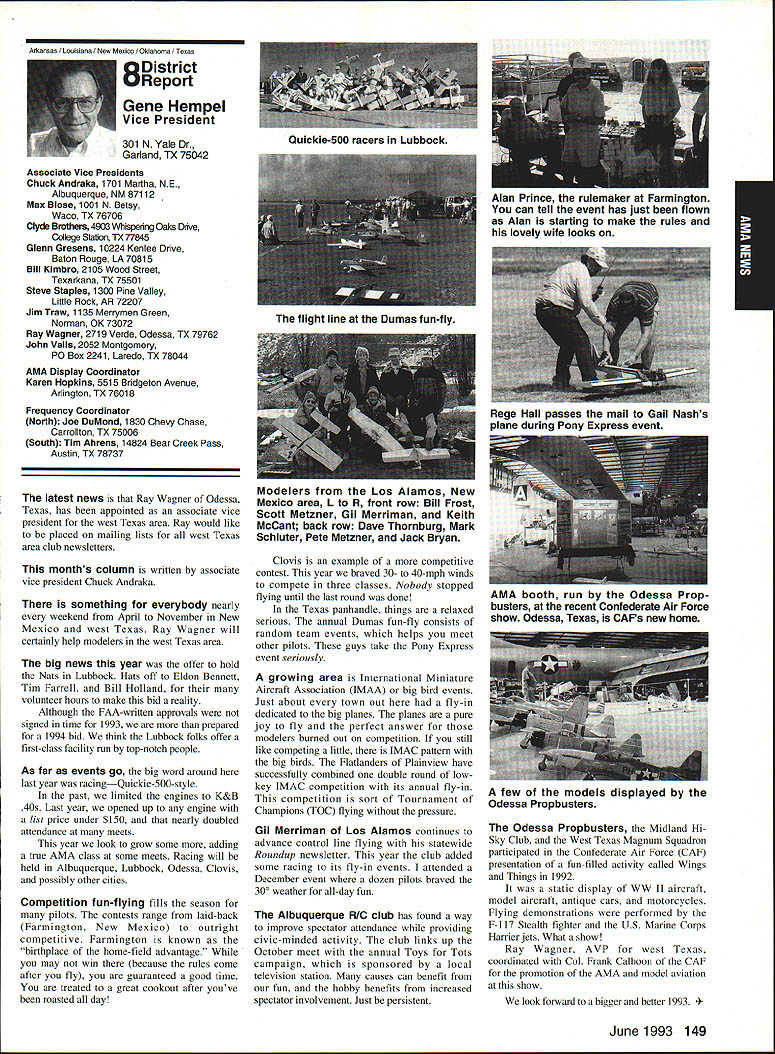
The latest news is that Ray Wagner of Odessa, Texas, has been appointed as an associate vice president for the west Texas area. Ray would like to be placed on mailing lists for all west Texas area club newsletters.
This month's column is written by associate vice president Chuck Andraka.
There is something for everybody nearly every weekend from April to November in New Mexico and west Texas. Ray Wagner will certainly help modelers in the west Texas area.
The big news this year was the offer to hold the Nats in Lubbock. Hats off to Eldon Bennett, Tim Farrell, and Bill Holland, for their many volunteer hours to make this bid a reality.
Although the FAA-written approvals were not signed in time for 1993, we are more than prepared for a 1994 bid. We think the Lubbock folks offer a first-class facility run by top-notch people.
As far as events go, the big word around here is starter wars—Quickie-500 style.
In the past, we limited the engines to K&B .40s. Last year, we opened up to any engine with a .45 size or under .150, and that nearly doubled attendance at many meets.
This year we look to grow some more, adding a true AMA class at some meets. Racing will be held in Albuquerque, Lubbock, Odessa, Clovis, and possibly other cities.
Competition fun-flying fills the season for many pilots. The contests range from laid-back (Farmington, New Mexico) to outright competitive. Farmington is known as the "birthplace of the home-field advantage." While you may not win there (because the field is on top of a mesa), you are guaranteed a good time. You are treated to a great cookout after you've been roasted all day!
Clovis is an example of a more competitive contest. They braved 30- to 40-mph winds to compete in three classes. Nobody stopped flying until the last round was done!
In the Texas panhandle, things are a relaxed serious. The annual Dumas fun-fly consists of random team events, which helps you meet other pilots. These guys take the Pony Express event seriously.
A growing area is International Miniature Aircraft Association (IMAA) or big-bird events. Just about every town out here has a big-fly field dedicated to the big planes. The planes are a pure joy to fly and the perfect answer for those modelers burned out on competition. If you still like competing a little, there is IMAA pattern with big birds. The Flatlanders of Plainview have successfully combined the double round of low-key IMAC competition with its annual fly-in. This competition is sort of Tournament of Champions (TOC) flying without the pressure.
Gil Merriman of Los Alamos continues to advance control line flying with his statewide Roundup newsletter. This year the club added some racing to its fly-in events. I attended a December event where a dozen pilots braved the 30° weather for all-day fun.
The Albuquerque R/C club has found a way to improve spectator attendance while providing civic-minded activity. The club links up their October meet with the annual Toys for Tots campaign, which is sponsored by a local television station. Many causes can benefit from a fun event, and the hobby benefits from increased spectator involvement. Just be persistent.
The Odessa Propbusters, the Midland Hi-Sky Club, and the West Texas Magnum Squadron participated in the Confederate Air Force (CAF) presentation of a fun-filled activity called Wings and Things in 1992.
It was a static display of WWII aircraft, model aircraft, antique cars, and motorcycles. Flying demonstrations were performed by the F-117 Stealth fighter and the U.S. Marine Corps Harrier jets. What a show!
Ray Wagner, AVP for west Texas, coordinated with Col. Frank Calhoun of the CAF for the promotion of the AMA and model aviation at the show.
We look forward to a bigger and better 1993.
9 District Report
Russ Miller Vice President 980 N. 3rd Street, Carrington, ND 58421 Days: (701) 652-2739 Evenings: (701) 652-2321
Associate Vice Presidents:
- Nathan Lancaster, 3597 S. Kendall Street, Denver, CO 80235
- Travis McGinnis, 8027 W. 81st Circle, Arvada, CO 80005
- Loren Moen, 607 E. Vera, Bottineau, ND 58318
- Don Moden, 410 Hart, Salina, KS 67401
- Jim Ricketts, 4921 Fernwood Drive, Sioux Falls, SD 57103-5573
- R.L. "Doc" Scraper, 9524 Rose Avenue, Overland Park, KS 66207
- Jack L. Sibert, 3611 Kimberly Circle, Lincoln, NE 68506-4524
- Chuck Smith, 1091 Cheshire Street, Casper, WY 82609-3214
Frequency Coordinator:
- Steve Mangles, c/o Radio Service Center, 918 S. Sheridan, Denver, CO 80226
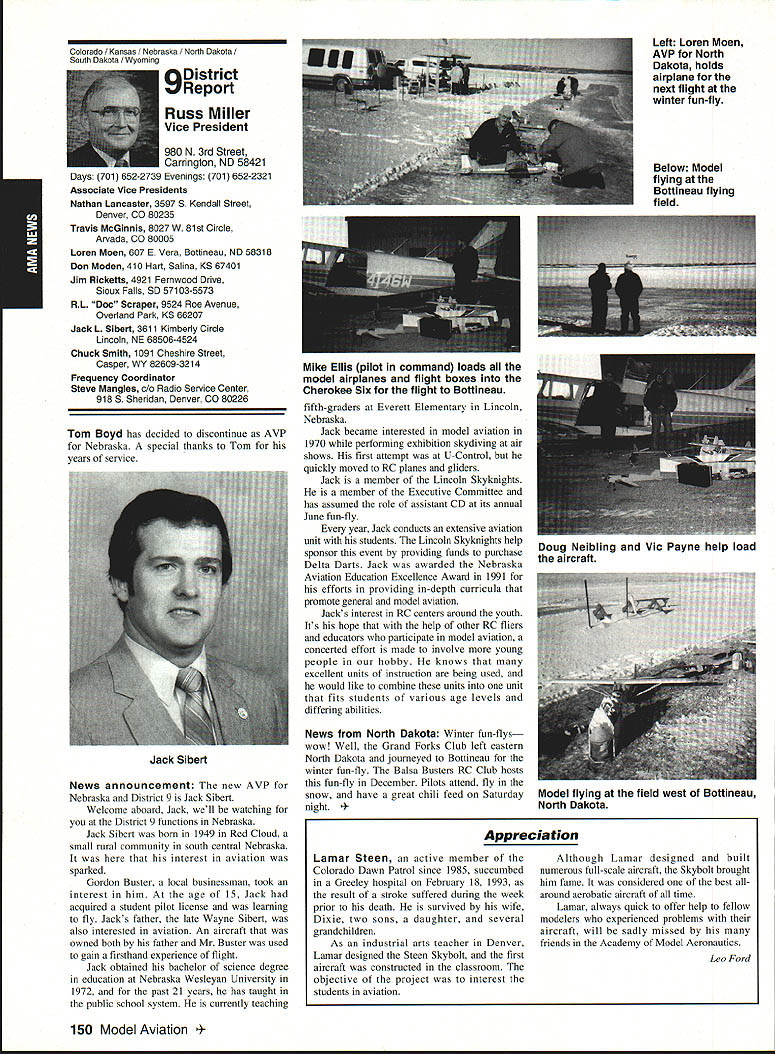
Tom Boyd has decided to discontinue as AVP for Nebraska. A special thanks to Tom for his years of service.
News announcement: The new AVP for Nebraska and District 9 is Jack Sibert. Welcome aboard, Jack; we'll be watching for you at the District 9 functions in Nebraska.
Jack Sibert was born in 1949 in Red Cloud, a small rural community in south central Nebraska. It was here that his interest in aviation was sparked. Gordon Buser, a local businessman, took an interest in him. At the age of 15, Jack had acquired a student pilot license and was learning to fly. Jack's father, the late Wayne Sibert, was also interested in aviation. An aircraft that was owned both by his father and Mr. Buser was used to gain a firsthand experience of flight.
Jack obtained his bachelor of science degree in education at Nebraska Wesleyan University in 1972, and for the past 21 years, he has taught in the public school system. He is currently teaching fifth-graders at Everett Elementary in Lincoln, Nebraska.
Jack became interested in model aviation in 1970 while performing exhibition skydiving at air shows. His first attempt was at U-Control, but he quickly moved to RC planes and gliders. Jack is a member of the Lincoln Skyknights. He is a member of the Executive Committee and has assumed the role of assistant CD at its annual June fun-fly.
Every year, Jack conducts an extensive aviation unit with his students. The Lincoln Skyknights help sponsor this event by providing funds to purchase Delta Darts. Jack was awarded the Nebraska Aviation Education Excellence Award in 1991 for his efforts in providing in-depth curricula that promote general and model aviation.
Jack's interest in RC centers around the youth. It's his hope that with the help of other RC fliers and educators who participate in model aviation, a concerted effort is made to involve more young people in our hobby. He knows that many excellent units of instruction are being used, and he would like to combine these units into one unit that fits students of various age levels and differing abilities.
News from North Dakota: Winter fun-flys—wow! Well, the Grand Forks Club left eastern North Dakota and journeyed to Bottineau for the winter fun-fly. The Balsa Busters RC Club hosts this fun-fly in December. Pilots attend, fly in the snow, and have a great chili feed on Saturday night.
AMA News
Great news from AMA Headquarters on increased liability coverage in the model aviation insurance program. Liability coverage has been increased to $2,500,000 per occurrence with commercial general liability protection for each flying site having a per location limit of $5,000,000 in the aggregate.
A special thanks and job well done to Carl Maroney and the headquarters staff for many months of research, negotiation, and hard work on behalf of the AMA membership. This is truly AMA at its best and reflects its dedication to providing superior membership services.
Congratulations! Leader Club status has been achieved and announced for the following District 10 Clubs:
- Antelope Valley Tailwinds, Inc., Lancaster, California
- Santa Clara County Model Aircraft Skypark, Morgan Hill, California
- Tustin Model Aircraft Association, Laguna Hills, California
District 10 has some of the best local modeling organizations in the nation, and I know there are many more clubs deserving recognition for their commitment to their communities and continuing activities.
Is your club a Leader Club? There are 14 criteria for Leader Club status. I know that dozens of clubs in District 10 qualify in many of these criteria, and I encourage local club officers to put forward their clubs for this prestigious award.
Additional information can be obtained from Jay Mealy at AMA headquarters.
I am sure everyone knows by now that there has been a lot of activity lately relating to RC frequencies and the FCC's proposed rule making—Docket #92-235. AMA has been doing an excellent job of staying on top of this situation and has opened a dialogue with the administration of the FCC on this issue.
The AMA Frequency Committee needs your help to identify the amount of local RC use on the 27 MHz band. This band lost favor during the CB craze of the mid-1970s and the concern over illegal high-powered linear amplifiers that spewed sideband transmissions all over the band.
However, there are still many RC operators on 27 MHz, and the frequency committee would like information on the numbers and location. Local District 10 clubs are asked to survey their members on frequency use on the 27 MHz band and submit that information to the District Frequency Coordinators, George Steiner and Eloy Marez.
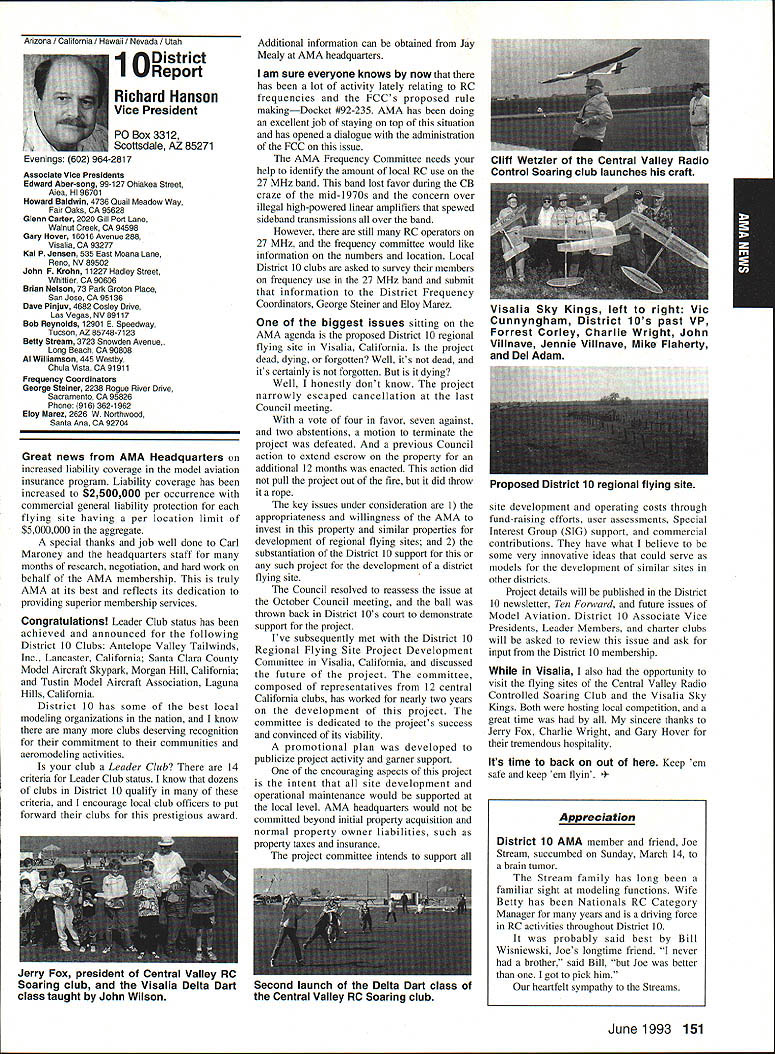
One of the biggest issues sitting on the AMA agenda is the proposed District 10 regional flying site in Visalia, California. Is the project dead, dying, or forgotten? Well, it's not dead, and it's certainly not forgotten. But is it dying?
Well, I honestly don't know. The project narrowly escaped cancellation at the last Council meeting.
With a vote of four in favor, seven against, and two abstentions, a motion to terminate the project was defeated. And a previous Council action to extend escrow on the property for an additional 12 months was enacted. This action did not pull this project out of the fire, but it did throw it a rope.
The key issues under consideration are:
- The appropriateness and willingness of the AMA to invest in this property and similar properties for development of regional flying sites.
- The submittal of the District 10 support for this or any such project for the development of a district flying site.
The Council resolved to reassess the issue at the October Council meeting, and the ball was thrown back in District 10's court to demonstrate support for the project.
I've subsequently met with the District 10 Regional Flying Site Project Development Committee in Visalia, California, and discussed the current status of the project. The committee, composed of representatives from 12 central California clubs, has worked for nearly two years on the development of this project. The committee is dedicated to the project's success and convinced of its viability.
A promotional plan was developed to publicize project activity and garner support. One of the encouraging aspects of this project is the intent that all site development and operational maintenance would be supported at the local level. AMA headquarters would not be committed beyond initial property acquisition and normal property owner liabilities, such as property taxes and insurance.
The project committee intends to support all site development and operating costs through fund-raising efforts, user assessments, Special Interest Group (SIG) support, and commercial contributions. They have what I believe to be some very innovative ideas that could serve as models for the development of similar sites in other districts.
Project details will be published in the District 10 newsletter, Ten Forward, and future issues of Model Aviation. District 10 Associate Vice Presidents, Leader Members, and charter clubs will be asked to review this issue and ask for support from the District 10 membership.
While in Visalia, I also had the opportunity to visit the flying sites of the Central Valley Radio Control Soaring Club and the Visalia Sky Kings. Both were hosting local competition, and a great time was had by all. My sincere thanks to Jerry Fox, Charlie Wright, and Gary Hower for their tremendous hospitality.
It's time to back on out of here. Keep 'em aloft and keep 'em flyin'.
Appreciation
District 10 AMA member and friend, Joe Stream, succumbed on Sunday, March 14, to a brain tumor.
The Stream family has long been a familiar sight at modeling functions. Wife Betty has been Nationals RC Category Manager for many years and is a driving force in RC activities throughout District 10.
It was probably said best by Bill Wisniewski, Joe's longtime friend. "I never had a brother," said Bill, "but Joe was better than one. I got to pick him."
Our heartfelt sympathy to the Streams.
AMA News
Academy of Model Aeronautics 1810 Samuel Morse Drive Reston, VA 22090
Key Dates:
- April 30–May 2: IMAC, Orlando, Florida
- June 3–6: Indoor Nats, Johnson City, Tennessee
- June 19: Annual Membership Meeting, Muncie, Indiana
- June 19–20: Homecoming, Muncie, Indiana
- June 26–27: IMAA, Muncie, Indiana
- July 2: Officer nominations due at Headquarters
- July 7: Officer nominations due, PAMPA Precision Aerobatics Model Pilots Association
- July 10–11: Intercities FF Meet
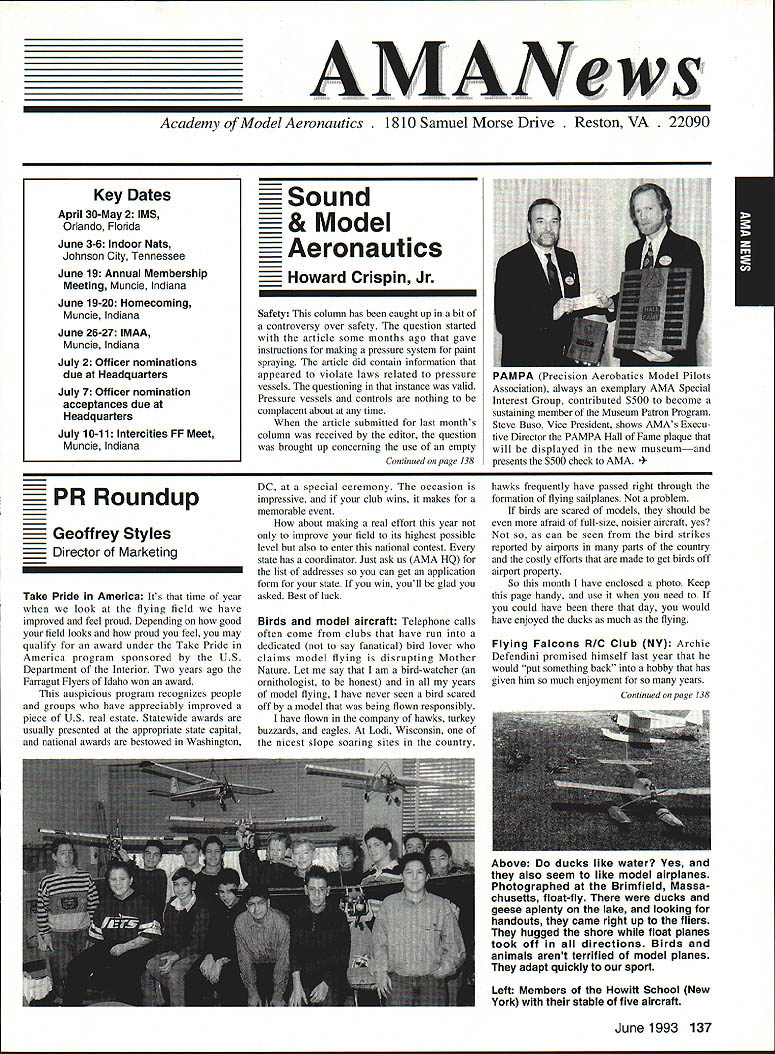
Safety column has caught up a bit of controversy over a safety question started some months ago. An earlier article gave instructions for making a pressure-system paint-spraying apparatus. The article did contain information that appeared to violate laws related to pressure vessels. In questioning this instance, AMA Headquarters accepted that pressure-vessel controls are a legitimate concern. AMA Special Interest Group contributed $500 to become a sustaining member of the Museum Patron Program.
Steve Buso, Vice President, shows AMA's Executive Director PAMPA Hall of Fame plaque. The plaque will be displayed in the new museum and presents a $500 check.
PR Roundup — Geoffrey Styles, Director, Marketing
Take Pride America
It's that time of year to look at the flying field and see if you have improved it and feel proud. Depending on how good the field looks and how proud you feel, you may qualify for an award under the Take Pride America program sponsored by the U.S. Department of the Interior. Two years ago Farragut Flyers, Idaho, won an award. This auspicious program recognizes people and groups who have appreciably improved a piece of U.S. real estate. Statewide awards usually are presented at the appropriate state capital; national awards are bestowed in Washington, D.C., at a special ceremony. The occasion of an impressive club win makes a memorable event. About making a real effort this year to improve your field to its highest possible level — also enter the national contest. Each state has a coordinator. Just ask us at AMA HQ; we'll list addresses and can get an application form for your state. Win and you'll be glad you asked. Best luck.
Birds, model aircraft
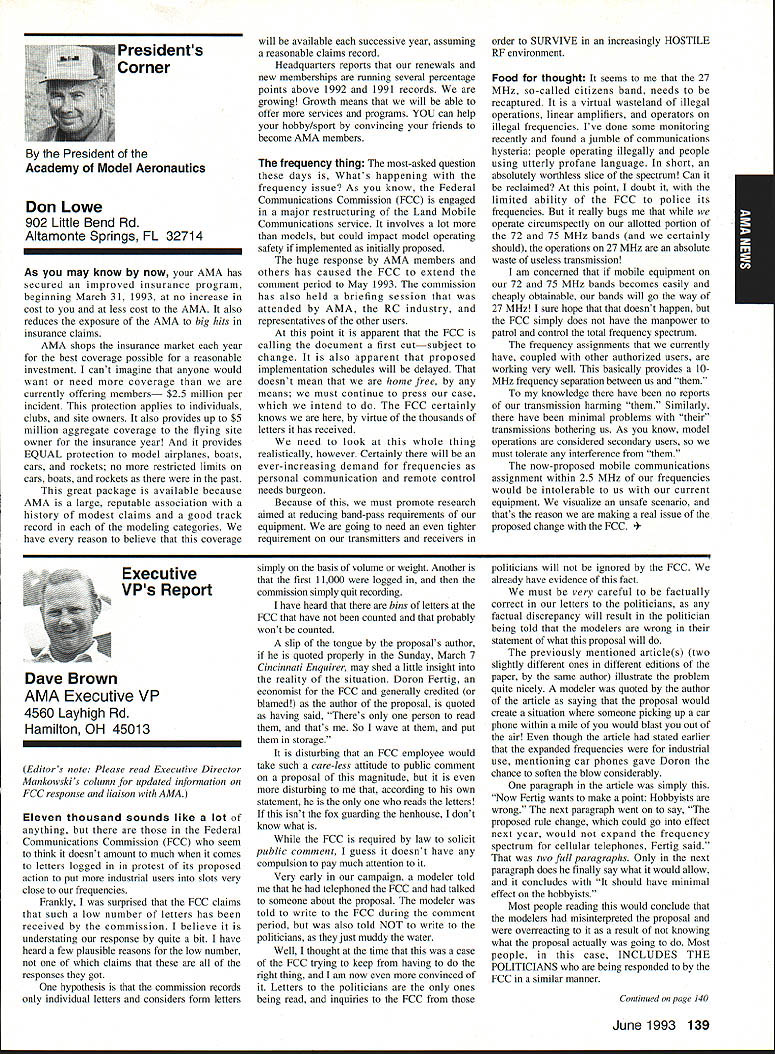
Telephone calls often come from clubs from people who say they are fanatical bird lovers and claim model flying is disrupting Mother Nature. Let us say that as a bird-watcher or ornithologist, and honest one at that, in years of model flying I have never seen a bird scared off by a model being flown responsibly. I have flown in the company of hawks, turkey buzzards, eagles. At Lodi, Wisconsin, one of the nicest slope-soaring sites in the country, hawks frequently have passed right through formation-flying sailplanes. Problems with birds being scared occur with full-size noisier aircraft; yes, bird strikes have been reported at airports in parts of the country and costly efforts have been made to get birds off airport property. So this month we have enclosed a photo. Keep the page handy in case you need it some day. You could have ducks while flying.
Flying Falcons R/C Club, NY
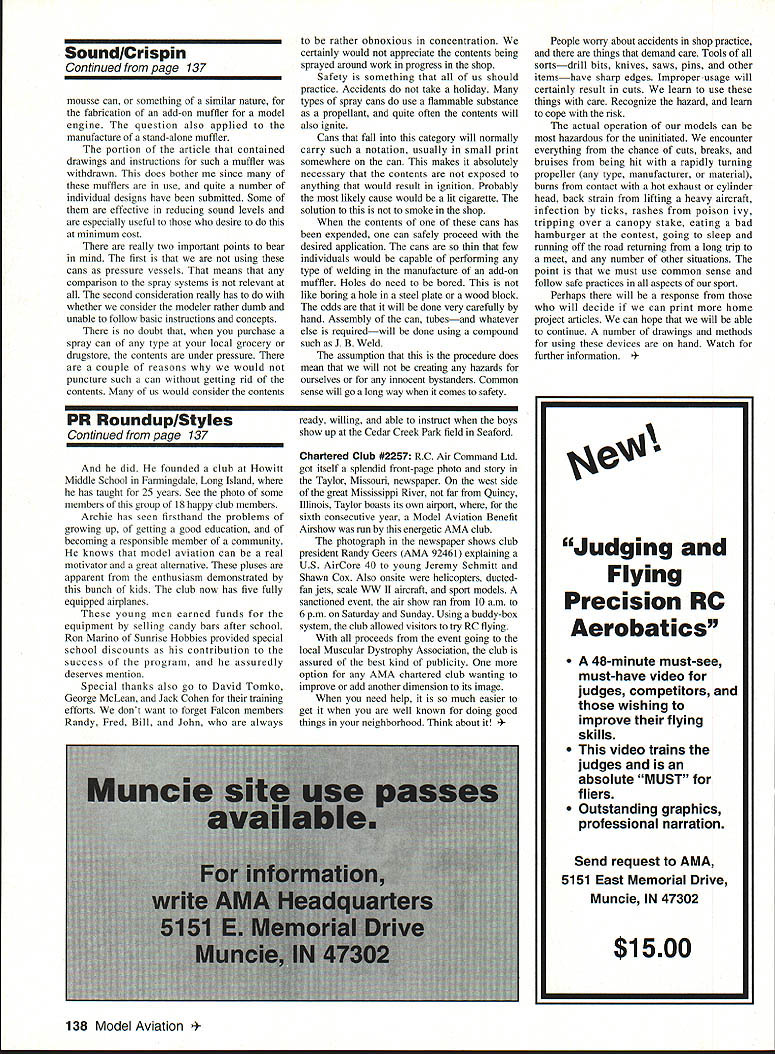
Archie Defendini promised himself last year he would put something back into the hobby that has given him much enjoyment over the years.
In its contest time again, and most will be found listed in the contest calendar. As you will see, the first of May remembers Zillah and the NW Regionals, two of the longest-running contests around, mentioned earlier.
Early in June comes Flat I, a fine floatplane event held near Sutherlin, Oregon. Go to Sutherlin, take the I-5 exit, and head east. Out in the country, a couple of miles from town, you will see a sign that says Flat I Reservoir, and it will point south.
The Umpqua Valley gang will have some signs out to tell where the float-fly is, so that should help. Bring something to fly off the water. Expect to have a good time and get in some relaxing flying.
June 18–20 brings the First Scalemasters Regional at Farragut State Park. Now that's a place that sets the definition of scenic. The Farragut Flyers put on a fine scale contest in a lovely spot.
Don't forget to spend some time in Corvallis between the 5th and the 12th, when the contest that qualifies our RC Pattern team for the World Champs will be held. Mike Dunphy is paying off on a pledge he made to me at the Richland Nationals. He told me then that he would have the team trials in District 11. The contest will be held at the Corvallis airport, south of town. A trip to Trump's Hobbies will get you directions.
The Bell-Air Flyers is holding its fourth annual Big Bird Fly-in near Bellingham, Washington, June 5–6.
The Bald Eagles Squadron of Eastern Washington will hold its second annual Giants of Summer IMAC Fly-in at Quartzite Mountain Sod and Nursery near Chewelah, Washington, on June 12–13.
Next year, the IMAA will hold its annual Gathering of Eagles Fly-In at Arlington, Washington. Make your plans now.
The Kitsap ARC will put on a Helicopter Fun-Fly on June 5 and 6 at its field at Bremerton Raceway.
The Lilac City Fan-Fly will be brought to you by the Barons on July 10–11 at the Barons' field at Deer Park. Lots of concrete to fly your fan off of, and lots of fun facts to talk to.
Pine Hollow happens on July 10–11. Floatplane madness at its best. Most dedicated types show up about Tuesday since everyone knows the best flying weather always happens just before a contest. What with the lake and the resort atmosphere, this isn't type-A territory until Saturday anyway.
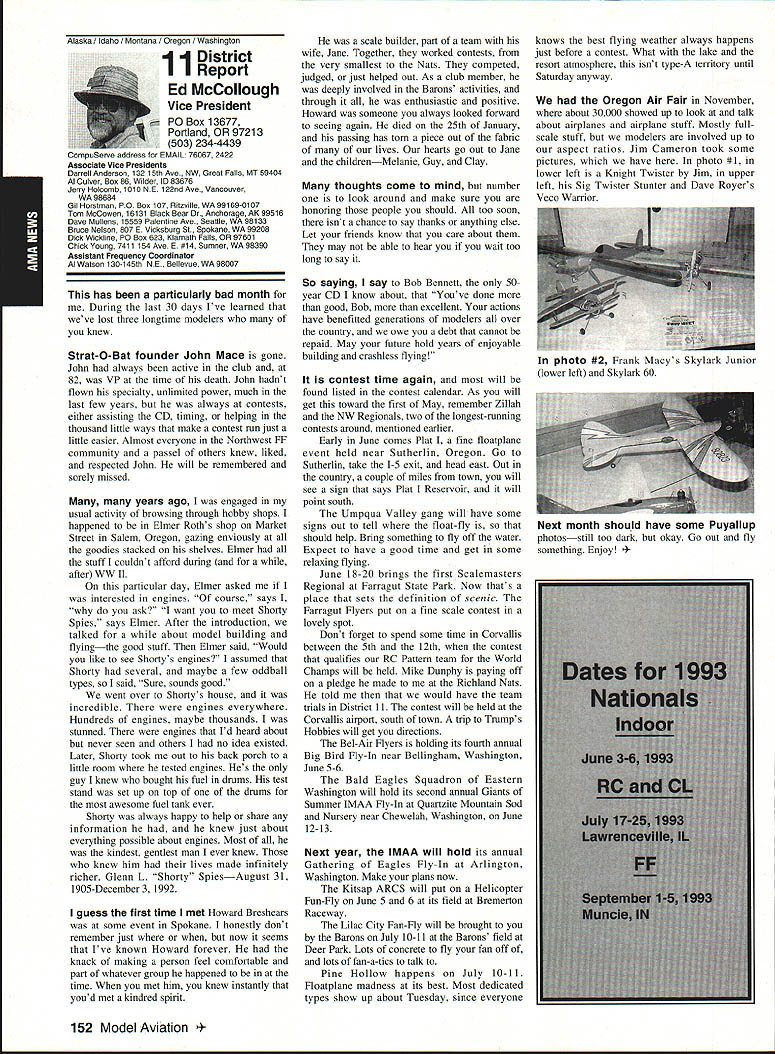
We had the Oregon Air Fair in November, where about 30,000 showed up to look at and talk about airplanes and air- and airplane stuff. Mostly full-scale stuff, but we modelers are involved up to our aspects. Jim Cameron took some pictures, which we have here. In photo #1, in picture lower left is a Knight Twister by Jim Dyer, in upper left, his Stig Swintert and Dave Royer's Veco Warrior.
Next month should have some Puyallup photos—still too dark, but okay. Go out and fly something. Enjoy!
Transcribed from original scans by AI. Minor OCR errors may remain.

