
AMA News
PR Roundup
Geoffrey Styles Director of Marketing
Some clubs run a mall show every year. Some clubs have adopted a stretch of highway. Some clubs run anti-drug campaigns, and some clubs have adopted a school. These are all emphatic, positive ways to get your club's name and needs known in your city or neighborhood.
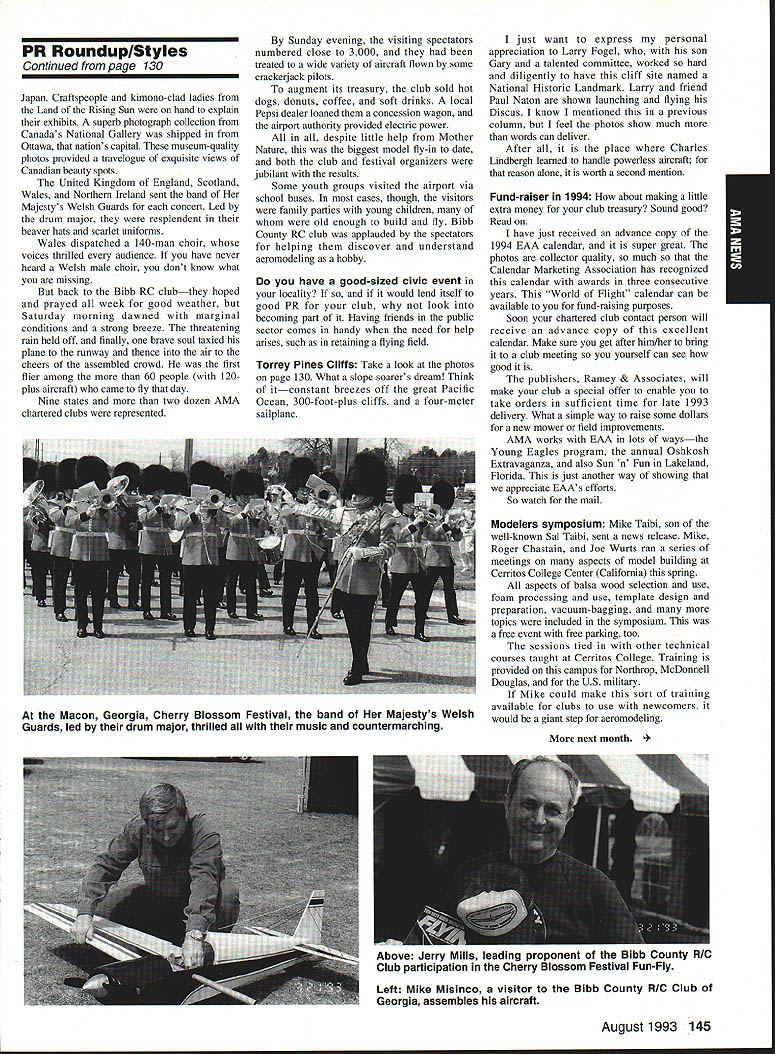
The Bibb County R/C Modelers latched onto a great idea when they hitched their publicity wagon to the Cherry Blossom Festival, held yearly in Macon, Georgia. The Cherry Blossom Festival, now in its 11th year, is one of the largest events in the southeastern United States, drawing people from many states and foreign countries.
Five years ago, members of the Bibb County club approached the festival organizers and volunteered to run a fly‑in at Herbert Smart Airport. They were welcomed warmly, flying privileges were arranged for the two‑day event, and the club has since become a headline item in this annual extravaganza. In 1993 Canada, Wales, and Japan were honored guests; special artistic displays accompanied the event.
AMA working — FCC and frequency issues
Probably the most asked question these days concerns the proposed action by the FCC and its impact on R/C frequency assignments. Analysis shows that adding new frequencies as close as 25 kHz to our present assignments would cause adjacent‑channel interference and be detrimental to safe operations.
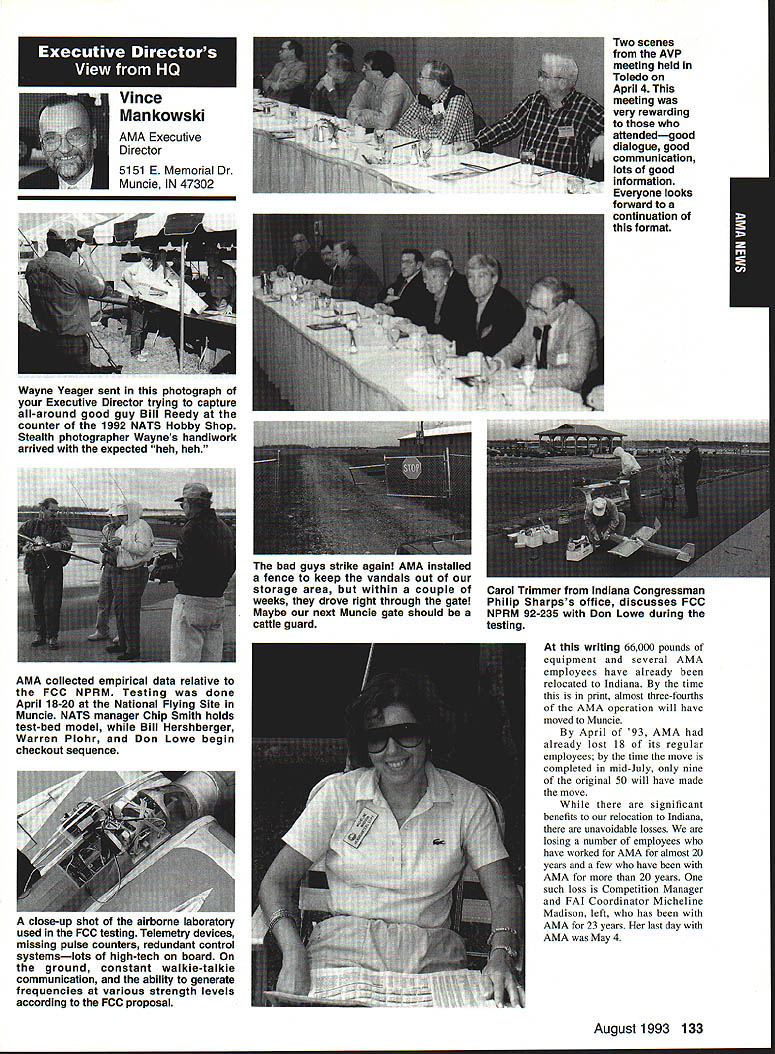
To solidify this argument, the AMA conducted flight tests April 18–22 at Muncie under difficult weather conditions (cold, wind, and snow). The testing and research were performed by Bill Hershberger, Warren Plohr, and George Steiner, assisted by Chip Smith from Headquarters and other Frequency Committee members. The tests proved conclusively that present equipment cannot handle this kind of interference at any significant distance. A detailed report of the test procedures and results is being prepared for the FCC, and a short video was made to explain the test methods. The FCC had previously indicated that such tests should be made and authorized operations on the proposed frequency at Muncie.
How this will play out is not yet known, but the FCC and Congress are aware of our concerns. The FCC has offered to work with us to achieve a suitable plan, and industry is cooperating to present a unified approach when the case is brought before the FCC. An additional Frequency Committee meeting will be held at Muncie in June to review the situation and plan further action.
Frequency assignments will be more competitive in the future as remote operations proliferate. We must be aggressive in protecting current allocations and push radio‑design technology to improve bandpass and protection from adjacent‑channel interference.
Safety
The AMA is intensely concerned about safety in flight operations. We deal with vehicles that fly at significant velocity, so to protect people and property we must exercise caution. Overall we do a good job — as indicated by the relatively few insurance claims — but no one wants personal injury or destruction of property.
The most important ingredient in safety is YOU. Careful, meticulous modelers who prepare and operate equipment properly minimize accident risk. In my experience, most failures result from pilot error: incorrect installation of equipment, weak airframe construction, improper battery charging, or insufficient piloting skill. We must continue to be extra careful.
We have also run tests related to control‑line safety, worked with the International Miniature Aircraft Association (IMAA) to assure safe operation of big models, and collaborated with Unlimited Pylon Racing organizers. These categories have exemplary safety records so far, and we will continue efforts to update and improve safety requirements.
Insurance
There has been some confusion about AMA’s new insurance program. The new program offers increased benefits without increasing cost to members or the AMA. It is structured so that AMA’s payout is limited: our insurance carrier bears the burden of large claims while AMA still pays most smaller claims from set‑aside funds. The net result is the same membership cost but better coverage for large claims.
Recently AMA was able to increase, at an affordable cost, the amount of insurance to $2.5 million per occurrence. Some worry this might make us more vulnerable to deep‑pocket lawsuits. However, if site owners, clubs, and members are insured under one policy with similar limits, there is less incentive for plaintiffs’ attorneys to single out site owners to reach higher limits. Protecting site owners from lawsuits and insulating them as much as possible is important to preserve flying sites.
National Flying Site — Muncie
Big things are happening at Muncie. By midyear Headquarters functions will be in place there, improving operating efficiency and reducing costs. A number of important events are scheduled at the National Flying Site, including Homecoming in June. We are negotiating with the Hot Air Balloon Association for its National Championship — it is possible the event will be at Muncie next year.
The AMA is working with the city and the Muncie Visitors Bureau, which formed a private Sports and Hobby Development Group to promote hobby‑related activities. If successful, Muncie could become a mecca for hobby and aerospace activities.
At this writing, 66,000 pounds of equipment and several AMA employees have been relocated to Indiana. By print time almost three‑fourths of AMA operations will have moved to Muncie. By April 1993, AMA had already lost 18 regular employees, and by mid‑July only nine of the original 50 will have made the move. While the relocation brings benefits, we are losing many long‑time employees — a regrettable but unavoidable aspect of the transition. One such loss was Competition Manager and FAI Coordinator Micheline Madison, who had been with AMA for 23 years; her last day was May 4.
Flying sites and outreach grants
Geoff Styles of Headquarters is now devoting full time to support of local sites and clubs, spending significant time working directly with clubs (including time in California and the Southeast). We are establishing an outreach grants program to help worthy clubs with field improvements. The program will be funded from an account set aside from membership dues and will be published in Model Aviation when available.
Please take good care of your flying field — it is your club’s most important asset.
Competition
This year AMA is sending several U.S. teams overseas and is hosting the Free Flight World Championships in California in October. We continue to sanction hundreds of events and work to improve rules as part of a balanced program to promote the sport and develop the hobby’s technical side.
Cans and low‑cost sound reduction
I still have concerns about publishing drawings and applications that use expendable small cans (mousse, hair‑spray types) as silencers. The subject was discussed at recent Executive Council meetings. It was understood we would print items with proper cautionary notes relating to the contents of a full can, but the editor was notified there was no OK to proceed. The previously submitted design will be held for approval before publishing. This is unfortunate because such solutions are a very low‑cost way for modelers to add sound reduction.
New products — quiet tuned pipes and propeller noise
I had an opportunity to review a German study on a quiet tuned pipe for large‑engine gas burners and intended to provide a detailed report. Unfortunately, the paper was lost (someone picked it up in Toledo), but another copy is expected. The study contains a large amount of data and should interest those working with larger models. Large models face particular challenges getting down to low sound levels.
Engine installations, exhaust systems, and propellers all contribute to noise. Low frequencies from large engines carry well and can result in high decibel levels. Few mufflers on the market sufficiently reduce exhaust noise; much development work remains.
Propeller noise is another important factor. Some propellers are inherently noisy, yet many fliers are reluctant to experiment to find the best propeller for their aircraft/engine/propeller combination. Slightly unloading the propeller in flight (with a good muffler) can reduce ground decibel levels. Try different propeller types and pitch/diameter combinations to find satisfactory performance at the lowest noise level.
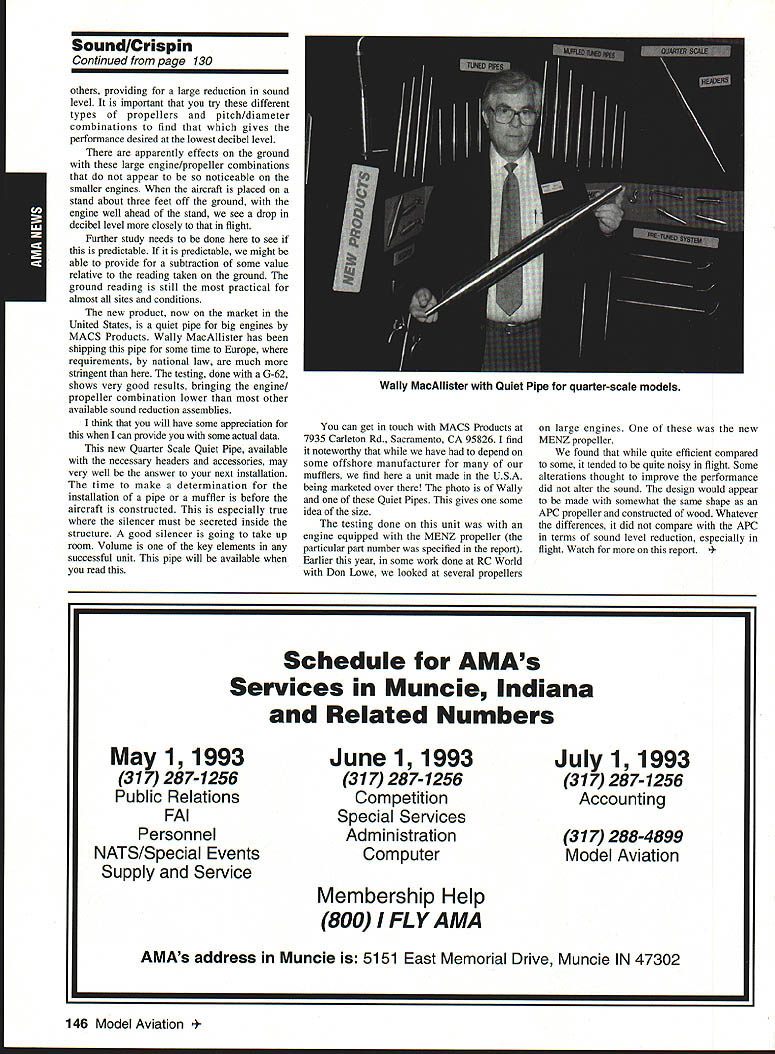
A new product on the U.S. market is the Quarter Scale Quiet Pipe from MACS Products (Wally MacAllister). This quiet pipe, which has been marketed in Europe where noise laws are stricter, produced very good results in testing with a G‑62 engine and a specified MENZ propeller. The unit includes necessary headers and accessories; volume is a key element in successful silencers, so planning for a silencer should occur during aircraft design. Contact MACS Products at 7935 Carleton Rd., Sacramento, CA 95826 for more information.
Earlier tests at RC World with Don Lowe examined several propellers for large engines. The MENZ propeller, while efficient, tended to be noisy in flight and did not compare favorably to the APC propeller in sound level reduction. More data and analysis will be published as available.
Officers' columns — "To column or not?"
Should we continue to print officers’ columns in each issue of Model Aviation? There is little uniformity among officers or members about what the column should contain. Many members want district news with photos of district events; others want columns to focus on issues confronting the AMA, rulemaking, how issues affect districts, and officers’ viewpoints.
Some columns have drawn criticism and even legal action; others have jeopardized earlier legal actions. These outcomes were not the result of trying to stir trouble but of attempting to inform members. The dilemma is similar to news media in wartime: the right to know versus the need to protect the institution. Which is more important — to inform members fully or to protect the organization from information that could be used against it? It’s a tightrope we must walk, and opinions vary. To column or not to column — the question remains open.
District and club notes
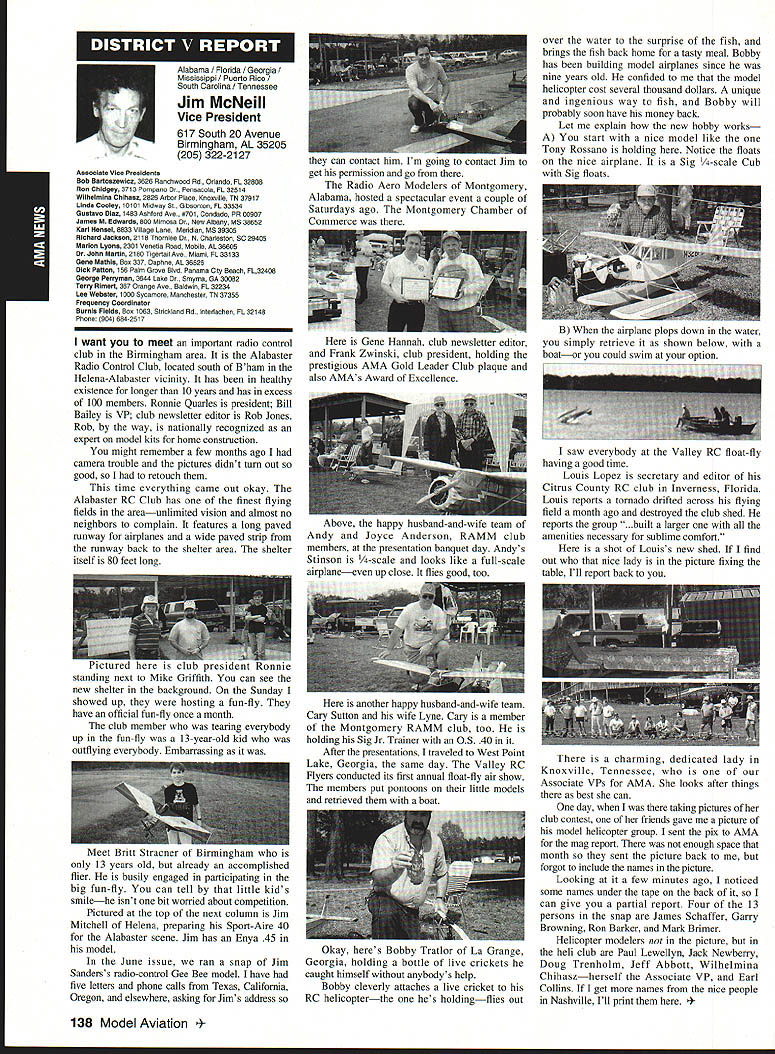
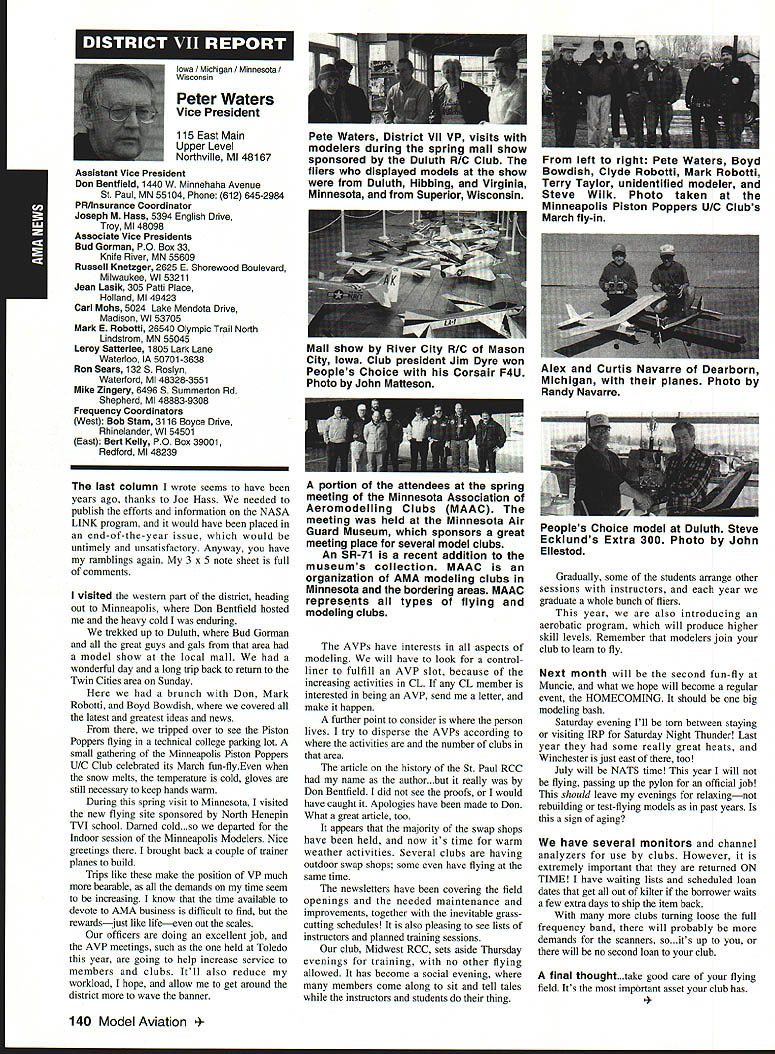
- Trips and visits: Recent visits to Minnesota included a mall model show hosted by Don Bentfield; a brunch with Don, Mark Robotti, and Boyd Bowdish; and a March fly‑in by the Minneapolis Piston Poppers. The North Hennepin TVI sponsored a new flying site, and indoor sessions with the Minneapolis Modelers remain popular.
- Training: Several clubs report planned training sessions and Thursday evening training nights. Many clubs are graduating new pilots each year and introducing programs (for example, aerobatics) to raise skill levels. Remember that people join clubs to learn to fly.
- Frequency monitors and channel analyzers: AMA has monitors and channel analyzers available for club use. It is important that borrowed equipment be returned on time to honor waiting lists and scheduled loans.
- Fund‑raiser: The 1994 EAA "World of Flight" calendar (publisher: Ramey & Associates) will be available for club fund‑raising. Clubs will receive advance copies via their chartered club contact. This is a simple way to raise money for mowers or field improvements.
- Modelers symposium: Mike Taibi, Roger Chastain, and Joe Wurts ran a free series of meetings at Cerritos College covering balsa selection, foam processing, template design, vacuum‑bagging, and more. The sessions tied into technical courses taught for industry and military contractors and offered valuable training for clubs and newcomers.
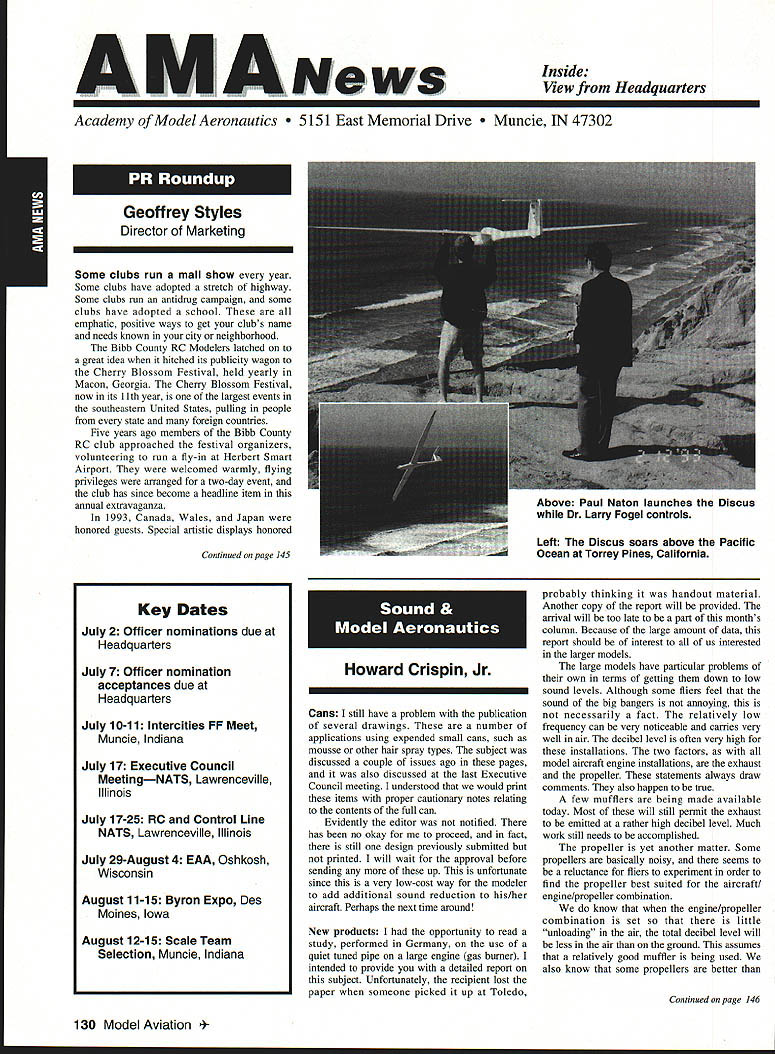
- Appreciation: Thanks to Larry Fogel and his committee (including son Gary) for their work to have a cliff site named a National Historic Landmark. The site is notable as the place where Charles Lindbergh learned to handle powerless aircraft.
Photos and miscellaneous
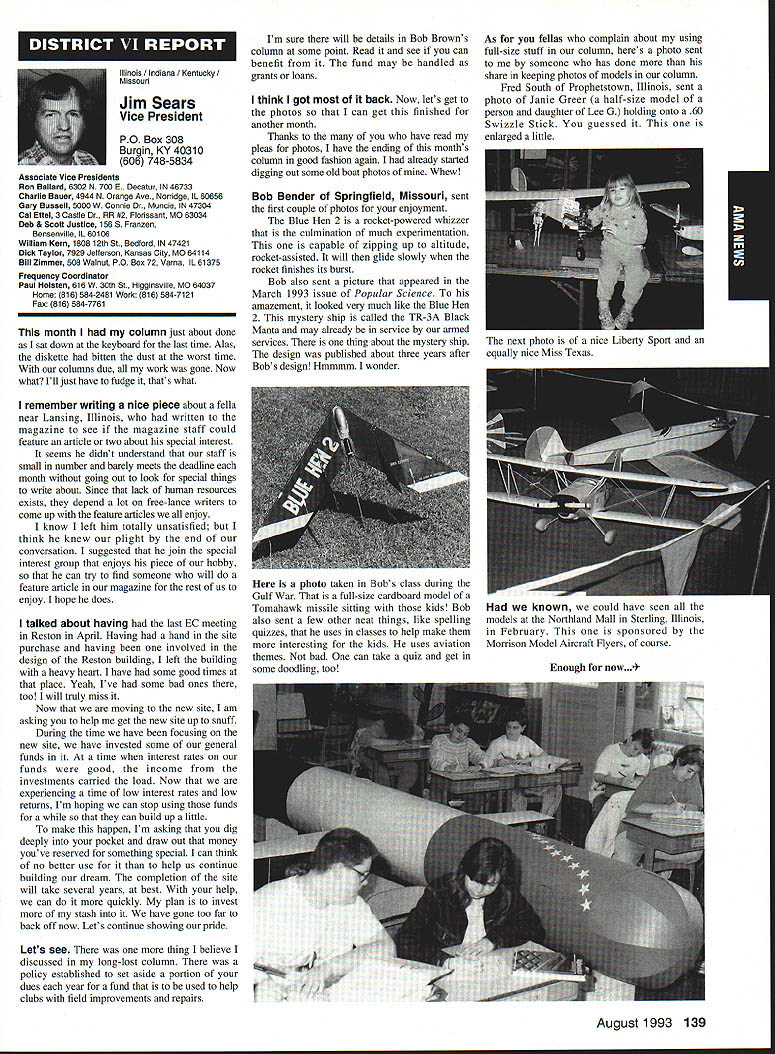
Thanks to readers who responded to the call for photos. Bob Bender of Springfield, Missouri, contributed images including the Blue Hen 2, a rocket‑powered whizzer capable of rocket assist to altitude and slow glide after the burst. One photo resembled a mystery ship (the TR‑3A Black Manta) that appeared in Popular Science; the resemblance to Bob’s design raised eyebrows.
More next month.
Key Dates
- July 2 — Officer nominations due, Headquarters
- July 7 — Officer nomination acceptances due, Headquarters
- July 10–11 — Intercities Free Flight Meet, Muncie, Indiana
- July 17 — Executive Council Meeting / NATS, Lawrenceville, Illinois
- July 17–25 — RC & Control Line NATS, Lawrenceville, Illinois
- July 29–August 4 — EAA AirVenture, Oshkosh, Wisconsin
- August 11–15 — Byron Expo, Des Moines, Iowa
- August 12–15 — Scale Team Selection, Muncie, Indiana
Till next month.
Transcribed from original scans by AI. Minor OCR errors may remain.

