
AMA News
Sound & Model Aeronautics
Howard Crispin, Jr.
Self Help: We still wait for manufacturers to get on the bandwagon and provide us with top-value mufflers with engines at the time of purchase. The manufacturers should, at the very least, make available good mufflers at reasonable cost. Except for a very few manufacturers, this is not being accomplished.
The continued rapid growth of the larger models, and associated engines, has created an additional difficulty. Modelers need to begin a concerted effort to induce manufacturers to understand the situation and take action. Why should this group be any less cooperative than the effort made by the Radio Control Manufacturers Association in regard to frequency questions?
This question of sound suppression is not unique to the United States. That is another point which becomes puzzling, especially in view of the fact that the majority of our engines are manufactured outside of the United States. This is true even with the big bangers, where, at the minimum, the engines' cylinder and piston assemblies are made out of the country.
Many countries have sound level laws equal to the AMA-recommended 90 dBA at 9 feet value, or lower. These are not rules by the aeromodeling groups; they are laws of the federal governments of the countries involved. You meet that or you do not fly.
Interestingly enough, United States companies such as MACS Mufflers sell in these countries. We in the United States are the largest single purchaser of these engines, and we certainly should have enough voice to require these manufacturers to work at the problem. If a company such as Irvine can make a muffler as efficient as the one on its Q40, then surely others can do as well.
Until such time as manufacturers do provide us with what we must have, we have no choice except to obtain good mufflers from aftermarket sources. Examples from these manufacturers have appeared in this column in the past, and effective units will continue to have mention so that you can obtain what you need.
There are many installations where a manufacturer's unit may not prove satisfactory. These are scale installations, mounting in special-application aircraft, and where especially light weight or size is critical. The aftermarket manufacturer can, and does, provide a unit to suit these areas.
Articles have appeared in this column, and on other pages, providing you with information, drawings, and materials for making your own muffler or add-on mufflers. There are some applications where this might be the only source.
One area where this is true is the Competition Fun Fly Association Unlimited Expert category aircraft. This is a very, very light aircraft—in most cases, finely engineered for the purpose. Everything about the aircraft, including the engine installation, is designed for maximum strength within the weight limits desired.
There is also a sound-level requirement that must be met, which means that the aircraft must have a good muffler. While it is possible to use a Davis Soundmaster muffler on the Formula Expert class model, this is not possible on the Unlimited. What is the option?
A survey of the aircraft flown in competition will show that most use a muffler made from a spray can, as described in this column and in the recent article by Dick Allen. All that is required is a pipe adapter for the particular engine, a spray can of the proper volume, some aluminum tubing, J-B Weld, and some plastic couplings. Now you can have a very good muffler for your installation at a very reasonable cost. This is also possible with very little effort.
Most of the installations at the recent championships for this category were the Webra .32 cubic inch. You can easily carry a spare in your field box, for use in the remote event that you should somehow damage the one installed on your number-one aircraft. This is an option which can be used on any model requiring minimum weight.
I have not seen any of these in use on free flight, but that is another option. You can select the assembly which will not increase the back pressure and operation will not suffer. Try your hand at the easily fabricated mufflers, and obtain a pipe header to suit your engine.
There is a possibility that the Academy can put together a document showing various forms of these units, with complete instructions and drawings. These could be considered a supplement to the Sound and Model Aeronautics handbook. This will be an item for the next Executive Council meeting. There could also be a listing for vendors of add-on and aftermarket mufflers, if the vendors would send in data sheets on their units for this purpose.
AMA News
There has been some streamlining of office functions; we now have all competition matters concentrated in one department, headed by Chip Smith.
We eliminated the job of Personnel Director and have placed that function in the Accounting Department, where it was prior to making it a separate department. Jane Ames, a very capable young woman, now heads the Accounting Department.
Carl Maroney still is in charge of the Special Services functions, dominated, of course, by insurance matters.
Greg Chartrand is responsible for all facility maintenance, including the flying center.
Mike Fulmer oversees the development of the museum, which is coming along nicely.
Joyce Hager, formerly head of Membership, is now Bob Underwood's knowledgeable aide.
Mary Lou Vojislavich is in charge of the Membership Department.
Bob Vojislavich is currently on disability leave due to a severe heart condition.
Model Aviation is headed by Rob Kurek. He spent nearly a year at our Headquarters in Reston.
Jay Mealy heads up Public Relations. He trained at Reston for a period of time.
Geoff Styles, as I’ve previously reported, is keeping a presence in Washington, D.C. He is there to tie in club and flying-site support efforts. He also provides interface with Washington contacts.
The Future
Predicting the future is difficult, as I learned when I worked as an aerospace engineer and participated in a think tank for fifteen years, trying to project military needs and then satisfy the developmental requirements necessary for our national defense. Although it was highly technical in nature and based on perceived enemy response, it was also political and required considered judgment.
Considered judgment is also necessary now, since AMA is in a transition period — one which encompasses the challenge of greater growth and increased services to its members. Transition is always fraught with problems, and at times some uncertainty. It is a time when weaknesses can be exposed and corrective action is necessary to improve our direction and to maintain standards. Council is convinced that the acquisition of property and the move to combine all operations at one facility at Muncie is the right decision to move to a better tomorrow, leading to increased growth and service.
We have been accused by our critics of neglecting the membership at large in order to create a monument to our pride; nothing could be farther from the truth. What we are seeking to accomplish by the Muncie facility is to leverage our resources by generating an activity that multiplies the resources.
If we were to invest $2 million in flying sites around the country, one might fully fund two to four developments, serving 100–400 modelers. Obviously such a program would impact a minuscule segment of the membership, and how would we select those who would receive this benefit?
On the other hand, if investment of such funds creates increased public awareness and a significant growth, then a much larger impact on the whole membership is possible.
One thing is sure: AMA will never be able to directly fund flying sites in sufficient quantity to directly impact a significant part of our membership, so we do what is possible. We will continue to provide direct assistance in helping clubs to obtain sites by making staff available to do this. This in itself costs money for salaries and expenses. We have had significant success in this effort since the late ’70s.
AMA’s services to modelers will not diminish, as some predict, but will increase. Obviously, the event and competition activities will be directly benefited by the Muncie facility. Several thousand modelers and spectators have visited this facility this year. When we have the site developed for our Nationals, that number will be significantly larger. How many new modelers has this activity generated? I don’t know, but certainly there is a large public awareness, and that is advantageous. I remind you that one of the goals of this was possible at Reston!
Dues Increase?
You are aware by now that we have instituted a small increase in membership dues. It amounts to about a 5% increase for most categories. Compared to the cost-of-living increase of over 30% in the past eight years, we think we have done well. It is too soon to tell what the net effect will be with membership increases, but our membership has leveled off the past couple of years, so that we can no longer absorb the higher cost of our operations. This small increase will give us a break-even budget, assuming there is no increase in membership.
Before I close, I would like to share with you a letter just received from Dr. Gerald Gregorek, Contest Director for the first AMA-conducted Spacemodeling Team Selection. He writes:
"Dear Don:
I want to thank you and your staff for the outstanding support given Howard Kuhn and the entire U.S. Spacemodeling Flyoffs. I cannot imagine any material need or help that was not provided promptly and cheerfully; we literally had only to ask and we would receive.
From our arrival at noon on Friday, to Sunday evening, Chip Smith worked with us tirelessly. Chip had the launch area in great shape, provided us with stopwatches, binoculars, radios and frequency monitors, even ice water in the tents. When we were short on timers for our duration events, JoAnne and Jay stepped in, and they were at the launch site on time, in the heat, and on their Saturday and Sunday, timing for us.
There is no question in my mind that the fine facilities of the AMA at Muncie and the dedication of its staff resulted in the most productive flyoffs in U.S. Spacemodeling history. For the very first time we could choose our alternate competitors by actual flight performance. Similarly, the scale altitude candidates had to fly their 'boilerplate' models to measure their altitude performance, and potential scale modelers brought representative models of their work to be flown. Every procedure recommended by the Spacemodeling Team Selection Committee was followed.
Twelve team members were selected by these procedures to represent the USA in Poland next September. They will fly in seven events in the three-team format. At a meeting prior to our departure, all team members wanted the team to represent the U.S.A. and its staff. For the unparalleled support given them during the Flyoffs, it was superb.
I will submit a more detailed report of the flyoffs shortly, but I wanted you to know that it was a personal pleasure for me as Contest Director to conduct these flyoffs at Muncie.
With the help of your people, it was easy. Please pass on my thanks to Chip, JoAnne and Jay for their phenomenal assistance, and I am sure this is just the beginning of our working together."
Gerald Gregorek
AMA News
Executive Director's View from HQ
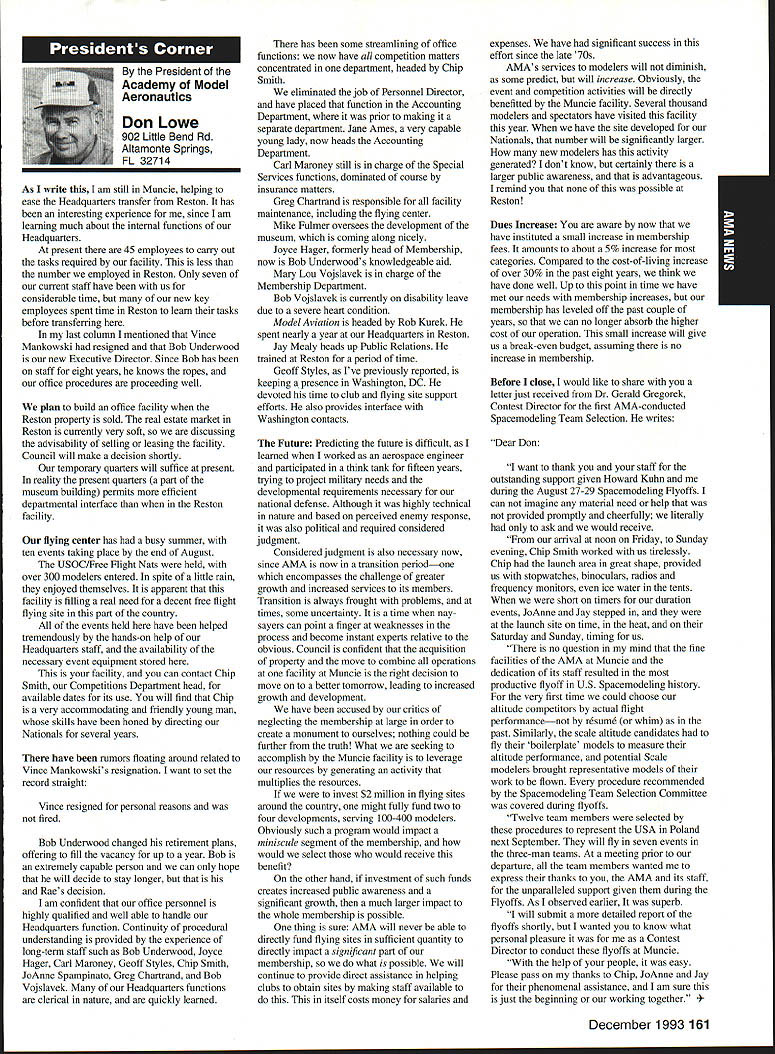
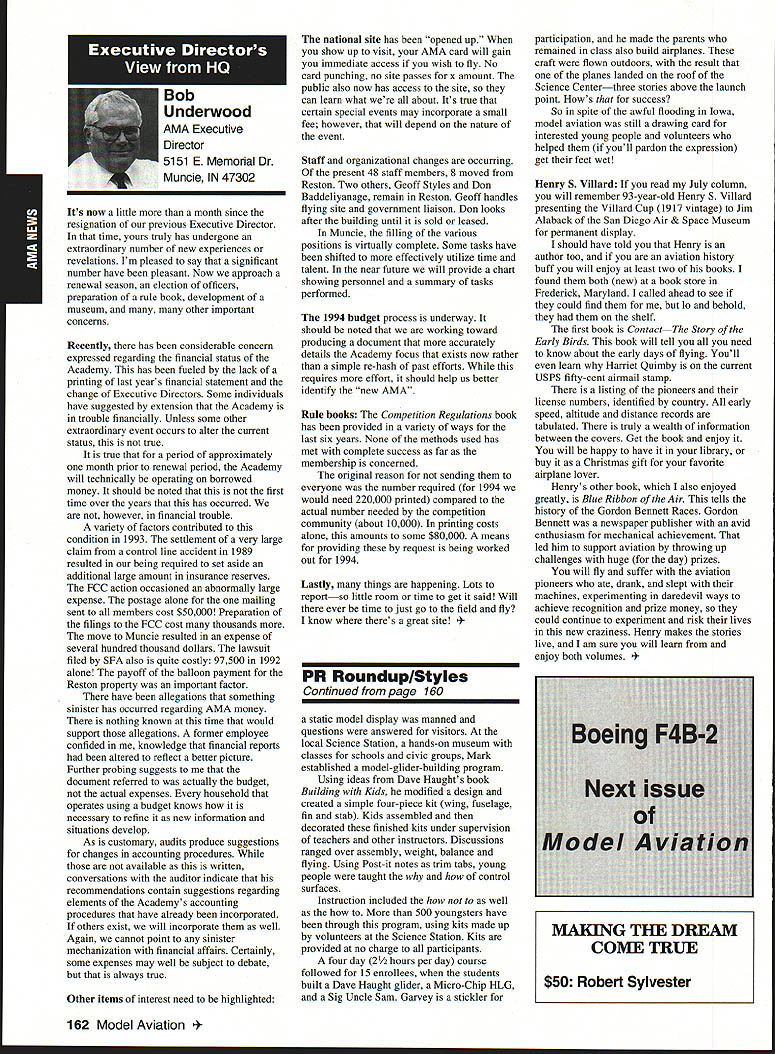
Bob Underwood AMA Executive Director 5151 E. Memorial Dr. Muncie, IN 47302
It's now a little more than a month since the resignation of our previous Executive Director. In that time, yours truly has undergone an extraordinary number of new experiences or revelations. I'm pleased to say that a significant number have been pleasant. Now we approach a renewal season, an election of officers, preparation of a rule book, development of a museum, and many, many other important concerns.
Recently, there has been considerable concern expressed regarding the financial status of the Academy. This has been fueled by the lack of a printing of last year's financial statement and the change of Executive Directors. Some individuals have suggested by extension that the Academy is in trouble financially. Unless some other extraordinary event occurs to alter the current status, this is not true.
It is true that for a period of approximately one month prior to renewal period, the Academy will technically be operating on borrowed money. It should be noted that this is not the first time over the years that this has occurred. We are not, however, in financial trouble.
A variety of factors contributed to this large condition in 1993. The settlement of a very large claim from a control line accident in 1989 resulted in our being required to set aside an additional large amount in insurance reserves. The FCC action occasioned an abnormally large expense. The postage alone for the one mailing sent to all members cost $50,000. Preparation of the filings to the FCC cost many thousands more. The move to Muncie resulted in an expense of several hundred thousand dollars. The lawsuit filed by SFA also is quite costly: $7,500 in 1992 alone. The payoff of the balloon payment for the Reston property was an important factor.
There have been allegations that something sinister has occurred regarding AMA money. There is nothing known at this time that would support those allegations. A former employee confided in me knowledge that financial reports had been altered to reflect a better picture. Further probing suggests to me that the document referred to was actually the budget, not the actual expenses. Every household that prepares a budget knows how it is necessary to refine it as new information and situations develop.
As is customary, audits produce suggestions for changes in accounting procedures. While those are not available at this writing, conversations with the auditor indicate that his recommendations contain suggestions regarding elements of the Academy's accounting procedures that have already been incorporated. If others exist, we will incorporate them as well. Again, we cannot point to any sinister mechanization with financial affairs. Certainly some expenses may well be subject to debate, but that is always true.
Other items of interest need to be highlighted:
- The national site has been "opened up." When you show up to visit, your AMA card will gain you immediate access if you wish to fly. No card punching, no site passes for X amount. The public also now has access to the site, so they can learn what we're all about. It's true that certain special events may incorporate a small fee; however, that will depend on the nature of the event.
- Staff and organizational changes are occurring. Of the present 48 staff members, 8 moved from Reston. Two others, Geoff Styles and Don Baddelyange, remain in Reston. Geoff handles flying site and government liaison. Don looks after the building until it is sold or leased.
- In Muncie, the filling of the various positions is virtually complete. Some tasks have been shifted to more effectively utilize that manpower. In the near future we will provide a chart showing personnel and a summary of tasks performed.
- The 1994 budget process is underway. It should be noted that we are working toward producing a document that more accurately details the Academy focus that exists now rather than a simple pre-hash of past efforts. While this requires more effort, it should help us better identify the "new AMA."
- Rule books: The Competition Regulations book has been provided in a variety of ways for the last six years. None of the methods used has met with complete success as far as the membership is concerned. The original reason for not sending them to everyone was the number required (for 1994 we would need 220,000 printed) compared to the actual number needed by the competition community (about 10,000). In printing costs alone, this amounts to some $80,000. A means for providing these by request is being worked out for 1994.
Lastly, many things are happening. Lots to report—so little room or time to get it said! I wonder if there’s ever the time to just go to the field and fly? I know there’s a great site!
Transcribed from original scans by AI. Minor OCR errors may remain.

