
AMA News
PR Roundup
Geoffrey Styles Director of Marketing
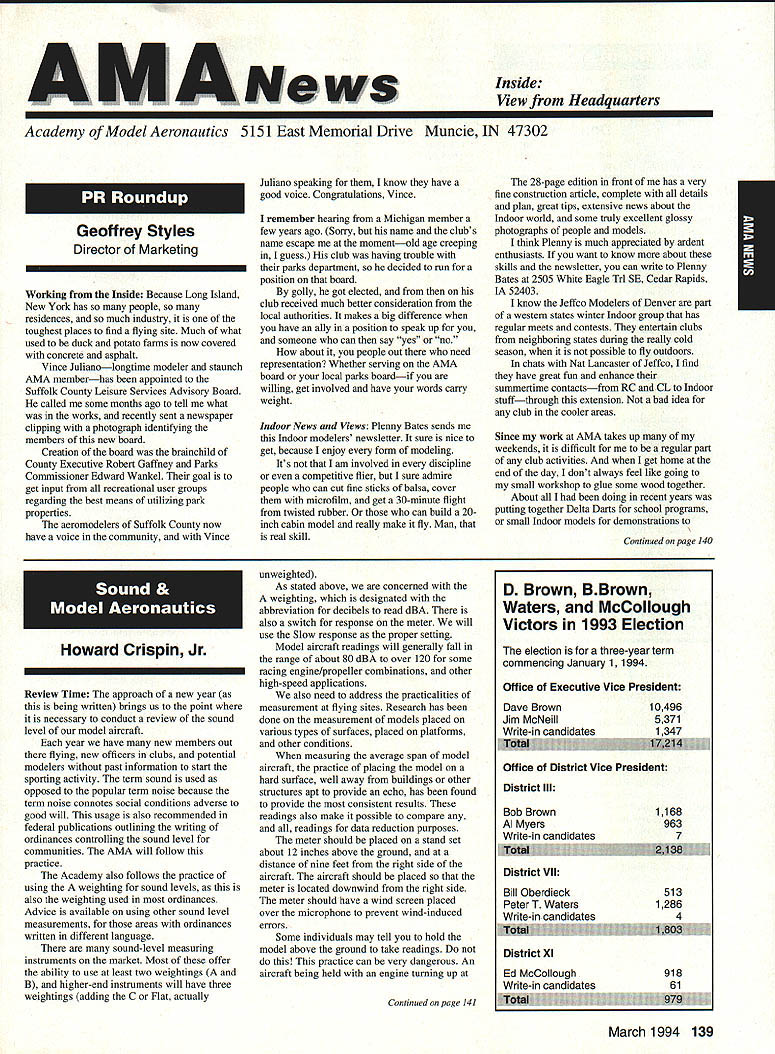
Because Long Island, New York, has so many people, residences, and industry, it is one of the toughest places to find a flying site. Much of what used to be duck and potato farms is now covered with concrete and asphalt.
Vince Juliano — longtime modeler and staunch AMA member — has been appointed to the Suffolk County Leisure Services Advisory Board. The board, created by County Executive Robert Gaffney and Parks Commissioner Edward Wankel, seeks input from recreational user groups on the best use of park properties. The aeromodelers of Suffolk County now have a voice in the community; congratulations to Vince for representing them.
I recall a Michigan club member who ran for a parks board position when his club had trouble with the parks department. He was elected, and his club thereafter received much better consideration from local authorities. If you need representation, consider serving on your local parks board or the AMA board — get involved and make your words carry weight.
Indoor News and Views
Plenny Bates sends the Indoor Modelers newsletter, a 28-page edition full of construction articles (complete with plans and tips), extensive indoor news, and excellent glossy photographs. Even if you don’t compete, the craftsmanship — cutting fine sticks of balsa, covering with Mylar/microfilm, or getting long flights from twisted rubber — is admirable.
- Newsletter contact: Plenny Bates, 2505 White Eagle Trl SE, Cedar Rapids, IA 52403.
Jeffco Modelers (Denver) and other western-state groups run winter indoor meets and contests, hosting clubs from neighboring states during the cold season when outdoor flying isn’t possible. These winter activities are a great way to enhance summertime contacts across RC, CL, and indoor disciplines.
Because AMA work takes many weekends, I’m not a regular at club activities, but I’ve been assembling Delta Darts and other small indoor models for school programs and demonstrations.
Review Time — Sound Levels and Flying-Site Relations
As the new year approaches, it’s time to review acceptable sound levels for model aircraft. Key points and practical guidance follow.
- Terminology
- Use the term "sound" rather than "noise" (the latter can imply adverse social conditions). This usage aligns with federal publications and ordinances.
- Measurement basics
- Use A-weighting (dBA) — the weighting most ordinances specify.
- Meter settings: use "Slow" response.
- Many meters offer at least two weightings; higher-end instruments add C and Flat (unweighted).
- Typical model readings: about 80 dBA up to over 120 dBA (some racing engine/propeller combinations).
- Practical measurement procedure
- Place the model on a hard surface, well away from buildings or structures that cause echoes.
- Set the meter on a stand about 12 inches above the surface.
- Position the microphone approximately at the propeller arc (roughly seven feet from the plane of the propeller) for run-up checks.
- Take several readings at maximum power used for takeoff/flight and record the highest reading.
- If background noise is significant, measure ambient and subtract from the aircraft reading.
- Safety and hearing
- Be aware of personal hearing risk: sound at close range (e.g., when bent over the aircraft) is much greater.
- Trying to make aircraft loud enough to hear in flight is a poor trade-off for damaging your hearing.
- Community relations and compliance
- Be considerate of neighbors; many local ordinances set maximum sound levels at property lines.
- If no ordinance exists, aim to keep sound at or below ambient at neighbor properties. Measure ambient during flying hours and compare.
- If aircraft exceed ambient at the property line (for example, 4 dBA above ambient), you should:
- Reduce ground dBA by that amount, and/or
- Alter flight paths to avoid approaching the complaint location.
- Public relations and outreach
- Maintain a good public-relations effort: let neighbors know who you are and invite them to fly-ins or demonstrations.
- Get neighbors involved when possible and demonstrate model construction and flight activities.
- Work with the community and local affairs; becoming an AMA Leader Club helps show community commitment.
Reducing sound levels is one of the most beneficial efforts for preserving flying sites — often achievable with modest changes.
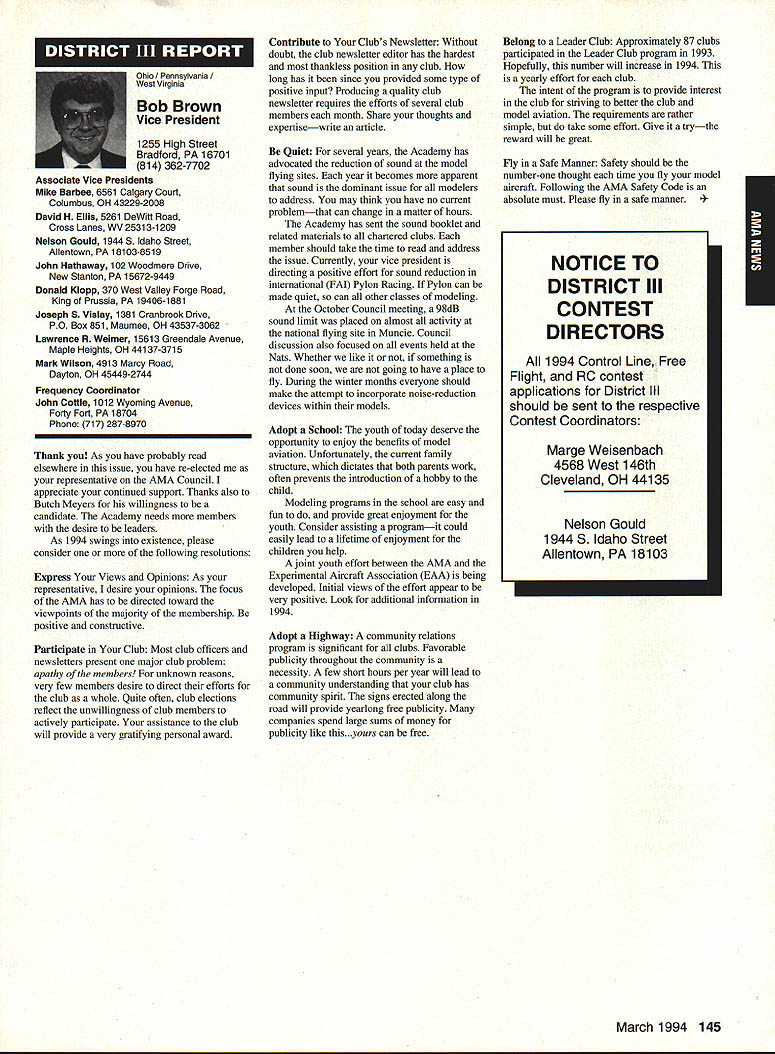
DISTRICT III REPORT
Ohio / Pennsylvania / West Virginia
Bob Brown Vice President 1255 High Street, Bradford, PA 16701 Phone: (814) 362-7702
Associate Vice Presidents
- Mike Barbee, 6651 Calgary Court, Columbus, OH 43229-2008
- David H. Ellis, 5261 DeWitt Road, Cross Lanes, WV 25313-1209
- Nelson Gould, 1944 S. Idaho Street, Allentown, PA 18103-8519
- John Hathaway, 102 Woodmere Drive, New Stanton, PA 15672-9449
- Donald Klapp, 370 West Valley Forge Road, King of Prussia, PA 19406-1881
- Joseph S. Vilay, 1381 Cranbrook Drive, P.O. Box 851, Maumee, OH 43537-3062
- Lawrence R. Weimer, 15613 Greenbriar Avenue, Maple Heights, OH 44137-3515
- Mark Wilson, 4913 Marcy Road, Dayton, OH 45449-2744
Frequency Coordinator
- John Cottle, 1012 Wyoming Avenue, Forty Fort, PA 18704 — Phone: (717) 287-8970
Thank you for re-electing me to the AMA Council. I appreciate your support and encourage more members to step forward as leaders. As 1994 begins, please consider these resolutions:
- Express your views and opinions
- Provide constructive input so AMA focus reflects the majority membership.
- Participate in your club
- Volunteer; apathy is the major problem in many clubs. Your involvement is personally rewarding.
- Contribute to your club newsletter
- Editors need help — share articles, tips, and photos.
- Be quiet (address sound)
- Sound is the dominant issue for modelers. Read the sound booklet sent to chartered clubs and work on noise reduction (including F4 pylon racing initiatives).
- Note: A 98 dB sound limit was adopted for most activities at the national flying site in Muncie.
- Adopt a school
- Introduce youth to modeling through school programs; it can lead to lifelong enjoyment.
- Adopt a highway
- Community programs and roadside signs build public goodwill and free publicity.
- Belong to a Leader Club
- Participate in the Leader Club program to strengthen your club and community outreach.
- Fly in a safe manner
- Follow the AMA Safety Code at all times.
Photos & Member Highlights
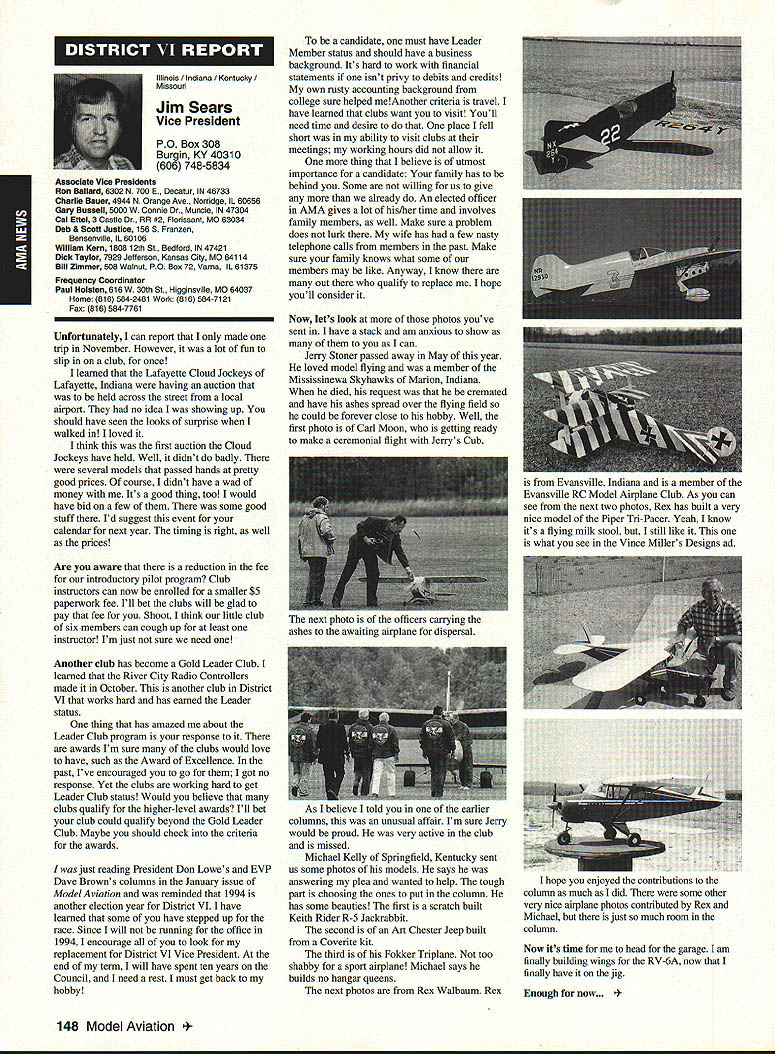
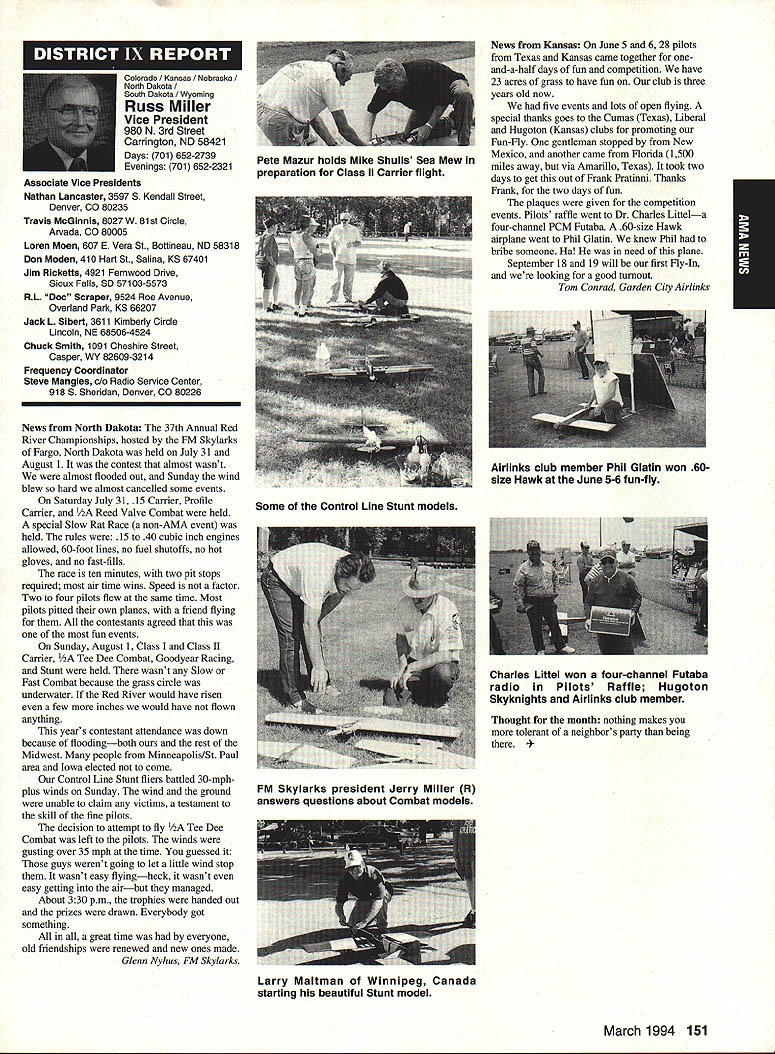
- Jerry Stoner (Mississinewa Skyhawks, Marion, IN) passed away in May. His ashes were ceremonially spread over the flying field by club members; Carl Moon made a ceremonial flight with Jerry's Cub.
- Michael Kelly (Springfield, KY) submitted photos of scratch-built models including a Keith Rider R-5 Jackrabbit, an Art Chester Jeep (Coverite kit), and a Fokker Triplane.
- Rex Walbaum (Evansville, IN) submitted photos of a well-built Piper Tri-Pacer. Many thanks to members who submitted photos; space is limited but much appreciated.
Site Acquisition, Organization, and Safety
Discussion highlights from recent staff meetings and district activities:
- Site acquisition success factors
- Community involvement, a professional image, and unification across clubs are common elements in successful site-acquisition projects.
- Associations and chapter organizations (e.g., San Diego County Association of Model Clubs, Central Arizona Modelers Advisory Council) have benefited by speaking with a single voice to landowners.
- Communication and regional coordination
- There is a need for a regional clearinghouse to disseminate property-acquisition materials and pool logistical resources.
- Formalizing district organizational structures could strengthen information sharing among clubs, chapters, and special-interest groups.
- Safety and emergency preparedness
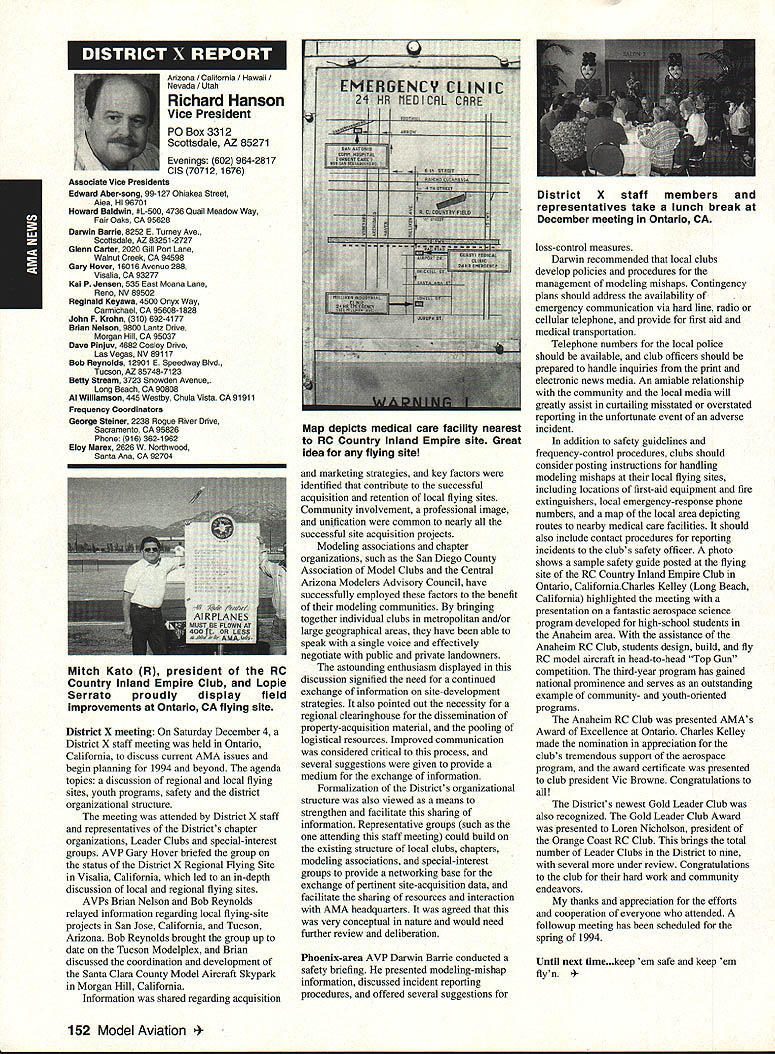
- Phoenix-area AVP Darwin Barrie conducted a safety briefing covering incident reporting and loss-control measures.
- Clubs should develop contingency plans addressing emergency communication (hard line, radio, cellular), first aid, and medical transportation.
- Clubs should post onsite instructions for handling mishaps: locations of first-aid equipment and fire extinguishers, local emergency numbers, routes to medical facilities, and reporting procedures to the club safety officer.
- Youth and community programs
- Charles Kelley (Long Beach, CA) highlighted an aerospace science program for high-school students in the Anaheim area; students design, build, and fly R/C models in the "Top Gun" competition.
- The Anaheim RC Club received AMA's Award of Excellence for support of aerospace education.
- Orange Coast RC Club was presented the Gold Leader Club Award, bringing the district total to nine Leader Clubs.
A follow-up meeting is scheduled for spring 1994. Until then, keep them safe and keep them fly'n.
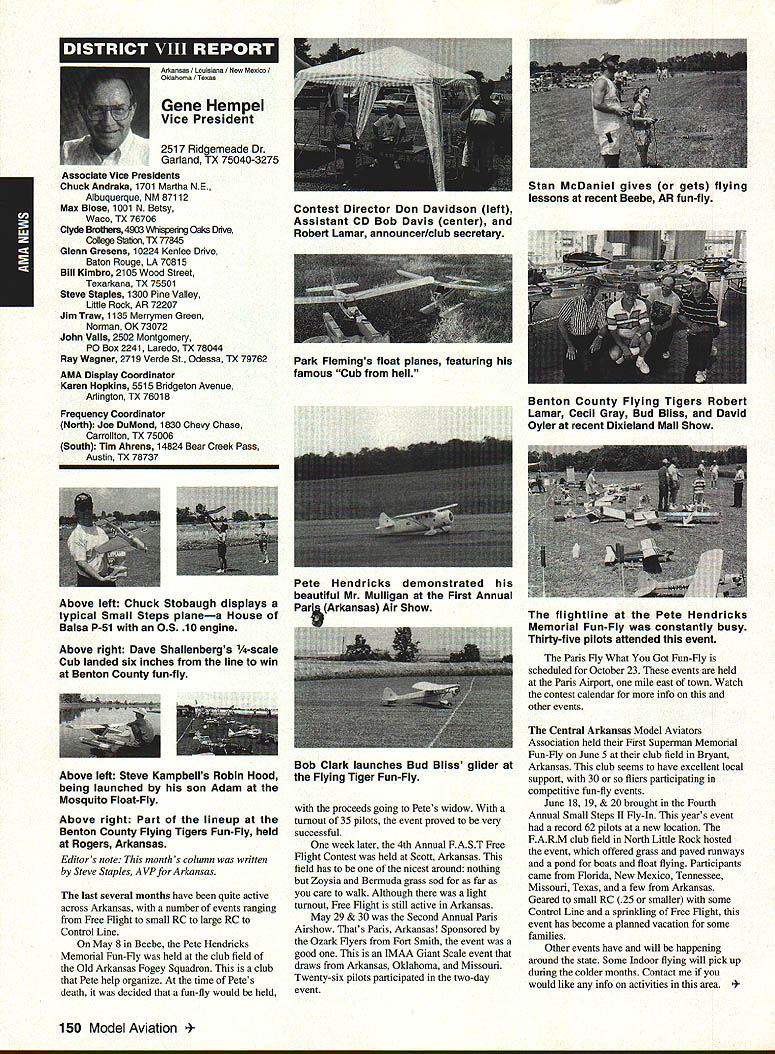
Kansas Fun-Fly (Garden City Airlinks)
- Event: June 5–6 — 28 pilots from Texas and Kansas, one-and-a-half days of fun and competition on 23 acres of grass.
- Events: Five competition events plus open flying.
- Thanks to the Cumas (Texas), Liberal and Hugoton (Kansas) clubs for promotion.
- Raffle winners: Dr. Charles Littel (four-channel Futaba); Phil Glatin won a .60-size Hawk airplane.
- Upcoming: September 18–19 — first Fly-In planned.
Thought for the month: Nothing makes you more tolerant of a neighbor's party than being there.
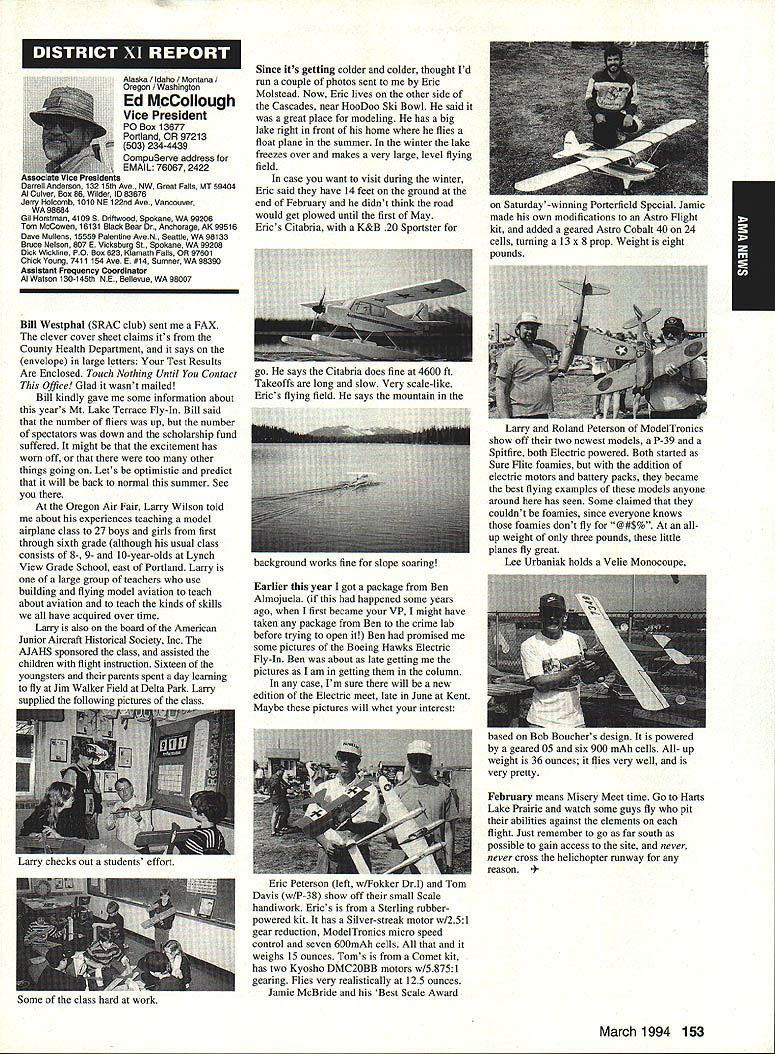
Winter Flying — Eric Molstead
Eric Molstead (near Hoodoo Ski Bowl) reports that his floatplane flying site becomes a large, level winter flying field when the lake freezes. He notes long, slow takeoffs at 4,600 ft with a K&B .20 Sportster on his Citabria; the nearby mountain also offers slope-soaring opportunities.
Closing Notes
Work continues on site acquisition, safety, youth outreach, and community relations. Keep sending photos and reports — they make the column lively. On a personal note, I’m building wings for an RV-6A now that it’s on the jig.
Enough for now... keep 'em safe.
Transcribed from original scans by AI. Minor OCR errors may remain.

