
AMA News
PR Roundup
Geoffrey Styles Director of Marketing
- Conservation Reserve Program (CRP)
- About a year ago a Minnesota chartered club was using farmland enrolled in the Conservation Reserve Program (CRP), commonly called "landbank." CRP land is taken out of agricultural production and the farmer is paid for not growing crops.
- Although model flying had taken place for several years, the farmer asked a local U.S. Department of Agriculture (USDA) representative whether the club's use was permitted and was told it was strictly against the regulations. The farmer was informed he could be backcharged subsidies received during the years flying had occurred — an amount that ran into thousands of dollars — and therefore had to tell the club to leave.
- AMA worked with the farmer, 4‑H, and USDA to resolve the matter. After months of correspondence and patience, the USDA sent a letter dated October 15, 1993, stating in part:
- "However, we have reconsidered our previous position concerning flying model airplanes on CRP acreage. Because it is clearly not prohibited in the 1985 Food Security Act, we have determined flying model airplanes will not likely adversely impact the control of erosion and will be considered a permissible use."
- If you have access to CRP land and the landowner is willing to allow model flying, AMA can provide a copy of the USDA letter (signed by the Acting Deputy Administrator, State/County Operations, Washington, D.C.) for the landowner's records.
- San Francisco Presidio
- Chartered clubs in the San Francisco area should note that the U.S. Department of the Interior controls the Presidio. The National Park Service has published a booklet, Post to Park, and filed an Environmental Impact Statement/General Management Plan.
- Russ Cahill is Interim Presidio General Manager (office at Fort Mason). The park includes a 300‑acre forest in need of careful management. Plans call for developing Lobos Creek Valley as a quiet wildlife refuge, restoring shoreline to preserve wetlands and migratory bird habitat, while still providing for public use. The same area was formerly a military site.
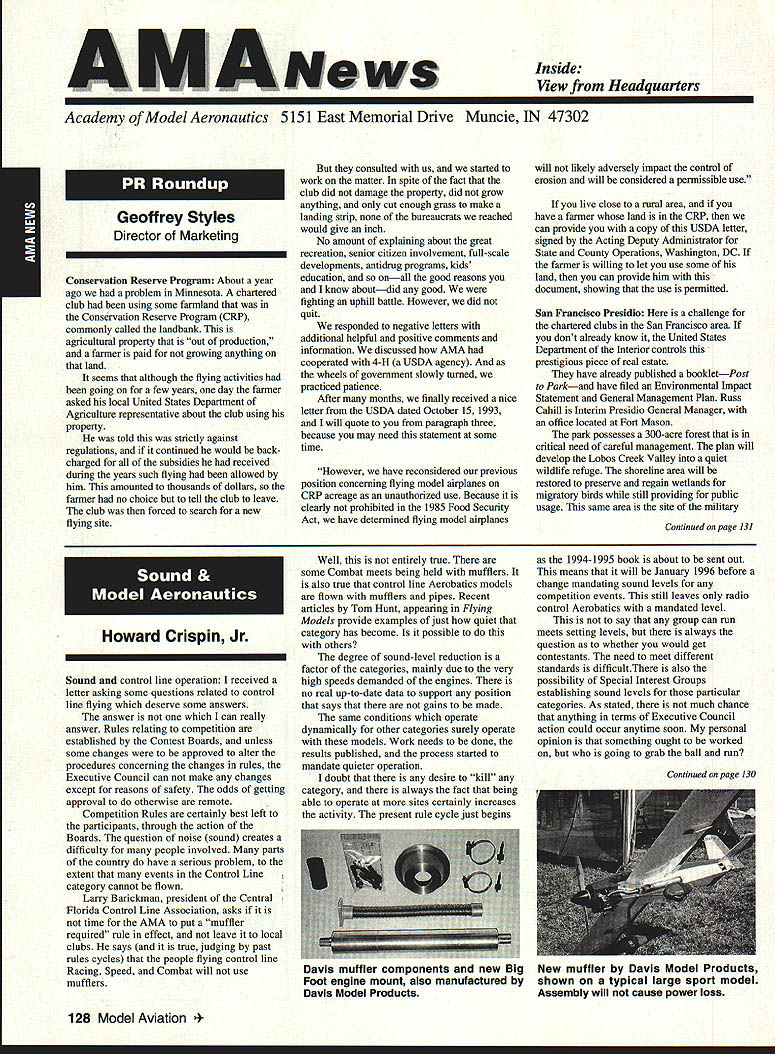
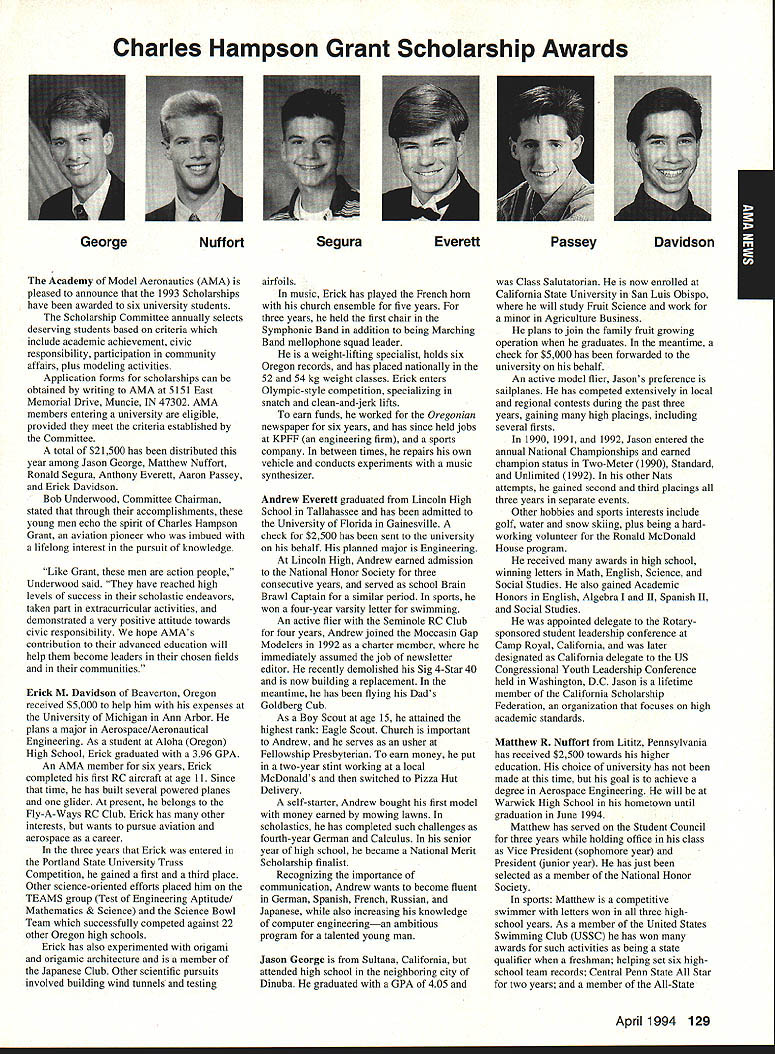
Sound & Model Aeronautics
Howard Crispin, Jr.
- Control‑line flying and sound issues
- Rules for competition are set by the Contest Boards. The Executive Council can only change rules for safety reasons; other changes must follow the Contest Boards' procedures. As a result, the Contest Boards and participants should generally determine competition rules.
- Noise (sound) is a serious problem in some areas, to the extent that some Control‑Line events cannot be held. Larry Barickman, president of the Central Florida Control Line Association, asked whether AMA should adopt a "muffler required" rule rather than leaving it to local clubs.
- Some Combat and Aerobatics events are already using mufflers or tuned pipes, and recent articles (e.g., Tom Hunt in Flying Models) show how much quieter some categories have become. However, high‑speed categories present greater sound‑reduction challenges.
- There is a need for up‑to‑date data: more work, testing, and published results are required before broadly mandated sound limits can be adopted.
- The current rule cycle (1994–1995) had just begun; even if a sound‑level mandate were proposed now, it would not take effect until the rule change schedule allows — typically no earlier than January 1996. Special Interest Groups or local organizers could set category‑specific sound standards in the meantime.
- The goal is to reduce sound where possible without "killing" categories; quieter operation can increase the number of usable sites and participation.
Research: Low‑Speed Airfoil Design
- Professor Michael Selig (University of Illinois) seeks to continue research begun in 1987 at Princeton: Low‑Speed Airfoil Design and Wind Tunnel Testing for Model Aircraft.
- The research, while originally directed toward RC sailplanes, could benefit SAE weight‑lift competitions and general modeling; little research exists for the Reynolds number range 60,000–300,000.
- To request Professor Selig's full letter or for more information, contact AMA Headquarters at (317) 287‑1256 ext. 2106.
- Contributions may be sent as checks payable to the University of Illinois AAE Department, addressed to:
- Professor Michael Selig
Department of Aeronautical and Astronautical Engineering University of Illinois at Urbana‑Champaign 306 Talbot Laboratory, 104 S. Wright St. Urbana, IL 61801‑2935
Maryland Engineering Challenge (Public Service)
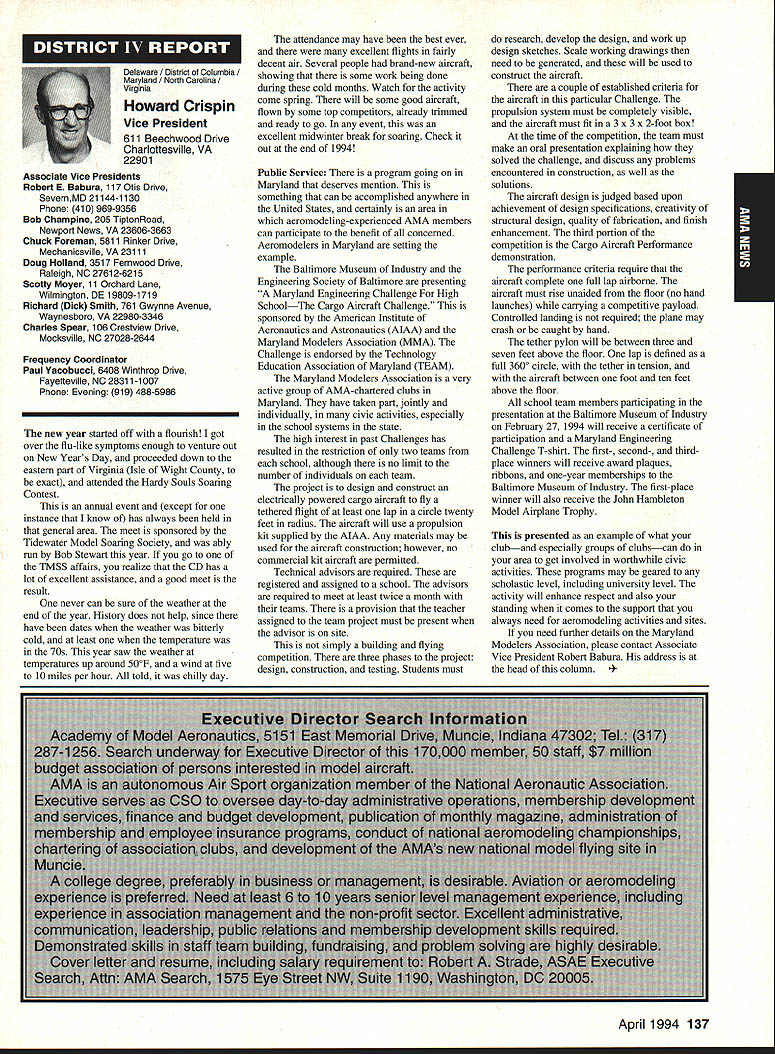
- The Baltimore Museum of Industry and the Engineering Society of Baltimore present "A Maryland Engineering Challenge for High School — The Cargo Aircraft Challenge," sponsored by AIAA and the Maryland Modelers Association (MMA), and endorsed by TEAM.
- Objective: design and build an electrically powered cargo aircraft that completes at least one lap in a circle 20 feet in radius.
- Key rules and requirements:
- Propulsor kit provided by AIAA; any airframe materials allowed except commercial kit aircraft.
- Technical advisors must be registered and meet with teams at least twice monthly; a teacher must be present when an advisor is on site.
- Project phases: design, construction, testing; teams must research, sketch, and produce scale working drawings for construction.
- Propulsion must be visible; aircraft must fit in a 3 × 3 × 2‑foot box.
- At competition, teams give an oral presentation describing solutions and construction problems/solutions.
- Performance: aircraft must rise unaided from the floor carrying a competitive payload and complete one full lap (360°) with the tether in tension, between 1 and 10 feet above the floor. Controlled landing is not required.
- Awards: participation certificates and T‑shirts for entrants; plaques, ribbons, and museum memberships for top finishers; the John Hambleton Model Airplane Trophy for first place.
- This program is an example clubs can emulate to engage schools and communities and to strengthen local support for aeromodeling.
Scholarships and Recognitions
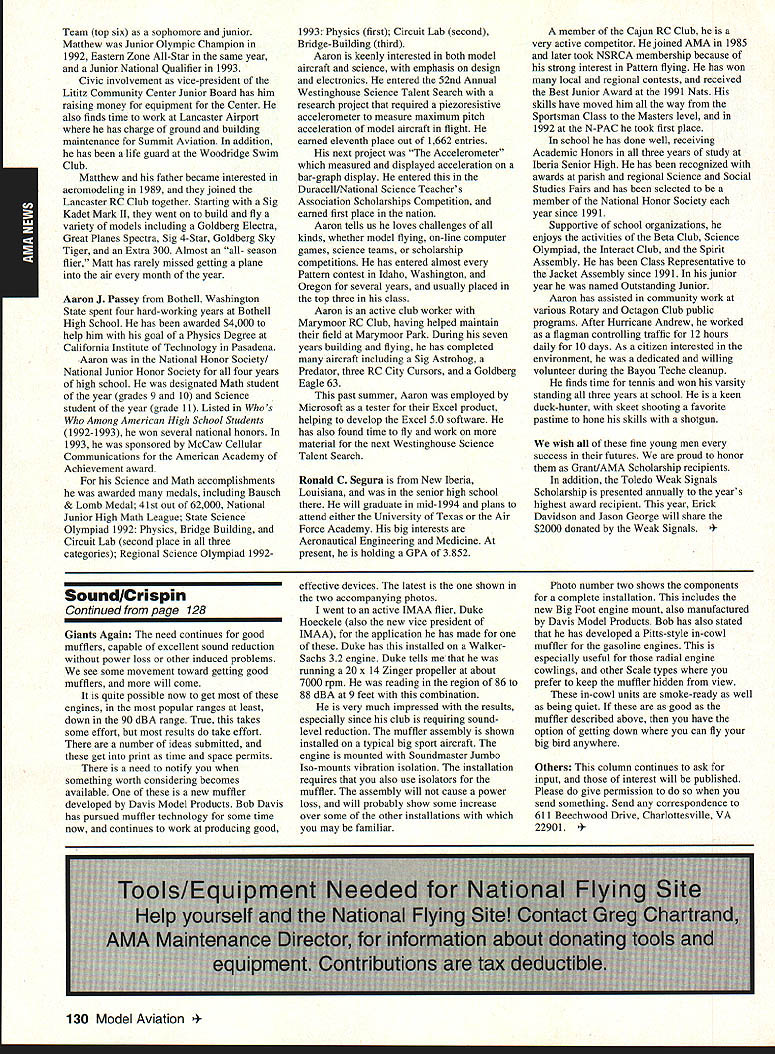
- We congratulate the recipients of Grant/AMA Scholarships and other awards:
- Matthew (Lancaster area): Active civic involvement, long history in aeromodeling with Lancaster RC Club; Junior Olympic Champion 1992; Junior National Qualifier 1993; works at Lancaster Airport; builds and flies a variety of models.
- Aaron J. Passey (Bothell, WA): Awarded $4,000 toward physics degree at Caltech; National Honor Society member; multiple math/science awards; entered Westinghouse Science Talent Search with an accelerometer project and earned a high placement; won the Durrell/NSTA scholarship national first place for "The Accelerometer"; active in pattern contests and Marymoor RC Club field maintenance; worked at Microsoft as an Excel tester.
- Ronald C. Segura (New Iberia, LA): Senior planning to attend University of Texas or the Air Force Academy; high GPA; active Cajun RC Club member and competitor (Best Junior Award at 1991 Nats); strong school involvement and community service.
- The Toledo Weak Signals Scholarship ($2,000) is awarded to this year's highest scholarship recipients; this year Erick Davidson and Jason George will share the award.
Letters and Member Concerns
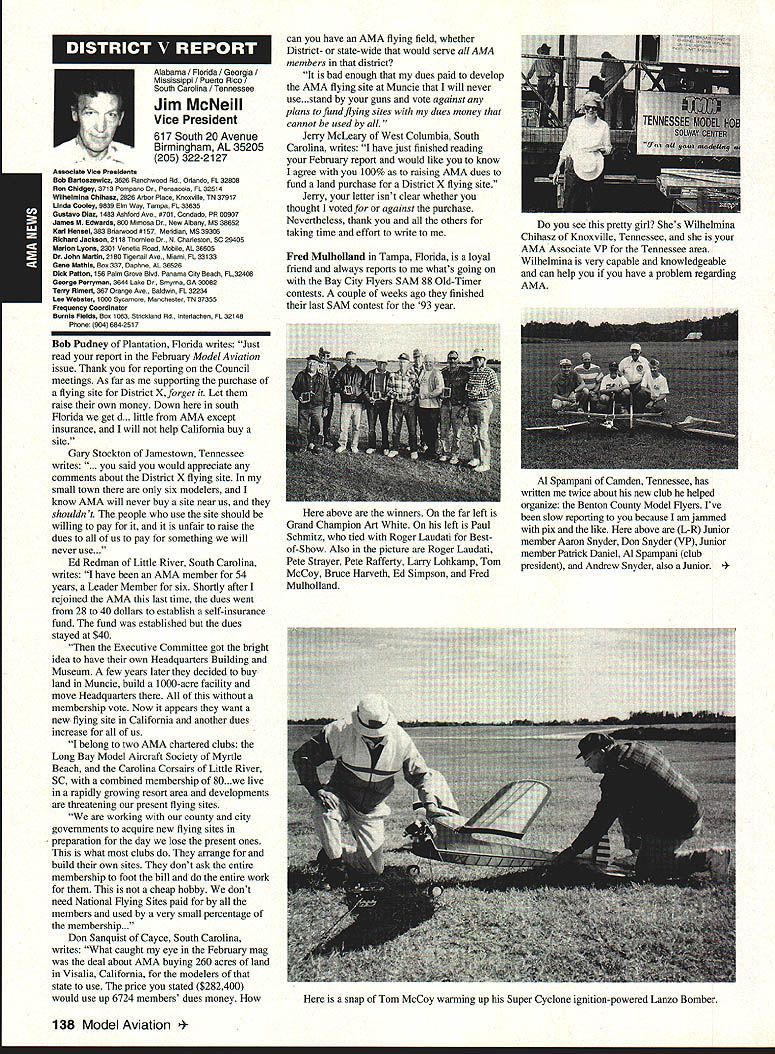
- Several members wrote about proposals for AMA to fund district flying sites and about dues increases:
- Common themes: clubs typically raise funds locally for sites; many members object to using national dues to buy local flying fields that few members will use; members feel local users should bear the cost; members want fair treatment when dues fund national projects.
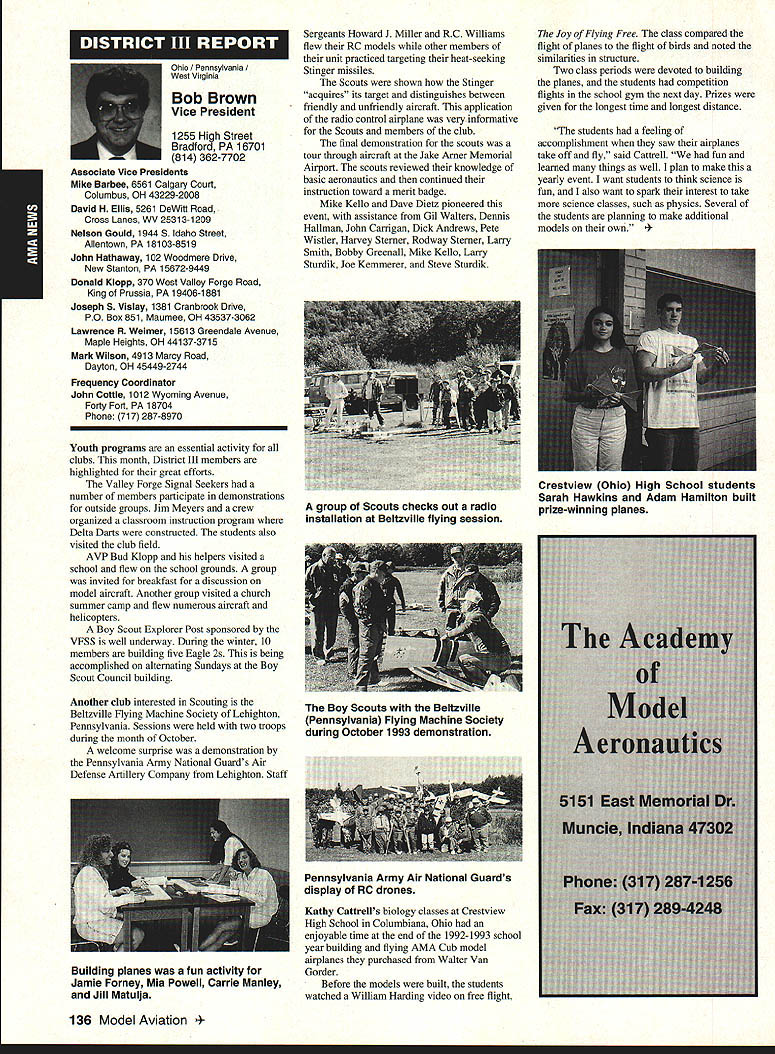
- Specific correspondents include Bob Pudney (Plantation, FL), Gary Stockton (Jamestown, TN), Ed Redman (Little River, SC), Don Sanquist (Cayce, SC), and Jerry McLeary (West Columbia, SC). All letters reflect strong feelings about fairness, dues allocation, insurance, and national versus local responsibilities.
- These views are important input for AMA governance and funding discussions.
Club News, Fundraising, and Events
- Albany Thundervorts
- The club located a new 135‑acre flying site thanks to members Rod Rickel, Will Davis, and Tim Lundsford. The field still needs work but provides a new home for the club.
- Museum fundraising
- HQ circulated a prospectus suggesting clubs seek outside donations to complete the AMA museum. Some newsletters misinterpreted the prospectus; the intent was to solicit private support to finish museum work without overburdening dues revenue.
- Example: Marymoor R/C Club raised $1,000 by arranging a radio donation/wholesale purchase and a raffle; Airtronics donated a radio. Clubs are encouraged to use creative local fundraising.
- Alaska and Northwest club events
- Midnight Sun R/C Club (Fairbanks) plans Pattern, Fun‑Scale, and Fun‑Fly events at the Water‑N‑Wheels contest (July 1–2). The club supports many local charities and plans several events: Fun‑Fly (April 24), Fun Scale (May 15), Float Fly (May 15 and June 5), Midnight Sun Fly (June 18), and possible Kenai Float Fly (June 19).
- Anchorage ARCS club: ARCS Winter Fun‑Fly (March 13); Spring Scale & Pattern Contest (May 28–29); Float Fly (June 17–19); All‑Night Fun‑Fly (date noted).
- Northwest Regionals: organizers are finalizing airport dates; contact Mike Hazel (1073 Windemere NW, Salem, OR 97304) for up‑to‑date information. Last year: 79 competitors, ~40 events, 123 trophies.
- Idaho Scale Squadron
- The Snake River Modelers near Ontario hosted a well‑run Idaho Scale Squadron contest with excellent turnout and a manicured field.
Club Membership and Waiting Lists (guidelines and suggestions)
- Observations and suggestions for clubs facing membership limits:
- Allow local prospective members (living within a few miles) priority access to membership.
- Consider restrictions on dual membership: disallow membership in another club within 50 miles unless that club has a special interest (e.g., helicopters, soaring).
- Require members to contribute volunteer service to the club; failure to meet commitments without acceptable excuse could affect renewal.
- Offer an Associate membership for beginners: training through the club's program while on the waiting list, with a special associate dues level.
- These measures aim to train newcomers, ensure member contribution, and keep membership local and active.
More next month.
Transcribed from original scans by AI. Minor OCR errors may remain.

