
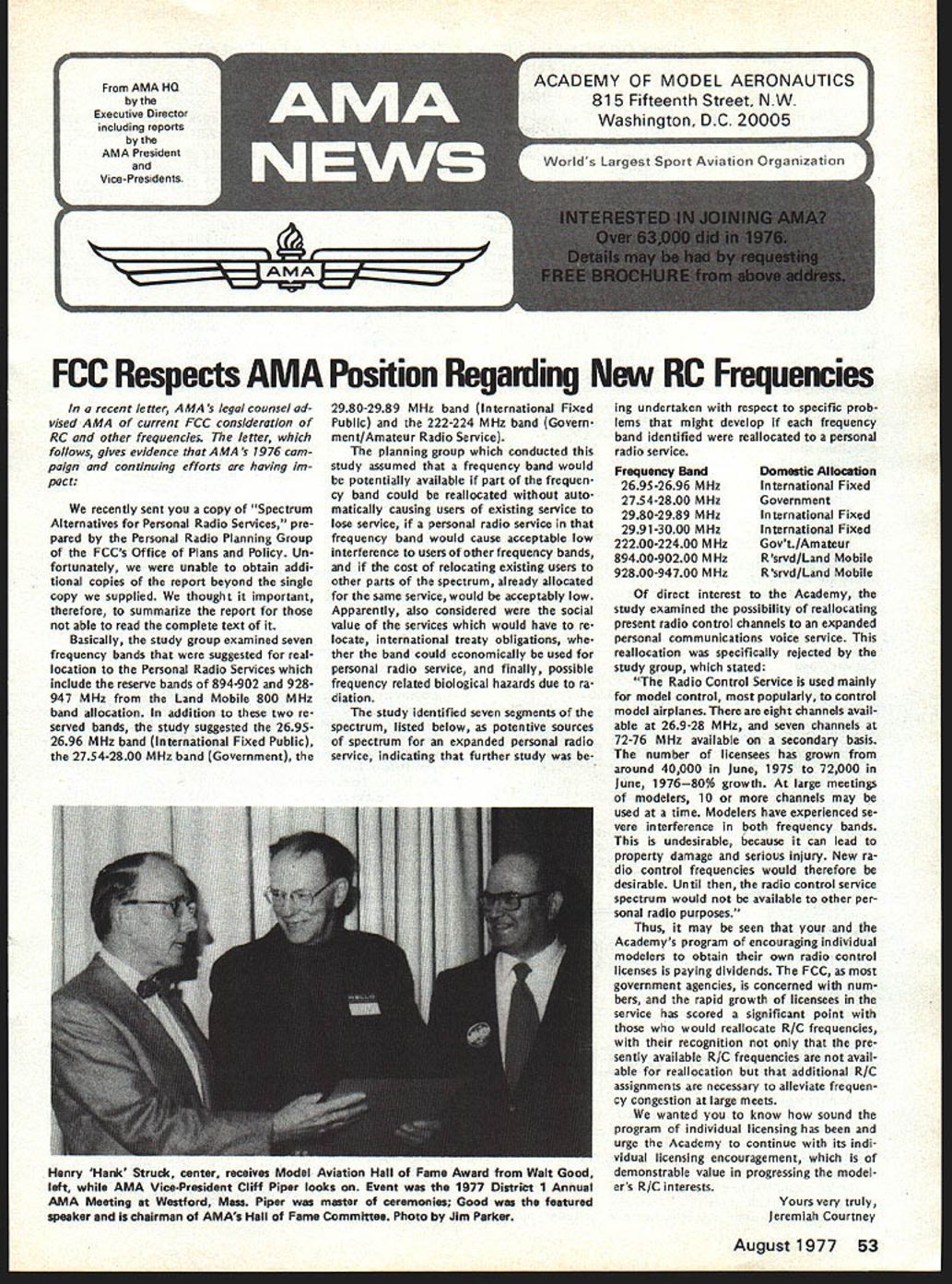
FCC Respects AMA Position Regarding New RC Frequencies
In a recent letter, AMA's legal counsel advised AMA of current FCC consideration of RC and other frequencies. The letter, which follows, gives evidence that AMA's 1976 campaign and continuing efforts are having impact:
We recently sent you a copy of "Spectrum Alternatives for Personal Radio Services," prepared by the Personal Radio Planning Group of the FCC's Office of Plans and Policy. Unfortunately, we were unable to obtain additional copies of the report beyond the single copy we supplied. We thought it important, therefore, to summarize the report for those not able to read the complete text of it.
Basically, the study group examined seven frequency bands that were suggested for reallocation to the Personal Radio Services which include the reserve bands of 894-902 and 928-947 MHz from the Land Mobile 800 MHz band allocation. In addition to those two reserved bands, the study suggested the 26.95-26.96 MHz band (International Fixed Public), the 27.54-28.00 MHz band (Government), the 29.80-29.89 MHz band (International Fixed Public) and the 222-224 MHz band (Government/Amateur Radio Service).
The planning group which conducted this study assumed that a frequency band would be potentially available if part of the frequency band could be reallocated without automatically causing users of existing service to lose service, if a personal radio service in that frequency band would cause acceptable low interference to users of other frequency bands, and if the cost of relocating existing users to other parts of the spectrum, already allocated for the same service, would be acceptably low. Apparently, also considered were the social value of the services which would have to relocate, international treaty obligations, whether the band could economically be used for personal radio service, and finally, possible frequency related biological hazards due to radiation.
The study identified seven segments of the spectrum, listed below, as potential sources of spectrum for an expanded personal radio service, indicating that further study was being undertaken with respect to specific problems that might develop if each frequency band identified were reallocated to a personal radio service.
Frequency Band
- 26.95-26.96 MHz — International Fixed
- 27.54-28.00 MHz — Government
- 29.80-29.89 MHz — International Fixed
- 29.91-30.00 MHz — International Fixed
- 222.00-224.00 MHz — Govt./Amateur
- 894.00-902.00 MHz — R'srvd/Land Mobile
- 928.00-947.00 MHz — R'srvd/Land Mobile
Of direct interest to the Academy, the study examined the possibility of reallocating present radio control channels to an expanded personal communications voice service. This reallocation was specifically rejected by the study group, which stated:
The Radio Control Service is used mainly for model control, most popularly, to control model airplanes. There are eight channels available at 26.9-28 MHz, and seven channels at 72-76 MHz available on a secondary basis. The number of licensees has grown from around 40,000 in June, 1975 to 72,000 in June, 1976—80% growth. At large meetings of modelers, 10 or more channels may be used at a time. Modelers have experienced severe interference in both frequency bands. This is undesirable, because it can lead to property damage and serious injury. New radio control frequencies would therefore be desirable. Until then, the radio control service spectrum would not be available to other personal radio purposes.
Thus, it may be seen that your and the Academy's program of encouraging individual modelers to obtain their own radio control licenses is paying dividends. The FCC, as most government agencies, is concerned with numbers, and the rapid growth of licensees in the service has scored a significant point with those who would reallocate R/C frequencies, with their recognition not only that the presently available R/C frequencies are not available for reallocation but that additional R/C assignments are necessary to alleviate frequency congestion at large meets.
We wanted you to know how sound the program of individual licensing has been and urge the Academy to continue with its individual licensing encouragement, which is of demonstrable value in progressing the modeler's R/C interests.
Yours very truly, Jeremiah Courtney August 1977
From AMA HQ — Executive Director, including reports: AMA President, Vice-Presidents
AMA News
aeromodelling. It is, "The easiest way to start a balky engine is—LATER!" Agree?
R/C SPORTSMAN—NOW A "SUNDAY" PAPER
R/C SPORTSMAN MAGAZINE has been a fast-improving tabloid-type publication. At the "MACS" Show in California nice-guy Jim Sunday announced that he has taken over ownership of the magazine. Exec. Director John Worth and I wished him the very best in his new venture. We also exchanged promises of cooperation between R/C Sportsman and AMA. It was during this pleasant exchange that it occurred to me that now aeromodelling has a true "Sunday paper!" Good luck, Jim Sunday!!
AS THE MODELER LEFT THE HOUSE
He called back over his shoulder, "Honey, I'm going down to the hobby shop. I'll be back in about 20."
WORTH THINKING ABOUT!
Compromise is neither getting all you wanted, nor giving everything away. But at least it gets you something more than nothing!
BORED? GO FLY A KITE!
If by chance you are momentarily tired of building (and rebuilding) your model planes, or your wife tells you to "go fly a kite," or your youngster insists you go with him to fly a kite, I have a suggestion. To "keep your hand in" and use what you have learned from model aviation, you might look at a line of kites SHAPED LIKE AIRPLANES from the Stratton Air Engineering Co., of Los Alamitos, CA. These are really clever kits designed as biplanes, triplanes, and even 4-wingers, and as their designer, Craig Stratton, describes them, they are "energy-less" airplanes, powered with wind alone. Stratton has even just announced a replica kite of the Wright Flyer. You might even be tempted to put one of the .010 or .020, or even an .049 gas engine on one of Stratton's kites to help the wind. They are known as "Squadron Kites" and can be found in hobby or toy shops and in the ads in the modeling magazines.
AN OLD FRIEND OF MINE, IVAN AWFULITCH
was watching me fly and said to another buddy of mine, "Watching Johnny fly, you soon get used to never getting used to it!"
SOLO CLUB CERTIFICATE—FROM SPOKANE
Chuck Thompson, Editor of the Barons Model Club newsletter, "MONOCLE," (cute name!) sent me a copy of the certificate the club issues upon completion of a member's first successful solo flight. This award is not a new idea, as lots of clubs do the same thing, but I want to thank Chuck for reminding me of it. This is the kind of little device that can keep the enthusiasm up in your club. Perhaps a note to Chuck Thompson at N. 4017 Monroe, Spokane, WA 99205 will get you a copy of their certificate to copy. And while you are at it, you also might like to exchange newsletters.
PUZZLE OVER THIS!
Trying to decide just what to do with all the leftover pieces of balsa after you complete a model airplane is like trying to figure out what to do with the rest of the turtle after you make a turtle-neck sweater!
WANT TO MAKE A HIT WITH YOUR WIFE?
Fellows, if you have been overdoing modeling just a bit lately, the following might be a wise hint! Records show that no woman in history has ever shot her husband while he was washing the dishes!!!
NATIONAL ASSOCIATION OF SCALE MODELERS
Some of the leaders in scale modeling, such as Claude McCullough, Mike Stott, Bill Northrop, Tim Crummy, and others are making motions toward forming a special interest group of scale modelers. As I have done with most of the other special interest modelers, I certainly offer them my blessing and good wishes. One of AMA's most active and most dedicated scale modelers has offered to be the "pivot-point" while the organization is being formed. You may contact Bob Underwood, 4109 Concord Oaks Dr., St. Louis, MO 63128.
HEAVEN'S ABOVE—FOR GOOD MODELERS
Since we all assume that modelers are all GOOD PEOPLE this should assure us of an...
AMA News
eventual trip to Heaven. But I'll bet that the FAA will tell us we can only go the first 400 feet in a model airplane!!
A CALENDAR WITH A NEWSLETTER—GCRCC
From Robert Moorman I received the newsletter, "FLIGHTLINE," of the Greater Cincinnati Radio Control Club. Enclosed with the newsletter was a calendar for the month showing a schedule of instructor assignments by the day. These are experienced club instructors who have agreed to make themselves available on given evenings to aid the beginners. The calendar also shows meeting nights and so forth. This calendar-with-newsletter idea looks like a fine idea, as certainly does the entire training program. The address for Robert Moorman is 3489 Edgeview Dr., Cincinnati, OH 45213, and I'm sure he would send you a sample of their calendar, or if you wish, probably exchange newsletters with you.
GOOD PUBLIC RELATIONS—COMMUNICATE!
Do you ever put yourself in the place of an interested but uninformed spectator at your flying field? Neatly lettered cards to place near your model at your flying field would be a great thing for the "uninformed." It could have the name and type of model, the purpose of the model, the power, and any other technical information, along with YOUR NAME and address. There should also be available a club poster or club information sheets for anyone interested in joining. AND DON'T FORGET, AMA has those BEAUTIFUL NEW FOLDERS that are available from AMA Headquarters just for the asking. SHOW YOUR PRIDE.
AEROMODELING—IN THE PUBLIC EYE!
Our pride in the art of building and flying miniature aircraft is growing all the time! And thank goodness we have gotten over our old timidity and embarrassment of letting the world know just how much fun we get from our great sport and hobby. The image of aeromodeling and the sort of people who have chosen it as a form of personal expression is rapidly reaching a level of proper dignity in the eyes of the public.
This new miniature aircraft image is being established in many ways, with the many consumer shows, flying demonstrations, air shows, mall shows, and publicized competitions all making strong contribution. (If your group isn't yet "doing it," pitch in and help.) The public is really having fun watching us have fun! And you can rest assured that the old "toy airplane" tag is being corrected as folks see for themselves, first hand, that "they ain't toys!" With my model airplane I am as dignified as any golfer carrying his sack of expensive sticks or the tennis enthusiast paying high fees for hitting a ball back and forth over an imaginary fence.
CONSUMER SHOWS have become one of our greatest rallying points and information devices. This includes such sparkling shows as the WRAMS in New York, the WEAK SIGNALS in Toledo, the MACS SHOW in California, in the Chicago area, the EXPO SHOW, and the outstanding new SOUTHWEST MODELERS SHOW in Dallas. There are a bunch of other shows and expositions, a little smaller but also "carrying the torch" for aeromodeling. Several of the outstanding clubs are combining "shows" and competition with their sponsorship of AMA District Meetings. Districts I, VII, and XI have been served in this way.
The WRAMS SHOW in Westchester has outgrown the available space, becoming more popular every year. It is impossible to attend the WRAMS SHOW without getting hobby-excited. The WEAK SIGNALS R/C CONFERENCE in Toledo moved to much larger quarters, and this year was jammed in this larger space.
The SOUTHWEST MODELERS SHOW, held for the first time last January was such a new-born success that next January 21st and 22nd it will be expanded to about three times the space and to over 160 booths of excitement. It is held on the Texas State Fairgrounds. The MACS SHOW has been an ever-expanding center of hobby excitement in the Anaheim Convention Center in California. The latest word from that show is that it will be moved to Long Beach next year to take advantage of more space and a better choice of dates.
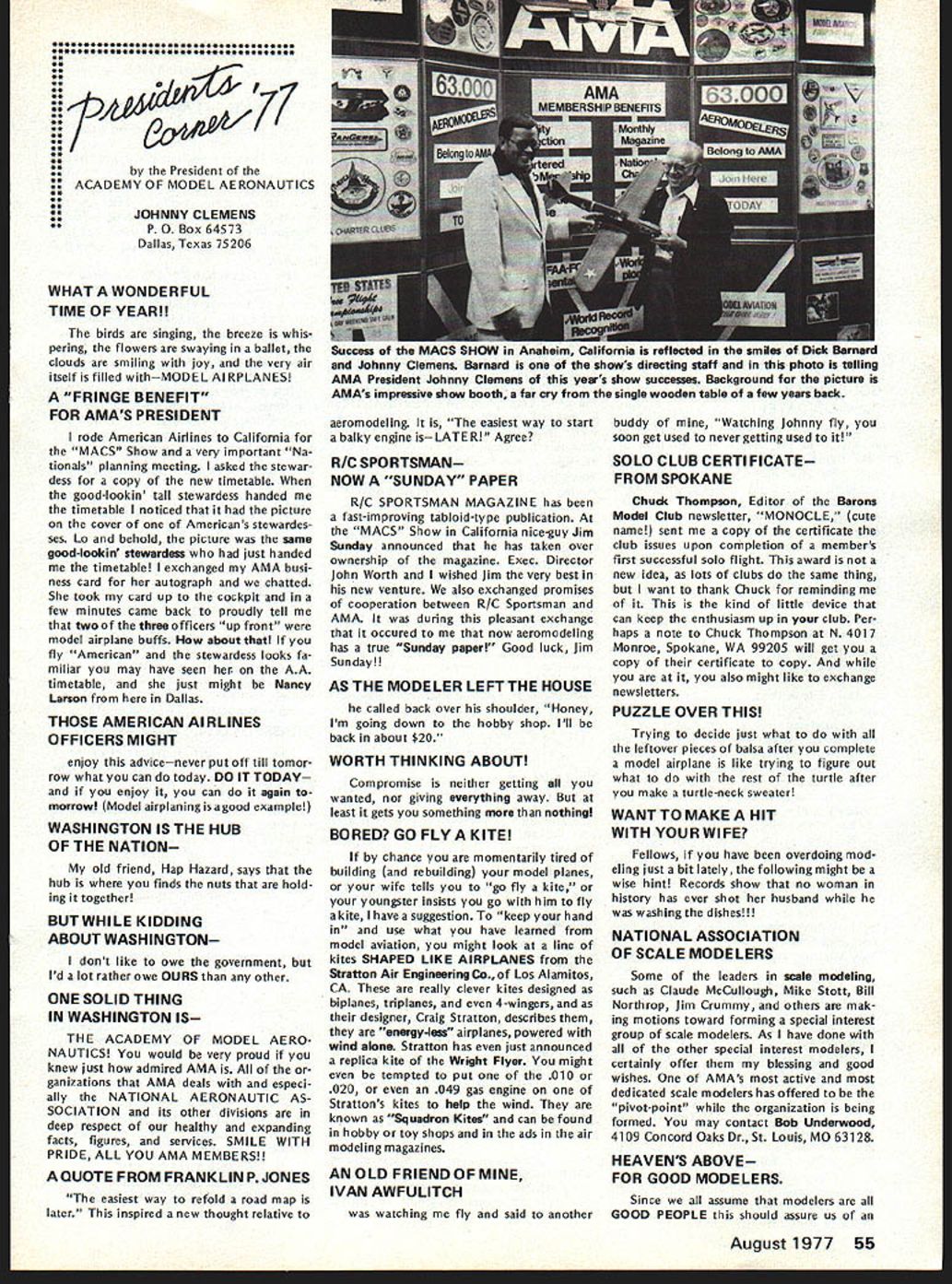
These great shows glow with success and the ACADEMY OF MODEL AERONAUTICS is proud to have an active part in the excitement. As the shows have grown, AMA's participation has grown from a single bare wooden table to a very handsome, very professional booth that all AMA members can be proud of. Having an AMA booth at these shows and meetings offers a direct-to-AMA-Headquarters method of signing up for new or renewal memberships. It also gives the individual member a place and a person to talk to about membership problems which might exist. And in most events some of the highest AMA officers are there in person to greet the individual member.
The requests for AMA to send displays and representatives to these worthy gatherings is ever-increasing. The Executive Council has approved funds for buying more booth and display materials. The goal is to have a standard booth available in each AMA District, with perhaps three feature booths available in strategic locations around the country. AMA WILL IMPROVE THE IMAGE!!! WITH YOUR APPROVAL. AND HELP!!!
TAKE YOUR TIME WITH YOUR BUILDING!
Don't forget, probably the only man who ever got all his work done by Friday was Robinson Crusoe! (Stolen quote.)
ON THE WALL—UNIV. OF CALIFORNIA-RIVERSIDE.
"LEAD, FOLLOW, OR GET OUT OF THE WAY!"
SOMETHING FOR THE LADIES!!
Several AMA members at the shows such as WRAMS, MACS, WEAK SIGNALS, and so forth, have looked over all the AMA pins and patches and then said, "Don't you have any jewelry or something I can take home to my wife?" That is such a fine suggestion and attitude that you can bet AMA is looking into it. If you know of items or sources please send the information to Larry Bolich or Frank Ehling at AMA HQ.
IF YOU ATTEND THE "NATS" IN RIVERSIDE
—a restaurant there has placemats on which I found a quote I like. It reads, "THOSE WHO BRING SUNSHINE TO THE LIVES OF OTHERS CANNOT KEEP IT FROM THEMSELVES." This restaurant not only has beautiful quotes, but the most beautiful pies you ever saw. The name is Squires, on University Blvd.
AT A "NATS" PLANNING MEETING
there is always a lot of argument revolving around the choice of the "ideal" flying site for each of the events. For this year's "Nats" there were several excellent Free-Flight sites suggested, and as many different opinions as there were people involved! After several rounds of argument, one of the officials, with "tongue in cheek" said, "Why don't you just pick a site and then keep it a secret until the last moment?"
This same "tongue in cheek" wise official offered further "tongue in cheek" advice suggesting that we put in the entry blank that all "protests" should be made out in advance and submitted well before time for the event in order that Contest Directors could consider the problems at their leisure, perhaps with the aid of a Ouija Board or crystal ball.
This all gives me a chance to mention that in planning, meetings, and organization, more has gone into the upcoming "Nats" in RIVERSIDE, CALIFORNIA than any national meet previously. Better plan to attend! Aug. 7-14.
This also gives me the chance to offer a reminder that—
NO MATTER WHAT THE COMPETITION— WHEN THERE IS FRIENDSHIP AND RESPECT— EVERYBODY WINS!
AS THE AIRLINE SAYS—FLY UNITED!!
Two of the AMA "family's" most active young folks have decided to make it a "team." Control line fliers and organizers Ben Sassetti and Patsy Sasset are now Ben and Patty Sassetti. I guess, in modelers' language they have taken two monoplanes and combined them into one biplane, so they can FLY UNITED. Best wishes to Ben and Patty from all of AMA!
GRASSFIELD CLIPPINGS—WHAT?
One of the most interesting of the newsletters that I receive is a paper called "Clippings" from the GRASSFIELD R/C CLUB of Minneapolis, MN. That club is lucky to have a "double-duty" volunteer in VIC LEEHORFF who has stuck his chin out as both club president and newsletter editor. (Watch this "foss"—it's possible future AMA presidential timber!)
I want you to share with me some of the colorful language Vic uses in his articles! I quote—"His plane looked like a big cake of wax, its wings heeled over with craft dexterity and skill until time to enter the landing pattern. As the plane lowered near the ground ready to touch down, it happened. The earth swelled, rose up and swallowed the plane, chewed it up, belched, and spit up the remains, scattering what was left on the field." Vic, that is pretty "heady" stuff. You sound like a very colorful fellow and I may appoint you to write some model airplane soap opera!
"STREAMLINES"—FROM ROMEO, MICHIGAN
A new newsletter editor from ROMEO AREA R/C CLUB, DON LAWRENCE, gave me a closing line for my column from an editorial of his, I quote—
"ANY TIME WE FLY WE'RE MAKING MEMORIES —LET'S MAKE THEM ALL GOOD!"
****** all for now ******
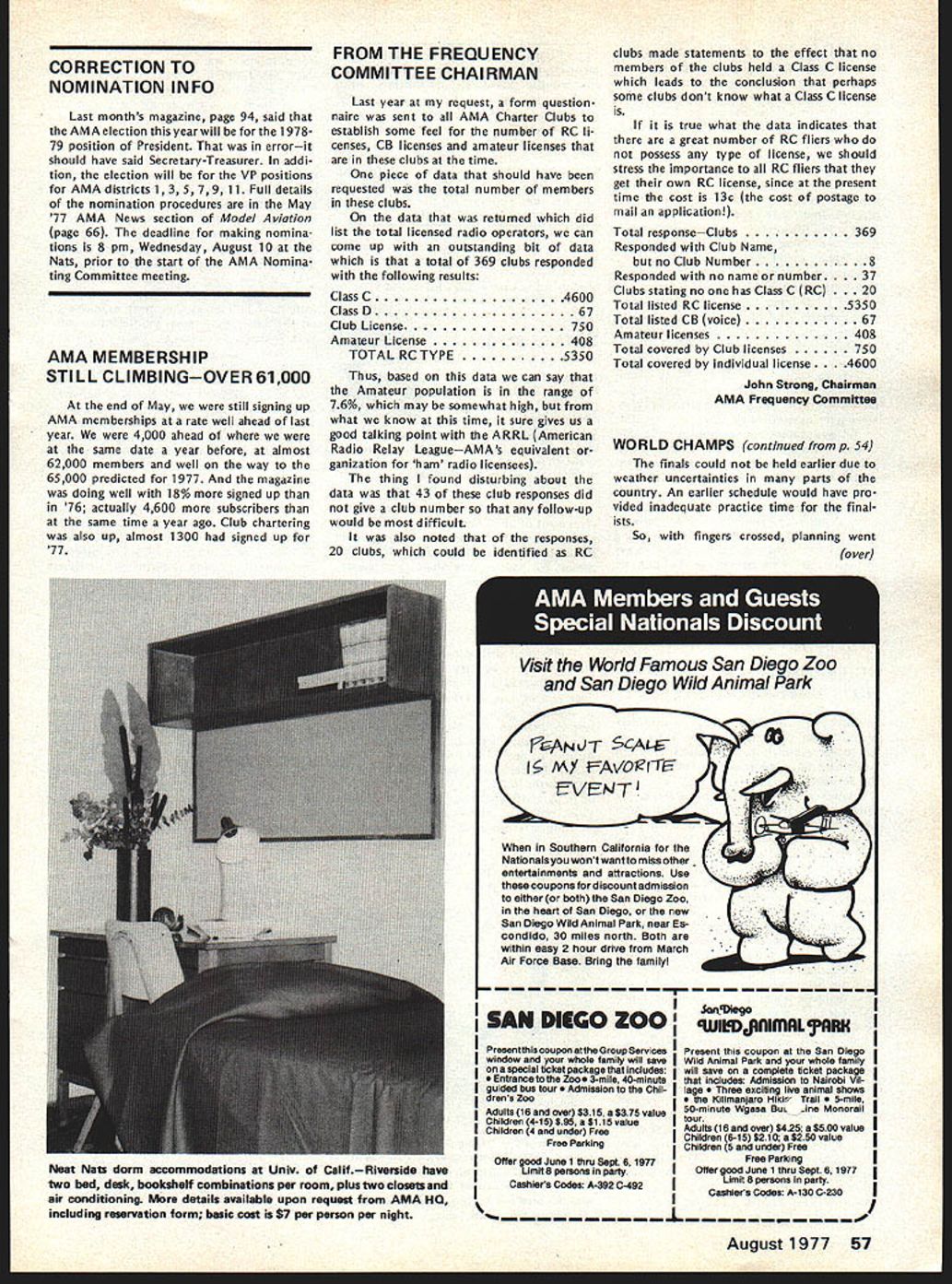
CORRECTION TO NOMINATION INFO
Last month's magazine, page 94, said that the AMA election this year will be for the 1978-79 position of President. That was in error—it should have said Secretary-Treasurer. In addition, the election will be for the VP positions for AMA districts 1, 3, 5, 7, 9, 11. Full details of the nomination procedures are in the May '77 AMA News section of Model Aviation (page 66). The deadline for making nominations is 8 p.m., Wednesday, August 10 at the Nats, prior to the start of the AMA Nominating Committee meeting.
AMA MEMBERSHIP STILL CLIMBING—OVER 61,000
At the end of May, we were still signing up AMA memberships at a rate well ahead of last year. We were 4,000 ahead of where we were at the same date a year before, at almost 62,000 members and well on the way to the 65,000 predicted for 1977. And the magazine was doing well with 18% more signed up than in '76; actually 4,600 more subscribers than at the same time a year ago. Club chartering was also up, almost 1,300 had signed up for '77.
FROM THE FREQUENCY COMMITTEE CHAIRMAN
Last year at my request, a form questionnaire was sent to all AMA Charter Clubs to establish some feel for the number of RC licenses, CB licenses and amateur licenses that are in these clubs at the time.
One piece of data that should have been requested was the total number of members in these clubs.
On the data that was returned which did list the total licensed radio operators, we can come up with an outstanding bit of data which is that a total of 369 clubs responded with the following results:
Class C . . . . . . . . . . . . . . . . . 4600 Class D . . . . . . . . . . . . . . . . . 67 Club Licenses . . . . . . . . . . . . . . 750 Amateur Licenses . . . . . . . . . . . . 408 TOTAL RC TYPE . . . . . . . . . . . . . 5350
Thus, based on this data we can say that the Amateur population is in the range of 7.6%, which may be somewhat high, but from what we know at this time, it sure gives us a good talking point with the ARRL (American Radio Relay League—AMA's equivalent organization for "ham" radio licenses).
The thing I found disturbing about the data was that 43 of these club responses did not give a club number so that any follow-up would be most difficult.
It was also noted that of the responses, 20 clubs, which could be identified as RC clubs made statements to the effect that no members of the clubs held a Class C license which leads to the conclusion that perhaps some clubs don't know what a Class C license is.
If it is true what the data indicates that there are a great number of RC fliers who do not possess any type of license, we should stress the importance to all RC fliers that they get their own RC license, since at the present time the cost is 13¢ (the cost of postage to mail an application!).
Total response—Clubs . . . . . . . . . . . . . . . . . 369 Responded with Club Name, but no Club Number . . . . . . . . . . . . . . . . . . . 8 Responded with no name or number . . . . . . . . . . . . . . . . . . . . . . . . . . 37 Clubs stating no one has Class C (RC) . . . . . . . . . . . . . . . . . . . . . . . . 20 Total listed RC license . . . . . . . . . . . . . . . . . . . . . . . . . . . . . 5350 Total listed CB (voice) . . . . . . . . . . . . . . . . . . . . . . . . . . . . . 67 Amateur licenses . . . . . . . . . . . . . . . . . . . . . . . . . . . . . . 408 Total covered by Club Licenses . . . . . . . . . . . . . . . . . . . . . . . . 750 Total covered by Individual License . . . . . . . . . . . . . . . . . . . . 4600
John Strong, Chairman AMA Frequency Committee
AMA News
FCC Respects AMA Position Regarding New R/C Frequencies
A recent letter from the AMA's legal counsel advised AMA that the FCC is currently considering R/C and other frequencies. The letter follows and gives evidence of AMA's 1976 campaign and continuing efforts having impact. We recently sent a copy of "Spectrum Alternatives: Personal Radio Services," prepared by the Personal Radio Planning Group, FCC's Office of Plans and Policy. Unfortunately, unable to obtain additional copies of the report beyond the single copy supplied, we thought it important, therefore, to summarize the report so you would be able to read the complete text.
Basically, the study group examined seven frequency bands suggested as a real location for Personal Radio Services. These include reserved bands 89,400–90,200 and 92,800–94,700 MHz, the Land Mobile 800 MHz band allocation, and in addition two reserved bands. The study suggested:
- 2695–2696 MHz
- 2754–2800 MHz
- 2980–2989 MHz
- 2991–3000 MHz
- 22,200–22,400 MHz
- 89,400–90,200 MHz
- 92,800–94,700 MHz
(The domestic allocations noted in the report were International Fixed, Government, International Fixed, International Fixed, Government/Amateur, Reserved/Land Mobile, Reserved/Land Mobile, respectively.)
The planning group conducted the study assuming the frequency band would potentially be available as part of a frequency band could be reallocated, automatically causing users of existing services to lose service. A personal radio service frequency band would cause acceptably low interference to users of other frequency bands; the cost of relocating existing users to other parts of the spectrum already allocated to the same service would be acceptably low.
The study also considered social value of services which would have to relocate, international treaty obligations, whether a band could economically be used for personal radio service, and finally possible frequency-related biological hazards due to radiation.
Of direct interest to the Academy, the study examined the possibility of reallocating present Radio Control channels for expanded personal communications voice service. The reallocation was specifically rejected. The study group stated Radio Control Service is used mainly for model control — popularly the control of model airplanes. Eight channels are available at 26.9–27.8 MHz; seven channels at 72–76 MHz are available on a secondary basis. The number of licensees has grown from around 40,000 in June 1975 to 72,000 in June 1976 — an 80% growth. At large meetings of modelers, 10 channels may be used at one time. Modelers have experienced severe interference in both frequency bands — undesirable because it can lead to property damage and serious injury. New radio-control frequencies would therefore be desirable.
Until radio-control service spectrum would be available for other personal radio purposes, the Academy's program encouraging individual modelers to obtain their own radio-control licenses is paying dividends.
The FCC and other government agencies concerned with the rapid growth in numbers of licensees have scored a significant point in recognizing that presently available R/C frequencies are vulnerable to reallocation. Additional R/C assignments are necessary to alleviate frequency congestion at large meets. The sound program of individual licensing has demonstrated value in protecting modelers' R/C interests and the Academy is urged to continue its individual licensing encouragement.
Yours very truly, Jeremiah Courtney August 1977
A recent letter from AMA’s legal counsel advised AMA that the FCC is currently considering R/C and other frequencies. The letter follows and gives evidence of AMA’s 1976 campaign and continuing efforts having impact. I recently sent a copy of Spectrum Alternatives: Personal Radio Services, prepared by the Personal Radio Planning Group, FCC’s Office of Plans and Policy. Unfortunately, unable to obtain additional copies of the report beyond the single copy supplied, I thought it important therefore to summarize the report as I was able to read the complete text.
Basically, the study group examined seven frequency bands suggested for relocation to Personal Radio Services. Suggested relocation bands include reserved bands 894–902 and 928–947 MHz, Land Mobile/800 MHz band allocations, and in addition two reserved bands. The study suggested:
- 2695–2696 MHz
- 2754–2800 MHz
- 2980–2989 MHz
- 2991–3000 MHz
- 22200–22400 MHz
- 89400–90200 MHz
- 92800–94700 MHz
Domestic allocations shown by the study included International Fixed, Government, International Fixed/Public, Government/Amateur Radio Service, and Reserved/Land Mobile usages as noted above.
The planning group conducted the study assuming the frequency bands would potentially be available as part of the frequency band could be reallocated automatically causing users of existing services to lose service. A personal radio service frequency band would cause acceptably low interference to users of other frequency bands; the cost of relocating existing users to other parts of the spectrum already allocated to the same service would be acceptably low. The group apparently also considered the social value of services that would have to relocate, international treaty obligations, whether a band could be economically used for personal radio service and, finally, possible frequency-related biological hazards due to radiation.
The study identified the seven segments of spectrum listed above as potential sources for expanded personal radio service, indicating further study being undertaken with respect to specific problems that might develop.
Of direct interest to the Academy, the study examined the possibility of reallocating present Radio Control channels to expanded personal communications voice service. Reallocation was specifically rejected. The study group stated Radio Control Service is used mainly for model control, popularly to control model airplanes. Eight channels available at 26.9–27.8 MHz; seven channels at 72–76 MHz are available on a secondary basis. The number of licensees has grown from around 40,000 in June 1975 to 72,000 in June 1976 — 80% growth. At large meetings of modelers, 10 channels may be used at one time. Modelers have experienced severe interference in both frequency bands — undesirable because it can lead to property damage and serious injury. New radio-control frequencies would therefore be desirable.
Until radio-control service spectrum would be available for other personal radio purposes, the Academy’s program encouraging individual modelers to obtain their own radio-control licenses is paying dividends. The FCC and other government agencies concerned with the rapid growth in numbers of licensees have scored a significant point in recognizing that presently available R/C frequencies are vulnerable to reallocation. Additional R/C assignments are necessary to alleviate frequency congestion at large meets. The sound program of individual licensing has demonstrated value in protecting modelers’ R/C interests and the Academy is urged to continue its individual licensing encouragement.
AMA News
newsletter, Greensburg, PA, I noticed that they planned to hold a cross country RC race of about 8.4 miles length. Don't know the results, but it's another example of good club activities. Have read of other such events, of course, and I'm sure you're all familiar with the "Liberty Bell" coast-to-coast crossing. Flying eight miles may sound easy, but when you contend with route difficulties and try to master the problem of flying from an automobile, then, I'm sure it's not easy!
Special Event
I will close this month's short report with a plug for the RC Pattern Flyers Masters Contest to be held on 25 & 26 June in Springfield, OH. The contest, of course, is to select the three-man U.S. team to fly in the World Championships also to be held in Springfield the week following. My wife, Clara, also prompts me to invite all who can attend not only these events, but also the very unique banquet and special doings (which she is planning) to be held the 25th of June at Scot's Inn, Springfield — y'all come!
**************
Take note of the new masthead photo this month. Some third grade students that I gave a talk to the other day, told their teacher later that I looked like a skinny Santa Claus! Oh well, so much for trying to be dashing!
**************
There seems to be some sort of contest going on with these vice presidential columns for cute endings and blurred pictures. District IV members arise! Send me your cute ends in photographic form and I'll reprint the darkest and blurriest here. We can win!
VI DISTRICT REPORT
Illinois · Indiana · Kentucky · Missouri
Glenn Lee District VI Vice-President 819 Mandrake Batavia, IL 60510
Associate Vice-Presidents Roger Geers, 729 N. 22nd St., Quincy, IL 62301 Robert Giff, 216 Stanley Lane, Springfield, IL 62704 John Matthews, 5034 Madeira Dr., Apt. C, Ft. Wayne, IN 46805 Sidney Miller, 524 Corinthia Ct., Elk Grove Vlg., IL 60007 Edwin Wm. Paul, 1040 Maywick Dr., Lexington, KY 40504 Robert E. Stagner, 1838 Sherier Pl., Poplar Bluff, MO 63901 Phillip Sullivan, 3021 Spring Valley Ct., Anderson, IN 46011
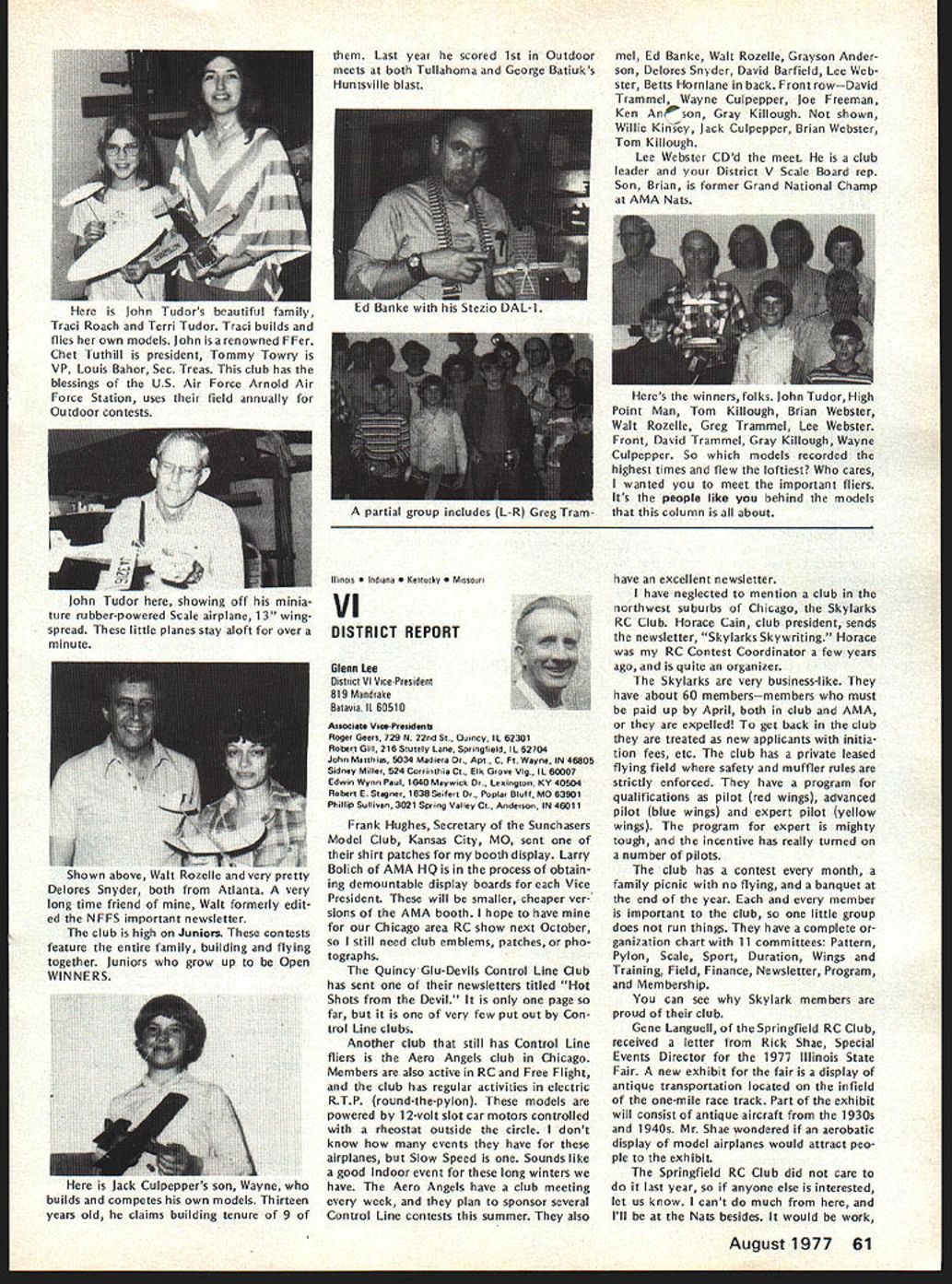
Frank Hughes, Secretary of the Sunchasers Model Club, Kansas City, MO, sent one of their shirt patches for my booth display. Larry Bolich of AMA HQ is in the process of obtaining a demonstrable display board for each Vice-President. These will be smaller, cheaper versions of the AMA booth. I hope to have mine for our Chicago area RC show next October, so I will need club emblems, patches, or photographs.
The Quincy-Gut-Devils Control Line Club has sent one of their newsletters titled "Hot Shots from the Devil." It is only one page so far, but it is one of very few put out by Control Line clubs.
Another club that still has Control Line fliers is the Aero Angels club in Chicago. Members are also active in RC and Free Flight, and the club has regular activities in electric R.T.P. (round-the-pylon). These models are powered by 12-volt slot car motors controlled with a rheostat outside the circle. I don't know how many events they have for these airplanes, but Slow Speed is one. Sounds like a good indoor event for these long winters we have. The Aero Angels have a club meeting every week, and they plan to sponsor several Control Line contests this summer. They also have an excellent newsletter.
I have neglected to mention a club in the northwest suburbs of Chicago, the Skylarks RC Club. Horace Cain, club president, sends the newsletter, "Skylarks Skywriting." Horace was my RC Contest Coordinator a few years ago, and is quite an organizer.
The Skylarks are very business-like. They have about 60 members — members who must be paid up by April, both in club and AMA, or they are expelled! To get back in the club they are treated as new applicants with initiation fees, etc. The club has a private leased flying field where safety and muffler rules are strictly enforced. They have a program for qualifications as pilot (red wings), advanced pilot (blue wings) and expert pilot (gold wings). The program for expert is mighty tough, and the incentive has really turned on a number of pilots.
The club has a contest every month, a family picnic with no flying, and a banquet at the end of the year. Each and every member is important to the club, so one little group does not run things. They have a complete organization chart with committees: Pattern, Pylon, Scale, Sport, Duration, Wings and Training, Field, Finance, Newsletter, Program, and Membership.
You can see why Skylark members are proud of their club.
Gene Languell of the Springfield RC Club received a letter from Rick Shave, Special Events Director for the 1977 Illinois State Fair. A new exhibit for the fair is a display of antique transportation located in the infield of the one-mile race track. Part of the exhibit will consist of antique aircraft from the 1930s and 1940s. Mr. Shave wondered if an aerobatic display of model airplanes would have a place in the exhibit.
The Springfield RC Club did not care to do it last year, so if anyone else is interested, let us know. I can't do much from here, and I'll be at the Nats besides. It would be work, but I hope someone will take it on. and such things as crowd control and landing areas must be considered to say nothing of flying every day for 10 days. I doubt if money is available for expenses, although I don't have any information on this.
Iowa • Michigan • Minnesota • Wisconsin
VII DISTRICT REPORT
Hardy Brodersen District VII Vice-President P. O. Box 1104 Birmingham, MI 48012
Associate Vice-Presidents James D. Clark, RR 3, Cedar Rapids, IA 52404 Frank Morrissey, 140 W. Park Ave., New Berlin, WI 53151 Win. Rohrig, 4941 Tanglewood Trail, St. Joseph, MI 49085 Terry Taylor, 6308 Lombardy Lane, Crystal, MN 55428 Wayne Yeager, 38235 Castle, Romulus, MI 48174
Control Line Contest Board Opening—Dist. VII
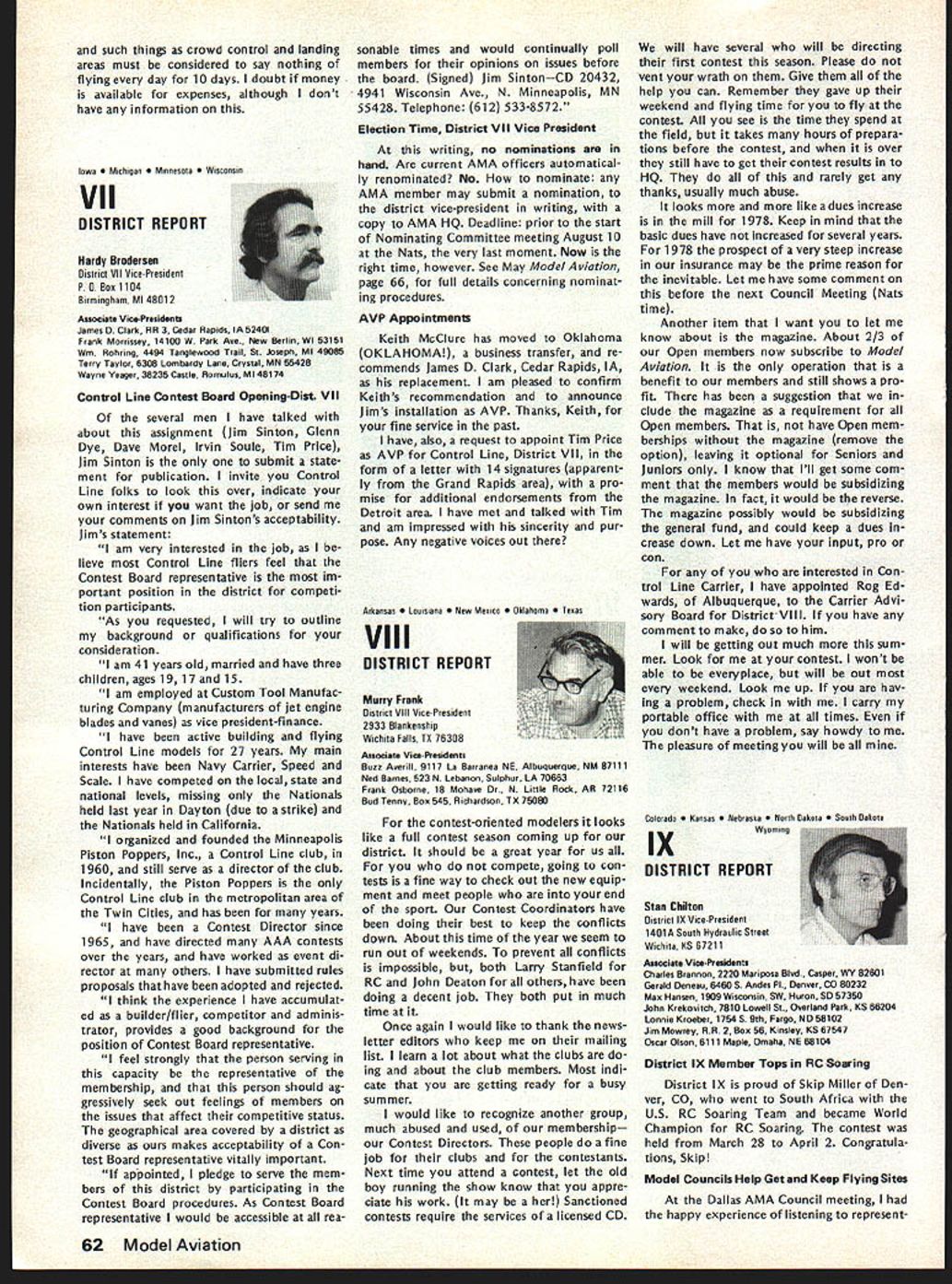
Of the several men I have talked with about this assignment (Jim Sinton, Glenn Dye, Dave Morel, Irvin Soule, Tim Price), Jim Sinton is the only one to submit a statement for publication. I invite you Control Line folks to look this over, indicate your own interest if you want the job, or send me your comments on Jim Sinton's acceptability. Jim's statement:
"I am very interested in the job, as I believe most Control Line fliers feel that the Contest Board representative is the most important position in the district for competition participants.
"As you requested, I will try to outline my background or qualifications for your consideration.
"I am 41 years old, married and have three children, ages 19, 17 and 15.
"I am employed at Custom Tool Manufacturing Company (manufacturers of jet engine blades and vanes) as vice president-finance.
"I have been active building and flying Control Line models for 27 years. My main interests have been Navy Carrier, Speed and Scale. I have competed on the local, state and national levels, missing only the Nationals held last year in Dayton (due to a strike) and the Nationals held in California.
"I organized and founded the Minneapolis Piston Poppers, Inc., a Control Line club, in 1960, and still serve as a director of the club. Incidentally, the Piston Poppers is the only Control Line club in the metropolitan area of the Twin Cities, and has been for many years.
"I have been a Contest Director since 1965, and have directed many AAA contests over the years, and have worked as event director at many others. I have submitted rules proposals that have been adopted and rejected.
"I think the experience I have accumulated as a builder/flier, competitor and administrator, provides a good background for the position of Contest Board representative.
"I feel strongly that the person serving in this capacity be the representative of the membership, and that this person should aggressively seek out feelings of members on the issues that affect their competitive status. The geographical area covered by a district as diverse as ours makes acceptability of a Contest Board representative vitally important.
"If appointed, I pledge to serve the members of this district by participating in the Contest Board procedures. A Contest Board representative would be accessible at all reasonable times and would continually poll members for their opinions on issues before the board." (Signed) Jim Sinton—CD 20432, 4941 Wisconsin Ave., N., Minneapolis, MN 55428. Telephone: (612) 533-8572.
Election Time, District VII Vice President
At this writing, no nominations are in hand. Are current AMA officers automatically renominated? No. How to nominate: any AMA member may submit a nomination, to the district vice-president in writing, with a copy to AMA HQ. Deadline: prior to the start of Nominating Committee meeting August 10 at the Nats, the very last moment. Now is the right time, however. See May Model Aviation, page 66, for full details concerning nominating procedures.
AVP Appointments
Keith McClure has moved to Oklahoma (OKLAHOMA!), a business transfer, and recommends James D. Clark, Cedar Rapids, IA, as his replacement. I am pleased to confirm Keith's recommendation and to announce Jim's installation as AVP. Thanks, Keith, for your fine service in the past.
I have, also, a request to appoint Tim Price as AVP for Control Line, District VII, in the form of a letter with 14 signatures (apparently from the Grand Rapids area), with a promise for additional endorsements from the Detroit area. I have met and talked with Tim and am impressed with his sincerity and purpose. Any negative voices out there?
Arkansas • Louisiana • New Mexico • Oklahoma • Texas
VIII DISTRICT REPORT
Murry Frank District VIII Vice-President 2933 Blankenship Wichita Falls, TX 76308
Associate Vice-Presidents Buzz Arell, 9117 La Barranca NE, Albuquerque, NM 87111 Ned Barnes, 523 N. Lebanon, Sulphur, LA 70663 Frank Osborne, 18 Mohave Dr., N. Little Rock, AR 72116 Bud Tenney, Box 545, Richardson, TX 75080
For the contest-oriented modelers it looks like a full contest season coming up for our district. It should be a great year for us all. For you who do not compete, going to contests is a fine way to check out the new equipment and meet people who are into your end of the sport. Our Contest Coordinators have been doing their best to keep the conflicts down. About this time of the year we seem to run out of weekends. To prevent all conflicts is impossible, but both Larry Stanfield for RC and John Deaton for all others, have been doing a decent job. They both put in much time at it.
Once again I would like to thank the newsletter editors who keep me on their mailing list. I learn a lot about what the clubs are doing and about the club members. Most indicated that they are getting ready for a busy summer.
I would like to recognize another group, much abused and used, of our membership—our Contest Directors. These people do a fine job for their clubs and for the contestants. Next time you attend a contest, let the old man running the show know that you appreciate his work. (He may be a hero!) Sanctioned contests require the services of a licensed CD.
We will have several who will be directing their first contest this season. Please do not vent your wrath on them. Give them all of the help you can. Remember they gave up their weekend and flying time for you to fly at the contest. All you see is the time they spend at the field, but it takes many hours of preparations before the contest, and when it is over they still have to get their contest results in to HQ. They do all of this and rarely get any thanks, usually much abuse.
It looks more and more like a dues increase is in the mill for 1978. Keep in mind that the basic dues have not increased for several years. For 1978 the prospect of a very steep increase in our insurance may be the prime reason for the inevitable. Let me have some comment on this before the next Council Meeting (Nats time).
Another item that I want you to let me know about is the magazine. About 2/3 of our Open members now subscribe to Model Aviation. It is the only operation that is a benefit to our members and still shows a profit. There has been a suggestion that we introduce the magazine as a requirement for all Open members. That is, not have Open memberships without the magazine (the members' option), leaving it optional for Seniors and Juniors only. I know that I'll get some comment that the members would be subsidizing the magazine. In fact, it would be the reverse. The magazine possibly would be subsidizing the general fund, and could keep a dues increase down. Let me have your input, pro or con.
For any of you who are interested in Control Line Carrier, I have appointed Rog Edwards, of Albuquerque, to the Carrier Advisory Board for District VIII. If you have any comment to make, do so to him.
I will be getting out much more this summer. Look for me at your contest. I won't be able to be everywhere, but will be out most every weekend. Look me up. If you are having a problem, check in with me. I carry my portable office with me at all times. Even if you don't have a problem, say howdy to me. The pleasure of meeting you will be all mine.
Colorado • Kansas • Nebraska • North Dakota • South Dakota • Wyoming
IX DISTRICT REPORT
Stan Chilton District IX Vice-President 10410 South Hydraulic Street Wichita, KS 67211
Associate Vice-Presidents Charles Brennan, 2220 Mariposa Blvd., Casper, WY 82601 Gerald Deane, 6640 S. Andes Pl., Denver, CO 80232 Max Hansen, 1909 Wisconsin, Shw., Miles City, MT 59330 John Krekorian, 7810 Lowell St., Overland Park, KS 66204 Lonnie Krehbiel, 1754 S. 9th, Emporia, KS 66801 Joe Mowery, RR 2, Box 54, Kiowa, KS 67070 Oscar Olson, 6111 Maple, Omaha, NE 68104
District IX is proud of Skip Miller of Denver, CO, who went to South Africa with the U.S. RC Soaring Team and became World Champion for RC Soaring. The contest was held from March 28 to April 2. Congratulations, Skip!
Model Councils Help Get and Keep Flying Sites
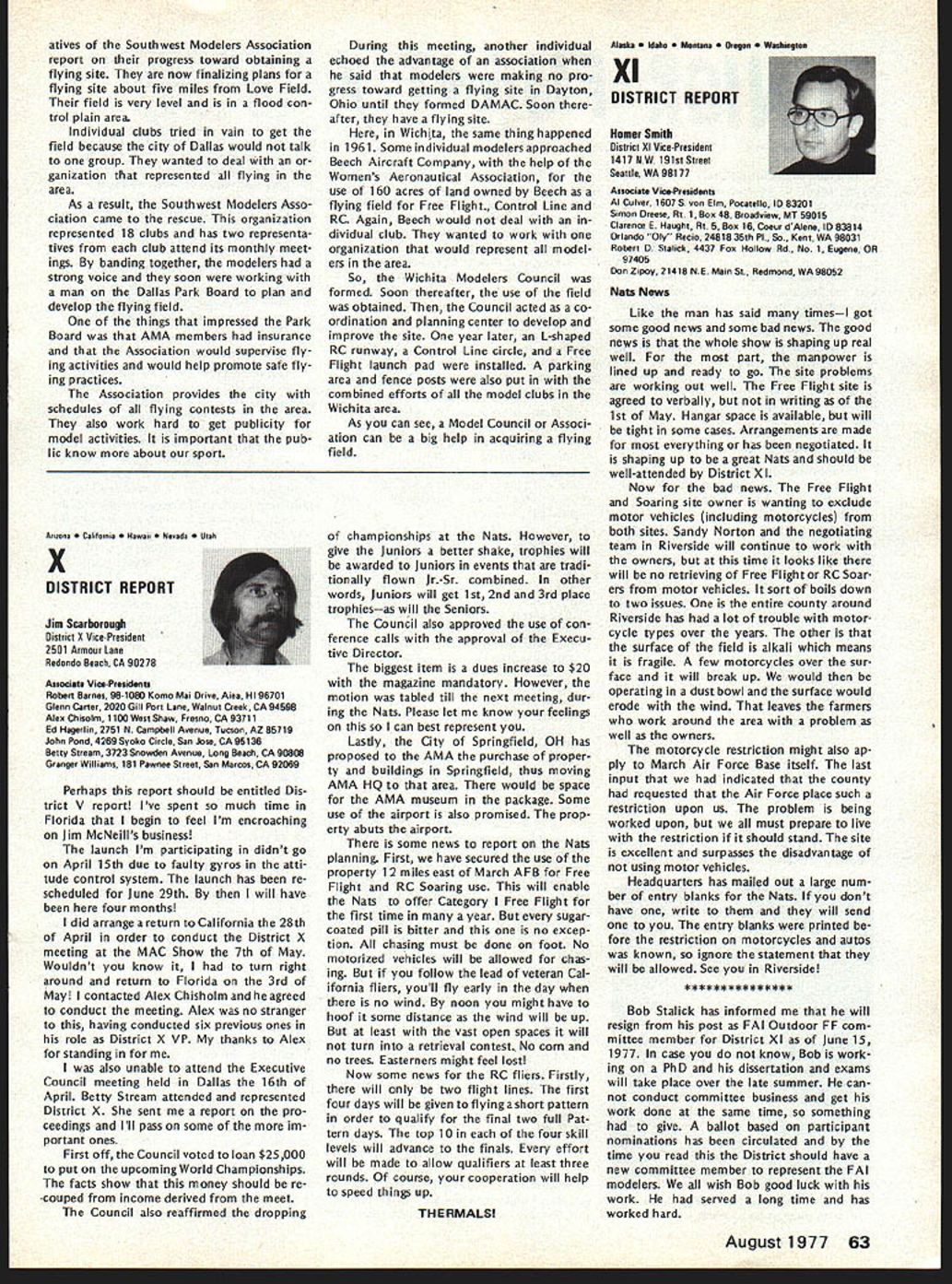
At the Dallas AMA Council meeting, I had the happy experience of listening to represent-
AMA News
A recent letter from the AMA's legal counsel advised AMA that the FCC is currently considering R/C and other frequencies. The letter follows and gives evidence of AMA's 1976 campaign and continuing efforts having impact. I recently sent a copy of Spectrum Alternatives: Personal Radio Services, prepared for the Personal Radio Planning Group, FCC's Office of Plans and Policy. Unfortunately, I was unable to obtain additional copies of the report beyond the single copy supplied. I thought it important, therefore, to summarize the report so you are able to read the complete text.
Basically, the study group examined seven frequency bands suggested for relocation to Personal Radio Services. These suggested relocations include reserved bands 894–902 MHz and 928–947 MHz (Land Mobile — 800 MHz band allocation). In addition, two reserved bands were suggested: 2695–2696 MHz band (International Fixed/Public), 2754–2800 MHz band (Government), 2980–2989 MHz band (International Fixed/Public), 2991–3000 MHz band (International Fixed), and 22,200–22,400 MHz band (Government/Amateur Radio Service). The planning group conducted the study assuming that a frequency band would potentially be available as part of a frequency reallocation. The study considered whether part of a frequency band could be reallocated automatically causing users of an existing service to lose service; whether a personal radio service frequency band would cause acceptably low interference to users of other frequency bands; the cost of relocating existing users to other parts of the spectrum already allocated to the same service; and whether such relocation costs would be acceptably low. The study also considered the social value of services that would have to relocate, international treaty obligations, whether a band could economically be used for personal radio service, and finally possible frequency-related biological hazards due to radiation.
The study identified seven segments of spectrum listed below as potential sources of spectrum to be expanded for personal radio service, indicating further study being undertaken with respect to specific problems that might develop. Frequency bands identified for reallocation to personal radio service:
- 2695–2696 MHz — International Fixed/Public
- 2754–2800 MHz — Government
- 2980–2989 MHz — International Fixed/Public
- 2991–3000 MHz — International Fixed
- 22,200–22,400 MHz — Government/Amateur Radio Service
- 89,400–90,200 MHz — Reserved/Land Mobile
- 92,800–94,700 MHz — Reserved/Land Mobile
Of direct interest to the Academy, the study examined the possibility of reallocating present radio control channels to expand personal communications voice service. Reallocation was specifically rejected. The study group stated Radio Control Service is used mainly for model control — popularly control of model airplanes. Eight channels are available in the 26–28 MHz area and seven channels in the 72–76 MHz area (available on a secondary basis). The number of licensees has grown from around 40,000 in June 1975 to 72,000 in June 1976 — an 80% growth. At large meetings modelers may use 10 channels at one time. Modelers have experienced severe interference on both frequency bands; this is undesirable because it can lead to property damage or serious injury. New radio-control frequencies would therefore be desirable until radio control service spectrum would be available for other personal radio purposes. Thus it may be seen that the Academy's program encouraging individual modelers to obtain their own radio control licenses is paying dividends.
The FCC and other government agencies concerned with the rapid growth in licensees have scored a significant point: to reallocate R/C frequencies would remove recognition of presently available R/C frequencies. Availability of additional R/C assignments is necessary to alleviate frequency congestion at large meets. The sound program of individual licensing has urged the Academy to continue its encouragement of individual licensing; its demonstrable value is progressing modelers' R/C interests.
Yours very truly, Jeremiah Courtney August 1977
AMA News — not found on this scanned page
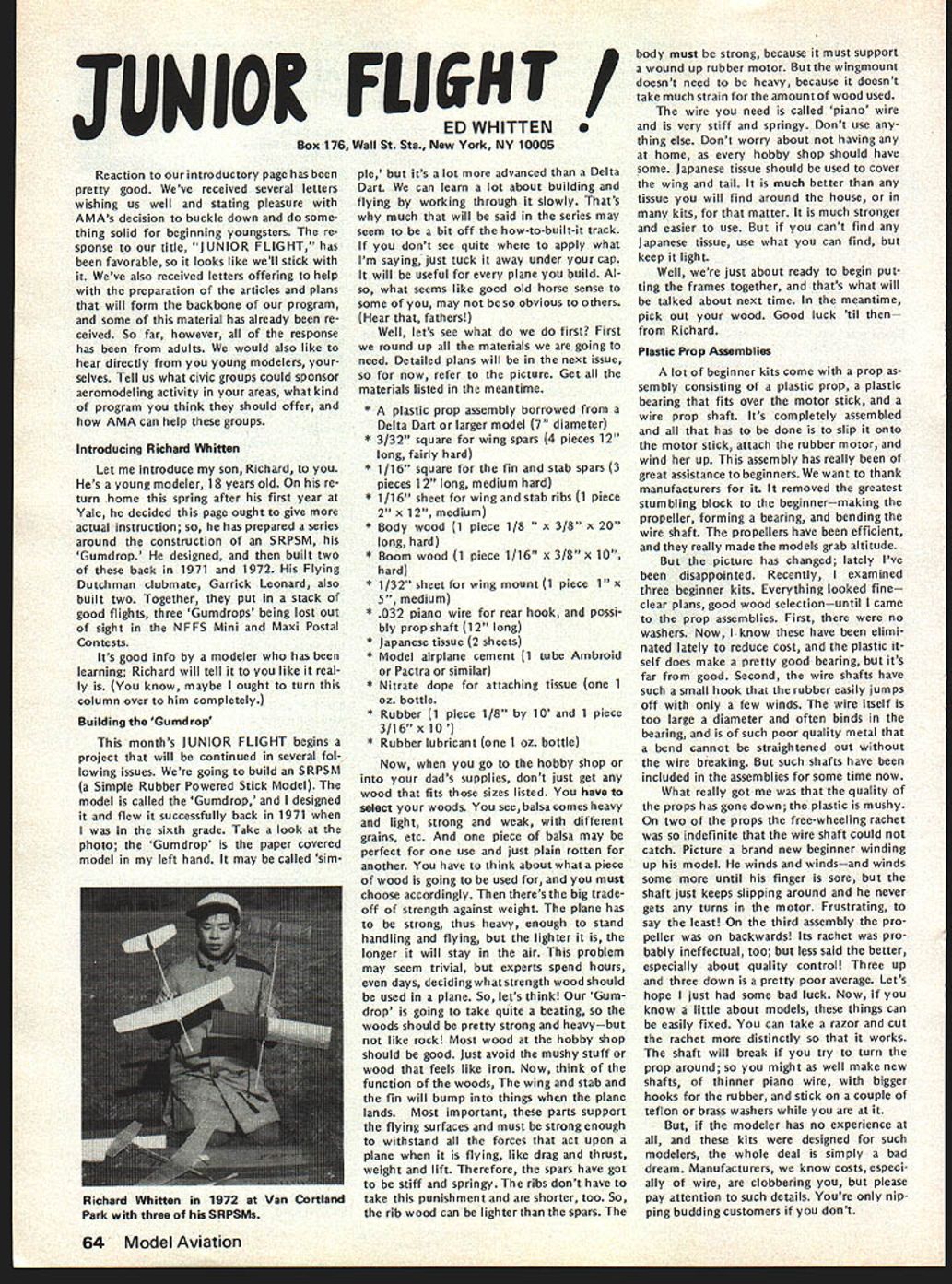
I examined the provided scanned page carefully but could not find any continuation or text for the article titled "AMA News." The page is the "JUNIOR FLIGHT!" feature by Ed Whitten (Model Aviation, p.64) and does not contain the AMA News material that continues from your prior-page context.
If you want me to extract the AMA News continuation, please provide the correct scanned page (the page that follows the prior-page context where Jeremiah Courtney's August 1977 sign-off appears). Alternatively, I can extract and correct the full text of the "Junior Flight!" article on this page if that would help. Which would you prefer?
Transcribed from original scans by AI. Minor OCR errors may remain.

