
AMA News
PR Roundup
Geoffrey Styles Director of Marketing, AMA — Muncie
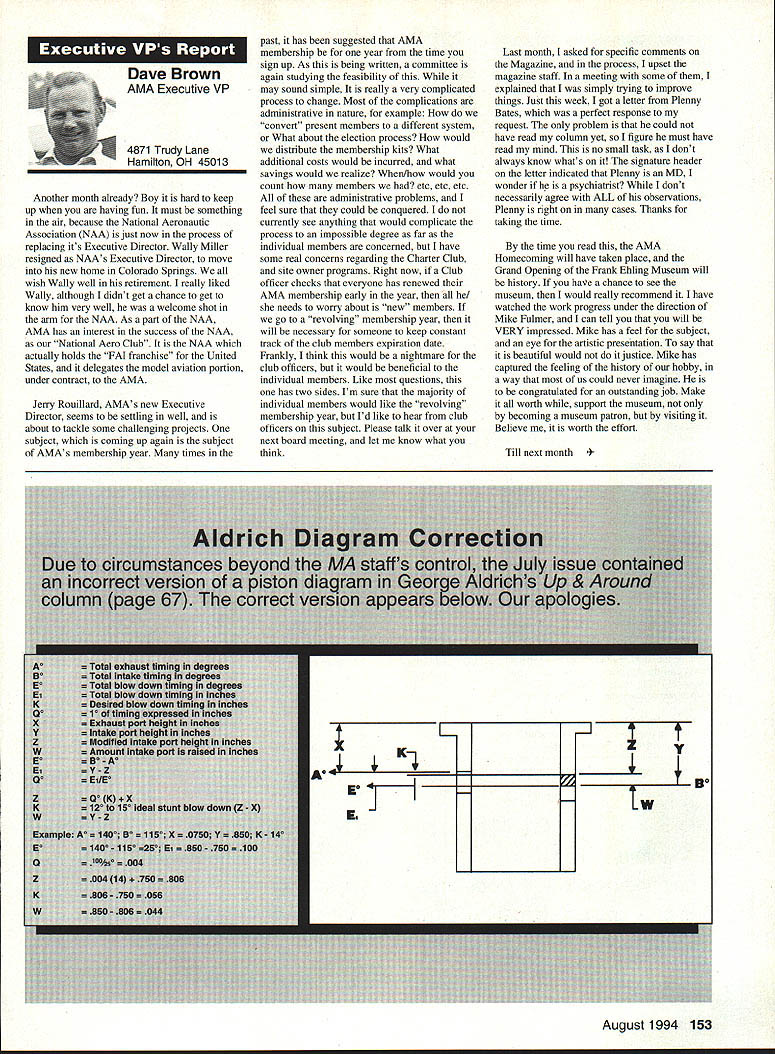
Those who attended Homecoming and the opening of the Museum in June met some of the employees who handle the wide variety of member services AMA offers. These hardworking folks often don't get recognized except as a voice at the end of the telephone, so I will include a couple of photos in this column from time to time to let you know who they are. Customer service is important to everyone at the Academy.
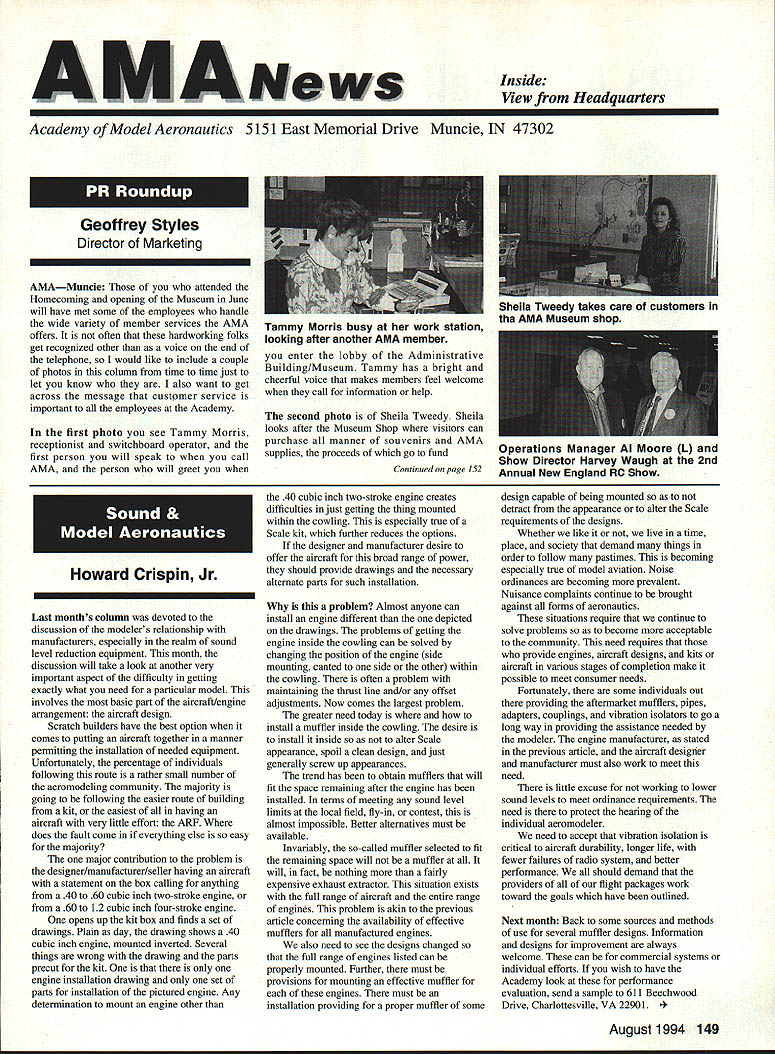
In the first photo you see Tammy Morris, receptionist and switchboard operator — the first person you will speak with when you call AMA and the person who greets members entering the lobby of the Administrative Building/Museum. Tammy has a bright, cheerful voice and makes members feel welcome when they call for information or help.
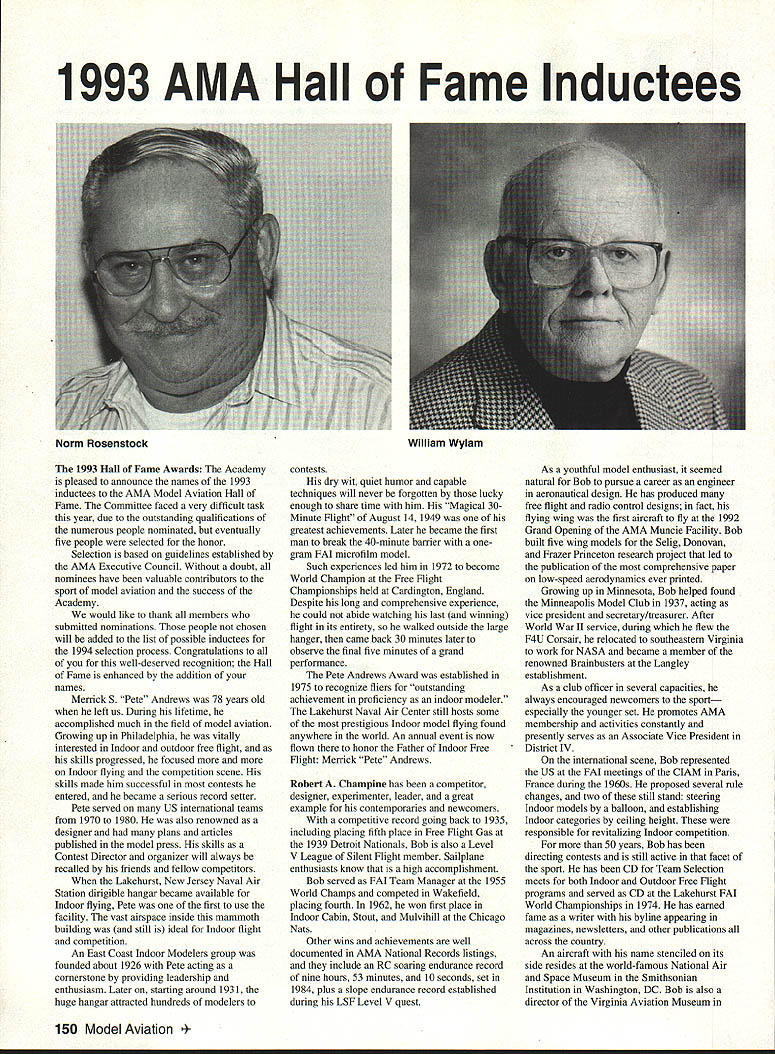
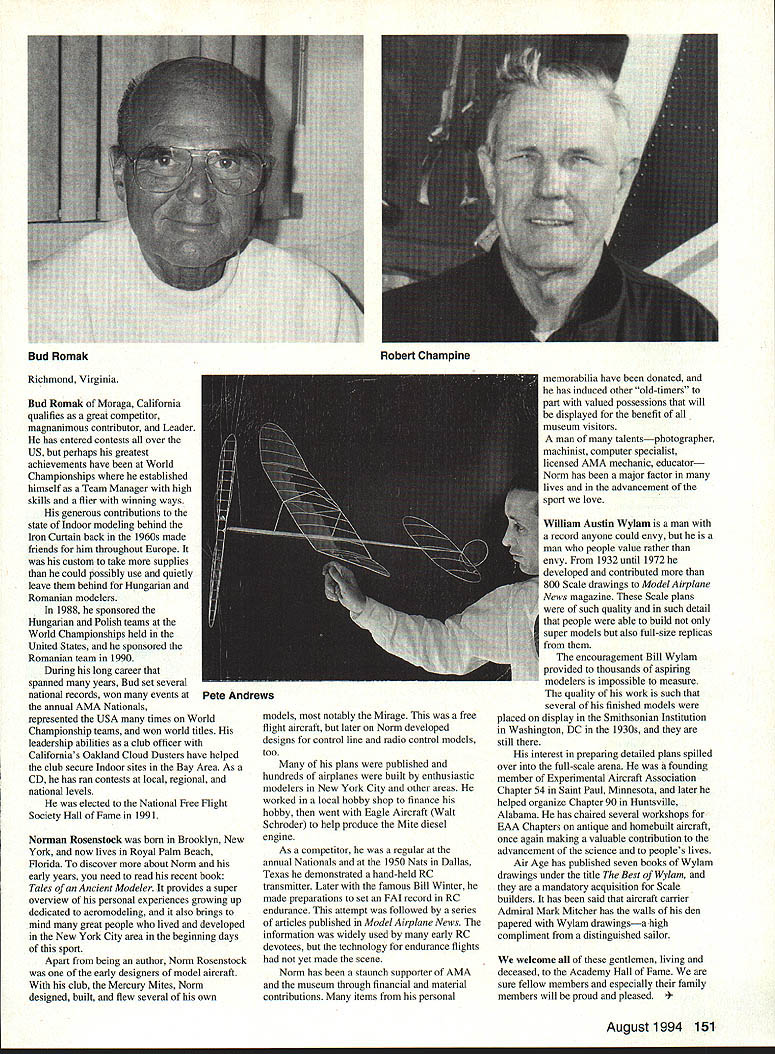
The second photo shows Sheila Tweedy. Sheila looks after the Museum Shop where visitors can purchase a number of souvenirs and AMA supplies; proceeds go to fund the Museum.
Fitting engines and mufflers in kits
Last month's column discussed modelers' relationships with manufacturers, especially regarding sound‑level reduction equipment. This month I want to look at another important issue: getting exactly what you need for a particular model — the basic parts, aircraft/engine arrangement, and aircraft design.
Scratch builders have the best option when it comes to arranging the aircraft to permit installation of needed equipment. Unfortunately, only a small percentage of the community scratch builds. Most modelers follow the easier route — building kits or buying ARFs. ARFs are not at fault; the core problem lies with designers/manufacturers/sellers who box an aircraft calling for a broad range of engines (for example, "40–60 cubic‑inch two‑stroke" or "60–120 cubic‑inch four‑stroke") but supply drawings and precut parts for a single engine installation.
Common problems:
- Drawings may show a specific engine installation (for example, a 40‑ci engine mounted inverted) while kit parts are precut for that installation.
- Installing a different engine often creates difficulty fitting the engine and exhaust within the cowling, especially for scale kits that reduce clearance options.
- Maintaining correct thrust line and side/offset adjustments can be challenging when the engine position is changed.
Solutions designers and manufacturers should provide:
- Alternate mounting drawings (side‑mount, canted, or other positions) and necessary alternate parts.
- Firewall and cowling clearances for the range of specified engines.
- Provisions for header pipes or remote‑mounted mufflers where practical.
The largest and most pressing problem today is installing effective mufflers. Many modelers try to preserve scale appearance by fitting a muffler inside whatever space remains after engine installation. In practice, mufflers chosen to “fit” that leftover space are often little more than expensive exhaust extractors and do not meet sound‑level limits at local fields or contests.
Recommendations for improvement:
- Engine manufacturers should provide muffler outlets and mounting points that accept common header pipes or adapters without extensive modification.
- Kit designers should incorporate muffler mounting options into firewall and cowling designs.
- Aftermarket suppliers should continue developing practical mufflers, header pipes, adapters, couplings, vibration isolators, and gaskets that fit common installations.
Until broader design changes occur, aftermarket solutions will continue to be important. Modelers should plan installations carefully and give manufacturers feedback about what works and what does not. Noise ordinances and nuisance complaints are increasing; to keep our sport accepted by the community, manufacturers, kit designers, aftermarket suppliers, and modelers must work together to provide practical, attractive, and effective solutions.
---
Hall of Fame
- Bud Romak — Moraga, California
Bud Romak qualifies as a great competitor, generous contributor, and leader. He entered contests across the U.S. and excelled at World Championships, serving as a skilled Team Manager. In the 1960s he quietly supported indoor modelers behind the Iron Curtain by leaving supplies for Hungarian and Romanian modelers. He sponsored the Hungarian and Polish teams in 1988 and the Romanian team in 1990. Bud set several national records, won many AMA Nationals events, represented the USA on World Championship teams, won world titles, helped secure indoor sites with the Oakland Cloud Dusters, and served as a CD at many contest levels. He was elected to the National Free Flight Society Hall of Fame in 1991.
- Norman Rosenstock — Royal Palm Beach, Florida
Born in Brooklyn, Norm Rosenstock is an early designer and modeler from the New York City era. His book, Tales of an Ancient Modeler, recounts his personal experiences and many notable figures from the sport's development. With the Mercury Mites, Norm designed, built, and flew several models (notably the Mirage). He later designed control line and radio control models, published plans that hundreds built, worked in a hobby shop, and assisted Eagle Aircraft in producing a small diesel engine. Norm was active at the Nationals, demonstrated early RC transmitters, and—alongside Bill Winter—pursued RC endurance efforts described in Model Airplane News. A staunch supporter of AMA and the museum, he has donated memorabilia and encouraged others to contribute. Norm has worked as a photographer, machinist, computer specialist, licensed AMA mechanic, and educator.
- William Austin Wylam — (various locations)
From 1932 to 1972 Bill Wylam produced more than 800 scale drawings for Model Airplane News. His detailed plans enabled modelers to build outstanding models and, in some cases, full‑size replicas. Several of his finished models were displayed in the Smithsonian in the 1930s. He was a founding member of EAA Chapter 54 in Saint Paul and helped organize Chapter 90 in Huntsville, Alabama, conducting workshops for EAA and homebuilt aircraft groups. He has published collections titled The Best of Wylam, essential for scale builders. Bill's encouragement and high‑quality work contributed greatly to the advancement of scale modeling.
We welcome these gentlemen, living and deceased, to the Academy Hall of Fame. Fellow members and their families will be proud to see their contributions recognized.
---
Executive Council and Strategic Planning
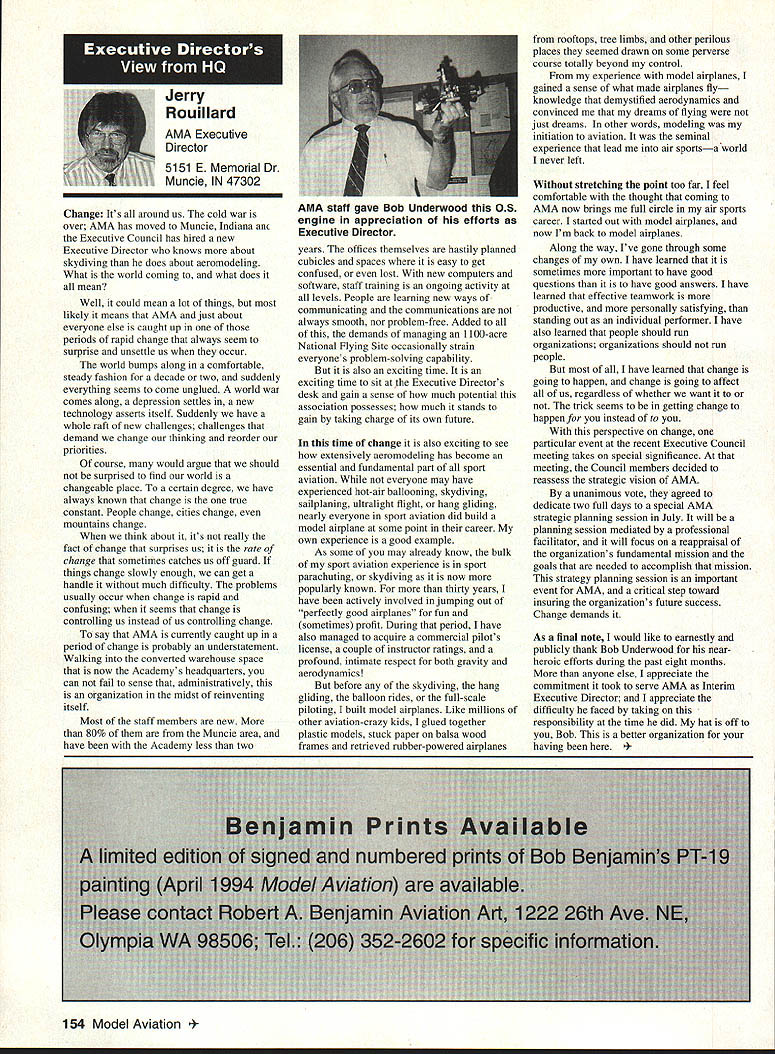
The Executive Council recently decided to reassess AMA’s strategic vision. By unanimous vote, they scheduled a two‑day strategic planning session in July, led by a professional facilitator, to determine the organization's fundamental mission and the goals needed to accomplish it. This strategic planning is an important step toward ensuring AMA’s future success.
I would like to publicly thank Bob Underwood for his efforts as Interim Executive Director during the past eight months. His commitment and dedication were invaluable; the organization is better for his service.
---
District IV / IMAA and Club Activity
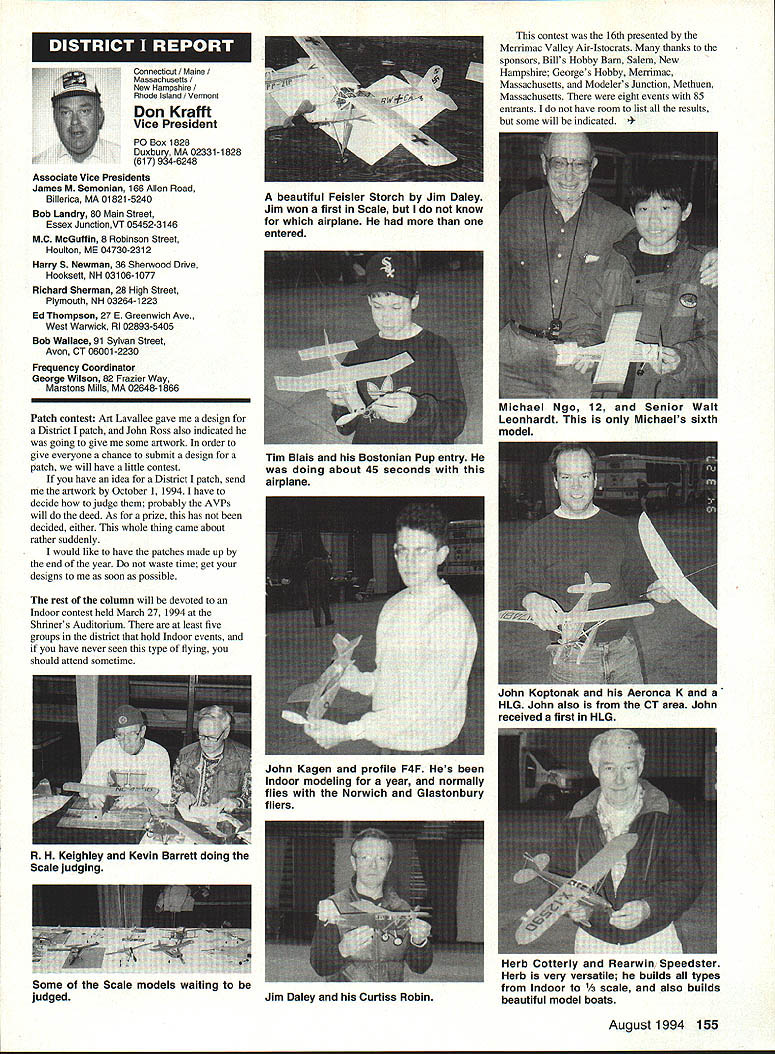
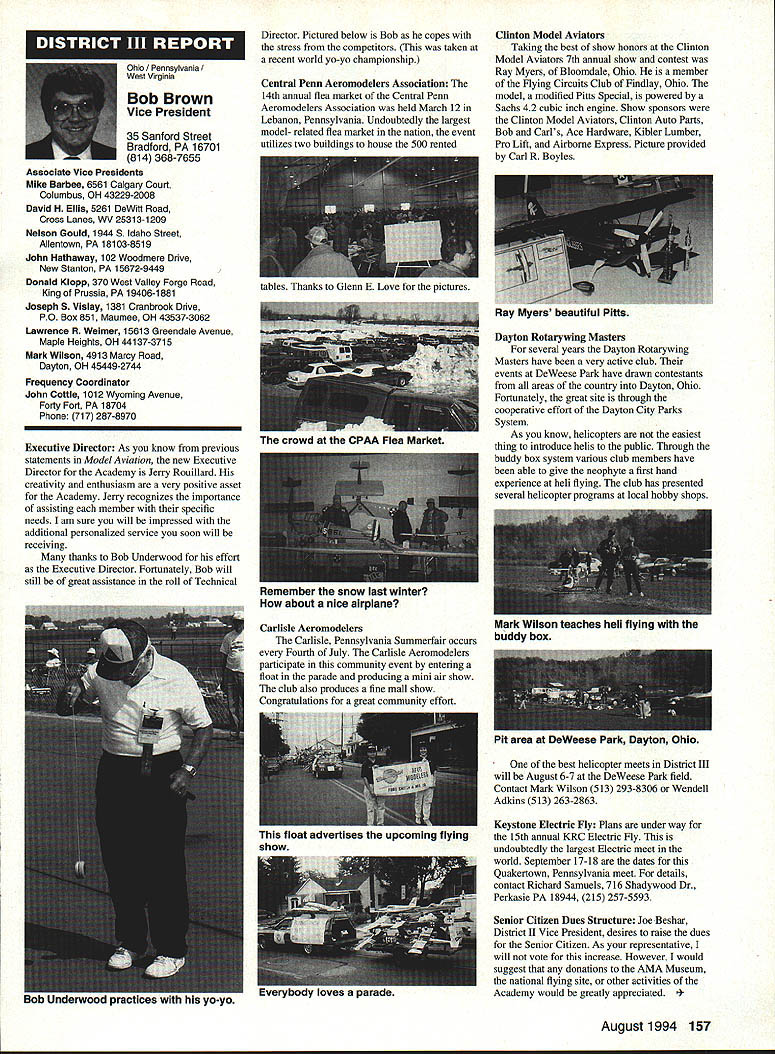
- IMAA Festival of Giants: In 1995 the Festival will be in District IV (Danville, Virginia). The June 25–26, 1994 Giant Fly‑In likely has been held by the time you read this. J. B. Isel is the Contest Director for the 1995 event, working with the Danville Aeromodellers. The event has support from the Parks and Recreation Department and sponsorship from Coca‑Cola.
- East Lincoln & Catawba Valley Radio Control Flyers: These two clubs have collaborated on Fly‑In events to raise money for charity. Last year they raised $1,153 for the Shriners' Hospital for Crippled Children in Greenville, South Carolina. This year's event will be September 3–4 at the East Lincoln Field; proceeds will again go to the Shriners' Hospital.
- National Aeronautic Association meeting: The Air Sports Divisions met in Alexandria, Virginia, with the participation of the AMA and other national organizations (Balloon Federation of America, EAA, Helicopter Club of America, International Aerobatic Club, Soaring Society of America, US Hang Gliding Association, US Parachute Association, US Ultralight Association). Common concerns discussed included use of airspace, noise reduction, safety, insurance, and a meeting with FAA Administrator David Hinson. Coordination among divisions is yielding benefits and planned future meetings.
---
Club Report: Wyoming Sagebrush Hoppers
Don Fisher
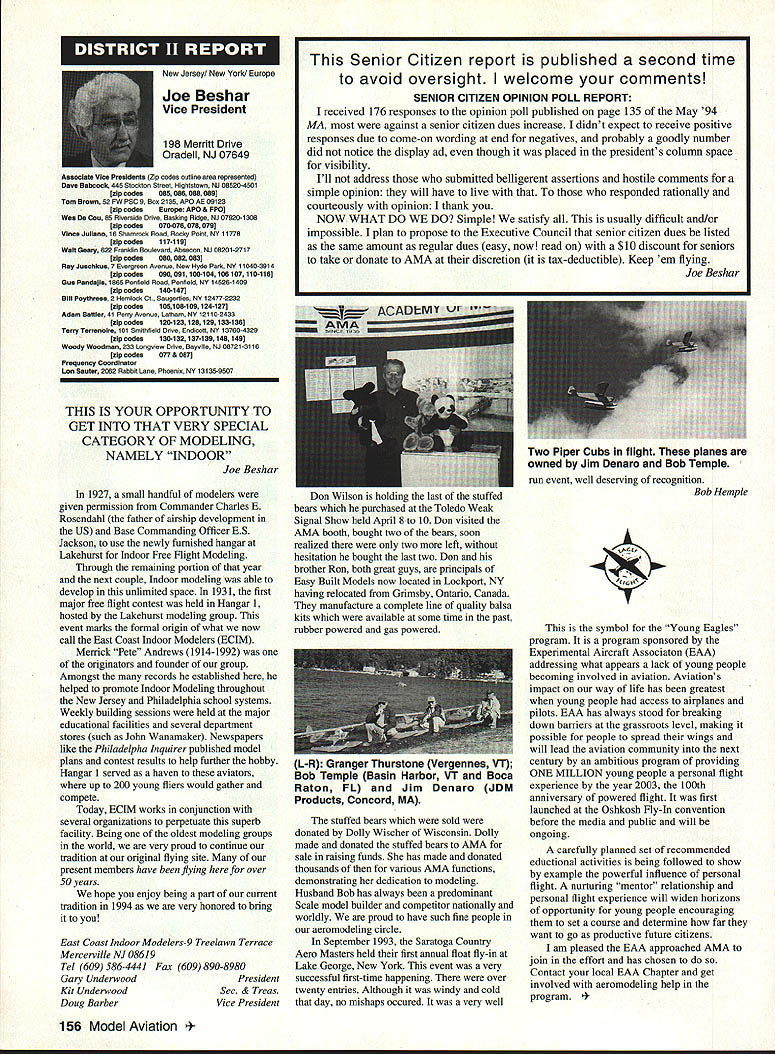
At the Powell field, five winter projects were test‑flown successfully with no mishaps:
- Webb Higgins started with a Stinger 1.20 powered by an ST 3000 with C & H ignition and a Walbro carb modification — excellent performance with gentle, slow landings.
- Webb also flew a Biggie Stinger with a G‑62 engine; it handled well though heavier and with slightly different vertical performance.
- Russ Knicfel unveiled another Stinger with a G‑62. During control checks the plane was unresponsive until the wing was removed and a disconnected battery plug to the receiver was found and corrected.
- Russ then flew a Spacewalker II powered by a Saito 1.50; the four‑stroke provided smooth, realistic flight and a pleasing sound.
- Dennis Rollins flew a .35‑powered Road Runner; the older design performed reliably.
Other notes:
- George Trosper discovered a radio range issue when he flew out too far and lost contact; he used the experience to refine his flying limits.
- Webb finished with a spirited flight of a rear‑rotor, tuned‑pipe, .40‑powered Blaster.
The banquet was well attended; prizes and raffle winners included Grace Buckets of Billings ($25), Bob Bishop of Billings ($15), Webb Higgins of Powell ($10), and Bill Canfield of Story, Wyoming (who won a YS 1.20 with a $5 ticket). The event was a successful day of testing, camaraderie, and good food.
---
Inside View — Headquarters
Academy of Model Aeronautics 5151 East Memorial Drive, Muncie, IN 47302 Geoffrey Styles, Director, Marketing, AMA — Muncie
Those attending Homecoming and the Museum opening met many employees who handle AMA member services. These hardworking staff often go unrecognized except as a voice on the phone. I will include photos occasionally to highlight staff and to emphasize that customer service is important at the Academy.
Tammy Morris (receptionist/switchboard operator) and Sheila Tweedy (Museum Shop manager) are two examples of employees who help members and visitors feel welcome and support the Museum through shop proceeds.
The ongoing modernization of offices, new computers and software, and management of the 1,100‑acre National Flying Site make this an exciting, if challenging, time. Staff training and improved communications are continuous efforts. My own path through modeling to other air sports and now back to AMA confirms the importance of modeling as an initiation to aviation and the need to adapt positively to change.
If we want our hobby to remain a good neighbor, everyone in the chain — modelers, kit and engine manufacturers, and aftermarket suppliers — must work together to provide quieter, more scale‑appearing installations without sacrificing performance or durability.
Transcribed from original scans by AI. Minor OCR errors may remain.

