
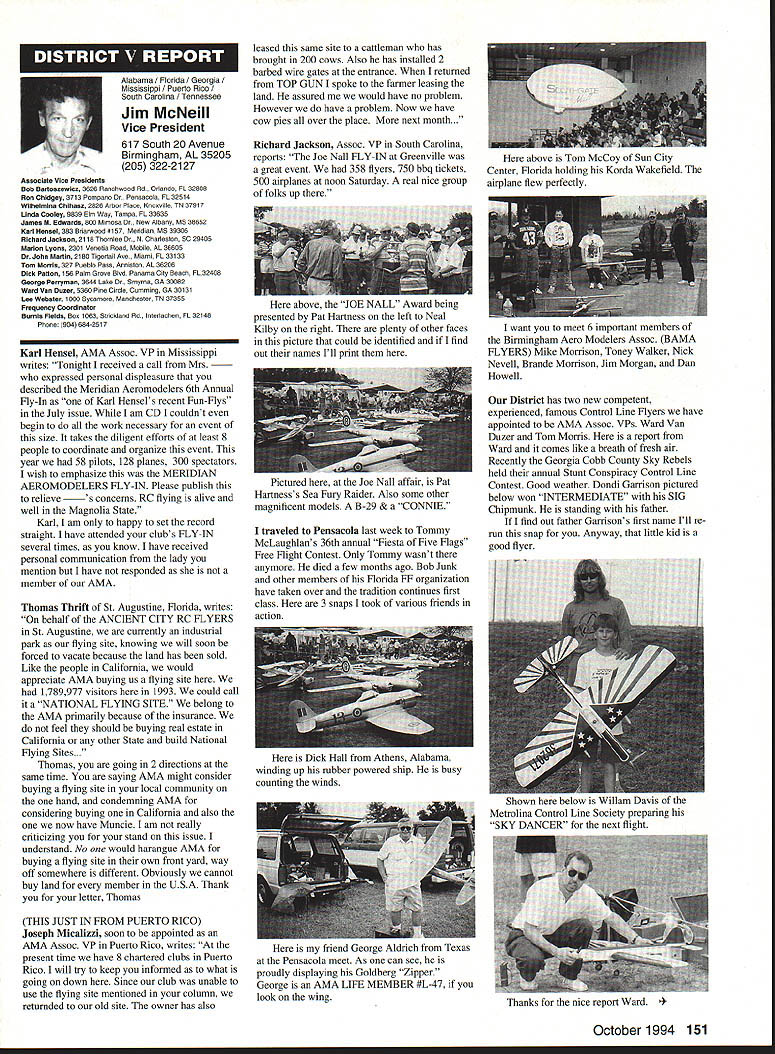
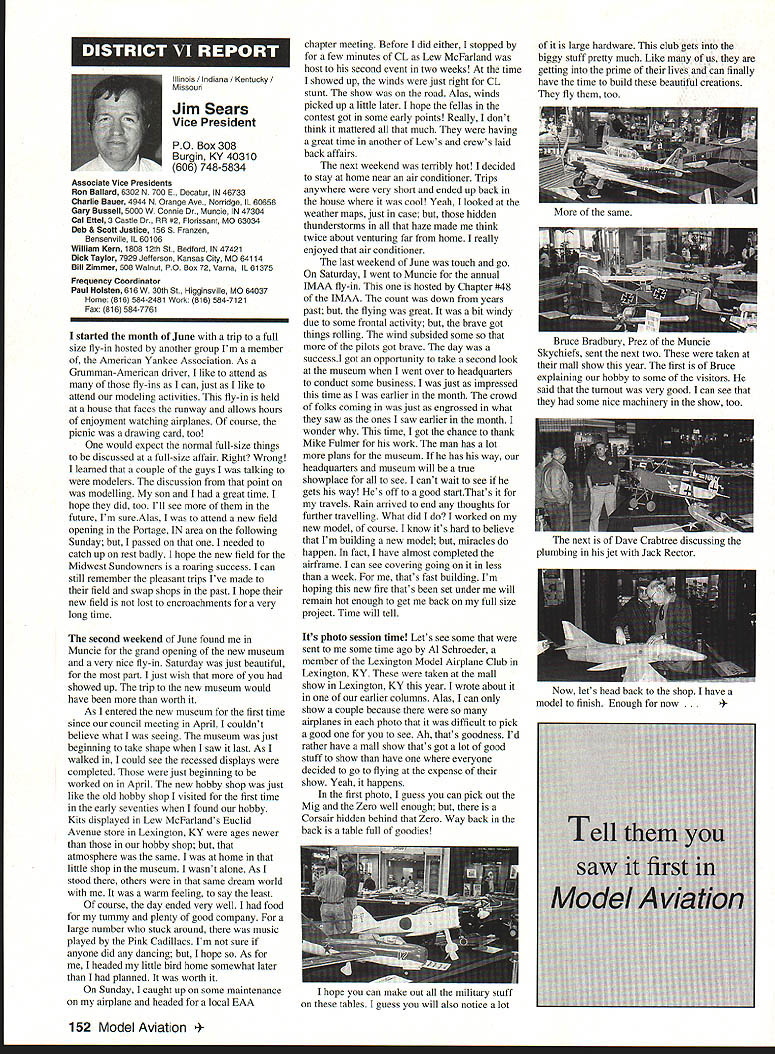
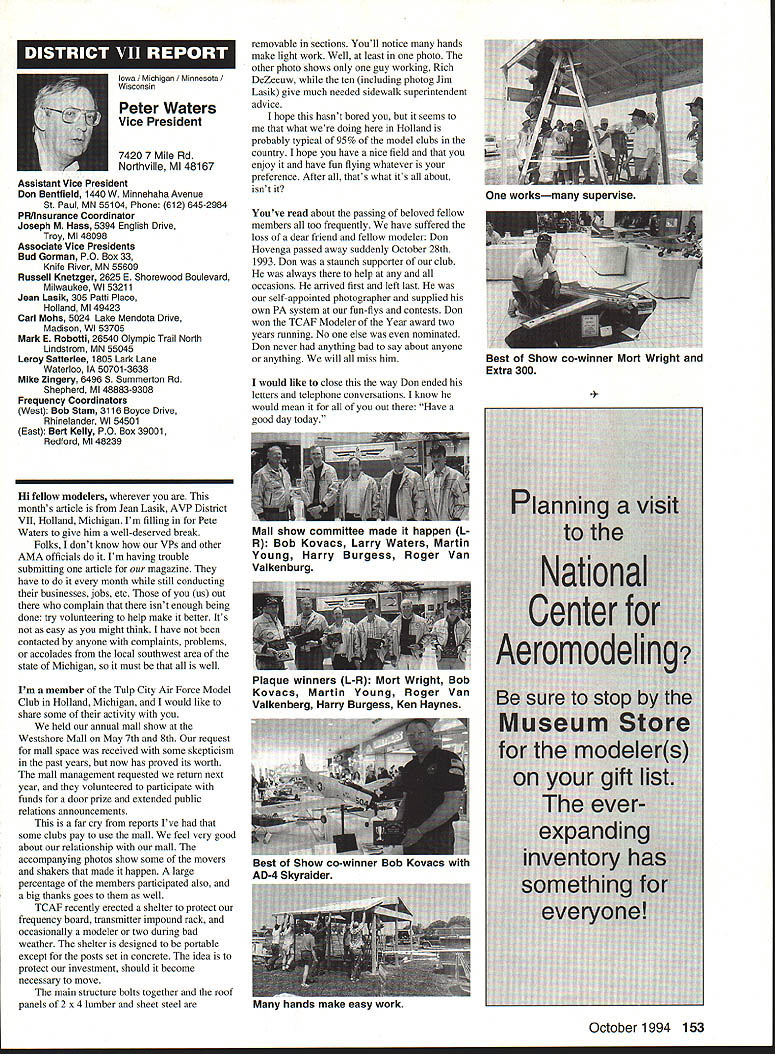
Sound & Model Aeronautics
Howard Crispin, Jr.
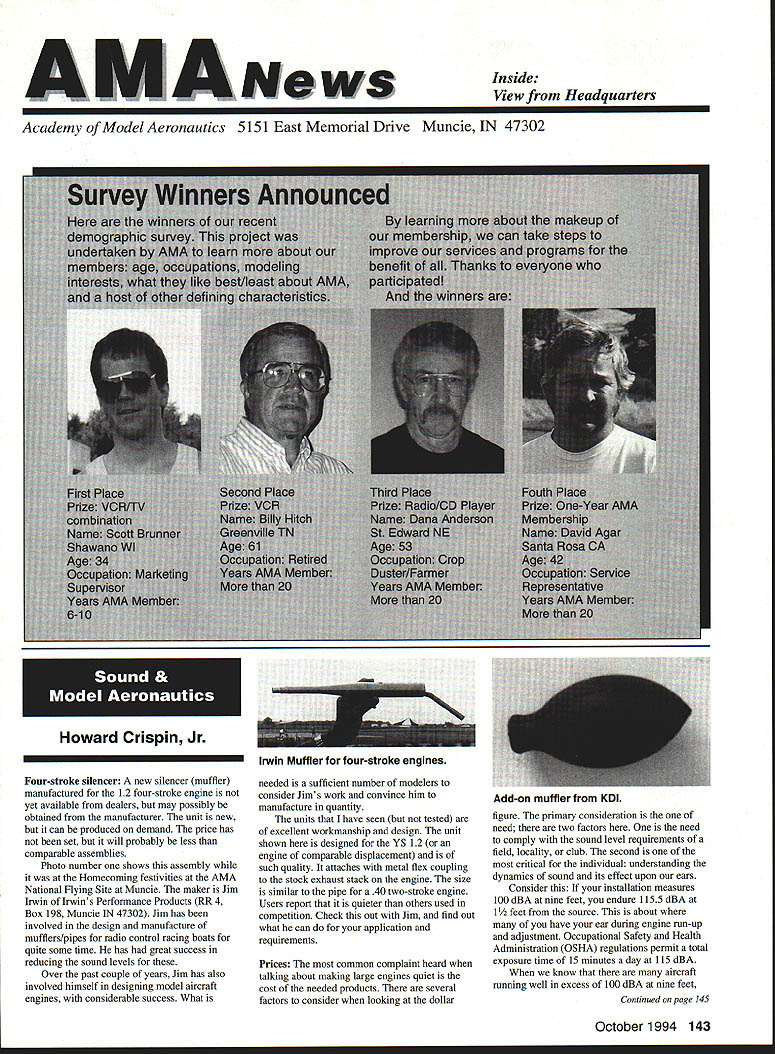
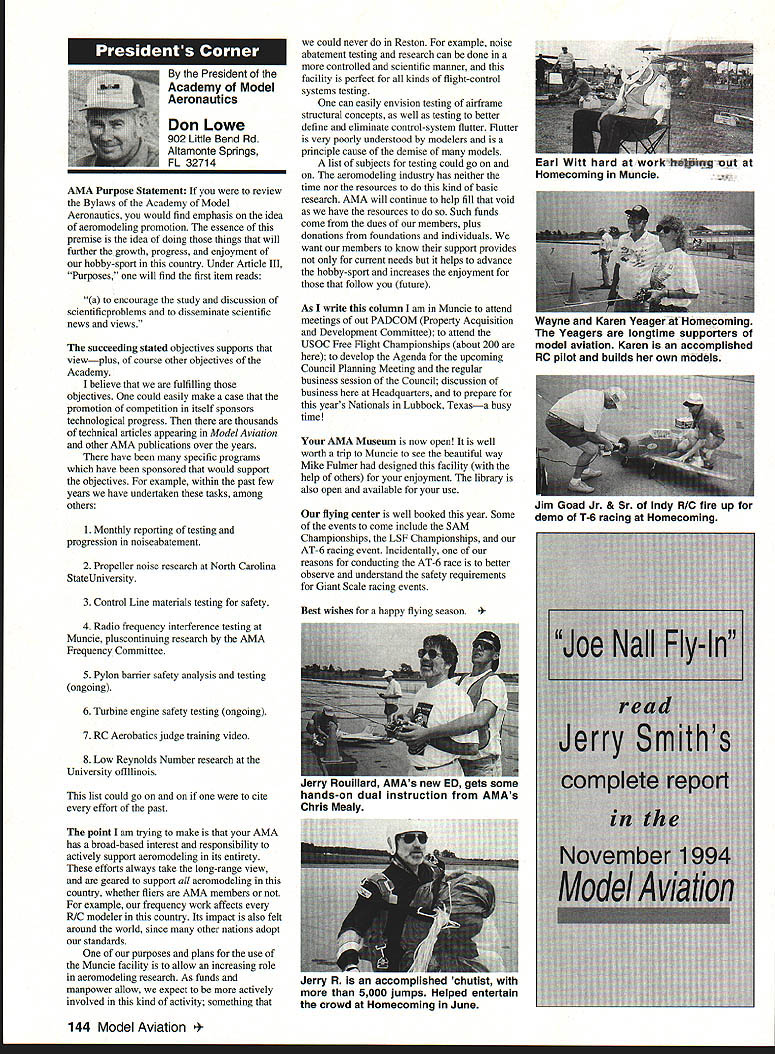
Four-stroke silencer: A new silencer (muffler) manufactured for the 1.2 four-stroke engine is not yet available from dealers but may possibly be obtained from the manufacturer. The unit is new, but it can be produced on demand. The price has not been set, but it will probably be less than comparable assemblies.
Photo number one shows this assembly while it was at the Homecoming festivities at the AMA National Flying Site at Muncie. The maker is Jim Irwin of Irwin's Performance Products (RR 4, Box 198, Muncie IN 47302). Jim has been involved in the design and manufacture of mufflers and pipes for radio-control racing boats for quite some time and has had great success in reducing the sound levels of those engines.
Over the past couple of years Jim has also involved himself in designing model aircraft engines, with considerable success. What is needed is a sufficient number of modelers to consider Jim's work and convince him to manufacture in quantity. The units that I have seen (but not tested) are of excellent workmanship and design. The unit shown here is designed for the YS 1.2 (or an engine of comparable displacement) and is of such quality it attaches with a metal flex coupling to the stock exhaust stack on the engine. The size is similar to the pipe for a .40 two-stroke engine. Users report that it is quieter than others used in competition. Check this out with Jim and find out what he can do for your application and requirements.
Prices: The most common complaint heard when talking about making large engines quiet is the cost of the needed products. There are several factors to consider when looking at the dollar figure. The primary consideration is need: there are two factors here. One is the need to comply with the sound-level requirements of a field, locality, or club. The second is the most critical for the individual: understanding the dynamics of sound and its effect upon our ears. Consider this: if your installation measures 100 dBA at nine feet, you endure 115.5 dBA at 1½ feet at the exhaust during engine run-up and adjustment. Occupational Safety and Health Administration (OSHA) regulations permit a total exposure time of 15 minutes a day at 115 dBA. When we know that there are many aircraft running well in excess of 100 dBA at nine feet, we could never do in Reston. For example, noise-abatement testing and research can be done in a more controlled and scientific manner, and this facility is perfect for all kinds of flight-control systems testing.
One can easily envision testing of airframe structural concepts as well as testing to better define and eliminate control-system flutter. Flutter is very poorly understood by modelers and is a principal cause of the demise of many models.
The aeromodeling industry has neither the time nor the resources to do this kind of basic research. AMA will continue to help fill that void as we have the resources to do so. Such funds come from the dues of our members, plus donations from foundations and individuals. We want our members to know their support provides not only for current needs but also helps to advance the hobby-sport and increases the enjoyment for those that follow you.
As I write this column I am in Muncie to attend meetings of our PADCOM (Property Acquisition and Development Committee); to attend the USOC Free Flight Championships (about 200 are here); to develop the agenda for the upcoming Council Planning Meeting and the regular business session of the Council; to discuss business here at Headquarters; and to prepare for this year's Nationals in Lubbock, Texas — a busy time!
Your AMA Museum is now open! It is well worth a trip to Muncie to see the beautiful way Mike Fulmer has designed this facility (with the help of others) for your enjoyment. The library is also open and available for your use.
Our flying center is well booked this year. Some of the events to come include the SAM Championships, the LSF Championships, and our AT-6 racing event. Incidentally, one of the reasons for conducting the AT-6 race is to better observe and understand the safety requirements for Giant Scale racing events.
Best wishes for a happy flying season.
Executive VP's Report
Dave Brown AMA Executive VP 4871 Trudy Lane Hamilton, OH 45013
I'm back! Back from a long trip to Ireland and Scotland, where I attended a couple of contests and spent some time with the Irish R/C Team members. Frankly, I had a ball, and while I was there I got a chance to spend some time with my counterpart, Vice Chairman Douglas Dickie of the Scottish Aeromodellers Association, along with its Chairman, Mr. Gerry Marchbanks. In talking with them, along with Roy Brotherton of England, it struck me that we all had basically the same problems facing our sport in all countries.
The issue of noise, and how it is making it very difficult to retain flying sites, is near the top of the list for all of us. We all have to deal with members who seem to either think the national association should mandate low limits of noise on all aeromodels, and a seemingly equally strong element who are adamantly against it. We share a deep concern for the increasing costs of fielding teams for World Championships and the costs of most of our operations.
I got a particular kick out of some comments made when Gerry and Dickie were presented at the awards ceremony for the Triple Crown Championships. It seems that some of the modelers didn't think these gentlemen had shown up at enough of their events. After hearing a list of where they had been, I could relate to their situation. Aeromodelling is such a diverse hobby that it seems nearly impossible to be at every type of event, much less every event.
Last month I described the event I was going to, but I made one mistake. I had assumed that a fourth team from Wales would compete, but Wales was not able to field a full team, so an "international" team was put together with an Irishman, a Scotsman, an Englishman, and a Welshman(?). It was a good idea and allowed more people to take part in the event to get a taste of international competition. The results were: England, Scotland, and Ireland.
I also got a chance to tour the Scottish Air Museum, and was very impressed with it. It's a nice balance between civilian and military aviation, covering the whole spectrum of eras from the days of Chanute and Lilienthal through the space age. A little sign on the wall of an exhibit may lead to a relationship developing between the AMA Museum and this museum. If this sounds familiar, it should, as such a recreation is the centerpiece of AMA's new museum at Muncie. I will put our museum staff in touch with them to see if anything mutually beneficial could develop.
I also got a chance to fly a model powered by one of the jet turbine engines while I was in Scotland, which was neat. If you haven't heard one of these run, you can't imagine how realistic they sound. I still have serious reservations about the propane fuel used by many of these engines, but I am becoming more comfortable with their mechanical safety.
Alas, all vacations must come to an end. Upon return I found a pile of mail that would bury a small horse, and a safety committee meeting scheduled for the very next weekend. While I was gone, the Nats R/C and CL scale events had been cancelled, due primarily to the very low entry creating a projected loss of about $300 per contestant, which I calculate to be nearly $9,000. Was this a justified action in view of the facts? I think so, although I realize that it will certainly upset some people. I can't blame them for being upset at this cancellation, but I am trying to see that those who had to make this difficult decision be fully supported. I have expressed concerns before regarding the continuation of the Nats in its current format, and this year's experience has done nothing to increase my faith in its viability. Perhaps the poor showing of this year will push the situation over the edge and result in some changes. A lot of ideas have been voiced, and we will have to see what transpires.
Just before leaving for my trip, I had a chance to stop at AMA HQ and I am happy to report that, contrary to earlier assessments, the cash-flow situation appears to be somewhat better this year than last. We may even get through this year without having to borrow any funds, and if we do have to borrow, it should be less in amount and later in the year than last year. This is a sign that things are looking up, primarily as a result of it being cheaper to operate in Muncie, as was projected before we moved. It's actually a good thing, as our membership and revenues are less than last year. Of course, if the Nats is a real bust, this could change.
Executive Director's View from HQ
Jerry Rouillard AMA Executive Director 5151 E. Memorial Dr. Muncie, IN 47302
It's a busy time of year here at Headquarters. We have dispatched a large contingent of staff to the National Championships in far-off Lubbock, Texas; we have just opened our new museum; and we are making preparations for the quarterly Executive Council meeting in Indianapolis on July 30.
Of all this activity, it is the Nationals that dominates the Headquarters agenda this time of year, and for a newcomer it has really been an eye-opener. Even though preregistration figures indicate this year's attendance will be unusually light, the logistical burden of the contest is staggering. It is also quite sobering.
The hundreds of hours of staff time, the thousands of dollars worth of equipment, and the passionate involvement of our competitive community set "the Nats" apart from many of the other things that this association does. It's a one-year shot that depends on a lot of variables not altogether within our control: the weather, the willingness of volunteers, and the interest of competitors in a given event or location.
For a number of good reasons, the National Championships gets a lot of Headquarters' attention. This year most of that attention has been particularly focused on the Scale events.
As early as late May, Competition Director Chip Smith had alerted us that Nationals registrations were light overall. As the contest drew closer, Chip followed up his earlier warning with a more specific problem: registrations were still not good overall, but the Scale events appeared to be in serious trouble. By late June only 29 competitors had registered in the RC and CL Scale events — events that normally would have drawn many more competitors.
Scale Category Manager Bjorn Guenther was particularly concerned about these low numbers. Many of the classifications had only one or two competitors — a situation that would make it very difficult to justify the administrative costs associated with judging the event.
As it turned out, those costs would have totaled a net loss of nearly $9,000 — about $300 per contestant. Faced with this dilemma, John took the long view and recommended cancellation of both Control Line and Radio Control Scale events at Lubbock.
The decision to cancel these events was not an easy one. Tradition is important in any sport, and it is hard not to sympathize with a competitor who was expecting to compete, is ready to compete, but now is unable to because the event has been scratched. Predictably, there have been angry responses to the cancellation.
More surprisingly, however, the majority of the competitors supported the decision to cancel the event when we called to advise them of what had taken place. Although they were unhappy with the low registration figures, most agreed that it made little sense to run a token version of this major event at the National Championships.
This is one of the nice surprises about AMA. Experience would not have led me to expect this kind of thoughtful reaction from competitors who had just been given bad news. I would have expected more anger and more of a tendency to "shoot the messenger." That this was not the overall reaction of the people we contacted says some good things about this organization.
I do have one negative expectation that I have to live with, however: Chip Smith is going to be leaving his full-time employment with AMA after the current National Championships is over in Lubbock. Chip has family obligations that are taking him back to Tennessee in August, and all of us here at Headquarters are genuinely sorry to see him go.
Although I have only known him for a short time, Chip is one of those people who — as trite as it sounds — is hard not to like. He is also one of those people who tends to surprise you. Underneath an "aw shucks," country-boy demeanor is an exceedingly bright, conscientious, and hard-working department manager.
Fortunately, we will not be losing Chip altogether. He still will be writing for Model Aviation, and we hope to get him back from time to time to help with special events or projects that he can fit around his obligations at home.
In early June the new Frank V. Ehling Museum was formally opened to the public. It was the culmination of a tremendous amount of work by museum curator Mike Fulmer, but Mike had to miss the big moment because of tests that required he spend the week in California.
It was a shame that Mike could not be there, because the Museum opening was a roaring success. Virtually everyone who showed up to tour the facility was amazed by the number of model aircraft on display and the artistry of Mike's presentations.
In the month since the opening, the museum continues to draw a steady stream of interested visitors from both the modeling community and the general public. For the modelers, it is a source of pride and often nostalgic reflection. For the general public, it is one of the best tools we have to reach people with the breadth and depth of modeling history and technology. All in all, the museum is an asset in which all of the AMA family can take pride. Our hats are off to Mike Fulmer.
AMA News
AMA Purpose Statement — Review of Bylaws
The Academy of Model Aeronautics emphasizes aeromodeling promotion as the essence and premise of doing things that will further the growth, progress, and enjoyment of the hobby-sport community. Under Article III, "Purposes," the first item reads: "To encourage the study and discussion of scientific problems and to disseminate scientific news and views." The succeeding stated objectives support this view.
The Academy believes that in fulfilling these objectives it could easily make the case that promotion, competition, and sponsorship foster technological progress. Thousands of technical articles appearing in Model Aviation and other AMA publications over the years, and specific programs the Academy has sponsored, support these objectives.
Examples of tasks and programs the AMA has undertaken in recent years include:
- Monthly reporting and testing progression — noise abatement
- Propeller noise research — North Carolina State University
- Control-line materials testing — safety
- Radio-frequency interference testing — Muncie, plus continuing research by the AMA Frequency Committee
- Pylon barrier safety analysis and testing — ongoing
- Turbine engine safety testing — ongoing
- R/C aerobatics judge training video
- Low Reynolds-number research — University of Illinois
The list could go on. The point is that the AMA has a broad-based interest and responsibility to actively support aeromodeling in its entirety. Our efforts always take a long-range view geared to support aeromodeling across the country, whether fliers are AMA members or not. For example, frequency work affects every R/C modeler in the country. Its impact is also felt around the world since other nations adopt standards and procedures used here.
The purposes and plans to use the Muncie facility allow an increasing role for aeromodeling research. As funds and manpower allow, expect the Academy to be actively involved in this kind of activity — something that could never be done at Reston. Noise-abatement testing and research can be done in a controlled, scientific manner at the facility. It is perfect for all kinds of flight-control systems testing. One can easily envision testing airframe structural concepts as well as testing to better define and eliminate control-system flutter. Flutter is very poorly understood by modelers and is a principal cause of the demise of many models. The list of subjects for testing could go on.
Muncie
There will be ample coverage elsewhere in the magazine of the 1994 Homecoming, held the second weekend in June. The most impressive event — at least for me — was the opening of the museum. Mike Fulmer and his assistants did an outstanding job of completing this portion in time for the Homecoming. For the first time, model aviation artifacts are housed in an area designed as a museum.
While every effort was made to provide for the display of many of these items in the headquarters during the years at Reston, there is a major difference between a museum superimposed on an office complex and a purposely designed museum. The result is something to be proud of, and it will be greatly expanded when the remainder of the space in the building becomes available. The design lends itself to continuation without disruption of the present display. I believe that anyone stopping by Muncie will find the time well spent as they see what has been accomplished.
District IV was well represented at the event, along with all of the others, making it possible to see more than two hundred flights each day. Milt and Joy Peacock of Westminster, Maryland, tried to steal the show by getting coverage and their photograph in the local newspaper. (Milt probably convinced the reporter that his two Stinsons were the best of show — or something like that.)
Helen and Eck Calder from Asheville, North Carolina, and members of the Fletcher Radio Control Club were there enjoying the fun and flying, as was Larry Lewis, President of the Raleigh Aero Masters (see photo number one).
John and Lillian Wort were there, with John showing a video of an interview with Frank Ehling. Frank has been slowly recovering from a prolonged illness, and this was the first contact most have had with him for some time.
The museum at Muncie is named for Frank in recognition of his long service to aeromodeling and especially for his many years as Technical Director. Among the many designs by Frank is the Delta Dart, which has probably introduced more young people to model aviation than any other design.
Big Birds
The IMAA Fly-In at Danville was directed by John Estlow and came off very well. For the most part, the wind was brisk on both days, but this did not stop the flying. Over 90 registrants were there on both days.
In terms of planning, this event was somewhat of a preview for next year's IMAA Festival to be held at the same Danville Airport. John Estlow, the same basic crew, along with the sponsorship and assistance of the Parks and Recreation Department, the Airport Authority, and others, form the group that will make this a great event. The Festival will be the premier event for 1995 in District IV.
A wide variety of aircraft were flown at this event, with fliers and builders from far away. Among those attracting attention was Miles Reed from Canton, Ohio. Miles flew a couple of his latest designs, including the Weeks Solution X. A kit for this aircraft was raffled off and won by Jim Crawford of North Carolina's Burlington Alamance Radio Control Club. The kit was donated by All-American Kit Cutters, with some accessories donated by Miles Reed.
Photo number two shows the lucky winner (center) with CD John Estlow on the left and fly-in assistant Michael Farlow. John and Michael are both members of the Danville Aeromodelers / Danville Giant Aeromodelers.
Passing of a Friend
Lyle (Jim) Pepino passed away in his sleep on June 25, 1994. Jim and his wife and constant companion, Anne, were in Warrenton, Virginia, taking part in what they so much enjoyed doing together: attending a Scale meet. In this case it was at Bealeton, and they were scheduled to go to Danville and the IMAA Fly-In on Sunday.
Jim was a well-known visitor at meets all around the country, displaying an immense collection of documentation, photo files, and plans. Being a fine modeler of engine-powered and electric-powered scale aircraft, Jim also participated in these events.
Jim traveled widely photographing aircraft for documentation, often for articles, both in the United States and abroad. He and Anne were a well-known pair at many meets, including Topeka, Houston, Oakland, Pasadena, and others. These shows introduced many modelers to the scale activities he supported.
All of this contributed to his being one of the first to suggest articles and to get people interested in scale and other specialized subjects. He knew aircraft and had the painstaking eye to document with clarity the fine points of an aircraft structure.
His many activities and interests allowed him to meet and become friends with many. He was probably best known for his involvement in electric contests, where his efforts were exceptional. He will be missed by the many friends he made through his travels and for his help at contests and similar events.
On behalf of the AMA, our condolences go to Anne and the family.
Transcribed from original scans by AI. Minor OCR errors may remain.

