
AMA POSITION PAPER TO THE FCC
Continuing Effort by AMA'S Legal Counsel, Frequency Committee and Headquarters Staff
Last year's AMA/FCC effort on behalf of RC'ers was dramatic and fast-paced, concentrated in a few months period. Since then, the pace has been more deliberate and more complicated, spread over a longer period of time. It will continue this way for the rest of the year, at least. It's all part of a longer range effort, aimed at producing improved conditions for Radio Control modelers on a basis less subject to future upsets.
A necessary part of the current effort is the submitting of official AMA responses from FCC to specific FCC proposals known as "dockets." These dockets are published by the FCC to indicate government concerns and ideas—also proposals—regarding current problems and possible new legislation.
The FCC issues many such dockets and some touch only indirectly on RC matters. Each such docket, however, offers an opportunity to present and promote our viewpoint, to reinforce with the FCC our case for needing expansion and improvement of RC operating conditions.
AMA's Frequency Committee, legal counsel, and the headquarters staff coordinate our responses and proposals to the FCC. It's a steady effort without a lot of fanfare and publicity, gradually putting together a total package defining our needs and wants; also any objections we have to proposals which might hurt our RC activity.
It's a tedious effort, with a lot of legal language. A lot of it is boring reading. But it's all a necessary part of the process by which we participate in governmental actions which affect us. Through such a process AMA is representing RC'ers on a continuing basis. It's a battle that others get involved in only sporadically. And it's what AMA dues help make possible.
In the June '77 issue of AMA News (page 59), AMA's response to FCC Docket 20271 was published. Here is another, our response to Docket 21116.
21116. In the Matter of Amendment of Part 2 of the Commission's Rules to prohibit the marketing of external radio frequency amplifiers capable of operation on any frequency from 24 to 35 MHz. Submitted by AMA June 24, 1977.
- The AMA is the governing body for model aircraft activities in the United States. Its membership at the end of 1976 was in the neighborhood of 62,000, of which approximately 75% regularly fly radio controlled (RC) model aircraft under licenses issued by the Federal Communications Commission. Furthermore, as the United States representative of the Federation Aeronautique Internationale, the Academy is concerned with RC activities world-wide as well as those within the United States.
- At the present time, radio control activities are conducted under a license issued by the Federal Communications Commission in the Radio Control Service (formerly the Class C Citizens Radio Service). In this service, licensees are permitted to operate on six 27 MHz channels and seven 72 MHz channels. The 27 MHz RC channels are interspersed between the Citizens Band Radio Service (CB) (formerly the Class D Citizens Radio Service) voice frequencies.
- With the recent explosion in CB popularity and an accompanying rise in illegal CB operations, the 27 MHz RC channels are rapidly becoming unusable for model aircraft control. Interference to a voice channel may cause momentary irritation to the user; interference, even for a fraction of a second, to an RC channel being used for model control can result in the loss of a valuable model, and present a serious risk of injury to the flyer or spectators.
- The problems RC flyers are experiencing daily that prevent efficient use of 27 MHz RC frequencies are a direct result of two varieties of rules violations by CB operators. First, significant numbers of CB operators operate directly on the exclusive RC frequencies. Illegal off-frequency operation interference problems are addressed in the Academy's comments in Docket 21117, filed simultaneously herewith.
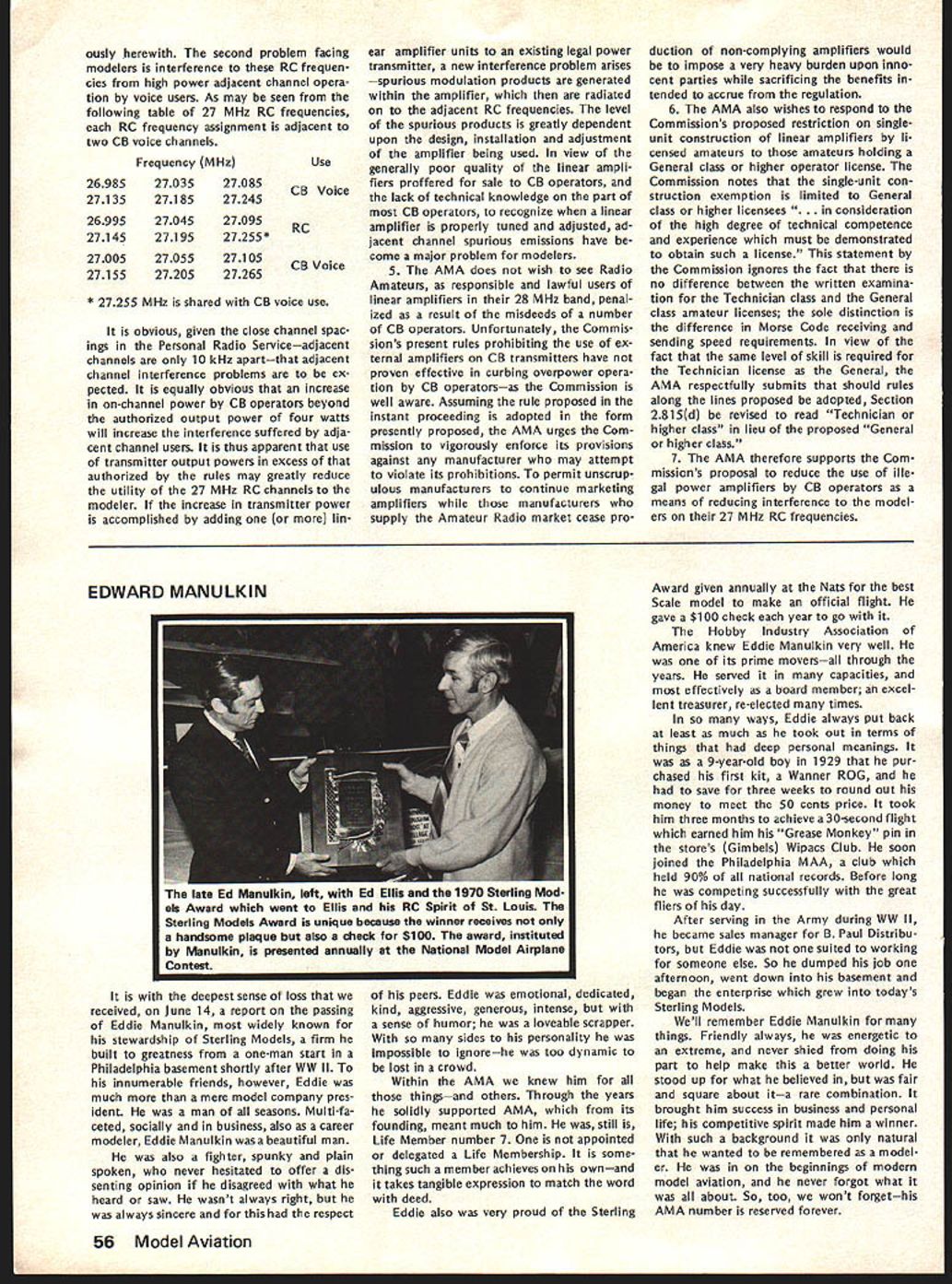
The second problem facing modelers is interference to these RC frequencies from high power adjacent channel operation by voice users. As may be seen from the following table of 27 MHz RC frequencies, each RC frequency assignment is adjacent to two CB voice channels.
Frequency (MHz) Use 26.985 27.035 27.085 CB Voice 27.135 27.185 27.245 CB Voice 26.995 27.045 27.095 RC 27.145 27.195 27.255 * 27.005 27.055 27.105 CB Voice 27.155 27.205 27.265
*27.255 MHz is shared with CB voice use.
It is obvious, given the close channel spacings in the Personal Radio Service—adjacent channels are only 10 kHz apart—that adjacent channel interference problems are to be expected. It is equally obvious that an increase in on-channel power by CB operators beyond the authorized output power of four watts will increase the interference suffered by adjacent channel users. It is thus apparent that use of transmitter output powers in excess of that authorized by the rules may greatly reduce the utility of the 27 MHz RC channels to the modeler. If the increase in transmitter power is accomplished by adding one (or more) linear amplifier units to an existing legal power transmitter, a new interference problem arises—spurious modulation products are generated within the amplifier, which then are radiated on to the adjacent RC frequencies. The level of the spurious products is greatly dependent upon the design, installation and adjustment of the amplifier being used. In view of the generally poor quality of the linear amplifiers offered for sale to CB operators, and the lack of technical knowledge on the part of most CB operators, to recognize when a linear amplifier is properly tuned and adjusted, adjacent channel spurious emissions have become a major problem for modelers.
- The AMA does not wish to see Radio Amateurs, as responsible and lawful users of linear amplifiers in their 28 MHz band, penalized as a result of the misdeeds of a number of CB operators. Unfortunately, the Commission's present rules prohibiting the use of external amplifiers on CB transmitters have not proven effective in curbing overpower operation by CB operators—as the Commission is well aware. Assuming the rule proposed in the instant proceeding is adopted in the form presently proposed, the AMA urges the Commission to vigorously enforce its provisions against any manufacturer who may attempt to violate its prohibitions. To permit unscrupulous manufacturers to continue marketing amplifiers while those manufacturers who supply the Amateur Radio market cease production of non-complying amplifiers would be to impose a very heavy burden upon innocent parties while sacrificing the benefits intended to accrue from the regulation.
- The AMA also wishes to respond to the Commission's proposed restriction on single-unit construction of linear amplifiers by licensed amateurs to those amateurs holding a General class or higher operator license. The Commission notes that the single-unit construction exemption is limited to General class or higher licensees "...in consideration of the high degree of technical competence and experience which must be demonstrated to obtain such a license." This statement by the Commission ignores the fact that there is no difference between the written examination for the Technician class and the General class amateur licenses; the sole distinction is the difference in Morse Code receiving and sending speed requirements. In view of the fact that the same level of skill is required for the Technician license as the General, the AMA respectfully submits that should rules along the lines proposed be adopted, Section 2.815(d) be revised to read "Technician or higher class" in lieu of the proposed "General or higher class."
- The AMA therefore supports the Commission's proposal to reduce the use of illegal power amplifiers by CB operators as a means of reducing interference to the modelers on their 27 MHz RC frequencies.
Last year's AMA/FCC effort on behalf of R/Cers was a dramatic, fast-paced, concentrated few-months period. Since then the pace has, deliberately and by necessity, been spread over a longer period of time and will continue that way for the rest of the year at least. It is part of a longer-range effort aimed at producing improved conditions for Radio Control modelers so they will be less subject to future upsets. A necessary part of the current effort is submitting official AMA responses to specific FCC proposals (known as dockets). Dockets published by the FCC indicate government concerns, ideas, and proposals regarding current problems and possible new legislation. When the FCC issues such dockets some touch indirectly on R/C matters; such a docket, however, offers an opportunity to present and promote our viewpoint and to reinforce the FCC case needing expansion and improvement of R/C operating conditions. AMA's Frequency Committee, legal counsel and headquarters staff coordinate responses to FCC proposals. It is a steady effort with little fanfare or publicity, gradually putting together a total package defining needs and wants and also objections to proposals that might hurt R/C activity. It is tedious effort, a lot of legal language and a lot of boring reading, but it is a necessary part of the process to participate in governmental actions that affect us. Through such process AMA is representing R/Cers on a continuing basis. It is a battle; others get involved sporadically. It's what AMA dues help make possible.
In the June '77 issue of AMA News (page 59) AMA's response to FCC Docket 20271 was published. Another response to Docket 21116 (Matter: Amendment of Part 2 of the Commission's Rules — Prohibit marketing external radio-frequency amplifiers capable of operation on frequencies 24–35 MHz) was submitted by AMA June 24, 1977.
- The AMA is the governing body for model aircraft activities in the United States. Its membership at the end of 1976 numbered in the neighborhood of 62,000; approximately 75% regularly fly radio-controlled (R/C) model aircraft under licenses issued by the Federal Communications Commission. Furthermore, the United States representative to the Federation Aeronautique Internationale is concerned with R/C activities worldwide as well as within the United States.
- At the present time radio control activities are conducted under licenses issued by the Federal Communications Commission in the Radio Control Service (formerly Class C Citizens Radio Service). Service licensees are permitted to operate six 27 MHz channels and seven 72 MHz channels. The 27 MHz R/C channels are interspersed between Citizens Band Radio Service (CB), formerly Class D Citizens Radio Service, voice frequencies.
- With the recent explosion in CB popularity and the accompanying rise in illegal CB operations, 27 MHz R/C channels are rapidly becoming unusable for model aircraft control. Interference on a voice channel may cause momentary irritation to the user; interference for a fraction of a second on an R/C channel being used for model control can result in the loss of a valuable model and present a serious risk of injury to the flyer and spectators.
- The problems R/C flyers are experiencing daily which prevent efficient use of 27 MHz R/C frequencies are a direct result of two varieties of rules violations by CB operators. First, a significant number of CB operators operate directly on exclusive R/C frequencies — illegal off-frequency operation — interference problems addressed in the Academy's comments in Docket 21117 filed simultaneously.
AMA News
They are more important to talk to than talking to each other, because WE are already hooked! If you do no more than help them know how to be better and SAFER spectators you are serving yourself and the total cause.
CLEVER PEOPLE — THESE AMA'ers
I am just corn-ball enough that I enjoy a clever play-on-words and letters and so forth. I have always admired the choice of name and initials of the C.A.R.D.S. club of Lansing, MI and the fact that each member holds the title of a different card in the deck. As an honorary member I am naturally the "JOKER." Now also from Michigan comes another "cute group," the TRAVERSE AREA MODEL PILOTS SOCIETY whose initials spell T.R.A.M.P.S. But the real clever stroke is their newsletter editor, WALT FRICKE, starting his column out under the title of "HOBO NEWS!" No bum rap there!
CARL WHEELEY, PUBLISHER OF MODEL AVIATION
Just called me on the phone to remind me that deadline for this copy was rapidly closing in on me. I'm not sure Carl understood me, but I told him that I sat down on my typewriter — and got a little behind in my typing!
A CHUCKLE FROM MODEL BUILDER MAGAZINE
In one of the articles in Bill Northrop's "Model Builder" magazine I found this. "We thought we were watching your free-flight model off in the distance, but it just landed on a TV antenna and started cleaning its feathers!"
AND NOW A NOTE OF DEEPEST SADNESS
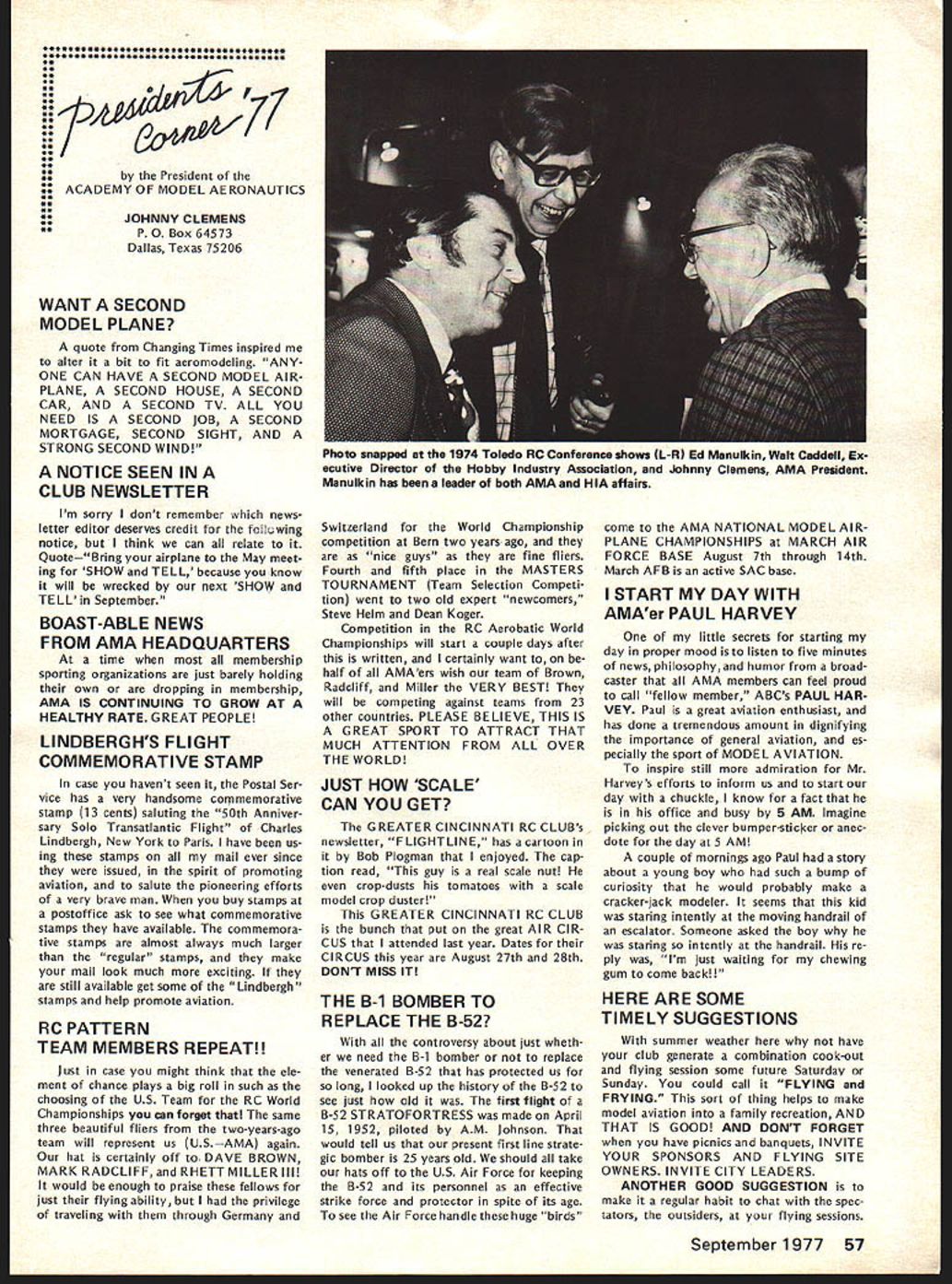
As I opened for business the morning of June 14th I received a long distance phone call from my fine old friend, Matty Sullivan, who, with a lump in his throat, told me of the passing of our grand little friend, Eddie Manulkin. Eddie had passed away quietly at home the day before. With his passing the ones of us who knew Eddie not only lost a personal friend, but the entire modeling industry and especially the Academy of Model Aeronautics and its members, lost a great friend and booster.
If the name Manulkin is not well-known to you, perhaps you will recognize Eddie more quickly as the president, for 25 years, of Sterling Models, Inc., of Philadelphia. His service to the art of modeling went far beyond his products. He was an enthusiastic and devoted member of the Hobby Industry Association of America, having served on nearly every committee the Association has had, and having served on the Board of Directors of the HIAA for 14 years and as its treasurer for 8 years.
The Academy of Model Aeronautics has a very special reason for honoring Eddie's memory. During some very "lean years" for the Academy, and always when there was a need for funds, Mr. Manulkin was among the first in line to reach into his own pocket to help, and urged others in the hobby industry to do likewise.
On behalf of the entire membership of AMA I extend our sympathies to the family. AMA will remember a friend named Eddie Manulkin, and I will have loving memories of my personal friend who smilingly carried that same name.
Johnny Clements Pres. of AMA
A WORTHY CURSE FROM SEATTLE
ED BROWN is the editor of "PLANE TALK," the newsletter of the SEATTLE RADIO AERO CLUB. In their June issue Ed aims a curse at anyone who would do such a dastardly deed as to litter their flying field. The curse—
"If you with litter will disgrace, and spoil the beauty of this place, May indigestion rack your chest, and ants invade your pants and vest."
LOTS TO TALK ABOUT FROM ONE NEWSLETTER
"FLIGHT LOG" is the newsletter of the LEAVENWORTH COUNTY AEROMODELERS (Kansas) and FRANK WHITE, JR. is its editor. I found something in the newsletter that I think we can all profit from. In the president's column (but Frank didn't say who the president is!) a very simple but to-the-point statement of rules for their flying field. I quote—RULES FOR USE OF OUR FLYING FIELD WILL BE DICTATED BY COMMON SENSE AND COURTESY. Now how could it be put more simply than that?
In a change of pace Frank says the "Crash of the Month Award" goes to Henry Weeks who now knows you cannot take out a steel post by striking it with the wing of a J-3 Cub. Their newsletter also boasts that the club now has its first female flier, Frank's wife, Penny. He says she is doing well learning to fly, but still needs the whole sky. Then Frank signs his newsletter, "Frank White, Jr., Newsletter Editor and currently spectator instead of flier, because my wife took my plane away from me."
I would offer one last quote from the Leavenworth Aeromodelers "Flightlog," and a bit of advice. Editor White asks if the club should pay to have their field mowed, or do it themselves. He says, "If we pay for the mowing, dues would have to be raised, or perhaps we could buy a herd of rabbits and be done with it!" Frank, if you were as old and experienced as I am you would know that you only need to start with TWO rabbits, but just be careful they are the proper kind! They multiply like calculators!
SERVE YOUR TRANSMITTER ON A TRAY?
We have watched with interest for the past several years some of the world's top Pattern pilots, other than our U.S. fliers, using shoulder strap supported transmitter trays (or rests). When I talked with them, in spite of a language barrier, they explained that with their hands relieved of the weight of the transmitter, their fingers and thumbs became more sensitive. Result — better control. When you watch the Pretzners and Matts fly, you can believe it. My "grapevine" telegraph now tells me that most of our top U.S. fliers are trying out the transmitter tray. Some U.S. manufacturers are now offering them.
A SAFETY POEM YET—
I always gain something from reading the DCRC (Washington area) newsletter. This month it is a little safety poem. ROSES ARE RED—VIOLETS ARE SWELL, A FINGER IN THE PROP—HURTS LIKE—
DOPING ADVICE — BE CAREFUL!
When you are doping your model plane, be sure to open all the windows — so that you get plenty of cross-ventilation.
ILLEGAL CB TO BE HEAVILY PENALIZED!
Heavy fines are going into effect for the CB owner who treats his broadcast device as a playtoy and ignores the restrictions under which all CB is supposed to operate. If CB is used properly and within the stated power limits, antenna lengths, and on the designated and approved frequencies (NOT OUR RC ONES) we have no quarrel with them. INTERESTINGLY, the new fines and penalties for CB rule violations were inspired MAINLY by those CBers who choose to use CB improperly and for other purposes than as a plaything or a means for breaking the law. Of course, OUR STAND has been a strong one, and I sure wish that EVERY AMA'er could see the constant flow of actions and pleadings from our attorney, Jerry Courtney, and our excellent AMA Frequency Committee (John Strong, Chairman).
ONE THING ABOUT AEROMODELING
it helps you develop a fantastic ability to laugh at the other guy's problems.
AMA WORD FROM ANCHORAGE, ALASKA
AMA Licensed member No. 95776 came in my store today "to meet the president of AMA." He is Henry Buchanan from Anchorage, Alaska, and we had a very enjoyable visit. Henry was telling me about their flying, saying that because of the weather, they could only have two contests a year (very short flyable season). He said that their contests were in great contrast to what the rest of us are used to. THEY FLY AT NIGHT. With the "midnight sun" they start the meet at 6 pm and fly officially 'til midnight, and then "fun-fly" the rest of the night, with picnic and all.
And I must compliment Henry, too, because he was visiting me in TEXAS and never once mentioned that TEXAS is only the SECOND LARGEST STATE in the U.S.! Here is a hearty "HELLO" to ALASKA AMA'ers.
I STILL WONDER WHAT HE MEANT—
Today an AMA member was kind enough to inquire about my general health, having remembered that about 3½ years ago I was very ill, with my weight having dropped to an unbelievable 82 pounds. His final comment was, "Gosh, Johnny, after all that I sure hope you never die of anything serious!"
To twist this into a serious thought, I remember a quote from some important man who said, "I sure hope that when I die I will be worth remembering." This is my hope for each of us, but we are the only ones who can make it happen.
NOW THAT HOT WEATHER IS HERE—
ART TILLERY reminds us to be careful and not overload our deodorant!
**********all for now**********
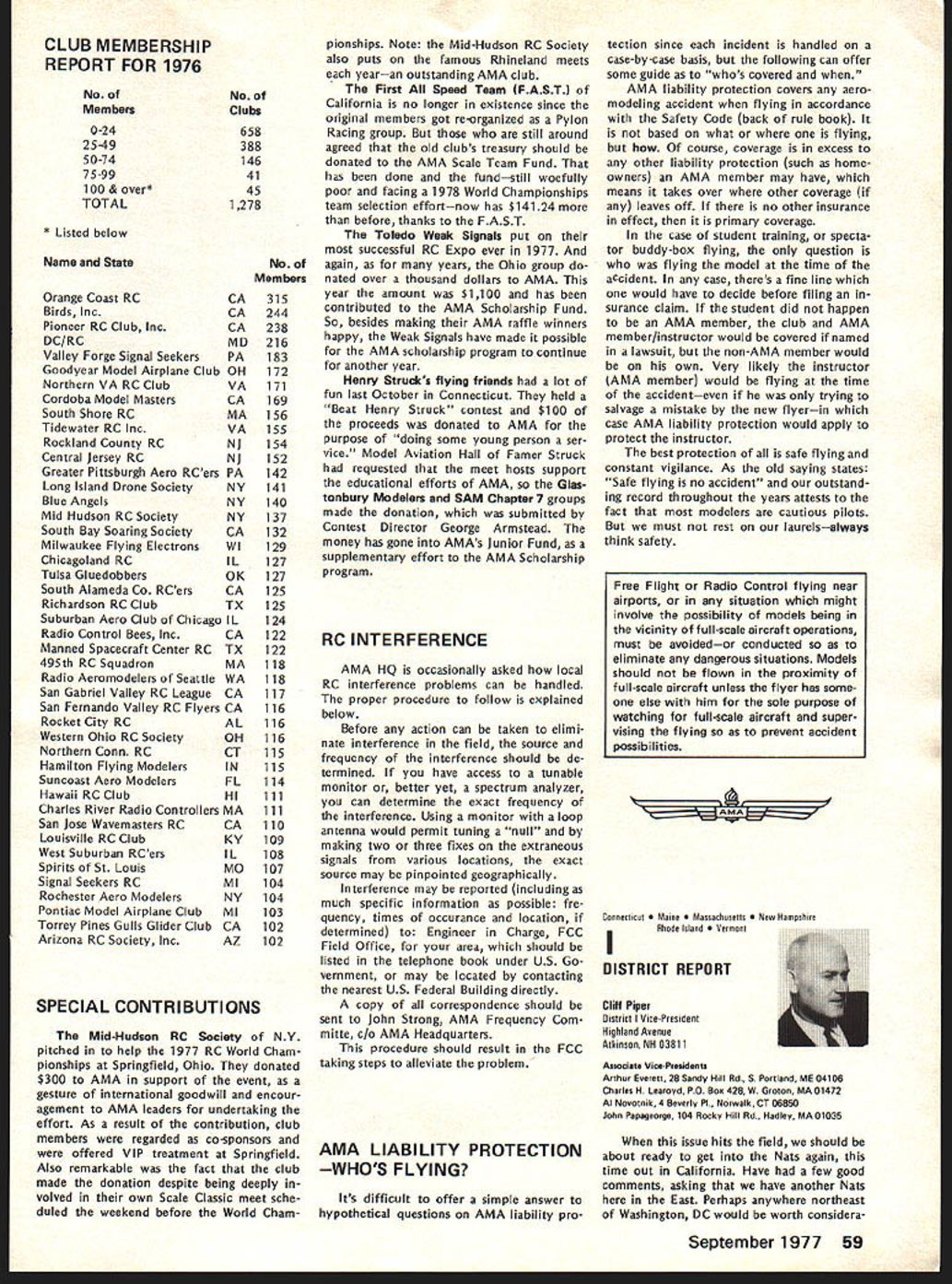
CLUB MEMBERSHIP REPORT FOR 1976
No. of Members No. of Clubs 0-24 658 25-49 388 50-74 146 75-99 41 100 & over 45 TOTAL 1,278
* Listed below
Name and State - No. of Members Orange Coast RC, CA - 315 Birds, Inc., CA - 244 Pioneer RC Club, Inc., CA - 238 DC/RC, MD - 216 Valley Forge Signal Seekers, PA - 183 Goodyear Model Airplane Club, OH - 172 Northern VA RC Club, VA - 171 Cordoba Model Masters, CA - 169 South Shore RC, MA - 155 Tidewater RC Inc., VA - 155 Rockland County RC, NJ - 154 Central Jersey RC, NJ - 152 Greater Pittsburgh Aero RC's, PA - 142 Long Island Drone Society, NY - 141 Blue Angels, NY - 140 Mid Hudson RC Society, NY - 137 South Bay Soaring Society, CA - 132 Milwaukee Flying Electrons, WI - 129 Chicagoland RC, IL - 127 Tulsa Gluedobbers, OK - 127 South Alameda Co. RC'ers, CA - 125 Richardson RC Club, TX - 125 Suburban Aero Club of Chicago, IL - 124 Radio Control Bees, Inc., CA - 122 Manned Spacecraft Center RC, TX - 122 495th RC Squadron, MA - 118 Radio Aeromodellers of Seattle, WA - 118 San Gabriel Valley RC League, CA - 117 San Fernando Valley RC Flyers, CA - 116 Rocket City RC, AL - 116 Western Ohio RC Society, OH - 116 Northern Conn. RC, CT - 115 Hamilton Flying Modelers, IN - 113 Suncoast Aero Modelers, FL - 114 Hawaii RC Club, HI - 111 Charles River Radio Controllers, MA - 111 San Jose Wavemasters RC, CA - 110 Louisville RC Club, KY - 109 West Suburban RC'ers, IL - 108 Spirits of St. Louis, MO - 107 Signal Seekers RC, MI - 104 Rochester Aero Modelers, NY - 104 Pontiac Model Airplane Club, MI - 103 Torrey Pines Gulls Glider Club, CA - 102 Arizona RC Society, Inc., AZ - 102
SPECIAL CONTRIBUTIONS
The Mid-Hudson RC Society of N.Y. pitched in to help the 1977 RC World Championships at Springfield, Ohio. They donated $300 to AMA in support of the event, as a gesture of international goodwill and encouragement to AMA leaders for undertaking the effort. As a result of the contribution, club members were regarded as co-sponsors and were offered VIP treatment at Springfield. Also remarkable was the fact that the club made the donation despite being deeply involved in their own Scale Classic meet scheduled the weekend before the World Championships. Note: the Mid-Hudson RC Society also puts on the famous Rhineland meets each year—an outstanding AMA club.
The First All Speed Team (F.A.S.T.) of California is no longer in existence since the original members got reorganized as a Pylon Racing group. But those who are still around agreed that the old club's treasury should be donated to the AMA Scale Team Fund. That has been done and the fund—still woefully poor and facing a 1978 World Championships team selection effort—now has $141.24 more than before, thanks to the F.A.S.T.
The Toledo Weak Signals put on their most successful RC Expo ever in 1977. And again, as for many years, the Ohio group donated over a thousand dollars to AMA. This year the amount was $1,100 and has been contributed to the AMA Scholarship Fund. So, besides making their AMA raffle winners happy, the Weak Signals have made it possible for the AMA scholarship program to continue for another year.
Henry Struck's flying friends had a lot of fun last October in Connecticut. They held a "Beat Henry Struck" contest and $100 of the proceeds was donated to AMA for the purpose of "doing some young person a service." Model Aviation Hall of Famer Struck had requested that the meet hosts support the educational efforts of AMA, so the Glastonbury Modelers and SAM Chapter 7 groups made the donation, which was submitted by Contest Director George Armstead. The money has gone into AMA's Junior Fund, as a supplementary effort to the AMA Scholarship program.
RC INTERFERENCE
AMA HQ is occasionally asked how local RC interference problems can be handled. The proper procedure to follow is explained below.
Before any action can be taken to eliminate interference in the field, the source and frequency of the interference should be determined. If you have access to a tunable monitor or, better yet, a spectrum analyzer, you can determine the exact frequency of the interference. Using a monitor with a loop antenna would permit tuning a "null" and by making two or three fixes on the extraneous signals from various locations, the exact source may be pinpointed geographically.
Interference may be reported (including as much specific information as possible: frequency, times of occurrence and location, if determined) to: Engineer in Charge, FCC Field Office for your area, which should be listed in the telephone book under U.S. Government, or may be located by contacting the nearest U.S. Federal Building directly. A copy of all correspondence should be sent to John Strong, AMA Frequency Committee, c/o AMA Headquarters.
This procedure should result in the FCC taking steps to alleviate the problem.
AMA LIABILITY PROTECTION — WHO'S FLYING?
It's difficult to offer a simple answer to hypothetical questions on AMA liability protection since each incident is handled on a case-by-case basis, but the following can offer some guide as to "who's covered and when."
AMA liability protection covers any aeromodelling accident when flying in accordance with the Safety Code (back of rule book). It is not based on what or where one is flying, but how. Of course, coverage is in excess to any other liability protection (such as homeowners) an AMA member may have, which means it takes over where other coverage (if any) leaves off. If there is no other insurance in effect, then it is primary coverage.
In the case of student training, or spectator buddy-box flying, the only question is who was flying the model at the time of the accident. In any case, there's a fine line which one would have to decide before filing an insurance claim. If the student did not happen to be an AMA member, the club and AMA member/instructor would be covered if named in a lawsuit, but the non-AMA member would be on his own. Very likely the instructor (AMA member) would be flying at the time of the accident—even if he was only trying to salvage a mistake by the new flyer—in which case AMA liability protection would apply to protect the instructor.
The best protection of all is safe flying and constant vigilance. As the old saying states: "Safe flying is no accident" and our outstanding record throughout the years attests to the fact that most modelers are cautious pilots. But we must not rest on our laurels—always think safety.
Free Flight or Radio Control flying near airports, or in any situation which might involve the possibility of models being in the vicinity of full-scale aircraft operations, must be avoided—or conducted so as to eliminate any dangerous situations. Models should not be flown in the proximity of full-scale aircraft unless the flyer has someone else with him for the sole purpose of watching for full-scale aircraft and supervising the flying so as to prevent accident possibilities.
DISTRICT REPORT
Cliff Piper District II Vice-President Highland Avenue Atkinson, NH 03811
Associate Vice-Presidents Arthur Everett, 28 Sandy Hill Rd., S. Portland, ME 04106 Charles H. Leonard, P.O. Box 428, W. Groton, MA 01472 Al Nowacki, 4 Beverly Pl., Norwalk, CT 06850 John Papageorge, 104 Rocky Hill Rd., Hadley, MA 01035
When this issue hits the field, we should be about ready to get into the Nats again, this time out in California. Have had a few good comments, asking that we have another Nats here in the East. Perhaps anywhere northeast of Washington, D.C. would be worth considera...
AMA News
tion, provided that there is a suitable site available. NOW IS THE TIME TO START THINKING AND PLUGGING FOR A NATS HERE IN OUR SECTION OF THE U.S.A. If anyone has an "in" and feels that he has a possible site for consideration by the Nats Executive Committee, please let me know now, and we'll work on it. There is a list of requirements, including nearby large city or cities, suitable billeting accommodations, such as a college/university, large areas for our Free-Flighters, and areas enclosed for administration, and coordination of the week-long activities. This list is available from HQ, and they will be glad to send one upon request to any interested party. I'll be talking to other area VP's here in the East and perhaps we can generate more enthusiasm toward such a goal. California hasn't had a Nats for 10 years, when the Navy sponsored it at Los Alamitos. They went after it, and after a couple of false starts, came up with a solid recommendation which was acted upon. Incidentally, a tie-in such as they have with some military association would be a help, too. Paul Penney recently pointed out that the last one he was able to attend was the closest it has come to our area, and that was Philly in 1969. If we get it together by 1979, that should be some kind of a cycle, shouldn't it?
************
Still no further comment on the Quickie 500 dilemma which I have created, by asking for more feed-back. If you feel that there is a domination of the event, or if you like it the way it is, let me hear from you. Not talking about all the "special" race events for one type of plane, with engine restrictions, bonuses, point subtraction penalties, etc., but just plain want some more comments about the feeling of the membership about this or any other event being flown. Incidentally, the officers of the AMA can't do anything about making an event "official." This is up to the Contest Board, and should be handled through your CB representative for the District. Standard procedures for rules changes are published often, and can be obtained from HQ.
************
I have on hand now copies of Chartered Clubs, throughout the country, which is an up-to-date list reproduced from the last two months of MA, and other clubs mentioned in previous columns. If you want a copy, just phone or write.
************
Quickies: I'm running for re-election. I'm working. Sold the Tri-Pacer. Am back flying sport RC/HLG/Peanut Scale/and even some Ukie. Am very anxious to make more club visits. Please write and tell me your meeting dates, and we'll set up some dates to answer your questions on AMA.
************
Still no final selection on a close for the column, but thanks for the many good suggestions.
AMA News
DISTRICT REPORT
Jim McNeill District V Vice-President 617 South 20 Avenue Birmingham, AL 35205
Associate Vice-Presidents
- Gene Hannah, 3332 Wiley Rd., Montgomery, AL 36106
- Richard E. Jackson, 107 White Blvd., Summerville, SC 29483
- Chris Joiner, 5984 Warner Road, Columbus, GA 31904
- Bill Kite, 550 West Stone Dr., Kingsport, TN 37660
- Tom McLaughlin, 4140 Fenn Ct., Pine Glades, Pensacola, FL 32503
- Luis Rodriguez, E-10, 5th St. Ext., Villa Rica, Bayamon, Puerto Rico 00919
- Julie Woods, PO Box 127, Scooba, MS 39358
I've been all over the District since last month and I have a bunch of important happy people I want you to meet. O.K.?
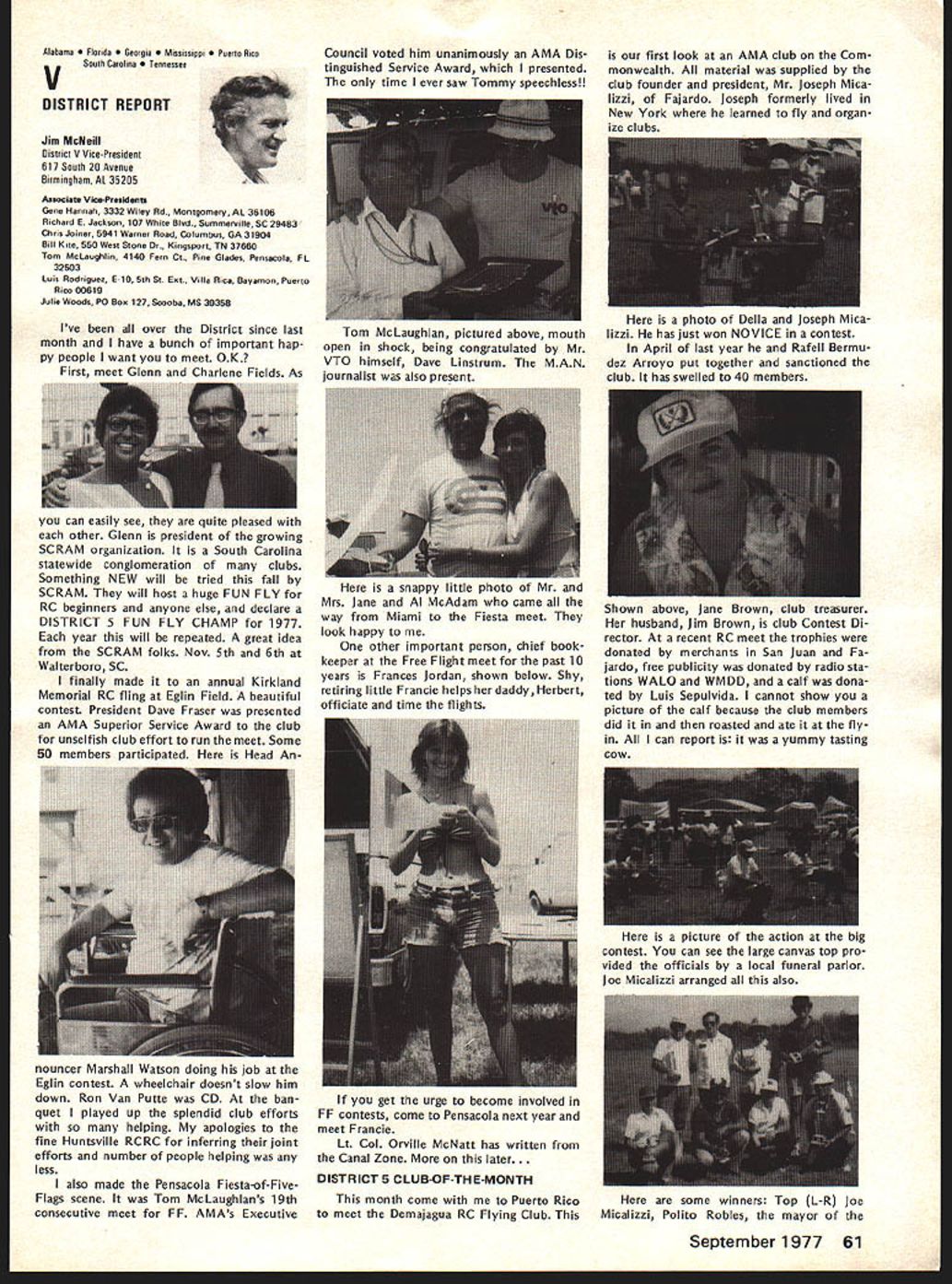
First, meet Glenn and Charlene Fields. As you can easily see, they are quite pleased with each other. Glenn is president of the growing SCRAM organization. It is a South Carolina statewide conglomeration of many clubs. Something NEW will be tried this fall by SCRAM. They will host a huge FUN FLY for RC beginners and anyone else, and declare a DISTRICT 5 FUN FLY CHAMP for 1977. Each year this will be repeated. A great idea from the SCRAM folks. Nov. 5th and 6th at Walterboro, SC.
I finally made it to an annual Kirkland Memorial RC fling at Eglin Field. A beautiful contest. President Dave Fraser was presented an AMA Superior Service Award to the club for unselfish club effort to run the meet. Some 50 members participated.
I also made the Pensacola Fiesta-of-Five-Flags scene. It was Tom McLaughlin's 19th consecutive meet for FF. AMA's Executive Council voted him unanimously an AMA Distinguished Service Award, which I presented. The only time I ever saw Tommy speechless!!
One other important person, chief bookkeeper at the Free Flight meet for the past 10 years, is Frances Jordan. Shy, retiring little Francie helps her daddy, Herbert, officiate and time the flights.
If you get the urge to become involved in FF contests, come to Pensacola next year and meet Francie.
Lt. Col. Orville McNatt has written from the Canal Zone. More on this later...
DISTRICT 5 CLUB-OF-THE-MONTH
This month come with me to Puerto Rico to meet the Demajagua RC Flying Club. This is our first look at an AMA club on the Commonwealth. All material was supplied by the club founder and president, Mr. Joseph Micalizzi, of Fajardo. Joseph formerly lived in New York where he learned to fly and organize clubs.
In April of last year he and Rafell Bermudez Arroyo put together and sanctioned the club. It has swelled to 40 members.
At a recent RC meet the trophies were donated by merchants in San Juan and Fajardo, free publicity was donated by radio stations WALO and WMDD, and a calf was donated by Luis Sepulvida. I cannot show you a picture of the calf because the club members did it in and then roasted and ate it at the fly-in. All I can report is: it was a yummy tasting cow.
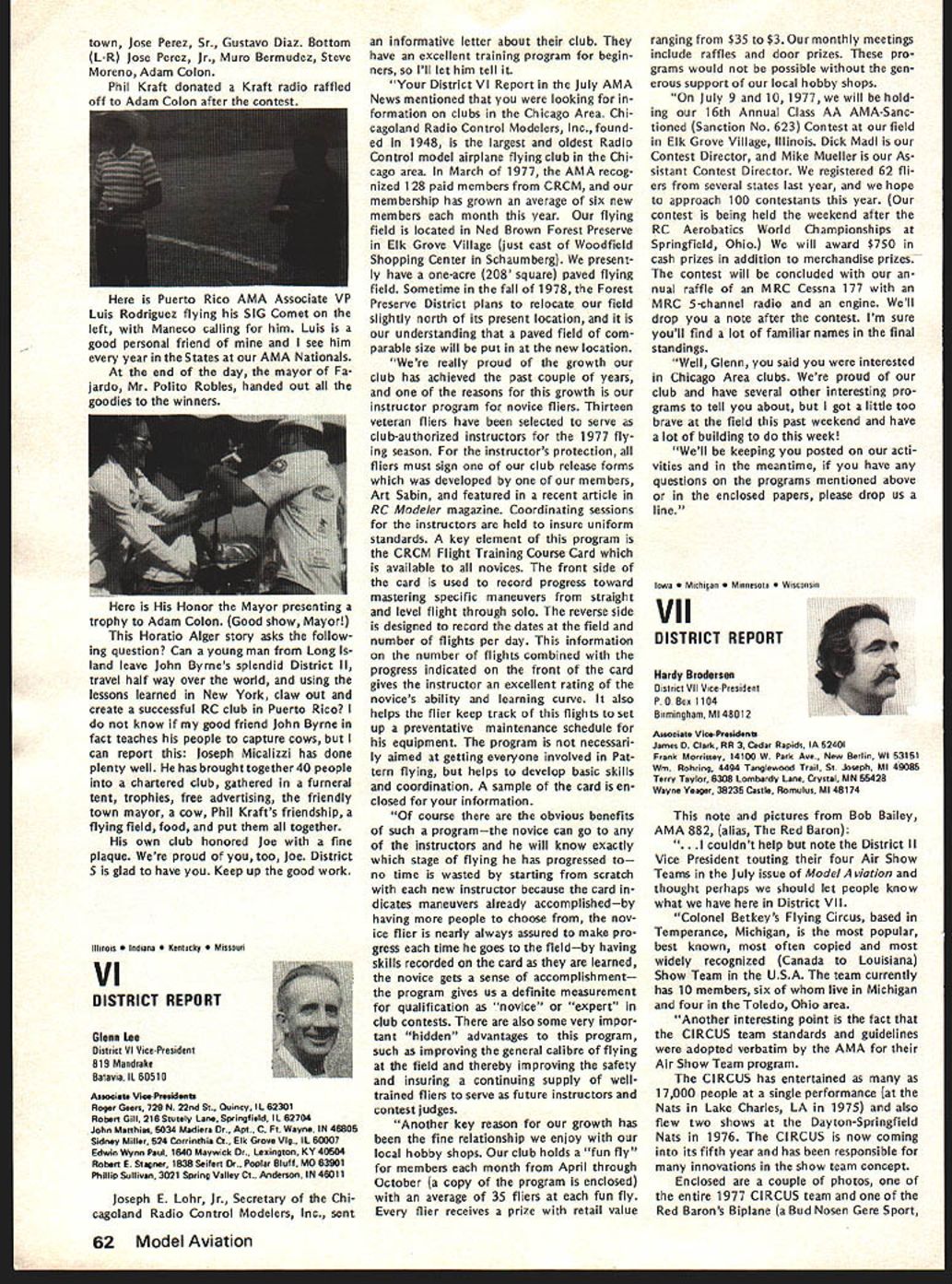
Here is a picture of the action at the big contest. You can see the large canvas top provided the officials by a local funeral parlor. Joe Micalizzi arranged all this also. At the end of the day, the mayor of Fajardo, Mr. Polito Robles, handed out all the goodies to the winners.
This Horatio Alger story asks the following question? Can a young man from Long Island leave John Byrne's splendid District II, travel half way over the world, and using the lessons learned in New York, claw out and create a successful RC club in Puerto Rico? I do not know if my good friend John Byrne in fact teaches his people to capture cows, but I can report this: Joseph Micalizzi has done plenty well. He has brought together 40 people into a chartered club, gathered in a funeral tent, trophies, free advertising, the friendly town mayor, a cow, Phil Kraft's friendship, a flying field, food, and put them all together.
His own club honored Joe with a fine plaque. We're proud of you, too, Joe. District 5 is glad to have you. Keep up the good work.
VI DISTRICT REPORT
Glenn Lee District VI Vice-President 819 Mandrake Batavia, IL 60510
Associate Vice-Presidents Roger Geers, 702 N. 22nd St., Quincy, IL 62301 Robert Galli, 215 Stanley Lane, Springfield, IL 62704 John Barbera, 5304 Sedalia Dr., Apt. C, Ft. Wayne, IN 46805 Sidney Miller, 524 Corinthia Ct., Elk Grove Vlg., IL 60007 Edwin Winn, 9634 Markley Rd., Lexington, KY 40508 Robert E. Tigner, 1888 S. Remer Dr., Taylor Bluff, MN 55901 Phillip Sullivan, 3028 Spring Valley Ct., Anderson, IN 46011
Joseph E. Lohn, Jr., Secretary of the Chicagoland Radio Control Modelers, Inc., sent an informative letter about their club. They have an excellent training program for beginners, so I'll let him tell it.
"Your District VI Report in the July AMA News mentioned that you were looking for information on clubs in the Chicago Area. Chicagoland Radio Control Modelers, Inc., founded in 1948, is the largest and oldest Radio Control model airplane flying club in the Chicago area. In March of 1977, the AMA recognized 128 paid members from CRCM, and our membership has grown an average of six new members each month this year. Our flying field is located in Ned Brown Forest Preserve in Elk Grove Village (just east of Woodfield Shopping Center in Schaumberg). We presently have a one-acre (208' square) paved flying field. Sometime in the fall of 1978, the Forest Preserve District plans to relocate our field slightly north of its present location, and it is our understanding that a paved field of comparable size will be put in at the new location.
"We're really proud of the growth our club has achieved the past couple of years, and one of the reasons for this growth is our instructor program for novice fliers. Thirteen veteran fliers have been selected to serve as club-authorized instructors for the 1977 flying season. For the instructor's protection, all fliers must sign one of our club release forms which was developed by one of our members, Art Sabin, and featured in a recent article in RC Modeler magazine. Coordinating sessions for the instructors are held to insure uniform standards. A key element of this program is the CRCM Flight Training Course Card which is available to all novices. The front side of the card is used to record progress toward mastering specific maneuvers from straight and level flight through solo. The reverse side is designed to record the dates at the field and the number of flights per day. This information on the number of flights combined with the progress indicated on the front of the card gives the instructor an excellent rating of the novice's ability and learning curve. It also helps the flier keep track of his flights to set up a preventative maintenance schedule for his equipment. The program is not necessarily aimed at getting everyone involved in Pattern flying, but helps to develop basic skills and coordination. A sample of the card is enclosed for your information.
"Of course there are the obvious benefits of such a program—the novice can go to any of the instructors and he will know exactly which stage of flying he has progressed to—no time is wasted by starting from scratch with each new instructor because the card indicates maneuvers already accomplished—by having more people to choose from, the novice flier is nearly always assured to make progress each time he goes to the field—by having skills recorded on the card as they are learned, the novice gets a sense of accomplishment—the program gives us a definite measurement for qualification as 'novice' or 'expert' in club contests. There are also some very important 'hidden' advantages to this program, such as improving the general caliber of flying at the field and thereby improving the safety and insuring a continuing supply of well-trained fliers to serve as future instructors and contest judges.
"Another key reason for our growth has been the fine relationship we enjoy with our local hobby shops. Our club holds a 'fun fly' for members each month from April through October (a copy of the program is enclosed) with an average of 35 fliers at each fun fly. Every flier receives a prize with retail value ranging from $35 to $3. Our monthly meetings include raffles and door prizes. These programs would not be possible without the generous support of our local hobby shops.
"On July 9 and 10, 1977, we will be holding our 16th Annual Class 'AA' AMA-Sanctioned (Sanction No. 623) Contest at our field in Elk Grove Village, Illinois. Dick Madl is our Contest Director, and Mike Mueller is our Assistant Contest Director. We registered 62 fliers from several states last year, and we hope to approach 100 contestants this year. (Our contest is being held the weekend after the RC Aerobatics World Championships at Springfield, Ohio.) We will award $750 in cash prizes in addition to merchandise prizes. The contest will be concluded with our annual raffle of an MRC Cessna 177 with an MRC 5-channel radio and an engine. We'll post a note after the contest. I'm sure you'll find a lot of familiar names in the final standings.
"'Well, Glenn, you said you were interested in Chicago Area clubs. We're proud of our club and have several other interesting programs to tell you about, but I got a little too brave at the field this past weekend and have a lot of building to do this week!'
"'We'll be keeping you posted on our activities and in the meantime, if you have any questions on the programs mentioned above or in the enclosed papers, please drop us a line.'"
VII DISTRICT REPORT
Hardy Broderson District VII Vice-President P. O. Box 1104 Birmingham, MI 48012
Associate Vice-Presidents James D. Clark, RR 3, Cedar Rapids, IA 52401 Frank Morrissey, 14100 W. Park Ave., New Berlin, WI 53151 Wm. Robbins, 1490 Tangerwood Trail, St. Joseph, MI 49085 Terry Taylor, 6308 Lombardy Lane, Crystal, MN 55428 Wayne Yeager, 38235 Castle, Romulus, MI 48174
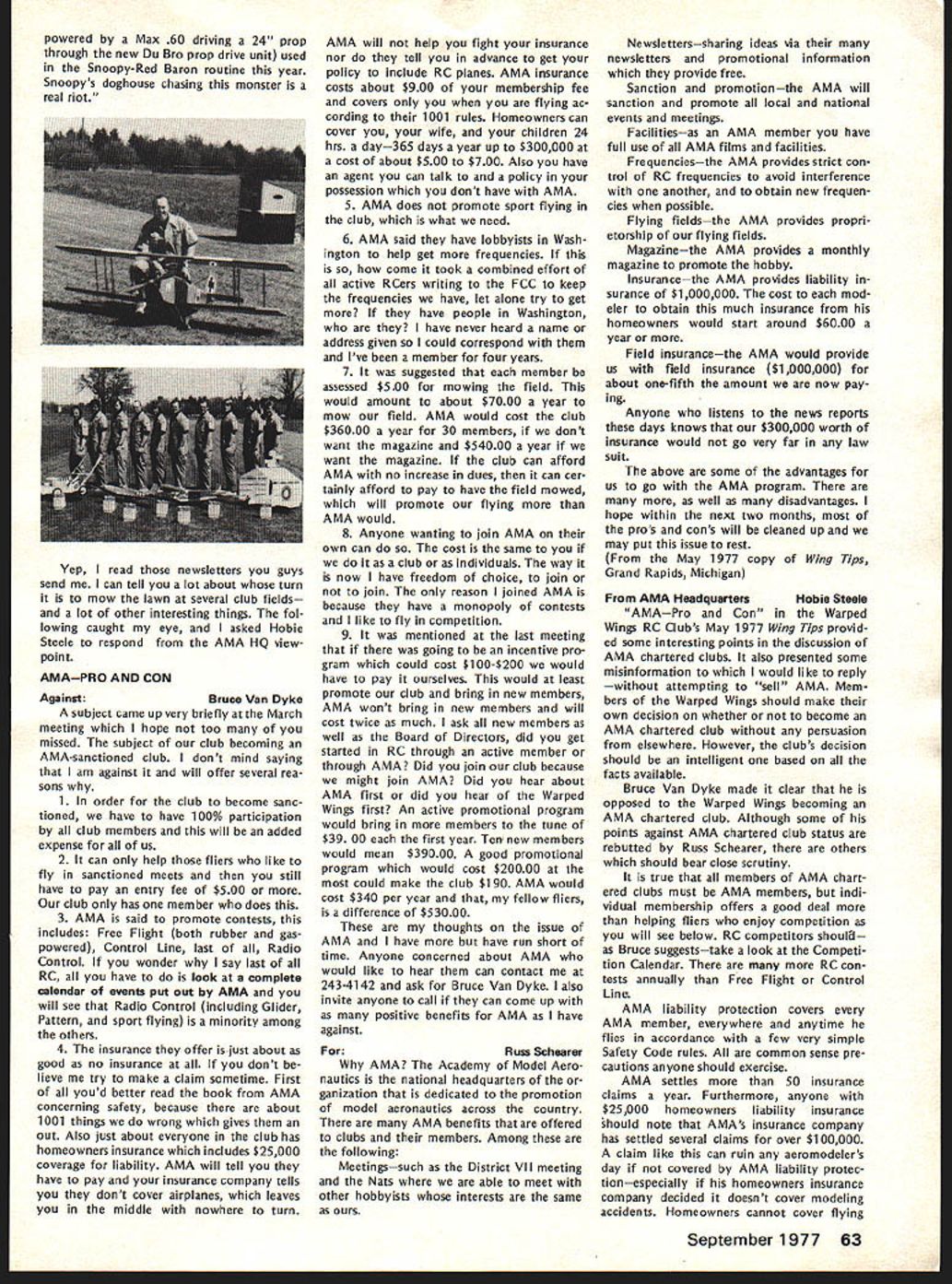
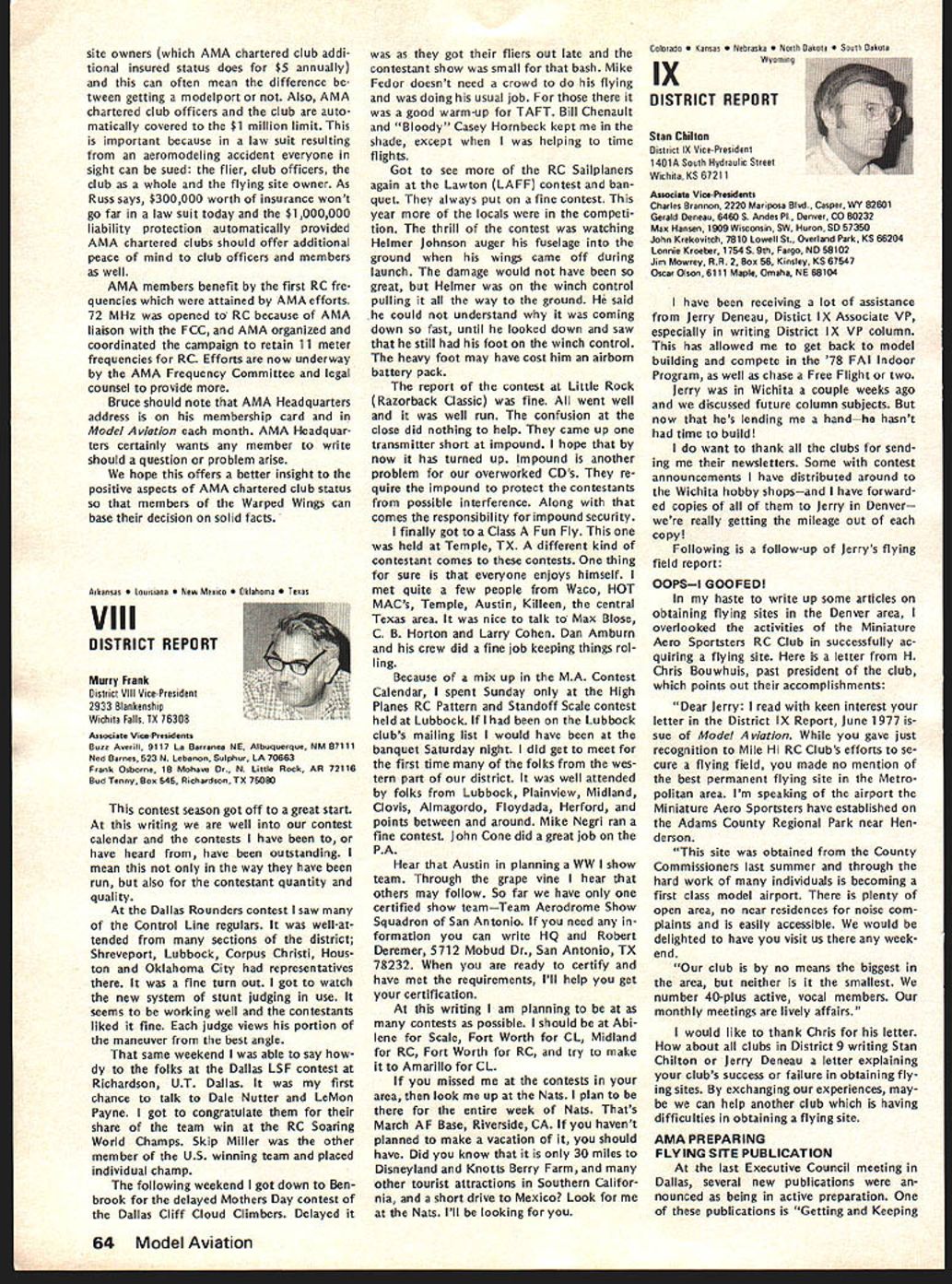
This note and pictures from Bob Bailey, AMA 882, (alias, The Red Baron):
"...I couldn't help but note the District II Vice President touting their four Air Show Teams in the July issue of Model Aviation and thought perhaps we should let people know what we have here in District VII.
"Colonel Bekey's Flying Circus, based in Temperance, Michigan, is the most popular, best known, most often copied and most widely recognized (Canada to Louisiana) show team in the U.S.A. The team currently has 10 members, six of whom live in Michigan and four in the Toledo, Ohio area.
"Another interesting point is the fact that the CIRCUS team standards and guidelines were adopted verbatim by the AMA for the Air Show Team program.
"The CIRCUS has entertained as many as 17,000 people at a single performance (at the Nats in Lake Charles, LA in 1975) and also two shows at the Dayton-Springfield Nats in 1976. The CIRCUS is now coming into its fifth year and has been responsible for many innovations in the show team concept.
"Enclosed are a couple of photos, one of the entire 1977 CIRCUS team and one of the Red Baron's Biplane (a Bud Nosen Gere Sport,
AMA News
Yep, I read those newsletters you guys sent me. I can tell you a lot about whose turn it is to mow the lawn at several club fields and a lot of other interesting things. The following caught my eye, and I asked Hobie Steele to respond from the AMA HQ viewpoint.
AMA—PRO AND CON
Against: Bruce Van Dyke
A subject came up very briefly at the March meeting which I hope not too many of you missed. The subject of our club becoming an AMA-sanctioned club. I don't mind saying that I am against it and will offer several reasons why.
- In order for the club to become sanctioned, we have to have 100% participation by all club members and this will be an added expense for all of us.
- It can only help those fliers who like to fly in sanctioned meets and then you still have to pay an entry fee of $5.00 or more. Our club only has one member who does this.
- AMA is said to promote contests, this includes: Free Flight (both rubber and gas-powered), Control Line, last of all, Radio Control. If you wonder why I say last of all RC, all you have to do is look at a complete calendar of events put out by AMA and you will see that Radio Control (including Glider, Pattern, and sport flying) is a minority among the others.
- The insurance they offer is just about as good as no insurance at all. If you don't believe me try to make a claim sometime. First of all you'd better read the book from AMA concerning safety, because there are about 1001 things we do wrong which gives them an out. Also just about everyone in the club has homeowners insurance which includes $25,000 coverage for liability. AMA will tell you they have to pay and your insurance company tells you they don't cover airplanes, which leaves you in the middle with nowhere to turn.
AMA will not help you fight your insurance nor do they tell you in advance to get your policy to include RC planes. AMA insurance costs about $9.00 of your membership fee and covers only you when you are flying according to their 1001 rules. Homeowners can cover you, your wife, and your children 24 hrs. a day—365 days a year up to $300,000 at a cost of about $5.00 to $7.00. Also you have an agent you can talk to and a policy in your possession which you don't have with AMA.
- AMA does not promote sport flying in the club, which is what we need.
- AMA said they have lobbyists in Washington to help get more frequencies. If this is so, how come it took a combined effort of all active RCers writing to the FCC to keep the frequencies we have, let alone try to get more? If they have people in Washington, who are they? I have never heard a name or address given so I could correspond with them and I've been a member for four years.
- It was suggested that each member be assessed $5.00 for mowing the field. This would amount to about $70.00 a year to mow our field. AMA would cost the club $360.00 a year for 30 members, if we don't want the magazine and $540.00 a year if we want the magazine. If the club can afford AMA with no increase in dues, then it can certainly afford to pay to have the field mowed, which will promote our flying more than AMA would.
- Anyone wanting to join AMA on their own can do so. The cost is the same to you if we do it as a club or as individuals. The way it is now I have freedom of choice, to join or not to join. The only reason I joined AMA is because they have a monopoly of contests and I like to fly in competition.
- It was mentioned at the last meeting that if there was going to be an incentive program which could cost $100-$200 we would have to pay it ourselves. This would at least promote our club and bring in new members. AMA won't bring in new members and will cost twice as much. I ask all new members as well as the Board of Directors, did you get started in RC through an active member or through AMA? Did you join our club because we might join AMA? Did you hear about AMA first or did you hear of the Warped Wings first? An active promotional program would bring in more members to the tune of $39.00 each the first year. Ten new members would mean $390.00. A good promotional program which would cost $200.00 at the most could make the club $190. AMA would cost $340 per year and that, my fellow fliers, is a difference of $150.00.
These are my thoughts on the issue of AMA and I have more but have run short of time. Anyone concerned about AMA who would like to hear more can contact me at 243-4142 and ask for Bruce Van Dyke. I also invite anyone to call if they can come up with as many positive benefits for AMA as I have against.
For: Russ Schearer
Why AMA? The Academy of Model Aeronautics is the national headquarters of the organization that is dedicated to the promotion of model aeronautics across the country. There are many AMA benefits that are offered to clubs and their members. Among these are the following:
Meetings—such as the District VII meeting and the Nats where we are able to meet with other hobbyists whose interests are the same as ours.
Newsletters—sharing ideas via their many newsletters and promotional information which they provide free.
Sanction and promotion—the AMA will sanction and promote all local and national events and meetings.
Facilities—as an AMA member you have full use of all AMA films and facilities.
Frequencies—the AMA provides strict control of RC frequencies to avoid interference with one another, and to obtain new frequencies when possible.
Flying fields—the AMA provides proprietorship of our flying fields.
Magazine—the AMA provides a monthly magazine to promote the hobby.
Insurance—the AMA provides liability insurance of $1,000,000. The cost to each modeler to obtain this much insurance from his homeowners would start around $60.00 a year or more.
Field insurance—the AMA would provide us with field insurance ($1,000,000) for about one-fifth the amount we are now paying.
Anyone who listens to the news reports these days knows that our $300,000 worth of insurance would not go very far in any law suit.
The above are some of the advantages for us to go with the AMA program. There are many more, as well as many disadvantages. I hope within the next two months, most of the pro's and con's will be cleaned up and we may put this issue to rest.
(From the May 1977 copy of Wing Tips, Grand Rapids, Michigan)
From AMA Headquarters Hobie Steele
"AMA—Pro and Con" in the Warped Wings RC Club's May 1977 Wing Tips provided some interesting points in the discussion of AMA chartered clubs. It also presented some misinformation to which I would like to reply without attempting to "sell" AMA. Members of the Warped Wings should make their own decision on whether or not to become an AMA chartered club without any persuasion from elsewhere. However, the club's decision should be an informed one based on all the facts available.
Bruce Van Dyke made it clear that he is opposed to the Warped Wings becoming an AMA chartered club. Although some of his points against AMA chartered clubs are rebutted by Russ Schearer, there are others which should bear close scrutiny.
It is true that all members of AMA chartered clubs must be AMA members, but individual membership offers a good deal more than helping fliers who enjoy competition as you will see below. RC competitors should—as Bruce suggests—take a look at the Competition Calendar. There are many more RC contests annually than Free Flight or Control Line.
AMA liability protection covers every AMA member, everywhere and anytime he flies in accordance with a few very simple Safety Code rules. All are common sense precautions anyone should exercise.
AMA settles more than 50 insurance claims a year. Furthermore, anyone with $25,000 homeowners liability may find that, in a claim against him AMA's insurance company has settled several claims for over $100,000. A claim like this can ruin any aeromodeler's day if not covered by AMA liability protection—especially if his homeowners insurance company decided it doesn't cover modeling accidents. Homeowners cannot cover flying site owners (which AMA chartered club additional insured status does for $5 annually) and this can often mean the difference between getting a modelport or not. Also, AMA chartered club officers and the club are automatically covered to the $1 million limit. This is important because in a law suit resulting from an aeromodeling accident everyone in sight can be sued: the flier, club officers, the club as a whole and the flying site owner. As Russ says, $300,000 worth of insurance won't go far in a law suit today and the $1,000,000 liability protection automatically provided AMA chartered clubs should offer additional peace of mind to club officers and members as well.
AMA members benefit by the first RC frequencies which were attained by AMA efforts. 72 MHz was opened to RC because of AMA liaison with the FCC, and AMA organized and coordinated the campaign to retain 11 meter frequencies for RC. Efforts are now under way by the AMA Frequency Committee and legal counsel to provide more.
Bruce should note that AMA Headquarters address is on his membership card and in Model Aviation each month. AMA Headquarters certainly wants any member to write should a question or problem arise.
We hope this offers a better insight to the positive aspects of AMA chartered club status so that members of the Warped Wings can base their decision on solid facts.
AMA POSITION PAPER TO THE FCC
Last year's AMA/FCC effort on behalf of RCers was a dramatic, fast-paced, concentrated few months' period. Since that pace has deliberately been complicated and spread over a longer period of time, the effort will continue in this way for the rest of the year at least. It's part of a longer-range effort aimed at producing improved conditions for radio control modelers on a basis less subject to future upsets. A necessary part of the current effort is submitting official AMA responses to specific FCC proposals known as dockets. Dockets published by the FCC indicate government concerns, ideas and possible new legislation regarding current problems. The FCC issues such dockets, some of which touch indirectly on RC matters. Such a docket, however, offers an opportunity to present and promote our viewpoint and to reinforce the case for expansion and improvement of RC operating conditions. AMA's Frequency Committee, legal counsel and headquarters staff coordinate responses to proposals before the FCC. It's a steady effort, without a lot of fanfare or publicity, gradually putting together a total package defining needs and wants and also objections to proposals which might hurt RC activity. It's a tedious effort involving a lot of legal language and boring reading, but it's a necessary part of the process to participate in governmental actions which affect us. Through such process AMA represents RCers on a continuing basis. It's a battle in which others get involved sporadically; it's what AMA dues help make possible.
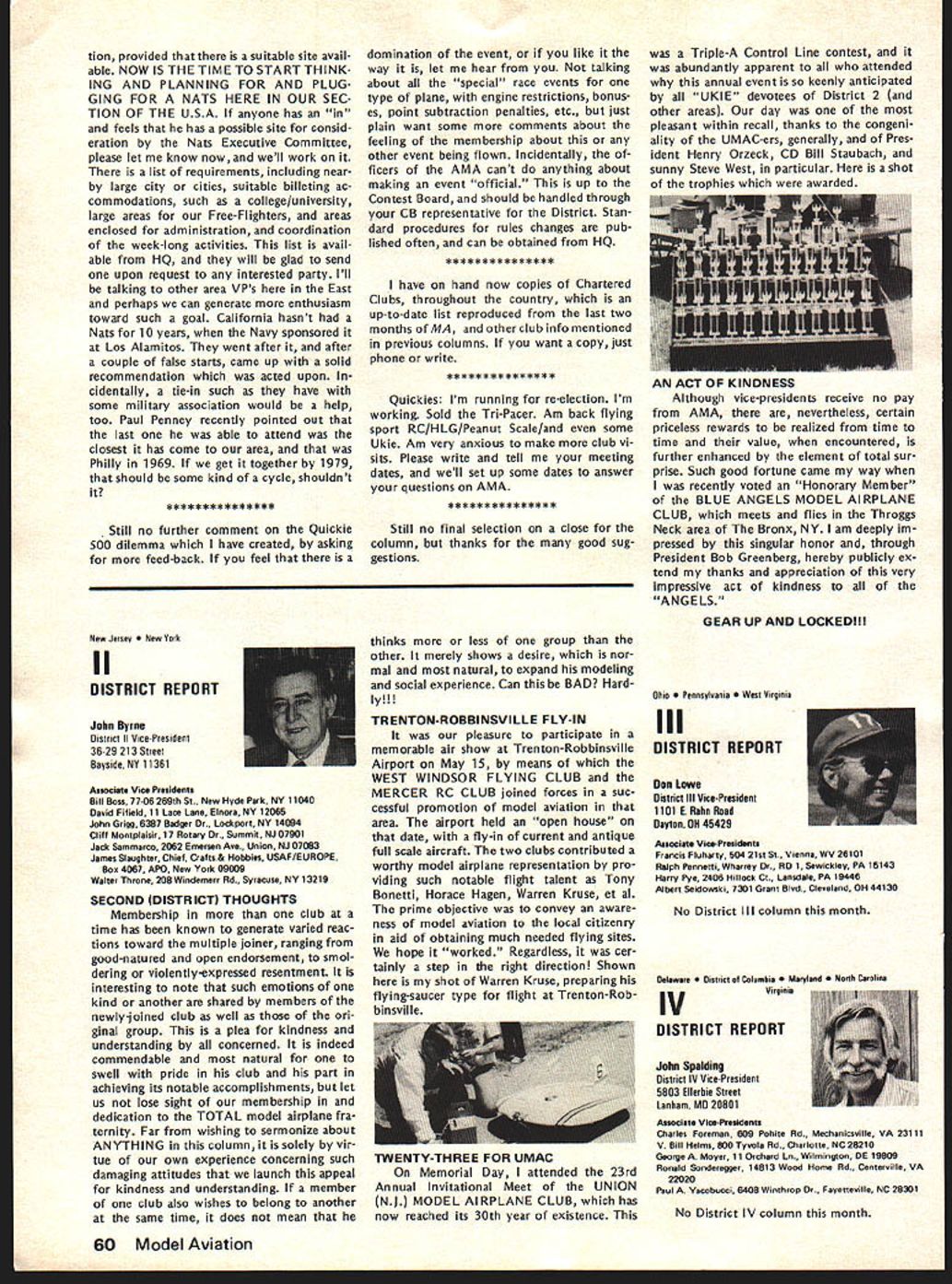
In the June '77 issue of AMA News (page 59) AMA's response to FCC Docket 20271 was published. We have submitted another response to Docket 21116 (Matter: Amendment of Part 2 of the Commission's Rules to prohibit marketing external radio frequency amplifiers capable of operation on frequencies 24–35 MHz). Submitted AMA June 24, 1977.
- The AMA is the governing body for model aircraft activities in the United States. Its membership at the end of 1976 numbered in the neighborhood of 62,000, approximately 75% of whom regularly fly radio-controlled (RC) model aircraft under licenses issued by the Federal Communications Commission. Furthermore, the AMA is the United States representative to the Federation Aeronautique Internationale and is concerned with RC activities world-wide as well as within the United States.
- At the present time radio control activities are conducted under licenses issued by the Federal Communications Commission in the Radio Control Service, formerly Class C of the Citizens Radio Service. Service licensees are permitted to operate six 27 MHz channels and seven 72 MHz channels. The 27 MHz RC channels are interspersed between Citizens Band Radio Service (CB), formerly Class D, voice frequencies.
- With the recent explosion in CB popularity accompanying the rise of illegal CB operations, the 27 MHz RC channels are rapidly becoming unusable for model aircraft control. Interference on a voice channel may cause momentary irritation to the user; interference lasting a fraction of a second on an RC channel being used for model control can result in the loss of a valuable model and present a serious risk of injury to the flier and spectators.
- The problems RC flyers are experiencing daily which prevent efficient use of 27 MHz RC frequencies are a direct result of two varieties of rules violations by CB operators. First, significant numbers of CB operators operate directly on exclusive RC frequencies — illegal off-frequency operation. The interference problems are addressed in the Academy's comments in Docket 21117 filed simultaneously.
I checked the supplied scanned page carefully. That page contains the "JUNIOR FLIGHT!" column (Ed Whitten) and the GUMDROP plan/drawing — it does not contain any visible continuation of the "AMA News" article referenced in your prior-page context.
Because the image does not show any "AMA News" text to transcribe or correct, I can't extract a continuation from this page without inventing or copying text not present in the image.
What I can do next (pick one):
- If you want me to continue the AMA News article using the OCR text you posted as reference, I can clean and correct that OCR excerpt and return it (but that would not be verified against this image).
- Or you can upload the correct scanned page that actually contains the AMA News continuation (or any other pages), and I will extract and correct the text exactly from that image.
Which would you prefer?
Transcribed from original scans by AI. Minor OCR errors may remain.

