
Sound & Model Aeronautics
Howard Crispin, Jr.
Last month we discussed methods of taking sound-level measurements and the use of those measurements in determining the effects model-aircraft activity might incur in our neighborhood. Now that you have saved those instructions, we can proceed to the next step in complying with local ordinances or satisfying complaints from neighbors.
A vital part of dealing with noise questions is knowing distances to property lines. This requires a reasonably accurate chart or an aerial view of the area. The type of illustration is less critical than its capability for measuring distances. An aerial view or topographical map is important when you need to know the terrain around the flying site. The important factor is that the drawing have a scale that can readily be applied for measurements. The larger the scale, the better the accuracy.
A sketch showing roads into the field and the relative locations of houses provides some insight but serves very little purpose in analyzing sound-level dissipation over distance and the effect at a particular point of interest. Do not attempt to do justice with a drawing on a standard 8 1/2 x 11-inch sheet of paper.
The first point of interest on the chart should be your runway, with the pilot position(s) clearly noted. This becomes the reference point for a number of other dimensions to be considered. Runway alignment should be accurately indicated — the flight envelope will be aligned with this mapped direction. This assumes flight takes place in line with the runway, though many flights have a bit of an arc and the ends can be well to the rear of the runway line.
Most fliers have no real concept of how far out they fly; it is certainly easier to fly farther out with large aircraft. Working with radio-control aerobatics over the years, we have known aircraft flown, on the split-S turnaround, as much as 2,500 feet from the center pilot position. For the purpose of analysis, assume 2,000 feet out to the left and right and note that distance on your chart. Be generous and allow 750 feet straight out from the pilot — many fliers go beyond this; if so, extend the line to perhaps 1,000 feet.
Mark out a rectangle on your chart corresponding to this flight envelope. We will proceed as if this is the limitation imposed at your site. If the box should be larger, note that.
Next, note all occupied buildings within 1,000 feet of the outside of this box. This is not to say you are always flying near the limits of the box, but anything well inside becomes a sort of safety net. The decibel reduction for the sound level at 1,000 feet from the boundary of the box, assuming a measurement at nine feet above ground, will be in the neighborhood of 40 dB down. With reasonable effort at sound reduction at the site, you will come close to complying with most ordinances under these conditions. Flying a tighter box and reducing power where possible will help.
With a bit of work using a calculator, you can figure out quite accurately the level of sound measured at your neighbors' property lines. You can produce a complete sound-level profile for your flying site once the box and occupied areas are noted on the map.
Proceed to make checks at property lines and each potential problem location, and compare those to your calculated figures, keeping in mind differences due to the actual flight path of the aircraft. The only complete comparison would be if the aircraft actually flew into the position on the box nearest the point in question — this also assumes you made a good estimate of the slant range (remember last month).
Houses between your box and within that 1,000-foot working distance are where you will probably encounter the most potential problems. The closer a house is to the flight path, the greater the potential for complaints. If you have a house underneath your flight path at a point where you are likely to be at full throttle, you may have an impossible solution without radical changes.
The first thing to attempt, when this becomes a problem, is to alter the orientation of your flight area — shift direction or move to a different location on the overall property. If no readily available solutions exist, the only alternative may be to begin serious flying-site searches.
There are two major points in the operation of radio-controlled aircraft that cannot be altered:
- Much overflight area is required.
- There is only a finite amount of sound reduction that can be accomplished with current technology.
Working within those parameters is the only practical solution that will permit flying with the same types of aircraft as usual. Any other solution will constitute a radical change and may not fit with the continued existence of the club as currently known.
If you have analyzed your site and would like to submit the work for a check and possible recommendations, please feel free to do so. Time constraints prevent a promise of immediate return, but results will be back within a reasonable time. Every club really ought to have such a plan in hand.
If you send in your plan for review, please provide the dBA level at nine feet. If your club has a rule in effect, the checks will be at selected locations; otherwise, try to provide any figures you have for this task. Later listings of club sites and locations should also carry any sound-level restrictions in force.
---
Fund-Raising — A Perspective
Following the lead of other associations, AMA is now involved in a new initiative: fund-raising. (There was significant fund-raising involved in the building and development of our first facility in Reston, Virginia.) The current purpose is to provide the means to do projects beyond the financial scope of income from member fees: flying-site development, youth projects, technical support and symposia, safety programs and investigations, and other improvements in services to members. It is not our intent to continuously fund membership, but to seek out, both within and outside our membership, those who have the interest and means to help with these projects. Resources are necessary to move beyond the status quo and meet the growing needs of our hobby/sport.
We are developing our approach to fund-raising and firming plans for the use of such funds. The present priority is the development of the Muncie Facility. We are also firming up plans regarding the Visalia site. Anyone with means and interest in promoting the growth of aeromodelling is invited to join this effort. Headquarters contact for this project is Jay Mealy.
---
Where Are We Going?
Aeromodelling around the world has seen phenomenal growth in the last 50 years. The advance in technology has been staggering. The sophistication evident in all categories is outstanding. We have maintained strong interest and support in earlier categories and are forging ahead to new frontiers.
Aeromodelling has bridged the gap between simple hand-launched gliders, military drones, and Remotely Piloted Vehicles. In fact, some model equipment is the same as used in smaller military systems. This presents a real challenge for the AMA.
We are in the business of promoting aeromodelling, but we must also maintain reasonable restraint to assure safety and the well-being of members and those adjacent to flying sites. Technological evolution is applauded, but discretion in activities is essential, or others will impose restrictions.
AMA must be more involved to assure safe and sensible limits for activities. We are becoming more proactive in developing events and the necessary safety requirements. No longer is it adequate to make "rule of thumb" judgments; we must become more scientifically involved, and that requires resources. Safety systems must be designed and tested scientifically — lives are at stake.
The worst thing that could happen to our hobby is a serious injury or death. Such a tragedy would lead to a negative perception of aeromodelling. If we are to continue advancing in technology, we need members' help to keep it the safe and enjoyable hobby it has been. Take care in building, installing equipment, and flying models so we don't face government restrictions or cause injury to others.
I love the hobby. It has given me 60 years of enjoyment. I want it to grow and prosper and provide fun for future generations.
---
AMA News
Executive VP's Report
Dave Brown AMA Executive VP 4871 Trudy Lane Hamilton, OH 45013
Sorry about last month. I wrote a column before I left for the IMS Show in California, but part of it was garbled in transmission and it missed the deadline, so I withdrew it.
My principal function under the Bylaws is to monitor the financial affairs of the organization and to report these to the Executive Council and the membership. We have a preliminary balance sheet for the year ending Dec. 31, 1994, showing a little better performance than expected, due principally to expense cuts in a shrinking market. Membership numbers are down and we continue to see an apparent aging of our membership as Senior Citizen memberships grow while virtually every other category shrinks. Seniors pay less for memberships but are our biggest source of donations and bequests.
We are putting more effort into fund-raising, with Jay Mealy assigned to this task. As a 501(c)(3) non-profit organization, AMA can accept tax-deductible donations. If you are in a position to arrange an immediate or deferred donation, contact Jay Mealy.
We have decided to go ahead with the next phase of construction on the Muncie site to make it suitable to host the '96 Nats. It's a large project projected to cost around $400k, but it should yield roughly a $70k shift in our net Nats cost. Historically the Nats have netted AMA $25k to $40k in costs; these improvements should allow net income of $30k to $50k. Considering other expanded uses, it should pay for itself in a few years.
Recent word indicates the tenant in our Reston property plans to purchase the property in 1995, which will give a little cash buffer. Eventually we will need to build a new Headquarters building, but current priorities are improvements to the flying field. We must balance ambitious projects with conservative backup plans.
AMA must explore non-dues income like member programs (credit card, phone card), merchandising, and other revenue sources to avoid ever-increasing dues. Till next month.
---
Executive Council Meeting in Muncie
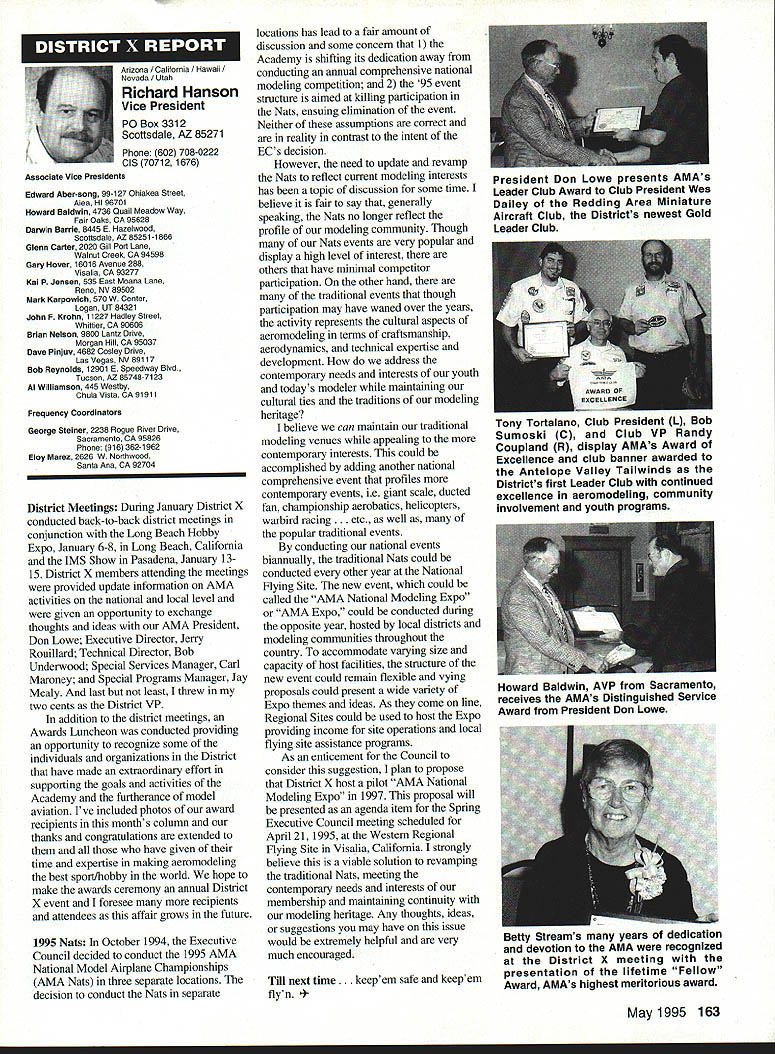
The January Executive Council meeting introduced three newly elected Council members: John Grigg (District II VP), Charlie Bauer (District VI VP), and George Aldrich (District VIII VP). Retiring VPs Gene Hempel and Jim Sears attended and were presented Meritorious Service Awards. Gene Hempel continues to serve on the Safety Committee; Jim Sears remains active as a District Associate VP. Ex-District II VP Joe Beeshar was unable to attend due to a last-minute business trip.
President Don Lowe and EVP Dave Brown gave brief reports. President Lowe thanked AMA's Special Interest Groups and welcomed SIG participation in administering this year's National Championships. EVP Brown reported that despite a slight membership downturn, revenue flows remain sound and Reston lease arrangements are producing benefits; current lessees appear likely to purchase the property.
Executive Director's report focused on membership changes: an overall 5% decline year-to-year, with new-member share declining from 19% (1991) to 15% (1994).
NAA Report: Lance Zellers reported NAA is without a President following Hal Gross's retirement; CEO Jack Cole is managing operations.
PADCOM: Committee Chairman Bob Brown presented a revised plan for the next stage of development at the National Flying Site, preparing it to host the entire 1996 National Championships. Modifications include Stage Center — a multipurpose flying site with cross runways to accommodate Pylon and Pattern flyers. The Council approved $420,000 in development costs for construction beginning in early spring, weather permitting.
Safety Committee: Consultant Lee Webster reported on AMA-sponsored tests of Pylon Racing safety cages and outlined the next testing phase, which will include the Unlimited Scale Racing Association and assess nylon netting as an added protective barrier for race-course workers.
Special Interest Groups: The Council approved SIG status for the National Electric Aircraft Council (NEAC). Applications from the Giant Scale Air Racing Association (GSARA) and the Unlimited Scale Racing Association (USRA) were referred back to the committee for further review.
Strategic Planning: Chairman Lance Zellers reviewed progress and won approval for continued funding; he indicated intent to step down as Committee Chair when a replacement is found.
Fund-raising: All fund-raising efforts will be coordinated through the Resource Development Committee, chaired by VP Rich Hanson. Development of the Muncie National Flying Site is the chief priority. Consultant Herbert Jones presented a comprehensive status report with detailed recommendations.
National Championships Committee: The Council approved identifying the Nats as a 5A contest classification with the Executive Council as the sole sanctioning authority. Headquarters was directed to research and recommend conditions under which Nats events might be canceled in the future.
AMA Open House: The annual Homecoming at the National Flying Site was refocused to attract young people to aviation and model aviation. This year's Open House will be held June 10-11 and will include the Experimental Aircraft Association's Young Eagles program, allowing youths to take a ride in a full-scale plane and follow up with hands-on modeling.
Legal Release for Giant Scale Events: A legal release for persons present in high-risk areas during giant scale air races was approved. The Council ratified that signing the release would not invalidate an individual's AMA liability coverage.
Membership Period Feasibility Study: The Council approved a study examining the feasibility of changing from a calendar-year membership renewal to a revolving anniversary-date system, focusing on problems for chartered clubs and potential options.
GPS Pilot Program: The Council suggested purchasing GPS navigation units for each District to precisely identify established flying sites. Purchase of a unit for District IV was approved as a pilot project under District VP Howard Crispin.
Awards and Adjournment: Three new Fellowship awards were approved. The meeting adjourned until the next quarterly meeting in Visalia, California, April 21-22.
Full minutes of the January Council meeting will be available after approval at the April meeting. Minutes for the November 1994 meeting are available from AMA Administration: phone (317) 287-1256, ext. 201 or 210; fax (317) 741-0057.
---
AMA News — Inside View (Museum & Headquarters)
The museum at Muncie provides a magnificent display of model aviation's history. It will only get better as we utilize all the floor space provided by the building when we raise funds to build and move Headquarters offices to their own building.
If you call Headquarters, remember to ask for the correct department (Competitions, etc.). The Muncie staff is intelligent, hard-working, and eager to help. Although only three staff came with the move from Reston, many are very "up to speed."
The Muncie property is impressive and gives a sense of pride in what the AMA membership has accomplished. By pooling dues, members have built the property and an organization that gives security for our avocation.
Please be patient with Headquarters while computer system updates are in progress. The staff is doing its very best with existing systems. Contact your District VP with opinions on pertinent matters; many VPs have lines and fax machines for member contact.
---
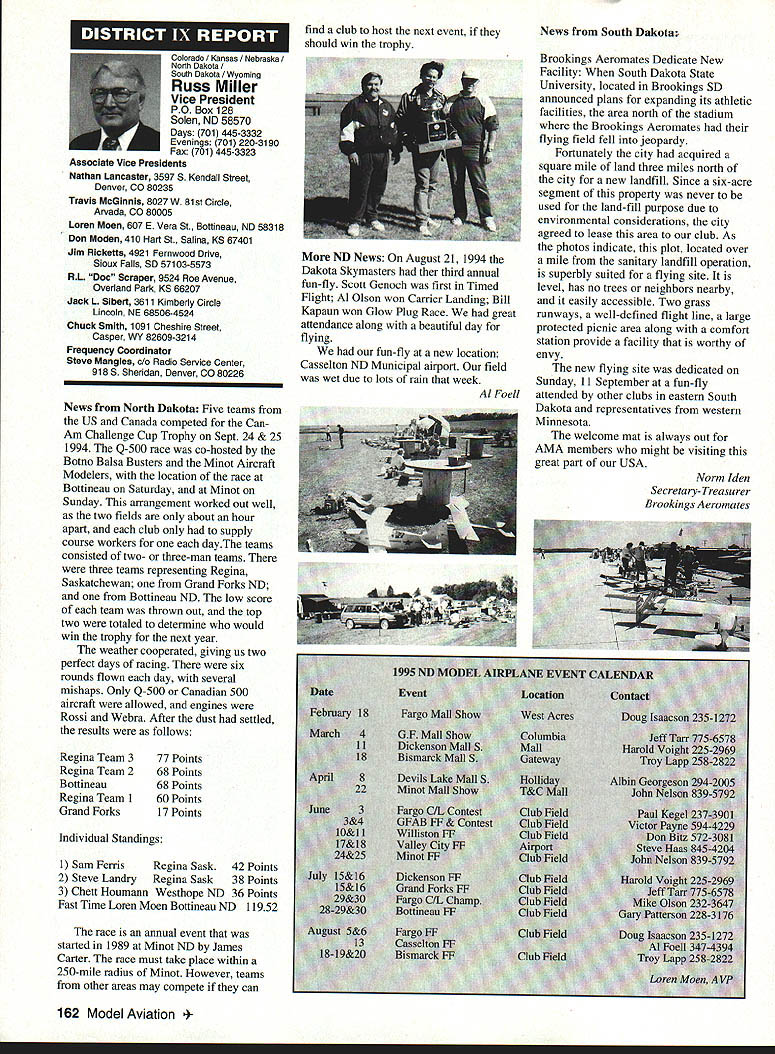
DISTRICT II REPORT
New Jersey / New York / Europe
John C. Grigg, Vice President 6387 Badger Dr., Lockport, NY 14094-5947 Eve: (716) 434-3955
Time flies. It seems like just yesterday I submitted the column for the April issue. My first month in office has been interesting and reminded me that being a district VP can be a rocky road.
We seem headed toward confrontation with clubs not part of the AMA family. Two independent clubs in District II have set up flying fields within radio-interference range of long-existing AMA fields. We must do something before this gets out of hand. AMA has taken a pacifist stance in recent years; we must find a way to negotiate with these clubs before a serious accident happens.
Symposium: I recently attended the Central New York Association Symposium — attendance exceeded 3,000 and the display models showed increasing workmanship and quantity. I'll publish next year's date as soon as practical.
Nostalgia: Watch the competition section for a Nostalgia RC Old Timer event to be held in late spring or early summer by Bob Noll, probably at the Sayre, PA site. This category is growing in popularity. Easy-Built Models, a displaced Canadian outfit now in District II, is kitting a nostalgia control-line kit of the dMECO All-American Sr. I have a pre-production kit and will include a picture and brief write-up as building progresses.
Executive Council — January 1995: Attending the EC meeting as VP rather than President was unusual. PADCOM garnered the greatest interest; this is where most monies and visibility will be focused. PADCOM may soon be involved in an attempt to gain control of the Galeville, NY site for exclusive modeler use. No guarantees, but we will try.
The Executive Council is spending dollars and energy to develop better safety standards and equipment; research results look positive. Strategic planning occupies much meeting time; success will require membership input and possibly direct involvement.
Fund-raising concerns me: I recognize the need for additional dollars but question why the same people become targets of campaigns. We must find donors with disposable assets to assist our needs. Average members already contribute via dues, club dues, and site fees.
Photos this month include a younger-me with a Paragon sailplane and a 1994 picture of Hank Likes of New Jersey with what appears to be a Bird Dog liaison plane from WWII.
If you want publicity in the column for a special event, send data at least three months before the desired appearance date — that's about the lead time needed. Use the competition calendar for contests and reserve the district column for special events.
Time out — running long. More in the July issue. Two AVPs will take over next month. Until then, the runway is clear!
---
DISTRICT III REPORT
AMA Safety Code: As the new year starts, please read and understand the AMA Safety Code. Article 11 deals with alcohol use while flying. Please abide by the intent — save alcoholic beverages until after flying. Modeling is a relaxing, family sport; let's keep it that way.
Modelers' Reunion: Were you a modeler in the Clarksburg, West Virginia area during the '40s and '50s and a member of the VFW Model Aviation Club? Joe Williams and Don Ogren are planning a reunion. Write Don at 20 Hunt Hollow, Rochester, NY 14624 if interested.
NCFFA: The Executive Council formally recognized the National Competition Fun Fly Association as a Special Interest Group. If your club is hosting a fun-fly this year, consider incorporating NCFFA ideas. Guidelines (not dictates) are available from Dan Luchaco, 605 Stevenson St., Sayre, PA 18840.
Last fall, several District III fun-fliers entered the NCFFA National Championships in Indianapolis. Participants included Rod Maier, Jim Florio, Jeff Black, Steve Luchaco, Dan Luchaco, and Don Belfort.
Steel City Soarers: In Pittsburgh, the Steel City Soarers promote model aviation with an annual demonstration at Verners School in Verona, PA. The program includes a "History of Flight" video, static displays, and sixth-grade students flying their own Delta Darts.
KRC Electric Fly: For 15 years, the Keystone RC Club has produced the KRC Electric Fly. To celebrate, they're producing a video on Electric Fly and electric flight. Contact John Hickey, 1624 Maple Ave., Hatfield, PA 19440 for a copy.
---
AMA News — Past History, Scale, and Local Notices
Past History
Looking over old records shows where we came from in aeromodeling. Twenty years ago our news section was carried in American Aircraft Modeler (AAM) published by Potomac Publications. When that company folded, the Executive Council organized a commercial-type publication of about eighty pages — Model Aviation magazine — first mailed in May 1975. The magazine and its contents have grown and changed considerably since then.
Scale
If you're into Scale building and flying, there is a lot of scale material around this District. A good camera, some travel time, and a bit of effort can yield documentation and ideas. Full-scale fly-ins often include participation from local AMA clubs and can be excellent sources of reference photos and paint-scheme ideas.
Two recent full-scale aircraft of note:
- A WACO VKS-7 owned by Dennis Harbin of Charlottesville, VA — hangared at Gordonsville Airport. Mr. Harbin noted his father built a giant model of this aircraft.
- A four-place Taylorcraft owned by Dick Hauser, hangared at Warrenton in Northern Virginia. He is a member of the Virginia Air Show Squadron and a longtime member of the Northern Virginia Radio Control Club.
Gone Flying
The Fredericksburg Aeromasters MAC lost two dedicated members this past week: Dave Hancock (Secretary Emeritus) passed away on February 3, and Charles Rector, longtime editor of "Talespins," also passed away. They will be sorely missed.
Last Chance for Hall of Fame Nominations
Deadline for AMA Hall of Fame nominations is March 31. If you know someone who positively impacted aeromodeling, contact Mary Lou Vojslavek at AMA Headquarters for a nomination form.
---
AMA News — Local Highlights & Photos
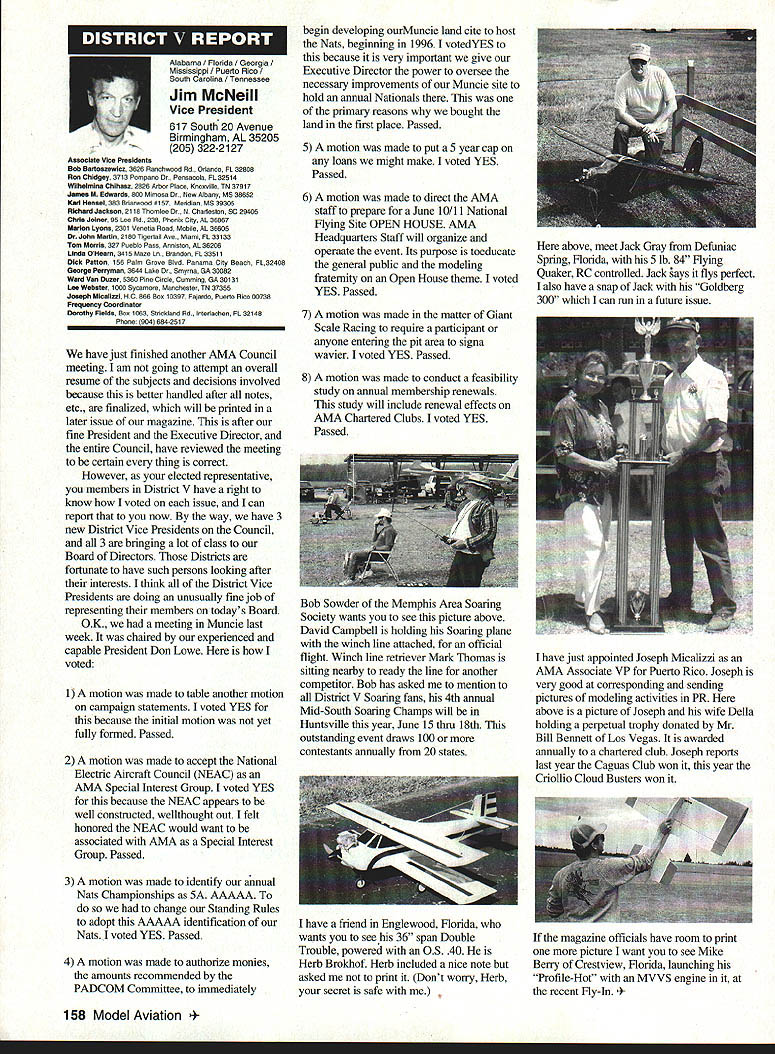
- Jack Gray of Defuniak Springs, FL, with his 5 lb., 84" Flying Quaker (R/C controlled). Jack reports it flies perfectly.
- Bob Sowder of the Memphis Area Soaring Society shared a photo of David Campbell preparing for an official winch-launched soaring flight. The 4th annual Mid-South Soaring Champs will be in Huntsville June 15–18 and draws 100+ contestants from 20 states.
- Herb Brokhoff (Englewood, FL) sent a photo of his 36" span Double Trouble powered with an O.S. .40.
- Joseph Micalizzi was appointed AMA Associate VIP for Puerto Rico and reports on club activities there; pictured with his wife Della holding a perpetual trophy donated by Bill Bennett of Las Vegas.
- Mike Berry of Crestview, FL, launching his "Profile-Hot" with an MVVS engine at a recent fly-in.
---
DISTRICT VI REPORT
Things are happening in District VI.
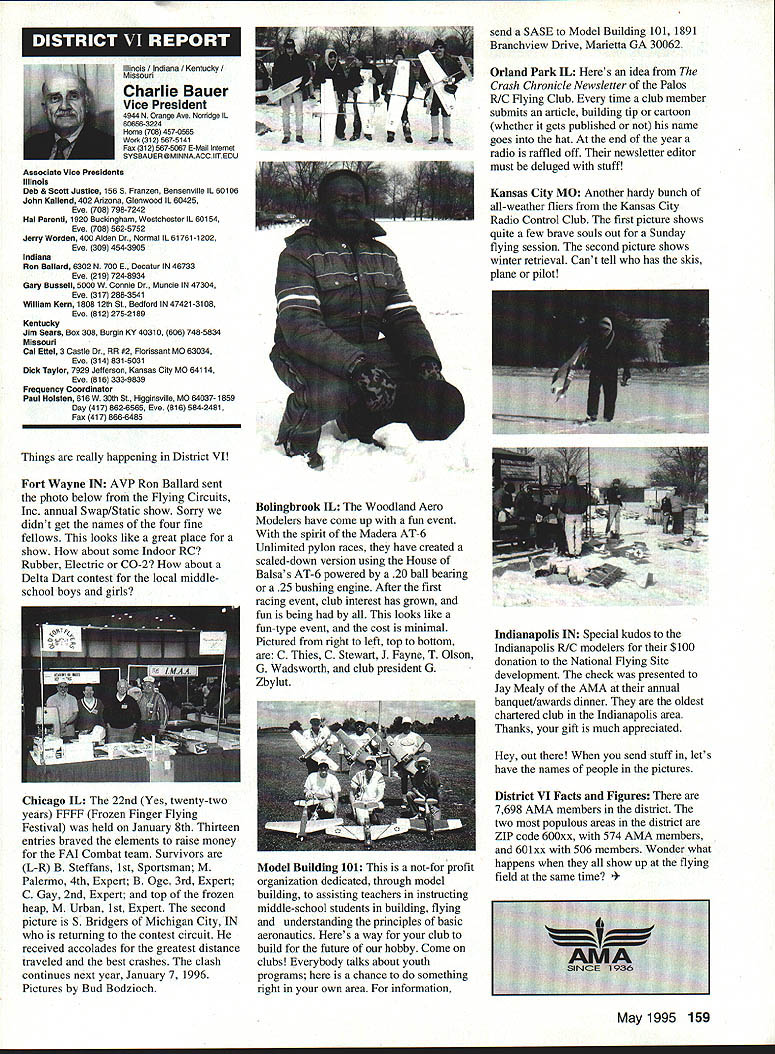
Fort Wayne, IN: AVP Ron Ballard sent photos from the Flying Circuits, Inc. annual Swap/Static show — a great place for a show. Consider indoor RC events (rubber, electric, CO-2) or a Delta Dart contest for middle-schoolers.
Chicago, IL: The 22nd Frozen Finger Flying Festival (FFFF) was held January 8. Thirteen entries braved the elements to raise money for the FAI Combat team. Winners included B. Steffans (1st Sportsman) and M. Urban (1st Expert). The next contest is January 7, 1996.
Bolingbrook, IL: The Woodland Aero Modelers created a scaled-down version of AT-6 Unlimited pylon races using House of Balsa AT-6 models powered by a 20-ball-bearing or .25 bushing engine. Interest has grown after the first event.
Model Building 101: A not-for-profit organization dedicated to assisting teachers in instructing middle-school students in building, flying, and understanding basic aeronautics. For information, send an SASE to Model Building 101, 1891 Branchview Drive, Marietta, GA 30062.
Orland Park, IL: The Palos R/C Flying Club's newsletter runs a membership promotion: each time a club member submits an article, building tip, or cartoon (published or not), their name goes into a hat; a radio is raffled at year’s end.
Kansas City, MO: Photos show hardy all-weather fliers out for a Sunday flying session and winter retrieval.
Indianapolis, IN: The Indianapolis R/C modelers donated $100 to the National Flying Site development, presented to Jay Mealy at their annual banquet. They are the oldest chartered club in the Indianapolis area.
District VI Facts and Figures: 7,698 AMA members in the district. The two most populous ZIP code areas are 600xx (574 members) and 601xx (506 members).
---
DISTRICT VII REPORT
Iowa / Michigan / Minnesota / Wisconsin
Peter Waters, Vice President 7420 7 Mile Rd., Northville, MI 48167 Phone: (810) 486-1800 | Fax: (810) 486-1603
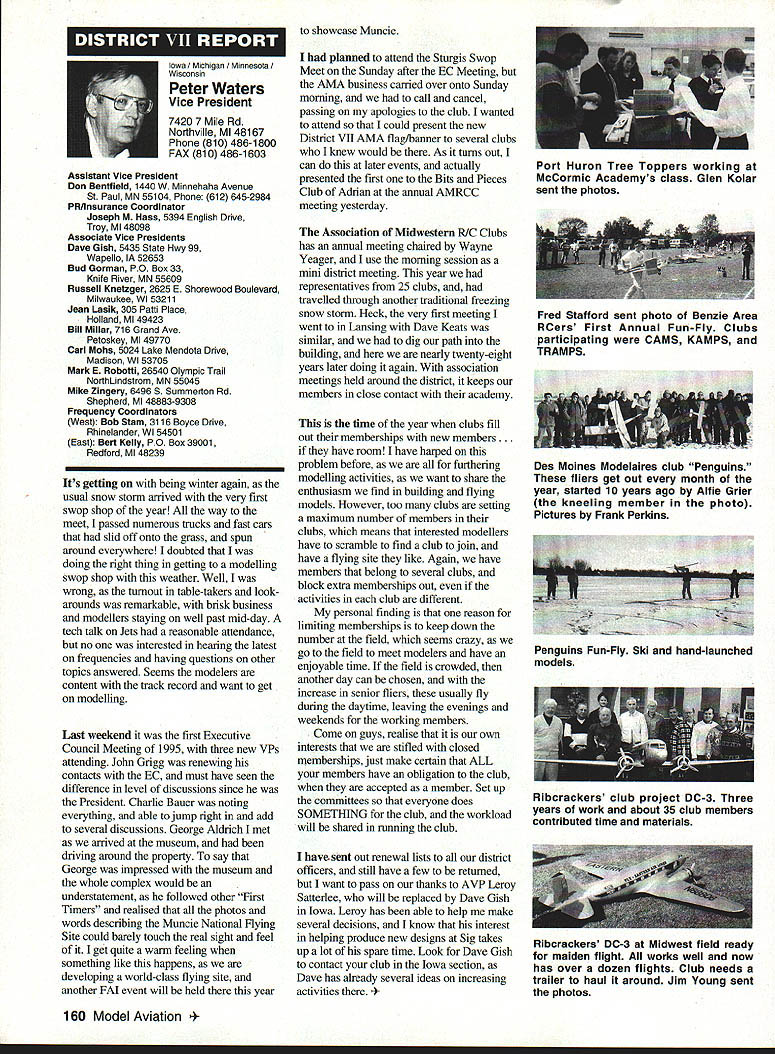
Winter came in full force, yet swap shop turnout was remarkable with brisk business. A tech talk on jets had reasonable attendance.
The January Executive Council meeting was attended by three new VPs: John Grigg, Charlie Baur, and George Aldrich. The museum and Muncie National Flying Site impressed first-time visitors; developments there will support a world-class flying site and FAI events.
I planned to attend the Sturgis Swap Meet but had to cancel due to continuing AMA business. I presented the first District VII AMA flag/banner to the Bits and Pieces Club of Adrian.
The Association of Midwestern R/C Clubs annual meeting serves as a mini district meeting; this year representatives from 25 clubs attended.
Clubs are filling memberships for the year. Some clubs set maximum membership numbers — this can stifle growth and make it hard for interested modellers to find a club. Clubs should consider committees and shared obligations to distribute workload and allow more members.
I’ve sent renewal lists to district officers; thanks to A-VP Leroy Satterlee, who will be replaced by Dave Gish in Iowa. Look for Dave to contact clubs in the Iowa section with new ideas.
---
DISTRICT VIII REPORT
Now let me tell you about the people who work at Headquarters in Muncie. We have all seen employees who work only for a paycheck, but I have never met a single person in our Muncie facility that fits that description. The strongest feeling I had returning home was one of pride in the people. If you call Headquarters, speak to them with respect — they go out of their way to give something extra to their jobs.
The museum is worth a trip to Muncie; it draws you into the marvelous world of modeling history. The Muncie property itself is impressive and gives a sense of achievement. By pooling resources, members have built the property and an organization that provides security for our avocation.
Council actions authorized further development of the Muncie site to make a unified Nationals possible in 1996. Updating computer systems is also a high priority and work is in progress. Please be patient with Headquarters operations — they are doing their best with an outdated system.
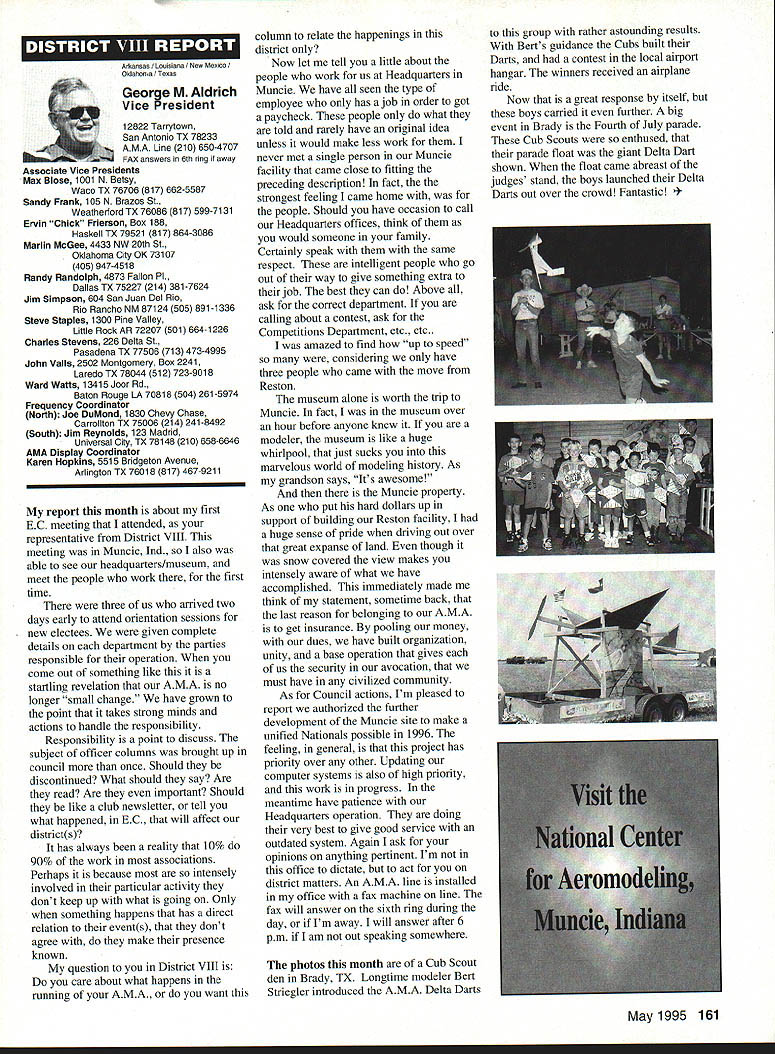
The photos this month show a Cub Scout den in Brady, TX. Longtime modeler Bert Striegler introduced the AMA Delta Darts to the group; Cubs built Darts and held a contest in the local airport hangar. Winners received airplane rides. The boys even carried the enthusiasm to a Fourth of July parade, launching Delta Darts from their float.
---
AMA News — Nats & Expo Proposal
A decision to conduct the Nats in separate locations has led to discussion and concern that the Academy is shifting away from an annual comprehensive national modeling competition and that the '95 event structure might reduce participation. Neither assumption reflects the intent of the Executive Council.
The Nats need updating to reflect current modeling interests. Some events remain popular while others have minimal participation. The challenge is to address contemporary interests (giant scale, ducted fan, championship aerobatics, helicopters, warbird racing, etc.) while maintaining the cultural aspects of aeromodeling.
Proposal:
- Maintain traditional Nats venues while adding another national comprehensive event that profiles contemporary events.
- Conduct national events biannually: the traditional Nats at the National Flying Site every other year; an "AMA National Modeling Expo" (or "AMA Expo") in the alternate years, hosted by local districts and modeling communities.
- Keep the Expo flexible to accommodate varying host capacities and themes; regional sites could host the Expo and provide income for site operations and local flying-site assistance programs.
I plan to propose District X host a pilot "AMA National Modeling Expo" in 1997 as an agenda item for the Spring Executive Council meeting on April 21, 1995, at the Western Regional Flying Site in Visalia, California. Input and suggestions are encouraged.
Till next time — keep 'em safe and keep 'em flyin'.
Transcribed from original scans by AI. Minor OCR errors may remain.

