
Sound & Model Aeronautics
Howard Crispin, Jr.
BACKGROUND Last month you were presented with some results of an Air Force study. This was done so that further portions of the study might not be interpreted incorrectly. Bits and pieces can be presented so long as they stand alone; their contribution to the total is often another matter. The generation and transmission of sound energy is a complex subject. Often the complexities have relatively little effect on the total, yet many small factors, when summed, may become significant.
The study was initiated some years ago and concerned the possibilities of providing the military with very quiet remotely piloted strike or reconnaissance aircraft — aircraft that could approach a target area with very low detectability. That same need is what we should aim for with model aircraft. The study was also based on engines in the range of our "giant" models, a fast-growing segment of the sport.
The study observed that the design of a quiet aircraft, from the aural detectability standpoint, requires consideration of three important aspects: the source (aircraft), the path (atmosphere and ground attenuation), and the receiver (ground observer). The purpose was to reduce aural detectability for two types of 5 HP engines considered. The method was to reduce the intensity and alter the radiation pattern of the noise generated by the engines — the same factors we need to consider for model aircraft.
Some basic facts:
- Relation between sound pressure and sound power level: the mean-square acoustic pressure at a location from a sound source is proportional to the acoustic power emitted by the source; the mean-square pressure varies inversely as the square of the distance from the source.
- Directivity: many sound sources radiate more strongly in some directions than others. For high-frequency sound, pressure in front of a speaker or mouth can be roughly ten times greater than in the opposite direction. Low-frequency sound tends to radiate more uniformly. The directivity factor describes how directional a source is.
Aircraft and Detection
Several factors determine the aural detectability of noise generated by an aircraft:
- The intensity and radiation pattern of the noise generated by the aircraft.
- The spectrum and time character of the generated noise.
- The distance separating the source and the receiver.
- Atmospheric absorption.
- Refraction and scattering effects due to wind velocity, temperature gradients, and turbulence.
- Attenuation due to terrain absorption.
- Background noise present in the receiver's environment.
- Sensitivity of the receiver (observer).
- Items 1 and 2 are associated with the aircraft noise source.
- Items 3 through 6 are associated with the transmission path.
- Items 7 and 8 are associated with the receiver.
Space limits what can be presented in this series. Next: criteria and the relative effects of these factors as they relate directly to model aircraft, followed by tests and results.
---
President's Corner
Don Lowe 902 Little Bend Rd., Altamonte Springs, FL 32714
Aeromodeling is fun. Sometimes in this office I lose sight of that fact as I get caught up in the AMA business — a lot of which isn't much fun — and forget the reason for it all. Our goal is to promote model aviation and to help aeromodelers get more enjoyment from the hobby. Modeling is something we do because it gives us pleasure.
Clara and I were privileged to attend the Thirteenth Annual Joe Nall Fly-In in Greenville, SC, hosted by Pat Hartness and the Confederate Air Force. Pat's estate is an outstanding facility for fliers: private airstrip, vintage aircraft, lakes, nature trails, a large hangar-workshop and ample camping. This year's entry exceeded 460 fliers with hundreds of large models of every description. Because of the size, the organizers limit the crowd to AMA members, family and friends, yet thousands of spectators still enjoy the event.
Pat makes his facility available to modelers and continually improves it. His model shop and hangar are at our disposal. At the flightline I had a model inspected by a fellow (sorry, I didn't catch his name) who then insisted on walking back to the hangar to inspect my second model so I could proceed to fly — a perfect example of the hospitality at Joe Nall. Saturday night's barbecue was limited to 850 diners this year — great food and music rounded out the event. If you haven't attended Joe Nall, you're missing a treat.
Personally, I still enjoy sport flying, fly-ins, evaluating and experimenting with new aircraft and products. Currently I'm flying Precision Aviation's IAC One-Design and a DiGicon-equipped model. From the DiGicon downlink I learned my Davis Arco has a top speed of 90 mph, stall speed of 20 mph, approach speed of 30–35 mph, and full-prop rpm of 7,500. Airspeed readout on transmitters would save many "I ain't got it" calls and approach crashes. Also, as predicted, stall speed in a 60-degree bank is roughly twice the level-flight stall speed.
On instruction: responses to my column two months ago split into three camps — those who have sent "best" instruction methods to AMA and received little response; those who favor a standardized method of instruction; and those who think they are already doing a good job and want AMA to stay out of it. I respect all views. Clubs have many dedicated instructors; we should reward and encourage them. A standardized format could increase efficiency, but we must also consider where new pilots will fly — many sites are already crowded.
About the annual audit printed last month: a formatting issue made the museum patronage fund appear different than it actually is. The "museum patronage fund" figure included only donations from the museum cup, not the museum patrons program. The Museum Patron program number in revenue was net of expenses, so the museum expenses line appeared as zero. You can't tell much about museum finances from the audit as presented; I apologize and will try to correct the format next time.
Till next month.
---
Executive Director's View from HQ
Jerry Rouillard AMA Executive Director 5151 E. Memorial Dr., Muncie, IN 47302
This month we go inside Model Aviation magazine as part of a continuing series introducing you to departments at Headquarters.
Model Aviation has existed in its present form since 1975 and remains the Academy's single most important communication tool. It balances objective coverage of all aeromodeling disciplines — Radio Control, Free Flight, and Control Line — with timely association information.
The magazine staff:
- Rob Kurek, Publications Manager — oversees production, editorial, advertising, administration and distribution. Rob's background is in journalism and publications management.
- Jim Haught, Managing Editor — an AMA member since age five, Jim edits articles and columns, assists with editorial planning, writes a monthly column and reports on modeling activities.
- Judy Hollandsworth, Production Manager — has been with the Academy over a decade. Judy oversees production from layouts to press time and supervises three graphic designers.
- Matthew Usher, Editor — a modeler with publishing experience, assists with editing, reporting, writing and photography.
On average, Jim and Matthew edit two construction articles, nearly 30 regular columns, five feature articles and several miscellaneous items each month.
Graphic designers:
- Carla Kunz — veteran communications experience.
- Bill Thornbro — Ball State graduate and Muncie native.
- Heather Erdahl — recent Ball State graduate, joined AMA via local temporary agency.
Administrative Assistant April Hathaway handles numerous tasks to keep editorial, production and administration running; she's often the voice you hear when contacting the magazine.
Supporting staff:
- Shirley Cook — magazine account executive; handles billing for advertising and hobby shop accounts, maintains subscriptions and delinquent-account reports.
- Sue Schrock (Hobby Advertising, Inc.) — advertising representative based in Harrisburg, VA; has sold advertising for nearly a decade.
Model Aviation should reflect who we are. The staff works monthly to create a magazine modelers will read and enjoy and encourages reader feedback.
---
AMA News — Inside View, Headquarters
Academy of Model Aeronautics 5151 East Memorial Drive, Muncie, IN 47302
Background
Last month I presented some results of an Air Force study. Further portions might be misinterpreted if taken out of context. The generation and transmission of sound energy is complex, and individual pieces often don't reflect the total effect. The study concerned the development of very quiet remotely piloted strike/reconnaissance aircraft — aircraft that could approach targets with low detectability. The findings are pertinent to model aircraft, particularly giant models, because the design considerations to reduce noise intensity and change the radiation pattern are the same.
Key facts:
- Mean-square acoustic pressure at a location is proportional to the acoustic power emitted by the source; it varies inversely as the square of the distance from the source.
- Directivity matters: high-frequency sound is more directional (forward direction may be ~10× more intense), while low-frequency sound is more uniform. The directivity factor quantifies a source's directionality.
Aircraft and Detection
Factors determining aural detectability of aircraft noise:
- Intensity and radiation pattern of the aircraft noise.
- Spectrum and temporal character of the noise.
- Distance between source and receiver.
- Atmospheric absorption.
- Refraction and scattering from wind, temperature gradients, and turbulence.
- Attenuation due to terrain absorption.
- Background noise at the receiver.
- Sensitivity of the receiver.
- Items 1–2: aircraft noise source.
- Items 3–6: transmission path.
- Items 7–8: receiver.
Space limits this series. Next: criteria and relative effects of these factors as they apply to model aircraft, followed by test results.
September 1995 Howard Crispin, Jr.
Local and Regional Notes
- Pennsylvania magazine: The May/June 1995 issue highlighted two progressive AMA chartered clubs — Tri-County WingSnappers (Fun-Fly) and Valley Forge Signal Seekers (five-year flying-site lease with Valley Forge National Park). Positive public articles like these benefit modeling activity throughout the state.
- KRC Electric Fly: Keystone R/C Club will host the premier electric event September 15–17, 1995 at Buc-Lee Aerosportsmen Field, Quakertown, PA. A Friday symposium (Sept. 15) features speakers including Keith Shaw, Bob Kopski and others. Contact Antonio Assetto, 639 Neshaminy Ave., Warrington, PA 18976; Tel: (215) 491-9419.
- Greater Cincinnati Radio Control Club: Stan Miller provided insights into the club's meeting activities and shared photos.
---
District IV Report
Howard Crispin Vice President 611 Beechwood Drive, Charlottesville, VA 22901
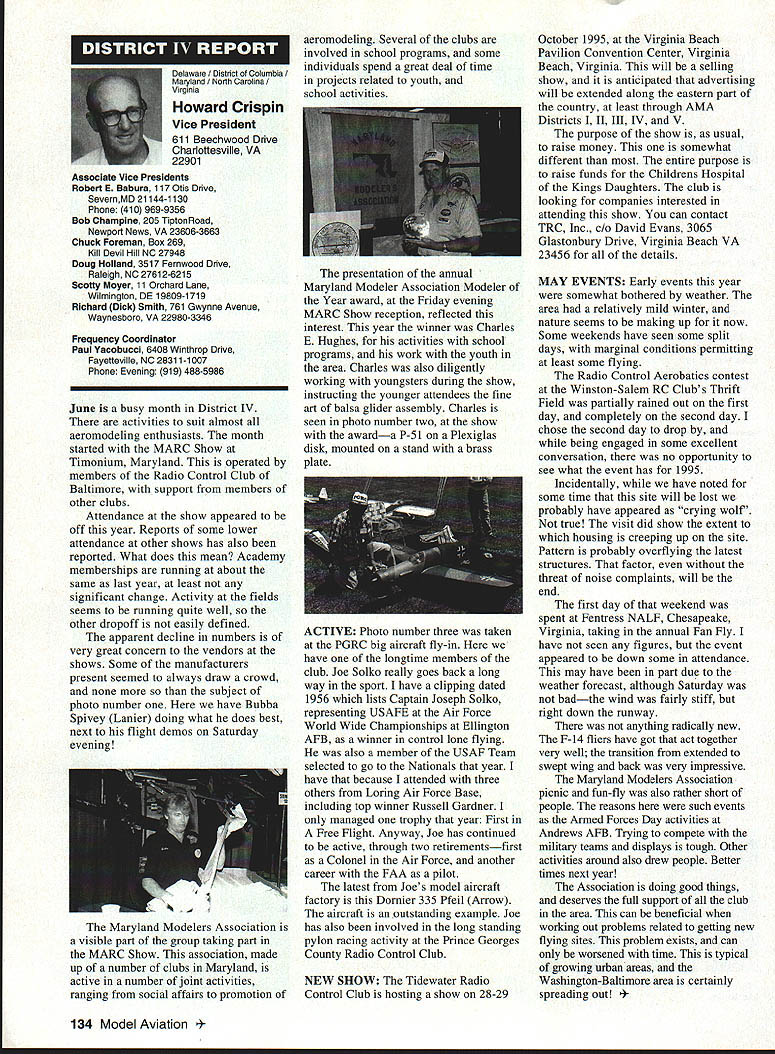
June is a busy month in District IV, with activities for nearly every aeromodeling interest. The MARC Show at Timonium, MD (Radio Control Club of Baltimore with support from other clubs) seemed down in attendance this year; similar drops have been reported at other shows. Academy memberships appear steady and field activity remains healthy, so the cause isn't clear. Vendors are concerned by lower show turnout.
At MARC, Bubba Spivey (Lanier) drew crowds with flight demos. The Maryland Modelers Association (a coalition of clubs) participates in joint activities, school programs and youth outreach. Charles E. Hughes received the Maryland Modelers Association Modeler of the Year award for his work with school programs and youth instruction.
At the PGRC big-aircraft fly-in, longtime member Joe Solko displayed a remarkable Dornier 335 Pfeil (Arrow). Joe has deep roots in the sport, including competition in the 1950s; he has been involved in nylon racing at Prince Georges County R/C Club.
NEW SHOW: Tidewater Radio Control Club will host a selling show October 28–29, 1995 at the Virginia Beach Pavilion Convention Center to raise funds for the Children's Hospital of the King's Daughters. Contact TRC, Inc., c/o David Evans, 3065 Glastonbury Drive, Virginia Beach, VA 23456 for details.
May events were weather-affected. The Radio Control Aerobatics contest at Winston-Salem RC Club's Thrift Field was rained out on the second day; site development and encroaching housing threaten future use. The annual Fan Fly at Fentress NALF, Chesapeake, VA, was down in attendance; highlights included F-14 demonstrations with wing sweep transitions. The Maryland Modelers Association picnic and fun-fly also saw lower turnout, partly due to competing Armed Forces Day activities at Andrews AFB.
The Association's work on school programs and site preservation is valuable and deserves full support as urban growth increasingly pressures flying sites.
---
District VI Report
Illinois / Indiana / Kentucky / Missouri Charlie Bauer, Vice President 4944 N. Orange Ave., Norwood, IL 60656-3024 Home: (708) 457-0565 • Work: (312) 567-5411 • FAX: (312) 567-5067 E-Mail: SYSBAUER@MINN.ACCT.EDU
Associate Vice Presidents:
- Illinois: Deb & Scott Justice, 156 S. Franzen, Bensenville, IL 60106; John Kallend, 402 Arizona, Glenwood, IL 60425, Eve. (708) 789-7242; Hal Parent, 1920 Buckingham, Westchester, IL 60154, Eve. (708) 562-5762; Jerry Worden, 400 Aiden Dr., Normal, IL 61761-1202, Eve. (309) 454-3905.
- Indiana: Ron Ballard, 6302 N. 700 E., Decatur, IN 46733, Eve. (219) 724-8934; Gary Bussell, 5000 W. Connie Dr., Muncie, IN 47304, Eve. (317) 288-3451; William Kern, 1808 12th St., Bedford, IN 47421-3108, Eve. (812) 275-2189.
- Kentucky: Jim Sears, Box 308, Burgin, KY 40310, (606) 748-5834.
- Missouri: Cal Eitel, 3 Castle Dr., RR #2, Florissant, MO 63034, Eve. (314) 831-5031; Dick Taylor, 7929 Jefferson, Kansas City, MO 64114, Eve. (816) 333-9893.
Frequency Coordinator:
- Paul Holsten, 616 W. 30th St., Higginsville, MO 64037-1659. Day (417) 662-6565, Eve. (816) 584-4281, Fax (417) 866-6485.
Club highlights:
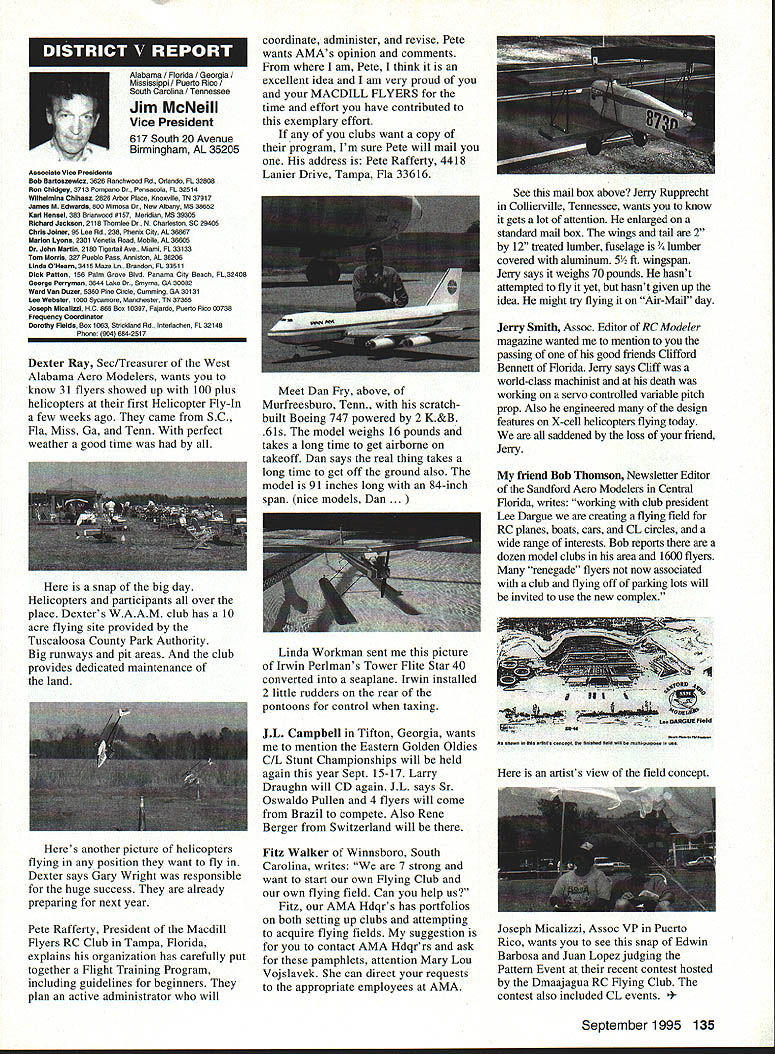
- Chicago, IL: Suburban Aeroclub of Chicago (SAC) sets aside two spring Sundays for new planes and new pilots only, allowing novices and test flights without regular traffic. They advertised in local hobby stores; result: 15 new planes flown and 11 new pilots, many of whom joined the club.
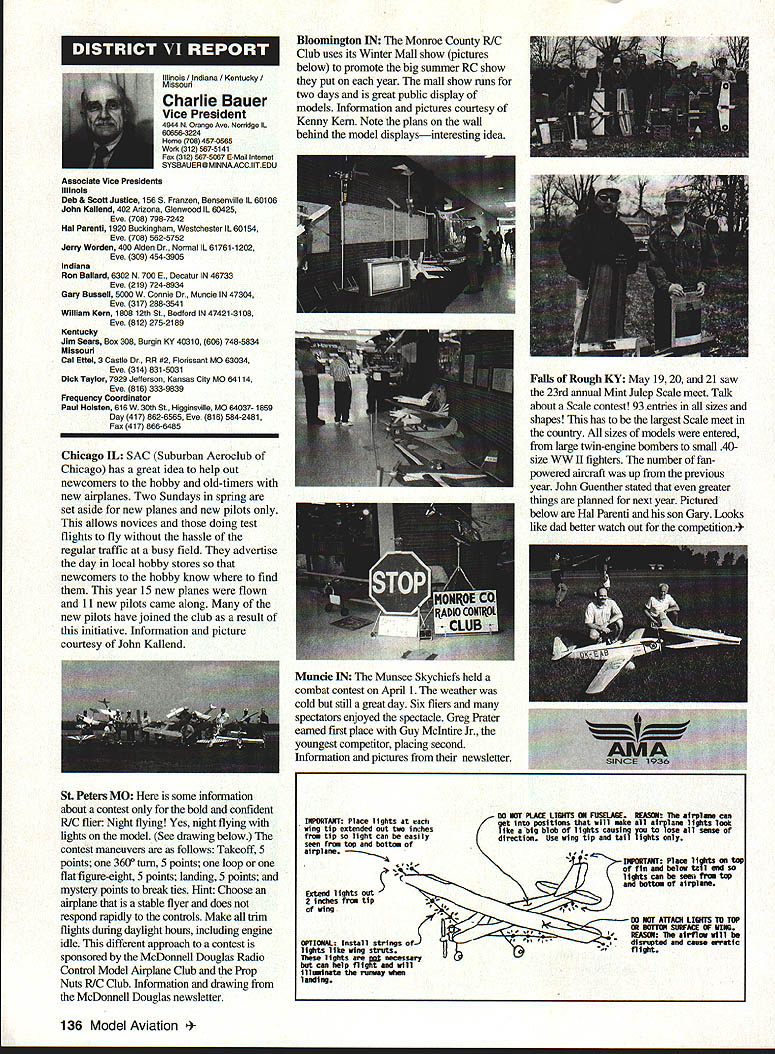
- St. Peters, MO: McDonnell Douglas Radio Control Model Airplane Club and the Prop Nuts R/C Club sponsor a night-flying contest with lights on models. Maneuvers include takeoff (5 pts), one 360° turn (5 pts), one loop or flat figure-eight (5 pts), landing (5 pts), plus mystery points for tie-breakers. Advice: choose a stable airplane and make all trimming flights in daylight.
- Bloomington, IN: Monroe County R/C Club uses a Winter Mall show to promote their summer R/C show; mall display runs two days and draws public interest.
- Muncie, IN: The Munsee Skychiefs held a combat contest April 1 with six fliers; Greg Prater won, Guy McIntire Jr. (youngest) placed second.
- Falls of Rough, KY: The 23rd annual Mint Julep Scale meet (May 19–21) drew 93 entries — possibly the largest scale meet in the country, from large twin-engine bombers to small .40-size WWII fighters. Fan-powered aircraft entries were up from the previous year.
---
District VII Report
Jean Lasik, Associate Vice President, District VII
MALL SHOWS — MODEL STATIC DISPLAY Mall shows are important to the success of modeling in Southwest Michigan. They introduce the hobby to the general public and can recruit new members.
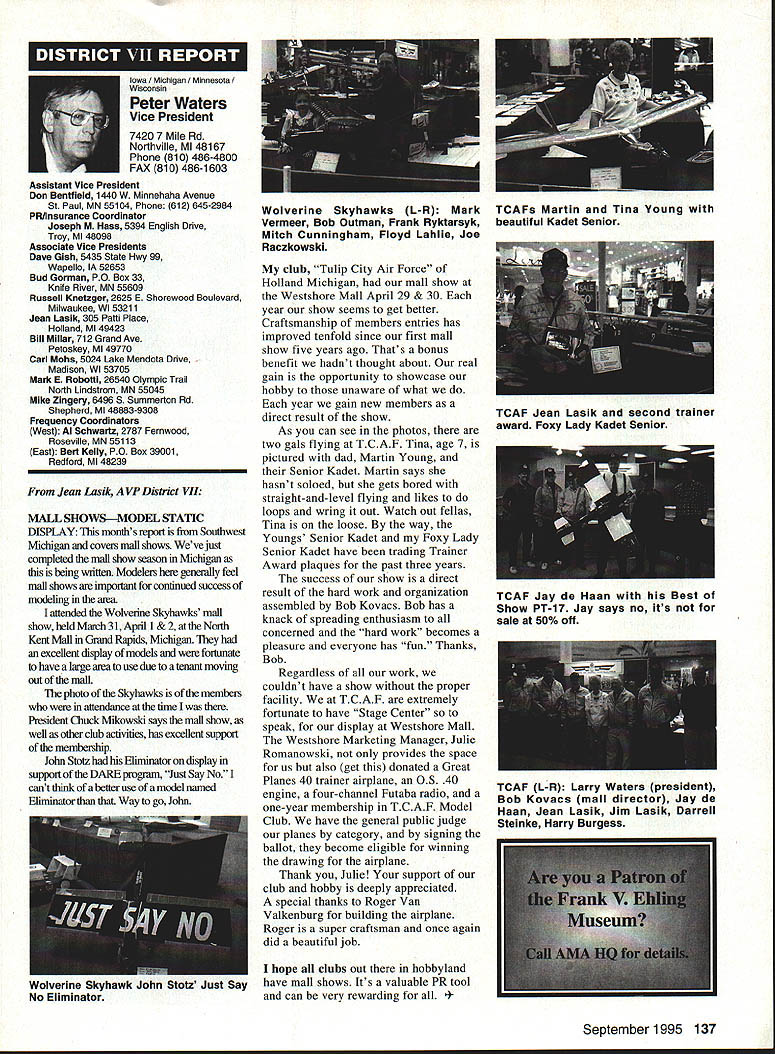
- Wolverine Skyhawks: Mall show held March 31–April 2 at North Kent Mall, Grand Rapids, MI. The club had an excellent display and strong membership support. John Stotz displayed his Eliminator in support of the DARE "Just Say No" program.
- Tulip City Air Force (Holland, MI): Mall show at Westshore Mall, April 29–30. Membership craftsmanship has improved greatly over five years. The club showcases the hobby and gains new members through the show. Young participants include Tina (age 7) flying with her father Martin Young on a Senior Kadet trainer; club members have been exchanging Trainer Award plaques for years.
Special recognition:
- Julie Romanowski, Westshore Marketing Manager, provided space for the display and donated a Great Planes .40 trainer, OS .40 engine, a four-channel Futaba radio, and a one-year T.C.A.F. membership for a raffle. Roger Van Valkenburg built the airplane donated for the raffle.
Mall shows are valuable PR tools — clubs are encouraged to hold them.
---
District VIII Report
Arkansas / Louisiana / New Mexico / Oklahoma / Texas George M. Aldrich, Vice President 12822 Tarrytown, San Antonio, TX 78233 A.M.A. Line: (210) 650-4707
Many members I speak with treat the AMA as if it were a foreign country. The AMA belongs to all of us. If you feel otherwise, please write and tell me why and how we can change things.
Model size and speed: discussions at an AMA/IMAA fly-in focused on how big and fast a model can be and still be called a model. The Executive Council (E.C.) must set reasonable safety guidelines so we can obtain insurance. If anyone can provide solid engineering data on this subject, please share it.
This October the E.C. will meet with contest board chairmen to smooth procedures and ensure the people who fly events help set the rules. Contact your contest board representative with suggestions.
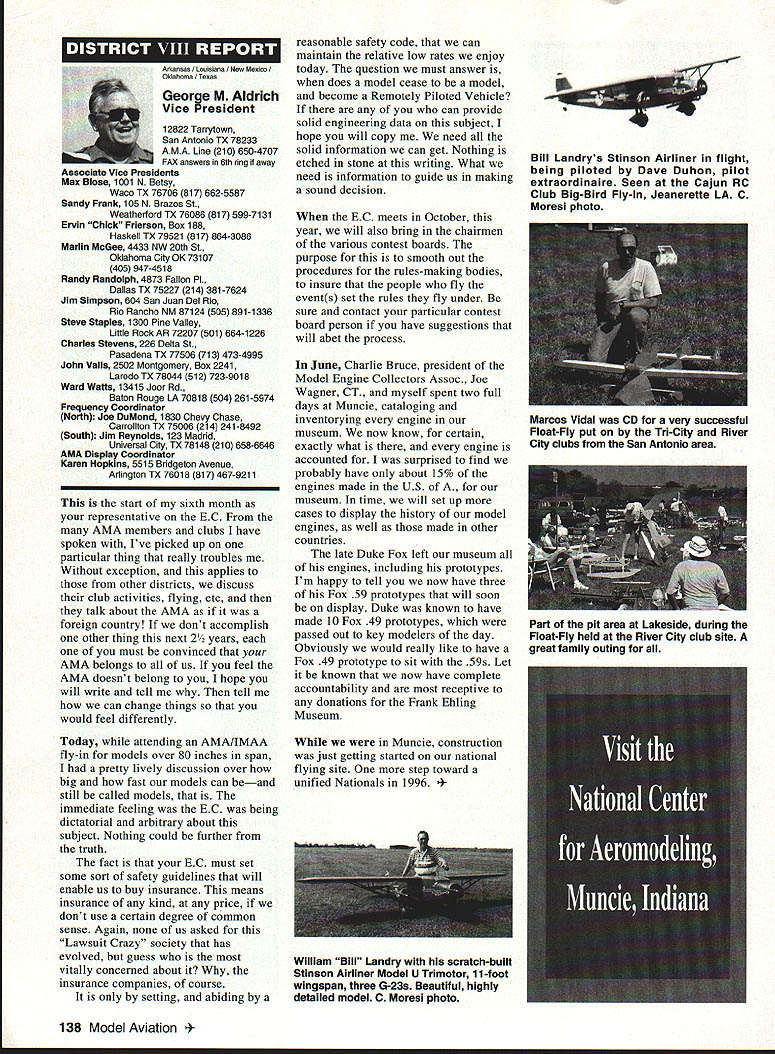
Museum inventory: In June, Charlie Bruce (Model Engine Collectors Assoc.), Joe Wagner (Conn.), and I cataloged every engine in our museum. Every engine is accounted for; currently we probably have only about 15% of engines made in the U.S. for the museum. We will set up more display cases to show the history of model engines worldwide.
Duke Fox legacy: The late Duke Fox left his engines, including prototypes, to the museum. We now have three Fox .59 prototypes on display. Duke reportedly made ten Fox .49 prototypes; we would welcome a Fox .49 prototype for display alongside the .59s. We now have complete accountability and welcome donations for the Frank Ehling Museum.
National flying site: construction had just started during our visit to Muncie — one more step toward a unified Nationals in 1996.
---
District X Report
Gene Lotgering, District X (excerpt)
Thanks to the many newsletter editors and clubs throughout District X who produce informative, educational and entertaining local newsletters. Having been a newsletter editor, I appreciate how demanding that job can be. Submitting newsletters to the district helps keep leadership informed of local issues.
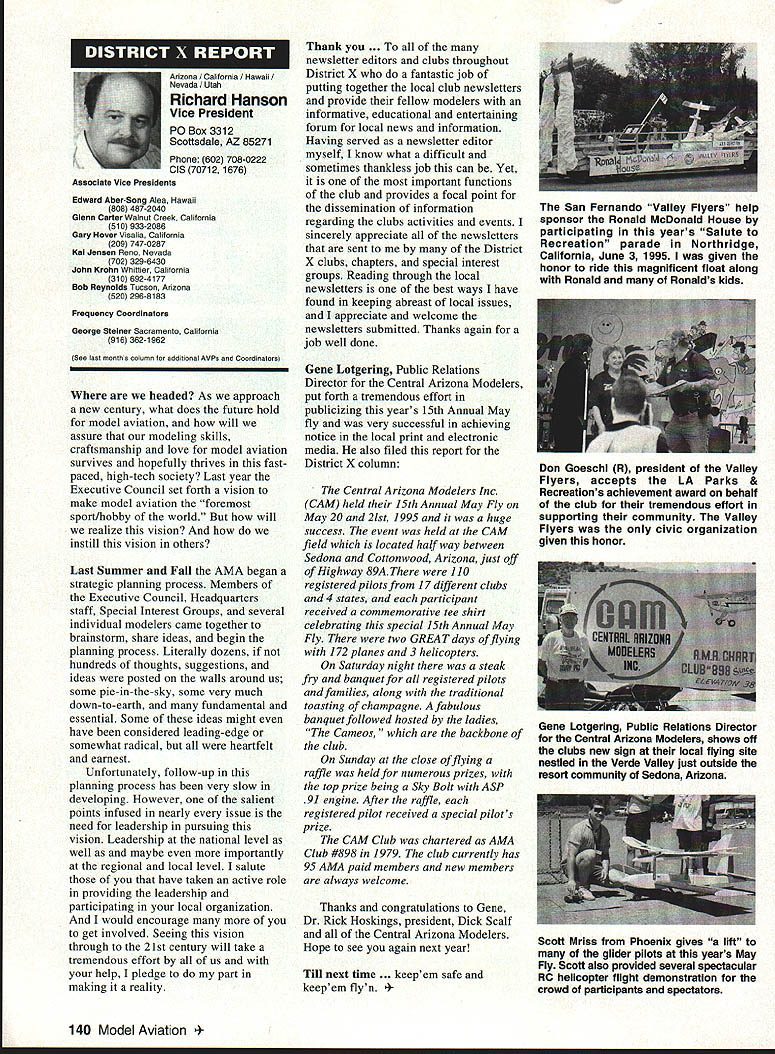
Central Arizona Modelers (CAM) — 15th Annual May Fly
- Held May 20–21, 1995 at the CAM field between Sedona and Cottonwood, AZ (off Highway 89A).
- 110 registered pilots from 17 clubs and 4 states; 172 planes and 3 helicopters flown.
- Saturday night steak fry and banquet for pilots and families; Sunday raffle with the top prize a Sky Bolt with ASP .91 engine; every registered pilot received a pilot's prize.
- CAM was chartered AMA Club #898 in 1979 and currently has 95 AMA-paid members. Thanks to Gene Lotgering, Dr. Rick Hoskings (president), Dick Scalf and all CAM volunteers.
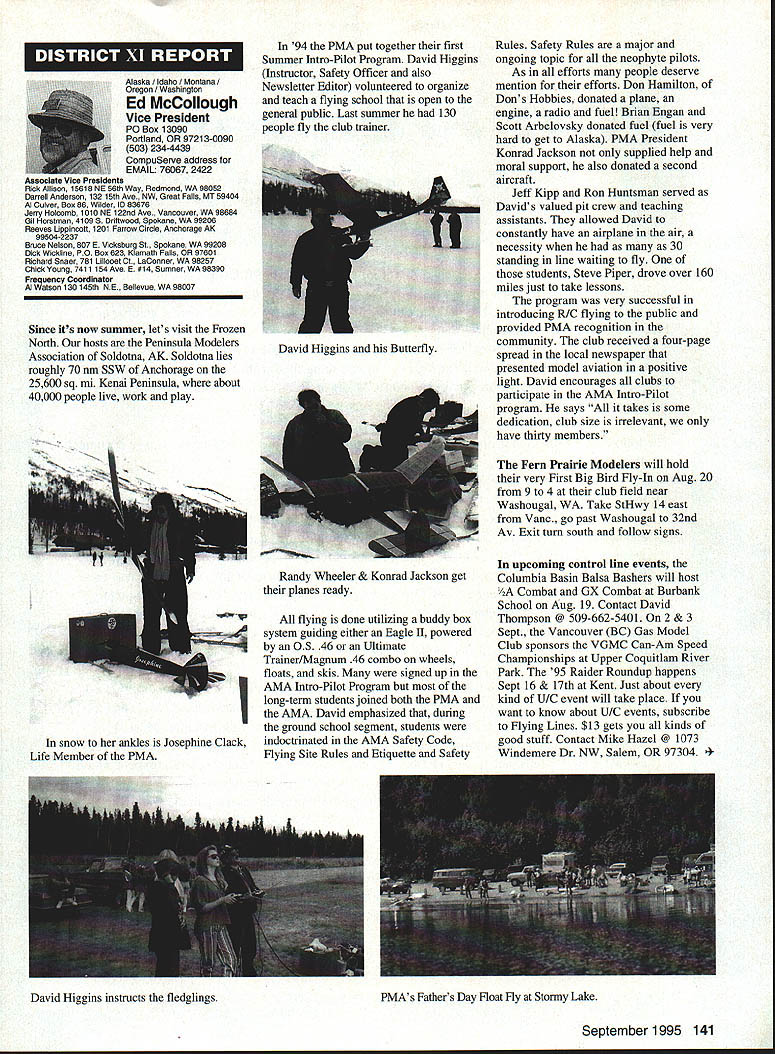
Peninsula Modelers Association (Soldotna, AK) — Intro-Pilot Program
- Soldotna is about 70 nm SSW of Anchorage on the Kenai Peninsula.
- In 1994 PMA organized a Summer Intro-Pilot Program. Instructor David Higgins taught a flying school open to the public; 130 people flew the club trainer last summer.
- The club uses a buddy-box system with Eagle II (OS .46) or Ultimate Trainer/Magnum .46 setups on wheels, floats and skis. Ground school covers the AMA Safety Code, flying site rules, etiquette and safety.
- Donations and support: Don Hamilton (Don's Hobbies) donated a plane, engine, radio and fuel; Brian Egan and Scott Arbelovsky donated fuel; PMA President Konrad Jackson donated a second aircraft. Jeff Kipp and Ron Huntsman assisted as pit crew and teaching assistants. The program generated a four-page spread in the local newspaper and successfully introduced R/C flying to the community. David urges all clubs to participate in the AMA Intro-Pilot program; dedication matters more than club size.
Other events:
- Fern Prairie Modelers: First Big Bird Fly-In on Aug. 20 (9–4) at club field near Washougal, WA. Directions: take SR Hwy 14 east from Vancouver, past Washougal to 32nd Ave. exit, turn south and follow signs.
- Control line events: Columbia Basin Balsa Bashers host 1/2A Combat and GX Combat at Burbank School on Aug. 19 (contact David Thompson, 509-662-5401). Sept. 2–3 the Vancouver (BC) Gas Model Club sponsors the VGMG Can-Am Speed Championships at Upper Coquitlam River Park. The '95 Raider Roundup is Sept. 16–17 at Kent. For U/C event listings, subscribe to Flying Lines (contact Mike Hazel, 1073 Windemere Dr. NW, Salem, OR 97304).
Till next time — keep 'em safe and keep 'em fly'n.
Transcribed from original scans by AI. Minor OCR errors may remain.

