

AMA News
Sound & Model Aeronautics
Howard Crispin, Jr.
The earlier columns dealing with the USAF study defined the various factors affecting the generation and transmission of sound. The next portion of the study relates the methods, and the problems, which face anyone attempting to make finite measurements relating to the transmission of sound.
This is especially a concern when we attempt to measure sounds accurately as generated by an aircraft in flight. Here we look at the concerns and solutions used in the USAF study and relate them to methods usable by those of us without sophisticated equipment and facilities.
A basic statement from the study: the problem of determining aural detection requires the measurement or estimation of the radiated noise associated with the aircraft. It is also desirable to identify the major contributing sources of the overall noise signature and to determine the effects of quieting techniques such as mufflers, shrouds, cowlings, and combinations of these.
Signature measurements are obtained from aircraft flyover tests or in special anechoic chambers. Flyover measurements present actual flight conditions but introduce problems such as reflections, wind and temperature gradients, differing paths for each measurement and configuration, and the fact that total acoustic power and directivity cannot be calculated directly from the measurements. Anechoic rooms provide a reflection-free area for acoustic measurements with negligible reflections and temperature gradients, but they lack proper airflow to simulate flight velocity, which affects noise generation and radiation.
The noise from the source can be measured in various directions to determine total acoustic power radiated. A major disadvantage of anechoic room measurements is the lack of proper airflow to simulate flight velocity, which affects noise generation and radiation.
Methods generally available to us and their effect on our approach: we have established a standardized goal of making all operations at a sound level no higher than 90 dBA, measured at nine feet from the engine over a hard surface. These standards were set to make readings consistent regardless of where taken, provided the instrument is reasonably in calibration.
We recognize that flight conditions may alter the actual figure when relating this to adjacent reception areas. Nevertheless, the 90 dBA at nine feet standard is the best practical benchmark available to most Academy members. More sophisticated equipment would refine our data, but the problem is obtaining sufficient support to provide facilities and equipment. Technical development and education are part of the Academy's bylaws but have not been primary in terms of application or funding; we tend to respond to critical needs.
Inflight measurement is the best way to proceed, but it requires equipment beyond what many have on hand. First, an airborne telemetry system is absolutely necessary to provide, at a minimum:
- Engine rpm
- Airspeed
- Altitude
We do not have as much problem with path, temperature, and reflectivity as the USAF does with RPV (Remotely Piloted Vehicle) research because we can take data at very low altitudes and obtain usable statistics. The critical need is availability of a pilot capable of holding a defined path and distance from the microphone used for sound measurement.
There was a telemetry system on display at Toledo that appeared to provide everything needed at a very reasonable cost. Unfortunately, it was being offered on illegal frequencies for telemetry—in fact, on our radio control frequencies—which could have been a disaster. Discussion later brought assurance the frequency would be changed to amateur (ham) frequencies. There was a mistaken thought that so long as a licensed amateur operated the system it would be legal for others to use; that is not the case. Nothing new yet, but a properly licensed system would be a welcome, readily available option.
Some work has been done using flyby operation, where the aircraft is flown along a defined line 50 feet from the microphone and at an altitude of 20 feet. Using an analyzer (third-octave bands, as an example) with an accumulate function provides very good flight data. Making the data complete, with more than just sound level, requires engine rpm and airspeed. Only then can we say which specific propellers and silencers will provide provable sound levels. We will publish procedures next time.
Add-On Muffler
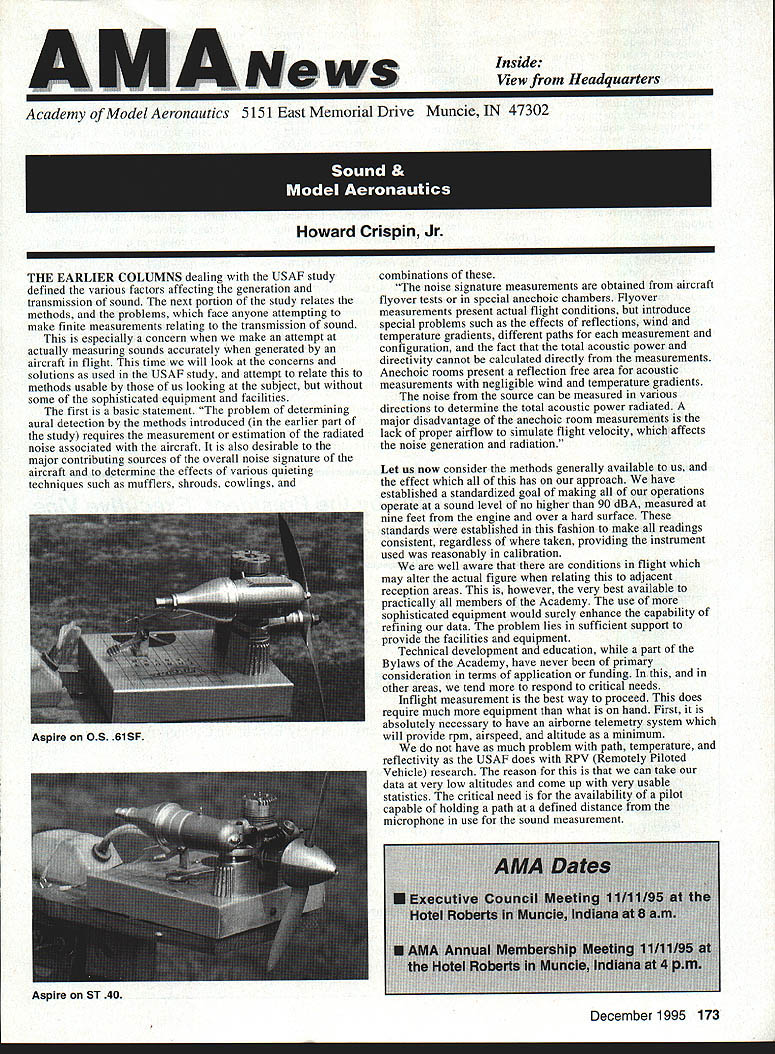
An attempt was made recently to get some running time, but high temperatures and humidity have made testing difficult. The field was set up early before it got excessively hot; the first run began with temperatures approaching 100°F. We ran an OS .61SF to accumulate octave-band analyzer data, but could not test a variety of propellers, so we do not have definitive figures yet. We hope cooler weather will improve testing conditions.
We tested the Aspire add-on unit from DuBro Products and found it impressive. Many previous add-on units that claim "one size fits all" often work fairly well on .40 engines but are restrictive and unsatisfactory on .60 engines; Aspire is different.
Key features of the Aspire unit:
- Well engineered with a series of steps providing a tight seal at the muffler and front-section attachment.
- Includes an attachment bolt and installation instructions.
- Contains two rings of neoprene inserts spaced around the central part of the unit; on a .61 engine, remove the inserts in the inner ring to alter back pressure.
- Designed to prevent loss of power and minimize temperature increase.
We have adjusted the volume of the add-on unit. Mounting it on a typical .40 muffler provides a greater percentage increase in total muffler capacity compared to mounting on a .61 muffler; the .40 muffler works quite well and the .61 should be better.
Readings taken on the analyzer showed the assembly generating 89.2 dBA at 12,750 rpm with an APC 12x7 propeller. A Simpson meter read about 5 dBA higher. Even with readings below 90 dBA, we feel confident we can run larger props and obtain substantially lower readings. The Aspire unit works; manufacturing and assembly are excellent. We may have trouble operating equipment reliably under 100°F—testing will need cooler air.
Transcribed from original scans by AI. Minor OCR errors may remain.

