
AMA News
Sound & Model Aeronautics
Howard Crispin, Jr.
MUFFLERS ON BIG BANGERS
Mufflers on big gas engines are always a subject for discussion. New items appear on the market, but relatively few are truly effective at reducing the sound levels of the larger engines. Propeller noise is also a major factor: propeller rotational speed generates noise — the faster the prop, the louder the noise. Selecting appropriate propellers and understanding rpm effects can help.
Some very good muffler installations have been seen at fly‑in events, but they rarely appear in publication because there are no drawings or instructions available. Two major problems in designing mufflers for big engines are the size of the unit and the shape of the muffler. Pattern models and most sport aircraft do not share the same level of difficulty: you can often bury a pipe in a pattern aircraft, and many sport models tolerate an external unit hanging in the slipstream. Scale models present a different challenge.
A large percentage of big models are scale replicas and face the long‑standing problem: where to place the muffler while retaining full‑scale appearance. Few modelers will, or can, fabricate a home‑built muffler, and there are very few mufflers that mount inside a cowling while preserving scale looks. No one wants a long tube and bulky can spoiling the lines of a sleek scale fuselage.
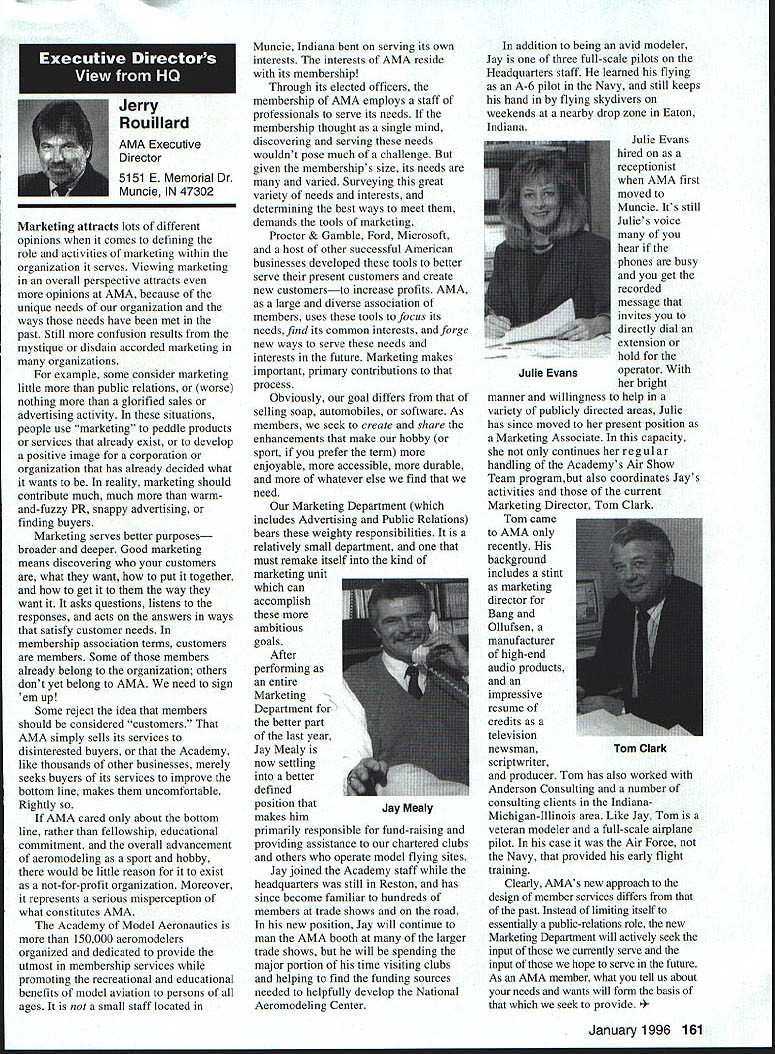
One successful solution was developed by Milt Peacock of the Westminster Aero Modelers (Maryland) for his quarter‑scale Ercoupe. The airplane is powered by a Zenoah G‑38, turning a Zinger 18 × 6/10 propeller. The engine is mounted on vibration isolators, and both the muffler and the isolation mounts were Milt's own fabrication. The system works well, particularly in flight where pilots often run reduced rpm for realism. It is typical of the approach needed to preserve true scale appearance.
Some basic design fundamentals applicable to model mufflers include cut‑and‑try methods unless you have access to a proven design. Key considerations include:
- Volume relative to engine displacement (first‑order consideration).
- Means of flow regulation.
- Shape and placement to retain scale appearance.
Theoretical concepts and data exist for application to model engines, but practical solutions vary. Several individuals are developing mufflers for large model engines, and marketable units suitable for scale enthusiasts are expected in the future.
---
President's Corner
By the President of the Academy of Model Aeronautics
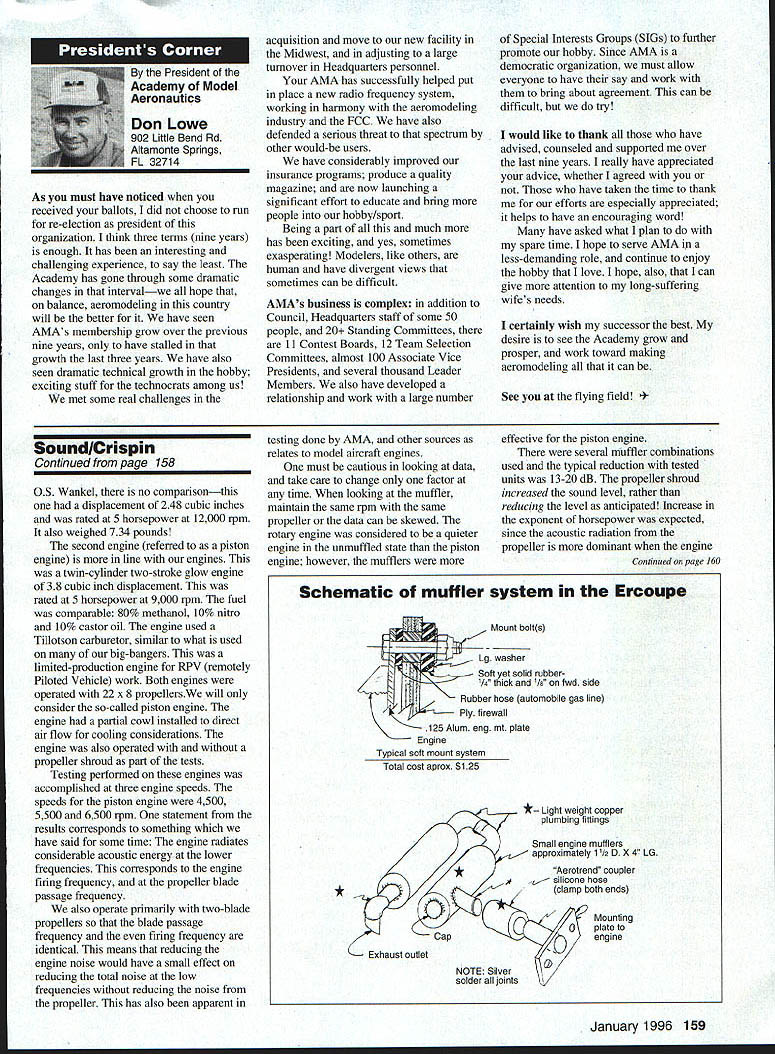
Don Lowe 902 Little Bend Rd. Altamonte Springs, FL 32714
As you may have noticed when you received your ballots, I chose not to run for re‑election as president of this organization. Three terms — nine years — is enough. It has been an interesting and challenging experience. The Academy has gone through dramatic changes in that interval, and we all hope aeromodeling in this country will be the better for it.
We saw AMA membership grow during my first six years, but growth stalled during the last three. There has been dramatic technical growth in the hobby — exciting developments for the technocrats among us. We faced real challenges: acquiring and moving to our new Midwest facility, and adjusting to significant turnover in Headquarters personnel.
AMA has successfully helped put in place a new radio frequency system working in harmony with the aeromodeling industry and the FCC, and we have defended that spectrum from other would‑be users. We have considerably improved our insurance programs, produce a quality magazine, and are launching significant efforts to educate and attract more people to the hobby and sport.
AMA's business is complex. In addition to Council and a Headquarters staff of about 50 people, we have more than 20 standing committees, 11 contest boards, 12 team selection committees, almost 100 associate vice presidents, several thousand leader members, and many special interest groups (SIGs). As a democratic organization we must allow everyone to have their say and work toward agreement — a sometimes difficult but necessary process.
I want to thank all who have advised, counseled, and supported me over the last nine years. I have appreciated your advice, whether I agreed with you or not. Those who took the time to thank me for our efforts were especially appreciated — encouragement helps a lot.
Many have asked what I plan to do with my spare time. I hope to serve AMA in a less‑demanding role and continue to enjoy the hobby I love. I also hope to give more attention to my long‑suffering wife's needs. I certainly wish my successor the best and want to see the Academy grow and prosper.
See you at the flying field!
Two club newsletters I received recently expressed very different views of our AMA, which I think are worth sharing.
From the Texas City R/C Newsletter: "The A.M.A. has said it will pick up the $250,000 not covered by insurance but this is only paid after the insured's household insurance amount is paid and then any other modeling organization has paid. (Whew! G.M.A.) A.M.A. tries every way in the world to keep from paying." I read this in total dismay. Many members carry homeowners insurance that affords coverage. Since AMA operates as a non‑profit, it makes sense to use all coverage available. If you have no other insurance, AMA coverage is primary.
From the BRRCC Flypaper (Baton Rouge R/C Club), Rick Whitlow tells of a personal accident and cites positive experience with AMA insurance: after personal insurance covered part of his bills he contacted AMA, and they sent forms and covered what his personal policy did not. That kind of help can be very welcome.
These two examples show how perceptions can differ. Your AMA is run by modelers for modelers. The Executive Council is its board of directors, and as a member, I am directly responsible to each of you.
---
Executive VP's Report
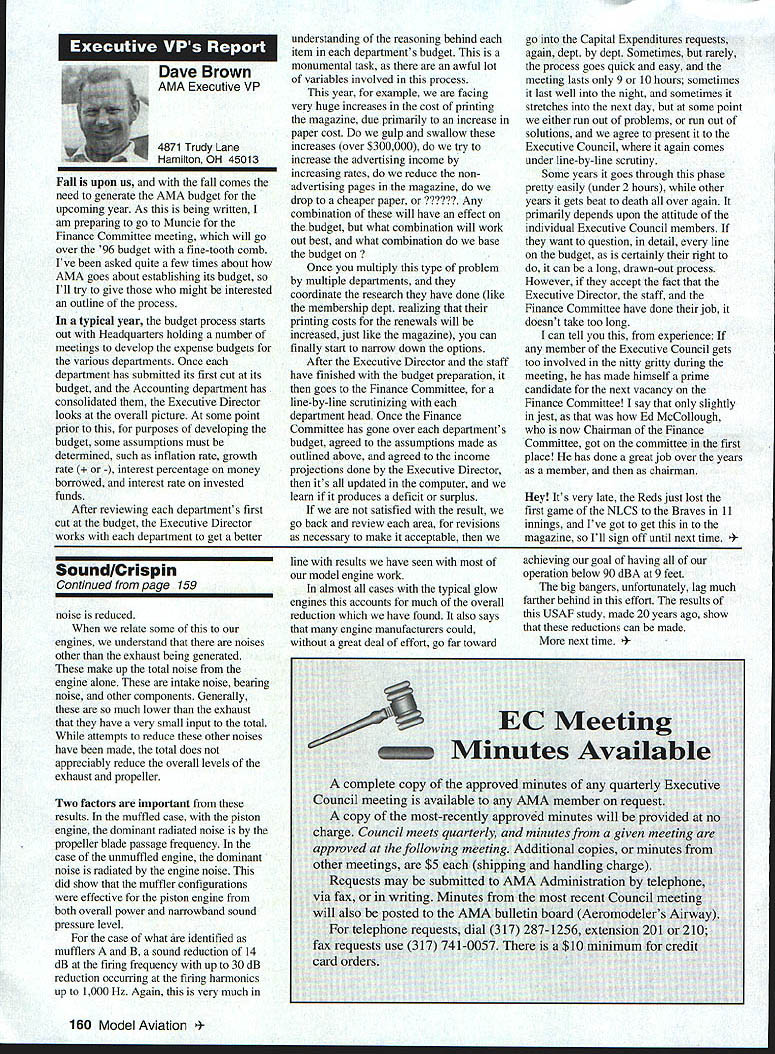
Dave Brown AMA Executive VP 4871 Trudy Lane Hamilton, OH 45013
Fall is upon us, and with fall comes the need to generate the AMA budget for the upcoming year. As I write this, I am preparing to go to Muncie for the Finance Committee meeting, where we will review the '96 budget in detail. I've been asked how AMA establishes its budget, so here is an outline of the process.
- Headquarters meetings: Departments develop expense budgets and submit initial drafts.
- Consolidation: Accounting consolidates departmental budgets and the Executive Director reviews the overall picture.
- Assumptions: For budgeting, assumptions must be set — inflation rate, expected growth, interest rates on borrowed and invested funds.
- Review and refinement: The Executive Director works with each department to understand and refine budget items.
- Finance Committee review: The committee performs a line‑by‑line review with each department head and agrees on assumptions and income projections.
- Revision: Budgets are updated in the computer to show deficit or surplus; revisions and capital expenditure requests are made as necessary.
- Executive Council review: The Executive Council examines the proposed budget, again line‑by‑line, and either approves it or requests further revision.
This is a monumental task due to the many variables. For example, this year we faced large increases in magazine printing costs, primarily from paper price increases (over $300,000). Options include absorbing the cost, raising advertising rates, reducing non‑advertising pages, switching to cheaper paper, or a combination of actions. Similar issues affect other departments (e.g., membership mailings).
If the Finance Committee and Executive Director are satisfied, the budget moves to the Executive Council. The time it takes there depends on how detailed individual council members want to be. If a council member digs into the minutiae, they become a prime candidate for the Finance Committee — as a bit of irony, that's how Ed McCollough became Finance Committee chairman. He has done a great job.
Sometimes the Finance Committee meeting is quick (9–10 hours); sometimes it runs late into the night or the next day. Regardless, the process aims to produce a budget that balances realistic assumptions with fiscal responsibility.
Hey — it's very late, the Reds just lost the first game of the NLCS to the Braves in 11 innings, and I've got to get this in to the magazine, so I'll sign off until next time.
---
Inside View
Headquarters Academy of Model Aeronautics 5151 East Memorial Drive Muncie, IN 47302
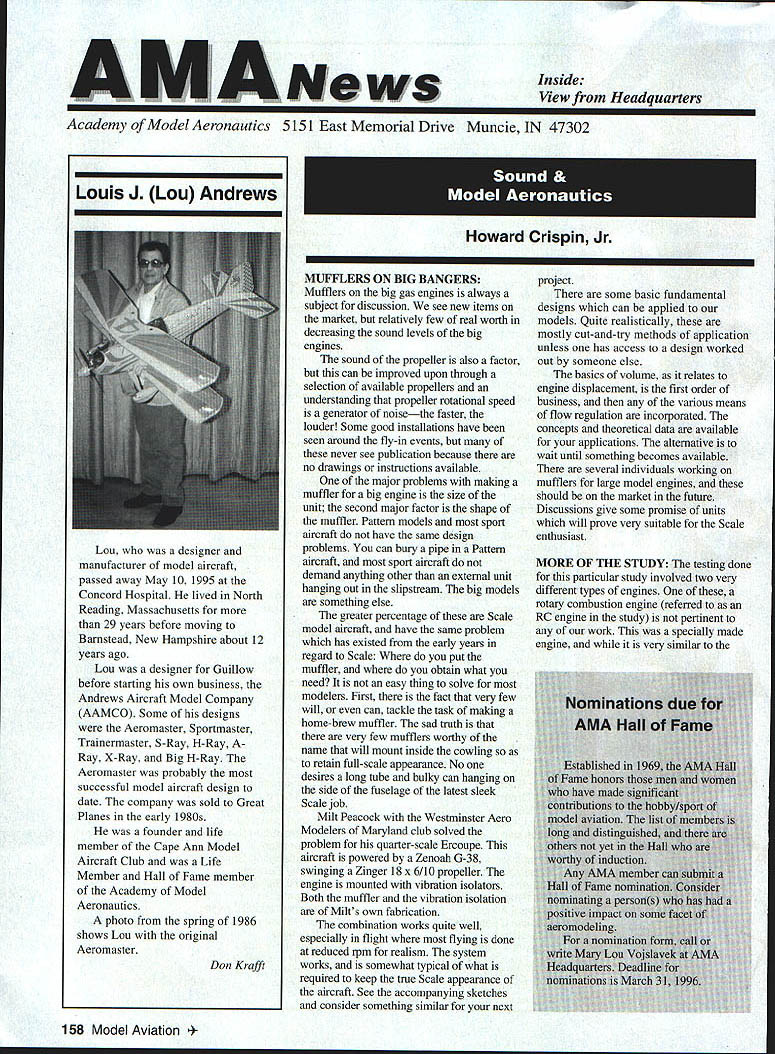
Louis J. "Lou" Andrews — Lou Andrews, designer and manufacturer of model aircraft, passed away May 10, 1995, at Concord Hospital. He lived in North Reading, Massachusetts, for 29 years before moving to Barnstead, New Hampshire, about 12 years ago. Lou was a designer for Guillow before starting his own company, Andrews Aircraft Model Company (AAMCO). Some of his designs include the Aeromaster, Sportmaster, Trainermaster, S‑Ray, H‑Ray, A‑Ray, X‑Ray, and Big H‑Ray. The Aeromaster was probably his most successful design. The company was sold to Great Planes in the early 1980s. Lou was a founder and life member of the Cape Ann Model Aircraft Club and a life member and Hall of Fame member of the Academy of Model Aeronautics.
Transcribed from original scans by AI. Minor OCR errors may remain.

