
Behind the Scenes at Springfield
It takes people, planning, and perseverance — plus a fair amount of talent, experience and luck — to produce a good World Championships. Those ingredients were evident at Springfield, Ohio June 29–July 4. A great RC Aerobatics event was the natural result, but it wasn't easy.
Prior to the event a small group of seasoned AMA officials did the planning in a series of meetings, held in the Washington, D.C., area over a several month period. They worked out the details of the meet, but everything depended upon a goodly number of capable volunteers showing up at the site.
At the last planning meeting about a week prior to the event there was still a lot of doubt about being able to count on enough good people for all the critical jobs needed to run a good meet. Memories of the 1974 World Championships at Lakehurst, NJ haunted the meeting — at that event a drastic shortage of personnel had seriously compromised operations.
But the Springfield, Ohio location offered some basis for optimism. Many talented local people had helped produce a great National Championships in 1976. Hopefully, many would be available for the 1977 World Championships. Also, about two dozen RC Pattern fliers who would be competing for a spot on the U.S. team at the same site, on the weekend before, had promised to help if necessary.
As it turned out the Ohio modelers came through but most of the Pattern finalists did not. It was a bare minimum crew that got the event going but more help developed as the meet progressed and some AMA spectators pitched in. In the end a strong and smooth working group had been put together.
Weather problems almost wrecked the event just before official flying was to start on Friday. A tremendous storm the night before flattened most of the field facilities, yet flying got started the next morning within an hour of the original schedule. But it was very windy and directly across the runway. Fortunately, the wind stayed below the FAI specification for suspension (about 27 mph), so flying continued.
The flight lines functioned despite the problems, aided by several alternative means of communications. AMA had bought walkie-talkies before the meet (as part of Nats equipment), battery-powered field phones had been borrowed, local "hams" provided a separate radio link between sites; a commercial telephone was installed in the operations control tent. Key officials were equipped with radio paging units. These means of communications were used to overcome various problems caused by the storm.
Two days previous another crisis developed — an emergency situation. Two large electrical power generators contracted turned out unusable; one was damaged in a highway accident on the way to the site, the other failed to produce power despite several days of intensive trouble-shooting repairs. The problem was finally resolved with help from the Ohio Air National Guard. The 251st Combat Communications Group loaned three portable generators. Air Guard people also helped provide a radio link and an airfield tower proved necessary.
F-100 jets took off near the model flying circles during official practice flying on Thursday. Good radio coordination minimized interruptions to model flying. Safety problems from full-scale aircraft operations took a lot of good people to cope with.
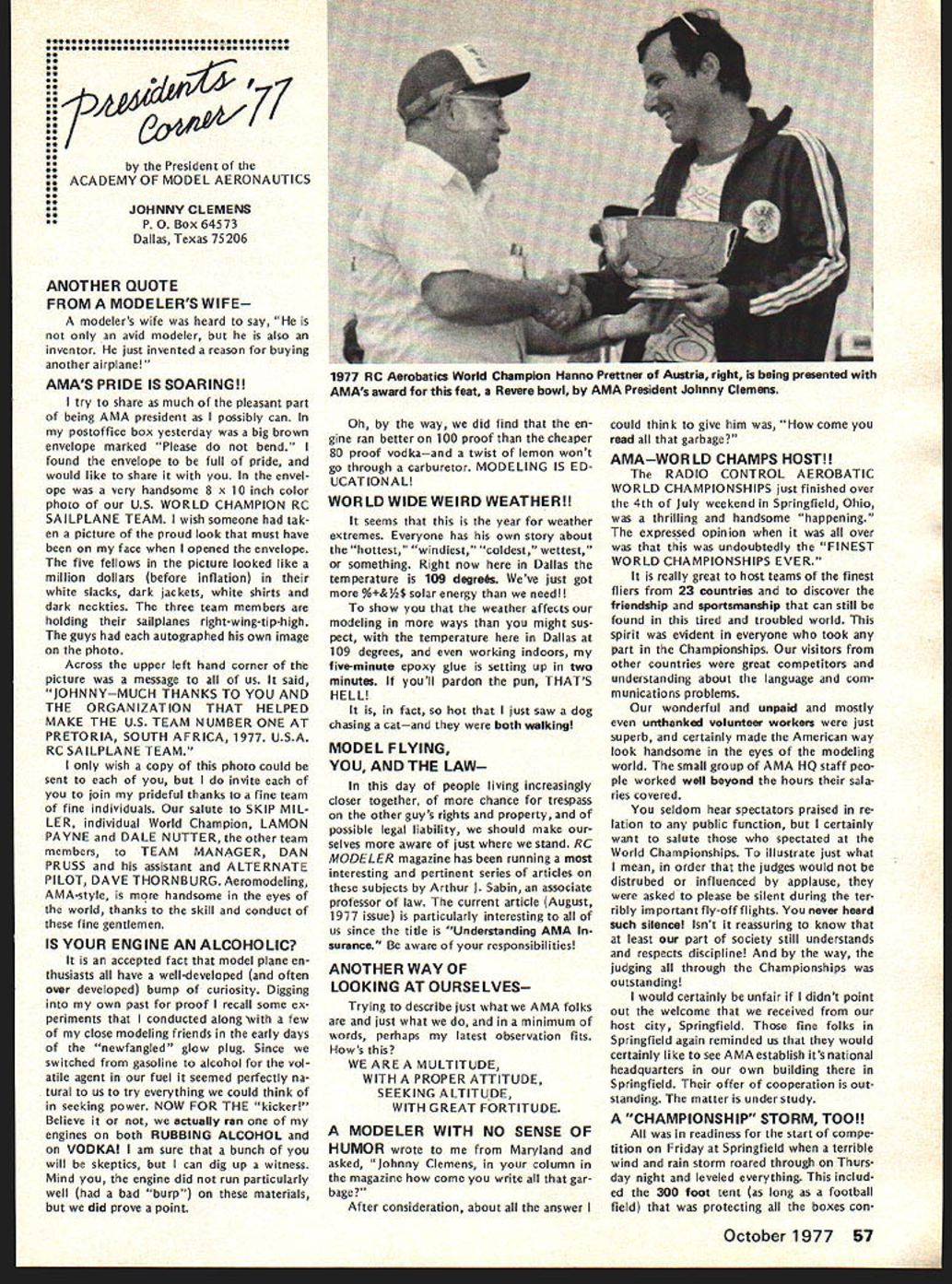
Most were busy dealing with a series of operational troubles with little opportunity to partake in social activities. In fact, it wasn't until Sunday afternoon — the next-to-last day — that real relaxation was evident. While the flight lines operated (two circles 2,000 feet apart, with an operations control center midway between), a group of Ohio volunteers and local Civil Air Patrol cadets began cleaning up the mess left by the storm. Torn canvas from a destroyed 300-foot-long circus-type tent—the main facility for contestants and sponsors—was gathered up and moved away. Hundreds of tables and chairs which had been tossed around were retrieved and stacked for re-use. Public address system wiring and speakers were repaired (over a half-mile of wiring was involved!). Damaged signs were gathered, repaired, and put up again. Fences and rope lines for crowd control were restored. Piles of litter were cleaned.
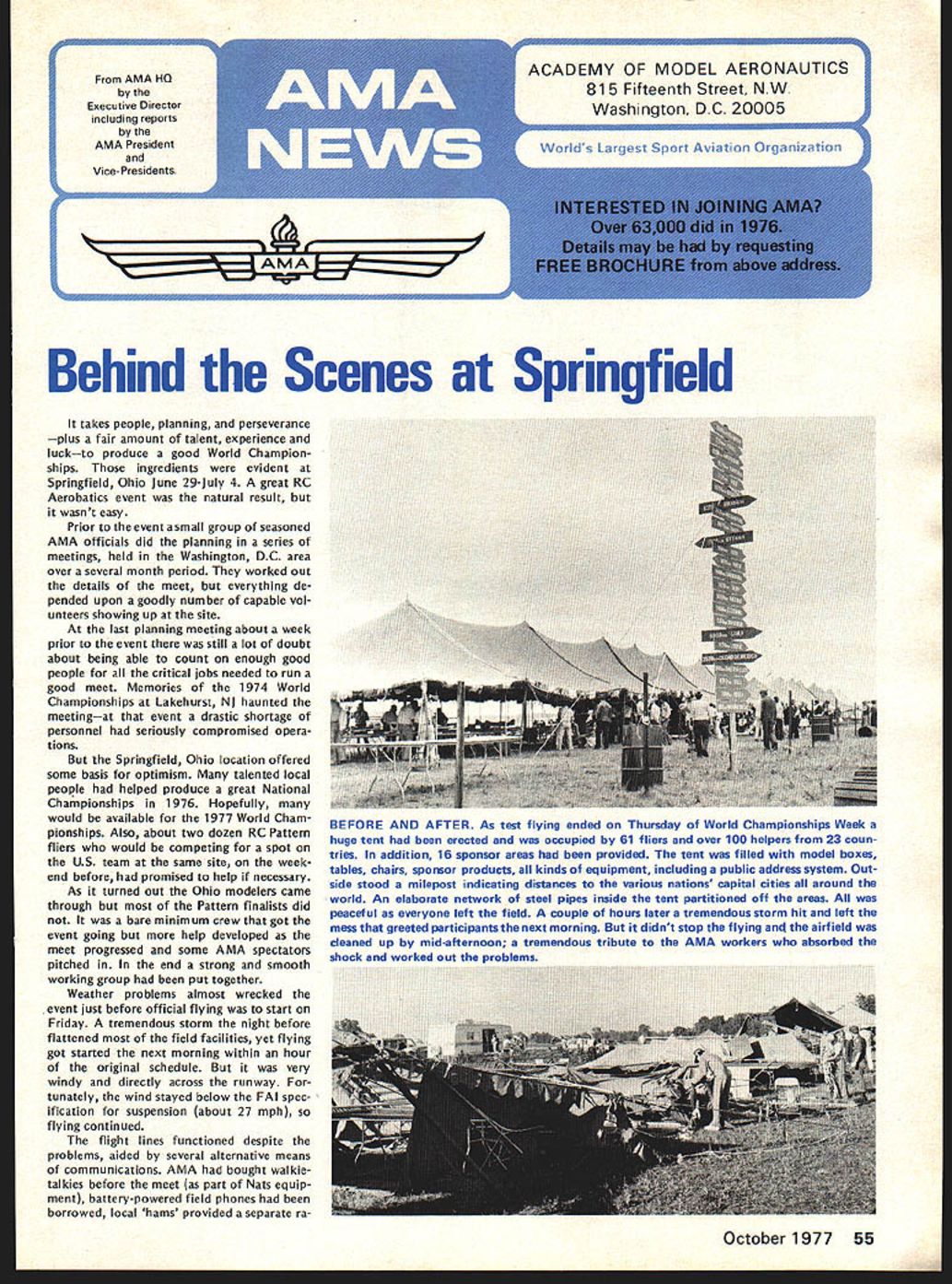
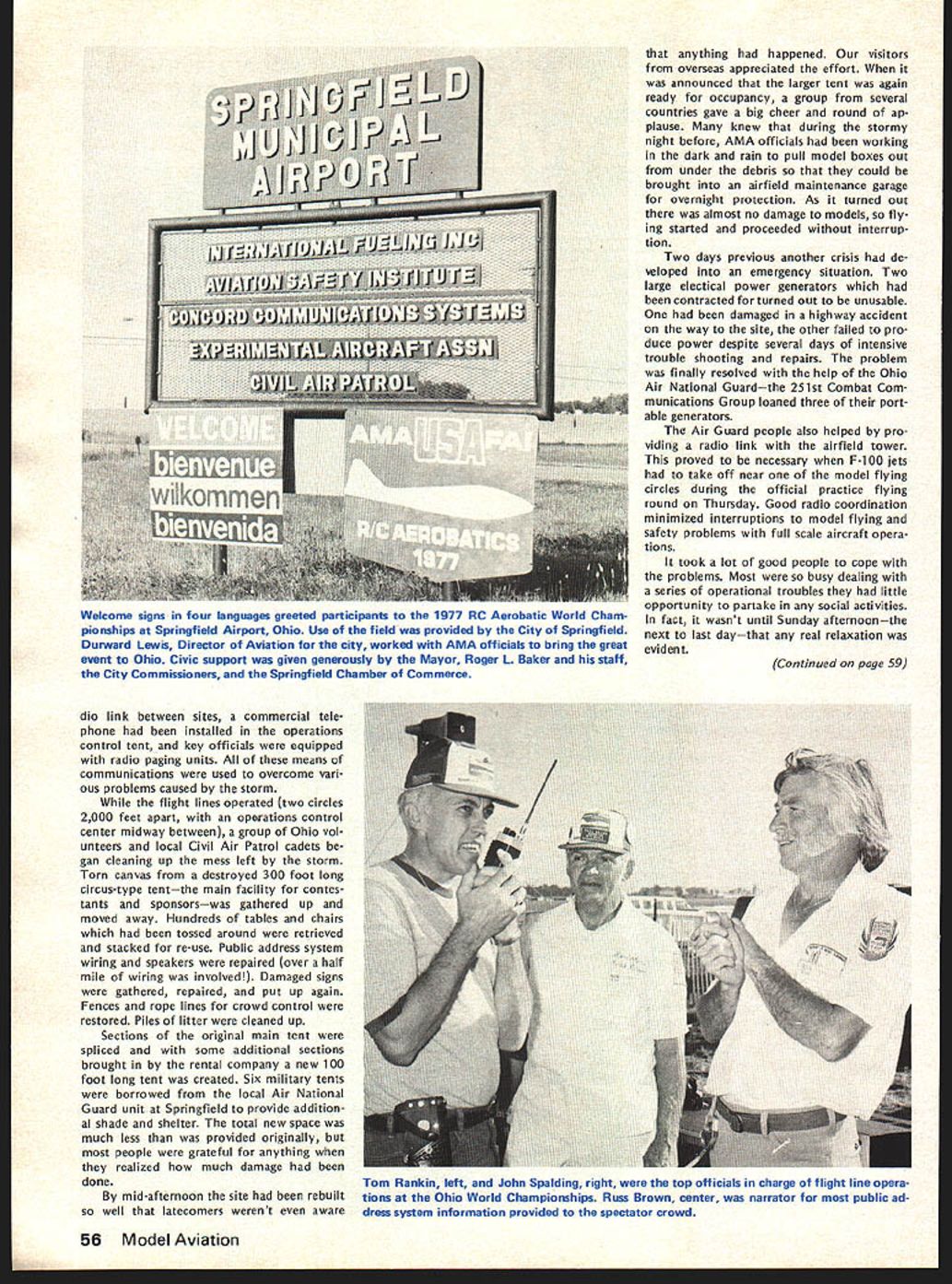
Sections of the original main tent were spliced and, with some additional sections brought in by the rental company, a new 100-foot-long tent was erected. Six military tents were borrowed from the local Air National Guard unit at Springfield to provide additional shade and shelter. The total new space was much less than was provided originally, but most people were grateful for anything when they realized how much damage had been done. BEFORE AND AFTER As test flying ended Thursday, World Championships week, a huge tent was erected to house 61 fliers and over 100 helpers from 23 countries. In addition, 16 sponsor areas provided tent space filled with model boxes, tables, chairs, sponsor products and equipment, including a public address system. Outside stood a milepost indicating distances to the various nations' capital cities around the world. An elaborate network of steel pipes inside the tent partitioned off areas. When everyone left the field a couple of hours later, a tremendous storm hit and left a mess that greeted participants the next morning. It didn't stop flying — the airfield was cleaned up mid-afternoon. Tremendous tribute to AMA workers who absorbed the shock and worked out the problems.
A larger tent was again ready for occupancy and a group from several countries gave a big round of applause when they learned that during the stormy night before AMA officials were working in the dark and rain to pull model boxes out from under debris and bring them to the airfield maintenance garage for overnight protection. As it turned out, almost no models were damaged and flying started and proceeded with little interruption.
Two days previously another crisis developed — an emergency situation. Two large electrical power generators contracted for the meet turned out to be unusable: one was damaged in a highway accident on the way to the site and the other failed to produce power despite several days of intensive troubleshooting and repairs. The problem was finally resolved with help from the Ohio Air National Guard. The 251st Combat Communications Group loaned three portable generators. Air Guard personnel also helped provide a radio link; an airfield tower proved necessary.
F-100 jets took off near the model flying circles during official practice flying rounds on Thursday. Good radio coordination minimized interruptions and model-flying safety problems. Full-scale aircraft operations took a lot of good people to cope with the problems. Most were busy dealing with a series of operational troubles and had little opportunity to partake in social activities.
A commercial telephone link between sites was installed; the operations-control tent and key officials were equipped with radio paging units — a means of communication that was used to overcome various problems caused by the storm. containing the models from all over the world which were to be flown in the contest the next day. It was a twist of fate that brought the storm to a pinpoint at that exact spot, but it was another twist of fickle fate that not one of the competition model planes was hurt.
Through a fantastic effort on the part of everyone connected with the meet the wreckage was sorted out and, as if by a miracle, everything was put in order so that the meet could start as planned on Friday.
CHAMPIONSHIP VICTORY BANQUET A VICTORY!
At Wittenberg University after a delicious dinner came the final salutes to our international guests and the new champions. The dining hall was decorated in impressive fashion with the world's flags both on the walls and the tables. The program was a combination of dignity and light cheerfulness, and you would have been very proud of YOUR AMA. A farewell party followed in the banquet hall of one of the motels. The total story of the World Championships is one that will be long remembered, worldwide!
THE IRISH TEAM WON EVERYONE'S HEART!
The most popular heroes of the World Championships were probably the Irish Team. As the last official flight was completed the Irish Team's tent area was declared a hospitality house with all meet participants invited for liquid refreshments. The most impressive item on the "menu" proved to be delicious "Irish Coffee." This was a delightful way to break the tension of competition and finish off a hot dry day in wonderful fashion. We will remember fondly the "wild men from Ireland!"
WHAT DO MODELER'S WIVES DO FOR HOBBIES?
We heard of a modeler who spent so much time at the workbench and at the flying field that, in self defense, his wife took up cross-word puzzles. In fact, she became such a crossword addict that when she died suddenly she had her buried "six-down and three-across."
FROM THE GOOMBAH FLYPAPER
The FLYING GOOMBAHS' Model Airplane Club of Braintree, MA, has a very good newsletter called the "Flypaper." In their July issue I found a paragraph that I think explains beautifully why we should show our model aviation to the public. I quote from the "Flypaper":
"What's the difference? Why do we bother to do all those flying demonstrations? And why should we spend so much money on a PA system or on walkie-talkies for our contests? Or signs and pennants and stakes and all that other junk? THE DIFFERENCE IS PROFESSIONALISM! THAT'S what makes the difference between a bunch of OVERGROWN KIDS playing with toys, and a LEGITIMATE HOBBY that is practiced by sensible adults and young folks performing in the eyes of the public."
"THANKS, GOOMBAHS, FOR PUTTING IT INTO WORDS FOR US!"
TAKE GOOD CARE OF YOURSELF!!
IT JUST DAWNED ON ME THAT STAYING HEALTHY IS A LIFETIME JOB!
SAFETY AND FIRST AID
Safety has to be our very first consideration if we are to fly model-airplanes. Otherwise we will simply NOT BE ACCEPTED by the community around us. But certainly the most effective way to "sell yourself" on acting in a safe manner is to consider it selfishly. By selfishly I simply mean that if you are using wisdom and common sense and carefulness to protect what is yours, then you are automatically protecting the community around you.
It will sound corny, but if you should hit a spectator with your model plane, his hard head might bust your airplane. If you fly through the "pit area" and clip a few of your buddy's planes, theirs might be built of harder stuff than yours. If you insist on stopping your engine by sticking your finger in the prop you might easily break a costly prop. Thus, if you expand your selfishness and avoid these costly errors you have not only protected your own health and billfold, but you have made it much safer for my highly valuable (in my eyes!) hide to be around you.
BUT ACCIDENTS WILL HAPPEN and we should be prepared to cope with them. Calmness and common sense are most valuable when an emergency must be handled, but FIRST AID TRAINING could be one of the most important things in your life. Where do you get first aid training? Inquire at your area RED CROSS, your POLICE DEPARTMENT, your FIRE DEPARTMENT, your SCHOOL, or your HOSPITAL.
It might make a wonderful club project to invite one or more of those groups to visit your model club to put on a program on SAFETY and FIRST AID. Next best would be to appoint some one or two folks from your group to attend classes on those very important subjects.
PROOF OF THE VALUE OF A PROGRAM LIKE THIS has appeared in several of our AMA Club newsletters lately where a little training on the part of someone in the club has perhaps even helped save a life.
FURTHER SAFETY WARNING—LIGHTNING!
DO NOT FLY IF A STORM IS APPROACHING! In nearly every kind of storm there is a high electrical potential. You are always flying in a cleared area so YOU ARE ABOUT THE TALLEST THING AROUND! If lightning is looking for something to strike YOU MIGHT BE IT! A radio antenna makes you just THAT MUCH TALLER, and the steel lines of a Control Line model WOULD MAKE AN IDEAL LIGHTNING ROD! If you are flying Control Line and you feel a bit of static through your lines when you are up high, GET YOUR AIRPLANE DOWN ON THE DECK. Even put it in the ground with the engine running knowing that you might break a prop or even a rudder. AMA CAN'T AFFORD TO LOSE YOU, and YOU DARN SURE CAN'T AFFORD TO LOSE YOU! BE SAFE—SURE!
A BIT OF PHILOSOPHY FROM MITZI GAYNOR—
We just enjoyed the most energetic and happy stage presentation I've ever seen. One of the numbers in this "MITZI GAYNOR SHOW 1977" was "YOU'RE NEVER FULLY DRESSED WITHOUT A SMILE." I sat there entranced by the sparkling smiles on the faces of the dancers, and it seemed to me that perhaps this show was speaking to our entire world.
IT FLEW LIKE A WHAT?
There was a guy who used to fly with us who was such a tightwad that he would "borrow" nearly all the materials he built into his models. The last thing he borrowed for his latest model was a pair of wheels. SURE ENOUGH, THE PLANE FLEW LIKE A WHEEL-BORROW! AND THIS GUY WAS NOT REALLY A BAD GUY—UNTIL YOU GOT TO KNOW HIM!!
AMA LIFE MEMBER NO. 5 — JEREMIAH COURTNEY
The name JEREMIAH COURTNEY will probably look or sound familiar to you. If you have read anything of all the recent actions relative to Radio Control and CB frequency problems you should recall Courtney's name as the attorney representing the Academy of Model Aeronautics in these matters. His initial interest in legal matters relative to AMA was only regarding radio control problems. However, he "fought our battle" so well always that our need for him and our use of him expanded beyond that singular subject. It was also very evident that his services showed dedication well beyond simple legal service.
Courtney was paid a very modest, or in reality, just a "token" fee for his services. Because of the great increase in workload that AMA was piling on his desk, the AMA Executive Council voted the first of 1977 to increase its payment fee to Courtney to a little more realistic figure. There was some questioning from the membership about this, and some grumbling. I thought it might be of interest to the membership to hear my opinion. I receive copies of all of the official correspondence out of Courtney's law office relative to AMA and its affairs. I am also aware that there are a multitude of phone calls and miles of "leg work" that can't be called to my attention. I am also aware of the extremely HIGH LEVEL OF EFFECTIVENESS we have enjoyed from these services. SUMMARY: I feel we have a bargain!
NOW FOR SOMETHING YOU ARE PROBABLY NOT AWARE OF: This same gentleman, ATTORNEY JEREMIAH COURTNEY, is also a LIFE MEMBER of the Academy of Model Aeronautics. He is holder of AMA license number L-5, and he is very proud of that. That will also explain much of the fervor and dedication he has shown to the cause and beyond—services of the past.
I just talked to Mr. Courtney on the phone and he made a statement to me that I want to share with you. He said, "The lawyer needs a client as much as the client needs a lawyer; and IN THE ACADEMY OF MODEL AERONAUTICS I HAVE A WONDERFUL CLIENT."
PROTECTING MEMBERSHIP RIGHTS
Since AMA has grown to an outstanding membership the Executive Council has felt it should know AMA's legal grounds should, through gross misdeeds, a member ever be considered for expulsion. This would assure protection of the rights of both the individual and of the AMA membership. Attorney Courtney is submitting legal opinion in this matter for possible revision of the AMA By-Laws. Hopefully we will never need this!
WANT TO SEE A TYPICAL AMA MEMBER?
Get out your membership card, hold it up, look in a mirror, AND SMILE!!
A BIT OF PRAYER TO CLOSE MY MESSAGE—
MAY GOD STAND BETWEEN YOU AND HARM AS YOU EXPLORE THE MYSTERIES OF TOMORROW.
*****all for now*****
Behind the Scenes (Cont. from pg. 56)
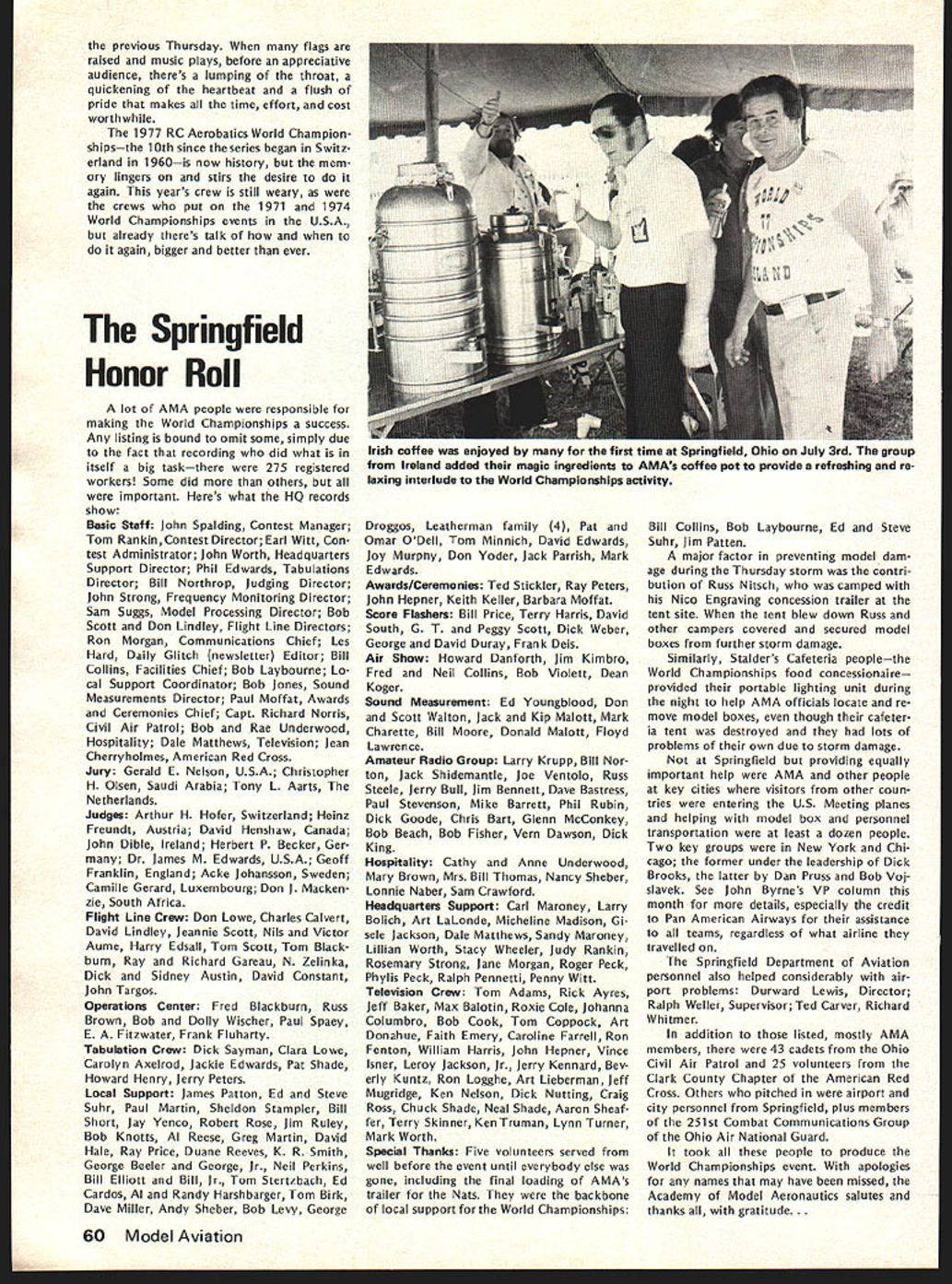
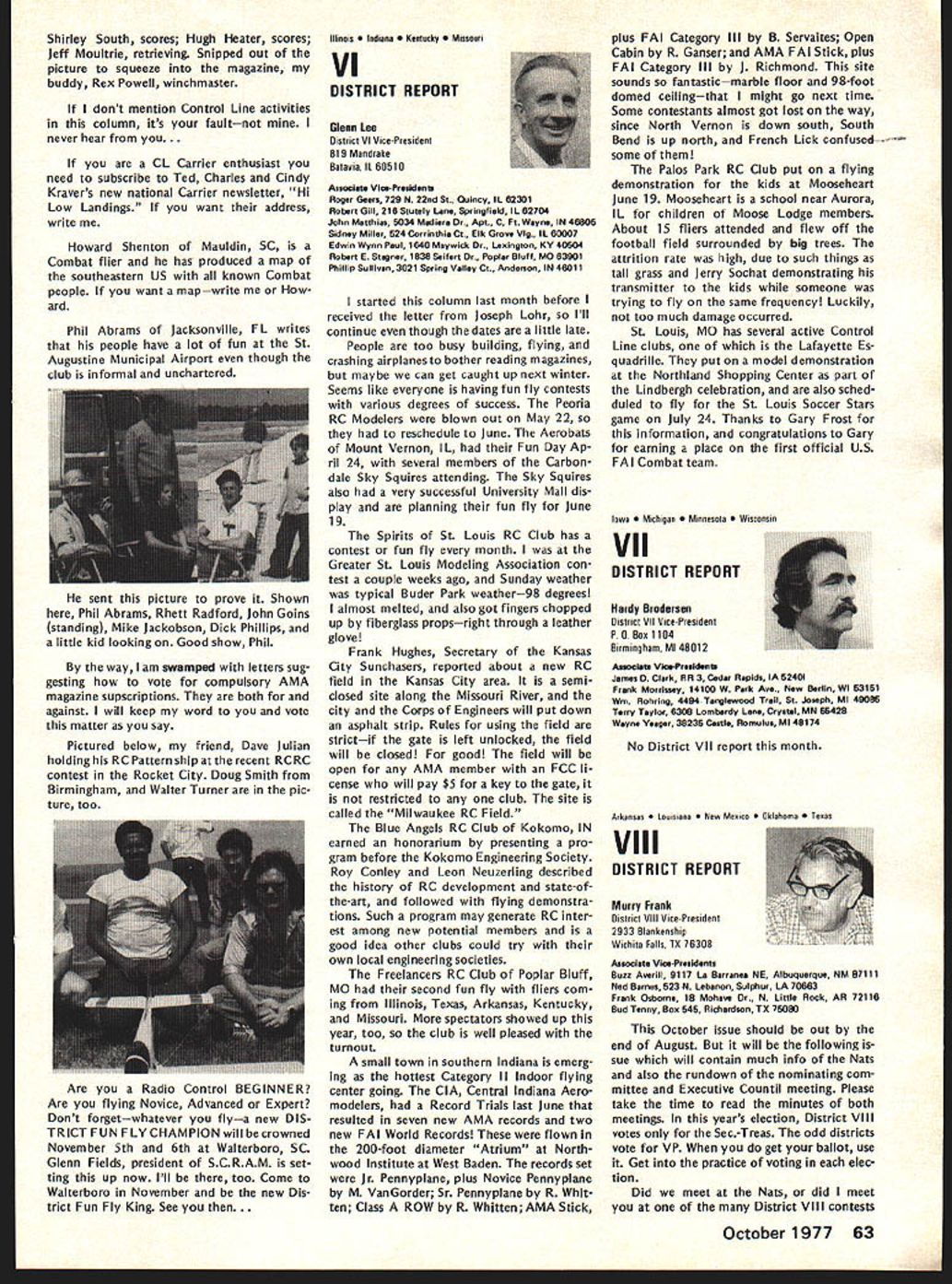
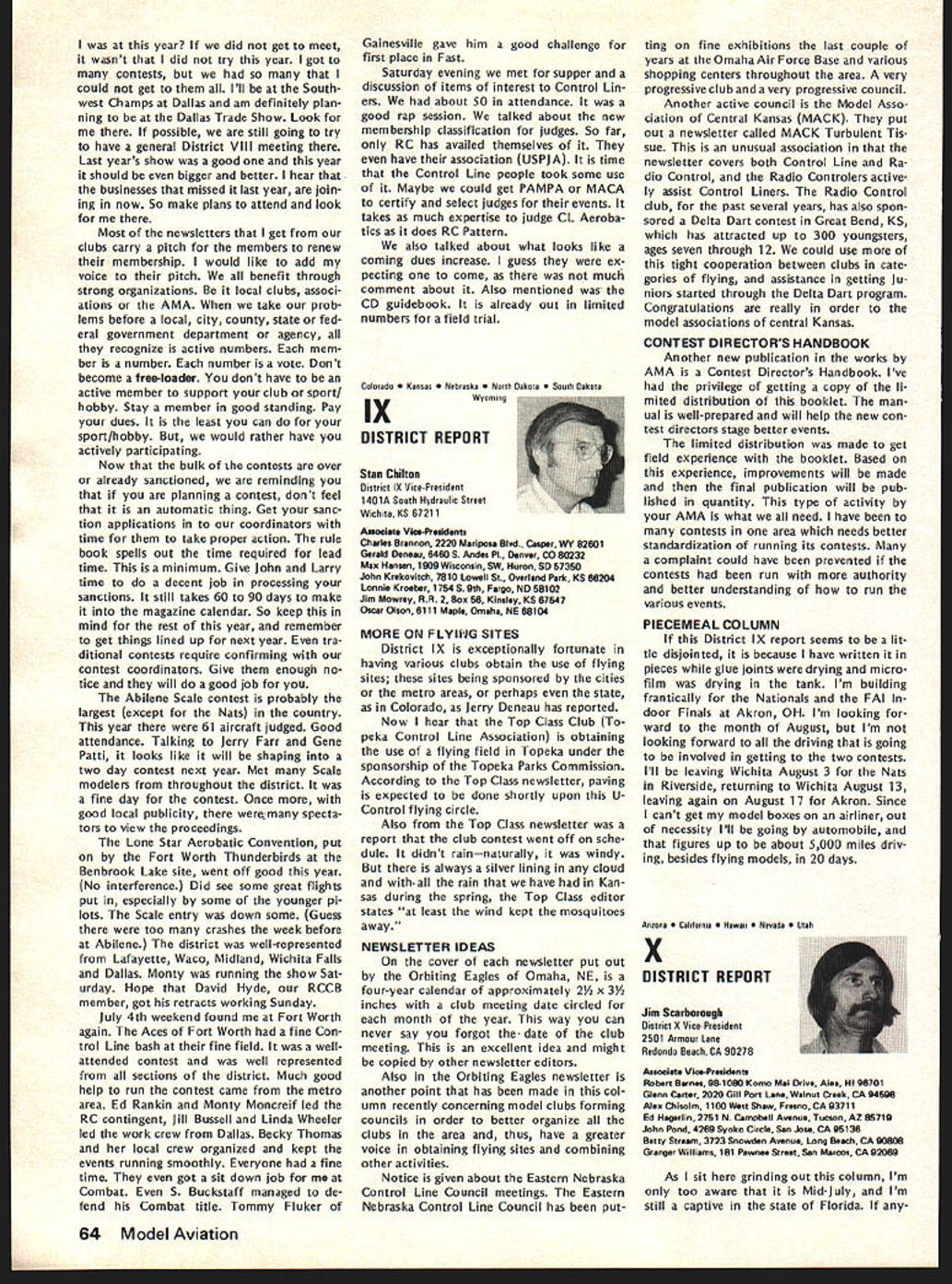
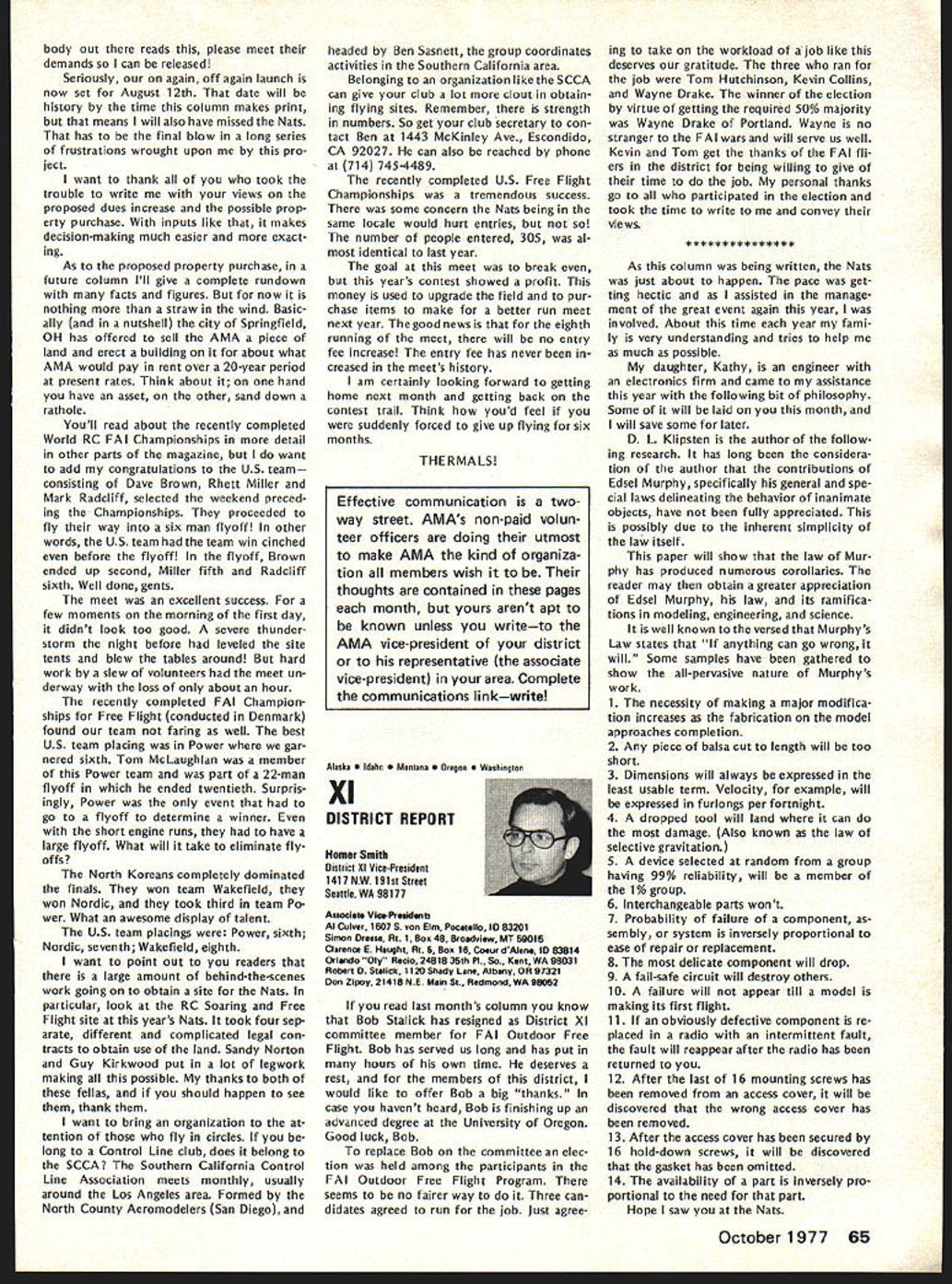
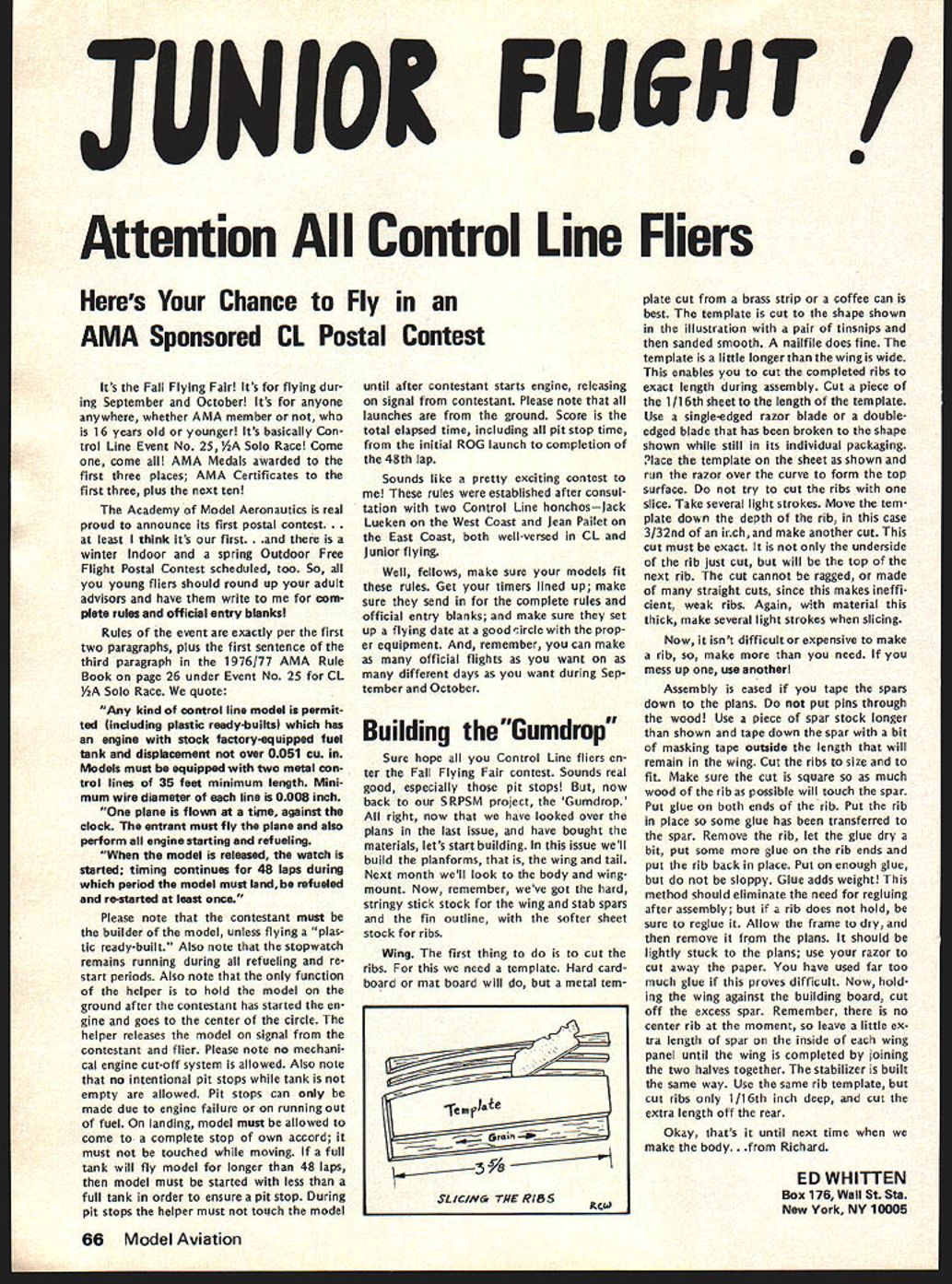
The Irish team took the lead in adding some fun to the World Championships. They announced that they would provide the vital ingredients for an Irish Coffee break after Sunday's flying. AMA arranged for the coffee and the Irish came up with the key additive, known as Paddy's—a whole case, hand carried from Ireland.
Sponsors and others added to the event by coming up with beer, cheese, and other snacks, while AMA provided soft drinks. So a grand party was held on the airfield and for a few hours the airport at Springfield was a happy place. It was just the touch needed to ease the pressure of an otherwise serious event.
The party put things in proper perspective. Model flying is basically intended to be fun, with a foundation of friendships that bridge across international borders and overcome language barriers. As the refreshments were consumed, it became obvious that all participants were equal. Pilots, mechanics, flight line crews, tabulators, judges, and all the other types of people it took to make this World Championships work, were part of one big happy family. This is what the World Championships is all about—the blending of all aeromodelling interests in a spirit of respect and enjoyment of each other.
The contest didn't end with the Sunday party. The longest day was yet to come—on Monday, the 4th of July. It began an hour earlier than the previous day, due to the need to get in two flyoff rounds of the top six pilots, in addition to a full round of all contestants, plus an awards ceremony and an evening banquet.
The day went well. Weather was good. The flight line and support crews held up (many on their fourth, fifth, or sixth consecutive day of duty). There was even time for some demonstration flying, TV interviews, and more socializing between flights.
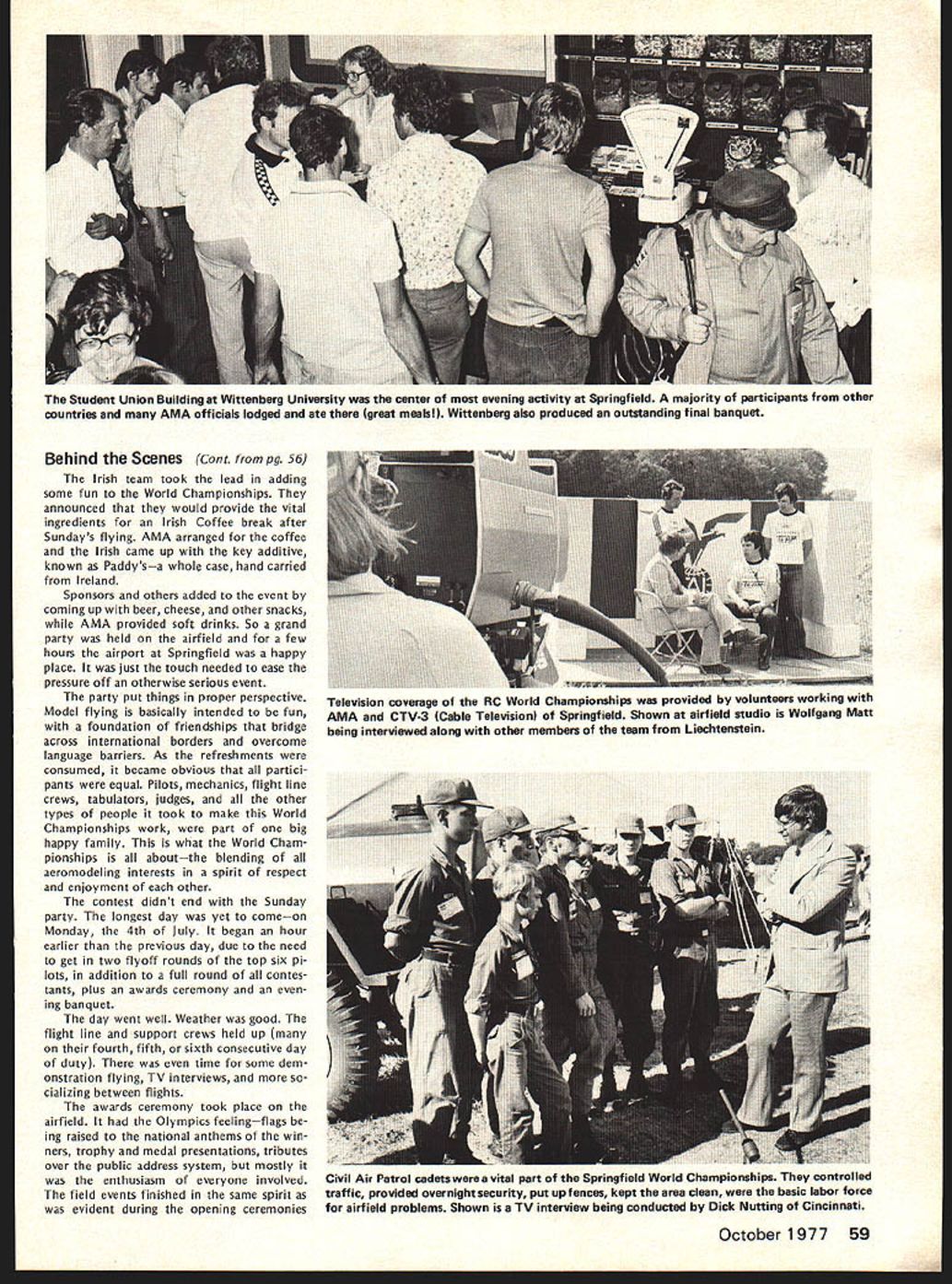
The awards ceremony took place on the airfield. It had the Olympics feeling—flags being raised to the national anthems of the winners, trophy and medal presentations, tributes over the public address system, but mostly it was the enthusiasm of everyone involved. The field events finished in the same spirit as was evident during the opening ceremonies and at the Sunday night party. The contestants then moved to the Student Union for the final awards banquet, which was an outstanding finish to a hard-fought competition. The 1977 RC Aerobatics World Championships—the 10th since the series began in Switzerland in 1960—is now history, but the memory lingers on and stirs the desire to do it again. This year's crew is still weary, as were the crews who put on the 1971 and 1974 World Championships events in the U.S.A., but already there's talk of how and when to do it again, bigger and better than ever.
The Springfield Honor Roll
A lot of AMA people were responsible for making the World Championships a success. Any listing is bound to omit some, simply due to the fact that recording who did what is in itself a big task—there were 275 registered workers! Some did more than others, but all were important. Here's what the HQ records show:
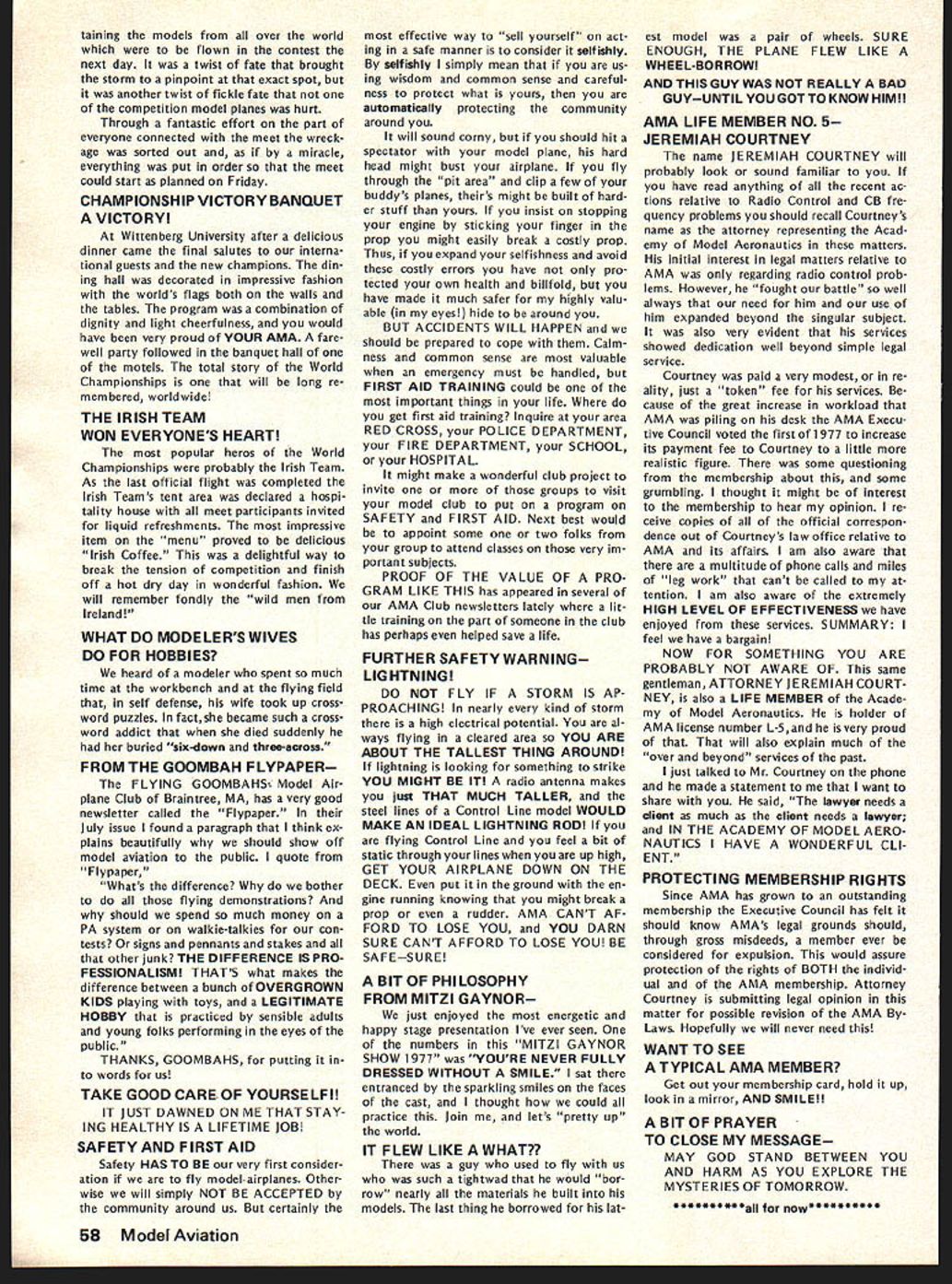
Basic Staff: John Spalding, Contest Manager; Tom Rankin, Contest Director; Earl Witt, Contest Administrator; John Worth, Headquarters Support Director; Phil Edwards, Tabulations Director; Bill Northrop, Judging Director; John Strong, Frequency Monitoring Director; Sam Suggs, Model Processing Director; Bob Scott and Don Lindley, Flight Line Directors; Ron Morgan, Communications Chief; Les Hard, Daily Glitch (newsletter) Editor; Bill Collins, Facilities Chief; Bob Laybourne, Local Support Coordinator; Bob Jones, Sound Measurements Director; Paul Moffat, Awards and Ceremonies Chief; Capt. Richard Norris, Civil Air Patrol; Bob and Rae Underwood, Hospitality; Dale Matthews, Television; Jean Cherryholmes, American Red Cross.
Jury: Gerald E. Nelson, U.S.A.; Christopher H. Olsen, Saudi Arabia; Tony L. Aarts, The Netherlands.
Judges: Arthur H. Hofer, Switzerland; Heinz Freundt, Austria; David Henshaw, Canada; John Dible, Ireland; Herbert P. Becker, Germany; Dr. James M. Edwards, U.S.A.; Geoff Franklin, England; Acke Johansson, Sweden; Camille Gerard, Luxembourg; Don J. Mackenzie, South Africa.
Flight Line Crew: Don Lowe, Charles Calvert, David Lindley, Jeannie Scott, Nils and Victor Aune, Harry Edsall, Tom Scott, Tom Blackburn, Ray and Richard Garreau, N. Zelinka, Dick and Sidney Austin, David Constant, John Targos.
Operations Center: Fred Blackburn, Russ Brown, Bob and Dolly Wischer, Paul Speary, E. A. Fitzwater, Frank Fluharty.
Tabulation Crew: Dick Sayman, Clara Lowe, Carolyn Axelrod, Jackie Edwards, Pat Shade, Howard Henry, Jerry Peters.
Local Support: James Patton, Ed and Steve Suhr, Paul Martin, Sheldon Stampler, Bill Short, Jay Yenco, Robert Rose, Jim Riley, Bob Knotts, Al Reese, Greg Martin, David Hale, Ray Price, Duane Reeves, K. R. Smith, George Becker and George, Jr., Neil Perkins, Bill Elliott and Bill, Jr., Tom Stertbach, Ed Cardosa, Al and Randy Harshbarger, Tom Birk, Dave Miller, Andy Sheber, Bob Levy, George Dregos, Leatherman family (4), Pat and Omar O'Dell, Tom Minnich, David Edwards, Joy Murphy, Don Yoder, Jack Parrish, Mark Edwards.
Awards/Ceremonies: Ted Stickler, Ray Peters, John Hepner, Keith Keller, Barbara Moffat.
Score Flashers: Bill Price, Terry Harris, David South, G. T. and Peggy Scott, Dick Weber, George and David Darray, Frank Deis.
Air Show: Howard Danforth, Jim Kimbro, Fred and Neil Collins, Bob Violett, Dean Koger.
Sound Measurement: Ed Youngblood, Don and Scott Walton, Jack and Kip Malott, Mark Charette, Bill Moore, Donald Malott, Floyd Lawrence.
Amateur Radio Group: Larry Krupp, Bill Norton, Jack Shideman, Joe Ventolo, Russ Steele, Jerry Bull, Jim Bennett, Dave Bastress, Paul Stevenson, Mike Barrett, Phil Rubin, Dick Goode, Chris Bart, Glenn McConkey, Bob Beach, Bob Fisher, Vern Dawson, Dick King.
Hospitality: Cathy and Anne Underwood, Mary Brown, Mrs. Bill Thomas, Nancy Sheber, Lonnie Naber, Sam Crawford.
Headquarters Support: Carl Maroney, Larry Bolich, Art LaLonde, Micheline Madison, Gisele Jackson, Dale Mathews, Sandy Maroney, Lillian Worth, Stacy Wheeler, Judy Rankin, Rosemary Strong, Jane Morgan, Roger Peck, Phyllis Peck, Ralph Pennetti, Penny Witt.
Television Crew: Tom Adams, Rick Ayres, Jeff Baker, Max Balotin, Roxie Cole, John Columbo, Bob Cook, Tom Coppock, Art Donahue, Faith Emery, Caroline Farrell, Ron Fenton, William Harms, John Hepner, Vince Isner, Leroy Jackson, Jr., Jerry Kennard, Beverly Kutz, Ron Loghge, Art Lieberman, Jeff Mugridge, Ken Nelson, Dick Nutting, Craig Ross, Chuck Shade, Neal Shade, Aaron Sheaffter, Terry Skinner, Ken Trunan, Lynn Turner, Mark Worth.
Special Thanks: Five volunteers served from well before the event until everybody else was gone, including the final loading of AMA's trailer for the Nats. They were the backbone of local support for the World Championships: (names not repeated here in HQ list).
A major factor in preventing model damage during the Thursday storm was the contribution of Russ Nitsch, who was camped with his Nico Engraving concession trailer at the tent site. When the tent blew down Russ and other campers covered and secured model boxes from further storm damage.
Similarly, Stalder's Cafeteria people—the World Championships food concessionaires—provided their portable lighting unit during the night to help AMA officials locate and remove model boxes, even though their cafeteria tent was destroyed and they had lots of problems of their own due to storm damage.
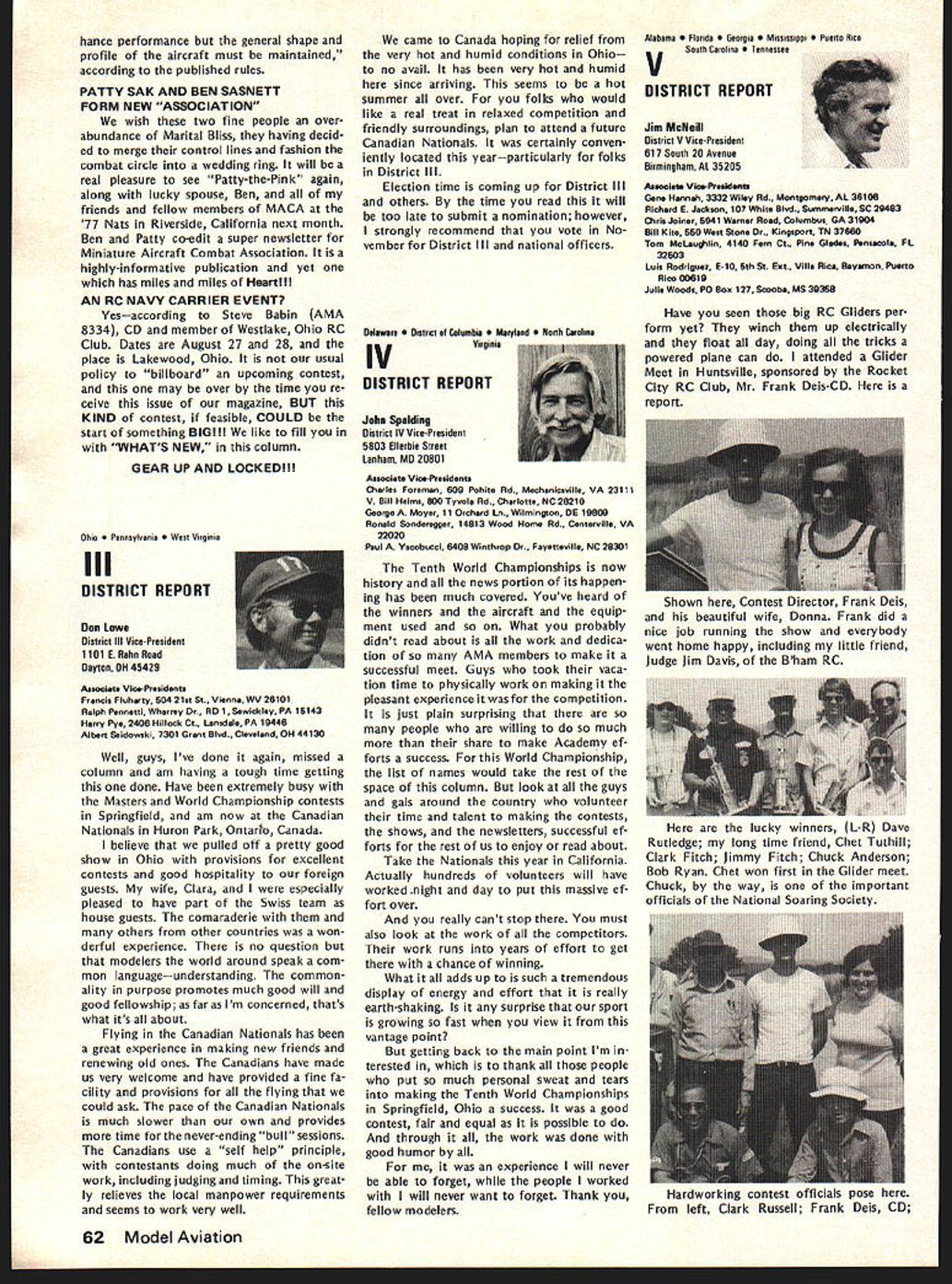
Not at Springfield but providing equally important help were AMA and other people at key cities where visitors from other countries were entering the U.S. Meeting planes and helping with model box and personnel transportation were at least a dozen people. Two key groups were in New York and Chicago; the former under the leadership of Dick Brooks, later by Dan Pruss and Bob Vojislavsek. See John Byrne's VP column this month for more details, especially the credit to Pan American Airways for their assistance to all teams, regardless of what airline they traveled on.
The Springfield Department of Aviation personnel also helped considerably with airport problems: Durward Lewis, Director; Ralph Weller, Supervisor; Ted Carver, Richard Whitmer.
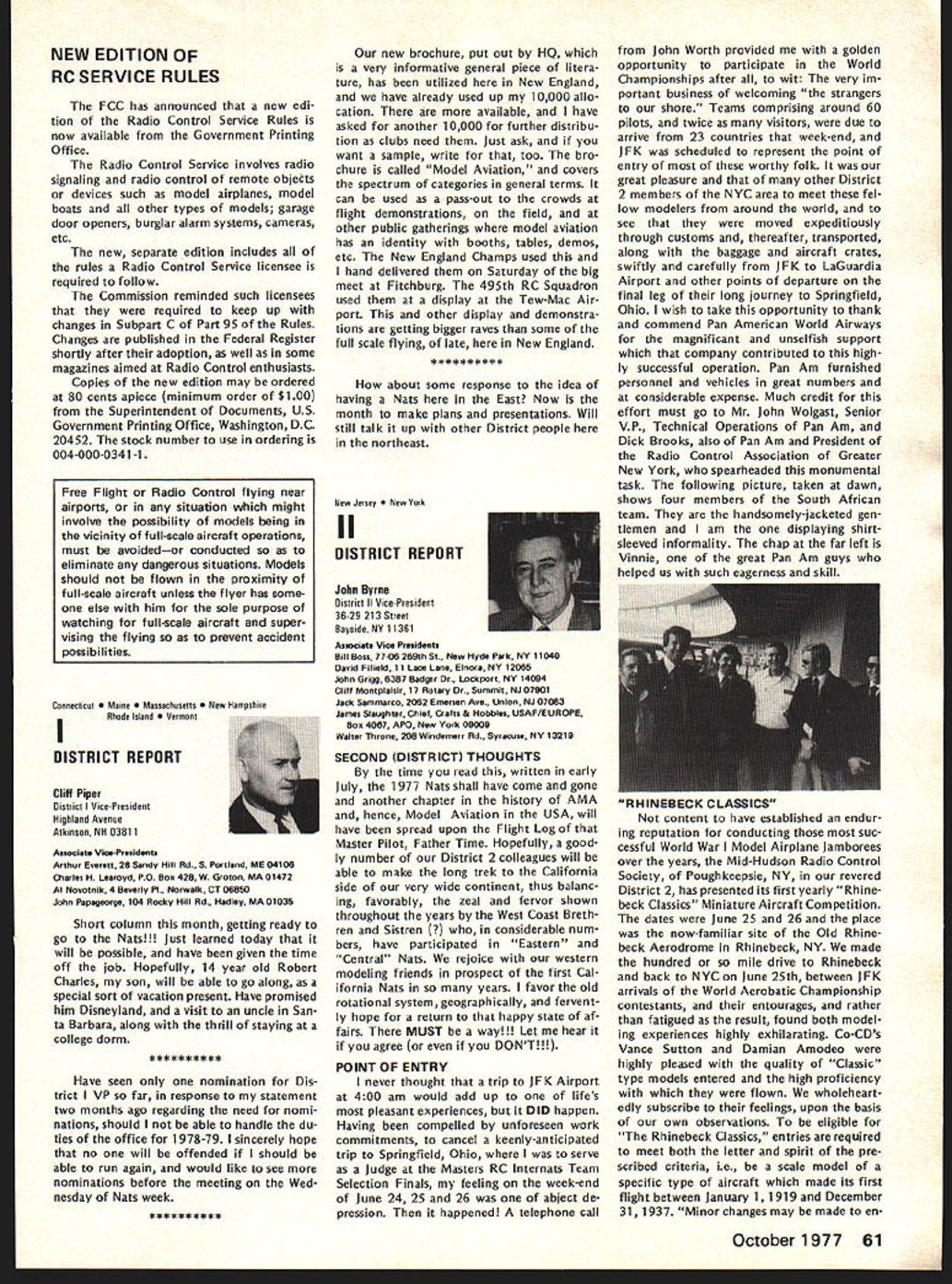
In addition to those listed, mostly AMA members, there were 43 cadets from the Ohio Civil Air Patrol and 25 volunteers from the Clark County Chapter of the American Red Cross. Others who pitched in were airport and city personnel from Springfield, plus members of the 251st Combat Communications Group of the Ohio Air National Guard.
It took all these people to produce the World Championships event. With apologies for any names that may have been missed, the Academy of Model Aeronautics salutes and thanks all, with gratitude. Behind the scenes Springfield takes people, planning, perseverance plus a fair amount of talent, experience and luck to produce good World Championships. The ingredients were evident at Springfield, Ohio, June 29–July 4 at the great RC Aerobatics event. The result wasn't easy. Prior events had a small group of seasoned AMA officials doing the planning. A series of meetings held in the Washington, D.C., area over several months worked out details. Much depended upon a goodly number of capable volunteers showing up on site. The last planning meeting, about a week prior to the event, still left a lot of doubt about being able to count on enough good people for the critical jobs needed to run a good meet. Memories of the 1974 World Championships at Lakehurst, N.J., haunted the meeting — at that event a drastic shortage of personnel seriously compromised operations. Springfield, Ohio, as a location offered some basis for optimism. Talented local people had helped produce the great National Championships in 1976 and, hopefully, would be available for the 1977 World Championships. Also, about two dozen RC Pattern fliers who would be competing for the U.S. team the same site the weekend before promised to help with the necessary crew. As it turned out, Ohio modelers came through. Pattern finalists did the bare minimum crew to get the event going; as more help developed the meet progressed. Some AMA spectators pitched in and helped, and a strong, smooth-working group was put together.
Weather problems almost wrecked the event. Just before official flying started Friday, a tremendous storm the night before flattened field facilities, yet flying got started the next morning within an hour of the original schedule. It was very windy, directly across the runway; fortunately the wind stayed below FAI specification suspension (about 27 mph) and flying continued. Flight lines functioned despite problems, aided by several alternative means of communications. AMA bought walkie-talkies before the meet as part of Nats equipment; battery-powered field phones were borrowed; local hams provided a separate radio link.
BEFORE AND AFTER
As test flying ended Thursday, and World Championships Week began, a huge tent was erected and occupied by 61 fliers, over 100 helpers and 23 countries. In addition, 16 sponsor areas provided tent space filled with model boxes, tables, chairs, sponsor products and all kinds of equipment including a public address system. Outside stood a milepost indicating distances to various nations' capital cities around the world. An elaborate network of steel pipes inside the tent partitioned off areas. By the time everyone left the field a couple of hours later a tremendous storm hit and left a mess to greet participants the next morning. It didn't stop flying; the airfield was cleaned up by mid-afternoon. It was a tremendous tribute to the AMA workers who absorbed the shock and worked out the problems.
As it turned out almost no damage was done to models; flying started and proceeded with only interruption. Two days previous another crisis developed — an emergency situation. Two large electrical power generators contracted for the meet turned out unusable; one had been damaged in a highway accident on the way to the site and the other failed to produce power despite several days of intensive trouble-shooting and repairs. The problem was finally resolved when the Ohio Air National Guard, the 251st Combat Communications Group, loaned three portable generators. Air Guard personnel also helped by providing a radio link; an airfield tower proved necessary. F-100 jets took off near model-flying circles during official practice flying on Thursday. Good radio coordination minimized interruptions; full-scale aircraft operations and model-flying safety problems required a lot of good people to cope with. Most were busy dealing with a series of operational troubles and had little opportunity to partake in social activities; in fact it wasn't until Sunday afternoon — the next-to-last day — that real relaxation was evident.
A radio link between sites and a commercial telephone installed in the operations-control tent, and key officials equipped with radio paging units, were means of communication used to overcome various problems caused by the storm. Flight lines operated t o enhance performance but the general shape and profile of the aircraft must be maintained," according to the published rules.
PATTY SAK AND BEN SASNETT FORM NEW "ASSOCIATION"
We wish these two fine people an over-abundance of Marital Bliss, they having decided to merge their control lines and fashion the combat circle into a wedding ring. It will be a real pleasure to see "Patty-the-Pink" again, along with lucky spouse, Ben, and all of my friends and fellow members of MACA at the '77 Nats in Riverside, California, next month. Ben and Patty co-edit a super newsletter for Miniature Aircraft Combat Association. It is a highly-informative publication and yet one which has miles and miles of Heart!!!
AN RC NAVY CARRIER EVENT?
Yes — according to Steve Babin (AMA 8334), CD and member of Westlake, Ohio RC Club. Dates are August 27 and 28, and the place is Lakewood, Ohio. It is not our usual policy to "billboard" an upcoming contest, and this one may be over by the time you receive this issue of our magazine, BUT this KIND of contest, if feasible, COULD be the start of something BIG!!! We like to fill you in with "WHAT'S NEW," in this column. GEAR UP AND LOCKED!!!
AMA News
Behind the scenes — Springfield takes people, planning, perseverance, plus a fair amount of talent, experience and luck to produce good World Championships. The ingredients evident at Springfield, Ohio, June 29–July 4, for a great RC Aerobatics event were a natural result — it wasn't easy. Prior to the event a small group of seasoned AMA officials did the planning. A series of meetings held in the Washington, D.C., area over several months worked out the details. Much depended upon a goodly number of capable volunteers showing up on site. At the last planning meeting, about a week prior to the event, there was still a lot of doubt about being able to count on enough good people — critical jobs needed to run a good meet.
Memories of the 1974 World Championships at Lakehurst, N.J., haunted the meeting — at that event a drastic shortage of personnel seriously compromised operations. Springfield, Ohio, offered some basis for optimism. Talented local people had helped produce the great National Championships in 1976; hopefully they would be available for the 1977 World Championships. Also, about two dozen RC Pattern fliers who would be competing for a spot on the U.S. team the same site the weekend before had promised the help necessary. As it turned out, Ohio modelers came through. Pattern finalists did the bare minimum crew to get the event going; as the meet developed, some AMA spectators pitched in and a strong, smooth-working group was put together.
Weather problems almost wrecked the event. Just before the official flying start on Friday, a tremendous storm the night before flattened the field facilities; yet flying got started the next morning within an hour of the original schedule. It was very windy, directly across the runway, but fortunately the wind stayed below the FAI specification suspension (about 27 mph) and flying continued. Flight lines functioned despite problems, aided by several alternative means of communications. AMA bought walkie-talkies before the meet as part of Nats equipment; battery-powered field phones borrowed from local hams provided a separate radio link between sites.
As test flying ended Thursday, World Championships Week saw a huge tent erected to accommodate 61 fliers and over 100 helpers from 23 countries. In addition, 16 sponsor areas were provided. The tent filled with model boxes, tables, chairs and sponsor products of all kinds, including a public address system. Outside stood a milepost indicating distances to various nations' capital cities around the world. An elaborate network of steel pipes inside the tent partitioned off areas.
Everything was peaceful and orderly until a couple of hours later when a tremendous storm hit and left a mess to greet participants the next morning. It didn't stop flying; the airfield was cleaned up by mid-afternoon. It was a tremendous tribute to AMA workers who absorbed the shock and worked out the problems. Visitors from overseas appreciated the effort. A larger tent was again ready for occupancy and a group from several countries gave a big cheer and round of applause when they learned that, during the stormy night before, AMA officials were working in the dark and rain to pull model boxes out from under debris and had brought them to the airfield maintenance garage for overnight protection. As it turned out, almost no damage was done and flying proceeded with only minor interruption.
Two days previously another crisis developed. Two large electrical power generators contracted for the meet turned out unusable — one damaged in a highway accident on the way to the site, the other failed to produce power despite several days of intensive troubleshooting and repairs. The problem was finally resolved when the Ohio Air National Guard, the 251st Combat Communications Group, loaned three portable generators. Air Guard personnel also helped provide radio links; an airfield tower proved necessary.
F-100 jets took off near model flying circles during official practice flying rounds Thursday. Good radio coordination minimized interruptions to model flying and prevented safety problems; full-scale aircraft operations took a lot of good people to cope with the situation. Most of the people involved were busy dealing with a series of operational troubles and had little opportunity to partake in social activities. In fact, it wasn't until Sunday afternoon — the next-to-last day — that real relaxation was evident.
A commercial telephone was installed between sites, and the operations-control tent and key officials were equipped with radio paging units — means of communications used to overcome various problems caused by the storm. The efforts of local helpers, AMA staff and volunteers made it possible to complete the meet successfully despite the difficulties encountered.
BEFORE AND AFTER
As test flying ended Thursday, World Championships week saw a huge tent erected, occupied by 61 fliers and over 100 helpers from 23 countries. In addition, 16 sponsor areas provided space; the tent was filled with model boxes, tables, chairs, sponsor products and all kinds of equipment, including a public-address system. Outside stood a milepost indicating distances to various nations' capital cities around the world. An elaborate network of steel pipes inside the tent partitioned off areas.
Peaceful, everyone left the field a couple of hours later when a tremendous storm hit and left a mess to greet participants the next morning. It didn't stop flying; the airfield was cleaned up by mid-afternoon. A tremendous tribute to AMA workers — who absorbed the shock and worked out the problems — was in order.
Visitors from overseas appreciated the effort, and officials announced a larger tent would again be ready for occupancy. A group from several countries gave a big cheer and round of applause when they learned that, during the stormy night before, AMA officials had been working in the dark rain to pull model boxes out from under debris so they could be brought to the airfield maintenance garage for overnight protection. As it turned out, almost no damage occurred to models and flying started and proceeded without interruption.
Two days earlier another crisis had developed. Two large electrical power generators contracted for the meet turned out unusable — one damaged in a highway accident on the way to the site and the other failing to produce power despite several days of intensive troubleshooting and repairs. The problem was finally resolved when the Ohio Air National Guard, the 251st Combat Communications Group, loaned three portable generators. Air Guard personnel also helped provide a radio link; an airfield tower proved necessary. F-100 jets took off near model flying circles during official practice flying rounds Thursday. Good radio coordination minimized interruptions to model flying and prevented safety problems; full-scale aircraft operations took a lot of good people to cope with the situation. Most of the people involved were busy dealing with a series of operational troubles and had little opportunity to partake in social activities. In fact, it wasn't until Sunday afternoon — the next-to-last day — that real relaxation was evident. A commercial telephone was installed between sites, and the operations-control tent and key officials were equipped with radio paging units — means of communications used to overcome various problems caused by the storm.
AMA News
Agreeing to take on the workload of a job like this deserves our gratitude. The three who ran for the job were Tom Hutchinson, Kevin Collins, and Wayne Drake. The winner of the election by virtue of getting the required 50% majority was Wayne Drake of Portland. Wayne is no stranger to the FAI wars and will serve us well. Kevin and Tom get the thanks of the FAI fliers in the district for being willing to give of their time to do the job. My personal thanks to go to all who participated in the election and took the time to write to me and convey their views.
**************
As this column was being written, the Nats was just about to happen. The pace was getting hectic and as I assisted in the management of the great event again this year, I was involved. About this time each year my family is very understanding and tries to help me as much as possible.
My daughter, Kathy, is an engineer with an electronics firm and came to my assistance this year with the following bit of philosophy. Some of it will be laid on you this month, and I will save some for later.
D. L. Klinsten is the author of the following research. It has long been the consideration of the author that the contributions of Edsel Murphy, specifically his general and special laws delineating the behavior of inanimate objects, have not been fully appreciated. This is possibly due to the inherent simplicity of the law itself.
This paper will show that the law of Murphy has produced numerous corollaries. The reader may then obtain a greater appreciation of Edsel Murphy, his law, and its ramifications in modeling, engineering, and science.
It is well known to the versed that Murphy's Law states that "If anything can go wrong, it will." Some samples have been gathered to show the all-pervasive nature of Murphy's work.
- The necessity of making a major modification increases as the fabrication on the model approaches completion.
- Any piece of balsa cut to length will be too short.
- Dimensions will always be expressed in the least usable term. Velocity, for example, will be expressed in furlongs per fortnight.
- A dropped tool will land where it can do the most damage. (Also known as the law of selective gravitation.)
- A device selected at random from a group having 99% reliability will be a member of the 1% group.
- Interchangeable parts won't.
- Probability of failure of a component, assembly, or system is inversely proportional to ease of repair or replacement.
- The most delicate component will drop.
- A fail-safe circuit will destroy others.
- A failure will not appear till a model is making its first flight.
- If an obviously defective component is replaced in a radio with an intermittent fault, the fault will reappear after the radio has been returned to you.
- After the last of 16 mounting screws has been removed from an access cover, it will be discovered that the wrong access cover has been removed.
- After the access cover has been secured by the hold-down screws, it will be discovered that the gasket has been omitted.
- The availability of a part is inversely proportional to the need for that part.
Hope I saw you at the Nats.
AMA News
Behind the scenes Springfield takes people, planning, perseverance, plus a fair amount of talent, experience and luck to produce good World Championships. The ingredients were evident at Springfield, Ohio, June 29–July 4, the great RC Aerobatics event, but the natural result wasn't easy.
Prior to the event a small group of seasoned AMA officials did the planning—series meetings held in the Washington, D.C., area over several months worked out the details—but everything depended upon a goodly number of capable volunteers showing up on site. At the last planning meeting, about a week prior to the event, there was still a lot of doubt about being able to count on enough good people for the critical jobs needed to run a good meet.
Memories of the 1974 World Championships at Lakehurst, N.J., haunted many—the drastic shortage of personnel seriously compromised operations. Springfield, Ohio, offered some basis for optimism; talented local people had helped produce great National Championships in 1976 and, hopefully, would be available for the 1977 World Championships. Also, about two dozen RC Pattern fliers who would be competing for spots on the U.S. team the same site the weekend before had promised the help necessary. As it turned out, Ohio modelers came through. The Pattern finalists did the bare minimum crew work to get the event going; as the meet progressed some AMA spectators pitched in and a strong, smooth-working group was put together.
Weather problems almost wrecked the event. Just before official flying started Friday, a tremendous storm the night before flattened field facilities, yet flying got started the next morning within an hour of the original schedule. It was very windy, directly across the runway; fortunately the wind stayed below the FAI specification suspension (about 27 mph) and flying continued. Flight lines functioned despite problems, aided by several alternative means of communications. AMA had bought walkie-talkies before the meet as part of Nats equipment; battery-powered field phones were borrowed, and local ham radio operators provided separate radio links.
BEFORE AND AFTER
As test flying ended Thursday and World Championships Week began, a huge tent was erected and occupied by 61 fliers and over 100 helpers. Twenty-three countries were represented and 16 sponsor areas provided displays. The tent was filled with model boxes, tables, chairs and sponsor products, including a public address system. Outside stood a milepost indicating distances to various national capitals around the world. An elaborate network of steel pipes inside the tent partitioned off areas.
A few hours after everyone left the field Thursday, a tremendous storm hit and left a mess for participants to greet the next morning. The storm didn't stop flying; the airfield was cleaned up by mid-afternoon—a tremendous tribute to AMA workers who absorbed the shock and worked out the problems. Visitors from overseas appreciated the effort; several countries gave a big round of applause when it was announced a larger tent was again ready for occupancy. During the stormy night before the meet, AMA officials worked in the dark and rain to pull model boxes out from under debris and could have brought them into the airfield maintenance garage for overnight protection. As it turned out, there was almost no damage and flying started and proceeded without interruption.
Two days previously another crisis developed. Two large electrical power generators contracted for the meet turned out unusable—one was damaged in a highway accident en route and another failed to produce power despite several days of intensive troubleshooting and repairs. The problem was finally resolved when the Ohio Air National Guard loaned three portable generators. Air Guard personnel also helped by providing a radio link; an airfield tower proved necessary for coordination. Good radio coordination minimized interruptions and model-flying safety problems when full-scale aircraft operations occurred nearby. Those operations took a lot of good people to cope with.
Most people were busy dealing with a series of operational troubles and had little opportunity to partake in social activities; in fact, it wasn't until Sunday afternoon, the next-to-last day, that real relaxation was evident. A commercial telephone link between sites was installed, operations control tent key officials were equipped with radio paging units, and these means of communications were used to overcome various problems caused by the storm. Flight lines operated.
Transcribed from original scans by AI. Minor OCR errors may remain.

