
Sound & Model Aeronautics
Howard Crispin, Jr.
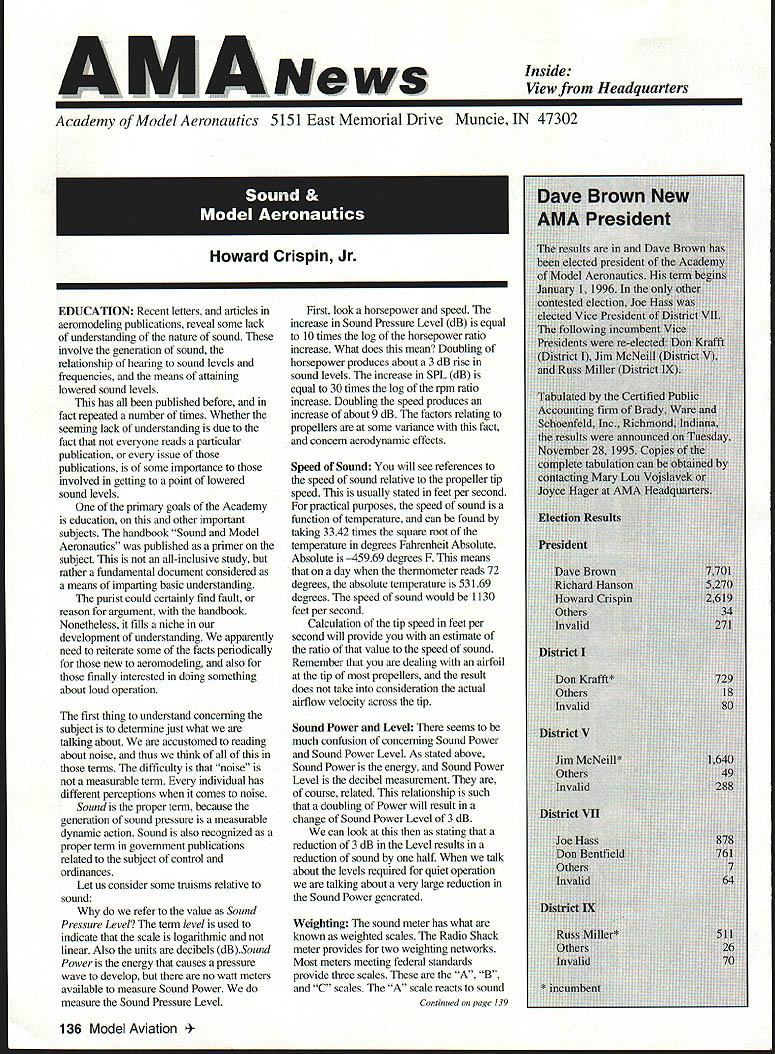
EDUCATION: Recent letters and articles in aeromodeling publications reveal some lack of understanding of the nature of sound. These involve the generation of sound, the relationship of hearing to sound levels and frequencies, and the means of attaining lowered sound levels.
This has all been published before, and in fact repeated a number of times. Whether the seeming lack of understanding is due to the fact that not everyone reads a particular publication, or every issue of those publications, is of some importance to those involved in getting to a point of lowered sound levels.
One of the primary goals of the Academy is education on this and other important subjects. The handbook "Sound and Model Aeronautics" was published as a primer on the subject. This is not an all-inclusive study, but rather a fundamental document considered as a means of imparting basic understanding.
The purist could certainly find fault, or reason for argument, with the handbook. Nonetheless, it fills a niche in our development of understanding. We apparently need to reiterate some of the facts periodically for those new to aeromodeling, and also for those finally interested in doing something about loud operation.
The first thing to understand concerning the subject is to determine just what we are talking about. We are accustomed to reading about noise, and thus we think of all of this in those terms. The difficulty is that "noise" is not a measurable term. Every individual has different perceptions when it comes to noise.
Sound is the proper term, because the generation of sound pressure is a measurable dynamic action. Sound is also recognized as a proper term in government publications related to the subject of control and ordinances.
Let us consider some truisms relative to sound:
- Why do we refer to the value as Sound Pressure Level? The term "level" is used to indicate that the scale is logarithmic and not linear. Also the units are decibels (dB). Sound Power is the energy that causes a pressure wave to develop, but there are no watt meters available to measure Sound Power. We do measure the Sound Pressure Level.
- First, look at horsepower and speed. The increase in Sound Pressure Level (dB) is equal to 10 times the log of the horsepower ratio increase. What does this mean? Doubling horsepower produces about a 3 dB rise in sound levels. The increase in SPL (dB) is equal to 30 times the log of the rpm ratio increase. Doubling the speed produces an increase of about 9 dB. The factors relating to propellers are at some variance with this fact, and concern aerodynamic effects.
- Speed of Sound: You will see references to the speed of sound relative to the propeller tip speed. This is usually stated in feet per second. For practical purposes, the speed of sound is a function of temperature and can be found approximately by taking 49.0 times the square root of the temperature in degrees Fahrenheit absolute (°R = °F + 459.69). Absolute zero is −459.69°F. This means that on a day when the thermometer reads 72°F, the absolute temperature is 531.69°R. The speed of sound would be approximately 1,130 ft/s.
- Calculation of the tip speed in feet per second will provide you with an estimate of the ratio of that value to the speed of sound. Remember that you are dealing with an airfoil at the tip of most propellers, and the result does not take into consideration the actual airflow velocity across the tip.
- Sound Power and Level: There seems to be much confusion concerning Sound Power and Sound Power Level. As stated above, Sound Power is the energy, and Sound Power Level is the decibel measurement. They are, of course, related. This relationship is such that a doubling of power will result in a change of Sound Power Level of 3 dB.
- We can look at this then as stating that a reduction of 3 dB in the Level results in a reduction of sound by one half. When we talk about the levels required for quiet operation we are talking about a very large reduction in the Sound Power generated.
- Weighting: The sound meter has what are known as weighted scales. The Radio Shack meter provides for two weighting networks. Most meters meeting federal standards provide three scales. These are the "A", "B", and "C" scales. The "A" scale reacts to sound much like the human ear; the "B" scale is less discriminating; the "C" scale is relatively flat over most of the range and is useful in determining frequency content (if C is much higher than A, much of the sound is below about 600 Hz).
(Continued on page 139)
---
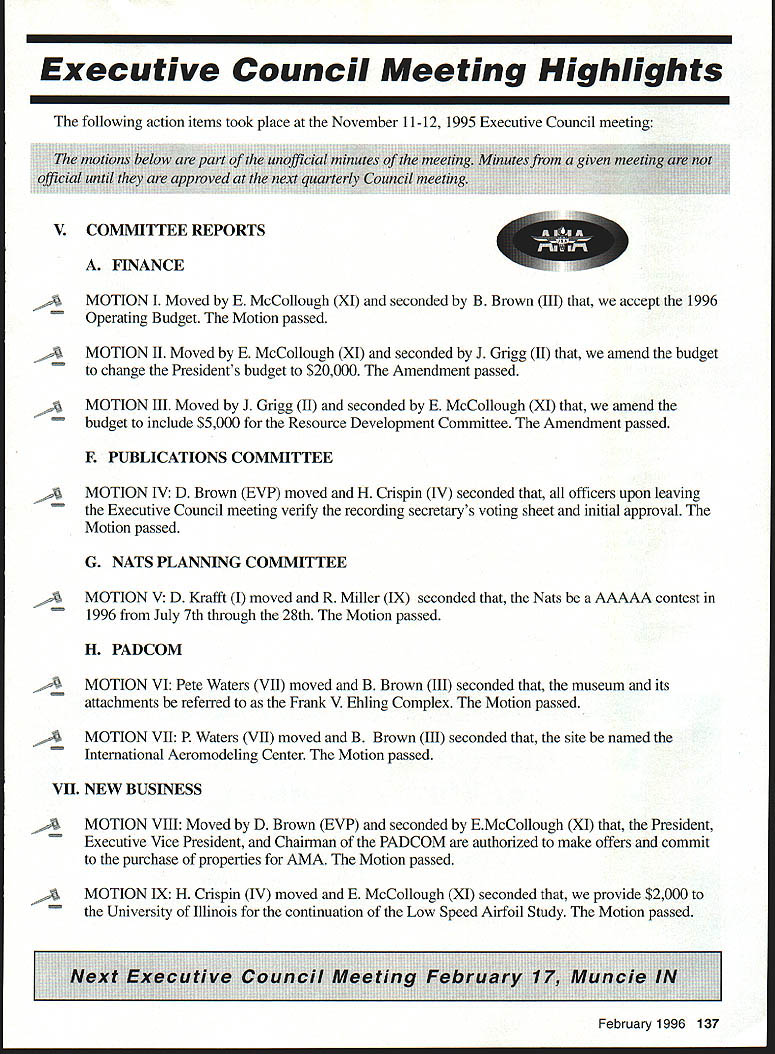
Executive Council Meeting Highlights
The following action items took place at the November 11–12, 1995 Executive Council meeting:
The motions below are part of the unofficial minutes of the meeting. Minutes from a given meeting are not official until they are approved at the next quarterly Council meeting.
V. COMMITTEE REPORTS
A. FINANCE
- MOTION I — Moved by E. McCollough (XI) and seconded by B. Brown (III) that we accept the 1996 Operating Budget. Motion passed.
- MOTION II — Moved by E. McCollough (XI) and seconded by J. Grigg (II) that we amend the budget to change the President's budget to $20,000. Amendment passed.
- MOTION III — Moved by J. Grigg (II) and seconded by E. McCollough (XI) that we amend the budget to include $5,000 for the Resource Development Committee. Amendment passed.
F. PUBLICATIONS COMMITTEE
- MOTION IV — D. Brown (EVP) moved and H. Crispin (IV) seconded that all officers, upon leaving the Executive Council meeting, verify the recording secretary's voting sheet and initial approval. Motion passed.
G. NATS PLANNING COMMITTEE
- MOTION V — D. Krafft (I) moved and R. Miller (IX) seconded that the Nats be an AAAAA contest in 1996 from July 7 through 28. Motion passed.
H. PADCOM
- MOTION VI — Pete Waters (VII) moved and B. Brown (III) seconded that the museum and its attachments be referred to as the Frank V. Ehling Complex. Motion passed.
- MOTION VII — P. Waters (VII) moved and B. Brown (III) seconded that the site be named the International Aeromodeling Center. Motion passed.
VII. NEW BUSINESS
- MOTION VIII — Moved by D. Brown (EVP) and seconded by E. McCollough (XI) that the President, Executive Vice President, and Chairman of the PADCOM are authorized to make offers and commit to the purchase of properties for AMA. Motion passed.
- MOTION IX — H. Crispin (IV) moved and E. McCollough (XI) seconded that we provide $2,000 to the University of Illinois for the continuation of the Low Speed Airfoil Study. Motion passed.
Next Executive Council Meeting: February 17, Muncie, IN.
---
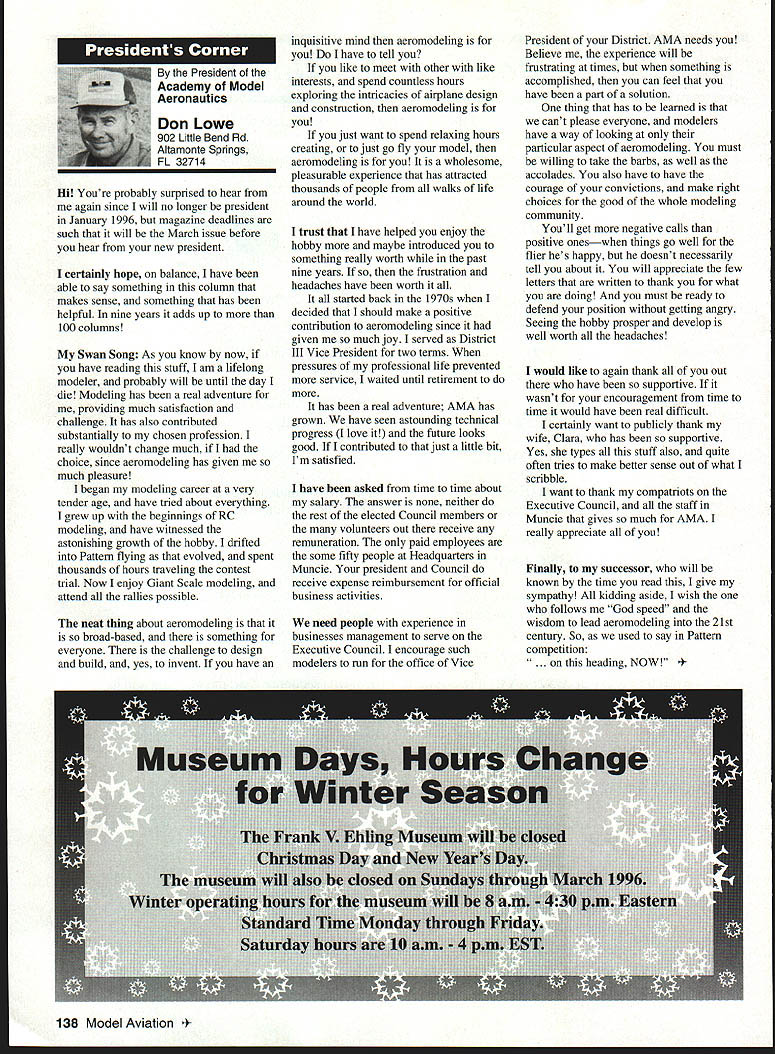
President's Corner
By the President of the Academy of Model Aeronautics
Don Lowe 902 Little Bend Rd. Altamonte Springs, FL 32714
Hi! You're probably surprised to hear from me again since I will no longer be president in January 1996, but magazine deadlines are such that it will be the March issue before you hear from your new president.
I certainly hope, on balance, I have been able to say something in this column that makes sense, and something that has been helpful. In nine years it adds up to more than 100 columns!
My Swan Song: As you know by now, if you have been reading this stuff, I am a lifelong modeler and probably will be until the day I die! Modeling has been a real adventure for me, providing much satisfaction and challenge. It has also contributed substantially to my chosen profession. I really wouldn't change much, if I had the choice, since aeromodeling has given me so much pleasure.
I began my modeling career at a very tender age, and have tried about everything. I grew up with the beginnings of RC modeling, and have witnessed the astonishing growth of the hobby. I drifted into Pattern flying as that evolved, and spent thousands of hours traveling the contest trail. Now I enjoy Giant Scale modeling, and attend all the rallies possible.
The neat thing about aeromodeling is that it is so broad-based, and there is something for everyone. There is the challenge to design and build, and, yes, to invent. If you have an inquisitive mind then aeromodeling is for you.
If you like to meet with others with like interests, and spend countless hours exploring the intricacies of airplane design and construction, then aeromodeling is for you!
If you just want to spend relaxing hours creating, or just go fly your model, then aeromodeling is for you! It is a wholesome, pleasurable experience that has attracted thousands of people from all walks of life around the world.
I trust that I have helped you enjoy the hobby more and maybe introduced you to something really worthwhile in the past nine years. If so, then the frustration and headaches have been worth it all.
It all started back in the 1970s when I decided that I should make a positive contribution to aeromodeling since it had given me so much joy. I served as District II Vice President for two terms. When pressures of my professional life prevented more service, I waited until retirement to do more.
It has been a real adventure; AMA has grown. We have seen astounding technical progress (I love it!) and the future looks good. If I contributed to that just a little bit, I'm satisfied.
I have been asked from time to time about my salary. The answer is none, neither do the rest of the elected Council members or the many volunteers receive any remuneration. The only paid employees are the some fifty people at Headquarters in Muncie. Your president and Council do receive expense reimbursement for official business activities.
We need people with experience in business management to serve on the Executive Council. I encourage such modelers to run for the office of Vice President of your District. AMA needs you! Believe me, the experience will be frustrating at times, but when something is accomplished, you can feel that you have been part of a solution.
One thing that has to be learned is that we can't please everyone, and modelers have a way of looking at only their particular aspect of aeromodeling. You must be willing to take the barbs as well as the accolades. You also have to have the courage of your convictions, and make right choices for the good of the whole modeling community.
You'll get more negative calls than positive ones — when things go well for the flier he's happy, but he doesn't necessarily tell you about it. You will appreciate the few letters that are written to thank you for what you are doing! And you must be ready to defend your position without getting angry. Seeing the hobby prosper and develop is well worth all the headaches!
I would like to again thank all of you out there who have been so supportive. If it wasn't for your encouragement from time to time it would have been really difficult.
I certainly want to publicly thank my wife, Clara, who has been so supportive. Yes, she types all this stuff also, and quite often tries to make better sense out of what I scribble.
I want to thank my compatriots on the Executive Council, and all the staff in Muncie that gives so much for AMA. I really appreciate all of you!
Finally, to my successor, who will be known by the time you read this, I give my sympathy! All kidding aside, I wish the one who follows me "God speed" and the wisdom to lead aeromodeling into the 21st century. So, as we used to say in Pattern competition: "...on this heading, NOW!"
---
AMA News
EDUCATION
Academy of Model Aeronautics 5151 East Memorial Drive, Muncie, IN 47302
Recent letters and articles in aeromodeling publications reveal some lack of understanding of the nature of sound, the generation of sound, the relationship of hearing to sound levels and frequencies, and the means of attaining lowered sound levels. I have published on the subject before and the fact is repeated a number of times. Whether this seeming lack of understanding is due to the fact that everyone reads a particular publication issue or to other reasons, these publications have some importance in getting the point of lowered sound levels as a primary goal of Academy education.
There are other important subjects in the handbook Sound and Model Aeronautics published as a primer on the subject — not an all-inclusive study, rather a fundamental document considered as a means of imparting basic understanding. A purist could certainly find fault or argue with the handbook. Nonetheless it fills a niche in development of understanding and apparently there is a need to reiterate some facts periodically for the new aeromodeling enthusiast who is finally interested in doing something about loud operation.
The first thing to understand concerning the subject is to determine just what we are talking about. We are accustomed to reading about noise and thus think of it in those terms. Noise is not a measurable term; an individual has different perceptions of what constitutes noise. Sound is the proper term because the generation of sound pressure is a measurable dynamic action. Sound is also the proper term used in government publications related to the subject of noise control and ordinances. Let us consider some truisms relative to sound.
Refer: Sound Pressure Level — the term "level" is used to indicate a scale logarithmic rather than linear. Units are decibels (dB). Sound Power is the energy that causes the pressure wave to develop, but no watt meters are available to measure Sound Power; we measure Sound Pressure Level.
- First, look at horsepower and speed increase. Change in Sound Pressure Level in dB equals 10 times the log of the horsepower ratio increase. Doubling horsepower produces about a 3 dB rise in sound level. Increase in SPL in dB equals 30 times the log of the rpm ratio increase. Doubling speed produces an increase of about 9 dB (factors relating to propellers cause some variance; aerodynamic effects are a factor).
- Concerning speed of sound — you will see references to speed of sound relative to propeller tip speed, usually stated in feet per second. For practical purposes, speed of sound is a function of temperature and can be found by taking approximately 49.0 times the square root of the temperature in degrees Fahrenheit absolute (°R = °F + 459.69). When the thermometer reads 72°F, absolute temperature is 531.69°R and speed of sound is about 1,130 ft/s. Calculation of tip speed in ft/s will provide an estimate of the ratio of tip speed to speed of sound. When dealing with airfoil tips of propellers, the result does not consider the actual airflow velocity across the tip.
- Sound Power Level can cause confusion. Sound Power is the energy; Sound Power Level is a decibel measurement. A doubling of power will result in a 3 dB change in Sound Power Level. Thus, a reduction of 3 dB means about half the sound power. Quiet operation requires very large reductions in Sound Power generated.
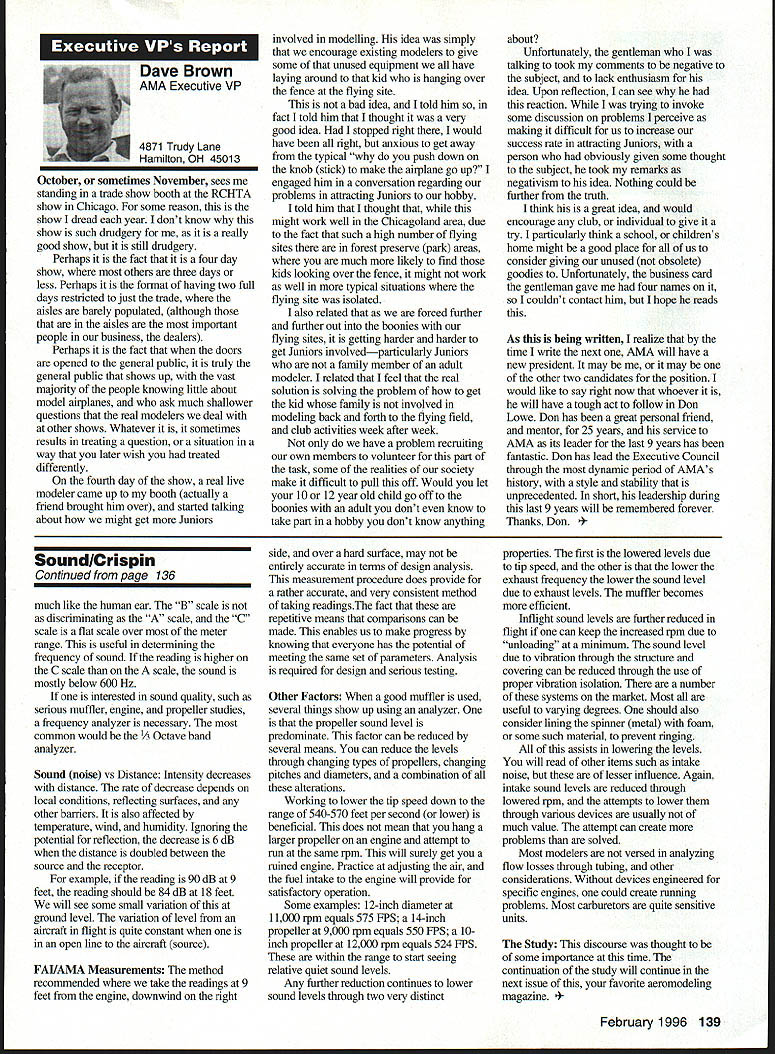
- Weighting: Sound meters have weighted scales. Radio Shack meters provide two weighting networks. Most meters meeting federal standards provide three scales: A, B, and C. The A scale reacts much like the human ear. The B scale is not as discriminating as A, and the C scale is flat over most of the meter range and useful in determining frequency content. If the reading is higher on the C scale than on the A scale, the sound is mostly below about 600 Hz.
- If one is interested in sound quality, such as serious muffler, engine, and propeller studies, a frequency analyzer is necessary. The most common would be the 1/3 octave band analyzer.
- Sound (noise) vs Distance: Intensity decreases with distance. The rate of decrease depends on local conditions, reflecting surfaces, and any other barriers. It is also affected by temperature, wind, and humidity. Ignoring reflections, the decrease is 6 dB when the distance is doubled between the source and the receptor. For example, if the reading is 90 dB at 9 feet, the reading should be about 84 dB at 18 feet. There will be small variations at ground level. The variation of level from an aircraft in flight is quite constant when one is in an open line to the aircraft.
- FAI/AMA Measurements: The recommended method takes readings at 9 feet from the engine, downwind on the right side, and over a hard surface. This may not be entirely accurate for design analysis, but it provides a consistent and repeatable method for comparisons. Consistency enables progress by allowing everyone to meet the same parameters. Analysis is still required for design and serious testing.
- Other Factors: With a good muffler, propeller sound is often predominant. Levels can be reduced by changing propeller type, pitch, and diameter, and by lowering tip speed to the range of roughly 540–570 ft/s or lower. This does not mean hanging a larger propeller on an engine and attempting to run at the same rpm — that can cause problems. Adjusting air- and fuel-intake for the engine will help.
Examples:
- 12-inch diameter at 11,000 rpm ≈ 575 ft/s tip speed.
- 14-inch propeller at 9,000 rpm ≈ 550 ft/s.
- 10-inch propeller at 12,000 rpm ≈ 524 ft/s.
Further reduction lowers sound levels via two properties: lower tip speed and lower exhaust frequency (muffler becomes more efficient). Inflight sound levels are reduced if one can keep increased rpm due to "unloading" at a minimum. Structural vibration and covering noise can be reduced with proper vibration isolation; lining the metal spinner with foam can prevent ringing.
Intake noise is of lesser influence and is reduced through lowered rpm. Attempts to reduce intake noise with devices often cause more problems than they solve. Carburetors and flow losses through tubing are sensitive and require development for specific engines.
This discourse is intended to be of importance. Continuation of the study will appear in the next issue.
---
Executive Director's View from HQ
Jerry Rouillard AMA Executive Director 5151 E. Memorial Dr. Muncie, IN 47302
THE INFORMATION AGE
When talk turns to "information systems," some people get interested, and some get edgy. The difference is usually defined along the lines of something called "computer literacy." If you are computer literate, you enjoy jumping into the discussion of bits and bytes. If you're not computer literate, you probably start looking for someone who still speaks English and doesn't confuse and bore you at the same time.
Regardless of who you are, there's little question that information systems affect nearly everything about your life. And that includes your membership in AMA.
AMA is in the information business. The effective handling of information is critical to the mission of our organization. Our future success is tied directly to our ability to handle large volumes of information efficiently and effectively. Some may argue that we are in the model airplane business, but what we really do on a day-to-day basis is gather, process, and disseminate information; information that enables "The Academy" (AMA Mission Statement, 1994) to provide leadership, organization, competition, protection, representation, recognition, education and scientific/technical development to modelers and other organizations.
But information doesn't come cheap in the information age, and the way we handle our information is currently one of the most critical aspects of the Academy's future success. It is critical because information handling has evolved so rapidly that few organizations can stay ahead of their needs unless they update their information systems on an almost constant basis.
Like a majority of membership associations, AMA has had problems deciding how to handle the complicated issue of updating its information technology. Move too fast and you end up with an expensive mistake. Move too slowly and you find yourself on the back side of the power curve, with too little capacity and members wondering why the computer keeps fouling up their records.
Expectation levels are far different in 1995 than they were years ago. When all of our members sent in their membership applications by mail and paid by check, they were usually willing to wait a couple of weeks for confirmation. With more applications coming in by fax and paid by credit card, expectation levels demand quicker response.
The information technology AMA now possesses is in need of updating. It's not a hardware problem. We have a networked set of personal computers that is more than adequate. This hardware and the network are the territory of Systems Manager David Norris and his assistant Rick Craig. Dave is the technical wizard who keeps everyone in computing power at the Academy. He has rebuilt many aging PCs into upgraded machines to handle modern operating systems and software. With Rick's help, Dave keeps the hardware running and keeps all our employees in the net.
The software situation is different. The Academy's membership database system is running out of capacity, sophistication, and adaptability. It evolved in a less-demanding environment, requires high maintenance, and lacks the ability to handle increasing demands of a modern distributed processing system.
We are on the way to a new solution. This past summer, AMA hired Greg Minch to take over a project that will bring a new membership database online at Headquarters within the next year. The project had been plagued by missteps and had been shunted to the back burner because of quick fixes on the old system.
Instead of doing everything in-house, we asked a consulting firm to determine our needs and advise how to satisfy them. We hired a firm that wasn't selling a hardware or software solution of their own. They talked to staff, reviewed operations, and asked the kinds of questions they ask other membership associations with similar needs. We then solicited proposals from leading vendors and formed a User Committee to evaluate proposals and recommend the best fit. Greg is coordinating and will oversee development and implementation. By next summer, AMA will be testing the new system alongside the current version.
It would be nice to say that once the new system is in place the job will be done. The reality is we will continue to need development as technology evolves rapidly. Next time we will start working on solutions earlier; in the information business, it's tough to play catch-up.
---
AMA News
Academy of Model Aeronautics 5151 East Memorial Drive Muncie, IN 47302
EDUCATION (summary)
Recent letters and articles show a continuing need to educate modelers about sound, its measurement, and means to reduce it. The handbook Sound and Model Aeronautics serves as a primer. Key points covered include:
- "Noise" is subjective; "sound" (sound pressure) is measurable in decibels (dB).
- Sound Pressure Level uses a logarithmic scale; doubling power ≈ +3 dB, doubling rpm ≈ +9 dB (propeller aerodynamics may vary results).
- Tip speed relative to speed of sound matters; aim to keep tip speed in a quieter range (examples given earlier).
- Sound meters use A, B, and C weighting; use frequency analyzers for detailed studies.
- Sound intensity decreases roughly 6 dB with each doubling of distance in open conditions.
- FAI/AMA measurement protocol (9 ft, downwind, right side, hard surface) gives consistent, repeatable results helpful for comparisons.
- Mufflers, prop selection, lower tip speeds, and vibration isolation are effective measures to reduce sound; intake noise is less influential and often not worth aggressive mitigation attempts that could cause running problems.
Continuation of the study will appear in a future issue.
---
AMA News — Club & Member Notes
The Academy of Model Aeronautics will have its own web site in the near future. Until that happens, contact Vice President Bob Brown at rlb4@pitt.edu.
Leader Club Awards:
- Gold Leader Club: Northeast Philadelphia R/C Club.
- Silver Leader Club: Westerville Model Aeronautics Association of Columbus, Ohio.
Contact Jay Mealy at AMA Headquarters for information on the Leader Club program.
Club Highlights:
- The Jackson County Aeromodelers (Jackson County, WV) feature an Andrews Aeromaster built by Rolla Wallace in 1968.
- Wayne County R/C Flyers (Wooster, OH) received front-page coverage in The Daily Record with five color pictures. Congratulations to president Greg Hildebrand and the club.
- Tri County Wingsnappers (Hamburg, PA) hosted a successful Swap Meet and planned a Second Annual Swap Meet on March 23, 1996. Their Fun Fly is scheduled for June 15–16. Contact Walter Gladney, 665 Dunkels Church Road, Kutztown, PA 19530.
- Bob Evans Fly-In: The 7th Annual event hosted by the RC Aces of Jackson, OH and the Mountaineers and Hillbillies RC Clubs of Charleston, WV had over fifty pilots registered at Bob Evans' Farm in Rio Grande, OH. Bill Carper organized the event.
---
DISTRICT IV REPORT
Delaware / District of Columbia / Maryland / North Carolina / Virginia
Howard Crispin Vice President 611 Beechwood Drive Charlottesville, VA 22901
Associate Vice Presidents:
- Robert E. Babura, 117 Otis Drive, Severn, MD 21144-1130 — Phone: (410) 969-9356
- Douglas Barry, 5300 Olde Millbrooke Dr., Glen Allen, VA 23060
- Allen Eklund, 8415 Maeve Ct., Clemmons, NC 27012
- Bob Champine, 205 Tipton Road, Newport News, VA 23606-3663
- Chuck Foreman, 412 Pine Cone Ct., Kill Devil Hill, NC 27948
- Doug Holland, 3517 Fernwood Drive, Raleigh, NC 27612-6215
- Scotty Moyer, 11 Orchard Lane, Wilmington, DE 19809-1719
- Richard (Dick) Smith, 761 Gwynne Avenue, Waynesboro, VA 22980-3346
Frequency Coordinator:
- Paul Yacobucci, 6408 Winthrop Drive, Fayetteville, NC 28311-1007 — Evening: (919) 488-5986
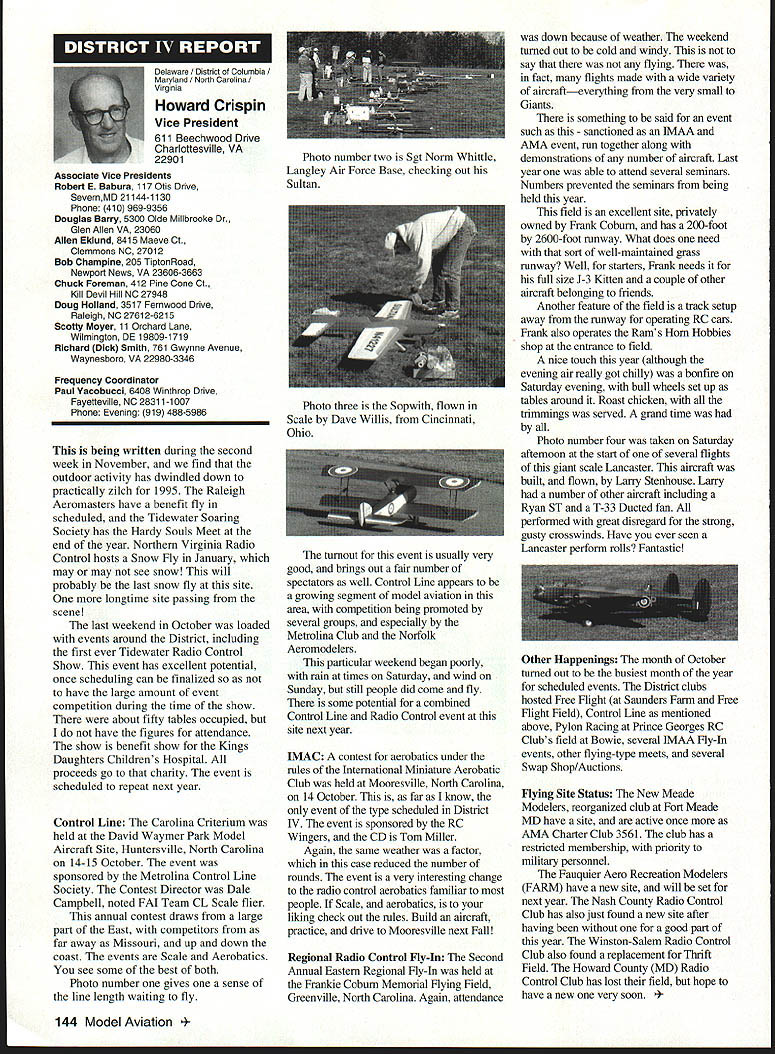
This was written during the second week in November, and outdoor activity has dwindled to practically nil for 1995. Highlights:
- Raleigh Aeromasters hosted a benefit fly-in; Tidewater Soaring Society held the Hardy Souls Meet; Northern Virginia Radio Control hosts a Snow Fly in January (may be final at that site).
- The first Tidewater Radio Control Show was held in late October with about fifty tables; proceeds benefit the Kings Daughters Children's Hospital. The show is scheduled to repeat next year.
- Control Line: The Carolina Criterium was held at David Waymer Park Model Aircraft Site, Huntersville, NC (14–15 October), sponsored by the Metrolina Control Line Society. Events included Scale and Aerobatics; attendance drew competitors from across the East and spectators.
- IMAC: An aerobatics contest under International Miniature Aerobatic Club rules was held at Mooresville, NC (14 October), sponsored by the RC Wingers; CD was Tom Miller.
- Regional Radio Control Fly-In: The Second Annual Eastern Regional Fly-In was held at the Frankie Coburn Memorial Flying Field, Greenville, NC. Attendance was down due to cold, windy weather. The field features a 200' x 2,600' runway and on-site RC car track; Frank Coburn operates Ram's Horn Hobbies at the entrance. The event included a bonfire and community dinner.
- Other October events included Free Flight meets, Pylon Racing, several IMAA Fly-Ins, and Swap-Shops/Auctions.
Flying Site Status:
- New Meade Modelers (reorganized at Fort Meade, MD) regained a site and AMA Charter Club status (3561), with military priority membership.
- Fauquier Aero Recreation Modelers (FARM) secured a new site for next year.
- Nash County Radio Control Club and Winston-Salem Radio Control Club found replacement sites.
- Howard County (MD) Radio Control Club lost their field but hope to secure a new one soon.
---
DISTRICT V REPORT
Jim McNeill Vice President 617 South 20 Avenue Birmingham, AL 35205 Phone/FAX: (205) 252-2654
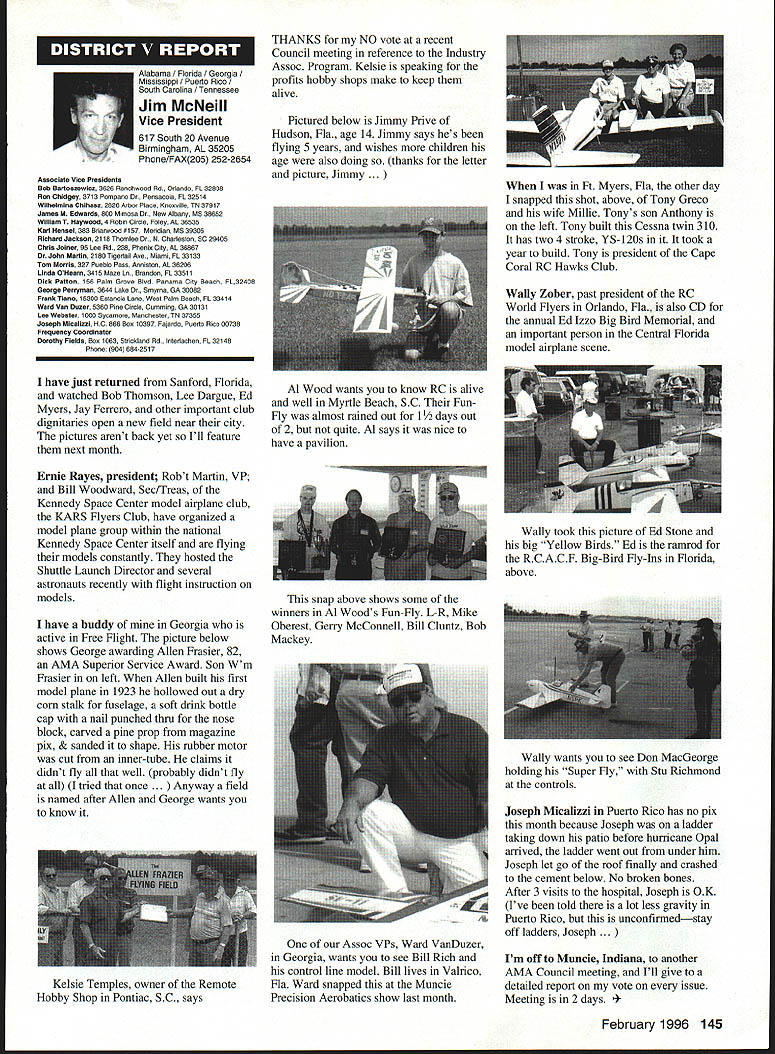
I have just returned from Sanford, Florida, where Bob Thomson, Lee Dargue, Ed Myers, Jay Ferrero, and others opened a new field near the city. Photos will appear next month.
KARS Flyers Club (Kennedy Space Center): Ernie Rayes (president), Rob't Martin (VP), and Bill Woodward (Sec/Treas) organized a model plane group within the Kennedy Space Center that is active and has hosted the Shuttle Launch Director and several astronauts with flight instruction.
Free Flight note: Allen Frasier, 82, received an AMA Superior Service Award. Allen built his first model in 1923 using materials like a dry corn stalk and a carved pine prop. A field is named after Allen.
---
DISTRICT VI REPORT
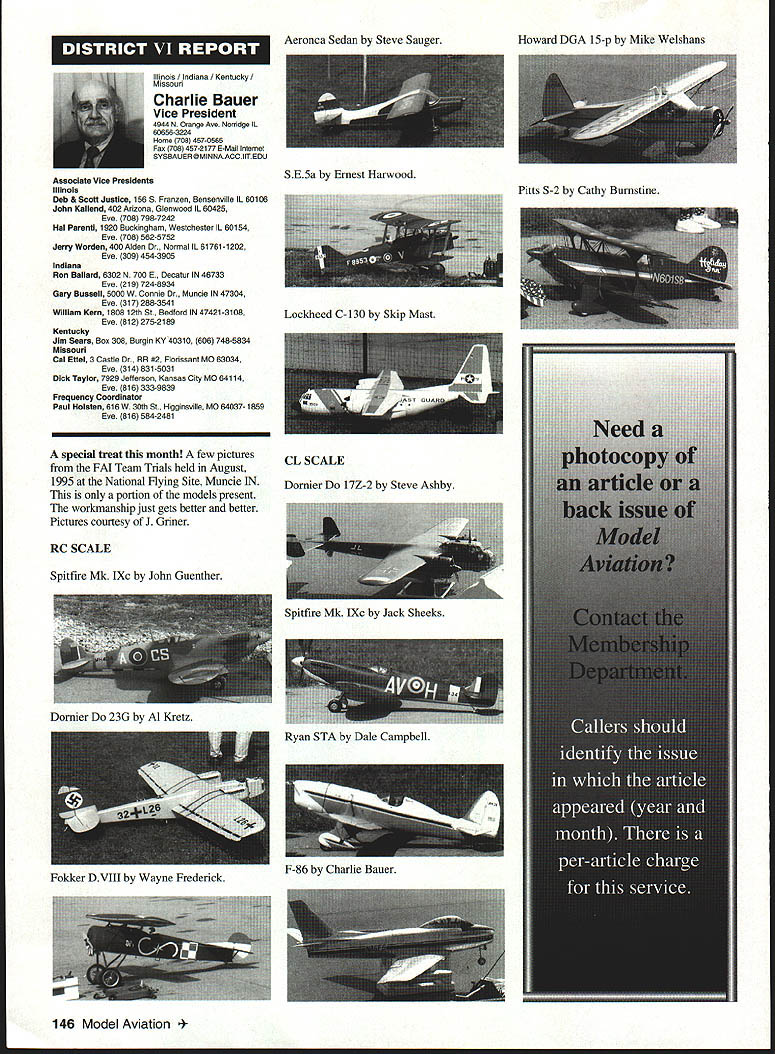
Special treat this month: photos from the FAI Team Trials held in August 1995 at the National Flying Site, Muncie, IN. The workmanship on the models continues to improve. Pictures courtesy of J. Griner.
RC SCALE
(Photos and captions referenced.)
---
DISTRICT VII REPORT
Iowa / Michigan / Minnesota / Wisconsin
Peter Waters Vice President 7420 7 Mile Rd. Northville, MI 48167 Phone: (810) 486-4800 — FAX: (810) 486-1603
Assistant Vice President:
- Don Bentfield, 1440 W. Minnehaha Avenue, St. Paul, MN 55104 — Phone: (612) 645-2984
PR/Insurance Coordinator:
- Don Joseph, H.S. 5394 English Drive, Troy, MI 48098
Associate Vice Presidents:
- Dave Gish, 5435 State Hwy. 99, Wapello, IA 52653
- Bud Gorman, P.O. Box 33, Knife River, MN 55609
- Russell Knetzer, 2625 E. Shorewood Boulevard, Milwaukee, WI 53211
- Jean Lakes, 305 Patti Place, Holland, MI 49423
- Bill Millar, 712 Grand Ave., Petoskey, MI 49770
- Carl Mohs, 5024 Lake Mendota Drive, Madison, WI 53705
- Mark E. Robotti, 26540 Olympic Trail, North Lindstrom, MN 55045
- Mike Zingery, 6496 S. Summerton Rd., Shepherd, MI 48883-9308
Frequency Coordinators:
- (West) Al Schwartz, 2787 Fernwood, Roseville, MN 55113
- (East) Bert Kelly, P.O. Box 39001, Redford, MI 48239
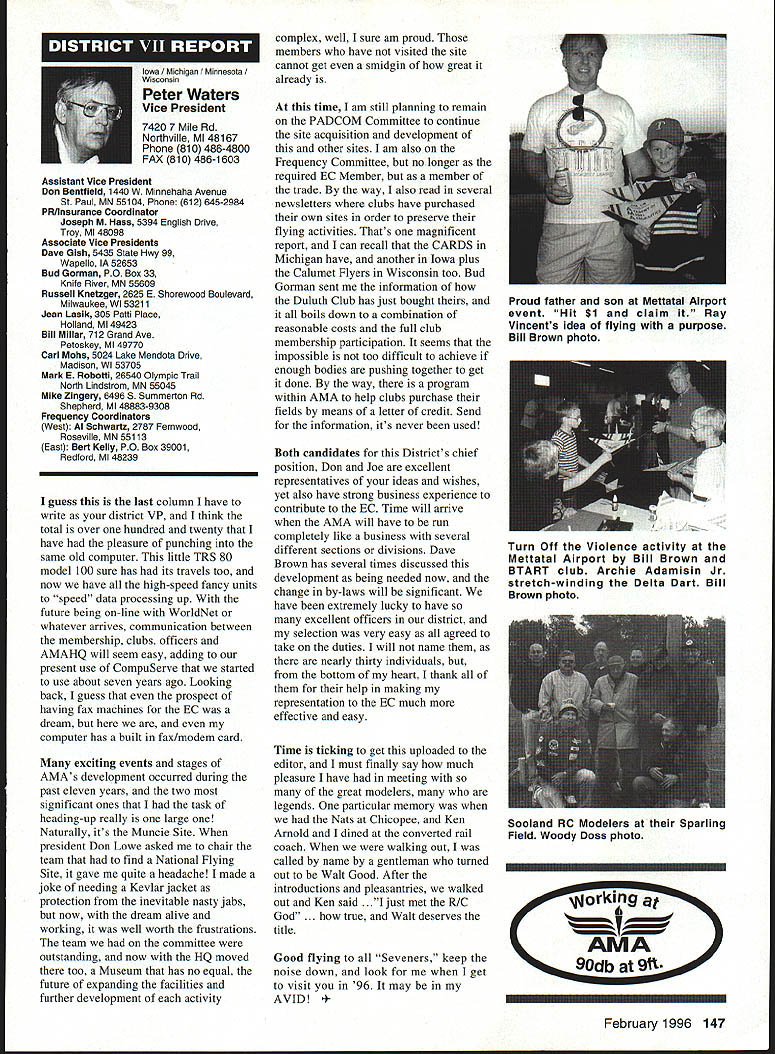
This may be my last column as your district VP; I believe I've written over 120 columns. Technology has advanced since I began (even my old TRS 80 Model 100 has traveled). Communication options like WorldNet and CompuServe make membership communication easier. Fax machines for the Executive Council were once a dream.
Significant accomplishments over the past eleven years include the Muncie Site. When President Don Lowe asked me to chair the team to find a National Flying Site, it was a challenge but ultimately rewarding. With HQ moved to Muncie and the Museum on-site, the facilities are excellent.
I plan to remain on PADCOM to continue site acquisition and development and to remain on the Frequency Committee as a non-EC member.
Clubs buying their own sites (CARDS in Michigan, clubs in Iowa and Wisconsin, Duluth club) demonstrate that purchasing a site is achievable with full membership participation. AMA has a program to help clubs purchase fields via a letter of credit — contact HQ for information.
Both candidates for the District chief position (Don and Joe) are excellent. AMA will need to operate more like a business in the future, with potential by-law changes.
I appreciate the many officers and nearly thirty volunteers who assisted me; their help made representation to the EC effective.
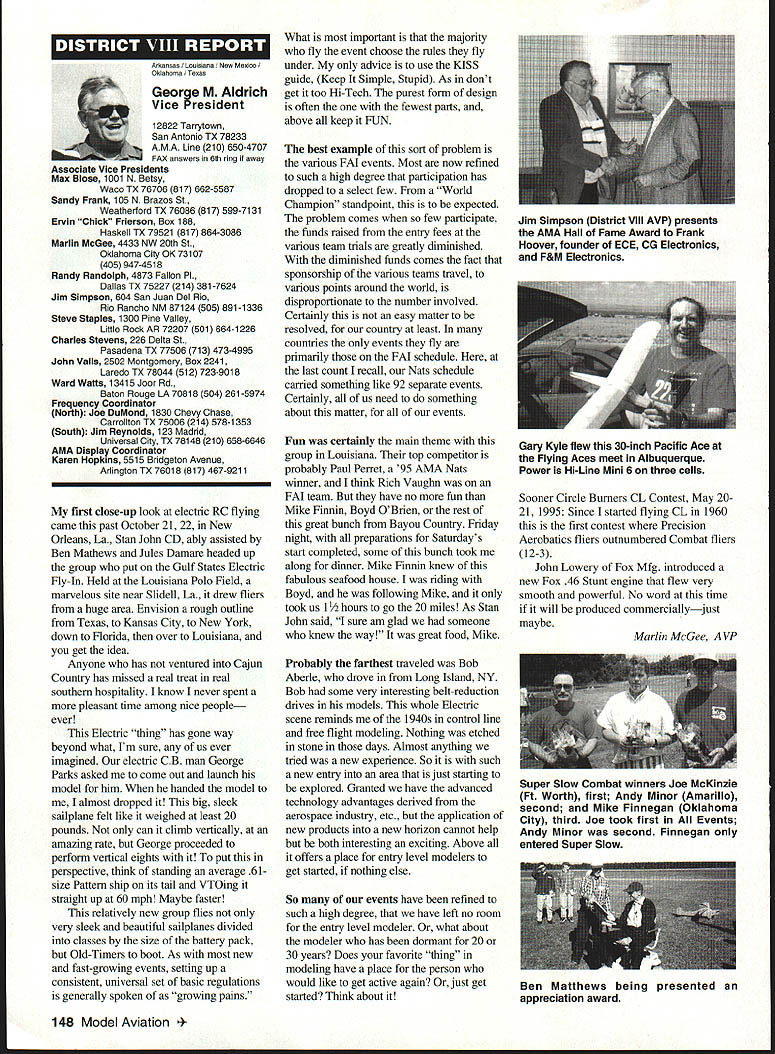
Electric RC flying: My first close-up look was October 21–22 in New Orleans at the Gulf States Electric Fly-In (CD Stan John). The event drew flyers from a wide area. Electric flight has progressed beyond expectations: sleek sailplanes with impressive vertical performance and VTO capability. Electric classes are divided by battery pack size. The scene resembles the experimental period of the 1940s in control line and free flight — lots of new ideas and experimentation.
Advice: Keep rules simple (KISS — Keep It Simple, Stupid). Don't overcomplicate entry-level events. Many refined events exclude entry-level participants. We must keep a place for new and returning modelers.
Good flying to all "Seveners," keep the noise down, and look for me when I visit you in '96.
---
DISTRICT IX REPORT
Colorado / Kansas / Nebraska / North Dakota / South Dakota / Wyoming
Russ Miller Vice President P.O. Box 128 Solen, ND 58570 Days: (701) 445-3332 — Evenings: (701) 220-3190 — Fax: (701) 445-3323
Associate Vice Presidents:
- Max Hansen, 1909 Wisconsin SW, Huron, SD 57350
- Nathan Lancaster, 3597 S. Kendall Street, Denver, CO 80235
- Travis McGinnis, 8027 W. 81st Circle, Arvada, CO 80005
- Loren Moore, 607 E. Vera St., Bottineau, ND 58318
- Don Moden, 410 Hart St., Salina, KS 67401
- Jim Ricketts, 4921 Fernwood Drive, Sioux Falls, SD 57103-5573
- Jack L. Siebert, 3611 Kimberly Circle, Lincoln, NE 68506-4524
- Chuck Smith, 1091 Cheshire Street, Casper, WY 82609-2314
Frequency Coordinator:
- Steve Mangiles, c/o Radio Service Center, 918 S. Sheridan, Denver, CO 80226
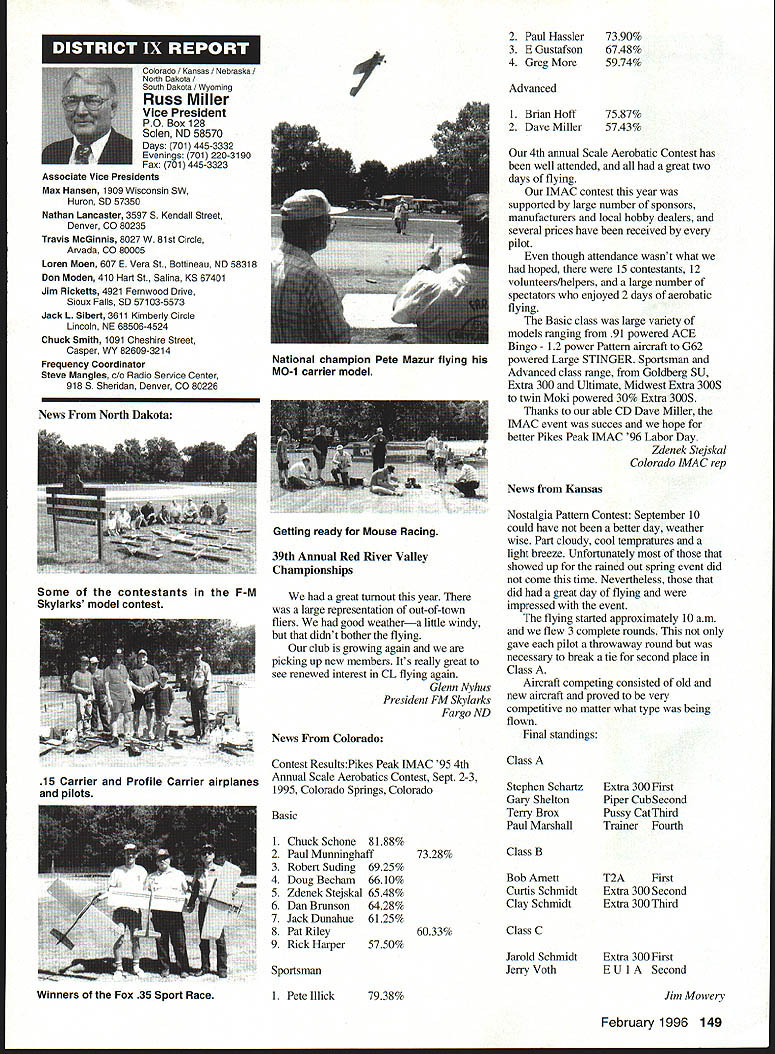
News From North Dakota
39th Annual Red River Valley Championships:
- Great turnout with many out-of-town fliers.
- Weather: a bit windy but flying continued.
- Club growing and picking up new members.
- Glenn Nyhus, President FM Skylarks, Fargo, ND.
News From Colorado
Contest Results — Pikes Peak IMAC '95, 4th Annual Scale Aerobatics Contest, Sept. 2–3, 1995, Colorado Springs, CO
Basic:
- Chuck Schone — 81.88%
- Paul Munninghoff — 73.28%
- Robert Suding — 69.25%
- Doug Becham — 66.10%
- Zdenek Stejskal — 65.48%
- Dan Brunson — 64.28%
- Jack Dunahue — 61.25%
- Pat Riley — 60.33%
- Rick Harper — 57.50%
Sportsman:
- Pete Illick — 79.38%
- Paul Hassler — 73.90%
- E. Gustafson — 67.48%
- Greg Moro — 59.74%
Advanced:
- Brian Hoff — 75.87%
- Dave Miller — 57.43%
The event was supported by sponsors, manufacturers, and local hobby dealers. Attendance included 15 contestants, 12 volunteers/helpers, and many spectators. Thanks to CD Dave Miller.
News from Kansas
Nostalgia Pattern Contest (September 10):
- Weather: part cloudy, cool, light breeze.
- Three rounds flown with a throwaway round.
- Final standings:
Class A:
- 1st Stephen Schartz — Extra 300
- 2nd Gary Shelton — Piper Cub
- 3rd Terry Brox — Pussy Cat
- 4th Paul Marshall — Trainer
Class B:
- 1st Bob Arnett — T2A
- 2nd Curtis Schmidt — Extra 300
- 3rd Clay Schmidt — Extra 300
Class C:
- 1st Jarold Schmidt — Extra 300
- 2nd Jerry Voth — E U I A
Reported by Jim Mowery.
---
AMA News (District X & General Items)
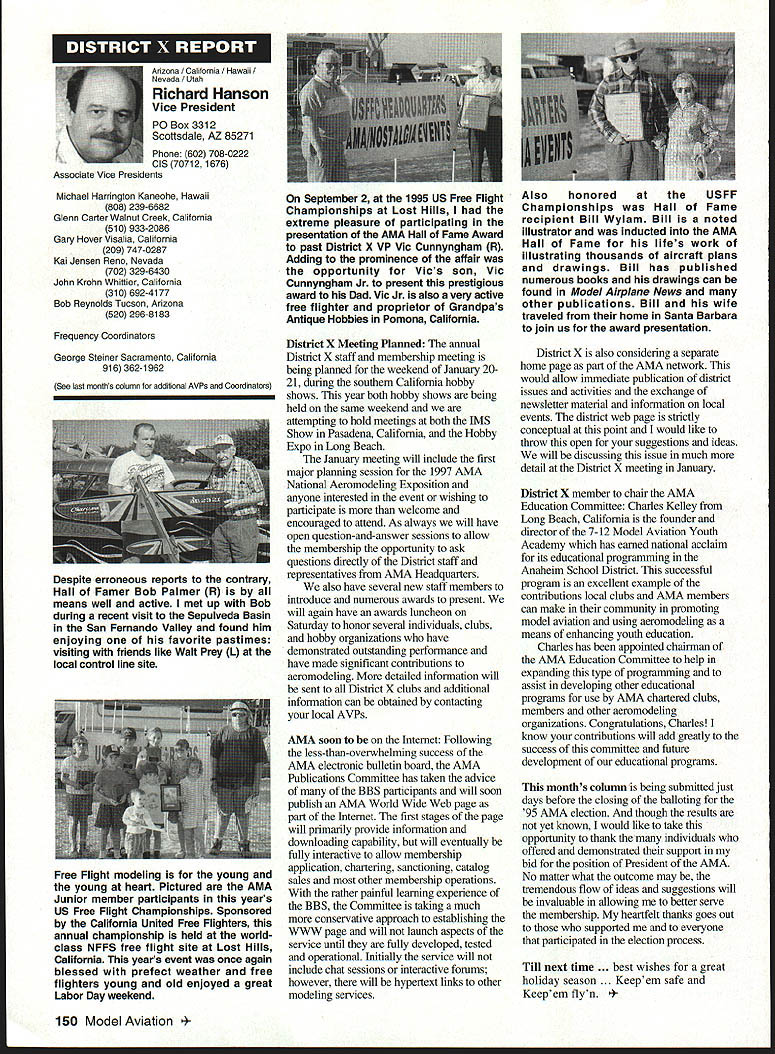
On September 2, at the 1995 US Free Flight Championships at Lost Hills, the AMA Hall of Fame Award was presented to past District X VP Vic Cunningham. Vic's son, Vic Cunningham Jr., presented the award. Vic Jr. is an active free flighter and proprietor of Grandpa's Antique Hobbies in Pomona, CA.
District X Meeting Planned:
- Annual District X staff and membership meeting planned for the weekend of January 20–21 during southern California hobby shows (IMS Show in Pasadena and Hobby Expo in Long Beach).
- The meeting will include planning for the 1997 AMA National Aeromodeling Exposition. Open Q&A sessions, staff introductions, and awards luncheon will be included. Details will be sent to District X clubs.
AMA on the Internet:
- Following the AMA electronic bulletin board experience, the Publications Committee will publish an AMA World Wide Web page. Initial stages will provide information and downloads, with eventual interactivity for membership application, chartering, sanctioning, catalog sales, etc. The launch will be conservative and tested; initial service will not include chat or interactive forums but will include hypertext links to other modeling services.
- District X is considering a district home page to publish events and exchange newsletter material.
Education Committee:
- Charles Kelley (Long Beach, CA), founder/director of the 7–12 Model Aviation Youth Academy, has been appointed chairman of the AMA Education Committee to expand educational programming for clubs and organizations.
Thanks and best wishes for the holiday season. Keep them safe and keep them flyin'.
---
AMA News — Hall of Fame & Northwest
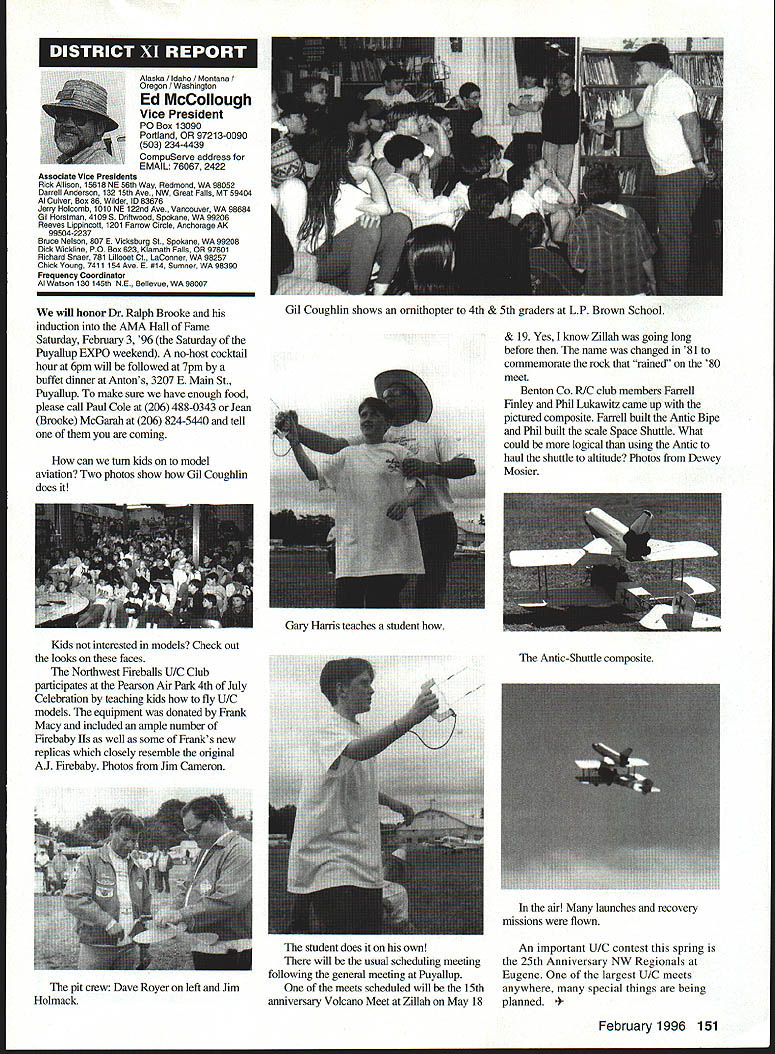
We will honor Dr. Ralph Brooke on his induction into the AMA Hall of Fame Saturday, February 3, 1996 (the Saturday of the Puyallup EXPO weekend). A no-host cocktail hour at 6:00 pm will be followed at 7:00 pm by a buffet dinner at Anton's, 3207 E. Main St., Puyallup. To reserve, call Paul Cole at (206) 488-0343 or Jean (Brooke) McGarah at (206) 824-5440.
How can we turn kids on to model aviation? Examples:
- Gil Coughlin and the Northwest Firebabies U/C Club teach kids to fly U/C models at the Pearson Air Park 4th of July Celebration. Equipment donated by Frank Macy included several Firebaby II's and replicas of the A.J. Firebaby. Photos by Jim Cameron.
- Student solo flight photos demonstrate success of hands-on teaching.
Scheduling meeting will follow the general meeting at Puyallup. The 15th anniversary Volcano Meet at Zillah is scheduled for May 18–19. The Benton Co. R/C Club composite (Antic Bipe towing a scale Space Shuttle) is highlighted — Farrell Finley built the Antic Bipe and Phil Lukawitz built the scale Space Shuttle. Photos from Dewey Mosier.
An important U/C contest this spring is the 25th Anniversary NW Regionals at Eugene — one of the largest U/C meets anywhere with special plans expected.
---
Transcribed from original scans by AI. Minor OCR errors may remain.

