
A CELEBRATION OF EAGLES
John Worth
The Greatest Reunion of All Time! A sellout of all overnight accommodations in the Muncie area was most likely at press time for the July 6–7, 1996 Celebration of Eagles weekend. Planning for the Sunday‑night banquet was based on 300–400 attendees — almost 250 were confirmed at the end of April and another 400 had indicated "maybe" or "hope so" by mid‑May.
But there's more to it than numbers. The names of those expected are the big story. Imagine, for example, Bert Pond, who was at the first Nationals more than 70 years ago in 1925 (St. Louis), and who proxy‑flew the winning Moffett International Contest entry from New Zealand at the 1936 Nationals (Detroit), coming along with wife Norma.
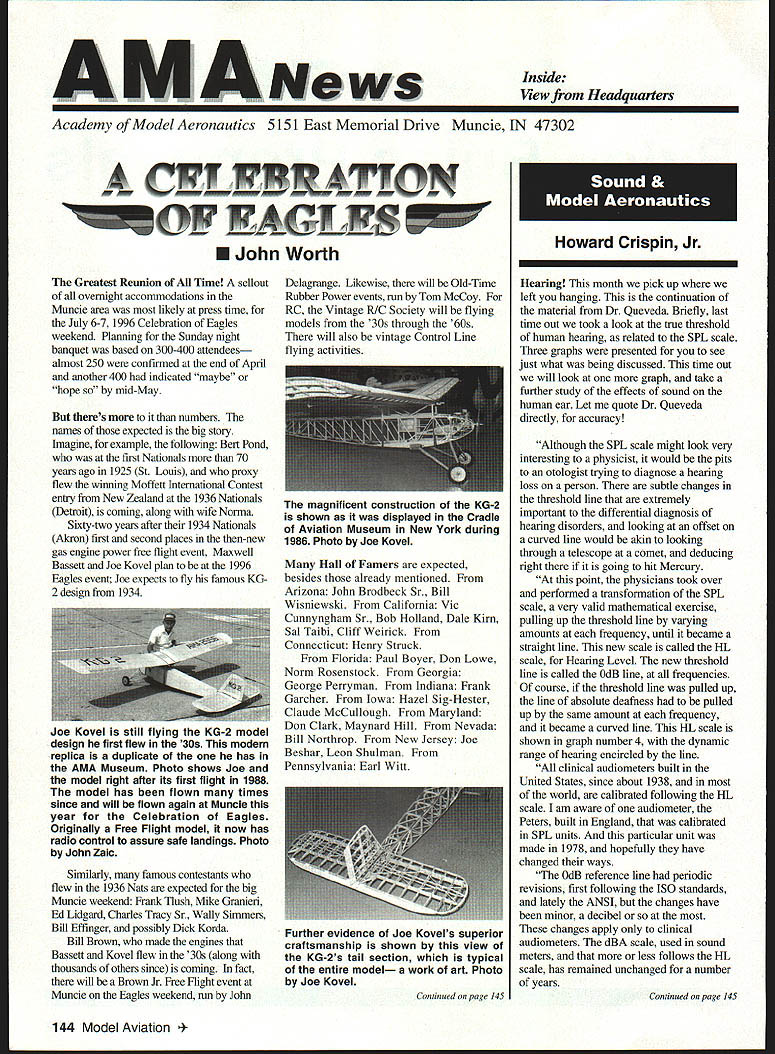
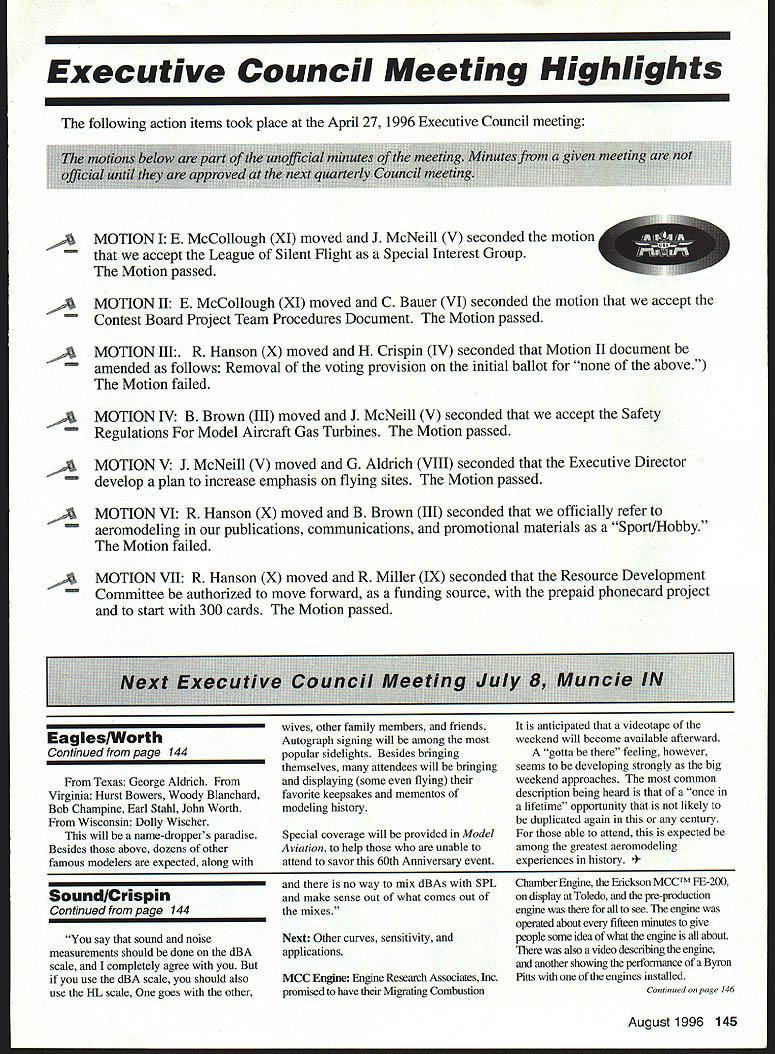
Sixty‑two years after their 1934 Nationals (Akron) first and second places in the then‑new gas‑engine power free‑flight event, Maxwell Bassett and Joe Kovel plan to be at the 1996 Eagles event; Joe expects to fly his famous KG‑2 design from 1934.
Similarly, many famous contestants who flew in the 1936 Nats are expected for the big Muncie weekend: Frank Tlush, Mike Granieri, Ed Lidgard, Charles Tracy Sr., Wally Simmers, Bill Effinger, and possibly Dick Korda.
Bill Brown, who made the engines Bassett and Kovel flew in the ’30s (and thousands of others since), is coming. In fact, there will be a Brown Jr. Free Flight event at Muncie on the Eagles weekend, run by John Delagrange. Likewise, there will be Old‑Time Rubber Power events, run by Tom McCoy. For RC, the Vintage R/C Society will be flying models from the ’30s through the ’60s. There will also be vintage Control Line flying activities.
Many Hall of Famers are expected, besides those already mentioned. Highlights by state include:
- Arizona: John Brodbeck Sr., Bill Wisniewski
- California: Vic Cunningham Sr., Bob Holland, Dale Kim, Sal Taibi, Cliff Weirick
- Connecticut: Henry Struck
- Florida: Paul Boyer, Don Lowe, Norm Rosenstock
- Georgia: George Perryman
- Indiana: Frank Garcher
- Iowa: Hazel Sig‑Hester, Claude McCullough
- Maryland: Don Clark, Maynard Hill
- Nevada: Bill Northrop
- New Jersey: Joe Beshar, Leon Shulman
- Pennsylvania: Earl Witt
Eagles / Worth
- From Texas: George Aldrich
- From Virginia: Hurst Bowers, Woody Blanchard, Bob Champine, Earl Stahl, John Worth
- From Wisconsin: Dolly Wischer
This will be a name‑dropper's paradise. Besides those above, dozens of other famous modelers are expected, along with wives, family members, and friends. Autograph signing will be among the most popular sidelines. Many attendees will bring and display (and some will fly) favorite keepsakes and mementos of modeling history.
Special coverage will be provided in Model Aviation to help those who are unable to attend savor this 60th‑anniversary event. It is anticipated that a videotape of the weekend will become available afterward. A "gotta be there" feeling seemed to be developing strongly as the big weekend approached. The most common description being heard was that of a "once in a lifetime" opportunity not likely to be duplicated again in this or any century. For those able to attend, this is expected to be among the greatest aeromodeling experiences in history.
Sound / Crispin
"You say that sound and noise measurements should be done on the dBA scale, and I completely agree with you. But if you use the dBA scale, you should also use the HL scale. One goes with the other, and there is no way to mix dBAs with SPL and make sense out of what comes out of the mixes."
Next: Other curves, sensitivity, and applications.
MCC Engine
Engine Research Associates, Inc. promised to have their Migrating Combustion Chamber engine, the Erickson MCC FE‑200, on display at Toledo, and the pre‑production engine was there for all to see. The engine was operated about every fifteen minutes to give people some idea of its characteristics. There was also a video describing the engine and another showing the performance of a Byron Pitts aircraft with one of the engines installed.
The engine on display was only run at idle, and for only a few seconds at a time to comply with building requirements. The exhaust was directed into a large plastic bag, where the gases were trapped, contained, and dumped outside after each run. Many visitors approached the display and commented, "Hey, look at the new Wankel engine" or "Look at the rotary engine." Of course, neither is true — it is not a rotary, Wankel, two‑stroke, or even a four‑stroke engine.
The restrictions still permitted one to come away with a good idea of the performance and the very quiet operation. The engine on the stand was running a 24 x 8 Zinger at an idle speed of about 1,500 rpm. The engine is rated as a two‑cubic‑inch displacement unit, equating to very high torque. Recommended propellers range from a 20 x 10 through a 24 x 8 — values closer to scale props for the aircraft expected to use this engine. The Pitts in the video was flown with a 22 x 10 at an aircraft weight of 16.5 pounds. On display the engine was shown with a 22 x 8 Zinger.
Initial engines are rather expensive, as might be expected for a limited first run. These units are machined from bar stock (width 6.2 inches), involving considerable machine work. Later engines will almost certainly use castings for most assemblies. Wear surfaces are plasma‑coated for long life. There is no need for a muffler, but users will likely fit a rubber tube to direct exhaust gas away from the aircraft. This may affect exhaust note — the tone appears higher with the tube than without.
The fuel used on the demonstrated unit was regular alcohol with 15% nitro and synthetic lubricant. There are two glow plugs. Idle operation is very smooth — an area where many two‑stroke engines vibrate at large amplitudes. Mounting becomes somewhat easier. The carburetor is a modified Walbro, familiar to many large‑engine users for glow operation setup.
MCC, for Migrating Combustion Chamber, is a registered trademark held by Engine Research Associates. The patents for the principle are held by Fred Erickson, inventor and owner. Information on this engine, costs, delivery, and other data is obtainable from:
Engine Research Associates, Inc. 5710 Industrial Rd., Fort Wayne, IN 46825 Tel.: (219) 471‑7645
Executive VP's Report
Doug Holland — AMA Executive VP
3517 Fernwood Dr. Raleigh, NC 27612 (Home) (919) 787‑5163 (Office) (919) 787‑7454
How long have you had the privilege of being on this earth? Or, to put it another way, how old are you? Have you noticed that most of the guys flying model airplanes are getting older? Now I realize that if you are not getting older you are dead, but what I am talking about is the fact that we do not have too many high‑school basketball‑team candidates holding transmitters. Most people in the clubs and those you fly with are grown men — many are senior citizens.
The great part about our hobby is that no matter what age we are, there is almost always a way to fly. We see handicapped people flying, the very young, and the very old. It is really great that it can be that way and that it is a hobby you can carry with you as long as you are able to do much of anything. That contrasts sharply with many competitive sports we did when younger; we have definitely aged out of those activities.
Model aviation is, according to a psychiatrist friend of mine, a balanced hobby: we can work with our hands, plan with our heads, do it indoors or outdoors, and then put it on show for our enjoyment and for others to see. Many businessmen have said, "I would rather give it to my hobby shop dealer than to my psychiatrist," and if they don't do something, they'll go absolutely nuts. We all need to stay busy and creative and have an activity we enjoy. Model aviation offers those opportunities.
When anything offers this much fun and fellowship, it ought to be shared. We should make an effort to find new people to bring into the hobby, teach them how to fly, enjoy the fellowship, and share what we have.
The more membership we have in AMA, the easier it is to get political attention when representing clubs before government agencies, to help get fields, or to deal with the federal government for frequencies and other rules and regulations AMA works on. Greater membership also makes it easier to secure promotional deals that save members money on services like eye care and telephone use.
AMA does a lot for its members, and I will attempt through this column to share some of these programs. I hope you will read this column to see what benefits you can personally get that you have not had before. Since this is such a great sport/hobby and we have all these benefits, we ought to share them with others so they might enjoy life to its fullness as we do.
I would like to challenge each club to increase its membership for 1997 by 8%. If your club does so, and if you wish, I will be happy to publish your club's name and address in this column. You must notify me that you have increased your membership by 8%.
Another thing we are always interested in, but have very little information on, is where our members got started in the hobby. Please drop me a card or letter telling me where you were first introduced to model aviation — camp, church, Boy Scouts, school, from a friend, or a hobby shop? If you have an interesting story about your early involvement in model aviation, I would like to put it in the file. We have many interesting stories out there, and it would be great to collect some of them.
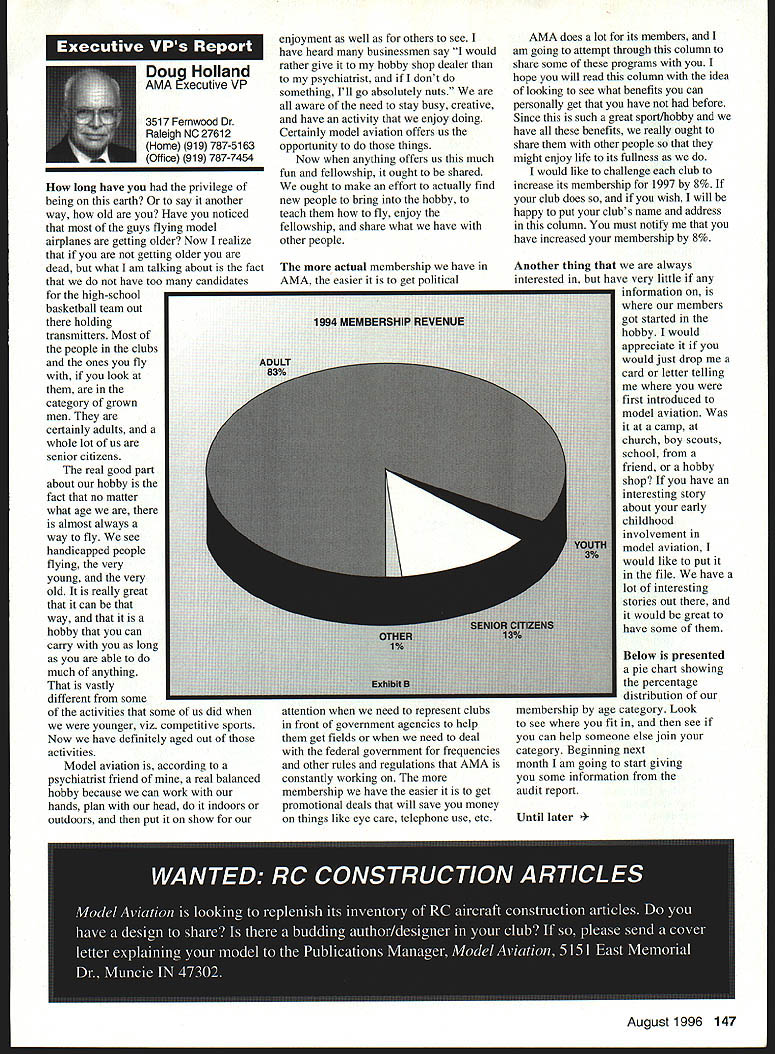
Below is a pie chart showing the percentage distribution of our membership by age category. Look to see where you fit in, and then see if you can help someone else join your category. Beginning next month I will start giving you information from the audit report.
Until later —
Executive Director's View from HQ
Joyce Hager — AMA Executive Director
5151 E. Memorial Dr. Muncie, IN 47302
Editor's note: The following was prepared by John Worth.
Irwin Ohlsson — his memory lives on. Two of the great "Irwins" of aeromodelling are now gone. The first, Irwin Polk, died a few years ago; now Irwin Ohlsson has left us. He passed away on Saturday, April 20, 1996.
Irwin Ohlsson was best known for manufacturing the model engines and products that bear his name, from when they first appeared in the ’30s through the present. But he was much more than a famous manufacturer. He served as AMA president (the fourth), during 1943–46.
Those years were critical to AMA. Irwin's presidency, during the transition from World War II to peacetime, helped assure that our national aeromodelling organization, which began in 1936, would continue after the pre‑war "kids" who went into military service returned as adults. From an organization that was mainly youth‑dominated before the war, AMA began a trend after the war toward mostly adult membership (essentially the same members getting older). Irwin presided over the transition that established AMA as much more than a youth‑based organization of contest fliers.
This change paralleled Ohlsson's personal history. Before his election to the AMA presidency, he had been an active modeler for sixteen years. He was California State Champion in 1934 and attended the Nationals in Akron, Ohio, that same year. At that event, Maxwell Bassett and Joe Kovel placed first and second in the then‑new gas‑engine event. Irwin wasn't among the winners, but he was the only West Coaster to get his gas‑engine entry off the ground — the engine he used was one he built himself, his first.
Within a year he and Harry Rice went into business together, and engines with the Ohlsson name were soon produced by the thousands. With this "growing up" from modeler to manufacturer, Irwin's change to adult status made him famous and respected worldwide. Until declining health closed out his life, Irwin was often asked for his opinions and advice — his successful business experience and friendships with many famous modelers and industry leaders made him a sought‑after resource.
Recognizing his contributions to AMA and to aeromodelling, Irwin Ohlsson was inducted into the AMA Model Aviation Hall of Fame at the 1975 Nationals in Lake Charles, Louisiana.
In his last years, Ohlsson enjoyed a relatively quiet lifestyle. One of his greatest pleasures was flying his twin‑engined Widgeon RC seaplane and a replica of his Pacemaker model design fitted with floats. He and close friends often flew these models at Lake Elsinore, California.
Irwin Ohlsson will be long remembered because many thousands of modelers still fly his engines 40 to 50 years after they were made — a tribute that transcends several generations, with many Ohlsson engines handed down from fathers to sons. So long as his engines continue to run, which should be well into the next century, the name Ohlsson will be seen and heard wherever modelers gather to fly and relive the "good old days."
AMA News
Hearing (continuation of material from Dr. Queveda)
Briefly, last time I looked at the true threshold of human hearing as related to the SPL scale. Three graphs were presented to show the discussion. This time we'll look further at the effects of sound on the human ear. Let me quote Dr. Queveda directly for accuracy:
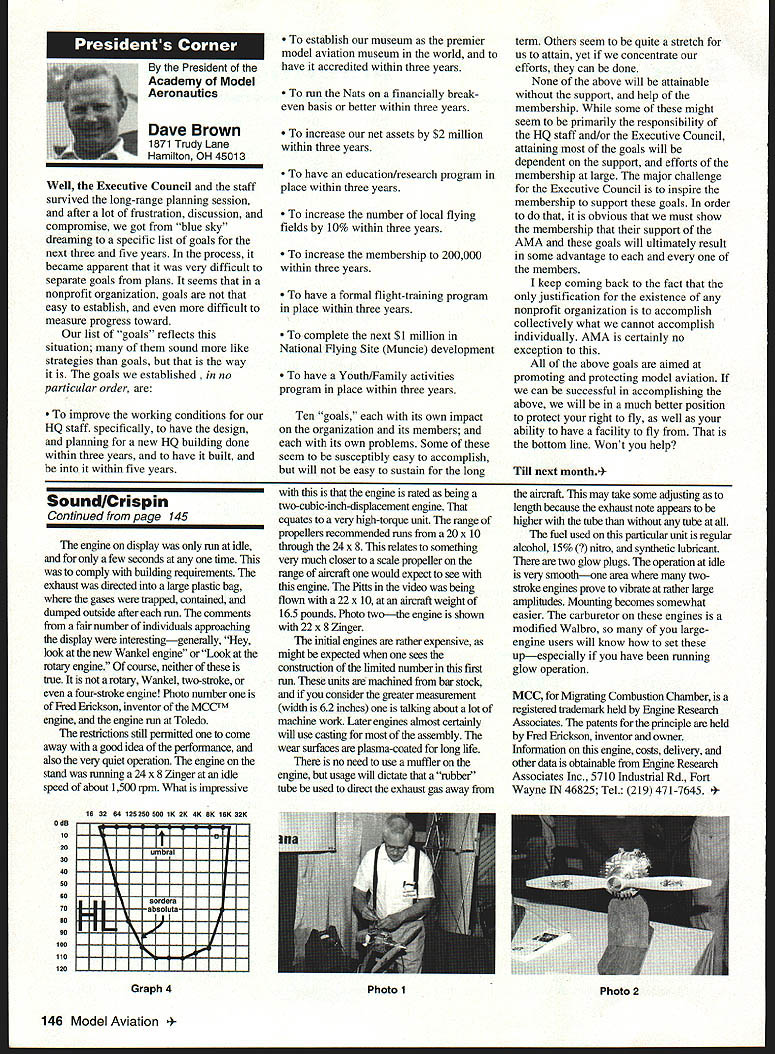
Although the SPL scale might look very interesting to a physicist, it would put an otologist trying to diagnose the hearing loss of a person at a disadvantage. Subtle changes in the threshold line are extremely important in the differential diagnosis of hearing disorders. Looking at an offset curved line would be akin to looking through a telescope at a comet and deducing its course in relation to Mercury. The point is that physicians performed a transformation on the SPL scale — a valid mathematical exercise — by pulling up the threshold line by varying amounts at each frequency until it became a straight line. The new scale was called the HL scale (Hearing Level) and the new threshold line was called the 0 dB line. As the threshold line was pulled up, the line of absolute deafness was pulled up the same amount at each frequency and became a curved line.
The HL scale is shown on graph number 4. The dynamic range of hearing is encircled. Clinical audiometers built in the United States since about 1938 and those worldwide are calibrated following the HL scale. Periodic revisions to the 0 dB reference line have been made — the first following ISO standards, and lately ANSI changes have made minor decibel adjustments that apply to clinical audiometers. The dBA scale used on sound meters less closely follows the HL scale, which has remained unchanged for a number of years.
Executive Council Meeting Highlights
The following action items took place at the April 27, 1996 Executive Council meeting:
- MOTION: E. McCollough (XI) moved; J. McNeill (V) seconded the motion to accept the League of Silent Flight as a Special Interest Group.
- Result: Passed. (I voted YES.) The League of Silent Flight is a credible organization that can represent soaring effectively.
- MOTION: Accept and implement a 10‑page document titled CONTEST BOARD PROCEDURES.
- Result: Passed. (I voted YES.) Background: Earlier in the year a meeting was held in Muncie of all Contest Board members and chairmen. From that meeting, input from AMA Headquarters, and the Executive Council, a well‑thought‑out 10‑page document was developed. Revisions include adoption of a three‑year cycle for rules changes (instead of two years), a standard basic numbering system for all categories, new considerations for safety proposals, and other updates. If anyone in the District wants a copy of the 10‑page document, write and a copy will be mailed free.
- AMENDMENT: Affirm the conclusions of contributors to the new CONTEST BOARD PROCEDURES and remove the voting provision on the initial ballot for "none of the above."
- Result: Motion failed. (I abstained because the amendment seemed remote, ambiguous, and vague.)
- MOTION: Accept new SAFETY REGULATIONS FOR MODEL AIRCRAFT GAS TURBINES (3‑page dossier).
- Result: Passed. (I voted YES.) The dossier had been reviewed favorably by the AMA Safety Committee on Feb. 16 and was well studied by experts. If anyone wants a copy, write and one will be mailed.
- DIRECTION: Establish a Flying Sites Department at AMA Headquarters.
- Result: Approved. Without flying sites, the hobby will disappear — this was recognized as a good idea.
- MOTION: Officially resolve to refer to aeromodeling in official publications as a "Sport/Hobby," using the term "Hobby" judiciously when referring to specific aspects; instruct Model Aviation editorial staff and AMA Headquarters to monitor communications for proper terminology.
- Result: Failed. (I voted NO — the proposal sounded silly and unreal.)
- MOTION: Authorize a Resource Committee to issue 300 pre‑paid phone cards with a 70th Nationals insignia.
- Result: Passed. (I voted YES.)
Transcribed from original scans by AI. Minor OCR errors may remain.

