
Sound & Model Aeronautics
Howard Crispin, Jr.
HEARING CONTINUED: There are a number of different means of defining loudness curves and applications. We occasionally see articles attempting to make use of some of these, and they often are an exercise in frustration because the average modeler is not really interested in complicating his life. Dr. Quevedo continues his discussion:
"Many years ago (about 25 or 30) Fletcher and Munson came out with the so‑called equal‑loudness curves for human hearing, suggesting that the desensitization of the ear for low and high frequencies at very low listening levels became less and less as the intensity of the sound increased, until the ear response was almost flat at high intensity levels. But more modern research indicates that Fletcher and Munson were only about 20% right, so the low‑level compensation in modern hi‑fi sound equipment is only a few dB at the most at low and high frequencies. Furthermore, the compensation suggested by Fletcher and Munson required a different weighting scheme for each dB increase in loudness, an extremely cumbersome procedure.
"So for all practical purposes, there are only two scales and two measuring systems to analyze sound and noise:
- The SPL scale, measured with a sound meter set at linear weighting.
- The HL scale, measured with the sound meter set at the A weighting (dBA)."
Dr. Quevedo also states that there are really only two instances that require the use of the SPL scale with linear measurement:
- Clinical audiometer calibration.
- Identifying sounds that, although not perceived as very loud, could present physical damage to the ear due to a very large amount of energy present at very low or very high frequencies.
Dr. Quevedo also discussed the question of power versus force in working with sound. Some work was done to prove the concept of power as applied to sound, but not much. The most important point made was that in sound, as opposed to most other forms of energy, you only need to know the FORCE of sound—in this case the sound pressure—to know exactly how much POWER is present. In mechanical systems, unless you know force AND velocity, or torque AND angular velocity, you don't have the slightest idea how much POWER is being developed. In electrical systems, unless you know both voltage AND current, or voltage AND the impedance of the circuit, you again don't know how much POWER is being developed. The velocity part of mechanical systems, or the equivalent current part of electrical systems, is automatically taken care of by the almost constant impedance of the conducting medium (the ear) and by the almost constant impedance of the primary receptor, the middle ear.
The purpose of all of this is to provide some understanding of hearing and the sound generated by model aircraft. We measure sound pressure levels as a weighted dBA in order to know whether we meet certain legal requirements or established operating rules. The other concern is determining if we are creating a hazard for ourselves and for those around us being exposed to high levels from our operations. Consider giving adequate concern to all of these.
Personally, I find it very disturbing to see so many of our members not wearing any type of ear protection when operating models, especially those who operate routinely at very high dB levels—pylon racing, ducted‑fan racing, many sport aircraft, and a great number of giant models.
TURBINE ENGINES: Turbine engines are no longer theoretical. We are seeing more of these at each jet fly around the country, with probably the most at the Fly‑In at Muncie on 7–9 May. Most vendors will probably be represented at that event. Safety and the AMA guidelines for operation are always a subject for discussion. Another very important consideration has been the sound level generated by these engines. I find it beyond understanding why the manufacturer of these engines cannot perform operational tests, on the ground and in the air, to provide individuals and national aero clubs around the world with accurate, honest figures of the sound levels to be expected, and means of meeting national requirements. Much of the world has established permissible levels for model aircraft operation, and the equipment is certainly available to obtain the data.
Acquisition of data requires first of all a very capable flier in order to place the aircraft in a position for measurement. This need is to provide the best recording of the data with minimum chance for error. For example, one requirement is that a full‑throttle pass be made at an altitude of 15 to 20 feet and at a distance of 50 feet from the microphone. The rest is then up to the measuring equipment. One can thus obtain good in‑flight data which can be translated into varying distances quite easily. This cannot be done with the usual hand‑held sound meter.
The opportunity presented itself at NALF Fentress during the recent Fan Fly. Garland Hamilton, long‑time scale flier and retired Marine now working with Bob Violett, was there with a T‑33 powered by the French IPX‑260 gas turbine engine. This engine is propane‑fueled, and the aircraft was operating under the AMA waiver program. It is presently required to operate at a reduced throttle setting, and to make a pass at full throttle in front of the microphone at a distance of 50 feet. Garland was exceptionally capable of flying the airplane at the altitude and speed requested, and the readings for the full‑throttle pass were interesting data. One must understand that these engines are high‑fuel‑consumption devices and one certainly does not waste much time, especially at high throttle.
The T‑33 has a fairly long intake duct and a long tailpipe. Whether this affects the nature of the sound, and to what degree, is a matter for further study. Certainly one would expect an installation with the engine mounted in the center fuselage area to be somewhat different than that of the T‑33.
The readings on the ground were taken at nine feet over pavement. The full‑throttle fly pass was performed at 50 feet from the microphone and at an altitude of about 10–12 feet. The readings were made using the IVIE Sound Analyzer on the 1/3‑octave band scale, and SPL in dBA. All of this is standard procedure except for the engine!
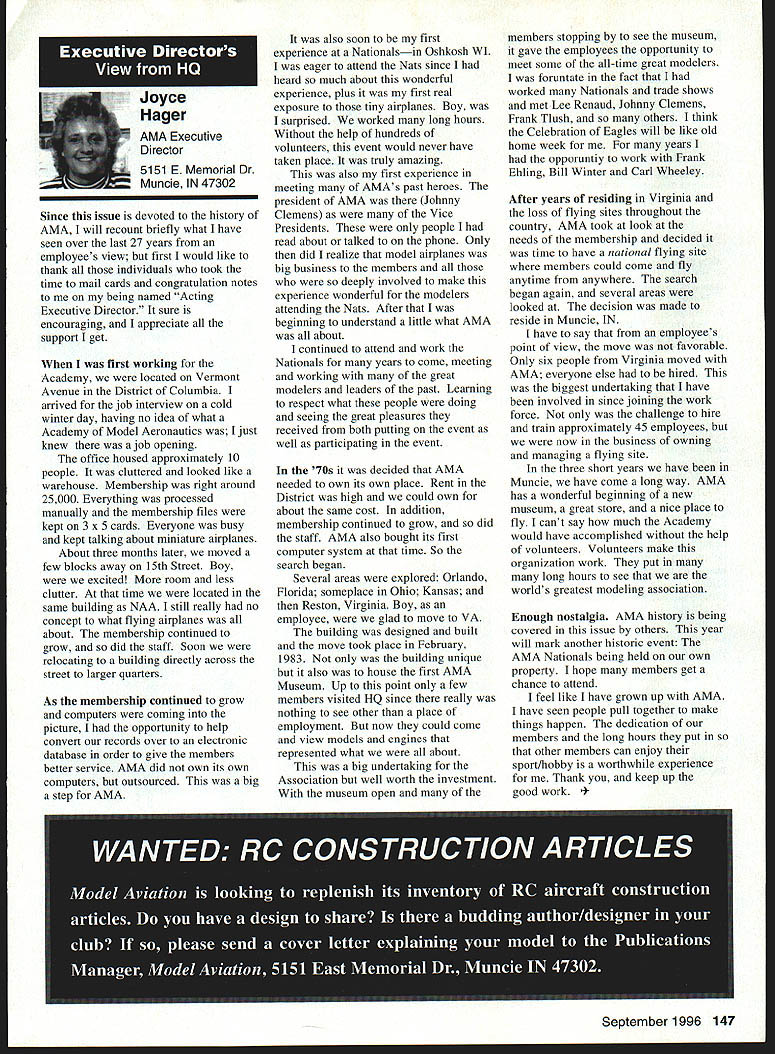
The full‑throttle ground reading was 97.6 dBA. The spectrum shows the predominant sound generated at about 1.42 kHz, which works out to about 85,000 r.p.m. I have been told that the engines operate, depending on the catch, from 80,000 to 120,000 r.p.m.! Harmonics and other sounds generate high levels approaching the level at 1.42 kHz. The sound levels at the low range exhibit lower dB and on average are about 10–12 dB down from the high level at the upper frequency. This fairly flat trace accounts for the overall somewhat high total dB level.
I refer to the ground reading as somewhat high. This is because the sound characteristics in the air are completely different. It is this which makes the turbine engine sound rather quiet, and it is difficult to find the cause for concern about the sound of this aircraft. This may not be entirely true, as stated above, with a completely unmuffled unit.
The in‑flight reading, taken at full throttle in a fly‑past, was 73.8 dBA at 50 feet. If one would compare that to the reading on the ground at 50 feet we would find the reading to be 88.7 dBA. That equals a drop of 14.9 dBA from ground to the particular in‑flight measurement. The sound level at 1,000 feet from the aircraft would be about 47.8 dBA—down close to ambient range.
There is one other factor here. Look at the printout: the highest sound level is at 25 Hz, which is probably not audible to most people. This slopes down to a low in the range at which most two‑stroke, propeller‑driven aircraft operate (and in the range of ducted fans), and then rises to a hump again at the 4–6.3 kHz range. The assumption is that the low frequency is the airflow into the engine, which is now probably undisturbed at the velocity of flight. The composition of the exhaust flow also is changed at the higher level. The high‑frequency level is down almost 15 dB from the highest low‑frequency level. The level at midrange is down almost 25 dB. This low overall reading, and especially the frequency ranges where the sound occurs, means that we have a very fine engine, as it exists now, as far as noise is concerned.
One other thing to consider is that people flying now do not operate at full throttle for much of the flight. Fuel consumption is critical. There is also the fact that since thrust increases in flight there really is no need for full‑throttle operation for much of the flying. The T‑33 performs quite well at reduced throttle.
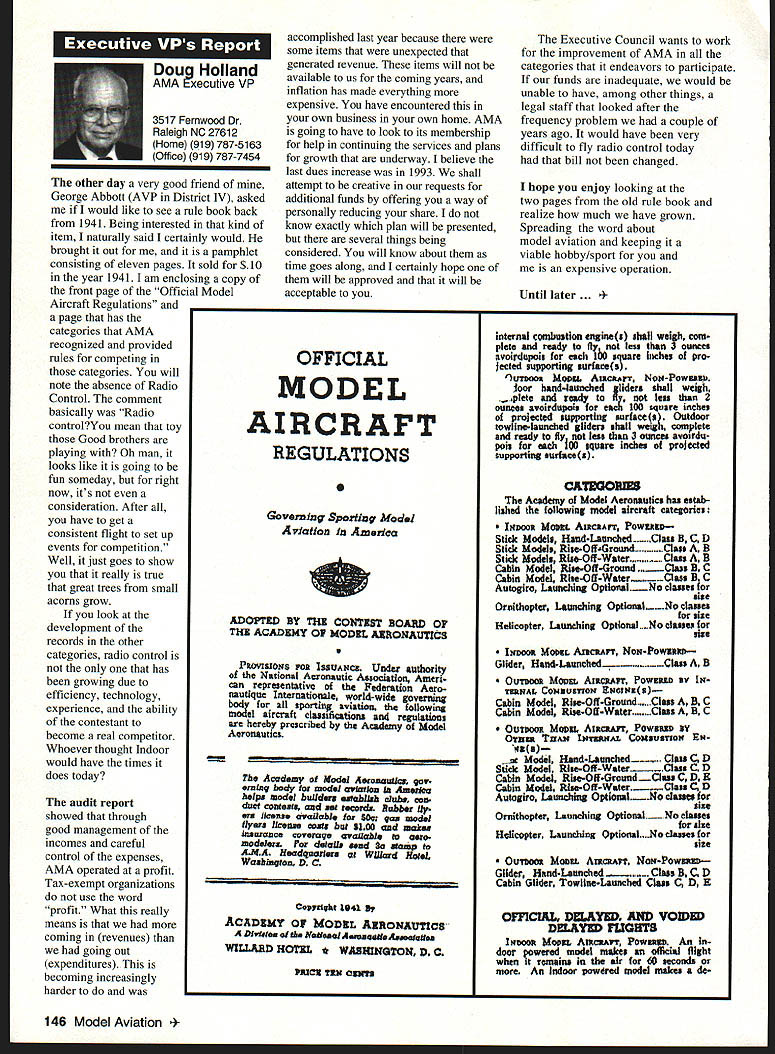
Photo number one is of Garland and the T‑33—a beautiful model and an outstanding pilot.
Transcribed from original scans by AI. Minor OCR errors may remain.

