
Museum Minutes
Gary Prater Museum Director 5151 E. Memorial Dr. Muncie, IN 47302
In a recent column I asked for comments from readers concerning: "What is it that we're doing at the Academy that's wholly worthwhile, benefits everybody, member and nonmember alike, and justifies the considerable public and private support we seek?" I am convinced this is one of those "grand questions" at the heart of our existence—especially the museum's. It needs to be answered as fully as possible before we mount a campaign for support and make those changes that move the museum from a corporate to a public institution.
What I'm trying to do by asking that question is establish a dialogue with interested persons. Many of us use the word "dialogue" loosely in everyday conversation to mean "talking with each other." I want to use the word to mean something greater: a way of communicating that encourages learning and is based on mutual respect.
In this sense, dialogue can be seen as a process with certain characteristics:
- It includes all people, especially those who disagree with an idea or action.
- It seeks to invent a process so all can speak and is not dominated by one person.
- It doesn't assume anyone is wrong because they do disagree.
- It tolerates ambiguity—there may not be one simple answer or solution.
- It seeks to identify and suspend fundamental assumptions and definitions that are inaccurate.
- It takes time to develop and may never end.
We can choose between discussion or dialogue. We can either win or learn. In a dialogue, if you try to win, you lose. If you choose to debate (to win) an issue, the debate will inevitably degenerate into an argument where we choose sides and enter into conflict.
Dialogue helps build trust, common ground, common understandings, and teamwork. Dialogue is a way of thinking and learning together. If we use it consistently, we will create an honest—rather than overly romantic—picture of the Academy museum many of us would like, and we will use that picture to evaluate changes and to measure the institution's progress toward fulfillment of its promise. Most importantly, it will help us define problems before we try to solve them. For example, an organization running out of money could say the solution is to get money. Wrong. Lack of money is a symptom. If the solution can't be found, you're probably asking the wrong question.
Effective dialogue demands participants be courageous in letting people know what they represent. Courage demands respect. People cannot respect someone who won't take a stand when the winds blow. One must also have a good heart, be sincere, and be forgiving of others. Blaming a person and focusing on the person rather than the problem cannot be allowed. Lastly, engaging in dialogue demands certain personal characteristics: participants need to be willing to change attitudes toward others and to see themselves as conscientious participants who, through dialogue, develop a reputation for high standards and ethics.
We must look for good intentions in others, be willing to give the benefit of the doubt, and avoid assuming we know their motivations. In the case of the museum, we must also adhere to the professional agenda of the museum discipline and avoid the personal agendas that float around every workplace.
Enough said. This short exposition on the concept of dialogue is in response to an excellent letter sent to me by Michael Fritz, AMA #5565. With an impassioned tone, Michael wanted to know why we were focusing on the past, when in his view the real problem is declining and aging membership. He also asked how the existence of the museum could rectify his concerns and increase Academy enrollment and modeling participation. He asked many other questions as well in what I think was a sincere attempt to establish a dialogue. Kudos, Michael.
In the spirit of dialogue, I would like to give my two cents in regard to a few of his concerns and see if they inspire anyone else to chime in.
First, regarding the lack of young people in model aviation, I posit that young people will probably never again identify with the airplane the way they once did. The "youth problem" may not be a problem at all, but rather a symptom of our times. Model railroading, for example, is experiencing the same trend. So let's not try to solve the problem before it's defined.
I have an audio tape of Charles Hampson Grant lambasting the Academy because of its preoccupation with gasoline engines and urging leadership to refocus on youth and rubber-powered models. For all of Grant’s efforts, we have nevertheless gone from gas engines to turbines, and who knows what’s next. Turbines are definitely not children's playthings!
Focusing on the "youth problem" may be an attempt to recreate the past as Grant wanted to do. Aircraft of all sorts lack the aura and mystique of the early years. However, recent events—especially the AMA Model/Hobby Expo here in Muncie—showed how excited kids can be about model aviation when it is presented among many fun things to do. Parents brought their kids to the International Aeromodeling Center in droves because they wanted to expose them to worthwhile, fun activities that promote positive youth development and offer lifelong learning opportunities.
If we let the past live on in the museum and focus on what kids want to do today, maybe we can move the Academy and the industry to a place they've never been. Knowing we cannot reverse societal trends allows us to concentrate on new ways to integrate model aviation into children's learning and play. After all, model aviation is still the only form of aviation open to all, and it will always be sky-high fun for everyone.
---
AMA News
Executive VP's Report
Doug Holland AMA Executive VP 3517 Fernwood Dr. Raleigh, NC 27612 (Home) (919) 787-5153 (Office) (919) 787-7454
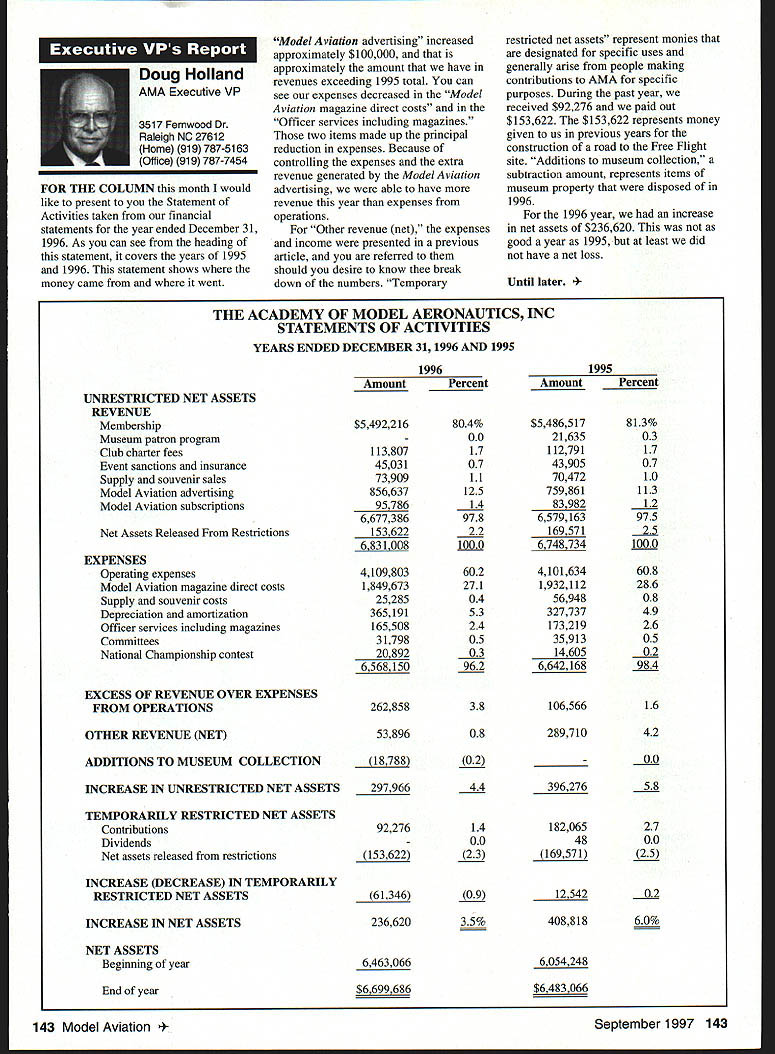
For this month's column I present the Statement of Activities taken from our financial statements for the year ended December 31, 1996. The statement covers 1995 and 1996 and shows where the money came from and where it went.
Highlights:
- "Model Aviation" advertising increased approximately $100,000, which is approximately the amount by which 1996 revenues exceeded 1995 totals.
- Expenses decreased in "Model Aviation magazine direct costs" and in "Officer services including magazines." Those two items accounted for the principal reduction in expenses.
- Because we controlled expenses and generated extra revenue from Model Aviation advertising, we had more revenue than expenses from operations in 1996.
- "Temporarily restricted net assets" represent monies designated for specific uses and generally arise from contributions. During the past year we received $92,276 and paid out $153,622. The $153,622 represents money given to us in previous years for the construction of a road to the Free Flight site.
- "Additions to museum collection" (a subtraction) represents items of museum property that were disposed of in 1996.
For 1996 we had an increase in net assets of $236,620. This was not as good a year as 1995, but at least we did not have a net loss.
Until later.
Statements of Activities — Years Ended December 31, 1996 and 1995
Unrestricted Net Assets — Revenue
- Membership: $5,492,216 (80.4%) in 1996; $5,486,517 (81.3%) in 1995
- Museum patron program: $0 (0.0%) in 1996; $21,635 (0.3%) in 1995
- Club charter fees: $113,807 (1.7%) in 1996; $112,791 (1.7%) in 1995
- Event sanctions and insurance: $45,031 (0.7%) in 1996; $43,905 (0.7%) in 1995
- Supply and souvenir sales: $73,909 (1.1%) in 1996; $70,472 (1.0%) in 1995
- Model Aviation advertising: $856,637 (12.5%) in 1996; $759,861 (11.3%) in 1995
- Model Aviation subscriptions: $95,786 (1.4%) in 1996; $83,982 (1.2%) in 1995
- Net assets released from restrictions: $153,622 (2.2%) in 1996; $169,571 (2.5%) in 1995
Total Unrestricted Revenue: $6,831,008 (100.0%) in 1996; $6,748,734 (100.0%) in 1995
Unrestricted Net Assets — Expenses
- Operating expenses: $4,109,803 (60.2%) in 1996; $4,101,634 (60.8%) in 1995
- Model Aviation magazine direct costs: $1,849,673 (27.1%) in 1996; $1,932,112 (28.6%) in 1995
- Supply and souvenir costs: $25,285 (0.4%) in 1996; $56,948 (0.8%) in 1995
- Depreciation and amortization: $365,191 (5.3%) in 1996; $327,737 (4.9%) in 1995
- Officer services including magazines: $165,508 (2.4%) in 1996; $173,219 (2.6%) in 1995
- Committees: $31,798 (0.5%) in 1996; $35,913 (0.5%) in 1995
- National Championship contest: $20,892 (0.3%) in 1996; $14,605 (0.2%) in 1995
Total Expenses: $6,568,150 (96.2%) in 1996; $6,642,168 (98.4%) in 1995
Excess of Revenue Over Expenses from Operations: $262,858 (3.8%) in 1996; $106,566 (1.6%) in 1995
Other Revenue (Net): $53,896 (0.8%) in 1996; $289,710 (4.2%) in 1995
Additions to Museum Collection (net): $(18,788) (−0.2%) in 1996; $0 (0.0%) in 1995
Increase in Unrestricted Net Assets: $297,966 (4.4%) in 1996; $396,276 (5.8%) in 1995
Temporarily Restricted Net Assets
- Contributions: $92,276 (1.4%) in 1996; $182,065 (2.7%) in 1995
- Dividends: $0 (0.0%) in 1996; $48 (0.0%) in 1995
- Net assets released from restrictions: $(153,622) (−2.3%) in 1996; $(169,571) (−2.5%) in 1995
Increase (Decrease) in Temporarily Restricted Net Assets: $(61,346) (−0.9%) in 1996; $12,542 (0.2%) in 1995
Increase in Net Assets: $236,620 (3.5%) in 1996; $408,818 (6.0%) in 1995
Net Assets
- Beginning of year: $6,463,066 (1996); $6,054,248 (1995)
- End of year: $6,699,686 (1996); $6,483,066 (1995)
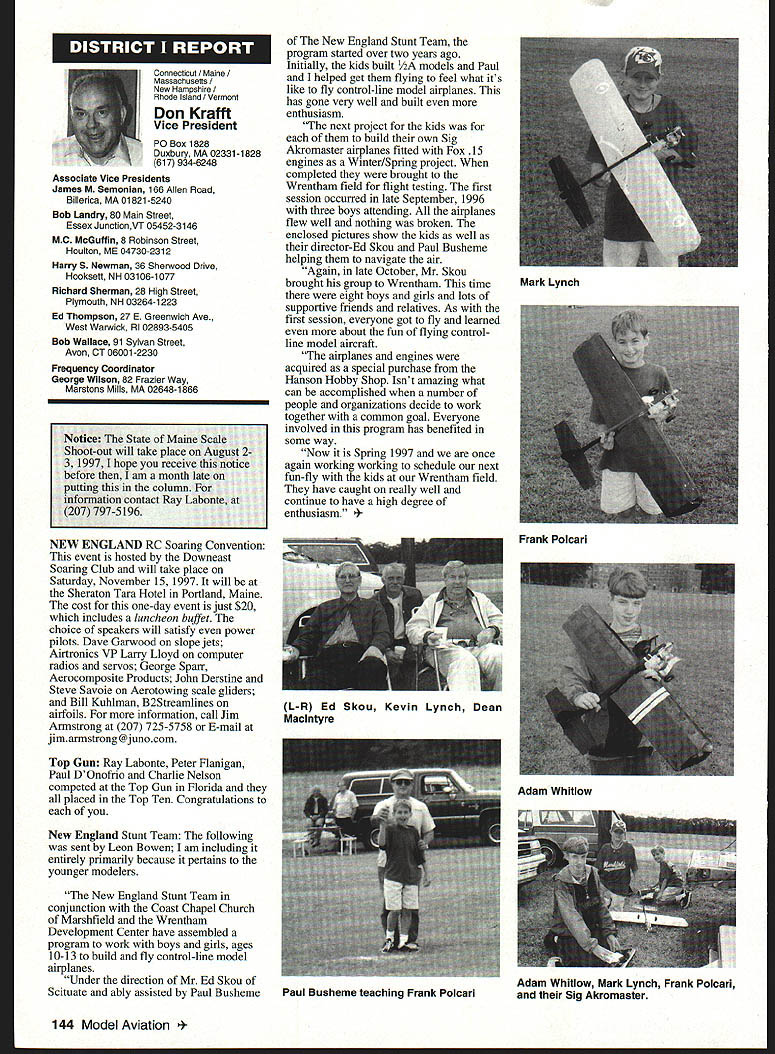
The New England Stunt Team
Submitted by Leon Bowen (pertains to younger modelers)
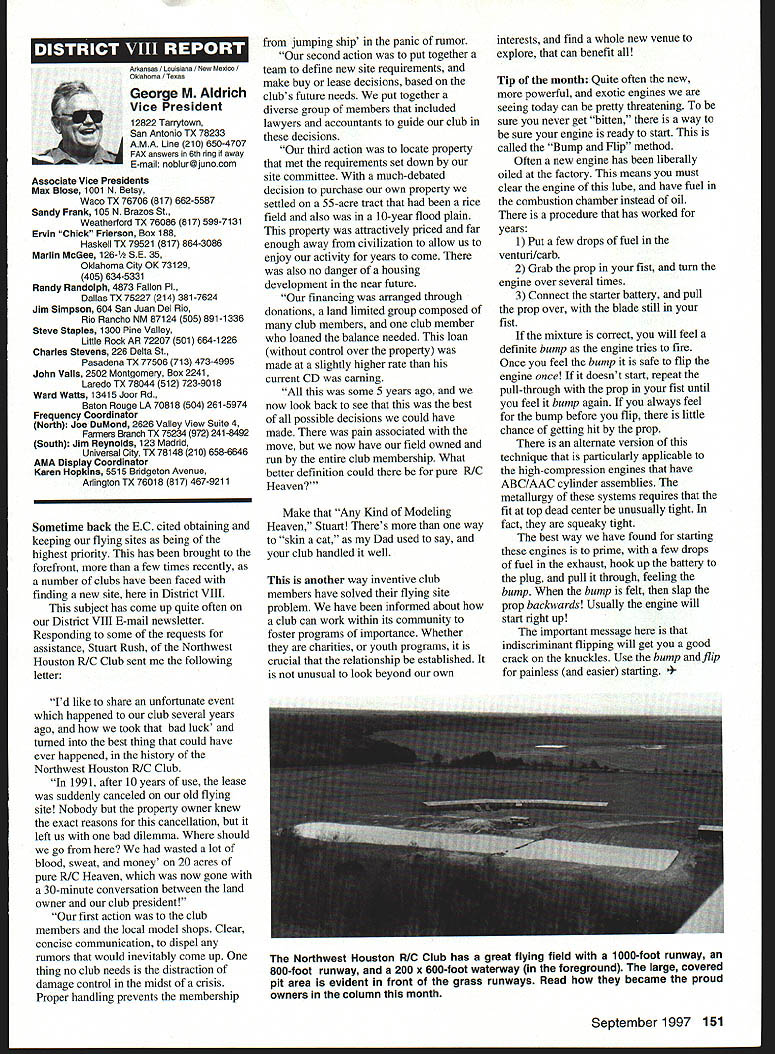
The New England Stunt Team, in conjunction with the Coast Chapel Church of Marshfield and the Wrentham Development Center, assembled a program to work with boys and girls ages 10–13 to build and fly control-line model airplanes.
Under the direction of Ed Skou of Scituate and assisted by Paul Busheme of the New England Stunt Team, the program started over two years ago. Initially, the kids built 1/2A models; Paul and I helped get them flying so they could feel what it's like to fly control-line model airplanes. This built enthusiasm.
The next project was for each child to build a Sig Akromaster fitted with a Fox .15 engine as a winter/spring project. When completed, the airplanes were brought to the Wrentham field for flight testing. The first session occurred in late September 1996 with three boys attending. All airplanes flew well and nothing was broken.
In late October, Mr. Skou brought eight boys and girls (and many supportive friends and relatives) to Wrentham. Everyone got to fly and learned more about control-line model aircraft.
The airplanes and engines were acquired as a special purchase from the Hanson Hobby Shop. It's amazing what can be accomplished when people and organizations work together with a common goal. Everyone involved in this program has benefited.
Now, in spring 1997, we are again working with the kids to schedule our next fun-fly at the Wrentham field. They have caught on really well and continue to show high enthusiasm.
---
News & Notes
- MARLENE NIKODEM, past president of the Niagara County Radio Control Model Airplane Club and a 20-year veteran of pylon racing and fun-flying, has agreed to serve as AVP for western New York. Marlene and husband Ernie are both very active fliers.
- Five months into 1997, spring weather has been slow to arrive in parts of the country. Despite that, clubs have continued to hold indoor shows, mall displays, and freeze flies—bringing model aviation to local communities and generating interest.
- Several club visits highlighted excellent local club organization and outreach. Examples include Radio Control Society of Marine Park (RCSMP) and the Pennsylvania Avenue Radio Control Society (PARCS). Clubs with strong membership manuals and active community outreach provide good models other clubs can adapt.
---
DISTRICT VI REPORT
Charlie Bauer Vice President
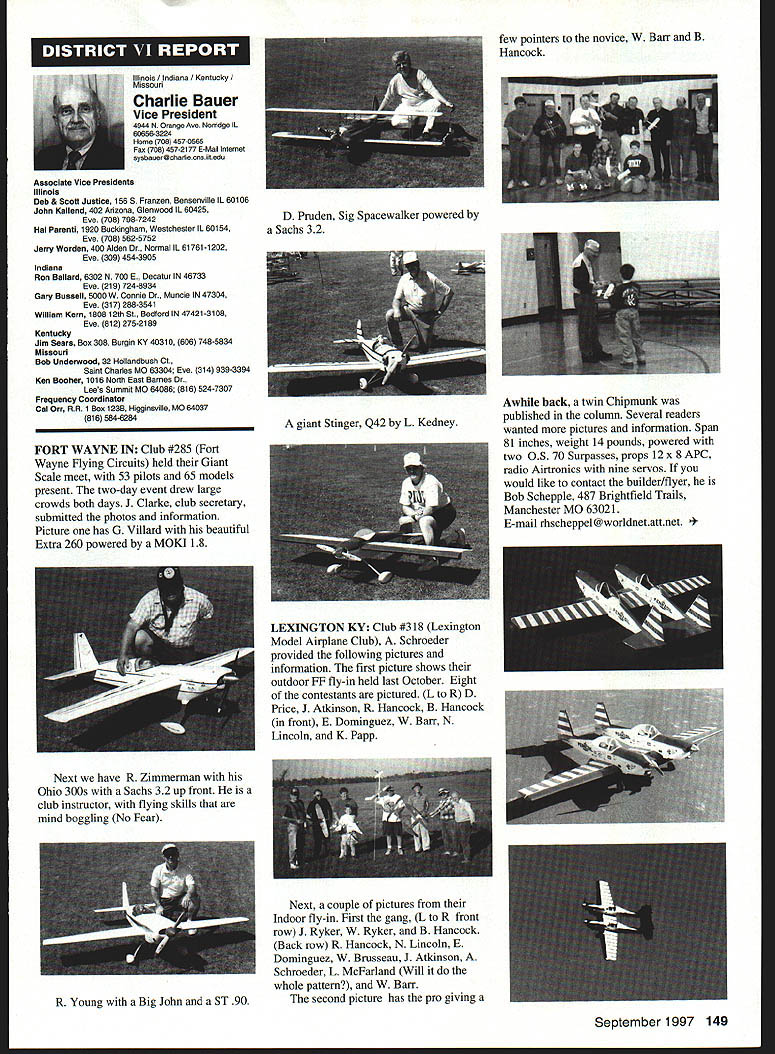
FORT WAYNE, IN: Club #285 (Fort Wayne Flying Circuits) held their Giant Scale meet with 53 pilots and 65 models present. The two-day event drew large crowds both days. J. Clarke, club secretary, submitted the photos and information.
Notable aircraft:
- G. Villard — Extra 260 powered by a MOKI 1.8
- R. Zimmerman — Ohio 300s with a Sachs 3.2 (club instructor, impressive skills)
- R. Young — Big John with a ST .90
LEXINGTON, KY: Club #318 (Lexington Model Airplane Club). Outdoor free-flight fly-in last October had eight contestants: D. Price, J. Atkinson, R. Hancock, B. Hancock, E. Dominguez, W. Barr, N. Lincoln, and K. Papp.
Indoor fly-in participants (front row, left to right): J. Ryker, W. Ryker, B. Hancock. Back row: R. Hancock, N. Lincoln, E. Dominguez, W. Broussard, J. Atkinson, A. Schroeder, L. McFarland, and W. Barr.
A twin Chipmunk previously featured:
- Span: 81 inches
- Weight: 14 pounds
- Power: two O.S. 70 Surpasses
- Props: 12 x 8 APC
- Radio: Airtronics with nine servos
Contact builder/flyer: Bob Schepple, 487 Brightfield Trails, Manchester, MO 63021. E-mail: nhscheppel@worldnet.att.net
---
DISTRICT VII REPORT
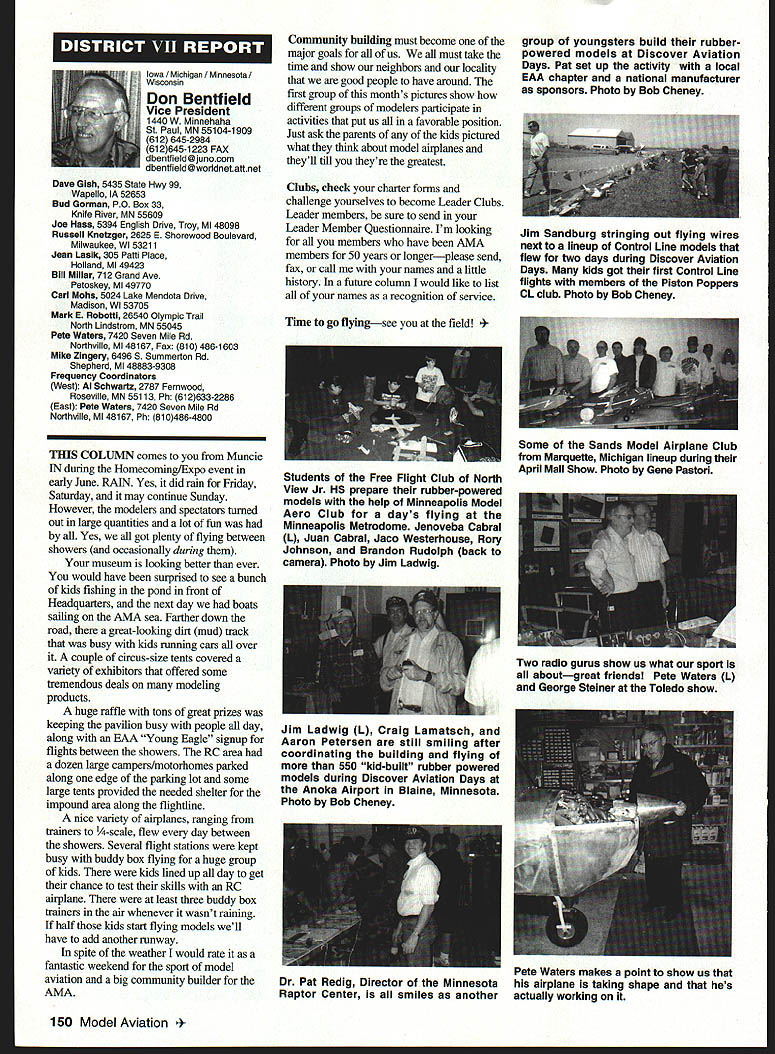
This column comes from Muncie, IN during the Homecoming/Expo event in early June. Rain affected Friday through Sunday, but modelers and spectators still turned out in large quantities and had a lot of fun—flying between showers.
Highlights from Homecoming/Expo:
- Kids fishing in the pond in front of Headquarters; boats sailed on the AMA sea.
- Dirt track busy with kids running cars.
- Exhibitors under large tents offered deals on modeling products.
- A huge raffle and an EAA "Young Eagle" signup kept people busy.
- The RC area featured large campers and tents that provided shelter for impound and flightline areas.
- Buddy-box flying introduced many kids to RC; multiple buddy-box trainers flew whenever weather allowed.
- The event was a strong community-builder for the AMA.
Community building must become a major goal: show neighbors we are positive community members. Clubs should check charter forms and challenge themselves to become Leader Clubs. Leader members should send in Leader Member Questionnaires. Also, any members who have been AMA members for 50 years or longer should send names and a short history for recognition in a future column.
Time to go flying—see you at the field!
---
DISTRICT IX REPORT
Russ Miller Vice President P.O. Box 1288 Solen, ND 58570 Days: (701) 455-3332 Evenings: (701) 220-3190 Fax: (701) 455-3323
Associate Vice Presidents:
- Max Hansen, 1909 Wisconsin SW, Huron, SD 57350
- Nathan Lancaster, 3597 S. Kendall Street, Denver, CO 80235
- Troy Lapp, 1618 Houston Dr., Bismarck, ND 58504
- Travis McGinnis, 8027 W. 81st Circle, Arvada, CO 80005
- Don Moden, 410 Hart St., Salina, KS 67401
- Jim Ricketts, 4921 Fernwood Drive, Sioux Falls, SD 57105-5573
- Jack L. Sibert, 3611 Kimberly Circle, Lincoln, NE 68506-4524
- Chuck Smith, 1091 Echeshire Street, Casper, WY 82609-3214
Frequency Coordinator:
- Steve Mangles, c/o Radio Service Center, 918 S. Sheridan, Denver, CO 80226
News from Nebraska
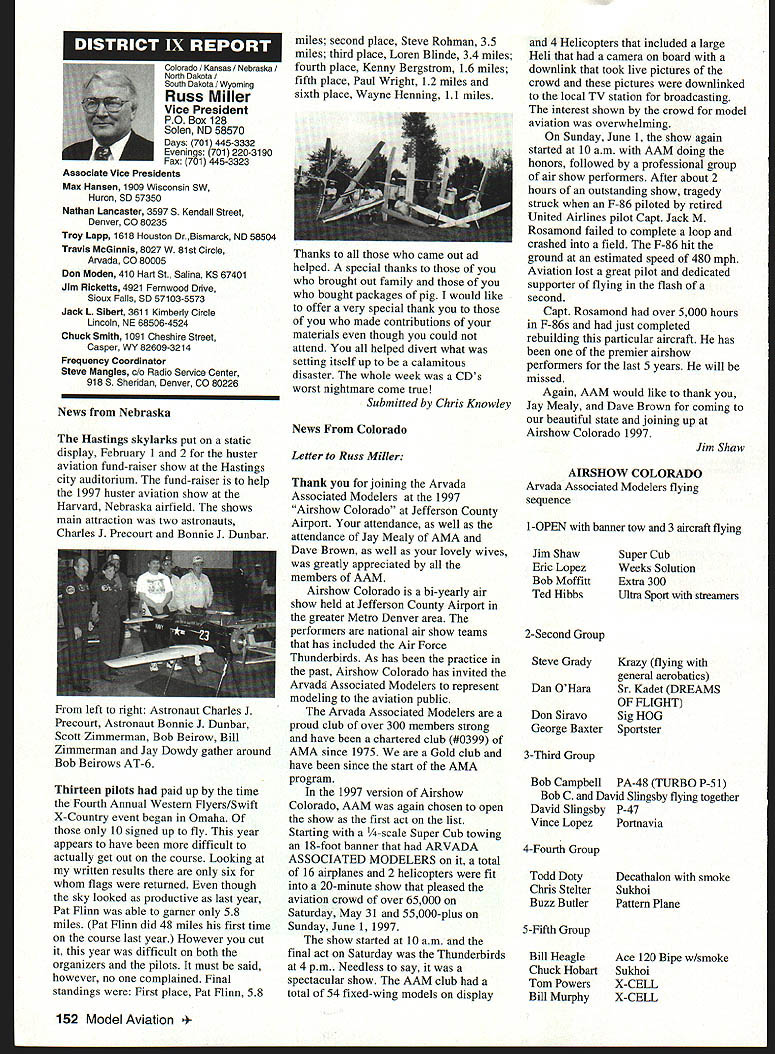
- The Hastings Skylarks held a static display (Feb 1–2) for the Hustler aviation fund-raiser at the Hastings city auditorium. The show featured astronauts Charles J. Precourt and Bonnie J. Dunbar.
- Fourth Annual Western Flyers/Swift X-Country event in Omaha: 13 pilots paid up; 10 signed up to fly; flags were returned for only 6 pilots. Final standings:
- Pat Flinn — 5.8 miles
- Steve Rohman — 3.5 miles
- Loren Blinde — 3.4 miles
- Kenny Bergstrom — 1.6 miles
- Paul Wright — 1.2 miles
- Wayne Henning — 1.1 miles
Special thanks to those who supported the event with time, family participation, and material donations.
Submitted by Chris Knowley
News From Colorado
Letter to Russ Miller thanking him for joining the Arvada Associated Modelers at the 1997 "Airshow Colorado" at Jefferson County Airport. AAM represented modeling to a crowd of over 65,000 on Saturday and 55,000+ on Sunday. AAM opened the show with a 1/4-scale Super Cub towing a banner and presented a 20-minute sequence with 16 airplanes and 2 helicopters.
Notable: A large helicopter with an onboard camera downlinked live crowd images to local TV. Audience interest in model aviation was overwhelming.
Tragically, on Sunday an F-86 (piloted by Capt. Jack M. Rosamond) failed to complete a loop and crashed, resulting in the loss of a respected airshow performer.
Submitted by Jim Shaw
Airshow Colorado — Arvada Associated Modelers Flying Sequence
- Open with banner tow and 3 aircraft flying:
- Jim Shaw — Super Cub
- Eric Lopez — Weeks Solution
- Bob Moffitt — Extra 300
- Ted Hibbs — Ultra Sport with streamers
- Second Group:
- Steve Grady — Krazy (general aerobatics)
- Dan O'Hara — Sr. Kadet (Dreams of Flight)
- Don Siravo — SIG Hog
- George Baxter — Sportster
- Third Group:
- Bob Campbell — PA-48 (Turbo P-51)
- Bob C. and David Slingsby — flying together (David Slingsby — P-47)
- Vince Lopez — Portavinia
- Fourth Group:
- Todd Doty — Decathlon with smoke
- Chris Stelter — Sukhoi
- Buzz Butler — Pattern Plane
- Fifth Group:
- Bill Heagle — Ace 120 Bipe w/smoke
- Chuck Hobart — Sukhoi
- Tom Powers — X-Cell
- Bill Murphy — X-Cell
---
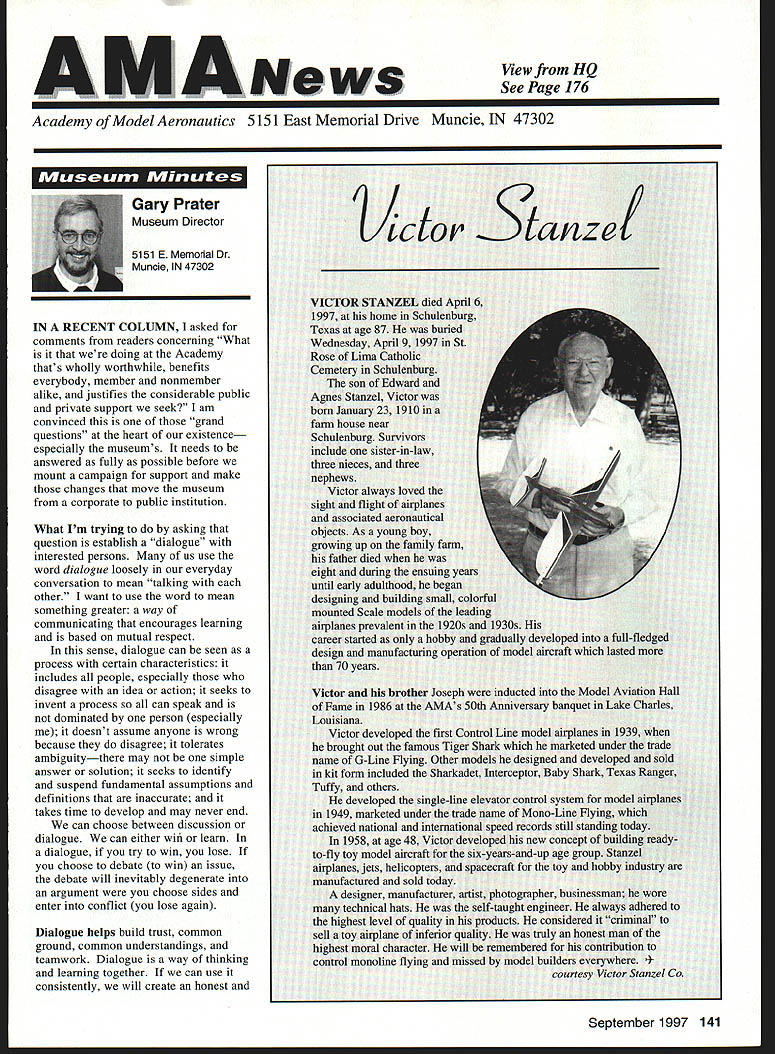
Obituary: Victor Stanzel
Victor Stanzel died April 6, 1997, at his home in Schulenburg, Texas, age 87. He was buried Wednesday, April 9, 1997, in St. Rose de Lima Catholic Cemetery, Schulenburg. Survivors include his son Edward, a sister-in-law, three nieces, and three nephews. Victor was born January 23, 1910, in a farmhouse near Schulenburg.
Victor loved flight and airplanes from a young age. After his father died when Victor was eight, he began designing and building small, colorful mounted scale models of leading airplanes from the 1920s and 1930s. His hobby developed into a full-fledged design and manufacturing operation in model aircraft that lasted 70 years.
Notable achievements:
- Victor developed the first control-line model airplanes in 1939 and introduced the Tiger Shark under the trade name U-Line Flying.
- Other kits included the Sharkadet, Interceptor, Baby Shark, Texas Ranger, Tuffy, and more.
- In 1949 he developed a single-line elevator control system marketed as Mono-Line Flying, achieving national and international speed records that still stood at the time of this writing.
- In 1958, at age 48, he developed ready-to-fly toy model aircraft for the six-years-and-up market. Stanzel airplanes—jets, helicopters, and spacecraft—were manufactured and sold in the toy-hobby industry.
Victor's brother Joseph was inducted into the Model Aviation Hall of Fame in 1986. As a self-taught engineer, designer, manufacturer, artist, photographer, and businessman, Victor adhered to the highest standards of quality and integrity. He considered it criminal to sell an inferior toy airplane. He will be remembered for his contributions to control-line and mono-line flying and will be missed by model builders everywhere.
(courtesy Victor Stanzel Co., September 1997)
---
DISTRICT XI REPORT
Ed McCollough Vice President PO Box 13900 Portland, OR 97213-0900 (503) 244-4439 Email: vpxi@pacifier.com
SENATE BILL 395 (Oregon)
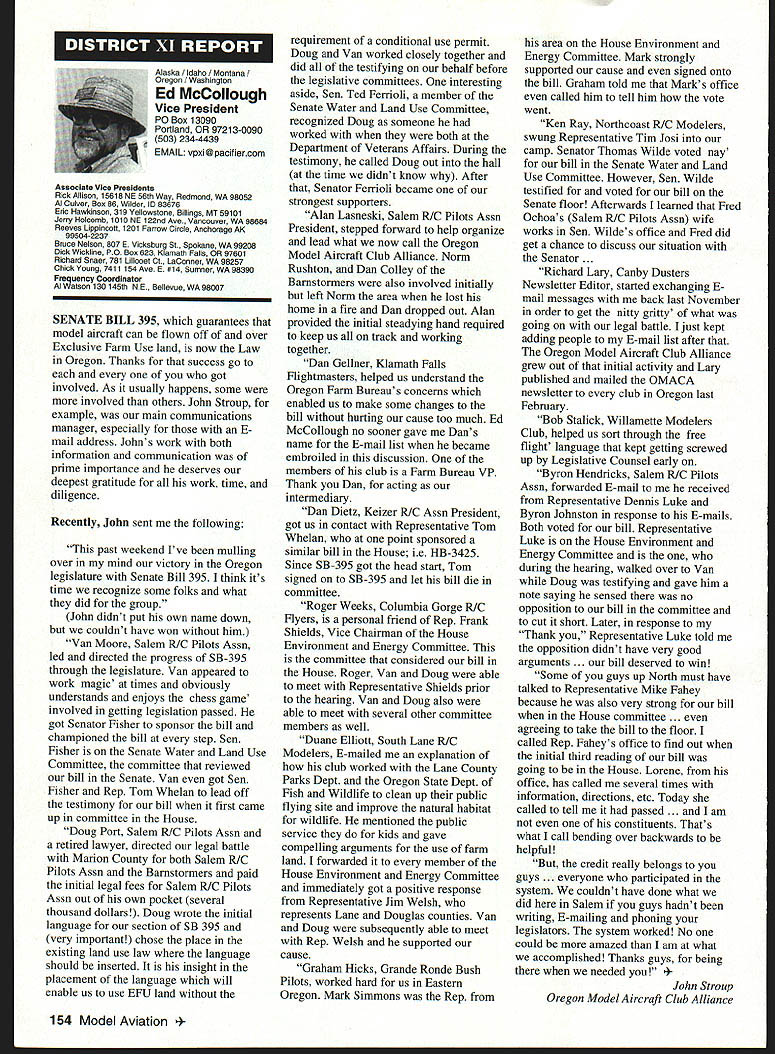
Senate Bill 395, which guarantees that model aircraft can be flown on and over Exclusive Farm Use (EFU) land, is now law in Oregon. Many people contributed; special recognition goes to John Stroup for communications work and to several leaders who organized and championed the bill.
Key contributors and roles:
- Van Moore (Salem R/C Pilots Assn): Led and directed SB-395 through the legislature; secured Senator Fisher as sponsor.
- Doug Port (Salem R/C Pilots Assn, retired lawyer): Directed the legal battle with Marion County and wrote the initial bill language; paid initial legal fees out of pocket.
- Alan Lasneski (Salem R/C Pilots Assn): Helped organize the Oregon Model Aircraft Club Alliance (OMACA).
- Dan Gellner (Klamath Falls Flightmasters): Helped address Farm Bureau concerns.
- Dan Dietz (Keizer R/C Assn): Connected the group with Representative Tom Whelan.
- Roger Weeks (Columbia Gorge R/C Flyers): Contact for Representative Frank Shields.
- Duane Elliott (South Lane R/C Modelers): Shared public service and habitat-improvement work that supported the bill.
- Graham Hicks (Grande Ronde Bush Pilots): Worked in Eastern Oregon to secure Representative support.
- Ken Ray (Northcoast R/C Modelers): Helped bring Representative Tim Josi into support.
- Richard Lary (Canby Dusters): Helped distribute information via e‑mail and newsletters.
- Bob Stalcik (Willamette Modelers Club): Assisted with free-flight language issues.
- Byron Hendricks and others provided grassroots contacts and support that helped the bill succeed.
John Stroup summarized the collaborative effort and thanked the many volunteers who wrote letters, phoned legislators, and followed through. The system worked because many clubs and individuals got involved.
Submitted by John Stroup, Oregon Model Aircraft Club Alliance
---
Transcribed from original scans by AI. Minor OCR errors may remain.

