
AMA News
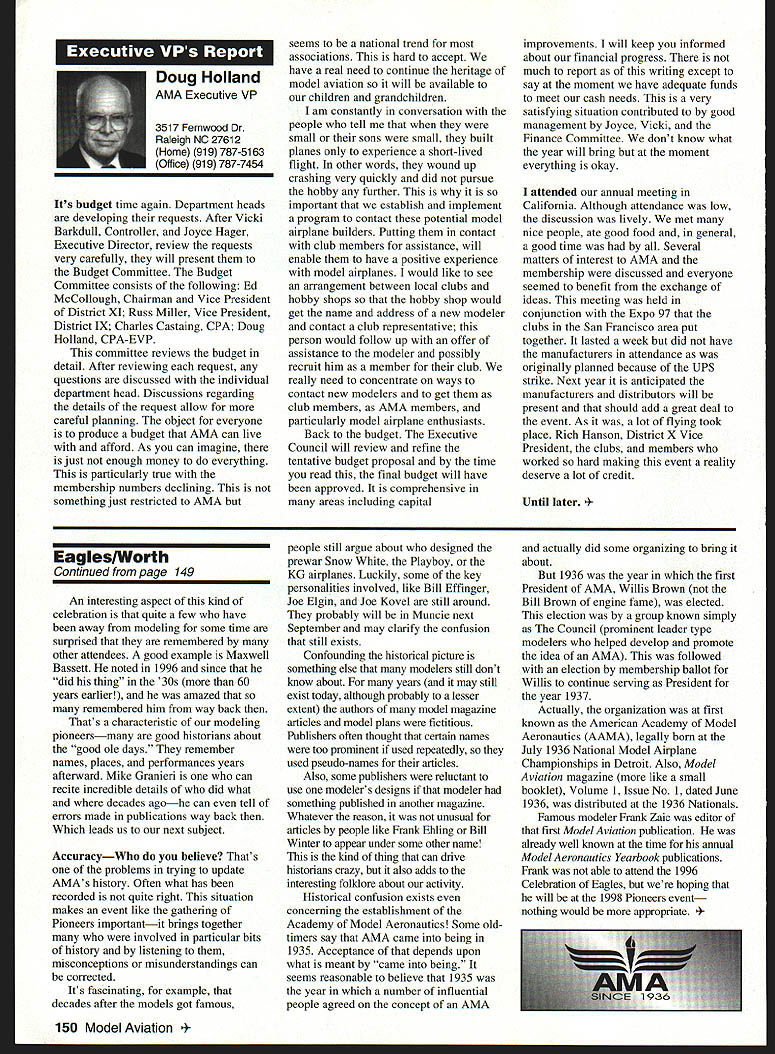
Hall of Fame Inductees
Each year the Council of AMA Presidents reviews applications for the Model Aviation Hall of Fame. The Hall of Fame recognizes individuals who have contributed to and participated in the hobby/sport of aeromodeling over many years. Consideration is given to scientific development, event participation, leadership, contributions as a writer or designer, and industry relationships. While inductees are typically longtime AMA members, membership is not a prerequisite.
Roy Mayes
Roy Mayes’s modeling career spans much of AMA history. A Californian, his competition career began in 1930 in rubber-powered contests run by the Oakland Tribune. Scale and endurance models brought him numerous wins throughout California. Roy also worked with gasoline-powered free-flight models; as late as 1982, at the U.S. Free Flight Championships in Taft, California, he placed first in Gas/Rubber FF Scale and in 1984 finished second in FF Gas Scale. On one occasion a rubber-powered autogiro he designed flew out of sight and was recovered days later from a distant lake.
As a designer, Roy produced many kits sold by M&L Model Company (later Sky Devil Model Company), including the successful Mono-Line series of five models. In 1939 he designed a fuel tank that allowed an engine to run inverted as well as upright, leading to the first inverted control-line (CL) flying. Early on, he assembled and delivered kits by bicycle throughout the Oakland area.
In 1945 he went to work for Al Hosepian’s Model Airplane Motors Co., contributing to manufacture of the Micro 19 engine. Radio control also interested Roy; in the 1950s he co-authored the “42er” design with Dick Schumacher and wrote an RC column in West Coast Model News offering information about early radio sets and kits.
Roy’s leadership was important to the Academy. After organizing the Avian Air Club at University High School in Oakland, he consolidated several groups in 1946 to form Western Associated Modelers (WAM), which still exists. By 1949 thirty-six clubs with some 2,000 members participated in WAM. Over the years Roy served as event director, CL contest board chairman, and organizer of many events. The Academy is proud to induct Roy Mayes into the Model Aviation Hall of Fame.
Francis (Fran) McElwee
Francis “Fran” McElwee of New Jersey is regarded as an innovator who introduced many original concepts to model aviation. As a teenager he competed in local and regional free-flight events on the East Coast and in Canada. In 1947 he built and flew an original radio-control (RC) model, helping to demonstrate the practicability and consistency of radio control.
After World War II—during which he earned his pilot’s wings and flew P-51s in the European theater—Fran designed and flew control-line models, including designs capable of performing rolls while tethered. Inspired by meeting Jim Walker, he pursued unusual and creative projects. In 1972 Fran joined Alpha Squadron of Pennsylvania, the first AMA show team, and remained with it until 1982. His contributions included innovative flying saucers that towed banners and a bicentennial flying U.S. flag now in the AMA Museum collection.
Fran’s models and articles appeared in Model Craftsman, Air Trails, Flying Models, Model Airplane News and other publications. His Defender CL aerobatics model won the New York Daily Mirror meet in 1946 and 1947; it was kitted by the Scientific Model Airplane Company and published in a British plan book in 1949. Other successful designs included the Rodart and Robot RC rudder-only models and the Mini-Mini Saucer (1973), which had a four-inch wingspan and nine-inch length. At age 72 Fran continues to fly 1/2A RC models and attend vintage-model events. The Academy welcomes Francis McElwee as a Hall of Fame inductee.
John C. Patton
John C. Patton’s many years of dedicated AMA service earned him wide respect. He served as the Academy’s 17th president and as District IV Vice President. Known for firmness, calmness, honesty, and objectivity, Pat listened carefully and handled people and problems effectively—qualities that made his 15 years as Contest Director for the Mid-Atlantic Championships particularly successful, where he managed 150–200 contestants and created a fun, wholesome atmosphere.
For 15 years Pat managed the Hobby Shop at the Nationals and was instrumental in bringing the first RC FAI Aerobatics Championships to the United States in 1971, helping to run the event. He held offices in numerous clubs in the Washington, D.C./Frederick, MD area, including presidencies of the Monocacy Modelers MAC and the Frederick MAC, and organized DCRC symposiums at Johns Hopkins Applied Physics Lab from 1954–1964—events that helped transmit aeromodeling state-of-the-art information.
Pat served as AMA voting representative to the FAI and participated in the first aerobatics RC judges’ school in Hertzenheim, Germany. He served two years as Nats RC Event Director and was Contest Director for record trials where six new world records were established, including RC duration and altitude. In recent years he has chaired the Council of AMA Presidents (from 1985 onward) and operated programs for scout, school, and CAP groups, including flying demonstrations and AMA club-building sessions. Pat lives in Maryland and remains active at the flying site. The Academy extends its congratulations as he enters the Hall of Fame.
Robert (Bob) Underwood
Bob Underwood of Missouri epitomizes a path common to many AMA members. In the late 1930s he became enamored with flight, spending his youth on control-line and free-flight models—from a scratch-built O&R-powered free flight to Thermic 50 gliders and CL models flown in schoolyards. High school track and photography temporarily ended his modeling.
After a two-year army stint, Bob returned to modeling in the late 1950s—initially with radio boats and HO trains—then rediscovered aeromodeling in 1966. After a summer teaching himself to fly with six-channel reed equipment, he committed to the hobby.
Bob became involved with the Greater St. Louis Modeling Association, a coalition of CL, FF, and RC clubs. As chairman for eight years he organized hall shows, demonstrations, Delta Dart activities, fun-flys, and a program that provided scholarships to students entering park administration and recreation programs at four Missouri state universities. He also served as Contest Director for an annual AAA meet that embraced all three modeling disciplines.
Robert (Bob) Wischer
Bob Wischer of Wisconsin is a dean of RC Scale. He began modeling in 1930 with the Milwaukee Model Aircraft Engineers and, after flying a full-scale Aeronca K (purchased in 1941) and a Taylorcraft (1942) and earning a commercial pilot’s license, returned to modeling with an eye for accuracy and detail. Quarter-scale versions of the Aeronca and Taylorcraft are part of his regularly flown RC collection.
Since the mid-1950s Bob has been a consistent competitor and winner at local, regional, and national contests. He earned more than ten first places at the Nats between 1974 and 1990 and won events such as Rhinebeck and the Mint Julep, including victories in the Designer class of RC Scale. His draftsman’s background and attention to detail made him a formidable competitor.
Bob was a member of five FAI World Championship Scale teams and is the only U.S. competitor to win the individual world championship (1974), having been elevated from alternate status when a teammate lost a model. In 1963 he developed successful muffler designs at a time when few existed; his solutions were shared at the Toledo show and remain in use.
A long-time volunteer, Bob has contributed behind the scenes at Nats since 1973, at multiple World Championships, and since 1985 at the AMA exhibit at the Experimental Aircraft Association convention. He wrote the Model Aviation RC Scale column from 1977–1989, reported on the Tournament of Champions and EAA fly-ins, and authored articles and plans for a range of aircraft (Cessna O-2, Piper Pacer, Aeronca K, series sport ships). He served as U.S. CIAM Scale representative to the FAI from 1977–1993. The Academy welcomes Bob Wischer to the Hall of Fame; he continues to fly and pursue precision modeling almost every week.
Neil Armstrong
During a Celebration of Eagles event, Neil Armstrong—longtime modeler and friend of aviation—visited, helped younger modelers trim free-flight models, and recalled formative days that led to his historic aviation career. Nominated by committee member Cliff Weirick, Mr. Armstrong was unanimously approved for induction.
In recognition of his significant contributions to model aviation as an aerodynamicist and role model—and for his broader contributions to aviation—the Academy is honored to induct Neil Armstrong into the Model Aviation Hall of Fame.
Eagles / Worth (continued)
An interesting aspect of pioneer gatherings is that many who have been away from modeling for decades are surprised and pleased to be remembered by fellow attendees. Maxwell Bassett, for example, was amazed in 1996 that so many people remembered his activities from the 1930s. Pioneers often serve as excellent historians of the “good old days,” recalling names, places, and performances with remarkable detail. Mike Granieri, for instance, can recite who did what and where decades ago, including errors made in early publications.
Accuracy is a recurring challenge when updating AMA history. What has been recorded is sometimes incorrect or incomplete. Gatherings of pioneers are important because they bring together participants who can clarify misconceptions and correct misunderstandings—helpful when debates persist about who designed prewar models such as the Snow White, the Playboy, or the KG airplanes. Fortunately, some key personalities—Bill Effinger, Joe Elgin, Joe Kovel—are still around and may clarify lingering confusion.
Another source of historical confusion is that many model-magazine articles and plans were published under fictitious names. Publishers sometimes reused pseudonyms for perceived prominence, or printed designs under different names to avoid cross-publication conflicts. As a result, articles by people such as Frank Ehling or Bill Winter occasionally appeared under other names, which complicates historical research but also adds to the hobby’s folklore.
Even the founding date of the Academy of Model Aeronautics has caused debate. Some old-timers cite 1935 as the year AMA “came into being,” depending on how that phrase is interpreted. What is clear is that in 1936 a group known as The Council elected Willis Brown as the first president of AMA; this group was composed of influential editors and leaders who organized and promoted the concept of AMA. The organization was initially called the American Academy of Model Aeronautics (AAMA) and was legally established at the July 1936 National Model Airplane Championships in Detroit. Model Aviation magazine (a small booklet), Volume 1, Issue No. 1, was distributed at the 1936 Nationals in late June.
Frank Zaic edited the first Model Aviation publication; he was already well known for his annual Model Aeronautics Yearbook publications. Although Frank was unable to attend the 1996 Celebration of Eagles, organizers hoped he would join the 1998 Pioneers event—an appropriate tribute to his role in early AMA publishing.
Notable pioneer: Percy Winslow Pierce
Percy Winslow Pierce gained fame early. At sixteen he, with friends Cecil Peoli and Jim Noonan, often drew crowds of up to 2,000 for flying demonstrations. By eighteen he operated a mail-order model aviation business, lectured at the Aeronautical Society in New York City, had built more than seventy-five models, was Model Editor for Aeronautics magazine and Editor-in-Chief of Fly magazine, and held many national and world distance and duration records. Percy’s success helped popularize aeromodeling among youth in the United States at a time when it had been considered an activity for serious adult experimenters—an influence that shaped the hobby’s future.
Transcribed from original scans by AI. Minor OCR errors may remain.

