
AMA/Charles H. Grant Scholarships
Each year, the Academy awards scholarships to deserving high school seniors who intend to pursue higher education at local and state colleges and universities. The awards are provided from a budgeted amount of general funds and from donations by individuals and organizations.
The basic awards are the Charles H. Grant Scholarships. Applicants are screened and ranked by national test scores, class ranking, school and community activities, modeling activities, and other criteria. Recipients must have been AMA members for a minimum of three years prior to applying and must be enrolled in an accredited institution for the following school year.
Screening and final selections were made by a committee of Betty Stream, Cliff Telford, Ed McCollough, Russ Miller, Charlie Bauer, and Bob Underwood. Their recommendations were presented to the AMA Executive Council for approval.
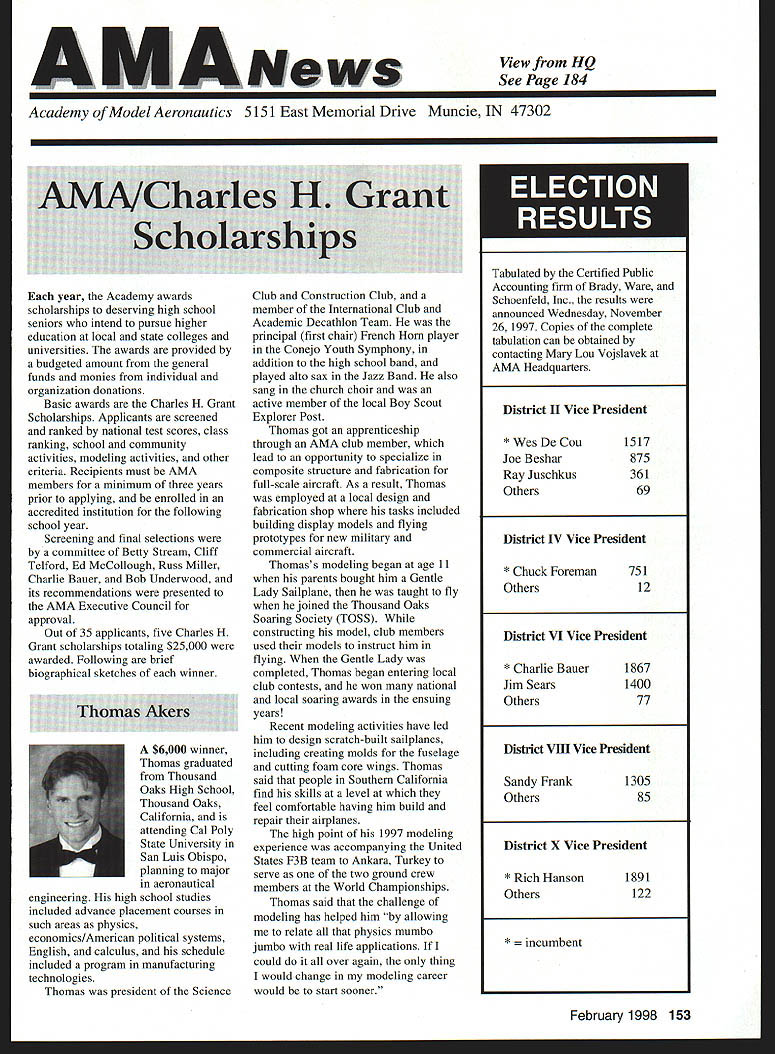
Out of 35 applicants, five Charles H. Grant scholarships totaling $25,000 were awarded. Following are brief biographical sketches of each winner.
Thomas Akers
A $6,000 winner, Thomas graduated from Thousand Oaks High School in Thousand Oaks, California, and is attending Cal Poly State University in San Luis Obispo, planning to major in aeronautical engineering. His high school studies included Advanced Placement courses in physics, economics/American political systems, English, and calculus, and his schedule included a program in manufacturing technologies.
Thomas was president of the Science Club and Construction Club, and a member of the International Club and Academic Decathlon Team. He was the principal (first chair) French horn player in the Conejo Youth Symphony, in addition to participating in the high school band, and he played alto sax in the jazz band. He also sang in the church choir and was an active member of the local Boy Scout Explorer Post.
Thomas got an apprenticeship through an AMA club member, which led to an opportunity to specialize in composite structure and fabrication for full-scale aircraft. He was employed at a local design and fabrication shop where his tasks included building display models and flying prototypes for new military and commercial aircraft.
His modeling began at age 11 when his parents bought him a Gentle Lady sailplane; he was taught to fly when he joined the Thousand Oaks Soaring Society (TOSS). While constructing his model, club members used their models to instruct him in flying. When the Gentle Lady was completed, Thomas began entering local club contests and went on to win many national and local soaring awards.
Recent modeling activities have led him to design scratch-built sailplanes, including creating molds for fuselages and cutting foam-core wings. People in Southern California trust his skills for building and repairing their airplanes.
The high point of his 1997 modeling experience was accompanying the United States F3B team to Ankara, Turkey, to serve as one of the two ground crew members at the World Championships. Thomas said modeling has helped him “relate all that physics mumbo jumbo to real-life applications. If I could do it all over again, the only thing I would change in my modeling career would be to start sooner.”
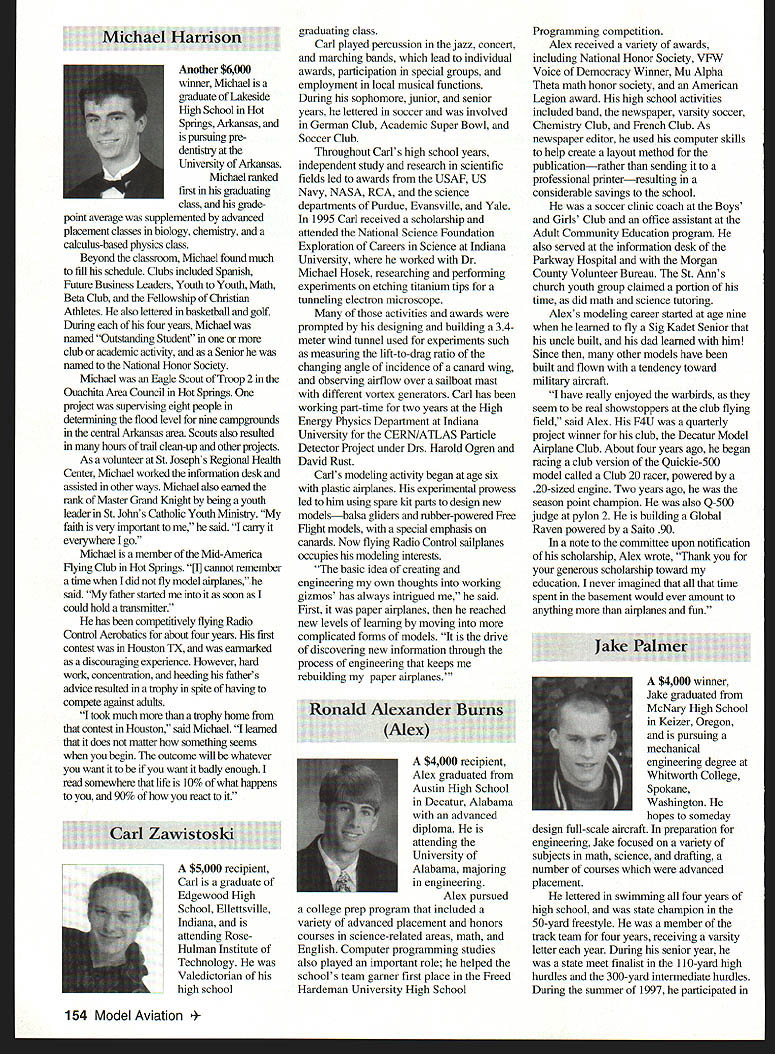
Michael Harrison
A $6,000 winner, Michael graduated from Lakeside High School in Hot Springs, Arkansas, and is pursuing pre-dentistry at the University of Arkansas. Michael ranked first in his graduating class and supplemented his grade-point average with Advanced Placement classes in biology, chemistry, and a calculus-based physics class.
Beyond the classroom, Michael was active in Spanish Club, Future Business Leaders, Youth to Youth, Math Club, Beta Club, and the Fellowship of Christian Athletes. He lettered in basketball and golf. During his four years in high school, Michael was named “Outstanding Student” in one or more clubs or academic activities, and as a senior he was named to the National Honor Society.
Michael is an Eagle Scout from Troop 2 in the Ouachita Area Council in Hot Springs. One project involved supervising eight people to determine flood levels for nine campgrounds in the central Arkansas area. Scouts also resulted in many hours of trail clean-up and other community projects.
As a volunteer at St. Joseph’s Regional Health Center, Michael worked the information desk and assisted in other ways. He also earned the rank of Master of the Grand Knight by being a youth leader in St. John’s Catholic Youth Ministry. “My faith is very important to me,” he said. “I carry it everywhere I go.”
A member of the Mid-America Flying Club in Hot Springs, Michael cannot remember a time when he did not fly model airplanes—his father started him as soon as he could hold a transmitter. He has been competitively flying radio-control aerobatics for about four years. His first contest in Houston, Texas, was discouraging, but through hard work, concentration, and his father’s advice he returned with a trophy despite competing against adults.
“It took much more than a trophy home from that contest in Houston,” said Michael. “I learned that it does not matter how something seems when you begin. The outcome will be whatever you want it to be if you want it badly enough. I read somewhere that life is 10% of what happens to you, and 90% of how you react to it.”
Carl Zawistoski
A $5,000 recipient, Carl graduated valedictorian from Edgewood High School in Ellettsville, Indiana, and is attending Rose-Hulman Institute of Technology.
Carl played percussion in the jazz, concert, and marching bands, which led to individual awards, participation in special groups, and employment in local musical functions. He lettered in soccer during his sophomore, junior, and senior years and was involved in German Club, Academic Super Bowl, and Soccer Club.
Throughout high school, independent study and research in scientific fields led to awards from the USAF, US Navy, NASA, RCA, and the science departments of Purdue, Evansville, and Yale. In 1995 Carl received a scholarship to attend the National Science Foundation Exploration of Careers in Science at Indiana University, where he worked with Dr. Michael Hosek researching and performing experiments on tunneling electron microscope tests.
Many activities and awards were prompted by his designing and building a 3.4-meter wind tunnel used for experiments such as measuring lift-to-drag ratios of thin-sheet wings, changing angle of incidence of a canard wing, and observing airflow over a sailboat mast with different vortex generators. Carl has worked part-time for two years at the High Energy Physics Department at Indiana University for the CERN/ATLAS Particle Detector Project under Drs. Harold Ogrem and David Rust.
Carl’s modeling activity began at age six with plastic airplanes. His experimental approach led him to design new models from spare kit parts—balsa gliders and rubber-powered free-flight models, with a special emphasis on canards. He now flies radio-control sailplanes.
“The basic idea of creating and engineering my own thoughts into working gizmos has always intrigued me,” he said. “First, it was paper airplanes, then I moved into more complicated forms of models. The drive of discovering new information through the process of engineering keeps me rebuilding my paper airplanes.”
Ronald Alexander Burns (Alex)
A $4,000 recipient, Alex graduated from Austin High School in Decatur, Alabama, with an advanced diploma and is attending the University of Alabama, majoring in engineering.
Alex pursued a college-prep program with a variety of Advanced Placement and honors courses in science, math, and English. Computer programming played an important role; he helped his school team win first place in the Freed-Hardeman University high school programming competition.
He received awards including National Honor Society, VFW Voice of Democracy Winner, Mu Alpha Theta math honor society, and an American Legion award. His high school activities included band, the newspaper (where he served as editor), varsity soccer, Chemistry Club, and French Club. As newspaper editor, he used his computer skills to develop an in-house layout method rather than sending it to a professional printer, resulting in considerable savings to the school.
Alex coached soccer at the Boys’ and Girls’ Club and worked as an office assistant at the Adult Community Education program. He volunteered at Parkway Hospital’s information desk and with the Morgan County Volunteer Bureau, participated in St. Ann’s church youth group, and tutored in math and science.
His modeling career started at age nine when he learned to fly a Sig Kadet Senior that his uncle built. Since then he has built and flown many models, often favoring military aircraft. He enjoys warbirds, calling them “real showstoppers” at the club flying field; his F4U won quarterly-project honors at his club, the Decatur Radio Airplane Club.
About four years ago he began racing a club version of the Quiet 500 model called a Club 20 racer, powered by a .20-sized engine. Two years ago he was the season point champion and he was also Q-500 point champion in 1995. He is building a Global Radian powered by a Saito .90.
In a note to the committee upon notification of his scholarship, Alex wrote, “Thank you for your generous scholarship toward my education. I never imagined that all that time spent in the basement would ever amount to anything more than airplanes and fun.”
Jake Palmer
A $4,000 winner, Jake graduated from McNary High School in Keizer, Oregon, and is pursuing a mechanical engineering degree at Whitworth College in Spokane, Washington. He hopes to someday design full-scale aircraft. In preparation for engineering, Jake focused on math, science, and drafting and took many Advanced Placement courses.
He lettered in swimming and was a member of the high school swim team, becoming state champion in the 50-yard freestyle. He was a member of the track team for four years, receiving a varsity letter each year, and during his senior year was a state meet finalist in the 110-yard high hurdles and the 300-yard intermediate hurdles. During the summer of 1997 he participated in a track meet in Shanghai, China, and in a Junior National Swim meet in Clovis, California.
Jake is an active member of a church youth group and participates in road clean-up and soup kitchens.
His modeling career began at age eight when he received an inexpensive control-line model. He rapidly developed an interest and soon joined the Keizer RC Association. With the help of an instructor he learned to fly and purchased a Super Sportster 40 kit. While building and flying the model, he discovered free flight, which quickly grabbed his interest.
Through contact with Ed Whitten and Andrew Tagliafico and support from the Willamette Modelers club, Jake began entering local indoor events. He progressed to FAI (Federation Aeronautique Internationale) level by building and flying F1D models. He competed in the World Championships for the United States as the first-ever junior competitor and won the title of Junior World Champion with a two-flight total of 72:01 minutes. “I just recently finished my first variable-pitch propeller which I'm anxious to test, so look out Steve Brown and Caesar Banks!” he said.
Additional Scholarships and Awards
Scholarships are also awarded in addition to the Charles H. Grant awards. Criteria are based on factors specified by the contributors in whose names the awards are made.
- Hutchinson Scholarship: Presented to the applicant who exemplifies outstanding achievement in free flight. Jake Palmer was awarded $1,000.
- Weak Signals: Each year the Weak Signals RC Club conducts a special raffle during their exposition at Toledo. The proceeds are awarded by the club to the top Grant scholarship recipient. This year the $4,000 donation was equally distributed between Thomas Akers and Michael Harrison.
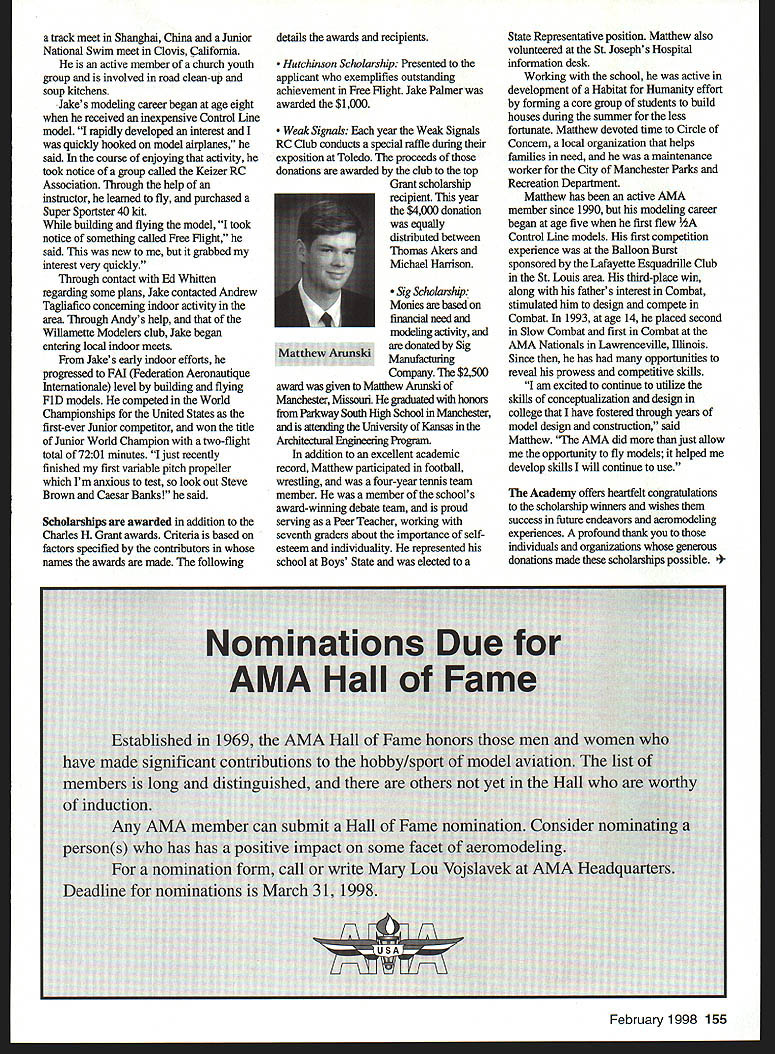
- Sig Scholarship: Donated by Sig Manufacturing Company, this award is based on financial need and modeling activity. The $2,500 award was given to Matthew Arunski of Manchester, Missouri.
Matthew Arunski
Matthew graduated with honors from Parkway South High School in Manchester, Missouri, and is attending the University of Kansas in the Architectural Engineering program. He has been an active AMA member since 1990; his modeling career began at age five when he first flew 1/2A control-line models.
In addition to an excellent academic record, Matthew participated in football, wrestling, and was a four-year tennis team member. He was on the school's award-winning debate team and served as a Peer Teacher, working with seventh graders about self-esteem and individuality. He represented his school at Boys' State and was elected to a State Representative position. Matthew also volunteered at St. Joseph's Hospital information desk.
Working with his school, he helped develop a Habitat for Humanity effort by forming a core group of students to build houses during the summer for the less fortunate. Matthew devoted time to Circle of Concern, a local organization that helps families in need, and worked as a maintenance worker for the City of Manchester Parks and Recreation Department.
His first competition experience was at the Balloon Burn sponsored by the Lafayette Esquadrille Club in the St. Louis area. A third-place win and his father's interest in combat flying stimulated him to design and compete in Combat. In 1993, at age 14, he placed second in Slow Combat and first in Combat at the AMA Nationals in Lawrenceville, Illinois. Since then he has had many opportunities to demonstrate his skills.
“I am excited to continue to utilize the skills of conceptualization and design in college that I have fostered through years of model design and construction,” Matthew said. “The AMA did more than just allow me the opportunity to fly models; it helped me develop skills I will continue to use.”
The Academy offers heartfelt congratulations to the scholarship winners and wishes them success in their future endeavors and aeromodeling experiences. A profound thank you to the individuals and organizations whose generous donations made these scholarships possible.
Transcribed from original scans by AI. Minor OCR errors may remain.

