


THE EAGLES LEGACY
AMA's History—Past, Present, Future
by John Worth
History involves both events and people. Sometimes it's a matter of what happened (and when); other times it's a matter of who was involved. Often it is a combination of these factors.
For example, sometimes history is made by someone—or several people—doing something very special. Maxwell Bassett won the 1932 National Model Airplane Championships with a gasoline-powered engine in a competition event that previously had been dominated by rubber-powered models. That happening (shared with Bill Brown, the designer and maker of the engine) changed the history of model aviation forever, because never again would gasoline-powered models compete directly in national competition against rubber power.
Another significant history-making aeromodeling achievement was the Good brothers' winning of the first Nationals Radio Control event in 1936. At that time, radio control was a highly specialized activity engaged in by very few experimenters using homemade equipment and model designs.
Since then, radio control model flying has evolved into a huge aeromodeling activity involving hundreds of thousands (perhaps millions) of dollars, using mostly commercial ready-to-use equipment, flown mostly in models produced in kit or Almost Ready-To-Fly form.
Along the way, many individuals have achieved national attention and recognition, with numerous inductees to the Model Aviation Hall of Fame. Many more, through performance achievements and publicity—even if not achieving Hall of Fame status—have gained recognition largely via publication of their activities in the model press.
From these examples we have learned about contributions to the history of aeromodeling—what happened long ago and more recently on the way to where we are now. In the process, we have gotten indications of what we can expect for at least part of the future. We have seen, for instance, that turbine engines—in just the past 10 years—have become a reliable new source of model propulsion.
Based on history, we can expect such engines to become more numerous, cheaper, and smaller. Less certain at present, although clarification should be forthcoming soon, are the personalities who will become famous in the history of this developing aspect of model aviation. This suggests an interesting thought: as technological progress proceeds, we are all part of this segment of history in the making. We may or may not be directly involved, but it's all happening in our lifetime, and we are therefore observers of this historical development.
This in turn means that many of us will be able to look back some years from now and remember who and what was involved—who developed and who contributed. Names not too familiar to us now will likely be much better known before long, and some of them may be nominated for selection or even election to a future Hall of Fame.
By looking ahead to what may happen in the future, we gain perspective on what is happening this year when we recognize model aviation pioneers and a new crop of Hall of Famers at the Celebration of Eagles II event in Muncie, Indiana.
Think about it: you can be part of history in the making by attending the event in person. You can actually meet, talk with, and perhaps even share a dinner with some of those already famous for deeds and events of the past.
Focus on two key dates: Friday, September 11 and Saturday, September 12, 1998. On the evening of the 11th we will be having a Pioneers' Party at the AMA Museum. Everyone is invited and there is no charge—no invitation is necessary.
---
Sound and Model Aeronautics
Ian Maclaughlin
A resident neighboring your field has made a noise complaint against your club. How will you respond? If you have adequately prepared, chances of keeping your field are very good. If you begin scrambling to prepare a response, your field may become another statistic in a disturbing trend.
The message that must come across is: "We are well aware of the local community standards regarding nuisance due to noise, have taken the appropriate steps to ensure that we can comply with those standards, and have the controls and monitoring in place to demonstrate that we are in compliance. This complaint has no merit."
However, it will take much more than just saying those words. Whoever decides whether or not you will be allowed to continue flying has to be guided to the conclusion that "this complaint has no merit," based on the evidence you provide.
The AMA Sound Committee supports you in acquiring the means to have the right answers should your right to fly come into question.
Sound Committee Mission Statement: "Prevent the loss of flying fields arising from adverse community reaction to the sounds our model aircraft emit."
Simple goal statement, isn't it? So was "Put a man on the moon." There is much to be done, and an orderly, systematic, and successful approach to accomplishing that mission depends on the efforts of many. Individuals and clubs that need to control sound emissions to maintain harmony with their neighbors, AMA, and hobby suppliers all have a stake in this and a responsibility for some of the work.
We (the Sound Committee) will be defining, arguing, and revising tasks and deciding to whom they should be allocated. Sometimes it will be obvious who should do what, and sometimes not. We can say it is up to hobby suppliers to provide quieter power plants, but that is not realistic by itself. Consumers must demonstrate that we are a ready market for quieter power plants, and the smart providers will make them available. There will be many such issues as our approach evolves.
Actually, the problem and our responses have been evolving. We are losing flying fields faster than new ones are being established. This is not acceptable, and, working together, we can change it.
What are the prevailing sound emission standards in your locale? If you know, congratulations! Most don't know at what point a sound crosses the line from innocuous to a nuisance. The public official or landowner sitting in judgment over a noise complaint probably doesn't know either, and we may need to inform him or her.
This leads to one of the first tasks: learning the community standards with which we have to comply. Who should do it? This task must be done at the local level; standards are not uniform across political subdivisions. National and international standards provide recommendations but are not always used; and where they are used, they have usually been tailored.
The committee can provide guidance in finding the standards and possibly fill in some details, but it wouldn't be feasible for the AMA to do it for you. It's usually a club effort, but could be a cooperative effort among clubs in the same area.
Public ordinances and building codes are the usual sources regarding noise nuisance standards in most communities. Many municipalities' codes are available online and accessible via the Web. In other cases, phone calls and/or trips to the library and city/county administration centers may be required.
In San Diego County, a call to "Noise Control" in the county government phone directory got a quick response, including a copy of the pertinent sections of the county codes and ordinances. The applicable code is well drafted and traceable to standards recommended by the American National Standards Institute (ANSI). Sound level limits are specified in one-hour average dBA levels, with limits in the range of 40–65 dBA (one-hour average) depending on factors such as time of day and zoning.
The limits apply at the property line—a bit different from building codes, which specify levels allowable at the location of a noise-sensitive site (a residence, school, hospital, etc.). The building code seems more thoughtful in this regard; the ordinance does not differentiate whether the adjoining property is noise-sensitive or vacant. This example should serve as a model of what to look for.
The permissible level should be quantified, preferably as an average, over a specified period of time and in universally recognized units (e.g., one-hour equivalent dBA level, Leq). The permissible level is usually specified at the receptor's location, not as a source level. It may be defined at the property line, a sensitive location, or some standard distance from the source.
With an ordinance such as this, there is little room for legal wrangling. If the evidence is presented properly, you will either be compliant or you will not. Designing club rules for compliance with community standards is straightforward in this case.
In many communities, codes regarding sound nuisance are written in vague terms that "loud and annoying sounds" are prohibited. Whether or not you are in compliance is difficult to demonstrate or contest, and it is up to the whim of the official who stands in judgment.
If this is the situation in your community, you must provide a quantitative definition of "local community standards," and persuade the public official of your interpretation. This may seem formidable, but it involves more than legal or technical skill. Persons in public office and legal arenas tend to be swayed more by precedent and authority than by logic and science, so the following course of action is suggested:
- If local sound ordinances are too vague, move up a step or two in the public hierarchy. Look for applicable provisions in county or state codes, and possibly ordinances of neighboring communities.
- Obtain a copy of ANSI Standard S12.40-1990, Sound Level Descriptors for Determination of Compatible Land Use, and extract from it the fill-in-the-blanks for local codes. This document contains guidelines, not enforceable law, but it is widely recognized as authoritative.
- Do a sound survey of your site and the surrounding noise-sensitive locations to determine the ambient sound level. If sound generated by your model flying activity does not contribute significantly to raising the ambient level, you will have a strong argument for compliance with local standards.
A recording sound meter is required; these are expensive instruments, but they can be rented and will be needed only for a few days.
A clear understanding of your community's sound emission standards is fundamental to the other steps you'll take to control them. Someone in your club—officers or a committee established to address this issue—needs to develop that understanding and be prepared to present it to club members and outsiders. Sensible standards that apply to your particular flying site will be derived from community standards, as will the constraints for club rules and operations.
---
Executive VP's Report
Doug Holland
AMA Executive VP
3517 Fernwood Dr Raleigh, NC 27612 (Home) (919) 787-5163 (Office) (919) 787-7454
In upcoming months we will publish various statements and schedules taken from the audit report. This will provide you an opportunity to see the numbers and better understand the financial operations of AMA. For those of you who do not particularly care about the numbers, I will continue to include a humorous item for your enjoyment.
Two men were on the beach in Florida and appeared there regularly. They never talked; they just sat side by side. Finally one day one of them said, "I used to be in the lumber business. My business went bad; I had a fire. That's how I ended up down here." The second man didn't say anything for a minute or two; then he turned and said, "I used to be in the textile business. I had a flood. That's how I ended up down here." The first man looked back at him and asked, "How do you start a flood?"
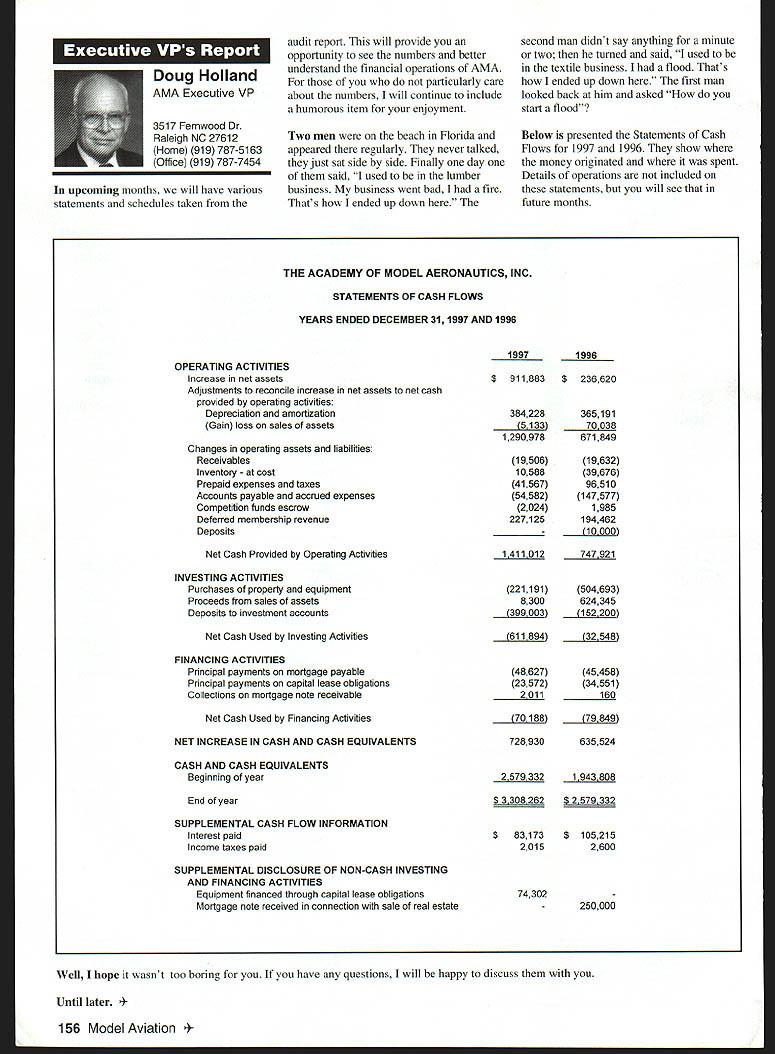
Below are the Statements of Cash Flows for 1997 and 1996. They show where the money originated and where it was spent. Details of operations are not included on these statements, but you will see those in future months.
THE ACADEMY OF MODEL AERONAUTICS, INC. STATEMENTS OF CASH FLOWS YEARS ENDED DECEMBER 31, 1997 AND 1996
OPERATING ACTIVITIES
- Increase in net assets ........................................ $ 911,883 $ 236,620
- Adjustments to reconcile increase in net assets to net cash provided by operating activities:
- Depreciation and amortization ............................. 384,228 365,191
- (Gain) loss on sales of assets ........................... (5,133) 70,038
-------------------------------- Total adjustments ....................................... 1,290,978 671,849
Changes in operating assets and liabilities:
- Receivables ................................................ (19,506) (19,632)
- Inventory - at cost ....................................... 10,588 (39,676)
- Prepaid expenses and taxes ................................. (41,567) 96,510
- Accounts payable and accrued expenses ..................... (54,582) (147,577)
- Competition funds escrow .................................. (2,024) 1,985
- Deferred membership revenue ............................... 227,125 194,462
- Deposits .................................................. — (10,000)
-------------------------------- Net Cash Provided by Operating Activities ................... 1,411,012 747,921
INVESTING ACTIVITIES
- Purchases of property and equipment ....................... (221,191) (504,693)
- Proceeds from sales of assets ............................. 8,300 624,345
- Deposits to investment accounts .......................... (399,003) (152,200)
-------------------------------- Net Cash Used by Investing Activities ....................... (611,894) (32,548)
FINANCING ACTIVITIES
- Principal payments on mortgage payable .................... (48,627) (45,458)
- Principal payments on capital lease obligations .......... (23,572) (34,551)
- Collections on mortgage note receivable .................. 2,011 160
-------------------------------- Net Cash Used by Financing Activities ....................... (70,188) (79,849)
NET INCREASE IN CASH AND CASH EQUIVALENTS ................... 728,930 635,524
CASH AND CASH EQUIVALENTS
- Beginning of year ......................................... 2,579,332 1,943,808
- End of year ............................................... 3,308,262 2,579,332
SUPPLEMENTAL CASH FLOW INFORMATION
- Interest paid ............................................. 83,173 105,215
- Income taxes paid ......................................... 2,015 2,600
SUPPLEMENTAL DISCLOSURE OF NON-CASH INVESTING AND FINANCING ACTIVITIES
- Equipment financed through capital lease obligations ...... 74,302 —
- Mortgage note received in connection with sale of real estate ................. 250,000
Well, I hope it wasn't too boring for you. If you have any questions, I will be happy to discuss them with you.
Until later.
---
AMA News
Academy of Model Aeronautics — AMA News 5151 East Memorial Drive, Muncie, IN 47302
Executive Council Meeting Highlights
Motions made May 2–3, 1998. Executive Council meeting motions below are unofficial minutes. Minutes will be official upon approval by the Council.
MOTION I — moved W. DeCou; seconded R. Miller:
- Have Doug Holland and Dave Brown contact Anita Northrop immediately to express strong interest pending Doug's validation of financial information provided to AMA.
- MOTION passed: 12 yes (II, IV, V, VI, VII, VIII, IX, X, XI, EVP, NAA), 1 no (III).
MOTION II — moved D. Holland; EVP seconded J. MeNeill:
- Postpone consideration of funding Mile Square until the June 1998 Executive Council meeting.
- MOTION passed: 9 yes (IV, V, VI, VII, VIII, IX, XI, EVP, NAA), 4 no (II, III, X).
- Note: this item placed on the agenda for the June 15, 1998 meeting.
MOTION III — moved J. MeNeill; seconded R. Hanson:
- Authorize President and Executive Vice President to purchase IMS Show up to $100K with intent of running in conjunction with Western States Modelers Association.
- MOTION passed: 9 yes (II, IV, V, VI, VII, VIII, X, EVP, attendance), 3 no (III, IX, XI, NAA).
---
DISTRICT II REPORT
Wes De Cou
Vice President
85 Riverside Drive Basking Ridge, NJ 07920-1308 Day: (908) 221-6899 Eve: (908) 221-1666 Fax: (908) 221-9297 ecodeu@idt.net
Associate Vice Presidents:
- Dave Babcock, 445 Stockton Street, Hightstown, NJ 08520-4501
- Roy A. Brown, USAF (Ret), 620 Kossuth Ave #4E, 07073
- Vince Juliano, 16 Shamrock Rd., Rocky Point, NY 11778
- Roy Juszkiewicz, 50 Livingston St., Staten Is., NY 10306
- James M. Lewis, P.O. Box 81, Congers, NY 10920
- Bob McKay, 109 W. Edward St., Islip, NY 11751
- Dave Mathewson, Box 613, Camillus, NY 13031
- Tom Murray, 31 Voorhees Ave., Basking Ridge, NJ 07920
- Malcolm Nickerson, 407 Willow Street, Lockport, NY 14094
- Bill Potthers, 2 Hemlock Court, Sayreville, NJ 08872
- Al Santini, 71 Perry Avenue, Latham, NY 12110-2423
- Terry Terrence, 101 Smithfield Dr., Endicott, NY 13760-4329
Frequency Coordinator:
- Lon Sauter, 53 Airport Dr., Oswego County Airport, Fulton, NY 13069 — (315) 598-6903
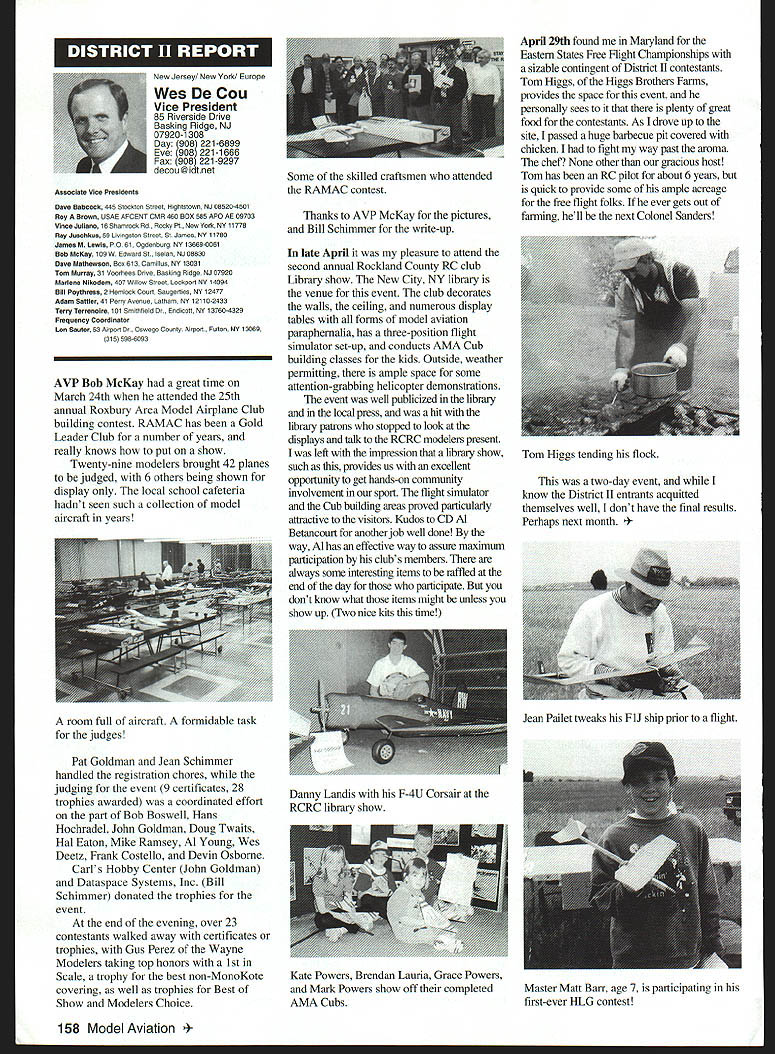
AVP Bob McKay had a great time on March 24 when he attended the 25th annual Roxbury Area Model Airplane Club building contest. RAMAC has been a Gold Leader Club for a number of years and really knows how to put on a show.
Twenty-nine modelers brought 42 planes to be judged, with six others shown for display only. The local school cafeteria hadn't seen such a collection of model aircraft in years.
Pat Goldman and Jean Schimmer handled registration, while judging was a coordinated effort by Bob Boswell, Hans Hochradel, John Goldman, Doug Twaits, Hal Eaton, Mike Ramsey, Al Young, Wes Deetz, Frank Costello, and Devin Osborne.
Carl's Hobby Center (John Goldman) and Dataspace Systems, Inc. (Bill Schimmer) donated trophies for the event.
At the end of the evening, more than 23 contestants walked away with certificates or trophies. Gus Perez of the Wayne Modelers took top honors with a 1st in Scale, a trophy for the best non-MonoKote covering, and trophies for Best of Show and Modelers' Choice.
Thanks to AVP McKay for the pictures, and Bill Schimmer for the write-up.
In late April I attended the second annual Rockland County RC Club library show at the New City, NY library. The club decorates the walls, the ceiling, and numerous display tables with all forms of model aviation paraphernalia, sets up a three-position flight simulator, and conducts AMA club building classes for kids. Outside, weather permitting, there is ample space for attention-grabbing helicopter demonstrations.
The event was well publicized in the library and local press, and was a hit with patrons who stopped to look at the displays and talk to the RCRC modelers. A library show provides an excellent opportunity to get hands-on community involvement in our sport. The flight simulator and club building areas proved particularly attractive to visitors. Kudos to CD Al Betancourt for another job well done! By the way, Al has an effective way to assure maximum participation by his club members: there are always some interesting items to be raffled at the end of the day for those who participate.
April 29 found me in Maryland for the Eastern States Free Flight Championships with a sizable contingent of District II contestants. Tom Higgs, of the Higgs Brothers Farms, provides the space for this event and personally sees to it that there is plenty of great food for the contestants. As I drove up to the site, I passed a huge barbecue pit covered with chicken; I had to fight my way past the aroma. The chef? None other than our gracious host! Tom has been an RC pilot for about six years but is quick to provide some of his ample acreage for the free flight folks. If he ever gets out of farming, he’ll be the next Colonel Sanders!
This was a two-day event, and while I know the District II entrants acquitted themselves well, I don't have the final results. Perhaps next month.
Transcribed from original scans by AI. Minor OCR errors may remain.

