
THE FCC EFFORT CONTINUES...
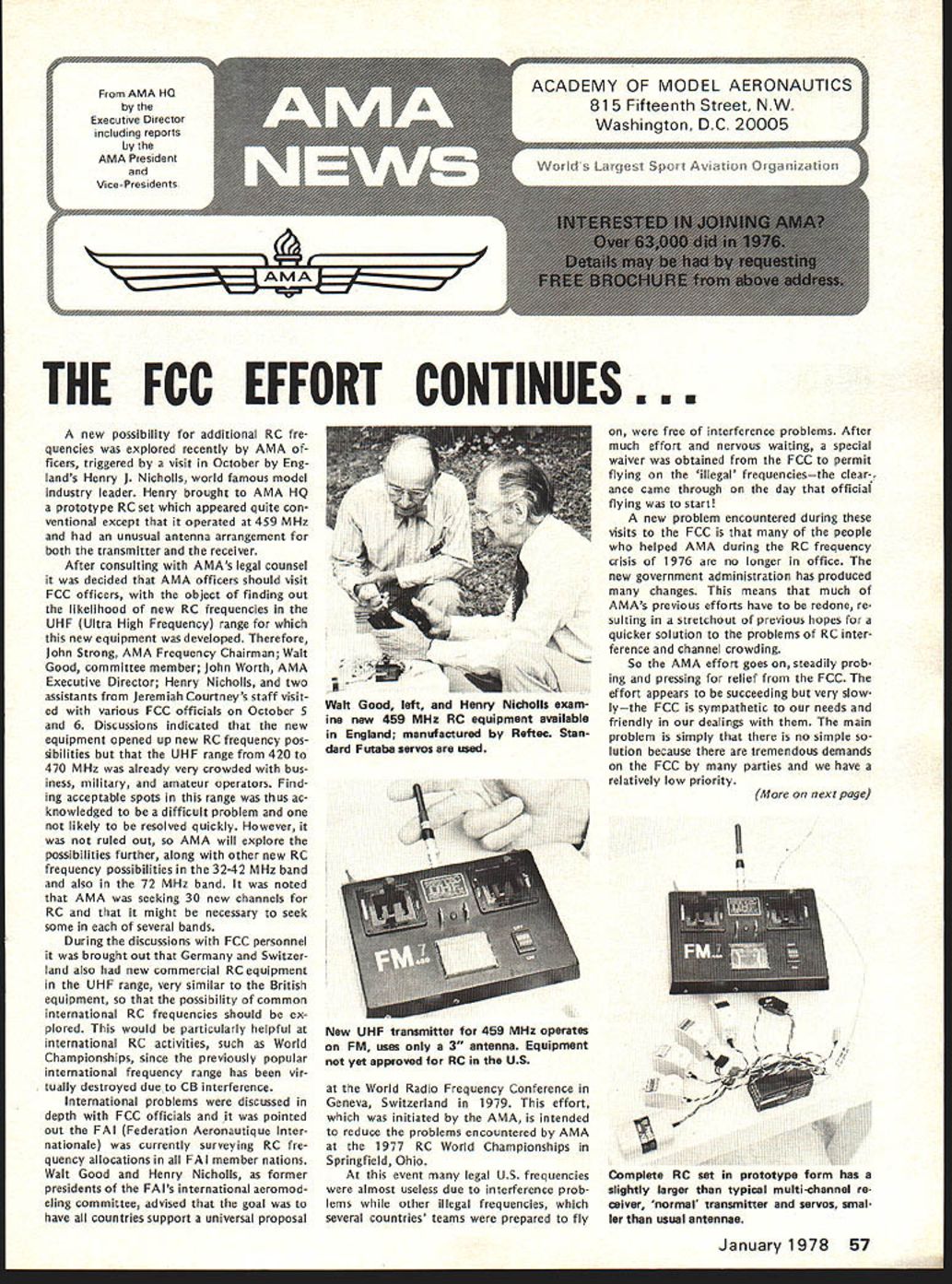
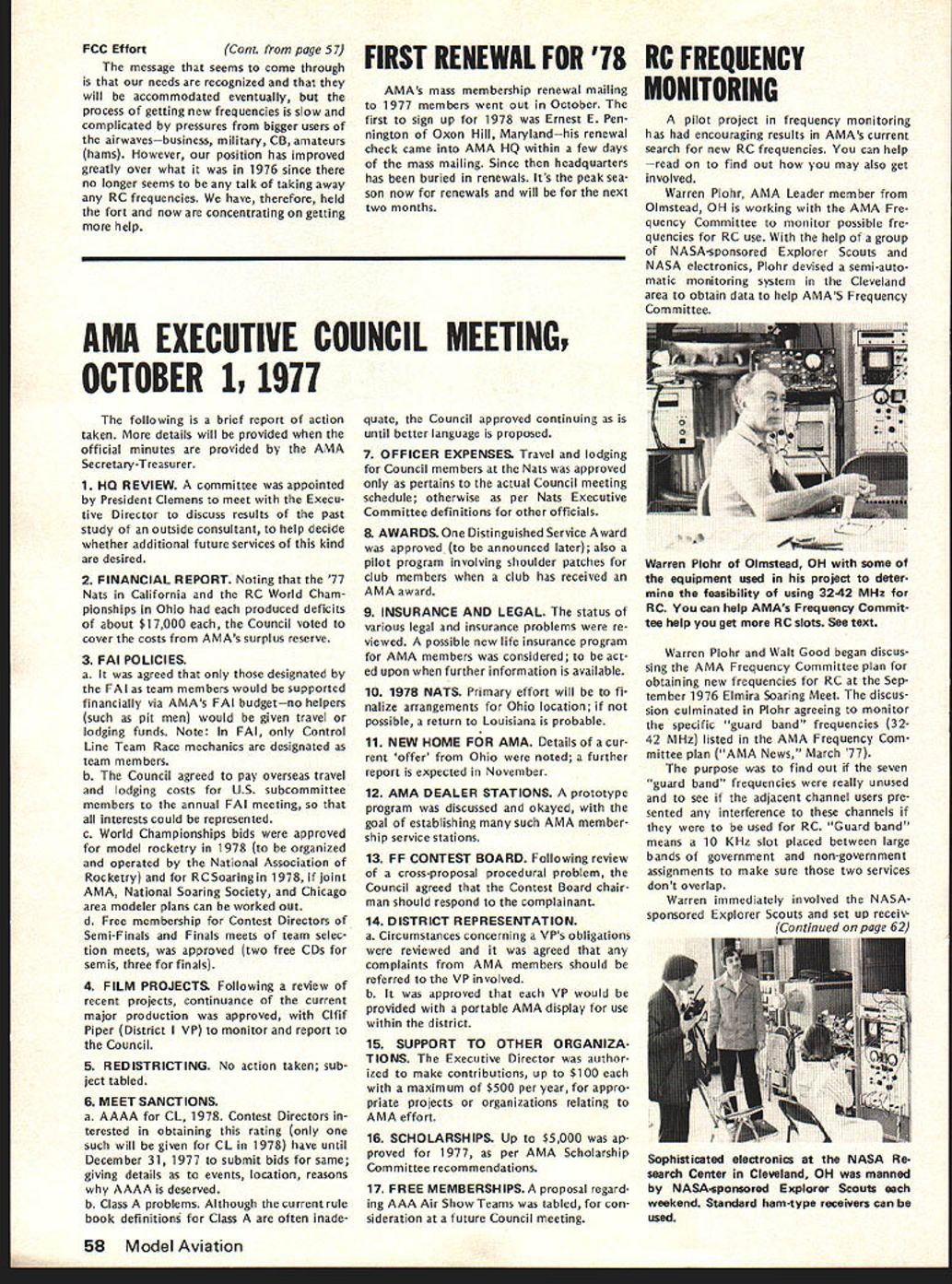
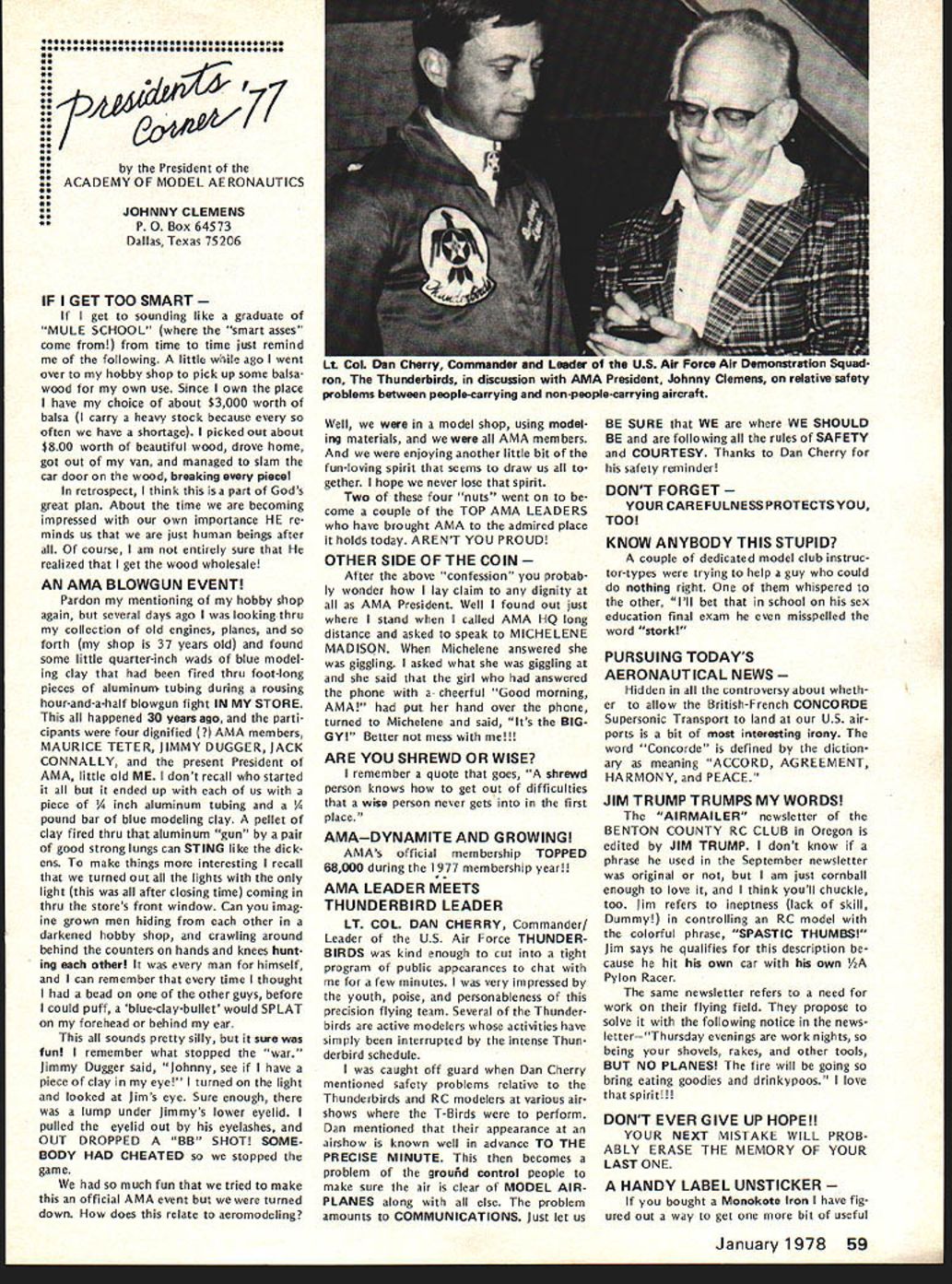
A new possibility for additional RC frequencies was explored recently by AMA officers, triggered by a visit in October by England's Henry J. Nicholls, world famous model industry leader. Henry brought to AMA HQ a prototype RC set which appeared quite conventional except that it operated at 459 MHz and had an unusual antenna arrangement for both the transmitter and the receiver.
After consulting with AMA's legal counsel it was decided that AMA officers should visit FCC officers, with the object of finding out the likelihood of new RC frequencies in the UHF (Ultra High Frequency) range for which this new equipment was developed. Therefore, John Strong, AMA Frequency Chairman; Walt Good, committee member; John Worth, AMA Executive Director; Henry Nicholls, and two assistants from Jeremiah Courtney's staff visited with various FCC officials on October 5 and 6. Discussions indicated that the new equipment opened up new RC frequency possibilities but that the UHF range from 420 to 470 MHz was already very crowded with business, military, and amateur operators. Finding acceptable spots in this range was thus acknowledged to be a difficult problem and one not likely to be resolved quickly. However, it was not ruled out, so AMA will explore the possibilities further, along with other new RC frequency possibilities in the 32-42 MHz band and also in the 72 MHz band. It was noted that AMA was seeking 30 new channels for RC and that it might be necessary to seek some in each of several bands.
During the discussions with FCC personnel, it was brought out that Germany and Switzerland also had new commercial RC equipment in the UHF range, very similar to the British equipment, so that the possibility of common international RC frequencies should be explored. This would be particularly helpful at international RC activities, such as World Championships, since the previously popular international frequency range has been virtually destroyed due to CB interference.
International problems were discussed in depth with FCC officials and it was pointed out that the FAI (Federation Aeronautique Internationale) was currently surveying RC frequency allocations in all FAI member nations. Walt Good and Henry Nicholls, as former presidents of the FAI's international aeromodelling committee, advised that the goal was to have all countries support a universal proposal at the World Radio Frequency Conference in Geneva, Switzerland in 1979. This effort, which was initiated by the AMA, is intended to reduce the problems encountered by AMA at the 1977 RC World Championships in Springfield, Ohio.
At this event many legal U.S. frequencies were almost useless due to interference problems while other illegal frequencies, which several countries' teams were prepared to fly on, were free of interference problems. After much effort and nervous waiting, a special waiver was obtained from the FCC to permit flying on the "illegal" frequencies — the clearance came through on the day that official flying was to start!
A new problem encountered during these visits to the FCC is that many of the people who helped AMA during the RC frequency crisis of 1976 are no longer in office. The new government administration has produced many changes. This means that much of AMA's previous efforts have to be redone, resulting in a stretchout of previous hopes for a quicker solution to the problems of RC interference and channel crowding.
So the AMA effort goes on, steadily probing and pressing for relief from the FCC. The effort appears to be succeeding but very slowly — the FCC is sympathetic to our needs and friendly in our dealings with them. The main problem is simply that there is no simple solution because there are tremendous demands on the FCC by many parties and we have a relatively low priority.
FIRST RENEWAL FOR '78
AMA's mass membership renewal mailing to 1977 members went out in October. The first to sign up for 1978 was Ernest E. Pennington of Oxon Hill, Maryland—his renewal check came into AMA HQ within a few days of the mass mailing. Since then headquarters has been buried in renewals. It's the pack season now for renewals and will be for the next two months.
RC FREQUENCY MONITORING
A pilot project in frequency monitoring has had encouraging results in AMA's current search for new RC frequencies. You can help—read on to find out how you may also get involved.
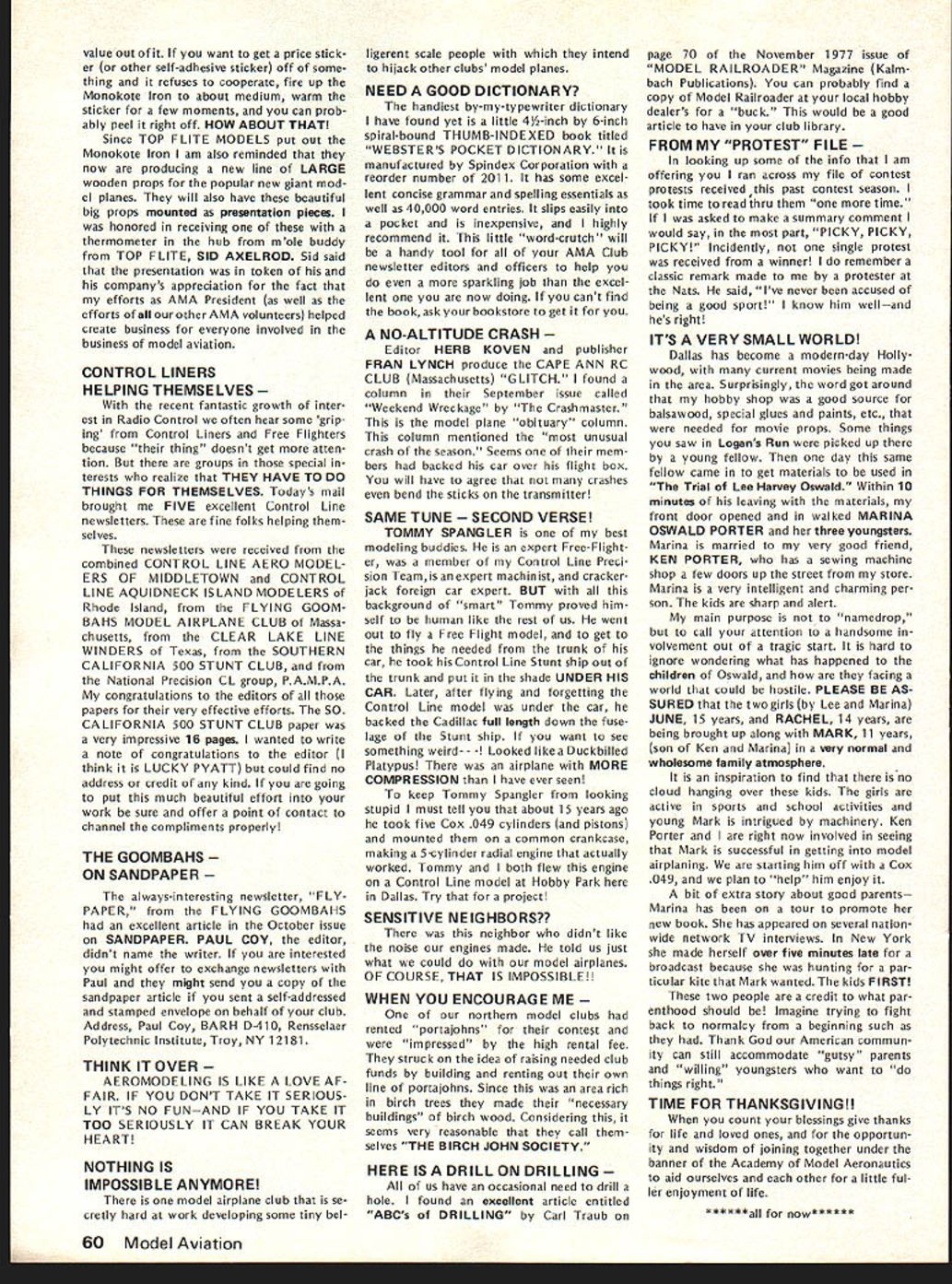
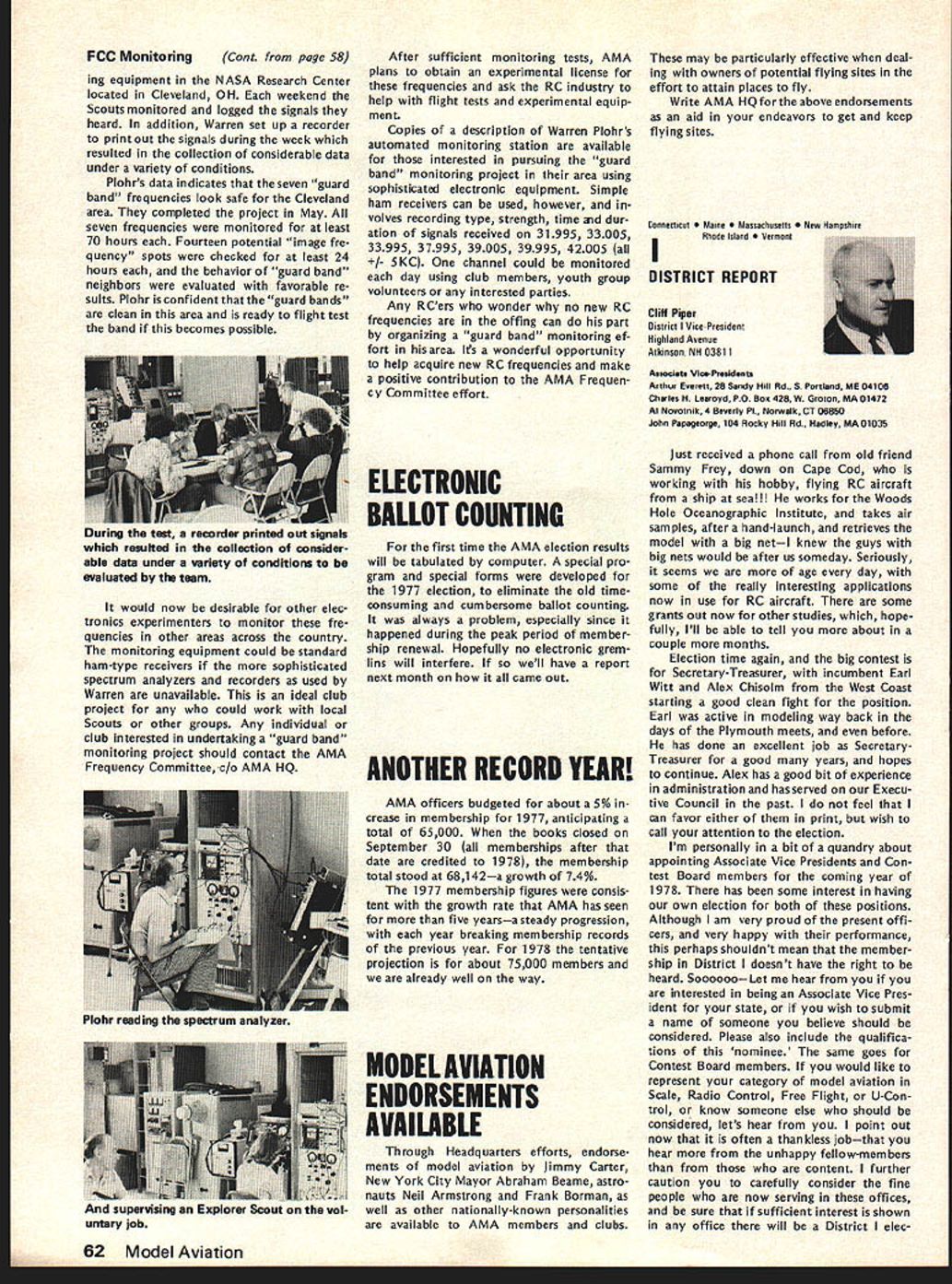
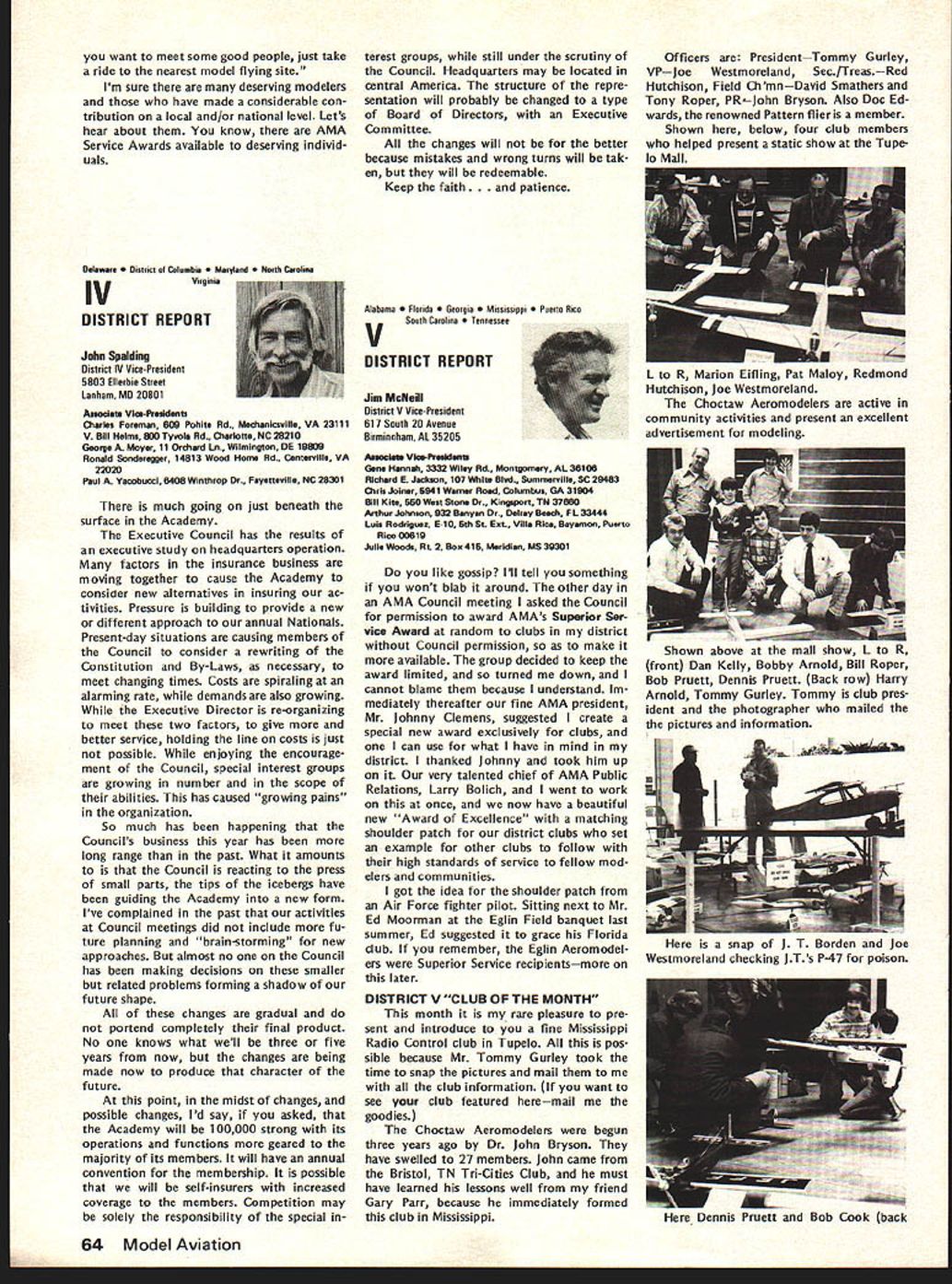
Warren Plohr, AMA Leader member from Olmstead, OH is working with the AMA Frequency Committee to monitor possible frequencies for RC use. With the help of a group of NASA-sponsored Explorer Scouts and NASA electronics, Plohr devised a semi-automatic monitoring system in the Cleveland area to obtain data to help AMA's Frequency Committee.
Warren Plohr and Walt Good began discussing the AMA Frequency Committee plan for obtaining new frequencies for RC at the September 1976 Elmira Soaring Meet. The discussion culminated in Plohr agreeing to monitor the specific "guard band" frequencies (32-42 MHz) listed in the AMA Frequency Committee plan ("AMA News," March '77).
The purpose was to find out if the "guard band" frequencies were really unused and to see if the adjacent channel users presented any interference to these channels if they were to be used for RC. "Guard band" means a 10 KHz slot placed between large bands of government and non-government assignments to make sure those two services don't overlap.
Warren immediately involved the NASA-sponsored Explorer Scouts and set up receivers
AMA EXECUTIVE COUNCIL MEETING, OCTOBER 1, 1977
The following is a brief report of action taken. More details will be provided when the official minutes are provided by the AMA Secretary-Treasurer.
- HQ REVIEW. A committee was appointed by President Clemens to meet with the Executive Director to discuss results of the past study of an outside consultant, to help decide whether additional future services of this kind are desired.
- FINANCIAL REPORT. Noting that the '77 Nats in California and the RC World Championships in Ohio had each produced deficits of about $17,000 each, the Council voted to cover the costs from AMA's surplus reserve.
- FAI POLICIES.
a. It was agreed that only those designated by the FAI as team members would be supported financially via AMA's FAI budget—no helpers (such as pit men) would be given travel or lodging funds. Note: In FAI, only Control Line Team Race mechanics are designated as team members. b. The Council agreed to pay overseas travel and lodging costs for U.S. subcommittee members to the annual FAI meeting, so that all interests could be represented. c. World Championships bids were approved for model rocketry in 1978 (to be organized and operated by the National Association of Rocketry) and for RC Soaring in 1978, if joint AMA, National Soaring Society, and Chicago area modeler plans can be worked out. d. Free membership for Contest Directors of Semi-finals and Finals meets of team selection meets was approved (two free CDs for semis, three for finals).
- FILM PROJECTS. Following a review of recent projects, continuance of the current major production was approved, with Cliff Piper (District 1 VP) to monitor and report to the Council.
- REDISTRICTING. No action taken; subject tabled.
- MEET SANCTIONS.
a. AAA for CL, 1978. Contest Directors interested in obtaining this rating (only one such will be given for CL in 1978) have until December 31, 1977 to submit bids for same; giving details as to events, location, reasons why AAA is deserved. b. Class A problems. Although the current rule book definitions for Class A are often inadequate, the Council approved continuing as is until better language is proposed.
- OFFICER EXPENSES. Travel and lodging for Council members at the Nats was approved only as pertains to the actual Council meeting schedule; otherwise as per Nats Executive Committee definitions for other officials.
- AWARDS. One Distinguished Service Award was approved (to be announced later); also a pilot program involving shoulder patches for club members when a club has received an AMA award.
- INSURANCE AND LEGAL. The status of various legal and insurance problems were reviewed. A possible new life insurance program for AMA members was considered; to be acted upon when further information is available.
- 1978 NATS. Primary effort will be to finalize arrangements for Ohio location; if not possible, a return to Louisiana is probable.
- NEW HOME FOR AMA. Details of a current "offer" from Ohio were noted; a further report is expected in November.
- AMA DEALER STATIONS. A prototype program was discussed and okayed, with the goal of establishing many such AMA membership service stations.
- FF CONTEST BOARD. Following review of a cross-proposal procedural problem, the Council agreed that the Contest Board chairman should respond to the complainant.
- DISTRICT REPRESENTATION.
a. Circumstances concerning a VP's obligations were reviewed and it was agreed that any complaints from AMA members should be referred to the VP involved. b. It was provided that each VP would be provided with a portable AMA display for use within the district.
- SUPPORT TO OTHER ORGANIZATIONS. The Executive Director was authorized to make contributions, up to $100 each with a maximum of $500 per year, for appropriate projects or organizations relating to AMA effort.
- SCHOLARSHIPS. Up to $5,000 was approved for 1977, as per AMA Scholarship Committee recommendations.
- FREE MEMBERSHIPS. A proposal regarding AAA Air Show Teams was tabled, for consideration at a future Council meeting.
THE FCC EFFORT CONTINUES.
A new possibility for additional RC frequencies was explored recently when AMA officers traveled to England. Henry J. Nicholls, world-famous model industry leader, brought to AMA HQ a prototype RC set that appeared quite conventional except that it operated on 459 MHz and had an unusual antenna arrangement on both transmitter and receiver. After consulting AMA's legal counsel it was decided AMA officers should visit FCC officials to find out the likelihood of new RC frequencies in the UHF (Ultra High Frequency) range if new equipment developed.
Therefore John Strong, AMA Frequency Chairman, Walt Good, committee member, John Worth, AMA Executive Director, Henry Nicholls and two assistants from Nicholls' staff visited various FCC officials October 5-6. Discussions indicated the new equipment opened up new RC frequency possibilities. The UHF range (420-470 MHz) is already very crowded — business, military and amateur operators — and finding acceptable spots in the range is acknowledged a difficult problem not likely to be resolved quickly. However, it was ruled out that AMA would abandon exploring UHF; AMA will continue to pursue other new RC frequency possibilities as well. The 32-42 MHz band and the 72 MHz band were also noted as possibilities. AMA is seeking 30 new channels for RC and it may be necessary to seek them in several bands.
During discussions FCC personnel brought out that Germany and Switzerland, as well as Britain, have new commercial RC equipment in the UHF range very similar to the British equipment. The possibility of common international RC frequencies should be explored; this would be particularly helpful for international RC activities such as World Championships since the previously popular international frequency range has been virtually destroyed by CB interference.
International problems were discussed in depth. FCC officials pointed out that the FAI (Federation Aeronautique Internationale) is currently surveying RC frequency allocations of FAI member nations. Walt Good and Henry Nicholls, former presidents of the FAI's International Aeromodelling Committee, advised that the goal is to have countries support a universal proposal at the World Radio Conference in Geneva, Switzerland in 1979. This effort, initiated by AMA, is intended to reduce problems encountered at the AMA 1977 RC World Championships in Springfield, Ohio, where legal U.S. frequencies were almost useless due to interference problems and other illegal frequencies used by several countries' teams. Many teams were prepared to fly free of interference problems. After much effort and nervous waiting a special waiver was obtained — an FCC permit to fly on illegal frequencies — and the clearance came through the day official flying was to start.
New problems were encountered during the visits. The FCC people who had helped AMA during the RC frequency crisis of 1976 are no longer in office. The new government administration has produced changes which mean much of AMA's previous effort must be redone, resulting in a stretch-out of previous hopes for a quicker solution to problems of RC interference and channel crowding. So AMA's effort goes steadily on, probing for pressing relief. The FCC effort appears to be succeeding very slowly; the FCC is sympathetic and dealings have been friendly, but the main problem is simply there is no simple solution because of the tremendous demands on the FCC. RC parties have relatively low priority among the many users of the airwaves.
The message seems to have come through that AMA's needs are recognized and will be accommodated eventually. The process of getting new frequencies is slow and complicated by pressures from larger users of the airwaves — business, military, CB and amateur operators. However, the position has improved greatly over what it was in 1976. There no longer seems to be talk of taking away RC frequencies. AMA has therefore held its ground and is now concentrating on getting the necessary help.
FIRST RENEWAL FOR 1978 R/C FREQUENCY MONITORING
AMA's mass membership renewal mailing for 1977 members went out October 1st. Ernest E. Pennington, Oxon Hill, Maryland—his renewal check came to AMA HQ first.
CONTROL LINERS HELPING THEMSELVES
With the recent fantastic growth of interest in Radio Control we often hear some "griping" from Control Liners and Free Flighters because "their thing" doesn't get more attention. But there are groups in those special interests who realize that THEY HAVE TO DO THINGS FOR THEMSELVES. Today's mail brought me FIVE excellent Control Line newsletters. These are fine folks helping themselves.
These newsletters were received from the combined CONTROL LINE AERO MODELERS OF MIDDLETOWN and CONTROL LINE AQUIA/NECK ISLAND MODELERS of Rhode Island, from the FLYING GOOMBAHS MODEL AIRPLANE CLUB of Massachusetts, from the CLEAR LAKE LINE WINDERS of Texas, from the SOUTHERN CALIFORNIA SOOT STUNT CLUB, and from the National Precision CL Group, P.A.M.P.A. My congratulations to the editors of all those papers for their very effective efforts. The SO. CALIFORNIA SOOT STUNT CLUB paper was a very impressive 16 pages. I wanted to write a note of congratulations to the editor (I think it is LUCKY PYATT) but could find no address or credit of any kind. If you are going to put this much beautiful effort into your work be sure and offer a point of contact to channel the compliments properly!
THE GOOMBAHS — ON SANDPAPER PAUL COY, the editor, didn't name the writer. If you are interested you might offer to exchange newsletters with Paul and they might send you a copy of the sandpaper article if you send a self-addressed and stamped envelope on behalf of your club. Address, Paul Coy, BARH D-410, Rensselaer Polytechnic Institute, Troy, NY 12181.
THINK IT OVER —
AEROMODELING IS LIKE A LOVE AFFAIR. IF YOU DON'T TAKE IT SERIOUSLY IT'S NO FUN—AND IF YOU TAKE IT TOO SERIOUSLY IT CAN BREAK YOUR HEART!
NOTHING IS IMPOSSIBLE ANYMORE!
There is one model airplane club that is secretly hard at work developing some tiny belligerent scale people with which they intend to hijack other clubs' model planes.
NEED A GOOD DICTIONARY?
The handiest-by-my-typewriter dictionary I have found yet is a little 4½-inch by 6-inch spiral-bound THUMB-INDEXED book titled "WEBSTER'S POCKET DICTIONARY." It is manufactured by Spindex Corporation with a reorder number of 2011. It has some excellent concise grammar and spelling essentials as well as 40,000 word entries. It slips easily into a pocket and is inexpensive, and I highly recommend it. This little "word-crutch" will be a handy tool for all of your AMA Club newsletter editors and officers to help you do even a more sparkling job than the excellent one you are now doing. If you can't find the book, ask your bookstore to get it for you.
A NO-ALTITUDE CRASH —
Editor HERB KOVEN and publisher FRAN LYNCH produce the CAPE ANN RC CLUB (Massachusetts) "GLITCH." I found a column in their September issue called "Weekend Wreckage" by "The Crashmaster." This is the model plane "obituary" column. This column mentioned the "most unusual crash of the season." Seems one of their members had backed his car over his flight box. You will have to agree that not many crashes even bend the sticks on the transmitter!
SAME TUNE — SECOND VERSE!
TOMMY SPANGLER is one of my best modeling buddies. He is an expert Free-Flighter, was a member of my Control Line Precision Team, is an expert machinist, and crackjack foreign car expert. BUT with all this background of "smart" Tommy proved himself to be human like the rest of us. He went out to the hobby shop to buy a Free Flight model, and to get to the things he needed from the trunk of his car, he took his Control Line stunt ship out of the trunk and put it in the shade UNDER HIS CAR. Later, after flying and forgetting the Control Line model was under the car, he backed the Cadillac full length down the fuselage of the stunt ship. If you want to see something weird—!! It looked like a Duckbilled Platypus! There was an airplane with MORE COMPRESSION than I have ever seen!
To keep Tommy Spangler from looking stupid I must tell you that about 15 years ago he took fire Cox .049 cylinders (and pistons) and mounted them on a common crankcase, making a 5 cylinder radial engine that actually worked. Tommy and I both flew this engine on a Control Line model at Hobby Park here in Dallas. Try that for a project!
SENSITIVE NEIGHBORS?
There was this neighbor who didn't like the noise our engines made. He told us just what we could do with our model airplanes. OF COURSE, THAT IS IMPOSSIBLE!!
WHEN YOU ENCOURAGE ME —
One of our northern model clubs had rented "portajohns" for their contest and were "impressed" by the high rental fee. They struck on the idea of raising needed club funds by building and renting out their own line of portajohns. Since this was an area rich in birch trees they made their "necessary buildings" of birch wood. Considering this, it seems very reasonable that they call themselves "THE BIRCH JOHN SOCIETY."
HERE IS A DRILL ON DRILLING —
All of us have an occasional need to drill a hole. I found an excellent article entitled "ABC's of DRILLING" by Carl Traub on page 70 of the November 1977 issue of "MODEL RAILROADER" Magazine (Kalmbach Publications). You can probably find a copy of Model Railroader at your local hobby dealer for a "buck." This would be a good article to have in your club library.
FROM MY "PROTEST" FILE
In looking up some of the info that I am offering you I ran across my file of contest protests received this past contest season. I took time to read through them "one more time." If I was asked to make a summary comment I would say, in the most part, "PICKY, PICKY, PICKY!" Incidentally, not one single protest was received from a winner! I do remember a classic remark made to me by a protester at the Nats. He said, "I've never been accused of being a good sport!" I know him well—and he's right!
IT'S A VERY SMALL WORLD!
Dallas has become a modern-day Hollywood, with many current movies being made in the area. Surprisingly, the word got around that my hobby shop was a good source for balsa wood, special glues and paints, etc., that were needed for movie props. Some things you saw in Logan's Run were picked up there by a young fellow. Then one day this same fellow came in to get materials to be used in "The Trial of Lee Harvey Oswald." Within 10 minutes of his leaving with the materials, my front door opened and in walked MARINA OSWALD PORTER and her three youngsters. Marina is married to my very good friend, KEN PORTER, who has a sewing machine shop a few doors up the street from my store. Marina is a very intelligent and charming person. The kids are sharp and alert.
My main purpose is to "remind" you, but to call your attention to a hands-on involvement out of a tragic start. It is hard to ignore wondering what has happened to the children of Oswald, and how they are facing a world that could be hostile. PLEASE BE ASSURED that the two girls (by Lee and Marina) JUNE, 15 years, and RACHEL, 14 years, are being brought up along with MARK, 11 years, (son of Ken and Marina) in a very normal and wholesome family atmosphere.
It is an inspiration to find that there is no cloud hanging over these kids. The girls are active in sports and school activities and young Mark is intrigued by machinery. Ken Porter and I are right now involved in seeing that Mark is successful in getting into model airplaning. We are starting him off with a Cox .049, and we plan to "help" him enjoy it.
A bit of extra story about good parents—Marina has been on a tour to promote her new book. She has appeared on several nationwide network TV interviews. In New York she made herself over five minutes late for a broadcast because she was hunting for a particular kite that Mark wanted. The kids FIRST!
These two people are a credit to what parenthood should be! Imagine trying to fight back to normalcy from a beginning such as they had. Thank God our American community can still accommodate "gutsy" parents and "willing" youngsters who want to "do things right."
TIME FOR THANKSGIVING!!
When you count your blessings give thanks for life and loved ones, and for the opportunity and wisdom of joining together under the banner of the Academy of Model Aeronautics to aid ourselves and each other for a little fuller enjoyment of life.
***** all for now ***** A new possibility — additional RC frequencies — was explored recently when AMA officers traveled to England to visit Henry J. Nicholls, world-famous model industry leader. Henry brought to AMA HQ a prototype RC set which appeared quite conventional except that it operated on 459 MHz and had an unusual antenna arrangement on both transmitter and receiver. After consulting AMA's legal counsel it was decided AMA officers should visit FCC officers to find out the likelihood new RC frequencies in the UHF (Ultra High Frequency) range might be available and to determine whether new equipment had been developed.
Therefore John Strong, AMA Frequency Chairman; Walt Good, committee member; John Worth, AMA Executive Director; Henry Nicholls; two assistants; and Jeremiah Courtney's staff visited various FCC officials October 5–6.
Discussions indicated the new equipment opened up new RC frequency possibilities. The UHF range, 420–470 MHz, is already very crowded with business, military and amateur operators. Finding acceptable spots in the range was acknowledged to be a difficult problem and not likely to be resolved quickly. However the 32–42 MHz band and the 72 MHz band were also noted. AMA is seeking some 30 new channels for RC and it might be necessary to seek them in several bands.
During discussions FCC personnel pointed out that Germany, Switzerland and Britain also have new commercial RC equipment in the UHF range, very similar to the British equipment. The possibility of common international RC frequencies should be explored; that would be particularly helpful for international RC activities such as World Championships since previously popular international frequency ranges have been virtually destroyed by CB interference. International problems were discussed in depth. FCC officials pointed out FAI (Federation Aeronautique Internationale) is currently surveying RC frequency allocations of FAI member nations. Walt Good and Henry Nicholls, former presidents of FAI's international aeromodelling committee, advised the goal is to have countries support a universal proposal at the World Radio Conference in Geneva, Switzerland, 1979.
The effort was initiated by AMA to reduce problems encountered at the AMA 1977 RC World Championships in Springfield, Ohio. At that event legal U.S. frequencies were almost useless due to interference problems; several countries' teams preferred to fly on illegal frequencies to avoid interference. After much effort and nervous waiting, a special waiver was obtained from the FCC permitting flying on illegal frequencies — the clearance came through the day official flying was to start.
A new problem encountered during the visits was that many of the FCC personnel who had helped AMA during the RC frequency crisis in 1976 were no longer in office. A new government administration produced changes which meant much of AMA's previous work had to be redone, resulting in a stretchout of previous hopes for a quicker solution to the problems of RC interference and channel crowding. So AMA's effort goes steadily on, probing for pressing relief. The FCC effort appears to be succeeding very slowly. The FCC is sympathetic to AMA's needs and dealings have been friendly. The main problem simply is that there is no simple solution because of the tremendous demands on the airwaves and RC has a relatively low priority.
The message seems to have come through that the need is recognized and will be accommodated eventually. The process of getting new frequencies is slow and complicated by pressures from bigger users of the airwaves — business, military, CB and amateur operators. However the position has improved greatly since 1976; it no longer seems there is talk of taking away RC frequencies. AMA has therefore held its ground and is now concentrating on getting help.
FIRST RENEWAL FOR 1978 RC FREQUENCY MONITORING — AMA's mass membership renewal mailing for 1978 went out October 1. The first renewal check received at AMA HQ was from Ernest E. Pennington, Oxon Hill, Maryland.
AMA News
Equipment in the NASA Research Center located in Cleveland, OH. Each weekend the Scouts monitored and logged the signals they heard. In addition, Warren set up a recorder to print out the signals during the week which resulted in the collection of considerable data under a variety of conditions.
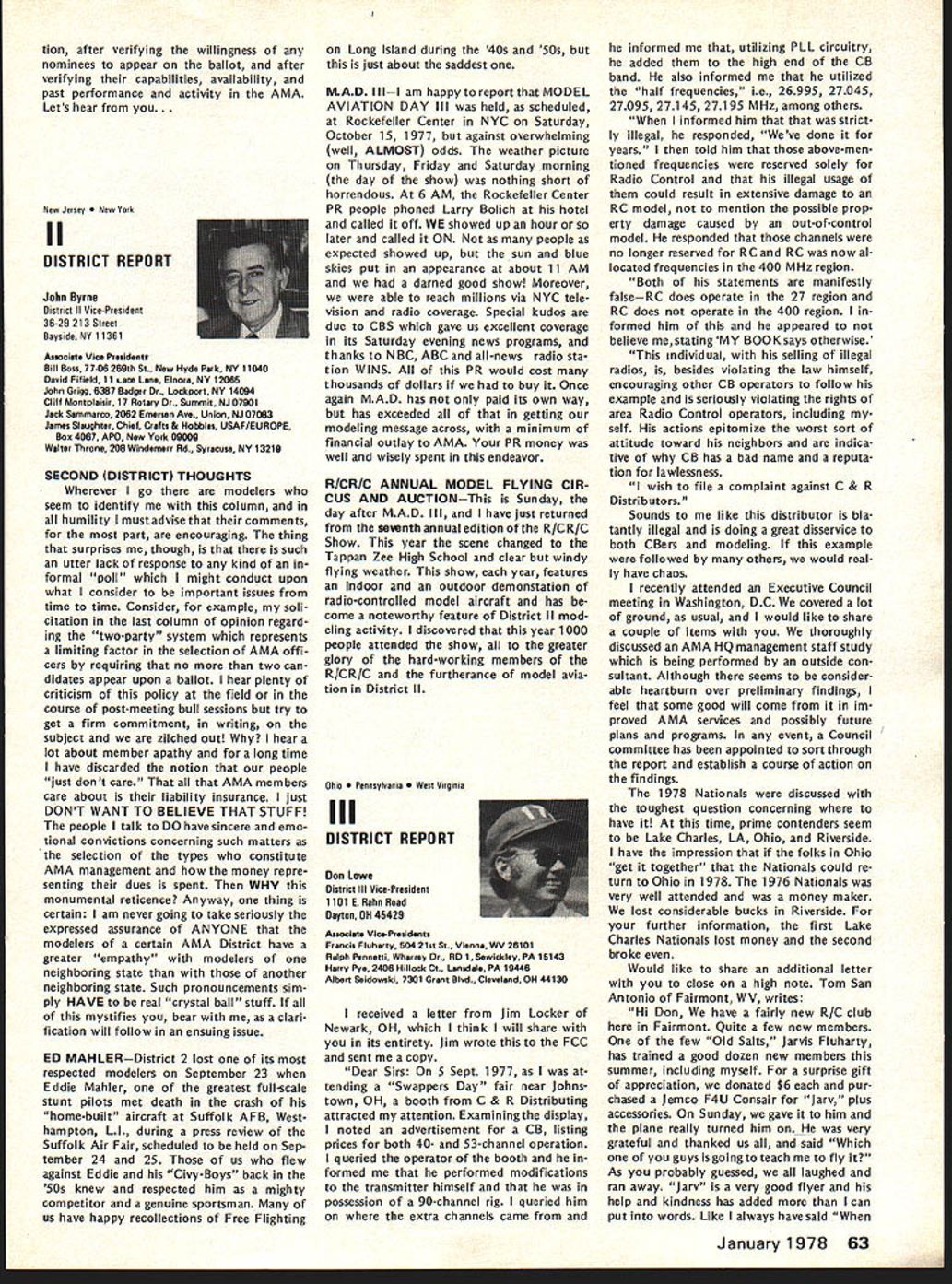
Plohr's data indicates that the seven "guard band" frequencies look safe for the Cleveland area. They completed the project in May. All seven frequencies were monitored for at least 70 hours each. Fourteen potential "image frequency" spots were checked for at least 24 hours each, and the behavior of "guard band" neighbors were evaluated with favorable results. Plohr is confident that the "guard bands" are clean in this area and is ready to flight test the band if this becomes possible.
It would now be desirable for other electronics experimenters to monitor these frequencies in other areas across the country. The monitoring equipment could be standard ham-type receivers if the more sophisticated spectrum analyzers and recorders as used by Warren are unavailable. This is an ideal club project for any who could work with local Scouts or other groups. Any individual or club interested in undertaking a "guard band" monitoring project should contact the AMA Frequency Committee, c/o AMA HQ.
After sufficient monitoring tests, AMA plans to obtain an experimental license for these frequencies and ask the RC industry to help with flight tests and experimental equipment.
Copies of a description of Warren Plohr's automated monitoring station are available for those interested in pursuing the "guard band" monitoring project in their area using sophisticated electronic equipment. Simple ham receivers can be used, however, and involves recording type, strength, time and duration of signals received on 31.995, 33.005, 33.995, 37.995, 39.005, 39.995, 42.005 (all +/- 5KC). One channel could be monitored each day using club members, youth group volunteers or any interested parties.
Any RC'ers who wonder why no new RC frequencies are in the offering can do his part by organizing a "guard band" monitoring effort in his area. It's a wonderful opportunity to help acquire new RC frequencies and make a positive contribution to the AMA Frequency Committee effort.
ELECTRONIC BALLOT COUNTING
For the first time the AMA election results will be tabulated by computer. A special program and special forms were developed for the 1977 election, to eliminate the old time-consuming and cumbersome ballot counting. It was always a problem, especially since it happened during the peak period of membership renewal. Hopefully no electronic gremlins will interfere. If so we'll have a report next month on how it all came out.
ANOTHER RECORD YEAR!
AMA officers budgeted for about a 5% increase in membership for 1977, anticipating a total of 65,000. When the books closed on September 30 (all memberships after that date are credited to 1978), the membership total stood at 68,142 — a growth of 4.7%.
The 1977 membership figures were consistent with the growth rate that AMA has seen for more than five years — a steady progression, with each year breaking membership records of the previous year. For 1978 the tentative projection is for about 75,000 members and we are already well on the way.
MODEL AVIATION ENDORSEMENTS AVAILABLE
Through Headquarters efforts, endorsements of model aviation by Jimmy Carter, New York City Mayor Abraham Beame, astronauts Neil Armstrong and Frank Borman, as well as other nationally-known personalities are available to AMA members and clubs. These may be particularly effective when dealing with owners of potentially flying sites in the effort to obtain places to fly.
Write AMA HQ for the above endorsements as an aid in your endeavors to get and keep flying sites.
THE FCC EFFORT CONTINUES.
A new possibility for additional RC frequencies was explored recently when AMA officers visited England. Henry J. Nicholls, world-famous model industry leader, brought to AMA HQ a prototype RC set which appeared quite conventional except that it operated on 459 MHz and had an unusual antenna arrangement on both transmitter and receiver. After consulting AMA's legal counsel, it was decided AMA officers should visit FCC to find out the likelihood of new RC frequencies in the UHF (Ultra High Frequency) range now that new equipment has been developed. Therefore John Strong, AMA Frequency Chairman; Walt Good, committee member; John Worth, AMA Executive Director; Henry Nicholls and two assistants, and Jeremiah Courtney's staff visited various FCC officials October 5-6.
Discussions indicated the new equipment opened up new RC frequency possibilities. The UHF range (420-470 MHz) is already very crowded with business, military and amateur operators. Finding acceptable spots in the range, thus acknowledged, is a difficult problem that is unlikely to be resolved quickly. However, AMA will explore possibilities further along other new RC frequency avenues. The 32-42 MHz band and the 72 MHz band were also noted. AMA is seeking 30 new channels for RC and it might be necessary to seek some in several bands.
During discussions FCC personnel pointed out that Germany, Switzerland and other nations also have new commercial RC equipment in the UHF range very similar to the British equipment. The possibility of common international RC frequencies should be explored; it would be particularly helpful for international RC activities such as the World Championships since the previously popular international frequency range has virtually been destroyed by CB interference.
International problems were discussed in depth. FCC officials pointed out that the FAI (Federation Aeronautique Internationale) is currently surveying RC frequency allocations in FAI member nations. Walt Good and Henry Nicholls, former presidents of the FAI's International Aeromodelling Committee, advised that the goal is to have countries support a universal proposal at the World Radio Frequency Conference in Geneva, Switzerland, 1979. This effort, initiated by AMA, is intended to reduce problems encountered at the AMA 1977 RC World Championships in Springfield, Ohio. Legal U.S. frequencies were almost useless due to interference problems; on other illegal frequencies several countries' teams prepared to fly free of interference. After much effort and nervous waiting, a special waiver was obtained — an FCC permit to fly on illegal frequencies — the clearance came through the day official flying was to start.
A new problem encountered during the visits was that FCC people who had helped AMA during the RC frequency crisis of 1976 are no longer in office. The new government administration has produced changes which mean much of AMA's previous efforts have had to be redone, resulting in a stretch-out of earlier hopes for a quicker solution to RC interference and channel crowding.
So AMA's effort goes steadily on, probing for pressing relief. The FCC effort appears to be succeeding very slowly. The FCC is sympathetic and dealings have been friendly. The main problem simply is that there is no simple solution because of the tremendous demands on the FCC and modelers have relatively low priority. The message seems to come through: the need is recognized and will be accommodated eventually, but the process of getting new frequencies is slow and complicated because of pressures from bigger users of the airwaves — business, military, CB and amateur radio. However, the position has improved greatly since 1976; there no longer seems to be talk of taking away RC frequencies. AMA has therefore held its fort and is now concentrating on getting help.
FIRST RENEWAL FOR 1978 RC FREQUENCY MONITORING
AMA's mass membership renewal mailing for 1977 members went out October 1 to sign up for 1978. Ernest E. Pennington, Oxon Hill, Maryland, was the first to renew — his renewal check came to AMA Headquarters. A new possibility for additional RC frequencies was explored recently when AMA officers made a trip to England. Henry J. Nicholls, world-famous model industry leader, brought an AMA Headquarters prototype RC set which appeared quite conventional except that it operated at 459 MHz and had an unusual antenna arrangement on both transmitter and receiver. After consulting AMA's legal counsel it was decided AMA officers should visit the FCC to find out the likelihood of new RC frequencies in the UHF (Ultra High Frequency) range if new equipment were developed. Therefore John Strong, AMA Frequency Chairman; Walt Good, committee member; John Worth, AMA Executive Director; Henry Nicholls and two assistants visited various FCC officials October 5-6.
Discussions indicated the new equipment opened up new RC frequency possibilities. The UHF range, 420-470 MHz, is already very crowded with business, military and amateur operators. Finding acceptable spots in the range was acknowledged to be a difficult problem and not likely to be resolved quickly. However, the 32-42 MHz band and the 72 MHz band were also noted as possibilities. AMA is seeking 30 new channels for RC and it might be necessary to seek some channels in several bands.
During discussions FCC personnel brought out that Germany, Switzerland and other countries also have new commercial RC equipment in the UHF range very similar to British equipment. The possibility of common international RC frequencies should be explored; this would be particularly helpful for international RC activities such as World Championships since the previously popular international frequency range has been virtually destroyed by CB interference. International problems were discussed in depth. FCC officials pointed out that the FAI (Federation Aeronautique Internationale) is currently surveying RC frequency allocations of FAI member nations. Walt Good and Henry Nicholls, former presidents of the FAI's international aeromodelling committee, advised that the goal should be to have countries support a universal proposal at the World Radio Conference in Geneva, Switzerland, in 1979. The effort was initiated by AMA to reduce problems encountered at the AMA 1977 RC World Championships in Springfield, Ohio, where legal US frequencies were almost useless because of interference problems and where teams from several countries were prepared to fly on illegal frequencies to avoid interference. After much effort and nervous waiting a special waiver was obtained from the FCC permitting flying on illegal frequencies — the clearance came through the day official flying started.
A new problem encountered during the visits was that many of the FCC people who had helped AMA during the RC frequency crisis in 1976 were no longer in office. The new government administration has produced changes in personnel and means that much of AMA's previous work has had to be redone, resulting in a stretch-out of earlier hopes for a quicker solution to RC interference and channel crowding. So AMA's effort goes steadily on, probing for pressing relief. The FCC effort appears to be succeeding very slowly. The FCC is sympathetic and dealings have been friendly. The main problem simply is that there is no simple solution because of the tremendous demands on the FCC and modelers have relatively low priority. The message seems to come through: the need is recognized and will be accommodated eventually, but the process of getting new frequencies is slow and complicated because of pressures from bigger users of the airwaves — business, military, CB and amateur radio. However, the position has improved greatly since 1976; there no longer seems to be talk of taking away RC frequencies. AMA has therefore held its fort and is now concentrating on getting help.
THE FCC EFFORT CONTINUES.
Walt Good, left, and Henry Nicholls examine new 459 MHz RC equipment available in England, manufactured by Reftec. Standard Futaba servos used. New UHF transmitter, 459 MHz, operates FM and uses three antennae. Equipment yet to be approved for RC use by the U.S. FCC.
FIRST RENEWAL FOR ’78 RC FREQUENCY MONITORING
AMA’s mass membership renewal mailing for 1977 members went out October 1. First sign-up for ’78: Ernest E. Pennington, Oxon Hill, Maryland — his renewal check came to AMA HQ. The inboard expenses must be picked up through entry fees, etc.
In another decision that will keep our representation at a top level at FAI meetings, the Council voted to send the U.S. member of each FAI subcommittee to the annual FAI meeting. The USA pays about $35,000 yearly dues to the FAI and spending maybe $5,000 to look out for our best interests is cheap insurance. It will be of tremendous help to our voting delegate to be able to turn to the subcommittee member of each special interest group, say FAI Control Line and ask a technical question before voting.
The AMA is investigating another benefit for members. A large insurance company has offered a term life insurance that each member can initiate on his own. There will be no expense to the AMA. There would be a monthly payment by the member to the insurance company. What do you think of this? Let me know.
Two courts have rendered decisions that are currently under appeal. They ruled that model airplanes are full‑sized aircraft in the sense that homeowners' insurance rules out aircraft coverage. This means that homeowners' insurance may not be the prime insurance anymore. This could cause a tremendous rate increase in AMA's insurance if these decisions are not overturned.
Nothing new to report in the lawsuit against AMA by the widow of a passenger killed in the light plane crash that I told you about last month. The lawyer retained by AMA in Minnesota has rendered a decision that the AMA is blameless, based on the facts supplied to him.
AMA has come up with a really nifty portable display to set up at small shows, flying circuses or what have you. Each VP will have one when they are completed. Interested parties can contact him and he'll see that you get it. It is designed to set up on a table top and has built‑in lighting that really sets it off. This is the brain‑child of Larry Bolich. He has really come up with a dandy.
A reminder that if you haven't voted — do it! The deadline is getting close as you read this. You don't need to send in a renewal in order to vote. Vote now — renew later.
Don't forget — I'm supporting Alex Chisolm for Secretary‑Treasurer. I'd appreciate it if you'd vote for him. Give it some thought and then vote.
THERMALS! I could not find the article titled "AMA News" on the provided scanned page.
What I see on this page is the "Junior Flight" column (heading: "AMA INDOOR POSTAL SET FOR JANUARY/FEBRUARY" by Ed Whitten) and its related copy and photo caption — not an "AMA News" article or a continuation of the prior-page "AMA News" text you provided.
If you intended me to extract the "AMA News" continuation, please either:
- Provide the correct scanned page that contains the "AMA News" continuation, or
- Confirm you want me to transcribe the visible "Junior Flight / AMA Indoor Postal Set for January/February" article on this page instead.
Tell me which you prefer and attach the correct image if needed.
Transcribed from original scans by AI. Minor OCR errors may remain.

