
Hall of Fame Inductees
The year 1998 was a special year for the Model Aviation Hall of Fame. Typically, five individuals are inducted. However, in the "Year of the Pioneer," climaxed by a special event held in September, thirteen deserving modelers were added to the rolls.
Normally, the selection committee consists of the nine AMA Presidents. This year, the committee was expanded by adding a Leader Member selected from each of the 11 AMA districts. Selection for the Hall of Fame honor is based on service to the Academy, modeling, and aviation in general. These individuals represent every facet of the hobby/sport, including competition, administrative support, and industry. The thirteen brief biographies which follow represent a combined total of 974 years of modeling experience.
Bob Aberle
Bob Aberle of Hauppauge, New York, has enjoyed a productive modeling career in a variety of hobby/sport disciplines. He started in 1951 with local and regional free flight contests and now competes in RC electric old-timer events.
For 28 years he has written for Flying Models magazine. Included in some 2,000 pages of published material are 30 RC designs, covering sport, scale, racers, old-timers, and "how-to" articles.
In 1985 Bob penned a book named Clean and Quiet—A Guide to Electric Model Flight. The publication is recognized worldwide as a definitive handbook for beginners in this rapidly expanding part of the hobby/sport. He is a co-founder of Modelair-Tech, a company dedicated to the advancement of electric powered flight.
From 1980 to 1983, Bob served as chairman of the AMA Frequency Committee. During that period, he spearheaded the effort that led to the present frequency assignments by the FCC. Many hours, frustrations, and trips to Washington filled that timeframe. In many cases, it was his sheer will and determination that brought about the changes advanced by the Frequency Committee. He continues to serve on the Frequency Committee today. For his service he has received the Howard McEntee Award, AMA Fellowship Award, and AMA Distinguished Service Award.
Bob organized the Silent Electric Flyers of Long Island and is Vice President of R/C Squadron.
Jack Albrecht
Jack Albrecht of Fairfield, California, began his modeling career at age 9 in San Francisco. Using money saved from a magazine route, he purchased an unassembled Bunch Mighty Midget engine. By high school in 1943, he had set control line speed records in the 100-mph range. He enlisted in the Army in 1944 and served in the South Pacific. After Army service (1944–1946), he continued his winning ways in control line speed. Jack studied radio engineering in college.
As an Army reservist, he served in Korea. He became involved with radio control in the 1950s, constructing the first handheld reed system designed by Alex Schneider and Ed Rockwood, and later experimenting with digital proportional units such as the Digicom designed and manufactured by Don Mathes and Doug Spreng.
For over 20 years, Jack served in the hobby industry. His association with Kraft Systems continued until they ceased to produce equipment. He then became the Customer Relations Manager for Airtronics Inc., where he remained until his recent retirement.
In 1982, as a member of the Frequency Committee, Jack was assigned the task of writing and staffing a plan for the orderly phase-in of the 50 aircraft and 30 surface frequencies and presenting the plan to the industry. He is still serving on AMA's Frequency Committee.
Jack was elected to the DCRC Club Hall of Fame in 1975, was awarded the AMA Distinguished Service Award in 1992, and was added to the Vintage RC Society's Hall of Fame in 1994.
George Buso
George Buso of Hyde Park, New York, has enjoyed aeromodeling for almost 65 years. The early 1930s saw the construction of many Korda-type rubber models and hand-launched gliders, flying in many contests in the Syracuse area. During Navy duty in 1946, he married his high school sweetheart who helped chase free flight models. In 1947, he began working with control line models, designing and building a Hellcat while attending college. Having no one to help him learn to fly CL, he taught himself and ultimately organized a club in Delhi, New York.
By 1952, George made the acquaintance of Ed Lorenz and began experimenting with R/C, which led to his flying pattern with a model he designed called "Configuration III." Scale was his next challenge. He qualified for the World Championships but did not compete when he lost the model five days before the event.
George has been heavily involved with international scale competition. He has served as a judge, team manager, and contest director on numerous occasions, and served as AMA's FAI voting delegate for six years.
For 25 years George produced and managed the unique Rhinebeck Jamboree event. One of his two AMA Superior Service Awards was for that achievement. He is also an AMA Fellow, having received that award in 1996.
Additional activities included serving on the Radio Control Contest Board, organizing the IBM Radio Control Model Club, and assisting in planning the "Celebration of Eagles" held in 1996. George served for many years as an Associate Vice President for District II.
Maxey Hester
Maxey Hester of Montezuma, Iowa, brings a long history of competition activity and industry involvement. As a teenager, he built and flew scores of rubber-powered free flight models. World War II interrupted his modeling career when he joined the Navy at age 17. Following the war, he started a family and a business as a finish carpenter in Des Moines. He returned to modeling in 1953, flying control line.
In 1954, he discovered R/C, using a single-channel system designed by E. Paul Johnson. In 1958, he moved to reed systems and flew them until 1965 when he switched to proportional. Between 1954 and 1987, he flew in hundreds of local, regional, national and international events in pattern, pylon, and scale competition. His credentials include 2nd, 3rd, and 4th place finishes in F4C Scale World Championships. The list of national wins is extensive.
Maxey's designs include over a dozen scale, pattern, sport, and pylon models: the Zlin Akrobat, Ryan STA, Komet, Citabria, and others. A number of these can still be found on the competition circuit today.
Maxey served as a contest director both locally and nationally. He was a charter member and first president of the Des Moines Modelaires RC Club and a charter member of MNFRA.
In 1967, Maxey became plant manager for Sig Manufacturing Co. Inc. Following the death of Glen Sigafoss, the company's founder, he became Vice President. He has always been a hands-on manager and remains involved in the company's operations. He is an active full-scale air show pilot and, along with his wife Hazel, flies the "Sig" air force of about seven aircraft, including three famous Pussycats. Maxey is very active in the EAA Young Eagles Program.
Joe Kovel
Joe Kovel of Woodhaven, New York, can boast of 72 years of model flying. His competition flying days began in 1934 with both local and national events. He continues to fly an RC version of the famous 1935 KG (Kovel-Grant) free flight design. Joe has been elected to the Society of Antique Modelers (SAM) Hall of Fame.
During the early years of model development, Joe worked and flew with many pioneers in the hobby/sport, including Charles Hampson Grant and Bill Brown.
Joe published articles in Model Airplane News covering a wide range of subjects, including construction of various models, propellers for gas models, and wing airfoil sections. One article was titled "Grant Wing Sections for Every Purpose." Over a long partnership with Grant, Joe built numerous models, beginning in 1934 with the first "Patent Model" featuring a wing segment with a three-flap activation mechanism. He refurbished a second version of the "Patent Model" in 1988.
Joe spent his working life in aviation with jobs at Sikorsky Aircraft, Seversky Aircraft, Brewster Aero Corporation, B & H Aircraft, and Edo Aircraft. He served in the Navy at Squantum Naval Air Station and Key West Naval Air Station. After discharge, he participated in maintenance work on aircraft at Floyd Bennett Field for weekend pilots.
Vernon Krehbiel
Vernon Krehbiel of Williamsville, New York, is recognized through the initials "VK" of the VK Model Aircraft Company. His initial interest in models was spurred by a 1927 Scripps Howard newspaper column titled "How to Build and Fly Model Airplanes," which led to Vern producing scale models of the Spad, Nieuport, and Polish fighter.
In 1929, the advent of Model Airplane News provided new information and the start of a long relationship with Howard McEntee. Vern began producing rubber-powered flying models scaled up from the three views found in MAN.
Vern's first gas job was a Flying Quaker powered by a GHD engine which didn’t run; it was replaced by a Baby Cyclone Model B. The engine remained in his possession until his recent death.
A true believer in the theories of C.H. Grant, Vern incorporated many of Grant's ideas in his designs. After a stint in the Air Force, he returned to the family business. In 1947 he married Shirley Freicht, who proved to be the motivational inspiration for the VK Model Aircraft Company. While still flying control line and free flight, he was bitten by R/C. By 1960, he and Shirley created the VK line of models. The company soon outgrew the shop behind their home and moved to Akron, New York. Through Shirley's insistence, the company concentrated on classic scale designs "since they would never go out of date." They are still produced by Lew Proctor Models today.
Vern received the Cole Palen Achievement Award for his Rhinebeck work and spent many years on the lecture circuit at events such as the Toledo and DC R/C conferences.
Austin Leftwich
Austin Leftwich of Richmond, Virginia, brings 65 years of modeling background to the Hall of Fame. He joined AMA in 1938 and became a contest director in 1939. His interests span rubber free flight, gas free flight, control line, RC pattern, pylon, sailplanes, and helicopters.
In 1941, he obtained an amateur radio operator's license to experiment with radio control. Using a homemade copy of the Good Brothers system, he flew a modified Super Buccaneer.
Austin's competition record spans 1939 to 1974. In 1952, he competed as a member of the United States World Championship Wakefield team in Helsinki, Finland. He holds records in a variety of disciplines on a national level. His pylon record model, Delta Two, resides in the AMA museum. In addition, Austin set an FAI RC sailplane altitude record in 1962 and an FAI Hydroplane Closed Circuit Distance record in 1968 at Lake Meade, York, Pennsylvania.
Austin wrote technical articles for Air Trails magazine as well as material and plans for Model Builder. He participated in the design improvement and testing of the Contralite and Blue Max radio systems and was instrumental in developing the use of nylon bolts for wing attachment.
Over the years Austin served as a Contest Director at several events. He was an organizer and charter member of the Richmond Model Club and the Richmond Arena Model Control Club in 1958. From 1985 until 1996 he participated as a member of the Special Events Contest Board.
Jerry Nelson
Jerry Nelson of Hillsboro, Oregon, at age 59 has been modeling for a half century. He holds a private pilot's license with glider and instrument ratings, an A&P certificate, and an Amateur Radio Technician license.
From free flight to aerobatics in the early 1970s, Jerry went on to compete in pattern, pylon, sailplanes, and scale. He has designed over 50 R/C models. Two notable achievements include developing the first all-fiberglass RC model, a KA6E sailplane with a 12-foot wingspan, and creating a fully aerobatic 100-inch RC model. He operates Nelson Aircraft Company, which supplies a variety of modeling materials.
Jerry has been active administratively: he is a past RC Contest Board Chairman, started 40-sized Formula 1 and MNFRA racing associations over 25 years ago, introduced the turnaround pattern event with biplanes, and started the IMAC Scale aerobatic pilot association.
He was a US team member of the 1963 and 1965 FAI F3A Aerobatic World Championship competitions. In 1977 he served as a jury member at the FAI event in Springfield, Ohio. On three occasions Jerry ran the contest director role for the Tournament of Champions in Las Vegas.
Jerry has written numerous articles and published plans in national and international magazines. He received the AMA Distinguished Service Award in 1967 and the Howard McEntee Award. He is a member of the Canby Dusters RC club and is a district director for IMAA.
William Netzeband
William Netzeband of Murrieta, California, holds a commanding position in the control line community. Many of his competition wins occurred in Navy Carrier and Precision Aerobatics (Stunt) events; his innovative designs were featured in virtually every model publication from 1951 to 1978.
Flying-wing designs such as Scared Kitten, Fierce Arrow, and Humbug changed thinking about model design and flying and were featured in his technical writing.
Bill served as contest and event director for several national events. He organized the Double Cola Model Airplane Club in 1953 and the Joplin Model Airplane Club in 1958.
Significant contributions to the industry came while Bill worked for Testors Corporation from 1959 until retirement. He focused on designing and producing ready-to-fly models that the average 10-year-old could successfully fly. The program produced wide exposure for the hobby/sport.
Over the years Bill was a member of about 10 different clubs, serving in officer positions and as newsletter editor. During his management activities at the 1958 National Control Line Stunt event, he developed the elimination system still used in national and international competition today.
Frank Parmenter
Frank Parmenter of Georgetown, Texas, joined AMA in 1939. That year he won his first large contest and a $50 prize. On four occasions he was a member of the FAI World Championship Wakefield team and attended other championships as a supporter and assistant to team members. He participated in all the FAI power or Wakefield selection contests from 1953 through 1966.
Frank is recognized as an able ambassador for aeromodeling, whether as competitor or supporter. His position with NACA (later NASA) provided additional opportunity to serve as an outstanding influence.
Along with holding several national records, he served as Contest Director for many large events. His contributions to AMA fund drives, FAI team support, and National Free Flight symposium activities were significant.
Frank was one of the organizers of the Brainbusters, a group that played important roles in AMA activities, especially during World War II years. He served as AMA District IV Vice President in 1947–1948.
One of Frank's significant but almost invisible contributions to free flight activity was the development of the "stab-lit" concept for controlling the glide direction of free flight models. While the process has minimal effect on the power pattern, it is important in producing excellent flights.
From his earliest designs in 1940 to the selection of his "Charisma" as the NFFS model of the year in 1973, he has added much to the hobby/sport.
Len Purdy
Len Purdy of Oakwood, Georgia, takes pride in holding AMA number 129, an original number obtained when he joined AMA the year it took over from the NAA. As a 12-year-old, he became engrossed with aeromodeling after winning his first contest in 1933.
His passion for modeling was evidenced through flying, serving as a Contest Director, and forming clubs. He was responsible for creating a system for selecting U.S. FAI teams through local competitions that earned points toward a final "Masters" event.
Over the years Len operated three companies related to model activities. The first, established in 1955, was Etron Products, devoted to the manufacture of RC escapements. In 1960, Etron evolved into Cobb Hobby Manufacturing. In 1964 the business moved to Oakwood, Georgia, and the name became Lanier RC. Lanier RC was instrumental in producing Almost Ready to Fly (ARF) models. Between 1964 and 1978, almost 150,000 of these models were sold—16 different model types in all. Lanier models were used by Jim Whiteley and Jim Kirkland to win international events. These models continued to be produced under the Lanier name after Len sold the company in 1980.
Art Schroeder
Art Schroeder of Spring Hill, Florida, counts 62 years of modeling activity. He began at age 8 and progressed through many stages before becoming involved with RC in 1952. He became an active pattern competitor in 1960 and continued through 1987. His designs, such as the Eyeball, Migiball, and Eyelash were published and kitted.
Art held many administrative positions nationally and internationally, including AMA District II Vice President, Chairman of the AMA Scholarship Committee, Aerobatic Educators' Council, and Contest Director. On an international level, he served on the FAI/CIAM Youth and Education Committee, was editor and founder of the CIAM Flyer, and served as press liaison for the 1994 European Scale RC Championships.
Art is recognized for his work as a columnist for Model Airplane News, Model Builder, Aeromodeller, and foreign publications. He served as editor for Model Airplane News between 1970 and 1984 and for the Air Age book Giant Steps.
He served as an ad copywriter and consultant for firms such as MRC, Cass Engineering, J&J, Span Aero, Sig, and Top Flite. He wrote and appeared in the TV film Scaling the Heights produced for Yleis Radio, Helsinki, Finland.
As a flight demonstrator, he piloted a scale model Pitts in formation with the full-sized craft and became the first American to fly an American RC radio model in the Soviet Union in 1979.
George Steiner
George Steiner of Sacramento, California, was stimulated to develop a modeling career when he saw Amelia Earhart take off on her famous, but ill-fated, flight. After a few active years, his enthusiasm waned and was not rekindled until 1965 when he discovered a table full of Comet and Megow models at a flea market. From that moment he took up the hobby and discovered early, simple electronics equipment. He reports that for 52 straight weekends he crashed before finally achieving his first non-crash flight; the model flew away!
Becoming involved with sailplanes, he devised a simple constructed winch for launching featuring a rolling pin and a Ford starter motor. In 1971 and 1972, using a Graupner Cirrus, he took first place in distance and speed contests. By 1976, he achieved level 4 in LS R/C.
His interest turned to radio design and development; by 1978 he created a programmable transmitter with reversing and rate switches. The product was sold to several people; his was the only one built. He became deeply involved with AMA in the 1980s, becoming a Frequency Coordinator and performing transmitter checking at the Nats. He joined the Frequency Committee in 1985. His work on the committee has been invaluable. He promoted the concept of purchasing the checking equipment now in use, was deeply involved in the testing necessary for the 80-channel frequency introduction, and has been called as a consultant for various frequency matters involving interference concerns.
His articles have appeared regularly in RC Modeler since 1974 and in R/C Aerobatics. He authored the book A to Z Radio Control Electronics Journal. George's pet phrase when a problem requires Frequency Committee deliberation is "No problem!" — then he does the job.
Keith Storey
Keith Storey, AMA #9, of Los Angeles, California, brings a story not only of modeling dedication but of model promotion. He was involved in free flight, gliders, and rubber-powered models prior to World War II. His career took off after attending his first Nats in 1946. From 1947 to 1949, he placed in the top four in every control line speed contest held at the Nats. During the Fort-Worth Challenge meet in St. Louis, Keith won various events and set new AMA records.
Keith started the First All Speed Team (FAST) club in 1946. The group originated the concept of Team Race and Goodyear look-alike designs, which later became a prototype concept for RC pylon racing. He promoted pylon to Eastern and Midwestern modelers and magazines. When pylon became an event at the Nats in 1957, Keith won it three times. Plans for his "Gold Rush III" were published in 1962, featuring innovative ideas such as special bellcranks for differential aileron travel.
In 1953, Keith was elected President of AMA, which signaled a change from competitor to administrator and promoter. During the 1950s, he became associated with Disney Studios in Burbank, resulting in a serial used as a theme for a TV segment on the Mickey Mouse Club program. The four-part serial featured a boy who wanted to be an airline pilot and a girl who dreamed of being a stewardess. Keith assisted producers in styling modeling aspects and used FAST club members and equipment.
Starting in 1955, he became a Disneyland employee and performer in Tomorrowland, flying eight shows a day, seven days a week. He hired crew, set routines, announced, and flew for two years.
Keith also helped in club field acquisition for sites such as Sepulveda Basin, Whittier Narrows, and Mile Square. In the 1970s he suffered burnout, but by 1990 his urge to participate returned.
Additional Inductees
In addition to the thirteen members elected to the Hall of Fame for 1998, the selection committee voted to include past AMA presidents to the roll. To date, Keith Storey was the only living past president not already included. Additional deceased Presidents included:
- AMA #3 Edward Roberts
- AMA #5 Everett Angus
- AMA #8 Frank Bushey
- AMA #15 Howard Johnson
- AMA #20 John Grigg
The Model Aviation Hall of Fame and the Academy of Model Aeronautics salute these deserving individuals and welcome them for their contribution to the hobby/sport of aeromodeling.
AMA News
Relatively small percentage of the overall expense), describe the site-plan and they demonstrate the financial ability of the club to repay the loan.
Wes brought the proposal to the Executive Committee of the AMA and to the financial committee, who reviewed the proposal and offered the club a $6,000.00 loan to be repaid at a low interest rate. The offer was in line with our proposed repayment schedule based on dues and anticipated new member enrollment over 18 months. Since this was the first time for such an endeavor, we had to do our homework, prepare budget estimates, project future revenues and prepare and present arguments why the monies were needed. Additionally, Wes De Cou worked behind the scenes to lobby for us with the AMA and his advocacy of our efforts was truly commendable. The work paid off in a very quick turnaround.
Club officers and several members signed the promissory note and we were in business. (Someone has to take responsibility, accountability and, yes, liability to repay the loan. By being business-like, we made it very easy for the AMA to say YES.)
Club membership had dropped from 110 to less than half that in the two years of transition and reconstruction. The new flying site (combined with the loss of another smaller local club's flying site) increased membership in just over a year by 80%. The loan has been repaid in full, on time.
We want to thank the AMA, all involved officers and officials, Wes De Cou, Joe Beshar, Matty Ruzzo of the Lyndhurst Public Works Department and Paul Passamano of the Lyndhurst Parks and Recreation Department, the mayor and town council of Lyndhurst, and, of course, others too numerous to mention.
Finally, to those clubs who have a demonstrated need for funding, you have a wonderful additional resource. Contact the Flying Site Assistance Coordinator.
"Take the time to think through what you need, how you would use the resources, the ability of the club to repay and then make a request to the AMA for help. We found a proposal worked very well. It provided the AMA with the information to show the whys (need for the money), the hows (how it would be repaid), the what (projects for which the money would be used) and the whos (the responsible officers and members to assure fiscal responsibility). We made it like a business proposition rather than like kids asking Dad for some money. In turn, this made it easy for the AMA to evaluate our request, see the value in loaning the money, the return on their investment and the accountability for the funds. Remember, this is like a bank loan. The club must be able to show adequate 'credit worthiness.' But unlike dealing with a bank, the AMA underwrites what we need and want."
And lastly, do not expect the AMA to fund your entire project. Your club must shoulder a substantial part of the cost directly. This demonstrates a greater local commitment to the project.
You have an excellent resource in the AMA now in Joe Beshar, who recently assumed the position of Flying Site Assistance Coordinator for the AMA. We extend sincere congratulations in his new position.
AMA News
Executive VP's Report
Doug Holland AMA Executive VP 3517 Fernwood Dr. Raleigh, NC 27612 (Home) (919) 787-5163 (Office) (919) 787-7454
Recently I was privileged to babysit my two granddaughters. Just before dinner, we started discussing food and what one might eat at each meal. Angie, the four-year-old, asked, "Granddaddy, do you know what you can't eat for breakfast?" My response was, "No, what can't I eat for breakfast?" Angie said, "Lunch and dinner." Now I told you it was a four-year-old joke.
Speaking of food, too often a free meal is like the cheese the mouse gets — it has a trap attached.
Below are schedules of the income and expenses for the 1997 and 1996 Nats. The bottom lines indicate a swing from a $20,892 excess of expenses over income for 1996 to a $4,462 excess of income over expenses for 1997. That is a $25,354 swing. Having most of the event in Muncie saves a lot of money. The indoor events are held in Johnson City, Tennessee. A careful look at the expenses shows several items that the off-site event location causes. Site rental and officials' travel expenses are the largest two.
THE ACADEMY OF MODEL AERONAUTICS, INC. SCHEDULES OF NATIONAL CHAMPIONSHIP CONTEST REVENUE AND EXPENSES YEARS ENDED DECEMBER 31, 1997 AND 1996
Revenue
- Entry fees: 1997 — $32,863 (81.8%) ; 1996 — $44,961 (92.5%)
- Trophy sponsorships: 1997 — $1,503 (3.7%) ; 1996 — $1,250 (2.6%)
- Souvenir sales — net: 1997 — $5,133 (12.8%) ; 1996 — $630 (1.3%)
- Miscellaneous: 1997 — $671 (1.7%) ; 1996 — $1,747 (3.6%)
Total Revenue: 1997 — $40,170 (100.0%) ; 1996 — $48,588 (100.0%)
Expenses
- Planning meeting: 1997 — $2,458 (6.1%) ; 1996 — $7,384 (15.2%)
- Officials — fees, travel, lodging and uniforms: 1997 — $6,064 (15.1%) ; 1996 — $17,095 (35.2%)
- Staff expenses: 1997 — $128 (0.3%) ; 1996 — $305 (0.6%)
- Trophies: 1997 — $11,547 (28.7%) ; 1996 — $22,096 (45.5%)
- Cars, trucks and trailers: 1997 — $487 (1.2%) ; 1996 — $417 (0.8%)
- Equipment rental and other: 1997 — $1,500 (3.7%) ; 1996 — $6,766 (13.9%)
- Contestant supplies: 1997 — $324 (0.8%) ; 1996 — $741 (1.5%)
- Site rental: 1997 — $5,290 (13.2%) ; 1996 — $5,050 (10.4%)
- Officials, parties and awards: 1997 — $67 (0.1%) ; 1996 — $577 (1.2%)
- Supplies, services and other: 1997 — $4,926 (12.3%) ; 1996 — $5,766 (11.9%)
- Telephone: 1997 — $75 (0.1%) ; 1996 — $68 (0.1%)
- Miscellaneous: 1997 — $2,842 (7.1%) ; 1996 — $3,215 (6.7%)
Total Expenses: 1997 — $35,708 (88.7%) ; 1996 — $69,480 (143.0%)
Excess (deficiency) of revenue over expenses: 1997 — $4,462 (11.3%) ; 1996 — $(20,892) (−43.0%)
Until Later!
DISTRICT I REPORT
Connecticut / Maine / Massachusetts / New Hampshire / Rhode Island / Vermont
Don Krafft Vice President PO Box 1828 Duxbury, MA 02331-1828 (781) 934-8248
Associate Vice Presidents
- James M. Semonian, 166 Allen Road, Billerica, MA 01821-5240
- Bob Landry, 80 Main Street, Essex Junction, VT 05452-3146
- M.C. McGuffin, 8 Robinson Street, Houlton, ME 04730-2312
- Harry S. Newman, 36 Sherwood Drive, Hooksett, NH 03106-1077
- Richard Sherman, 30 High Street, Plymouth, NH 03264-1223
- Ed Thompson, 27 E. Greenwich Ave., West Warwick, RI 02893-5405
- Bob Wallace, 91 Sylvan Street, Avon, CT 06001-2230
Frequency Coordinator George Wilson, 82 Frazier Way, Marstons Mills, MA 02648-1866
New England Scale Masters Qualifier
The Woodstock Airport in Connecticut was used for the first time for this event. It is a good location but the runway was quite rough. It was supposed to have been resurfaced but the weather caused delays and it was not done in time. The first five in the expert class qualified to go to the Scale Masters held in Ohio: Ray Labonte, Tom Kossewski, Ed Estrabrook, Lloyd Roberts, and James Russell.
Photos from the event included:
- Expert winner Ray Labonte receiving his trophy from Jim Sbrogna.
- Lloyd Roberts, 4th in expert, flying a Flybaby modeled after one he once owned.
- Gus Deltwas and his dog Max (a familiar sight at contests).
- A few of the airplanes lined up for spectator viewing.
- Mitch Buckley, the only Junior entered; his mother made all the trophies.
- General Skyfarer, built by Moe Gionfriddo, about to be flown by Harvey Thomasian; CD Jim Sbrogna observes.
- Nick Ziroli Jr. won the Airtronics radio.
- The judges, left to right: Charlie Nelson, Jim Parker, Harvey Hjelm, Chauncey Dance, Richie Roberts, and Don Krafft.
Early in July AVP Robert McKay and longtime modelers Don Post and Sal Cannizzo gave an indoor R/C demonstration to the Somerset County 4-H Broken Props Club. Coupled with a previous rubber-powered demo, the kids are now primed for year-round flying activities.
From AVP Marlene Nikodem comes word of a summer filled with interesting flying events. In May the Niagara County R/C Model Flying Club hosted the second annual John Grigg Memorial Sailplane Contest. Jim Roller, Bill Wegman, and Pete Fiorentine finished 1–2–3 in the Unlimited class; Roman Parzy III, Wegman, and Roller came out 1–2–3 in the Standard class.
RCCR (Radio Control Club of Rochester) hosted the Ray Edmunds Memorial Air Show and Fun Fly in early June. The event, CD'd by Jerry Joseph, saw 43 contestants bring 75 airplanes from as far away as Saratoga. Demonstration flights were by combat flyers Jim Warner, Rodney Boatman, George Hartman, and Mike Daly. The glider demo was by Bill Wegman, while Don Ogren performed with his flying lawnmower. RCCR wives treated everyone to a great meal after the flying festivities.
In late June five local RC clubs participated in the Niagara Air Show at the Niagara Falls Air Base. The Navy Blue Angels were a big draw, but model aviation got significant attention. Members of the Wings and Rotors, Brauer Aviators, the Flying Knights, the Aircrafters, and the Niagara County R/C Model Flying Club spent one hour each day showing skills as RC pilots. In addition, 42 models were displayed in hangar space allotted to the model groups. Over 200,000 people enjoyed the show. The base commander was impressed and has already extended an invitation to participate next year.
Also in June, the World Miniature Warbird Association (WMWA), a product of Dino Di Giorgio's efforts, reported the following accomplishments at its first event:
- 98 pilots registered
- 168 aircraft
- 9 WWII pilots in attendance, honored at the banquet, including two original Tuskegee Airmen and an Me 109G pilot
- 7 countries represented
- Good spectator attendance
- A great time by all who attended
One highlight was 11-year-old Paul Sifter showing the old-timers that it isn't too tough to fly a giant-scale P-51 in windy conditions—seven times.
From Emil Cassanello on Long Island comes word of the Scale Masters qualifier held in August at the Skyhawks field in Manorville. Nick Ziroli Sr. took 1st place with his P-38. Emil Cassanello and Sal Urciroli took 1st in Team Scale with a Fokker EIII, while Ron Prestin and Bob Allen placed 2nd with a P-47 Thunderbolt done in Col. Francis "Gabby" Gabreski's colors. Gabby attended the meet; Me-109 pilot Gottfried Dullas also attended.
Internal club problems: clubs often meet demise because of internal factions. Don't let this happen to your club. Stagnation breeds trouble—plan events and activities and build a treasury. Establish goals and strive to meet them.
Alliance Balsa Bees
From William Peel III, secretary for the Alliance Balsa Bees:
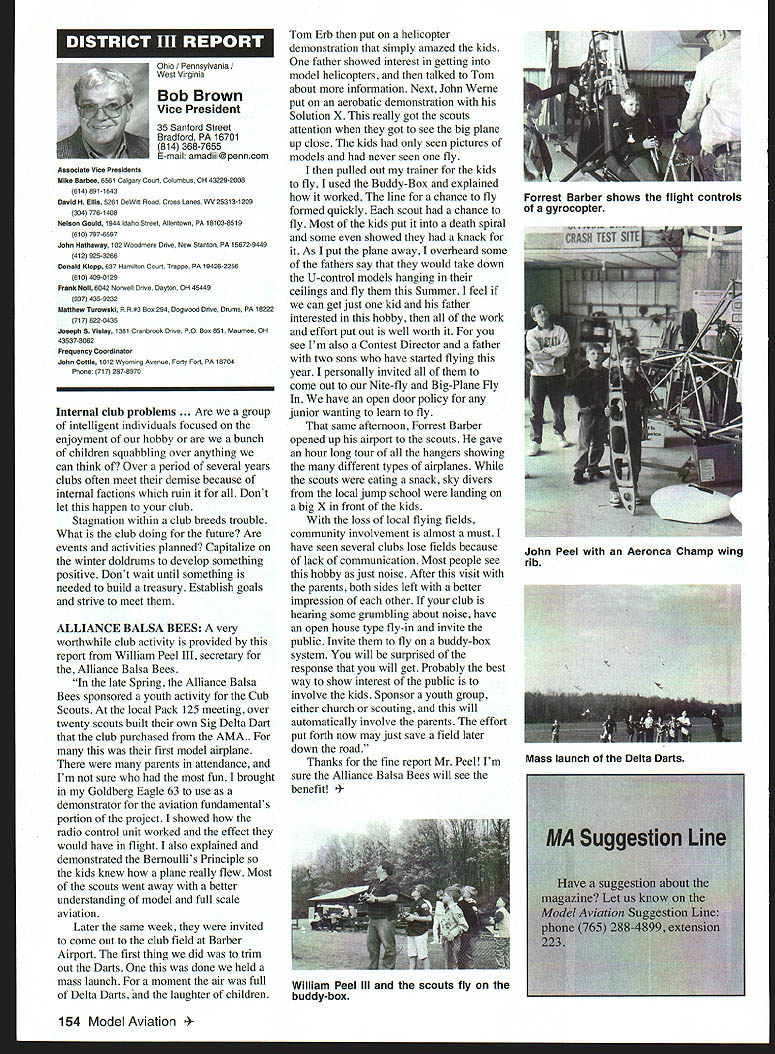
In late spring the Alliance Balsa Bees sponsored a youth activity for Cub Scouts. At Pack 125, over twenty scouts built their own Sig Delta Dart that the club purchased from the AMA. Many parents attended. A Goldberg Eagle 63 was used as a demonstrator to show how the radio control unit worked and to explain Bernoulli's Principle. Most scouts left with a better understanding of model and full-scale aviation.
Later that week they were invited to the club field at Barber Airport. After trimming the Darts, a mass launch filled the air with Delta Darts. Tom Erb put on a helicopter demonstration, John Werer performed aerobatics with his Solution X, and William Peel used a trainer with a buddy-box so each scout could fly. Many fathers showed interest afterward and planned to fly themselves.
Forrest Barber opened his airport to the scouts, giving an hour-long tour of the hangars. Skydivers from a local jump school landed in front of the kids. Community involvement is vital given the loss of local flying fields; open houses and youth group sponsorships can help save fields.
Thanks to the Alliance Balsa Bees for a fine effort!
Lots of photos came in for the column:
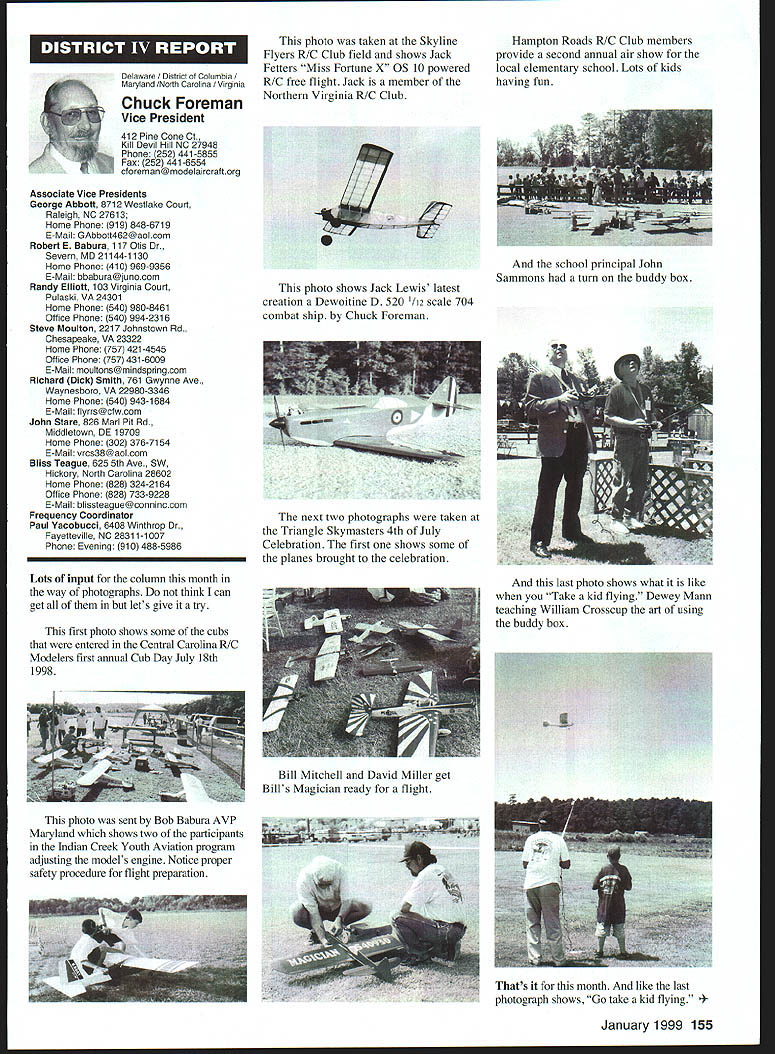
- Central Carolina R/C Modelers' first annual Cub Day (July 18, 1998)
- Two participants in the Indian Creek Youth Aviation program adjusting the model's engine (sent by Bob Babura, AVP Maryland)
- Jack Fetters' "Miss Fortune X" OS 10 powered R/C free flight at the Skyline Flyers R/C Club field (Jack is a member of the Northern Virginia R/C Club)
- Jack Lewis' Dewoitine D.520 1/2 scale combat ship by Chuck Foreman
- Hampton Roads R/C Club providing a second annual air show for a local elementary school (including the school principal John Ammons trying the buddy box)
- Triangle Skymasters 4th of July Celebration photos (planes, Bill Mitchell and David Miller preparing Bill's Magician, and Dewey Mann teaching William Crosscup to use the buddy box)
That's it for this month. Go take a kid flying.
DISTRICT V REPORT
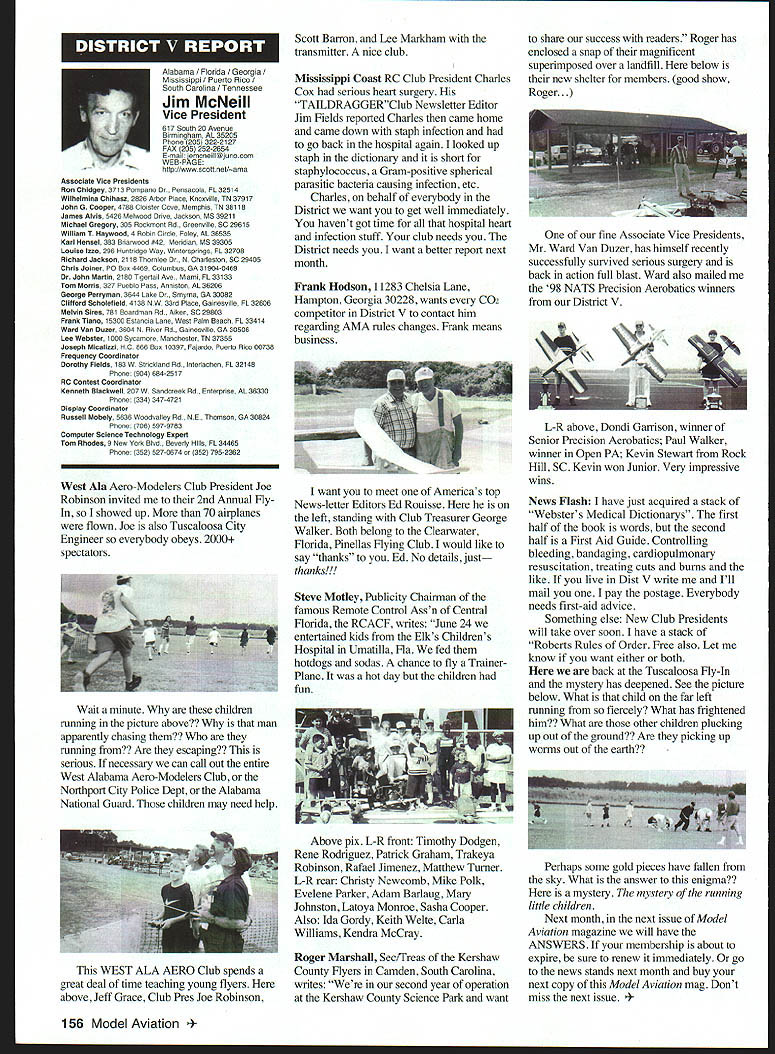
West Ala Aero-Modelers Club President Joe Robinson invited me to their 2nd Annual Fly-In; more than 70 airplanes were flown. Joe is also Tuscaloosa County Airport Engineer so everybody obeys. Over 2,000 spectators attended.
Mississippi Coast RC Club President Charles Cox had serious heart surgery. His "TAILDRAGGER" Club Newsletter Editor Jim Fields reported Charles then came home and developed a staph infection and had to return to the hospital. On behalf of everyone in the District we want you to get well—your club and the District need you.
Frank Hodson, 11283 Chelsia Lane, Hampton, Georgia 30228, asks every CD and competitor in District V to contact him regarding AMA rules changes.
Steve Motley, Publicity Chairman of the Remote Control Ass'n of Central Florida (RCCAF), writes: "June 24 we entertained kids from the Elk's Children's Hospital in Umatilla, Fla. We fed them hamburgers and sodas and gave them a chance to fly a trainer plane. It was a hot day but the children had fun."
Roger Marshall, Sec/Treas of the Kershaw County Flyers in Camden, South Carolina, writes: "We're in our second year of operation at the Kershaw County Science Park and want to share our success." Roger enclosed a photo of their new shelter superimposed over a landfill.
News Flash: I have a stack of Webster's Medical Dictionaries. The first half is words; the second half is a first aid guide. If you live in Dist V write me and I'll mail you one (postage paid). Everyone needs first-aid advice.
Also available: a stack of Robert's Rules of Order for new club presidents. Free—let me know if you want one or both.
Perhaps some gold pieces have fallen from the sky—what is the answer to the enigma of the running little children? Next month we will have the answers. If your AMA membership is about to expire, be sure to renew it immediately. Or buy the next issue of Model Aviation magazine at the newsstand.
DISTRICT VI REPORT
Charlie Bauer Vice President 4944 N. Orange Ave., Norridge, IL 60656-3224 Home: (708) 457-0565 Fax: (708) 457-2177 sysbauer@charlie.cns.it.edu
Associate Vice Presidents — Illinois
- John Kaleilend, 402 Arima, Glenwood, IL 60425, Evening: (708) 798-7242
- Hal Parent, 1920 Buckingham, Westchester, IL 60154, Evening: (708) 862-5752
- Jerry Worden, 400 Allen Dr., Normal, IL 61761-1202, Evening: (309) 454-3905
Associate Vice Presidents — Indiana
- Ron Ballard, 6920 N. 700 E., Decatur, IN 46733, Evening: (219) 724-8934
- Gary Bussell, 5000 W. Cottage Dr., Muncie, IN 47304, Evening: (317) 284-3851
- William Kern, 1808 12th St., Bedford, IN 47421-3108, Evening: (812) 275-2189
Associate Vice President — Kentucky
- Jim Sears, Box 308, Burgin, KY 40310, (606) 748-5834
Associate Vice Presidents — Missouri
- Bob Underwood, 32 Holubach Ct., St. Charles, MO 63304, Evening: (314) 939-3934
- Ken Boehner, 1016 North East Barnes Dr., Lees Summit, MO 64086, (816) 524-7307
Frequency Coordinator Cal Orr, R.R. 1, Box 1238, Higginsville, MO 64037 (660) 584-6284 — Fax: (660) 584-6285
Webmaster Gary Parent, 11001 Marindale Dr., Westchester, IL 60154 Evening: (708) 361-9556 http://www.csamit.edu/~ama-dist6/index.htm
OPPORTUNITY: Jerry Worden, R/C contest coordinator (except soaring), asked to be replaced after doing an outstanding job for several years. If you are interested, contact Jerry via the District VI web page.
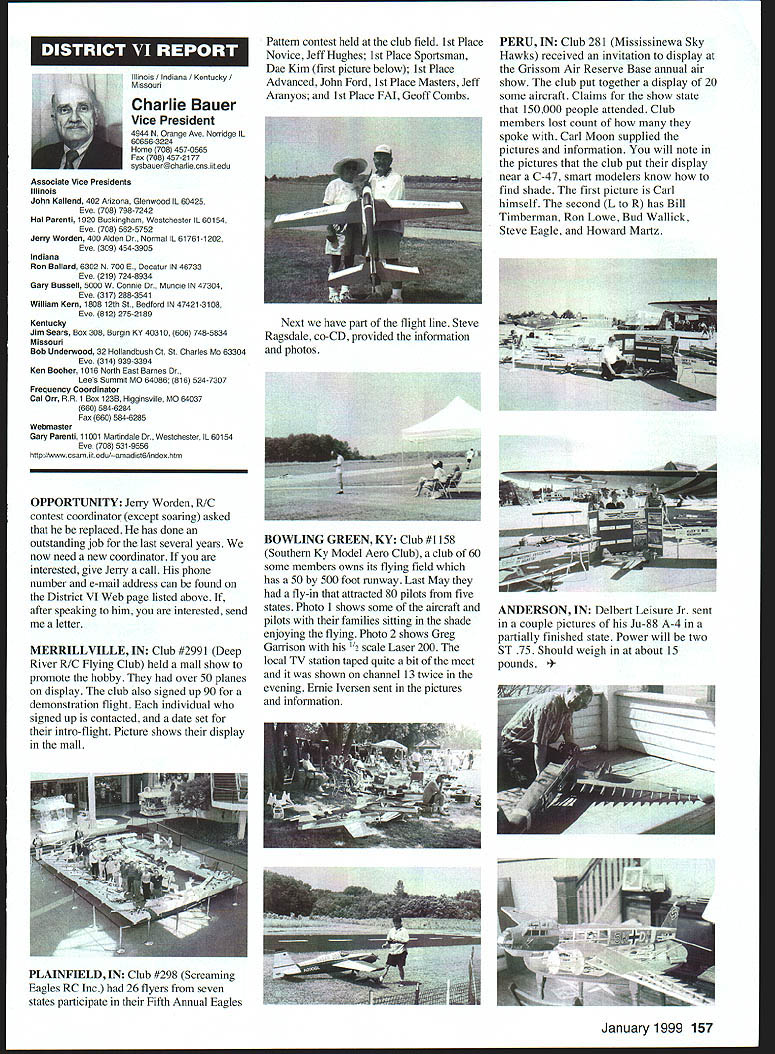
MERRILLVILLE, IN: Deep River R/C Flying Club (Club #2991) held a mall show to promote the hobby with over 50 planes on display and signed up 90 for demonstration flights.
PLAINFIELD, IN: Screaming Eagles R/C Inc. (Club #298) had 26 flyers from seven states participate in their Fifth Annual Eagles Pattern contest. Winners included Jeff Hughes (Novice), Dave Kim (Sportsman), John Ford (Advanced), Jeff Haggar (Masters), and Geoff Combs (FAI).
BOWLING GREEN, KY: Southern Ky Model Aero Club (Club #1158), a 60-member club, owns a field with a 50 x 500 foot runway. Their fly-in attracted 80 pilots from five states and received local TV coverage. Photos and info from Ernie Iversen.
PERU, IN: Mississinewa Sky Hawks (Club #281) displayed at the Grissom Air Reserve Base annual air show, which reportedly had 150,000 attendees. The club's display was near a C-47. Photos and info from Carl Moon.
ANDERSON, IN: Delbert Leisure Jr. sent photos of his Ju-88 A-4 in a partially finished state, powered by two .75 engines and estimated at about 15 pounds.
DISTRICT VII REPORT
Iowa / Michigan / Minnesota / Wisconsin
Dave Gish Vice President 5435 St. Hwy 99, Wapello, IA 52653 Tel: (319) 766-3202 — Fax: (319) 766-4038 E-mail: gofy1@lisco.net
Associate Vice Presidents
- Joe Campopiano, 3709 SW 4th St., Des Moines, IA 50315
- Bud Gorman, Box 33, Knife River, MN 55609
- Joe Hess, 5394 English Drive, Troy, MI 48098
- Russell Knetzger, 2625 E. Sherwood Boulevard, Milwaukee, WI 53211
- Thomas D. Lazar, 435 Hubbell St., Marshall, WI 53559-9409
- Andy Lowe, 9957 Crestley, Redford, MI 48239 — Tel: (313) 534-6650 — E-mail: andy@electrodynam.com
- Bill Miller, 712 Grand Ave., Petoskey, MI 49770
- Mark E. Robotti, 26540 Olympic Trail, North Lindstrom, MN 55045
- Mike Zingery, 6498 S. Summerton Rd., Shepherd, MI 48883-9308
Frequency Coordinators
- West: Al Schwartz, 2787 Fernwood, Roseville, MN 55113 — Ph: (612) 633-2286
- East: Pete Waters, 7420 Seven Mile Rd, Northville, MI 48167 — Ph: (810) 486-4800
OOPS! Correction: Wayne Yeager quit as the pylon board member from Dist VII, not as the contest coordinator.
Jean Lasik has resigned as an AVP from Michigan and will be moving to Florida. She will be replaced by Andy Lowe from Livonia, MI (contact: 734-422-5420).
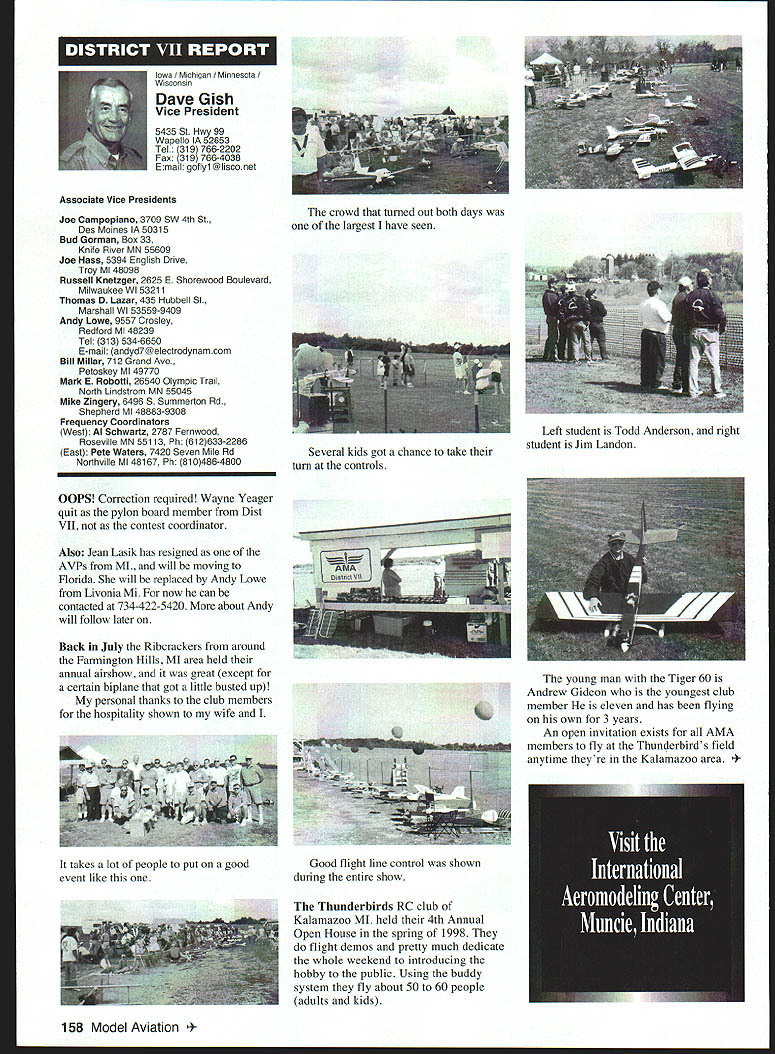
Back in July the Ribcrackers from the Farmington Hills, MI area held their annual airshow. Thanks to the club members for their hospitality.
Thunderbirds RC club of Kalamazoo, MI held their 4th Annual Open House in spring 1998. They do flight demos and dedicate the weekend to introducing the hobby to the public, flying about 50–60 people using the buddy system.
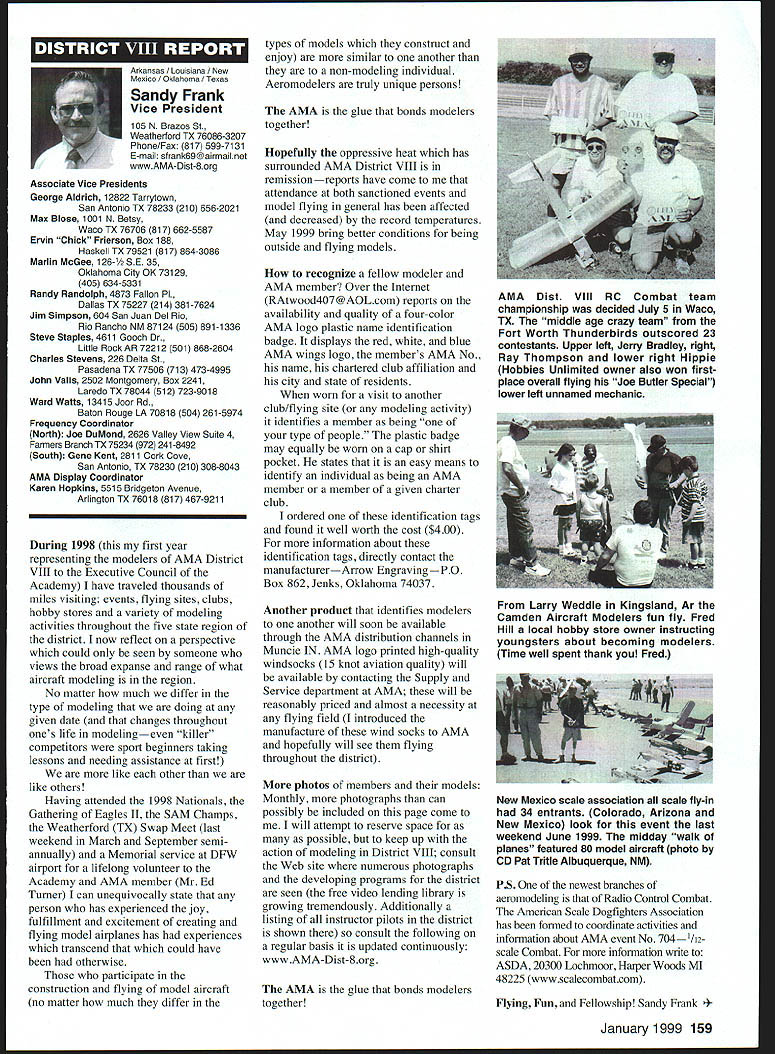
During 1998 (my first year representing the modelers of AMA District VIII to the Executive Council), I traveled thousands of miles visiting events, flying sites, clubs, hobby stores, and many modeling activities throughout the region. Regardless of type of modeling, participants share more similarity with each other than with non-modelers. The AMA is the glue that bonds modelers together.
Attendance at events and flying has been affected by record heat. May 1999 bring better conditions for being outside and flying models.
Identification products:
- AMA logo plastic name identification badge (red, white, and blue AMA wings logo, AMA No., name, chartered club affiliation, city/state). Cost: $4.00. Contact Arrow Engraving, P.O. Box 862, Jenks, Oklahoma 74037.
- AMA logo windsocks (15-knot aviation quality) will be available through AMA distribution in Muncie, IN. Contact the Supply and Service Department of AMA.
More photos and info are posted on the District VIII web site: www.AMA-Dist-8.org.
P.S. Radio Control Combat is growing. The American Scale Dogfighters Association (ASDA) has been formed to coordinate activities and information about AMA events. Contact ASDA, 20300 Lochmoor, Harper Woods, MI 48225, or www.scalebomb.com.
Flying, Fun, and Fellowship! Sandy Frank
DISTRICT IX REPORT
Colorado / Kansas / Nebraska / North Dakota / South Dakota / Utah / Wyoming
Russ Miller Vice President P.O. Box 128, Solen, ND 58072 (701) 385-4332 — Evenings: (701) 323-3190 — Fax: (701) 455-3329 russmiller@midwest.net
Associate Vice Presidents
- Max Hansen, 1909 Wisconsin St., Huron, SD 57350
- Nathan Lancaster, 3597 S. Kendall Street, Denver, CO 80235
- Troy Lapp, 1609 Main St., Williston, ND 58801
- Travis McGinnis, 8027 W. 81st Circle, Arvada, CO 80005
- Don Molen, 410 Hart St., Salina, KS 67401
- Jim Ricketts, 4921 Fernwood Drive, Sioux Falls, SD 57103-0573
- Jack L. Siebert, 3611 Kimberly Circle, Lincoln, NE 68506-4524
- Chuck Smith, 1091 Cheshire Street, Casper, WY 82609-3214
- Mike Weidner, 5535 Foxdale Circle, Colorado Springs, CO 80919-1788
Frequency Coordinator Steve Mangles, c/o Radio Service Center, 918 S. Sheridan, Denver, CO 80226
News from South Dakota
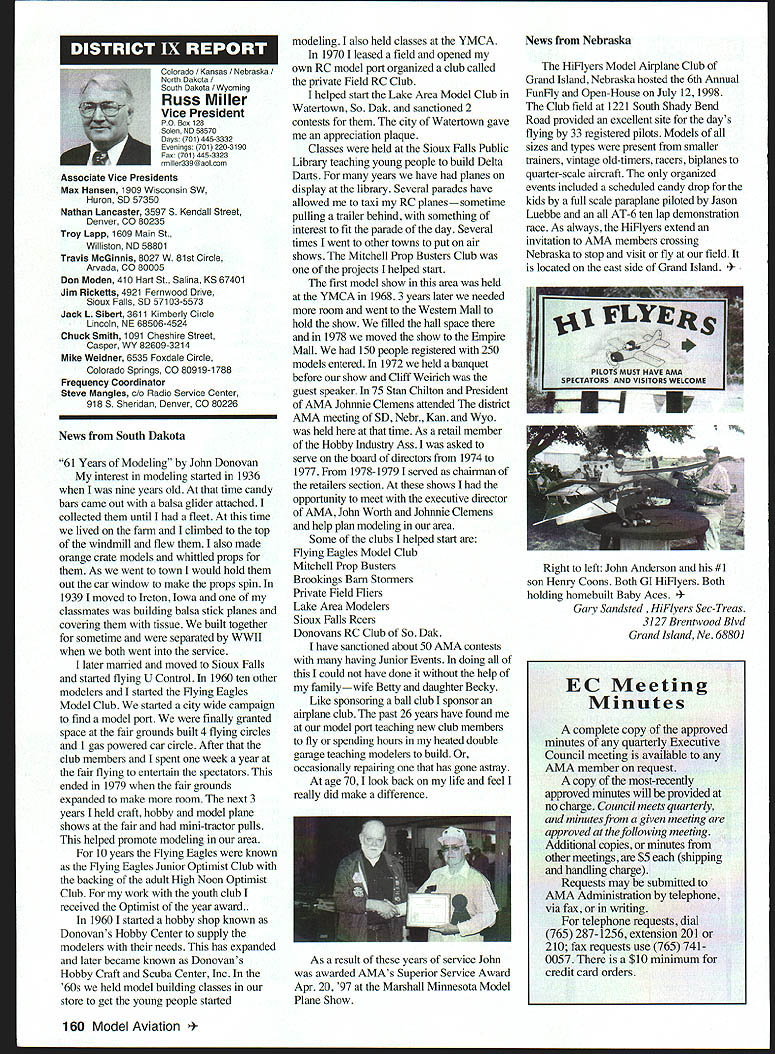
"61 Years of Modeling" by John Donovan
John's interest began in 1936 at age nine with balsa gliders attached to candy bars. He built orange crate models and whittled props. After WWII he moved to Sioux Falls and started flying U-control. In 1960 he and ten other modelers started the Flying Eagles Model Club. They campaigned for a model port and were granted space at the fairgrounds, building four flying circles and a gas-powered circle. The club entertained fair spectators yearly until 1979.
For ten years the Flying Eagles were known as the Flying Eagles Junior Optimist Club with adult backing. For his work with youth, John received Optimist of the Year.
In 1960 he started Donovan's Hobby Center, later Donovan's Hobby Craft and Scuba Center, Inc. He held model-building classes in his store and at the YMCA. In 1970 he leased a field and organized the Private Field RC Club.
He helped start the Lake Area Model Club in Watertown, SD, and sanctioned contests. The city of Watertown gave him an appreciation plaque.
John has sanctioned about 50 AMA contests with many Junior events. He credits family support (wife Betty and daughter Becky) for much of his success. At age 70 he feels he really made a difference.
News from Nebraska
The HiFlyers Model Airplane Club of Grand Island hosted the 6th Annual FunFly and Open House on July 12, 1998. The club field provided an excellent site for 33 registered pilots. Models of all sizes and types were present. Organized events included a candy drop for kids by a full-scale paraplane and an all AT-6 in-lap demonstration race. The HiFlyers invite AMA members to visit or fly at their field, located on the east side of Grand Island.
DISTRICT X REPORT
Arizona / California / Hawaii / Guam / Nevada / Utah
Richard Hanson Vice President PO Box 3312, Scottsdale, AZ 85271 Phone/Fax: (602) 728-9400 E-mail: richh@pminternet.com http://www.ama-10.com/ama
Associate Vice Presidents
- Glenn Carter, Walnut Creek, California — (510) 933-2086
- Michael Harrington, Kaneohe, Hawaii — (808) 239-6682
- Gary Hover, Visalia, California — (209) 747-0287
- Kai Jensen, Reno, Nevada — (702) 329-6430
- John Krohn, Whittier, California — (310) 692-4177
- Bob Reynolds, Tucson, Arizona — (520) 296-8183
Frequency Coordinator
- George Steiner, Sacramento, California — (916) 362-1962
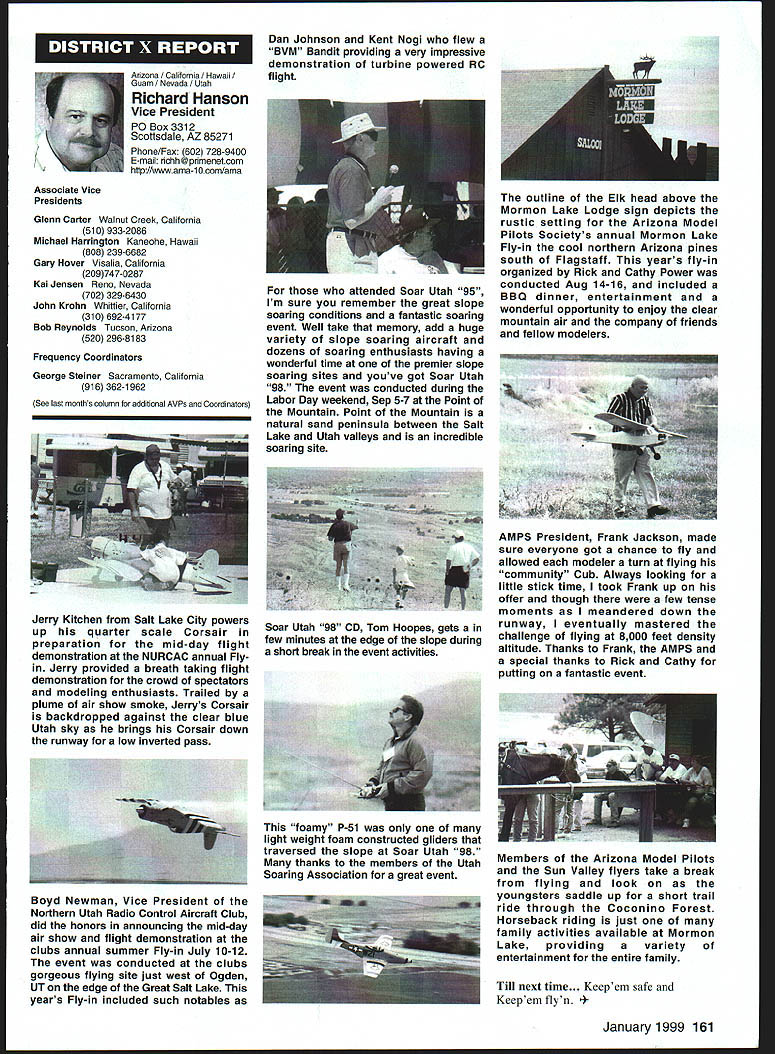
For those who attended Soar Utah "95", you may remember great slope soaring conditions. Soar Utah "98" (Labor Day weekend, Sep 5–7) at the Point of the Mountain offered excellent slope soaring. Point of the Mountain is a natural sand peninsula between the Salt Lake and Utah valleys and is an incredible soaring site.
The Arizona Model Pilots Society's annual Mormon Lake Fly-in (Aug 14–16) was organized by Rick and Cathy Power. The event included a BBQ dinner, entertainment, and flying in clear mountain air. AMPS President Frank Jackson ensured everyone got to fly the "community" Cub. Flying at 8,000 feet density altitude provided a challenge.
Members of AMPS and the Sun Valley flyers took a break as youngsters saddled up for a short trail ride through the Coconino Forest. Horseback riding is one of many family activities available at Mormon Lake.
Till next time... Keep 'em safe and keep 'em fly'n.
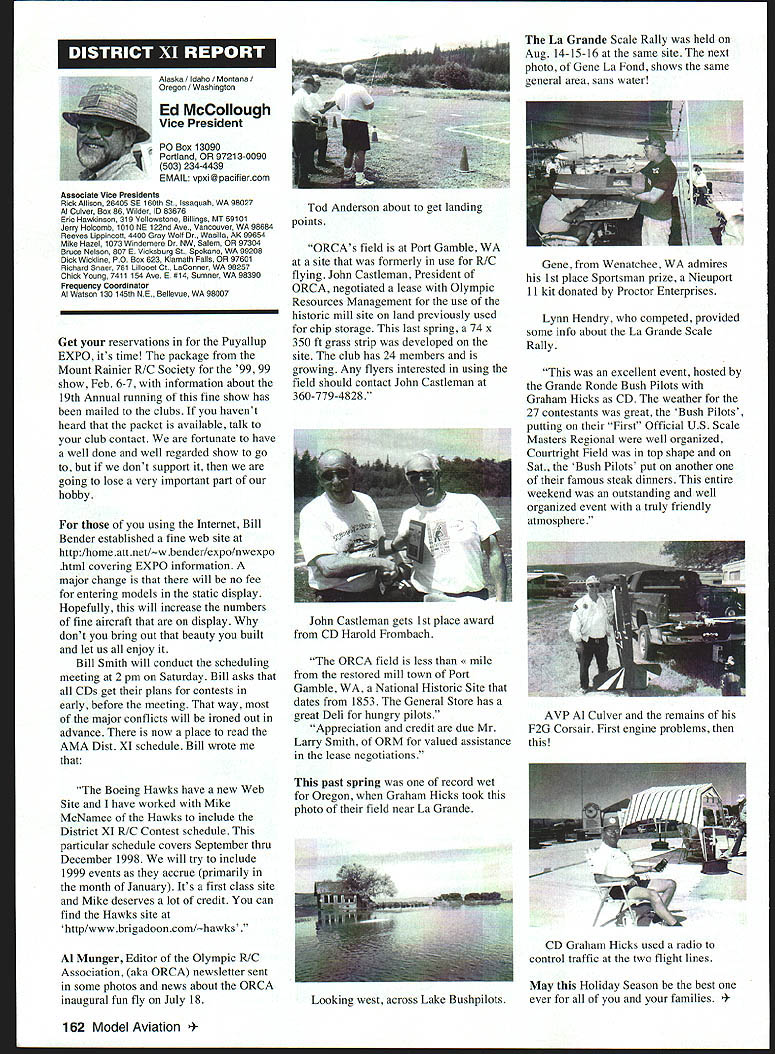
DISTRICT XI REPORT
Alaska / Idaho / Montana / Oregon / Washington
Ed McCollough Vice President PO Box 13090, Portland, OR 97213-0090 (503) 234-4439 — EMAIL: vpxi@pacifier.com
Get your reservations in for the Puyallup EXPO—it's time! The package from the Mount Rainier R/C Society for the 1999 show (Feb. 6–7) with information about the 19th Annual running has been mailed to clubs. If you haven't heard the packet is available, talk to your club contact.
Bill Bender established a web site covering EXPO information: http://home.att.net/~w.bender/expo/wexpo.html. A major change: there will be no fee for entering models in the static display to encourage more fine aircraft on display.
Bill Smith will conduct the scheduling meeting at 2 pm on Saturday. Bill asks that all CDs get contest plans in early to iron out major conflicts. The Boeing Hawks have a new web site that includes the District XI R/C contest schedule for September through December 1998: http://www.brigadoon.com/~hawks/.
Al Munger, editor of the Olympic R/C Association (ORCA) newsletter, sent photos and news about ORCA's inaugural fun fly on July 18.
ORCA's field is at Port Gamble, WA, at a site formerly used for R/C flying. John Castleman, ORCA president, negotiated a lease with Olympic Resources Management for the historic mill site. A 74 x 350 ft grass strip was developed. The club has 24 members and is growing. Contact John Castleman at 360-779-4828 for field use.
Photos and highlights:
- Tod Anderson ready to get landing points.
- John Castleman receiving a 1st place award from CD Harold Frombach.
The ORCA field is less than a mile from the restored mill town of Port Gamble, WA, a National Historic Site dating from 1853. The General Store has a great deli for hungry pilots. Appreciation is due Mr. Larry Smith of ORM for assistance in the lease negotiations.
This past spring was one of record wet for Oregon; Graham Hicks took a photo of their field near La Grande showing lake conditions. The La Grande Scale Rally was held Aug 14–16 at the same site. Gene La Fond of Wenatchee, WA won 1st place Sportsman with a Nieuport 11 kit donated by Proctor Enterprises. Lynn Hendry described the event as excellent, well organized, with great weather and a friendly atmosphere. The Bush Pilots put on their famous steak dinner.
AVP Al Culver and the remains of his F2G Corsair experienced engine problems and then a crash.
CD Graham Hicks used a radio to control traffic at two flight lines.
May this holiday season be the best one ever for you and your families.
Transcribed from original scans by AI. Minor OCR errors may remain.

