
AMA News
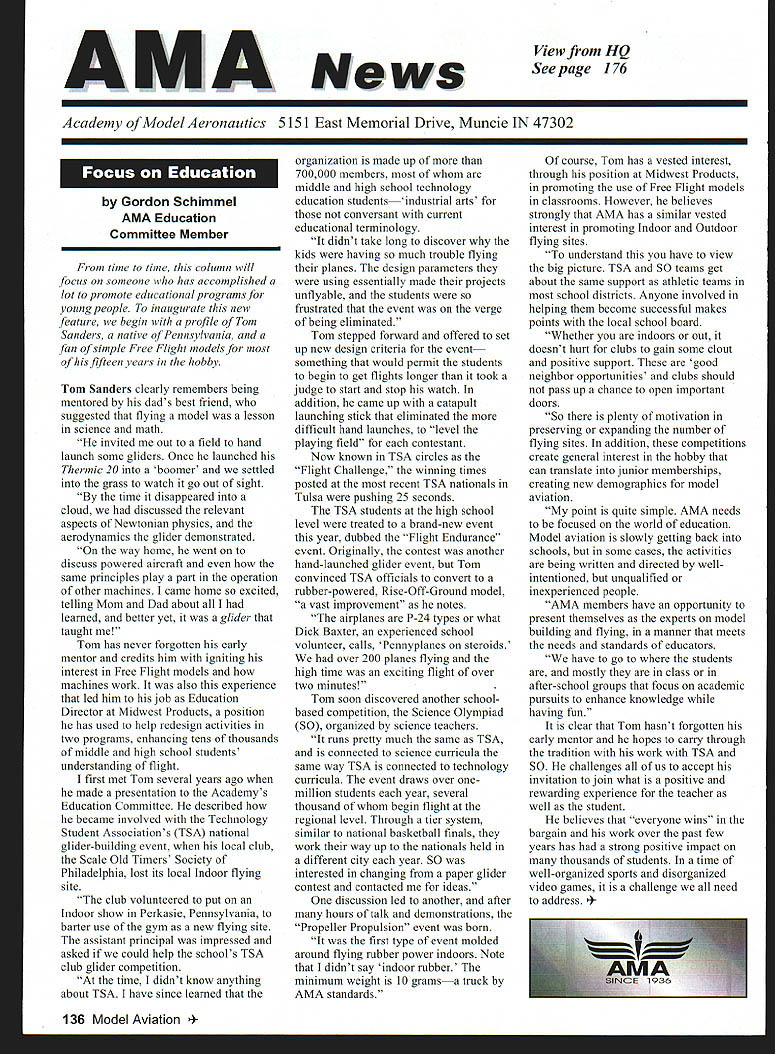
Focus on Education
by Gordon Schimmel AMA Education Committee Member
From time to time this column will focus on someone who has accomplished a lot to promote educational programs for young people. To inaugurate this feature, we profile Tom Sanders, a native of Pennsylvania and a fan of simple Free Flight models from his early teens.
Tom clearly remembers being mentored by his dad's best friend, who suggested that flying a model was a lesson in science and math. "He invited me out to a field to hand-launch some gliders. Once he launched his Thermic 20 into a 'boomer' and we settled in the grass to watch it go out of sight. By the time it disappeared into a cloud, we had discussed the relevant aspects of Newtonian physics and the aerodynamics the glider demonstrated.
"On the way home, he went on to discuss powered aircraft and even how the same principles play a part in the operation of other machines. I came home so excited, telling Mom and Dad about all I had learned, and better yet, it was a glider that taught me!"
Tom has never forgotten his early mentor and credits him with igniting his interest in Free Flight models and how machines work. That experience led to his job as Education Director at Midwest Products, a position he has used to redesign activities and programs that have enhanced tens of thousands of middle and high school students' understanding of flight.
I first met Tom several years ago when he made a presentation to the Academy's Education Committee. He described how he became involved with the Technology Student Association's (TSA) national glider-building event after his local club, the Scale Old Timers' Society of Philadelphia, lost its indoor flying site. The club volunteered to put on an indoor show in Perkasie, Pennsylvania, to barter use of the gym as a new flying site. The assistant principal was impressed and asked if they could help the school's TSA club glider competition.
At the time Tom didn't know anything about TSA. He has since learned the organization includes more than 700,000 members, most of whom are middle and high school technology education students (industrial arts in older terminology). It didn't take long to discover why the kids were having so much trouble flying their planes: the design parameters they were using essentially made their projects unflyable, and the students were so frustrated the event was on the verge of being eliminated.
Tom stepped forward and offered to set up new design criteria—something that would permit students to get flights longer than it took a judge to start and stop a watch. He also devised a catapult launching stick that eliminated the more difficult hand launches and "leveled the playing field" for each contestant. Now known in TSA circles as the "Flight Challenge," winning times at recent TSA nationals in Tulsa were pushing 25 seconds.
At the high school level the TSA introduced a brand-new "Flight Endurance" event. Originally another hand-launched glider event, Tom convinced TSA officials to convert it to a rubber-powered Rise-Off-Ground (ROG) model—a vast improvement. The airplanes are P-24 types, what Dick Baxter, an experienced school volunteer, calls "pennyplanes on steroids." At one meet there were over 200 planes flying and the high time was an exciting flight of over two minutes.
Tom soon discovered Science Olympiad (SO), a school-based competition organized by science teachers. SO runs much like TSA but is connected to science curricula; it draws over one million students each year, several thousand of whom begin flight competition at the regional level and work their way up to nationals. SO was interested in changing from a paper glider contest and contacted Tom for ideas. After many hours of discussion and demonstrations, the "Propeller Propulsion" event was born—the first event molded around rubber-powered flight indoors. Note: Tom emphasizes he didn't mean "indoor rubber" in the ultra-light sense; SO's minimum weight is 10 grams, which is heavy by AMA indoor standards.
Through his position at Midwest Products Tom has a vested interest in promoting Free Flight models in classrooms, but he also believes AMA has a similar vested interest in promoting indoor and outdoor flying sites. To understand this you have to view the big picture: TSA and SO teams receive about the same support as athletic teams in most school districts. Anyone involved in helping them succeed gains points with the local school board. Whether indoors or out, it helps clubs to build clout and positive community support. These are "good neighbor opportunities" clubs should not pass up, because they open important doors.
There is plenty of motivation to preserve and expand the number of flying sites. Competitions create general interest in the hobby that can translate into junior memberships and new demographics for model aviation. AMA members have an opportunity to present themselves as the experts on model building and flying in a manner that meets educators' needs and standards.
Tom's message is simple: go to where the students are—mostly in class or in after-school groups focused on academic pursuits that enhance knowledge while having fun. He hasn't forgotten his early mentor and hopes to carry on that tradition through his work with TSA and SO. He challenges all of us to accept his invitation to join what is a positive and rewarding experience for both teacher and student. "Everyone wins" in the bargain, and his work over the past few years has had a strong positive impact on many thousands of students. In a time of highly organized sports and disorganized video games, it is a challenge we all need to address.
Transcribed from original scans by AI. Minor OCR errors may remain.

