
AMA News
Flying Site Assistance
- Joe Beshar
- Coordinator
- 198 Merritt Dr.
- Oradell, NJ 07649
- Fax: (201) 261-0223
- Tel.: (201) 261-1281
Finding—Preserving—Maintaining
Dr. John Martin of Coconut Grove, Florida has practiced model flying as far back as I can remember, and believe me, that is a long, long time. He has always been up front promoting model aviation, serving actively as an AMA Associate Vice President, and was one of the first to register as a Flying Site Assistance Volunteer.
It sure didn't take him long to send us interesting material as to what can be done regarding flying sites. I would like to share this with you in hopes that it will enlighten our membership to what can be done if there is a will to do so.
John outlines a different type flying field, employing a baseball field. You say, "What's so different?"
Well, it is an indoor field presently flying conventional indoor models. With the recent availability of electric power and micro-micro radio systems, the millennium has great excitement in store for the RC enthusiast where weather is not a problem. You don't even need a wind sock.
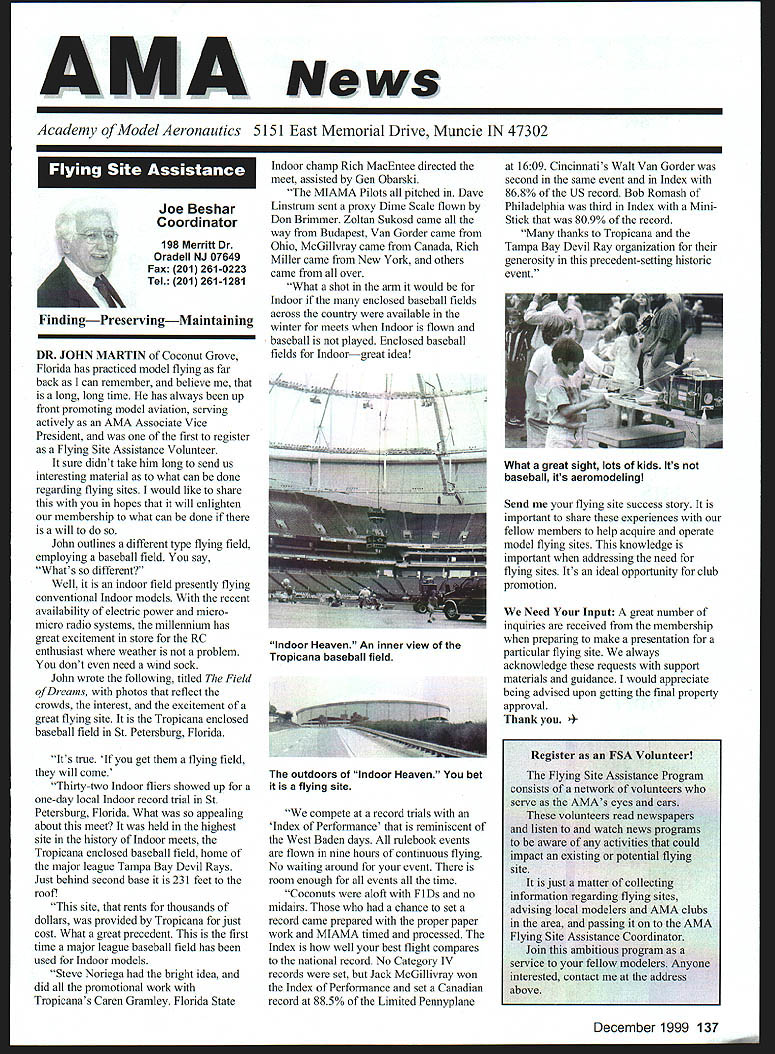
John wrote the following, titled "The Field of Dreams," with photos that reflect the crowds, the interest, and the excitement of a great flying site. It is the Tropicana enclosed baseball field in St. Petersburg, Florida.
"It's true. 'If you get them a flying field, they will come.'
Thirty-two indoor fliers showed up for a one-day local indoor record trial in St. Petersburg, Florida. What was so appealing about this meet? It was held in the highest site in the history of indoor meets, the Tropicana enclosed baseball field, home of the major league Tampa Bay Devil Rays. Just behind second base it is 231 feet to the roof!
This site, that rents for thousands of dollars, was provided by Tropicana for just cost. What a great precedent. This is the first time a major league baseball field has been used for indoor models.
Steve Noriega had the bright idea, and did all the promotional work with Tropicana's Caren Gramley. Florida State Indoor champ Rich MacEntee directed the meet, assisted by Gen Obarski. MIAMA pilots pitched in. Dave Linstrum sent a proxy Dime Scale flown by Don Brimmer. Zoltan Sukosd came all the way from Budapest. Van Gorder came from Ohio, McGillivray came from Canada, Rich Miller came from New York, and others came from all over.
What a shot in the arm it would be for indoor flying if the many enclosed baseball fields across the country were available in the winter for meets when indoor is flown and baseball is not played. Enclosed baseball fields for indoor — great idea!
We compete at record trials with an "Index of Performance" that is reminiscent of the West Baden days. All rulebook events are flown in nine hours of continuous flying. No waiting around for your event. There is room enough for all events all the time.
Coconuts were aloft with F1Ds and no midairs. Those who had a chance to set a record came prepared with the proper paperwork and MIAMA timed and processed. The Index showed how well your best flight compares to the national record. No Category IV records were set, but Jack McGillivray won the Index of Performance and set a Canadian record at 88.5% of the Limited Pennyplane at 16:09. Cincinnati's Walt Van Gorder was second in the same event and in Index with 86.8% of the U.S. record. Bob Romash of Philadelphia was third in Index with a Mini-Stick that was 80.9% of the record.
Many thanks to Tropicana and the Tampa Bay Devil Rays organization for their generosity in this precedent-setting historic event."
Send me your flying site success story. It is important to share these experiences with our fellow members to help acquire and operate model flying sites. This knowledge is important when addressing the need for flying sites. It's an ideal opportunity for club promotion.
We need your input: A great number of inquiries are received from the membership when preparing to make a presentation for a particular flying site. We always acknowledge these requests with support materials and guidance. I would appreciate being advised upon getting the final property approval.
Thank you.
Register as an FSA Volunteer!
The Flying Site Assistance Program consists of a network of volunteers who serve as the AMA's eyes and ears. These volunteers read newspapers and listen to and watch news programs to be aware of any activities that could impact an existing or potential flying site.
It is just a matter of collecting information regarding flying sites, advising local modelers and AMA clubs in the area, and passing it on to the AMA Flying Site Assistance Coordinator. Join this ambitious program as a service to your fellow modelers. Anyone interested, contact me at the address above.
Transcribed from original scans by AI. Minor OCR errors may remain.

