
1977 ANNUAL FAI MEETING
GENERAL
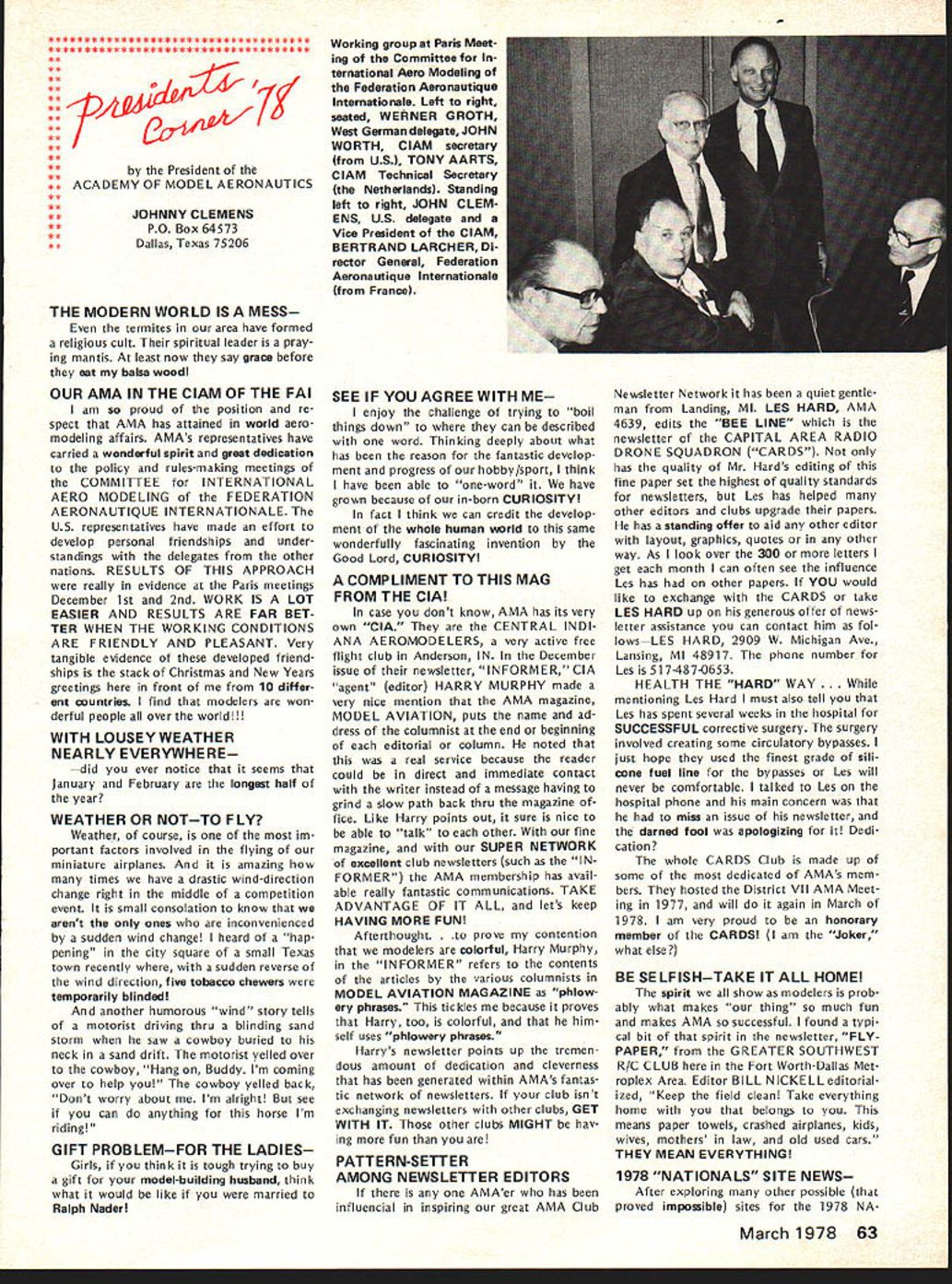
The largest gathering in history featured the annual Federation Aeronautique Internationale (FAI) meeting in Paris on December 1 and 2. 58 representatives from 29 countries were present for technical and plenary meetings of the Committee for International Aero Modeling (CIAM) and worked harmoniously to dispose of a 37-page agenda in record time.
Very little controversy prevailed, despite some significant new developments in several areas. Practically all proposals from the USA were either adopted or tabled for future consideration.
The meeting's major achievement was approval of a new FAI Sporting Code for 1979-1983, with the provision of a flexible section to accommodate certain types of changes on an annual basis. In general, items affecting model specifications (aircraft size, engines, equipment, etc.) are to be frozen during the four-year rule book period, but items of world championships procedure (such as RC maneuvers, number of flights, engine noise measurement, etc.) will be subject to change in accordance with lessons or problems from world championships or other major contest experience.
The new arrangement is expected to be a good compromise between the unlimited annual FAI changes of past years (until the '70s) and the unreasonable and excessive freezing of rules changes in recent years. Expected to be approved for printing by mid-year, the 1979 Sporting Code will be available via National Aero Clubs (AMA for the USA) by the end of 1978.
The USA delegation was the largest ever, with ten in official positions. Our group went to the meeting with six elected representatives and several members of subcommittees (or proxies for same). After the meeting another elected position was added as Dan Pruss regained his former officership as Chairman of the RC Soaring Committee. Thus, the USA group ended up with seven out of 17 elected positions of the FAI's CIAM (Committee for International Aero Modeling). The complete 1978 lineup of FAI positions is listed at the end of this report.
The Paris meetings began under a cloud due to late delivery of the agenda. This is normally mailed to all countries in October and is a compilation of proposals received by the FAI during the months previous (all proposals had to be sent to FAI by mid-September). This year the official agenda did not arrive in the USA until the day before Thanksgiving, just before U.S. representatives were to depart for Europe. Some delegates from other countries didn't get the agenda until they got to Paris.
Under this situation there was almost no time for circulation of agenda information to key individuals and groups around the country, to get their inputs for guidance of U.S. voting at the meetings. Fortunately, however, AMA got an unofficial copy several days before the official one arrived from Paris. Copies of pertinent parts were immediately made by AMA and rushed to the various special interest groups. This was followed up by phone calls from members of those groups to help guide the U.S. delegation. It was frantic, but our people went overseas with useful information gathered in this manner.
But the Paris meetings could have been changed had any countries chosen to do so. They had a legal right to do so, since they are not obligated to accept decisions produced as a result of inadequate advance information. However, there was no challenge and all delegates worked together, with minimum controversy. As a result a lot of business was accomplished and in less time than usual.
For the first time in many years AMA had individual representation in attendance for all interests. This required eight specialists: Laird Jackson—Control Line; George Xenakis—Free Flight; Bob Wischner—Scale; Don Lowe—RC Aerobatics; Dan Pruss—RC Soaring; Alan Satterlee—RC Pylon; John Burkam—RC Helicopters; and Jerry Gregorek—Spacemodels.
Two others also participated: AMA President Johnny Clements attended as the U.S. voting delegate, as 3rd Vice-President of CIAM, and as Chairman of the Information and Education Subcommittee; AMA Executive Director John Worth attended as the CIAM Secretary.
Reports from all U.S. participants are included in this issue.
FAI Meeting (Cont.)
that his attendance was important to U.S. interests and progress of the activity. This verified the reason why, last October, the AMA Executive Council approved sending so many representatives—to protect our investment in the international scene and its effect on U.S. modelers.
The large U.S. delegation was made possible by AMA's new FAI budget which allocates $1 of each adult member's dues to FAI activities. Half of this amount goes to pay for the franchise which gives AMA the exclusive right to represent U.S. modeler interests in the FAI; the other half goes to directly support transportation and other expenses of U.S. teams to world championships, U.S. attendance at FAI meetings, and support for administration of team selection programs.
The new budget became necessary when government transportation aid for U.S. FAI activities ended in 1976, after many years of subsidy. What seemed like a disaster at the time has now, through AMA's own resources, been salvaged by a positive and effective program for continued and expanded AMA participation in the future.
The 1977 Paris meeting was significant. The FAI rules changes which resulted (detailed in the Competition News Section of this month's Model Aviation magazine) will have a major impact on many areas of U.S. modeling. Our participation helped assure that the result was positive.
1978 Officers of the CIAM
- President - S. Pirenoff, Finland
- 1st V.P. - E. Krill, Austria
- 2nd V.P. - J. Sirotkin, U.S.S.R.
- 3rd V.P. - J. Clemens, U.S.A.
- Tech. Sec. - A. Aarts, Netherlands
- Secretary - J. Worth, U.S.A.
- Asst. Sec. - P. Chausseberg, France
Subcommittee Chairmen:
- Control Line - Laird Jackson, U.S.A.
- Free Flight - P. Allnutt, Canada
- RC Aerobatics - C. Olsen, England
- RC Soaring - D. Pruss, U.S.A.
- RC Pylon - A. Sattler, U.S.A.
- RC Helicopters - D. Chapman, U.S.A.
- RC Electrolight - P. Blommaart, Belgium
- Scale - H. Zeigler, Switzerland
- Spacemodels - O. Saffek, C.S.S.R.
- Education - J. Clemens, U.S.A.
FAI CIAM SCALE
Bob Wischer
Personal contacts and opportunities for exchange of ideas and opinions on Scale matters with representatives of the other competing nations was a first experience for me at the rule-making level. Having competed in three World Championships, where competitors and judges have expressed opinions regarding rules and their applications, it was enlightening to find that the committee members were sensitive to their desires. There was an unexpected cooperative spirit between most committee members. I found it especially rewarding that, in spite of my being there for the first time, my opinions were not disregarded but were actively solicited. Throughout the plenary session, delegates and committee members exhibited a high degree of competence in the dispatch of their duties. Modelers can be assured that their wishes are not being dealt with lightly.
In the Scale Committee session a question was raised about the status of Free Flight Scale rules. It was pointed out by the chairman, Helmut Zeigler, that provisional rules had been in force since 1971 and that no international events had been conducted since then. As a result he asked that the rules be dropped, and consideration at a later date if more interest was shown. He agreed that activity was increasing in some areas and recommended, with committee concurrence, that the rules would be returned to active status as provisional in the near future if requested (by agreement of a majority of delegates).
Most of the session was given to discussion and voting on rule changes found necessary in conducting past championships. The results of the voting and subsequent changes in rules and the judges guide are published elsewhere in this magazine. I had the personal satisfaction of seeing a U.S. proposal for an increase in weight for RC Scale approved by the subcommittee and then by the full CIAM. This had been voted down in the previous session, was re-submitted and will become effective in 1979 (for the 1980 World Championships).
FAI CIAM RC SOARING
Dan Pruss
After the RC Soaring World Championships in 1977 the contestants and many other F3B competitors felt the rules which had long been overdue for revamping would see this change at this year's CIAM meeting. With the main issue being the inequity of the Distance task, most proposals focused attention in that direction.
However, another problem arose. If 15 modelers were asked for their opinions for the task change one would get 15 different versions on how Distance should be flown. Another bigger problem was that most of the proposals were good ones. It was felt by the subcommittee member that a solution to this would be to list several options in the Distance task, including the possibility of combining Distance and Speed into one task, so that the contest organizers could then select which of the task choices would be flown and announce this with their contest advertising. Many of the committee members were in accord with this viewpoint of planning but the subcommittee chairman felt it would be too radical a move and he wouldn't entertain the idea as a proposal. It was, however, referred to the next subcommittee for further consideration for the future.
These annual Paris meetings, which are held at the FAI headquarters, work this way. The subcommittees, which have been working the previous year via the mails, gather in individual technical meetings to determine their final proposals and to name any others submitted by various countries.
The RC Soaring technical meeting made only little progress with regards to task B mainly because various proposals had much merit but no one proposal seemed distinctly better. A compromise was reached and 12 laps was decided to be the maximum scored per Distance flight. To deemphasize the luck of distance even further, a flight schedule will consist of combined Duration and Distance or Speed tasks: AB, AC; AB; etc. A round will consist of task AB or AC, but scheduled in a balanced fashion. The result will be more emphasis on Duration.
The rules established this year will hold through 1979, the year of the scheduled Soaring World Championships. Two offers were made for this event; one from the U.S. and one from Belgium. A decision as to which will prevail is to be made in March 1978 at the Bureau (CIAM Officers) Meeting in Paris.
It was somewhat disappointing that the head of our subcommittee didn't view some of our proposals with a more open mind. However, the situation may change as evidenced by a 21 to 6 vote electing this scribe to the chairman's post for 1978. Our foot is now in the door and it may be easier to open it further.
The Paris trip always has that side benefit of meeting interesting people, such as the likes of Dr. Laird Jackson (Control Line subcommittee chairman) and George Xenakis (representing Free Flight), both of whom I shared living quarters with. It'll be difficult to mention Paris and convince you that we talked shop for most of our too short time together, but we did. Besides, the unseasonably cold (−5 degrees C) weather wasn't exactly a "Paris in the spring..." atmosphere. Even the street walkers were running to stay warm!
FAI CIAM RC PATTERN
Don Lowe
I attended the CIAM meeting in Paris in December as the U.S. RC Aerobatics F3A subcommittee representative. Technically, I was an "observer," but this did not hinder in any way my ability to function effectively in representing the U.S. Pattern fliers. This was my first assignment in this regard, and I must say that I was impressed with the cooperative atmosphere and the efficient functioning of the RC meeting and the general plenary session, conducted by Sandy Pimenoff. As you probably know, our Executive Director, John Worth, serves as secretary to the CIAM. In addition to that task, he did a fine job of adding representation to the U.S. position in the general meeting.
RC Aerobatics underwent a significant change at this meeting, which I feel will be a significant benefit to the future and continued advancement in this category. Essentially, a completely new pattern and procedure was adopted by an overwhelming vote. This acceptance was in large part due to the preparatory work of the RC Pattern subcommittee which had been working on the plan for at least two years (during which time Ron Chidgey was the U.S. representative). At Paris it was necessary to consider not only this proposal but an additional one from Switzerland which had been given only very limited advance publicity. There were a number of smaller items, long overdue for change, which were acted upon.
The essence of the changes involved the ideas of:
1) Creating a pattern schedule and procedure which is more challenging to the expert competitor, more exciting to the observer, and yet allowing satisfying participation by the less expert flier.
2) Promoting advancement in model and equipment design, to challenge a modeler's ingenuity in this regard but at the same time not obsolete current designs and equipment.
3) Improving model processing by eliminating weighing with fuel and measuring for an archaic wing-loading requirement.
There is still some cleanup work that the subcommittee must do, such as provide a recommended pattern for small contests (the Swiss proposal will form the basis), redo some of the detail wording, and provide a more suit-
AMA News
Largest gathering in history featured annual Fédération Aéronautique Internationale (FAI) meeting, Paris, December 1-2. Fifty-eight representatives from 29 countries were present. In technical plenary meetings the Committee for International Aero Modeling (CIAM) worked harmoniously to dispose of a 37-page agenda in record time. Very little controversy prevailed despite some significant new developments in several areas. Practically every proposal from the USA was either adopted or tabled for future consideration at meetings. A major achievement was approval of the new FAI Sporting Code 1979-1983, with a provision for a flexible section to accommodate certain types of changes on an annual basis. General items affecting model specifications (aircraft size, engines, equipment, etc.) are frozen during the four-year rulebook period; items dealing with world championships procedure, such as RC maneuvers, number of flights, engine noise measurement, etc., will be subject to change in accordance with lessons and problems experienced at world championships and other major contests. The new arrangement is expected to be a good compromise between the unlimited annual FAI changes of past years and the unreasonable, excessive freezing of rule changes in recent years. The approved Sporting Code is expected to be printed mid-year 1979 and will be available via national aero clubs and AMA. At the end of 1978 the USA delegation was the largest ever; ten official positions in the group went to the meeting, six elected representatives, several members of subcommittees and proxies.
Hats probable for Lake Charles — Final decision will be made January 28 at the meeting of AMA's Executive Council. Preliminary indications favor return to Lake Charles, Louisiana, for the next National Model Airplane Championships if development proceeds. Likely dates will be July 30–August 6. A recent evaluation by AMA officers of Lake Charles versus other possibilities showed factors favoring the Louisiana site in terms of availability, size, accommodations and keeping activity on the same airfield. Lake Charles was clearly ahead, especially in the area of Free Flight — a perennial Nats problem due to space requirements. Lake Charles is currently an available acceptable site.
Two other locations were intensively studied: Ohio (several sites explored) and New Jersey (the Lakehurst area received major consideration). The Lakehurst site had a severe Free Flight problem — a newly discovered potential FF site was determined too small to accommodate large numbers of cars and people. The Ohio sites previously used for the 1976 Nats (Springfield airport) are expected to have major repairs done on the main runway in 1978; likewise the previous indoor site is due for repair work which would preclude its availability. Other reasons, including key problems with accommodations, caused the Ohio and New Jersey sites to be dropped from 1978 consideration. The Ohio situation may be favorable in 1979 and will be watched closely during 1978. Meanwhile, some other strong points favor Lake Charles:
- Freedom — AMA would have maximum leeway in use of airfield facilities.
- Hours available — flying possible dawn to dusk; fewer noise complaint problems or restrictions due to conflict with other users of the property.
- Accommodations — the camping field used in 1974–75 will probably be possible again. Also low-cost air-conditioned dormitories are expected to be available again.
- Size — much larger than the usual Nats Free Flight area, except Riverside, California, 1977. An RC area able to accommodate flight circles is necessary.
Comment — The 1975 Nats at Lake Charles was a happy event; participants indicated it was nearest the old-time Nats in fun and atmosphere. It broke even financially in contrast to the deficit involving thousands of dollars at the last Nats. Lake Charles is relatively central. Details of the final decision will be reported in the next issue of the publication.
An elected position was added: Dan Pruss regained his former officership as Chairman, RC Soaring Committee. Thus the USA group ended up with seven out of 17 elected positions on FAI's CIAM Committee. The complete 1978 lineup of FAI positions is listed at the end of this report.
Paris meetings began under a cloud due to late delivery of the agenda, normally mailed to countries in October. A compilation of proposals received by FAI during the previous months was sent by FAI mid-September; the year’s official agenda did arrive in the USA until the day before Thanksgiving, just before US representatives departed for Europe. Some delegates from other countries didn’t get the agenda until later. NATIONAL MODEL AIRPLANE CHAMPIONSHIPS plans are now being made to go with a "proven team" by returning to the warm welcome at LAKE CHARLES, LA. Dates not yet solid, but should be at the traditional time around August 1st.
AND PLEASE BE FOREWARNED—This could easily be the LAST "Nationals" in the old traditional form. The obvious reasons are: —we are running out of suitable locations; present form is far too costly under present means to finance; far too many complexities to be handled by available volunteer help; costs badly out of proportion to number of modelers served.
Foreseeing these problems, I began, four years ago while I was in the hospital for over four months, to do some deep thinking and planning for an entirely new format for our "NATS." The need was for a more practical, more handleable, and MORE-FUN-FOR-MORE-PEOPLE "NATS" that would fit a workable budget. At first no one would listen to my ideas. Now after a deeper look, and in view of serious losses at the recent World Championships and NATS some dedicated deep-thinking AMA leaders are seeing merit in the suggested new format. JUST AS SOON AS POSSIBLE OUR THINKING WILL BE OFFERED TO THE MEMBERSHIP FOR OPINION AND YOUR HELP. It is time to "clean up our act."
IT IS MY CHOICE!! Frequently I am asked why, with the many fields in which I am skilled, I have chosen to earn a very modest living in the hobby field. It is pretty simple. I would rather have to fight like a tiger to "make it" in a business I love than to be a big success in something I despised.
"A 'NO EXCUSES' CHRISTMAS PARTY— The BIRMINGHAM R/C ASSOCIATION is AMA Charter Club No. 100 and BILL MATTHEWS sends me their newsletter. I suspect that their Christmas Party on December 16th was a huge success because they were accepting no excuses. Quoting from their paper, "... The club voted to accept only the following excuses—"
Sickness: Not a valid excuse. Doctor's statements not acceptable. If you are able to go to the doctor, you are able to go to the party.
Death: If it is your own, you will be excused. If it is someone else's there is nothing you can do for them anyway, so you might as well attend the party.
Surgery: You will probably need all of whatever you have for model flying so you should not consider having anything removed. We accepted you into the club just as you are, and having anything removed would make you less than we bargained for.
Business: Unacceptable. Business should never interfere with your hobby. You must keep your priorities in order.
In-laws in town: You need this party in the worst way. Those missing the party for this reason will be given a free psychiatric examination.
Anniversary: If your wife won't come with you give her a ticket to Star Wars and she'll never miss you. Remember—the Christmas party happens only once a year.
"PLANE TALK"—FROM SEATTLE— In the past I have quoted ED BROWN who is editor of the SEATTLE RADIO AERO CLUB newsletter, "PLANE TALK." I smiled when Ed's August issue came in the mail with a cheerful "Hi Johnny!" at the bottom of the first page. I must confess I giggled out loud. In "caps" across the bottom of the page it read—"KEEP CALM—SHOOT BULL—FLY SAFE—EAT LOTS—SUPPORT YOUR CLUB!" Ya gotta admit, they've got the spirit!
IN ANOTHER NEWSLETTER— I can't remember in what newsletter I saw it, but this slogan stands out in my mind—"STAND UP AND BE MEMBERIZED!"
SPEAKING FOR MANY CLUB LEADERS— I always admire the spirit shown in "FLY-PAPER," newsletter of the FLYING GOOMBAHS MODEL AIRPLANE CLUB from up Massachusetts way. I would like to quote a part of a recent editorial from the Goombahs paper that will express the feelings of a lot of overworked club leaders. I quote, in part, "... I'm sick and tired of busting my hump along with the same dozen other guys so someone can fly at a field once a month, and then forget he is in the club at all. Sure—we can use his dues—but we can use his sweat a lot more." Continuing to quote, "... There isn't all that much work, just enough to go around! When we have our excellent contests who shows up to fly? All our long lost members, that's who! And who still does all the work—the same old dirty dozen—that's who!" GEE, I WISH I HAD AN ANSWER TO THIS PROBLEM! Do any of you have a good plan for linking responsibility to privilege in club activities??
AN ALWAYS SPIRITED NEWSLETTER— JOHN WORKMAN edits the "GLOW PLUG" for the MIDDLE TENNESSEE R/C SOCIETY and he always "salts" the paper with good cartoons and humor. A recent cartoon that struck my fancy, was one that showed a modeler approaching another modeler with a cup in his hand and saying, "Could I borrow another cup of fuel?" John must exchange with a bunch of other clubs, because I found him quoted in a newsletter from Seattle that I have already mentioned in this column, and the quote was one I had stolen from LES HARD'S "BEE LINE" that I also had previously mentioned. SMALL DARNED WORLD!
CLUB QUESTIONNAIRE— EXCELLENT IDEA! In another issue of the "GLOW PLUG" (mentioned above) was a questionnaire sent to all club members asking what they liked most and least about their club. With the questionnaire Workman had urged the members to "send it or bring it to the meeting." He also said, "IT'S YOUR CLUB. MAKE IT SERVE YOU." This questionnaire is such an excellent idea that every club should follow this lead! I feel sure that John Workman would send you a copy of their questionnaire if you send him a self-addressed and stamped envelope, or perhaps exchange a newsletter. You can address him, JOHN WORKMAN, 5321 Overton Rd., Nashville, TN 37220.
TECHNOLOGY SUGGESTION— Why in heck don't our technical geniuses figure out a way to take the tar out of all the cigarettes and use it to patch the chuckholes in our stupid streets???
SPEAKING OF STREETS— When I opened my hobby shop here in Dallas almost 38 years ago it was in the "hottest" business district in town. The city has moved "on out," leaving our part of town now heavily populated by the inflow of aliens, many of whom speak no English. But these people are now doing well on welfare etc., a lot of them now have TWO CARS JACKED UP IN THE FRONT YARD!
A NEWSLETTER FROM JUNEAU, ALASKA! Thanks to GARY FULLER of w-a-y up there in JUNEAU, ALASKA, I receive a copy of the GASTINEAU AEROMODELER SOCIETY's newsletter, "GAS FUMES." Gary is the editor of their newsletter, on top of serving also as club president. My salute to that club is not only for having a fine newsletter but mainly for wanting to be an active part of AMA and aeromodeling even if they are that far away from our usual AMA centers of activity. I think Gary expressed the feelings of all of us when he closed his December newsletter with the wish, "HAVE A BEAUTIFUL NEW YEAR, AND FLY PEACEFULLY." Those AMAsers might like to hear from some of you other clubs. Address, Gary R. Fuller, Rt. 4, Box 4411, Juneau, Alaska 99803.
OUR MODERN WORLD— AGAIN I guess most of us (modelers) have a keen sense of humor. Two of our newsletter editors reproduced a cartoon that we can all appreciate. JOHN WORKMAN in the Middle Tennessee RC Society "GLOW PLUG" and BOB GODWIN in the Mile-Hi RC Club "TAIL-SPINNERS" (Denver area) both printed a cartoon from "Berry's World." The cartoon shows a little kid under a Christmas tree with all kinds of gifts around it. The father is saying to the mother, "All he wants to do is stack up the batteries!"
PLAYGROUND FOR THE FLYING SITE— In the MILE-HI RC CLUB newsletter mentioned above I found a note that sure sounds like a good idea. In order to promote the "family" angle in aeromodeling, their plea—"We would like to have a sandbox and play area at Skyranch (flying site) and if you have an old swing set that's still safe, why not bring it out."
MY NEW MODEL PLANE ISN'T A MESS! IT JUST LOOKS LIKE A MESS!!!
A STICKY THOUGHT OF MY OWN— In spite of what all the commercials say, THERE IS NO SUCH THING AS A SUPER GLUE!! It is far more important HOW you make a glue joint than WHAT you make it with. The presently so-called "SUPER GLUES" are actually only just another material to glue with, AND WILL NOT MAKE UP FOR CARELESS WORK ON YOUR PART. You can't bet that the poorly fitted joints that most of us make would not hold a tractor or the crossbar of a football goalpost. On your next model make better fitted joints, properly clamped or pinned, and you will notice you need less glue, and the model will be lighter and look far neater. Besides, if you do good work, darn near any glue works well. Don't count on some chemist to make up for your workmanship "sins."
IT IS MY WISH THAT THE NEW YEAR BE THE HAPPIEST YEAR OF YOUR LIVES!
******all for now******
AMA News
FAI CIAM/RC Pattern (Cont.)
able method for measuring engine noise, based on findings from the World Champs at Springfield last year. It is emphasized that this new pattern and procedure will be effective for the 1979 RC F3A World Championships (expected to be held in South Africa). Therefore, it behooves us in the U.S. to begin using the changed pattern as quickly as possible in order to prepare our team.
Just as a brief discussion I will comment that the new pattern procedure uses lessons learned from the Las Vegas contests, which included snap rolls, square maneuvers and reverse rolls. The two new preliminary FAI schedules contain none of these, but are still difficult enough to select the best finalists who may then fly a pattern which includes many more difficult maneuvers based on Vegas experience. However, a good pattern without snap rolls or even a spin can be selected—the finals pattern is put together by the individual flier and may be changed each flight.
There is another good feature of the new pattern package in that maneuvers and descriptions may be changed every two years instead of only once during a current four-year cycle.
In closing I can say that it is very important to have good relations with all the other CIAM people. The most effective work was accomplished in relaxed preliminary discussion with our counterparts. It was also apparent that a good solid subcommittee position was essential to approval by the plenary session. In each instance, where there was near unanimity of subcommittee position, this was then accepted by the plenary session. It is also important that we send our best, most knowledgeable, and respected experts to these meetings. After all, persuasion is the key to success and success is vitally influenced by these factors.
FAI CIAM/RC HELICOPTERS
John Burkarn
Early in the morning of the first day of meetings, President Sandy Pimenoff, of Finland, called for nominations for officers and subcommittee chairmen for 1978. I had barely time enough to write Don Chapman's name on a piece of paper and slip it to Johnny Clemens, our voting delegate. Don had previously agreed to serve as RC Helicopter Subcommittee Chairman, and I am sure he will do an excellent job. Later on after the meeting had split up into separate special interest groups, the Helicopter proposals were discussed.
The West Germans had proposed a whole new set of contest rules using the 1976 European NRCHA (National RC Helicopter Association) set of maneuvers. There were some very good points in their proposal which should be added to the present rules. However, since the existing RC Helicopter subcommittee had had no chance to study the proposal, and since they did not furnish a list and description of the maneuvers, the proposal was referred to the subcommittee for possible later blending with the current rules. I got a chance to talk to Werner Groth, the German delegate, who was the first chairman of the RC Helicopter subcommittee in 1975. He described to me some of these maneuvers and their good features.
The U.S. proposals, (a) to divide K factors by 5 for easier calculation of scores and (b) the introduction of a set of safety rules for international model helicopter competition, were accepted by the technical committee without opposition, as were the safety rules found elsewhere in this magazine. Another U.S. proposal, to raise the maximum weight from 5 kg to 7 kg with fuel, was withdrawn in view of the fact that it was not supported by a majority of the Helicopter subcommittee. It was easy to see that the sentiment of the delegates was against it, especially since Germany's famous pilot, Dieter Schlueter, had performed so spectacularly at Las Vegas with his Profile 60-powered helicopter that weighed only 4 kg. He performed consecutive rolls and loops and three-turn stall turns with his Bell 222, which had a light training fuselage.
At the plenary meeting on Friday, where the official voting took place, the two U.S. proposals were passed without any questions. Since Don Chapman was unopposed as RC Helicopter Chairman, he was accepted without even a vote. Most of the officers and chairmen nominated were repeats from the previous year.
After a smooth and enjoyable train ride back to Luxembourg, from where our plane departed for New York, we ate a delicious dinner at the restaurant of Paul Behm, famous Luxembourg RC Pattern and Helicopter flier. That was by far the most delicious meal of the whole trip. During dessert we heard a familiar buzzing noise out in front of the restaurant. There was Paul flying his Kavan Alouette II under the street lights!
After dinner we visited his workshop in the attic above the fourth floor of the restaurant, where a great many models resided—from helicopters to a giant model of the Concorde SST! We then learned that Paul had previously started the helicopter in the attic, had carried it down one flight of stairs, then down three floors in a tiny elevator and out in front, engine still running. Some guys have trouble getting from the ready box to the starting heli-pad!
Next, we watched home movies of the 1977 World Championships for RC Aerobatics, taken in Springfield, Ohio. Also other contests and airshows. The third reel had shots of some of the German RC Helicopter maneuvers Werner Groth had described to me at the FAI meeting. One was to carry a child's toy sand pail dangling three or four feet below one skid, drag the bucket across a one meter square trough of water, carry it to a toy building where a man reached up, unhooked it and dumped it into a measuring device to see how much water it contained. At another place a man hung a toy piece of structure onto a dangling line from the hovering helicopter. This load was then carried to another place and deposited. Still another task was to blow balloons off a table with the downwash from the rotor.
All three maneuvers looked dangerous. They all seemed to be run against a clock, which encouraged reckless flying. The dangling piece of structure got to swinging rather violently, making the model more difficult to fly. The table reached up and caught one of the helicopters. Several crashes were shown on the short film we saw. These films gave some valuable background information which otherwise could not have been obtained, short of seeing the action first hand. This information will be passed on to the new RC Helicopter Chairman, Don Chapman, along with other facts learned on the trip.
We all left with the highest regard and friendship for members of the Aero Modellers of Luxembourg and Camille Gerard, their delegate, who met us at the airport with his sons and other club members, and acted as guide and interpreter for us.
The weather was clear and cold and enjoyable the whole week and it was a most delightful trip. By far, the best part of the trip was the company of and fellowship with the rest of our AMA gang from the good old U.S.A. Man, you can learn so much so quickly by talking with these world-renowned experts!
FAI CIAM RC PYLON
Adam Sattler
The purpose of my attendance at this meeting was to determine if common ground could be found with other nations to stimulate interest in all countries toward participation—once again—in RC Pylon Racing. The Formula 1 set of rules has worked well in the United States and Japan, and is meeting increased interest in Finland. Nevertheless, it seems unlikely that a majority of FAI will ever accept a change in aircraft specifications to Formula 1 types. Therefore, I am attempting to establish and maintain agreement on those points that are not controversial. To allow continuing flexibility for these portions of the current FAI Pylon rules, the U.S. proposed the rules be changed to provisional status. This passed, and has the effect of eliminating the possibility of a World Championship within the next few years. On the other hand, international events with larger participation can still be held and with those rules changes that the majority find acceptable.
With this opportunity now present, I solicit the opinion of those interested in an international Racing event, for their proposals for changes that would re-awaken interest. I don't think we can consider changing fuel, engine or aircraft specifications. But we can ask for changes in race operation, use of tuned pipe, improved wheel specifications, etc.
I intend to form a new subcommittee consisting of last year's members, plus a few more new ones.
If you have any inputs, please write or call Adam Sattler, 80 Randi Rd., Apt. A-2, Schenectady, NY 12309 (518) 379-4632.
HQ Note: FAI RC Pylon Racing activity has been plagued in recent years by confusion and disagreement over what most people really want. This has been compounded by a comparatively few voices seeming to speak for the majority concerning rules needs or desires. FAI response to these voices, however, has not produced any increase in the activity; in fact, an overall decrease seems to have resulted.
The most effective action in such a situation is for those concerned to meet in person to resolve differences. At the December 1976 meeting, AMA had no Pylon Racing representative in Paris and no progress was made during 1977. At the December 1977 meeting, Adam Sattler was able to attend and talk with representatives from other countries. Hopefully, 1978 will be more fruitful in getting general agreement on what rules FAI Pylon should use in the future.
FAI CIAM CONTROL LINE
Laird Jackson
Paris by way of Reykjavik, Luxembourg and one of Marshall Foch's last WW I supply trips isn't exactly the deluxe route (even Freddie Laxer snorted when I told him), but since Ah Mon! Tours had made the arrangements, who could argue? Our cozy (at least it
FAI CIAM/Control Line (Cont.)
was for the first 20 minutes) group had assembled at the Lufthansa Terminal at JFK for the flight to Europe and our first chance to get to know each other. It was the largest delegation we have ever sent to an FAI CIAM meeting and was led by president John Clemens (aided by a grant from the Polaroid Corporation). Several wives and relatives (who paid their own way) accompanied us.
For a change we left on time and enjoyed an uneventful flight to Iceland, a short refueling stop, on to Luxembourg, another short stop to see the city and then a rather tiring ride into Paris. Luxembourg was quite cold with ice in evidence and everything was fairly routine there except for the time the SPCA (customs?) representative asked me if I didn't feel kinda guilty about leaving a cold horse in Philadelphia. I said the horse could look out for himself so we were allowed to go on. (Obviously, something got lost in the translation during this conversation).
On arrival in Paris we found that winter had arrived early in Europe and it remained below 0 degrees celsius for the remainder of our stay—clear days but cold. Our hotel was nicely located near the Louvre and convenient to the FAI office and was a delightful accommodation without stretching the budget. We then had two days on our own for overcoming the jet lag and over 24 hours of travelling. This provided an opportunity for sightseeing and controlled experimentation with Parisian vehicular traffic prior to the onset of loftier duties.
Business began on Wednesday with a 'summit' planning meeting of all concerned, during which carefully coordinated conspiratorial and coercive plans were laid for a subtle infiltration of this year's CIAM agenda. President Clemens nearly blew our cover when he prematurely revealed the nature of the Polaroid grant (loan of a camera and film) but quickly recovered in his usual fashion as we sallied forth in a coordinated march (led by the Terrible Trio—Pruss, Xenakis, and yours truly) on Chops Gallice, a small restaurant near the FAI office used as a gathering point for delegates. We were treated to a low key reception by one of the French model magazines—it was low key, as I apparently missed some of it—and laid some groundwork for Thursday's and Friday's business.
This year's agenda was quite full and we all anticipated long meetings and a lot of controversial haggling. It turned out that quite the opposite was the case. Each technical committee did its job thoroughly on Thursday and, as a result, Friday's plenary meeting went quite smoothly. Control Line had its share of business, but none became a problem of contention. The subcommittee recommendation for further study of 1.5 cc engines in Team Race and silencers for Team Race and Combat was readily accepted. The Dutch have produced a preliminary report of sound levels of Team Racers and Combat engines and further work on design recommendations for silencers is proceeding. The preliminary draft of the Team Race Jury Guide was also accepted and should be available in final version by the time the FAI Bureau meets in late March 1978. The committee recommended freezing the Control Line sections of the FAI Sporting Code, as currently modified, for the first four years (except that contest procedures may be further modified if necessary).
In Speed, lines must now be separated by 5 mm at the wingtip and 25 mm at the handle (both are minimum) with no linking permitted.
In Aerobatics, scoring was clarified so that omitted maneuvers are not scored, but all others which follow are scored as if they were in the proper sequence.
In Team Race, the fuel capacity remains at 7 cc., three total timekeepers/lap counters are now required rather than four, and a five-second time penalty may be imposed for starting the engine too early.
In Combat, ground time will now receive a one point per second down penalty and ground time begins with grounding or fly-away; the pilot may also be disqualified for letting go of the handle before his ship has landed. Combat helpers must now be registered prior to the start of competition. They are not official entrants and therefore may be of any nationality, but must be registered so as to avoid unauthorized helpers in the competition area. Each pilot may have no more than two registered helpers (excluding other team members) and each helper may register for the pilots of only one national team (i.e., you can't help both the English and the Dutch, but you may help more than one Dutch pilot).
The next Control Line FAI World Championships will be held at RAF Woodvale, near Liverpool, England, August 4-10, 1978, in combination with Scale. It will cost 35 English pounds entry per competitor, and 15 pounds per supporter, including meals and banquet (probably noon meal only). An additional 40 pounds for accommodations at Liverpool University or 10 pounds for camping will be charged. Both locations will be available for longer than the competition dates.
Business done, we enjoyed one last evening before departure back to Luxembourg and a delightful dinner and party with Luxembourg modelers. Their films of the RC Aerobatic Championships at Springfield this past summer were great. They were gracious hosts on our last night before the homeward flight.
As always our group accomplished more than just official business, as we all developed new contacts, new ideas and new collaborations for FAI and AMA modeling benefit. It would also be remiss to omit mention of the enjoyment of Paris' 'Experiences Gastronomiques Varices' which delighted all. In order to share these with you, we selected one choice, a three-star special picked by John Burkham and Gerry Gregorek. The recipe for "Saucisson Golf Spherique Rechaine" may be obtained by sending a self-addressed stamped envelope to either John or Gerry, c/o AMA HQ. Both in flame and in casserole versions are described.
FAI CIAM
FREE FLIGHT
George Xenakis
This year's agenda for the CIAM plenary meeting did not cover any issues as crucial as last year's proposal to have World Champs on three-year cycles. Yet, there were a number of questions of great interest to U.S. Free Flighters, questions that would not have had the U.S. input were we not represented at the Free Flight technical meeting. The fact that we did not get the full CIAM agenda until after we got to the meeting made it even more imperative to have our representatives there to react in real time to the issues that were raised. Fortunately, we did get a preliminary agenda just before we left and did get a partial informant from a few members of the AMA Outdoor and Indoor committees. But, since there are almost always amendments proposed to the agenda proposals by various countries, real-time U.S. representation is needed.
The agenda items discussed, and the votes in the technical meeting (T/M) and in the plenary meeting (P/M) which is the official vote, were:
- A German Democratic Republic (East Germany) proposal, as modified by the technical committee, to:
(a) provide a starting line in Free Flight contests from which launching must take place. This starting line must be approximately at right angles to the prevalent wind direction at the start of each round. Starting positions are indicated by small (picket) poles, spaced 7 to 10 meters along the starting line for FAI and 4 to 5 meters for F1B and F1C. Vote: T/M—unanimous for, P/M—unanimous for.
(b) provide a 100 meter x 50 meter launch area for F1B and F1C. Vote: T/M—10 for, 11 against (incl. U.S.), 1 abstention, P/M—not voted on since Par. (a) above was accepted instead of (b).
- An Australian proposal that the Free Flight subcommittee consider placing some limitation on thermal detection equipment at World Championships.
Vote to refer to subcommittee: T/M—5 for, 6 against (incl. U.S.), P/M—6 for, 18 against.
- A U.S. proposal which was withdrawn in its original form because it referred to Indoor "rounds" (which are not mentioned in the Sporting Code), and re-submitted as follows: Add to the end of the collision rule—The recommenced flight must be flown before the next official flight.
Vote: T/M—unanimous for, P/M—unanimous for.
- A proposal that for Indoor models, the timing be clarified to state: The time recorded is the mean of the two times registered by the time keepers but reduced to the nearest whole number of seconds below the resulting mean time.
Vote: T/M—unanimous for, P/M—unanimous for.
- France's proposal to raise the Coupe d'Hiver weight to 90 grams structure weight failed again.
Vote: T/M—2 for, 6 against (incl. U.S.) 3 abstentions, P/M—10 for, 11 against (incl. U.S.), 4 abstentions.
- The provisional rules for F1H (A1 Glider) were adopted as follows: Area—max. of 18 sq. dm. (279 sq. in.); Min. Wt.—220 grams; Max. Cable Length—50 meters; Flights—5 at 120 seconds each.
Vote: T/M—unanimous for, P/M—unanimous for.
Comment: There was much discussion on the length of the tow cable (which some proposed at 30 meters to be more compatible with a 2-minute max) and on the length of the max, which some wanted to be kept at 3 minutes. T/M votes on these issues were: 30 meter line—7 for (incl. U.S.), 2 against 120 sec. max—9 for, 1 against, U.S. abstained.
- The provisional rules for a beginner's Indoor model were adopted as follows: Span—maximum of 460 mm; Weight—3 grams min. without rubber; Rubber—1.5 grams max. (but no limit for record attempts); Covering—any material except microfilm; Official Flight—60 secs. or more; Rest of Rules—like F1D rules.
AMA News
except that steering is not permitted.
Vote: T/M—unanimous for, P/M—unanimous for.
- The United Kingdom proposed that the changes in the Sporting Code for steering of Indoor models, which was adopted at the 1975 plenary meeting (with implementation to be delayed for four years until 1979), be adopted as a special condition for the 1978 Indoor Championships.
Vote: T/M and P/M voted strongly for it because the rule had flaws that needed correction.
In conclusion, I believe that the U.S. got largely what it wanted for Free Flight at the 1977 CIAM meeting. We would have liked to have had a lower weight on the A1 Class, but on this point we were pretty much out of line with the rest of the countries. I do not believe that the extra weight will be detrimental; in fact, it should allow stronger wings that won't fold on the tow. On delaying the new steering rule implementation, we were trying to support the one Indoor committee member who responded by indicating that it was too complicated and subject to manipulation for strategic purposes rather than avoiding model entanglements. This was a little hard to resist, however, since the CIAM had already adopted it three years ago.
As a final note, if anyone would like to get items put on the CIAM agenda for 1978's meeting next December they should send them into the AMA, preferably before July 1.
AMA News
WILLIAM L. BOSS
I have appointed Bill Boss to the CLCB post which Jean has held. Bill has agreed to serve and we are pleased to announce that his term will begin on January 1, 1978, upon the expiration of Jean's tenure. Bill is a widely-known modeler and contest official. His deep involvement in the competitive aspects of model aviation, combined with his keen interest in the rules of the sport, and an intimate knowledge of AMA rule-making policies and procedures, place him in an excellent position to serve in this capacity. Bill has been Vice-President of District II and, more recently and at present, serves as an Associate Vice-President of our district. Bill thus brings to his newest assignment an unexcelled capability and a wealth of enthusiasm. We could not expect more than that of any appointee.
PETER BIANCHINI
I have appointed Pete to succeed Bill Boss as an Associate Vice President of District II, effective January 1, 1978. Although Pete's 45 years in model aviation have embraced every facet of that activity, his present specialty is Control Line. Pete lives in Yonkers, NY and, in addition to being a member of DER LUFTMEISTERS MODEL FLYING CLUB of that city, he also serves as treasurer of the ASSOCIATION OF MODEL AIRPLANE CLUBS OF GREATER NEW YORK.
DON'T WAIT—LET'S COORDINATE!
District II had an enviable contest coordinating record during 1977. Our success in this area is not only a tribute to our three coordinators (Fred Blackburn, Dick Sobrino and Bryan Sattler) but, as well, to the cooperation of coordinator Paul Penney of District I, and Ken Reber, coordinator of District III. Much of the credit must go, as well, to those clubs (including some who have achieved "traditional meet" status) who responded to our appeal last year for early sanction applications. Please continue to cooperate and get those sanction applications to the appropriate coordinator as soon as possible. This way you will be in a better position to obtain the date of your choice and, at the same time, to give the other clubs a break. There are more and more contests all of the time but, always, the same number of weekends during the contest season. Thank you!
ENCORE! ENCORE!
So popular was "THE GREAT MODEL-MASTER DESIGN KIT" contest last year that its creators, THE MID-HUDSON MODEL-MASTERS of Wappingers Falls, NY are at it again. It is really a novel idea which could be duplicated by other clubs and we are pleased to pass the idea along to you. What the club does is provide its members (and fellow like modelers, by mail) with a piece of select balsa wood, measuring exactly 1/32" x 3" x 6" and a small piece of tissue. To complete successfully, the contestant is required to draw and present original plans, build a flying model, according to such plans, from the limited materials provided and certain others which are permitted, give it a name and bring it to the meeting (or mail it in for a proxy flight) for the performance test. The rules read as follows: "1. Use only the balsa supplied—no more. Tissue is optional. 2. You can use all the wire, plastic, teflon, rubber, steel, aluminum, lead, dope, glue, plasticizer, or fiberglass you desire. 3. You must NOT use styrofoam, condenser paper, helium, hydrogen, microfilm, or additional balsa or tissue. 4. Model may be any size, any configuration, rubber-powered or hand-launched. 5. You must give it a name and supply a simple set of plans, and 6. NO CHEATING ALLOWED!" For further information, contact E. R. VanGorder, 10 Brothers Rd., Wappingers Falls, NY 12590 (phone (914) 297-636), the editor of the club newsletter "Wing Tips." Try it—you may like it!
GEAR UP AND LOCKED!!!
III DISTRICT REPORT
Don Lowe District III Vice-President 1101 E. Rahn Road Dayton, OH 45429
Associate Vice-Presidents Francis Flaherty, 504 21st St., Vienna, WV 26101 Ralph Pennette, Wharley Rd., Oley, PA 19540 Harry Poe, 2406 Hallock Ct., Lyndside, PA 19406 Alfred Sokolowski, 3301 Grant Blvd., Cleveland, OH 44130
As I write this report Clara and I are returning from Paris. I represented the U.S. as technical representative for RC Aerobatics at the December 1977 CIAM meeting. For those who may not be familiar with this activity, the CIAM is the modeling arm of FAI, which determines the competition rules for all international contests. The AMA annually sends a delegation, which this year included the AMA president, the Executive Director (both of whom are FAI officers) and representatives for the major category interests, including RC Pattern, Pylon, Helicopters, Soaring, Control Line, Free Flight, Scale and Rockets.
The CIAM is the single most important activity in the world in terms of influence on modeling. The international rules established by this group effect the total modeling activity, and, over the long term, determine what you as a modeler will be involved in. I have written a technical report of the meeting which should appear elsewhere in this issue, so I won't belabor the details. In addition, full descriptions of the various proposals and actions taken will be published.
I must say that this was a singular experience. The delegation had a chance to enter into serious debate with modelers from all around the world. We also had the opportunity to visit Paris and Luxembourg. Camille Gerard of Luxembourg (he was a judge at the RC World Champs in Springfield last year) met us at the airport when we arrived in Europe and looked after our needs until we boarded the train for Paris. On our return to the Luxembourg airport for our trip home, he came with us and, along with other modelers, provided us with warm hospitality at Paul's restaurant in Luxembourg. Paul was a competitor at Springfield and also in Doylestown in '71. We learned that the Grand Duchy of Luxembourg has four thriving model clubs. This is a large percentage of the modelers in the 300,000+ population of this beautiful nation-state.
After a sumptuous dinner prepared by Paul, we were shown movies of the Springfield World Championships and some European fun flys and model air shows. The fun flys or shows generally follow a contest and give non-competitive modelers an opportunity to do their "thing." The movies revealed an astonishing assembly of large, small, unusual and bizarre flying machines. It is evident from the movie and discussion that the U.S. is trailing in this aspect of modeling. The AMA is going to attempt to obtain movies of this activity for use by the local model clubs. The development of the AMA Show Teams is a start in this direction. Typically, European contests consist of a day of formal FAI competition and a second day of the fun fly or demonstration flying—seems like we ought to be more involved in this kind of activity.
This has been a year of tremendously satisfying modeling experience for me. It has ranged from great head-to-head competition, helping to promote and conduct the RC World Champs at Springfield, participation in the Las Vegas Tournament of Champions; many activities in the support of modeling in this country and finally to get to participate in the international planning for future aeromodeling.
As I sit in a DC-8 at 30,000+ feet over the Atlantic, looking at the setting sun in the West, I feel ever so grateful for a modeling experience that has influenced my whole life. If I had it to live over, I can't imagine a more enjoyable, fruitful experience.
IV DISTRICT REPORT
John Spalding District IV Vice-President 5803 Ellerbe Street Lanham, MD 20801
Associate Vice-Presidents Charles Foreman, 609 Poole Rd., Mechanicsville, VA 23111 B. Bill Harris, 8007 Yarrow Rd., Charlotte, NC 28210 George A. Hoover, 11 Orchord Ln., Wilmington, DE 19809 Ronald Sundseng, 14813 Wood Home Rd., Centreville, VA 22020 Paul A. Yacobucci, 6408 Wexford Dr., Fayetteville, NC 28301
No District IV report this month.
V DISTRICT REPORT
Jim McNeill District V Vice-President 817 South 20th Avenue Birmingham, AL 35205
Associate Vice-Presidents Glenn Hamman, 7332 View Rd., Montgomery, AL 36106 Richard E. Jackson, 107 White Bird, Summerville, SC 29483 Bill Kiefer, 556 West Stone Dr., Kingsport, TN 37660 Arthur Johnson, 902 Bonny Dr., Daytona Beach, FL 33444 Luis Rodriguez, R. E. 10, Sta. 6, Ext., Villa Rosa, Bayamon, Puerto Rico 00961 Rich Woods, Rt. 2, Box 415, Meridian, MS 39301
It's thank you time. I want to thank all 800 of you who voted me back in office, and all the other 5000 of you who meant to but forgot. Your district will be represented and heard from these next two years. I've never missed a Council meeting yet.
Thanks also to the following who helped me put together the AWARD OF EXCELLENCE program to honor and reward deserving AMA chartered clubs in my district. To Ed Moorman, who suggested the idea; to Pres- ident Johnny Clemens, who gave me permission; to AMA Public Relations genius Larry Bolich, who designed the plaques and shirt patches; and to John Worth, who provided the wherewithal to put the entire thing together.
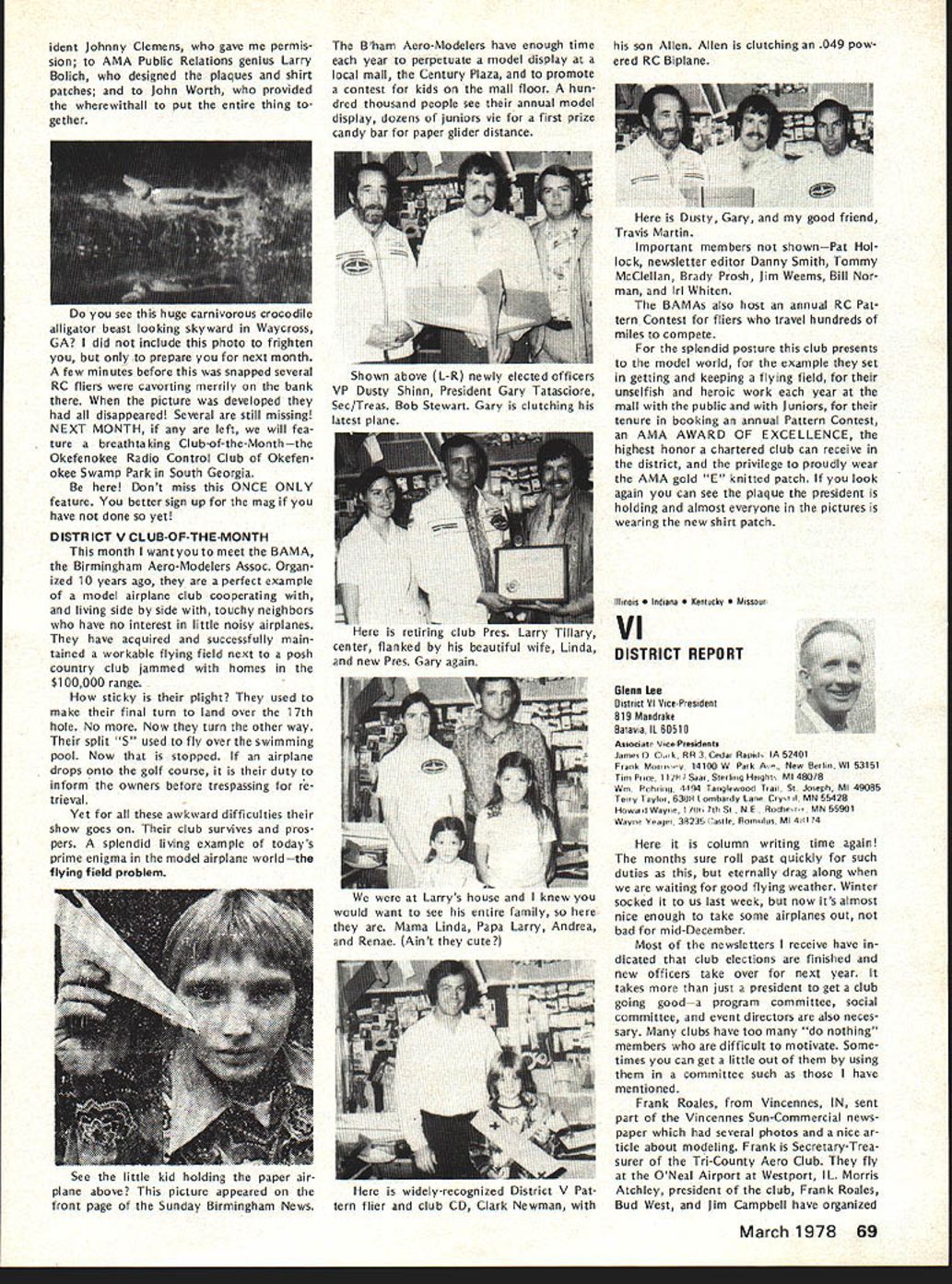
The B'ham Aero-Modelers have enough time each year to perpetuate a model display at a local mall, the Century Plaza, and to promote a contest for kids on the mall floor. A hundred thousand people see their annual model display, dozens of juniors vie for a first prize candy bar for paper glider distance.
DISTRICT V CLUB-OF-THE-MONTH
This month I want you to meet the BAMA, the Birmingham Aero-Modelers Assoc. Organized 10 years ago, they are a perfect example of a model airplane club cooperating with, and living side by side with, touchy neighbors who have no interest in little noisy airplanes. They have acquired and successfully maintained a workable flying field next to a posh country club jammed with homes in the $100,000 range.
How sticky is their plight? They used to make their final turn to land over the 17th hole. No more. Now they turn the other way. Their split "S" used to fly over the swimming pool. Now that is stopped. If an airplane drops onto the golf course, it is their duty to inform the owners before trespassing for retrieval.
Yet for all these awkward difficulties their show goes on. Their club survives and prospers. A splendid living example of today's prime enigma in the model airplane world—the flying field problem.
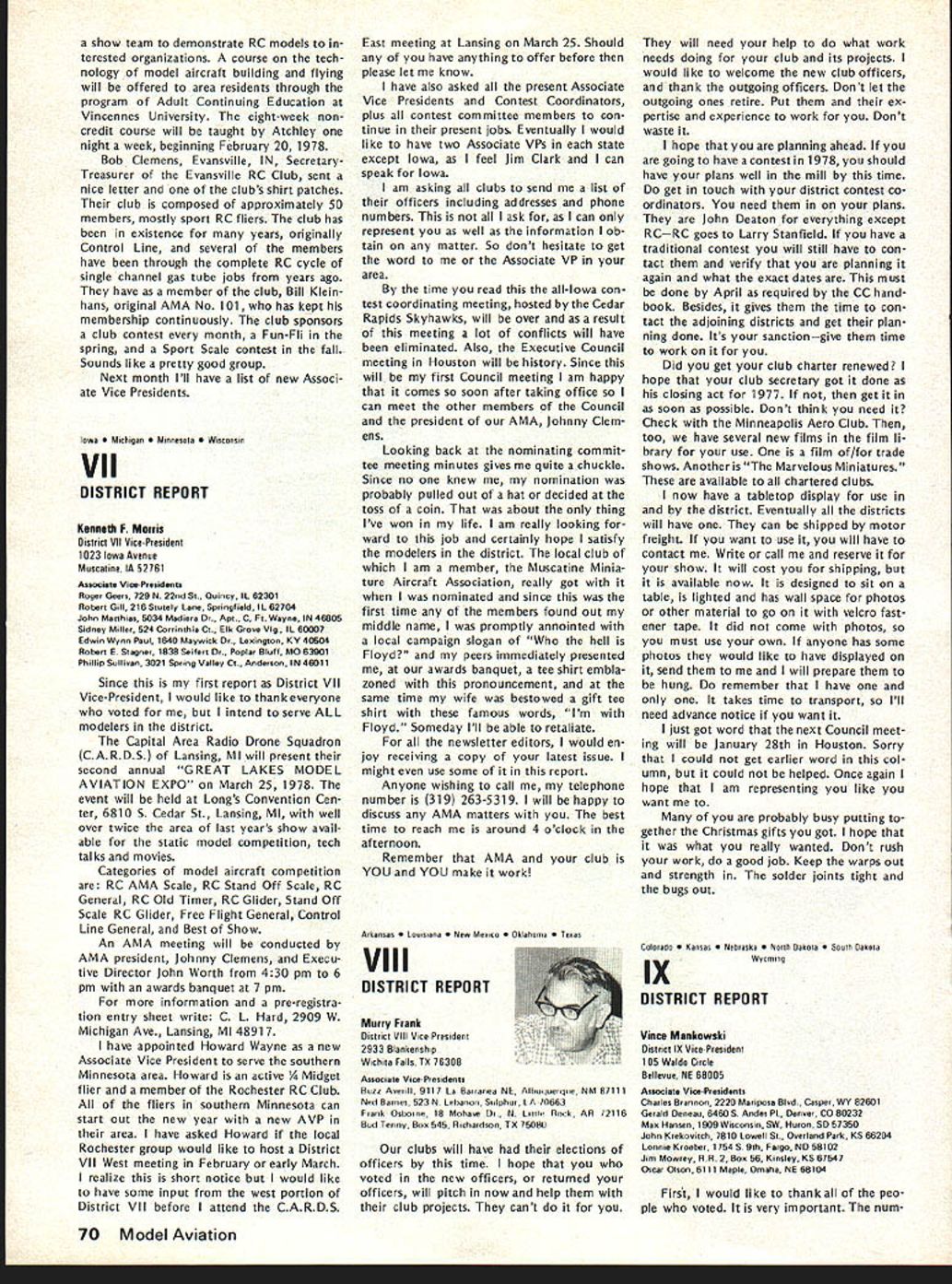
Important members not shown—Pat Hollock, newsletter editor Danny Smith, Tommy McClellan, Brady Prosh, Jim Weems, Bill Norman, and Irl Whiten.
The BAMAs also host an annual RC Pattern Contest for fliers who travel hundreds of miles to compete.
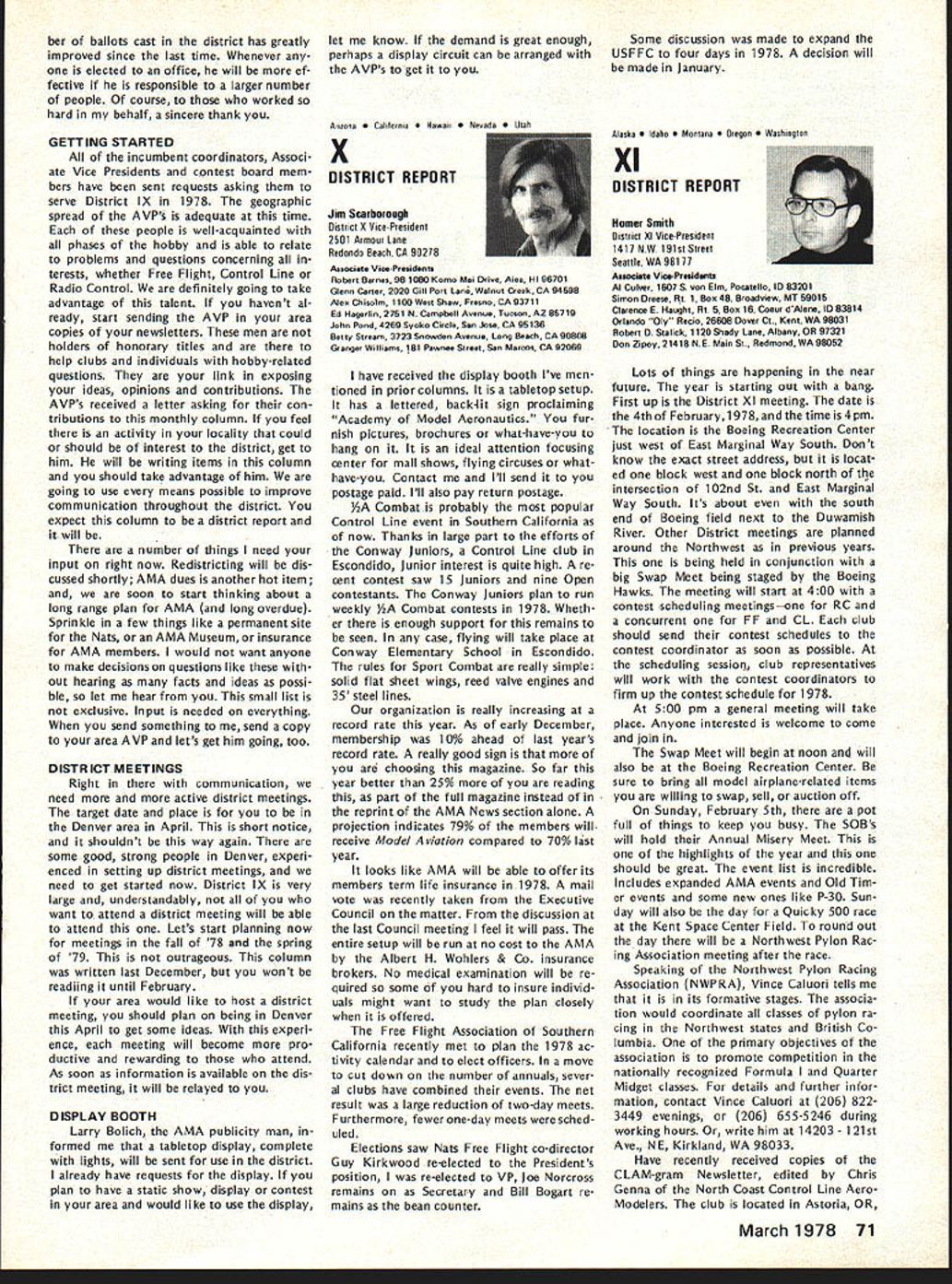
For the splendid posture this club presents to the model world, for the example they set in getting and keeping a flying field, for their unselfish and heroic work each year at the mall with the public and with Juniors, for their tenure in booking an annual Pattern Contest, an AMA AWARD OF EXCELLENCE, the highest honor a chartered club can receive in the district, and the privilege to proudly wear the AMA gold "E" knitted patch. If you look again you can see the plaque the president is holding and almost everyone in the pictures is wearing the new shirt patch.
AMA News
The largest gathering in history featured the annual Fédération Aéronautique Internationale (FAI) meeting in Paris, December 1-2. Fifty-eight representatives from 29 countries were present. The technical plenary meetings of the Committee for International Aeromodelling (CIAM) worked harmoniously to dispose of a 37-page agenda in record time. Very little controversy prevailed despite some significant new developments in several areas. Practically every proposal from the USA was either adopted or tabled for future consideration at meetings. A major achievement was approval of the new FAI Sporting Code 1979–1983, with provision for a flexible section to accommodate certain kinds of changes on an annual basis. General items affecting model specifications — aircraft size, engines, equipment, etc. — are frozen during the four-year rule-book period. Items dealing with world championships procedure, such as RC maneuvers, number of flights, engine-noise measurement, etc., will be subject to change in accordance with lessons learned from world championships and other major contest experience. The new arrangement is expected to be a good compromise between the unlimited annual FAI changes of the past years and the unreasonable, excessive freezing of rule changes in recent years. The Sporting Code is expected to be approved and printed mid-year 1979 and will be available via National Aero Clubs.
At the end of 1978 the USA delegation was the largest ever, with ten official positions. The group went to the meeting with six elected representatives and several members on subcommittees, plus proxies.
NATS PROBABLE FOR LAKE CHARLES — The final decision will be made at the January 28 meeting of AMA's Executive Council. Preliminary indications favor a return to Lake Charles, Louisiana, for the next National Model Airplane Championships, should development proceed. Likely dates would be July 30–August 6. Recent evaluation by AMA officers of Lake Charles versus other possibilities showed several factors favoring the Louisiana site in terms of availability, size, and accommodations while keeping activity on the same airfield. Lake Charles is clearly ahead, especially in the Free Flight area — a perennial Nats problem due to space requirements. Lake Charles is currently an available and acceptable site.
Two other locations were intensively studied: Ohio (several sites explored) and New Jersey (the Lakehurst area received major consideration). Lakehurst had a severe Free Flight problem; the newly discovered potential FF site there was determined to be too small to accommodate large numbers of cars and people. Ohio, previously used for the 1976 Nats, had the Springfield airport expected to have major repairs done on the main runway in 1978; likewise the previous indoor site was due for repair work which would preclude its availability. Other reasons, including key accommodation problems, caused the Ohio and New Jersey sites to be dropped from 1978 consideration. The Ohio situation may be favorable in 1979 and will be watched closely during 1978. In the meantime some other strong points favor Lake Charles:
- Freedom — AMA would have maximum leeway to use airfield facilities.
- Hours available — flying possible dawn to dusk; noise complaint problems and restrictions due to conflict with other users of the property would be minimized.
- Accommodations — camping (field '74, '75) will probably be possible again. Also low-cost air‑conditioned dormitories are expected to be available again.
- Size — much larger than the usual Nats Free Flight area except Riverside, California, '77. An RC area able to accommodate flight circles is necessary.
Comment: The 1975 Nats at Lake Charles were a happy event; participants indicated the nearest Nats in the old terms — fun atmosphere. In contrast, the last Nats at Lake Charles ran a financial deficit involving thousands of dollars. Lake Charles is relatively central. Details of the final decision will be reported in the next issue.
An elected position added: Dan Pruss regained his former officership as Chairman of the RC Soaring Committee. Thus the USA group ended up with seven out of 17 elected positions on FAI's CIAM. The complete 1978 lineup of FAI positions is listed at the end of the report.
The Paris meetings began under a cloud due to late delivery of the agenda, normally mailed to countries in October. The compilation of proposals received by FAI during the previous months and proposals sent to FAI in mid-September resulted in the official agenda arriving in the USA only the day before Thanksgiving, just before U.S. representatives departed for Europe. Some delegates from other countries didn't get the agenda until they got to Paris. ber of ballots cast in the district has greatly improved since the last time. Whenever anyone is elected to an office, he will be more effective if he is responsible to a larger number of people. Of course, to those who worked so hard in my behalf, a sincere thank you.
GETTING STARTED
All of the incumbent coordinators, Associate Vice Presidents and contest board members have been sent requests asking them to serve District IX in 1978. The geographic spread of the AVP's is adequate at this time. Each of these people is well-acquainted with all phases of the hobby and is able to relate to problems and questions concerning all interests, whether Free Flight, Control Line or Radio Control. We are definitely going to take advantage of this talent. If you haven't already, start sending the AVP in your area copies of your newsletters. These men are not holders of honorary titles and are there to help clubs and individuals with hobby-related questions. They are your link in exposing your ideas, opinions and contributions. The AVP's received a letter asking for their contributions to this monthly column. If you feel there is an activity in your locality that could or should be of interest to the district, get to him. He will be writing items in this column and you should take advantage of him. We are going to use every means possible to improve communication throughout the district. You expect this column to be a district report and it will be.
There are a number of things I need your input on right now. Redistricting will be discussed shortly; AMA dues is another hot item; and, we are soon to start thinking about a long range plan for AMA (and long overdue). Sprinkle in a few things like a permanent site for the Nats, or an AMA Museum, or insurance for AMA members. I would not want anyone to make decisions on questions like these without hearing as many facts and ideas as possible, so let me hear from you. This small list is not exclusive. Input is needed on everything. When you send something to me, send a copy to your area AVP and let's get him going, too.
DISTRICT MEETINGS
Right then with communication, we need more and more active district meetings. The target date and place is for you to be in the Denver area in April. This is short notice, and it shouldn't be this way again. There are some good, strong people in Denver, experienced in setting up district meetings, and we need to get started now. District IX is very large and, understandably, not all of you who want to attend a district meeting will be able to attend this one. Let's start planning now for meetings in the fall of '78 and the spring of '79. This is not outrageous. This column was written last December, but you won't be reading it until February.
If your area would like to host a district meeting, you should plan on being in Denver this April to get some ideas. With this experience, each meeting will become more productive and rewarding to those who attend. As soon as information is available on the district meeting, it will be relayed to you.
DISPLAY BOOTH
Larry Bolich, the AMA publicity man, informed me that a tabletop display, complete with lights, will be sent for use in the district. I already have requests for the display. If you plan to have a static show, display or contest in your area and would like to use the display, let me know. If the demand is great enough, perhaps a display circuit can be arranged with the AVP's to get it to you.
Arizona • California • Hawaii • Nevada • Utah
X DISTRICT REPORT
Jim Scarborough District X Vice-President 2501 Armour Lane Redondo Beach, CA 90278
Associate Vice-Presidents: Robert Barnes, 98-1080 Kamehameha Drive, Aiea, HI 96701 Glenn Carter, 2200 Golf Port Lane, Walnut Creek, CA 94598 Alex Chisholm, 1100 West Shaw, Fresno, CA 93711 Ed Hopkinson, 1751 N. Campbell Avenue, Tucson, AZ 85719 John Ford, 2269 Sycamore (?), San Jose, CA 95136 Betty Stewart, 3723 Snowfield Avenue, Long Beach, CA 90808 Grager Williams, 1318 Pearce Street, Santa Monica, CA 90406
I have received the display booth I've mentioned in prior columns. It is a tabletop setup. It has a lettered, back-lit sign proclaiming "Academy of Model Aeronautics." You furnish pictures, brochures or what-have-you to hang on it. It is an ideal attention-focusing center for mall shows, flying circuses or whatever-have-you. Contact me and I'll send it to you postage paid. I'll also pay return postage.
J/A Combat is probably the most popular Control Line event in Southern California as of now. Thanks in large part to the efforts of the Conway Juniors, a Control Line club in Escondido, Junior interest is quite high. A recent contest saw 65 Juniors and nine Open contestants. The Conway Juniors plan to run weekly J/A Combat contests in 1978. Whether there is enough support for this remains to be seen. In any case, flying will take place at Conway Elementary School in Escondido. The rules for Senior Combat are really simple: 35' steel lines, reed valve engines and 35' steel lines.
Our organization is really increasing at a record rate this year. As of early December, membership was 10% ahead of last year's record rate. A really good sign is that more of you are choosing this magazine. So far this year better than 25% more of you are reading this, as part of the full magazine instead of the reprint of the AMA News section alone. A projection indicates 79% of the members will receive Model Aviation compared to 70% last year.
It looks like AMA will be able to offer its members term life insurance in 1978. A mail vote was recently taken from the Executive Council on the matter. From the discussion at the last Council meeting I feel it will pass. The entire setup will be run at no cost to the AMA by the Albert H. Wohlers & Co. insurance brokers. No medical examination will be required so some of you hard-to-insure individuals may want to study the plan closely when it is offered.
The Free Flight Association of Southern California recently met to plan the 1978 activity calendar and to elect officers. In a move to cut down on the number of annuals, several clubs have combined their events. The net result was a large reduction of two-day meets. Furthermore, fewer one-day meets were scheduled.
Elections saw Nats Free Flight co-director Guy Kirkwood re-elected to the President's position, I was re-elected to VP, Joe Norcross remains on as Secretary and Bill Bogart remains as the bean counter.
Alaska • Idaho • Montana • Oregon • Washington
XI DISTRICT REPORT
Homer Smith District XI Vice-President 1417 N.W. 191st Street Seattle, WA 98177
Associate Vice-Presidents: Al Culver, 1607 S. Von Elm, Pocatello, ID 83201 Simon Dreese, Rt. 1, Box 48, Broadview, MT 59016 Clarence E. Haught, R.F.D. 5, Box 16, Coeur d'Alene, ID 83814 Orlando "Oly" Recio, 26808 Dover Ct., Kent, WA 98031 Robert D. Stalick, 1120 Shady Lane, Albany, OR 97321 Don Zipay, 21418 N.E. Main St., Redmond, WA 98052
Lots of things are happening in the near future. The year is starting out with a bang. First up is the District XI meeting. The date is the 4th of February, 1978, and the time is 4 p.m. The location is the Boeing Recreation Center just west of East Marginal Way South. Don't know the exact street address, but it is located one block west and one block north of the intersection of 102nd St. and East Marginal Way South. It's about even with the south end of Boeing Field next to the Duwamish River. Other District meetings are planned around the Northwest as in previous years. This one is being held in conjunction with a Big Swap Meet being staged at the Boeing Hawks. The meeting will start at 4:00 with a scheduling session — one for RC and a concurrent one for FF and CL. Each club should send their contest schedules to the contest coordinator as soon as possible. At the scheduling session, club representatives will work with the contest coordinators to firm up the contest schedule for 1978.
At 5:00 pm a general meeting will take place. Anyone interested is welcome to come and join in.
The Swap Meet will begin at noon and will also be at the Boeing Recreation Center. Be sure to bring all model airplane-related items you are willing to swap, sell, or auction off.
On Sunday, February 5th, there are a pot of things to keep you busy. The S.O.B.'s will hold their Annual Misery Meet. This is one of the highlights of the year and this one should be great. The event list is incredible. The annual events will include Old Timers events and some others like P-30. Sunday will also be the day for a Quickie 500 race at the Kent Space Center field. To round out the day there will be a Northwest Pylon Racing Association meeting after the race.
Speaking of the Northwest Pylon Racing Association (NWPRA), Vince Calouri tells me that it is in its formative stages. The association would coordinate all classes of pylon racing in the Northwest states and British Columbia. One of the primary objectives of the association is to promote competition in the nationally recognized Formula I and Quarter Midget classes. For details and further information, contact Vince Calouri at (206) 822-3449 evenings, or (206) 655-2426 during working hours. Or, write him at 14203 - 121st Ave., NE, Kirkland, WA 98033.
Have recently received copies of the CLAM-GRAM Newsletter, edited by Chris Genna of the North Coast Control Line Aeromodellers. The club is located in Astoria, OR.
AMA News
and I am glad to hear from them. Dave Green was recently re-elected as top CLAM and John Thompson was returned as secretary. Bill Skelton was elected treasurer, with Shane Brown elected assistant gavel smasher. A delegation of CLAMS recently attended the Portland Aeroliners' Fun Fly. "Darth" Varner captured first place in High-Low and John Thompson took second. The CLAMs attended the Shady Acres Combat Bash in September. Although they aren't ready to take on the Jive Combat Team yet, they did provide the Shady Acres Combat Team with two valuable members for the after-contest tug-o-war. Don't know the players in the Shady Acres gang, but the JCT includes such notables as Gary Stevens, Dirty Dan, Gary Byerly, Phil Granderson, and Lowell Paddock, I think. Dave Fisher recently won the CLAMs keep-it-flying derby, showing determination that made even World War II combat flying aces envious. It seems he collided in midair with Jim Cameron. Good luck, gang. Keep 'em flying.
Transcribed from original scans by AI. Minor OCR errors may remain.

