
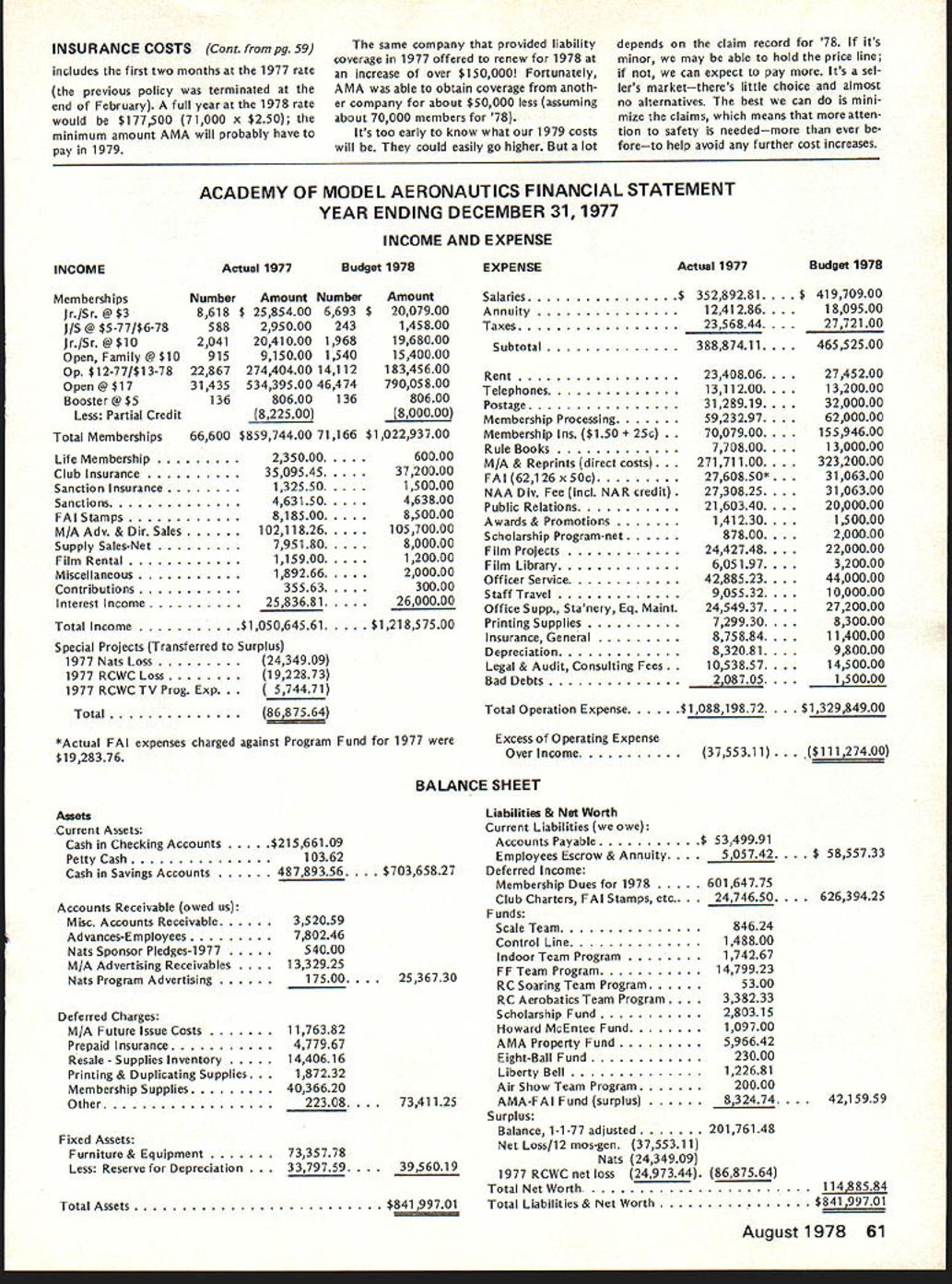
AMA EXECUTIVE COUNCIL EXPANDS DUES INCREASE FOR '79
Operating Deficits in '77 and '78 Evaporate Previous Surplus
When the last membership dues increase went into effect (in 1973) the AMA Executive Council promised to hold the line on future increases for at least five years. The promise was kept. And during those five years, as membership grew steadily, a healthy surplus of funds developed. In fact, at the beginning of the fifth year, 1977, the surplus had grown to just over $200,000—almost a quarter of a million dollars. Yet a little over a year later that surplus was cut almost in half and it was expected that by the end of 1978 the surplus would be all gone. The story of what happened in the past year and a half is what is behind the headlines above, and why AMA'ers will pay a lot more for membership next year.
Several factors combined in 1977 to wave a warning flag by mid-year to say that a dues increase should be considered. Inflation alone was increasing expenses in general, to the extent that even with increased membership, the added costs were outpacing the increased income. One item in particular—membership insurance—jumped from an annual cost of about $53,000 in 1976 to $70,000 in 1977. The AMA Executive Council could see the trend early in '77 and in January of that year approved a budget that anticipated a year-end deficit of about $50,000.
The Council wasn't too concerned, however, since they knew that there was a reserve of surplus funds to more than make up the deficit. They also knew that 1977 was the fifth year since the last dues increase and that, if necessary, an increase could be made for 1978 to get income back on top of expenses. So, when the decision time came in early August of '77—during the Council meeting at the National Championships in California—the outlook was reassuring and no crisis was apparent.
However, the trend was obvious concerning income vs. expenses, so the Council discussed and voted on proposals for dues increases. But several Council members noted that there was a strong mood among their constituents that a dues increase should not be made so long as a large surplus of funds existed. The Executive Director cautioned against this view, noting that the surplus—while it seemed large—amounted to only about 20% of the current annual budget and that in an inflationary situation the reserve was not excessive.
It was finally voted at the 1977 Nats meeting that there would be no dues increase for 1978. For the moment, that decision seemed to be okay. Unfortunately, the timing was just a bit too early. It had to be that way, because mid-August was the deadline for finalization of materials for the annual membership renewal mailing to follow shortly after—about 70,000 renewal packets had to be prepared and this volume of mail requires a lead time of about six weeks. Had the timing been about a month later a different Council vote might have resulted.
In early August it was too soon to know how the financial report of the July RC World Championships (Springfield, OH) would turn out. A preliminary report indicated that a loss of about $5,000 was definite, but many bills were still not in so that the picture was incomplete. Similarly, the Nats was in mid-stride and it was too soon to know how that operation would turn out, although it was apparent that income would be lower than had been hoped for. In both situations it was felt that the surplus would cover any losses so no special action was required.
By year end the picture was dramatically different. The combined World Champs and Nats losses developed to be worse than expected, totalling almost $50,000. Thus, when the Council met in January to consider the '78 budget they were faced with an obviously deteriorating situation. They were looking at an overall loss for 1977 of over $80,000 and a prediction of close to the same amount for '78 (even without any Nats or other special event losses, the increased basic operating expenses due to inflation made the outlook for '78 no better than '77).
The Council, therefore, voted for a 1979 dues increase, to provide $3 additional from each adult AMA member. The amount seemed safe enough, even allowing for an expected large jump in membership insurance and other costs. But once again the timing was unfortunate. The true insurance cost for 1978 was not yet available. The previous coverage was due to expire shortly, and the insurance company had not yet provided cost figures for renewal. And a bid from another company was not yet finalized.
So the Council allowed almost $50,000 more in the budget for insurance alone, as compared with the '77 cost. That was about a dollar more per member than before—a major increase. But it turned out to be not enough. Within a month after the January Council meeting the company providing '77 coverage asked $225,000 for '78 coverage, an increase to about $3.25 per member, almost 400%! Meanwhile, the bid from the alternate company came through at $2.50 per member, or about $175,000 for the year. With no other choices available the latter cost prevailed, and even though about $50,000 lower than the other offer, the net effect was to increase the '78 expense budget by about $30,000. This increase, plus others which developed concerning rent and miscellaneous factors, produced a revised '78 budget deficit of about $100,000—almost the same amount remaining in the current surplus.
Thus, when the Council met again in late April of this year, it was apparent that the dues increase voted just a couple of months previous was inadequate. With no reserve to fall back on for '79 they needed to be sure that dues income would be enough to cover all expenses. They also felt it was necessary to begin to rebuild the reserve, especially since inflation was showing no real signs of abating and insurance costs in '79 might get even worse.
The mood, therefore, was to get back to the situation of the '73-'76 period—more than enough funds to cover all costs and to assure that the dues increase would hold at the '79 level for more than just a year. So they went beyond a $22 adult rate (with magazine), which had been proposed, and voted for $25. They also voted to increase the dues rate for Juniors, Seniors, and Family members—it was noted that Juniors cost AMA $2.75 in basic insurance costs alone and that the $3 rate (without publication) was no longer feasible.
For 1979 a Junior will pay $5 for basic dues, a Senior will pay $7.50. If either wishes the magazine the cost will be $8 additional. Family members (second adult AMA member in a family) will pay $17 ($25 less the magazine cost).
At the same time, the Council voted to include the magazine automatically to all adult members (except for Family members). It was noted that the currently available option concerning the magazine had previously been voted to be dropped in 1980, so the new action was merely to apply the change a year earlier so as to consolidate all dues change actions in the same year.
The magazine decision was noted to be based in the fact that most AMA members who had the choice in '78 paid for the magazine separately and that economies would result in the elimination of dual publication operations (AMA News and Model Aviation), so that any increase in the magazine portion of the dues increase would be minimized. It was pointed out that the magazine operation had paid its own way since its inception in mid-'75 and that it operated within its own budget, currently based on $1.27 per member.
For '79 the magazine will continue to operate within its own budget, based on $8 per member. Thus, only $1 of the $8 1979 adult member dues increase will go to the magazine. Even at $8 this is a very low subscription rate, considerably less for AMA members than for non-members and less than any other magazine of comparable size and quality.
In the meantime, it is noted that about $25,000 in magazine credits (which had not been claimed by AMA members in 1975 when offered refunds for unfulfilled subscriptions) had been part of the '76-'77 surplus of general funds and thus the magazine had helped prolong the time between the previous and new dues increase.
The AMA Executive Council, in taking the bold new dues action for '79, is looking for a renewal of the situation which developed after the 1973 dues increase. With the extra funds available AMA made tremendous strides in the following five-year period, particularly in the area of public relations and progress with the FCC and FAA concerning model aviation. If the same situation repeats, the early 1980's can be the greatest period of AMA progress yet—the basic theme behind the Executive Council's action has been to develop and strengthen the AMA so it could do more rather than less, and to continue the growth of the past 10 years on the way to the goal of 100,000 members by 1990.
AMA'S NEW LIFE INSURANCE PROGRAM
Some AMA members have questioned why AMA has added life insurance to the basic membership liability protection coverage.
AMA is only incidentally involved in the insurance business. AMA is, first of all, a membership service organization. As such, our goal is to serve the needs of members as best we can. As a fundamental service AMA has provided members with Comprehensive General Liability Protection for many years (since 1942). In addition, AMA several years ago automatically included Accident/Medical coverage for members, at no extra charge. The liability protection serves if the AMA member injures someone or damages someone's property while flying, the accident/medical program pays for medical bills if the member is injured. It is the ability to provide such protection that allows Academy members to fly with confidence, knowing that they are protected against suit or medical bills if an accident should occur.
The collective bargaining power of the membership provides purchase strength—the dollars involved are substantial. Through this strength of numbers AMA is able to add to insurance service by offering members the opportunity to buy a low cost term life insurance plan, if they so desire. There is no obligation to purchase this coverage—it is simply available for those who might want to take advantage of it. Most important is that AMA incurs no expense nor receives any profits from this plan. All expenses for this plan are the responsibility of Albert H. Wohlers & Company, including materials, addressing and postage for the initial mailings and promotional expenses.
It was this firm which assisted the AMA in getting its current membership liability coverage, effective the first of March 1978. It was through their efforts that AMA was able to save $53,000 on the annual cost of current coverage, as compared to the cost of renewing coverage through our previous insurance company. Previously, the same company offered to provide a life insurance program for members at no cost to the AMA. This program was studied and approved in 1977 by the AMA Executive Council as a supplemental and optional benefit for members.
Meantime many more AMA members have applied for the life insurance coverage than those who have indicated AMA should not have offered it. Thus, it appears that the plan has been well-received by enough members to justify the program. In short, all AMA members have benefited from the savings in liability and accident/medical coverage, and many have taken advantage of the life insurance option without any cost having been incurred by AMA. Therefore, the life insurance program is a bonus benefit of AMA membership and the costs are borne only by those who choose to participate.
CAMPING AND FAMILY DORMS AGAIN AT NATS
Many '75 Nats families enjoyed the unique facilities at McNeese State University, Lake Charles, Louisiana. They took advantage of special family suites, for groups of couples or for families consisting of more than just a husband and wife—such as a couple plus one or more children, or a couple plus other adults with or without children. The special family suites include four small rooms—each with two single beds—plus a sitting room, a utility room, and a multiple-person bathroom, including several sinks, showers and commodes. The family suite rate is $8 per person who is 16 or over—no charge for children under 16. For example, a suite with two adults and two children under 16 rents for a total of $16 per night; a suite being shared by two couples rents for $32 per night, etc. All dormitories are at McNeese State University, approximately four miles southwest of Chenault Air Base. All reservations for use of dormitories must be made through AMA, either through advance entry by mail or at Nats headquarters at the air base. No priority system is necessary, except families with children will receive preference. There is ample room for all other anticipated users of dormitory space. Advance reservation and payment by mail is recommended, however, and refunds will be made for any space not used. A $5 key deposit will be required; refundable at checkout.
For individuals or couples dorm rooms are available for $5 per person per night, two to a room; $8 per night if one to a room.
Camping on Site. For tents, trailers and overnight motor home or recreational vehicle parking, whether at the camp site or other authorized parking area, there is a $10 charge per site which covers the complete Nats period and any number of persons in the camping party; there will be no refund for unused days. The camping fee must be paid in advance upon arrival. There is no electrical power to individual campsites, but the camp area includes portable toilets. No priority system; many campsites available.
Additional camping is available at the Indoor site (Burton Coliseum) about five miles south of Chenault Air Base—where most Nats events will be held. The cost will be $5 per night, payable to AMA, with electrical and water hookups available for trailers (dumping facilities). Trailer camper parking in the shade (tents, also) will be possible at the Indoor site. Restrooms are also available.
For motel and other camping information write AMA HQ (or check the appropriate box on the entry form).
Entry forms were mailed prior to June 1, to all '76 and '77 Nats contestants. The deadline for advance (by mail) entry is July 3rd. If you don't have an entry form by June 15 (assuming you want one), please advise AMA HQ immediately so that the deadline will not be missed—late entry is expensive!
THE RISING COST OF INSURANCE
Up until a few years ago, the cost to AMA of providing liability protection to AMA members was relatively low, averaging about 50c per member. More recently the cost has increased in major jumps, actually more than tripled for 1978! The annual totals for recent years:
1974 51,900 members . . . $24,800 1975 53,900 " . . . $24,800 1976 62,500 " . . . $37,210 1977 66,600 " . . . $46,000 1978 (est.) 71,000 " . . . $156,000
Note: These figures do not include the cost of AMA's supplementary accident coverage, which originally—and still—costs 25c per member.
It should also be noted that the 1978 cost
AMA News
When the last membership dues increase went into effect in 1973, the AMA Executive Council promised to hold the line on future increases for at least five years. That promise was kept. During the five years membership grew steadily and healthy surplus funds developed. In fact, beginning the fifth year, 1977, surplus had grown to just over $200,000 — almost a quarter-million dollars. Yet little over a year later the surplus was cut almost in half. Had it continued the expected end of 1978 surplus would have gone. What's behind the headlines above? AMA'ers will pay a lot in membership dues next year.
Several factors combined in 1977 to wave a warning flag mid-year and say a dues increase should be considered. Inflation alone — increasing expenses in general to an extent greater than increased membership — added costs outpacing increased income. In particular, membership insurance jumped — annual cost about $53,000 in 1976, $70,000 in 1977.
The AMA Executive Council could see the trend early in '77. In January the year's approved budget anticipated a year-end deficit of about $50,000. The Council wasn't too concerned, ever since it knew reserve surplus funds would make up the deficit. Also it knew 1977 was the fifth year since the last dues increase and that a necessary increase could be made in 1978 to get income back to meet expenses. So decision time came early August, 1977, during the Council meeting at the National Championships in California — the outlook reassuring, no crisis apparent. However, the trend concerning income vs. expenses was obvious. The Council discussed and voted on several proposals for dues increases. Several Council members noted the strong mood among constituents that a dues increase should be made so long as large surplus funds existed. The Executive Director cautioned against that view, noting the surplus, while it seemed large, amounted to only about 20% of the current annual budget; with the inflationary situation the reserve was not excessive. Finally, at the 1977 Nats meeting it was voted that there would be no dues increase for 1978. At the moment that decision seemed okay.
Unfortunately the timing was just a bit too early. The mid-August deadline for finalization of materials for the annual membership renewal mailing followed shortly after — about 70,000 renewal packets are prepared — the volume of mail requires a lead time of about six weeks. Had the timing been about a month later a different Council vote might have resulted. In early August it was too soon to know how the financial report for the July RC World Championships at Springfield, Ohio would turn out. The preliminary report indicated a loss of about $5,000; definite bills were still outstanding and the picture incomplete. Similarly, the Nats were mid-stride and too soon to know how the operation would turn out, although apparent income would be lower than hoped. Both situations were felt the surplus would cover the losses and no special action was required.
The year-end picture was dramatically different. Combined World Champs and Nats losses developed worse than expected, totaling almost $50,000. Thus when the Council met in January to consider the 1978 budget it faced an obviously deteriorating situation — looking at an overall loss for 1977 of over $80,000 (a prediction close to the same amount), with 1978 Nats and other special event losses increased, and basic operating expenses increased due to inflation, the outlook for 1978 was no better than 1977. The Council therefore voted a 1979 dues increase to provide $3 additional per adult AMA member. That amount seemed safe enough allowing for expected large jumps in membership insurance and other costs.
Once again timing was unfortunate. The true insurance cost for 1978 was not yet available — previous coverage was due to expire shortly and the insurance company had not yet provided renewal cost figures; the bid from another company had not been finalized. So the Council allowed almost $50,000 in the budget for insurance, lone compared to the 1977 cost.
Model Aviation ended 1977 slightly in the black, with net income $705.48. Total income was $383,360.26 and total expenses $382,656.78. Income included $281,242 membership/subscriptions plus $90,361.26 advertising, hob shop sales, non-member subscriptions, and plans sales; also $11,757 allocation from general funds to cover magazines provided out of charge to AMA officers and free members, mostly Contest Directors. Expenses included $271,711 direct costs plus $110,943.78 allocated costs as part of headquarters overhead apportioned to magazine operation.
Thus again, at the beginning of 1978 the magazine has continued to pay for itself and not drain general AMA income. The magazine staff consists of five people, salaries paid completely from magazine income. In addition, magazine income covers part of the salaries of some people in other departments for services partially used by the magazine. folks took me to the race at the age of 5 hidden under the laprobe on the floor of the back seat of my folks' Model T Ford.
My first job at the Speedway was painting "Men" and "Women" on the little white buildings in the infield. I was mortified at such a degrading job as lettering outhouses!!! Until, that is, my boss convinced me that I had the most important assignment at the Speedway. He said, "There'll be about 250,000 people here this weekend, and what if they didn't know which little building to go to: Johnny, your efforts might stop a 250,000 person riot!"
That little lesson that my boss taught me about painting outhouses has paid off all the rest of my life. It simply pointed out that even the most menial job should be done the best we know how, because we don't know who might be guided or aided by our work.
My "Indy 500" roots go much deeper. My grandfather (Dad's father) drove in the very first "500." He was a relief driver for Frank Fox in a Pope-Hartford racer. And he finished the race! There was another relief driver in that race that you may have heard of. His name, well known in aviation circles, was Eddie Rickenbacker. Both of these relief drivers' names may be found listed in the statistics of the 1911 "500," on page 119 of a book, "Indianapolis 500," produced by Lyle Engel and the editors of Auto Racing Magazine. Rickenbacker was my VIP guest at an airshow that I MC'd later on and mentioned how important he felt aeromodeling was to the total picture of all of aviation.
And it is a small world! I was taught to fly (in an ancient Cub) by H. Wier Cook who was an "ace" in Rickenbacker's 94th Aero Pursuit Squadron during World War I. The Indianapolis Municipal Airport is named after Cook, who had his air school there.
A SALUTE TO A WONDERFUL COUPLE
The cover of the June 1978 issue of Model Airplane News magazine featured CARL and BETH GOLDBERG and ROY CLARK. This was bringing together the best of two worlds, aeromodeling and country music entertaining. The occasion was to salute Carl's 50th year anniversary in model aviation. When I saw the picture I smiled a big grin because there is no nicer couple in all of our modeling world than the Goldbergs, and I hope that Roy Clark enjoyed the flying of model planes at Walt Schroder and Bill Bennett's Tournament of Champions as much as we enjoy him as an entertainer. Please note that Carl Goldberg just can't get away from modeling. On the M.A.N. cover he is still showing his interest in R.C. (Roy Clark!!!)
THIS APPROACH IS COMPLETELY WRONG!!
Much can be accomplished by an individual AMA member if he has a valid cause and a constructive purpose. The member needs to simply plead his case in the proper manner and the machinery that has been set up PER THE AMA BY-LAWS will see that the matter gets full and proper attention.
The thing that triggered all this is a letter from an appointed AMA Associate Vice President. This letter is somewhat unbelievable from an AMA officer in its lack of "homework" and proper procedure. The letter is primarily in regard to AMA insurance matters. The letter is predicated on another enclosed letter from another AMA member who is an insurance agent. The insurance agent's letter is in regard to a group life insurance policy recently offered AMA members. His letter has a valid basis, and was submitted to the AMA Associate VP. (It would have been better sent to the members District Vice President). At this point the Associate VP wrote a highly indignant accusive two-page letter addressed to the Executive Council, with copies sent to all model magazine publishers.
The things wrong with this approach are, first, the two-page tirade was not even about Group Life Insurance; the insurance agent AMA member had written his letter about, but was about AMA's individual member liability insurance while flying. The second error was in trying to generate outside pressure for the very organization he was appointed to serve. When he accepted the appointment he should have accepted the responsibility to follow AMA's by-laws and to help the Executive Council make decisions. The Executive Council of the Academy of Model Aeronautics has been elected BY YOU, THE MEMBERSHIP, and will make all decisions of policy, per the by-laws. The Executive Council of AMA is a highly intelligent group of 15 persons, with all the information, and an EXCELLENT TRACK RECORD.
RC BOMBERS AT NEW TOKYO AIRPORT?
An item in PAUL HARVEY'S broadcast of May 16th started out like this: "JOHNNY CLEMENS' RC MODELERS... HEAR THIS:..." and then his bulletin went on to say that the local radicals who are opposed to the new airport in TOKYO, JAPAN, have vowed to prevent that new airport from functioning. Paul was calling to our attention that the radicals are trying to use radio controlled model airplanes CARRYING HOMEMADE BOMBS to damage the airport. Countermeasures used by the Japanese government were the setting up of 18 powerful radios on nine frequencies to jam all RC transmission.
Since Mr. Harvey is an enthusiastic RC flier himself (AMA No. 52197), he made a personal observation that with the jamming going on, the "bombers" might easily bomb themselves!!
Right now Paul Harvey and I are in much the same boat in that our jammed-full schedules negate our pursuit of our model building and flying passions. I well remember two Christmases ago when Paul told me that he was going to have to sit down with Angel (Mrs. Harvey) and figure out ways and means of trimming his heavy schedule. Since that time he has TRIPLED his burden of personal appearances. You see, Paul and I run on the same kind of fuel, nervous energy. And we both feel that if there is some little bit of "good" we can do in this old world we gotta do it. A feature of Paul's broadcasts is known as "The Rest of the Story." Someday I would like to turn the tables on Paul and tell you "the rest of the story" of Paul's background and his comments when I was thought to be terminally about five years ago. If you are fortunate enough to hear his broadcasts, you are listening to a great American, a great guy, and a respected fellow member of the Academy of Model Aeronautics.
AND BY THE WAY—
If you think that inflation has a stranglehold on your billfold, Paul Harvey mentioned in this morning's broadcast that a hotel room at the new Tokyo airport costs $100 and a cab ride from the airport into Tokyo is $53. I have no yen to go there at those prices.
A JEWEL OF PHILOSOPHY
We hope you've noticed that there are very few old dumb fools!
RC SAILPLANE SYMPOSIUM—IN ITALY!
The mail just brought an announcement of a SYMPOSIUM ON DESIGN OF R/C SAILPLANES by the Aero-Club of Vergiate in Italy, October 1-7, 1978. The program follows: 0900 Hrs.-Opening and Introduction; 1300-Lunch at the Vergiate Aerodrome Restaurant; 1430-Questions, answers and open discussion; 1730-Closing. Fee: 15,000 Lire.
Papers are invited from all RC glider enthusiasts from all over the world. Papers to be in English, French, German, or Italian. All papers will be translated into English and bound into a book for free distribution to the authors and to the symposium participants, and for sale to others. Title and brief outline of each paper must be submitted to the organizers by July 31st. A copy of the complete paper with all drawings and other attachments must be in the hands of the organizers before the opening of the Symposium.
Interested people should contact: Mr. FRANCO PINTANIDA, Via Alberta da Somma, 42, 21019 SOMMA LOMBARDO (Varese), ITALY
Papers have already been announced from Belgium, England, and Italy.
Since "ACADEMY" (of Model Aeronautics) interprets to mean "A LEARNED SOCIETY FOR THE ADVANCEMENT OF ARTS OR SCIENCES," how about you learned U.S. glider guiders participating in this Symposium!!!
A POPULAR RECIPE FROM POPLAR BLUFF
It is always pleasant to see the ladies involve themselves in their husband's hobby lives. In the "SEMO-FLIER," newsletter of the FREELANCER R/C CLUB of Poplar Bluff, MO, editor Bobby Baker includes a column by the wives. Club president ROBERT STAGNER'S wife CAROLYN wrote a charming column in which she told of getting a recipe book which must have been written by a wife. She said every recipe in it called for some kind of wine. She said that she prepared a dish in her crockpot that called for two pounds of chicken, carrots, onion, celery, and spices, all stewed in white wine. Carolyn reports that it was not only delicious but was THE HAPPIEST CHICKEN they had ever eaten!!! Perhaps Carolyn would share her recipe for "HAPPY CHICKEN" with you if you dropped her a note. The Stagners live at 1838 Seifert Dr., Poplar Bluff, MO 63901. You other clubs might want to exchange newsletters with the Freelancers RC Club, too.
A WISE AND FRIENDLY GESTURE
STEVE TISCHLER is secretary and editor for the BARNSTORMERS of Portland, Ore. His May issue of the Barnstormer News was an item smacking of friendliness and good old-fashioned courtesy toward new members. It was a letter-of-welcome to new members and also read, "Barnstormer name tags will be mailed to all new members at our next meeting. Be proud of your club. Wear your name tag whenever you fly." GREAT IDEA! New friends means still more fun.
A PROFOUND BIT OF PHILOSOPHY
"OUR FUTURE IS SHAPED BY OUR PAST." Since that is obvious it seems to me that it would be wise for us to be very careful what we do in our past!
*******all for now*******
AMA News
INSURANCE COSTS (Cont. from pg. 59)
Includes the first two months at the 1977 rate (the previous policy was terminated at the end of February). A full year at the 1978 rate would be $177,500 (71,000 x $2.50); the minimum amount AMA will probably have to pay in 1979.
The same company that provided liability coverage in 1977 offered to renew for 1978 at an increase of over $150,000! Fortunately, AMA was able to obtain coverage from another company for about $50,000 less (assuming about 70,000 members for '78).
It's too early to know what our 1979 costs will be. They could easily go higher. But a lot depends on the claim record for '78. If it's minor, we may be able to hold the price line; if not, we can expect to pay more. It's a seller's market—there's little choice and almost no alternatives. The best we can do is minimize the claims, which means that more attention to safety is needed—more than ever before—to help avoid any further cost increases.
When the last membership dues increase went into effect in 1973, the AMA Executive Council promised to hold the line on future increases for at least five years. The promise was kept. During those five years membership grew steadily and healthy surplus funds developed. In fact, beginning the fifth year, 1977, the surplus had grown to just over $200,000—almost a quarter million dollars. Yet little over a year later the surplus was cut almost in half. By the expected end of 1978 the surplus would be gone. What's the story? What happened in the past year to cut the surplus in half? What is behind the headline above? AMA-ers will pay a lot in membership next year.
Several factors combined. A 1977 wave of warning flags mid-year said a dues increase should be considered. Inflation alone increased expenses in general; the extent of increased membership added costs that outpaced increased income. One item in particular—membership insurance—jumped. Annual cost was about $53,000 in 1976, $70,000 in 1977.
The AMA Executive Council could see the trend early in '77. In January the year‑approved budget anticipated a year‑end deficit of about $50,000. The Council wasn't too concerned, since reserve surplus funds would make up the deficit; it also knew 1977 was the fifth year since the last dues increase and that a necessary increase could be made in 1978 to get income back on top of expenses. So decision time came early August '77 during the Council meeting at the National Championships, California. The outlook was reassuring—no crisis apparent. However, the trend was obviously of concern regarding income vs. expenses. The Council discussed and voted on proposals for dues increases. Several Council members noted the strong mood among constituents that a dues increase should be made, as long as large surplus funds existed. The Executive Director cautioned against that view, noting the surplus, while it seemed large, amounted to only about 20% of the current annual budget; given the inflationary situation the reserve was not excessive. Finally, at the 1977 Nats meeting it was voted there would be no dues increase for 1978. At the moment the decision seemed okay.
Unfortunately, the timing was just a bit too early. The mid‑August deadline for finalization of materials for the annual membership renewal mailing followed shortly after—about 70,000 renewal packets were prepared. The volume of mail requires a lead time of about six weeks. Had the timing been about a month later a different Council vote might have resulted. Early August was too soon to know what the financial report for the July RC World Championships at Springfield, Ohio, would turn out to be. A preliminary report indicated a loss of about $5,000; definite bills were still to be received and the picture was incomplete. Similarly, the Nats were mid‑stride—too soon to know how the operation would turn out, although apparent income was lower than hoped. Both situations suggested the surplus would cover the losses; no special action was required.
The year‑end picture was dramatically different. Combined World Champs and Nats losses developed worse than expected, totaling almost $50,000. Thus when the Council met in January to consider the 1978 budget it faced an obviously deteriorating situation—an overall loss for 1977 of over $80,000 and a prediction of a close to the same amount for 1978. Nats and other special event losses and increased basic operating expenses due to inflation made the outlook for 1978 no better than 1977. The Council therefore voted a 1979 dues increase to provide $3 additional per adult AMA member. The amount seemed safe enough allowing for expected large jumps in membership insurance and other costs.
Once again timing was unfortunate. True insurance costs for 1978 were not yet available—the previous coverage was due to expire shortly and the insurance company had not yet provided cost figures for renewal; bids from another company had not yet been finalized. So the Council allowed almost $50,000 in the budget for insurance, alone compared to the 1977 cost of about...
Model Aviation ended 1977 slightly in the black—net income $70,548. Total income was $383,360.26 to cover total expenses of $382,656.78. Income included $281,242 membership subscriptions plus $90,361.26 advertising, hobby shop sales, non‑member subscriptions, plan sales; also $11,757 allocation from general funds to cover magazines provided outcharge AMA officers free to members, mostly Contest Directors' expenses. Included were $271,711 direct costs plus $110,943.78 allocated costs, part HQ overhead apportioned to magazine operation. Thus again, at the beginning of 1977 the magazine has continued to pay for itself and not drain general AMA income. The magazine staff consists of five people; their salaries are paid completely from magazine income. In addition, magazine income covers the cost of part of the salaries of some people in other departments and for services partially used by the magazine—a dollar per member befo
AMA News
re the dues increase. We have not had one in a long time, and the general feeling was that this should cover our financial needs, within anticipated membership increases, and raise the dues enough to keep us solvent for another three or four years. The surplus we HAD has gone thataway, almost, and we really can't get into deficit spending.
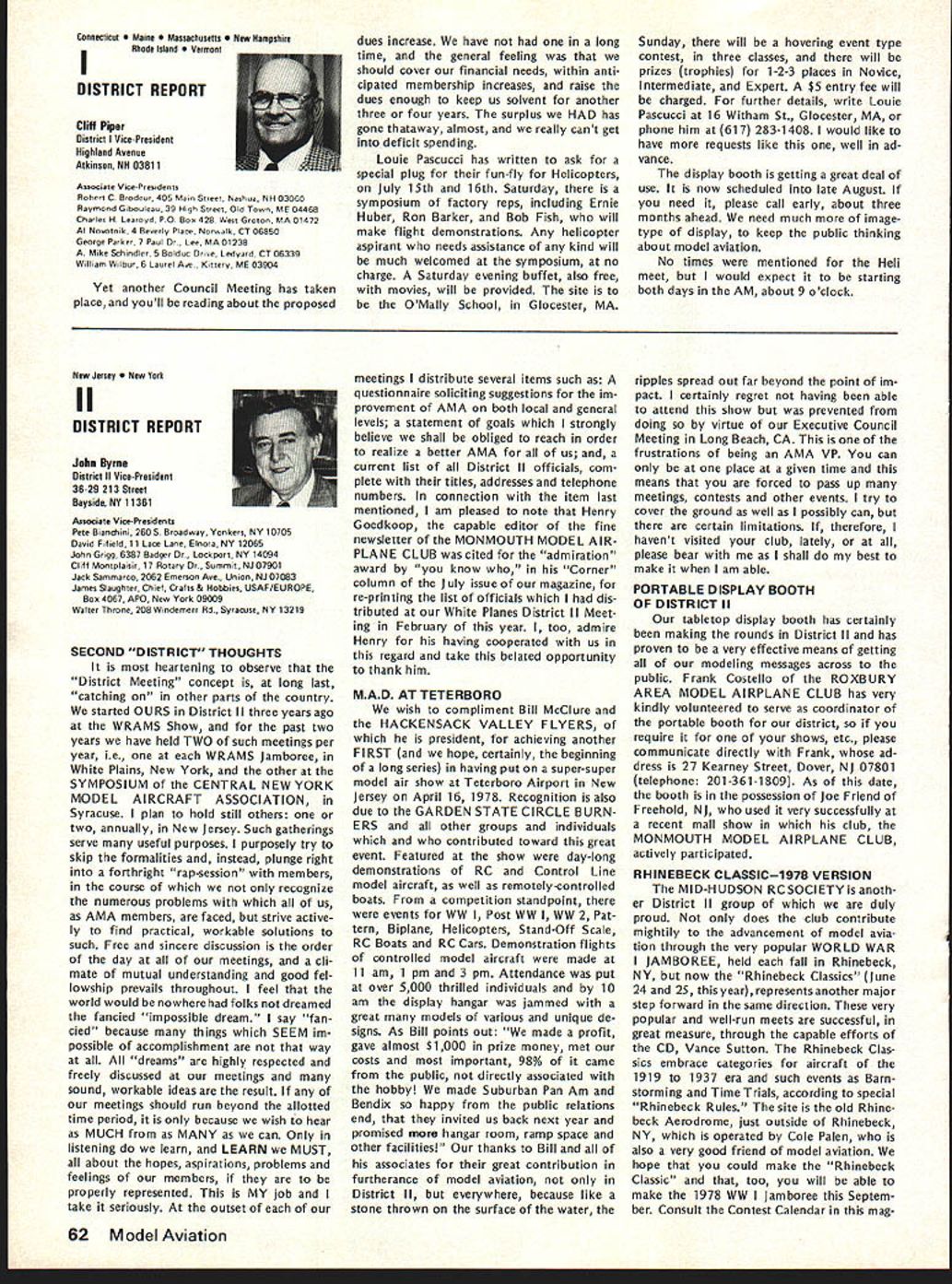
Louie Pascucci has written to ask for a special plug for their fun-fly for Helicopters, on July 15th and 16th. Saturday, there is a symposium of factory reps, including Ernie Huber, Ron Barker, and Bob Fish, who will make flight demonstrations. Any helicopter aspirant who needs assistance of any kind will be much welcomed at the symposium, at no charge. A Saturday evening buffet, also free, with movies, will be provided. The site is to be the O'Malley School, in Gloucester, MA.
Sunday, there will be a hovering event type contest, in three classes, and there will be prizes (trophies) for 1-2-3 places in Novice, Intermediate, and Expert. A $5 entry fee will be charged. For further details, write Louie Pascucci at 16 Watham St., Gloucester, MA, or phone him at (617) 283-1408. I would like to have more requests like this one, well in advance.
The display booth is getting a great deal of use. It is now scheduled into late August. If you need it, please call early, about three months ahead. We need much more of image-type of display, to keep the public thinking about model aviation.
No times were mentioned for the Heli meet, but I would expect it to be starting both days in the AM, about 9 o'clock.
AMA News
III DISTRICT REPORT
Don Lowe District III Vice-President 1101 E. Rahn Road Dayton, OH 45429
Associate Vice-Presidents Joe Ellis, 5192 Edgehurst, Lyndhurst, OH 44124 Francis Fluharty, 504 21st St., Vienna, WV 26101 Laird Jackson, 523 Meadowbrook, St. David, PA 19087 Edward Mixer, 521 Somerset St., McKeesport, PA 15131
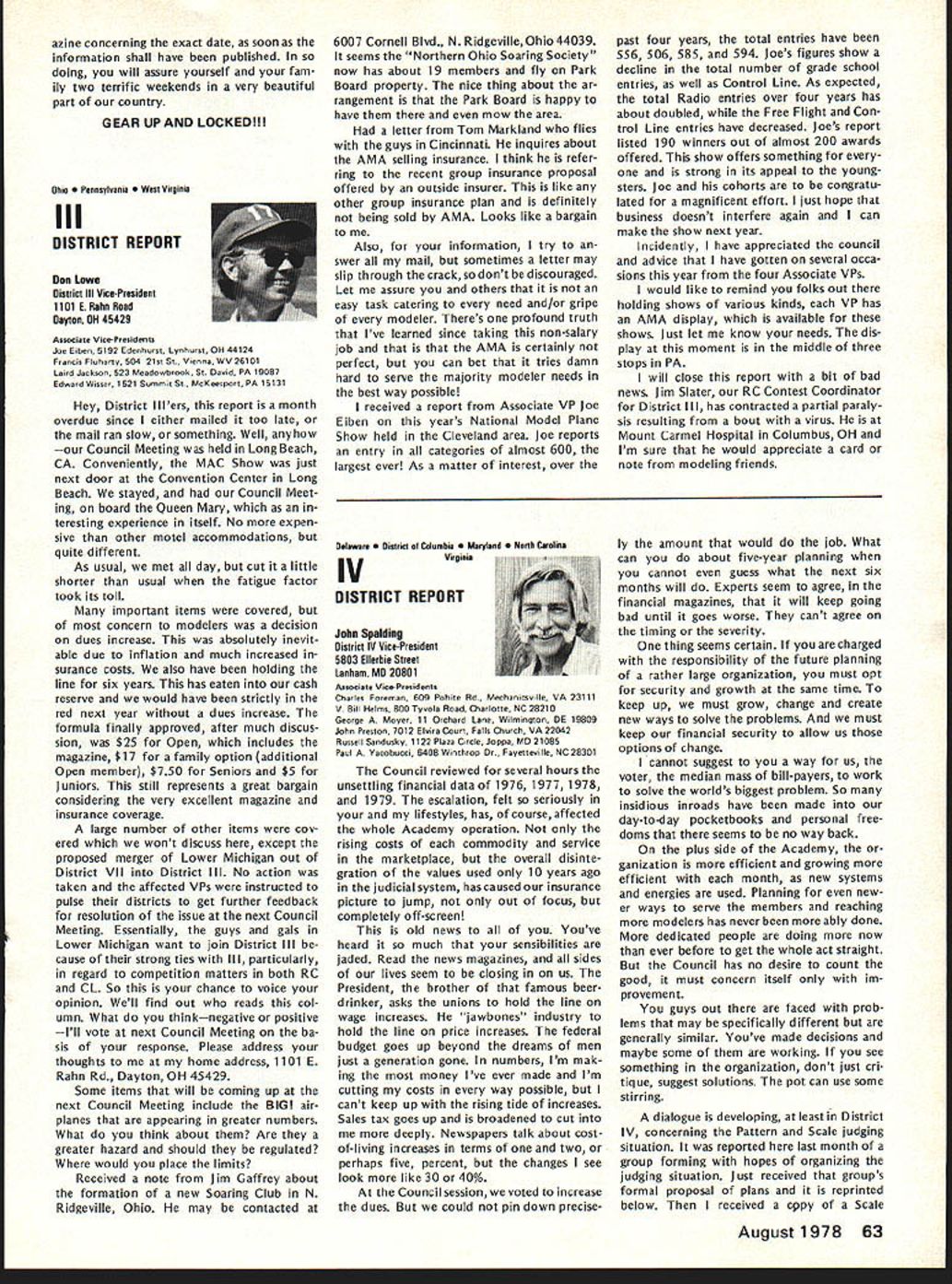
Hey, District III'ers, this report is a month overdue since I either mailed it too late, or the mail ran slow, or something. Well, anyhow — our Council Meeting was held in Long Beach, CA. Conveniently, the MAC Show was just next door at the Convention Center in Long Beach. We stayed, and had our Council Meeting, on board the Queen Mary, which was an interesting experience in itself. No more expensive than other motel accommodations, but quite different.
As usual, we met all day, but cut it a little shorter than usual when the fatigue factor took its toll.
Many important items were covered, but of most concern to modelers was a decision on dues increase. This was absolutely inevitable due to inflation and much increased insurance costs. We also have been holding the line for six years. This has eaten into our cash reserve and we would have been strictly on the red next year without a dues increase. The formula finally approved, after much discussion, was $25 for Open, which includes the magazine, $17 for a family option (additional Open member), $7.50 for Seniors and $5 for Juniors. This still represents a great bargain considering the very excellent magazine and insurance coverage.
A large number of other items were covered which we won't discuss here, except the proposed merger of Lower Michigan out of District VII into District III. No action was taken and the affected VPs were instructed to pulse their districts to get further feedback for resolution of the issue at the next Council Meeting. Essentially, the guys and gals in Lower Michigan want to join District III because of their strong ties with III, particularly in regard to competition matters in both RC and CL. So this is your chance to voice your opinion. We'll find out who reads this column. What do you think — negative or positive — I'll vote at next Council Meeting on the basis of your response. Please address your thoughts to me at my home address, 1101 E. Rahn Rd., Dayton, OH 45429.
Some items that will be coming up at the next Council Meeting include the BIG! air plans that are appearing in greater numbers. What do you think about these? Are they a greater hazard and should they be regulated? Where would you place the limits?
Received a note from Jim Gaffrey about the formation of a new Soaring Club in N. Ridgeville, Ohio. He may be contacted at 6007 Cornell Blvd., N. Ridgeville, Ohio 44039.
It seems the "Northern Ohio Soaring Society" now has about 19 members and fly on Park Board property. The nice thing about the arrangement is that the Park Board is happy to have them there and even mow the area.
Had a letter from Tom Markland who flies with the guys in Cincinnati. He inquires about the AMA selling insurance. I think he is referring to the recent group insurance proposal offered by an outside insurer. This is like any other group insurance plan and is definitely not being sold by AMA. Looks like a bargain to me.
Also, for your information, I try to answer all my mail, but sometimes a letter may slip through the crack, so don't be discouraged. Let me assure you and others that it is not an easy task catering to every need and/or gripe of every modeler. There's one profound truth that I've learned since taking this non-salary job and that is that the AMA is certainly not perfect, but you can bet that it tries damn hard to serve the majority modeler needs in the best way possible!
I received a report from Associate VP Joe Eiben on this year's National Model Plane Show held in the Cleveland area. Joe reports an entry in all categories of almost 600, the largest ever! As a matter of interest, over the past four years, the total entries have been 556, 506, 585, and 594. Joe's figures show a decline in the total number of grade school entries, as well as Control Line. As expected, the total Radio entries over four years has about doubled, while the Free Flight and Control Line entries have decreased. Joe's report listed 190 winners out of almost 200 awards offered. This show offers something for everyone and is strong in its appeal to the youngsters. Joe and his cohorts are to be congratulated for a magnificent effort. I just hope that business doesn't interfere again and I can make the show next year.
Incidentally, I have appreciated the counsel and advice that I have gotten on several occasions this year from the four Associate VPs.
I would like to remind you folks out there holding shows of various kinds, each VP has an AMA display, which is available for these shows. Just let me know your needs. The display at this moment is in the middle of three stops in PA.
I will close this report with a bit of bad news. Jim Slater, our RC Contest Coordinator for District III, has contracted a partial paralysis resulting from a bout with a virus. He is at Mount Carmel Hospital in Columbus, OH and I'm sure that he would appreciate a card or note from modeling friends.
IV DISTRICT REPORT
John Spalding District IV Vice-President 5803 Ellibre Street Lanham, MD 20801
Associate Vice-Presidents Charles Foreman, 609 Pantie Rd., Mechanicsville, VA 23111 G. A. Ralston, 8009 Wahoo Road, Charlotte, NC 28210 George A. Moyer, 11 Orchard Lane, Wilmington, DE 19809 John Preston, 7012 Elmore Court, Falls Church, VA 22042 Russell Sautkus, 1122 Plaza Circle, Reeder, MD 21085 Paul A. Yadouch, 6408 Westbrook Dr., Fayetteville, NC 28301
The Council reviewed for several hours the unsettling financial data of 1976, 1977, 1978, and 1979. The escalation, felt so seriously in your daily life, has, of course, affected the whole Academy operation. Not only the rising costs of each commodity and service in the marketplace, but the overall disintegration of the values used only 10 years ago in the judicial system, has caused our insurance picture to jump, not only out of focus, but completely off-screen!
This is old news to all of you. You've heard it so much that your sensibilities are jaded. Read the news magazines, and all sides of our lives seem to be closing in on us. The President, the brother of that famous beer-drinker, asks the unions to hold the line on wage increases. The "jawbones" industry to hold the line on price increases, the Federal budget goes up beyond the dreams of men just a generation gone. In numbers, I'm making the most money I've ever made and I'm cutting my costs in every way possible, but I can't keep up with the rising tide of increases. Sales tax goes up and is broadened to cut into us more deeply. Newspapers talk about cost-of-living increases in terms of one and two, or perhaps five, percent, but the changes I see look more like 30 or 40%.
At the Council session, we voted to increase the dues. But we could not pin down precisely the amount that would do the job. What can you do about five-year planning when you cannot even guess what the next six months will do? Experts seem to agree, in the financial magazines, that it will keep going bad until it goes worse. They can't agree on the timing or the severity.
One thing seems certain. If you are charged with the responsibility of the future planning of a rather large organization, you must opt for security and growth at the same time. To keep up, we must grow, change and create new ways to solve the problems. And we must keep our financial security to allow us those options of change.
I cannot suggest to you a way for us, the voters, the median mass of bill-payers, to work to solve the world's biggest problem. So many insidious inroads have been made into our day-to-day pocketbooks and personal freedoms that there seems to be no way back.
On the plus side of the Academy, the organization is more efficient and growing more efficient with each month, as new systems and energies are used. Planning for new members to serve the members and reach more modelers has never been more ably done. More dedicated people are doing more now than ever before to get the whole act straight. But the Council has no desire to count the good; it must concern itself only with improvement.
You guys out there are faced with problems that may be technically different but are generally similar. You've made decisions and maybe some of them are working. If you see something in the organization, don't just criticize, suggest solutions. The pot can use some stirring.
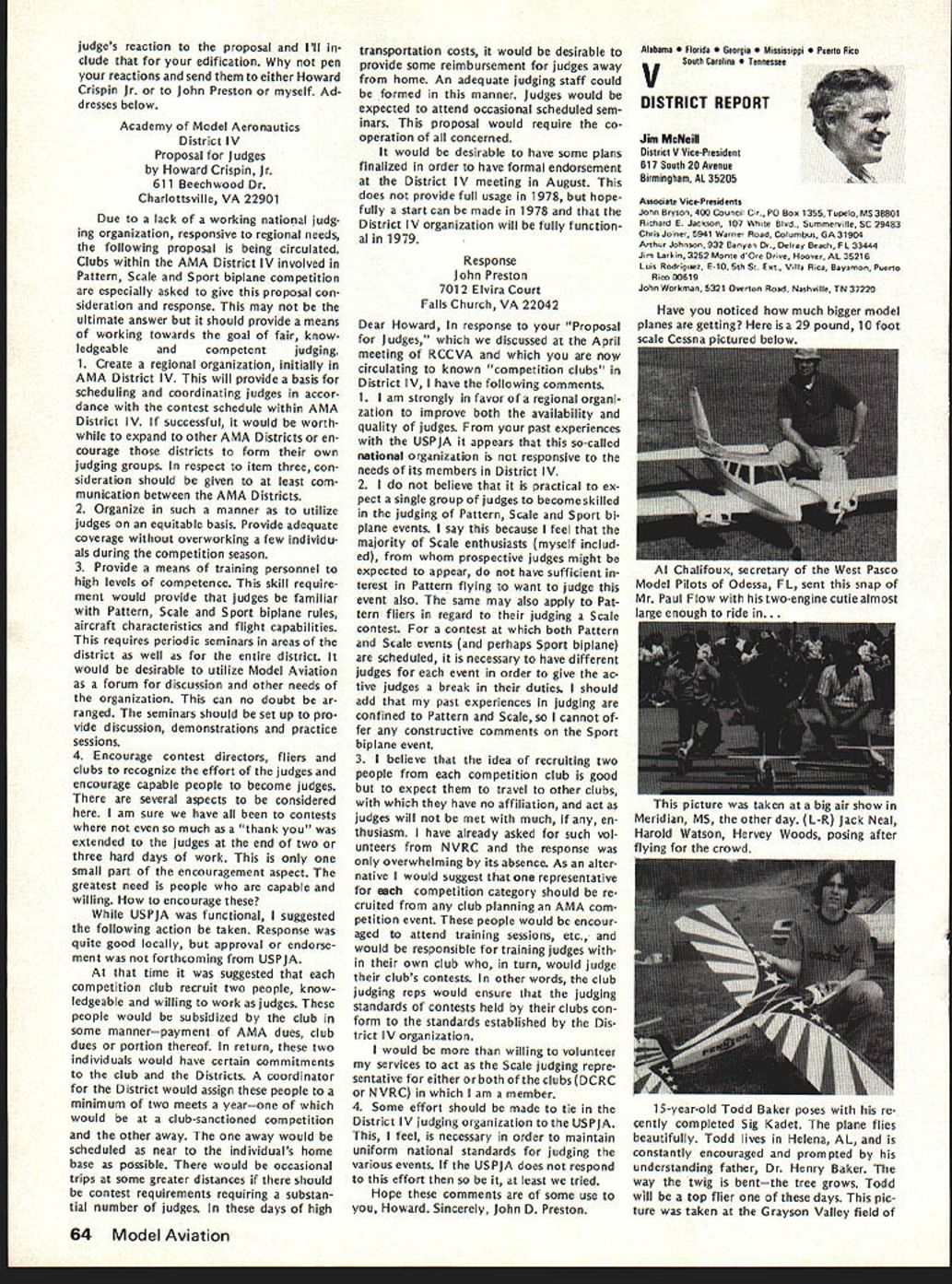
A dialogue is developing, at least in District IV, concerning the Pattern and Scale judging situation. It was reported here last month of a group forming with hopes of organizing the judging situation. I just received that group's formal proposal of plans and it is reprinted below. Then I received a copy of a Scale... judge's reaction to the proposal and I'll include that for your edification. Why not pen your reactions and send them to either Howard Crispin Jr. or to John Preston or myself. Addresses below.
Academy of Model Aeronautics District IV Proposal for Judges
by Howard Crispin, Jr., 611 Beechwood Dr., Charlottesville, VA 22901
Due to a lack of a working national judging organization, responsive to regional needs, the following proposal is being circulated. Clubs within the AMA District IV involved in Pattern, Scale and Sport biplane competition are especially asked to give this proposal consideration and response. This may not be the ultimate answer but it should provide a means of working towards the goal of fair, knowledgeable and competent judging.
- Create a regional organization, initially in AMA District IV. This will provide a basis for scheduling and coordinating judges in accordance with the contest schedule within AMA District IV. If successful, it would be worthwhile to expand to other AMA Districts or encourage those districts to form their own judging groups. In respect to item three, consideration should be given to at least communication between the AMA Districts.
- Organize in such a manner as to utilize judges on an equitable basis. Provide adequate coverage without overworking a few individuals during the competition season.
- Provide a means of training personnel to high levels of competence. This skill requirement would provide that judges be familiar with Pattern, Scale and Sport biplane rules, aircraft characteristics and flight capabilities. This requires periodic seminars in areas of the district as well as for the entire district. It would be desirable to utilize Model Aviation as a forum for discussion and other needs of the organization. This can no doubt be arranged. The seminars should be set up to provide discussion, demonstrations and practice sessions.
- Encourage contest directors, fliers and clubs to recognize the effort of the judges and encourage capable people to become judges. There are several aspects to be considered here. I am sure we have all been to contests where not even so much as a "thank you" was extended to the judges at the end of two or three hard days of work. This is only one small part of the encouragement aspect. The greatest need is people who are capable and willing. How to encourage these?
While USJPA was functional, I suggested the following action be taken. Response was quite good locally, but approval or endorsement was not forthcoming from USJPA.
At that time it was suggested that each competition club recruit two people, knowledgeable and willing to work as judges. These people would be subsidized by the club in some manner—payment of AMA dues, club dues or portion thereof. In return, these two individuals would have certain commitments to the club and the Districts. A coordinator for the District would assign these people to a minimum of two meets a year—one of which would be at a club-sanctioned competition and the other away. The one away would be scheduled as near to the individual's home base as possible. There would be occasional trips at some greater distances if there should be contest requirements requiring a substantial number of judges. In these days of high transportation costs, it would be desirable to provide some reimbursement for judges away from home. An adequate judging staff could be formed in this manner. Judges would be expected to attend occasional scheduled seminars. This proposal would require the cooperation of all concerned.
It would be desirable to have some plans finalized in order to have formal endorsement at the District IV meeting in August. This does not provide full usage in 1978, but hopefully a start can be made in 1978 and that the District IV organization will be fully functional in 1979.
Response
John Preston 7012 Elvira Court Falls Church, VA 22042
Dear Howard, In response to your "Proposal for Judges," which we discussed at the April meeting of RCCVA and which you are now circulating to known "competition clubs" in District IV, I have the following comments.
- I am strongly in favor of a regional organization to improve both the availability and quality of judges. From your past experiences with the USJPA it appears that this so-called national organization is not responsive to the needs of its members in District IV.
- I do not believe that it is practical to expect a single group of judges to become skilled in the judging of Pattern, Scale and Sport biplane events. I say this because I feel that the majority of Scale enthusiasts (myself included), from whom prospective judges might be expected to appear, do not have sufficient interest in Pattern flying to want to judge this event also. The same may also apply to Pattern fliers in regard to their judging a Scale contest. For a contest at which both Pattern and Scale events (and perhaps Sport biplane) are scheduled, it is necessary to have different judges for each event in order to give the active judges a break in their duties. I should add that my past experiences in judging are confined to Pattern and Scale, so I cannot offer any constructive comments on the Sport biplane event.
- I believe that the idea of recruiting two people from each competition club is good but to expect them to travel to other clubs, with which they have no affiliation, and act as judges will not be met with much, if any, enthusiasm. I have already asked for such volunteers from NVRC and the response was only overwhelming by its absence. As an alternative I would suggest that one representative for each competition category should be recruited from any club planning an AMA competition event. These people would be encouraged to attend training sessions, etc., and would be responsible for training judges within their own club who, in turn, would judge their club's contests. In other words, the club judging reps would ensure that the judging standards of contests held by their clubs conform to the standards established by the District IV organization.
I would be more than willing to volunteer my services to act as the Scale judging representative for either or both of the clubs (DCRC or NVRC) in which I am a member.
- Some effort should be made to tie in the District IV judging organization to the USJPA. This, I feel, is necessary in order to maintain uniform national standards for judging the various events. If the USJPA does not respond to this effort then so be it, at least we tried.
Hope these comments are of some use to you, Howard. Sincerely, John D. Preston.
AMA News
When the last membership dues increase went into effect in 1973, the AMA Executive Council promised to hold the line on future increases for at least five years. That promise was kept. During the five years membership grew steadily and healthy surplus funds developed. In fact, beginning the fifth year, 1977, the surplus had grown to just over $200,000—almost a quarter million dollars. Yet little over a year later the surplus was cut almost in half. Had the expected end of 1978 surplus been gone, the story would have been different. What happened the past year to make it half what was behind the headlines above?
AMA'ers will pay a lot more in membership next year. Several factors combined in 1977 to wave a warning flag mid-year and say a dues increase should be considered. Inflation alone was increasing expenses in general. The extent increased membership added costs which were outpacing increased income. One item in particular—membership insurance—jumped in annual cost from about $53,000 in 1976 to $70,000 in 1977.
The AMA Executive Council could see the trend early in 1977. January of that year, the approved budget anticipated a year-end deficit of about $50,000. The Council wasn't too concerned, ever since it knew reserve surplus funds could make up the deficit. It also knew 1977 was the fifth year since the last dues increase and a necessary increase could be made in 1978 to get income back on top of expenses. So decision time came early August 1977 during the Council meeting at the National Championships in California. The outlook was reassuring; no crisis appeared. However, the trend of income vs. expenses was obviously of concern. The Council discussed and voted on several proposed dues increases. Several Council members noted the strong mood among constituents that a dues increase should be made, long as large surplus funds existed. The Executive Director cautioned against that view, noting the surplus, while seeming large, amounted to about 20% of the current annual budget and that, in the inflationary situation, the reserve was not excessive. Finally, at the 1977 Nats meeting the Council voted there would be no dues increase for 1978. At the moment the decision seemed okay.
Unfortunately, the timing was just a bit too early. One cause was the mid-August deadline for finalization of materials for the annual membership renewal mailing which followed shortly after—about 70,000 renewal packets were prepared. The volume of mail requires a lead time of about six weeks. Had the timing been about a month later, a different Council vote might have resulted. Early August was too soon to know the financial report for the July RC World Championships at Springfield, OH would turn out. The preliminary report indicated a loss of about $5,000; definite bills were still to be paid and the picture was incomplete. Similarly, the Nats were mid-stride and too soon to know how the operation would turn out, although apparent income would be lower than hoped. Both situations were felt the surplus would cover the losses and no special action was required.
The year-end picture was dramatically different. Combined World Champs and Nats losses developed worse than expected, totaling almost $50,000. Thus the Council met in January to consider the 1978 budget and faced an obviously deteriorating situation. Looking at the overall loss for 1977, it was over $80,000—close to the same amount predicted for 1978. Nats or other special event losses increased and basic operating expenses, due to inflation, increased, making the outlook for 1978 no better than 1977. The Council therefore voted a 1979 dues increase to provide $3 additional for each adult AMA member. The amount seemed safe enough to allow for an expected large jump in membership insurance and other costs. Once again timing was unfortunate: the true insurance cost for 1978 was not yet available. The previous coverage was due to expire shortly and the insurance company had not yet provided cost figures for renewal; bids from another company were not yet finalized. So the Council allowed almost $50,000 in the budget for the insurance line compared to the ’77 cost of about $70,000.
Model Aviation ended 1977 slightly in the black with net income of $70,548; total income was $383,360.26 covering total expenses of $382,656.78. Income included $281,242 membership subscriptions plus $90,361.26 advertising, hobby shop sales, non-member subscriptions, and plans sales. Also $11,757 was an allocation from general funds to cover magazines provided out-of-pocket for AMA officers and free members (mostly Contest Directors). Expenses included $271,711 direct costs plus $110,943.78 allocated costs as part of HQ overhead apportioned to magazine operation.
Thus again in 1977 the magazine beginning has continued to pay for itself and not be a drain on general AMA income. The magazine staff consists of five people; salaries are paid completely from magazine income. In addition, magazine income covers part of the salaries of some people in other departments and the cost of services partially used by the magazine. A dollar per member before...
AMA News
When the last membership dues increase went into effect in 1973, the AMA Executive Council promised to hold the line on future increases for at least five years. That promise was kept; during those five years membership grew steadily and healthy surplus funds developed. In fact, beginning the fifth year, 1977, the surplus had grown to just over $200,000—almost a quarter of a million dollars. Yet little over a year later the surplus was cut to almost half. By the expected end of 1978 the surplus would have been gone. What happened in the past year to cut the surplus in half? What’s behind the headlines above? AMAers will pay a lot in membership next year.
Several factors combined. By mid-1977 a wave of warning flags said a dues increase should be considered. Inflation alone was increasing expenses in general; the extent of increased membership-added costs was outpacing increased income. In one particular item, membership insurance jumped in annual cost from about $53,000 in 1976 to $70,000 in 1977.
The AMA Executive Council could see the trend early in 1977. In January the year-approved budget anticipated a year-end deficit of about $50,000. The Council wasn’t too concerned, ever since it knew reserve surplus funds would make up the deficit, and also knew 1977 was the fifth year since the last dues increase; any necessary increase could be made in 1978 to get income back to meet expenses. So decision time came early August 1977 during the Council meeting at the National Championships in California — the outlook was reassuring; no crisis apparent. However, the trend of income versus expenses was obvious and concerning. The Council discussed and voted on proposals for dues increases. Several Council members noted a strong mood among constituents that any dues increase should be small, and large surplus funds existed. The Executive Director cautioned against that view, noting the surplus, while seeming large, amounted to only about 20% of the current annual budget and, in an inflationary situation, the reserve might be excessive. Finally, the Council voted at the 1977 Nats meeting that there would be no dues increase for 1978. In the moment the decision seemed okay.
Unfortunately the timing was just a bit too early. The mid‑August deadline for finalization of materials for the annual membership renewal mailing followed shortly after — about 70,000 renewal packets were prepared; the volume of mail requires a lead time of about six weeks. Had the timing been about a month later a different Council vote might have resulted; in early August it was too soon to know how the financial report for the July RC World Championships in Springfield, Ohio would turn out. The preliminary report indicated a loss of about $5,000; definite bills were still out and the picture incomplete. Similarly, the Nats were mid‑stride; it was too soon to know how that operation would turn out, although apparent income would be lower than hoped. Both situations were felt to be coverable by the surplus and no special action was required at that time.
The year‑end picture turned out dramatically different. Combined World Champs and Nats losses developed worse than expected, totaling almost $50,000. Thus the Council met in January to consider the 1978 budget and faced an obviously deteriorating situation. Looking at an overall loss for 1977 of over $80,000 (a prediction close to the same amount as 1978 Nats or other special event losses), and with basic operating expenses increased by inflation, the outlook for 1978 was no better than 1977. The Council therefore voted a 1979 dues increase to provide $3 additional per adult AMA member. The amount seemed safe enough, allowing for expected large jumps in membership insurance and other costs.
AMA News
Once again, timing was unfortunate. True insurance costs for 1978 were not yet available — previous coverage was due to expire shortly and the insurance company had not yet provided cost figures; renewal bids from another company were not finalized. So the Council allowed almost $50,000 in the budget for insurance alone compared to 1977 cost.
Model Aviation ended 1977 slightly in the black, net income $70,548. Total income $383,360.26 covered total expenses $382,656.78. Income included $281,242 membership subscriptions plus $90,361.26 advertising, hob shop sales, non‑member subscriptions, plans sales; also $11,757 allocation from general funds to cover magazines provided at no charge to AMA officers and to members, mostly Contest Directors. Expenses included $271,711 direct costs plus $110,943.78 allocated costs, part of HQ overhead apportioned to magazine operation. Thus again, at the beginning of 1978 the magazine has continued to pay for itself and not drain general AMA income. The magazine staff consists of five people; salaries are paid completely by magazine income. In addition, magazine income covers part of the salaries of some people in other departments and services partially used by the magazine — a dollar per member before...
AMA News
When the last membership dues increase went into effect in 1973, the AMA Executive Council promised to hold the line on future increases for at least five years. That promise was kept. During the five years membership grew steadily and healthy surplus funds developed. In fact, beginning the fifth year, 1977, the surplus had grown to just over $200,000—almost a quarter million dollars. Yet little over a year later the surplus had been cut almost in half. If the trend continued, the expected end-of-1978 surplus would be gone. What happened in the past year to reduce the surplus by half? Several factors combined.
In 1977 a wave of warning flags went up by mid‑year saying a dues increase should be considered. Inflation alone was increasing expenses in general. The extent of increased membership‑related costs was outpacing the increased income. One particular item—membership insurance—jumped, annual cost about $53,000 in 1976 to $70,000 in 1977.
The AMA Executive Council could see the trend early in 1977. In January, when the year‑approved budget was prepared, they anticipated a year‑end deficit of about $50,000. The Council wasn't overly concerned, since it knew reserve surplus funds could make up the deficit, and also knew 1977 was the fifth year since the last dues increase—a necessary increase could be made in 1978 to get income back on top of expenses. So decision time came early August 1977 during the Council meeting at the National Championships in California. The outlook there was reassuring; no crisis was apparent. However the trend in income versus expenses was obvious and of concern. The Council discussed and voted on proposals for dues increases. Several Council members noted a strong mood among constituents that a dues increase should be made, especially while large surplus funds existed. The Executive Director cautioned against that view, noting the surplus, while it seemed large, amounted to only about 20% of the current annual budget; with the inflationary situation the reserve was not excessive.
Finally, at the 1977 Nats meeting the Council voted that there would be no dues increase for 1978. At the moment the decision seemed okay. Unfortunately, the timing was just a bit too early. The mid‑August deadline for finalization of materials for the annual membership renewal mailing followed shortly after—about 70,000 renewal packets had been prepared. The volume of the mail requires a lead time of about six weeks. Had the timing been about a month later, a different Council vote might have resulted. Early August was too soon to know how the financial report for the July RC World Championships at Springfield, Ohio would turn out; the preliminary report indicated a loss of about $5,000 and definite bills still remained, so the picture was incomplete. Similarly, the Nats were mid‑stride and it was too soon to know how the operation would turn out; although apparent income would be lower than hoped, both situations seemed coverable by the surplus and no special action was required at that time.
By year‑end the picture was dramatically different. The combined World Championships and Nats losses developed worse than expected, totaling almost $50,000. Thus when the Council met in January to consider the 1978 budget, it faced an obviously deteriorating situation, looking at an overall loss for 1977 of over $80,000—a prediction close to the same amount as the anticipated loss from 1978 Nats or other special event losses. Increased basic operating expenses due to inflation made the outlook for 1978 no better than for 1977. The Council therefore voted a dues increase effective 1979 to provide $3 additional for each adult AMA membership. The amount seemed safe enough, allowing for expected large jumps in membership, insurance and other costs.
The insurance costs for 1978, however, were not yet available. Previous coverage was due to expire shortly and the insurance company had not yet provided cost figures; renewal bids from another company were not finalized.
Transcribed from original scans by AI. Minor OCR errors may remain.

