
AMA PETITION TO FCC ASKS FOR 30 RC FREQUENCIES
Following a year of intensive effort, the AMA Frequency Committee developed a broad-based proposal to the Federal Communications Commission covering anticipated RC frequency needs from the present (1978) through 1990. The effort involved coordination with the RC industry, model car and boat organizations, and model groups in other countries. The basic draft of AMA's proposal was circulated to the industry and other interests. The final version submitted to the FCC may be slightly different, but no major revisions are expected since much preliminary coordination had already been accomplished.
By past experience it is hoped that FCC action will be forthcoming before the end of 1979 — it typically takes about a year for petitions to go through the governmental rules change process. When that process begins AMA will advise all RCers how they can respond to the FCC to support the petition. In the meantime, please appreciate that a considerable amount of AMA volunteer and headquarters time went into developing this proposal, involving legal counseling and discussions with FCC officials. It is a complicated process that depends upon the AMA, as a national association, to bring together inputs and resources to present a composite petition embracing all interests.
The Academy of Model Aeronautics, Inc. hereby requests the Federal Communications Commission to allocate additional frequencies for use for the remote control of models for the period 1978–1990. The Commission in the past has fashioned modeler frequency allocations in response to crisis requests on the part of the AMA, without creating a long-range, enduring resolution that would account for prior partial relief and continuing growth in RC activities. The present petition seeks to remedy that situation and to effect a long-range solution to the modeler frequency requirement.
The petition also proposes to allow the use of narrow-band FM on all RC frequencies. This offers a means to provide more channels in less spectrum, permitting further expansion to accommodate continued growth.
In support of this petition the following is offered:
- The AMA is the governing body for model aircraft activities in the United States. Its membership doubled over six years and in mid-1978 stood at about 71,000, of which approximately 75% regularly fly radio-controlled model aircraft under licenses issued by the Commission. As the United States representative to the Federation Aeronautique Internationale (FAI), the Academy is concerned with RC activities worldwide as well as within the United States. Approximately 10% (over 5,000) of AMA's membership are youngsters below 19 but above the FCC minimum age requirement of 12 for the Radio Control Service.
- RC activities began in the 1930s and have grown into a recognized sport. It is estimated that about 250,000 modelers in the United States use approximately half a million transmitters to control planes, boats and cars by radio. An industry with annual sales of over $200 million supplies electronics, kits and accessories. RC electronics pioneered and refined equipment copied worldwide. Because RC operation is short-range, line-of-sight and low-power (one watt or less), transmissions have proven adequate in the absence of interference. Interference to other radio services from RC transmitters has been essentially zero; there are no known FCC complaints based on RC operations (verified by a supporting letter of February 3, 1978 from the Chief of the Commission's Field Operations Bureau).
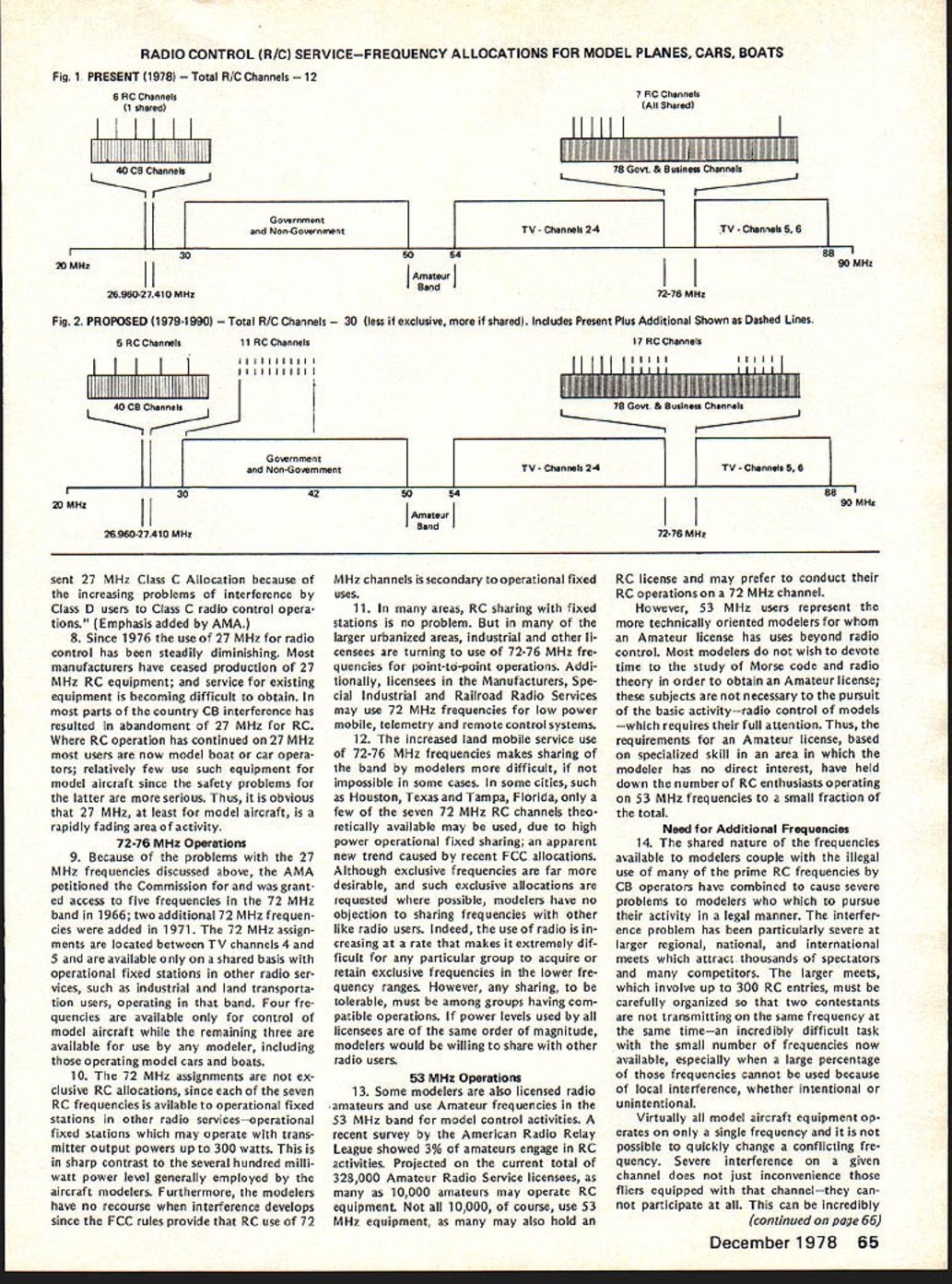
- Currently, virtually all RC activities are conducted under license by the Commission in the Radio Control (RC) Service (formerly the Class C Citizens Radio Service). In the RC Service, licensees are permitted to operate on six 27 MHz channels and seven 72 MHz channels. Both frequency bands are increasingly subject to interference.
27 MHz Operations
- Five of the six 27 MHz channels are interleaved with the Citizens Band (CB) Radio Service; the remaining channel is shared with CB operations, which generally operate at higher power and thus make the channel largely useless for RC operations. AMA has documented numerous instances in which CB licensees intentionally transmitted on RC channels (in violation of the Commission's rules) or caused severe adjacent-channel interference that overcame the low-power RC signals, resulting in loss of model aircraft. These cases are well documented in prior filings. Supporting documents are attached to emphasize safety and economic factors caused by RC interference. The RC interference situation is far more serious than many communications interference cases because it may result in physical damage or injury.
- The 27 MHz band was the birthplace of RC operations and many countries allocated 27 MHz for RC due to U.S. pioneering efforts. Suitable international operating rights in this part of the spectrum are important to the model aircraft community and should be preserved.
- AMA believes illegal CB operations will eventually drive RC activities away from 27 MHz and that alternate frequencies will be needed. Other countries are also beginning to move away from 27 MHz due to similar interference problems.
- The potential — and in many major population areas the de facto — loss of 27 MHz frequencies has been the chief stimulant to the search for new RC frequencies. Interference from CB operations to RC models was given serious consideration in FCC Docket 20120. In its Report and Order (60 FCC 2d 762, 38 RR 2d 97, 1976) the Commission noted: "We believe that, eventually, alternate frequencies will be required in lieu of the present 27 MHz Class C allocation because of the increasing problems of interference by Class D users to Class C radio control operations." (Emphasis added by AMA.)
- Since 1976 the use of 27 MHz for radio control has steadily diminished. Most manufacturers have ceased production of 27 MHz RC equipment; service for existing equipment is becoming difficult. In much of the country CB interference has resulted in abandonment of 27 MHz for RC. Where 27 MHz operation continues, most users are model boat or car operators; few use it for model aircraft because of the greater safety risks. Thus, 27 MHz, at least for model aircraft, is a rapidly fading area.
72–76 MHz Operations
- Because of 27 MHz problems AMA petitioned the Commission and was granted access to five frequencies in the 72 MHz band in 1966; two additional 72 MHz frequencies were added in 1971. The 72 MHz assignments are located between TV channels 4 and 5 and are available only on a shared basis with operational fixed stations in other radio services (industrial, land transportation, etc.). Four frequencies are available only for control of model aircraft while the remaining three are available to any modeler, including those operating model cars and boats.
- The 72 MHz assignments are not exclusive RC allocations: each of the seven RC frequencies is also available to operational fixed stations that may operate with transmitter output powers up to 300 watts — in sharp contrast to the several-hundred-milliwatt levels generally employed by modelers. Modelers have no recourse when interference develops since FCC rules provide that RC use of 72 MHz channels is secondary to operational fixed uses.
- In many areas RC sharing with fixed stations is not a problem. But in larger urban areas, industrial and other licensees are turning to 72–76 MHz for point-to-point operations. Licensees in the Manufacturers, Special Industrial and Railroad Radio Services may use 72 MHz frequencies for low-power mobile, telemetry and remote control systems.
- Increased land mobile use of 72–76 MHz complicates sharing with modelers and can make it impossible in some cases. In cities like Houston and Tampa, only a few of the seven 72 MHz RC channels may be usable due to high-power fixed sharing — an apparent trend caused by recent FCC allocations. Although exclusive frequencies are preferred and requested where possible, modelers have no objection to sharing with other radio users if power levels used by all licensees are of the same order of magnitude.
53 MHz Operations
- Some modelers are also licensed radio amateurs and use Amateur frequencies in the 53 MHz band for model control activities. A recent ARRL survey showed at least 3% of amateurs engage in RC activities. Based on 328,000 Amateur licensees, as many as 10,000 amateurs may operate RC equipment. Not all of these use 53 MHz equipment; many may also hold an RC license and prefer 72 MHz channels.
However, 53 MHz users tend to be more technically oriented modelers for whom an Amateur license has uses beyond RC. Most modelers do not wish to devote time to Morse code and radio theory required for an Amateur license because these subjects are not necessary to radio control of models. Thus, Amateur licensing requirements have held down the number of RC enthusiasts operating on 53 MHz to a small fraction of the total.
Need for Additional Frequencies
- The shared nature of available frequencies and illegal use of prime RC frequencies by CB operators have caused severe problems for modelers who wish to operate legally. Interference is particularly severe at larger regional, national and international events attracting thousands of spectators and many competitors. Large meets involving up to 300 RC entries must be carefully organized so two contestants do not transmit on the same frequency — an incredibly difficult task with the small number of available frequencies, especially when many are unusable locally due to interference.
Virtually all model aircraft equipment operates on a single frequency and cannot be quickly changed. Severe interference on a channel prevents those flyers from participating at all — potentially devastating for a competitor who traveled great distances for an event.
- The real problem is simply that there are not enough usable RC channels to satisfactorily accommodate the activity. Many reasons prevent all allocated channels from being used at once. After considerable study by user groups, the total number of frequencies judged necessary to handle long-term modeler needs (for the next 10–15 years) is 30 channels, including the seven 72 MHz frequencies now available. This judgment is based on several factors:
- Enough contests have successfully used as many as 17 channels by combining the 12 RC Service channels with several from the 53 MHz Amateur band, showing many situations where more channels could be utilized.
- More channels than can actually be used are necessary because some allocated RC channels are unusable in certain areas due to local interference. The entire 27 MHz RC band is useless in many areas due to illegal CB sharing. Likewise, availability of 72 MHz channels is aggravated in some areas by legal shared use where high-power allocations render low-power RC operation unsafe. Unless channels can be made truly exclusive (preferred), more channels are needed for sharing situations than would be needed if exclusive assignments were possible.
- Based on steady growth in RC participation over the past 10 years, with no signs of diminishing except for interference problems, more channels are needed simply to accommodate growth. Since the last channel allocations in 1971, RC activity has increased at least 100% as indicated by AMA membership increases. Doubling the number of RC channels, plus existing amateur frequencies, is not unreasonably large compared with growth since 1971.
- There is a growing trend toward establishing more flying sites, often near other sites. Enough frequencies would allow adjacent groups to use different sets and avoid interference, relieving the pressure for more distant operating sites.
- The most important single long-term need is allocation of "interference-free" RC channels. Loss of control due to interference may cause severe property damage or personal injury. Interference-free operation is best assured with exclusive channel allocations; availability of exclusive channels can reduce the total number of channels necessary (e.g., 20 exclusive channels may serve better than 30 shared ones).
Additional channels shared with other low-power users are an alternative to exclusive allocations only if shared services are selected to minimize mutual interaction and the total number of such channels is adequate so that, even if many are unusable locally, enough remain available. The fact RC models are mainly used during daytime and in non-industrial areas should make selective sharing possible.
Because each RC operator requires an exclusive channel at any one time, RC channels cannot be shared as communications channels can. Thus, the number of available channels dictates how many participants can operate simultaneously.
Note: 23 new channels (in addition to the current seven on 72 MHz) will permit the current five 27 MHz RC channels to be gradually phased out, perhaps within the five-year period the Commission has in the past allowed for amortization of equipment requiring replacement.
Potential New Frequencies
- An extensive study by modeling leaders, including discussions with FCC personnel, concluded that probably no single frequency band can provide the 23 new RC channels needed. A combination of several frequency groups may offer the solution. AMA's Frequency Committee examined FCC assignments, taking into account existing equipment, interference potential, and radio characteristics to develop suggested bands.
72 MHz Band
- The AMA believes the most likely place for additional frequencies is the 72 MHz band because it is already the most popular and heavily used band for RC and much 72 MHz equipment is available over the counter. New or converted equipment in the same band would present minimal problems, provided specific frequencies are carefully selected considering intermodulation, interference, image problems and other characteristics.
- The Committee searched for 72 MHz frequencies not available for high-power use in any radio service. Under present FCC rules, the following frequencies are available only for low-power (not more than one watt) assignments in the Special Industrial, Manufacturers and Railroad Radio Services: 72.44, 72.48, 72.52, 72.56, 72.60, 75.44, 75.48, 75.52, 75.56, 75.60 MHz.
- These ten frequencies would be most compatible with low-power RC operations. Other 72 MHz assignments may also be shared for RC if selected to minimize conflict with high-power fixed systems. If a substantial number (for example, 20) of such frequencies were made available nationwide, different combinations might be usable in various areas depending on local high-power assignments. The current proportion of sharing for plane, boat and car users at 72 MHz would be acceptable for any additional frequencies in this band.
30–42 MHz "Guard Band" Frequencies
- There are 11 guard-band channels (each 10 kHz wide) that separate government and non-government assignments in the 30–42 MHz band. The center frequencies are 30.565, 31.995, 33.005, 33.995, 35.005, 35.995, 37.005, 37.995, 39.005, 39.995 and 42.005 MHz. These slices are presently not assigned to any radio service and have seen very little use. A search of FCC assignment records shows only a few assignments on these frequencies.
- Advantages of using the 30–42 MHz guard-band frequencies include the potential to convert much existing 27 MHz equipment (largely unusable due to CB interference) to these channels. Manufacturer retrofits may be profitable, provided Type Acceptance procedures are addressed (for example, allowing retrofits to be certified under reasonable criteria). Very low power involved should minimize retrofit issues.
Few assignments exist in these guard bands, so allocating them to the RC Service would likely have negligible effect on existing uses while providing welcome relief to RC modelers. However, limited public information exists on government uses of adjacent frequencies. AMA monitoring teams in the Cleveland area listened to many of these frequencies, and were impressed with their "clean" nature, suggesting good potential for RC use.
222–224 MHz Band
- The 222–224 MHz band is shared by government and Amateur radio users. It might accommodate about ten low-power RC channels with 40 kHz spacing under the RC Service. Any other users of these RC channels should be compatible with the one-watt RC maximum power level.
- The Commission had originally proposed a Class E Citizens Radio Service in this portion of the spectrum, but that proposal appears abandoned due to objections. However, reconsideration may be possible given the minimal problems expected with low-power RC operations.
UHF Operations
- Other countries have RC frequencies in the UHF band. Germany allocated RC frequencies at 433 MHz with good results; Switzerland and the U.K. have similar frequencies (e.g., British 459 MHz RC FM equipment). The U.S. might consider making frequencies available in the same UHF region for international compatibility. The 900 MHz region may also be technologically feasible. RC operations in these areas appear compatible with other uses when managed properly.
International compatibility is important because international championships involve flying in other nations; compatibility with European assignments is therefore highly desirable.
Technical Requirements
- Present FCC regulations for RC equipment in the 72 MHz band have served well technically and are recommended as the basis for any new RC allocations. No interference problems from RC equipment to other services have been encountered. Low-power requirements (less than one watt) have proved satisfactory.
- The only modification proposed is to permit any type of modulation, provided the radiated bandwidth requirement is met. Allowing narrow-band FM and similar techniques can provide spectrum-saving channels. Narrow-band FM is logical for the 10 kHz-wide guard channels in the 30–42 MHz band. If FM is permitted on new 72 MHz channels of 20 kHz width (using 5 kHz deviation), FM's technical advantages — including better interference rejection — could be utilized. Several countries already authorize FM for RC use; FM is popular in Germany and has minimized interference problems.
Summary
- To summarize, the needs of RC modelers are:
- 30 RC channels, including the present seven 72 MHz allocations. The 23 new channels should be allocated on an RC-exclusive basis if possible.
- Exclusive RC channels where possible; if not, sharing may be acceptable if other users employ similarly limited power levels.
- Freedom to use any type of modulation, particularly narrow-band FM, commensurate with bandwidth requirements.
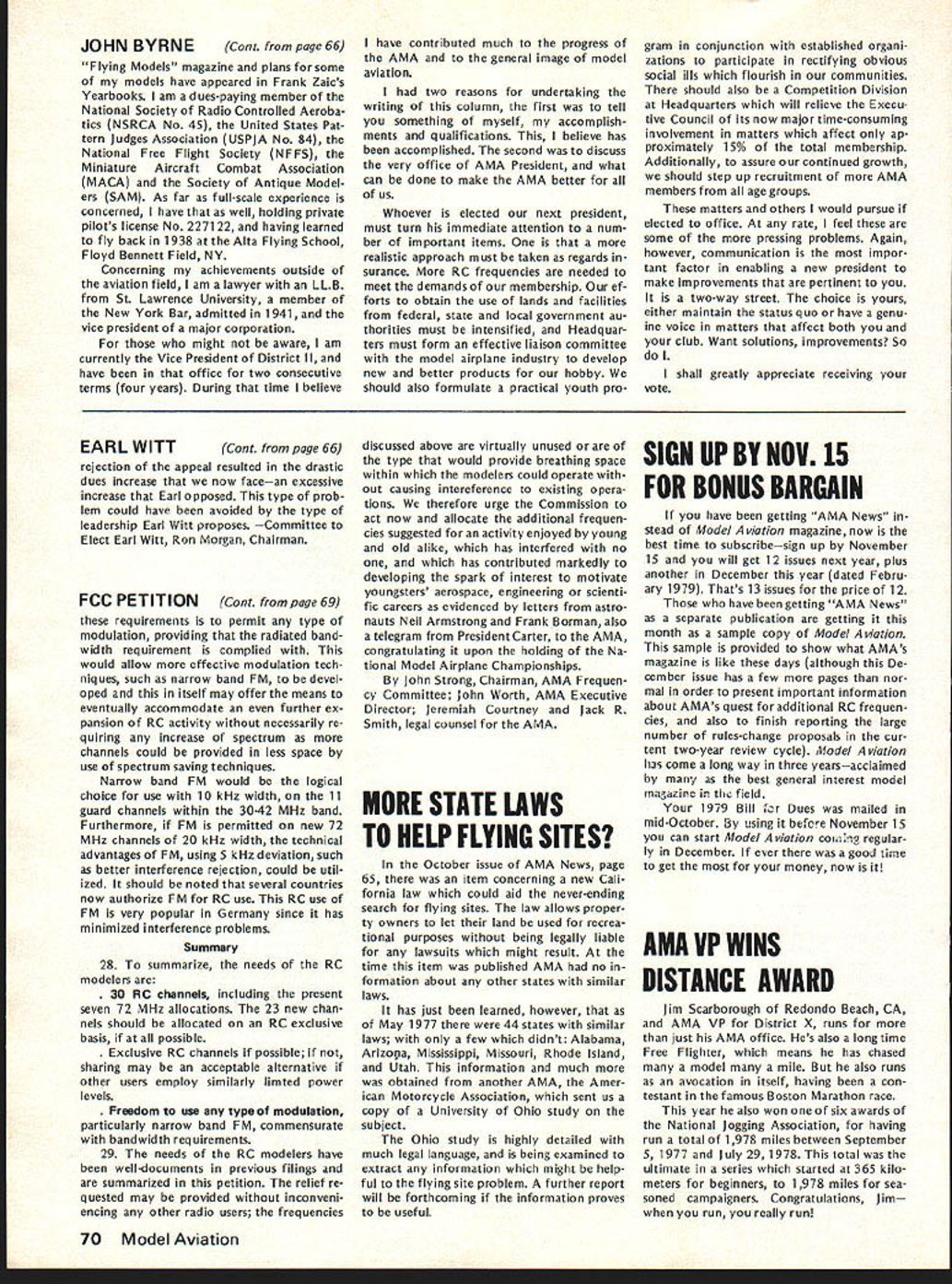
- The needs of RC modelers have been documented in previous filings and are summarized here. The relief requested may be provided without inconveniencing other radio users; the frequencies discussed are virtually unused or of types that would provide breathing space for modelers to operate without causing interference. The Commission is urged to act now and allocate the additional frequencies suggested for an activity enjoyed by young and old alike, which has interfered with no one and which has contributed markedly to motivating youngsters toward aerospace, engineering and scientific careers (as evidenced by letters from astronauts Neil Armstrong and Frank Borman, and a telegram from President Carter, congratulating AMA on the National Model Airplane Championships).
By John Strong, Chairman, AMA Frequency Committee; John Wirth, AMA Executive Director; Jeremiah Courtney and Jack R. Smith, legal counsel for the AMA.
---
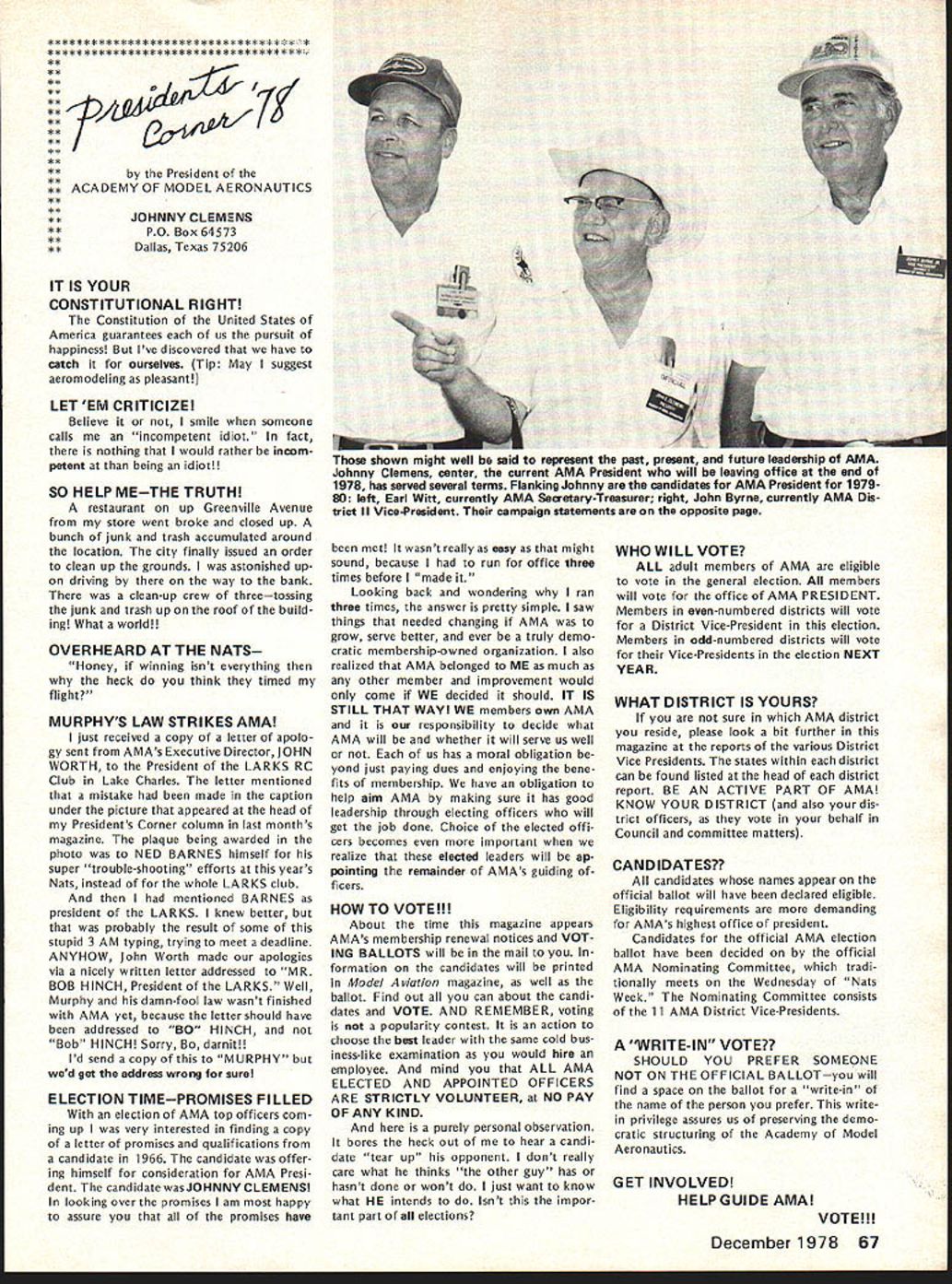
PRESIDENTS CORNER '78
by the President of the ACADEMY OF MODEL AERONAUTICS
JOHNNY CLEMENS P.O. Box 64573 Dallas, Texas 75206
IT IS YOUR CONSTITUTIONAL RIGHT!
The Constitution guarantees each of us the pursuit of happiness. But we have to catch it for ourselves. (Tip: aeromodeling is pleasant!)
LET 'EM CRITICIZE!
I smile when someone calls me an "incompetent idiot." There is nothing I would rather be incompetent at than being an idiot!
SO HELP ME — THE TRUTH!
A restaurant on up Greenville Avenue from my store went broke and closed. A bunch of junk accumulated around the location. The city ordered cleanup. I was astonished to see a crew of three tossing the junk and trash up on the roof of the building! What a world.
OVERHEARD AT THE NATS
"Honey, if winning isn't everything then why the heck do you think they timed my flight?"
MURPHY'S LAW STRIKES AMA!
An apology letter from AMA Executive Director John Worth to the President of the LARKS RC Club mentioned a mistake in a photo caption and then misaddressed the letter as "MR. BOB HINCH, President of the LARKS" instead of "BOB" HINCH! Murphy's law indeed.
ELECTION TIME — PROMISES FILLED
I ran for AMA President three times before I "made it." I ran because I saw things that needed changing for AMA to grow and serve members. AMA belongs to each of us and it's our responsibility to decide what AMA will be and whether it will serve us well. We have an obligation beyond paying dues: to help AMA by electing officers who get the job done. Elected leaders appoint the remainder of AMA's guiding officers.
HOW TO VOTE!!!
Renewal notices and voting ballots will be mailed. Candidate information appears in Model Aviation. Find out about the candidates and VOTE. Voting is not a popularity contest — choose the best leader with the same cold, business-like examination as hiring an employee. All AMA elected and appointed officers are volunteers and receive no pay.
A personal observation: I get bored watching candidates tear up opponents. I want to know what a candidate intends to do.
WHO WILL VOTE?
All adult AMA members are eligible to vote in the general election and will vote for AMA President. Members in even-numbered districts vote for a District Vice-President this election; odd-numbered districts vote next year.
WHAT DISTRICT IS YOURS?
If unsure of your district, see the district reports and the state listings at the head of each report. Be an active part of AMA. Know your district and your district officers — they vote on your behalf in Council and committee matters.
CANDIDATES??
All names on the official ballot will have been declared eligible. The Nominating Committee (the eleven District Vice-Presidents meeting during Nats week) decides candidates for the official ballot.
A "WRITE-IN" VOTE??
If you prefer someone not on the official ballot, there is a space for a write-in. This preserves AMA's democratic structure.
GET INVOLVED! HELP GUIDE AMA! VOTE!!!
***** all for now *****
---
AMA News
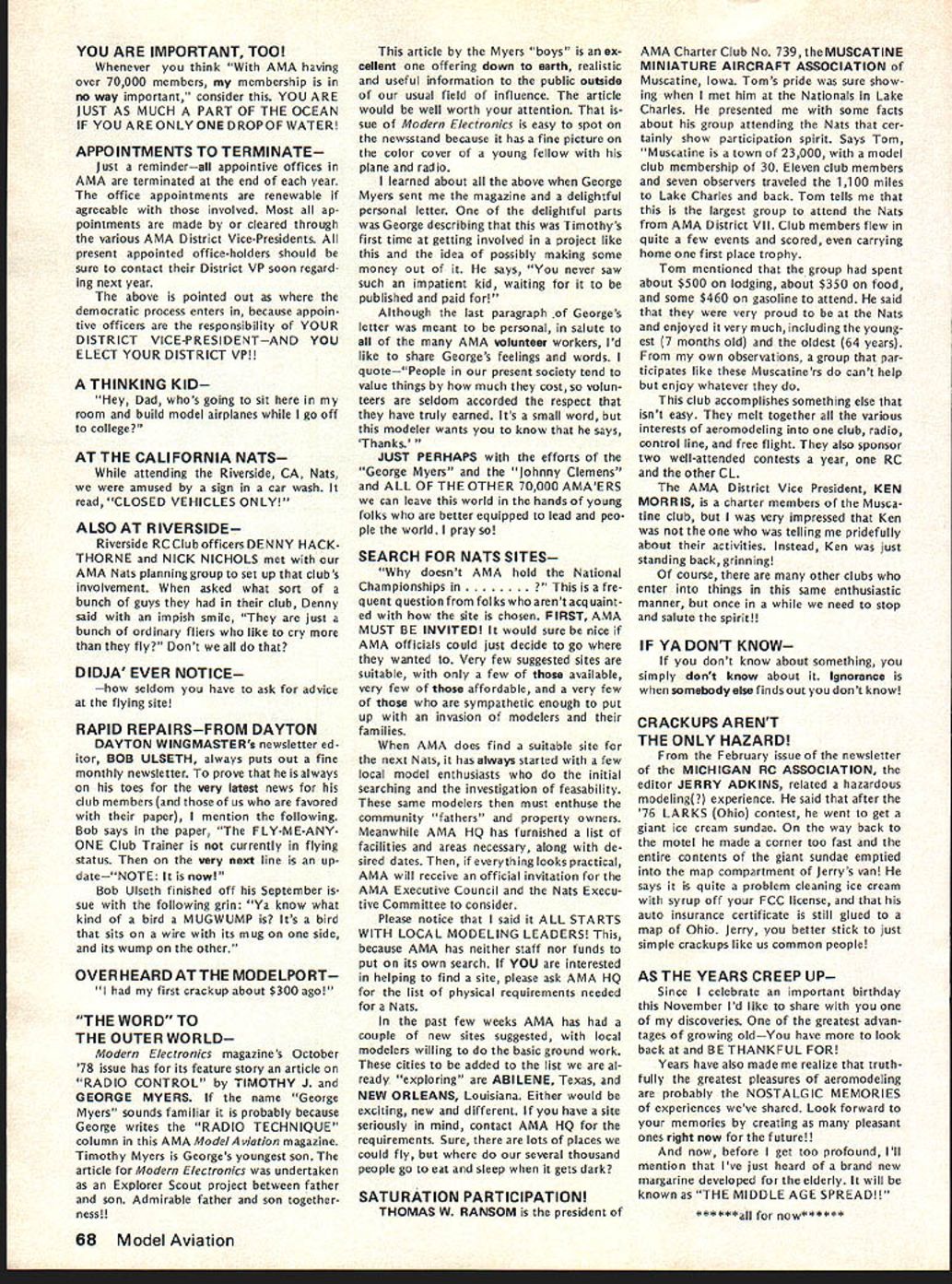
YOU ARE IMPORTANT, TOO!
Whenever you think "With AMA having over 70,000 members, my membership is in no way important," remember: you are just as much a part of the ocean if you are only one drop of water.
APPOINTMENTS TO TERMINATE
All appointive offices in AMA terminate at the end of each year. Appointments are renewable if agreeable. Most appointments are made by or cleared through District Vice-Presidents. Appointed office-holders should contact their District VP soon regarding next year.
A THINKING KID
"Hey, Dad, who's going to sit here in my room and build model airplanes while I go off to college?"
AT THE CALIFORNIA NATS
A sign in a car wash read: "CLOSED VEHICLES ONLY!"
ALSO AT RIVERSIDE
Riverside RCCU officers Denny Hackthorne and Nick Nichols met with the AMA Nats planning group. Asked about their club, Denny grinned, "They are just a bunch of ordinary fliers who like to try more than they fly!"
DIDJA' EVER NOTICE
—how seldom you have to ask for advice at the flying site!
RAPID REPAIRS — FROM DAYTON
Bob Ulshett of Dayton Wingmaster's newsletter reports timely news. Example: "The FLY-ME-ANY-ONE Club Trainer is not currently in flying status. NOTE: It is now!"
Bob ended his issue with: "Ya know what kind of bird a MUGWUMP is? It's a bird that sits on a wire with its mug on one side, and its wump on the other."
OVERHEARD AT THE MODELPORT
"I had my first crackup about $300 ago!"
THE "WORD" TO THE OUTER WORLD
Modern Electronics (Oct. '78) featured an article on "RADIO CONTROL" by Timothy J. and George Meyers. George writes the "RADIO TECHNIQUE" column in Model Aviation; Timothy is his son. The article was an Explorer Scout project. George's letter praised AMA volunteers: "People in our present society tend to value things by how much they cost, so volunteers are seldom accorded the respect they have truly earned. It's a small word, but this modeler wants you to know that he says, 'Thanks.'"
JUST PERHAPS with efforts from people like George Meyers and Johnny Clemens and the other 70,000 AMA'ers we can leave this world in the hands of young folks better equipped to lead. I pray so.
SEARCH FOR NATS SITES
"Why doesn't AMA hold the National Championships in _______?" — Because AMA must be invited. Very few suggested sites are suitable, affordable, and willing to host an invasion of modelers and families. Local model enthusiasts do the initial searching and must enthuse community leaders and property owners. AMA HQ furnishes requirements and desired dates; an official invitation is required for the Executive Council and Nats Executive Committee to consider.
Local modeling leaders must initiate site searches. AMA has neither staff nor funds to conduct its own search. If you want to help find a site, ask AMA HQ for the physical requirements needed. Recent suggested sites under exploration: Abilene, Texas and New Orleans, Louisiana.
SATURATION PARTICIPATION!
Thomas W. Ransom, president of AMA Charter Club No. 739, Muscatine Miniature Aircraft Association (Muscatine, Iowa), reported great participation at the Nats in Lake Charles. Muscatine (pop. 23,000) has a model club membership of 30. Eleven club members and seven observers traveled 1,100 miles to Lake Charles. They spent about $500 on lodging, $350 on food and $460 on gasoline. Club ages ranged from 7 months to 64 years. The club combines radio, control line and free flight interests and sponsors two contests a year. A salute to their spirit.
IF YA DON'T KNOW
If you don't know about something, you simply don't know about it. Ignorance is when somebody else finds out you don't know!
CRACKUPS AREN'T THE ONLY HAZARD!
From the Michigan RC Association newsletter: after a contest, Jerry Adkins bought a giant ice cream sundae; on the way back he took a corner too fast and the sundae emptied into the map compartment of his van. Cleaning ice cream and syrup off your FCC license is a problem.
AS THE YEARS CREEP UP
One advantage of growing old: you have more to look back at and be thankful for. The greatest pleasures of aeromodeling are often nostalgic memories. Create pleasant memories now for the future!
And a joke: a new prosthetic device for the elderly — "THE MIDDLE AGE SPREAD."
---
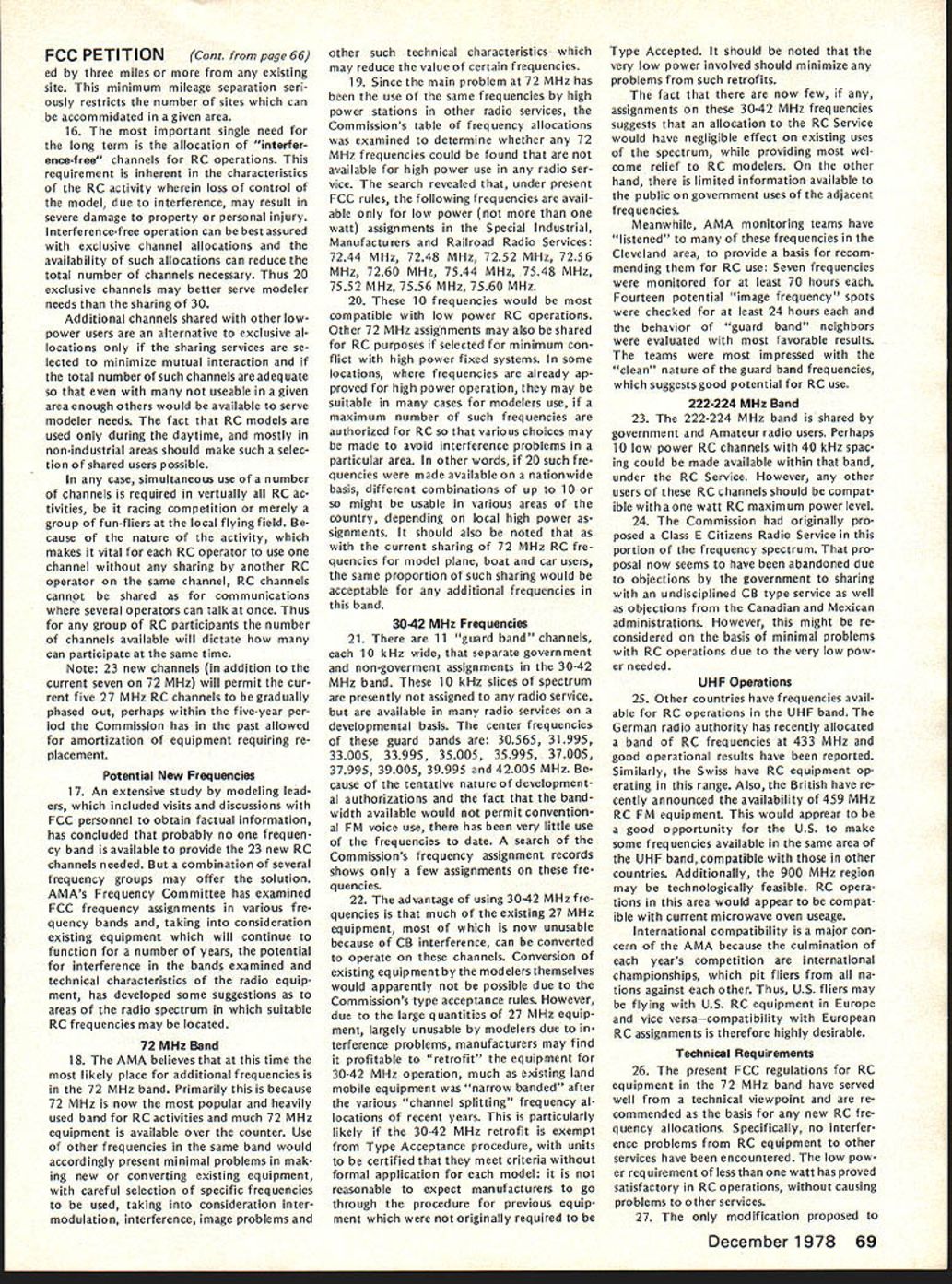
FCC PETITION (continued)
16 (cont.). Site restrictions also affect flying sites. For example, some allocations require sites to be separated by three miles or more from any existing site, limiting the number of sites that can be accommodated.
Interference-free channels are critical to safety. Exclusive allocations are preferred, but shared low-power allocations may be acceptable if mutual compatibility is ensured.
17–27 (see "Potential New Frequencies" and "Technical Requirements" sections above).
Closing of Petition
We urge the FCC to allocate the additional frequencies suggested and permit use of narrow-band FM and other appropriate modulation consistent with bandwidth rules. Doing so will support an activity that poses minimal interference risk and nurtures future aerospace, engineering and scientific talent.
By John Strong, John Wirth, Jeremiah Courtney and Jack R. Smith.
---
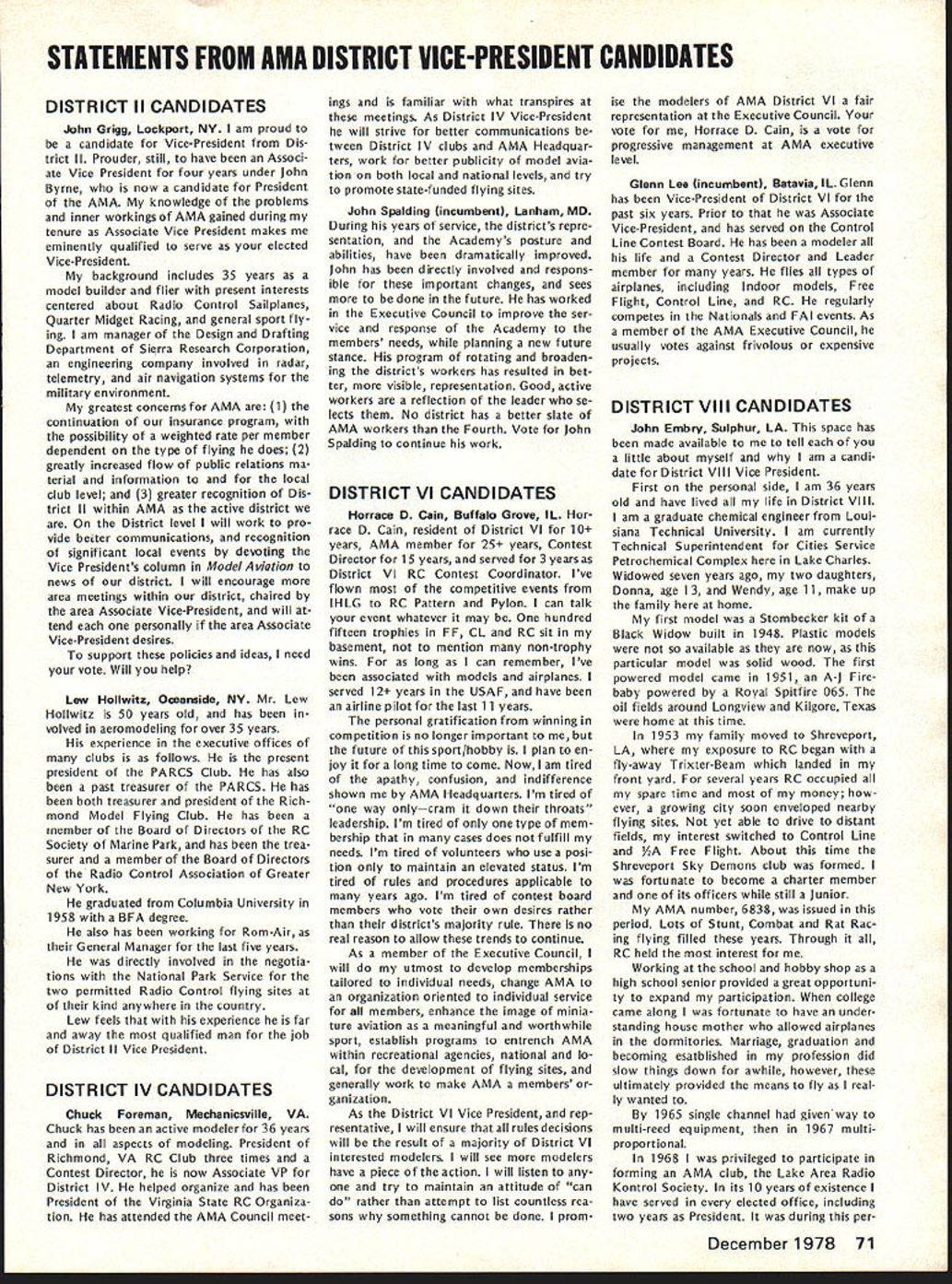
STATEMENTS FROM AMA DISTRICT VICE-PRESIDENT CANDIDATES
DISTRICT II CANDIDATES
- John Grigg, Lockport, NY — Candidate for Vice-President from District II. Former Associate Vice President for four years under John Byrne. Background: 35 years as model builder and flier; interests include radio control sailplanes, Quarter Midget racing and general sport flying. Manager of Design and Drafting at Sierra Research Corporation. Priorities: continuation of insurance program (possibly weighted by flying type), increased public relations material to clubs, and greater recognition of District II within AMA.
- Lew Hollwitz, Oceanside, NY — Age 50, over 35 years in aeromodeling. Executive officer of many clubs (president and treasurer roles). Graduate of Columbia University (1958, BFA). General Manager of Rom-Air for five years. Involved in negotiations with the National Park Service for two permitted RC flying sites. Believes his experience makes him the most qualified candidate for District II Vice President.
DISTRICT IV CANDIDATES
- Chuck Foreman, Mechanicsville, VA — Active modeler for 36 years across all aspects of modeling. Three-time president of Richmond RC Club, Contest Director, Associate VP for District IV. Helped organize Virginia State RC Organization. Priorities: better communications between District IV clubs and AMA HQ, increased publicity, and promotion of state-funded flying sites.
- John Spalding (incumbent), Lanham, MD — During his tenure district representation and the Academy's posture have improved. Has worked in the Executive Council to enhance service and response to members. Program includes rotating and broadening district workers to improve representation.
DISTRICT VI CANDIDATES
- Horrace D. Cain, Buffalo Grove, IL — Resident of District VI for 10+ years, AMA member 25+ years, Contest Director for 15 years, served as District VI RC Contest Coordinator. Flown nearly all competitive events. 115 trophies in FF, CL and RC. Former USAF (12+ years) and airline pilot (11 years). Platform: develop membership types tailored to individual needs, reorient AMA to individual service, enhance miniature aviation's image, establish programs to obtain flying sites, and improve representation on the Executive Council.
- Glenn Lee (incumbent), Batavia, IL — Vice-President of District VI for six years, prior Associate VP, served on Control Line Contest Board. Lifelong modeler, Contest Director and Leader member, flies indoor, free flight, control line and RC. Usually votes against frivolous or expensive projects.
DISTRICT VIII CANDIDATES
- John Embry, Sulphur, LA — Age 36, graduate chemical engineer, Technical Superintendent at Cities Service Petrochemical Complex in Lake Charles. Long modeling history (AMA No. 6838). Charter member and officer of the Lake Area Radio Kontrol Society. Involved with Nats planning and facilities coordination. Pledges to represent all phases of modeling fairly and to cover the district personally and through AVPs.
- Bill Lee, Missouri City, TX — Over 25 years of modeling with primary interests in Control Line. Active Leader member and contest worker. On CL Racing Advisory Committee and contributing editor for Control Line Racing. Nominated by outgoing VP Murry Frank. Prepared to devote time and effort required to represent District VIII.
DISTRICT X CANDIDATES
- Jim Scarborough (incumbent), Redondo Beach, CA — Running for a second term as Vice-President of District X. Acknowledges travel and paperwork burdens but owes continued service. Requests support.
- Betty Streem, Long Beach, CA — AMA member over 15 years, modeling family for 29 years, participated in free flight, control line and RC. Served as Associate Vice President and attended Executive Council meetings as proxy. Promises to serve District X faithfully and to serve AMA members broadly.
---
I DISTRICT REPORT
(Connecticut • Maine • Massachusetts • New Hampshire • Rhode Island • Vermont)
Cliff Piper, District I Vice-President Highland Avenue, Atkinson, NH 03811
Associate Vice-Presidents:
- Robert C. Boudreau — 405 Main Street, Nashua, NH 03060
- Raymond G. Bouleau — 39 High Street, Old Town, ME 04468
- Charles H. Larocque — P.O. Box 428, West Groton, MA 01472
- Al Novotnik — 4 Beverly Place, Norwalk, CT 06850
- George Parker — 7 Paul Dr., Lee, MA 01238
- Mike Shinniker — 8 Speaker Dr., Ledyard, CT 06339
- William Wilbur — 6 Laurel Ave., Kittery, ME 03904
Time to start planning our District I meeting for 1979. Offers have come from western Massachusetts, Connecticut and eastern Massachusetts. Also consider club needs for the AMA display piece for mall displays and static shows — plan at least two months ahead.
Watch for announcements on improved insurance benefits for 1979 as HQ works to provide better service. Vote for the presidential candidate of your choice. I have seen more positive views toward the dues increase lately.
Starting this month I will send a monthly news release to all appointed district officials with address and phone listings for better-informed officers and appointees. Any inputs for the November 4 Council Meeting are welcome if phoned by November 2.
LET'S HEAR IT FROM YOU!!
---
II DISTRICT REPORT
(New Jersey • New York)
John Byrne, District II Vice-President 38-29 213 Street, Bayside, NY 11361
Associate Vice-Presidents:
- Pete Brustel — 260 S. Broadway, Yonkers, NY 10705
- Frank Orsini — 8 Willow Ave., Piscataway, NJ 08854
- David Conforti — 11 Lake Lane, Orinda, NY 12065
- John Grigg — 882 Badger Dr., Lockport, NY 14094
- Cliff Pompliano — 117 Rarroz Dr., Summit, NJ 07901
- Jack Semencaro — 302 Emerson Ave., Union, NJ 07083
- Malo Sgombato — Chief, Crafts & Hobbies, USAF/EUROPE, Box 4097, APO, New York 09000
- Walter Thorne — 203 Windermere Rd., Syracuse, NY 13210
SECOND (DISTRICT) THOUGHTS: The next Executive Council meeting will be November 4–5 in Omaha, Nebraska, a two-day meeting to further consider a long-range AMA planning program. That meeting may include inspection of a possible Nats site in Nebraska.
IN THE PUBLIC SERVICE: More contests are donating proceeds to charities (e.g., Muscular Dystrophy Association, Boys' and Girls' Clubs). Congratulations to the clubs organizing these worthwhile events.
RHINEBECK RE-VISITED: The annual World War I Jamboree presented a unique and enjoyable event combining contests and a Cole Palen air show with full-scale vintage aircraft. The Mid-Hudson R/C Society received an AMA Award of Excellence for contributions to modeling and FAI team efforts.
GEORGE W. DICKINSON: Thanks to George Dickinson of Somerville, N.J., for becoming an AMA Life Member (No. L-50). Life membership begins at $1,000 and supports the AMA.
ROMANO GARABELLO MEMORIAL CONTEST (1978): Held September 17 at Floyd Bennett Field, Brooklyn, organized by the Pennsylvania Avenue Radio Control Society. The event was well-managed and largely attended.
GEAR UP AND LOCKED: Local club news: Virginia clubs and newsletters are active. HobbyPoxy-and-glass finishing systems proved durable in a recent crash repair. Club newsletters are the cement that holds groups together.
Voting time: use the new system and VOTE!
---
VI DISTRICT REPORT
Glenn Lee, District VI Vice-President 819 Mandrake, Batavia, IL 60510
Associate Vice-Presidents:
- David S. Ahlberg — 734 Acadia Rd., Valparaiso, IN 46383
- Roger Gress — Rte. 5, Quincy, IL 62301
- Robert Gail — 716 Sturtevant Lane, Springfield, IL 62704
- Frank L. Hughes — 709 NE 44th St., Kansas City, MO 64116
- Edwin Wm. Paul — 540 Mayfield Dr., Lexington, KY 40504
- Robert E. Szegler — 1388 Seibert Dr., Poplar Bluff, MO 63901
- Phillip Sullivan — 3021 Spring Valley Ct., Anderson, IN 46011
Award of Excellence: A new AMA shirt patch, the Award of Excellence, is available for members of chartered clubs approved by the District Vice-President as outstanding AMA clubs. The oval patch features a red, white and blue AMA logo with a golden "E" and lettering: "Award of Excellence, AMA Club, Academy of Model Aeronautics."
---
VII DISTRICT REPORT
Kenneth F. Morris, District VII Vice-President 1023 Iowa Avenue, Muscatine, IA 52761
I have received approximately 60% response on the Michigan redistricting issue; more input is needed before making a proposal to the Council. One issue apparent from responses is CONTEST COORDINATION — contest coordinators need help and communication. I will propose adding another contest coordinator to District VII (Michigan) for Control Line contests to relieve Wes Slack.
You should be receiving renewal forms and election ballots. Remember, you can VOTE without renewing. Even if you never renew you can vote in this election — so do it now. District VII can vote for AMA President; please vote so you have the right to voice opinions about results.
Clubs often report that the same few members do most of the work. Support your club and support AMA. I visited Cedar Rapids and the Iowa City Soaring meet recently.
---
VIII DISTRICT REPORT
Murry Frank, District VIII Vice-President 2933 Blankenship, Wichita Falls, TX 76308
The contest season continued beyond Labor Day with many successful events, including Dallas and Benbrook. The next Council meeting will be November 4–5 in Omaha, Nebraska — likely to inspect a possible Nats site at Lincoln. Keep up contest participation and club activity.
---
JUNIOR FLIGHT!
ED WHITTEN Box 176, Wall St. Sta., New York, NY 10005
TRY TETHER CONTEST FLYING
Pierre LaDat described tether contest flying with small models powered by .020 Tee Dee or Pee Wee engines. The "Filly Loo Bird" is a half-size plan with a 12" wingspan. In tether flying, models have guide wires from the right wingtip; racers fly clockwise circles. Guide wires are 10" from the fuselage centerline. Landing gear uses two wheels. Each model must have a cockpit or canopy.
Construction is simple: solid all-balsa is recommended; wings and stabilizers may extend through slots in the body or be mounted flush. Keep thrust line and wing/stab settings at 0–0–0. Airfoils need not be symmetrical but should not create excessive lift. The event encourages experimentation with planform layouts and fanciness; some build scale or rubber-powered variants. Models should have distinctive names — the name is part of the fun.
CL POSTAL ENDS OCT. 31
Get flights in for the Academy's second Control Line postal contest for modelers 16 years old and under. Entries must be received by the end of November.
JUNIOR FLIGHT WORKSHOP
Get your school's winter indoor building/flying program underway. The Fairwood Flyers (Berea, Ohio) form a sixth-grade club each fall that starts with hand-launched gliders and rubber-powered models, then advances indoors through the winter. They select officers, silkscreen T-shirts, hold local contests, and fly in nearby events. Members buy their own kits; dues are 25¢ weekly for supplies. Recommended kits: Micro-X "EZB" and "Simplex" gliders.
Recommended resources:
- Micro-X: Gerald Skjranac, Box 1063, Lorain, Ohio 44055 (send $1.00 for catalog).
- Old Timer Models: Jim Noonan, Box 18002, Milwaukee, WI 53218 (send 50¢ for catalog).
Suggestions:
- Keep club records for event categories and for each kit/magazine design flown.
- Limit club size to about 10 for manageability, with a waiting list.
- Use achievement ratings: "Cadet" for all on selection, "Pilot" for a one-minute rubber-powered flight, "Ace" for five minutes.
- AMA's "Cub" is recommended for beginners but may be too fast for low-ceiling gyms. Consider the Micro-X "EZB" or other intermediate designs. An interim model called the "Fun City Flyer" (bigger than an Easy B, smaller than a Pennyplane) will be presented soon.
WINTER INDOOR POSTAL SCHEDULED
Indoor postal contests fit well with school programs; AMA plans January/February/March events (Hand-Launched Stick and Hand-Launched Glider). Rules will be published; contact Ed Whitten for last year's rules.
FILLY-LOO BIRD — plans are half size.
---
Transcribed from original scans by AI. Minor OCR errors may remain.

