
ALL BY-LAWS CHANGES APPROVED
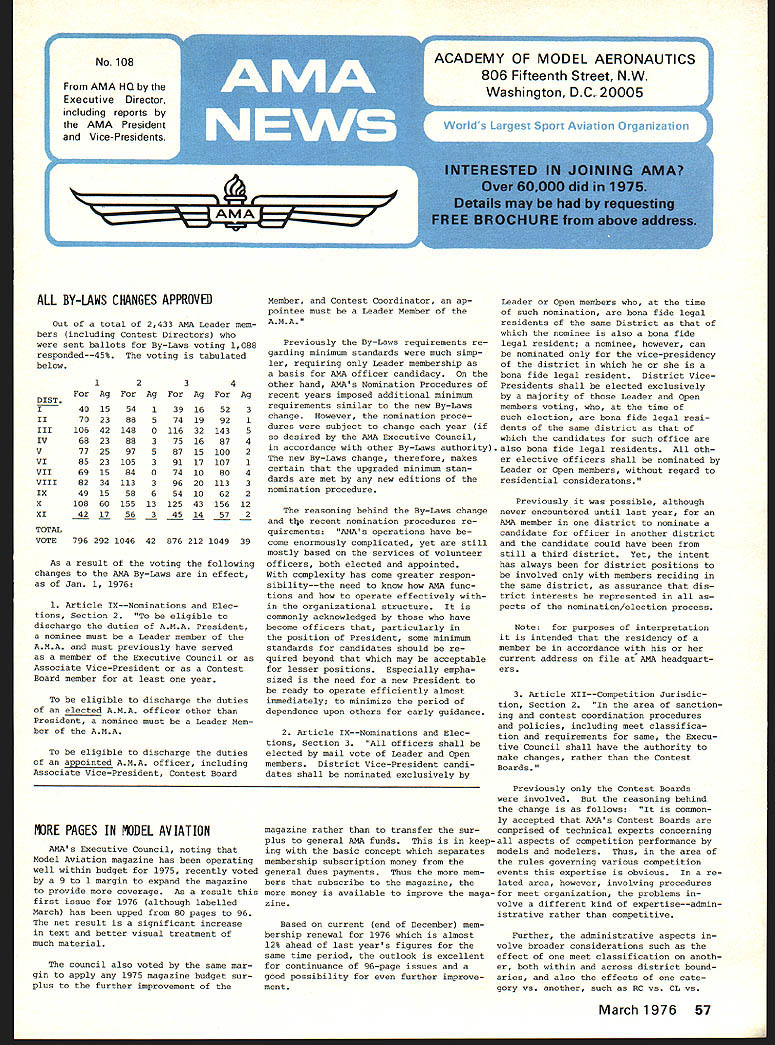
Out of a total of 2,433 AMA Leader members (including Contest Directors) who were sent ballots for By‑Laws voting, 1,088 responded—45%. The voting is tabulated below.
As a result of the voting the following changes to the AMA By‑Laws are in effect as of Jan. 1, 1976:
- Article IX—Nominations and Elections, Section 2. To be eligible to discharge the duties of an elected A.M.A. officer other than President, a nominee must be a Leader Member of the A.M.A.
To be eligible to discharge the duties of an appointed A.M.A. officer, including Associate Vice‑President, Contest Board member, and Contest Coordinator, an appointee must be a Leader Member of the A.M.A.
Previously the By‑Laws requirements regarding minimum standards were much simpler, requiring only Leader membership as a basis for AMA officer candidacy. On the other hand, AMA’s Nomination Procedures of recent years imposed additional minimum requirements similar to the new By‑Laws change. However, the nomination procedures were subject to change each year (as so decided by the AMA Executive Council), in accordance with other By‑Laws authority. The new By‑Laws change, therefore, makes certain upgraded minimum standards are met in new editions of the nomination procedure.
The reasoning behind the By‑Laws change and the recent nomination procedures requirements are as follows: AMA’s operations have become enormously complicated, yet are still mostly based on services of volunteer officers—both elected and appointed. With complexity has come greater responsibility—the need to know how AMA functions and how to operate effectively within its organizational structure. It is commonly acknowledged that those who have become officers, particularly in the position of President, should possess some minimum standards for candidates should be required beyond what may be acceptable for lesser positions. Especially emphasized is the need for a new President to be ready to operate efficiently almost immediately and to minimize the period of dependence upon others for early guidance.
- Article IX—Nominations and Elections, Section 3. All officers shall be elected by mail vote of Leader and Open members. District Vice‑President candidates shall be nominated exclusively by Leader and Open members who, at the time of such nomination, are bona fide legal residents of the same District as the nominee. A nominee, however, can be nominated only for the vice‑presidency of the district in which he or she is a bona fide legal resident.
District Vice‑Presidents shall be elected exclusively by a majority of Leader and Open members voting, who, at the time of such election, are bona fide legal residents of the district in which the candidates for such office are also bona fide legal residents. All other elective officers shall be nominated by Leader or Open members, without regard to residential considerations.
Previously it was possible, although never encountered until last year, for an AMA member in one district to nominate a candidate for officer in another district and the candidate could have been from still a third district. Yet, the intent has always been for district positions to be involved only by members residing in the same district, as assurance that district interests are represented in all aspects of the nomination/election process.
Note: For purposes of interpretation it is intended that the residency of a member be in accordance with his or her current address on file at AMA headquarters.
- Article XII—Competition Jurisdiction, Section 2. In the area of sanctioning and contest coordination procedures and policies, including meet classification requirements, the Executive Council shall have authority to make changes rather than the Contest Boards.
Previously only the Contest Boards were involved. But the reasoning behind the change is as follows: It is commonly accepted that AMA’s Contest Boards are composed of technical experts concerning performance aspects of competition, performance by models and modelers. Thus, in the area of rules and contest performance the Contest Boards have provided an appropriate specialized technical viewpoint. However, involvement in procedures and policies concerning overall sanctioning and classification of meets touches on broader organizational, administrative and managerial considerations where the Executive Council, representing the national organization, must take final responsibility. The Executive Council, therefore, has been given authority to make changes in these procedures and policies rather than leaving such matters solely to the Contest Boards.
By-Laws Changes (Cont.)
FP, etc. The effects are often financial and political, involving club and/or sponsor budgets for operating meets, special insurance situations, conflicts between clubs and many other problems beyond any questions of the types of models and events which may be involved.
Furthermore, the Contest Board procedures are too unwieldy to govern matters aside from competition rules and record rules—meet problems often need more flexible response, with changes from year to year—rather than via the 2‑year cycle for Contest Board action on rules matters. Still further, transferring the responsibilities as called for by the proposal will free the contest boards to concentrate on rules matters.
- Article XV—Amendments. The new by‑laws change deletes the underlined words: "These by‑laws shall be effective when adopted by affirmative vote of 2/3 of the initial Executive Council." Thereafter, amendment to the by‑laws (excepting for determination of the number of A.M.A. districts, which shall be made, in accordance with Article XI, Section 4), by the Executive Council may be made by an affirmative vote of 2/3 of A.M.A. Leader Members responding within forty‑five (45) days of issuance of a mail ballot. The Executive Council may recommend amendments to the by‑laws to the annual meeting of the A.M.A. or by initiating a mail ballot to the Leader Members.
It has been many years since any by‑laws changes were made at an A.M.A. annual meeting. Any such meeting could only include a small fraction of the A.M.A. Leader membership. It is, therefore, considered by the council that the only acceptable voting procedure is one which involves the entire Leader membership, which is what a mail ballot does. The proposal, therefore, is to assure that this basic democratic procedure is assured.
RC & 72 MHz — EXCLUSIVE EXCEPT...
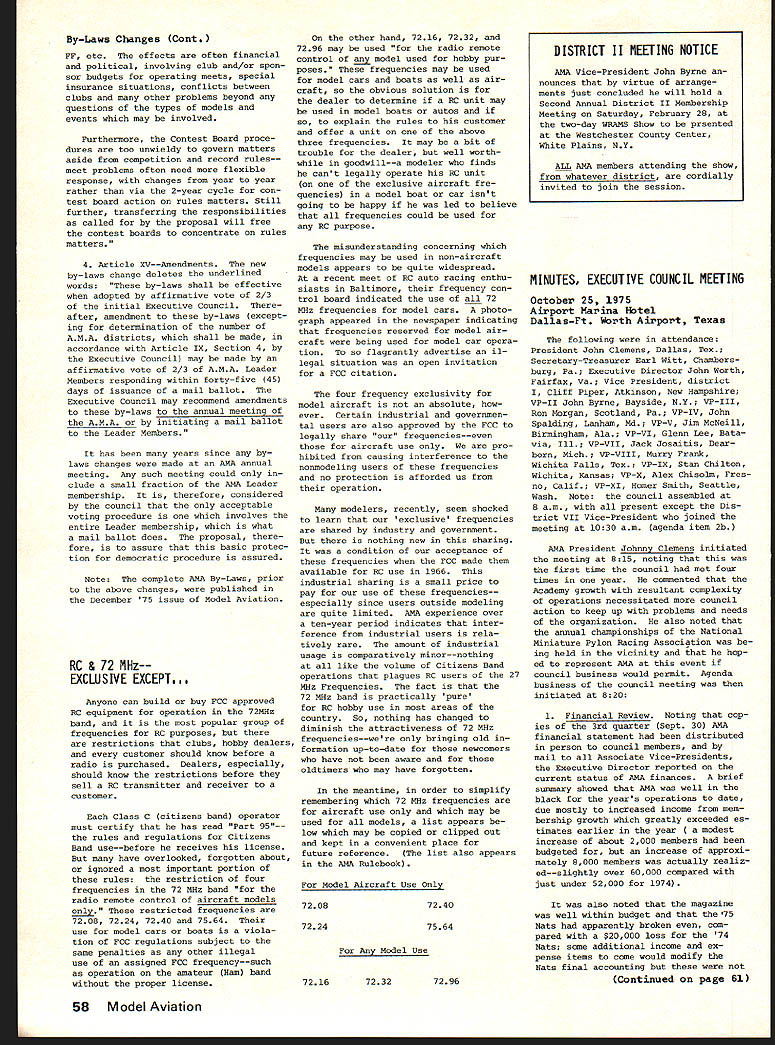
Anyone can build or buy FCC approved RC equipment for operation in the 72 MHz band, and it is the most popular group of frequencies for RC purposes, but there are restrictions that clubs, hobby dealers, and every consumer should know before purchase. Dealers, especially, should know the restrictions before they sell a RC transmitter and receiver to a customer.
Each Class C (citizens band) operator must certify that he has read "Part 95"—the rules and regulations for Citizens Band use—before he receives his license. But many have overlooked, forgotten about, or ignored a most important portion of these rules: the restriction of four frequencies in the 72 MHz band for the radio remote control of aircraft models only. These restricted frequencies are 72.08, 72.24, 72.40 and 75.64. Their use for models or boats is a violation of FCC regulations subject to the same penalties as any other illegal use of an assigned FCC frequency—such as operation on the amateur (Ham) band without the proper license.
On the other hand, 72.16, 72.32, and 72.96 may be used "for the radio remote control of any model used for hobby purposes." These frequencies can be used for model cars and boats as well as aircraft, so the obvious solution is for the dealer to determine if a RC unit may be used in model boats or autos and if so, to explain the rules to his customer and offer a unit on one of the above three frequencies. It may be a bit of trouble for the dealer, but well worthwhile in goodwill—a modeler who finds he can't legally operate his RC unit (one of the exclusive aircraft frequencies) in a model boat or car isn't going to be happy if he was led to believe that all frequencies could be used for any RC purpose.
The misunderstanding concerning which frequencies may be used in non‑aircraft models appears to be quite widespread. At a recent meet of RC auto racing enthusiasts in Baltimore, their frequency control board indicated the use of all 72 MHz frequencies for model cars. A photographer appeared in the newspaper indicating that frequencies reserved for model aircraft were being used for model car operation. So flagrantly advertising an illegal situation was an open invitation for a FCC citation.
The four frequency exclusivity for model aircraft is not an absolute, however. Certain industrial and governmental users are also approved by the FCC to legally share "our" frequencies—over much other traffic—if an agreement can be reached between the modelers and those government users when these frequencies are being used temporarily. But such sharing has been comparatively minor—nothing at all like the volume of Citizens Band operations that plagues RC users of the VHF frequencies. The fact is that the 72 MHz band is practically "pure" for RC hobby use in most areas of the country. So, nothing has changed to diminish the attractiveness of 72 MHz frequencies—we're only bringing old information up‑to‑date for those newcomers who have not been aware and for those oldtimers who may have forgotten.
In the meantime, in order to simplify remembering which 72 MHz frequencies are for aircraft use only and which may be used for any model, a list appears below which may be copied or clipped out and kept in a convenient place for future reference. (The list also appears in the AMA Rulebook.)
For Model Aircraft Use Only
- 72.08
- 72.24
- 72.40
- 75.64
For Any Model Use
- 72.16
- 72.32
- 72.96
MINUTES, EXECUTIVE COUNCIL MEETING
October 25, 1975 Airport Marina Hotel Dallas‑Ft. Worth Airport, Texas
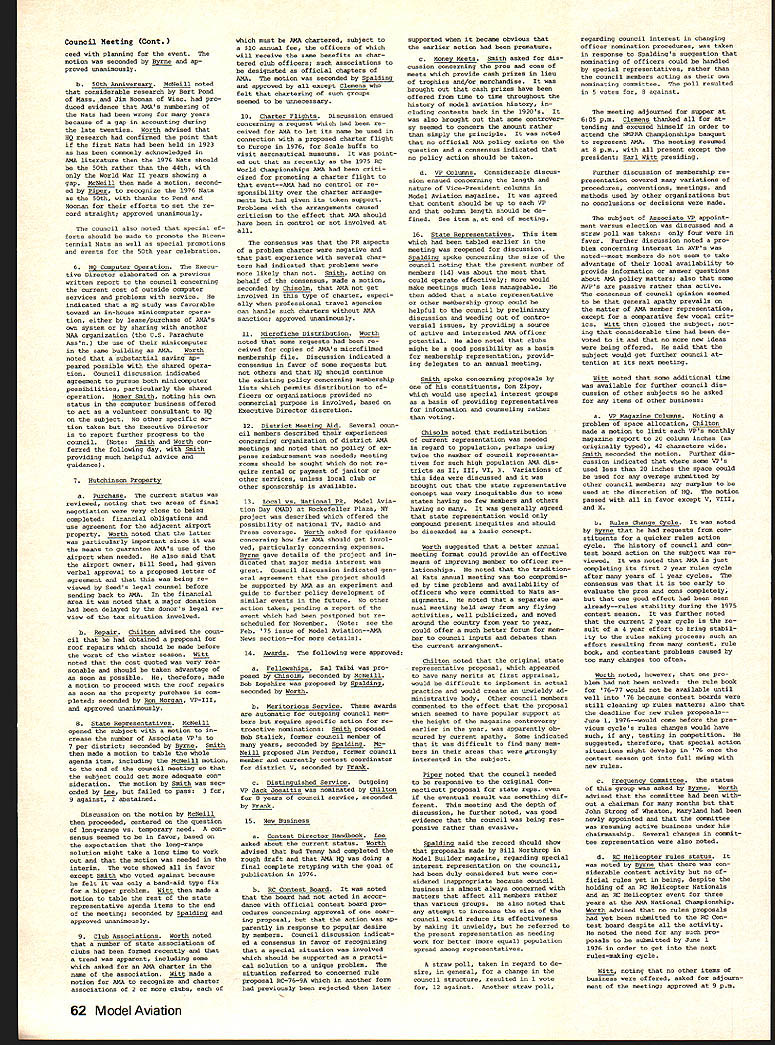
The following were in attendance: President John Clemens, Dallas, Tex.; Secretary‑Treasurer Earl Witt, Chambersburg, Pa.; Executive Director John Worth, Fairfax, Va.; Vice‑President, District I, Cliff Piper, Atkinson, N.H.; Vice‑President, District II, John Bayne, Bayside, N.Y.; Vice‑President, District III, Ron Morgan, Scotland, Pa.; Vice‑President, District IV, John Spalding, Lanham, Md.; Vice‑President, District V, Jim McNeill, Birmingham, Ala.; Vice‑President, District VI, Glenn Lee, Batavia, Ill.; Vice‑President, District VII, Jack Sosaitis, Dearborn, Mich.; Vice‑President, District VIII, Murry Frank, Wichita Falls, Tex.; Vice‑President, District IX, Sam Chilton, Wichita, Kans.; Vice‑President, District X, Alex Sholow, Fresno, Calif.; Vice‑President, District XI, Ken N. Smith, Seattle, Wash.
Note: the council assembled at 8:00 a.m. with all present except the District VII Vice‑President, who joined the meeting at 10:30 a.m. (agenda item 2b).
AMA President John Clemens initiated the meeting at 8:15, noting that this was the first time the council had met four times in one year. He commented that the increased growth with resultant complexity of operations necessitated more careful attention to the problems and needs of the organization. He also noted that the annual championships of the National Miniature Pylon Racing Association was being held in the vicinity and that he hoped to re‑sponsor AMA at this event if council business would permit. Agenda was initiated at 8:20.
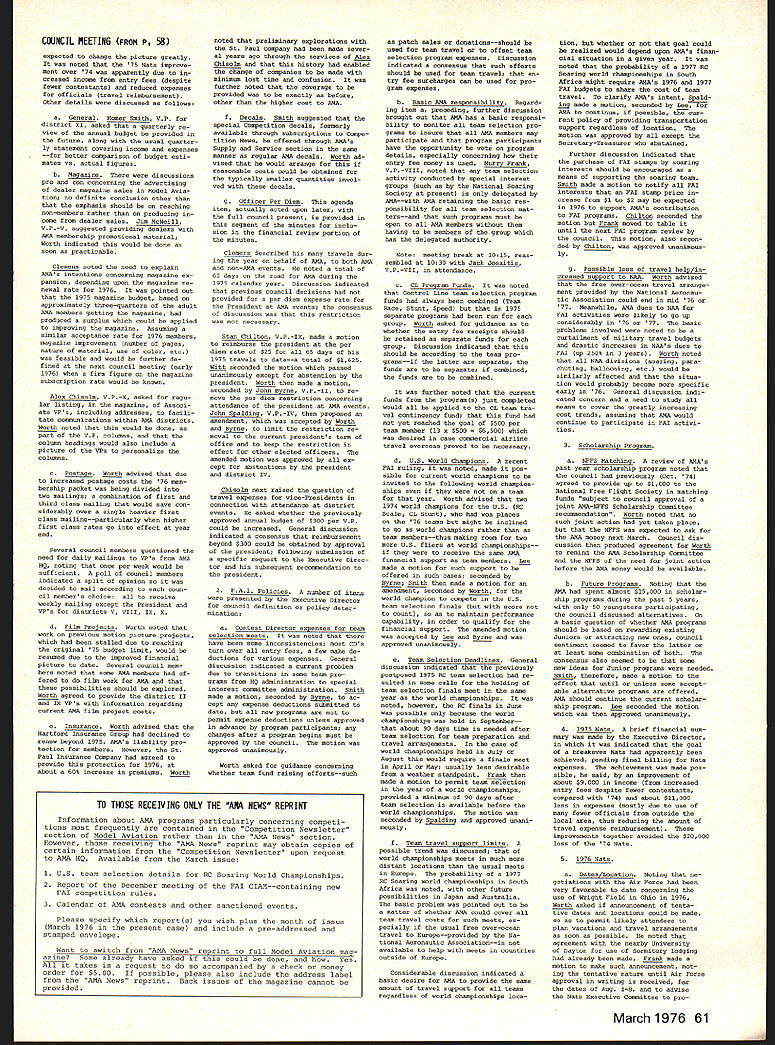
- Financial Review. Noting that copies of the 3rd quarter 1975 AMA financial statement had been distributed to the council and mailed to all Associate Vice‑Presidents, the Executive Director reported on the current status of AMA finances. A brief summary showed that Model Aviation magazine was operating well within the 1975 budget. The council recently voted, by a 9‑1 margin, to expand the magazine to provide increased coverage. As a result, the first issue of 1976, although labeled March, has been increased from 80 pages to 96 pages. The net result is a significant increase in text and better visual treatment of much material. The council also voted by the same margin to apply the 1975 magazine budget surplus toward further improvement.
AMA News
ALL BY-LAWS CHANGES APPROVED
Out of a total of 2,433 AMA Leader members (including Contest Directors) sent ballots on By‑Laws voting, 1,088 responded — 45%. Voting was tabulated as follows:
As a result of the voting the following changes to the AMA By‑Laws will take effect Jan. 1, 1976:
- Article IX — Nominations & Elections, Section 2. To be eligible to discharge the duties of AMA President, a nominee must be a Leader member of AMA and must previously have served as a member of the Executive Council, an Associate Vice‑President, a Contest Board member, or for at least one year have been eligible to discharge the duties of an elected AMA officer. In other words, a President nominee must be a Leader Member of AMA eligible to discharge duties as an appointed AMA officer including Associate Vice‑President, Contest Board member or Contest Coordinator appointee, and must be a Leader Member of AMA. Previously the By‑Laws requirements regarding minimum standards were much simpler, requiring only Leader membership as a basis for AMA officer candidacy. On the other hand, AMA's Nomination Procedures in recent years imposed additional minimum requirements similar to the new By‑Laws change. However, nomination procedures are subject to change in any year desired by the AMA Executive Council in accordance with other By‑Laws authority. The new By‑Laws change therefore makes certain upgraded minimum standards are met in new editions of the nomination procedure. The reasoning behind the By‑Laws change is that recent nomination procedure requirements, and AMA operations in general, have become enormously complicated yet still mostly based on services of volunteer officers — both elected and appointed. The complexity has brought greater responsibility and the need to know how AMA functions and operates effectively. The organizational structure commonly acknowledged has become more demanding of officers, particularly the position of President. Some minimum standards for candidates should be required beyond what may be acceptable for lesser positions. Especially emphasized is the need for the new President to be ready to operate efficiently almost immediately and to minimize the period of dependence upon others for early guidance.
- Article X — Nominations & Elections, Section 3. Officers shall be elected by mail vote. District Vice‑President candidates shall be nominated exclusively by Leader and Open members. At the time such nomination is made the nominee must be a bona fide legal resident of the same District. A nominee also can be nominated for the vicepresidency of a district only if a bona fide legal resident of that District. District Vice‑Presidents shall be elected exclusively by a majority of Leader and Open members voting in that election who are bona fide legal residents of the same district as the candidates for such office. Other elective officers shall be nominated by Leader and Open members without regard to residential considerations. Previously it was possible (although never encountered until last year) for an AMA member in one district to nominate a candidate in another district; a candidate could have been in a third district. The intent has always been that district positions involve members residing in the same district to assure district interests are represented. For purposes of interpretation, residency of a member is in accordance with the current address on file at AMA headquarters.
- Article XII — Competition Jurisdiction, Section 2. Area sanctioning, contest coordination procedures and policies, including meet classification requirements and the same, Executive Council shall have authority to make changes rather than the Contest Boards.
MORE PAGES IN MODEL AVIATION
AMA's Executive Council noted Model Aviation magazine has been operating well within the 1975 budget and recently voted, by a 9‑1 margin, to expand the magazine to provide increased coverage. As a result the first issue of 1976, although labeled March, has been increased from 80 pages to 96 pages. The net result is a significant increase in text and better visual treatment of much material. The council also voted by the same margin to apply the 1975 magazine budget surplus toward further improvement.
Previously Contest Boards were involved in the reasoning behind the change as commonly accepted AMA technical experts concerning contest matters. The transfer of certain responsibilities to the Executive Council was made to better coordinate contest sanctioning and classification in view of the increasing complexity of AMA activities and the need for centralized policy decisions.
AMA News
ALL BY‑LAWS CHANGES APPROVED
Out of a total 2,433 AMA Leader members, including Contest Directors, who were sent ballots on By‑Laws changes, 1,088 responded (45%). Voting was tabulated below.
As a result of the voting, the following changes to the AMA By‑Laws take effect Jan. 1, 1976:
- Article IX — Nominations/Elections, Section 2. To be eligible to discharge the duties of AMA President, a nominee must be a Leader member of the AMA and must previously have served as a member of the Executive Council, as an Associate Vice‑President, or as a Contest Board member for at least one year. To be eligible to discharge the duties of any elected AMA officer other than President, a nominee must be a Leader member of the AMA. To be eligible to be appointed to an AMA office, including Associate Vice‑President, Contest Board member, or Contest Coordinator appointees, the appointee must be a Leader member of the AMA.
Previously the By‑Laws' requirements regarding minimum standards were much simpler, requiring only Leader membership as the basis for AMA officer candidacy. In recent years AMA nomination procedures imposed additional minimum requirements similar to this By‑Laws change. However, nomination procedures are subject to change by the AMA Executive Council under other By‑Laws authority; the new By‑Laws change therefore makes certain that upgraded minimum standards are met by new editions of the nomination procedure.
The reasoning behind the By‑Laws change is that recent nomination procedure requirements reflect that AMA operations have become enormously complicated yet still are mostly based on services by volunteer officers, both elected and appointed. Complexity has brought greater responsibility and the need to know AMA functions and to operate effectively within the organizational structure. It is commonly acknowledged that officers, particularly the President, should meet some minimum standards. Candidates for President should be required to have experience beyond that which may be acceptable for lesser positions. Emphasis was placed on the need for the new President to be ready to operate efficiently almost immediately, to minimize the period of dependence upon others for early guidance.
- Article X — Nominations/Elections, Section 3. District Vice‑President candidates shall be nominated exclusively by Leader or Open members at the time such nomination is made and must be bona‑fide legal residents of the same district. The nominee must be a bona‑fide legal resident of the district. District Vice‑Presidents shall be elected exclusively by a majority of Leader and Open members voting at the time of such election who are bona‑fide legal residents of the same district. Candidates for such office shall also be bona‑fide legal residents. Other elective officers shall be nominated by Leader or Open members without regard to residential considerations.
Previously it had been possible — although never encountered until last year — for an AMA member in one district to nominate a candidate from another district; a candidate could have been from a third district. The intent has always been that district positions involve members residing in the same district, to assure district interests are represented. For purposes of interpretation, the residency of a member shall be that shown by the current address on file at AMA headquarters.
- Article XII — Competition Jurisdiction, Section 2. Area sanctioning, contest coordination procedures and policies, including meet classification requirements, shall be under the authority of the Executive Council, which shall have authority to make changes rather than the Contest Boards.
AMA News
The Executive Council, noting Model Aviation magazine has been operating well within budget in 1975, recently voted by a 9–1 margin to expand the magazine and provide increased coverage. As a result, the first issue of 1976, although labeled March, has been increased from 80 pages to 96 — a net increase of 16 pages — resulting in a significant increase in text and better visual treatment for much material. The council also voted by the same margin to apply the 1975 magazine budget surplus toward further improvement.
Previously, Contest Boards had been involved with magazine matters because they were comprised of technical experts concerned with competition plus general AMA functions. The council felt, however, that transfer of certain magazine responsibilities to the Executive Council was appropriate.
(End of continued article)
ALL BY-LAWS CHANGES APPROVED
Out of a total of 2,433 ballots sent to AMA Leader members, including Contest Directors, 1,088 responded (45%). The voting was tabulated and, as a result of the voting, the following changes in the AMA By‑Laws take effect Jan. 1, 1976:
- Article IX — Nominations & Elections, Section 2. To be eligible to discharge the duties of AMA President, a nominee must be a Leader member. The nominee must previously have served as a member of the Executive Council, Associate Vice‑President, Contest Board member or Contest Coordinator; an appointee must be a Leader member. Previously the By‑Laws requirements regarding minimum standards were much simpler, requiring only Leader membership as the basis for AMA officer candidacy. On the other hand, AMA’s Nomination Procedures in recent years imposed additional minimum requirements similar to this By‑Laws change. However, nomination procedures are subject to change in any year as desired by the AMA Executive Council in accordance with other By‑Laws authority. The new By‑Laws change therefore makes certain that upgraded minimum standards are met in new editions of the nomination procedure. The reasoning behind the By‑Laws change is that recent nomination procedures requirements reflect that AMA operations have become enormously complicated yet still mostly based on services by volunteer officers, both elected and appointed. Complexity has brought greater responsibility — the need to know AMA functions and to operate effectively within the organizational structure — and it is commonly acknowledged that officers, particularly the President, should meet some minimum standards. Candidates for President should be required to meet standards beyond those acceptable for lesser positions. Especially emphasized is the need for the new President to be ready to operate efficiently almost immediately, to minimize a period of dependence upon others for early guidance.
- Article X — Nominations & Elections, Section 3. Officers shall be elected by mail vote. District Vice‑President candidates shall be nominated exclusively by Leader and Open members at the time such nominations are made; the nominee for District Vice‑President must be a bona‑fide legal resident of the district. District Vice‑Presidents shall be elected exclusively by a majority of the Leader and Open members voting at the time of such election who are bona‑fide legal residents of the same district. Candidates for such office must also be bona‑fide legal residents. Other elective officers shall be nominated by Leader and Open members without regard to residential considerations. Previously it was possible, although never encountered until last year, for an AMA member in one district to nominate a candidate from another district; a candidate could have still been from a third district. The intent has always been that district positions involve members residing in the same district to assure that district interests are represented.
Note: For purposes of interpretation, a member's residence shall be in accordance with the current address file at AMA Headquarters.
- Article XII — Competition Jurisdiction, Section 2. Area sanctioning, contest coordination procedures and policies, including meet classification requirements, shall be the responsibility of the Executive Council which shall have authority to make changes rather than the Contest Boards.
MORE PAGES IN MODEL AVIATION — AMA's Executive Council, noting Model Aviation magazine has operated well within budget in 1975, recently voted by a 9–1 margin to expand the magazine and provide better coverage. As a result, the first issue of 1976, although labeled March, has been increased from 80 pages to 96 — the net result being a significant increase in text and better visual treatment of much material. The Council also voted by the same margin to apply the 1975 magazine budget surplus toward further improvement.
Previously, Contest Boards were involved in reasoning behind changes. Contest Boards are comprised of technical experts concerning the various facets of the hobby plus general AMA functions; however, the transfer of certain responsibilities to the Executive Council will permit broader consideration of overall AMA policy and budgetary effects. ALL BY-LAWS CHANGES APPROVED
Our total of 2,433 AMA Leader members, including Contest Directors, sent ballots. By‑laws voting: 1,088 responded — 45%. Voting tabulated below.
As a result of the voting the following changes to AMA By‑Laws take effect Jan. 1, 1976:
- Article IX — Nominations & Elections, Section 2. To be eligible to discharge the duties of AMA President, a nominee must be a Leader member of the AMA and must previously have served as a member of the Executive Council, Associate Vice‑President, Contest Board member, or Contest Coordinator, or have been an elected AMA officer for at least one year. Other President nominees must be Leader members of the AMA eligible to discharge duties as appointed AMA officers; including Associate Vice‑President, Contest Board member, or Contest Coordinator appointees, who must be Leader members of the AMA.
Previously, By‑Laws requirements regarding minimum standards were much simpler, requiring only Leader membership as the basis for AMA officer candidacy. In recent years AMA nomination procedures imposed additional minimum requirements similar to this new By‑Laws change. However, nomination procedures are subject to change by vote of the Executive Council in accordance with other By‑Laws authority. The new By‑Laws change therefore makes certain that upgraded minimum standards are met regardless of future editions of the nomination procedure. The reasoning behind the By‑Laws change: AMA nomination procedures and requirements — and AMA's operations — have become enormously complicated yet are still mostly based on the services of volunteer officers, both elected and appointed. Complexity has brought greater responsibility and the need to know how AMA functions and to operate effectively. The organizational structure commonly acknowledged has become more complex, particularly in the position of President. Some minimum standards for candidates should be required beyond what may be acceptable for lesser positions. Especially emphasized is the need for the new President to be ready to operate efficiently almost immediately and to minimize the period of dependence upon others for early guidance.
- Article IX — Nominations & Elections, Section 3. Officers shall be elected by mail vote. District Vice‑President candidates shall be nominated exclusively by Leader and Open members at the time such nomination; the nominee must be a bona fide legal resident of the same district. District Vice‑Presidents shall be elected exclusively by a majority of Leader and Open members voting at the time such election who are bona fide legal residents of the same district. Candidates for such offices shall also be bona fide legal residents. Other elective officers shall be nominated by Leader and Open members regardless of residential considerations.
Previously it was possible, although never encountered until last year, for an AMA member in one district to nominate a candidate in another district; a candidate could have been from a third district. The intent has always been that district positions involve members residing in the same district to assure that district interests are represented. For purposes of interpretation, residency of a member is intended to be according to the current address file at AMA Headquarters.
AMA News
- Article XII — Competition Jurisdiction, Section 2. Area sanctioning, contest coordination procedures and policies, including meet classification requirements, the Executive Council shall have authority to make changes rather than the Contest Boards.
AMA's Executive Council, noting Model Aviation magazine has been operating well within budget in 1975, recently voted by a 9–1 margin to expand the magazine to provide better coverage. As a result, the first issue of 1976, although labeled March, has been increased to 96 pages. The net result is a significant increase in text, better visual treatment of much material. The council also voted by the same margin to apply the 1975 magazine budget surplus toward further improvement.
Previously, Contest Boards were involved in magazine-related decisions. The reasoning behind the change follows the commonly accepted view that Contest Boards are comprised of technical experts concerned primarily with contest rules and procedures, while magazine policy and presentation are better handled by the Executive Council and the magazine staff.
ALL BY-LAWS CHANGES APPROVED
Out of a total of 2,433 AMA Leader members, including Contest Directors, ballots on By‑Laws changes were sent. Voting: 1,088 responded (45%). Voting tabulated below.
As a result of the voting the following changes to the AMA By‑Laws take effect Jan. 1, 1976:
- Article IX — Nominations & Elections, Section 2. To be eligible to discharge the duties of AMA President, a nominee must be a Leader member of the AMA and must previously have served as a member of the Executive Council, Associate Vice‑President, Contest Board member, or have served as an elected AMA officer. A nominee for President who is eligible to discharge the duties of an appointed AMA office, including Associate Vice‑President, Contest Board member, or Contest Coordinator appointee, must be a Leader member of the AMA.
Previously, By‑Laws requirements regarding minimum standards were much simpler, requiring only Leader membership as the basis for AMA officer candidacy. On the other hand, AMA nomination procedures in recent years imposed additional minimum requirements similar to the new By‑Laws change. However, nomination procedures are subject to change from year to year as desired by the AMA Executive Council in accordance with other By‑Laws authority; the new By‑Laws change therefore makes certain upgraded minimum standards are met in new editions of the nomination procedure. The reasoning behind the By‑Laws change is that recent nomination procedure requirements reflect that AMA operations have become enormously complicated yet still are mostly based on services of volunteer officers, both elected and appointed. The increased complexity has brought greater responsibility and the need to know how AMA functions and how to operate effectively within its organizational structure. It is commonly acknowledged that officers, particularly the position of President, should meet some minimum standards. Candidates should be required to meet standards beyond those acceptable for lesser positions. Especially emphasized is the need for the new President to be ready to operate efficiently almost immediately and to minimize the period of dependence upon others for early guidance.
- Article X — Nominations & Elections, Section 3. Officers shall be elected by mail vote of Leader and Open members. District Vice‑President candidates shall be nominated exclusively by Leader and Open members at the time such nomination is made; nominees for District Vice‑President must be bona fide legal residents of the same district. District Vice‑Presidents shall be elected exclusively by a majority of the Leader and Open members voting at the time of such election who are bona fide legal residents of the same district; candidates for such office shall also be bona fide legal residents. Other elective officers shall be nominated by Leader and Open members without regard to residential considerations.
Previously it was possible, although never encountered until last year, for an AMA member of one district to nominate a candidate for an office in another district; a candidate could have been from a third district. The intent has always been that district positions involve members residing in the same district to assure the district's interests are represented. For purposes of interpretation, residency of a member is intended to be according to the current address file at AMA Headquarters.
- Article XII — Competition Jurisdiction, Section 2. Area sanctioning, contest coordination procedures and policies, including meet classification requirements, the Executive Council shall have the authority to make changes rather than the Contest Boards.
Transcribed from original scans by AI. Minor OCR errors may remain.

