
AMA News
NEW RC FREQUENCY UPDATE
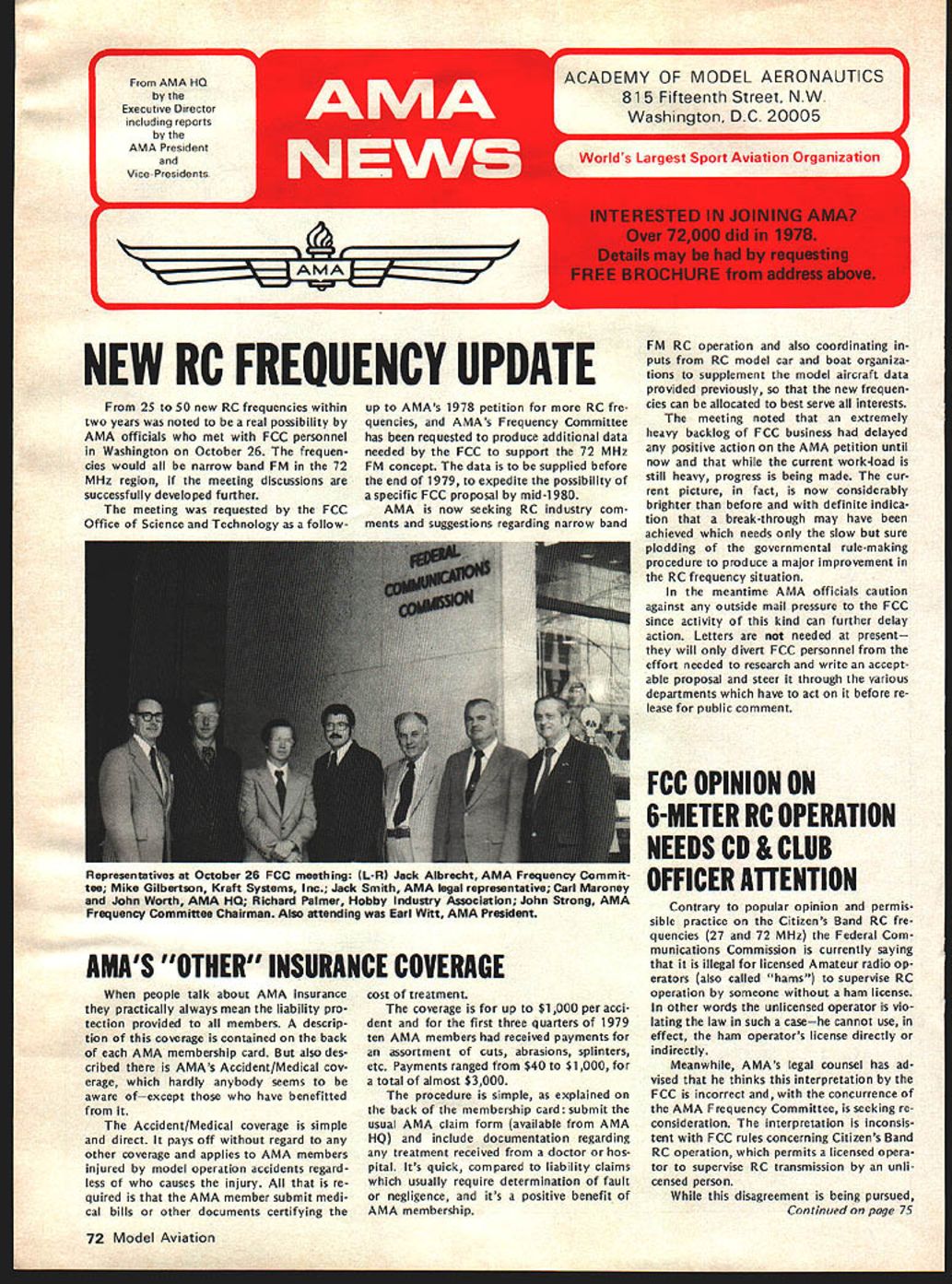
AMA officials met with FCC personnel in Washington on October 26. From 25 to 50 new RC frequencies within two years was noted as a real possibility. The frequencies would be narrow‑band FM in the 72 MHz region if discussions continue to develop successfully.
- The meeting was requested by the FCC Office of Science and Technology as a follow‑up to AMA’s 1978 petition for additional RC frequencies.
- AMA’s Frequency Committee has been asked to produce additional technical data needed by the FCC to support the 72 MHz FM concept. That data is to be supplied before the end of 1979 to help expedite a specific FCC proposal by mid‑1980.
- AMA is seeking comments and suggestions from the RC industry regarding narrow‑band FM RC operation, and is coordinating input from RC model car and boat organizations to supplement the model aircraft data already provided.
- The meeting noted an extremely heavy backlog of FCC business had delayed action on the petition, but progress is being made and the outlook is brighter than before.
AMA officials caution against outside mail pressure to the FCC at this time. Letters can divert FCC staff from the technical work needed to research, draft and steer a proposal through the necessary departments prior to release for public comment.
MORE RC FREQUENCY PROGRESS
A meeting among the AMA Frequency Committee, AMA legal representative, representatives of the RC industry and the FCC was arranged for October 26. Progress will be reported in next month’s column.
AMA'S "OTHER" INSURANCE COVERAGE
When people refer to AMA insurance they usually mean the liability protection described on the back of each AMA membership card. Also described there is AMA’s Accident/Medical coverage, which fewer members know about.
- The Accident/Medical coverage pays regardless of other coverage and applies to AMA members injured in model operation accidents regardless of who caused the injury.
- Coverage is up to $1,000 per accident.
- In the first three quarters of 1979, ten AMA members received payments (ranging from $40 to $1,000) for cuts, abrasions, splinters, etc., totaling almost $3,000.
- To file a claim: submit the AMA claim form (available from AMA Headquarters) and include documentation of treatment (medical bills, doctor or hospital records). This process is typically quicker than liability claims, which usually require fault determinations.
FCC OPINION ON 6‑METER RC OPERATION — CD & CLUB OFFICER ATTENTION
The Federal Communications Commission presently holds that it is illegal for licensed Amateur radio operators (hams) to supervise RC operation by someone who does not hold an Amateur license. Under this interpretation, an unlicensed person may not operate using the ham’s station or license, directly or indirectly.
- AMA’s legal counsel believes this FCC interpretation is incorrect, and, with the AMA Frequency Committee, is seeking FCC reconsideration.
- The interpretation appears inconsistent with FCC rules concerning Citizens Band RC operation, which permit a licensed operator to supervise RC transmissions by an unlicensed person.
- Until (and unless) the FCC changes its stance, AMA Contest Directors and club officers are advised not to allow unlicensed operation on 6‑meter (50–54 MHz) frequencies or other Amateur bands under their control. Contest participants and team selection competitors should be aware of this restriction.
- If the FCC reconsiders and the situation changes, AMA will publish notice.
AMA PROTESTS FCC HIGH‑POWER ALLOCATIONS
Responding to member complaints, AMA filed a protest with the FCC about the trend of approving comparatively high‑power operations on frequencies previously used predominantly by low‑power stations. In some areas (notably Houston) this has effectively eliminated RC and other low‑power operations on certain 72 MHz frequencies and created safety concerns.
The AMA letter to the FCC (excerpted) follows:
Mr. Carlos V. Roberts Chief, Safety and Special Radio Services Bureau Federal Communications Commission 2025 M Street, N.W. Washington, D.C. 20554
Dear Mr. Roberts,
When the FCC authorized RC operation on a number of 72 MHz frequencies in 1966, the situation was compatible with most other users (predominantly low‑power transmitters). In recent years, several new allocations have upset that compatibility. In some cases the FCC has authorized high‑power operations that have made model flying unsafe for many miles surrounding the new station, effectively destroying the usefulness of the particular frequency for low‑power radio control operations. Low‑power users are often not advised when a new high‑power allocation is authorized and learn of the change only after crashes caused by unexpected interference.
We believe it is impractical to mix high and low power users on the same frequency in the same vicinity. Your letter of September 1, 1978, noted concerns about burden on processing staff, but the situation we refer to involves a limited number of applications on a total of seven frequencies and should not impose an undue burden. Our petition, filed November 17, 1978, includes proposals to use 10 frequencies in the 72–76 MHz range for low‑power operations only. We trust our petition is receiving attention and that relief will be forthcoming.
Such relief is sorely needed in the interest of public safety. We have pursued this matter constructively and patiently and expect that continued perseverance will produce action in our favor in 1980.
Sincerely, (AMA Representative)
SPECIAL INTEREST GROUPS
During the 1978 presidential campaign the president pledged to support and work with special interest groups within AMA as professional sources of input. At the August Executive Council meeting, actions were taken to realize this effort.
- The Executive Council can accept organizations in an advisory capacity but cannot independently verify whether a group truly represents AMA special interest members.
- To be recognized, a group should have some form of organized communication (for example, a newsletter). Given differences in organization and finances among groups, no single credibility standard was adopted.
- Recognition will be handled on a case‑by‑case basis. Any special interest group seeking recognition must present credentials to the Council.
FLYING SITES
At least five federal agencies are positioned to offer areas for flying sites. The National Committee for Urban Recreation wrote seven agencies with suggestions on how each could encourage recreational opportunities. Key suggestions include:
- HUD: Expand the FHA Property Release Option Program to transfer repossessed property to local governments for recreation.
- HEW (Department of Health, Education and Welfare): Implement the 1978 Community Schools Act to provide recreation opportunities through joint use of schools, community centers, and private facilities.
- EPA: Give technical assistance to state and local grant recipients for incorporating supplemental park and recreation uses in projects.
- DOD: Determine how Department of Defense land and other federal land could be used and how management must be handled.
- GSA: Request guidelines for providing recreation facilities in existing and new federal properties and assist local governments in land banking surplus properties.
The National Committee (formed in 1978) includes mayors, county representatives, and leaders of urban social equity, recreation and environmental organizations. AMA will follow up on agency responses and explore possible AMA participation to represent its membership.
HEADQUARTERS RELOCATION
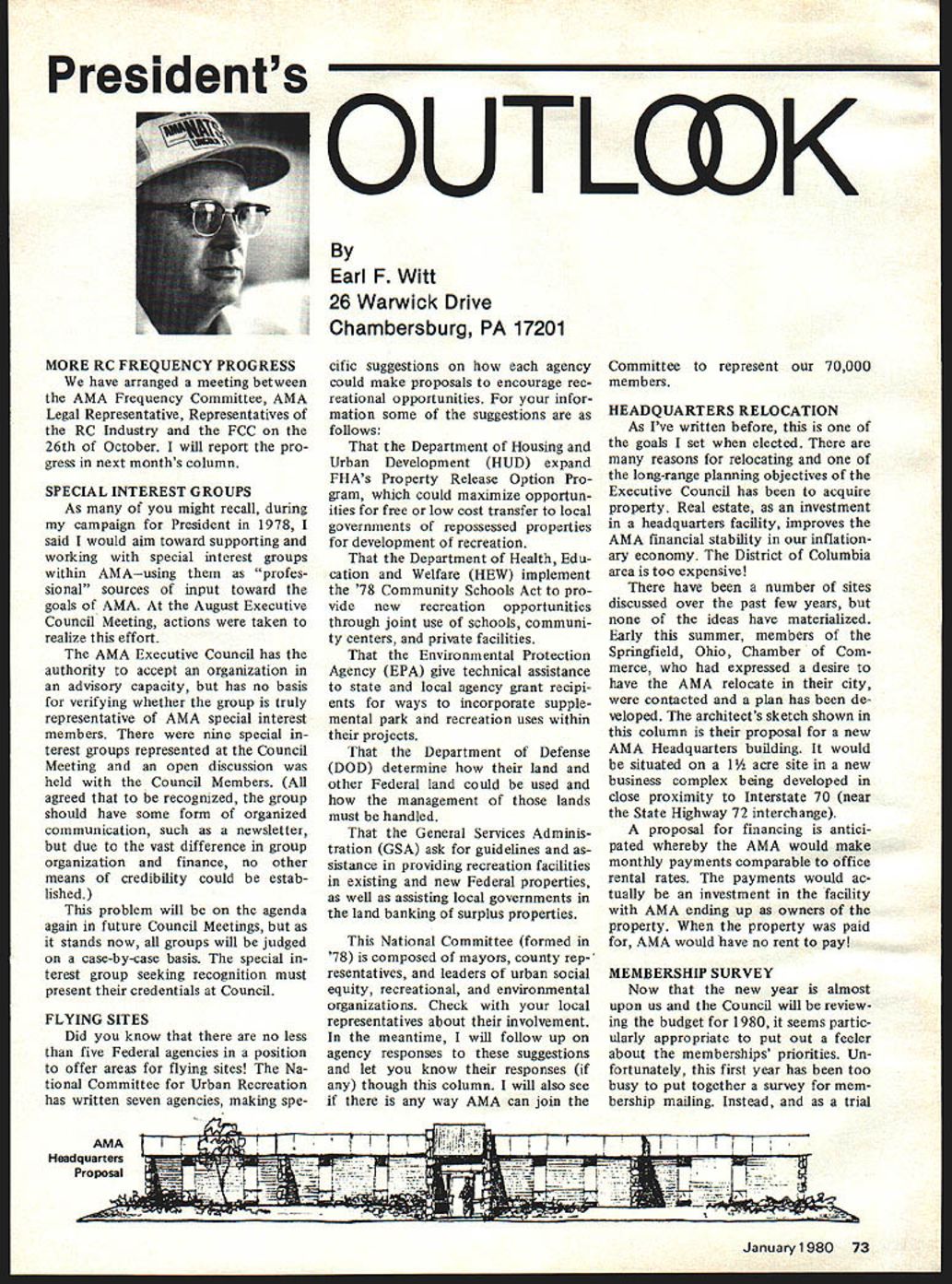
Relocating AMA headquarters and acquiring property has been a long‑range planning objective to improve financial stability. The District of Columbia area is considered too expensive.
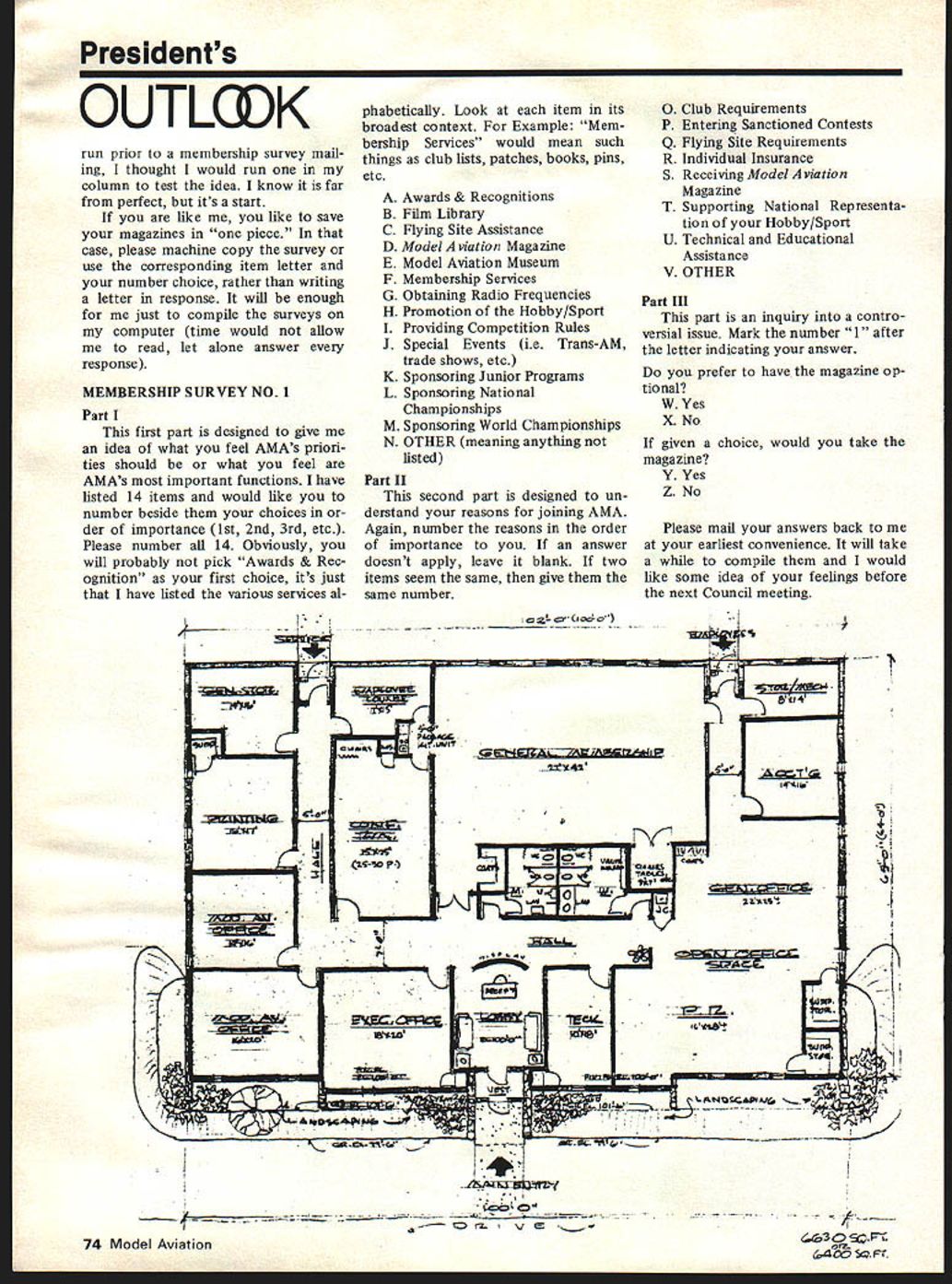
- Springfield, Ohio, Chamber of Commerce members proposed a new AMA headquarters located on a 1½ acre site in a new business complex near Interstate 70 (near the State Highway 72 interchange).
- A financing proposal is anticipated in which AMA would make monthly payments comparable to office rent; those payments would build ownership so that, when paid off, AMA would no longer have rent.
MEMBERSHIP SURVEY — President’s OUTLOOK
With the Council reviewing the 1980 budget, the president solicits membership priorities. As a trial, a short survey is being run in this column prior to a possible membership mailing. If you prefer to keep your magazine intact, please machine‑copy the survey or use item letters and number choices rather than writing a long letter. Mail responses to the president.
MEMBERSHIP SURVEY NO. 1
Part I — Rank these AMA priorities in order of importance (1 = most important). Number all 14 items.
- A. Awards & Recognitions
- B. Film Library
- C. Flying Site Assistance
- D. Model Aviation Magazine
- E. Model Aviation Museum
- F. Membership Services (club lists, patches, books, pins, etc.)
- G. Obtaining Radio Frequencies
- H. Promotion of the Hobby/Sport
- I. Providing Competition Rules
- J. Special Events (Trans‑AM, trade shows, etc.)
- K. Sponsoring Junior Programs
- L. Sponsoring National Championships
- M. Sponsoring World Championships
- N. OTHER (anything not listed)
Part II — Why you joined AMA. Number in order of importance. If not applicable, leave blank. Equal importance may receive the same number.
- O. Club Requirements
- P. Entering Sanctioned Contests
- Q. Flying Site Requirements
- R. Individual Insurance
- S. Receiving Model Aviation Magazine
- T. Supporting National Representation of your Hobby/Sport
- U. Technical and Educational Assistance
- V. OTHER
Part III — Controversial issue. Mark "1" after the letter indicating your answer.
- Do you prefer the magazine be optional?
- W. Yes
- X. No
- If given a choice, would you take the magazine?
- Y. Yes
- Z. No
Please mail your answers back to the president at your earliest convenience.
FROM AROUND THE DISTRICT
- "I will not watch the bomb — I will watch the plane." — Bubba Keefe forgot that advice and did not win the Bomb Drop at the Charleston Radio Control Society fun‑fly; the plane survived, but he was mortified.
- Miami/Pompano Beach: Dade County Commissioners refused a new Goodyear blimp hangar; the blimp will be sited in Pompano Beach. Meanwhile, the Miami Indoor Aircraft Model Association is concerned about where to fly during construction.
- Broward County: Muffler rule enforced; engines at the field met acceptable decibel levels.
- Warner Robins AFB (Georgia): About 50,000 guests attended an open house; pattern pilots and club members provided flying demos and answered questions.
- Puerto Rico: Scale planes are popular; noteworthy Cessna 310 model by Joseph Micalizzi.
- Georgia: Pop Curtis’s Senior Citizens R/C Team prepared for a Cross Country R/C Relay Race; team members were mostly 60+ years old.
- Junior recognitions: Tom Veloskey, Jr. (R/C); Ken and Steve Hicks (C/L); Alice Calder and Julie Deep (F/F).
- Heart of Dixie F/F Contest (Huntsville): Excellent weather. Walt Rozelle won High Point Trophy; Cliff Upshaw won Junior High Point. Notable entries included Lin Cochran’s canard rocket and Ed Lidgard’s rubber‑powered pusher.
- Palm Beach Aeronauts’ "Concrete Cygnet" now lies in 40 feet of water serving as a fish habitat; the club is seeking boats and hoists to raise it for a Giant Static Scale contest.
- RC Soaring is growing in District VI. 2‑Meter fliers: consider the 2‑Meter World Cup Championships, January 19–20, in the Mojave Desert (contact Doug Ford).
- Indiana: RC soaring again permitted at the Dunes National Lakeshore; contact Lake County RC Soaring Society for rules.
- SOAR members Stan Watson, Jack Hiner and John Dince set records in Duration, Distance and Altitude in Unlimited and 2‑Meter classes.
- Club and newsletter notes:
- Joe Cervana (Palos RC Club) predicts club airshows and social fly‑ins will become more common than competition.
- Lincoln Nats results: Gib Robbins (1st A Gas), Bob Mattes (1st C and FAI Power), Charlie Stolich (1st Jetex), Chris Matsuno (1st A‑1), Marv Bashaw (1st Coupe), Dick Hardcastle (1st Pennyplane), Stan Stoy (1st IHLG).
- McDonnell‑Douglas RC Club needs a flying site.
- Chicagoland: possible two fields available; Streamwood Tri‑Village RC Club celebrates five years with editors Lee Bergstedt and Larry Ott.
- Peoria RC Modelers sponsor a 20‑minute pylon race with one required pit stop — a novel format to increase flying time.
- Syntronic Aero Club reports growth and the need for safe flying habits (club contact: Austin Veltien).
- Jack Sheeks (model designer) retired to a hobby shop in Indianapolis and hosts club meetings.
- Greater St. Louis Modeling Association has contributed over $5,000 to a Missouri Park Board scholarship fund; Buder Park hosted MACA Combat Team Trials.
- Kansas City: apology for missing a meeting; contact AVP Frank Hughes or E.L. Cox for information.
- Comment on publishing: modelers often report advertisers’ product claims but do not always support publisher efforts; more reciprocal interest is encouraged.
- Equipment note: praise for the K&B 6.5 engine for easy starting, smooth idle and reliable performance in sport and formula events.
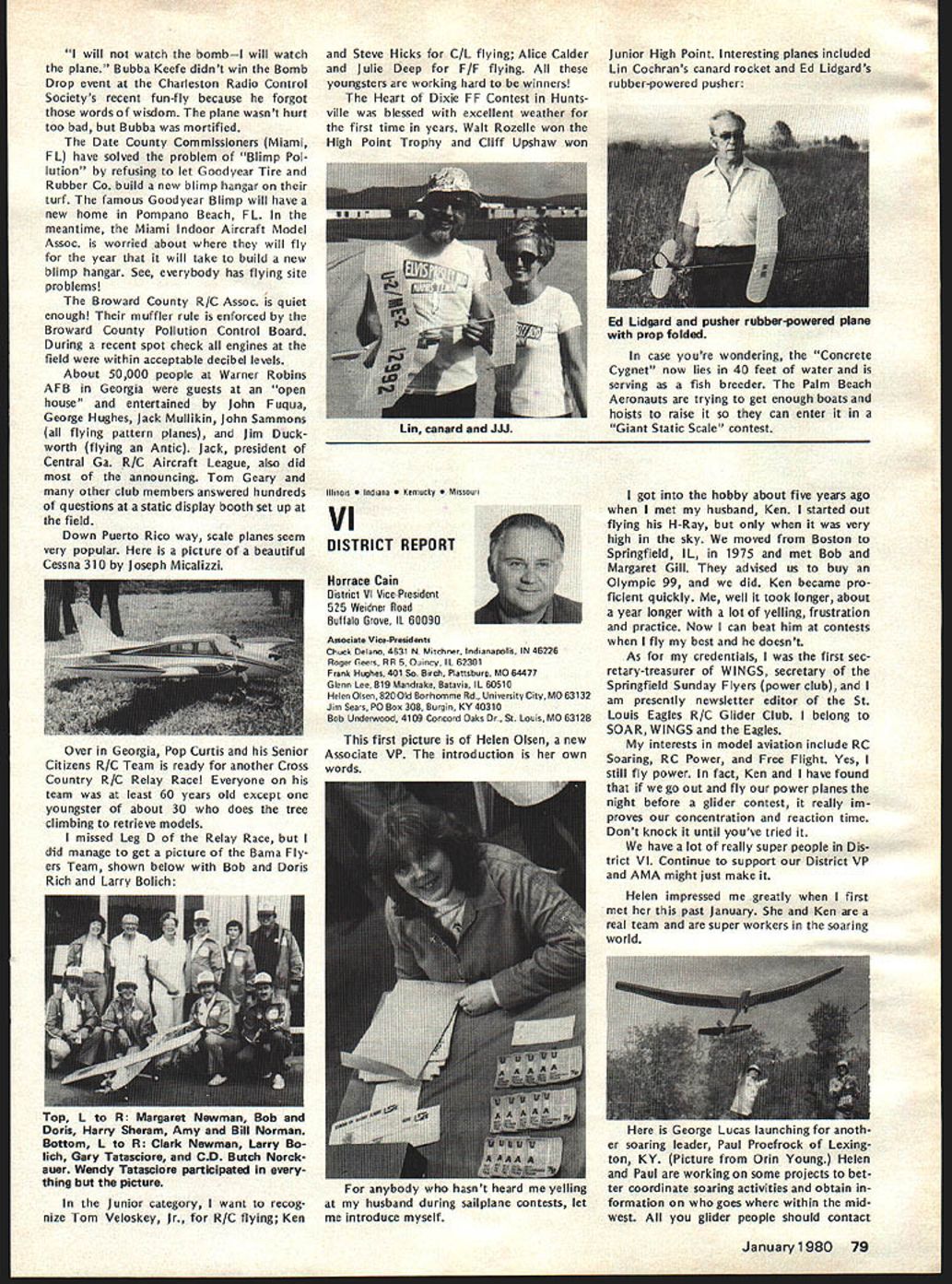
District VI plans include improved area coordination (Chicago Association meeting in February), more glider activity (Helen Olsen), and events such as the District Club Team Fun‑Fly Championships in Indianapolis on September 14, 1980. State contests are planned for July 19–20. There is an opening for a Contest Coordinator for Control Line and Free Flight.
HAPPY HOLIDAYS — FLY FRIENDLY SKIES.
Transcribed from original scans by AI. Minor OCR errors may remain.

