
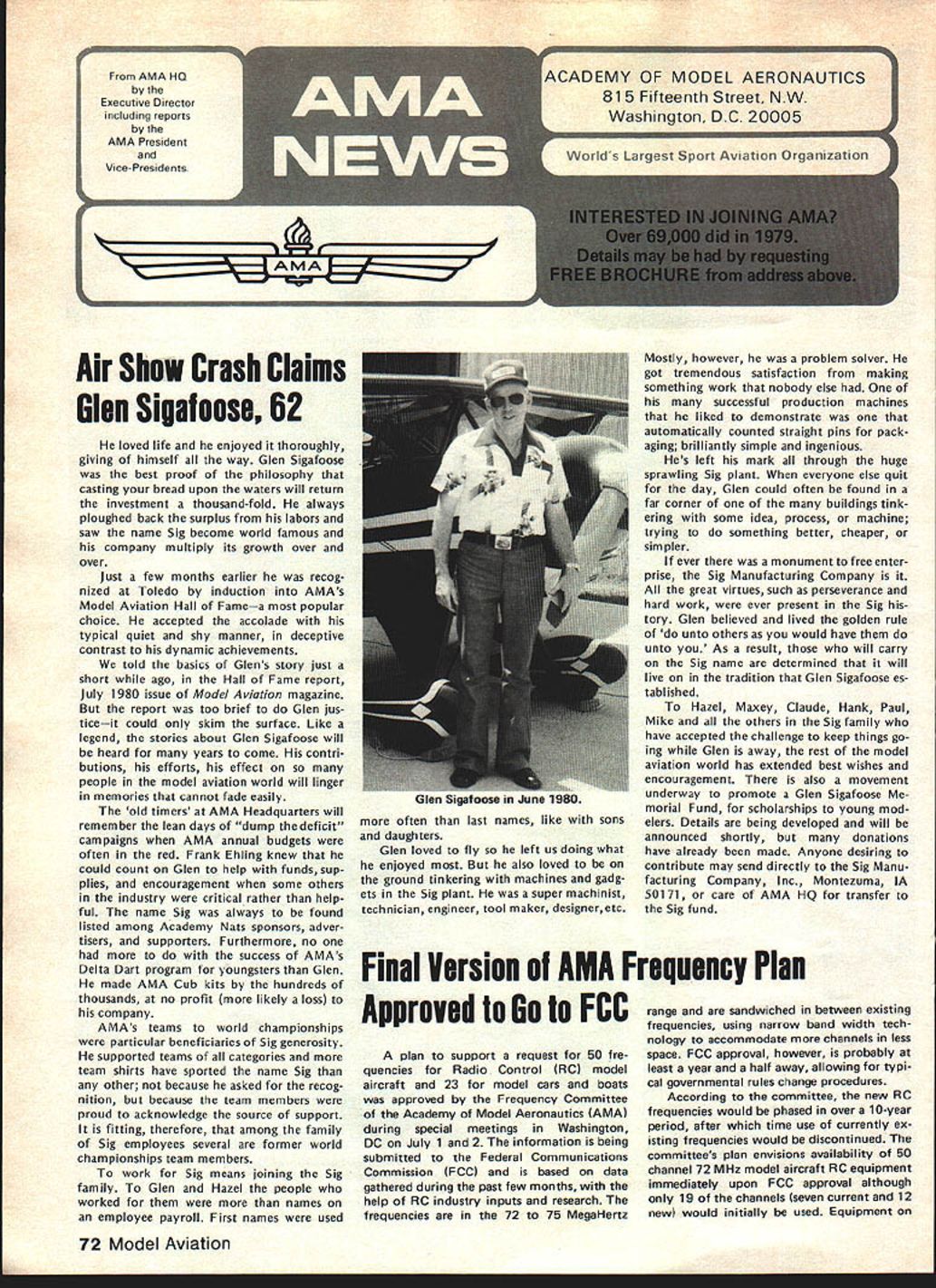
Air Show Crash Claims Glen Sigafoose, 62
Glen Sigafoose loved life and enjoyed it thoroughly, giving of himself freely. He was living proof of the philosophy that casting your bread upon the waters will return the investment a thousand-fold. Glen consistently ploughed back the surplus from his labors, saw the Sig name become world famous, and helped his company multiply its growth again and again.
A few months earlier he was inducted into AMA's Model Aviation Hall of Fame — a popular choice he accepted in his typical quiet, shy manner, deceptively at odds with his dynamic achievements. The brief Hall of Fame report in the July 1980 issue of Model Aviation could only skim the surface of his story.
Old-timers at AMA Headquarters remember the lean days and "dump the deficit" campaigns when AMA budgets were often in the red. Frank Ehling knew he could count on Glen for funds, supplies, and encouragement when others in the industry were critical rather than helpful. The name Sig was always listed among Academy Nats sponsors, advertisers, and supporters.
Glen did more than sponsor events. He was instrumental in the success of AMA's Delta Dart program for youngsters and produced hundreds of thousands of AMA Cub kits — often at no profit and sometimes at a loss to the company. AMA teams to world championships were frequent beneficiaries of Sig generosity; many team shirts bore the Sig name not because Glen asked for recognition but because team members were proud to acknowledge their source of support. Several former world championship team members have been among Sig employees.
To work for Sig meant joining the Sig family. Glen and Hazel regarded employees as more than payroll names; first names were used more often than last names. Glen loved to fly and left us doing what he enjoyed most, but he also loved to tinker with machines and gadgets in the Sig plant. He was a superb machinist, technician, engineer, toolmaker, and designer.
Above all, he was a problem solver who took great satisfaction in making something work that nobody else had. One of his favorite production machines to demonstrate was an ingenious automatic straight-pin counter for packaging. He left his mark throughout the sprawling Sig plant, often working in some far corner after everyone else had quit for the day to improve processes and machines.
Sig Manufacturing Company stands as a monument to free enterprise, perseverance, and hard work. Glen lived by the Golden Rule — "do unto others as you would have them do unto you" — and those who will carry on the Sig name are determined to preserve the tradition he established.
To Hazel, Maxey, Claude, Hank, Paul, Mike, and all others in the Sig family who have accepted the challenge to keep things going while Glen is away, the model aviation community extends its best wishes and encouragement. A movement is underway to promote a Glen Sigafoose Memorial Fund for scholarships to young modelers. Details will be announced shortly and many donations have already been made. Contributions may be sent to Sig Manufacturing Company, Inc., Montezuma, IA 50171, or care of AMA Headquarters for transfer to the Sig fund.
Final Version: AMA Frequency Plan Approved
The Frequency Committee of the Academy of Model Aeronautics (AMA), at special meetings in Washington, D.C., July 1–2, approved a plan supporting a request for 50 frequencies for radio control (R/C) model aircraft and 23 for model cars and boats. The proposal centers on narrow-bandwidth allocations in the 72–75 MHz range to accommodate many more channels in the same spectrum. Information and technical data have been gathered from the RC industry and research to support the submission to the Federal Communications Commission (FCC).
The committee envisions a 10-year phase-in/phase-out plan. New 50-channel equipment would be allowable for model aircraft use after the transition; existing 72–75 MHz equipment would be phased out according to the schedule below. FCC approval is expected to take at least a year and a half due to regulatory procedures.
What to expect assuming FCC approval:
- During the 10-year transition period a total of 19 frequencies would be available for model aircraft use — the seven currently approved plus 12 new frequencies that would become available as soon as equipment is offered for sale (expected immediately upon FCC approval, since narrow-band equipment is already marketed overseas). This equipment would be compatible with the 50-channel requirements in effect after the transition period.
- Four (instead of three) of the existing frequencies would be shared by model aircraft, boat, and car users during the 10-year transition: 72.16, 72.32, 72.92, and 75.64. Currently 75.64 is designated for aircraft only; it would be added to the shared group to align with the eventual frequency plan. During the transition 75.64 would still be available for aircraft use but with increased interference risk from non-aircraft activity.
- Twenty-one new frequencies for non-aircraft model use (cars/boats) would be available immediately after FCC approval, in addition to the four shared frequencies, giving up to 25 frequencies for car and boat operations during the 10-year transition.
- At the end of the 10-year transition, none of the existing 72–75 MHz frequencies would be used. Instead, 31 new frequencies would be available for model aircraft use. For car and boat use, the four current shared frequencies would be dropped and the new non-aircraft frequencies would provide up to 23 new channels.
- During the transition, any or all of the 50 new aircraft frequencies can be used where none of the current frequencies are used — for example at special meets (like the Nats) or at club fields that choose to exclude existing frequencies. Use of the 50 new frequencies would be legal upon FCC approval but mixing old and new equipment at the same location may be unsafe depending on frequency combinations. AMA plans to publish a list of compatible frequencies upon FCC approval.
- Similarly, the new frequencies for boats and cars can be used sooner than the end of the transition in specific situations where old frequencies are not in use.
- Because early operation of new frequencies is a safety matter, such operation may be incorporated into the AMA Safety Code. Insurance coverage might be contingent on proper or safe mixing of old and new frequencies at a given time and place; where frequency control is exercised to prevent unsafe mixing, insurance coverage would apply.
The exact text of AMA's submission to the FCC was being finalized and will be published as soon as it is received by the FCC.
New AMA RC Frequency Identification and Control System
Introduction
Why propose a new identification and control system after many years of the current color-streamer system? The existing streamer-based method cannot accommodate the many additional channels expected for RC use. The Frequency Committee therefore recommends a new system that introduces unique channel numbers for all RC channels (old and new), preserves compatibility with existing allocations (including 49 MHz), and is expandable for future frequencies. The FCC expects user organizations like the AMA to assume responsibility for local identification and control.
Highlights of the proposed system:
- Every RC channel, old or new, will have a unique channel number prominently displayed on the transmitter flag (plate). If changeable crystals or other selection methods are feasible, the number will identify the selected frequency.
- The system removes problems due to color blindness and flag fading.
- It provides immediate visibility for the 49 MHz band and is expandable for future allocations.
- Colors will distinguish bands (groups of frequencies); channel numbers will be the primary identifiers.
The plan was published in draft for member comment with the intention to introduce the system during the 1981 flying and competition season. Comments received during September 1980 would be considered prior to publication of a final version in November–December, with effectiveness on January 1, 1981 for AMA events.
AMA RC Frequency Identification and Control System — Overview
1.0 Objective
- Institute a new system covering existing channel allocations (including 49 MHz), allow continued use of the current seven channels on 72–75 MHz until superseded, and permit extension of channel numbers to new frequencies the FCC may authorize.
- The system is recommended for all AMA members and clubs as soon as practicable and will be mandatory at AMA-sponsored events starting calendar year 1981.
2.0 Background
- The present color-coded-flag system cannot accommodate a potential allocation of many additional RC channels (possibly 80 or more).
3.0 Description (General)
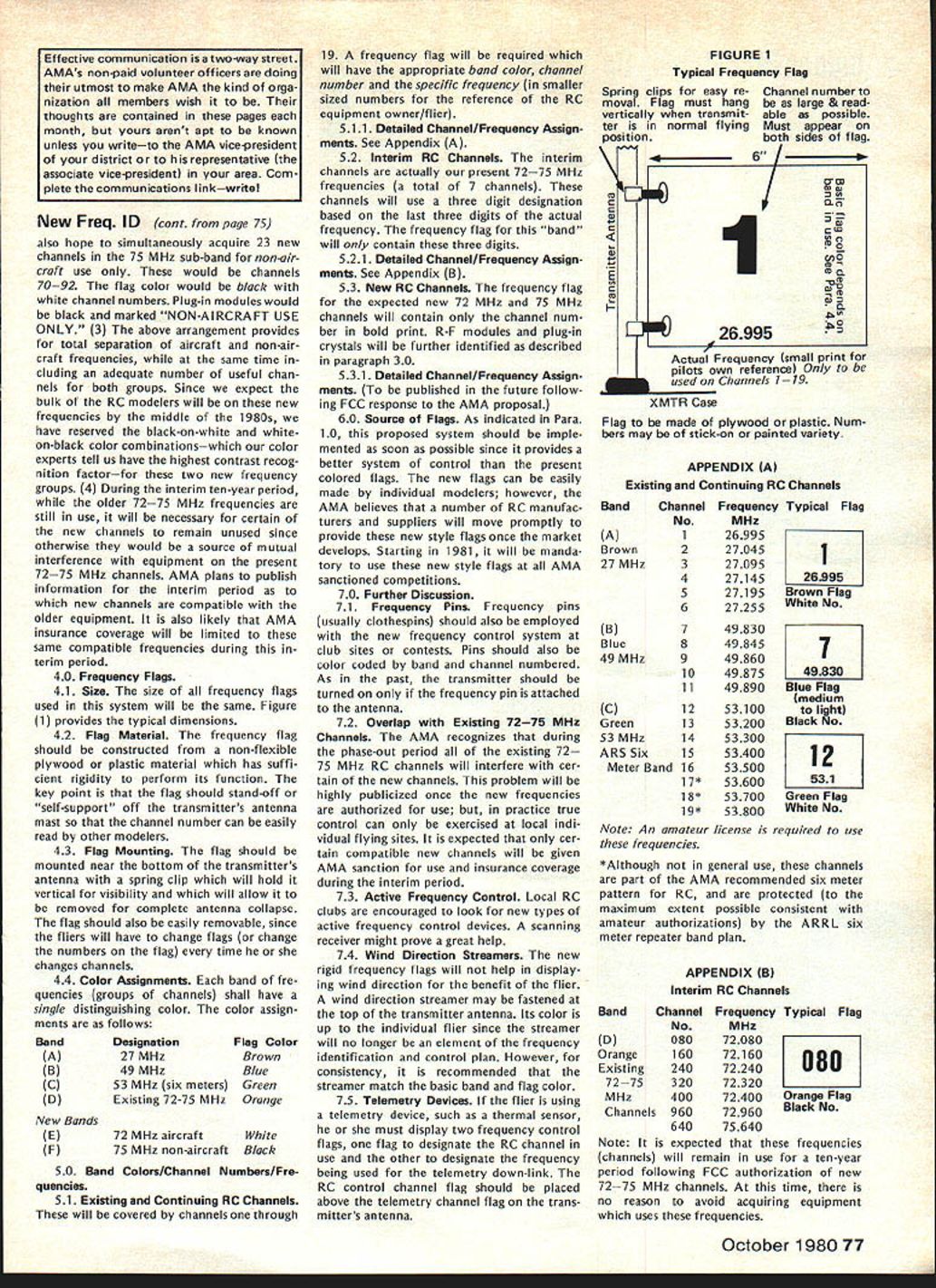
- A colored "flag" or plate with the channel number will be posted on every transmitter antenna. Channel numbering begins with existing 27 MHz frequencies.
- Existing RC channels on 27, 49 and 53 MHz will use the first 19 channel numbers. Flags for these channels will show both the channel number and the specific frequency.
- The current 72–75 MHz channels (total of seven) will have an interim three-digit designation based on the last three digits of the frequency (e.g., 72.080 → channel 080) to set them apart from the new allocations.
- Expected new 72–75 MHz allocations: aircraft-only channels 20–69 (white flag, black numbers); non-aircraft channels 70–92 (black flag, white numbers). Plug-in modules or crystals, if permitted, must follow the same band color-code and numbering.
- During the interim period some new channels will be unusable due to interference with existing equipment; AMA will publish compatibility guidance and may limit insurance coverage to compatible frequencies during the transition.
New Freq. ID — Key Points
- The new primary identifier is a sequential, unique channel number. Colors designate bands only.
- The AMA drew heavily on the European channel-numbering experience.
- The system addresses color blindness and fading issues and is readily expandable.
Frequency Flags
4.1 Size
- All frequency flags used in this system will be the same size.
4.2 Flag Material
- Construct flags from rigid plywood or plastic so they “self-support” off the transmitter antenna mast for easy reading.
4.3 Flag Mounting
- Mount near the bottom of the transmitter antenna with a spring clip to hang vertically and be removable for antenna collapse or channel changes.
4.4 Color Assignments
- Band (A) 27 MHz — Brown
- Band (B) 49 MHz — Blue
- Band (C) 53 MHz (six meters) — Green
- Band (D) Existing 72–75 MHz — Orange
- New Bands:
- Band (E) 72 MHz aircraft — White
- Band (F) 75 MHz non-aircraft — Black
Band Colors / Channel Numbers / Frequencies
5.1 Existing and Continuing RC Channels (Channels 1–19)
- Flags will display band color, channel number, and specific frequency (small print) for pilots’ reference.
- See Appendix (A) for detailed assignments.
5.2 Interim RC Channels (Existing 72–75 MHz — 7 channels)
- Use three-digit designations based on the last three digits of the actual frequency; flags contain only those three digits.
- See Appendix (B) for detailed assignments.
5.3 New RC Channels (New 72 MHz and 75 MHz channels)
- Flags will display only the channel number in bold print; plug-in modules and crystals will be similarly identified.
- Detailed assignments to follow after FCC response.
6.0 Source of Flags
- Individual modelers can produce flags, and manufacturers/suppliers are expected to supply them once the market develops. Starting in 1981, these flags will be mandatory at AMA-sanctioned competitions.
7.0 Further Discussion
7.1 Frequency Pins
- Use frequency pins (e.g., clothes pins) color-coded by band and numbered by channel; transmitter should be turned on only if the pin is attached.
7.2 Overlap with Existing 72–75 MHz Channels
- During the phase-out, existing channels will interfere with certain new channels. Local control at flying sites will be critical. AMA will publicize compatible new channels and likely limit insurance coverage to those compatible frequencies in the interim.
7.3 Active Frequency Control
- Clubs are encouraged to explore active devices, such as scanning receivers, for frequency control.
7.4 Wind Direction Streamers
- Because flags are rigid, wind streamers may be attached at the top of the antenna. Streamer color is optional, but matching the band color is recommended.
7.5 Telemetry Devices
- If using telemetry, display two flags: the RC control channel flag above the telemetry channel flag on the antenna.
7.6 Transmitter Antenna
- (See Figure 1 details below on mounting and visibility.)
Figure 1 — Typical Frequency Flag (Specifications)
- Spring clips for easy removal; flag must hang vertically when the transmitter is in normal flying position.
- Channel number to be as large and readable as possible; must appear on both sides of the flag.
- Flag material: plywood or plastic. Numbers may be stick-on or painted.
- Actual frequency (small print) only to be used on channels 1–19.
Appendix (A) — Existing and Continuing RC Channels
Band (A) 27 MHz — Brown flag
- Channel 1 — 26.995 MHz
- Channel 2 — 27.045 MHz
- Channel 3 — 27.095 MHz
- Channel 4 — 27.145 MHz
- Channel 5 — 27.195 MHz
- Channel 6 — 27.255 MHz
Typical flag: Brown flag, white “1” (26.995)
Band (B) 49 MHz — Blue flag (medium to light)
- Channel 7 — 49.830 MHz
- Channel 8 — 49.845 MHz
- Channel 9 — 49.860 MHz
- Channel 10 — 49.875 MHz
- Channel 11 — 49.890 MHz
Typical flag: Blue flag, black “7” (49.830)
Band (C) 53 MHz (six meters) — Green flag
- Channel 12 — 53.100 MHz
- Channel 13 — 53.200 MHz
- Channel 14 — 53.300 MHz
- Channel 15 — 53.400 MHz
- Channel 16 — 53.500 MHz
- Channel 17* — 53.700 MHz
- Channel 18* — 53.800 MHz
Typical flag: Green flag, white “12” (53.100)
Band (D) Existing 72–75 MHz Channels
- Channels 19–25 — See Appendix (B) for interim three-digit designations
Note: An amateur license is required to use the six-meter (53 MHz) frequencies marked with an asterisk. These channels are part of the AMA-recommended six-meter pattern and are protected consistent with amateur authorizations.
Appendix (B) — Interim RC Channels (Existing 72–75 MHz)
Band (D) Existing 72–75 MHz — Orange flag (interim three-digit designations)
- Channel 080 — 72.080 MHz
- Channel 160 — 72.160 MHz
- Channel 240 — 72.240 MHz
- Channel 320 — 72.320 MHz
- Channel 400 — 72.400 MHz
- Channel 480 — 72.480 MHz
- Channel 560 — 72.560 MHz
- Channel 640 — 72.640 MHz
- Channel 720 — 72.720 MHz
- Channel 800 — 72.800 MHz
Typical flag: Orange flag, black “080” (72.080)
Note: These interim channels are expected to remain in use for ten years following FCC authorization of new 72–75 MHz channels. There is no reason to avoid acquiring equipment using these frequencies at this time.
New Freq. ID — Summary
- New system uses unique sequential channel numbers as the primary identifier; colors denote bands only.
- Aircraft new channels: channels 20–69 (white flag, black numbers).
- Non-aircraft new channels: channels 70–92 (black flag, white numbers).
- During the interim period AMA will publish which new channels are compatible with older equipment and may limit insurance to compatible channels.
National Car Discount — 20%
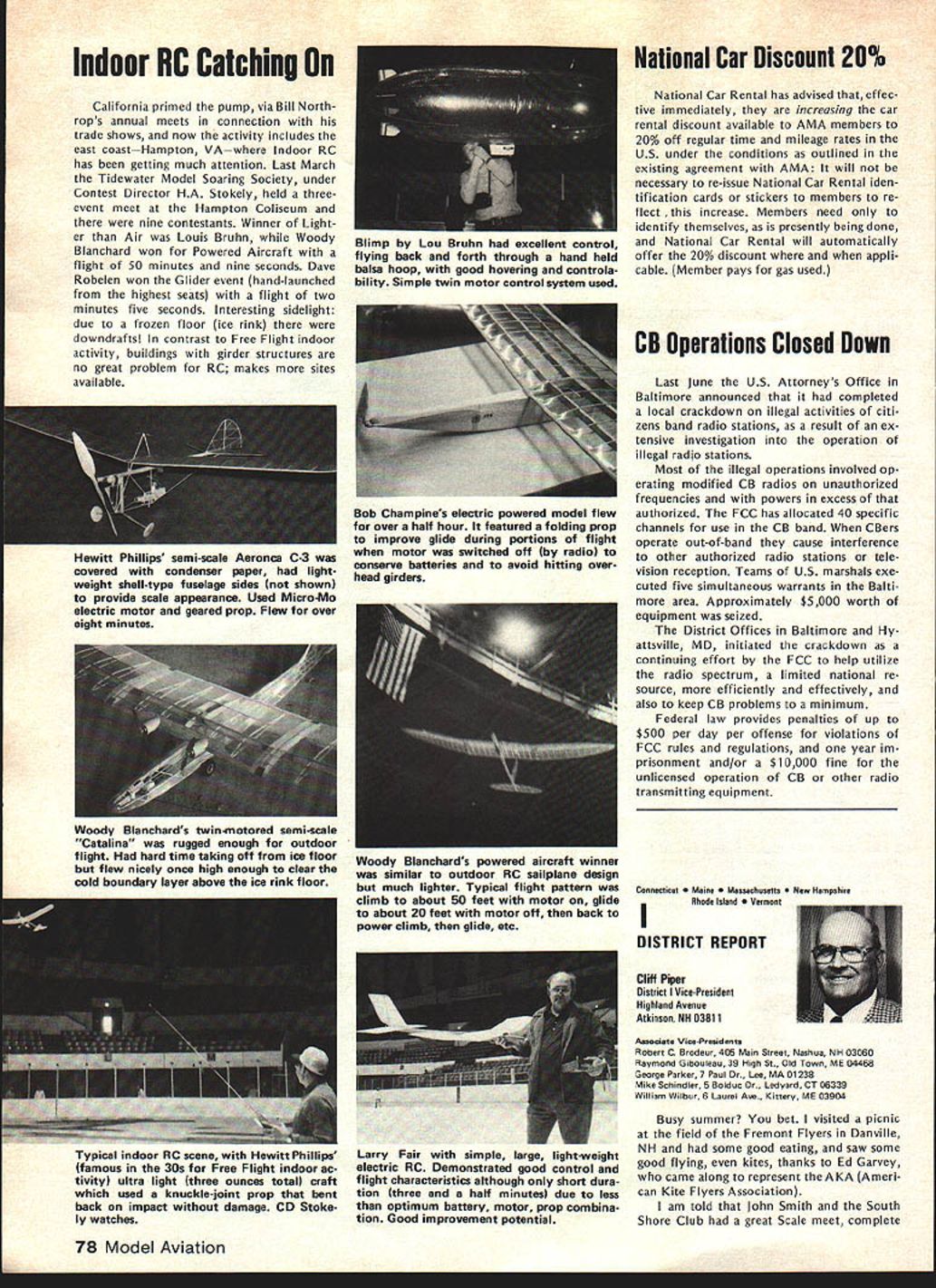
National Car Rental increased the rental discount available to AMA members to 20% off regular time and mileage rates in the U.S., effective immediately. Members do not need new identification cards; simply identify yourself and National will apply the 20% discount where applicable. Member pays for fuel used.
CB Operations Closed Down
In June the U.S. Attorney’s Office in Baltimore concluded a local crackdown on illegal CB radio activity after an investigation into unlicensed and modified CB operations. Illegal operations often used unauthorized frequencies and excessive power. Teams of U.S. marshals executed five simultaneous warrants and seized approximately $5,000 in equipment.
The Baltimore and Hyattsville district offices initiated the crackdown as part of FCC efforts to manage the radio spectrum efficiently and minimize CB interference. Federal penalties include fines up to $500 per day per offense and, for unlicensed operation, up to one year imprisonment and/or a $10,000 fine.
DISTRICT REPORT — Connecticut • Maine • Massachusetts • New Hampshire • Rhode Island • Vermont
Cliff Piper — District I Vice-President Highland Avenue, Atkinson, NH 03811
Associate Vice-Presidents
- Robert E. Brodeur — 405 Main Street, Nashua, NH 03060
- Raymond Bibeault — 39 High St., Old Town, ME 04468
- George Parker — 7 Park Dr., Lee, MA 02138
- Mike Schindler — 5 Radcliffe Dr., Ledyard, CT 06339
- William Wilbur — 6 Laurel Ave., Kittery, ME 03904
Busy summer reports:
- Picnic at the Fremont Flyers in Danville, NH — good flying and good food.
- South Shore Club’s Scale meet with 53 entries and hundreds of spectators.
- Delta Dart and other youth activities promoted locally.
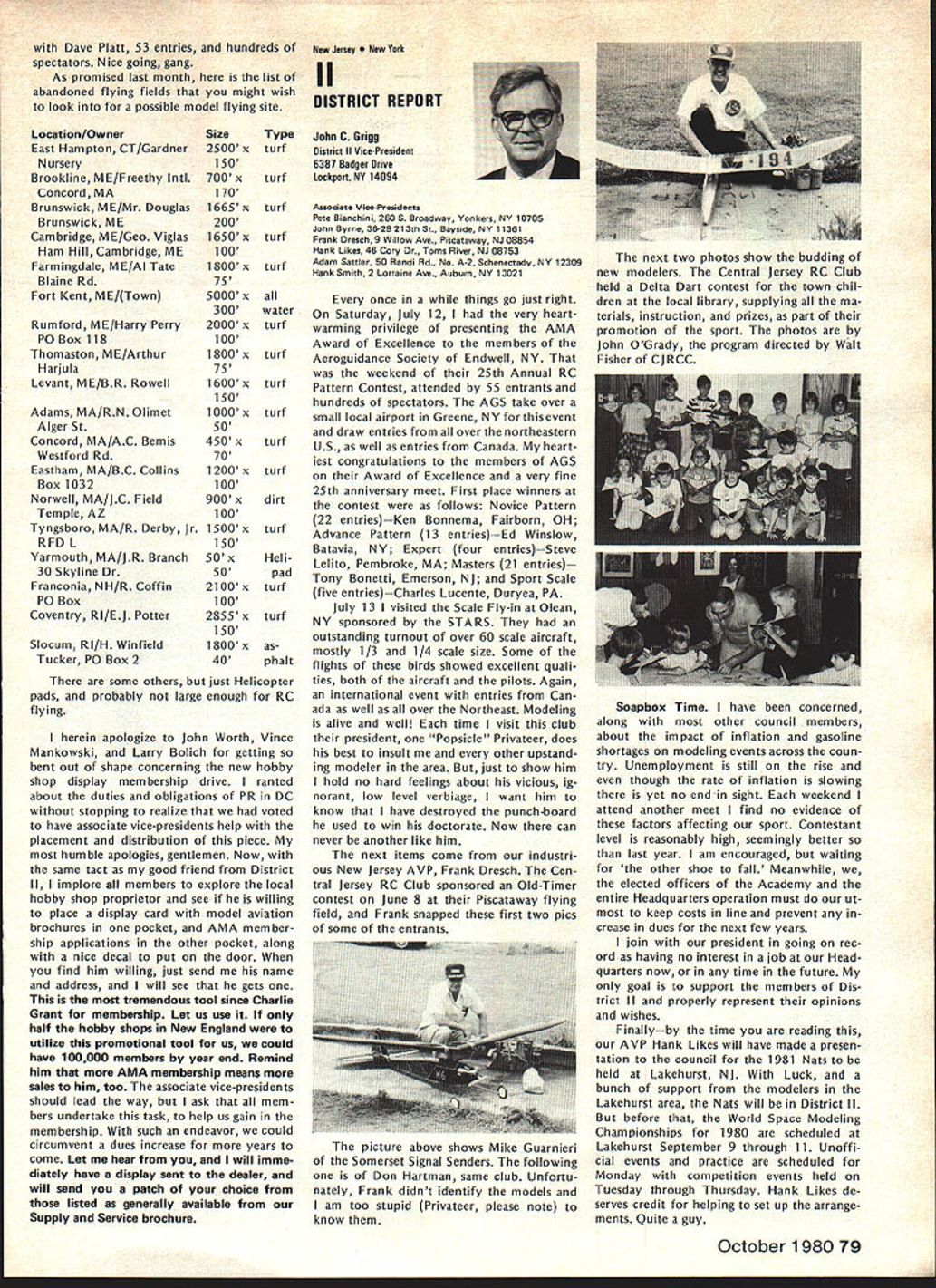
Abandoned flying fields (possible model sites) — Location — Size — Type:
- East Hampton, CT / Gardner Nursery — 2500' x 150' — turf
- Brookline, ME / Freethy Intl. — 700' x ? — turf
- Concord, MA — 170' x ? — turf
- Brunswick, ME / Mr. Douglas — 1665' x ? — turf
- Brunswick, ME — 200' x ? — turf
- Cambridge, ME / Geo. Viglas — 1650' x ? — turf
- Ham Hill, Cambridge, ME — 100' x ? — turf
- Farmingdale, ME / Al Tate — 1800' x ? — turf
- Blaine Rd. — 75' x ? — turf
- Fort Kent, ME / (Town) — 5000' x ? — all; 300' water
- Rumford, ME / Harry Perry — 2000' x ? — turf
- PO Box 118 — 100' x ? — turf
- Thomaston, ME / Arthur Harjula — 1800' x ? — turf
- Levant, ME / B.R. Rowell — 1600' x ? — turf
- Adams, MA / R.N. Olmiet — 1000' x ? — turf
- Alger St. — 50' x ? — turf
- Concord, MA / A.C. Bemis — 450' x ? — turf
- Westford Rd. — 70' x ? — turf
- Eastham, MA / B.C. Collins — 1200' x ? — turf
- Box 1032 — 100' x ? — turf
- Norwell, MA / J.C. Field — 900' x ? — dirt
- Temple, AZ — 100' x ? — ?
- Tyngsboro, MA / R. Derby, Jr. — 1500' x ? — turf
- RFD 1 — 150' x ? — ?
- Yarmouth, MA / J.R. Branch — 50' x ? — Heli.
- 30 Skyline Dr. — 50' pad — ?
- Franconia, NH / R. Coffin — 2100' x ? — turf
- PO Box — 100' x ? — ?
- Coventry, RI / E.J. Potter — 2855' x ? — turf
- Slocum, RI / H. Winfield — 1800' x ? — ?
- Tucker, PO Box 2 — 40' x ? — asphalt
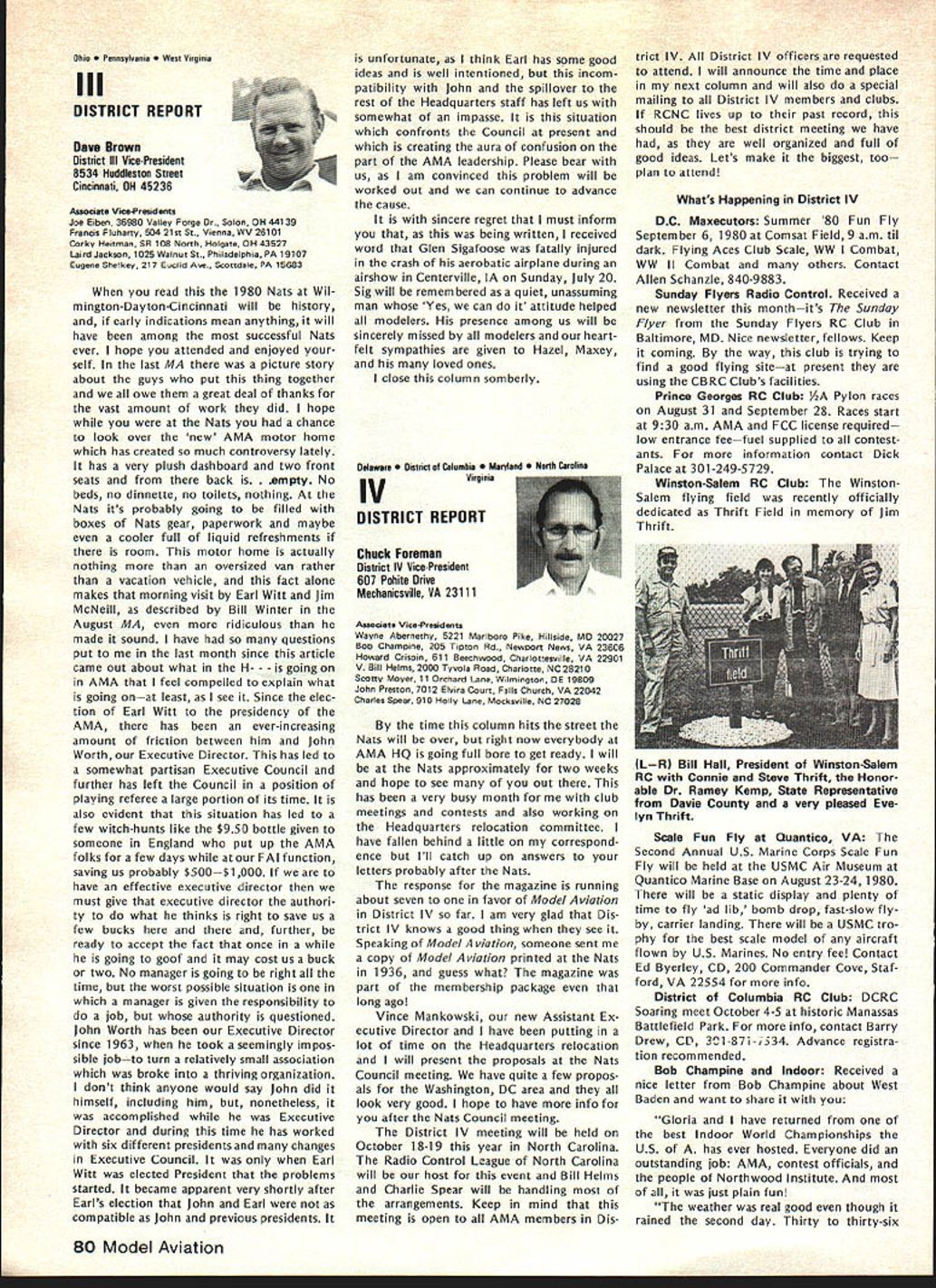
Apology and correction: The author apologized to John Worth, Vince Mankowski, and Larry Bohlic for earlier misstatements about the hobby shop display membership drive and clarified that associate vice-presidents are assisting with placement and distribution of display materials. Members are encouraged to approach local hobby shops to place display cards and AMA membership applications.
II DISTRICT REPORT — New Jersey • New York
John C. Grigg — District II Vice-President 6387 Badger Drive, Lockport, NY 14094
Associate Vice-Presidents
- Pete Bianchi — 260 S. Broadway, Yonkers, NY 10705
- John Byrne — 36-29 213th St., Bayside, NY 11361
- Frank Dresch — 9 Willow Ave., Piscataway, NJ 08854
- Hank Likes — 46 Cory Dr., Tom's River, NJ 08753
- Adam Sattler — 50 Rand Ave., No. A-2, Schenectady, NY 12305
- Hank Smith — 2 Lorraine Ave., Auburn, NY 13021
Highlights:
- Presented the AMA Award of Excellence to the Aeroguidance Society of Endwell, NY at their 25th Annual RC Pattern Contest (55 entrants). Winners included Ken Bonnema (Novice), Ed Winslow (Advanced), Steve Lelito (Expert), Tony Bonetti (Masters), and Charles Lucente (Sport Scale).
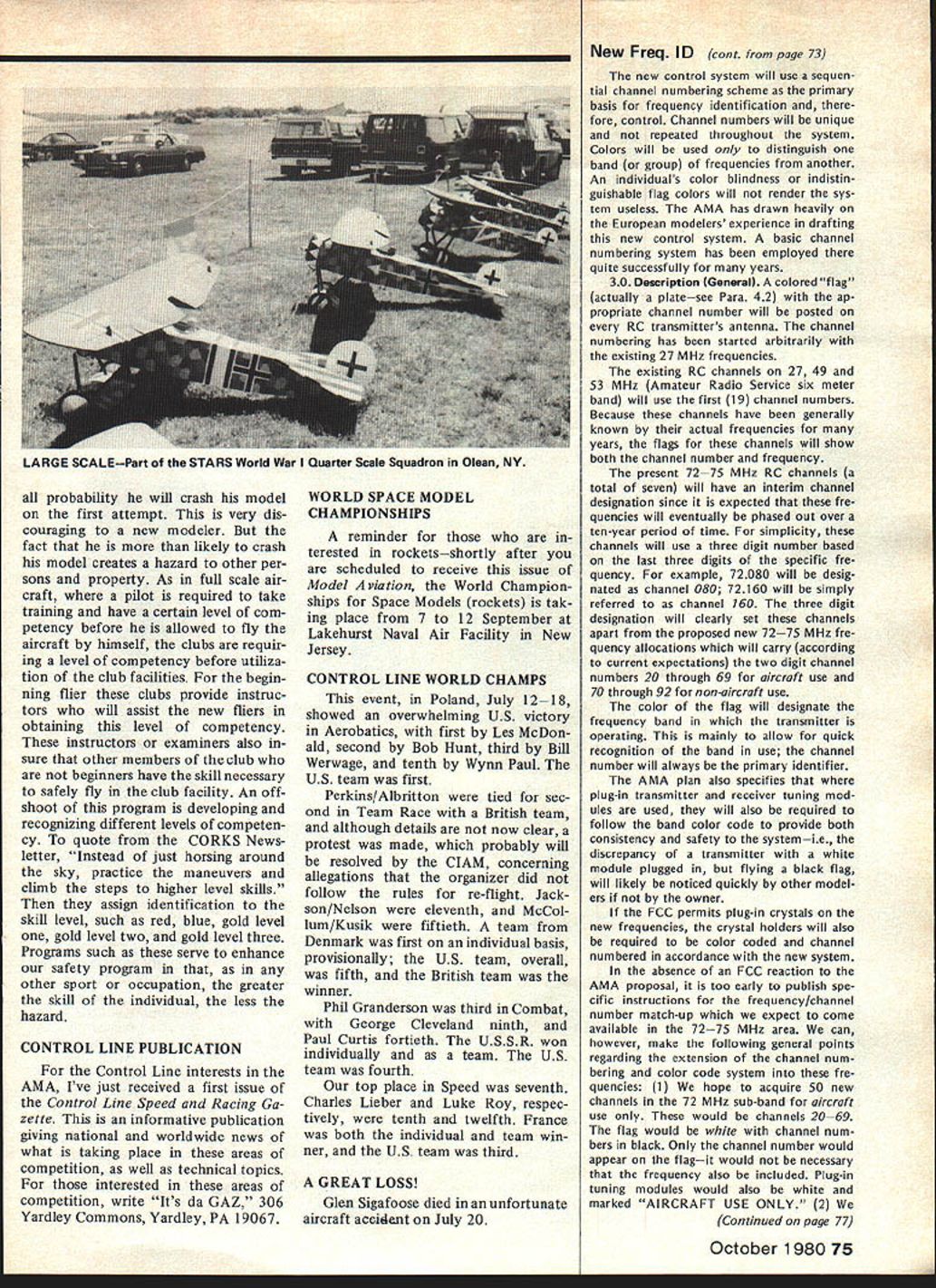
- Scale Fly-in at Olean, NY (STARS): over 50 scale aircraft; strong international participation.
- Central Jersey RC Club Old-Timer contest and youth Delta Dart contest at the local library were successful outreach events.
- Concern expressed over inflation and gasoline shortages but contest participation remained strong.
- Presentation planned for 1981 Nats at Lakehurst, NJ; World Scale Modeling Championships scheduled at Lakehurst September 9–11, 1980.
V DISTRICT REPORT
Bill Mathews — District V Vice President 311 Poinciana Drive, Birmingham, AL 35209
Associate Vice-Presidents
- John Gorday — Jackson, MS
- Richard Jackson — Charleston Heights, SC
- Arthur Johnson — Delray Beach, FL
- Philip McDowell — Nashville, TN
- Joseph Malizia, Sr. — Fajardo, PR
- Ed Moorman — Shalimar, FL
- Henry Shearon — Birmingham, AL
- Tom Tucker — Decatur, GA
Notes:
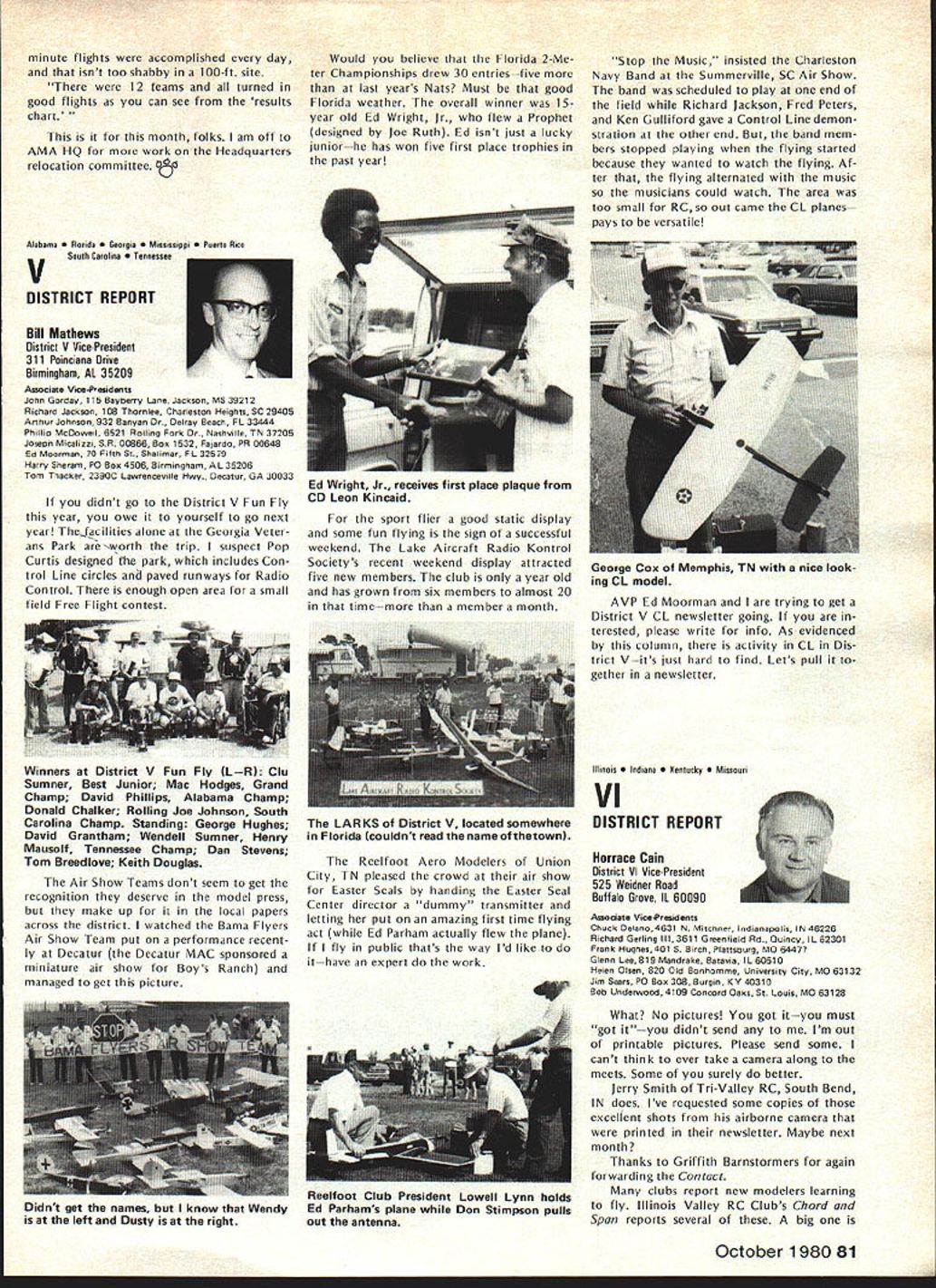
- District V Fun Fly at Georgia Veterans Park highly recommended.
- Air show teams like the Bama Flyers perform well and receive local recognition.
- Lake Aircraft Radio Kontrol Society’s weekend display attracted five new members (club grew from 6 to almost 20).
- Efforts underway to start a District V Control Line (CL) newsletter; interested parties should write for information.
VI DISTRICT REPORT
Horrace Cain — District VI Vice-President 525 Weidner Road, Buffalo Grove, IL 60090
Associate Vice-Presidents
- Chuck Davison — Indianapolis, IN
- Richard Gerling — Quincy, IL
- Frank Magnus — Pittsburg, MO
- Glenn Lee — Batavia, IL
- Allen Olsen — University City, MO
- Jim Sears — Burgin, KY
- Bob Underwood — St. Louis, MO
Notes:
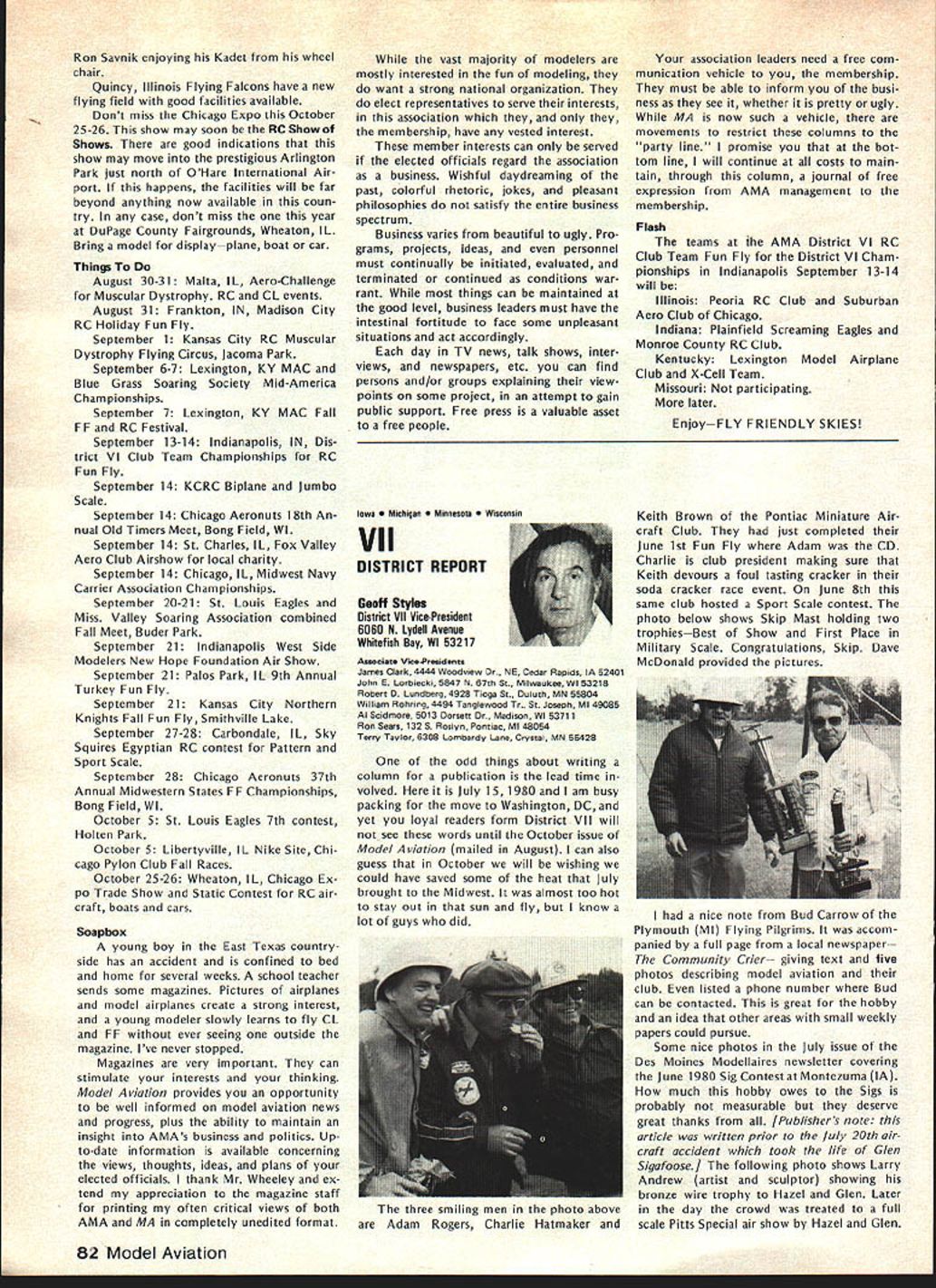
- Request for photos from clubs and meets; contributors encouraged to send prints.
- Acknowledgment of great airborne camera photos from Tri-Valley RC (South Bend, IN).
- Clubs continue to report new modelers learning to fly.
Editorial / Letters
"What You Don't Know Can Hurt You"
- Commentary addressed a Model Retailer editorial that criticized AMA leadership; the writer disputes claims that the current AMA President lacks qualifications and defends the survey process related to magazine optionality. The writer claims the Executive Council’s decision to make the magazine optional contradicts the survey results and expresses strong dissatisfaction with Council actions that appear self-interested.
"Vince Mankowski Moves to DC"
- Vince Mankowski has moved to Washington, DC to become Assistant Executive Director for the AMA. Former colleagues and members praise his contributions to local clubs, the 1979 Nats in Lincoln, and AMA District IX.
AT-6 Texans — Independence Day Pylon Racing (Pueblo, CO)
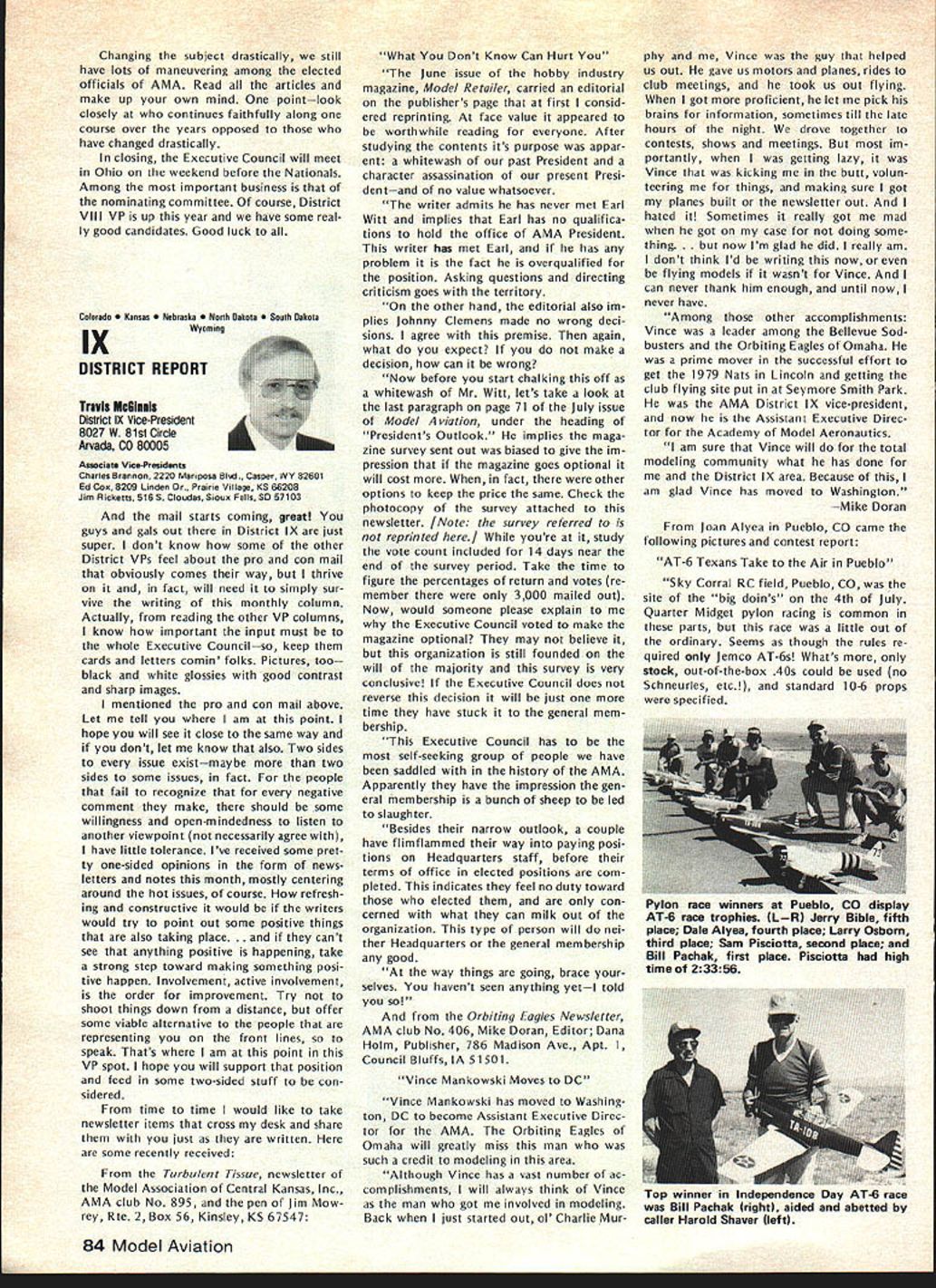
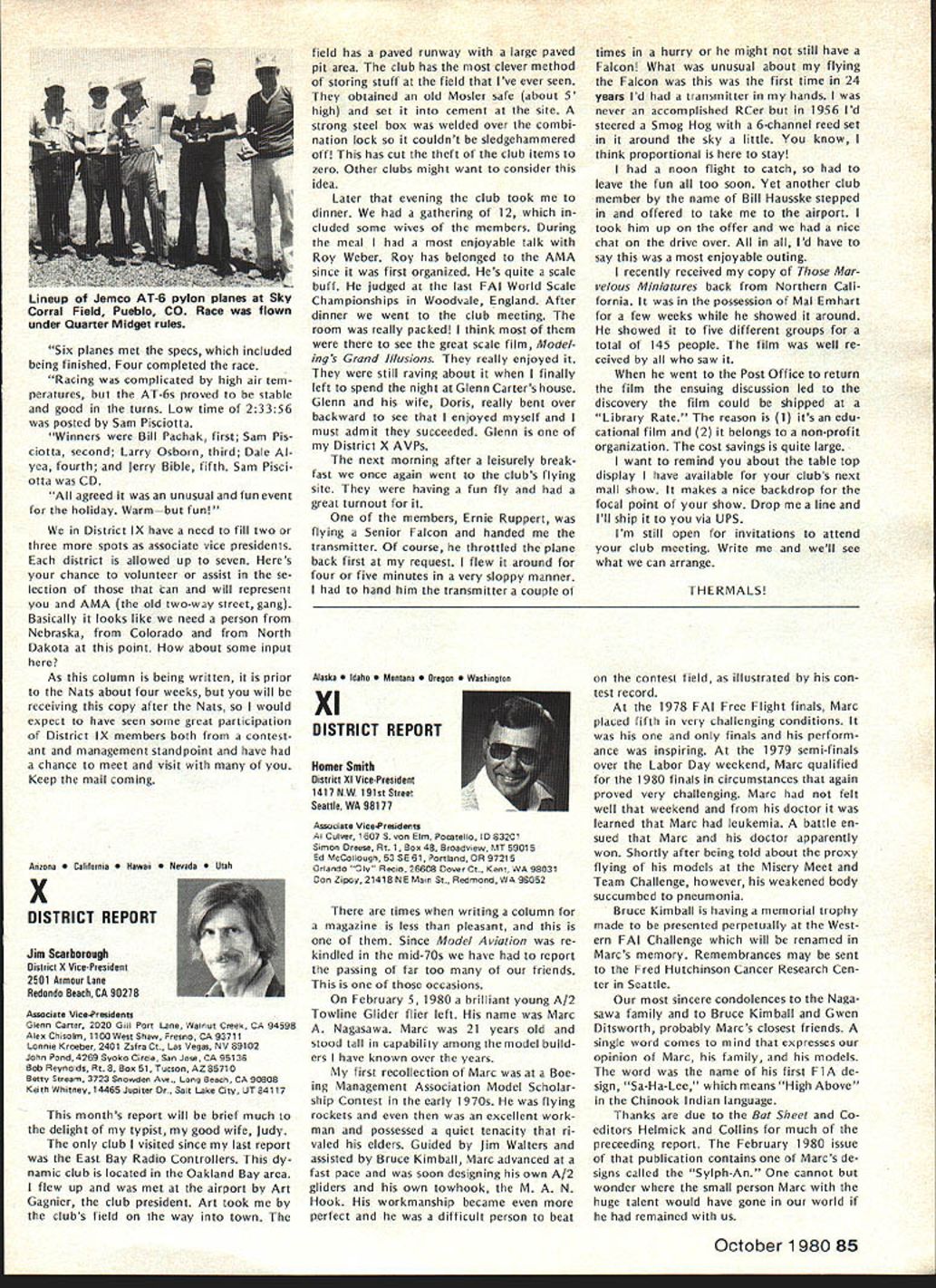
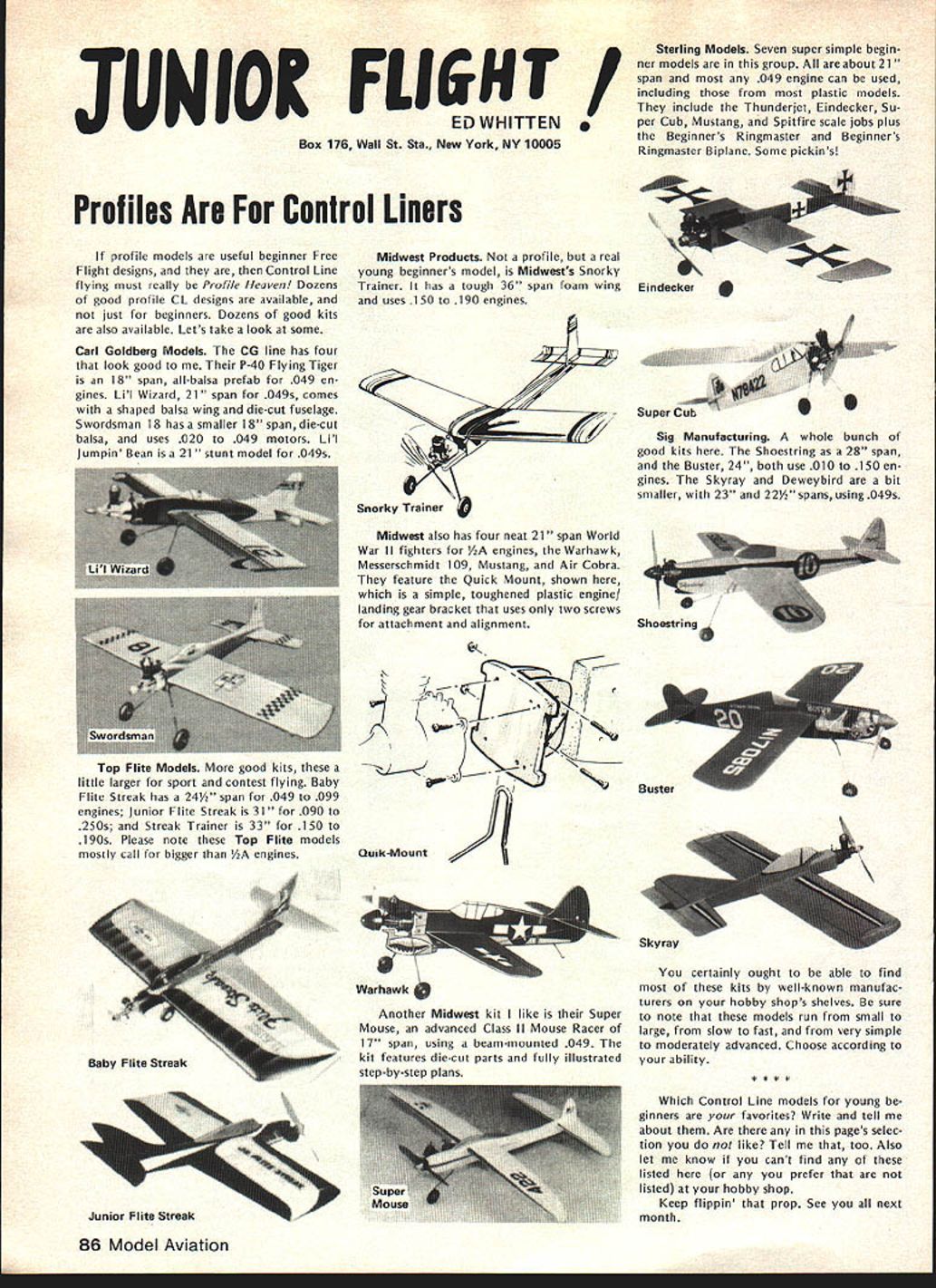
- Sky Corral RC field hosted an AT-6-only pylon race on July 4 with stock .40 engines and standard 10-6 props. Winners:
- 1st — Bill Pachak
- 2nd — Sam Piscotta
- 3rd — Larry Osborn
- 4th — Dale Alyea
- 5th — Jerry Birie
Miscellany / Closing Notes
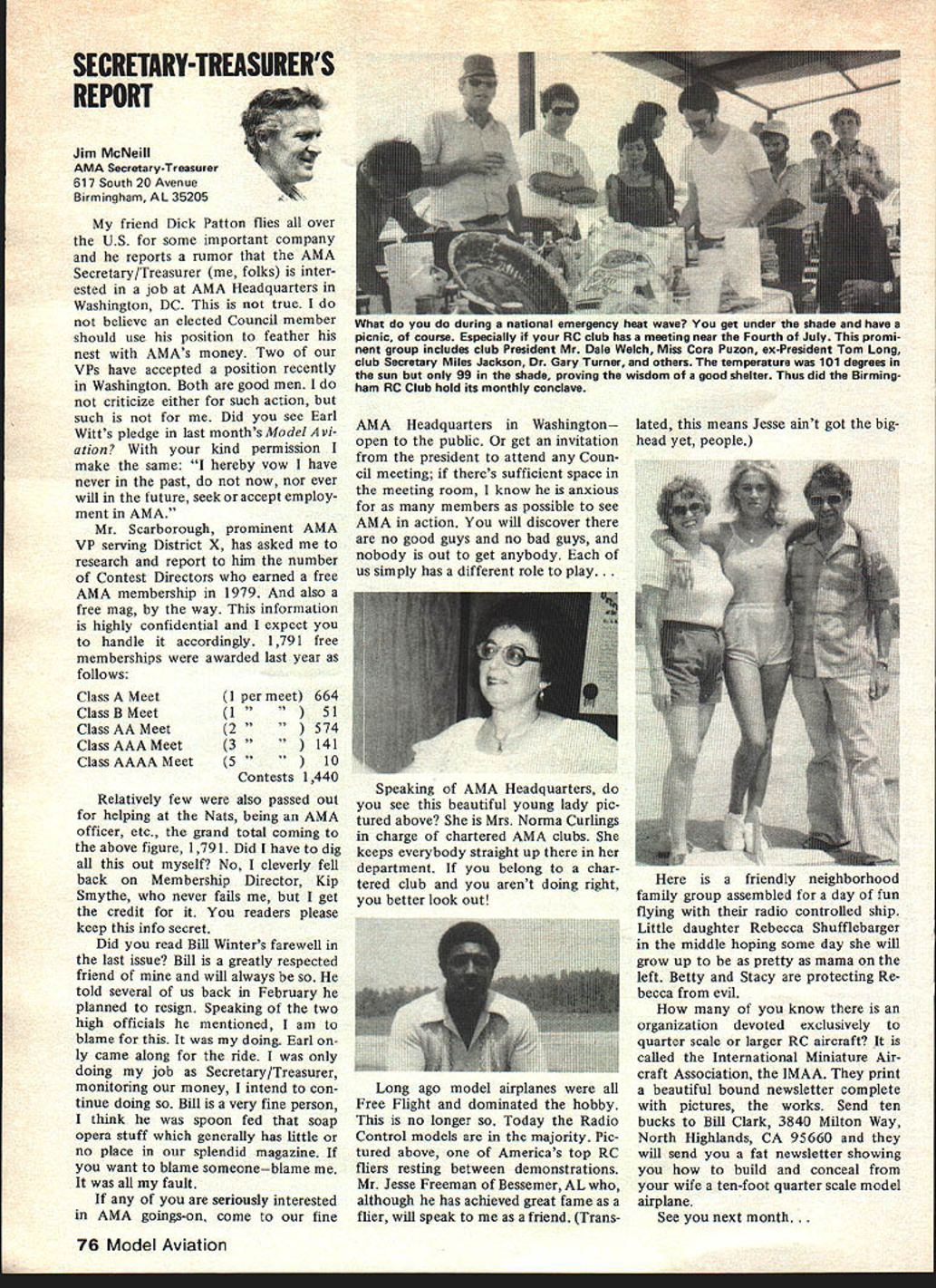
- AMA Headquarters is open to the public; members may request invitations to Council meetings if space allows.
- Mrs. Norma Curlings oversees chartered AMA clubs and maintains administrative order.
- The International Miniature Aircraft Association (IMAA) is focused on quarter-scale and larger RC aircraft; membership information available from Bill Clark, North Highlands, CA.
Fly friendly skies.
Transcribed from original scans by AI. Minor OCR errors may remain.

