
AMA NEWS
AMA Special Report to FCC Completes Big First Step to Get More RC Frequencies
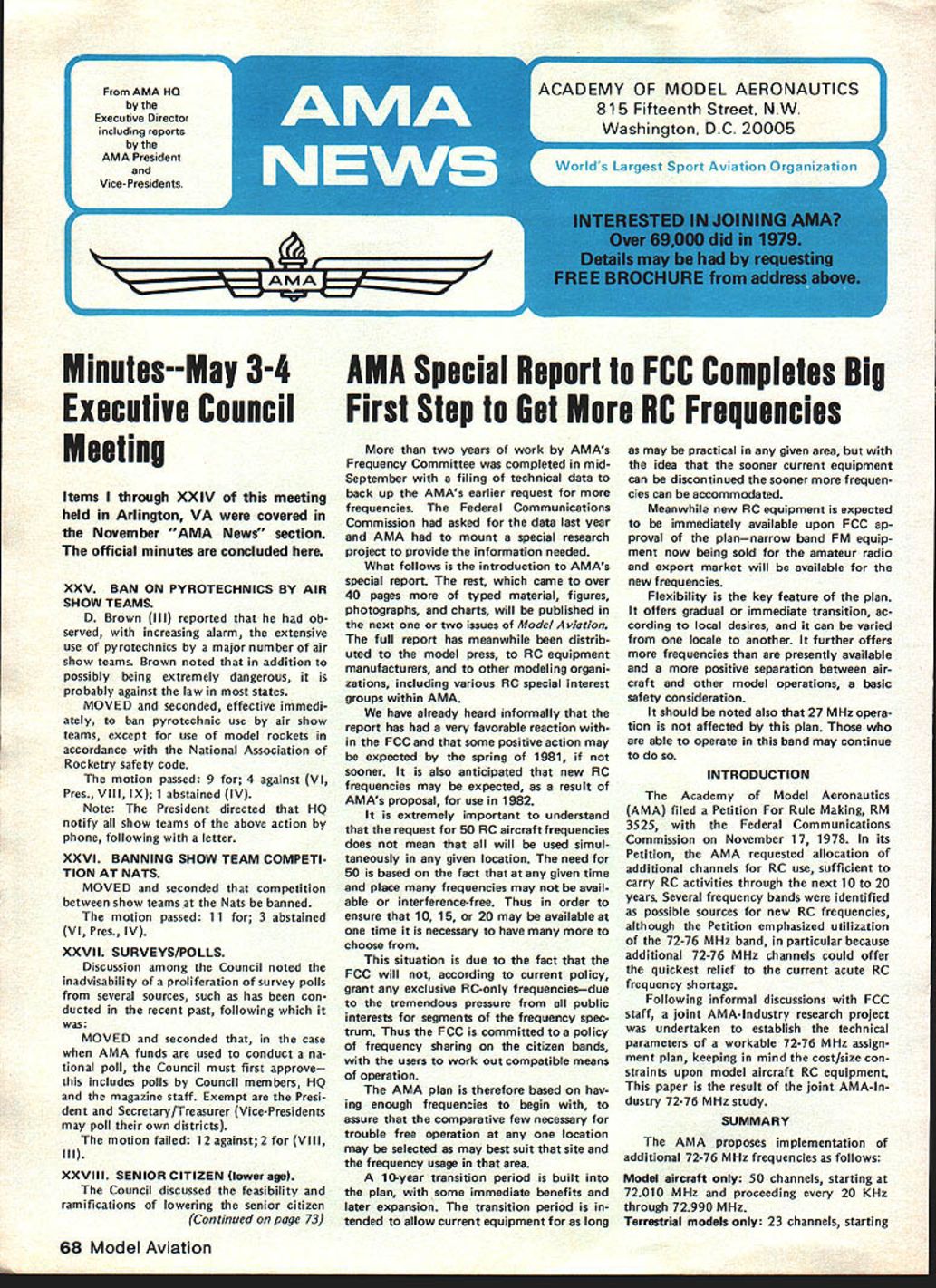
More than two years of work by AMA's Frequency Committee was completed in mid-September with the filing of technical data to back up the AMA's earlier request for more frequencies. The Federal Communications Commission had asked for the data last year, and AMA mounted a special research project to provide the information needed.
What follows is the introduction to AMA's special report. The remainder — over 40 pages of typed material, figures, photographs, and charts — will be published in the next one or two issues of Model Aviation. The full report has meanwhile been distributed to the model press, RC equipment manufacturers, and other modeling organizations, including various RC special-interest groups within AMA.
Informally, the report has received a very favorable reaction at the FCC. Some positive action may be expected by spring 1981, if not sooner. It is also anticipated that new RC frequencies could be available for use in 1982.
It is important to understand that the request for 50 RC aircraft frequencies does not mean all will be used simultaneously at any given location. The need for 50 is based on the fact that, at any time and place, many frequencies may not be available or interference-free. Having a larger pool increases the chances that 10, 15, or 20 usable channels will be available locally.
Current FCC policy, due to pressure from many public-interest users, does not provide exclusive RC-only frequencies; the FCC is committed to a policy of frequency sharing in the citizen bands. The AMA plan is therefore to provide enough interlaced frequencies so RC modelers can select channels that are compatible in their local areas.
A 10-year transition period is built into the plan, offering immediate benefits and later expansion. This allows current equipment to remain in use as practical while enabling eventual conversion to narrow-band equipment. Narrow-band FM equipment already being sold for the amateur radio and export markets is expected to be available for the new frequencies.
Flexibility is a key feature of the plan: it permits gradual or immediate local transitions, provides more frequencies than currently available, and offers clearer separation between aircraft and other model operations — an important safety consideration. The plan does not affect 27 MHz operation; users able to operate in that band may continue to do so.
INTRODUCTION
The Academy of Model Aeronautics (AMA) filed a Petition for Rule Making, RM-3525, with the Federal Communications Commission on November 17, 1978. In its petition, AMA requested allocation of additional channels for RC use sufficient to carry RC activities through the next 10 to 20 years. Several frequency bands were identified as possible sources for new RC frequencies, with emphasis on the 72–76 MHz band because additional channels there could offer the quickest relief to the current acute shortage.
Following informal discussions with FCC staff, a joint AMA–industry research project established the technical parameters of a workable 72–76 MHz assignment plan, mindful of cost and size constraints on model aircraft RC equipment. This paper is the result of that joint study.
SUMMARY
The AMA proposes implementation of additional 72–76 MHz frequencies as follows:
- Model aircraft only: 50 channels, starting at 72.010 MHz and proceeding every 20 kHz through 72.990 MHz.
- Terrestrial models only: 23 channels, starting at 75.410 MHz and proceeding every 20 kHz through 75.850 MHz.
The AMA recommends that existing equipment and frequencies be phased out according to this timetable:
- Year 0 — Adopt rules.
- Year 3 — Manufacturing of equipment under present rules to cease.
- Year 5 — Sale of equipment under present rules to cease.
- Year 10 — Use of equipment under present rules to cease; the seven primary RC frequencies now available in the 72–76 MHz band to be withdrawn.
Notes on compatibility and implementation:
- Use of 50-channel equipment simultaneously with existing 7-channel equipment may produce problems from intermodulation products and image response in older receivers.
- New frequencies immediately adjacent to older, wider-band equipment cannot be used without compatibility problems; initially, about thirteen usable new channels plus the current seven will be compatible for aircraft operations with both old and new equipment. For non-aircraft operations, approximately 21 new channels may be used without compatibility problems.
- After rule adoption and the full transition, the plan envisions 50 aircraft-only channels and 23 non-aircraft channels, all narrow-band, with old channels discontinued.
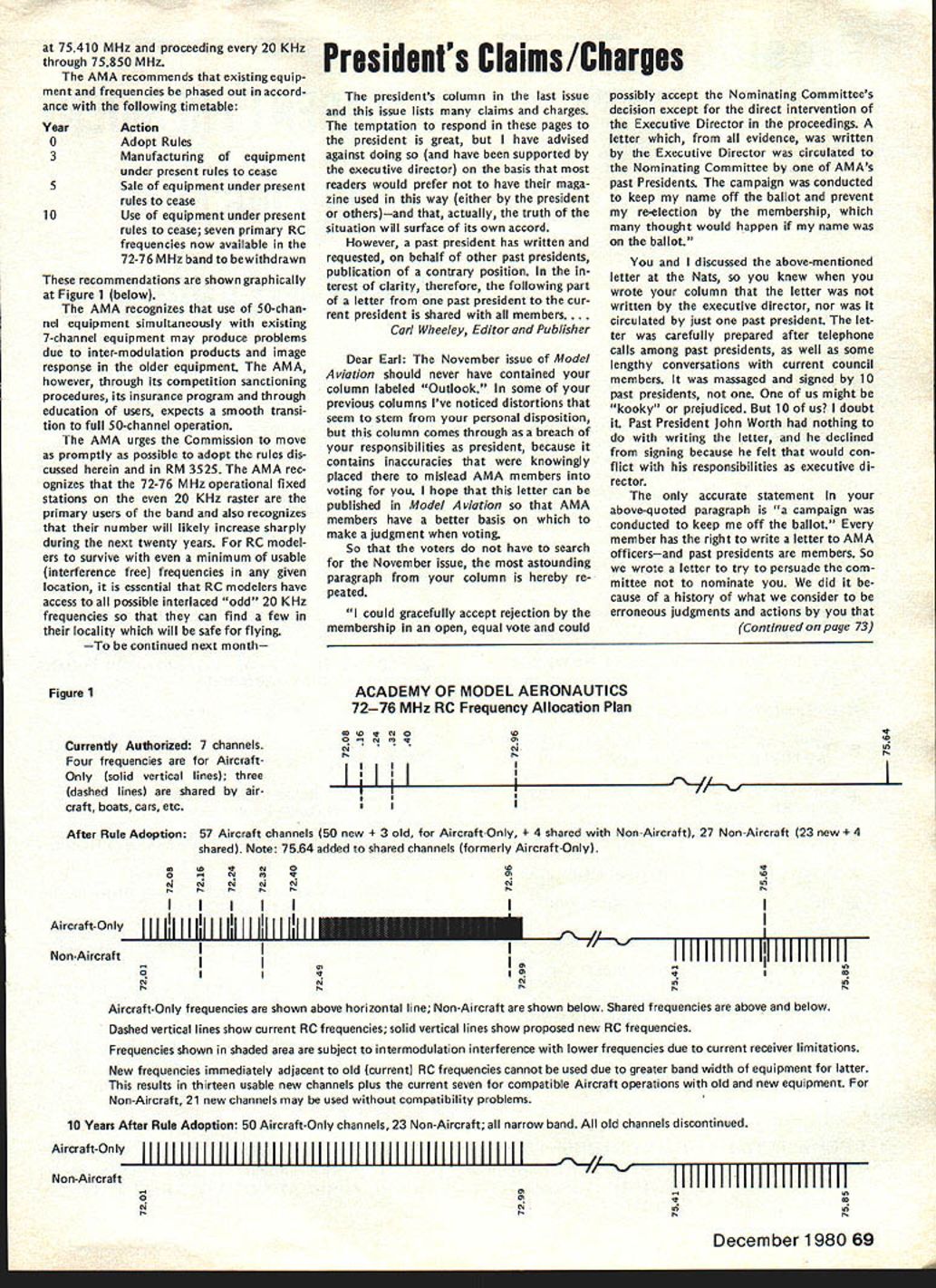
Figure 1 (descriptive summary):
- Currently authorized: 7 channels (four aircraft-only; three shared by aircraft and other models).
- After adoption: 57 aircraft channels (50 new + 3 old for aircraft-only + 4 shared) and 27 non-aircraft channels (23 new + 4 shared). Shared channels and aircraft-only channels are arranged to provide separation and to minimize interference.
- Ten years after adoption: 50 aircraft-only channels and 23 non-aircraft channels, all narrow-band; all old channels discontinued.
The AMA urges the Commission to move promptly to adopt the rules discussed in RM-3525. The 72–76 MHz operational fixed stations on the even 20 kHz raster are the primary users of the band; RC modelers need access to the interlaced odd 20 kHz frequencies to find safe channels locally.
---
MISINFORMATION
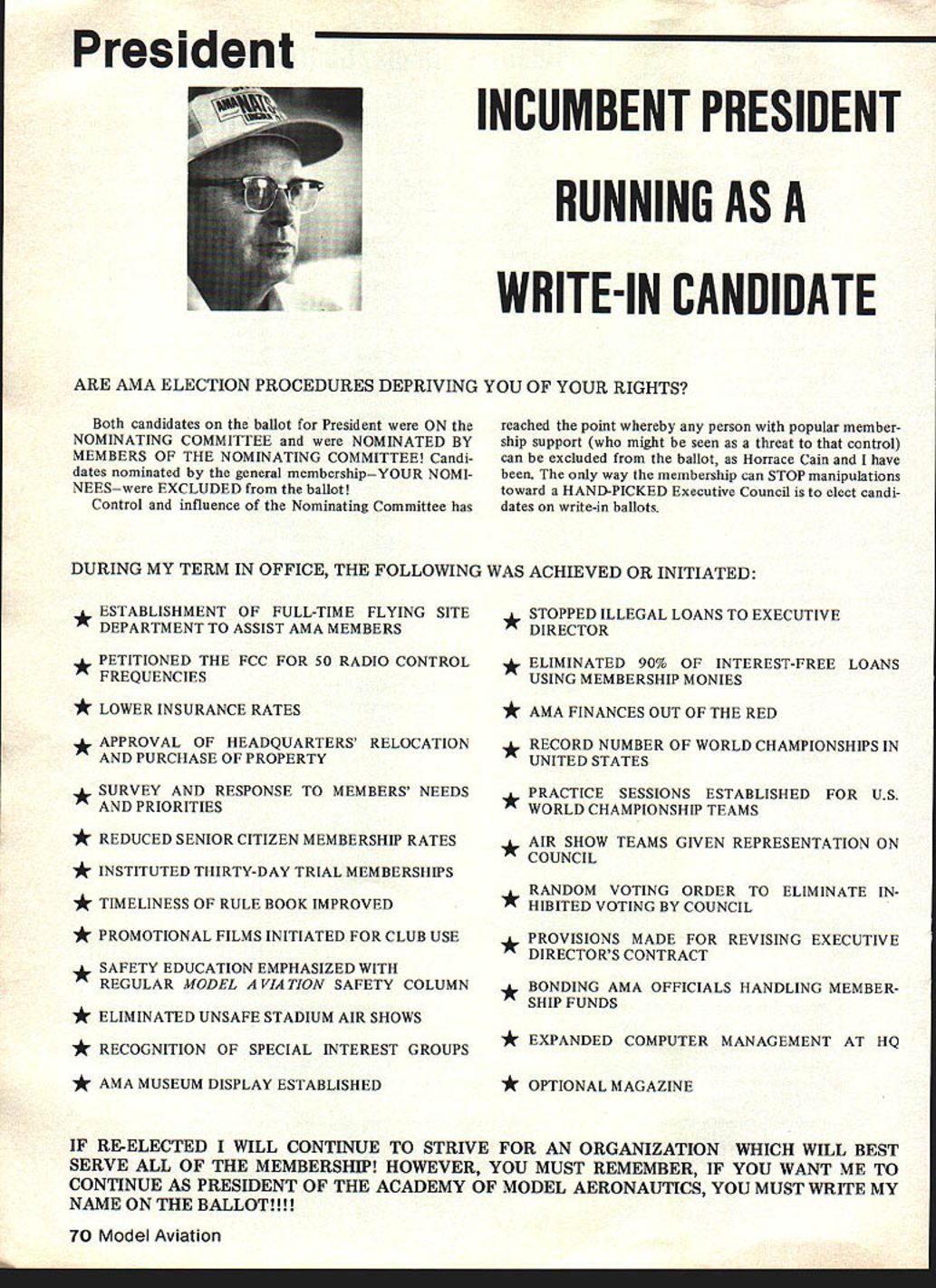
During the past month I have received many inquiries from around the country asking why I was not running for re-election when word circulated that my name was not on the ballot. I DID accept the nomination but was excluded from the ballot. As a consequence, I have received tremendous support from those AMA members who are, or have become, aware of my willingness to serve another term as your president.
NEED FOR CHANGE
There is a need to revise our bylaws to prevent domination of the AMA by employees or individuals who stand to personally benefit from AMA operations; such individuals cannot be considered fully objective in AMA management. Horace Cain's column in the November issue bluntly and truthfully stated situations and influences affecting some members who participate in AMA management. This domination of the Executive Council by outside influences affects nomination and election procedures and is a major concern when certain Council members consistently vote as a bloc rather than on issues.
As long as incumbent vice-presidents control selection of candidates and can exclude competition from general membership nominations, it is difficult to displace incumbents who can obtain majority support from vice-presidents, regardless of the wishes of individual AMA districts.
When vacancies occur on Council (for example, when two Council members were recently hired by the Executive Director), replacements are selected by the Executive Council. The general membership or the district being represented had no voice in those selections.
CONFIRMATION
I recently received the following letter from Loren M. Holm (AMA 77201), notarized by Janet M. Calvin of Quincy, IL, on August 19, 1980, which may confirm some of the facts mentioned above:
"Mr. Earl Witt President Academy of Model Aeronautics 26 Warwick Drive Chambersburg, PA 17201
Dear Sir:
I wish to bring to your attention the following incident which occurred during the 1980 Nats at Wilmington, OH.
On late Saturday evening (August 9, 9:30 to 11:00 pm) while visiting with Mr. Roger Geers and Mr. Tom Martin at Mr. Geer's campsite, Mr. Rick Gerling arrived in a very excited state of mind.
Mr. Gerling indicated that he had just left the AMA nominating committee meeting. Mr. Gerling further indicated that he had acted as a participant in the nominating process. Upon further discussion it was learned that Mr. Embry, VP District 8, was unable to attend. Mr. Gerling then indicated that Mr. John Worth talked with Mr. Embry via telephone and that Mr. Embry had asked Mr. Worth to represent him at the nominating committee meeting. Further conversation with Mr. Gerling brought forth such statements as 'John Worth asked me to sit in on the nominating committee meeting to represent District 8,' 'John Worth told me who to vote for for each of the positions,' 'I didn't know I could have voted for the best choice until after the meeting was over,' 'I don't know who Embry wanted, but John Worth knew who was to end up on the ballot.'
As an AMA member I am concerned over the implications of the above. Why is an associate vice-president who is also a candidate for the office of District 6 picked to act as a representative of another District? Why was he given instructions on how to vote by Mr. Worth and not by Mr. Embry himself since Mr. Embry was apparently in telephone communication with Mr. Worth at the place where the meeting was being held? It would appear to me that the processes which give representation to the voting membership was easily bypassed.
Very truly yours, Loren M. Holm AMA 77201"
---
FLYING SITES
The new flying site program under Geoff Styles is getting up to speed. Before this issue reaches readers, a meeting will have been held with members of several organizations, including the Department of the Interior and the Edison Electric Institute, who have potential space to make available to us.
Prior to Geoff taking over, flying sites were handled part time by Carl Maroney. I had been skeptical about the workload justifying a full-time position, but Geoff has, in less than two months, initiated a considerable amount of productive work.
MORE RC FREQUENCIES
The final version of the AMA report has been submitted to the FCC. The request is for at least 50 aircraft channels. The best possibility appears to be 13 new channels available immediately, with the balance coming later pending resolution of technical interference issues. Best estimate is we are still about a year away from implementation.
HEADQUARTERS MOVE
Progress is being made toward moving AMA Headquarters out of Washington, DC into a more economical area. An application for approval of industrial revenue bond financing (to be used if necessary) was submitted to and approved by the Fairfax (VA) County Economic Development Authority. Several inquiries have been received from prospective purchasers. While prospects for a permanent AMA-owned facility are good, interim office space at reasonable cost has been difficult to find pending completion of the new facility.
WORLD CHAMPIONSHIP TEAM SELECTIONS
Southern California hosted two U.S. World Championship team selection events over Labor Day weekend.
- RC Soaring at Domingos Hills: 35 contestants. Top three: Carl Blake, Don Edring, Dwight Holley.
- Free Flight at Taft: 98 contestants. Nordic Glider winners: James Wilson, Juan Livatto, Jose Dona. Wakefield winners: Carrol Allen, Joseph Foster, Walt Ghio. Power event winners: Dave Galbreath, Roger Simpson, Charles Martin.
---
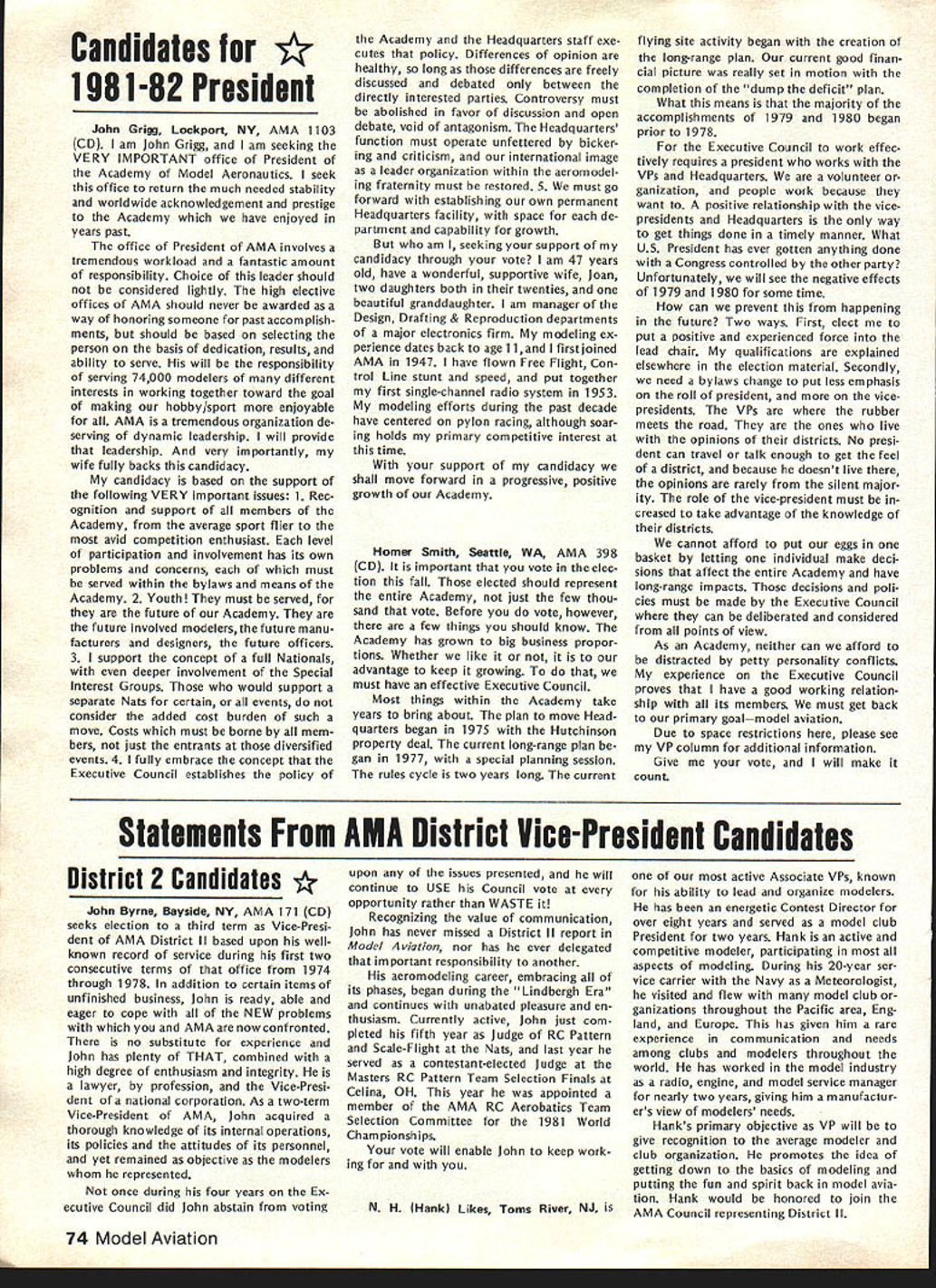
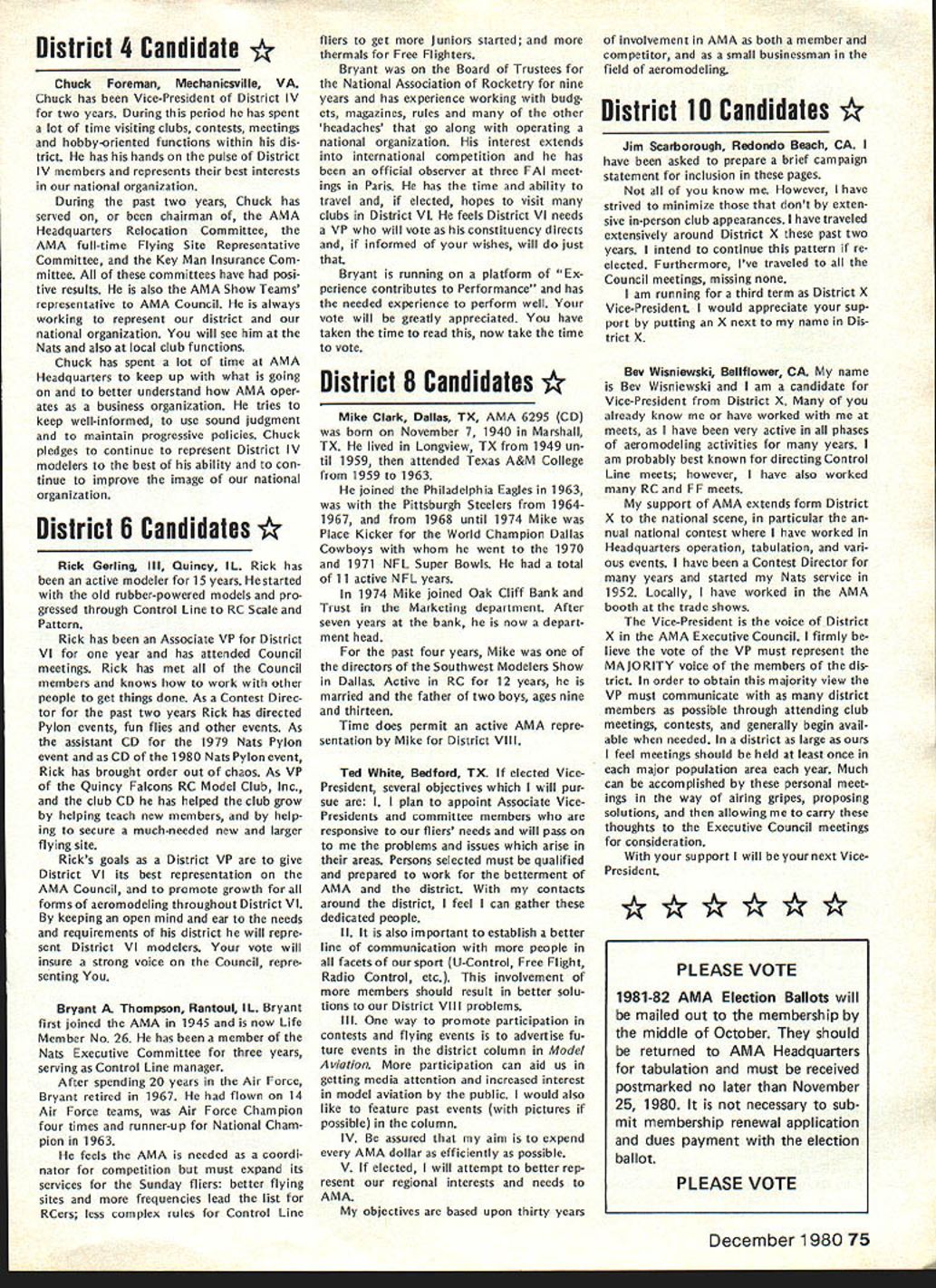
District 4 Candidate
Chuck Foreman — Mechanicsville, VA
Chuck has been Vice-President of District IV for two years. During that period he has visited clubs, contests, meetings, and hobby-oriented functions throughout his district. He has served on or chaired the AMA Headquarters Relocation Committee, the AMA full-time Flying Site Representative Committee, and the Key Man Insurance Committee. He is also the AMA Show Teams' representative to AMA Council.
Chuck spends time at AMA Headquarters to stay informed on AMA operations and business practices. He pledges to continue representing District IV modelers and to work to improve the image of the national organization.
---
District 6 Candidates
Rick Gerling, III — Quincy, IL
Rick has been an active modeler for 15 years, progressing from rubber-powered models to control line, RC scale, and pattern. He has been an Associate VP for District VI for one year and has attended Council meetings. As a contest director, Rick has directed pylon events, fun flies, and other competitions, including serving as assistant CD for the 1979 Nats Pylon event and CD for the 1980 Nats Pylon event. As VP of the Quincy Falcons RC Model Club, he has helped the club grow and secure a larger flying site.
Rick's goals as District VP are to represent District VI effectively on the AMA Council and to promote growth for all forms of aeromodelling in the district.
Bryant A. Thompson — Rantoul, IL
Bryant joined AMA in 1945 and is Life Member No. 26. He served on the Nats Executive Committee for three years as Control Line manager. A retired Air Force veteran (20 years), Bryant flew on 14 Air Force teams, was Air Force Champion four times, and was runner-up for National Champion in 1963.
He believes AMA must expand services for casual fliers: better flying sites and more frequencies for RC, simpler Control Line rules to encourage juniors, and more support for Free Flight. He served nine years on the Board of Trustees for the National Association of Rocketry and has experience with budgets, magazines, and rules. Bryant supports representing the district as directed by its members.
---
District 8 Candidates
Mike Clark — Dallas, TX (AMA 6295)
Born November 7, 1940, Mike lived in Longview, TX, attended Texas A&M (1959–1963), played professional football (Philadelphia Eagles 1963; Pittsburgh Steelers 1964–1967; Dallas Cowboys 1968–1974), and was place kicker for the World Champion Dallas Cowboys through 1974. Since 1974 he has worked in banking and is now a department head at Oak Cliff Bank and Trust. Active in RC for 12 years, Mike has served as a director of the Southwest Modelers Show in Dallas and is married with two sons.
Ted White — Bedford, TX
If elected Vice‑President, Ted plans to:
- Appoint associate vice-presidents and committee members responsive to fliers' needs.
- Establish better communication with all facets of the sport (U‑Control, Free Flight, Radio Control, etc.).
- Advertise future events in the district column of Model Aviation to promote participation and media attention, and feature past events with pictures when possible.
- Ensure efficient use of AMA dollars.
- Better represent regional interests to AMA.
Ted's objectives stem from 30 years of involvement in AMA as a member and competitor and as a small businessman in aeromodelling.
---
District 10 Candidates
Jim Scarborough — Redondo Beach, CA
Jim is running for a third term as District X Vice‑President. He has traveled extensively around District X during the past two years and has attended all Council meetings. He asks for your support.
Bev Wisniewski — Bellflower, CA
Bev has been active in all phases of aeromodelling for many years, best known for directing Control Line meets but also working RC and Free Flight events. She has supported AMA locally and nationally, serving in headquarters operations, tabulation, and various events since starting Nats service in 1952. Bev believes the VP must represent the majority voice of the district and will hold meetings in major population areas to hear members' views. She asks for your support.
---
ELECTION NOTICE — PLEASE VOTE
1981–82 AMA election ballots will be mailed to the membership by mid-October. Ballots should be returned to AMA Headquarters for tabulation and must be postmarked no later than November 25, 1980. It is not necessary to submit membership renewal or dues payment with the election ballot.
---
AMA RC Frequency Flag System Changes
In the October 1980 Model Aviation (p. 73) a new frequency identification system was described with an effective date of January 1, 1981. That announcement was premature. The system is now expected to become effective in mid-1981.
Responses to the October proposal are being evaluated and incorporated into a revised draft expected around January 1, 1981. The plan is to provide a transition period of about six months after publication for people to become familiar with the system and for manufacturers to produce new frequency "flags."
Major feedback concerned the color and nature of the flags. There was general dissatisfaction with the suggested rigid plywood or plastic flags. It now appears likely some form of plastic ribbon that clips on the antenna will be adopted, though there is still disagreement whether identification should be at the antenna tip or base. These details will be resolved by the AMA Frequency Committee, with a revised draft to be published in early 1981. By mid-1981, FCC action authorizing new frequencies is expected to have progressed far enough to make the new system official.
Transcribed from original scans by AI. Minor OCR errors may remain.

