
AMA Special Report To FCC
(Continued from last month)
Number of Channels Required
The AMA has identified RC channel requirements as follows:
- Aircraft
- 1980 — Usable Channels: 20; Total Channels: 30
- 1985 — Usable Channels: 20; Total Channels: 40
- 1990 — Usable Channels: 20; Total Channels: 50
- Terrestrial Models
- 1980 — Usable Channels: 20; Total Channels: 23
- 1985 — Usable Channels: 20; Total Channels: 23
- 1990 — Usable Channels: 20; Total Channels: 23
Derivation of Aircraft Requirements
The AMA has identified a requirement for 20 channels for model aircraft RC operations. Simultaneous operation of 15 aircraft was demonstrated in an AMA contest in 1974 when, through the use of 27, 54 and 72 MHz equipment, 17 RC channels were available and 15 aircraft were actually flown. Experience has shown, however, that when more than 15 aircraft are in the air at the same time, pilot confusion becomes a major problem. At contests, therefore, multiple flight lines are used, spaced far enough apart that contestants need only keep track of a few planes. These flight lines are generally too close to permit frequency reuse.
Given that 15 channels are the desired number for simultaneous use, an additional "overhead" allowance is required for ground testing and for delays between flights necessary to return frequency-availability flags to model field control. Because even momentary interference can be disastrous to an RC flier, very tight controls are imposed on frequency usage at contests (and in non-contest flying as well). Before a transmitter may be activated, the operator must secure a frequency flag for his channel from a board where one flag per channel is kept. If the flag is missing, the frequency is in use and may not be used by any other flier.
Based upon competition experience, five additional channels are required for these purposes, making a total of 20 available interference-free frequencies necessary in order that 15 channels may be simultaneously used.
Since the proposed channels are not necessarily interference-free, the effects of 10 kHz adjacent-channel sharing must be considered. As developed in the channel-spacing discussion later in this report, interstitial RC channels may still be rendered unusable due to fixed operations on an adjacent channel. Although offset or interstitial operation dramatically improves the resistance of RC operations to fixed interference, a single fixed station strong enough to cause problems will block both adjacent RC channels, thereby undercutting some of the advantage otherwise provided through interleaving the fixed and RC assignments.
Based upon the FCC's frequency assignment records for 72–73 MHz, the AMA has prepared a frequency-availability list for the top 25 urban areas. Taking an average case in those areas where 72 MHz usage is not precluded, three to five 72 MHz fixed assignments currently exist. Since each assignment blocks two interstitial RC channels, 30 channels are needed to assure 20 usable frequencies.
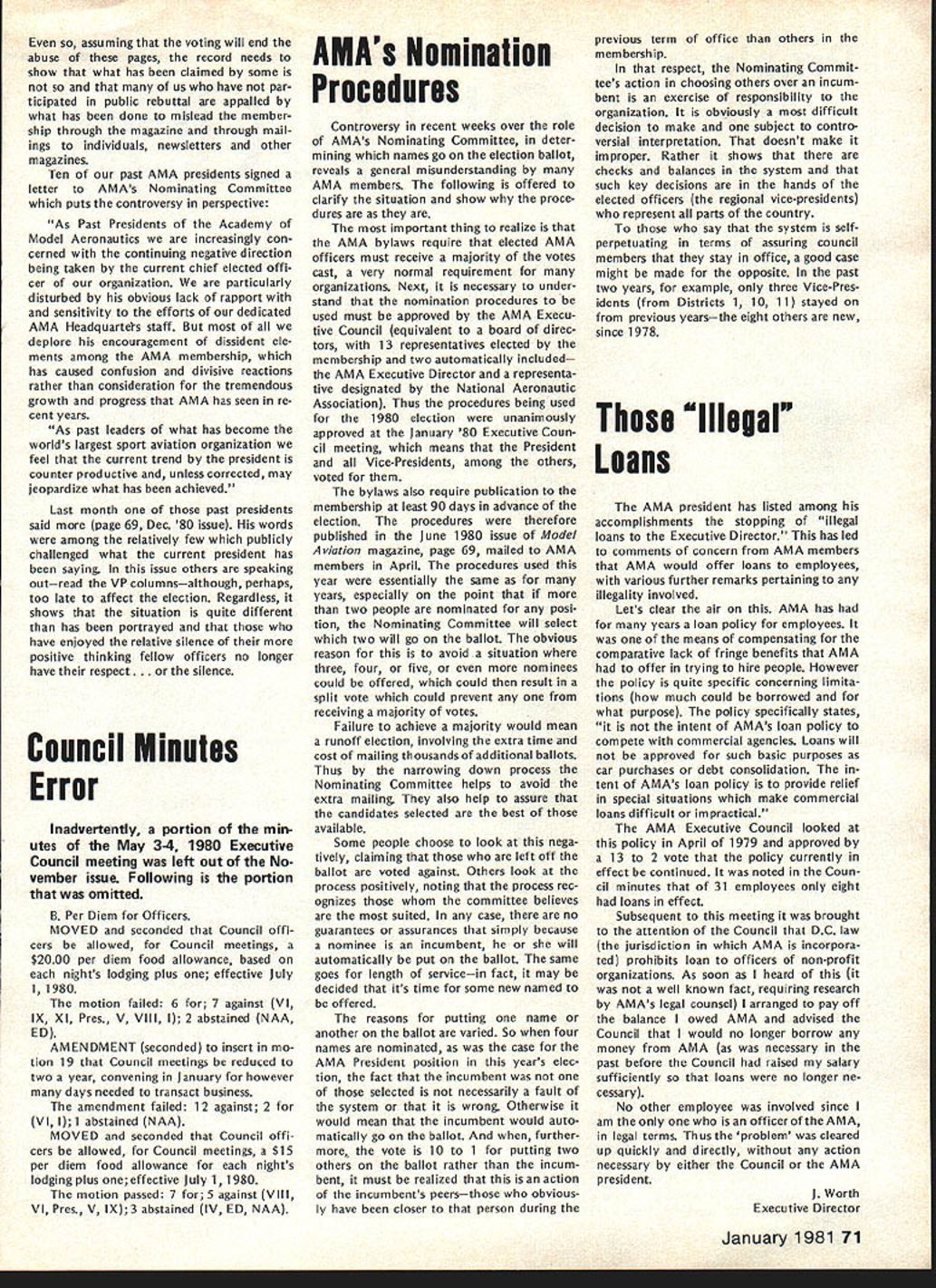
It is then necessary to project the growth of 72 MHz fixed systems over the next 10 years to determine the AMA's present and 10-year growth channel requirements. The FCC's Annual Reports show a growth pattern in the number of land mobile transmitters licensed. Assuming that 72 MHz use grows at least as fast as the general increase in base and fixed station use—a conservative assumption given the forces driving 72 MHz usage—an area with ten RC channels unavailable in 1980 could have 20+ channels blocked by 1990. Accordingly, by 1990 access to 50 channels will be necessary in order that urban-area fliers may be assured of having 15 usable (interference-free) frequencies.
AMA News
Even so, assuming that the voting will end the abuse of these pages, the record needs to show that what has been claimed by some is not so, and that many of us who have not participated in public rebuttal are appalled by what has been done to mislead the membership through the magazine and through mailings to individuals, newsletters and other magazines.
Ten of our past AMA presidents signed a letter to AMA's Nominating Committee which puts the controversy in perspective:
"As Past Presidents of the Academy of Model Aeronautics we are increasingly concerned with the continuing negative direction being taken by the current chief elected officer of our organization. We are particularly disturbed by his obvious lack of rapport with and sensitivity to the efforts of our dedicated AMA Headquarters staff. But most of all we deplore his encouragement of dissident elements among the AMA membership, which has caused confusion and divisive reactions rather than consideration for the tremendous growth and progress that AMA has seen in recent years.
"As past leaders of what has become the world's largest sport aviation organization we feel that the current trend by the president is counter productive and, unless corrected, may jeopardize what has been achieved."
Last month one of those past presidents spoke out (page 69, Dec. '80 issue). His words were among the relatively few which publicly challenged what the current president has been saying. In this issue others are speaking out — read the VP columns — although perhaps too late to affect the election. Regardless, it shows that the situation is quite different than has been portrayed and that those who have enjoyed the relative silence of their more positive-thinking fellow officers no longer have their respect nor their silence.
Council Minutes Error
Inadvertently, a portion of the minutes of the May 3–4, 1980 Executive Council meeting was left out of the November issue. The omitted portion follows.
B. Per Diem for Officers
- MOVED and seconded that Council officers be allowed, for Council meetings, a $20.00 per diem food allowance, based on each night's lodging plus one; effective July 1, 1980.
- The motion failed: 6 for; 7 against (VI, IX, Pres., V, VIII, I); 2 abstained (NAA, ED).
- AMENDMENT (seconded) to insert in motion 19 that Council meetings be reduced to two a year, convening in January for however many days needed to transact business.
- The amendment failed: 12 against; 2 for (VI, I); 1 abstained (NAA).
- MOVED and seconded that Council officers be allowed, for Council meetings, a $15 per diem food allowance for each night's lodging plus one; effective July 1, 1980.
- The motion passed: 7 for; 5 against (VIII, VI, Pres., V, IX); 3 abstained (IV, ED, NAA).
AMA's Nomination Procedures
Controversy in recent weeks over the role of AMA's Nominating Committee in determining which names go on the election ballot reveals a general misunderstanding by many AMA members. The following clarifies the situation and explains why the procedures are as they are.
Key points:
- The AMA bylaws require that elected AMA officers must receive a majority of the votes cast.
- The nomination procedures to be used must be approved by the AMA Executive Council (equivalent to a board of directors, with 13 representatives elected by the membership and two automatically included — the AMA Executive Director and a representative designated by the National Aeronautic Association). The procedures used for the 1980 election were unanimously approved at the January 1980 Executive Council meeting.
- The bylaws also require publication to the membership at least 90 days in advance of the election. The procedures were published in the June 1980 issue of Model Aviation, page 69, and mailed to AMA members in April.
A key point of the nomination procedures: if more than two people are nominated for any position, the Nominating Committee will select which two will go on the ballot. The reason is to avoid split votes that could prevent any candidate from receiving a majority. Failure to achieve a majority would require a runoff election, adding time and the expense of mailing thousands of additional ballots. Thus, by narrowing the candidates, the Nominating Committee helps avoid extra mailing and helps assure that the candidates selected are the best of those available.
Some view the process negatively, claiming that those left off the ballot are being voted against. Others view it positively, noting that the process recognizes those whom the committee believes are most suited. There are no guarantees that an incumbent will automatically be put on the ballot. Length of service is likewise not an automatic qualification — sometimes it's time for a new name.
When, for example, four names are nominated for the AMA President position and the incumbent is not one of the two selected, this is not necessarily a fault of the system. When the vote is 10 to 1 for putting two others on the ballot rather than the incumbent, it should be realized that this action was taken by the incumbent's peers — those who have worked most closely with that person during the previous term.
In that respect, the Nominating Committee's choosing others over an incumbent is an exercise of responsibility to the organization. It is a difficult decision and subject to controversial interpretation, but it is not improper. It shows that checks and balances exist and that such key decisions are in the hands of elected officers (the regional vice-presidents) who represent all parts of the country.
To those who say the system is self-perpetuating, consider the opposite example: in the past two years only three Vice-Presidents (from Districts 1, 10, 11) stayed on from previous years — the eight others are new since 1978.
Those "Illegal" Loans
The AMA president has listed among his accomplishments the stopping of "illegal loans to the Executive Director." This has led to concern among AMA members that loans might be offered to employees and about any illegality involved. Clarification follows.
- AMA has had for many years a loan policy for employees. It was one means of compensating for the comparative lack of fringe benefits when hiring staff. The policy is specific about limitations (how much may be borrowed and for what purposes). It states: "It is not the intent of AMA's loan policy to compete with commercial agencies. Loans will not be approved for such basic purposes as car purchases or debt consolidation. The intent of AMA's loan policy is to provide relief in special situations which make commercial loans difficult or impractical."
- The AMA Executive Council reviewed this policy in April 1979 and approved by a 13 to 2 vote that the policy currently in effect be continued. It was noted in the Council minutes that of 31 employees only eight had loans in effect.
- Afterward it was brought to the Council's attention that D.C. law (the jurisdiction in which AMA is incorporated) prohibits loans to officers of non-profit organizations. As soon as this was discovered (following research by AMA's legal counsel), the Executive Director arranged to pay off the balance owed to AMA and advised the Council that he would no longer borrow any money from AMA.
- No other employee was involved since the Executive Director is the only person who is an officer of the AMA in legal terms. The matter was thus cleared up quickly and directly, without any further action necessary by either the Council or the AMA president.
J. Worth Executive Director
President's OUTLOOK
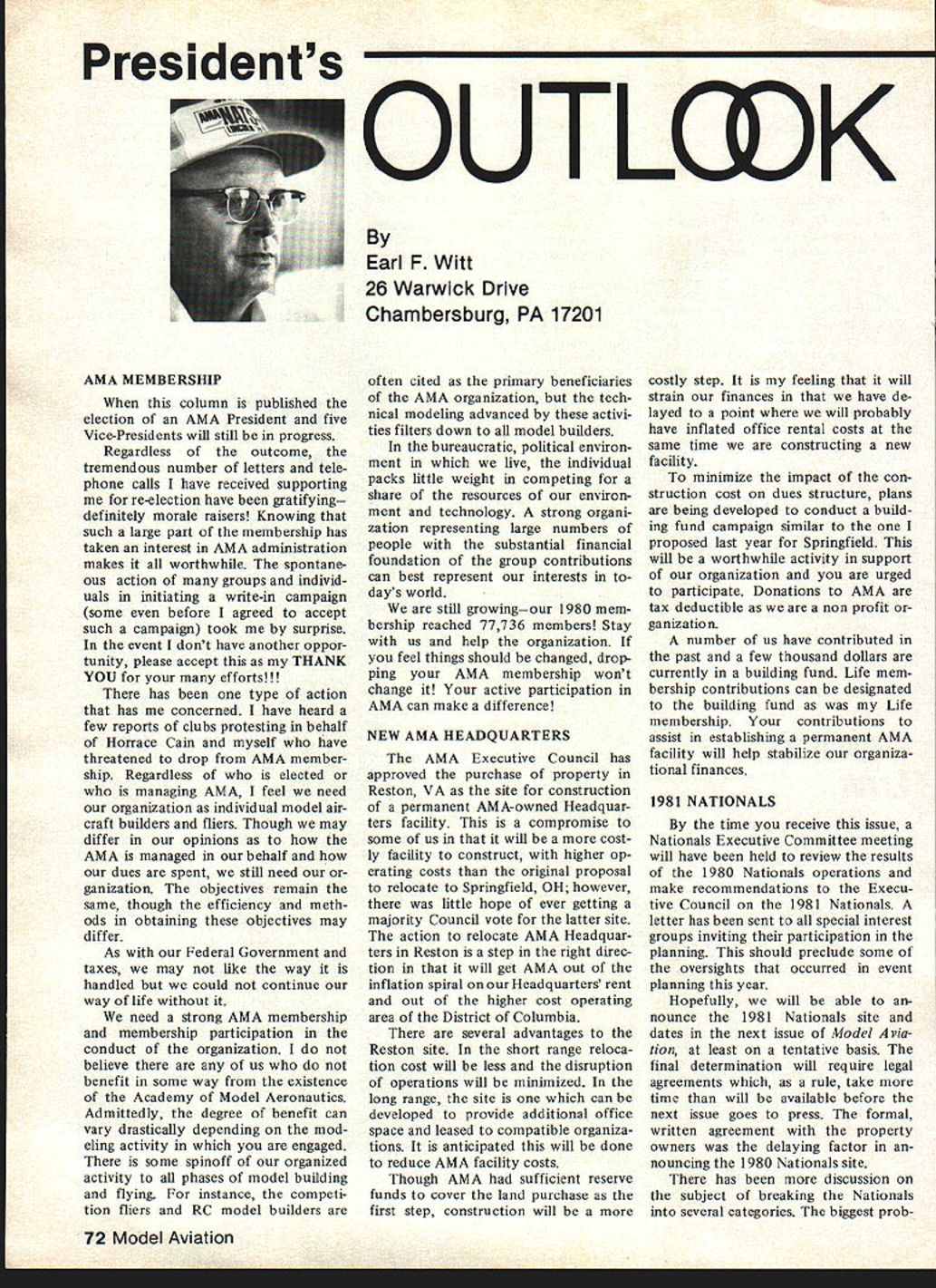
By Earl F. Witt 26 Warwick Drive, Chambersburg, PA 17201
AMA Membership
When this column is published the election of an AMA President and five Vice-Presidents will still be in progress.
Regardless of the outcome, the tremendous number of letters and telephone calls I have received supporting me for re-election have been gratifying. Knowing that such a large part of the membership has taken an interest in AMA administration makes it all worthwhile. The spontaneous action of many groups and individuals in initiating a write-in campaign (some even before I agreed to accept such a campaign) took me by surprise. In the event I don't have another opportunity, please accept this as my THANK YOU for your many efforts.
There has been one type of action that concerns me: I have heard reports of clubs threatening to drop AMA membership in protest. Regardless of who is elected or who is managing AMA, we need our organization as individual model aircraft builders and fliers. Though we may differ in opinions about how AMA is managed and how dues are spent, the objectives remain the same even if methods and efficiency differ.
We need a strong AMA membership and membership participation in the conduct of the organization. I do not believe there are any of us who do not benefit in some way from the existence of the Academy of Model Aeronautics. The degree of benefit varies depending on one’s modeling activity, but there is some spinoff of organized activity to all phases of model building and flying. For instance, competition fliers and RC model builders are often cited as primary beneficiaries, but technical modeling advanced by these activities filters down to all model builders.
In the political and bureaucratic environment we live in, the individual packs little weight in competing for resources. A strong organization representing large numbers of people with a substantial financial foundation can best represent our interests in today's world.
We are still growing—our 1980 membership reached 77,736 members. Stay with us and help the organization. If you feel things should be changed, dropping your AMA membership won't change it; your active participation can make a difference!
New AMA Headquarters
The AMA Executive Council has approved the purchase of property in Reston, VA as the site for construction of a permanent AMA-owned Headquarters facility. This is a compromise for some of us because it will be more costly to construct and have higher operating costs than the original proposal to relocate to Springfield, OH; however, there was little hope of getting a majority Council vote for Springfield. The action to relocate AMA Headquarters to Reston is a step in the right direction because it will get AMA out of the inflation spiral on our Headquarters' rent and out of the higher-cost operating area of the District of Columbia.
Advantages of the Reston site:
- Short-range relocation cost will be less and disruption of operations minimized.
- Long-range development potential allows additional office space to be leased to compatible organizations, reducing AMA facility costs.
Although AMA had sufficient reserve funds to cover the land purchase, construction will be more costly and may strain finances, especially since delayed action has increased office rental costs concurrently with construction plans.
To minimize the impact on dues, plans are being developed to conduct a building fund campaign similar to one previously proposed for Springfield. Donations to AMA are tax deductible as we are a non-profit organization. A number of contributions are already in a building fund; life membership contributions can be designated to the building fund.
1981 Nationals
By the time you receive this issue, a Nationals Executive Committee meeting will have reviewed the results of the 1980 Nationals operations and made recommendations to the Executive Council for the 1981 Nationals. Special interest groups were invited to participate in the planning to preclude oversights that occurred this year.
We hope to announce the 1981 Nationals site and dates in the next issue of Model Aviation, at least tentatively. Final determination requires legal agreements which take more time. A formal written agreement with property owners delayed the announcement of the 1980 Nationals site.
There has been discussion of breaking the Nationals into several category championships (Radio Control, Free Flight, Indoor, Control Line and Scale) to have optimum facilities for each category. The biggest problem with splitting the Nationals is finding sites that can accommodate all events in reasonable proximity. Historically, overwhelming support has favored one, all-event National Championships as a large annual get-together, though both formats have merits. If you have input, let your Council representative know as soon as possible.
Safety
Modeling safety should always be a consideration in our activities. Implementation is largely a local or personal responsibility because rules cannot cover all situations. The AMA Safety Code is general; hazardous conditions can exist yet be within the code's limits. Local determinations and common sense should be the rule.
Recent queries:
- A rule barring the use of glass composite plastic propellers on 1/4" scale was attributed to AMA insurance. There is no restriction on propeller types in the AMA insurance policy. Clubs may set safety standards more restrictive than the AMA Safety Code if they find a hazard.
- Comments were received on the 400-foot height limit for flying models. One individual noted that RC soaring models use a 984-foot launch line. The AMA Safety Code qualifies the 400-foot altitude limit: it is not an absolute flight limit but prescribes common-sense conditions that should apply when flying near full-scale aircraft.
A Growing Show
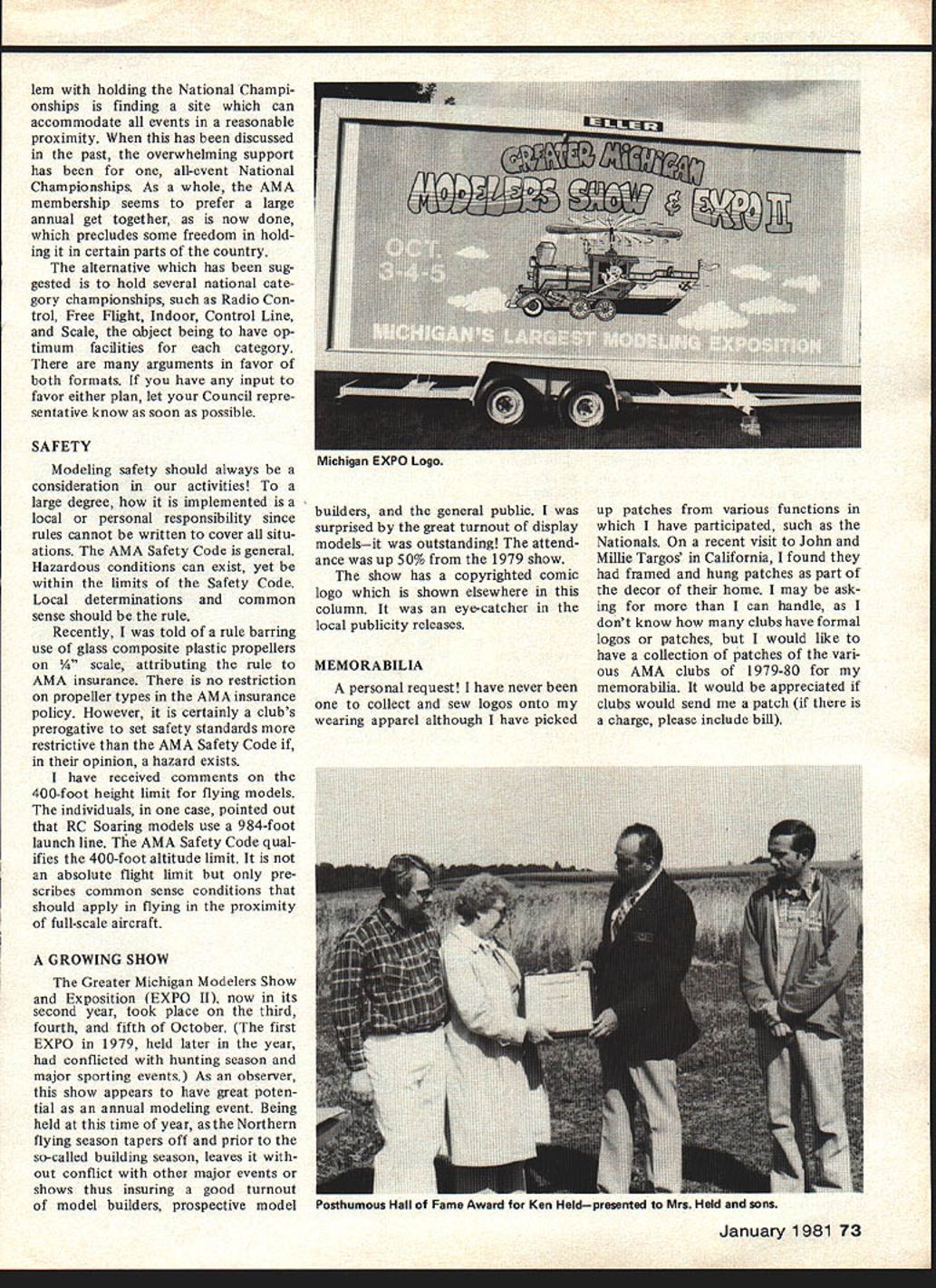
The Greater Michigan Modelers Show and Exposition (EXPO II) was held on October 3–5. This second-year event appears to have great potential as an annual modeling event. Being held as the Northern flying season tapers off and before the building season avoids conflicts with hunting season and major sporting events, ensuring a good turnout of model builders and the general public. Attendance was up 50% from the 1979 show. The show featured an eye-catching copyrighted comic logo and an outstanding turnout of display models.
Memorabilia
A personal request: I would like to have a collection of patches from various AMA clubs for memorabilia. If your club has a patch and can send one (include a bill if there is a charge), it would be appreciated.
Truth Takes Beating
In the December issue the AMA president printed a claim that AMA HQ has no censoring authority over Council member columns and included a list of achievements supposedly accomplished during his term of office. Although the implication may not have been that the president was taking credit, the presentation left that impression. Some items listed are not necessarily achievements, and in some cases the president abstained on votes or actually voted against items later claimed as accomplishments. Detailed review of previously published minutes of Council meetings during the past two years will show inconsistencies between claims and actual Council actions.
Whoever wins the election, AMA will have a capable president. If you have membership, magazine, or flying site problems, or other inquiries, write to AMA HQ or to me — I may reprint your letter here.
FCC Report (continued)
That 72 MHz usage will grow at a 50% faster rate than general base/fixed growth was used to compensate for several factors:
- Wireline remote transmitter control circuits are increasing dramatically in price.
- In many areas the traditional metallic pair circuits preferred for remote transmitter control are no longer available as telephone companies install digital carrier and optical fiber equipment.
- Wide-area multiple-transmitter simulcast common-carrier paging systems prefer radio rather than wireline control circuits due to audio phase and delay stability objectives not met with wireline circuits.
- Release of the ten 35 MHz and 40+ 900 MHz common-carrier paging channels proposed by the Commission will, by itself, account for substantial increases in 72 MHz usage.
- A study by a major manufacturer of paging transmitters indicates that a 72 MHz link used to control paging transmitters will usually pay for itself in less than two years by savings in line charges.
Accordingly, by 1990 access to 50 channels will be necessary so urban-area fliers can be assured of having 15 usable (interference-free) frequencies.
Derivation of Terrestrial Model Requirements
The channel requirements for terrestrial models (primarily model boats and cars) are much the same as for model aircraft. Even the largest model yachting regatta will typically not involve more than about 15 simultaneous frequencies. Beyond this number, it is very difficult to identify and track an individual model, be it a yacht or a car; most sanctioning organizations will not approve competition with more than 12–15 simultaneous entrants.
As with model aircraft RC activity, five "overhead" channels are necessary to support 15 operational channels.
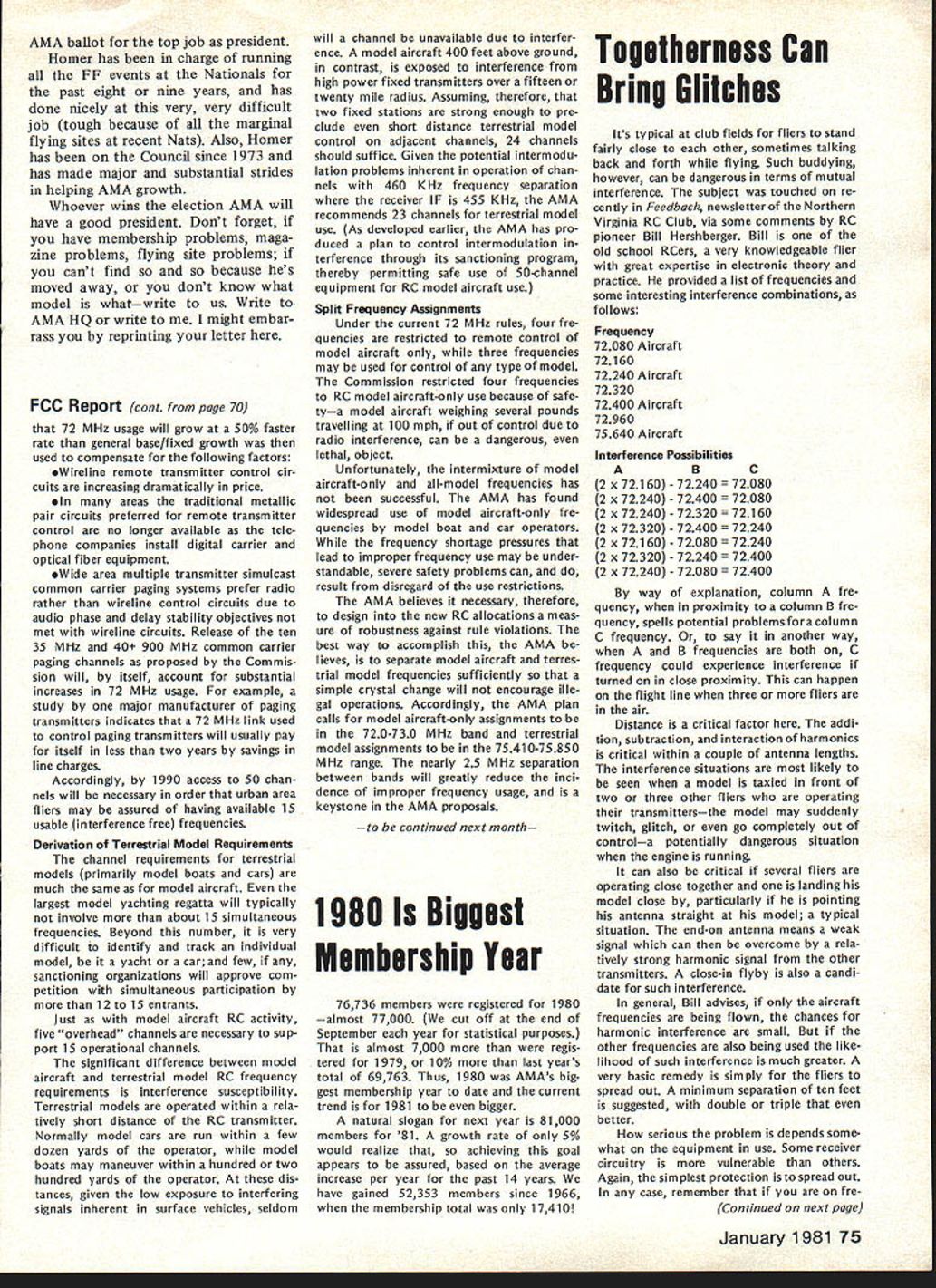
The significant difference between model aircraft and terrestrial model RC frequency requirements is interference susceptibility. Terrestrial models are operated within a relatively short distance of the RC transmitter. Model cars are normally run within a few dozen yards of the operator, while model boats may maneuver within a hundred or two hundred yards. At these distances, given the low exposure to interfering signals inherent in surface vehicles, seldom will a channel be unavailable due to interference. A model aircraft 400 feet above ground, in contrast, is exposed to interference from high-power fixed transmitters over a 15–20 mile radius.
Assuming two fixed stations are strong enough to preclude even short-distance terrestrial model control on adjacent channels, 24 channels should suffice. Given potential intermodulation problems inherent in operation of channels with 460 kHz frequency separation where the receiver IF is 455 kHz, the AMA recommends 23 channels for terrestrial model use. (As developed earlier, the AMA has produced a plan to control intermodulation interference through its sanctioning program, thereby permitting safe use of 50-channel equipment for RC model aircraft use.)
Split Frequency Assignments
Under the current 72 MHz rules, four frequencies are restricted to remote control of model aircraft only, while three frequencies may be used for control of any type of model. The Commission restricted four frequencies to RC model aircraft-only use because of safety: a model aircraft weighing several pounds and traveling at high speed, if out of control due to radio interference, can be dangerous or even lethal.
Unfortunately, the intermixture of model aircraft-only and all-model frequencies has not been successful. The AMA has found widespread use of model aircraft-only frequencies by model boat and car operators. While frequency-shortage pressures that lead to improper frequency use may be understandable, severe safety problems can and do result from disregard of use restrictions.
The AMA believes it necessary to design into the new RC allocations a measure of robustness against rule violations. The best way to accomplish this is to separate model aircraft and terrestrial model frequencies sufficiently so that a simple crystal change will not encourage illegal operations. Accordingly, the AMA plan calls for model aircraft-only assignments to be in the 72.0–73.0 MHz band and terrestrial model assignments to be in the 75.410–75.850 MHz range. The nearly 2.5 MHz separation between bands will greatly reduce the incidence of improper frequency usage and is a keystone in the AMA proposals.
—to be continued next month—
1980 Is Biggest Membership Year
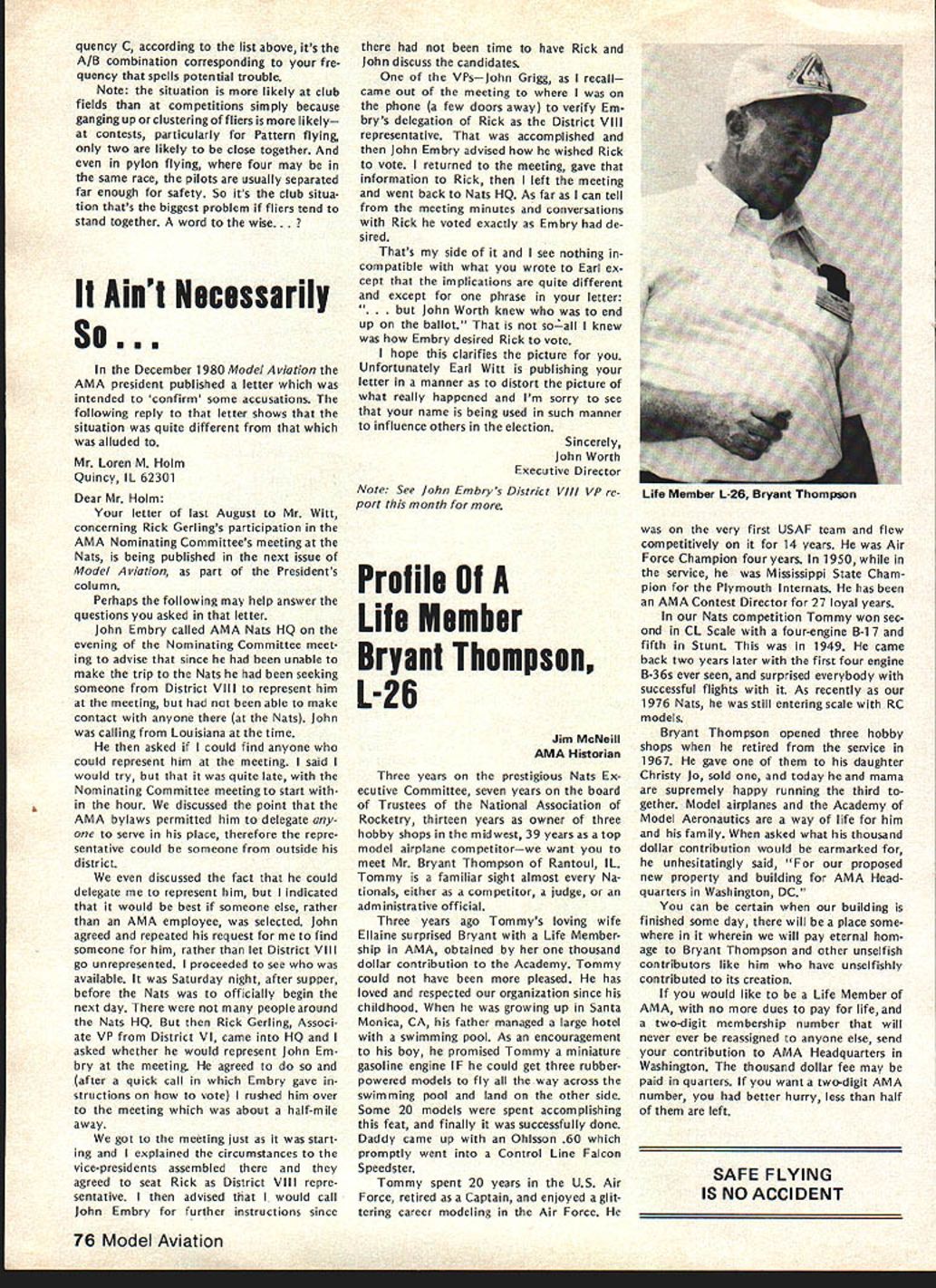
76,736 members were registered for 1980—almost 77,000 (statistics cut off at the end of September each year). That is almost 7,000 more than were registered for 1979, or a 10% increase over 1979's total of 69,763. Thus, 1980 was AMA's biggest membership year to date and the current trend indicates 1981 may be even bigger.
A natural slogan for next year is "80,000 members for '81." A growth rate of only 5% would realize that, so achieving this goal appears likely based on the average increase per year for the past 14 years. We have gained 52,353 members since 1966, when the membership total was only 17,410.
It Ain't Necessarily So . . .
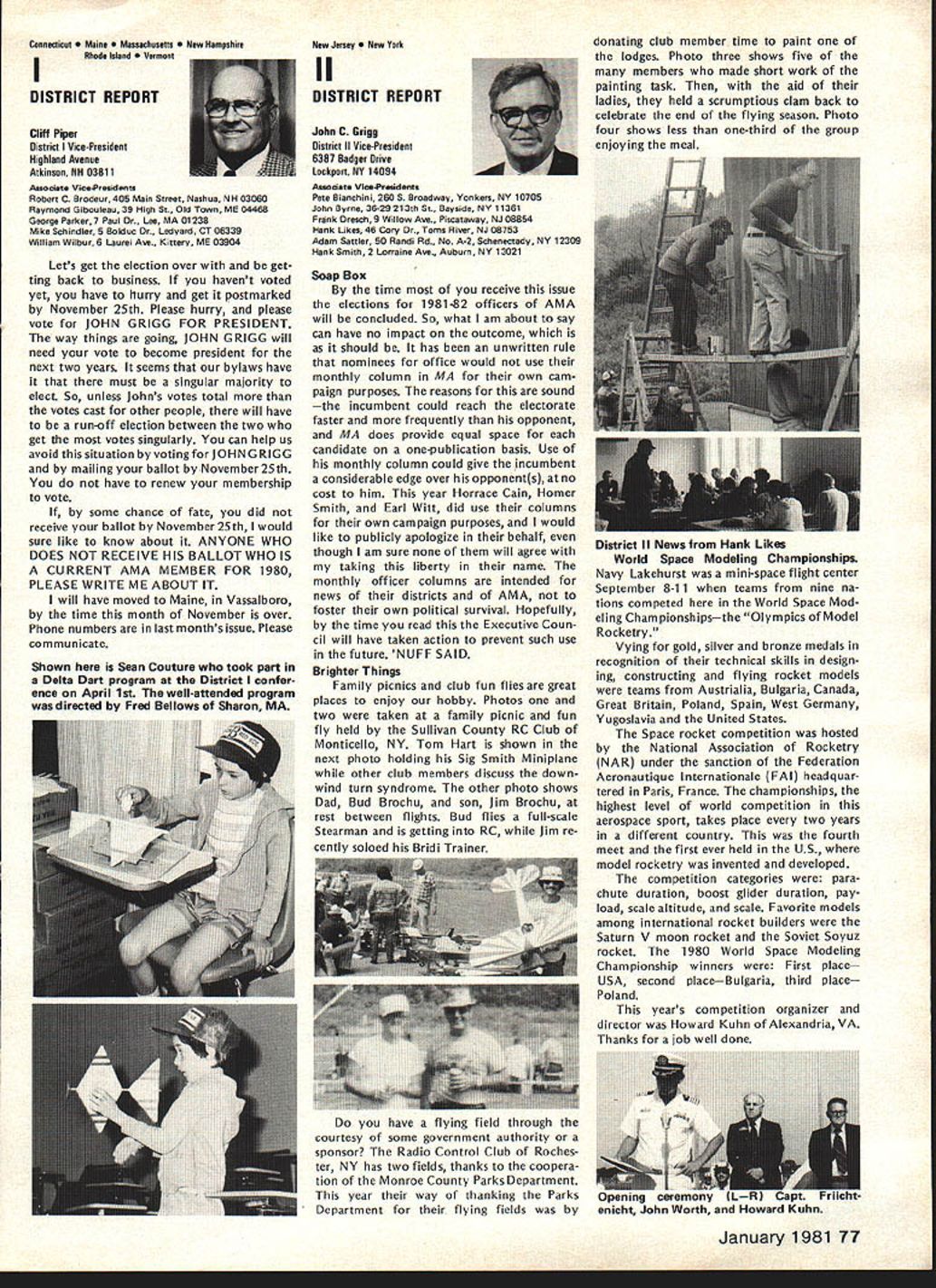
In the December 1980 Model Aviation the AMA president published a letter intended to "confirm" some accusations. The following reply to that letter shows the situation was quite different from what was implied.
Mr. Loren M. Holm Quincy, IL 62301
Dear Mr. Holm:
Your letter of last August to Mr. Witt, concerning Rick Gerling's participation in the AMA Nominating Committee's meeting at the Nats, is being published in the next issue of Model Aviation as part of the President's column. Perhaps the following may help answer the questions you asked in that letter.
John Embry called AMA Nats HQ on the evening of the Nominating Committee meeting to advise that since he had been unable to make the trip to the Nats he had been seeking someone from District VIII to represent him at the meeting, but had not been able to make contact with anyone there. John was calling from Louisiana at the time. He then asked if I could find anyone who could represent him at the meeting. I said I would try, but that it was quite late, with the Nominating Committee meeting to start within the hour. We discussed that the AMA bylaws permitted him to delegate anyone to serve in his place, therefore the representative could be someone from outside his district.
We discussed the fact that he could delegate me to represent him, but I indicated that it would be best if someone other than an AMA employee was selected. John agreed and repeated his request for me to find someone for him, rather than let District VIII go unrepresented. I proceeded to see who was available. It was Saturday night, after supper, before the Nats officially began the next day. There were not many people around Nats HQ. Rick Gerling, Associate VP from District VI, came into HQ and I asked whether he would represent John Embry at the meeting. He agreed to do so and (after a quick call in which Embry gave instructions on how to vote) I rushed him over to the meeting which was about a half-mile away.
We arrived as the meeting was starting. I explained the circumstances to the vice-presidents assembled and they agreed to seat Rick as District VIII representative. I then called John Embry for further instructions since there had not been time for Rick and John to discuss the candidates. One of the VPs—John Grigg—came out of the meeting to where I was on the phone to verify Embry's delegation of Rick as the District VIII representative. That was accomplished and then John Embry advised how he wished Rick to vote. I returned to the meeting, gave that information to Rick, then left the meeting and went back to Nats HQ. As far as I can tell from the meeting minutes and conversations with Rick he voted exactly as Embry had desired.
That's my side of it and I see nothing incompatible with what you wrote to Earl except that the implications are quite different, and except for one phrase in your letter: "...but John Worth knew who was to end up on the ballot." That is not so — all I knew was how Embry desired Rick to vote.
I hope this clarifies the picture for you. Unfortunately Earl Witt is publishing your letter in a manner that distorts what really happened and I'm sorry to see that your name is being used in such a manner to influence others in the election.
Sincerely, John Worth Executive Director
Note: See John Embry's District VIII VP report this month for more.
I DISTRICT REPORT
Cliff Piper District I Vice-President 7 Highland Avenue, Atkinson, NH 03811
Associate Vice-Presidents:
- Robert C. Brodeur, 405 Main Street, Nashua, NH 03060
- Raymond Gibeau, 39 High St., Old Town, ME 04468
- George Parker, 7 Paul Dr., Lee, MA 01238
- Mike Schindler, 5 Colduc Dr., Ledyard, CT 06339
- William Wilbur, 6 Laurel Ave., Kittery, ME 03904
Let's get the election over with and get back to business. If you haven't voted yet, you must hurry—ballots must be postmarked by November 25th. Please vote for JOHN GRIGG FOR PRESIDENT. Our bylaws require a singular majority to elect; unless John's votes total more than votes cast for other people, there may be a run-off. You do not have to renew your membership to vote.
If you did not receive your ballot and are a current 1980 AMA member, please write me about it.
I will have moved to Maine (Vassalboro) by the end of November. Phone numbers are in last month's issue.
Shown here (photo reference) is Sean Couture who took part in a Delta Dart program at the District I conference on April 1. The well-attended program was directed by Fred Bellows of Sharon, MA.
II DISTRICT REPORT
John C. Grigg District II Vice-President 6387 Badger Drive, Lockport, NY 14094
Associate Vice-Presidents:
- Pete Bianchini, 260 S. Broadway, Yonkers, NY 10705
- John Byrne, 36-29 212th St., Bayside, NY 11361
- Frank Dresch, 9 Willow Ave., Piscataway, NJ 08854
- Hank Likes, 46 Cory Dr., Tom's River, NJ 08753
- Adam Sattler, 50 Rand Rd., N. Schenectady, NY 12309
- Hank Smith, 2 Lorraine Ave., Auburn, NY 13021
Soap Box
By the time most of you receive this issue the elections for 1981–82 officers of AMA will be concluded. It has been an unwritten rule that nominees for office would not use their monthly column in Model Aviation for campaign purposes. The reasons are sound — the incumbent could reach the electorate faster and more frequently than his opponent. This year Horace Cain, Homer Smith, and Earl Witt used their columns for campaign purposes. I would like to publicly apologize on their behalf, even though they may not agree. The monthly officer columns are intended for news of their districts and of AMA, not to foster political survival. Hopefully the Executive Council will take action to prevent such use in the future.
Brighter Things
Family picnics and club fun flies are great places to enjoy our hobby. Photos (references) show activities at a family picnic and fun fly held by the Sullivan County RC Club of Monticello, NY. Tom Hart is shown holding his Sig Smith Miniplane while other club members discuss the downwind turn syndrome. Another photo shows Bud Brochu and son Jim between flights; Bud flies a full-scale Stearman and is getting into RC, while Jim recently soloed his Bird Trainer.
The Radio Control Club of Rochester, NY has two fields thanks to the Monroe County Parks Department. This year the club repaid the Parks Department by donating member time to paint one of the lodges, followed by a clam bake.
District II News from Hank Likes
World Space Modeling Championships: Navy Lakehurst hosted teams from nine nations (Australia, Bulgaria, Canada, Great Britain, Poland, Spain, West Germany, Yugoslavia, and the United States) September 8–11 in the World Space Modeling Championships — the "Olympics of Model Rocketry." The competition was hosted by the National Association of Rocketry (NAR) under the sanction of the Federation Aeronautique Internationale (FAI). Categories included parachute duration, boost glider duration, payload, scale altitude, and scale. The 1980 winners were: 1st — USA; 2nd — Bulgaria; 3rd — Poland. Organizer and director: Howard Kuhn of Alexandria, VA.
Opening ceremony participants included Capt. Frilichtenicht, John Worth, and Howard Kuhn.
The Executive Council voted to purchase a site in Reston, VA to build AMA's own headquarters structure. With luck construction can begin next spring.
Territories: Ohio • Pennsylvania • West Virginia
III DISTRICT REPORT
Dave Brown District III Vice-President 8534 Huddleston Street, Cincinnati, OH 45236
Associate Vice-Presidents:
- Joe Eiben, 36840 Valley Forge Dr., Solon, OH 44139
- Francis Rutkowski, 504 21st St., Vienna, WV 26101
- Corky Herman, 5012 North St., Hagerstown, MD 21740
- Laird Jackson, 1025 Walnut St., Philadelphia, PA 19107
- Eugene Shelley, 217 Euclid Ave., Scottdale, PA 15683
This past month has been busy preparing for a Vegas event and AMA business. By the time you read this we will have been to Washington for a Council meeting and plan to dedicate our new Headquarters site. It is gratifying to see AMA now as landowners and I hope to see an office building on our site within two to three years. AMA has come a long way since I joined in 1952.
If the election deadline has not passed, VOTE now. It is unfortunate the election may create more turmoil than it resolves. Our bylaws require a candidate receive a majority of votes to be elected. The write-in campaign by one candidate could force a run-off, costing in excess of $10,000 including postage. The Nominating Committee, made up of all 11 VPs, cast ballots in three rounds and one candidate received only one vote in each round — that should be informative.
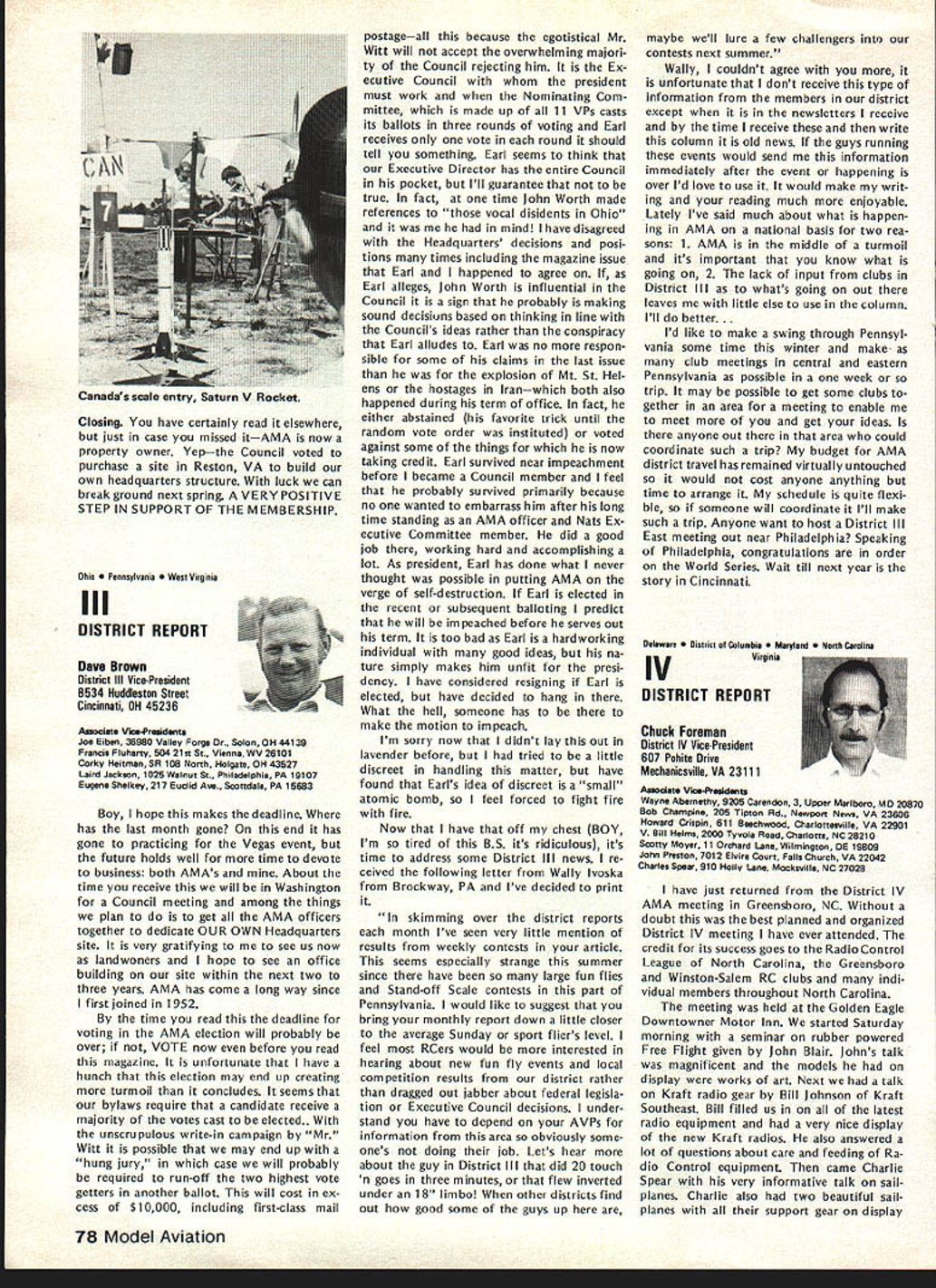
Now to District III news: I received a letter from Wally Ivoska (Brockway, PA) suggesting district reports include more coverage of weekly contests and local events that interest the average sport flier. I agree. If contest organizers send information promptly after events, I will gladly publish it. I plan a swing through Pennsylvania this winter to visit club meetings; if anyone can coordinate a one-week trip to central and eastern Pennsylvania, contact me.
Territories: Delaware • District of Columbia • Maryland • North Carolina • Virginia
IV DISTRICT REPORT
Chuck Foreman District IV Vice-President 607 Pohite Drive, Mechanicsville, VA 23111
Associate Vice-Presidents:
- Wayne Abernathy, 9205 Clarendon, Upper Marlboro, MD 20870
- Bob Chavanne, 265 Tipton Rd., Newport News, VA 23606
- Harvard Crispin, 611 Beechwood, Charlottesville, VA 22901
- V. Bill Helms, 2000 Tyvola Road, Charlotte, NC 28210
- Scotty Moore, 71 Orchard Lane, Wilmington, DE 19803
- John Preston, 7012 Elvira Court, Falls Church, VA 22042
- Charles Spear, 910 Holly Lane, Mocksville, NC 27028
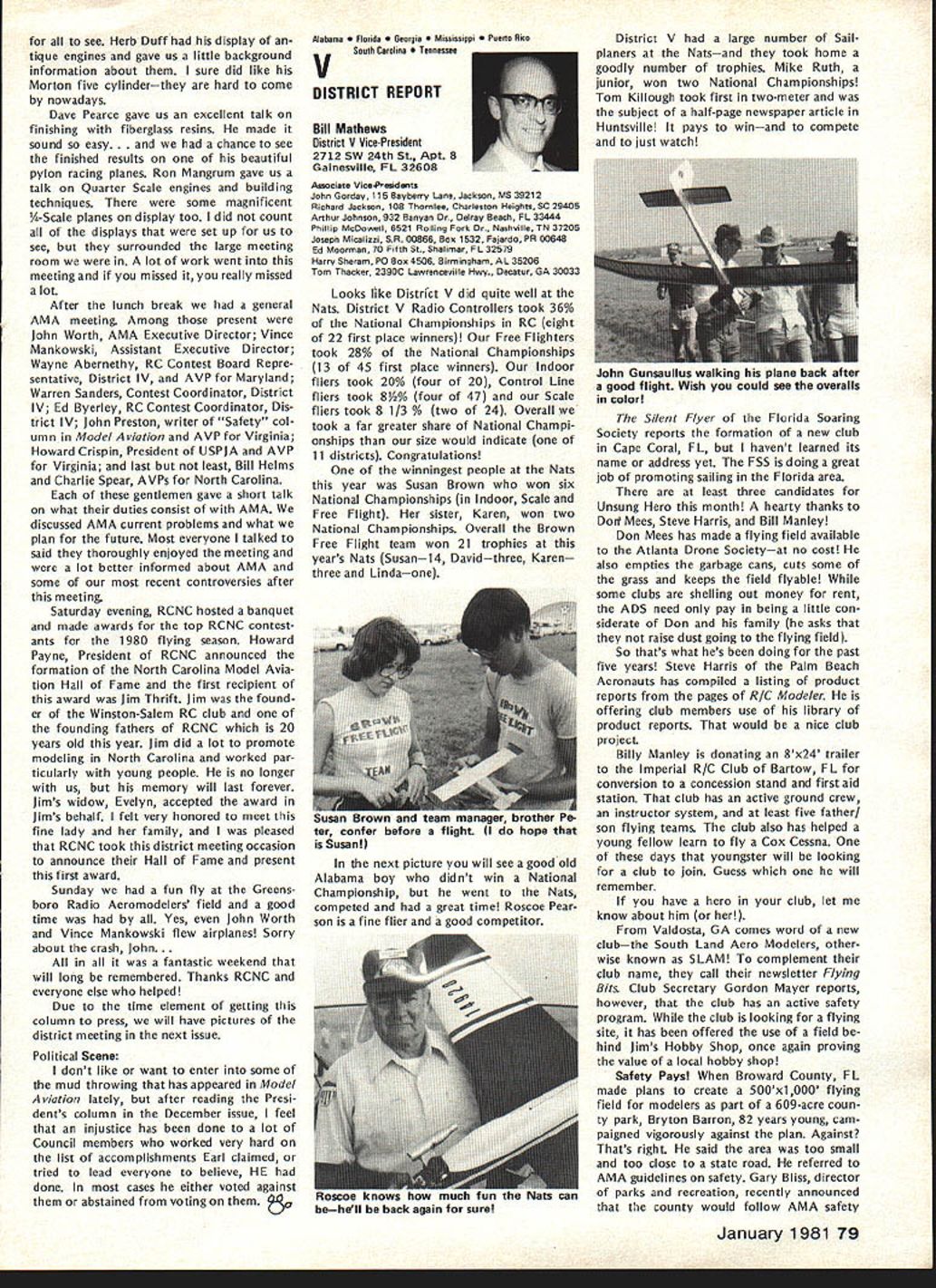
I have just returned from the District IV AMA meeting in Greensboro, NC. It was the best-planned and organized District IV meeting I have ever attended. Credit goes to the Radio Control League of North Carolina, the Greensboro and Winston-Salem RC clubs, and many individuals.
Highlights included:
- Saturday morning seminar on rubber-powered free flight by John Blair, featuring exquisite display models.
- Talk on Kraft radio gear by Bill Johnson (Kraft Electronics) with an excellent display and practical advice.
- Charlie Spear’s informative sailplane presentation with two beautiful sailplanes.
- Herb Duff displayed antique engines and provided background information.
- Dave Pearce demonstrated finishing with fiberglass resins, showing finished results on one of his pylon racing planes.
- Ron Mangrum spoke on Quarter Scale engines and building techniques; several magnificent 1/4-scale planes were on display.
Saturday evening featured an RCNC-hosted banquet and awards for top RCNC contestants for the 1980 flying season. Howard Payne announced the formation of the North Carolina Model Aviation Hall of Fame; the first recipient was Jim Thrift, founder of the Winston-Salem RC club and a founding figure of RCNC.
Sunday included a fun fly at the Greensboro Radio Aeromodelers' field — a good time for all. Yes, even John Worth and Vince Mankowski flew airplanes.
Due to timing for press, photos of the district meeting will appear in the next issue.
VI DISTRICT REPORT
Horace Cain District VI Vice‑President 525 Weidner Road, Buffalo Grove, IL 60090
Associate Vice‑Presidents:
- Chuck Delano, Indianapolis, IN
- Frank Hegges, Plattsburg, MO
- Glenn Lee, Batavia, IL
- Helen Olsen, University City, MO
- Jim Seers, Burgin, KY
- Bob Underwood, St. Louis, MO
Model aviation's major goal is to fly. Sometimes we do; sometimes we don't. Although I had planned this article as my "Full Stop," I will be allowed to submit the February '81 District VI report since elections are not yet final.
I express sincere gratitude to District VI members for outstanding cooperation and friendship over the past two years. Whoever replaces me will inherit one of AMA’s most meritorious chapters.
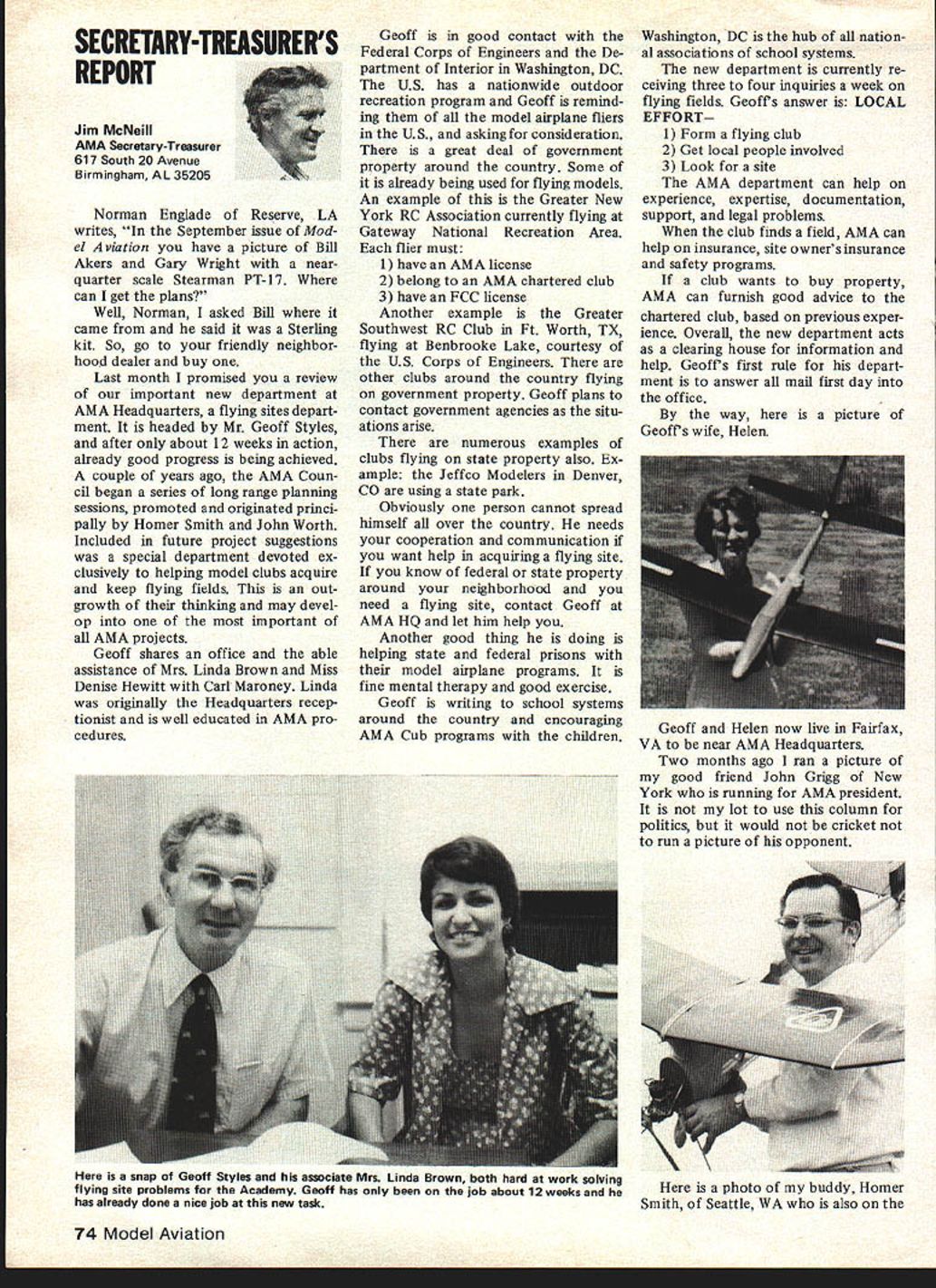
Geoff Styles, AMA Flying Site Representative, is establishing strong communications with industrial and public institutions. If allowed to continue, AMA and aeromodeling will be increasingly recognized and accepted within communities. The land purchase for the new AMA home in northern Virginia will be done about December 1, 1980, with building to start within two years.
From Around the District:
- Ken Kern, Kenco Electronics (Bedford, IN), worked on getting modelers on TV's "Real People."
- Tri‑Valley RC (South Bend, IN) now meets at First Bank and Trust in Roseland.
- The McDonnell Douglas Free Flight group and Thermaleers newsletter "The Turbolator" will no longer be distributed outside the clubs.
- Jerry Smith (RCM's "Here's How" editor) submitted aerial photos and technical information; contact him for details.
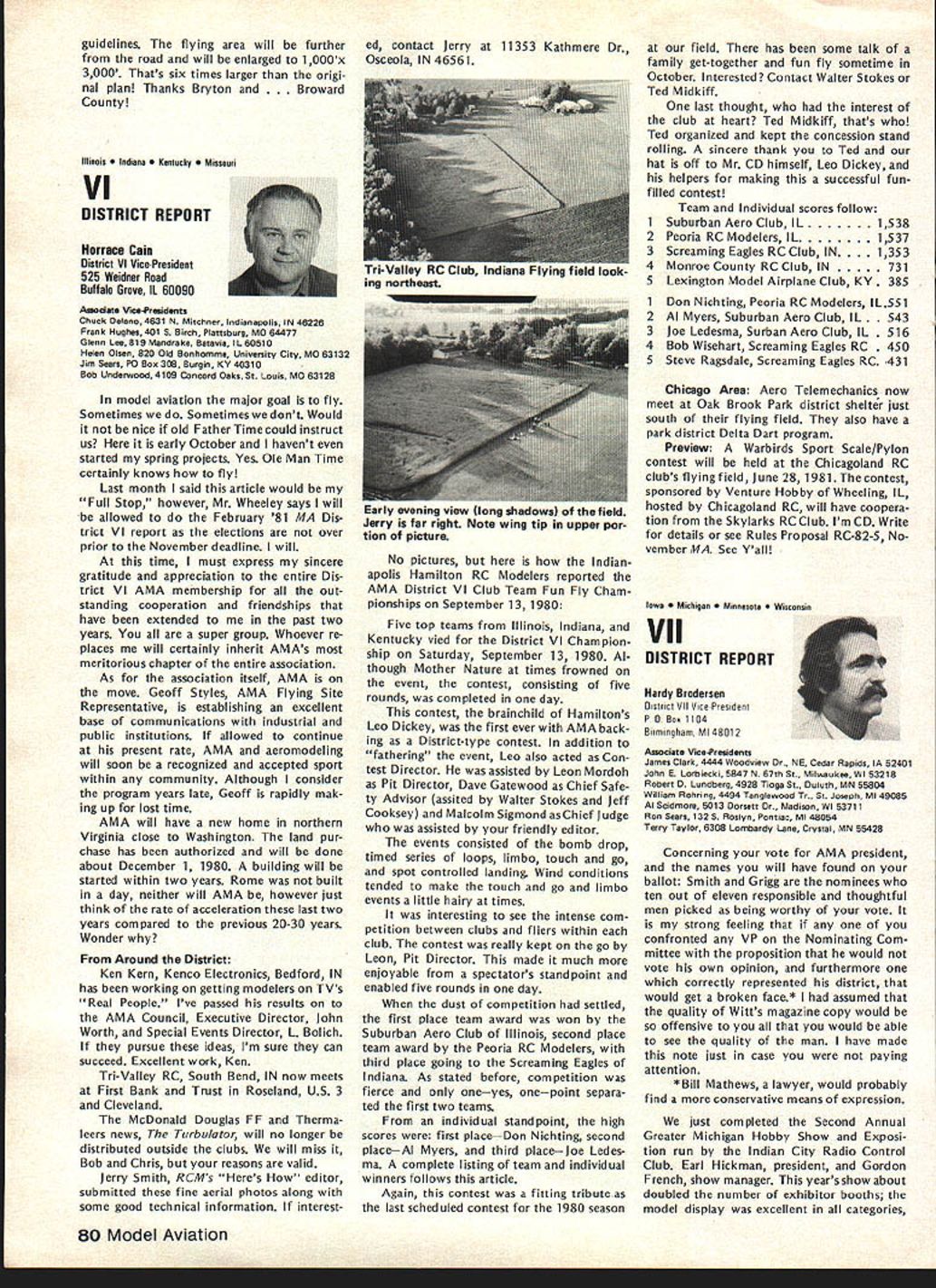
Indianapolis Hamilton RC Modelers reported the AMA District VI Club Team Fun Fly Championships held September 13, 1980. Five teams competed; despite weather the five-round contest finished in one day. Events included bomb drop, timed loops, limbo, touch-and-go, and spot-controlled landing. First place team: Suburban Aero Club (IL); second: Peoria RC Modelers; third: Screaming Eagles RC (IN). Individual high scores: 1st Don Nichting; 2nd Al Myers; 3rd Joe Ledesma.
Chicago area news: Aero Telemechanics meet at Oak Brook Park District shelter and run a park-district Delta Dart program. Preview: Warbirds Sport Scale/Pylon contest at Chicagoland RC club field on June 28, 1981 (hosted by Chicagoland RC with Skylarks RC cooperation).
VII DISTRICT REPORT
Hardy Brodersen District VII Vice President P.O. Box 1104, Birmingham, MI 48012
Associate Vice‑Presidents:
- James Clark, Cedar Rapids, IA
- John E. Lombardi, Milwaukee, WI
- Robert D. Lundberg, Duluth, MN
- William Rohrer, St. Joseph, MI
- Al Soderstrom, Madison, WI
- Ron Sears, Pontiac, MI
- Terry Taylor, Crystal, MN
Regarding the AMA president vote and nominees Smith and Griggs: they were chosen after thorough consideration and careful screening by the Nominating Committee. If a VP were asked to vote against his own opinion while representing his district, it would be unacceptable. I expected Witt's magazine copy to be offensive to members and anticipated that members would notice.
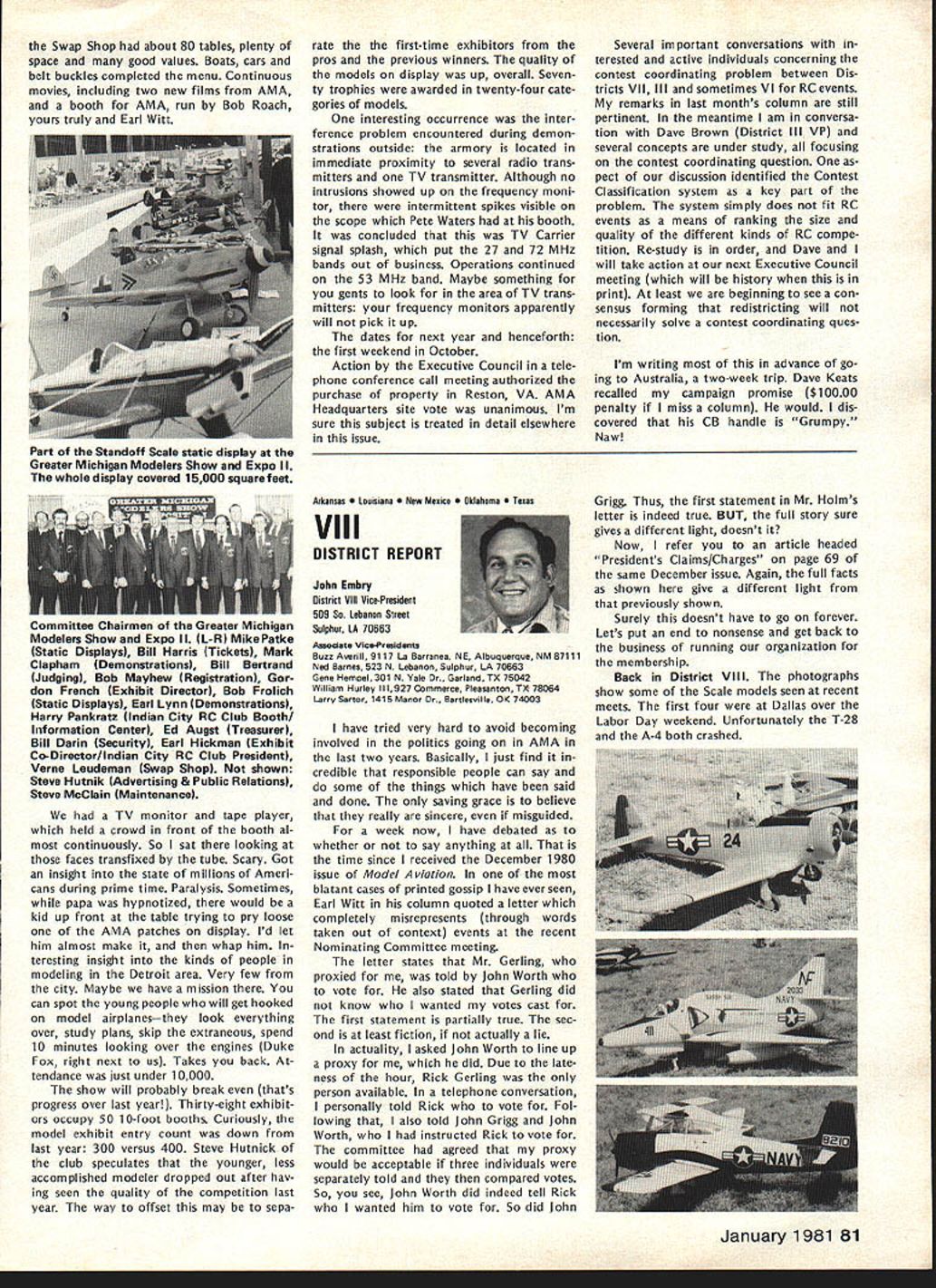
We recently completed the Second Annual Greater Michigan Hobby Show and Exposition run by the Indian City Radio Control Club. Attendance was just under 10,000; exhibitors occupied numerous booths and the model display was excellent. The Swap Shop had about 80 tables and many good values. Continuous movies, including two new AMA films, were shown at the AMA booth. The show will likely break even; dates for next year are the first weekend in October.
The Executive Council authorized purchase of property in Reston, VA for AMA Headquarters; the vote was unanimous.
Discussions continue about contest coordination between Districts VII, III, and sometimes VI for RC events. The Contest Classification system needs re-study — it does not fit RC events well as a means of ranking sizes and qualities of different RC competitions. Dave Brown and I will take action at the next Executive Council meeting.
I am writing much of this before a two-week trip to Australia.
IX DISTRICT REPORT
Travis McGinnis District IX Vice-President 8027 W. 81st Circle, Arvada, CO 80005
Associate Vice-Presidents:
- Charles Brannon, Casper, WY
- Ed Cox, Prairie Village, KS
- Jim Ricketts, Sioux Falls, SD
This column includes a contribution from Joan Alyea of Pueblo and shares sad news: District IX's Bill Pachak passed away.
Tribute to William R. (Bill) Pachak:
- Flew his first model airplane in Pueblo, CO in the mid-1930s.
- On October 6, 1980, Bill won the first heat at the Quarter Midget RC Pylon meet at Sky Corral Field; that evening he suffered a fatal heart attack.
- Bill was many things over the years—student, Air Force member, husband, father—and always a dedicated modeler. He built and flew a wide variety of models and was generous in teaching and mentoring others.
- He served as Contest Director, judge, club officer, and area representative of the National Miniature Pylon Racing Association. He was awarded the District IX All-Season Flyer patch, which will be presented to his widow.
- Bill will be greatly missed by modelers throughout Colorado and neighboring states.
Next month I will share this column with AVP Jim Ricketts of South Dakota, who has ideas concerning Juniors in AMA.
X DISTRICT REPORT
Jim Scarborough District X Vice-President 2501 Armour Lane, Redondo Beach, CA 90278
Associate Vice-Presidents:
- Glenn Carter, Walnut Creek, CA
- Alex Chisholm, Fresno, CA
- Lonnie Krebbs, Las Vegas, NV
- John Pond, San Jose, CA
- Bob Reynolds, Tucson, AZ
- Betty Strean, Long Beach, CA
- Keith Whitney, Salt Lake City, UT
This month I'm swamped with pictures. Recent activities include:
- Formation of a new 1/4-Scale group (chapter three of the Quarter-Scale Association) with Connie Vaughn appointed interim president.
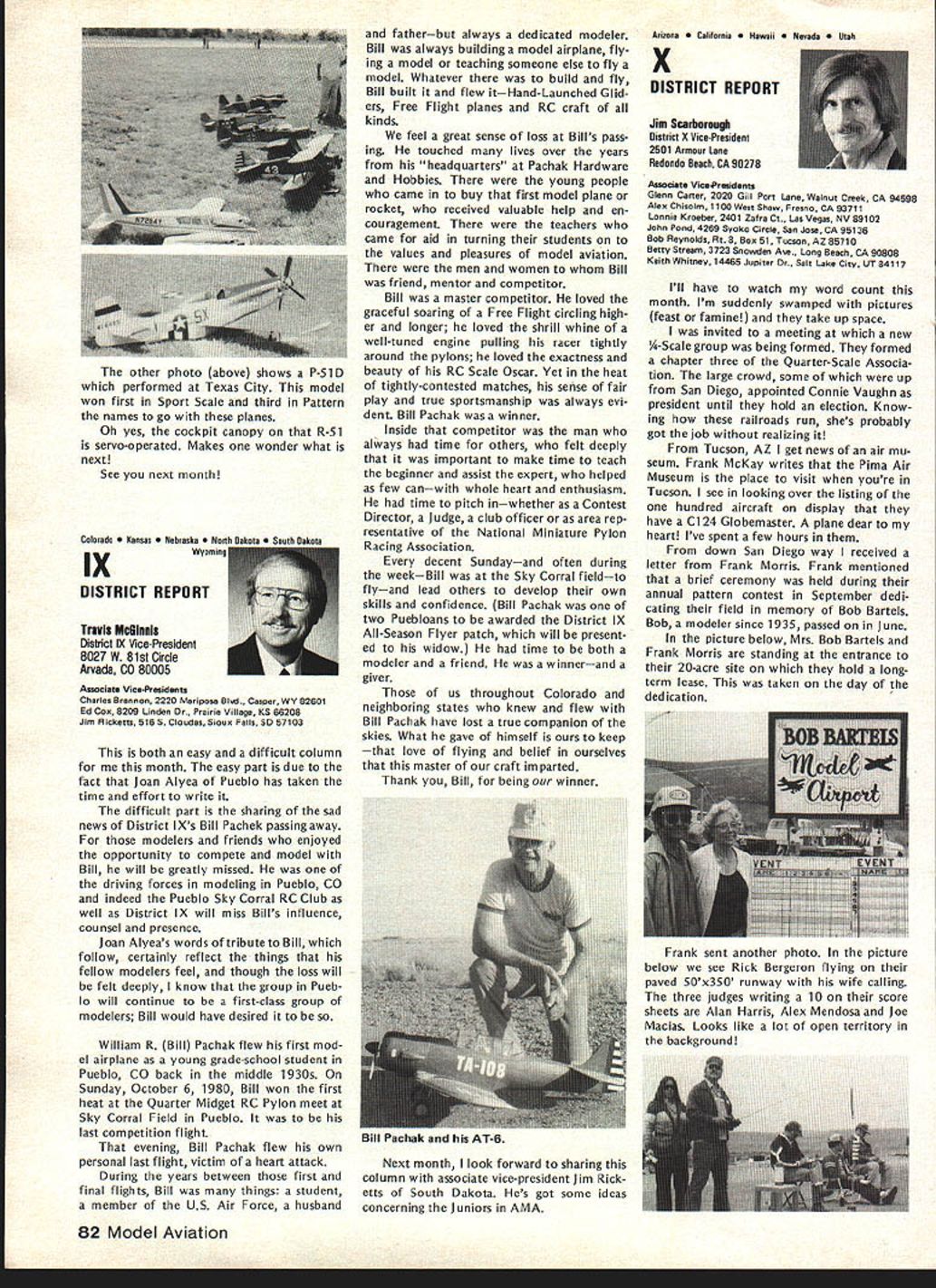
- Pima Air Museum in Tucson, AZ (recommended visit) has a C-124 Globemaster among its collection.
- The San Diego group held a ceremony dedicating their field in memory of Bob Bartels (a modeler since 1935).
- Photos (references) show a paved 50' x 350' runway and large pit area at a club field, and Rick Bergeron flying with his wife calling; judges are Alan Harris, Alex Mendoza and Joe Macias.
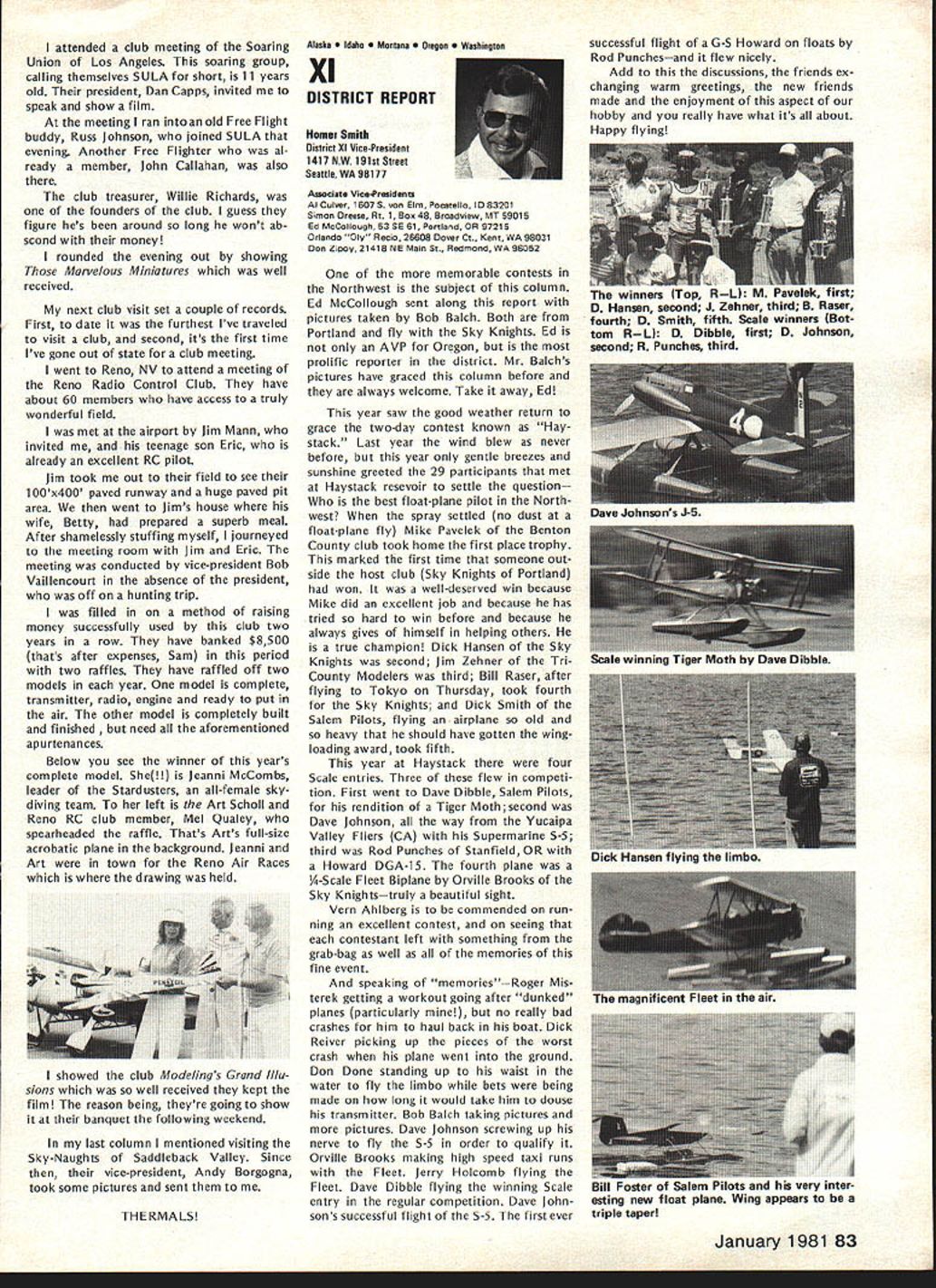
- I visited the Soaring Union of Los Angeles (SULA) and showed the film Those Marvelous Miniatures.
- I visited Reno Radio Control Club (60 members) and their excellent field. The club has raised $8,500 over two years with two raffles, each raffling one complete ready-to-fly model and another fully built but needing radio and engine. The winner of this year's complete model was Jeanni McCombs, leader of the Stardusters (an all-female skydiving team).
I also reported on the Sky-Naughts of Saddleback Valley and other club visits.
THERMALS!
AMA Special Report — FCC (Supplement)
Number of Channels Required (Summary)
The AMA identifies the following requirements:
- Aircraft: 20 usable channels needed for interference-free operation to support 15 simultaneous aircraft; total channels projected to 50 by 1990 to account for fixed-station growth and adjacent-channel blocking.
- Terrestrial models: 20 usable channels required, but a recommendation of 23 total channels is made due to intermodulation considerations.
Summary of Aircraft Derivation
- Fifteen simultaneous aircraft is the practical maximum before pilot confusion becomes significant.
- Five overhead channels are required for ground testing, frequency-flag turnover delays, and other contingencies, yielding 20 required usable frequencies.
- Adjacent-channel interference and fixed-station blocking reduce usable channels; each strong fixed assignment can block two interstitial RC channels.
- Based on FCC records for top urban areas, three to five 72 MHz fixed assignments currently exist in many areas. To assure 20 usable RC frequencies, 30 total channels may be needed today, and up to 50 by 1990 given projected growth in fixed stations.
(End of report.)
Transcribed from original scans by AI. Minor OCR errors may remain.

