
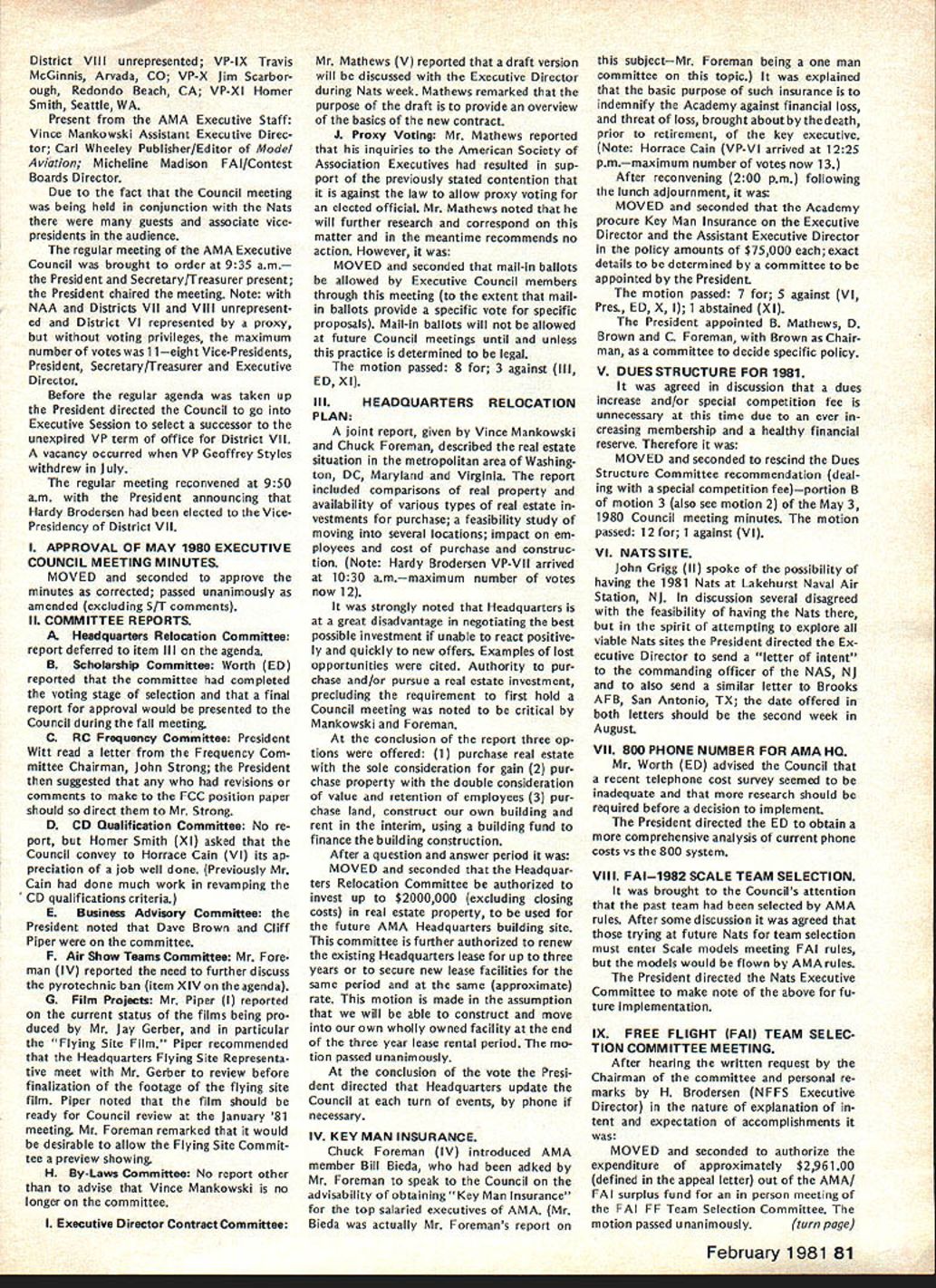
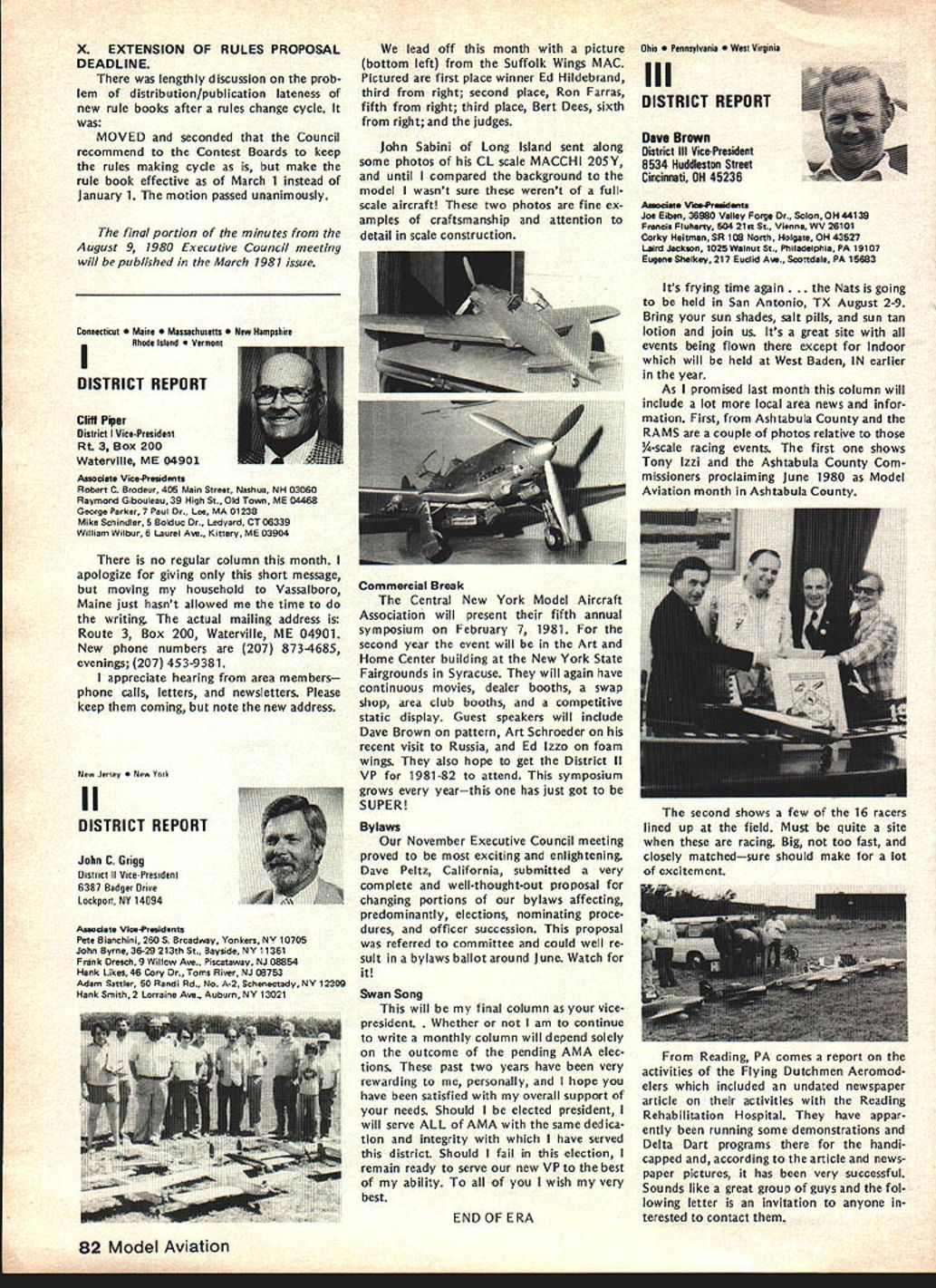
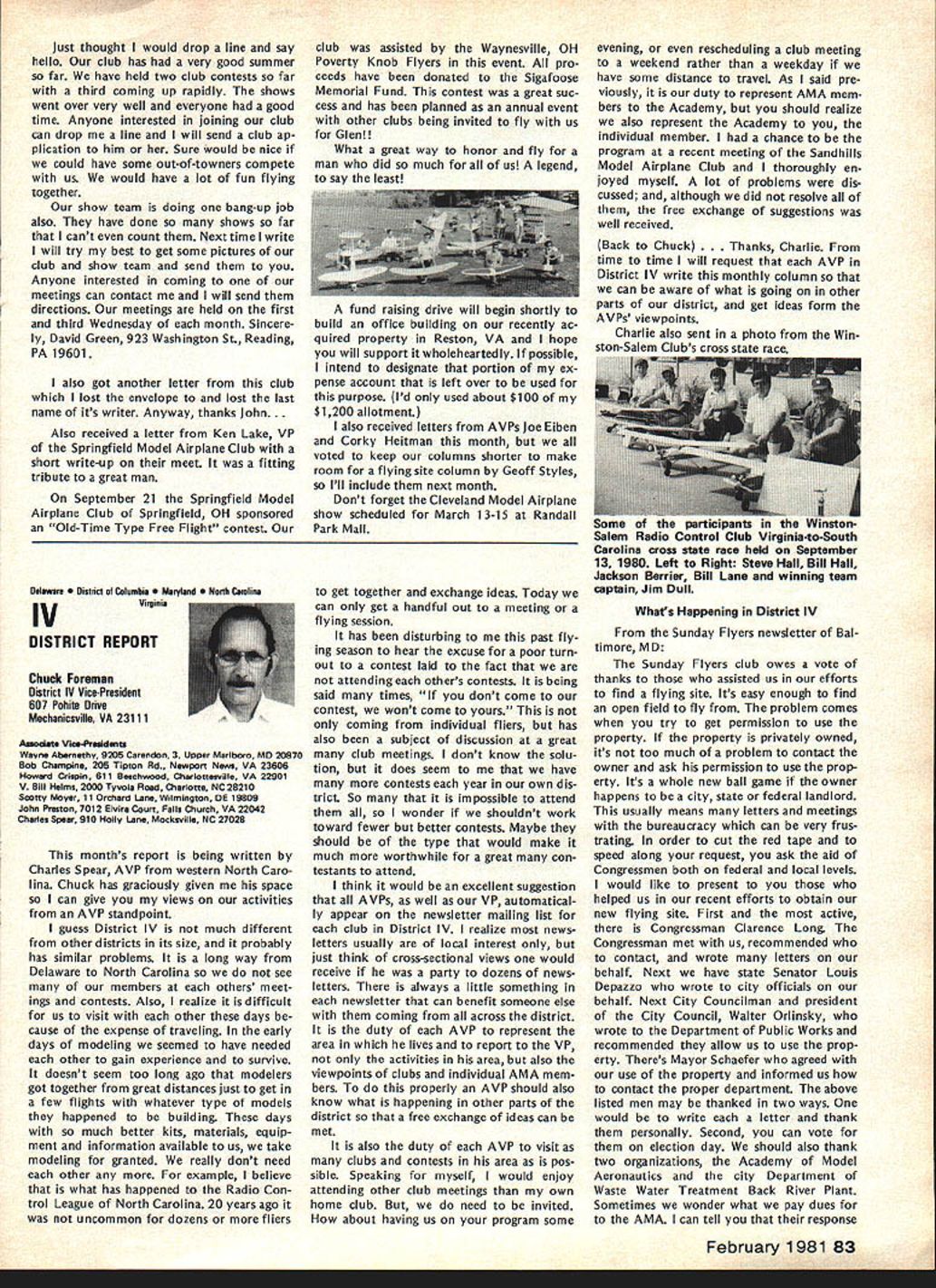
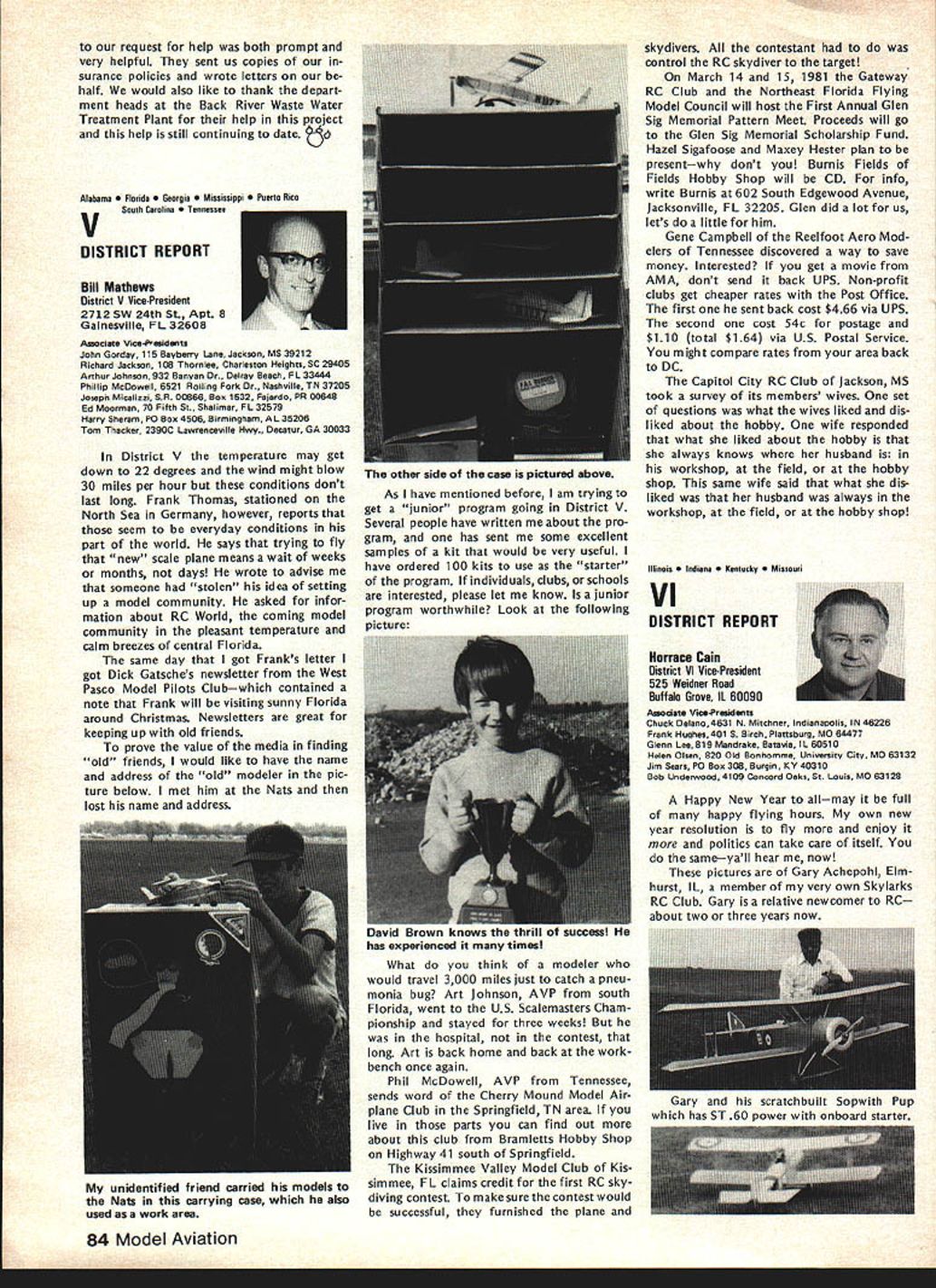
AMA News
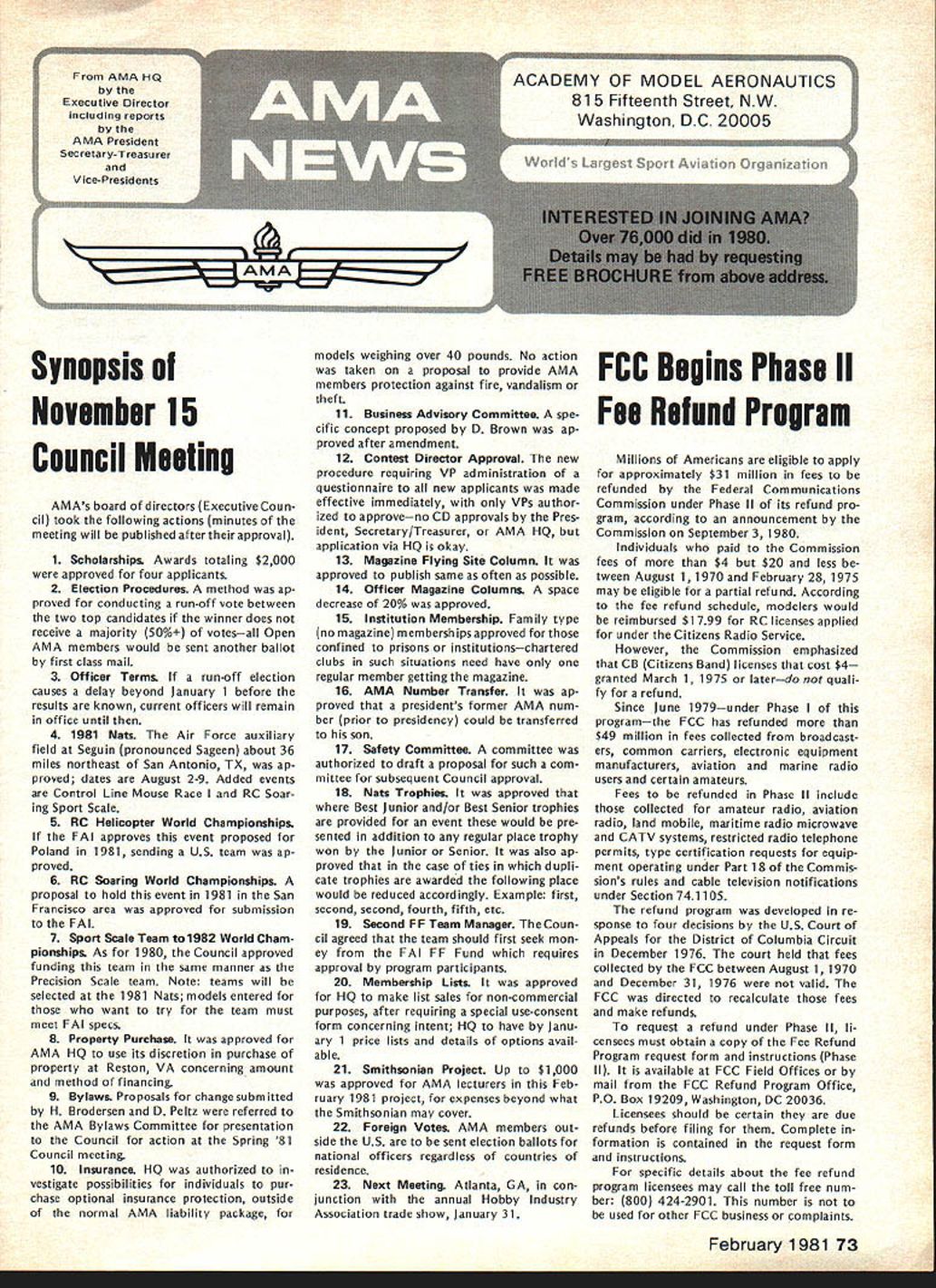
Synopsis — November 15 Council Meeting
AMA's Board of Directors (Executive Council) took the following actions. Minutes of the meeting will be published after approval.
- Scholarships — Awards totaling $2,000 approved for four applicants.
- Election Procedures — Method approved for conducting a run-off vote between the two top candidates when the winner does not receive a majority (50%) of votes. All Open AMA members would be sent another ballot by first-class mail.
- Officer Terms — If a run-off election causes delay beyond January 1 before results are known, current officers will remain in office until successors are installed.
- 1981 Nats — Air Force auxiliary field at Seguin (pronounced SAY-geen), about 36 miles northeast of San Antonio, TX; approved dates August 2–9. Added events: Control Line Mouse Race, RC Soaring, Sport Scale.
- RC Helicopter World Championships — If the FAI approves this event proposed for Poland in 1981, sending a U.S. team was approved.
- RC Soaring World Championships — Proposal to hold this event in 1981 in the San Francisco area approved for submission to the FAI.
- Sport Scale Team — 1982 World Championships: As in 1980, Council approved funding this team in the same manner as the Precision Scale team. Teams will be selected at the 1981 Nats; models entered by those trying for the team must meet FAI specifications.
- Property Purchase — Approved AMA HQ to use its discretion in purchasing property in Reston, VA concerning amount and method of financing.
- Bylaws Proposals — Changes submitted by H. Brodersen and D. Peltz referred to the AMA Bylaws Committee for presentation and Council action at the Spring 1981 meeting.
- Insurance — HQ authorized to investigate optional insurance for individuals (outside the normal AMA liability package) for models weighing over 40 pounds. No action taken on a proposal to provide AMA members protection against fire, vandalism, or theft.
- Business Advisory Committee — Specific concept proposed by D. Brown approved after amendment.
- Contest Director Approval — New procedure requiring VP administration of a questionnaire to all new applicants made effective immediately; only VPs authorized to approve. CD approvals by the President, Secretary/Treasurer, or AMA HQ are not authorized, but application via HQ is acceptable.
- Magazine Flying Site Column — Approved to publish the column as often as possible.
- Officer Magazine Columns — Space decrease of 20% approved.
- Institution Membership — Family-type (no magazine) memberships approved for persons confined to prisons or institutions; chartered clubs in such situations need have only one regular member receiving the magazine.
- AMA Number Transfer — Approved that a president's former AMA number (prior to presidency) could be transferred to his son.
- Safety Committee — Committee authorized to draft a proposal for such a committee for subsequent Council approval.
- Nats Trophies — Where Best Junior and/or Best Senior trophies are provided, these would be presented in addition to any regular place trophy won by the Junior or Senior. In case of ties where duplicate trophies are awarded, the following place trophies will be reduced accordingly (example: first, second, second, fourth, fifth).
- Second Free Flight Team Manager — Council agreed the team should first seek money from the FAI FF Fund, which requires approval by program participants.
- Membership Lists — Approved HQ to make list sales for non-commercial purposes after requiring a special-use consent form concerning intent. HQ to have price lists and details of options available by January 1.
- Smithsonian Project — Up to $1,000 approved for AMA lecturers for the February 1981 Smithsonian project, to cover expenses beyond what the Smithsonian may provide.
- Foreign Votes — AMA members outside the U.S. are to be sent election ballots for national officers regardless of country of residence.
- Next Meeting — Atlanta, GA, in conjunction with the annual Hobby Industry Association trade show, January 31.
---
Fee Refund Program
Millions of Americans may be eligible; approximately $31 million in fees were refunded by the Federal Communications Commission under Phase II of its refund program (announcement dated September 3, 1980). Individuals who paid Commission fees of $4 to $20 between August 1, 1970 and February 28, 1975 may be eligible for a partial refund. Under the fee refund schedule, modelers would be reimbursed $1.79 for RC licenses applied for under the Citizens Radio Service. The Commission emphasized that CB (Citizens Band) licenses, which cost $4 and were granted March 1, 1975 or later, do not qualify for refund. Since June 1979, under Phase I of the program, the FCC has refunded $49 million in fees collected.
---
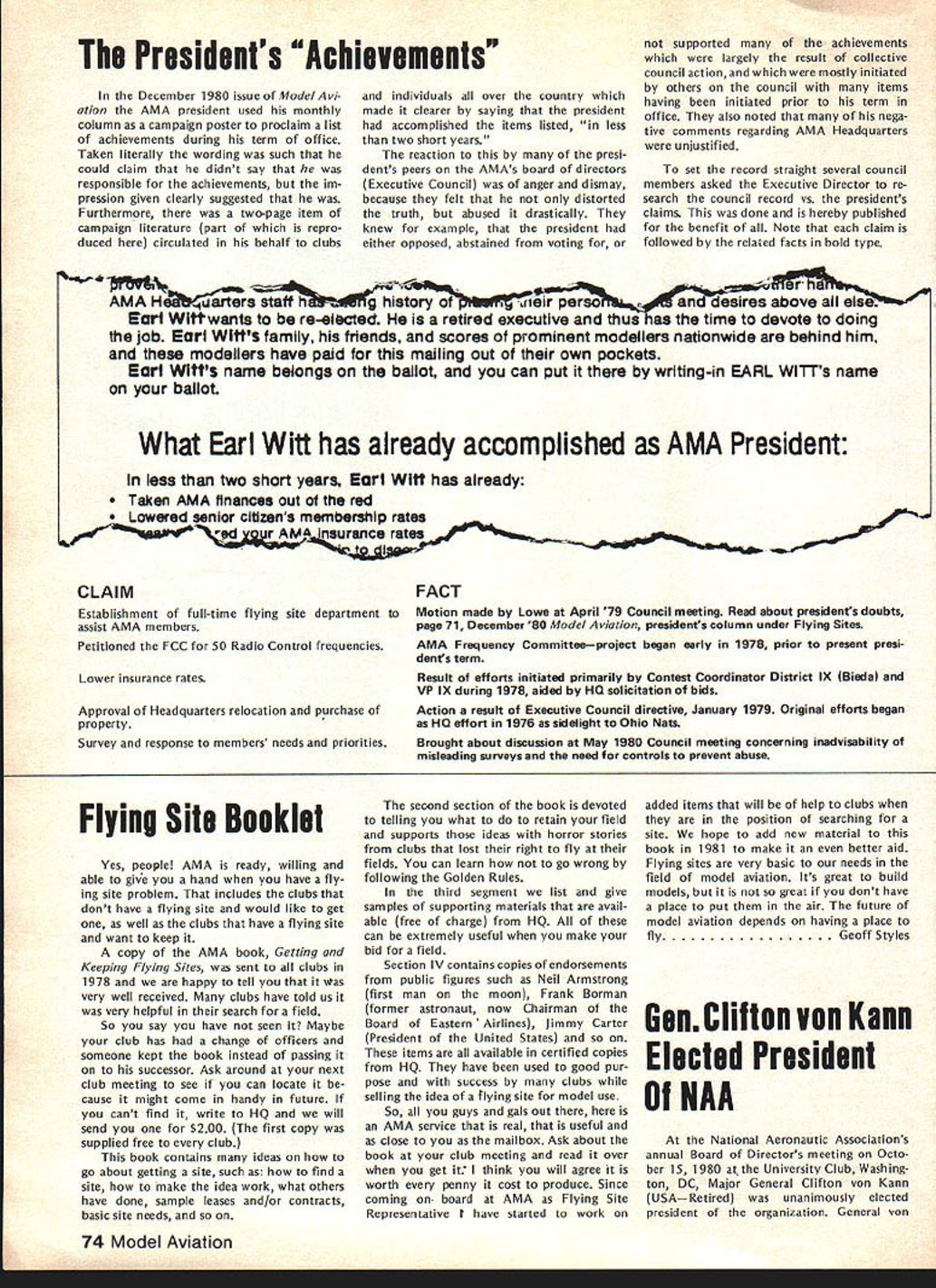
Flying Site Booklet
AMA offers practical help for clubs with flying-site problems — whether your club needs a site or wants to keep one. A copy of the AMA booklet Getting and Keeping Flying Sites was sent to all clubs in 1978 and was very well received. Many clubs found it helpful in their search for a field.
If your club no longer has the booklet (officer changes, etc.), ask around at your next meeting. If you cannot locate it, write to HQ and we will send you one for $2.00 (the first copy was supplied free to every club). The book contains ideas on how to find a site, how to make the idea work, sample leases and contracts, basic site needs, and more.
The second section advises what to do to retain your field and supports those ideas with horror stories from clubs that lost their flying rights — a useful "how not to go wrong" guide. Section III lists supporting materials (available free from HQ) that can help when making a bid for a field. Section IV contains copies of endorsements from public figures (e.g., Neil Armstrong, Frank Borman, Jimmy Carter). Certified copies of these endorsements are available from HQ and have been effective for many clubs.
We plan to add new material to the book in 1981 to make it an even better aid. Flying sites are essential to model aviation — it's great to build models, but you need a place to fly them. — Geoff Styles
---
AMA Assists Smithsonian Project
"Model Airplanes: Then and Now" is a special seminar scheduled for February 22–27, 1981 at the Smithsonian Air and Space Museum, Washington, DC. Coordinators: Robert C. Mikech (Curator of Aircraft and Manager of the Model Collection, National Air and Space Museum) and Frank Ehling (Technical Director, Academy of Model Aeronautics).
The seminar covers the full panorama of model aviation — from paper darts to modern quarter-scale models — with lectures, tours of the Museum and the Paul E. Garber Facility at Silver Hill, film clips, slides, photos, and displays of museum-quality models and engines. Sessions include technical instruction, historical reminiscences (including Paul E. Garber), and demonstrations.
#### Seminar Outline
- Sunday, February 22 — Individual arrivals at the Rosslyn Westpark Hotel, Arlington, VA. Reception, orientation program, and behind-the-scenes tour of the original Smithsonian building ("the Castle on the Mall"). (T, R)
- Monday, February 23 — Morning: Frank Ehling: "The Broad Scope of Model Building: From Paper Airplanes Up"; Hardy Brodersen: "Rubber Powered Flying Models: Towline and Hand Launch Gliders"; Paul E. Garber: "The Old Aero Clubs 1910–1930: The Beginning of Model Airplanes as a Sport."
Afternoon: Hardy Brodersen: "Powered Free Flight Models (gas models)"; movie clips of world-class competitions; outdoor demonstration and participation. (B)
- Tuesday, February 24 — Morning: Dr. Laird Jackson: "Control Line Models" and film on world championship contests; Dr. Walter A. Good: "Radio Control Models: Historical Highlights from the Early Experimental 1930s to the Ingenious Digital Systems of Today"; film—"Early RC—1938–1941."
Afternoon: Don Lowe: "RC Aerobatic Models"; film on remotely piloted vehicle (RPV) technology; Richard Kowalski: "Indoor Duration Model Aircraft: Complex and Delicate Structures for Competition and Record Class Flying"—lecture/demonstration. (B)
- Wednesday, February 25 — Morning: "The History and Technical Advances of Model Engines"; John Preston: "Flying Scale Models: Large and Small."
Afternoon: Jack Salmon: "Specialty Models Used by Air Show Teams." (B)
- Thursday, February 26 — Morning: Mike Grady: "Model Finishes and Scale Detail Realism"; Dr. Frank Mitchell: "Plastic Aircraft Kit Conversions and Scratch-Building."
Afternoon: Robert C. Mikech: tour of the Paul E. Garber Facility; Robert B. Meyer, Jr.: tour of the model engine collection. (B, T)
- Friday, February 27 — Morning: Robert C. Mikech: "Models for NASM (Museum Standards and Outside Requests for Assistance)"; John Worth, Executive Director, AMA: "The National and International Sport..." (program continues)
---
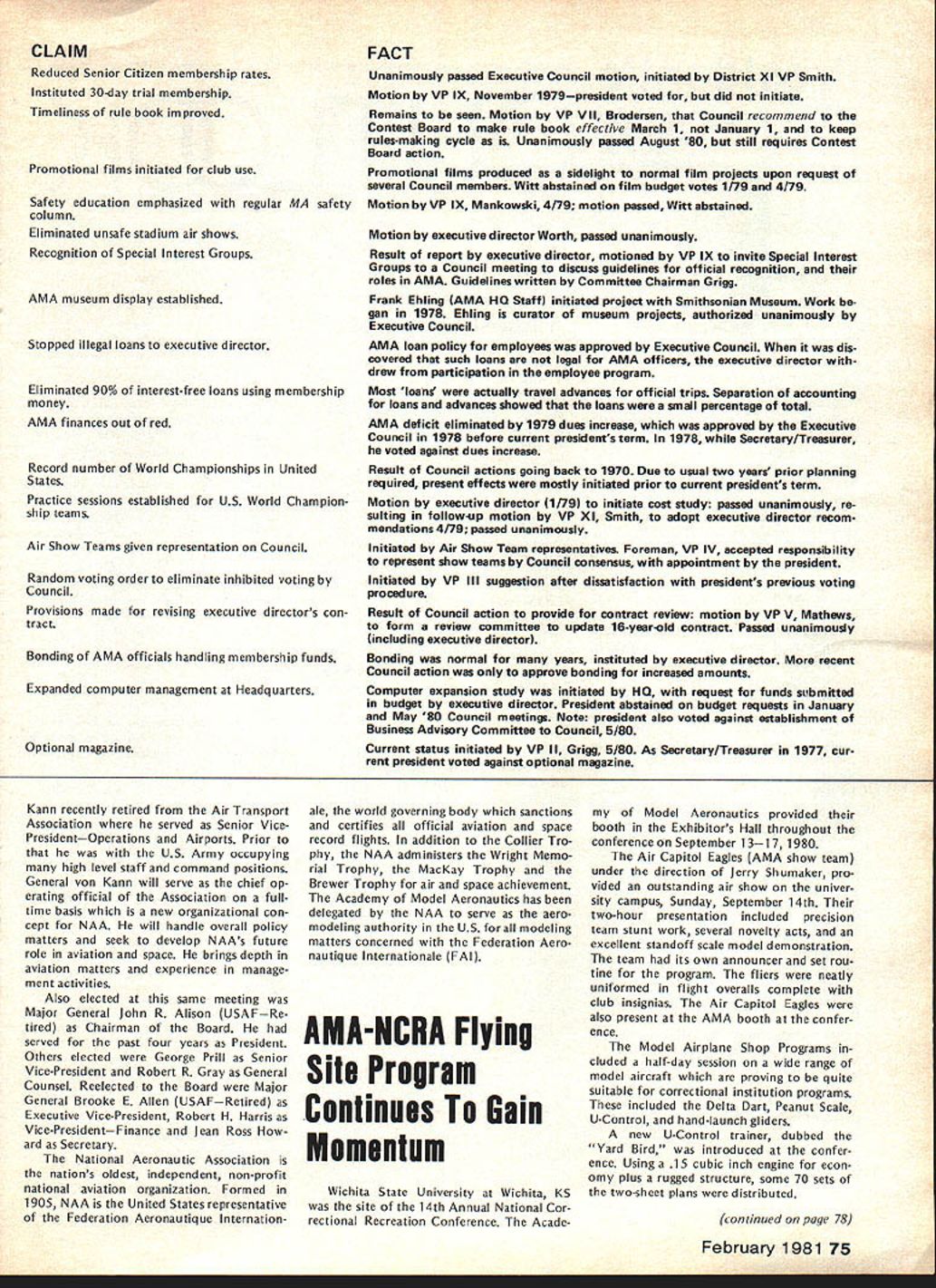
Claims and Facts (Selected)
Claim:
- Reduced Senior Citizen membership rates.
- Instituted 30-day trial membership.
- Timeliness of rule book improved.
- Promotional films initiated for club use.
- Safety education emphasized with a regular AMA safety column.
- Eliminated unsafe stadium air shows.
- Recognition of Special Interest Groups.
- AMA museum display established.
- Stopped illegal loans to executive director.
- Eliminated 90% of interest-free loans using membership money.
- AMA finances out of the red.
- Record number of World Championships in United States.
- Practice sessions established for U.S. World Championship teams.
- Air Show Teams given representation on Council.
- Random voting order to eliminate inhibited voting by Council.
- Provisions made for revising executive director's contract.
- Bonding of AMA officials handling membership funds.
- Expanded computer management at Headquarters.
- Optional magazine.
Fact:
- Reduced Senior Citizen rates: Unanimously passed Executive Council motion initiated by District XI VP Smith.
- 30-day trial membership: Motion by VP IX, November 1979 — president voted for, but did not initiate.
- Rule book timeliness: Motion by VP VII (Brodersen) to recommend making the rule book effective March 1 rather than January 1; unanimously passed August 1980 but still requires Contest Board action.
- Promotional films: Produced as part of normal film projects upon request of several Council members; Witt abstained on certain film budget votes.
- Safety column, stadium shows, Special Interest Groups, museum display, loan issues, finances, world championships, practice sessions, air show team representation, voting order, contract review, bonding, and computer expansion: each item resulted from specific Council or HQ actions and studies; where applicable, motions, committee reports, or prior actions are cited (see minutes and committee reports for details).
---
Executive Council — Selected Meeting Highlights
I. Approval of May 1980 Executive Council Meeting Minutes
Moved and seconded to approve minutes as corrected; passed unanimously as amended (excluding Secretary/Treasurer comments).
II. Committee Reports
- Headquarters Relocation Committee report deferred to item III.
- Scholarship Committee: executive director reported selection completed; final report to be presented at the fall meeting.
- RC Frequency Committee: President read a letter from Chairman John Strong; members asked to direct revisions/comments to Mr. Strong.
- CD Qualification Committee: no report; Horace Cain acknowledged for revamping CD qualification criteria.
- Business Advisory Committee: Dave Brown and Cliff Piper are members.
- Air Show Teams Committee: discussion noted need for further discussion of pyrotechnic ban.
- Film Projects: Flying Site film to be reviewed by Headquarters Flying Site Representative and the Flying Site Committee prior to finalization; film expected for Council review in January 1981.
- By-Laws Committee: noted that Vince Mankowski is no longer on the committee.
- Executive Director Contract Committee: draft to be discussed during Nats week; purpose is to provide overview of new contract basics.
- Proxy Voting: research indicated proxy voting for an elected official may be against the law; a motion allowed mail-in ballots for this meeting only; future mail-in ballots were deferred pending legal determination (motion passed: 8 for; 3 against).
III. Headquarters Relocation Plan
A joint report described real estate options in the Washington, DC metropolitan area. The Council noted the need for quick action to secure advantageous investments. After discussion, it was moved and seconded to authorize the Headquarters Relocation Committee to invest up to $200,000 (excluding closing costs) in real estate for a future AMA Headquarters site, to renew the existing lease for up to three years or secure new lease facilities for the same period at approximately the same rate. The motion passed unanimously. Headquarters was directed to update the Council on developments.
IV. Key Man Insurance
A motion passed to procure Key Man Insurance on the Executive Director and the Assistant Executive Director in policy amounts of $75,000 each; specifics to be determined by a committee appointed by the President (motion passed: 7 for; 5 against; 1 abstained). Committee appointed: B. Mathews, D. Brown, C. Foreman (Brown, Chairman).
V. Dues Structure for 1981
After discussion, the Council rescinded a Dues Structure Committee recommendation dealing with a special competition fee; motion passed: 12 for; 1 against.
VI. Nats Site
John Grigg (II) discussed possible 1981 Nats sites including Lakehurst NAS, NJ. The Executive Director was directed to send letters of intent to the commanding officer of NAS Lakehurst and to Brooks AFB, San Antonio, TX, proposing second week in August dates.
VII. 800 Phone Number for AMA HQ
The Executive Director was directed to obtain a more comprehensive analysis of current phone costs versus implementing an 800 number system before any decision.
VIII. FAI — 1982 Scale Team Selection
Those trying out at future Nats for team selection must enter Scale models meeting FAI rules; models will be flown under AMA rules. The Nats Executive Committee was directed to note this for future implementation.
IX. Free Flight (FAI) Team Selection Committee Meeting
Council authorized expenditure of approximately $2,961 from the AMA/FAI surplus fund for an in-person meeting of the FAI Free Flight Team Selection Committee. Motion passed unanimously.
X. Extension of Rules Proposal Deadline
After discussion on late distribution/publication of new rule books, the Council moved to recommend to the Contest Boards keeping the rule-making cycle as is but making the rule book effective March 1 instead of January 1. Motion passed unanimously.
(The final portion of the minutes from the August 9, 1980 Executive Council meeting will be published in the March 1981 issue.)
---
IV District Report
Chuck Foreman, District IV Vice‑President 607 Pohite Drive, Mechanicsville, VA 23111
Associate Vice‑Presidents (selected):
- Wayne Abernethy, Upper Marlboro, MD
- Bob Chambers, Newport News, VA
- Howard Crippen, Charlottesville, VA
- Bill Helms, Charlotte, NC
- Scotty Hoyer, Mocksville, NC
- John Preston, Falls Church, VA
- Charles Spear, Mocksville, NC
This month's report (written by Charles Spear, AVP from western North Carolina) notes that District IV faces long distances between clubs (Delaware to North Carolina) and travel expense challenges. In earlier years modelers traveled widely to share experience; today better kits, materials, and information have reduced that need, contributing to lower contest attendance. Many clubs report reciprocal nonattendance ("If you don't come to our contest, we won't come to yours"), and there may be too many contests of varying value. Suggestion: fewer but better contests to encourage broader attendance.
Recommendations and observations:
- AVPs (and the VP) should automatically be placed on the newsletter mailing list for each club in District IV so cross-sectional views and ideas can be shared.
- AVPs have a duty to represent their area and to report viewpoints to the VP; to do so effectively they should know what's happening elsewhere in the district.
- AVPs should visit clubs and contests when possible; clubs are encouraged to invite AVPs to meetings and consider scheduling to accommodate travel.
- Example: author enjoyed being program chair for the Sandhills Model Airplane Club meeting where many problems and ideas were discussed.
Also noted: Sunday Flyers (Baltimore, MD) thanked local and federal officials (including Congressman Clarence Long, state Senator Louis DePazzo, City Councilman Walter Olinsky, and Mayor Schaefer) and AMA HQ for assistance in obtaining a flying site. AMA provided prompt assistance (insurance policy copies and letters). The report highlights the continued value of AMA support to local clubs.
Transcribed from original scans by AI. Minor OCR errors may remain.

