
AMA News
AMA Officer Election — 1981 Nomination Procedures
- Odd-numbered years: election for national office of AMA Secretary‑Treasurer and regional Vice‑Presidents in odd‑numbered AMA districts (I, III, V, VII, IX, XI).
- Even-numbered years: election for national office of AMA President and regional Vice‑Presidents in even‑numbered AMA districts (II, IV, VI, VIII, X).
- Officers elected serve for the two years following the year in which the election takes place.
Candidate Minimum Standards
#### National Officers (President or Secretary‑Treasurer)
- Nominee must be an AMA Leader Member (Contest Directors are also Leader Members).
- Nominee must have served at least one year prior to beginning the term of office as either:
- an elected officer of the AMA (e.g., Vice‑President), or
- an officer directly appointed by the President or the Vice‑Presidents (e.g., Contest Board member, Contest Coordinator, Committee Chairman).
- Committee members merely approved by the President or a Vice‑President are not considered officers.
#### District Officers (Vice‑Presidents)
- Nominee must be a Leader Member of the AMA.
- District Vice‑President candidates shall be nominated exclusively by Leader or Open members who, at the time of nomination, are bona fide legal residents of the same district of which the nominee is also a bona fide legal resident.
- A nominee may be nominated only for the vice‑presidency of the district in which he or she is a bona fide legal resident.
- District Vice‑Presidents shall be elected exclusively by a majority of those Leader and Open members voting who, at the time of election, are bona fide legal residents of the same district as the candidates.
- All other elective officers shall be nominated by Leader or Open members without regard to residential considerations.
- Note: Residency is interpreted as the current address on file at AMA Headquarters.
Who May Submit Nominations
- Any AMA member may submit a nomination; however, the consent of the person nominated should be obtained prior to submission.
- Nominations must be submitted in writing and should be accompanied by a statement of at least 100 words concerning the nominee’s qualifications.
- Nominees are urged to submit any statements, documents, or evidence appropriate to supporting their nominations before the Nominating Committee meeting.
- Nominees must submit a letter of acceptance to the Nominating Committee prior to the start of the meeting.
When to Submit Nominations
- Nominations must be submitted prior to the start of the Nominating Committee meeting.
- Normally the Committee meets in mid‑summer during the National Model Airplane Championships.
Where to Submit Nominations
- Ordinarily District Vice‑Presidents also serve on the Nominating Committee.
- Nominations should be submitted to the Vice‑President of the AMA member’s district (names and addresses appear in the VP columns).
- At the same time, a copy of the nomination should be sent to AMA Headquarters (not required, but preferred).
Are All Nominations Accepted?
- Not necessarily. Nominations submitted in accordance with the guidelines will be considered by the Nominating Committee, but only two names per office will be approved by the Committee for listing on the ballot.
- The ballot will provide for write‑in votes for any additional candidates who meet the requirements.
Are Current Officers Automatically Re‑nominated?
- No. A current officer must be nominated by an AMA member for reelection and the nomination should follow the procedures outlined above.
Publication Requirement
- By AMA bylaws, the nominating procedures document (Council‑approved) must be published at least 90 days prior to the annual Nominating Committee meeting. This publication is the current Nomination Procedures Document unless superseded by a more recent publication.
---
RC Frequency Proposal and Experimental 900 MHz Program
We propose 50 channels on 72–73 MHz, with plug‑in crystals or frequency modules permitted for both receiver and transmitter operation so modelers can change channels to suit local conditions.
Alternatives beyond the 50 channels on 72–73 MHz are limited. Legal counsel has advised that the 3–300 MHz spectrum is largely allocated to commercial, amateur, and military users; only a few spot frequencies might have been available in the 30–42 MHz “guard band,” but these would be scattered 10 kHz assignments with nearby high‑power users causing potential interference—making them impractical.
Looking farther ahead, truly exclusive RC channels without adjacent‑channel interference would likely be in the 900 MHz band. AMA was granted an experimental license (issued 1/28/81) permitting operation on four channels in the 900 MHz region. An experimental program is underway to determine the feasibility of RC operation at these UHF frequencies, but mature equipment is many years away.
Notes:
- Narrow‑band FM systems capable of 10 kHz channel spacing are in use in Europe; technology exists to manufacture such systems in the U.S.
- Under the present plan, we can immediately introduce 21 new narrow‑band channels without interference to existing 72 MHz RC channels, and as new equipment is produced the transition will be eased.
- The proposal requested 23 new channels between 75.410 and 75.850 MHz exclusively for non‑aircraft RC (cars, boats, etc.), separating aircraft from other hobby uses and enabling simultaneous operation at “hobby park” facilities.
We are also preparing a new frequency control system to be more meaningful than the present color‑coded flags or streamers and inexpensive to implement. The Frequency Committee is exploring all possibilities consistent with AMA President and Executive Council direction.
Sincerely, Bob Akerle, W2QPP March 23, 1981
---
Flying Site Questionnaire
A questionnaire was mailed to all chartered clubs requesting basic information about the flying sites clubs use and prevailing conditions. Over 500 clubs have responded; many replies included letters or site layouts. Early highlights from a 10% sampling:
- 44% of clubs fly on a public site (primary site)
- 55% of clubs fly on a private site (primary site)
- 19% of clubs with a second field fly on private land
- 19% of clubs with a second site fly on public land
- 1% of clubs own their site
- Average time of occupancy/usage: 6.8 years
- 24% of clubs have a lease agreement with their landlord
- 76% do not have a lease arrangement
Only about 10 clubs stated they did not have a site or were in the process of losing their site; the questionnaire opened the door for intervention and assistance. The common themes in responses:
- Abide by the Safety Code to keep flying safe.
- Be a good neighbor regarding noise—most clubs enforce muffler rules (often down to .049 engines).
- Many clubs require prospective fliers to join AMA prior to flying; the "Guest Membership" allows a 30‑day temporary AMA membership (see details below).
Other observations:
- Clubs vary widely in dues; some have two‑level memberships (fliers and non‑fliers).
- Most clubs pay for field maintenance; a few have their field maintained by local authorities or property owners (public parks, sod farms).
- Site types range from school playing fields to military bases, parks, airports, university grounds, and private industry property.
- Many clubs use the AMA site owner liability insurance coverage; it’s an important aspect of site procurement available at no additional cost unless special certificate wording is required.
#### Additional Flying Site Notes (continued)
- Some clubs own land and offset taxes by renting part of it for crops.
- Availability of land is not strictly tied to geography; eastern clubs can have as large sites as western ones.
- Free Flight clubs tend to be smaller; efforts are needed to promote Free Flight as accessible and inexpensive.
- Most clubs allow guests but generally require AMA membership prior to flying. The Guest Membership was approved by the Executive Council to allow a 30‑day trial (details below).
- Parking too close to the flight line increases property damage claims; many claims involve models hitting parked cars. Encourage parking farther from landing areas to reduce claims and keep insurance rates favorable.
---
Guest Membership (Temporary Membership) — Explanation
Chartered clubs may grant a temporary (guest) membership under these conditions:
- The guest pays $5 to a club officer; this provides a 30‑day AMA membership effective the day after postmark of the guest’s mailing to AMA Headquarters (name, address, and fee).
- Guest membership is available only once per year per person.
- The $5 will be credited toward AMA dues if the balance of the annual membership fee is forwarded to AMA Headquarters within 60 days after the 30‑day guest period expires.
- Guest membership does not permit the holder to enter sanctioned contests, join chartered clubs as a member, or enter the National Model Airplane Championships. It does protect the club for actions of the guest while operating models at the club site.
Notes:
- Upon receipt of the $5, AMA will mail a credit voucher verification and a regular membership application to the guest.
- The day‑after‑postmark requirement prevents a situation where a guest flies, has an accident, and then pays; the postmark establishes intent in advance for insurance coverage.
---
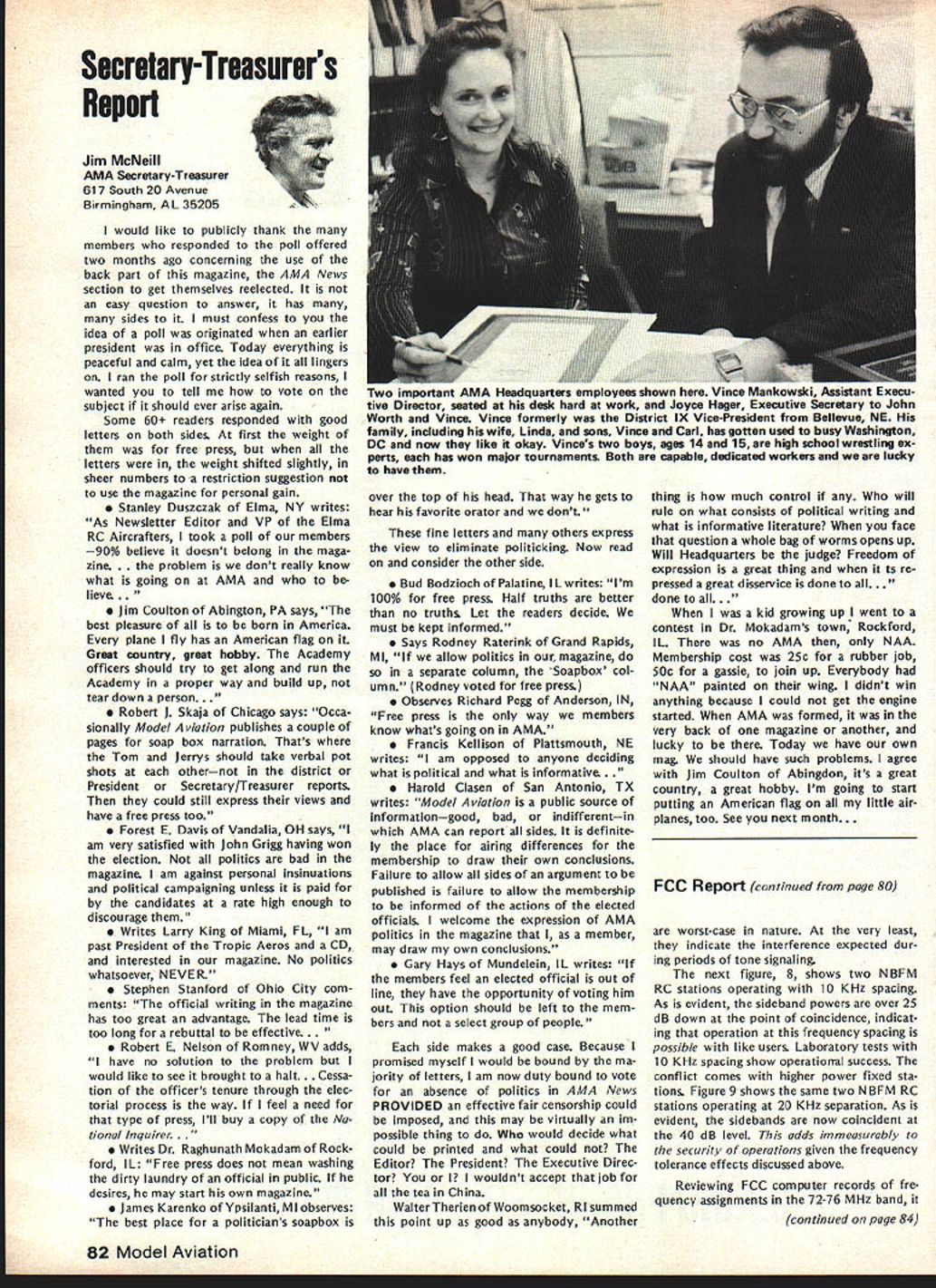
Secretary‑Treasurer’s Report
Jim McNeill AMA Secretary‑Treasurer 617 South 20th Avenue, Birmingham, AL 35205
A poll was run concerning the use of AMA News for members to express themselves. Over 60 readers responded with letters on both sides of the issue.
- Many writers argued against political or personal campaigning in official sections of the magazine; suggestions included confining political expression to a designated "Soapbox" or paid advertising.
- Others strongly supported free press, arguing the membership needs all information to judge elected officials and that limiting expression would be a disservice.
Because deciding who would censor submissions is difficult (Editor? President? Executive Director?), and unless an effective and fair censorship system can be established, the Secretary‑Treasurer felt obliged to vote for an absence of politics in AMA News only if such fair censorship were possible.
Contributors quoted in the letters include Stanley Duszczak, Jim Couton, Robert J. Skaja, Forest E. Davis, Larry King, Stephen Stanford, Robert E. Nelson, Dr. Raghunath Mokadam, James Karencok, Bud Bozich, Rodney Raterink, Richard Pegg, Francis Kellison, Harold Clasen, and Gary Hays.
Closing remark: The magazine is an important part of the hobby; keep it informative and constructive. See you next month.
---
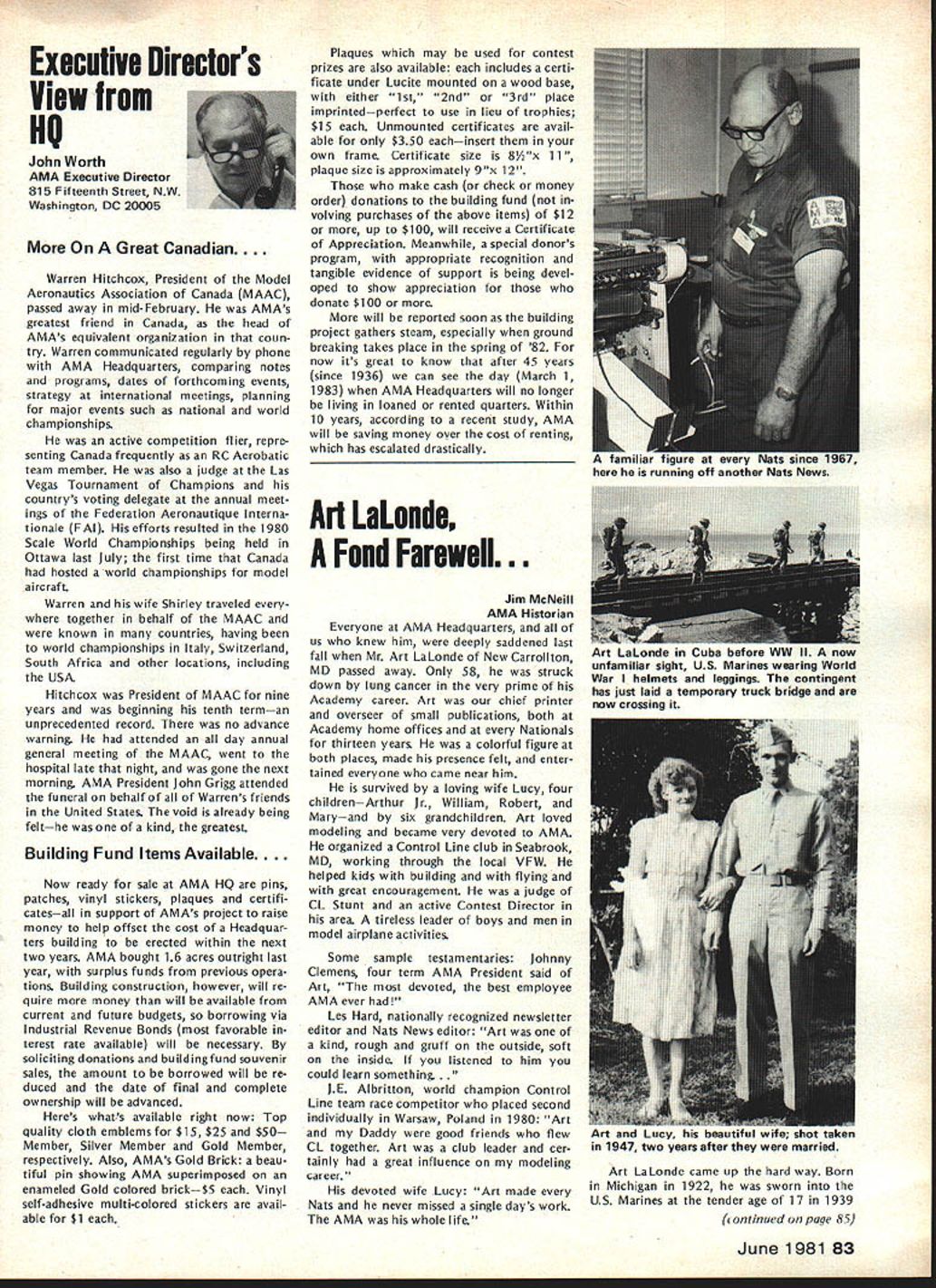
Executive Director’s View from HQ
John Worth AMA Executive Director 315 Fifteenth Street, N.W., Washington, DC 20005
More on Warren Hitchcox:
- Warren Hitchcox, President of the Model Aeronautics Association of Canada (MAAC), passed away in mid‑February. He was a strong friend of AMA, active in competition and international affairs, and instrumental in bringing the 1980 Scale World Championships to Ottawa. He served as MAAC President for nine years and was beginning his tenth term. AMA President John Grigg attended the funeral.
Building Fund Items Available:
- AMA Headquarters is selling items to help raise funds for a new Headquarters building (projected within the next two years). Items available:
- Top‑quality cloth emblems: Member ($15), Silver Member ($25), Gold Member ($50).
- Gold Brick pin: $5 each.
- Vinyl self‑adhesive stickers: $1 each.
- Plaques with certificate under Lucite (1st, 2nd, 3rd place): $15 each.
- Unmounted certificates (8½" x 11"): $3.50 each.
- Donors giving cash/check/money order donations of $12–$100 will receive a Certificate of Appreciation; a special donor recognition program is being developed for gifts of $100 or more.
- Groundbreaking is anticipated in spring 1982; projected full ownership after repayment using reduced borrowing plus donations.
---
From AMA HQ — Reports and Notices
- Insurance claims last year: 87 claims paid totaling $20,295.65; $88,360.00 held in reserve pending final resolution.
- National Park Service event (May 19–25): Modelers near Brooklyn, NY are urged to participate in a display at Floyd Bennett Field for the National Park Service 50th Anniversary celebration. Models (especially 1920s–1930s types) are requested for static display and flying demonstrations. Contact: Michaeline ("Mickey") Carpenter, 50th Anniversary Coordinator, Gateway National Recreational Area, Headquarters Building No. 69, Floyd Bennett Field, Brooklyn, NY 11234 — Tel: 212‑630‑0293.
Essay of the Month:
- "Who Is The R/Cer?" by Dan Basovitch (Richmond Model Flying Club). The essay describes the pride and effort of RC modelers in building and flying aircraft and the enjoyment of club companionship.
Free Flight Notices:
- Western New York Free Flight Society projected meet: July 11–12 at Pike, NY.
- Skyrunners contests: May 30–31 at the U.S. Army Airfield, Galesville, NY. Contact Joel Chesler, 91 Nottingham Road, Malverne Park, NY 11565 — Tel: 516‑593‑7518.
Pattern/Scale/Pylon notices and other contest listings appear in the Contest Calendar.
---
Flying Site (continued)
- Some clubs rent part of their land for crops to pay taxes and maintain virtually unlimited airspace due to surrounding farmland or swamps.
- Clubs on the East Coast can have large sites comparable to western clubs.
- Free Flight clubs tend to be small; a symposium might help stimulate interest.
- Most clubs encourage guests but require AMA membership before flying; Guest Membership arrangements are in place.
- Parking vehicles too close to the flight line is a common cause of property claims—move vehicles away from landing areas to reduce claims and keep insurance costs down.
---
District Reports
IV District Report
Chuck Foreman District IV Vice‑President 607 Pohite Drive, Mechanicsville, VA 23111
Associate Vice‑Presidents:
- Wayne Abernethy — Upper Marlboro, MD
- Bob Champion — Newport News, VA
- Howard Crispin — Charlottesville, VA
- V. Bill Helms — Charlotte, NC
- Scotty Moyer — Wilmington, DE
- John Preston — Falls Church, VA
- Charles Soper — Mocksville, NC
Notes:
- Temporary (guest) membership explained (see Guest Membership section).
- District IV had 87 insurance claims last year totaling $20,295.65 with $88,360 reserve pending.
- The Radio Control League of North Carolina will host the District IV AMA meeting on October 17–18 in Greensboro, NC.
- Two groups in District IV are working on 1982 Nats sites (Delaware and North Carolina).
- Local club highlights include field expansions, mall shows, races, and community involvement.
- Film and display resources are available for club programs; please return films and display booths promptly after use.
Upcoming events and contacts are listed in the district calendar and local notices.
---
V District Report
Bill Mathews District V Vice‑President 2712 SW 34th St., Apt. 8, Gainesville, FL 32608
Associate Vice‑Presidents:
- John Garscay — Jackson, MS
- Richard Jackson — Charleston Heights, SC
- Arthur Johnson — Delray Beach, FL
- Phillip McDowell — Nashville, TN
- Joseph Mitchell — Pensacola, PR
- Ed Morman — Shalimar, FL
- Harry Sherman — Birmingham, AL
- Tom Thacker — Decatur, GA
Notes:
- Spring has brought many contests: Magnolia Classic, Glen Sig Memorial Meet, Florida State Championships.
- Rocket City RC Club (Huntsville, AL) will host the 1981 Masters Tournament (U.S. RC Aerobatics team selection).
- Cape Coral R/Sea Hawks have an 11‑acre site with a lake.
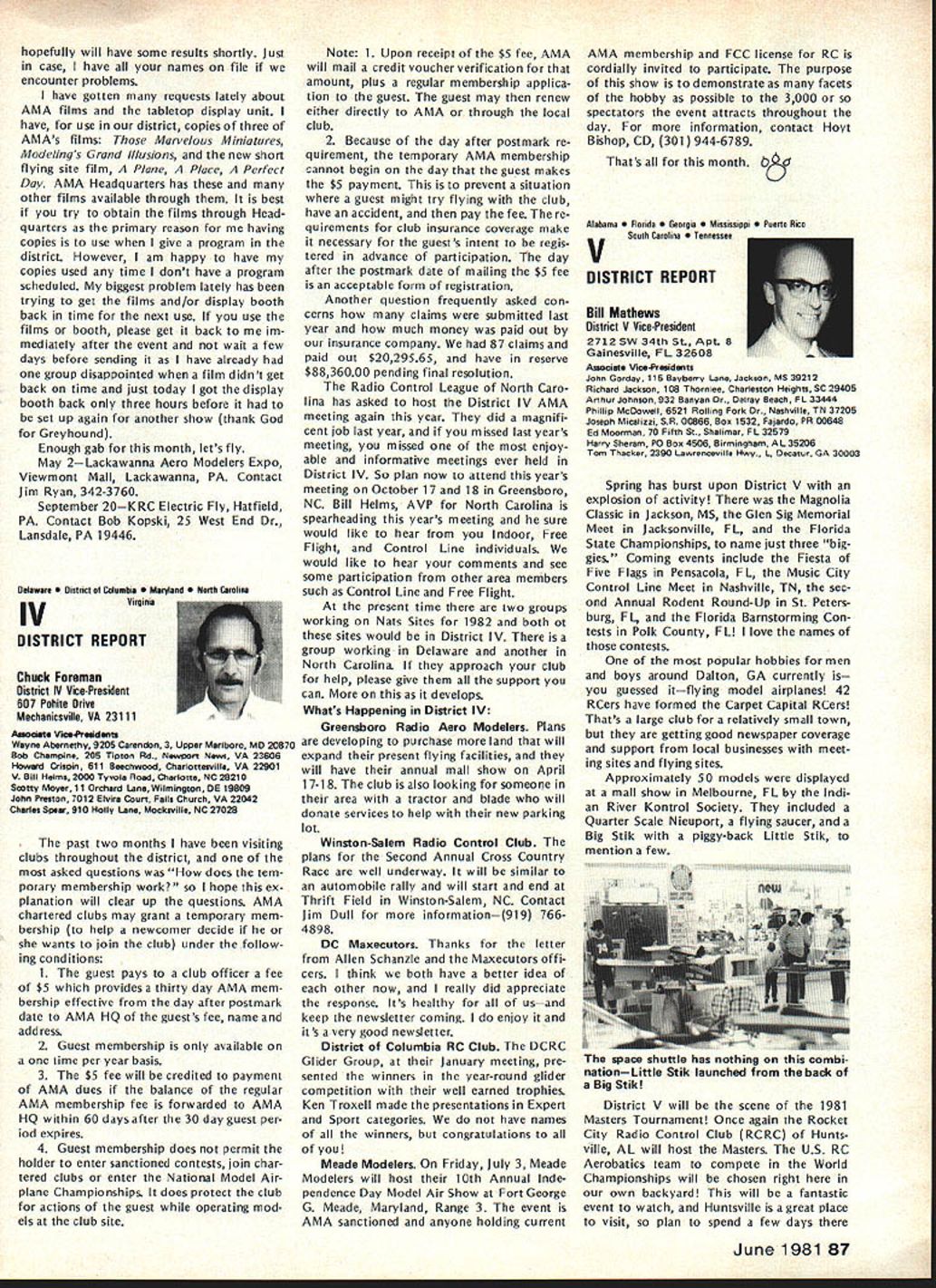
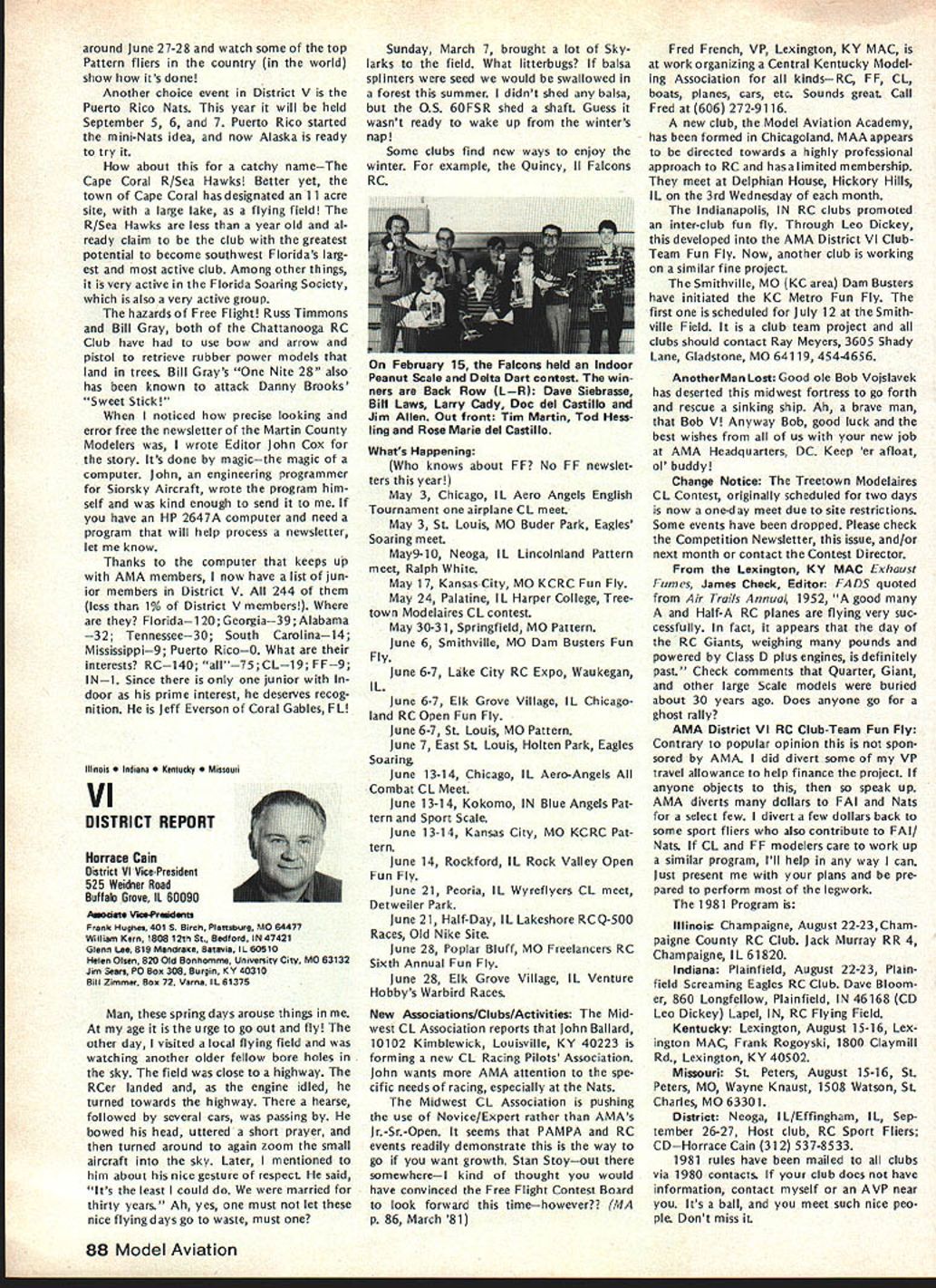
- Clubs report creative solutions: newspaper coverage, mall displays, indoor contests, and computer‑generated newsletters.
- Junior membership in District V: 244 juniors (Florida 120; Georgia 39; Alabama 32; Tennessee 30; South Carolina 14; Mississippi 9; Puerto Rico 0). Interests: RC 140; all 75; CL 19; FF 9; Indoor 1.
- Event calendar provided for May–June with many regional contests and fun flies.
- New initiatives include RC Racing Pilots' Association and regional fun fly programs.
---
VII District Report
Hardy Brodersen District VII Vice‑President P.O. Box 1100, Birmingham, MI 48012
Associate Vice‑Presidents:
- James Clark — Cedar Rapids, IA
- Tony Italiano — Brookfield, WI
- John E. Lortzbach — Milwaukee, WI
- Robert D. Lundberg — Duluth, MN
- William Froberg — St. Joseph, MI
- Al Scidmore — Madison, WI
- Ron Sears — Pontiac, MI
- Terry Taylor — Crystal, MN
Notes and highlights:
- Wisconsin RC Sailplane Championship program: point series across clubs; Gregg Seydel was 1980 state champ and achieved LSF level V.
- Madison club holds multiple AMA records across duration and closed course distance events.
- Attention to local frequency users and interference issues: a pilot meeting was planned to coordinate fact‑finding and strategy with the FCC and local transmitters. Clubs are urged to avoid individual action until plans are coordinated.
---
VIII District Report
Ted White District VIII Vice‑President 1109 Greendale, Bedford, TX 76021
Associate Vice‑Presidents:
- Bud Friedl — Little Rock, AR
- William Hurley III — Pleasanton, TX
- Dan Parsons — Albuquerque, NM
- Ed Perez — Grand Prairie, TX
- Al Rabe — Irving, TX
- Larry Sartor — Bartlesville, OK
- Ed Shearer — Metairie, LA
North Texas highlights (Ed Perez reporting):
- Southwest Modelers Show in Dallas (May 16–17): notable models such as Ed Couch’s F‑16 with a scale retract landing gear.
- Texas Scale Air Group will host the Scale Masters Qualifying Meet in Mineral Wells, TX (June 27–28); top five qualify for Scale Masters.
- Reserve Labor Day for the Southwest Championships (Pattern, Scale, Pylon).
- Regional interclub fun fly initiatives and family‑oriented activities are thriving.
---
IX District Report
Travis McGinnis District IX Vice‑President 8027 W. 81st Circle, Arvada, CO 80005
Associate Vice‑Presidents:
- Charles Brannon — Casper, WY
- Ed Cox — Prairie Village, KS
- Dick Cowley — Aurora, CO
- Glen Low — Lincoln, NE
- Tim Mattern — Grafton, ND
- Jim Ricketts — Sioux Falls, SD
Notes:
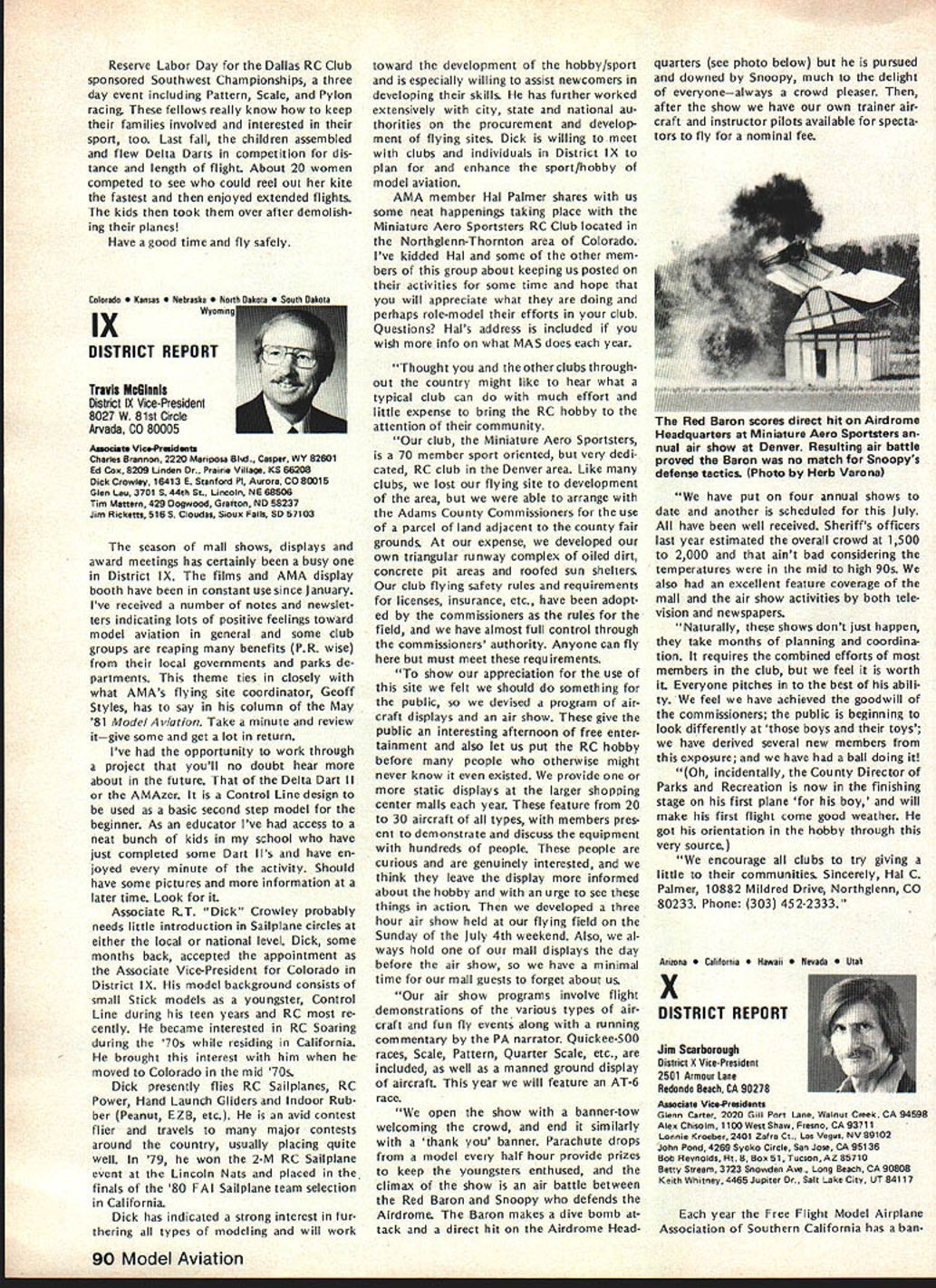
- Mall shows and public displays have increased positive PR and local government support for model aviation.
- Development of an educational Control Line trainer (Delta Dart II / Amazer) is underway for schools and beginner programs.
- Profile of Associate R.T. "Dick" Crowley: experienced in RC soar, power, hand launch and indoor rubber; avid contest flier and flying‑site advocate.
- Miniature Aero Sportsters (Northglenn‑Thornton, CO) example: club developed a municipal flying field, conducts mall displays and an annual air show to promote the hobby and recruit members. Contact Hal C. Palmer for details.
---
X District Report
Jim Scarborough District X Vice‑President 2501 Armour Lane, Redondo Beach, CA 90278
Notes:
- Free Flight Model Airplane Association of Southern California banquet honors state champions and team awards.
- Camarillo Flying Circus and Tri‑Valley RC Modelers meetings noted for hospitality and club programs.
- AMA display booth and new site film A Place, A Place, A Perfect Day are available for clubs to use at mall shows and for property owner presentations.
- Encouragement to visit other clubs and share resources.
---
XI District Report
Homer Smith District XI Vice‑President 1417 N.W. 191st Street, Seattle, WA 98177
Associate Vice‑Presidents:
- Al Culver — Pocatello, ID
- Simon Comer — Iona, MT
- Ed McColough — Portland, OR
- Bruce Nelson — Spokane, WA
- Orlando "Oly" Pacic — Kent, WA
- Don Zigoy — Redmond, WA
Notes:
- National Association of Scale Aeromodelers (NASAM) and its newsletter Replica recommended for scale enthusiasts (contact John Preston).
- Midnight Sun RC Club (Fairbanks, AK) developing a professional flight training course despite challenging weather.
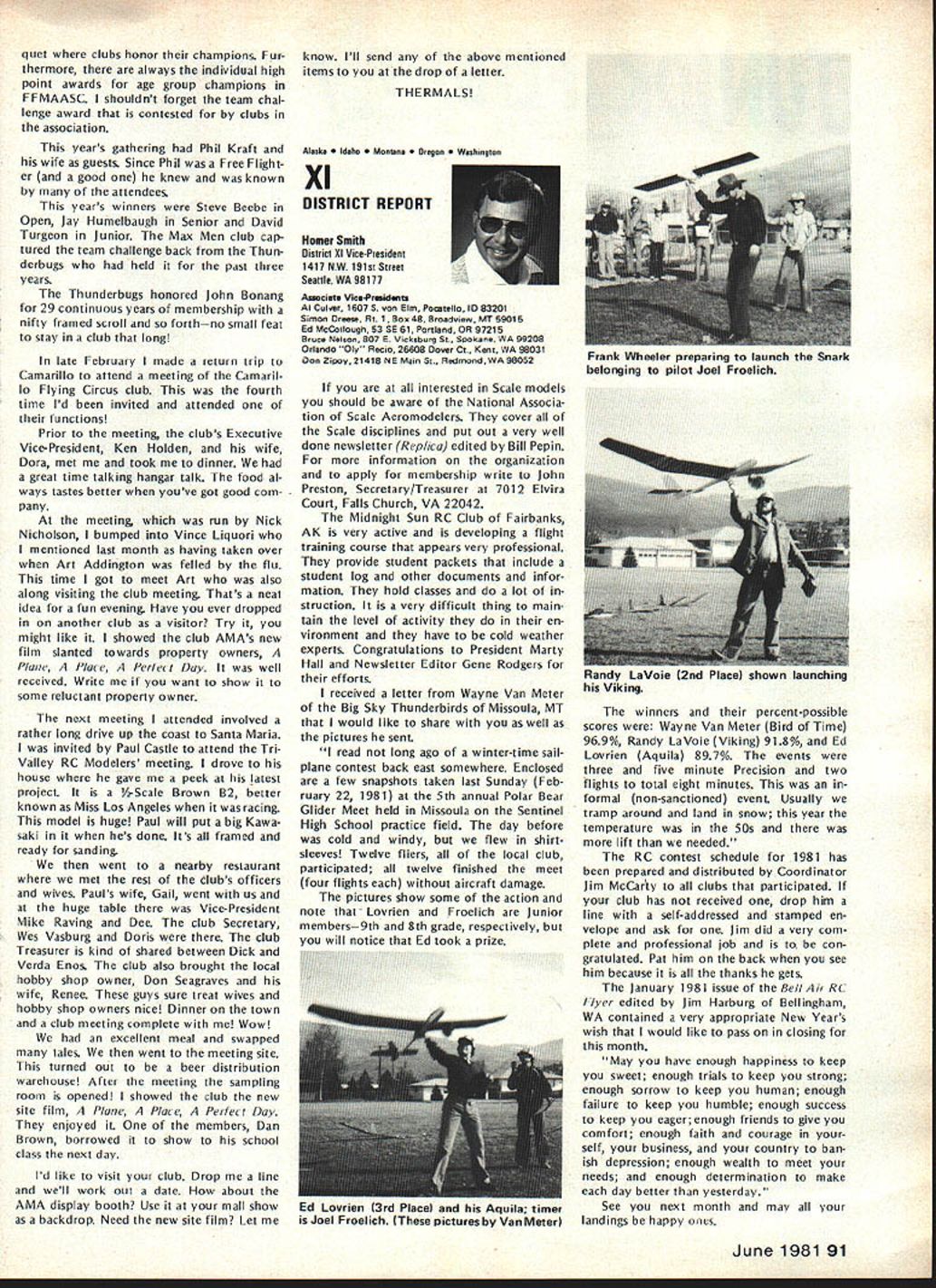
- Polar Bear Glider Meet (Missoula, MT): informal winter sailplane meet with strong participation and good flying conditions reported.
- RC contest schedule for 1981 distributed by Contest Coordinator Jim McCarthy; clubs should request copies if not received.
- Closing thought: best wishes for successful and safe flying.
---
Junior Flight
First Step To Success — Wood Selection
Ed Whitten Box 176, Wall St. Sta., New York, NY 10005
Recommendation:
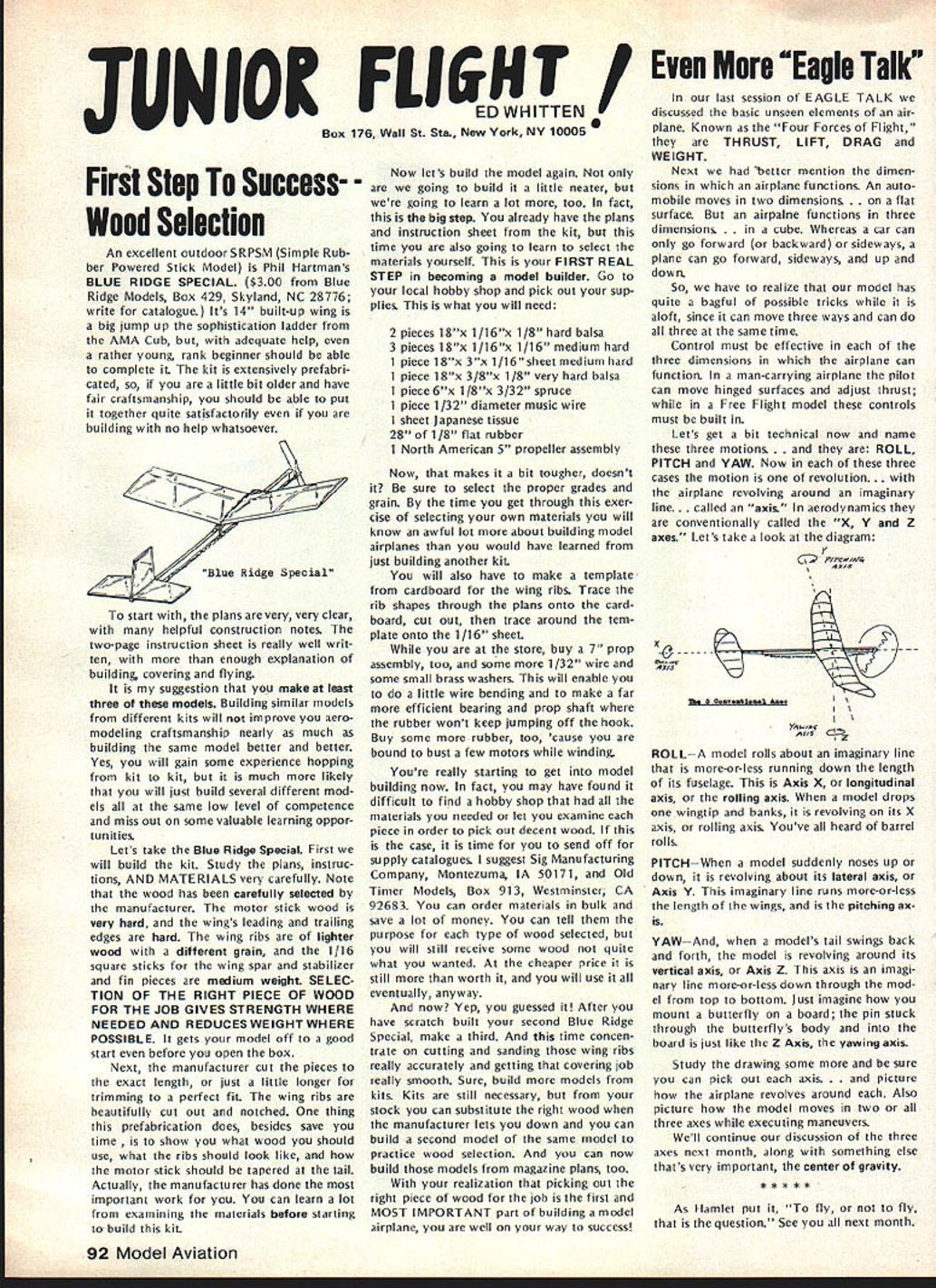
- Start with a well‑prefabricated Simple Rubber Powered Stick Model (SRPSM) such as Phil Hartman’s Blue Ridge Special (14" built‑up wing).
- Build at least three of the same model rather than many different models—repetition improves craftsmanship.
Materials and practice:
- Study plans, instructions, and the kit materials before building.
- Learn to select appropriate wood for each part: harder wood where strength is needed, lighter wood where weight reduction matters.
- For the Blue Ridge Special (example list of materials to buy separately):
- 2 pieces 18" x 1/16" x 1/8" hard balsa
- 3 pieces 18" x 1/16" x 1/16" medium hard
- 1 piece 18" x 3/32" x 1/16" sheet medium hard
- 1 piece 18" x 3/8" x 1/8" very hard balsa
- 1 piece 6" x 1/8" x 3/32" spruce
- 1 piece 1/32" diameter music wire
- 1 sheet Japanese tissue
- 28" of 1/8" flat rubber
- 1 North American 5" propeller assembly
Tips:
- Make a cardboard template for wing ribs and cut ribs accurately.
- Buy spare props, wire, and rubber—practice and breakage are normal.
- Order supplies from reputable manufacturers (e.g., Sig Manufacturing, Old Timer Models) if local hobby shops lack stock.
- After building and refining multiple models, try scratch‑building from plans.
Conclusion:
- Selecting the right wood for each part is the first and most important step in becoming a successful model builder.
Transcribed from original scans by AI. Minor OCR errors may remain.

