
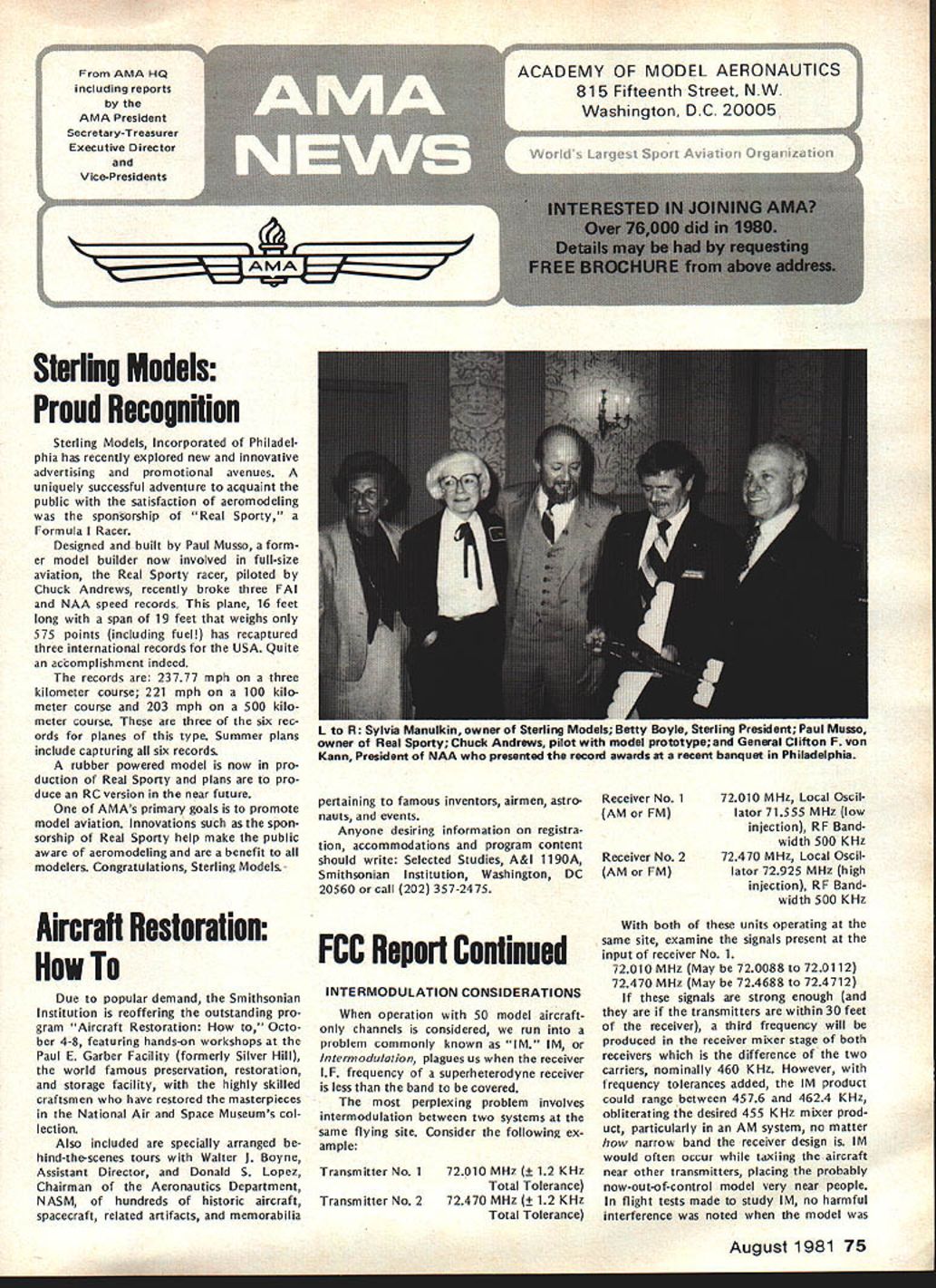
AMA NEWS
FCC Report (continued)
#### INTERMODULATION CONSIDERATIONS
When operating with a 50 model-aircraft-only channel plan, a problem commonly known as intermodulation (IM) arises. IM plagues us when the intermediate-frequency (IF) of a superheterodyne receiver is less than the band to be covered. A particularly perplexing problem is intermodulation between two systems at the same flying site. Consider the following example:
- Transmitter No. 1: 72.010 MHz (±1.2 kHz total tolerance)
- Transmitter No. 2: 72.470 MHz (±1.2 kHz total tolerance)
Receiver No. 1 (AM or FM) tuned to 72.010 MHz
- Local oscillator: 71.555 MHz (low injection)
- RF bandwidth: 500 kHz
Receiver No. 2 (AM or FM) tuned to 72.470 MHz
- Local oscillator: 72.925 MHz (high injection)
- RF bandwidth: 500 kHz
With both units operating at the same site, the signals present at the input of Receiver No. 1 may be:
- 72.010 MHz (may be 72.0088 to 72.0112)
- 72.470 MHz (may be 72.4688 to 72.4712)
If these signals are strong enough (for example, if the transmitters are within ~30 feet of the receiver), a third frequency will be produced in the receiver mixer stage of both receivers equal to the difference of the two carriers — nominally about 460 kHz. With frequency tolerances added, the IM product could range between roughly 457.6 and 462.4 kHz, which can obliterate the desired 455 kHz mixer product, particularly in AM systems. No matter how narrow the receiver design, IM could occur when taxiing aircraft are near other transmitters, potentially placing an uncontrolled model very near people.
Solutions to the IM problem require effective control of receiver specifications. AMA has developed a plan it believes workable to permit full use of the 50-channel frequency plan. Possible solutions include:
- Couple interfering pairs at a flying site to prevent both frequencies' simultaneous use.
- Assign halves of the band to certain parts of the country.
- Require dual-conversion receivers.
- Assign half of the 72 MHz channels to aircraft and half to non-aircraft since the two do not operate in close enough proximity for IM effects to be a problem.
- Use a narrow-band front end.
- Use a receiver design that can linearly accept very strong signal levels (e.g., in excess of 800–1,000 mV/m) without producing spurious mixer products.
In tests of 28 different receiver designs (from eight manufacturers, foreign and domestic), none passed the IM test at close ranges. A likely reason is the limited supply voltages in RC equipment: nominal 4.8 V nickel-cadmium packs and additional internal regulation reduce RF-stage voltages. A Kraft KPR-7M receiver modified to run its local oscillator and mixer at 9 volts (with re-biasing to maintain comparable gain) showed dramatic improvement — IM interference was nearly impossible to produce from two standard RC transmitters even when adjusted to produce exactly a 455 kHz mixer IM product.
Because IM products can fall near the 455 kHz IF, one solution is to use an IF other than 455 kHz. Two technical options exist, but neither is presently economical for the RC market:
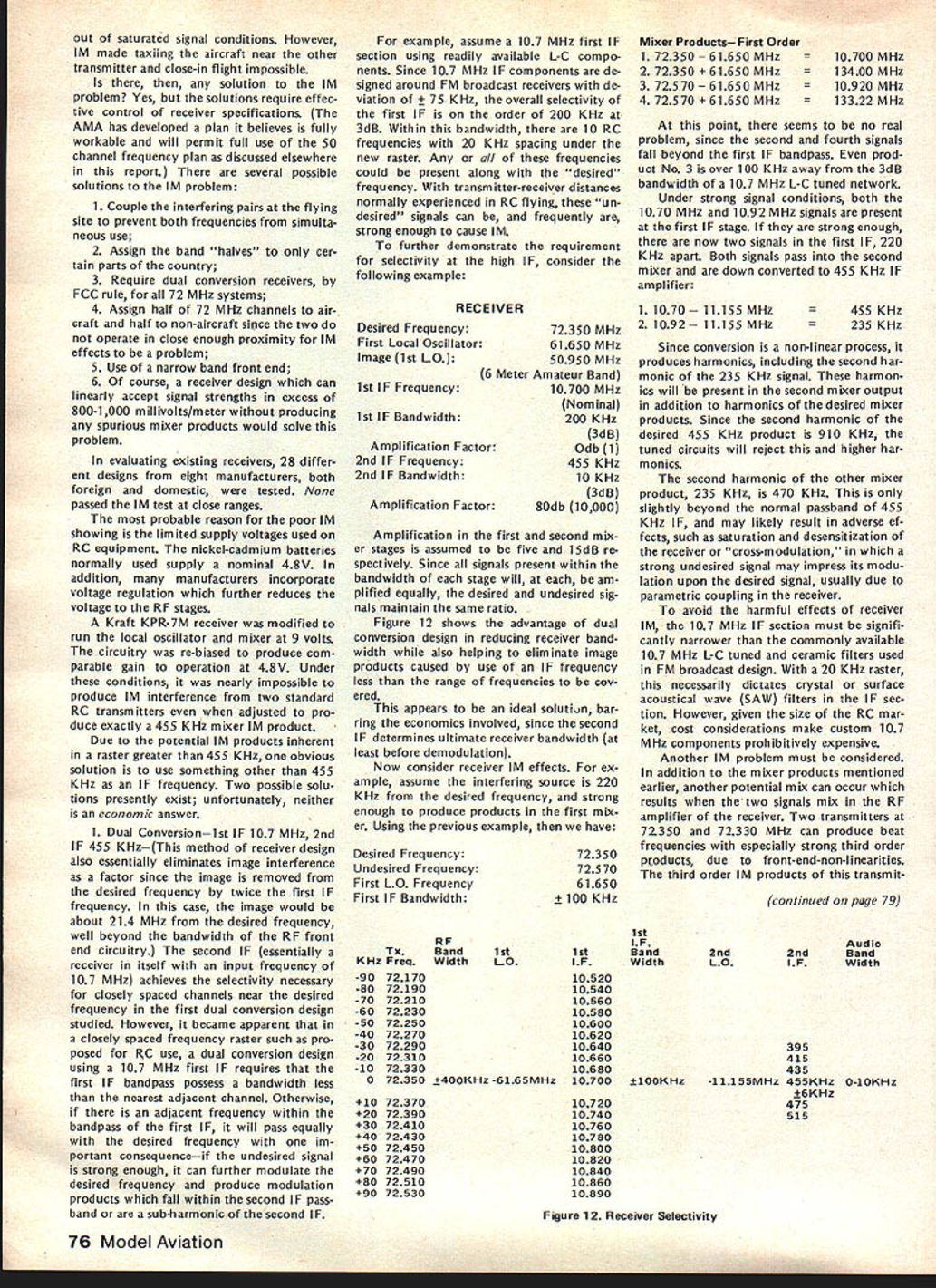
- Dual conversion: 1st IF at 10.7 MHz, 2nd IF at 455 kHz. This largely eliminates image interference because the image is removed from the desired frequency by twice the first IF (about 21.4 MHz in this example), well beyond the RF front-end bandwidth. However, to be effective with closely spaced RC channels (e.g., 20 kHz raster), the first IF bandpass must be narrower than the nearest adjacent channel. Readily available 10.7 MHz L‑C components (designed for FM broadcast with ±75 kHz deviation) typically have ~200 kHz 3 dB bandwidth; that would contain many RC channels and allow undesired signals to pass into the second mixer, producing IM and cross-modulation problems. Narrowing the 10.7 MHz IF sufficiently requires crystal or SAW filters, which are cost-prohibitive for the RC market at present.
Example illustrating dual-conversion IM issues:
- Receiver desired frequency: 72.350 MHz
- First local oscillator: 61.650 MHz (producing 1st IF = 10.700 MHz)
- First IF bandwidth: ~200 kHz (3 dB)
- Second IF: 455 kHz
If an undesired signal 220 kHz away (72.570 MHz) is present and strong enough, it produces a 10.920 MHz product in the first mixer. Both 10.700 MHz and 10.920 MHz may then be present at the first IF and be down-converted in the second mixer to 455 kHz and 235 kHz respectively. Nonlinear conversion produces harmonics; the second harmonic of 235 kHz is 470 kHz — near the 455 kHz passband — which can cause saturation, desensitization, or cross-modulation in the receiver.
Another IM problem arises when two signals mix in the RF amplifier due to front-end nonlinearities. Two nearby transmitters (e.g., 72.350 and 72.330 MHz) can generate strong third-order products that can interfere in the receiver.
In evaluating mitigation approaches, it is clear that improved receiver front-end linearity and selectivity (and higher RF-stage voltages) significantly reduce IM problems. However, practical solutions must balance technical performance with market cost constraints. The FCC/AMA technical work on these topics continues.
(Technical discussion continued; material truncated in source.)
---
Secretary‑Treasurer's Report
Jim McNeill AMA Secretary‑Treasurer 617 South 20th Avenue Birmingham, AL 35205
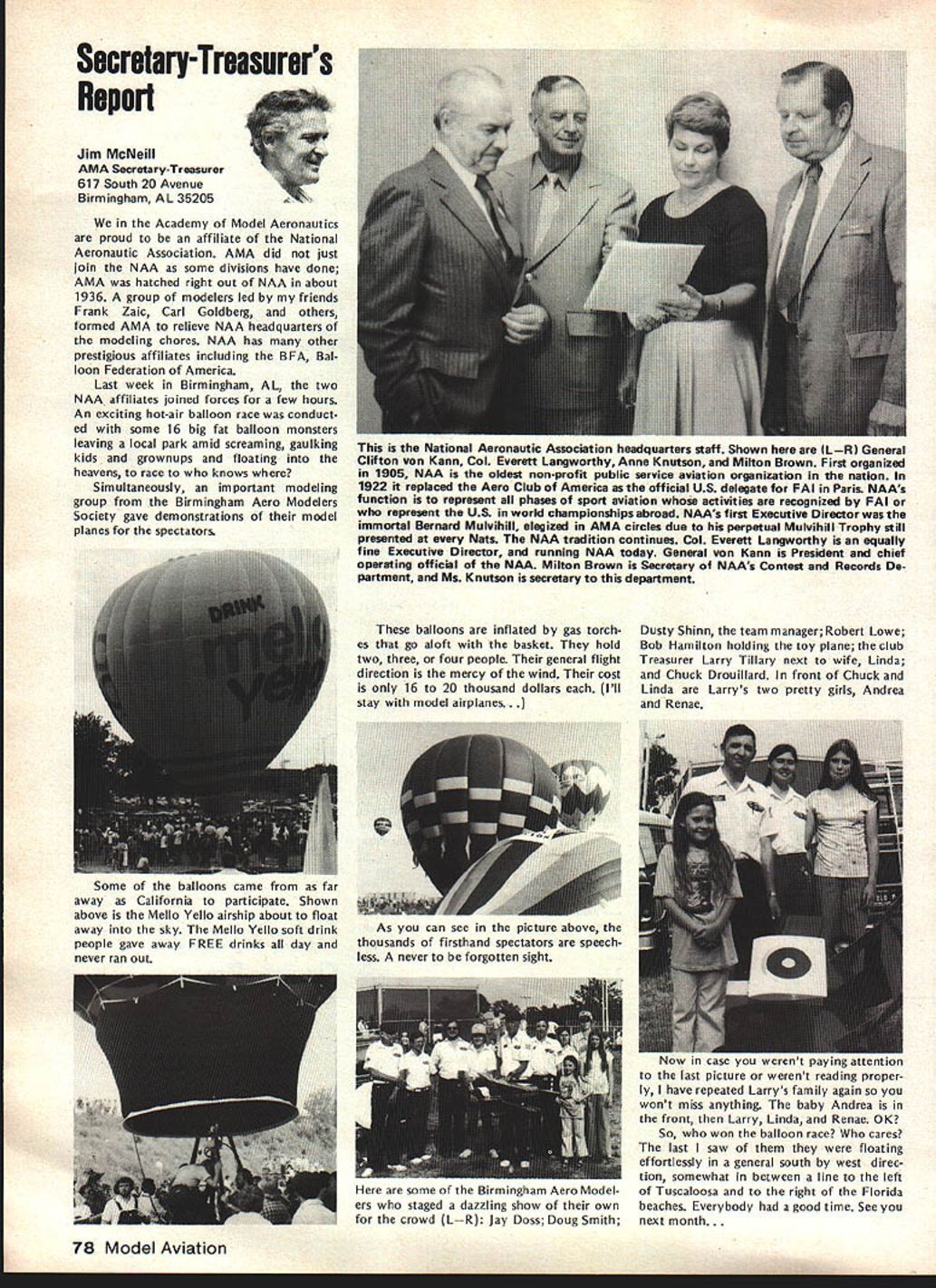
We in the Academy of Model Aeronautics are proud to be an affiliate of the National Aeronautic Association (NAA). AMA was formed out of involvement with the NAA in about 1936 by modelers including Frank Zaic and Carl Goldberg to take on modeling responsibilities. NAA has many affiliates, including the Balloon Federation of America.
Last week in Birmingham, AL, two NAA affiliates joined forces for a few hours. An exciting hot-air balloon race was conducted, with some 16 balloons launching amid large crowds. Simultaneously, the Birmingham Aero Modelers Society gave model plane demonstrations for spectators.
Balloons are inflated by gas torches, carry two to four people, and are governed largely by wind. Their cost is about $16,000–$20,000 each.
(Informal family note and closing remarks.) See you next month.
---
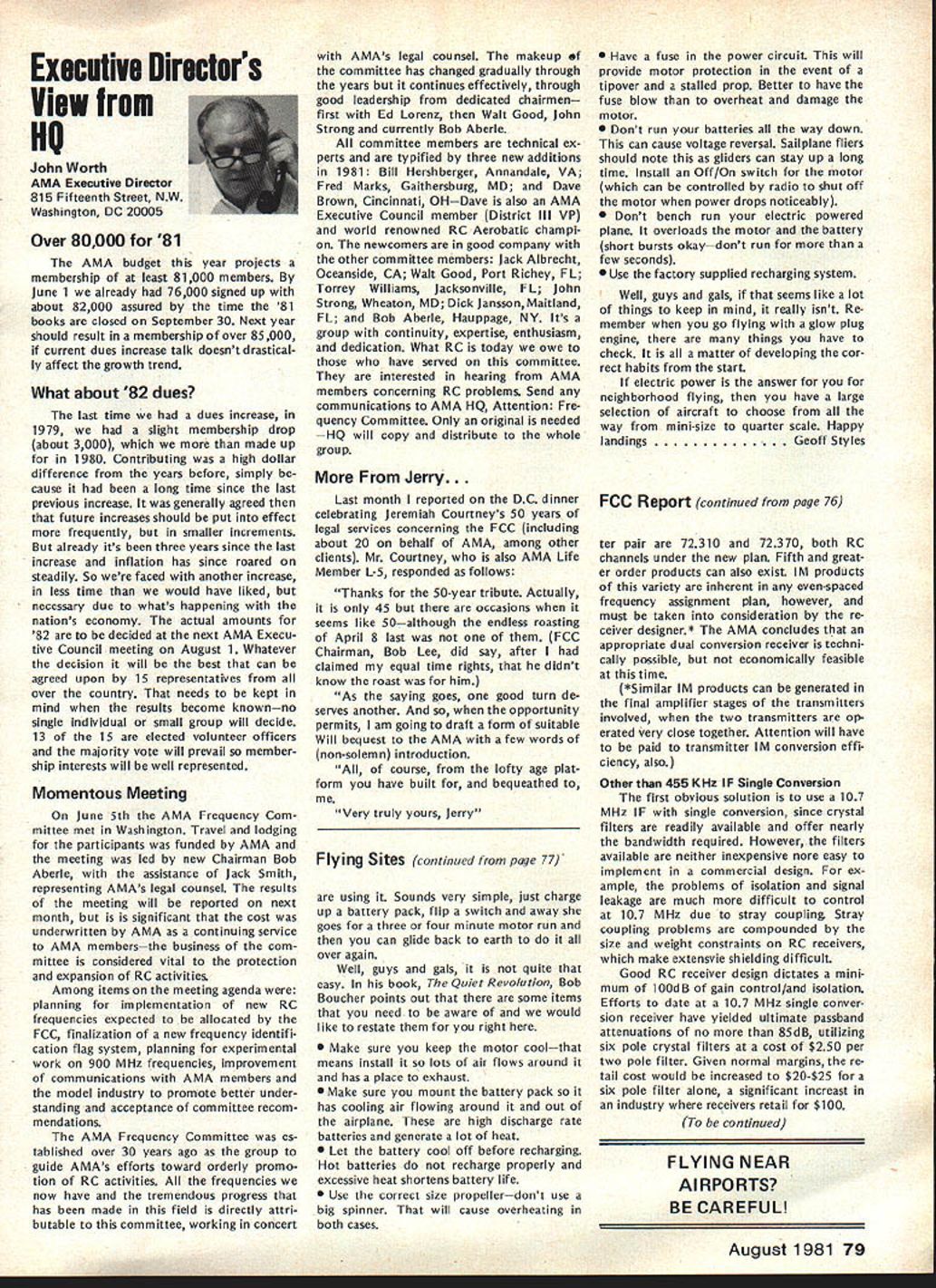
Executive Director — View from HQ
John Worth AMA Executive Director 815 Fifteenth Street, N.W. Washington, DC 20005
Over 80,000 for '81
The AMA budget projects a membership of at least 81,000 members this year. By June 1 we already had 76,000 signed up and about 82,000 are expected by the September 30 close of the fiscal year. Next year may see over 85,000, barring large dues changes.
What about '82 dues?
The last dues increase (1979) produced a slight membership drop (~3,000) but was made up in 1980. Since inflation continues, another increase is necessary. The exact amount for 1982 will be decided by the AMA Executive Council on August 1, with representation from 15 council members (13 elected volunteers). The majority vote will decide the outcome.
Momentous Meeting
On June 5 the AMA Frequency Committee met in Washington. Travel and lodging for participants were funded by AMA. The meeting was chaired by Bob Aberle with Jack Smith assisting as legal counsel. Agenda items included planning for FCC-allocated RC frequencies, a new frequency identification flag system, experimental work on 900 MHz frequencies, and improving communications with members and industry about committee recommendations.
The Frequency Committee has guided AMA frequency allocations for over 30 years. New 1981 members include Bill Fehrsberger (Annandale, VA), Fred Marks (Gaithersburg, MD), and Dave Brown (Cincinnati, OH). Current committee members also include Jack Albrecht, Walt Good, Torrey Williams, John Strong, Dick Jansson, and Bob Aberle. Send communications to AMA HQ, Attention: Frequency Committee.
---
More From Jerry...
A reply from Jeremiah Courtney (AMA Life Member L‑5) following a D.C. dinner celebrating his legal service to the FCC:
"Thanks for the 50‑year tribute. Actually, it is only 45 but there are occasions when it seems like 50... As the saying goes, one good turn deserves another. When the opportunity permits, I am going to draft a form of suitable will bequest to the AMA with a few words of (non‑solemn) introduction."
Very truly yours, Jerry
---
Flying Sites (continued)
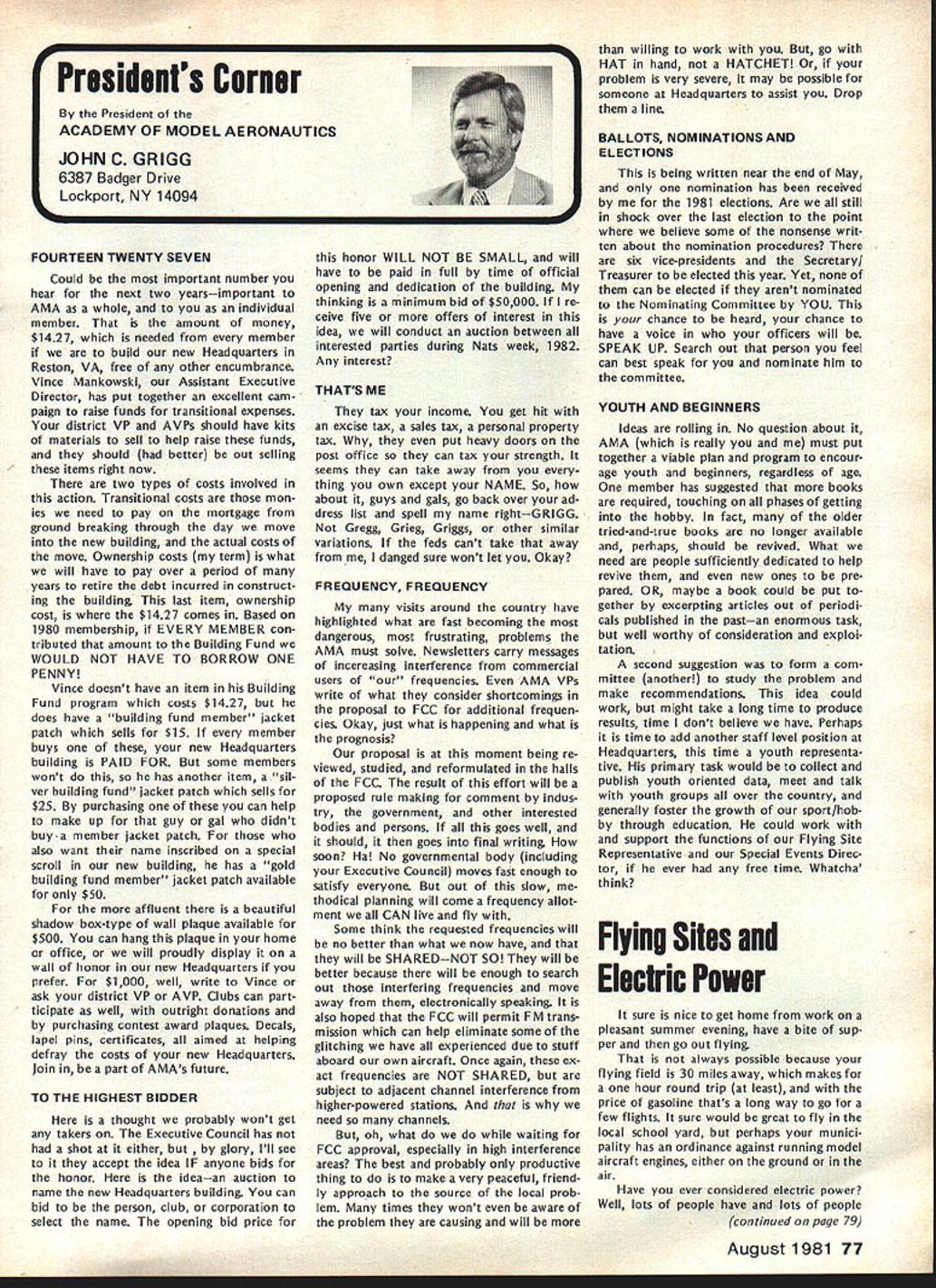
Electric-powered sailplanes are popular and relatively simple to operate, but there are important precautions:
- Keep the motor cool: install it so that plenty of air flows around it and there is an exhaust path.
- Mount the battery pack for good cooling airflow and exhaust. High-discharge batteries generate a lot of heat.
- Let the battery cool before recharging. Hot batteries recharge poorly and excessive heat shortens battery life.
- Use the correct size propeller—avoid large spinners that can cause overheating.
- Install a fuse in the power circuit to protect the motor in the event of a tipover or stalled prop.
- Avoid running batteries fully down to prevent voltage reversal; install an Off/On motor switch (radio-controlled if desired) to shut off the motor when power drops.
- Don't bench-run electric models for extended periods—short bursts are okay, but prolonged bench runs overload the motor and battery.
- Use the factory-supplied recharging system.
These habits are similar to the preflight checks for glow-engine models. If electric power suits your neighborhood flying, many models are available from mini-size to quarter-scale. Happy landings. — Geoff Styles
---
Minutes — Executive Council (April 4–5, 1981)
XXXII. 1981 NOMINATION PROCEDURES
- MOVED and seconded to use the 1980 nomination procedures for 1981. Motion passed: 10 for; 2 against (VI, VII); 3 abstained (IV, VIII, Pres.)
XXXIV. TEMPORARY MEMBERSHIP
- The Executive Director was requested to send information and forms concerning the previously approved club program for temporary (30‑day) membership to all Vice‑Presidents and Associate Vice‑Presidents.
XXXV. AMA NUMBER POLICY
- Headquarters reached the end of its ability to issue AMA member numbers using the present five-digit system. The policy of not reissuing a number for one year caused difficulties. The Executive Director proposed (a) converting to a six-digit system or (b) retaining five digits but using an alpha character in the first or last position.
- MOVED and seconded to rescind the policy of withholding AMA numbers for a year so new 1981 members may be accommodated. Motion passed AS AMENDED: 11 for; 3 against (I, VI, VIII).
- Amendment inserting "effective March 31, 1981" passed unanimously.
- MOVED and seconded that implementation be delayed as long as possible while plans for an alphanumeric system are developed immediately; passed unanimously. The Executive Director was directed to report back at the next meeting.
XXXVI. SCHOLARSHIP AMOUNTS
- Travis McGinnis (XI) spoke in favor of increasing the current scholarship allotment ($2,000). The President appointed a committee to study and recommend changes and report at the next Council meeting.
XXXVII. AWARDS
- MOVED and seconded the DISTINGUISHED SERVICE AWARD to Ed Turner for exemplary service to the Free Flight team selection program as committee chairman 1979–80. Motion passed unanimously.
- MOVED and seconded the CHAPTER ACHIEVEMENT AWARD to the Central New York Model Aircraft Association. Motion passed unanimously.
XXXVIII. NEXT COUNCIL MEETING—SITE AND DATES
- MOVED and seconded that the next Council meeting be held in Washington, DC. Passed unanimously.
- MOVED and seconded that the Washington, DC Council meeting be held April 4 and 5 (two days, with the second day for reviewing bylaws revision proposals). Passed unanimously.
---
APPENDIX I — Recommendation to Establish a Safety Advisory Committee
RECOMMENDATION: Establish a "Safety Advisory Committee."
PURPOSE: Provide the Executive Council, manufacturers, clubs, members, and others with advice, comments, or recommendations on safety matters related to model airplanes.
AUTHORITY/RESPONSIBILITY: The committee would advise, comment, and recommend; serve as a clearinghouse and consultation group for safety matters; identify and study safety problems; evaluate solutions; and communicate proposals to interested parties. The committee might propose or review programs such as Club Safety Officer programs, safety seminars, safety awards, or a safety seal for manufacturers. It would develop a list of safety experts and possibly subcommittees.
STRUCTURE: Recommend five members: at least one attorney and one employed in the safety field; other members chosen for hobby expertise. The structure should be flexible initially.
APPOINTMENT: Members may be recommended by any Executive Council member, with appointment by Council vote. Terms initially indefinite, with Council reserving the right to replace members. Executive Council members shall not serve on the Safety Advisory Committee.
RECOMMENDED INITIAL APPOINTEES: John Preston, Art Sabin, Don Lowe, Laird Jackson, and Dave Baum.
---
APPENDIX II — Use of Pyrotechnics by Air Show Teams
The Air Show Team Advisory Committee recognizes that pyrotechnic devices can be hazardous but, when properly used and supervised, can add spectacle to shows. "Pyrotechnic devices" are defined as any device that explodes, burns, or propels a projectile.
BANNED:
- All airborne pyrotechnics, including rockets, explosive bombs dropped from models, smoke bombs; explosive gases (e.g., hydrogen-filled balloons); and ground-mounted devices that launch a projectile.
PERMITTED (with conditions):
- Ground-based and electrically fired devices may be used for indoor and outdoor shows. Devices that expel burning or hot material (e.g., squibs, gerbs) must use proper safeguards.
Required conditions:
- All pyrotechnic devices must conform to federal, state, and local laws and ordinances; compliance is the responsibility of the pyrotechnic team's management.
- All pyrotechnic devices must be electrically fired using commercial-grade firing gear.
- Charges must be located behind the front row of protective barriers and at least 50 feet from the flight path.
- Charges exceeding 1/4 ounce of explosive content must be fired from a heavy metal safety vessel designed to prevent throwing debris.
- A fire extinguisher must be available whenever pyrotechnics are used.
Excluded from this definition (and not affected): smoke systems pumping smoke-producing liquid through mufflers and dummy bombs that use flour to simulate smoke on impact.
Note: Deviations from these guidelines are acceptable only if permitted by applicable laws, codes, or ordinances under obtained permits, and provided they do not reduce the safety requirements above.
---
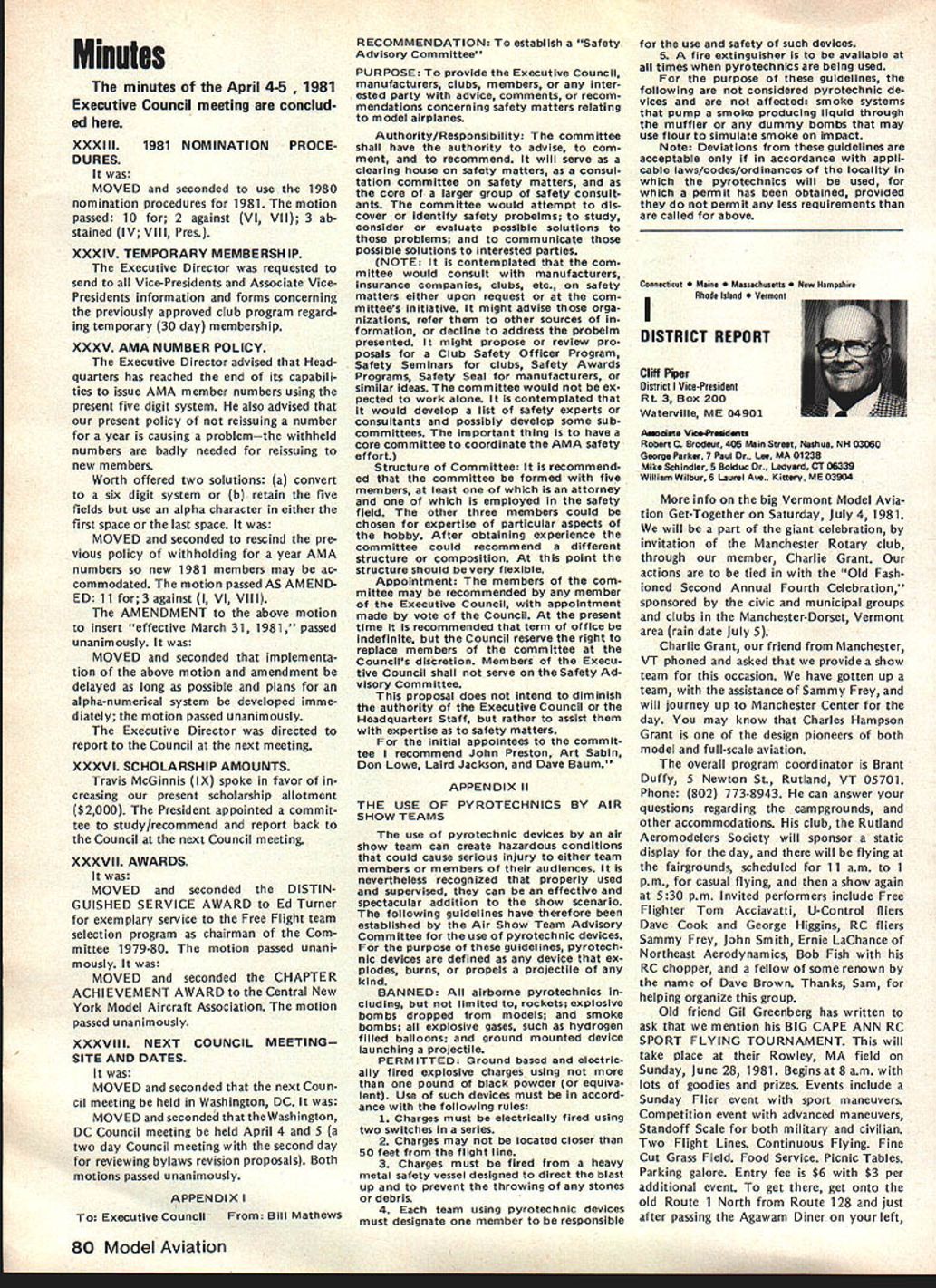
DISTRICT REPORT — District I
Cliff Piper District I Vice‑President Rt. 3, Box 200 Waterville, ME 04901
Associate Vice‑Presidents:
- Robert C. Brodeur, 405 Main Street, Nashua, NH 03060
- George Parker, 7 Paul Dr., Lee, MA 01238
- Mike Schindler, 5 Boulder Dr., Ledyard, CT 06339
- William Wilbur, 6 Laurel Ave., Kittery, ME 03904
Vermont Model Aviation Get‑Together — Saturday, July 4, 1981: The AMA will participate by invitation of the Manchester Rotary Club. Activities tie in with the "Old Fashioned Second Annual Fourth Celebration" in Manchester-Dorset, VT (rain date July 5). A show team has been organized with assistance from Sammy Frey.
For campgrounds and accommodations contact Brant Duffy, 5 Newton St., Rutland, VT 05701, (802) 773‑8943. Rutland Aeromodelers Society will sponsor a static display; flying scheduled 11:00 a.m. to (evening), air show at 5:30 p.m. Invited performers include free flight, U‑control, R/C liners, an R/C chopper, and Dave Brown.
BIG CAPE ANN RC SPORT FLYING TOURNAMENT — Rowley, MA field, Sunday, June 28, 1981, begins at 8 a.m. Events include 1/2A Sunday Flier, competition events, and stand‑off scale. Entry fee $6 ($3 per additional event). Field: cut grass; food service and parking available. Contact Gil Greenberg or contest director Dick Wolsey.
Nats entry forms available — Texas is a long way off; efforts continue to bring the Nats to the East.
---
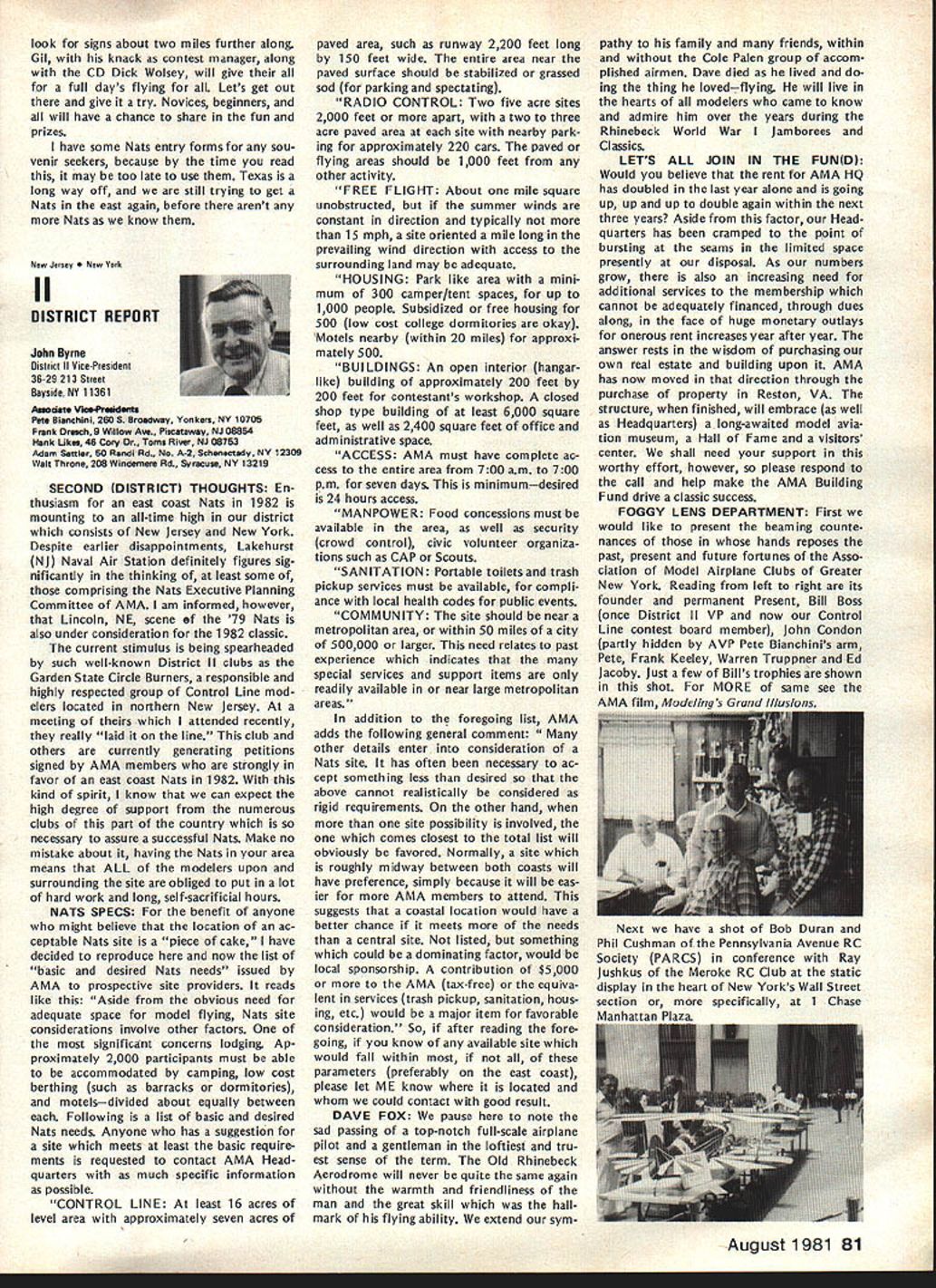
DISTRICT REPORT — District II
John Byrne District II Vice‑President 36‑29 213 Street Bayside, NY 11361
Associate Vice‑Presidents:
- Pete Bianchini, 260 S. Broadway, Yonkers, NY 10705
- Frank Dresch, 9 Willow Ave., Piscataway, NJ 08854
- Hank Likes, 46 Cory Dr., Toms River, NJ 08753
- Adam Sattler, 50 Rand Rd., No. A‑2, Schenectady, NY 12309
- Walt Throne, 208 Windermere Rd., Syracuse, NY 13219
SECOND (DISTRICT) THOUGHTS: Enthusiasm for an east-coast Nats in 1982 is mounting in District II (New Jersey and New York). Lakehurst Naval Air Station (NJ) and Lincoln, NE are under consideration.
NATS SITE SPECS (basic and desired):
- CONTROL LINE: ≥16 acres level area with ~7 acres paved (e.g., runway 2,200 ft × 150 ft).
- RADIO CONTROL: Two fixed sites ≥2,000 ft apart, each with 2–3 acre paved area and parking for ~220 cars; flying areas ≥1,000 ft from other activities.
- FREE FLIGHT: ~1 mile square unobstructed, or a mile-long site aligned with prevailing winds if winds are stable ≤15 mph.
- HOUSING: Park-like area with ≥300 camper/tent spaces (up to 1,000 people), subsidized housing for ~500 (e.g., dorms), motels within 20 miles for ~500.
- BUILDINGS: Open interior (hangar-like) ~200 ft × 200 ft for contestant workshops; closed shop of ≥6,000 sq ft; ~2,400 sq ft office/admin space.
- ACCESS: AMA access 7:00 a.m.–7:00 p.m. minimum daily for seven days (24‑hour desired).
- MANPOWER: Food concessions, security, volunteer organizations.
- SANITATION: Portable toilets and trash pickup.
- COMMUNITY: Near a metropolitan area or within 50 miles of a city of ~500,000.
Local sponsorship (e.g., $5,000 or equivalent services) is influential in selecting a site.
Notable: Dave Fox, a respected full‑scale pilot, has passed; condolences extended.
Fund raising: Rent for AMA HQ has doubled and will rise further; AMA has purchased property in Reston, VA, for a new building, museum, Hall of Fame, and visitor center. Support the AMA Building Fund campaign.
---
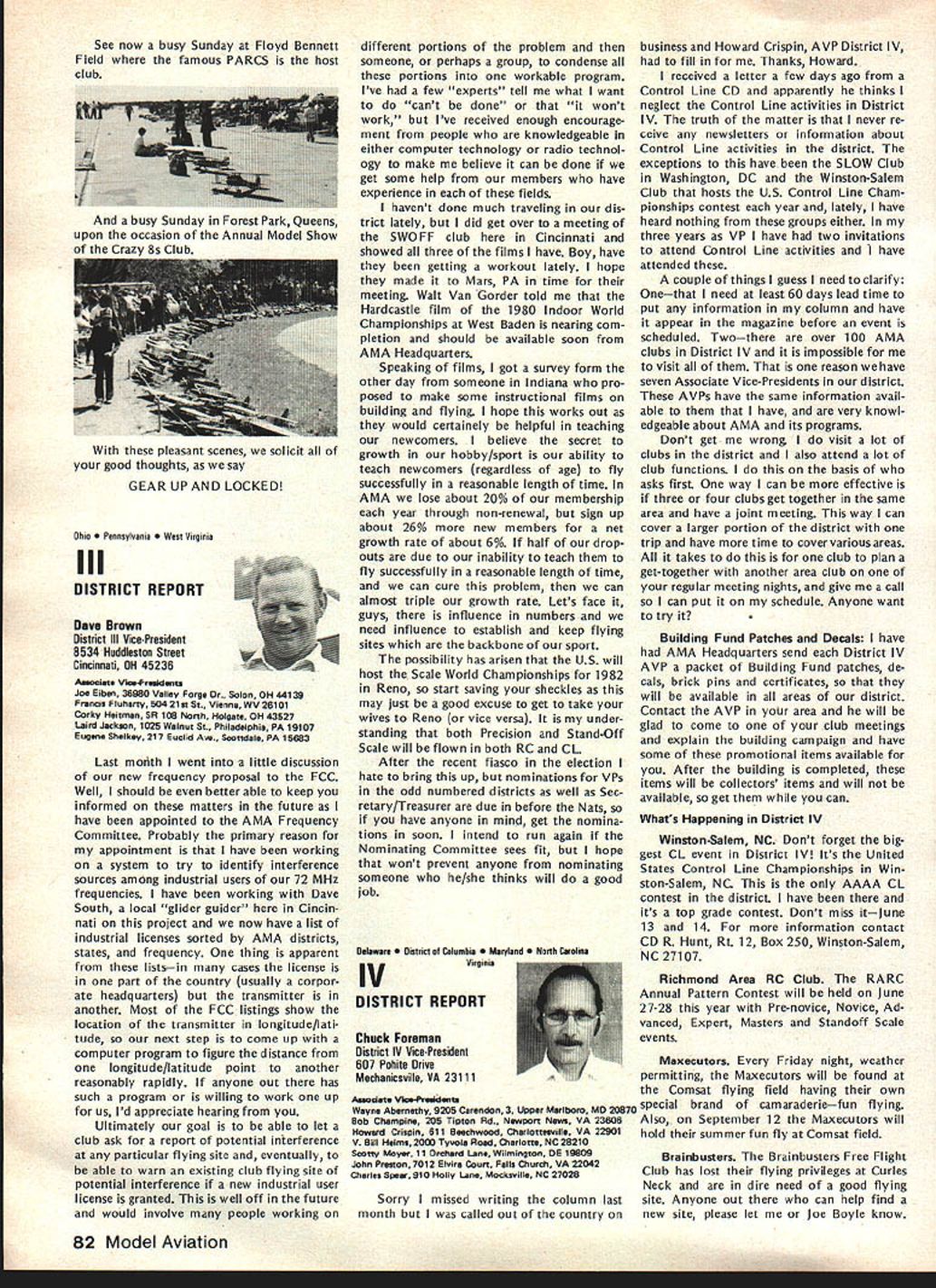
DISTRICT REPORT — District III
Dave Brown District III Vice‑President 8534 Huddleston Street Cincinnati, OH 45236
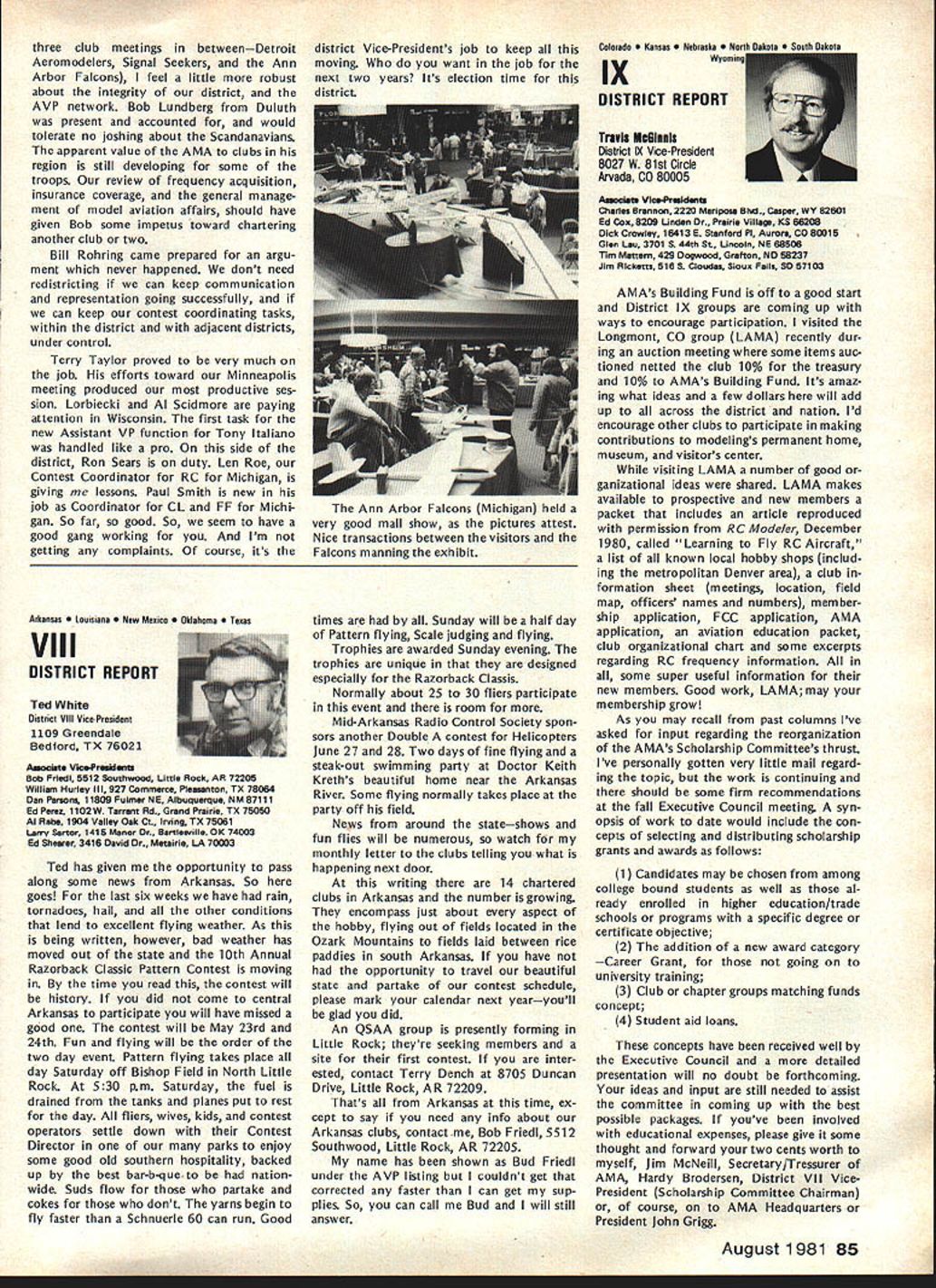
I have been appointed to the AMA Frequency Committee and am working on a system to identify industrial interference sources in the 72 MHz band. We have lists of industrial licenses sorted by district, state, and frequency. Many licenses list corporate HQ rather than transmitter locations; most FCC listings give transmitter longitude/latitude. The next step is programmatic: compute distances between coordinates to report potential interference for specific flying sites. Volunteers with programming or radio expertise are welcome.
Films: The Hardcastle film of the 1980 Indoor World Championships at West Baden is nearing completion and will be available from AMA HQ. Instructional building/flying films are proposed and could help teach newcomers; better teaching improves retention.
Membership: AMA loses ~20% yearly through non-renewal but signs ~26% new members for a net growth ~6%. Improving instruction for beginners could greatly increase growth.
Possible Scale World Championships 1982 in Reno; start planning.
Nominations for odd-numbered district VPs and Secretary/Treasurer are due before the Nats.
---
DISTRICT REPORT — District IV
Chuck Foreman District IV Vice‑President 607 Pohte Drive Mechanicsville, VA 23111
I missed last month's column due to business travel; Howard Crispin filled in. Feedback: District IV control-line clubs need better communication with the VP. I need ~60 days lead time for material to appear in the magazine. There are over 100 AMA clubs in District IV; AVPs help cover the district.
Building Fund promotional items (patches, decals, brick pins, certificates) are available from District IV AVPs.
What's Happening in District IV:
- Winston‑Salem, NC: United States Control Line Championships — June 13–14. Contact CD R. Hunt, Rt. 12, Box 250, Winston‑Salem, NC 27107.
- Richmond Area RC Club: Annual Pattern Contest — June 27–28 (classes: Pre-novice through Masters and Standoff Scale).
- Maxecutors: Weekly Friday night flying at Comsat field; summer fun fly on September 12.
- Brainbusters Free Flight Club lost privileges at Curles Neck and needs a new flying site; contact Joe Boyle or the District office.
---
DISTRICT REPORT — District V
Bill Mathews District V Vice‑President 311 Poinciana Drive Birmingham, AL 35209
Associate Vice‑Presidents:
- John Gorday, 115 Bayberry Lane, Jackson, MS 39212
- Richard Jackson, 108 Thornlee, Charleston Heights, SC 29405
- Arthur Johnson, 932 Banyan Dr., Delray Beach, FL 33444
- Phillip McDonald, 6521 Rolling Fork Dr., Nashville, TN 37205
- Joseph Micalizzi, Sr., RR 00886, Box 1532, Fairburn, PA 00648
- Ed Moorman, 701 Fifth St., Shalimar, FL 32579
- Harry Sherman, PO Box 4506, Birmingham, AL 35208
- Tom Thecker, 2390 Lawrenceville Hwy., Lawrenceville, GA 30043
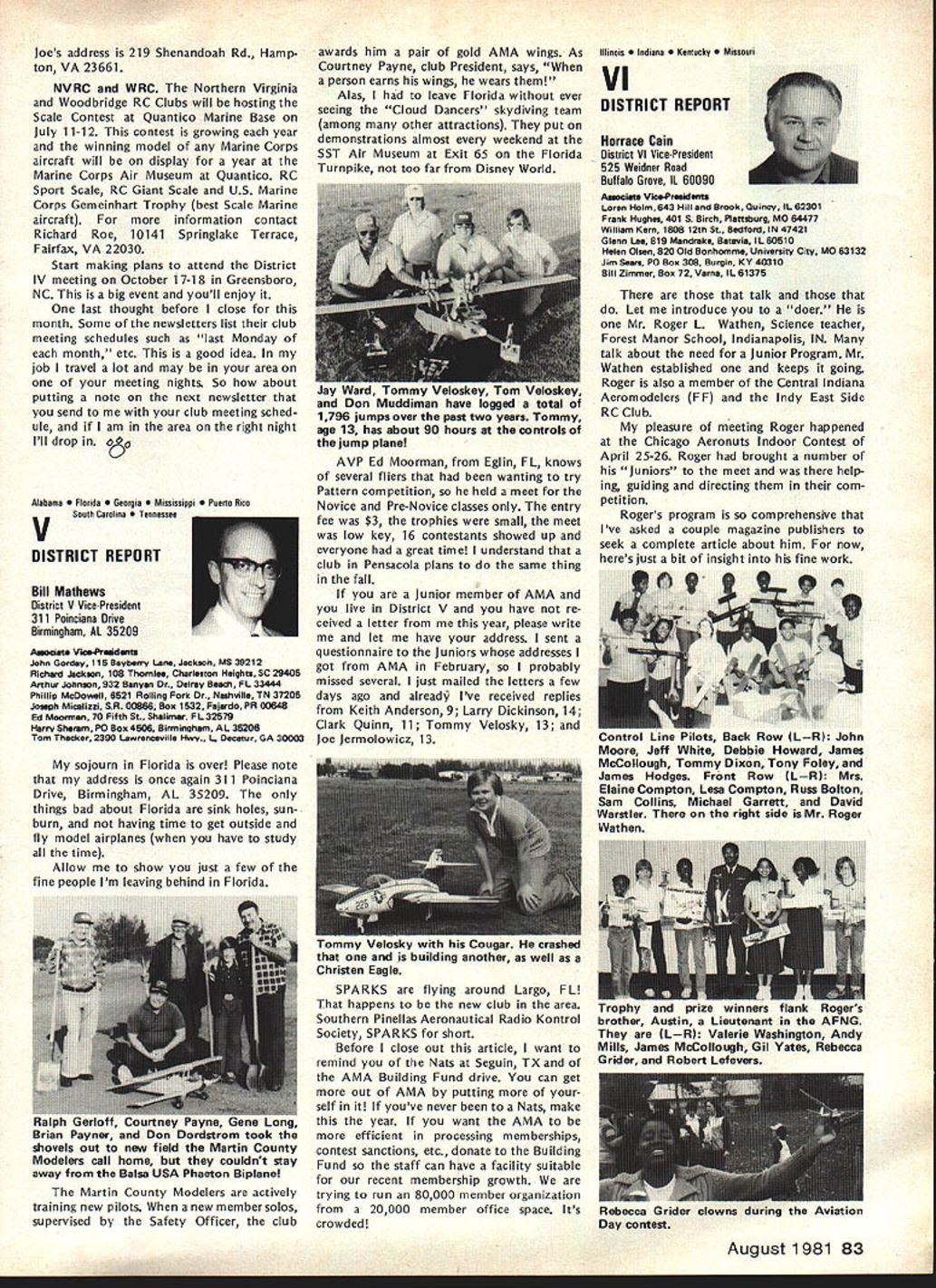
NVRC and WRC will host the Scale Contest at Quantico Marine Base on July 11–12. Winning Marine Corps aircraft models will be displayed at the Marine Corps Air Museum at Quantico. Events include RC Sport Scale, RC Giant Scale, and the U.S. Marine Corps Gemeinhart Trophy. Contact Richard Roe, 10141 Springlake Terrace, Fairfax, VA 22030.
District IV meeting: October 17–18 in Greensboro, NC.
Junior members: If you are a Junior in District V and haven’t received a letter, please write with your address.
SPARKS (Southern Pinellas Aeronautical Radio Kontrol Society) — new club in Largo, FL.
Reminder: Nats at Seguin, TX and support the AMA Building Fund.
---
DISTRICT REPORT — District VI
Horace Cain District VI Vice‑President 525 Weidner Road Buffalo Grove, IL 60090
Associate Vice‑Presidents:
- Loren Helm, 643 Hill and Brook, Quincy, IL 62301
- Frank Hughes, 401 S. Birch, Plattsburg, MO 64477
- William Kerr, 108 12th St., Bedford, IN 47421
- Glenn Lee, 819 Mandrake, Batavia, IL 60510
- Helen Olsen, 820 Old Bonhomme, University City, MO 63132
- Jim Sears, PO Box 368, Burgin, KY 40310
- Bill Zimmer, Box 72, Varna, IL 61375
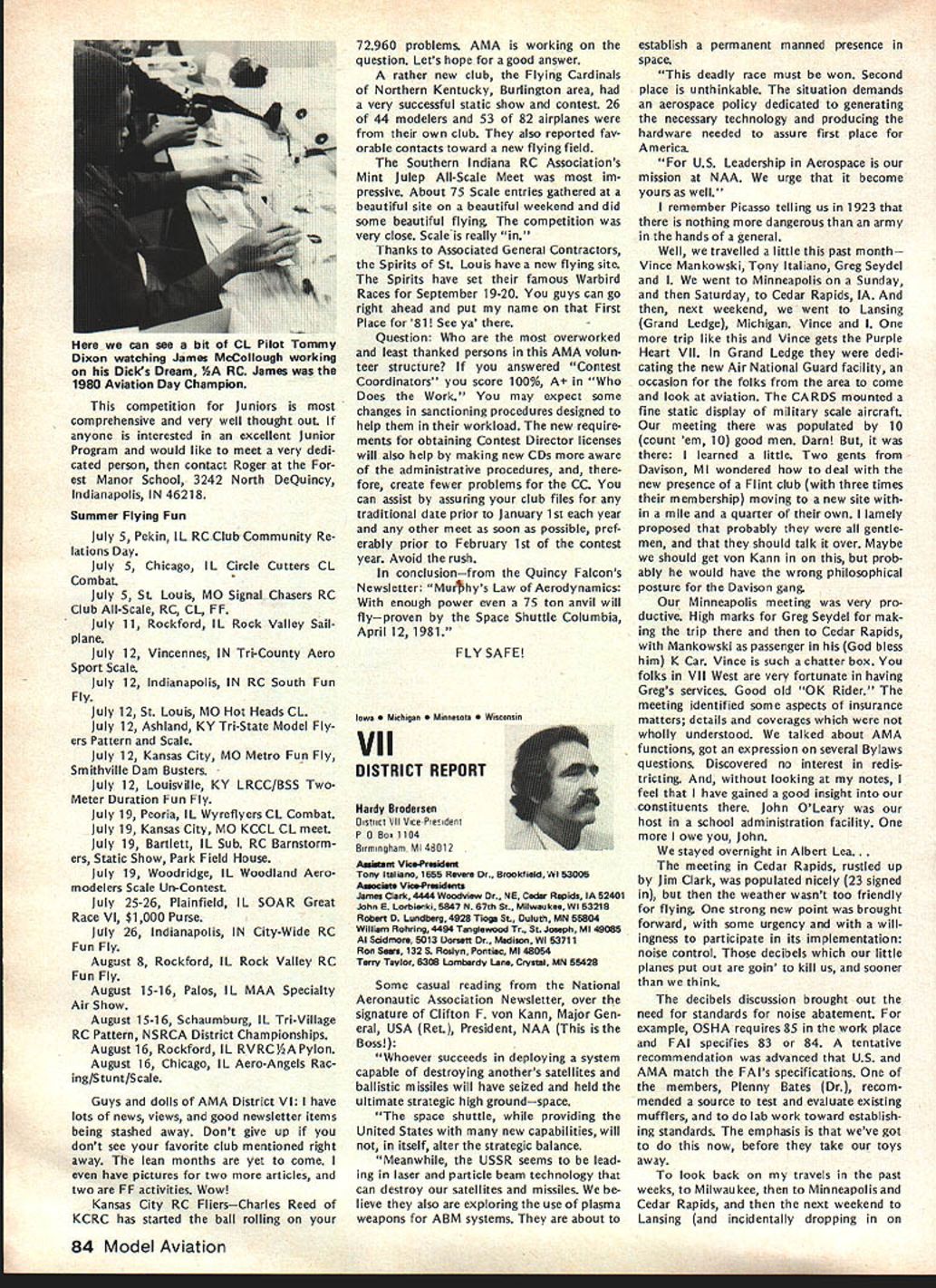
Feature — Roger L. Wathen: A science teacher in Indianapolis who established and runs a comprehensive Junior program, bringing many juniors to events and guiding them in competition. His program is an excellent model for junior outreach and training.
---
AMA NEWS — Miscellaneous Items
Sterling Models — Proud Recognition
Sterling Models Incorporated (Philadelphia) has engaged in effective public promotion by sponsoring the Real Sporty Formula Racer, designed and built by Paul Musso. Piloted by Chuck Andrews, the Real Sporty recently broke three FAI/NAA speed records for the USA:
- 237.77 mph (3 km course)
- 221 mph (100 km course)
- 203 mph (500 km course)
The full-size aircraft is 16 ft long, 19 ft span, and weighs 575 lb (including fuel). Plans include producing a rubber-powered model and an R/C version.
Aircraft Restoration Program
Due to popular demand, the Smithsonian Institution will reoffer the "Aircraft Restoration" program, October 4–8, featuring hands-on workshops at the Paul E. Garber Facility. Walter J. Boyne and Donald S. Lopez will be involved. For information, registration, and accommodations, contact Selected Studies A&I, Smithsonian Institution, Washington, DC 20560, or call (202) 357‑2475.
---
AMA News — Membership, Promotion, and Outreach
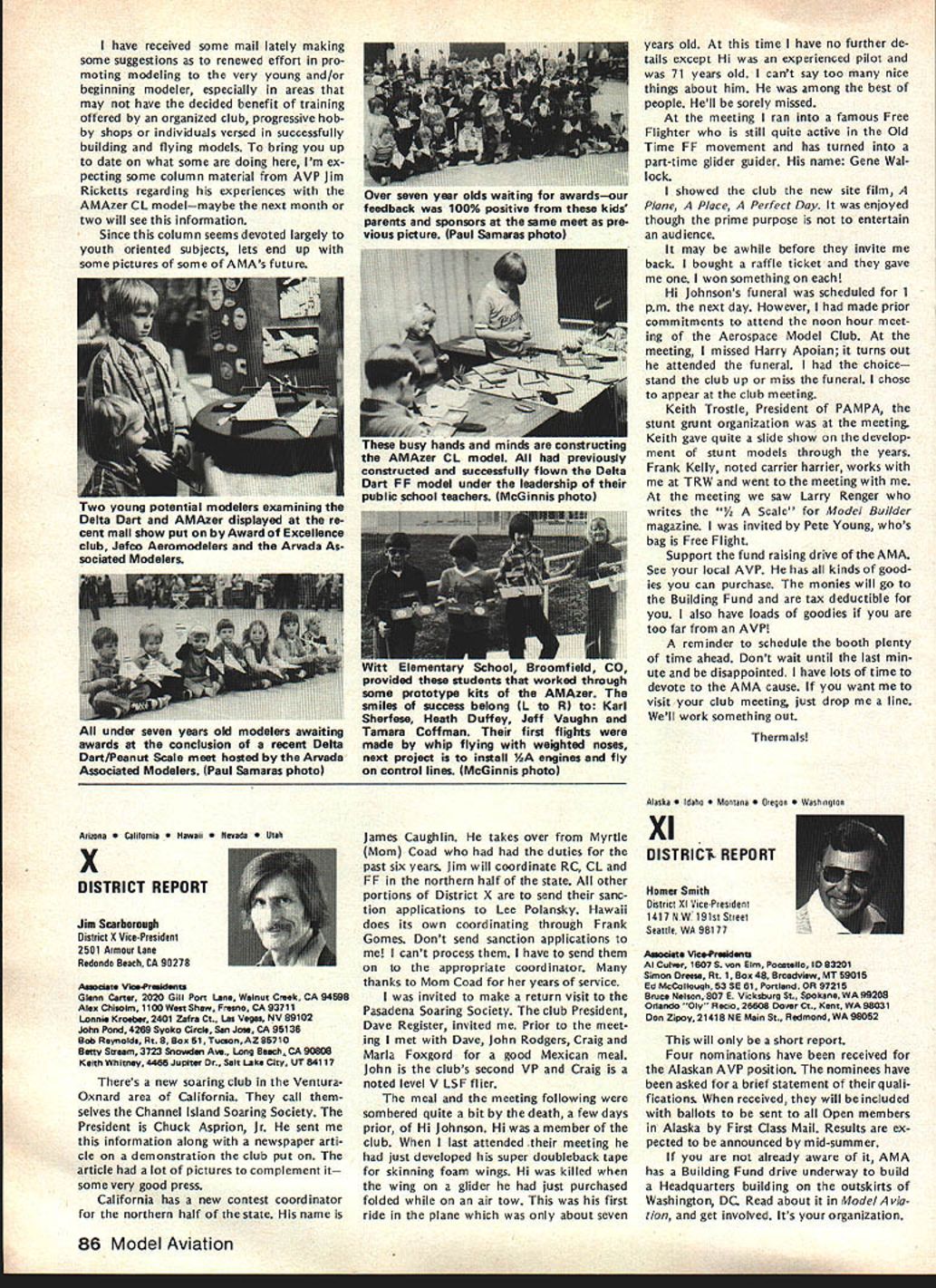
Mail and suggestions have been received advocating renewed efforts to promote modeling to young and beginning hobbyists, particularly in areas lacking club support or skilled mentors. Column material from AVP Jim Ricketts on the AMAzer CL model and other youth-oriented initiatives is forthcoming.
Support the Building Fund drive through your local AVP; funds are tax-deductible and will help provide adequate headquarters space, a museum, Hall of Fame, and visitor center.
Thermals!
Transcribed from original scans by AI. Minor OCR errors may remain.

