
RC Frequency Committee Report
Bob Aberle, Chairman AMA RC Frequency Committee
A meeting of the committee was held in Washington, D.C., on June 5, 1981 — the first in almost a year. Present: committee members Bob Aberle (Chairman), Jack Albrecht, Dave Brown, Walt Good, Bill Hershberger, Dick Jansson, Fred Marks, John Strong, Torrey Williams; AMA: John Worth (Executive Director), Carl Maroney (Executive Assistant); Legal Counsel: Jack R. Smith (Jeremiah Courtney law firm).
Key items:
- The FCC Notice of Proposed Rule Making (NPRM) is expected to be released in late 1981.
- New RC rules, adding some 73 channels, will most likely become effective around mid‑1983.
- The FCC will be asked to retain current technical specifications (except modulation limitations) under equipment type certification.
- Existing RC equipment may be usable indefinitely if the frequency is changed to one of the new "odd" channels within 10 years of the rule effectivity date.
- The new "odd" channels will include 50 channels for aircraft use and 23 for non‑aircraft use; these will be exclusive for RC use initially.
- Given the prospect of exclusive RC channels, the committee will seek AMA Executive Council approval to purchase two experimental RC systems operating near 900 MHz.
- In the near term, AMA will mount a campaign to discourage new commercial radio applicants from using the existing seven RC channels.
- A proposed computer program printout will pinpoint power and location of commercial stations operating on the present seven RC channels nationwide.
- The originally proposed frequency‑flag control system continues to be refined.
Details and Process Timeline
It is disheartening that the effort to obtain new RC frequencies will be extended. The delay results from limited FCC staff manpower and workload; modelers are considered a lower‑priority user of spectrum.
Progress to date and remaining milestones:
- AMA Petition for Rule Making (RM‑3525) submitted November 1978.
- FCC informed AMA of available channels in the 72–76 MHz band October 1979.
- AMA released its analyzed proposal to the FCC September 1980.
What still must happen:
- FCC releases NPRM — best information indicates December 1981.
- AMA/industry/general public respond (60 days from NPRM release — approx. February 1982).
- FCC releases Report & Order — typically 12–18 months (estimate June 1983).
- Rule effectivity — 30 days after Report & Order release (estimate July 1983).
These milestones reflect the normal FCC rule‑making schedule. Tactful lobbying may help, but premature or aggressive letter campaigns could overload FCC staff and slow the process; patience is advised.
Because of member and industry concerns about equipment obsolescence and cost, the committee decided to request the FCC revert type acceptance specifications back to present specifications (except for modulation limits). This change would allow conversion to new "odd" channels primarily by changing crystals (tighter tolerance), rather than mandating wholesale replacement of transmitters. The committee recognizes some risk — wideband receivers may still suffer adjacent‑channel interference — but this approach should greatly reduce forced obsolescence.
To pursue truly exclusive channels, AMA has been granted experimental spot frequencies in the ISM band (902–928 MHz). The committee will ask the Executive Council for up to $2,000 to buy two prototype systems (REFTEC) for testing; preliminary flight test reports can be expected in late 1982 if ordered promptly.
The AMA will also:
- Discourage new commercial applicants from using the seven current channels (plenty of alternatives exist).
- Explore Comp‑Comm Inc. and Telocator Network of America contacts to monitor and influence applications.
- Develop a computer database (FCC license data sorted by power and location) to inform members and districts.
- Consider adding a full‑time staff frequency coordinator; in the interim, appoint district frequency coordinators by district VPs.
- Refine a visual frequency control system combining channel numbering and color‑coded streamers; a final draft will appear in Model Aviation.
- Prototype a three‑dimensional pin/board frequency control to assist field operators with IM products, image issues, and adjacent channel interactions.
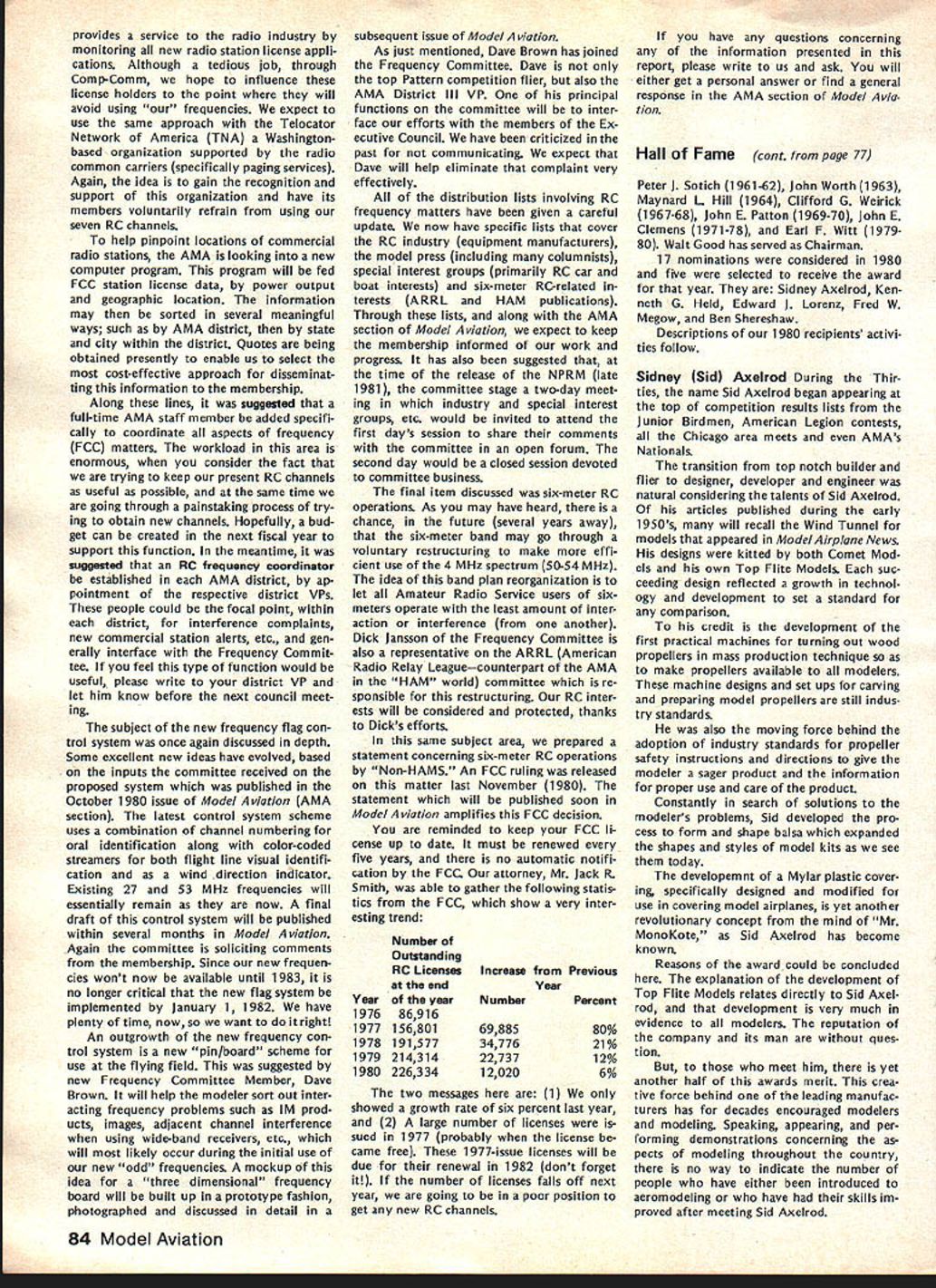
Keep your FCC license current (renew every five years). Many 1977 licenses (issued when the license was free) will be due in 1982; a drop in active licenses could negatively affect future channel allocation efforts.
If you have questions, write to the committee or consult the AMA section of Model Aviation.
---
FCC Report Continued
Image and Other Considerations
Using single‑conversion 455 kHz IF receivers to cover a band with about 980 kHz of available frequencies introduces image problems for some frequencies. One mitigation is low‑injection conversion for 72.010–72.490 MHz and high‑injection conversion for 72.510–72.990 MHz to avoid image responses. Assuming low‑injection conversion on the lower half of 72 MHz, no interference should arise from TV Channel 4 aural carriers at 71.75 MHz.
Even without up/down injection conversion, image conflicts under the proposed plan occur primarily for frequencies above 72.920 MHz. Direct image conflicts also exist between 72.050 and the current authorized 72.960 MHz without conversion.
Intermodulation (IM) between widely spaced frequencies (for example, 72.010 and 72.470 separated by ≈460 kHz) was discussed. An additional IM source arises from beats between a receiver’s local oscillator and close incoming signals (e.g., LO at 72.465 MHz with desired signal at 72.470 MHz). These beat effects are similar to two injection oscillators spaced 5 kHz apart and can occur at lower signal levels than typical IM, producing interference at longer ranges. FM receivers showed slightly better IM rejection (phase jitter vs. pulse interference in AM), but neither modulation type produced totally satisfactory results for separations of 450–460 kHz.
Conclusion
Access to 50 channels is necessary. The committee emphasizes tight control over mixing equipment not intended for 50‑channel use with equipment designed for full frequency use. AMA competition sanctioning and insurance qualifications can be used to prevent operation of non‑compliant equipment alongside 50‑channel designs. Receiver problems are solvable, but lack of access to 50 channels could render many urban areas unusable for RC within ten years. Long‑term access to ample channels outweighs short‑term equipment conversion issues.
At What Distance Can An RC Frequency Be Reused?
A. Free Space Conditions — Practical Reuse Assumptions
Theoretical free‑space calculations for ground‑aircraft paths are useful but not sufficient. More practical reuse estimates assume:
- Visual line of sight is necessary — models are rarely visible beyond about 1 mile (≈1,600 m).
- Most operations occur within 700–800 m of the operator.
- Typical RC transmitters have ERP under 150 mW due to non‑resonant antennas and inefficient ground planes.
- Common receivers require S+N/N ≈ 10 dB (AM); current NBFM receivers have capture ratios > 8–10 dB.
- AGC thresholds: AM ≈ 30 µV; FM limiting begins above ≈20 µV.
At a slant range of 750 m, received field is about 1,000–2,000 µV/m, causing 30–35 dB gain reduction in AM receivers. An interfering source producing ~100 µV/m at the receiving antenna would start to cause noticeable AM interference. For co‑channel interferers over flat terrain, interference could appear at 5–6 mile ranges. FM systems (6 kHz bandwidth contemplated) provide somewhat different protection; receiver capture and limiting suppress many amplitude‑varying interference components, yielding roughly similar reuse distances.
Thus, except in unusual conditions, safe operational separation between operating sites is at least 5 miles; allowing for equipment degradation, extend to about 7 miles.
B. Why FM?
Narrow‑band FM (NBFM) offers only limited capture benefit compared with wideband FM; NBFM behaves similarly to linear modulation for bandwidth and immunity considerations. Receiver limiting removes amplitude distortion (helpful against amplitude‑dominated interference), so NBFM can reject much of the amplitude component of composite signals. For fixed deviation and bandwidth, FM gives slightly improved noise immunity over equivalent AM systems, but NBFM does not enjoy the large capture advantages of wideband FM.
Experimental Data
Field tests with typical present‑generation RC equipment were conducted at a quiet flying site in San Diego County to confirm that 72 MHz frequencies could be reused at ~5 miles. Tests used single‑conversion 455 kHz IF double‑tuned front‑end receivers and transmitters radiating ~200 mW ERP. Interfering transmitters were positioned 3 miles from the operator; normal flying was possible with fully extended antennas but degraded with collapsed antennas. When interferers were moved to 5 miles separation, no observable degradation occurred, even with collapsed antennas. Quiet field tests confirmed theoretical predictions for ~5‑mile reuse with aircraft systems. Ground‑based reuse tests (cars, boats) were not done, but calculations predict possible reuse with less than one mile separation in many cases.
Compatibility of Existing Equipment with New Rules
- Equipment with non‑modular RF sections or wideband receivers may not perform adequately in a narrow‑band environment.
- Equipment with modular RF sections can use new frequencies as manufacturers develop new modules and receive FCC type acceptance.
- New type acceptance standards are recommended, reducing authorized bandwidth from 8 kHz to 6 kHz. Existing non‑modular equipment may not be convertible directly and will require equipment changes and re‑type acceptance.
- The anticipated phaseout: 3–5 years to discontinue manufacture/sale of current production equipment, plus an additional 3–5 years of continued operation on existing frequencies — adequate for amortization and pipeline clearing.
- AM will not be prohibited; some present designs can be modified for narrow‑band operation. Example: Simprop SSM AM system operates with narrow spacing and has been type accepted in a modified form.
- The industry can introduce new equipment within two years. AMA recommends allowing any modulation method compatible with a 6 kHz authorized bandwidth to preserve innovation; manufacturers must optimize the bandwidth budget for frequency and information rate.
---
Secretary‑Treasurer's Report
Jim McNeill AMA Secretary‑Treasurer 617 South 20 Avenue, Birmingham, AL 35205
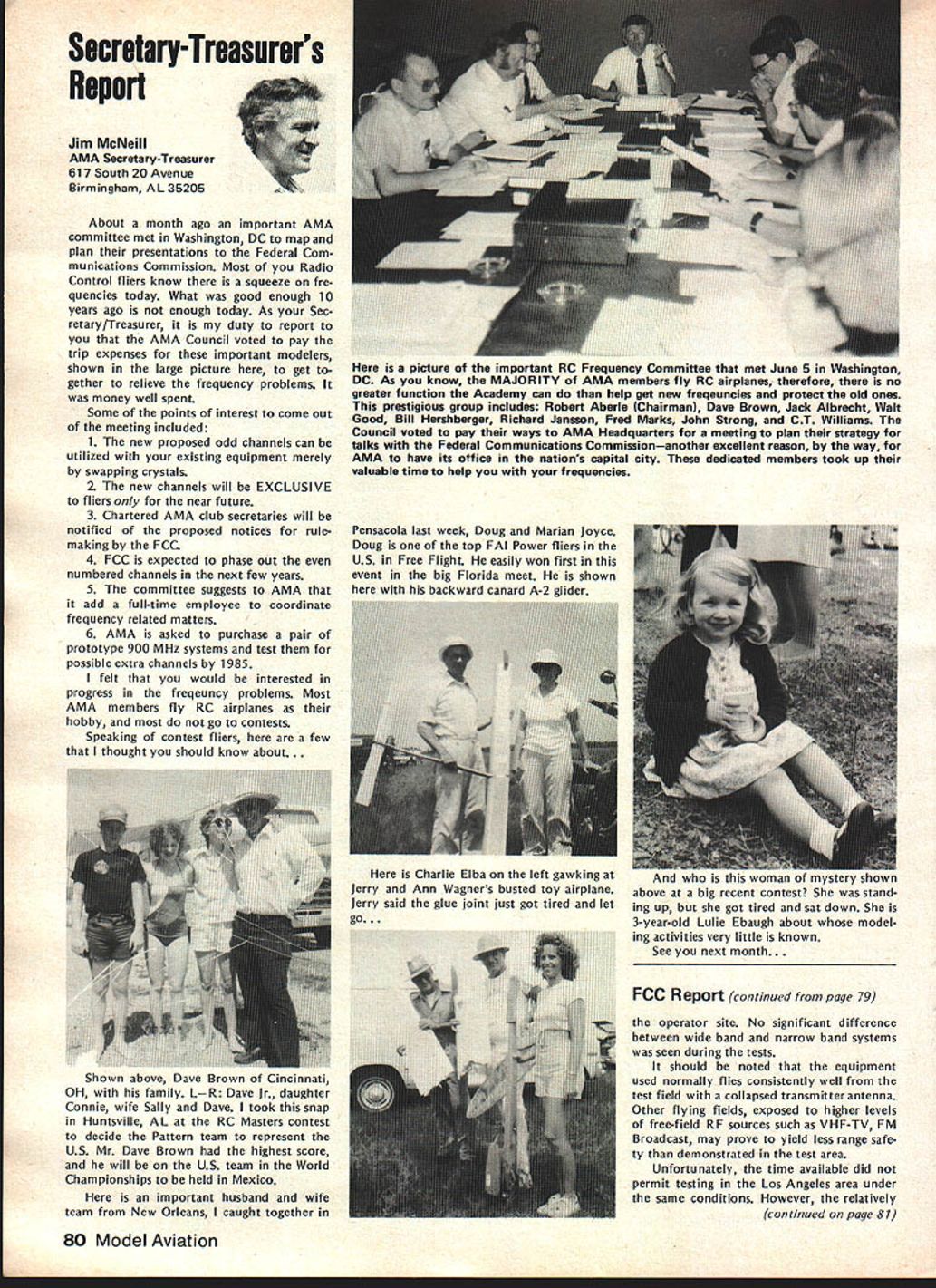
A month ago the AMA Frequency Committee met in Washington to plan presentations to the FCC. The AMA Council voted to pay trip expenses for those attending; the expense was considered money well spent.
Points of interest from the meeting:
- New proposed odd channels can be used with existing equipment by swapping crystals (if FCC allows crystal changing).
- New channels will be exclusive to fliers for the near future.
- Chartered AMA club secretaries will be notified of proposed FCC rule‑making notices.
- The FCC is expected to phase out even‑numbered channels over the next few years.
- The committee suggests adding a full‑time employee to coordinate frequency matters.
- AMA is asked to purchase prototype 900 MHz systems and test them for possible extra channels by 1985.
Most AMA members fly recreationally rather than contest. The committee’s work benefits the entire membership.
---
Executive Director's View from HQ
John Worth AMA Executive Director 815 Fifteenth Street, N.W., Washington, D.C. 20005
Better Than We Thought
Initial proposals suggested much existing equipment would become obsolete. Newer analysis indicates existing equipment could be used beyond a 10‑year transition if the FCC retains current frequency tolerances and allows crystal changes in many transmitters. Many transmitters already exceed spec performance; only a close‑tolerance crystal and, in some cases, a narrow‑band receiver would be required. AMA is asking the FCC to permit crystal changing where it will not cause problems — this could eliminate much of the obsolescence concern.
Toledo Leads the Way
The annual Weak Signals (Toledo) Show raffle donated $2,148 to AMA projects this year: $1,074 to the Glen Sigalose Memorial Scholarship Fund, $250 to sponsor an RC event at the 1981 Nats, and $824 to the AMA Building Fund. The Toledo Weak Signals club’s contribution is the first of this magnitude; a plaque will be displayed in AMA’s new headquarters to recognize their gift.
Building Fund Economics
AMA purchased property for a new headquarters in 1980, plans to build in 1982, and move in early 1983. The aim is to avoid escalating rent (~10%/year). The Building Fund drive seeks donations (rather than increased dues) to cover concurrent rent and construction costs; a $2 per member equivalent would yield $160,000, but AMA will seek individual and industry donations, souvenir sales, etc. About $10,000 has been pledged to date. Contributions are tax‑deductible.
To Be Or Not To Be
AMA has relatively few HQ visitors; most are impressed by the scope of staff and volunteer effort (over 30 employees, 160 committee volunteers, 200–300 national officials, and 2,000+ contest directors). Many staff donated unused vacation (over 200 days collectively) through dedication to the organization — a valuable voluntary contribution. AMA asks members to appreciate HQ staff and volunteers.
FCC Report (continued)
San Diego area tests confirmed successful frequency reuse at five‑mile separation. Compatibility issues with narrow‑band rules were reiterated: non‑modular wideband equipment will likely need replacement or modification; modular equipment can transition more easily. The industry can respond quickly and introduce new equipment within about two years. AMA urges allowing any modulation method within a 6 kHz bandwidth to encourage development.
---
AMA News — Condensed Items
Hall of Fame Awards
Model Aviation Hall of Fame Awards honor individuals with outstanding contributions to aeromodelling. The Council of Past Presidents administers the Awards Committee. Nominations are accepted from anyone (forms available from AMA Headquarters). Committee members do not vote for themselves; seven committee members have already been honored. Current Past Presidents on the committee include:
- Irwin G. Ohlsson (1943–46)
- Frank B. Bushey (1952)
- Keith H. Storey (1953–56)
- Claude McCullough (1957)
- Dr. Walter Good (1958–60)
Appreciation and In Memoriam
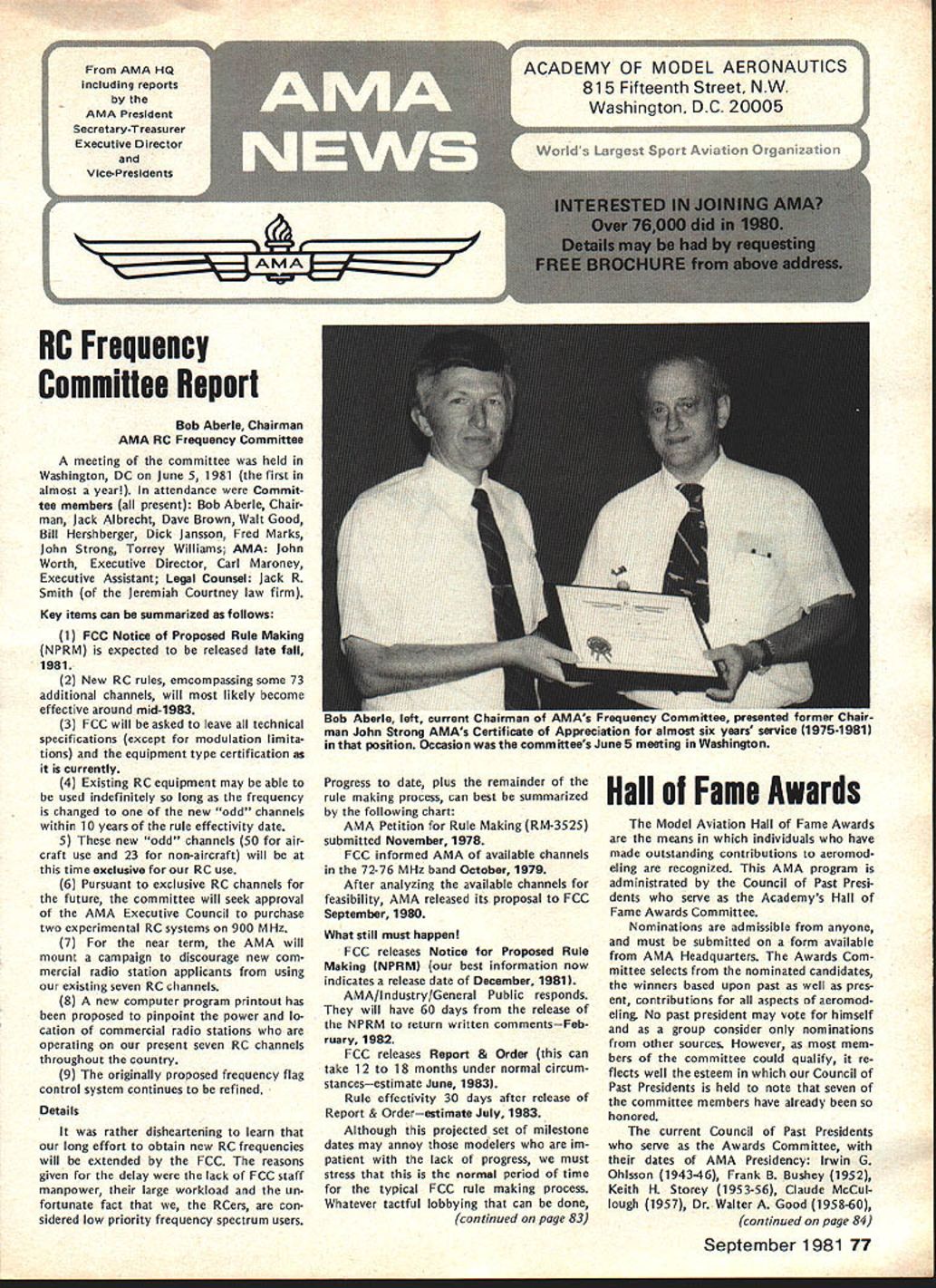
- Bob Aberle presented appreciation to John Strong for nearly six years of service (1975–1981) as committee chairman.
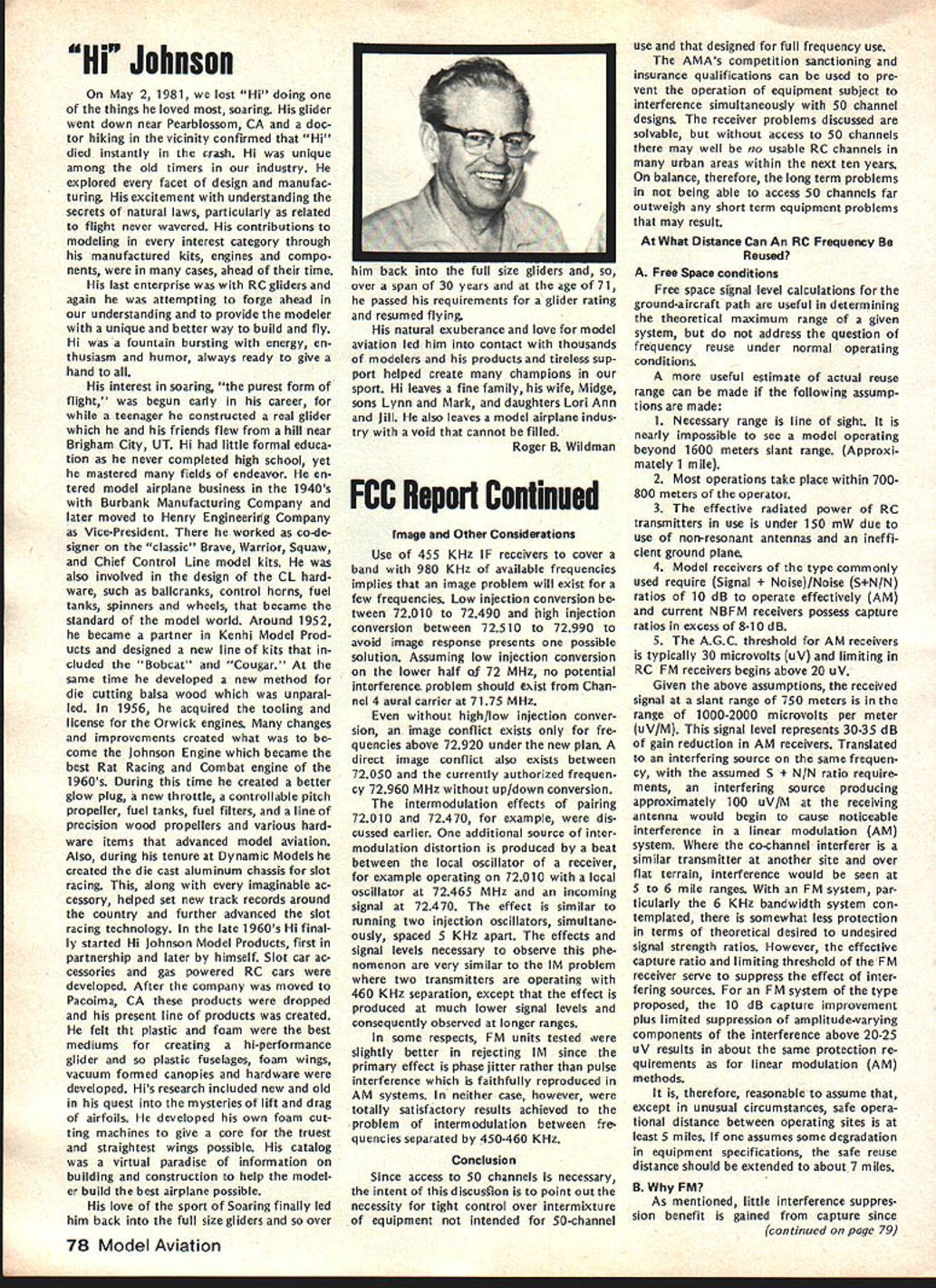
- In Memoriam: Hi Johnson, died May 2, 1981, in a soaring accident near Pearblossom, CA.
Communications and Publicity
Editors and newsletter writers should be cautious about public opposition to the frequency proposal. Negative publicity could jeopardize FCC approval and set back efforts for years. If you disagree with the proposal, suggest specific changes rather than broad opposition.
Insurance and Safety Standards
AMA is working to offer clubs an additional $1,000,000 umbrella policy above the current $1,000,000 limit. To obtain this, chartered clubs will need to comply with safety standards for flying sites (pilot lines, pit areas, spectator areas, distance from roads/buildings/obstructions). Ideas for standards are welcome.
---
Letters and Junior Section (selected)
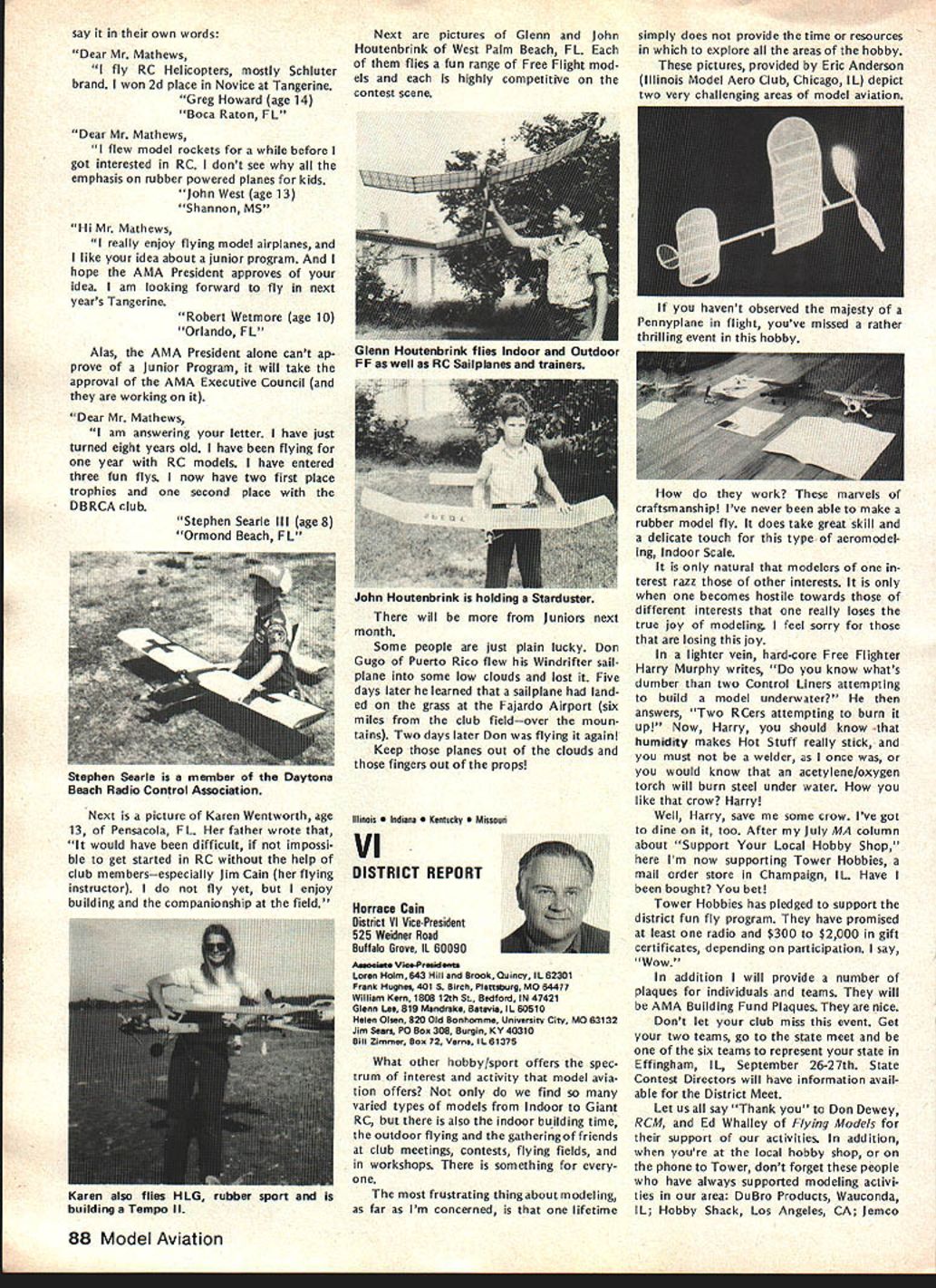
"Dear Mr. Mathews," — several letters from juniors praising RC activities and junior programs:
- Greg Howard (age 14), Boca Raton, FL — flies RC helicopters, won 2nd place Novice at Tangerine.
- John West (age 13), Shannon, MS — rode rockets before RC; comments on junior rubber‑powered emphasis.
- Robert Wetmore (age 10), Orlando, FL — enjoys flying and the junior program.
- Stephen Searle III (age 8), Ormond Beach, FL — has earned two firsts and a second in fun flys with DBRCA club.
The AMA Executive Council must approve any official junior program; work is in progress.
---
Things To Do (Selected Events)
- August 9 — Erie, IL RC Club Open Fun Fly.
- August 15–16 — Lexington, KY Kentucky State Club Team Fun Fly.
- August 15–16 — St. Peters, MO RC State Club Team Fun Fly.
- August 15–16 — Schaumburg, IL Tri‑Village RC NSRCA District Pattern Meet.
- August 16 — Chicago, IL Aero Angels CL Stunt/Scale.
- August 22–23 — Plainfield, IN Indiana State Club Team Fun Fly.
- August 22–23 — Champaign, IL Illinois State Club Team Fun Fly.
- August 23 — Pekin, IL RC 1/2 Scale and Sport Scale.
- August 23 — Kansas City, MO Northern Knights Fun Fly.
- August 23 — Lemont, IL Woodland Aeromodelers Cash Combat Bash.
- August 29–30 — Elk Grove Village, IL Chicagoland/AJ's Biplane Contest.
- August 30 — Rockford, IL RVRC Soaring.
- September 6 — Ashland, KY Tri‑State Model Fliers Pattern and Scale.
- September 6 — Kansas City, MO Smithville Dam Busters Fun‑Fly.
- September 7 — Kansas City, MO KCRC Flying Circus.
---
District Reports (Selected)
X District Report
Jim Scarborough, District X Vice‑President
- Peninsula Silent Flyers (Rolling Hills area) is a new soaring club with ~50 members, many teens.
- Antelope Valley Tailwinds, MARKS (Rialto), Santa Rosa Redwood Modelers and others have been active and supportive of the AMA Building Fund.
- The author attended multiple club meetings and encourages clubs to request AMA films, displays, and the AMA building fund support.
XI District Report
Homer Smith, District XI Vice‑President
- Marymoor Radio Control Club (MARC) will field a Trans‑America Relay Race team (Ontario, CA to Las Vegas).
- Eugene RC Aeronauts reminder: collect witness/claim info in incidents, contact AMA HQ and insurance agents promptly.
- Gastineau Aeromodelers (Juneau) reports on Nugget Mall exhibit and SE Fun Fly patches; Canadian fliers confirmed participation.
---
Junior Flight — Ed Whitten
Important "Eagle Talk" — stability and pitch control around the pitching axis:
- In Glide: A fore‑aft stability setup with wing incidence about 3° higher than the stabilizer keeps nose‑up attitude and aids stall recovery. Adjust glide by small changes to wing leading edge or stabilizer trailing edge; hand glides are useful but not definitive.
- Under Power: Add thrust line adjustments (typically 2–3° down thrust and about 2° right thrust). If climb behavior is poor, re‑adjust glide angles before finalizing thrust. Small incremental changes and test flights are essential.
- Builders and plan authors should include prop/wing/stabilizer angular relationships on plans. Accurate construction and attention to these hidden angles are crucial for good flying performance.
Final note: appearance (cockpits, paint) is secondary to proper angular relationships and flight trim — pay attention to the fundamentals.
---
If you have questions about any item in these reports, write to AMA Headquarters or consult the AMA section of Model Aviation.
Transcribed from original scans by AI. Minor OCR errors may remain.

