
AMA BUILDING FUND DRIVE
Space in the magazine has recently been used to explain the Building Fund Drive and why it is so important. The response has been very positive from AMA members and friends.
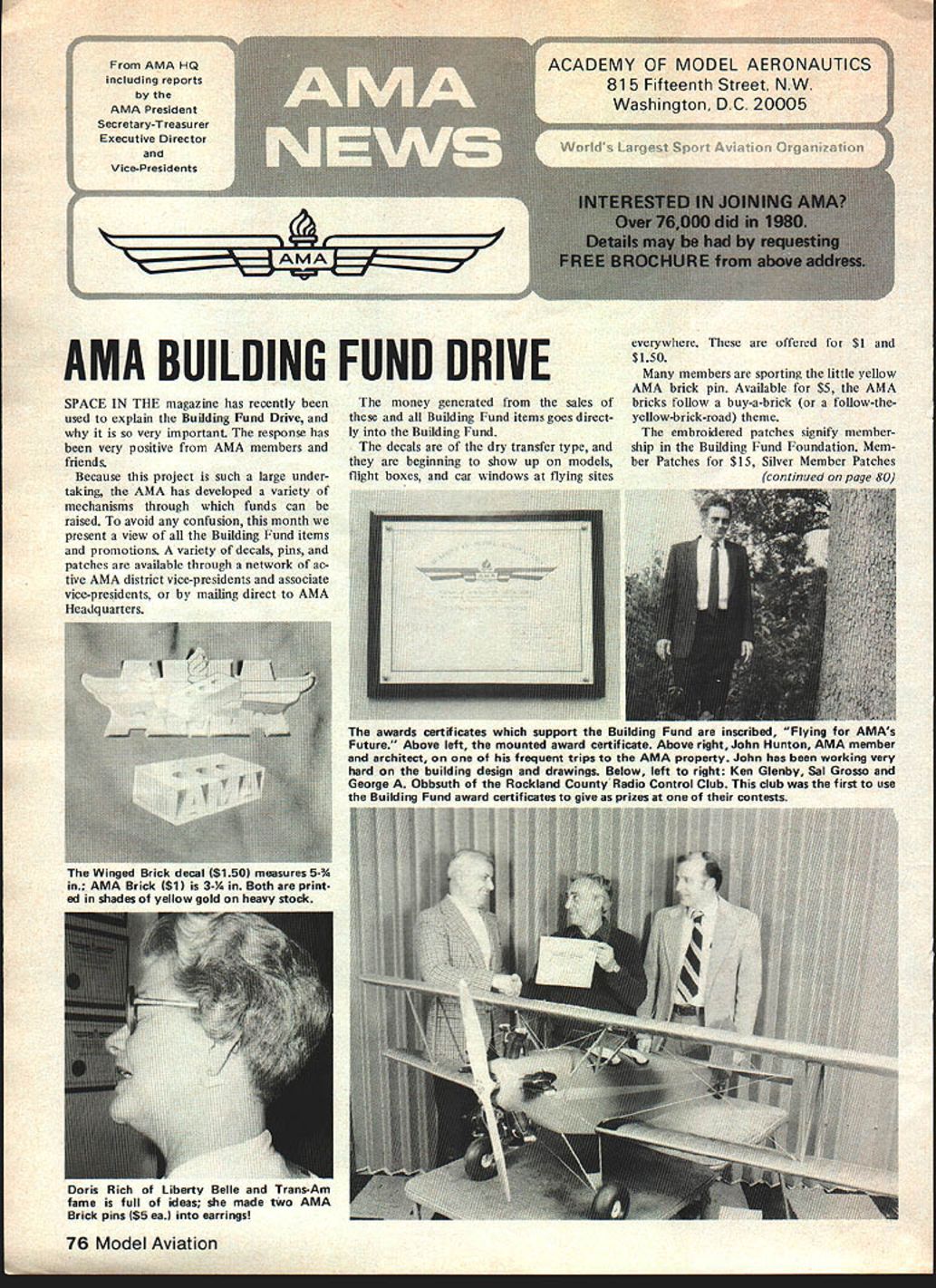
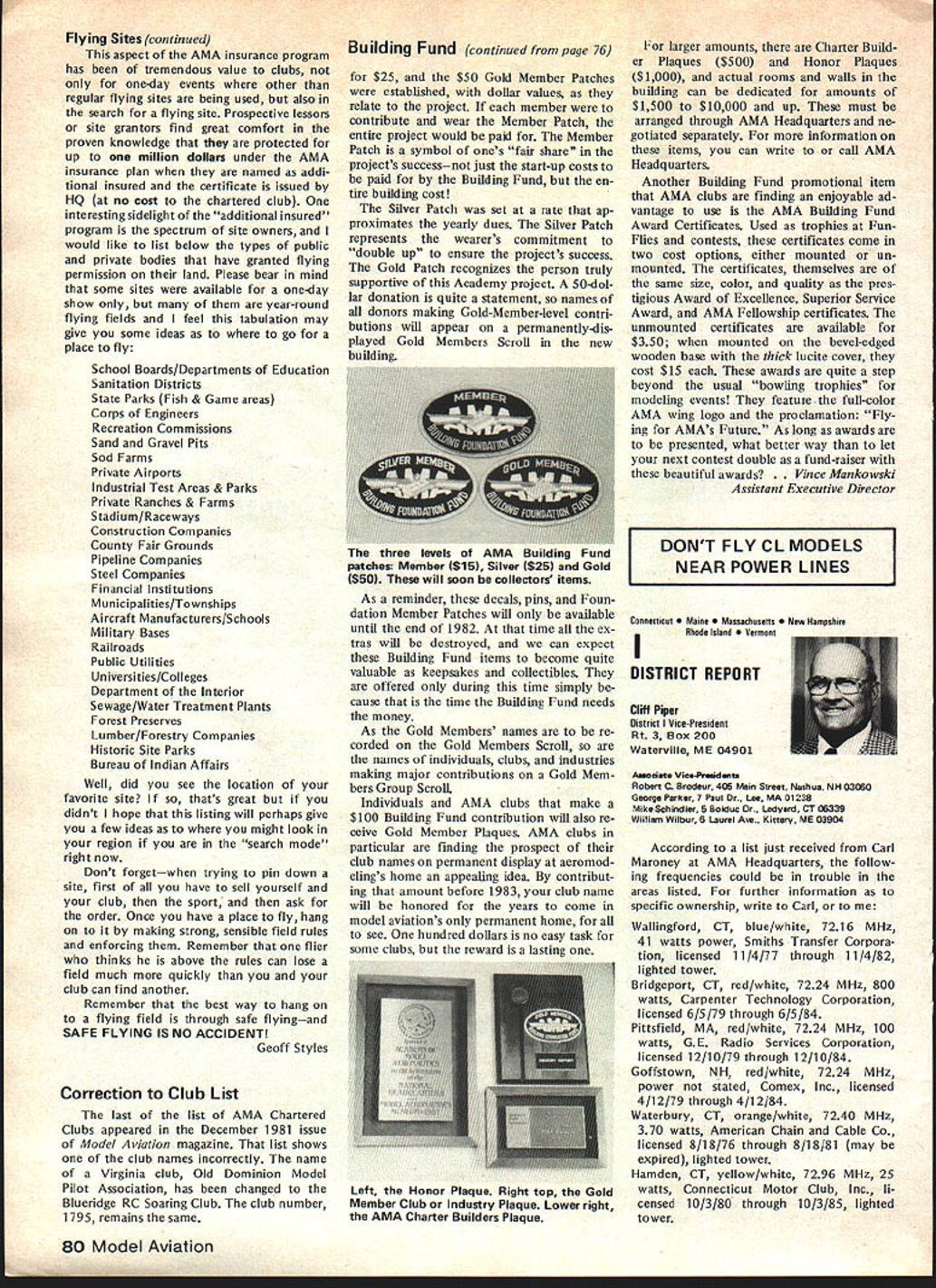
Because this project is such a large undertaking, the AMA has developed a variety of mechanisms through which funds can be raised. To avoid confusion, this month we present a view of the Building Fund items and promotions. A variety of decals, pins, and patches are available through a network of active AMA district vice-presidents and associate vice-presidents, or by mailing direct to AMA Headquarters. The money generated from the sales of these and all Building Fund items goes directly into the Building Fund.
- Decals: dry-transfer type; beginning to show up on models, flight boxes, and car windows at flying sites everywhere. Offered at $1 and $1.50.
- AMA Brick pin: little yellow brick pin, available for $5 (follows a "buy-a-brick" / "follow-the-yellow-brick-road" theme).
- Embroidered patches: signify membership in the Building Fund Foundation. Member patches are $15.
(Other Building Fund items and Silver Member patches are available through AMA channels.)
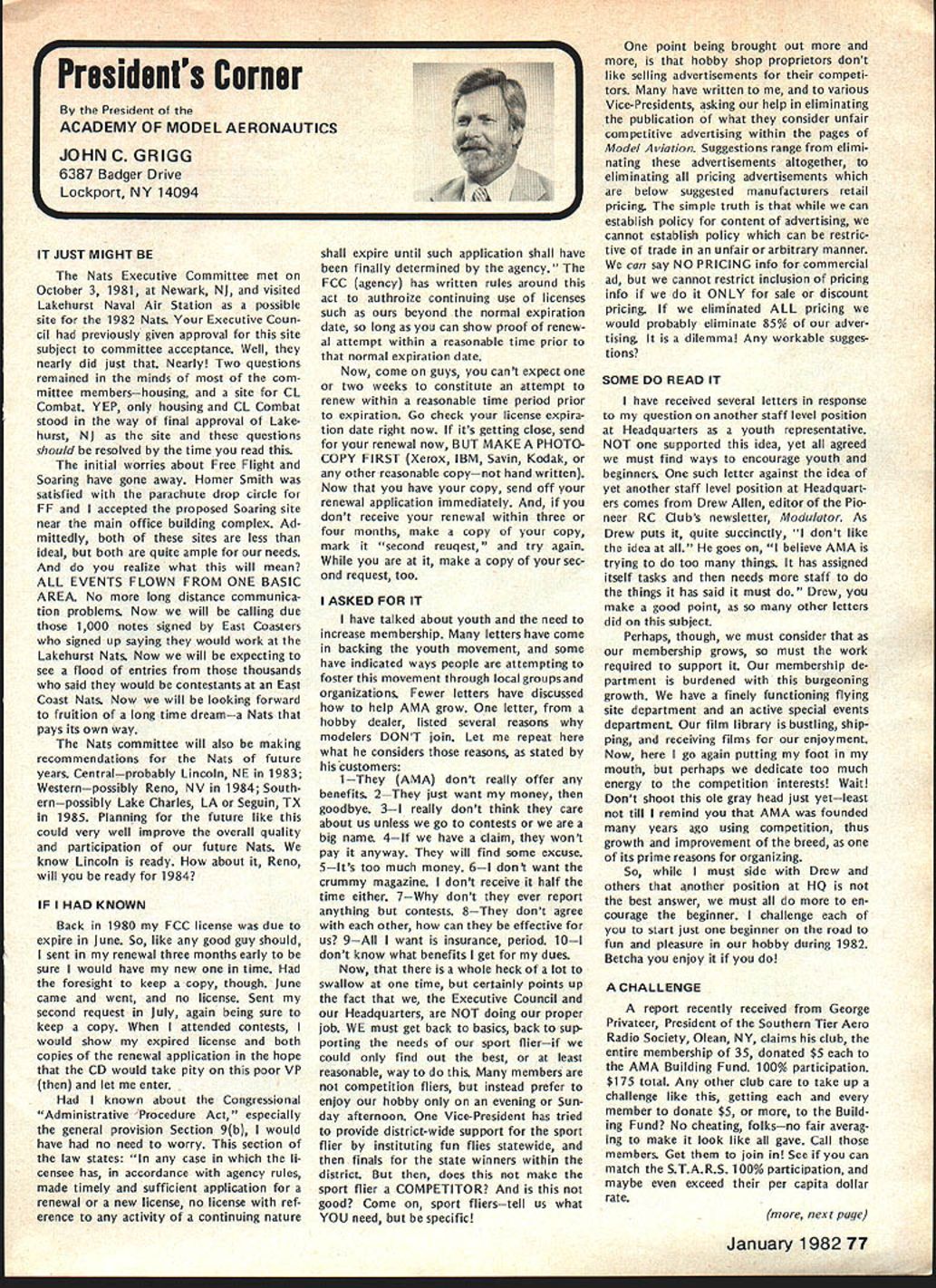
President's Corner
By John C. Grigg President, Academy of Model Aeronautics 6387 Badger Drive, Lockport, NY 14094
IT JUST MIGHT BE
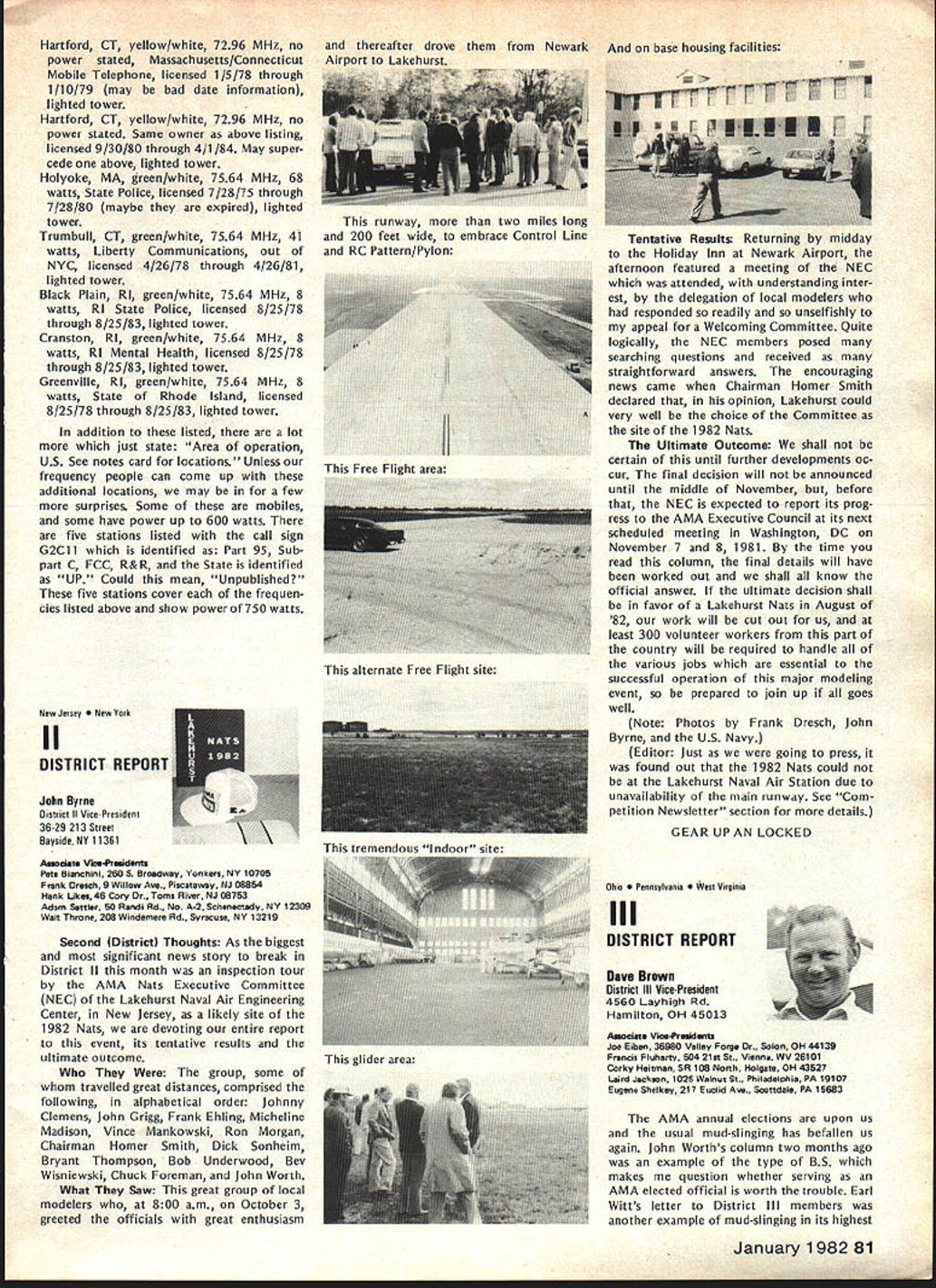
The Nats Executive Committee met on October 3, 1981, in Newark, NJ, and visited Lakehurst Naval Air Station as a possible site for the 1982 Nats. The Executive Council had previously approved the site subject to committee acceptance. The committee nearly gave final approval; two questions remained—housing and a site for CL Combat. Those issues should be resolved by the time you read this.
Initial worries about Free Flight and Soaring have been alleviated. Homer Smith was satisfied with the parachute drop circle for Free Flight, and I accepted the proposed Soaring site near the main office building complex. Admittedly both sites are less than ideal, but both are ample for our needs. The big advantage is that all events can be flown from one basic area—no more long-distance communication problems.
We will be calling on the East Coasters who signed up to work at Lakehurst and expecting a flood of entries from those who pledged to contest at an East Coast Nats. We look forward to the fruition of a long-time dream—a Nats that pays its own way.
The Nats committee will also recommend future sites: Central—probably Lincoln, NE (1983); Western—possibly Reno, NV (1984); Southern—possibly Lake Charles, LA or Seguin, TX (1985). Planning future sites like these could improve the overall quality and participation of future Nats.
IF I HAD KNOWN
Back in 1980 my FCC license was due to expire in June. I sent my renewal three months early and kept a copy, but June came and went with no new license. I sent a second request in July and kept that copy as well. At contests I showed my expired license and the copies of my renewal applications in the hope contest directors would allow me to enter.
I later learned about the Congressional Administrative Procedure Act, especially Section 9(b). It states that when a licensee has, in accordance with agency rules, made a timely and sufficient application for renewal, no license for an activity of a continuing nature shall expire until the application is finally determined by the agency. The FCC has rules authorizing continued use of licenses beyond the normal expiration date, provided you can show proof of a timely renewal attempt.
Practical advice:
- Check your license expiration date now.
- If renewal is needed, send it early and make a photocopy of your application (Xerox, IBM, Savin, Kodak, etc.—not hand written).
- If you don't receive renewal within three or four months, mark a copy "second request" and send again. Keep copies of all requests.
I ASKED FOR IT
A hobby dealer sent a list of reasons customers give for not joining AMA. They included:
- They (AMA) don't really offer any benefits.
- They just want my money; then goodbye.
- I don't think they care about us unless we go to contests or are a big name.
- If we have a claim, they won't pay it anyway; they'll find some excuse.
- It's too much money.
- I don't want the crummy magazine; I don't receive it half the time either.
- Why don't they ever report anything but contests?
- They don't agree with each other; how can they be effective for us?
- All I want is insurance, period.
- I don't know what benefits I get for my dues.
That's a lot to swallow and it points out that the Executive Council and Headquarters must get back to basics—supporting the needs of our sport life. Many members are not competition fliers and prefer to fly casually on evenings or weekends. One vice-president has tried to support sport fliers by instituting statewide fun flies with finals for state winners. But does this make the sport flier a competitor? Sport fliers—tell us specifically what you need.
Regarding advertising: hobby shop proprietors object to advertising that undercuts them. Suggestions range from eliminating competitor ads to disallowing pricing below suggested retail. While we can set advertising content policy, we cannot arbitrarily restrict trade. Eliminating all pricing would likely remove 85% of our advertising. It's a dilemma—any workable suggestions are welcome.
SOME DO READ IT
I asked whether Headquarters needs another staff-level youth representative. Many letters opposed adding staff, arguing AMA is trying to do too many things and would then need more staff. Drew Allen (editor of the Pioneer RC Club newsletter Modulator) said succinctly, "I don't like the idea at all."
However, as membership grows, the work required to support it also grows. Our membership department is burdened, we have a functioning flying site department, a special events department, and a bustling film library. While AMA was founded on competition, we must also do more to encourage beginners. I challenge each of you to start one beginner on the road to fun and pleasure in our hobby during 1982—you'll enjoy it.
A CHALLENGE
George Privater, President of the Southern Tier Area Radio Society (STARS), Olean, NY, reports his club of 35 donated $5 each to the AMA Building Fund—100% participation, $175 total. Any club care to match this challenge—getting every member to donate $5 or more? No averaging—call your members and get full participation. See if you can match STARS and maybe exceed their per-capita rate.
A SICK SITUATION
Reports have come in of intentional interference—people purposely transmitting on AMA frequencies to disrupt flying. Motives may vary, but the effect is the same: sailplanes and other aircraft are being shot down. We are assisting one New England club in combating this problem and hope to derive lessons from the effort. If your club experiences intentional interference, write to AMA Headquarters—attention Carl Maroney or Geoff Styles. Immediate fixes can't be promised, but attention will be increased toward the problem.
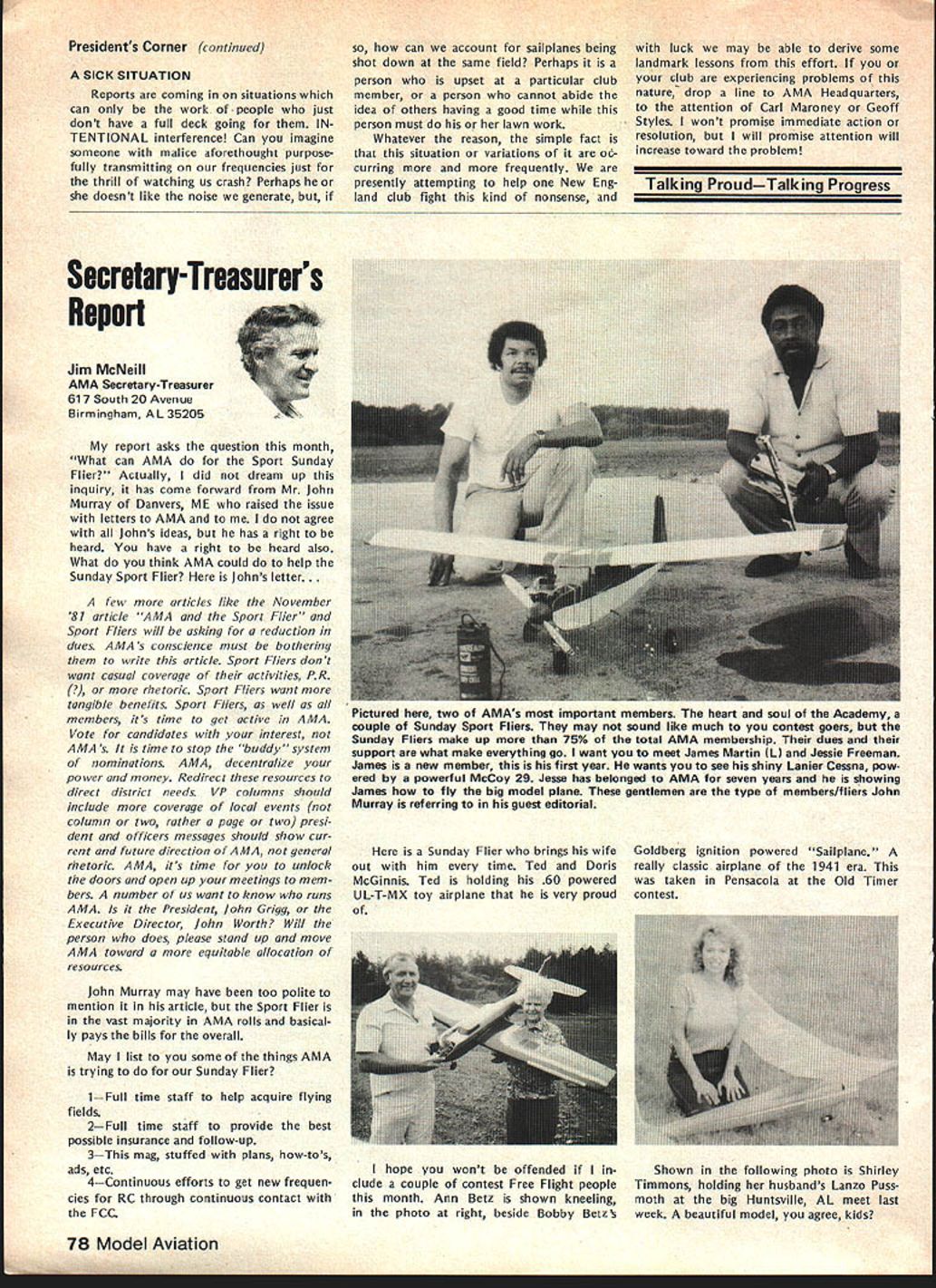
AMA News
Dues Mailings, Building Fund, and Outlook
The massive renewal and election mailing (over 80,000 pieces) went out on time this year. The Executive Council decided to use First Class mailing instead of Third Class despite the extra cost, which sped deliveries by two weeks or more. As a result, returns of next year's first dues payments showed up quickly and by the end of October Headquarters was in the usual year-end crush of mail.
The 1982 dues increase appears to be well accepted. Many members sent in the extra $2 they saved by early mailing to be applied to the AMA Building Fund; some sent more than $2. Within a few weeks the Building Fund increased by several thousand dollars. If the trend continues through the renewal season, we could reach our Building Fund goal and break ground for the new Headquarters and Museum building in early spring 1982.
As the Executive Council prepared to meet on November 7 to review the 1982 budget, signs were positive for a good year. Early indicators were encouraging, and optimism was building for an even better year ahead.
Aeromodeling Unlimited?
In October, Maynard L. Hill (former AMA President No. 14 and setter of many world records) established a new RC duration record with piston power: 20 hours exactly. The 20-hour figure was chosen deliberately, not as an absolute limit—Maynard designed the flight to be safe with reserves.
Maynard urges the FAI (Federation Aeronautique Internationale) to modify record procedures to reflect modern aeromodeling technology. Current FAI rules do not allow pilot relief, reflecting an older idea that a record tests both person and machine. With modern endurance capabilities, pilot fatigue (vision, comfort, hygiene) can create safety risks. Allowing pilot relief would permit safer pursuit of much longer flights—Maynard believes models could fly 50 hours or longer. His bench tests on engines, radios, fuel, and batteries support the potential for extremely long-duration flights. Food for thought from someone who has proven what's possible.
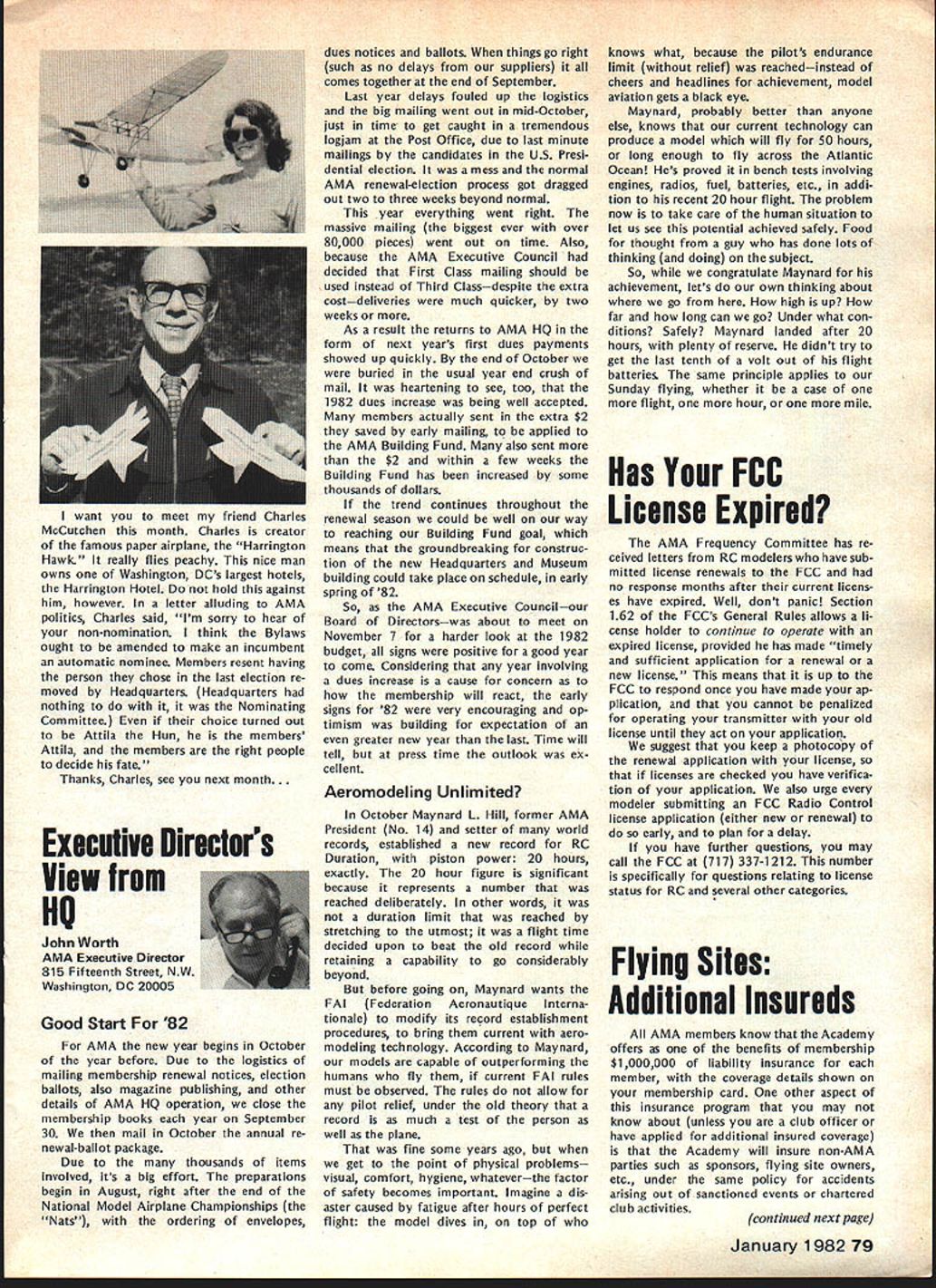
Has Your FCC License Expired?
The AMA Frequency Committee has received letters from RC modelers who submitted license renewals to the FCC and received no response months after their current licenses expired. Don't panic. Section 1.62 of the FCC's General Rules allows a license holder to continue to operate with an expired license provided a "timely and sufficient application" for renewal or a new license has been made. Keep a photocopy of your renewal application with your license as proof. Submit your FCC RC license application early and plan for delays.
For FCC questions relating to license status for RC and several other categories, you may call (717) 337-1212.
Flying Sites: Additional Insureds
AMA members are covered by $1,000,000 of liability insurance as one membership benefit. An important aspect of the program is that the Academy can insure non-AMA parties—sponsors, flying site owners, etc.—under the same policy for accidents arising out of sanctioned events or chartered club activities. This additional insured coverage has been valuable for clubs securing sites and for one-day events.
The certificate naming an additional insured is issued by Headquarters at no cost to the chartered club. Below are examples of public and private bodies that have granted flying permission on their land (some for one-day shows, many year-round):
- School boards / departments of education
- Sanitation districts
- State parks (fish & game areas)
- Corps of Engineers
- Recreation commissions
- Sand and gravel pits
- Sod farms
- Private airports
- Industrial test areas & parks
- Private ranches & farms
- Stadiums / raceways
- Construction companies
- County fairgrounds
- Pipeline companies
- Steel companies
- Financial institutions
- Municipalities / townships
- Aircraft manufacturers / schools
- Military bases
- Railroads
- Public utilities
- Universities / colleges
- Department of the Interior
- Sewage / water treatment plants
- Forest preserves
- Lumber / forestry companies
- Historic site parks
- Bureau of Indian Affairs
If you are searching for a flying site, this list may give ideas for organizations to approach. When seeking a site, first sell yourself and your club, then the sport, then ask for permission. Once you have a site, keep it by making sensible field rules and enforcing them—one flier who thinks he is above the rules can lose a field much faster than you can find another. The best way to hang on to a flying field is through safe flying—and SAFE FLYING IS NO ACCIDENT!
Geoff Styles
Transcribed from original scans by AI. Minor OCR errors may remain.

