
AMA NEWS
Good News
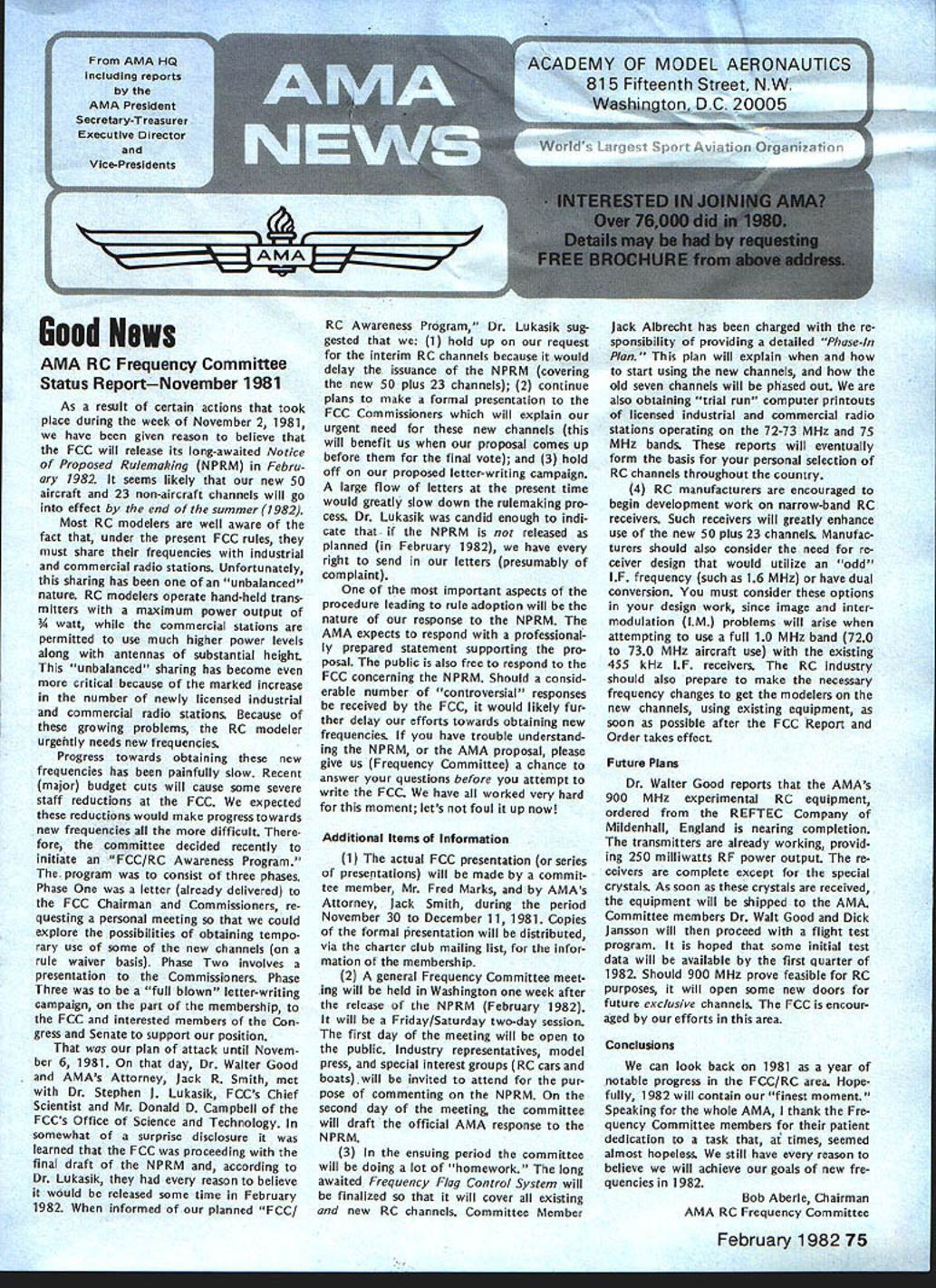
#### AMA RC Frequency Committee Status Report — November 1981
As a result of actions during the week of November 2, 1981, we have reason to believe the FCC will release its long‑awaited Notice of Proposed Rulemaking (NPRM) in February 1982. It seems likely the new 50 aircraft and 23 non‑aircraft channels will go into effect by the end of summer 1982.
Most RC modelers know that, under present FCC rules, we must share frequencies with industrial and commercial radio stations. Sharing has been unbalanced: modelers operate hand‑held transmitters with a maximum power output of 3/4 watt, while commercial stations may use much higher power and tall antennas. This imbalance has become more critical due to a marked increase in newly licensed industrial and commercial stations. Because of these problems, RC modelers urgently need new frequencies.
Progress toward obtaining new channels has been slow. Recent major budget cuts at the FCC will cause staff reductions, which could further delay progress. In response, the Frequency Committee initiated an FCC/RC Awareness Program consisting of three phases:
- Phase One: a letter (already delivered) to the FCC Chairman and Commissioners requesting a personal meeting to explore temporary use of some new channels on a rule‑waiver basis.
- Phase Two: a formal presentation to the FCC Commissioners.
- Phase Three: a letter‑writing campaign by the membership to the FCC and interested members of Congress and the Senate in support of our position.
On November 6, 1981, Dr. Walter Good and AMA attorney Jack R. Smith met with Dr. Stephen J. Lukasik (FCC Chief Scientist) and Donald D. Campbell (FCC Office of Science and Technology). We learned the NPRM was in final draft form and likely to be released in February 1982. Dr. Lukasik suggested the following actions:
- Hold off on requesting interim RC channels because doing so could delay issuance of the NPRM covering the new 50 + 23 channels.
- Continue with a formal presentation to the FCC Commissioners to explain our urgent need for the new channels — this will help when the proposal is voted on.
- Postpone the membership letter‑writing campaign; a large flow of letters now could greatly slow the rulemaking process.
Dr. Lukasik indicated that if the NPRM is not released as planned, we retain the right to submit letters and complaints. When the NPRM is released, AMA expects to file a professionally prepared statement supporting the proposal. The public will also be free to respond to the NPRM; a large number of controversial responses could delay action. If you have difficulty understanding the NPRM or the AMA proposal, please consult the Frequency Committee before writing the FCC.
Additional items of information:
- The FCC presentations (a series) will be made by committee member Fred Marks and AMA attorney Jack Smith during November 30–December 11, 1981. Copies of the formal presentation will be distributed via the charter club mailing list.
- A general Frequency Committee meeting will be held in Washington one week after the NPRM is released (February 1982). It will be a two‑day Friday/Saturday session: the first day open to the public (industry representatives, model press, and special interest groups invited to comment); the second day the committee will draft the official AMA response.
- The committee will finalize the Frequency Flag Control System to cover existing and new RC channels. Jack Albrecht will prepare a detailed Phase‑In Plan explaining when and how to start using the new channels and how the old seven channels will be phased out. The committee is also obtaining trial computer printouts of licensed industrial and commercial stations operating in the 72–73 MHz and 75 MHz bands; these reports will inform personal channel selection nationwide.
- RC manufacturers are encouraged to develop narrow‑band RC receivers and consider designs using an "odd" I.F. (for example, 1.6 MHz) or dual conversion to address image and intermodulation issues when using a full 1.0 MHz band with existing 455 kHz I.F. receivers. Manufacturers should also plan for ways to move modelers to the new channels using existing equipment after the FCC Report and Order takes effect.
Future plans: AMA's 900 MHz experimental RC equipment, ordered from REFTEC (Mildenhall, England), is nearing completion. Transmitters are operating at 250 mW RF output; receivers are awaiting special crystals. After shipment to AMA, Dr. Walt Good and Dick Jansson will conduct flight tests with expected initial data by Q1 1982. If 900 MHz proves feasible, it could open opportunities for exclusive channels; the FCC is encouraged by these efforts.
Conclusions: 1981 saw notable progress in the FCC/RC area. The Frequency Committee thanks its members for their dedication; we remain optimistic that new frequencies will be achieved in 1982.
Bob Aberle, Chairman AMA RC Frequency Committee
Please do NOT write to the FCC, your Congressman, your Senator, or any other official about our frequency proposal at this time — it can only hurt our effort.
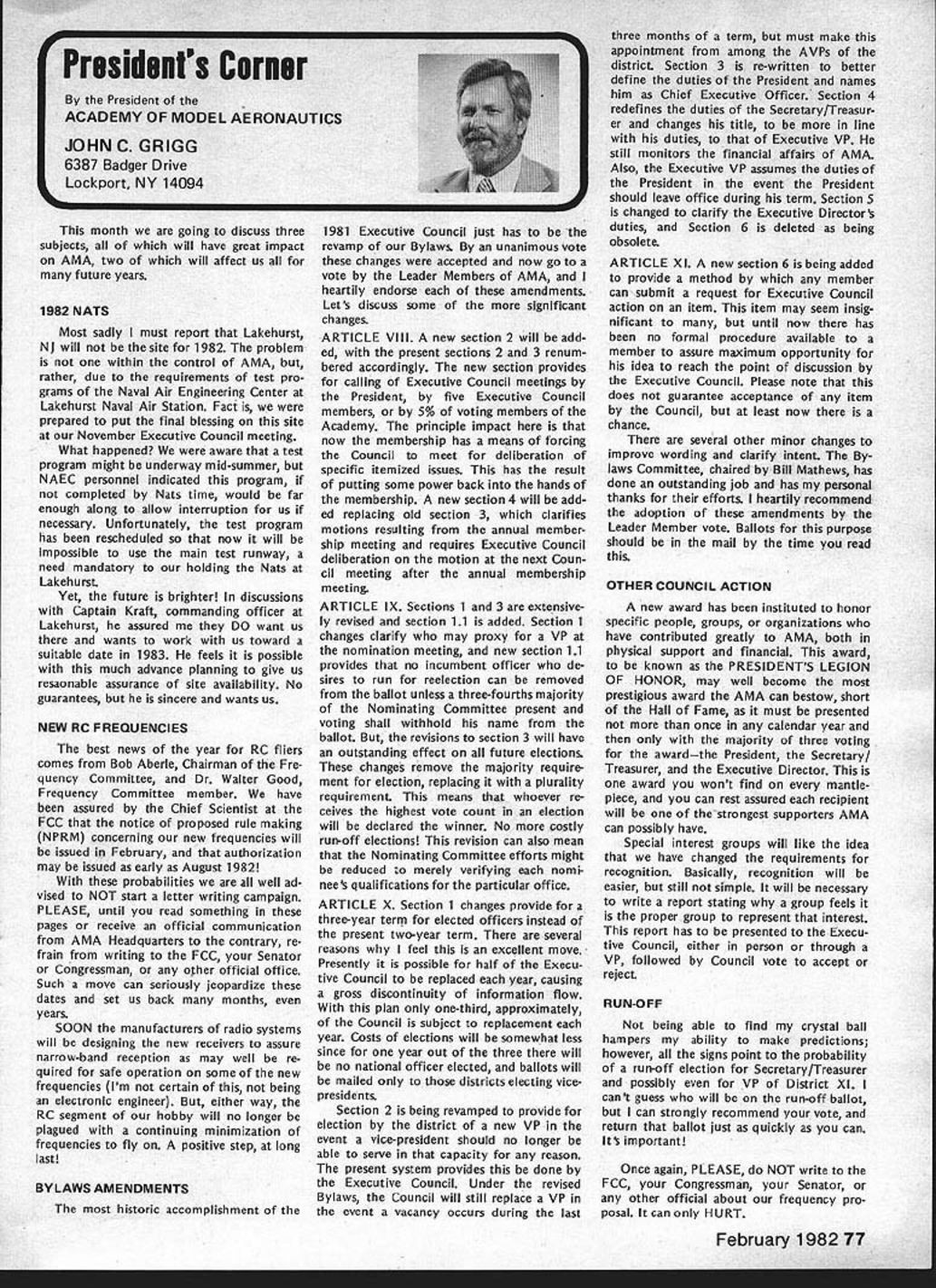
BYLAWS AMENDMENTS
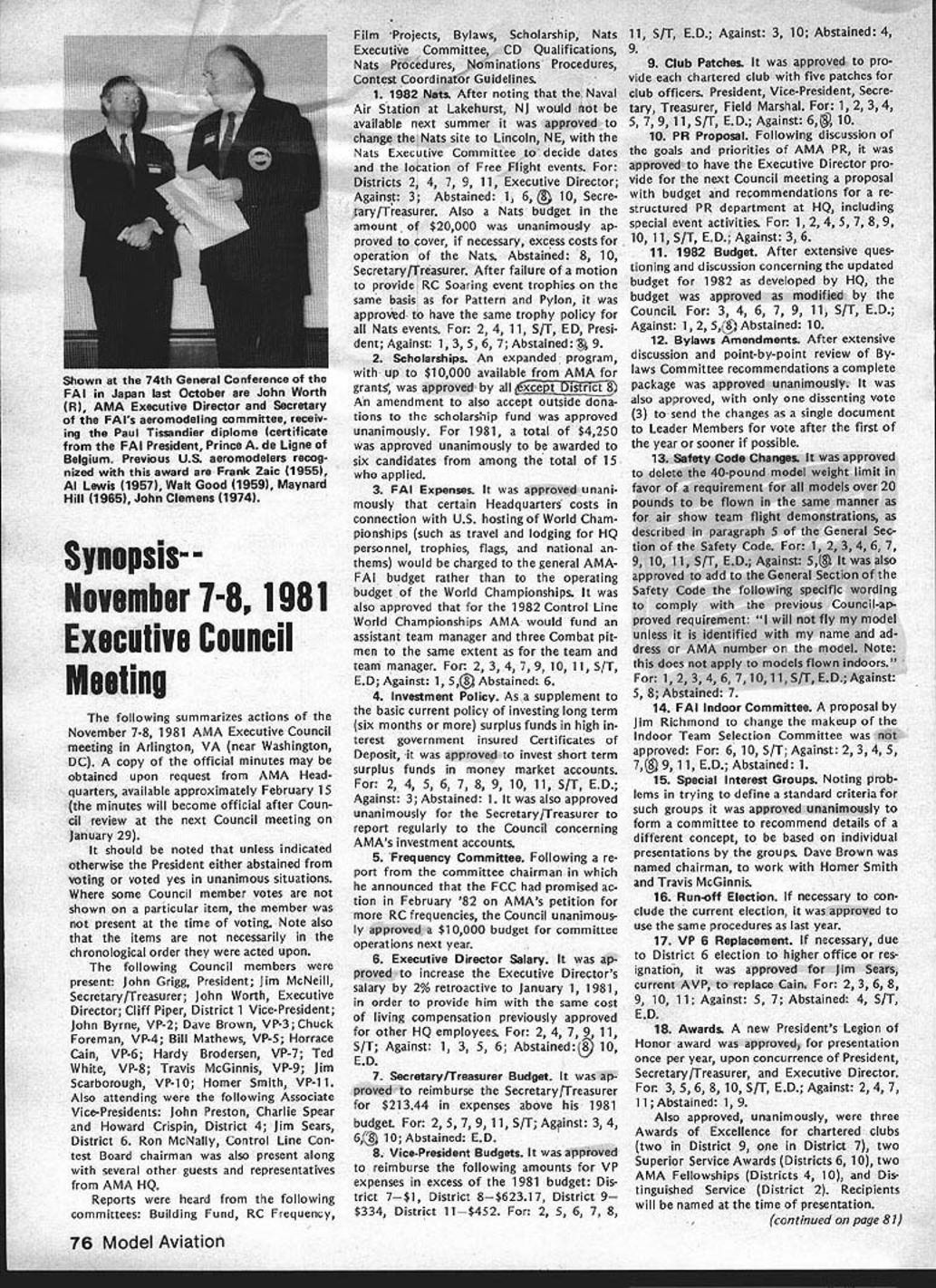
The 1981 Executive Council has revamped the Bylaws; the changes were accepted unanimously and now go to a vote by Leader Members. Key changes include:
Article VIII
- Adds a new section 2 (present sections 2 and 3 renumbered). The new section permits calling Executive Council meetings by the President, by five Executive Council members, or by 5% of voting Academy members — giving the membership a means to force Council deliberation on specific issues.
- Adds a new section 4 (replacing old section 3) clarifying motions from the annual membership meeting and requiring Executive Council deliberation on those motions at the next Council meeting.
Article IX
- Sections 1 and 3 are extensively revised and section 1.1 is added.
- Section 1 clarifies who may proxy for a VP at the nomination meeting.
- Section 1.1 provides that an incumbent officer desiring reelection cannot be removed from the ballot unless three‑fourths of the Nominating Committee present and voting withholds his name.
- Section 3 replaces the majority requirement for election with a plurality requirement — the highest vote getter wins, eliminating costly run‑off elections.
Article X
- Section 1 changes provide for three‑year terms for elected officers (instead of two years). This smooths continuity (only roughly one‑third of the Council replaced each year) and reduces election costs.
- Section 2 now provides for district election of a new VP if a vacancy occurs (Council fills a VP vacancy during the last three months of a term, from among the AVPs of the district).
- Section 3 better defines the duties of the President and names him Chief Executive Officer.
- Section 4 redefines the duties of the Secretary/Treasurer and changes the title to Executive VP; the Executive VP monitors financial affairs and assumes the President's duties if the President leaves office.
- Section 5 clarifies the Executive Director's duties; Section 6 is deleted as obsolete.
Article XI
- Adds a new section 6 creating a method for any member to submit a request for Executive Council action on an item — ensuring members have a formal path to have ideas considered by the Council (without guaranteeing acceptance).
The Bylaws Committee, chaired by Bill Mathews, is thanked for its work. Ballots for the Leader Member vote will be mailed shortly.
OTHER COUNCIL ACTION
- A new award, the PRESIDENT'S LEGION OF HONOR, has been instituted to recognize people, groups, or organizations that have contributed greatly to AMA (physically and financially). It may be presented not more than once per calendar year and only by unanimous vote of three officials: the President, the Secretary/Treasurer (Executive VP), and the Executive Director.
- Recognition requirements for special interest groups have been eased but remain rigorous: a formal report explaining representation of the interest must be presented to the Executive Council (in person or via a VP), followed by Council vote.
Run‑off
A likely run‑off election is anticipated for Secretary/Treasurer and possibly for VP of District XI. Members are urged to vote and return ballots promptly.
DISTRICT VI REPORT
Horace Cain District VI Vice‑President 525 Weidner Road, Buffalo Grove, IL 60090
Associate Vice‑Presidents:
- Loren Holm, Quincy, IL
- Frank Hughes, Plattsburg, MO
- William Kern, Bedford, IN
- Glenn Lane, Batavia, IL
- Helen Olsen, University City, MO
- Jim Sears, Burgin, KY
- Bill Zimmer, Varna, IL
Notes and highlights:
- Best wishes for a long flying season. District VI challenges other districts to form club‑team RC fun‑fly programs.
- Next year's Club Team Fun Fly allows anyone to enter state contests; details by mid‑March.
- Woodland Aeromodelers will host an annual auction on Saturday, February 13, 6:30 p.m., Edgewood School, Woodridge Dr., Woodridge, IL.
- Executive Council actions (Nov 7–8): the 40‑pound limit is removed; models over 20 pounds must follow demonstration rules. Names and addresses must be on or in models (indoor exempt). Leader Members will vote on extensive Bylaws changes.
- Commentary on Secretary/Treasurer election and Council politics; best wishes extended to all 1982 AMA officers. Jim Sears is expected to assume the position of District VI VP later this year.
Happy landings and a Happy New Year!
DISTRICT VII REPORT
Hardy Brodersen District VII Vice‑President P.O. Box 1104, Birmingham, MI 48012
Notes and highlights:
- District visits show AMA members are widespread; personal contact is important to remind members of AMA's value beyond insurance.
- A committee (Cain and Mathews) will review special rates (e.g., reduced rates for those on disability or limited income). A reduced rate for Senior Citizens has been adopted; other requests should be submitted for committee consideration.
- A proposed VP travel budget request was denied; VP budgets remain $1,200 per year to cover out‑of‑pocket district business expenses.
- A serious interference/jamming incident was investigated by a club: directional receivers and modified equipment suggested intentional jamming on aircraft frequencies, causing crashes. The club is documenting evidence and pursuing prosecution; similar cases have been referred to FCC field offices. Proper documentation may lead to severe fines and possible imprisonment for offenders. Clubs experiencing interference should document incidents and coordinate with AMA for referral to the FCC.
Regions covered: Iowa, Michigan, Minnesota, Wisconsin.
DISTRICT VIII REPORT
Ted White District VIII Vice‑President 1109 Greendale, Bedford, TX 76021
Associate Vice‑Presidents:
- Bob Frick, Little Rock, AR
- William Hurley III, Pleasanton, TX
- Dan Parsons, Albuquerque, NM
- Ed Perez, Grand Prairie, TX
- Al Rabe, Irving, TX
- Larry Sartor, Bartlesville, OK
- Ed Shearer, Metairie, LA
Notes and highlights:
- A memorable ride in a P‑51 Mustang provided exhilarating aerobatics (loops, Cuban eights, rolls) and underscored that "speed is safe; slow is risky" in high‑performance flying. The flight covered roughly 479 miles with about 10 hours of combined flying time (team effort credited).
- District X contributions to the AMA Building Fund lead the list of donors: the BIRD Club ($670), Scale Squadron ($500), and others. Individual donors are acknowledged. Support for the Building Fund is tax deductible; clubs and individuals are encouraged to contribute.
- The AMA booth is available for mall shows and club events — contact the district office if you want the booth or a representative at your show or meeting.
Thermals!
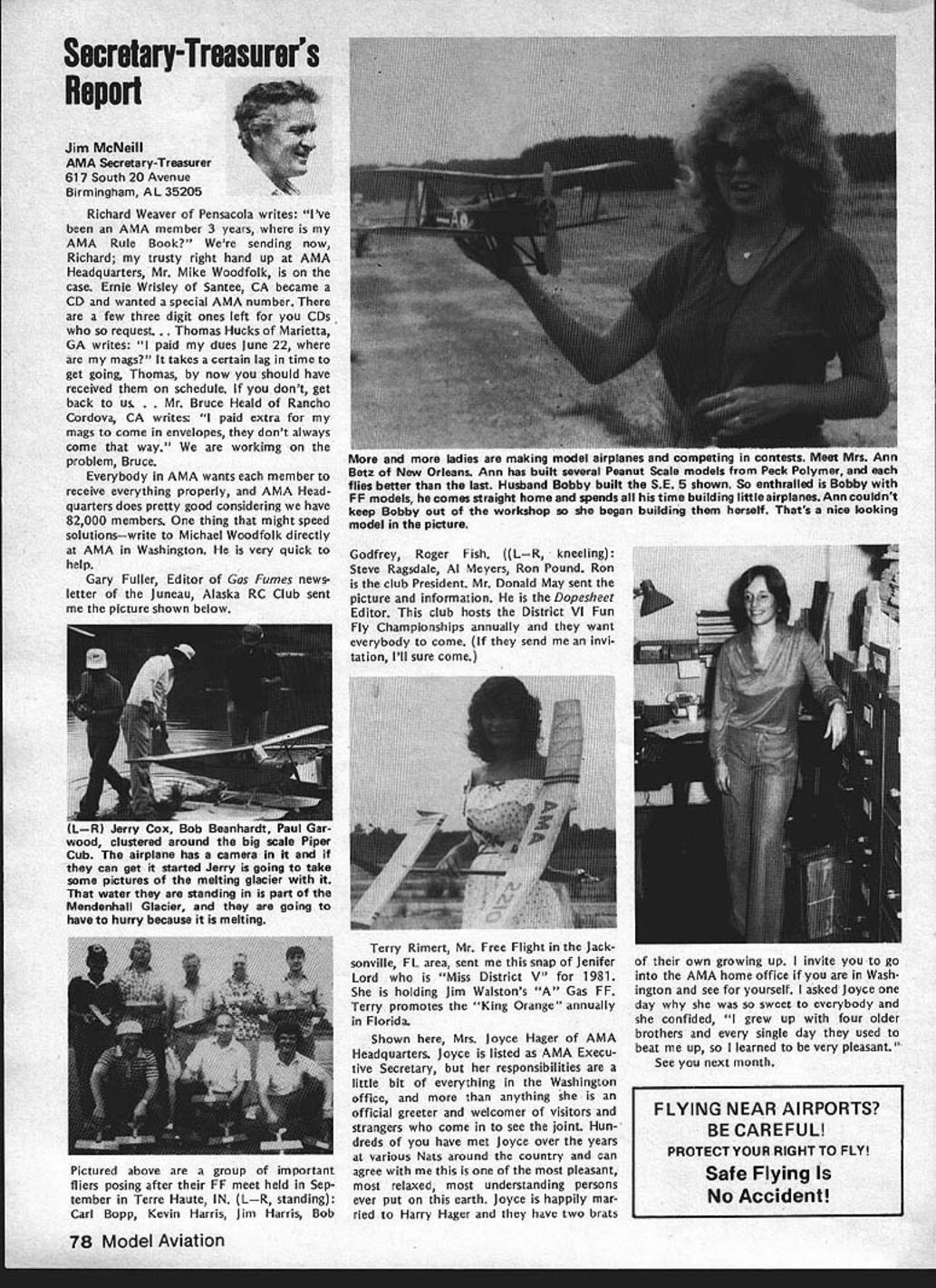
CLUB AND LOCAL HIGHLIGHTS
- Hickory RC Prop‑Twisters, Inc. (chartered 1969) now has its own flying site (an old private airport) and recently added a 25' x 90' shelter. The club has about 60 members — proof that small clubs can achieve their goals with work and fundraising.
- Southeastern Virginia RC Group: runway progress resumed after weather delays; the Fentress Scale Fun Fly was a success.
- Prince Georges RC Club: reprinted the AMA Building Fund brochure in its newsletter — appreciated support.
- Tidewater RC, Inc.: on September 27 they put on an air show at Ocean Naval Air Station and plan to form an AMA show team.
That's all for this month.
Transcribed from original scans by AI. Minor OCR errors may remain.

